Content warning: 19th-century colonialism, pop culture as history, headhunting, meta-interface tricks, and existential body horror.
Cover of Softside magazine, September 1980.
In Search Of… Dr. Livingston appeared in the September 1980 issue of Softside magazine as a type-in for the TRS-80, pages 26 to 29, credited as by
Carl Russell
Karen Russell
Ralph Fullerton
Becky Fullerton
(Aside: This is the first adventure game in our chronological series with two women in the credits.)
I haven’t previously emphasized this, but the double whammy of a hardware capacity of 16K plus the need to have code that can be printed in a magazine really makes for a harsh limit. There’s not a lot of space for niceties like “verb synonyms” or “sensible responses to wrong puzzle solving attempts”. With some careful design choices (and a willingness to toss in some synonyms) it’s possible to alleviate these problems, but really, the reputation of Very Old Parser Games to be almost pathologically unable to understand player input has more to do with necessity than the designers just falling down on the job.
The complete source code, as originally printed.
At a talk at Narrascope 2019, Jess Haskins brought up the fallacy of generalizing from fictional evidence, where “you weigh evidence from something you saw or heard in a work of fiction just as strongly as something you actually experienced firsthand.”
A corollary of this might be: there is a strong tendency to create games based on pop-culture notions of places and times. This saves work on both the writer side (who can at least try to get away with less research) and the reader side (who can be assumed familiar enough with, say, King Arthur, that some aspects of the character are already built).
Pick an adventure game set in “Egypt” and you’ll probably get pyramids and tombs, and possibly see Cleopatra. This isn’t necessarily inaccurate: there are pyramids in Egypt, but a focus on old Egypt leaves out roughly 2000 years of other stuff that happened. None of those years made the pop-culture hit parade.
If an adventure game is set in Africa outside of Egypt … well, there isn’t even much pop culture to choose from, except a certain 19th-century meeting between Dr. David Livingstone and Sir Henry M. Stanley.
…
July, 1871: Dr. David Livingstone, British explorer and missionary, was rumored dead; he had last been heard from via a letter dated May 30th, 1869, and while he sent many more letters over the prior 6 years, they never arrived at their destination. Although not dead, he was verging close. While in Congo he witnessed a massacre of (at least) 400 Africans by Arab slavers and had to flee to the trading town of Ujiji in Tanzania. He had supplies stored there, but when he arrived he found they had been stolen.
Meanwhile, the American journalist Henry Morton Stanley was on the wrong continent. He had been sent by the New York Herald to the grand opening of the Suez Canal, and from there did a tour of the Middle East, writing a travel guide, and going as far as India. He had heard rumors of Livingstone during these travels, and decided (on his own volition) to steer to Africa (as he later explained to his employer, he was “too far from a telegraph” to notify them of the new expenses he was taking on).
After a trek of over 1000 kilometers (and around 100 porters, many either deserted or dead from tropical diseases) Stanley found Livingstone in November, and shook his hand.
Stanley: “Dr. Livingstone, I presume?”
Livingstone: “Yes. I feel thankful that I am here to welcome you.”
There is, of course, a lot more to the event (including the fact Stanley ripped out his diary pages corresponding to this meeting and may have made the dialogue up) and if you want to fall down the rabbit hole I’d recommend Clare Pettitt’s 2007 book about the event (and the many memes that followed). For my purposes, it’s helpful just to note
a.) The meeting was, as Pettitt asserts, “one of the first international ‘celebrity’ moments in history.”
b.) Livingstone is remembered as a hero (anti-slavery crusader) and Stanley as a villain (later claimed the Congo in the name of Belgium, reportedly responsible for cruel abuses).
c.) The environment where the meeting happened was a Muslim trading town.
To start off the game proper, let me just quote a long excerpt:
YOU ARE IN A BEDROOM, WEARING PJ’S. A NIGHTSTAND SITS BETWEEN THE CLOSET AND THE BED. THE BEDCOVERS ARE TURNED DOWN.
YOU CAN SEE A TIMEWORN BOOK.
? OPEN CLOSET
YOU CAN SEE A TIMEWORK BOOK, A FADED RED KNAPSACK, A PAIR OF HIKING BOOTS.
? GET KNAPSACK
‘TIS DONE.
? GET BOOTS
YOUR FEET ARE NOW SNUG IN A PAIR OF HIKING BOOTS.
? GET BOOK
‘TIS DONE.
? GO BED
YOU ARE LYING IN A WARM SOFT BED.
? READ BOOK
AFRICA – LAND OF THE UNKNOWN BY R. U. REDDE
? OPEN BOOK
THE BOOK FALLS OPEN TO AN UNDERLINED PASSAGE.
? READ PASSAGE
… PLORER NODDED OFF TO SLEEP, HIS THOUGHTS BEGAN TO DRIFT T …
? DRIFT
YOU ARE DRIFTING IN A ROWBOAT ON A LAKE.
THERE IS A BEACH ON THE EASTERN SHORELINE.
YOU CAN SEE A TINY GREY MOUSE.
Some points to make: 1.) things start feeling like a “story within a story” and that you are entering a dream; however, if you don’t put on the hiking boots before using “DRIFT” to go to Africa you die. 2.) the whole “OPEN BOOK” ⟶ “READ PASSAGE” ⟶ “DRIFT” sequence I was able to get fairly quickly from experience, but I could easily see someone getting stuck here. It’s as if the authors had a choreographed set of moves in mind, but such sequences are very dangerous in modern games with an abundance of text and synonyms to work with; here the minimality is so stringent it’d be easy for the game to fall off the rails.
…
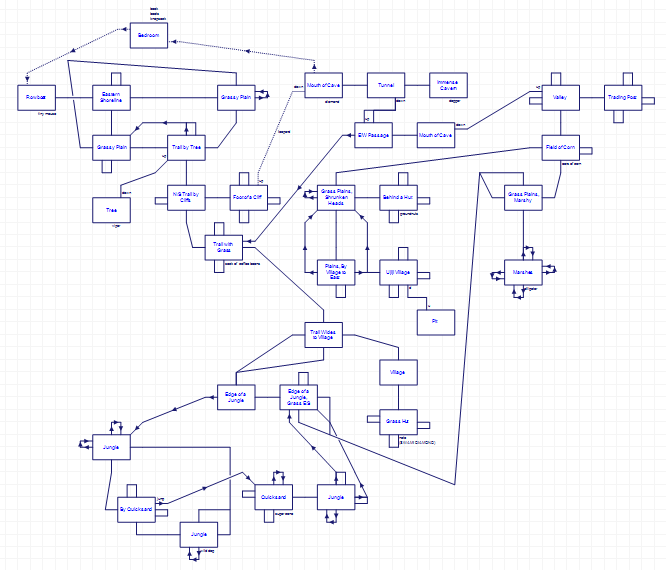
Upon arriving in Africa, there’s a fairly wide-open map, and it’s a really, really bad one.
Click for a larger version of the map.
Again, there is the old-IF tendency to have exits that go EAST one way go NORTH the other. Not great, not worse than elsewhere.
However, this game applies a trick that so far I had only seen in Adventure variants: sometimes a particular direction has more than one possible destination, and that destination will be picked at random. Even worse, sometimes a direction that states you can’t go that direction will actually, sometimes, let you go that direction. This is an actual gameplay transcript:
? N
YOU WON’T GET ANYWHERE GOING THAT DIRECTION.
? N
YOU CAN’T GO THAT WAY.
? N
YOU CAN’T GO THAT WAY.
? N
THAT DIRECTION IS SEALED OFF.
? N
YOU CAN’T GO THAT WAY.
? N
YOU CAN’T GO THAT WAY.
? N
YOU WON’T GET ANYWHERE GOING THAT DIRECTION.
? N
YOU WON’T GET ANYWHERE GOING THAT DIRECTION.
? N
YOU CAN’T GO THAT WAY.
? N
THAT DIRECTION IS SEALED OFF.
? N
YOU CAN’T GO THAT WAY.
? N
YOU WON’T GET ANYWHERE GOING THAT DIRECTION.
? N
THAT DIRECTION IS SEALED OFF.
? N
YOU ARE AT THE EDGE OF A JUNGLE.
GRASSLANDS EXTEND TO THE EAST AND SOUTH.
Because of this issue, part of mapping the game involved testing each invalid exit many, many times just in case the random number generator was acting up.
…
Early on someone throws a spear at you.
A NATIVE THROWS A SPEAR AT YOU.
HE MISSES AND RUNS OFF.
The spear is useful for killing an alligator later (except you don’t really need to enter the room with the alligator, nor is there any need to kill it). The spear is in reality more of an obstacle, because if you carry it one of the two villages in the game, this happens:
YOU ARE IN A NATIVE VILLAGE.
THERE ARE SEVERAL CAMPFIRES ABOUT.
YOU CAN SEE NOTHING UNUSUAL.
SUDDENLY, A VOLLEY OF SPEARS FLIES OVER YOUR HEAD; AN OBVIOUS WARNING!
YOU HAD BETTER LEAVE, FAST.
This marks the fourth adventure game we’ve seen where a weapon is mostly useless and can get you into trouble. (Other instances: Burial Ground Adventure, Pyramid of Doom, Lost Dutchman’s Gold.) I think this is enough to say we have a genuine pattern here; the idea of using your brains, wits, and navigation skills as opposed to just applying force perhaps was an intentional attempt to distance the genre from CRPGs and other games of a more violent nature. (In this specific case, perhaps the authors were trying to say something about colonialism.)
If you enter the village without a spear, you get someone wanting to trade instead.
YOU ARE IN A NATIVE VILLAGE.
THERE ARE SEVERAL CAMPFIRES ABOUT.
YOU CAN SEE NOTHING UNUSUAL.
A FRIENDLY NATIVE APPROACHES WITH SOME TRINKETS.
IT APPEARS HE WANTS TO MAKE A TRADE.
…
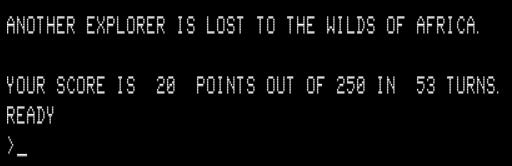
If you’re too reckless with threatening the natives, or dawdling around an alligator, you die, and apparently get booted out of the game:
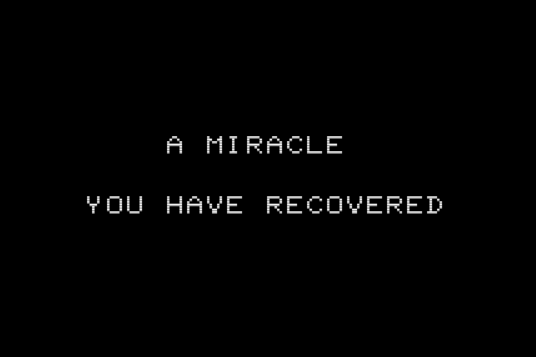
But wait! After a short pause:
You get resurrected back at the rowboat. This only works once, so if you die again, the death screen is no longer a fake-out.
…
There’s a jungle with quicksand, which used to be everywhere in the 80s.
? JUMP QUICKSAND
DO YOU REALLY EXPECT TO JUMP OVER 30 FEET?
If you’ve played Adventure before and know the rhetorical question trick, this is a funny moment, since the game decides to slip into animated graphics mode. (If not, I imagine this is just frustrating.)
? YES
…
The initial prompt for the game was just to find Dr. Livingstone, so I was a little confused for a while: there were treasures like a SAPPHIRE strewn about in typical-adventurer fashion. After an hour of gameplay it dawned on me there’s the usual gather-the-treasures plot on top of everything else (it is also admittedly setting appropriate to have someone swoop into 19th century Africa and take all their stuff). Once I realized treasures were a Thing I was still puzzled as to where to deposit the loot.
YOU ARE IN AN IMMENSE CAVERN. THE WALLS
ARE COVERED WITH AN IRIDESCENT GLOW.
YOU CAN SEE NOTHING UNUSUAL.
A VOICE ECHOES FROM THE MOUTH OF THE CAVE . . . S W A M I
I found one room (the cave entrance two rooms west of the description above) where SWAMI worked to teleport me back to the bedroom. *That* was where the treasures went. I had still been thinking we were in the story-within-a-story frame but apparently, we were just accidentally using magic? (I suppose it’s supposed to be like SAY YOHO in Pirate Adventure where you teleport to and from London?)
…
The biggest research fail comes here:
YOU ARE ON THE GRASS PLAINS.
TWO SHRUNKEN HEADS DECORATE A SIGN.
YOU CAN SEE NOTHING UNUSUAL.
? READ SIGN
UJIJI COUNTRY – KEEP OUT
NO HEED ‘EM, WE EAT ‘EM.
… to recap, Ujiji was just a Muslim trading town. Also, while headhunters were a thing in central and western Africa, they were never in Tanzania. (Fun bonus fact: some countries in Europe, including Croatia, had headhunting up to the 20th century.)
Also, re: the “we eat ’em” reference: again, doesn’t seem to be a thing in Tanzania, although one of the more extravagant rumors of Dr. Livingstone’s demise was that he was eaten by cannibals.
Just like the other village, the natives are friendly if you don’t have a spear.
YOU ARE IN THE UJIJI VILLAGE. A NATIVE
STANDS NEAR HOLDING A SPEAR. HE LOOKS EXCITED.
YOU CAN SEE NOTHING UNUSUAL.
SEVERAL NATIVES WAVE HELLO!
And sometimes (although he can randomly be in a couple other places) Dr. Livingstone will be “down” from this location, in a pit.
YOU ARE IN A PIT. LIGHT STREAMS IN FROM ABOVE.
…
Now we get to the existential body horror.
When you find Livingstone, he’s considered an object. You have to give his catchphrase to successfully take him along with you.
YOU CAN SEE DR. LIVINGSTON.
? GET LIVINGSTON
DR. LIVINGSTON?
? I PRESUME
‘TIS DONE.
If you take him back to the same location that SWAMI worked on earlier and try to teleport, you get the message
HELP
Livingstone then disappears from your inventory. You can teleport back to Africa and find him (I think positioned randomly?) but it’s clear that the original method of teleporting won’t work.
The original DRIFT word turns out to be the solution; in the rowboat way back at the beginning of the game DRIFT sends you back to the bedroom with Livingstone. I have no idea why this method works to transport Livingstone and not the other way.
If the original “HELP” message didn’t weird you out enough, consider we are entering what appears to be a world in a book, taking treasures from it, including a live person, and then depositing them at “home” outside the world of the book/story/dream.
…
OK, that game pushed even my patience. By way of apology, here’s an actual good game set in Africa from a dev team in Cameroon. (Aurion: Legacy of the Kori-Odan; it’s on Steam.)
I can’t really write “Finished” because this is yet another Adventure clone that doesn’t want to trigger the endgame, but it’s safe to say I’ve seen nearly everything.
If you’ll allow me a lateral analogy:
In Pac-Man 256 you are being chased by “the glitch” from level 256 of the original arcade Pac-Man. Weird numbers and broken shapes follow Pac-Man as he tries valiantly to escape the universe being consumed.
With Bilingual Adventure, distressing bugs kept creeping up. I found more “void rooms”. (Fortunately, I found out that the magic word Y2 works everywhere, even in those rooms.) The lamp started running out of power even though I had the lamp off (the game seems to be “cheating” and just keeps a timer once the lamp is turned on, and never bothers to check if it’s off or even in the player’s possession). Halfway through the game, trying to THROW AXE at a dwarf just led to the dwarf mysteriously disappearing and a blank prompt. My inventory capacity started reducing for no apparent reason until I could only hold 3 items at a time.
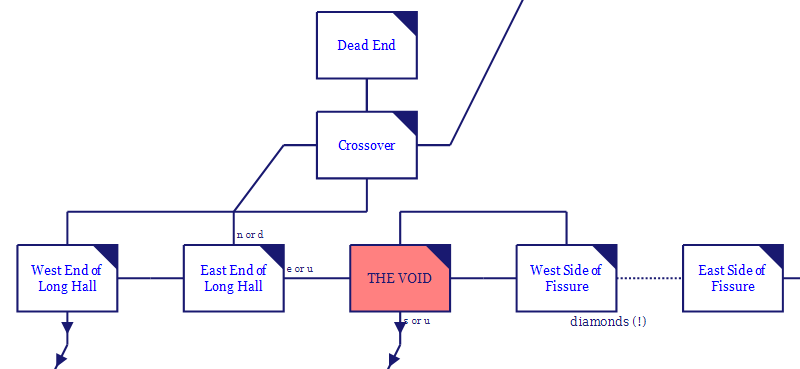
Dropping from the stalactite puts you in the room marked with the purple arrow (it’s different than in Original Adventure). The two rooms marked red are void.
Last time I was stumped by a sword in a stone, when Draconis mentioned that the HELP message should really be in the description of the item.
?? help
I guess you need some help getting the sword out. Well this might help. There is an inscription on the blade which says – “ONLY MY NAME WILL WIN YOU FAME”.
Ah, this must be one of those “magic word based on pop culture” deals.
?? excalibur
The sword begins to quiver and suddenly springs into your hand.
Now, I need to do a big mea culpa: the dragon *is* in the game. However, you aren’t allowed in the right area until you’re holding Excalibur. So this whole process seems to have been meant to “fix” the absurdity of the original scene.
You are in a secret canyon which exits to the north and east.
A fire breathing green dragon as big as a Winabago bars the way. He is standing on a priceless Persian rug.
There is a rare Persian rug lying here
?? kill dragon
With one mighty stroke of the sword you have offed the beast. His once mighty body is being consumed in its own fires. There is nothing left now but a little green ash on the carpet.
One other change:
You are in the giant room. The ceiling here is too high up for your lamp to show it. Cavernous passages lead east, north and south. On the west wall is scrawled the inscription, “FEE FIE FOE FOO sic”.
There is a nest of golden eggs here
In the original, saying FEE, FIE, FOE, and FOO in order would summon the eggs back to this spot if they’re gone. The words don’t work here; the game makes jokes instead.
?? fee
There is no fee – this is a free game.
?? fie
You seem to have a slight accent liebchen?.
Instead, the final word of FUM from the original fairy tale is what summons the eggs. (This may have been intended to be another cheap way to avoid keeping track of state — that is, the game expects people to say the four words and then FUM at the end, but only bothered to record the FUM.)
The joke is different in French.
Sur le mur de ‘louest on voit un graffiti: “BA BE BI BO etc.”
?? ba
BABA au rhum? – Interdiction absolue d’avoir de a’lcool ici.
?? be
BEBE ou? J’espere pas, c’est la nourriture favorite des sorcieres.
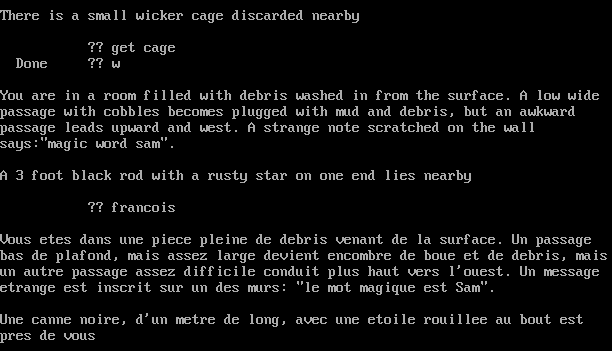
This is a good moment to segue out to my last point: Bilingual Adventure really seems to be the only parser text adventure with mid-game language switching in existence. I’m not meaning “the first since 1979” I’m meaning “the first and only since 1979.” (Language switching is common in lots of other games, but parser does raise the difficulty a bit.) I’m happy to be proven wrong here, but even if there’s another example or two I’m missing, I’ve got to give the crew of Manning and friends some props for blazing a trail that (almost?) nobody else followed.
Amongst the various changes I encountered one major system change, one serious bug, one general parser oddity, one old puzzle with a different solution from the original, and one new puzzle I can’t yet solve.
…
The most noticeable change in terms of gameplay feel is that the Bilingual Adventure enforces use of the lamp only very weakly. It doesn’t get mentioned as required until this room:
At your feet is a pit breathing traces of white mist. An east passage ends here except for a small crack leading on.
It is might dangerous to grope in the dark.
The game stops you if you try to go down without the lamp lit, and if you are persistent and attempt again, you die.
However, *past* this point you can turn the lamp off just fine. The room description never goes black or the like. The only other time the lamp is needed is the dark room (I’ll return to that it a moment). This has the effect of allowing a more casual stroll through the game rather than trying to optimize for lamp light.
…
There are a few of intentional removals from the map, no doubt to be able to stuff the entire game on a 38K floppy; the “dragon” section seems to be gone and a couple “side tunnels” that did nothing other than add atmosphere are also gone.
Removals are marked in red.
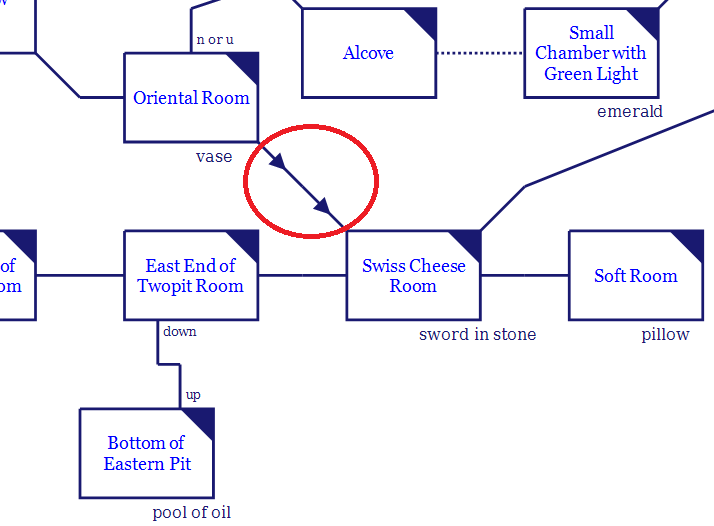
In the process, two spots on the map got broken. The Swiss Cheese room mentions an exit to the northwest, but it’s impossible to go that way; they only way to make it to the rooms with the Ming vase is to go around the other direction (the beanstalk that sprouts up from watering the plant leads there).
Rather more seriously, there’s a room west of the crystal bridge spot that’s a literal void. As in, there *is* a room there, but it has no description or exits, so if you land there you end up in limbo and have the quit the game.
Even after I knew about the “void room” I got caught in it once; to get the diamonds now you have to use the rod to make the crystal bridge, but the crystal bridge now doesn’t stay: you have to wave the rod again to go back. I had dropped it on the east side of the bridge so my only possible exit was to the void.
It’s possible the intent was to remove that place entirely to force solving the bridge puzzle, but the authors messed it up and made the bug instead.
…
On to the oddity: if you type a single unrecognized verb, the parser responds asking what noun you want to go with it. This is true even if the verb is unrecognized.
?? get
get what ?? bottle
Done ?? asdasd
asdasd what ??
This possibly was meant as a purely “helpful” feature for those who forgot to type a noun, but that ranks very low on the list of Actual Typos People Make.
I could maybe see this being useful in regard to the design allowing other languages and the bilingual nature of the game causing “syntax mixing” to happen. While the subject can be waved away with the parser (having an implied “I” or “you” or whatever pronoun you want to assign to the player character) the order VERB-OBJECT isn’t universal (in languages with an order preference, subject-object-verb is the most common). This would only make sense if the “split command” syntax in the excerpt let you type the noun first, but the game doesn’t let you.
Speaking of mixing, here’s what happens if you switch to French and try to type w for west:
?? w
C’est “ouest” en Francais.
…
The changed puzzle is at the dark room; in the original, it involved an adjacent room with a treasure “the size of a plover egg” with the implication you can type PLOVER as a magic word to teleport there and back. This lets you bring a lamp in, so you can go northeast and pick up the item there.
You are in a small chamber lit by an eerie magic >GREEN< light. An extremely narrow tunnel exits to the west. A dark corridor leads ne.
There is an emerald here the size of a green parrot's egg
?? ne
You're in a room so dark that you cannot see the treasure that might lay here. A corridor leading south is the only exit.
The magic word to arrive and bring the lamp is “green” (apparently the authors was trying to make the game more fair than original Adventure; I’m guessing that’s also why the dragon was cut). However, the same word is supposed to be used to get out, and it doesn’t work!
?? green
We cannot go there
What does work is this:
?? y2
You have walked up a hill, still in the forest. The road slopes back down the other side of the hill. There is a small brick building in the distance.
This might normally be fair, except the “Y2” room description had also been changed:
You are in a large room with passages to the south and west, and a wall of broken rock to the east. A large “Y” is painted on the north wall.
This means there is no way to beat the game without the outside knowledge of what the original room looked like (which had “Y2” rather than “Y”). So in the process of the authors trying to create a fairer puzzle, they made an (essentially) impossible puzzle.
…
As what I’m guessing is meant to be a replacement for the dragon puzzle, there’s a sword in a stone. I haven’t gotten anywhere.
There is a large gleaming silver sword imbedded in the block of stone.
?? get sword
The sword is stuck firmly in the stone and won’t come out.
In Adventure 550 the solution was to eat a strength-enhancing mushroom, but there doesn’t seem to be any “new” objects in Bilingual Adventure other than this one. I tried using the oil on the sword but it doesn’t work (giving a blank message, which means the solution might just be buggy).
I could, of course, do source diving to try to work out the puzzle, but I’ll hang on a little longer trying to solve it the “real” way. Feel free to drop any suggestions you might have. Any object available in vanilla Adventure (other than the carpet) is available.
Vous etes dans la maison. C’est une maison de captage d’une grande source.
Il y a plusieurs clefs la
Une lampe de cuivre brilliant est ici
De la nourriture est ici
Il y a la une petite bouteille
This game seems to be the very first text adventure playable on home computer in a language other than English. It’s a translation of the Crowther/Woods version of Adventure, released by Creative Computing for the CP/M operating system.
Via an old eBay auction.
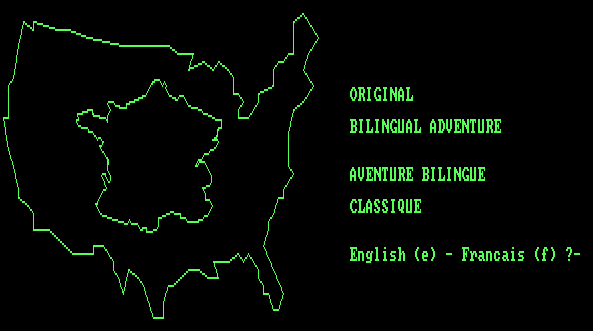
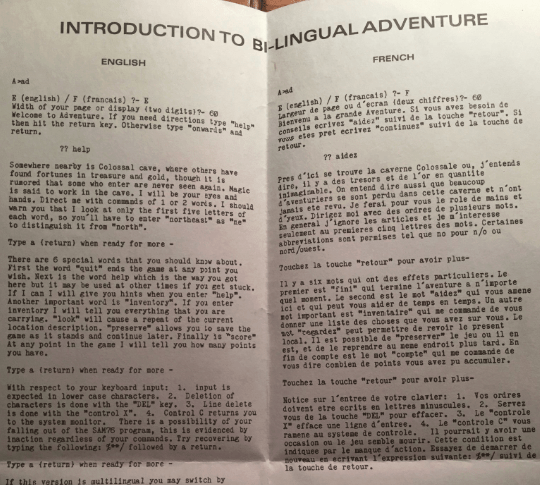
You pick a starting language (English or French) and then can swap between the languages at any time by typing “english” or “francais” appropriately. (The design seemed to allow for new languages, but those two are the only ones that were made.)
It’s another formerly “lost” game, but I managed to unearth a copy (via a dead link that the Internet Archive, fortunately, had saved). I’ve now uploaded it so you can play online.
It was written in the obscure computer language SAM76, the brainchild of Claude Ancelme Roichel Kagan. It claimed to be “designed by people for people“. SAM76 removes all English text from coding and uses only cryptic symbols and abbreviations. (Why this would make the language more user-friendly is an exercise left to the reader. I guess this makes the language potentially more international? … but it never took off, anyway.) The side effect is that while it was originally released on CP/M, the version at the link above is essentially the same, with a DOS instead of CP/M interpreter.
The credits go to:
– Jim Manning (did the majority of the implementation)
– Ancelme Roichel (author of SAM76, added some features and wrote the French)
– Harley Licht (proof testing, verifying)
– François Brault and Thierry Gauthier (checked the French)
This was written in New Jersey, not France, but Ancelme was originally from France and François and Thierry were visiting from France. So: written and checked by native speakers. I’ll bring that up again in a moment.
This is not an exact port by any means. Eagle-eyed readers may have already spotted “XYZZY” got changed to “SAM”. There’s text changes aplenty in general:
Original: A huge green fierce snake bars the way!
New: A huge vicious looking green snake is eyeing you malevolently.
The way dwarves worked in the Original Adventure was that the first one you met threw an axe, while the remainder threw knives, but the axe was the only thing you could take. In Bilingual Adventure:
There is a sharp knife lying on the ground here
The dragon has been removed entirely. There’s a silver sword embedded in a stone. (Borrowed from Adventure 550 maybe? It’s smack dab in the middle of the swiss cheese room, though.) Dropping the magazine in Witts End does not yield you an extra point, and the magazine in fact counts as a treasure (5 points).
There are enough differences I’m going to have to play this through (and even remap things) so I’ll save details for next time. Before closing out I wanted to point out a study done in 1983 on using computers to study languages where “teachers and supervisors of foreign language programs from 29 high schools in six states provide reviews of foreign language microcomputer courseware.”
French included some standard tutorial software, but also both this game and the French version of Mystery House. (…there’s a French version of Mystery House!?) The reviewers did not think well of the quality of the French:
The French version is clearly a translation of the English. The translation is frequently awkward and occasionally incorrect.
Clearly, just being a native speaker is no guard against spelling and grammar errors.
Like most text adventure software at this period, the parser only accepts the first couple letters of each word (so TOOTHPASTE and TOOTHBRUSH would be considered the same thing.) One of the educational catches of this is not catching word endings in languages where it matters!
The grammar is rudimentary (every input is imperative verb with direct object, and incorrect forms are accepted).
Since the game doesn’t even read to the end of the word, it can’t tell if word endings are correct, and as the 1983 study points out, accepts “prend nourr” for “prends la nourriture”. (Native French speakers: is leaving off “la” that horrifying? I don’t have a good sense.)
In spite of problems with language usage, vocabulary level, lack of instructions, etc., La Grande Aventure would be a strong activity for some students and, if it were accompanied by a variety of sound teaching devices (such as discussion, in French, of the goal after a session, speaking French during the game, requiring that the students draw and label the map that develops while playing, acting out scenes or situations from the game, having students’ compose their own branches of La Grande Aventure or their own games), could evolve into a very beneficial learning tool.
I like the idea of a class “acting out scenes and situations” in Adventure. Too bad the bit where you punch out a dragon is taken out.
First off, Jason Scott over at The Internet Archive managed to fix what was ailing my upload, so you can now try out The Public Caves as it was exhibited at Narrascope 2019:
Special thanks to everywhere there who contributed, even if you only added one line or room.
…
Second, let’s talk about Caves 4 and Wumpus 4. Yes, really.
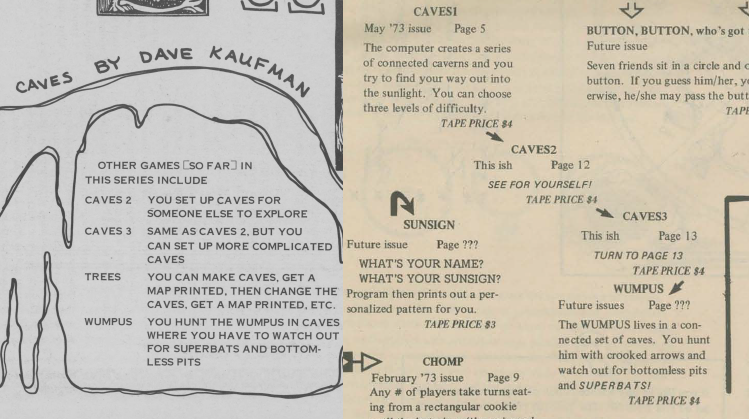
From the PCC Games issue. THESE COMPUTER-MADE CAVES ARE ON ALIEN PLANETS (THERE ARE 4 PLANETS TO EXPLORE) AND EACH HAS DIFFERENT DANGERS.
Caves 4 may have never existed “(PROGRAM NOT AVAILABLE YET)”; it looks like Dave Kaufman was still trying to make his original design more game-like. I’ve been trying to armchair-design a fix for the original Caves based on the prompt, but I’m really not sure where to go with it.
The existence of Wumpus 4 is only known through a hand-scrawled note on the source code of original Wumpus as printed in the same PCC Games issue:
WUMP4: HIDE-N-SEEK
This one’s fun to theorize about. It loops back all the way to the thing that started it all, the educational game Hide and Seek. Could it be a version of Wumpus where the location clues are slightly more enigmatic, so you have to “triangulate” like the original grid?
…
Last, and this is for the sake of completeness, is it possible Wumpus came *before* Caves? It certainly doesn’t read like that from the newspaper issues (May and September 1973):
There is one wrench in the equation, and that’s in the September issue on the same page:
We know Mugwump came first, because it was based on Hide and Seek which was written outside the People’s Computer Company. So these particular arrows are sequencing in terms of complexity rather than order being written.
This could get really in the Thicket of Historical People Not Clearly Dating Things for Posterity. It isn’t like Gregory didn’t know how things were being published (and wrote an article himself about his computer language Pilot in the April 1973 issue of PCC). He also mentions Dave Kaufman specifically in his famous narrative about how Wumpus was created.
If you like, send me a picture of your version of a Wumpus. Perhaps friendly Dave, our editor, will publish the best one in Creative Computing.
Keep in mind Dave Kaufman himself was the editor for this very article explaining the history of Wumpus. He didn’t seem particularly upset to leave Caves out.
Still, Caves has some very complicated code. and it’s much easier to imagine Wumpus being made while looking at Caves rather than the other way around. The “tree” basis of the Caves series has mostly dropped off by The People’s Caves, suggesting the order went something like a.) use a computer science structure to make the idea of physical caves (Caves 1) b.) use the idea of nodes-as-caves on a dodecahedron structure (Wumpus) and c.) realize it’s much simpler to drop the tree (Public Caves).
This may have all just been a manifestation of the hacker culture of the early 1970s; just trying to get things made when there was barely anything to work with, both borrowing and creating with equal measure. Maybe there was an aspect of parallel creation between Wumpus and Caves but Gregory and Dave decided to go with the simplest story. If some future historian wants to get finicky about a timeline, they’re welcome to try, but it looks like for the people involved it didn’t really matter.
My theory as to Crystal Cave’s authorship got shot down (although in the process I discovered yet another undocumented Adventure variant). I have a secondary theory but it’s going to be harder to test; for now, this game will remain by Anonymous.
The usual “I’m going to spoil the finale” warning applies.
Another public domain picture for spoiler space. This one’s from Australia.
Scene the First
The source code refers to the Fell King as “Arthur”, which is kind of epic. (When William of Malmesbury brought up the possibility of Arthur’s return from the dead, I don’t think this is what he meant.)
> sw
You are being followed by a dragon, who whines “I’m hungry.”
You’re in crypt.
There is a black, finely wrought iron crown here.
There is a massive iron tomb here. On top is a wrought figure of the King…a fell figure of grim visage, wearing a mithril helm, and holding a mace.
> get crown
The tomb crumbles into dust. The graven figure on top rises. He is stalking you, swinging the mace!
Ah, yes, the dragon. Keep in mind he complains every single turn.
> ne
A dragon follows you, whining “I want my treasure back.”
The Fell King is striding after you!
The mace strikes the dragon, killing the poor thing.
You’re in corridor.
The body of a small white dragon lies nearby.
The end of a rope dangles from above.
Alas. This doesn’t have to happen if you do the following action right upon activating the Fell King:
> wave scepter
The Fell King disintegrates into a pile of dust, which rapidly blows away
His helm falls with a crash, and rolls to one side.
You are in a narrow, northeast trending corridor.
Near you is a small helmet made of mithril.
The body of a small white dragon lies nearby.
The end of a rope dangles from above.
I confess I did not figure this out on my own and had to source dive again. It’s vaguely interesting that I had to do so because I’ve been waving scepters to cause magic to happen for a while now. There’s no clue at all to the scepter’s behavior, but again: not unusual. I suppose what is rare is a combat use of “arbitrary magic”; the unwritten rule has been to use waving random devices as utility effects, but never as a direct method of stopping an aggressor.
There’s even sensible reason for this rule: imagine you are fighting an enemy that will kill you in one turn. You want to perform an action to stop the aggressor. Given you have only one turn, testing magic items one by one (and getting clubbed by a mace over and over) can get a bit aggravating. Whereas, if you’re simply wandering the landscape and wanting to try out some ideas, a set of “nothing happens” messages before you hit paydirt isn’t nearly as irritating.
Interlude
Immediately after the Orca-Cola scene, the author(s) left open the floodgates of Wacky Stuff. This (entirely optional) bit starts off painful for multiple reasons but I think the last line redeems it.
> get toad
As you touch the toad, it starts to swell and shange shape. It’s — it’s — it’s turning into a dwarf princes! She — she — she’s — she’s — UGLY!
— VERY UGLY!!!!!!
She’s 3’6″ tall, and 180 lbs., with black, oily, snarly hair, and three large warts on her nose, which separates two beady red eyes that don’t track. She immediately starts to say, in a high-pitched nasal whine, “Trying to pick me up, eh sweetie? Where do you think you get off? I’m a decent broad, and won’t have any of this. Whatcha doing around here? You one of those weird explorers who rip off decent folks, taking their treasures out of the cave? I hope you haven’t found the vault yet . . .”
A cloud of white smoke and a wizard appear. He is garbed in green and violet robes, and says “I really must apologize about this. She has no business in this game; she escaped from another game in the next town. There really is no vault in this cave…she’s referring to the next cave. Sorry again.” With that, he takes her hand, and they start to vanish. As they fade out of sight, you note that she has taken his hat, and is beating him severely about the ears with it.
I want to play a game as the dwarf princess defending her vault from selfish adventurers.
Scene the Second
When the dwarves of Moria dug too greedily and too deep, they awakened a Balrog that slew great King Durin VI and became henceforth known as Durin’s Bane.
> w
The bridge is broken here! Above you, the other side of the break looms out of the darkness . . . Or is it something else?
> jump
You just manage to catch the far edge of the bridge and swing up onto it. You are at the west side of the broken bridge, which quickly leads down to the west side of the fissure, and thence to the west side of the colossal chamber. There seems to be a faint, ominous gleam at the bottom of the fissure. Below you, on the side of the fissure, you can see a small ledge. You can get down to it, but you cannot see a way to get back up.
There is turquoise sand here.
> get sand
Ok.
> d
You are stuck on a ledge on the west side of the fissure. You cannot go up. A strand of Grendl’s web, leading downward, is attached here.
> d
You are on a high, lonely ledge on the side of the fissure. Grendl’s strand passes here and continues.
> d
There is a loathsome balrog here.
You are on a lonely high ledge on the side of the fissure. Grendl’s strand passes here and continues.
The Philosopher’s Stone is here.
> throw sand
The sand spreads out into a fine, stinging cloud. Stricken, and taken off guard, the balrog stumbles back. . .back. . . and falls over the edge. . .down. . .down. . .down. . .and vanishes into the gloom.
Sand. The mightiest weapon of all. Clearly, that’s what the dwarves were lacking when they were driven from Moria. After:
> jump
You drop through an impenetrable gloom. Oppressive fear gathers, clawing at you. You are sinking into the depths of Hell, with no salvation in sight. The clammy, black air whistling past is the only sound filling your fear-crazed mind. You are tumbling endlessly, spinning over and over. Suddenly, you feel your descent slowing! With a rush, you finally come to a landing and find…
You are at the top of the Wizard’s Tower. Finely carved stone steps spiral downward. This chamber has a door on the east side, with the words
“CAUTION: THE TIME MAZE LIES BEYOND”
chiseled above.
Is it possible for something to be picturesque and memorable and bad writing all at the same time? The paragraph is dripping with modifiers in a way I haven’t seen since my 1980s Dungeons and Dragons campaign, and if this text appeared in a book I’d probably just close it and walk away, but in the context of this game (and having just taken out a Balrog with some sand yeah eat it Gandalf) my brain just went “neat!”
Another, More Annoying Interlude
After snagging the Philosopher’s Stone and a few other items I thought I had all the treasures, so I did the customary thing in Adventure-clones: find a place where I could leave my lantern off and type WAIT a lot. (And since four characters started to get annoying, I switched to typing I and took inventory a lot.) There normally is a “the cave is closing” type message, but after 100 or so turns I got nothing.
Another source dive, this time into the objects. And … of course I missed one. The very first one listed in cvobj.c, in fact.
{“several diamonds”, “There are diamonds here.\n”, 116},
I suspected, from the room number, that the diamonds were in the Timemaze, but I had mapped that area thoroughly. Resolving my dilemma took stepping through the maze map source code line by line until I realized what I was missing.
I’m not even sure how I would have done this! My guess is I thought I was in the room marked “D” when I tested the “past” exit but I was actually in “A”. One mapping mistake. Grrr.
Scene the Third, Whereupon the Cave Is Closing This Time for Real
The sepulchral voice intones, “The cave is now closed.” As the echoes fade, there is a blinding flash of light (and a small puff of white smoke). . . . You immediately feel the menacing presence of hundreds of pairs of unseen eyes upon you. As your eyes re-focus, you look around and find. . .
You are at the north side of an immense, high-walled arena. The center of the arena is occupied by a colossal jade idol. In the north wall, behind you, is a door.
Ah, the endgame. Where most large treasure hunts so far have fallen down. (Most atrociously in Adventure 550, which was otherwise a good game.)
> se
You are at the east side of an immense, high-walled arena. The center of the arena is occupied by a colossal jade idol, facing you. In the east wall, behind you, is a door.
> e
You are in the repository, where all of the implements and paraphernalia
of the cave expedition are stored! The only exit is to the west.
There is a little axe here.
There is a long sword here.
There is a broad sword here.
There is a spear here.
There is a short sword here.
There is a bow here.
There is a dagger here.
There is a quarterstaff here.
There is a halberd here.
There is armor here.
There is a “heater” shield here.
There is a round shield here.
There is a tall shield here.
There is a cuirass here.
Your reflection peers back at you from a mirror on the wall.
Wrr, is this going to take the Acheton approach and have you fight a bunch of enemies, needing to choose the right weapon each time?
> w
As you step out the door, your image also steps from the mirror, and follows you! Armed and armored exactly as you, *YOU* are your exact match, except that your good nature is reflected as *YOUR* evil nature. *YOU* will kill you, unless you destroy *YOURSELF* first. *YOU* are circling yourself warily, looking for an opening to attack.
Nope, just the one enemy. The resolution is fairly simple, so feel free to hit pause on your podcast device … er …. I mean stop reading for a moment and try to figure out how to win before I share the conclusion.
Bermuda Crystal Cave again, because it’s pretty and now I want to go there. Via Andrew Malone, CC BY 2.0.
> break mirror
The mirror shatters explosively, destroying *YOU*! You are thrown backward, throught the dorr, into the arena, where your screaming fans flock down around you, pick you up, and carry you off to a month-long revel honoring the glorious cave conqueror. . .
You scored 487 out of a possible 515, using 493 turns. You have reached “Junior Master” status.
I am not sure what’s with the score, and while the game was fun (despite the Timemaze) I don’t feel the dying need to work out where the missing points are.
…
For those waiting to get to try The Public Caves, it’s up at archive.org (just search for “Public Caves”) but I haven’t been able to get the “play online” feature to work. I’ll let y’all know as soon as I’ve resolved the issue.
As far as what I’m playing next, I have no idea. I still have Star Trek to get through (and I promise I’ll get something up about it next week) but there’s still a wide range of targets to hit in 1980, including our first non-English game that I need to play in its original language (since it has never been translated). It’s a language I know (well, knew) nothing about. Yes, folks, I am learning a language just for your entertainment.
This one’s going to start “normal”, pass through “slightly strange”, and get “Haunt-level weird” at the end. (If you never got to read about Haunt, you should, since no other game before or since has included references to both Cecil the Sea Serpent and Ronald Reagan’s Secretary of the Interior.)
Public domain picture of the Crystal Caves of Bermuda for spoiler space.
Last time I was stuck trying to find the pirate’s grotto, and it turned out to be my old nemesis, Missing a Room Exit.
>nw
You are in a secret passage running southeast. A second passage enters from the southwest.
From here I only had marked exits going southeast and southwest, but there’s also an exit to the northwest.
> nw
You are at the south end of a grotto. The floor is sand, sloping off to a beach, and a lake to the west. Faint light is visible to the north. There is evidence of a former passage to the west, but it has collapsed, and there is no way to go in that direction now. At one time in the far distant past, the grotto was obviously used by pirates, and there is the tattered remains of a “Jolly Roger” hanging from the ceiling.
Yes, now that I read it carefully, the text implies you can continue to the northwest, but I missed it anyway.
> n
You are at the north end of a grotto with a sand floor and a lake.
Light filters up from the lake, and you can faintly see an opening to the outside world under water, but it is inaccessible.
There is a ruby medallion here.
There is a heavy lead hammer here.
There is a large sparkling nugget of gold here.
The pirate’s treasure chest is here.
A skeleton is here, clutching a cutlass.
So, fairly easy resolution. I also realized I was interpreting the ruby medallion wrong, and it wasn’t glowing near enemies, but just near secret passages; this netted me an ermine cape and some rare spices.
Slightly more complex was the Siege Perilous throne from last time. One time I tested it I got this message
With a powerful roar, the throne hurls you straight up — you narrowly miss hitting the roof of the cave! Your fall jars every bone in your body, but you find that you are all right.
and I different time I received this message
With a roar, the throne flips you into the air to land on the ground in front of it.
but I was stumped as to what was going on, and had to poke at the source code before I realized there’s a cumulative effect going on; there are multiple “royal” type items and if you have them all something should occur. I also learned it’s a King Arthur reference.
Galahad is the knight for whom the Siege Perilous at Arthur’s table is destined. In the Lancelot, a knight named Brumand, trying to perform an act that Lancelot never dared to do, sits in it and is burned to a crisp. Malory says that Merlin made the Siege Perilous for the greatest Grail knight. When Galahad arrives at Camelot, his name appears on the seat destined for him.
— From The Camelot Project
the crown (mentioned in my last post)
the ermine cape
a platinum orb (from the Time Maze)
a scepter (from the Time Maze, guarded by a dragon)
Getting the platinum orb was technically easy, but when holding it while exiting the maze, I was pounced by a spider.
A giant hairy spider, named “Grendl”, drops from the ceiling, barely missing you. It starts to chase you around the room, trying to get you!
A giant hairy spider is following you, trying to get you!
Again I was rather stuck here, but it turned out to be a simple solution. There’s a sword you just need to be holding.
Grendl pounces – – –
but luckily falls upon your sword, and dies!!
In context, it’s understandable I missed this: I was still reckoning with both the pirate and maximum inventory capacity at the time. In a more recent game I would be able to tuck the entire universe in my back pocket, so I’d already have the sword in my possession without any extra puzzle-solving effort.
The dragon was a little more obtuse, and seems to be intended as an inversion of feeding the food to the bear:
> throw spices
The spices fly through the air, forming a fine cloud. The dragon rears back triumphantly, ready to blast you, when the spices make him sneeze explosively, and his fire is extinguished. A very crestfallen and woe-begone dragon looks up at you and says “Mind if I tag along, Boss?”
Once the dragon goes tame, it follows you around and complains about everything:
The small dragon wails “Can I have some treasure, too?”
A dragon follows you, whimpering “Can I have a match, boss?”
You are being followed by a dragon, who whines “I’m hungry.”
Yes, I think we could all use a little more treasure. With the cape, orb, and scepter in hand, I just needed to grab the crown from the Fell King (who I still haven’t figured out how to defeat) and run. While sprinting away from the Fell King, I managed to sit on the throne with all four special items and get to a new area:
> ne
The Fell King is striding after you!
You’re at the center of the Hall of the Mountain King.
There is a large, bejeweled throne here.
> sit
As you sit, you notice the inscription–“Siege Perilous — Nobles only.” The throne silently tips over, revealing a hidden passage beneath it. This is all that you have time to observe, as you are immediately transported, whirling giddily, throught a region of ominous vague shapes, somber shadows, and sullenly-glowing lights! Finally landing with a crash, you shake your head to clear it, look around, and discover . . . You are at the east side of a garden. A murmuring stream enters from the southeast, and exits through a passage to the east.
(Before going on, notice this is a pretty classy piece of structuring: there’s the “realistic” outside with the ranger, followed by the first inner section, but rather than opening the entire inner game at once, there’s a secondary puzzle that leads to a second inner section. A careful structure can go a long way in making a generic treasure hunt feel dynamic.)
The new area has a relatively standard unicorn and djinni (I haven’t figured out what the deal with either one is yet) but also:
> w
You are in an immense chamber, exiting to the east and west. It is lit by flickering, smoky torches, each of which gives off a vile, greasy, black smoke. Indistinctly visible through the smoke, the walls are seen to be lined with galleries.
There is a unicorn wearing a jeweled collar nearby.
A gigantic idol blocking the far end of the chamber is facing you.
A gigantic orc priest stands before the idol, and says:
“You would be well off to make an offering to out idol!”
The galleries are lined with orcs, silently watching you.
I tried offering various treasures.
The orcs chant “That is not the real thing”, and throw offal.
After they rejected every piece of treasure I was carrying, I contemplated if “that is not the real thing” was intended as a hint.
… wait, they wouldn’t? Would they? I had a bottle of cola from the barn at the start of the game.
> drop bottle
Ok.
The orcs scream “AAIIEEE – – – ‘ORCA-COLA’. IT IS THE REAL THING!!!”
A convulsive groan fills the chamber, as the idol shatters explosively.
Flying shards strike and kill all of the orcs, and narrowly miss you!
All the orcs vanish in greasy black clouds of smoke.
There is a small, exquisite jade idol here.
The giant, angry orc is coming after you!
(For those unfamiliar, Coke Is It! was an April Fools’ Day game where authors took old IF games and added delicious Coke. You drop to your knees and cradle Floyd’s head in your lap. Floyd looks up at his friend with half-open eyes. “Floyd did it … got Coke. Floyd a good friend, huh?” Quietly, you croon Floyd’s favorite song: “I’d Like To Buy The World A Coke”.)
One of the less-common Patterns I’ve noticed with games is to take an action which is somewhat abstracted (slaying generic monsters, say) and add personalities and/or ramifications (slaying monsters that turn out to have names and families, you monster). This sort of exercise could be performed on the standard treasure hunt, where the game chastises you for stealing stuff and points out how bad a person you are for playing a game. (This can occasionally be effective but is also wearying in the “you were helping the bad guy the whole time!” plot twist sort of way.)
The opening conceit of Crystal Caves runs along similar lines: having a cave realistically made where touching things will break them and a ranger constantly chastizing you for your plundering adventure sensibilities.
Except here there’s an “inner game” and the change happens, the ranger is never seen from again. (Except, maybe he’ll come back in the endgame?)
You are at the upper end of the misty lake.
You are afloat in a small boat.
There is a large rimstone dam here. Behind it, a pool of water spills steadily over the dam. The ceiling dips into the pool.
This is the location where I hinted at last time that it helps to know something about real caves. I admit my Zork training initially made me think of a human-built dam, but “rimstone dam” refers to a natural cave formation.
Because we aren’t talking about a giant concrete structure, the next action makes more sense. I don’t think any rimstone dams are holding back giant bodies of water as implied, but since this is the barrier between reality and fantasy, it works out:
> BREAK DAM
The dam crashes open with a mighty roar. A gigantic wall of water leaps across the lake and down the stream passage, destroying everything in its path.
You have to be careful to stow away your boat so it isn’t swept away, but otherwise, this will reveal the inner game as well as jam the front gate so you can’t go through anymore.
You are in a large hall with a pool of water. To the south, a waterfall thunders into the pool, and flows out through a passage to the east. To the west, a hole in the wall looms beyond a small beach.
You are afloat in a small boat.
The classic Adventure dwarves start attacking you here (and behave exactly as in original Adventure) and the pirate is also active (and will take any treasures he steals to his “grotto”, although I have no idea where that is). The geography is otherwise entirely different.
The Hall of the Mountain King has expanded to nine rooms. In the center is a throne which launches you in the air.
> W
You are in the center of the Hall of the Mountain King, a large octagonal room. There are passages on all sides!
There is a large, bejeweled throne here.
> SIT
As you sit, you notice the inscription–“Siege Perilous — Nobles only.” With a fearful roar, the throne hurls you straight up — plastering you on the roof of the cave!
To the northwest is a “bugbear” (although close in behavior to a bear; I think the name is from Dungeons and Dragons but bugbears in that game are humanoids). It is chained to the wall just like the classic one from Crowther/Woods Adventure, but if you feed it, it becomes a “well-fed” bugbear and still happy to attack you.
There’s a “King’s Dungeon” complex off to the southwest leading to a crypt. The crypt has a “Fell King” with an iron crown who will start chasing you if you try to take the iron crown. (You can run all the way back to the throne, where sitting while holding the crown isn’t fatal any more … but it doesn’t seem to help in stopping the Fell King anyway.)
The Crypt also has a “ruby medallion” which I haven’t fulled worked out, but seems to let out a glow every time an enemy is nearby, essentially behaving like the elvish sword from Zork. However, it does count as a treasure, and the Pirate has very grabby fingers, so I haven’t been able to play with it much.
There’s a Wizard’s Tower which you can enter as long as you’re holding a nearby scroll, whereupon you will find a Timemaze.
“p” and “f” here stand for “past” and “future”.
I originally hoped for some crazy “change things in the maze in the past to modify the future” type action, and I supppose it’s *possible* that’s embedded somewhere, but mainly the Timemaze is just a regular maze with two additional exits (past and future). One of the treasures (a scepter) is guarded by a dragon, where the KILL DRAGON trick from the original game doesn’t work. It looks like you can just take the scepter and run if you have some way of resisting fire.
To summarize, my open problems are:
1.) passing the bugbear
2.) defeating / evading the Fell King
3.) finding the Pirate Grotto
4.) stealing the scepter from the dragon
Item #3 is, in essence, the top priority for me because I can’t get much done with treasures being lifted all the time, but “find the hidden place that could be anywhere” type puzzles are intrinsically difficult to just work on.
HAVE SHOES ON THEIR FEET
AND SOMETHING TO EAT
WOULDN’T IT BE FINE
IF ALL HUMAN KIND
HAS SHELTER
HI THERE
************* TO GET TO THE UDDER SYDDE
WHAT WOULD YOU LIKE TO DO NEXT? MOVE
TUNNELS LEAD TO:
1 ‘OUTSIDE OF YOU’
2 ‘PIPPIN TRIPPING’
3 ‘SPACEMEN AND OTHERS FROM AFAR STAR’
4 ‘OUTSIDE OF YOU’
5 ‘CAN’T DIG TO THIS ONE !’
6 ‘ADDENDA, ADDENDA, ADDENDA !!!’
The last we saw of the Caves series by Dave Kaufman was perhaps a little underwhelming. The game generated a set of “caves” in tree format and challenged you to escape, but it was arranged in a manner that didn’t provide any challenge.
However, Mr. Kaufman wasn’t quite done yet, and according to the date on the source code, returned to the Caves in August 1973.
PCC Nov. 1973. “The ‘Public Caves’ are ever-expanding and forever changing. Each visit, the graffiti is different; new tunnels have been dug and new caverns added. New names have appeared and there is always someplace new to explore!”
One of the issues (perhaps, the only issue) with both Caves and Wumpus passing into adventure-game territory was the sameness of the rooms. The Public Caves does away with that. Each new room is built by a visitor who names it, each room has “graffiti” that the visitors can add to.
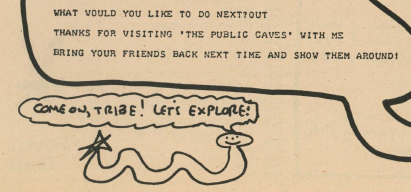
PCC Nov. 1973. While a touch confusing to read, this is showing an actual gameplay transcript.
The system is very clunky (although to be fair, the first of its kind). You must type WRITE, MOVE, BUILD, DIG, or OUT in full to do a command. WRITE lets you add to the text of a room. MOVE gives a list of adjacent rooms; if only one room is adjacent, you are moved there automatically. BUILD lets you make a brand-new room that is linked to your current room, and DIG lets you make a new tunnel into an existing room (which requires you type the exact name of the existing room you’re thinking of).
You can only BUILD once and DIG once per visit. This does not seem to be due to the technical limitations of the system, but as a sort of social engineering: encouraging people to contribute as a mass group, rather than having one person dominate and write a lot of content at once.
…
During the weekend that this post is going up, a version of The Public Caves will be live at the conference Narrascope. (I typed the 1973 source code and compiled it with QBASIC, so it runs under DOSBox.) The plan is to take what is collaboratively built and make it accessible to everyone. I will modify this post after the conference is over and include a link to play online. (ADD: Here is the link to play online.)
(Incidentally, the Narrascope setup is using a batch-file loop, so it’s not hard to quit and return to make more rooms, but I’m guessing that was true of the original game as well.)
…
Now, is this an adventure game? This post is part of “Before Adventure” so I guess I’m still waffling, but mainly on a technicality: it’s a system for creating a world but doesn’t come with one. (Of course, it’s possible to render the screenshots above as the start of a world, so if you consider the November PCC article part of the source code then that objection is taken care of.) The other question is if adventure games need puzzles. A fair number of definitions require them, like:
Adventure games focus on puzzle solving within a narrative framework, generally with few or no action elements.
— adventuregamers.com
or
a video game in which the player assumes the role of a protagonist in an interactive story driven by exploration and puzzle-solving.
— Wikipedia
although the mention of “puzzle solving” is more to distinguish the mechanics from, say, that of an action or strategy game. If you want to get technical, you could say there is an “narrative/exploration genre” but there needs to be some puzzle element added on to be a full “adventure game”. To which I say: fair enough. Game genre definitions can be useful for identifying what techniques work in which settings (see: Quarterstaff having a bad time when RPG and adventure elements clash) and isolating exploration games may even be useful in finding things adventure games can’t do that exploration games can (like having the audience itself make all the content).
But whatever this game’s designation, it gets tantalizingly close to a new era, and it seems like that’s worth celebrating. To paraphrase Stanley Kubrick, the universe may be dark and devoid of meaning, but that just means we get to create our own light and meaning to bring to it.
Narrascope is starting tomorrow in Boston (June 14th, 2019) and goes through the weekend.
NarraScope is a new games conference that will support interactive narrative, adventure games, and interactive fiction by bringing together writers, developers, and players.
I am on the wrong side of the country to go, but if you happen to be attending, I have arranged something special (thanks to Andrew Plotkin for help setting it up!)
Specifically: there is an expo room that is showing demos over the weekend.
Amongst the live demos there will be a historical exhibit with a game that has not seen the light of day since the 1970s. One could plausibly make the claim it is the first adventure game ever made. It predates both Wander and Adventure.
I’ll also be finishing my Before Adventure series soon after so y’all who can’t make it will get a chance to try the game out.















 Renga in Blue