Author Archive
I finished Gold, thanks to Voltgloss discovering how to fix the BASIC source code. One line in particular
9310 LOAD
should be
9310 SCROLL
It’s possible to do this fix even on the online emulated version. Just quit the game (with X, then Q) and type the “9310 SCROLL” line and hit ENTER (or NEWLINE as the keyboard puts it). You don’t actually type the letters S C R O L L but rather the letter “B” which types the word all at once. Then, typing GOTO 1 (“G” gives a full GOTO) will restart the game with the fix.
This indicates that the command is being stored as a single byte so this is likely just a corruption from dumping the tape (like Scott Adams’s name being misspelled on the version of The Golden Voyage I had).
Leaving off from last time, I couldn’t get east of a particular cliff without the game crashing. Actually taking the route…

…led to a “treasure room” next to a locked door. This locked door turns out to be the same as the one I couldn’t open before (even with a ring of keys) but unlocking the door works from the other side, and landed me to the north of the bridge where the gold was stored. So this represented an alternate way of reaching the gold:

I assume there’s a better way of drawing this out so the crazy-connection up top isn’t necessary.
I’m unclear if this really had anything to do with reaching the end of the game, but since I knew I was no longer even potentially stymied by a bug, I went to work trying to figure out where the wraith stored the gold after hiding it “well”. Since the character is clearly based off the pirate of Adventure hiding treasure in a maze, I took the guess the same thing happened here, and went for the odd three-dead-end-room spot I mentioned last time:

Got it in one! However, the prior exits blocked off were still blocked, so I started wandering in case another random event came up. As part of my wandering I tried entering the laboratory, thinking something different might happen rather than getting kicked out; indeed, instead of a laboratory there was a room with the “rumbling bowels of the earth”. (Voltgloss theorizes this triggers the second time you get the gold, I haven’t tested enough to be sure.)
Heading on from there leads to a small maze which I didn’t even bother mapping but just wandered hoping to get lucky, and then a dark room:
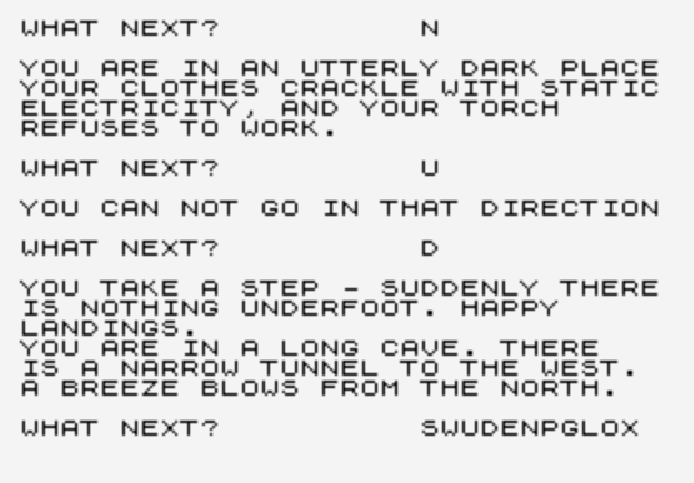
I was thusly deposited at the entrance past the obstacles and able to escape!
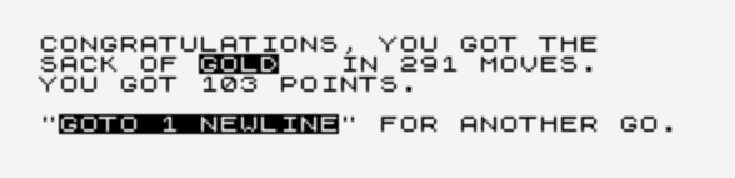
I have no idea if this is the max score. If it is I reckon the contest-givers assumed 103 would be an unlikely guess for a final score, so only someone who won would find it.
I don’t have much else to comment on, other than it is quite curious how closely this game resembled Quest in structure: go in to find a treasure also purely by navigation, get the entrance blocked off (at least two different ways), get the treasure stolen (to be recovered in a dead end) and only find a true exit in a maze deeper in the map. I don’t think it’s genuine direct influence (although there were a few Commodore PETs in England at this time, there were not many); rather, both authors were riffing off of Adventure, and when boiled down to its fundamentals of navigation, the twin ideas of “require an alternate exit” and “have a pirate-like figure steal the treasure” become natural ways of adding a smidge of plot to the proceedings. After all, Adventure itself had a gold treasure that was too heavy to carry up stairs, and required an alternate exit to get it back to the starting house.

Via zx81stuff.
Hilderbay Ltd was founded in 1979 and claimed in a later ad that their first product was for vacuum tube computer. Their software held to a general theme:
- Critical Path Analysis
- Stock Control
- Mortgage + Loan
- Payroll
- Simple Word Processor
- Statutory Sick Pay
- Kempston Centronics Interface S
Somehow, amidst all these utilities and business software, they produced a two-pack game cartridge for the ZX-81: Pick a Word and Gold. (No name is attached to any of them, although they did publish a short book attributed to Andrew Pennell.)
YOU AND I MUST PICK 1 OF THE 9 WORDS DISPLAYED IN TURN. THE FIRST TO GET THE SAME LETTER 3 TIMES WINS.
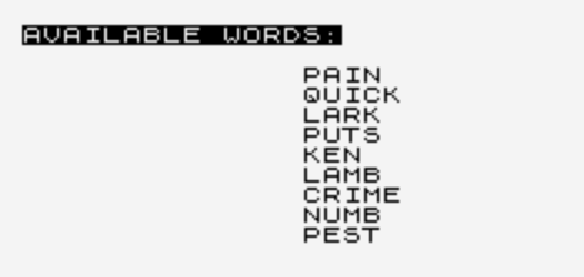
For example, if you can pick KEN, CRIME, and PEST, you win the game, since they all have the letter E. I admit I don’t know what the optimal strategy is, but the game claims on difficulty level 2 the best you can do is hold the computer to a draw.
Now, this is All the Adventures, not All the Computer Renditions of Tabletop Games (although here’s a link to play Pick a Word online), so what really interests us is the other game from the set, the wildly obscure Gold, which does happen to be listed on Mobygames, but under the category Compilation where nobody can find it. I came across it by browsing the website zx81stuff more or less at random.

The game is one of the surprisingly few from this era that ditches having a parser (see: Quest, Adventure in Murkle); even games which clearly stretch the machines they are designed for include the tried-and-true two word (or some multi word variant).
This is partially just cultural inertia — after all, strategy games of the time, from Oregon Trail to Taipan, were perfectly comfortable with menus. Even Japan started with a parser, even though the Japanese language doesn’t mesh with the two-word standard so well, and they started getting creative with menus when forced to by constraints. (Adventure in Murkle in particular also drops a parser due to be stuffed into a tiny 4K of space.) There’s design issues, too, but let’s get exploring now and save discussing them for after–

The map as I managed to get it. I can’t say it is the “complete map” for reasons I’ll get to.
As implied by the opening screenshot, your objective is to grab “a huge treasure”, and you are limited to direction commands, Get, Leave (drop stuff), and Open. As expected, a great deal of the gameplay consisted of just wandering around, and since the game doesn’t bother to specify exits, you have to test N/S/E/W/U/D on each and every room.
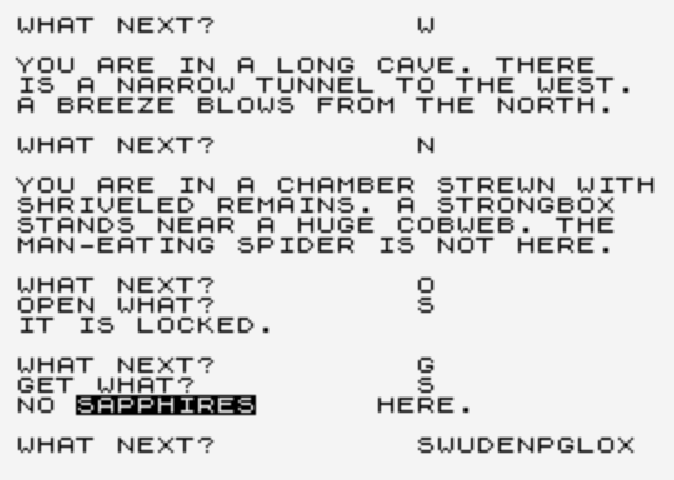
My first time through. I tried to get the strongbox if I couldn’t unlock it, thinking I could tote it around. Note that the way to specify an item is simply to list the first letter, so I was spoiled as to the existence of Sapphires when I was really trying to get a Strongbox. Somehow the game managed to make an almost-no-verb setup feel awkward. Also, the “man-eating spider is not here” message is going to become important.
The keys for the strongbox above are nearby, and inside the box are the sapphires, so there’s not much suspense in finding them. Most of the room descriptions are the standard “imagine what a random fantasy cave might look like” form…

…except for this part.

You get looped if you go into the laboratory back to the place you were in. “Pale, sightless creatures” is an interesting phrase; not common enough to be a cliché, but standard enough it shows up in that exact order in a number of books; ex: “Aidan had expected a dark, dreary place, one fraught with jagged edges, cold pools of water, and pale, sightless creatures.” When is a turn of phrase too stale, however colorful it may be?
Structurally, the game lets you meander in a fairly straightforward way to the northwest corner of the map and grab the “gold” of the title, just past an ice bridge (with a locked door I’ve never managed to open). Where things get interesting is when you try to get out.
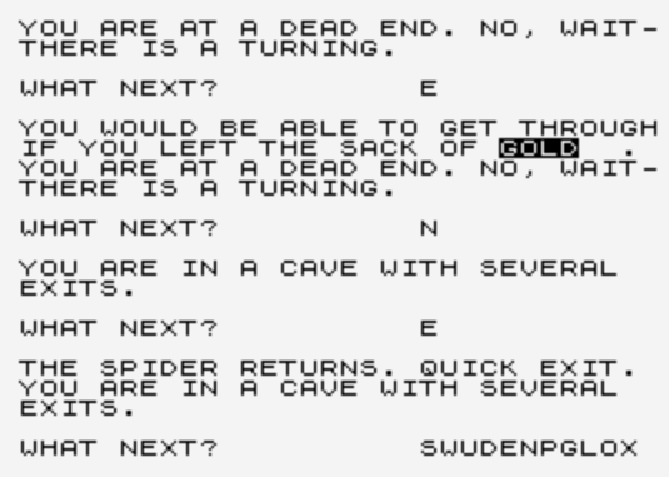
The front exit has two routes, but they are both blocked off as shown above. (Quest did the exact same trick, where once you found the treasure you couldn’t go back the way you came.) A third exit through a trapdoor doesn’t allow you to fit the gold through either. Wandering back to see if I missed anything, I had a wraith steal my gold.

I’d love to talk more at length about how even with extremely limited actions available the game managed something of a plot structure, but things cut off right here — I haven’t gotten farther, and with the current extant copy, I don’t think I can. That’s because one exit — east at the “sheer wall” quoted earlier — is the only one I haven’t tried, but it crashes the game. It is faintly possible I missed an exit on my map, as has often happened before, but I did treat things quite systematically. The only hitch is the dead ends.
One way a number of these games saved on space is to have rooms in mazes have a simple “Dead End.” as the description. It allows tossing in a bunch of extra navigational headache for the player without much more work for the author. On my map I started marking the dead ends as “cut off” exits because it took too much space to keep adding the rooms:

Two rooms right at the entrance. The “Turning” has a dead end going west and a dead end going down.
I started testing exits on each dead end just in case they weren’t really dead ends (The Tarturian did this trick) but after about 10 or so with no luck I just started assuming every dead end was real. Then near the end of my mapping I came across this by accident:
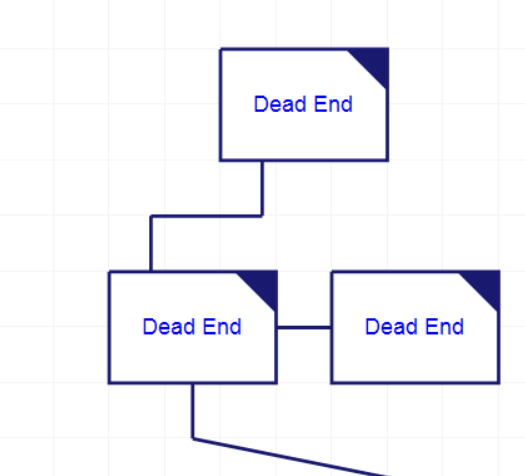
Yes, going east from a dead end didn’t say that direction was impassible, but rather, took me to a new dead end. However, the result was just a multi-dead-end as opposed to a new secret area. It is still faintly possible one of the myriad dead ends holds something genuinely interesting, but because of the crash on the cliff exit, I don’t have high confidence the game is winnable as is.
Or if “winnable” is even the right way to think about it. Early issues of Your Computer advertised a contest:

If you can’t find it amidst the messy text, the ad is promising the one who sends “the highest score” by 31 July 1982 will win a “64K Memotech” (a memory expansion pack). I have been unable to locate any results, but it may mean the high score is a little fuzzier than the average for this time period. (How did they keep people from cheating, anyway? You get 1 point for each room visited so there’s not a lot of “impossible” scores as long as you pick something reasonable.)
Gold still exists as an interesting specimen of trying to make an adventure with limited flexibility of action. It’s also somewhat astounding how awkward it still is to control; the specify-objects-by-their-first-letter system is somehow worse when it fails than a parser. “I didn’t understand that” — fair, I was trying to take an spiderweb but it was just an item of decoration — “I don’t see any sapphires here” — what? The first seems like intransigence but not fatal, while the second is a straight error, and made me feel uncomfortable in my actions, like I wasn’t getting a real treasure, but a fake virtual one that sets a variable flag.
Another Roger M. Wilcox game to knock off the pile, this one supposedly with loose inspiration from Arthur C. Clarke.
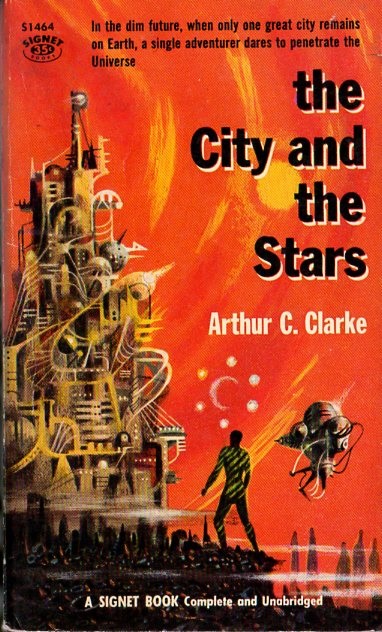
Cover by Richard Powers.
So, in preparation, I dutifully read a synopsis and the first few chapters. One billion years in the future, so far ahead in time that exploring the universe is in the past, one city on Earth — that of Diaspar — remains, and everything is run by a Central Computer, with new generations created and controlled by the computer, except for the unique “Alvin” who has the urge to go outside the city. The environment is philosophical and religious and heavy, so I was a bit boggled when I started the game and this happened:

>EAST
You are in the middle ages on a plain. Visible items:
Evil wizard. Sealed-off castle.
Obvious exits: West
>PULL STONE
That was the keystone! The castle crumbles.
That was the Wizard’s favorite castle! He strikes you down with a magical thunder bolt!
Erm, what? That was a little sillier than I expected.
The actual solution here eluded me a bit; I tried HELP which notified me “I know the noun MAINTENANCE” which will be important later but is no use for this puzzle. Based just on pure intuition I went back to the starting “dirt hill” and started to DIG where I found a gold nugget. Giving the nugget to the wizard:
The wizard says “Thanks,” picks up the gold nugget, stretches his arms up and out to make his body look like a Y, scintillates brilliant yellow, and flies off into the distance. Unfortunately, his glasses fell off on the way up.
The game becomes a little less silly past this point, but that was some opening. Oh, and taking the keystone still collapses the castle (leaving you with an iron rod), but the wizard doesn’t see so you are able to enter the rubble, dig to reveal a forge, use the forge to sharpen the iron rod into a spear, grab a nearby log to tote along, find a teleporter to jump up to a spaceship…
All of a sudden, you feel yourself transformed into coherent light. You streak through Earth’s atmosphere as though the 200 kilometers didn’t exist, and rematerialize inside a cylindrical room.
…with an alien who starts shooting at you, and use the rod as a spear to kill the alien.

OK, only a little less silly. What follows is a tightly structured linear set of rooms that reminded me of Tanker Truck. I won’t go into the puzzles blow by blow, but you
- shoot a second alien with the gun from the first alien
- sing a song on a sheet (“re mi do do sol”) in order to open a portal (“sing re. sing do. etc.”); according to the author it’s the Close Encounters of the Third Kind tune
- shoot the log with the gun to turn it into ash, which you can use to cover a “circuit protector”, and then when you try to shoot the protector, rather than the beam bouncing off it will destroy the protector
- climb a statue marked “The Master” and find a red gem, which you can turn and “hear a grrrrsphydink from below” opening a secret storage area
- find an alien helmet too small to fit your head, but it has purple lenses that you can pop out and put into the wizard’s glasses; the glasses help you see in a dark room later
You are in the Master’s first chamber. Visible items:
You see the glowing face of the Master.
I will have to say the puzzles were relatively smooth to solve; along the way there’s a viewscreen which compactly explains why you’re here.
An alien fleet is approaching Earth. It will arrive in 71 centons.
I never quite understood what the Master business was about — it’s the one element borrowed from City and the Stars, but only tangentially so (*) — but at least it added some nice atmosphere in the last part of the spaceship.
You are in the Master’s second chamber. Visible items:
Closed portal marked “The Master”.
At the last room there were computers which I got horribly stuck on, and had to use my one outside hint of the game.

I had forgotten about the hint inside the game about MAINTENANCE being a noun. As an aside, while adventure games have sometimes been explicit about verbs, this is the first time I’ve seen a noun be a hint, and I really wasn’t sure what to make of it. MAINTENANCE is in fact a key word:
Okay, “maintenance”
A mechanical voice intones, “PERMANENCY DEACTIVATED.”
After the maintenance mode is active, the computers can be pushed over, which I guess is how future tech works?
The computers topple over like dominos! The ship disappears at the last computer bank fails.
The game lets you know since the flagship has been destroyed (I guess that’s where we were the whole time) the fleet turns around and Earth is saved. We can then (assuming we wisely donned a space suit before destroying the ship) make it home.

Why was a person from the past needed in the first place? Best not to think about it too hard, I suppose. I almost suspect the title Medieval Space Warrior came first because it sounded cool and it was built around that.
Still, this was pretty brisk like Tanker Train, and I’m hopeful the author has shaken out the fussier puzzles out of his system. I theorize part of the reason commercial games often had absurd puzzles in this era is the feeling that if progress is “too smooth” then the game is insufficiently dense, with “not enough game” to it. $20 was not an atypical price (that’s what each Scott Adams game cost); with inflation that would be close to $60 in 2021 money. With the amount of content possible in a TRS-80 game, an “easy” game would be over in less than an hour (like Local Call for Death) — is that worth $60 of your time? Mind you, its relative smoothness might be why Local Call for a Death is superior to much of the work of the period, but I could see sheer economics would make authors reluctant. With Roger M. Wilcox’s private games, economics wasn’t a concern, but he was still emulating the games he saw, and he mentions in a comment two moments from the game are direct homages
* Touching a panel activates it, but pressing the panel causes a short-circuit. This comes DIRECTLY from Scott Adams’ _Strange Odyssey_, one of the 3 Scott Adams adventures that had a strong impact on me.
* “You hear a grrrrsphydink from below” is an homage to — perhaps even a direct quote from — _Death Dreadnought_ by Biff and Spudd Mutt. As a teenager, that game had a certain allure because the ads for it said it was “Rated R for gory descriptions”. Ooh, edgy!
(*) In the book, long before the main events start, the Master came back to Earth with his followers, and Alvin eventually finds the Master’s old spaceship as part of the plot. It’s not a flagship for an alien invasion or anything like that.
IN ORDER TO PRESERVE THE INTEGRITY OF THE TITLE ‘MASTER VENTURER’ HIGHLANDS COMPUTERS WILL NOT GIVE ANY HELP REGARDING THIS SECTION. THE ONE CLUE WE WILL GIVE IS THAT IT TAKES A MAGIC WORD TO CROSS THE CHASM TO THE WEST. GOOD LUCK
As with my finale posts in general, if you’ve arrived here from elsewhere, you should read my prior posts on Creature Venture first, even though this part is generally self-contained.

From the Gallery of Undiscovered Entities.
I assume it’s due to memory conditions, but the previous Highland games have all been split into “parts” with separate source code files where any “shared code” needs to be copied over. So for the “cutscene death” of The Tarturian the game just sends the information about what items have been acquired in the game and plays the ending appropriately.
Here, the authors have a “traditional” parser but didn’t bother to transfer over the same commands between parts. This is why in Part 1 trying to PUNCH a random item just said NO whereas using it in Part 2, PUNCH gave a hint. This difference extends to verb vocabulary, meaning that words understood in one part aren’t necessarily understood in another, and vice versa.
I fortunately sussed this out before approaching the master quest of Creature Venture, so I caught that, for example, KISS now worked as a verb. However, I still needed quite a few more hints, with a mixture of absurd actions I feel no remorse at spoiling and reasonable puzzles I was just too tired to get after wrestling with the absurd puzzles. What I will do here is narrate the rest of the game straight, without solving difficulties listed, then go back and explain how far I got on each puzzle.
After the warning on the top of this post, about needing a magic word, you are dropped in a new place with a dagger, flashlight, and batteries. The batteries have a limited life, and your inventory limit is changed: you can only carry a maximum of five items.

This means the best way to start is to leave the starting ring behind while you clear some puzzles. To the west there is the promised chasm, and with no hints in particular, you’re supposed to SAY SHAZAM. This makes a bridge leading to a room with some cake (it’ll make you briefly large if you eat it, you’ll need to save it) and a strange tree that you can nevertheless CHOP and get some rubber, even though CHOP never worked in the game prior to this.

Down below there’s a pick in a wall; pull it out and some water start flowing, which you can plug by typing PUT RUBBER.

Heading back to the starting area (ignoring a cup and a tack that are both there, which are complete red herrings) there’s a locked door next to a pool of oil. You can try to BREAK DOOR but it says you need more delicacy, so the thing to do is THROW DAGGER which somehow bounces off a rock creating sparks which then light the oil which sets the door on fire.

Headed north you get trapped by a cage, but fortunately you can EAT CAKE to temporarily get large and bust it open.

Further north there is a complete dead end. The trick is to DIG while holding the pick, which lets you tunnel through the wall. This leads further to a rug and a pencil, although the best thing to do after scarfing them both is to head back to the entrance (assuming you ditched the pick, you you have enough inventory room to grab the ring, too).
To the north there is a “mimic” chest which turns into a medusa.

The right answer here is to KISS SERPENT, and not, as one might fully and logically expect, KISS MEDUSA. This is sufficent to get the mimic/medusa to move revealing stairs going down, where you can find another dead end, where quite naturally, the obvious thing to do is use the pencil to DRAW a DOOR.

Past the door is a key; you can then head back and find a chasm that you can FLY the rug over, a large snake where RUB RING charms it…

…and a locked door where the key can be applied. Then: the final obstacle.

Which you can defeat via…. you know what, let’s save that. Maybe you (as in reader you, not you visualized theoretically playing the game) can come up with it before I spoil the puzzle in a few paragraphs.
…
So I was doomed from the very beginning — I did suss out from the hint in the instructions (that I planted at the top of this post) that I was going to need to guess at a magic word as oppose to extract one from the game in any way (noteworthy: it understands SAY XYZZY, even though nothing happens) but I just couldn’t summon up SHAZAM as a possibility and had to look it up.
The tree, rubber, and cake section I worked out on my own. Then I hit the dagger being thrown making sparks, and pretty much lost all willpower. My first impulse on the initial dead end was to use the PICK which was correct, but I couldn’t find the right syntax of DIG (I tried HIT WALL and the like). I did know to FLY with the rug, and my first impulse with the pencil was to DRAW stuff (including drawing on the snake, as shown) but I was far past patience and sanity to work out DRAW DOOR. I did KISS MEDUSA quite early and needed hints for KISS SERPENT. And finally, RUB RING on the serpent was totally reasonable (even if totally random magic) but I was too weary to work through my items by that point.
In an abstract way, there is something weird and refreshing when all the rules of fairness get broken, but it doesn’t feel as much fun from the inside. The master game portion really harkens back to the ludicrous endgames of works like Adventure and Warp, where I get the feeling it might start to be fun as a group — if 5 people are playing with notes, maybe one of them randomly will try throwing the dagger. I doubt there’s any sane ratiocination process to arrive at throwing the dagger, but that doesn’t mean someone won’t solve it (I hit upon YELL BOO myself last time, remember).
Oh, and the octopus? You’re supposed to TICKLE it. Anyone work that out?

With this kind of puzzle, yes, I suppose there is a theoretical path to what happened, but it gives me an avant-garde feeling, like words and causality have been deconstructed.
Endgame aside, I did enjoy this the most of the Highlands library so far; the goofy humor settled into a rhythm, the janky art was at least consistently so, and the puzzles before the endgame were tricky but not impossible. (According to the Gallery of Undiscovered Entities, this was the best selling of their games, briefly reaching the top 10.) We only have one more game to go to finish with Highlands (Mummy’s Curse) and at least I can say they’ve all been interesting to talk about.

OH OH IT’S LUCIFER HIMSELF
By some miracle, I still have avoided hints. I even technically “won” but there’s a master section I’ll explain at the end.
My first breakthrough was in regard to magic words. I had worked out SAY SESAME in an empty shed by the starting location opened a secret passage with a dagger, but I was stumped on BEEZ, from a diary in a bookcase.

SAY BEEZ did cause the bookcase to vibrate but nothing to happen. I knew (from my RES shenanigans, and an explicit message in the instructions) that the game supposedly only understood the first few letters of a word … but that turns out to be untrue in this case. On a whim (due to the paper being torn) I tried SAY BEEZLEBUB and was told by the game
YOUR SPELLING IS AS BAD AS MINE DAVE
Wait, what? Did the magical invoking diary misspell the word? A brief poke at the Internet yielded Beelzebub, and SAY BEELZEBUB caused the bookcase to move to the side and reveal a secret passage. This was bizarre-meta in both the defying the first characters of text rule on top of the computer … gamemaster? … acknowledging their own bad spelling, and how it somehow is reflected in the diary as well.
Past the passage was a maze.

Not much to say this time — only north/south/east/west directions but I also ran out of items for mapping, so I had to do the thing where I test an exit on a blank room to see if that behavior matches any of the blank rooms currently on my map. I didn’t even get to short-circuit my mapping, as I found the destination last.
This led to the long-awaited shovel.

You can KILL the creature as long as you have the dagger. This helpfully makes the dagger disappear.
The shovel I would normally then take back to the marked spot from the painting I’ve already mentioned, but it turned out to be too big to take back through the crack in the wall. The only thing I could do is hand it to the elf to through it to the room with the oozlybub.

I was horribly stuck and tried all the different improbable things I’m used to trying from adventure games, and by a miracle I came across
>YELL BOO
which caused the monster to disappear. I’m sure in other circumstances I would look it up and say “how could anyone solve that?” By dumb luck, apparently.
Shovel in hand, I could then finally find my long-awaited magic lamp.

If you rub more than 3 times, the lamp vaporizes you. This will be important later.
Now, I was still stuck, so I went back carefully over any game instructions I might have missed, and noticed that the text very specifically says PUNCHOUT BOOGEYMAN as one of its sample phrases. If you try to PUNCHOUT in the second half of the game (but not the first, it’s different BASIC source code so the responses to verbs are slightly different) the game says
RULE 3.2.1 STATES THAT YOU MAY ONLY PUNCHOUT BOOGEYMEN AND THE NEIGHBORS DOG
(If you try it in part 1, the game just says NO.) Even more meta, this command is also mentioned on the cover of the game (I quoted it on my first post, if you go back and check)! So I was able to PUNCH BOOGEY guarding the cage and pick it up.

I could then grab a BAT nearby, and try releasing it in every room, finding it not very useful yet.
I also discovered that rubbing the lamp near the mimic _was_ safe … the first time. It needed a magic wand.

I had previously tested this when I didn’t even know RES was restoring a saved game. The player had apparently found the wand already, but it wasn’t obvious from the inventory display that there was a wand there, because is big enough it overlaps the lamp picture. Another pitfall of the pictorial inventory.
With the magic wand I could open the cave-in at the fireflies. The fireflies turn out to be an unlimited light source, meaning you can drop the flashlight and batteries. (Also: technically optional, I’m fairly sure.)
I had finally chipped away all the puzzles I could find and was stuck on hidden puzzles again. The only remarkable-looking place I hadn’t fiddled yet with was a stump.

Trying to break the stump led to a custom message about needing a more delicate approach. I ended up ramming through my verb list and finding RUB worked as a teleporter (since the bark has been “rubbed off” due to people using the magic, aha).

The snake is easily defeatable via bat, so I was then able to go north, and run into our pal Lucifer, as shown at the screenshot at the start of this post. Fortunately, he doesn’t attack right away, he just blocks your passage.
After some thought, and realizing I didn’t have many items left to try anyway, I tried RUB LAMP (the genie wasn’t able to help). Going with an alternate approach of dropping everything, I typed DROP LAMP.

I wish I could say I was clever and thought of this — leveraging the don’t-rub-more-than-3-times rule to vaporize Satan, and I guess if anyone can do it, a genie can — but this was another accidental solve. Still, I’ll take it as a win.
(It also looks like it does this even if you haven’t used up the wishes, so I think the mechanic backstory may be more along the lines that demons aren’t allowed to use genies.)

And I really do mean a win — the game lets you quit out at this point if you want, but if you want to go for even bigger treasure, you can do the bonus master quest. It’s essentially a contained short story — you get reunited with the dagger, flashlight, and batteries, and have a short number of turns to win. I’m still not through that section so you’ll see my flawless(-ish) victory, or rampant use of hints, for my finale next time.

Sneak preview.
I did manage progress without hints, but in an entirely unprecedented way.
As far as “normal” play goes I still wasn’t having much luck but I realized I hadn’t given Creature Venture my “try every possible verb” treatment yet.

There wasn’t much in the way of surprise (although I’m still not sure what TRADE is referring to yet) but where things got very curious indeed was the verb RESET. When I tested it, I was warped to a new room.
(You may see already where this is going. It took a while for it to dawn on me.)
This was an entirely different area. Rather helpfully, I ended up finding a passage that led me back through a “behind the mirror” room…

… to a room I recognized, with a fireplace. I never could work out what the rectangular thing above the fireplace was, so I figured it out by accident.

EXAMINE MIRROR notes there’s no reflection, so you can just ENTER MIRROR to reach the area I was in. This was a rather unorthodox way to work out what the item was, but having items be so cryptic you can’t refer to them seems more like a bug than a feature, to be honest, so I happily went along with it, even though I was still unsure why RESET was working.
I also noticed, after a couple mapping forays, that the RESET word changed my inventory to include a magic lamp marked with THREE TIMES. I baffled over if any clues I’d seen would indicate this would happen, but still did some tests where I would RUB LAMP in various locations to see if anything useful would come of it.
And then finally, it struck me: the game is only interpreting the first three letters of the input. The game is reading RESET as RESTORE. I was restoring a saved game that was previously on the disk I was using!
In all fairness, it was still using DAVE as the name (I switched from JASON based on suggestions from my comment crew) and because I’m not playing with authentic disk speeds there was no obvious delay. But that certainly counts as my first puzzle-solve via antique pre-existing save.
…
So, what’s past the mirror?

I’ve managed to eke out a few more puzzles. There’s a rebus puzzle on a pillar right when you come in…

…which gives a word which allows opening a door nearby. Behind the door is a bottle of water. You can use the water to grow a tiny tree into a big one.

Climbing the tiny tree gets up to a “Kybor”, and your guess is as good as mine as to what that is. I tested my ill-gotten lamp and the genie made short work, leading to a “Boogieman” guarding a “cage” I still can’t pick up. (There’s a bat elsewhere where if you try to pick it up the game asks where you cage is, so I assume that’s the next step after solving the puzzle.)

To be clear, the save game that’s on the disk has a flashlight that’s almost out of charge, so I’ll need to figure out where the lamp comes from for real. While I was testing the genie out, though, I tried it on the Mimic.

Things don’t turn out too well for the genie.
On the northeast corner of the map there’s some fireflies which you can pick up with the empty bottle (the one that had water). I assume the fireflies might substitute for the flashlight running out, but the problem is the cave-in has me trapped. I don’t have a way of digging myself out and after enough turns you run out of air and die.
So to summarize, I’m stuck on:
a.) the same oozlybub as last time
b.) finding the magic lamp, for real
c.) getting back out of the cave-in
d.) getting by the Boogieman to get the cage

YOUR UNCLE LEARNED THE WAYS OF BLACK MAGIC AND OFTEN WOULD BECKON FORTH THE CREATURES OF HADES ONLY TO END UP RELINQUISHING HIS SOUL TO THIER DASTARDLY DEMANDS AND EVENTUALLY HIS LIFE.
IT IS RUMORED THAT YOUR UNCLE TRIED TO FIGHT BACK WITH THE HELP OF A MAGIC LAMP HE HAD BUT THAT IT WAS TOO LATE. ON THE NIGHT YOUR UNCLE DIED LUCIFER SENT FORTH A DEVIL RAIDER AND STOLE MOST OF THE TREASURE OF STASHBUCK MANSION.

I figured after the sprawling explore-a-thon that was The Tarturian I’d have a lot of map waiting for me, and I assume I still do, but I hit the edge so far early. I assume what I’m missing are hidden puzzles. That is, situations where there were no obvious obstacles. I can make a list of puzzles, but it’s pretty short:
1.) handle the oozlybub above. The elf I mentioned last time will throw things to be in the room, so maybe it can be something explode-y.
… and that’s it. I did also find a nifty hint which indicated a spot to dig …


I didn’t find this before because I previously thought the visual which turned out to be a PAINTING was a window. I do appreciate this is a purely visual clue that even needs to be solved visually, by mapping the outside picture to the right location.
… but as the game complains I don’t have a shovel, and there’s nothing I can proactively do to get one, I’m just going to assume I’ll run across one along the way. There’s nothing to “solve” really.

I did manage to find a flashlight laying on some stairs by LOOK STAIRS, and I’m still holding onto the words BEEZ and SESAME which don’t do me anything.

Beelzebub I assume. I’m hoping we get to meet Satan.
I assume I’m missing typing a LOOK at some item that will then yield me further information if I do the right verb, but I’ve tried to MOVE various objects to no avail (IT’S TOO HEAVY).
I’ve now twice combed over the map to make sure I haven’t missed any exits (although that’s not quite a guarantee there isn’t something I’ve botched up) but really, this game is lacking in things for me to try out.

The kitchen from last time where I can’t do anything with any of the items. LOOK ICEBOX (as suggested by Lisa in the comments) just says I SEE NOTHING OUT OF THE ORDINARY.
With a modern point-and-click I can at least lawnmow everywhere as busywork while I accidentally find the next thing to do, but here I’m not even sure what that busywork would be.
I’ll still be succumbing to hints soon, as I know y’all prefer to read about making progress to not making progress. But I do think these moments of stuckness are important to document, as they can be an unfortunate part of the adventure experience, one that can be excised by a smooth narrative that makes a game’s plot seem smoother than it is.
You have just inherited your UNCLE STASHBUCK’S MANSION but first you must rid it of the horrible creatures that have taken it over and find your uncle’s buried treasure.
Directing the computer with two word command such as ‘Go North’, ‘Get Key’, ‘Look Room’ ‘Punchout Boogeyman’,etc. You will need to explore deep into the mansion to finally find the Stashbuck Fortune.
— From the cover for Creature Venture

Art via the Gallery of Undiscovered Entities.
Butch Greathouse and Garry Rheinhardt so far have produced two oddities (Oldorf’s Revenge and The Tarturian) which involved the player controlling entire groups rather than single characters. They came off as interesting in a game-theory sense but slightly awkward to play.
Creature Venture is their third game, where they chuck most of the experimental ideas for a traditional adventure, except for substituting … well, I wouldn’t call it a new idea, exactly, but pushing a concept a bit farther than anyone else had.

The title screen is the only one in color, so I switched to black and white TV mode for the rest of the game. This means y’all miss out on the weird color bleed that happens rendering Apple II screens although you can see it on the screen above, with the purple vertical line to the left of the title and the green vertical line to the right (technical details at Jimmy Maher’s blog).
We can say the development of graphics in adventure games went through multiple phases, not really chronologically but overlapping all at once:
a.) scattered art (Zork, Stuga): a few occasional items have graphical renderings
b.) fully illustrated text adventure (Atlantean Odyssey): every location is illustrated, although the text is complete enough that the illustrations aren’t technically needed
c.) graphic adventure (Mystery House): gameplay is dependent on the graphics, and some items are only described by the graphics; however, if an item is picked up, it is described in inventory using text
and this phase I don’t have a good name for (graphic adventure, part II?), but really, nearly all pretense of giving names to rooms OR objects has been dropped.

Here’s the opening screen, which *does* include the “I’m in a field” boilerplate, but it ends up being rare.
On-Line Systems had plenty of rooms only described by pictures rather than words, but once an object is in inventory, it gets a name. Here, the objects are seen as images in the world and stay that way.
For example, peeking inside the mailbox (not described as such, you just have to recognize and LOOK MAILBOX) led to an item I originally thought was originally an ENVELOPE, but that word wasn’t recognized. It turns out to be a POSTCARD. Once picking up the postcard, it still is only shown as its graphic, and if you read the postcard, you’re shown it says SESAME without any text given outside the graphics window.

Once in inventory, here’s what it looks like. There’s batteries to the right, which *are* mentioned by name in the room description. The game no doubt thought they’d be a little too cryptic to puzzle out.
This is another raid-the-house hunt, but with odd creatures that I have yet to be able to deal with. If the blurb on the cover holds up I have to eliminate them all.

Like this elf. Maybe if I hand it a heavy enough item it’ll try to throw it and hurt their back?
The other curious thing about the graphics handling is the “zoom level”. We’ve seen this back in Mystery House — burning a hole in a carpet and zooming close to see a key — but here it feels a little more systematic. There is, for example, a kitchen:

You can LOOK STOVE

or LOOK TABLE

or LOOK SINK

or LOOK CABINETS.

This is far more extensive “zoom graphics” than any prior game I can think of, although having it be so extensive makes it more of a surprise when it doesn’t work (you can’t LOOK FRIDGE or even refer to it, for instance).
There’s one extra problem intrinsic to this sort of game of not knowing what to call rooms; I’m ballpark guessing, but if this map gets too large I could see myself not remembering what moniker I’ve given a particular place.
I described this room as “FIREPLACE” even though it appears you can’t refer to it. I think the letters FIRE are catching some other item in the parser you get later. Incidentally, the room exit is to the east, so you can’t depend that much on door positioning; I’ve just been testing every exit of every room, but fortunately diagonals are out, so I only need to test north/south/east/west/up/down.
I’m still getting my initial map written out, so not much more yet to report; hopefully I solve some puzzles next time and maybe put the kibosh on some on some monsters.
First catalog, we went around and found every last utility or piece of software that we could put out there, unashamedly.
— Paul Cubbage, director of the Atari Product Exchange from April 1981 to January 1984
This post won’t make sense without reading the one on Max’s Adventure; Atari was interested in the game and so it was later packaged and sold as Wizard’s Revenge under the APX label.

All the other APX text adventures (including the ones we haven’t looked at yet) first appeared in the summer 1981 catalog, this one made its first appearance in winter 1981.
As mentioned in the article by Max Manowski last time, he was contacted by Atari — while still scrounging for material, rather than just waiting for things to be sent in — in order to publish his game originally dropped at a Byte store in Seattle. He described the first game as “incomplete” so added a few things (which I’ll get to) but also removed the special font for the screens (which, as he explains in this interview, was using third-party software, so it would have been dodgy trying to sell it).

The default Atari font. Notice the “50% alive” stat — Max’s Adventure didn’t give you any warning if you were about to die in combat, but this game does.
The royalty cut was 10%; Max made about $500, so we’re not talking a huge seller (Chris Crawford’s Eastern Front, on the other hand, sold $1.8 million worth, again with royalties of only 10%). I haven’t seen much comment on if its fair or not; the director of APX, Paul Cubbage, did say people complained:
…and I’d say ‘Go to a flea market and sell [your software] off the back of your station wagon. The royalty is the royalty. I know it’s not much.’
(Compare with modern cuts on digital platforms: Steam gives 70% and Epic gives 88%. Of course, there’s no packaging involved, but the APX packaging was super-minimalist; an identical manual cover for each game with a hole where the title goes.)

If you’ve been following my backlog through 1981, this rainbow image should look familiar.
It should be said, though, that the concept as a whole was almost nixed by Atari entirely; prior to Cubbage there was Dale Yocum, who created the idea in the first place. As Chris Crawford notes:
…[he] was trying to explain to the management that there are a lot people out there that like to write programs and if we can publish these programs for them, it’s a win-win. He put together a business plan for it and said ‘Look, we only need a little bit of money and this thing can be self-sufficient and it might make some money.’ They grudgingly agreed to let him do it because the Atari platform desperately needed a larger software base, a void not being filled by the other publishers of the day.
Then Yocum was pushed by management out of his brainchild (I think that means Cubbage was then in charge?), so he quit a year later. The point here is that having random indie users send things for publications was slightly bizarre to Atari, even though other companies like Adventure International and On-Line Systems were doing much the same; in Atari’s case, they would take not just games, but software for tasks like renumbering the lines of BASIC programs and tracking a newspaper route. Since Cubbage himself admitted “I know it’s not much” the 10% was likely akin to pulling teeth from management’s mouth.
…
We still have a game to worry about, don’t we? The map is _roughly_ the same but there are definite changes; the bird by the water is out, and the water just becomes an (impassible?) obstacle. There might be some other solution, though, because the object count has been amped up. You can find some things just out in the open; just like the original, sometimes you have to search, but there’s definitely some variety that wasn’t in the last game. I’ve found a flute, a rag, and a bouncing ball, for instance.
However, the monsters are much tougher to battle and I haven’t had a success with just using PUNCH MONSTER, so if I run across one, my best bet has been to reset.

I did eventually find a sword and (now knowing about USE SWORD) was able to put it to use, killing monsters with a minimum of damage received.
I also found at one “fixed search” encounter, where searching at the place just north of the starting location unleashes a ticking time bomb which reduces your health. The advantage of keeping track of health is the game doesn’t have to always punish with an instant death, just regular damage.

However, I’m still rather stuck due to bugs. One run I managed to get a key, get to the room that would previously teleport to the eastern side of the map … and then crash. Using a different copy of the game, I hit multiple lock-ups while trying to do ordinary actions like SEARCH. I’m not sure if all the copies are corrupt somehow, but given I’ve already written about the game once, I’m fine leaving it here.

Here’s an example of the game locking up. I assume SEARCH was intended to spawn an encounter or item, and one or the other caused the problem.
The March 1981 issue of the Oregon Atari Computer Enthusiasts newsletter includes a review by Brian Dunn, age 11, of a game he calls Adventure by a mysterious “Max of Cle Ulum”. (In reality, the game has no name given, so I’m going with CASA’s title of Max’s Adventure.) As Dunn then explains:
According to folklore, this talented individual wrote this disc-based program, and gave it to a computer store in Seattle, saying only they were to give it to anyone they like.
In the next issue, the author himself, Max Manowski, writes in.

Source. The bit on the right is interesting, we’ll get to that.
We haven’t seen this kind of moment captured before; there’s certainly been random freeware, but not the exact circumstances the game was given away. In this case, Max writes “I have been made an offer to sell this program” and indeed, it later gets published by Atari through their Atari Program Exchange as Wizard’s Revenge. We’ll be getting to that one separately (and give a little history of the APX program I’ve learned in the process) but for now let’s just focus on this offering meant to be given by a store in Seattle to “anyone they like”.

The plot, as straightforwardly explained above, is that you made a wizard angry and now you have to escape.
The game seems ordinary from outward appearances, but as Max Manowski explains in an interview, he had read an article about a node-based system for writing adventures and based his on the idea. (He probably means GROW.) In other words, nearly every action is pegged to a particular location. This has obvious weaknesses; the game doesn’t understand many commands, and when it does, it’s a bit of a surprise. There’s also inconsistent handling. For example, GO SOUTH in many of the rooms with no exit south just triggers a “I don’t understand the command message”, although in some places (presumably where the author didn’t get worn out yet) there’s custom messages:

The confusion even extends to getting items:

The action that works here is LIGHT TORCH. This lets you see a variant version of the room with a passage to the north that’s too narrow to go through.
I figured, perhaps, this was a game of pure wandering, but got stuck by a passage blocked by water (with a chirping bird hanging out nearby) and a locked door.

The map up to where I originally got stuck.
I found out after some investigation that I was supposed to SEARCH in various rooms. It didn’t really matter which rooms; you’d have a random shot at getting various objects, and sometimes a wandering monster. Often you get a blank response, which is why I didn’t originally understand what was going on.

This isn’t even unlucky; the chance at finding something is something like 1 in 10.
Having discovered PUNCH works in fights against random monsters, I managed to get to a SWORD, but I was never able to use it.

I discovered later — from reading Max’s own hints — that USE SWORD works. SWING and STAB and various other words do nothing.
I eventually found both a worm and a wandering monster at the same time. Fortunately, I survived punching the monster, and took the worm over to feed the bird, who carried me over the water.

“After a while the passage turns to the left” is kind of impressive — it’s signaling that while you start walking east, the passage turns to the north, so that to go back you need to go south. (You can see this on the map I pasted earlier.) I can’t think of any games pre-1980 that did this. I think it’s part of the “every command is custom” aspect that led the author to doing this.
It turns out either a worm or a key works; the game tries hard to provide alternate routes to going places. Past the water/locked door is a shiny room where LOOK causes the room to shift and the player to get teleported to another area. I just kind of wandered until reaching the exit and finishing the game; there’s no further puzzles past this point, but there’s a lot of instant deaths.

A death sequence from earlier in the game.
I guess if you’re not going to have much in the way of puzzles, and do want a little “challenge”, instant death traps are the way to go.

Part of Garry Francis’s map, including the exit. From the CASA Solution Archive. Green has a higher chance of finding treasure with SEARCH, red has a higher chance of finding a monster, but there isn’t any way of working that out in game.
There wouldn’t be much more to say about the game …

Here’s the ending screen for the satisfaction of it, though.
… except the fairly unique feature that you can rewrite the game from within the game.
This is part of the node-based thing — remember in GROW how I came across a loose node that needed a room description? There’s nothing that sloppy here, but the commands for adding rooms were left in the software. From the ACE article:
The adventure by Max has a built in Editor with it’s own pseudo-language that allows the user to create or modify the adventure. To access the editor, the user types a “\” followed by a command such as: NEW, LIST, PRINT, CHANGE, or EXTEND. With these five commands, the user can write his own!
WHERE TO? \NEW?
NEW FILE NAME? TEST
NODE DESCRIPTION? YOU ARE IN A CAVE
WORDS OR PHRASES? OUT LEAVE RUN
ACTIONS? GVALLEY: (G=GOTO)
WORDS OR PHRASES? LOOK SEARCH
ACTIONS? W200 (W=WAIT) RLAMP (R=REQUIRE) YOU FOUND A KEY
I’ll return to write about Wizard’s Revenge (the APX version of the game) next time.



 Renga in Blue