Author Archive

A 1974 Nova Eclipse (with accessories), from the site Novas Are Forever. The site includes a fully-functional Nova emulator.
(Previous posts here, this post assumes you’ve read the previous ones.)
I managed to open up a fair amount more of the map, thanks to some hard-headed persistence and help from my commenters.

The game does a good job trying to maintain the map as a real piece of geography, and in one instance, having a good sense of it can help solve one of the puzzles. But for the first puzzle I just needed to read words correctly as opposed to horribly wrong:
Studio
You are in a brightly painted room. Each wall of the room is a different colour. The north wall is white, the east wall yellow, the south wall black and the west wall blue. There is a pile of debris in the middle of the floor.
There is a hole in the ceiling.
-> drop ladder
Dropped.
-> erect ladder
The ladder stands momentarily, wobbles and then falls to the ground.
The ladder is a “step ladder”. I somehow visualized it indistinctly until this moment, then I thought it was the kind with pieces of rope attached to steps, kind of like the ladder on a tree house. (That is, I thought the ladder falling down was sort of a joke.) But no — it is the regular kind of ladder you unfold that makes steps you can climb, with no rope whatsoever, and if you look at the room description it mentions the pile of debris. The wobbling is meant to be the ladder being unsteady from the debris!
You can fix this by doing DIG DEBRIS WITH SHOVEL first, which clears out enough space:
-> dig debris with shovel
You are spraying rubble everywhere.
-> erect ladder
The ladder is standing under the hole in the ceiling.
-> u
Dusty Room
You are in a very dusty room. There is a small amount of brick dust covering the floor which has a hole in it. There is a small hole in the ceiling.
The “spraying rubble” can happen even in cases where nothing useful is going on, so it is a little deceptive that way.
On the next level there was a Store Room with some tins and a tin opener, and the food is apparently, delicious? (It’s future food, it can last however long it wants.) There was also what appeared to be a dead-end corridor but I’ll get back to that.
If you look back at the “dusty room” you’ll notice a hole in the ceiling — that means you can climb the step ladder to get a bit higher. However, you have to climb the step ladder in the first place to get to the dusty room. The trick here is to tie some rope to the ladder, and then after climbing up, “pull rope” which will also bring up the ladder (which, given the ladder is so heavy no other items may be held while you’re carrying it, sounds like it’d be a workout). This fortunately didn’t take me long because in an earlier experimentation phase I tried tying to the rope to anything I could find and the only item I successfully managed to do it on was the ladder.
-> pull rope
The ladder and rope rise through the hole in the floor.

The last floor has a library with burned books and papers (always convenient so the author doesn’t need to implement any) and a locked wooden door that appears all the world to be the kind first seen in Zork where you need to slip a mat under a door and push a key in the keyhole onto it.
It doesn’t work. You here a clunk as if a key comes out but it doesn’t land on whatever you put under the door. I’ve tried quite a few different items; all of these fit (in either the keyhole or under the door) but none of them work:
paper, photograph, tin opener, stained leaflet, some labels, a slim candle, tiny box, match, charred papers
This may be an extended trick, since the game is trying to out-Zork Zork. You can also try violence:
KICK DOOR
Your foot goes clean through the wood of the door causing you to lose balance. As you fall forwards you impale your anal sphincter on a very sharp splinter of wood, resulting in massive internal injuries and severe bleeding.
You’ve curled your toes.
Phase 1 (Awakening)
Mode: Normal
You have scored 20 (out of 1670) points in 20
This puzzle remains unsolved.
The last thing you can find is a balcony outside, with a plot revelation:
You are standing on a narrow balcony, surrounded on two sides by a short metal railing. There is an exit to the west and a fire escape leading down from the unfenced side of the balcony. Unfortunately the flight of steps leading down from the balcony has been destroyed, however the remainder of the fire escape appears to be useable. A short distance from the bottom of the last flight of steps is a mound of rubble obscuring a doorway.
Your prominent position commands a tremendous view. Below you is a large grassy area surrounded by a tall wire fence. Set in the middle of the grass is a large tarmac circle with an H painted on it.
You are obviously on an island as there is sea in all directions beyond a sheer drop after the high fence. You appear to be about 50 metres above sea level.
This was a nice moment of plot; while I found myself falling off a cliff when trying to sneak through the fence, it wasn’t clear how things really looked outside the complex. Now it seems we need to secure some sort of vehicle (boat? helicopter? experimental teleportation gizmo?) to make our escape.
The rope can tie to the metal railing so you can climb down to reach the fire escape I mentioned last time, but the rope’s knot unties in the process so it is a one-way trip.
As you climb down the rope the badly tied knot comes undone. You land on the fire escape with a slight jolt.
Doing all this left me with the photograph puzzle and the security door with a slot.
Absolute darkness is essential
——————————
1. Use five parts water to one part developer.
2. Use ten parts water to one part fixer.
Both turned out to be connected. I needed a little help with the photograph. I had tried:
a.) mixing some fluid and water to make a solution
b.) making things dark (there’s a couple ways you can do this, the easiest is closing the door where the photograph is)
c.) putting the photograph in the solution
d.) taking out the photograph
The photograph ended up being too faint. I assumed I needed fixer.
The trick here is that there is no fixer, but if you avoid touching the photograph early you can keep it from getting damaged. Use the container itself that the photograph comes in to mix together the solution of water and developer, and only then take the photograph out.

This pass quite easily then solved the locked door mystery.
-> put photograph in slot
Done.
The screen of the only functioning monitor works momentarily, it displays a
picture of a room containing a joystick topped by a yellow button mounted
underneath a smashed television monitor. The floor of the room is covered with
dust and rubble.
-> open door
Opened.
-> w
Armoury
You are in a large room that has obviously been used to store armourments as
there is a distinct smell of gun oil and cordite. There is an armoured door to
the east.
Exits: –E- ——– —
There is a thermonuclear device here
There is a laser cannon here
There is a sharp bayonet here
More on that joystick in a second. The devices were of course tantalizing, but the laser cannon doesn’t work (you can examine to see “a round orifice in the end of the cannon” so maybe that gets filled with something). The thermonuclear device, which I switched on with glee, doesn’t work. (Old-school adventuring involves hunting for deaths and trying to collect all of them. Sometimes they contain clues.) The sharp bayonet, well, it also worked in the keyhole upstairs, but I haven’t found a use for it yet.
This led to my last discovery, the joystick seen on the monitor. It relates to this gizmo:
The camera-like object is now pointing directly at you. Now visible on its face
is a badge upon which is written:
Ferret security systems (laser division)
and a dial which is set to Multi-zap mega-death. Just as you take in these
details the laser energizes and burns out both of your eyes. The laser however
is not content with just blinding you, and continues burning into your skull,
vaporizing your brain.
On the east end of the corridor on the same floor as the armory there is a camera that slowly zeroes in on you before killing you. It turns out you can get it to shoot prematurely. Heading back to the floor with the long-last tins of food:
You are in a featureless corridor. There is a large quantity of rubble and dust piled up against the north wall.
Exits: —W ——– —
-> n
No way to go.
-> move rubble with shovel
You appear to have uncovered an exit to the north.
-> n
Control Room
You are in a room containing electronic equipment. There is a barely audible hum in the room. On the north wall is a smashed television screen. Mounted underneath the monitor is a joystick. Set in the top of the joystick is a yellow button. The floor is covered with dust and rubble.
(Thinking about the monitor display led me here — there isn’t anything airtight that said the room had to be here, but the spot was technically empty on my map and I suspected if any room was connected with the other monitor it would be “geographically close”, so to speak. The rooms are directly on top of each other.)
The joystick is stuck and doesn’t work, but you can still push the button. The first time I tried, when trying to leave the control room I died in an ambiguous way:
The world is becoming very dark, your concentration is wandering.
Your concentration has done a bunk, closely followed by your soul.
What really happens here is that the camera/laser is facing towards the ceiling, so when it fires it destroys that floor, and you fall to your death. So you need to intentionally wait a moment for the camera to zero in on you and point farther down, and then it is safe to press the button. This apparently (according to Voltgloss) resets the pattern of the camera, giving some more safe turns, but the yellow button can only be pushed once.
Assuming the button is pressed at the correct moment, the door to the outside gets busted open:
Corridor
You are in a featureless corridor. There are some shattered door remains hanging in an open doorway to the east.
Exits: NSEW ——– —
The camera-like object continues its downward track.
-> e
Grounds
You are standing on a large tarmac circle in the grounds of a large building. It is just possible to discern a large H painted on the tarmac. There are some shattered door remains hanging in an open doorway to the west. There is a wooden stake in the ground near a small gap in a continuous high fence to the east. There is a signpost here.
Exits: NSEW ——– —
The annoying thing is (other than the slightly longer camera survival time) this doesn’t do anything useful. It would be nice to blast again and destroy whatever is at the large H, maybe opening a passage below? I could see perhaps opening the large door first making it work, but I haven’t had any luck.
Still lots to experiment with, and please, if you figure out the wooden door with the blocked keyhole, drop a line in the comments.

A map showing the outside grounds with new connections from blasting the door and climbing in from above via rope.
(Almost forgot: I solved the plate-on-the-floor puzzle via inserting a hook and turning it. This lets you in a cellar with nothing in it. I assume the cellar comes into play later?)
(Continued from Part 1)
While this game positions itself explicitly in the gameplay realm of Zork, mainframe Zork only had a smattering of traditional plot, a sort of after-the-fact info-dump at the very end. Ferret has plot from the very start, interesting moments of world-building, and an overarching mystery.
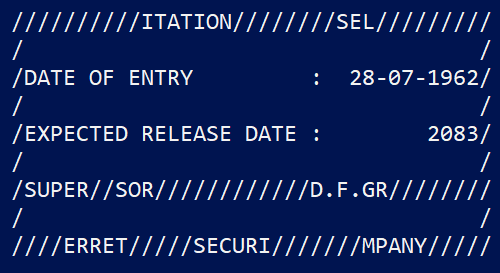
After pushing open the lid to the “Twilight Room” you awaken in, you find a two-room area, with a Resuscitation Chamber next to a Air Conditioning Room. The plaque indicates you entered your slumber back in 1963 and now are awake in (probably?) 2083.

Resuscitation Chamber
This room contains a number of box-like machines. There is a door to the west. To the left of a display are three illuminated buttons, one red, one orange, one green. In the centre of the room, atop a metal plinth is a large chest. The lid of the chest is closed. Fixed to the side of the chest is a brass plaque.
There is a large box here
The large box contains a crystal sphere. Breaking the crystal sphere means death.
The sphere shatters into a zillion pieces, liberating a strange misty vapour which starts doing funny things to your nervous system. You appear to be in a zero survivability situation as your brain finds the off button.
You’ve curled up your toes.
Phase 1 (Awakening)
Mode: Normal
You have scored 10 (out of 1670) points in 79 moves.
Rooms visited: 12. Rank achieved: Dense.
There’s a lot of colorfully described death in this game.
Of the buttons (red, orange, green) the red one kills you as it opens a door to the west leading to your death. What you can do instead is press the orange button, letting you pull a lever in the Air Conditioning Room, then letting you press the green button and open the door safely.
-> push green
The door slides into the west wall with a hiss of escaping air.
-> w
Chemical Store
You are in a cool dark room originally designed for the long term storage of
chemicals. Unfortunately the storage racks are nearly empty. Above the eastern
exit is a flashing sign.
There is a green bottle here
There is a brown bottle here
There are some labels here
This opens the map up a bit more:

There’s some scenery painting and a lot of items to deal with, but before I get into any of those, I have to bring up this in-joke:
Computer Room
You are in a room containing lots of useless ICL computer equipment (what other sort is there?).
(Remember, this is the UK division branch, and ICL was another minicomputer maker at the same time so was their direct competition. I recently wrote about ICL’s game Quest but didn’t finish because the port was buggy. Still hoping either the DOS or CP/M version surfaces one day.)
Back to the regular part of the game, you can pick up a gaggle of objects, some of them with different weights (that is, for example, it appears the rope ladder needs to be more or less carried alone):
a green bottle (with liquid), a brown bottle (empty), a step ladder, a coil of rope, a shovel, some steel drums, a crystal sphere, some labels, a metal hook, a slim candle, a match
To the west (at the “stairway” on the map) it is dark, so the only way to move forward is to use the match and light a candle (which has a short life) or more easily, just turn on a generator.
You are in a large square room. Near the south wall is what appears to be an electrical generator. On the side of the generator are two knobs, one red and one green.
Note that there is reason to want one room on the second floor to be dark, so this isn’t just an automatic case of turning on the lights and forgetting about it. Before describing that floor, let me mention one other obstacle:
Maintenance Room
You are in a small dusty room. There is a large steel plate set in the floor. There is a small opening near one edge of the plate. The plate is closed.
The plate is locked. The “opening” seems promising but I haven’t been able to get anything to work out — I’d theoretically like to reach in and feel for a locking mechanism on the other side? I might be visualizing it wrong and the “opening” is only very small, but this is all the description you get.
PUSH UP OPENING
There’s only one thing wrong with that sentence. The words.
(Aside: One of the norms of this game is that, similar to Cambridge games like Hezarin, examine is mostly a superfluous word. It works as a synonym for “read” in places but otherwise everything that you see is what you get. I of course am still going to keep examining everything constantly out of habit.)
Here’s the map including level 2. (Level 3 is blocked off by debris, so just turning on the lights doesn’t help get to it.)

A “filing room” has a purple folder with a piece of environmental plot.

It appears our last name is “Darkins” but the game is non-specific about a first name, probably to allow ambiguity to gender. Most of the games from this early time period had a non-specific character (AFGNCAAP: Ageless, Faceless, Gender-Neutral, Culturally-Ambiguous Adventure Person) so it’s always interesting to see at least a little snipped of character in. Modern games tend to be an all-or-nothing affair, since you can see the character, but text games allow a bit more flexibility and can be at the halfway point: some things are defined, some are left open to the player. (Or maybe: there is much more going on, and it will get revealed throughout the game. We’ll see?)
The second floor also has a photography room. This is where being dark is helpful.
Dimly-lit Room
You are in a dimly-lit room. In front of you is a wooden bench, above which is
a shelf. To your right there is a sink. Above your head is a length of frayed
string hanging from a rusty metal dome. The only exit is an imposing steel
door to the north.
Exits: N— ——– —
There are some interesting objects here:
a small beaker
which contains
some water
a plastic canister
a stained leaflet
-> read leaflet
The leaflet reads as follows –
Absolute darkness is essential
——————————
1. Use five parts water to one part developer.
2. Use ten parts water to one part fixer.
I have no doubt that the green bottle’s mysterious liquid is either developer or fixed, but I don’t have a second mysterious liquid to be the other portion. I also have no way of getting exact ratios like 5:1. I tried pour liquids between containers a while but it doesn’t give me measurements nor have statements like “you can only pour a part of this because the beaker is too small” invoking one of those water pouring puzzles. Still put 60-40 odds there will be a water pouring puzzle here, but I’m missing some items to be able to make things work. This does mean the candle should definitely be saved for later, when I have to shut the generator down in order to make the darkroom work.
Moving on:
Studio
You are in a brightly painted room. Each wall of the room is a different colour. The north wall is white, the east wall yellow, the south wall black and the west wall blue. There is a pile of debris in the middle of the floor. There is a hole in the ceiling.
I tried taking the rope, hook, and rope ladder and making various tosses, but my strong suspicion is that you drop the rope ladder from the top, having arrived to the third floor — in other words, this is a bit of geography that gets looped around to, as opposed to something that gets used right away.
Corridor
You are in a featureless corridor with a large strong door to the east.
Exits: NS-W ——– —
There is a camera-like object mounted high out of reach on the wall to your left. As you entered, a red light on its side began to wink.
-> n
Security Room
You are in a room containing surveillance equipment. Mounted above the smashed central control panel are a number of television monitors. The monitors appear to have been wrecked, however one of them still seems to be functioning. To the right side of the panel is a slot. There is an armoured door to the west. There is a metal plate above the door.
Exits: -S– ——– —
Two important pieces here:
1.) The camera starts tracking as you enter the east end of the corridor. After five (?) turns it finds you and you get fried by a mega-death laser. Given the game’s structure I suspect that means in order to defeat the camera’s mechanism you need to push things to the limit; that is, make two passes by the camera, which gives you enough equipment / knowledge / whatever to stop the security system.
2.) The Security Room to the north requires something for the slot. Oddly I haven’t been able to examine the monitor that is functioning, I don’t know if I’m using the wrong verb? EXAMINE MONITOR just gives “They appear to be monitors.” which is not terribly helpful.
Heading past the camera to the south yields a room with a window, so you can climb outside to a fire escape.

Going up reveals a balcony “just out of your reach” and I suspect this is where you actually climb up to the third floor, I just haven’t tested enough things yet. Going down leads to some “Grounds” where around the back you can find some wooden oars (?) and in the front you can find a signpost.
You are standing on a large tarmac circle in the grounds of a large building. It is just possible to discern a large H painted on the tarmac. There is a strong door to the west which is blocked by a pile of rubble. There is a wooden stake set in the ground near a small gap in a continuous high fence to the east. There is a signpost here.

The H suggests perhaps you’ll find a helicopter later. Trying to sneak out through the east is fatal:
Eeeeeeeeeeee-aaaaaaaaaaaargh!
You feel as though you are floating. In fact you are falling headlong over a cliff. As you see the rocks below approaching at an ever faster rate your totally uneventful life flashes before your eyes in a nanosecond. Splat!
I’m afraid you’ve kicked the bucket.
So to summarize, my obstacles are:
a.) security camera
b.) security door
c.) photography room (maybe needs to be later anyway)
d.) locked panel on first floor
I don’t know if the cliff really counts as an “obstacle” — I think the intent is you somehow escape the complex in a different way. But the various information sources on the game imply you eventually escape and start searching for survivors of the post-apocalypse.
Speaking of: what happened? Why is the building abandoned but the power was left going so you could still survive? Did you really go through the entire 100 year process or is this earlier in time? There’s no treasure-hunting here; rather unusually for one of these giant mainframe (er, micro-computer) games I’m interested in what’s going on as a plot, rather than just hoping for good puzzles.
For those who want to try this game and join in, my bare-bones version is still up. (TIP: Run the FERRET.BAT file, NOT the EXE file — when you die it otherwise kicks you out. If you die with the BAT version you can type FERRET to start the game again and the death message won’t disappear before you can read it.) You are welcome to suggest actions in the comments even if you aren’t playing. The only thing I’ll say is if you know an answer (that is, you’ve played ahead and confirmed something) to put your text in rot13 encryption. I’m honestly going to be mostly open for back-seating here — this is a plenty long enough game to not make things harder — but I still may want to wait a little seeing a solution if I’ve got a puzzle idea still to test, plus some of the other people reading may not want the spoiler themselves.
For today’s selection we have a colossally large game which has been worked on at a steady clip for 40 years, yet it appears almost nobody has heard of it or played it. While Ferret is a 1982 game, it has only been finishable by the general public as of August of this year.
Digital Equipment Corporation, of PDP-10 fame (PDP being the Zork mainframe of choice) had some engineers who were frustrated with management and split off to form their own corporation in 1968, Data General.
Data General is mostly known for Nova series of computers (which then helped inspired Xerox with their Alto, which then went on to help inspire Apple with their Lisa). While like any respectable mini-computer it was intended for business, and like any respectable mini-computer it was used for games, or at least one game. (See, for comparison, the ICL corporation and their game Quest.)
ferret. v.i. rummage, search, (around, for, about); search out (secrets).
Data General, while being founded in the US, had a UK Systems Division. In 1982 a small group of people from the Division (whose names we do not know) made a game called Ferret in the language PL/I. PL/I can be best described as an attempt to “fix” FORTRAN and make it appropriate for both scientific coders and business coders, essentially mashing together the FORTRAN and COBOL crowds. Example: original FORTRAN uses matrices in columns, like vectors, whereas for business applications you generally want rows, one row being one entry in a database. PL/I allows “array cross-sections” which essentially let you have it both ways; you can make SUM(B,(*,3)) or SUM(B,(3,*)) to refer quickly to either a row or column. (Source.)
To ZORK players:
Yet again you have the opportunity to experience sleepless nights spent trying to solve parts of a puzzle, because this game is very much like ZORK (only better). You can ignore the rest of this [information] as the game is based on the ZORK philosophy (there are some exceptions and some extras that you will find as you play the game).
Being on a mini-computer meant that the game was essentially only playable by a small number of people in the 1980s, and once the mini-computers were shut down the game stopped being accessible entirely. Just like Quest, there was some interest in porting the game, but unlike that game, it did not go through a whole set of mini-steps: it went directly to a PL/I interpreter for DOS in 2009, runnable under Windows console.
09/09/2009 8.10 Initial release under DOS.
12/10/2009 8.11 Fixes for erroneous messages relating to the lid in the Dark Room.
01/03/2011 9.00 Major extensions to rooms, puzzles, verbs etc.
15/08/2022 10.00 Final functional release with end game.
Oddly, the main package on the official website is for Windows 95. However, it uses an install procedure which triggers modern virus/trojan detectors, and I’m not even sure it is really a false positive (the game copies things into directories which were fair game in Windows 95 but considered highly protected by at least Windows 7). As of the current version of Ferret, the authors have put their own version with install elements removed, so you don’t need to worry about virus detectors; just download that version from the website if you’re having trouble. (EXTRA TIP: If you run FERRET.EXE directly the game exits immediately if you die after the final message; if you run FERRET.BAT instead it will kick you to a command prompt as intended and you can type FERRET to restart.)
Now, I did say the authors were anonymous. Despite the quite recent update, and their endorsement of the ifwiki history page about the game, they are listed as only Ferret Authors. Usually when I have an anonymous game it is because of source code being detached from context, or having REM statements scrubbed, or having the whole package under a “company name”. Here, the authors quite intentionally decided not to be named.
The description of the first room gives a clue to your circumstances: “You appear to be lying in an exceedingly small dark room and you feel as if you have been sleeping for ages. You are very drowsy, your body appears to be quite heavy and feels partially numbed. There don’t appear to be any exits from this room”. You have been automatically resuscitated and find yourself in a post-apocalyptic world where your mission is to explore your new environment and try to discover if there are any other survivors.
I’m still unclear as to the objective. I can say with near-certainty that the game is very, very, long, potentially in Warp territory. From the HELP command of the game, it has:
390 verbs,
3449 objects and there are currently
1785 rooms defined (NB. not all of these are accessible).
Since I managed to do well with Warp during IFComp (2022 still ongoing!) I figured perhaps I could do the same here.
Dark Room
You appear to be lying in an exceedingly small dark room and you feel as if you have been sleeping for ages. You are very drowsy, your body appears to be quite heavy and feels partially numbed. There don’t appear to be any exits from this room.
-> stand
As you attempt to stand up, the lid of your room bounces up due to the impact of your head.
-> kick roof
Owwww!
-> feel lid
Touching that has no effect.
-> feel floor
Touching that has no effect.
-> feel wall
Hmmm…. It’s got a rather nice feel to it.
-> yell
Aaaaaarrrrgghhhhhhhhhh!
-> jump
Jumping like that all over the place only gives you sore feet.
-> i
You aren’t carrying anything.
-> hit lid
With what?
-> kick lid
Owwww!
The opening here actually stumped me for a good long while, and I needed to break out my verb list right away and start checking. Fortunately the parser is good, at least so far (while the game kind-of dates to 2022, this is a direct port of original PL/I source as opposed to the result of remakes, so I expect it to be fairly close).
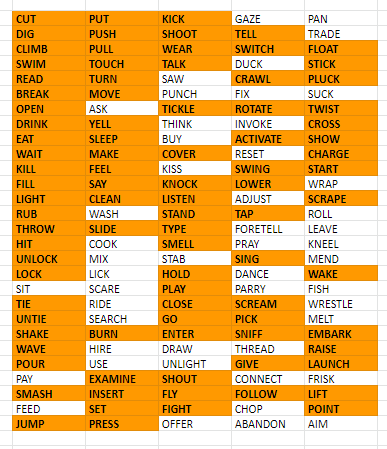
That’s a lot of orange. There are a few that might be just jokes and some that the game is counting as nouns instead of verbs (SWING: “What would you like to do with that?”) this is still one of the most lit-up lists we’ve had in the entire Project.
SHOW, interestingly enough, states “Show exits mode is enabled.” AUDIT turns on making a transcript of play, and MAKE does the same thing but just with your inputs; the points is to make a “macro file” that can be used to play through a particular section by essentially cutting-and-pasting commands. (This is similar to macros in Warp, but a little more user-convenient.)
Then there’s TEST, and I’ve never seen anything like it before. It has the player run every verb on a single object. A sampling of TEST being applied to the “lid” at the start:
CARRY LID
That doesn’t appear to be possible.
RUN LID
What are you, a computer operator?
GET UP LID
Such notions indicate that you have the brain of a newt.
KNOCK ON LID
Nothing much happens.
IN LID
That disney make much sense to me.
OUT LID
That doesn’t make much sense to me.
UNLOA LID
I don’t think you can load that, let alone unload it.
I guess the verb list isn’t supposed to be that much a mystery. The missing “D” for “UNLOAD” is because the game uses only the first five characters of each word. The Infocom standard at this time was six so this isn’t that unusual.
Moving on with the game itself:
Dark Room
You appear to be lying in an exceedingly small dark room and you feel as if you have been sleeping for ages. You are very drowsy, your body appears to be quite heavy and feels partially numbed. There don’t appear to be any exits from this room.
-> PUSH LID
There is an ominous creaking sound followed by a clunk. Light encircles your body temporarily blinding you.
Twilight Room
Your eyes appear to have adjusted to the light. Beyond your shell-like cover you can see a number of machines, dotted with switches and readouts.
-> LIFT LID
There is a loud piercing creaking sound, the world appears to spin and you tumble unceremoniously to the floor. The container you were in clangs shut.
Resuscitation Chamber
This room contains a number of box-like machines. There is a door to the west. To the left of a display are three illuminated buttons, one red, one orange, one green. In the centre of the room, atop a metal plinth is a large chest. The lid of the chest is closed. Fixed to the side of the chest is a brass plaque.
Exits: –E- ——– —
There is a large box here
-> score
Phase 1 (Awakening)
Mode: Normal
You have scored 5 (out of 1670) points in 54 moves.
Rooms visited: 4. Rank achieved: Dumbo.
Yes, I turned on the show exits mode. I know what I’m like.
Reading the plaque:
There’s a Facebook group for the game with no members as of this writing except for the Ferret authors (and myself). It has been on all the various sites (here’s an announcement post on intfiction, here’s an entry at CASA) but the only glimmer of interest I’ve found otherwise is a post by past Parsercomp entrant Jonathan asking about what people knew about the game, where the only response was the Ferret authors explaining they originally thought of potentially charging money for the game, but that “the money-making boat sailed.” The Ferret authors also explained that the “Adrian” who supposedly finished “Phase 1” by “5-2-2016” (according to the main web page) was familiar with the game from back in the Data General days.
While I’ve gotten a bit farther, I’ll start writing about the post-apocalypse in depth next time.
-> PUSH RED
The door slides into the west wall with a hiss of escaping air.
-> W
You have entered a very odorous room. Your head is starting to spin.
Your head has unscrewed from your body and is bouncing around on the floor.
You’ve bought the big one.
(Part 2 on Ferret is now posted.)
(Part 3 on Ferret is also now posted.)
(At 10 parts now and counting. You are best off using this link which will read everything in chronological order.)

From Giant Bomb.
In 1978 the author Mitsuru Sugaya debuted one of the first videogame-themed mangas, ゲームセンターあらし (Game Center Arashi).
The title character, Arashi, aimed to beat various competitors at arcade high scores.
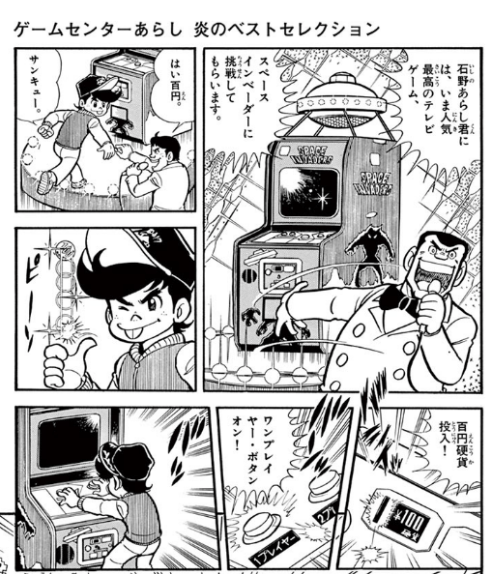
From the first issue.
Prominent games like Space Invaders (above) and Galaxian were featured. In a later spin-off feature, the author produced a series of two volumes, Hello Microcomputer, which taught readers both about how computers worked and how to code. The volumes sold incredibly well, over half a million copies; according to the author, some who got careers in the computer sector were inspired directly by the books.
The second volume included a section dedicated to a game called Mystery House; not the one by Roberta Williams, but the one directly inspired by her work released in 1982.
As mentioned in my post on the first Japanese adventure we know of, Omotesando Adventure, hobbyists in Japan imported games from the US and played them with dictionaries, so they were well aware of the early Sierra works. The Hello Microcomputer issue with Mystery House even includes a section on imported games, like Time Zone. (Based on the December 1982 issue of LOGiN Magazine, the top-selling Sierra import was Softporn Adventure.)
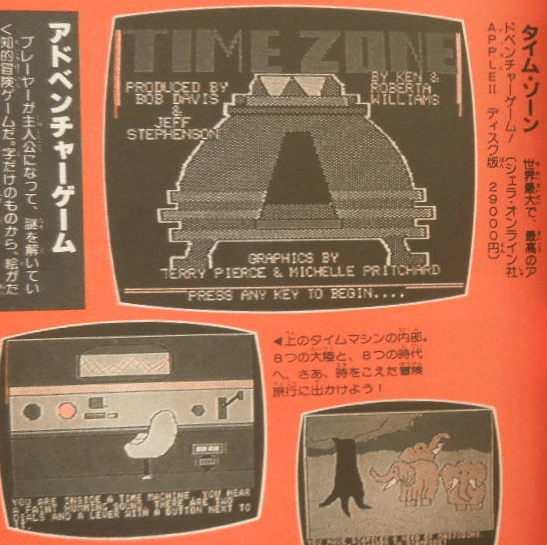
From Yahoo! Auctions. The price of 29000 Yen is roughly comparable to the $100 the game cost in the US, which in 2022 dollars is a little over $300.
The 1982 work was originally by Tsukasa Moritani, a dentist and regular visitor to the electronics/computer store Micro Cabin Yokkaichi.

He showed it to the owner Naoto Oyachi, who was impressed enough to work with Tsukasa to produce a publishable product.
The final work was for the Sharp MZ-80B (released in May) did well enough — spawning a sequel before the end of the year — that it was ported to multiple machines and was the basis for the general launch of Microcabin as a software company. Microcabin became one of the big Japanese game publishers, lasting all the way until the 2000s.
I am not going to play the Sharp version, although if you want to see it (and hear its rendition of the Pink Panther Theme) I’ve linked the relevant spot in the Bowl of Lentils video. I didn’t have a choice. That version is undumped.
I at least started to try the NEC PC-6001 version, which has a translation patch to be able to play in English. (As far as why I didn’t keep going, I’ll explain in a moment.)

The Pink Panther theme also plays on this version, and it is there because this game drops the “murder” aspect and just keeps the “find the treasure in a house” aspect, making it a diamond. The original Pink Panther movie surrounded a stolen diamond.
Mind you, the game is already partially in English; while the text output is in Japanese, the parser is in English. There’s a helpful guide card that gives translations of each of the words needed. Additionally, the verbs and nouns are separated, so they get typed on separate lines (that is, you can’t type OPEN DOOR, but OPEN. followed by hitting enter, then DOOR, then enter again).

What I discovered after enough testing is that there are two very different versions of Mystery House’s gameplay. The original Sharp version (and some other versions like Fujitsu FM-7) are “traditional” in that they use compass movement commands typed on the parser. The PC-6001 version (the one I started with) and the MSX version both use arrow keys for movement (that is, the N/S/E/W on the card above don’t apply).

An interior shot of the PC-6001 version.
In all versions, the game keeps track of what direction you are facing. In the Sharp and FM-7 versions if you type W for west but aren’t facing that direction the game will simply turn you that way. If you are facing that direction then the game moves you forward. The arrow-key games on the other hand will either turn you (if you press left or right) or move you forward (if you press up).
It is possible to get go up some stairs and then type DOWN to immediately go back down and get denied. That’s because the stairs are “behind” the player — you have to turn so they are visible, then go downstairs. (You can watch a video here of this happening to a real player.) In a way, the PC-6001 and MSX versions are simplified in this sense. Stairs can only be clearly seen in facing the “correct” direction so it makes a bit more intuitive sense that you can’t go DOWN again right away.
The graphic system feels both crude and intensely complicated at the same time. There’s a limited set of object graphics that get reused to form rooms, rather like Castles of Darkness; so unlike the Sierra games, it isn’t like there’s a custom room for each location. But the game needed the logic to draw the objects correctly as if traveling through a 3-D world; Deathmaze 5000 and some related games did something similar, but in a mostly wireframe format! Despite the clear inspiration, I find any characterizations of 1982 Mystery House to be just a knockoff of 1980 Mystery House to be misplaced; it clearly is doing its own thing both in a technical sense and a gameplay sense.

Alas, the interface on the PC-6001 version was just miserable to navigate. The parser is contained on a separate screen from the main graphic window so you have to keep switching back and forth. Every time a new graphic shows up, you need to hit “space” to switch to the command typing screen, then type out what might be a valid command (see above). If instead of a typed command you need to move, you go to the same typing screen, push a direction, then push it again (for some reason?) to actually do the move. It is very easy to get lost even in a handful of rooms.
I tried very hard to make it work — I even hooked a gamepad with macros for movement to try to make things smoother — but it was just too heavily grating to deal with. I finally decided to switch to the slightly more colorful FM-7 version. All commands are on the same screen as the graphics, and I found it genuinely easier to type W to turn rather than hope the janky arrow keys worked. Even though the direction commands are “overloaded” with them either turning or moving forward based on context, I never got confused moving around. (Based on the footage of the Sharp version, the FM-7 version is more authentic to the original anyway.)


That means, yes, I intentionally dropped playing the English version of the game to switch to Japanese! There really isn’t much Japanese to deal with and everything being graphical means you can puzzle out the action on screen. The only part I got confused is when I tried to climb a ladder and died, but — well, we’ll get to that.

(On the screen above, going “east” means “forward”. The compass in the upper right fortunately is enough to keep things straight.)
Exploring around the ground floor, I found a safe (from MOVE PAINTING) which was locked, a candle in a RACK, and a match in a RACK.

(RACK is a weird word — I want to use cabinet. The player in the video I linked earlier also tried to use CABINET first. I had one eye on the instruction card while I was playing, though, so I knew which nouns worked.)
Poking around the second floor eventually yielded a key sitting on a chair (via SEARCH CHAIR) and a key sitting in a flower vase (via SEARCH VASE).

This is a “two-square wide” room, so you can step forward to get closer to the flower vase, then SEARCH VASE to find a key inside.

The screen above shows going forward one step from the previous screen.

Once I got the hang of things it felt a little like the movement in a dungeon-crawler like Wizardry. Since Wizardry had already been imported, I wonder if it was also an influence.
The keys let me open the safe (which contained a hammer) but make no other progress. However, I hadn’t tried MOVE on anything other than the painting, so I went on a MOVE spree (and was told NO! a lot, the game writes it in English) before finding a movable table.

This leads down a dark ladder where you can die without a light source. Of course, I already had a match and candle so I could normally easily resolve the puzzle, but it took a couple tries to realize the game wasn’t keeping track of the candle as a “long term light source” like Adventure or its clones — it was an object that needed to be activated while on the ladder itself. If you light before going down it doesn’t work.


The second key I had goes to this “rack” and yields up some oil. This let me USE OIL on a cabinet, I mean, rack that was being finicky upstairs and find a new secret area.


The “attic floor” was very small and the only thing I could find (inside a rack which required a hammer to bust open) was a pick (like the kind you mine with) and a ladder that means death.

(I found out after the fact the Japanese indicates that you get up to the roof and fall. This is similar to a death from the original Mystery House.)
There’s a genuinely clever moment here, although I needed to check a walkthrough (by the ever-helpful くしかつ Kushikatsu) to figure it out. The ladder can be moved, and the spot behind the ladder is holding a secret (which is what the pick is for).

This leads to a new area with a key (just laying out on another chair) but where I was otherwise stumped. I had to do something clever with a fireplace but I needed the walkthrough again. You can light the fireplace.

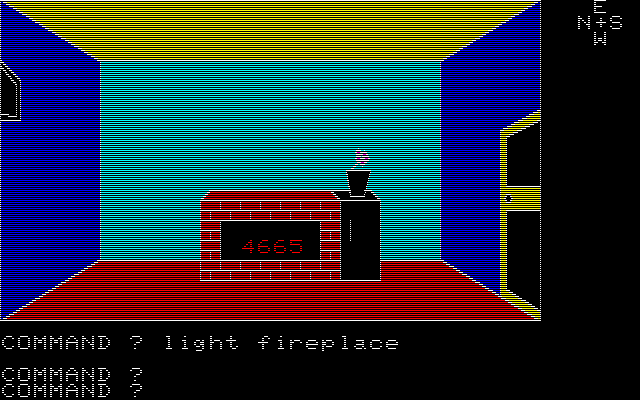
Ah-ha! But where does this code go? It turns out: back to the dark basement. Remember that rack with the oil? It can be moved.
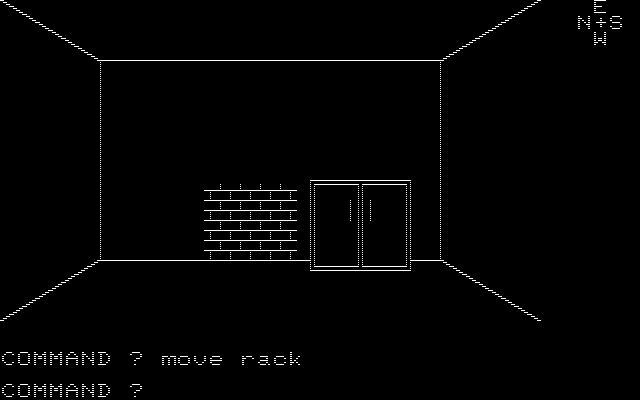
USE PICK then works here.

(One last trick: 4665 doesn’t work. You need to type in the number backwards.)
I admit I was originally skeptical this was just going to be a find-the-key hunt in the end — there are, after all, only a small number of verbs and graphical elements. However, the slight twists like the passage in the rack, the passage behind the ladder, and the code in the fireplace elevated the game up into having something approaching a real plot, even if you were just trying to find a diamond. I mean, er, gold.

(This video walkthrough of the PC-6001 version definitely gets a diamond. The Pink Panther music also doesn’t make sense without the original Sharp version having a diamond. For some reason the FM-7 changed the treasure to gold.)
I will at least plead for anyone else who writes about this game: yes, Dr. Moritani clearly was inspired by the Roberta Williams Mystery House. However, discarding it as just a knock-off (and just a stepping stone to the game people really want to talk about, The Portopia Serial Murder Case) really doesn’t make sense; the navigation is truly novel, the puzzles go in a completely different direction, and the graphics are built off of repeating elements meant to be viewed in a 3-D setting.
I should also add there was almost certainly inspiration from one other game. In some cases if do something the game doesn’t understand (usually referring to an item that isn’t in your current “view”), you get the cryptic message “Nothing to mean.” This is a very unusual and unique message, and it appears in only one other game: Omotesando Adventure. Clearly Dr. Moritani had played more than one adventure, including Omotesando, so we have a true continuity of game influences.
There are also two sequels to Mystery House (one which came quite quickly on the heels of this one) but while I wanted to play Omotesando and this game close together, I’m going to give a longer pause before hitting Mystery House II. Never fear, there’s plenty of interesting territory out there to explore, including my next game, which I can only describe as “incredibly enigmatic”.
I have completed the game, and my prior posts are needed for this one to make sense.

From World of Spectrum. As nifty as Murder at Awesome Hall sounds it is just a clone of the board game Clue.
I didn’t have too much farther to go; my stuckness could partly be traced to a deceptive parser message. But it’s more interesting to approach how I got out of trouble first.
There was, to recap, an animated skeleton guarding a trail. The skeleton didn’t actively attack but wouldn’t let me by, and my attempts to KILL were null and void.

My verb list again.
Adventure games can sometimes be the inverse of RPGs. In RPGs, the the player typically attains more and more objects and capabilities which make it easier to get out of trouble (this is why part 2 of a roguelike is often easier than part 1). With adventures, the player often attains a large object list which eventually gets narrowed down to a shorter one, making puzzles easier to solve; less objects to test as solutions to puzzles. There are enough murderously hard endgames this is not a hard and fast rule, but even grand-champion-hardest-of-all-time Quondam followed this pattern.
The same thing can happen with verbs. Specialty verbs in particular often are invoked only once; for example, while we could FLY with a kite, the kite becomes a “broken kite” and it becomes extremely unlikely FLY gets invoked again.
Here is the list of verbs with every verb crossed out I used at least once:

Some are obviously still potentially useful, like GO and SEARCH, and some I’ve already used more than once, like DIG. The thing to focus on is that there’s liable to be a use for all the verbs at some point in the game (at least in an old-school one).
It is possible in this era to have “placeholder verbs” which do nothing anywhere and are intended to give a more pleasing response than “I don’t understand”; HELP: “There is no help for you in this game.” More modern games have quite a few of these, like the famous “Violence isn’t the answer to this one” response to ATTACK. It can be helpful and satisfying to get this kind of response; the ability to even pretend to do some common act makes the world’s mimesis a little shoddier. With very old games having tight memory requirements, though, they often didn’t have space to waste on placeholder verbs.
SMASH, however, felt all the world like a placeholder verb. It gives the response “Vandal!” which really gets across the message “smashing things isn’t part of the game”. However, glancing at the special verb list, and glancing at the verbs that haven’t been crossed out, SMASH is a really tempting verb to try on the skeleton. I could swear I had already tried it without success (in fact I probably did, more on that in a second) but then I found, voila:

As I said, I thought I had tried it before, so I reloaded an old saved game and tested SMASH again only to find the “Vandal!” message come up. Not only does this come across as a “placeholder” it suggests the skeleton is part of that.
After some testing I realized the difference the second time is I was carrying a LARGE ROCK I didn’t have before. What the parser really should have done is say something like “I don’t have anything that will help with that”. Even the standard “Sorry” would have conveyed a similar spirit.
(The game in general is pretty bad about objects held being used without letting the player know they were used. the fluffy shrub from two posts ago being a good example. Once I picked up a CLOAK and wore it for the rest of the game — it otherwise wasn’t too useful to have. I assume it had an effect somewhere but I still don’t know where!)
Anyway, to circle back: if you’re ever stuck in an old-school adventure, especially near the endgame, try not just to list the verbs but the verbs that haven’t been used yet.
The rest of the game was straightforward. I found a MOUND on the trail that the shovel was able to dig out and get a hole. Inside the hole I found a passage blocked by a large boulder, and it was dynamite’s time to shine.

This leads to some stairs and an “Impenetrable” veil.

Just past the veil is an organ with some sheet music, and playing the music removes the veil. (I’d complain about the puzzle being too easy, but it was still a satisfying act.)

And then there is XERDON.

Just to be clear, he hasn’t seen you yet in the image above: if he sees you, you die. For example, if you try to get out your bow and arrow and use them in the same room XERDON is in.

Fortunately, it takes only a few more steps to go around a back route and find an “arrow slit” where XERDON is visible.


One SHOOT XERDON and it is all over.

This marks the first Howarth game I’ve managed to beat without hints. I don’t think this is due to my increased skillset as much as slightly more reasonable puzzles; despite the presence of quite a bit of magic there isn’t anything where the game asks you to do something completely arbitrary. I think the only exception might be the “smooth stone” where rubbing it summons a beggar, but the smoothness is meant to be a hint, and I did come across RUB quite naturally and quickly so the hint apparently worked.
Despite the presence of a light source with a timer, the author resisted temptation in making the timer run out quickly; I did forget to turn it off for a while and got low on oil, but the entire last part of the game needs no light so it didn’t matter anyway.
While it is possible for one of these games to be too simplistic to be fun, the winning key seems to be to allow for dense systems (like the interconnected navigation) but lean intuitive on the actual resolution to problems. Really (other than the parser issue from this post) I mainly had issues with visualizing; how big is a column of fire? Is a locked grate placed such that tying rope and having a mule pull on it even make sense? Is a “grotesque creature” with no other description something I could reasonably take down with a sword? I had to assume all the possibilities and run through each one.
Howarth stayed on a steady clip; we’ve got two more games for 1982 alone. But for now, we’re going to swerve back to Japan; we recently saw their first adventure game, but their first graphical adventure game ended up being much more important. And then, we’re going to approach one of the most mysterious games I’ve ever written about for this blog, one with a 1982 date yet where it only has been able to be completed as of two months ago.
I know there’s a significant amount of crossover, but not everyone reading this will have heard yet, so
IFComp 2022 Games Are Out
being the interactive fiction competition that has run since 1995.

71 selections this time around. Only 21 of them parser, but I’m guessing some of the energy for that went over to ParserComp 2022 which finished not too long ago.
Still too many to finish them all, but remember, to vote, you only need to have played five of them!

Cover art from four of the games.
(Continued directly from my last post.)

I managed to resolve the column of fire summoned at the tapestry above, but before getting to that, I made the Arrow of Death.

I mentioned a “grotesque creature” at a “guard room” (with no guards). Experimenting around I tried to just KILL CREATURE and somehow got a key out of the process. This is one spot where I think difficulty visualizing what the author really meant hurt things; I didn’t know if it was a giant creature or a small creature, one that was strong or weak. I really don’t know what happened at all or where the key even came from.
This is a common downside with the Scott Adams database system.
Moving on, I took the key up to a previously locked door in the kite/dead guard area (another loop over previously found terrain). This led to a storeroom with cheese and bread. I then took the bread over to the starving mule and made a friend.

The mule was now following me. Since I was on a hot streak I went to visit the prisoner trapped behind a grating, and it immediately occurred to me the rope might be helpful.

I was then able to get the mule to move and yank the grating off, letting me visit the prisoner, who turned out to be a helpful person indeed. He’s mentioned in Arrow of Death Part 1, so I’m first going to give the old Part 1 screenshot, then a new one:


I needed the strength weed again to wake the fletcher up. This was a pretty satisfying object re-use since the first time was to just get stronger turning a wheel, whereas here it is help someone in much worse shape, yet both cases “getting stronger” is appropriate.
One nice side effect is that turned three inventory objects representing the Arrow into one Magical Arrow object.
I was now out of things to do, so I went back to the tapestry and contemplated the column of fire. I realized I was visualizing it wrong: I was thinking of it something small, like the candle. If it was instead something large, I could try entering it, and since the tapestry hints at fire-walking:

Voila! This leads to a new outdoor area and (I think) puts the game back on a linearity path. Oh well.
Near where you exit is a hut with a pipe and tobacco, and in the other direction there is a lake with a boat.


Getting on the boat and picking up some oars, I tried ROW BOAT and got swallowed up by a whale. A whale on a lake. Sure?

The tobacco and pipe presented an immediate solution, so I filled the pipe and tried to SMOKE it twice, causing me to get spit up onto the shore.

This is yet another area in the linear journey, where you can snag a dynamite with a fuse, a large rock, and a mysterious small smooth stone from a cairn.

There’s a shovel, too, which is how you are able to dig up the dynamite. The earlier flintstone was dug up by hand, but the ground is too hard in this area to dig without a shovel.
After significant experimentation I realized I could RUB the stone to cause a beggar to appear (the one from the last game?) I then did GIVE STONE and the beggar handed me off a magic bow, which is handy since I didn’t want to be stabbing the bad guy with an arrow by hand.

And here I am stuck. Back at the shore there’s an “animated skeleton” near a trail which tries to block if you GO TRAIL. Trying to KILL or SMASH or the like doen’t work. Dropping the dynamite there, lighting the fuse, and running away doesn’t work — or at least it causes the dynamite to explode, but nothing to happen to the skeleton. I worry I’ve missed an item somewhere but I feel like I’ve searched the prior areas fairly thoroughly. (That “machinery” I was worried about last time I believe was just a hint as to the effect of the wheel — it was intended to move the large stone to dam up the river, allowing me to go into the mud.)
You’re welcome to take guesses as to what to do next in the comments, but if you know the answer (from playing previously) please hold off for now. This game has been relatively fair and I’d love to be able to beat it otherwise hint-free (not counting any clever reader theories in the comments).
Despite this being a direct plot continuation of Brian Howarth’s Arrow of Death Part 1 (which featured here last year) this marks a transition point in his work.

From Mobygames.
Specifically, his first three games in his Mysterious Adventures line were originally done for TRS-80 only. All further parts (picking up in 1982) were written using the Scott Adams database format, matched exactly enough that the same interpreter can be used to play Scott Adams and Mysterious Adventure games. Essentially, this meant removing “room descriptions” and relying on room names and items (and later, graphics) to create the environment. While it seems something of a loss the portability was part of what led Mysterious Adventures to be successful in the first place. The TRS-80 never lit the UK market on fire.
As far as how this happened: based on a note in this interview, Howarth had seen an article by Mike Woodroffe of Adventuresoft asking for programmers to port the Scott Adams games over to British computers.
Quoting the interview:
A non-programmer friend of mine was very keen to be part of creating adventures and had come across an editor that could compile/create and interpreter that could digest Scott Adams’ adventure data files. It became clear to us that if I could adapt my code to be able to interpret the Scott Adams data files, we would also be able to use the editor to allow non-programmers to write our own adventure data files, then package them up into my new engine and supply Molimerx with their voracious demand. My code was pretty compatible to the way the Scott’s code worked and only required some massaging to be compatible.
So the adventure series was now expanding nicely, but apart from the TRS80 platform, Molimerx only wanted me to port the code to IBM PC. He had no interest in any of the flood of new machines that were starting to saturate the market in the UK at the time. My new targets for porting the engine were machines such as Atari 400/800, Sinclair Spectrum, BBC Computer, Commodore 64, Oric Atmos (seemed like a new machine appeared in the UK each month). From this, I became so embroiled in porting that forward motion on creating new titles ground to a halt.
Something feels a little off to me here — supposedly Howarth’s attention on the Scott Adams format came from Woodroffe’s article, but the actual block quote seems to imply “a non-programmer friend of mine” had “come across an editor” (I would guess The Adventure System). My best reconciliation of the two stories is that Howarth learned about The Adventure System first, saw the Scott Adams format was well-documented, then saw the Woodroffe article, then used his memory of the documentation to be able to make Scott Adams ports.
Also, what does Howarth means about his code being adaptable? If he’s referring to the first three TRS-80 games in the old format, they are rather different and using the database required a complete ground-up rewrite of not just the game system itself but the games themselves. Scott Adams also said (without being specific) that “my recollection of a few of the items may be a bit different” so I suspect there might be some fudging of the sequence of events (perhaps unintentionally, we’re talking about events in 1982). Gareth Pitchford’s run-down of events comes with receipts but I’m still not confident on how things really happened.
Nevertheless, all we’re really worried about in the end is the game itself; to continue from Part 1 I’m going to stick with the ZX Spectrum.

A weirdly existential opening.
To recap, several games ago we found a golden baton, but in Arrow of Death Part 1 we found the baton to be corrupted by some sort of distant evil named Zerdon. In order to defeat Zerdon we needed to get the parts intended to form the Arrow of Death. We successfully found all the parts before the story cut off but had yet to make the arrow.

I wonder what the people who started with Wordier Part 1 thought when they got to this game.
You start out at the edge of the marsh things left off on last time, next to a plain and a chasm. The area appears to be empty for a shrub which is a “bundle of fluffy leaves”, and trying to DIG at the plain (unprovoked, I just had my tingly Adventurer Sense going) reveals a FLINTSTONE. There’s also a “narrow gorge” with “water at the bottom” yet I think this part may be meant just as scenery.

The chasm (see above) can be JUMPed into although it’s a one way trip. This suggests a linear structure but the game subverts that later; still, for a little while only one or two puzzles are presented at a time.

You land near a rope bridge; if you try to cross it a bird flies overhead and drops an iron helmet (which you can retrieve on a lower ledge). The lower ledge is also next to a crevice with a lamp.

Going past the rope bridge leads to a “straggly weed” you can pick up, and then an “iron grille” with “machinery”, which I have yet to be able to do anything useful.

My guess, based on my inventory (which includes a sword from the last game, as well as the pieces of the Arrow) was that I’m supposed to use the leaves and weed somehow to make a fire that connects with the grille? No verb I’ve thrown at the items gets recognized, neither MAKE FIRE nor MAKE SPARK work, so I may just be barking up the wrong tree.
(It took me later in my playthrough before I tried it, but I might as well spoil now what the weed is really useful for is eating; it increases your strength, rather like in Katakombs.)
Going back to the rope bridge, the room is described as having “ropes holding the bridge up”. You can cut the ropes and die. I originally thought perhaps this was a trap or gag, and if this was Acheton that’d be the case, but it doesn’t quite fit in with the Howarth style: once he switches from minimalist to ultra-minimalist, everything is important.

I didn’t find out until much later that if you’re not holding the fluffy shrub, this maneuver kills you; the shrub acts like a pillow.
It turns out this lands the player in a hub of sorts, although it isn’t obvious at first. Here’s the map as it looks on the first pass:

There is a locked door that blocks one route and a “heavy door” that blocks another. Otherwise, there’s a dead guard that can be searched for a uniform, a “wheel” that can be turned (next to a guard; you should disguise yourself with the uniform first)…

…and a “heavy kite” by a platform and the place where the dead guard with the uniform was.

If you wear the iron helmet from the bird you can safely JUMP while holding the kite and float down to the start of the game.

So that means the structure is (so far):
Area 1 -> Area 2 -> Area 3 -> Loop back to Area 1
It took me a little while to realize that the wheel turning is what makes the loop useful. By turning the wheel, you shut off a source of water in a gorge, leaving only mud that can be jumped into.

Searching the mud yields a lever that can be pulled, yielding a passage to a new area I haven’t fully reckoned with yet. There’s a dungeon with a prisoner locked behind a grating:

A “grotesque animal” at a “guard room”:

There’s no guard mentioned in the room, so it is strange the illustration shows a guard rather than the grotesque creature.
A “starving mule” at an “underground stable”:

Feeding the mule some of the strength weed doesn’t work.
And a “temple” with a “tapestry”:
There’s a button hiding behind the tapestry. Pressing it reveals an altar. Looking at the altar reveals a candle. Lighting the candle summons a “column of flame”. Once the column of flame is summoned you can PRAY, and the game claims “Something happened!”

What that something is, I don’t know; this is as far as I’ve gotten. I will say this has been more enjoyable that Part 1, not so much in the puzzles, but in the map. In addition to all the things found in the new area, there’s a bolted door. The bolted door leads back to the wheel/kite area!
Area 1 -> Area 2 -> Area 3 -> Loop back to Area 1 -> Area 4 with Area 3
To be clear with a map:

Red = 1, Orange = 2, Yellow = 3, Green = 4. Green connects back up with Yellow.
This kind of unexpected map interconnection I’ve found to be one of the most satisfying element of adventure games (or really, any games). It does make things slightly more complicated on the linearity front; when you know a particular obstacle will never again be seen, that restricts what objects might be helpful to that obstacle quite seriously, whereas if an obstacle can be returned to much later, it potentially opens up any object in the game. This is the type of tradeoff I’m willing to make for the feeling of a world with more depth than it has at first appearances.
The most curious thing is that the part that I had to skip while still baffled — the mysterious grille with machinery — is the only part I can’t return to. While you can go from Area 1 back to Area 2 by jumping down again, the bridge is destroyed so there’s no way to get across to where the grille is. The fortunate thing is that this isn’t Hezarin; the move count is low enough it won’t be hard to repeat everything, if that turns out to be necessary because of some clever trick missed earlier.
For once, I’m not “stuck”, just “stopped”, but historically I’ve hit a wall with Howarth before, so we’ll see how far this goes.
My verb list, for reference. Orange are verbs recognized by the game. It’s a fairly generous spread; the “cut rope while holding it” maneuver I figured out much more quickly from knowing that HOLD was a possible verb.

From the official Irn Bru Facebook page.
I should’ve known.
The pattern: I write about some halfway-dodgy program, abandon it, and assume I’m done.

The date here differs from the other one in the source of June 19th. I would guess the date here is when this particular room was made, as opposed to the code being started.
My readers take it up as a challenge and finish the thing anyway (Chou’s Alien Adventure being a prime example).
Here, I felt satisfied with what I had seen with Argonath Adventure, but Redhighlander had to go and make it to victory, so I was obliged to give it another try.

The full map, the room is orange being ones I didn’t visit before.
To be fair, I probably should have given it another spin. I often overlook USE as a verb (being so non-specific) and I only figured out how to pick up the Irn Bru at the end of my last session. The way is blocked by some spiderwebs, and while I’m unclear what contribution this particular beverage might provide (is there lore about it being a powerful acid?), here’s the result:

This leads down to a small area with two kitchens, a “monster” that is hungry, and a computer where you are supposed to INSERT a DISC (which I had already from elsewhere).
Of the two kitchens, one of them has a red lever that deposits you in a volcano.

The other has a blue lever that gives you food.

You can take biscuits from elsewhere and feed them to a monster at a jet engine. I’m unclear what purpose this serves, but the monster goes away once USE BISCUITS happens.

Moving over to the computer, you can INSERT DISC to get teleported to a room with a key.


The key then lets you go south from the “Neon Sign” room I gave a screenshot of earlier, and make it to the exit.


The final screen suggests a sort of second game concurrent with the first one, where you try to kill the various monsters for score before escaping. FIGHT alone works, you can’t type the name of the monster, but it doesn’t matter, because this mechanic really does seem to be broken: you just die, even if you fortify yourself first by sleeping and eating.

I admit to finding the “optional objective” here which is almost entirely separate from the main game intriguing, even if it is entirely broken. The closest comparison I can think of from pre-1982 games is Lugi, with a randomly generated map and had tasks like “gather money” which could lend points but didn’t affect the actual element of escape. With platformers and the like, the interface can usually convey that Collectible X is there for points and a shiny medal; with adventure games, it is never clear to the player when one element really is separate, as there just might be a clue or hidden item that requires the right amount of progress.
Is this really the first Scottish text adventure? Well, there’s still not absolute verification of Danny Browne’s identity (but who else would insert a casual Irn Bru reference?) and of course there’s plenty of games on the 1982 list I have yet to examine, but whatever the circumstances, this has a high likelihood of being in the first handful of text adventures from the country.
We’re going to try something a little different today and work through the complete works of Danny Browne. No, not the reggae music producer. I’m meaning a possibly-Scottish probably-teenager, notable if for nothing else we have yet to have a game hailing from Scotland.
I’m guessing, based on factors you’ll see in a moment, Danny was a student who tried his hand at writing adventure games starting in June 1982 and ending in November 1982. I have been unable to locate any ads or reprints of his games in magazines, and based on certain other aspects I highly suspect this is a set of “private games” (like The Smurf Adventure a few games ago), ones written by the author as personal projects but not intended for wide distribution.
Rather helpfully for doing an anthology post, Danny put months (and in two cases exact days) in which he wrote his games.
Acids (May)
Argonath Adventure (June 19th)
The Lazurite Factor (September 3rd)
Memory Alpha (November)
So without further ado:
Acids
The million-selling David Ahl book BASIC Computer Games (first printing: July 1973) included a game called Animal (original by Arthur Luehrmann at Dartmouth), where the player thinks of an animal and the computer tries to guess it with yes/no questions. There’s a stub of questions to start (DOES IT SWIM? IS IT A BIRD?) and then when the computer gets “stumped” the player is meant to give both the animal they were thinking and question that will work to narrow things down to that animal. It isn’t really a game as much as a proto-expert system, of the kind where a doctor can put in responses to a computer’s queries and have a diagnosis get narrowed down. It’s also close to GROW which was used to write an adventure game, except that GROW was not restricted to yes/no responses.
According to Kevin Bunch who interviewed Luehrmann recently, the original Dartmouth version of Animal included a swearing filter because college students are predictable.

Techholtz did the modified version of the game for DEC.
Acid is the same game but for acids.

This is not remotely an adventure game, but I mention it since our biographical material on Danny Browne is non-existent. It is dated as May 1982 which suggests he was a student who wrote this potentially thinking in terms of a chemistry class? (Based on the games that are to follow, probably not a teacher.)
The other important bit of context we can glean from Acid is that based on the source code, and despite the easy accessibility of Ahl’s re-print of the game, it seems to have been made from scratch (at least, it doesn’t match any of the versions I’ve looked at).
(As an aside, Arthur Luehrmann is one of the important oft-overlooked people in game history; he was a physics professor who was an early embracer of computer graphics and wrote the game POTSHOT which is one of the earliest “artillery games”; think Scorched Earth or GORILLAS.BAS.)
Argonath Adventure
The file on this game had some corruption, I think due to the presence of non-standard ASCII characters. It only munges up the title screen but the upshot is that instead of my regular emulator I used the online one at willus.com.

I wish I could give what the objective is, but I haven’t been able to finish and I’m not 100% sure the game is finishable. You’re on some sort of alien planet and there’s a spot where you “escape” but past that I am unclear.

Rather unusually, the player is dropped in their initial room at random; the “opening room” shown above is one of many. I’m not sure if this was intentional on an artifact of the game being a work in progress, because there is an apparent “opening room”.

However, unless you get the lucky random start, the only way to reach the room is through the command FART. Yes, FART has returned to us, for the fourth time. Here, it teleports between a handful of rooms (a different set than the starting one) including the surface of the planet. Once going in any direction, the player is locked in the complex.

The blocked exit at the far lower left asks for a key, and the room above it mentions a web blocking the passage.
There are wandering enemies at intervals. They appear randomly in any room. There’s some mention of combat mechanics in the source but they don’t seem to work, and while FIGHT is a verb the game doesn’t understand when I try to use it. They end up not mattering insofar as you can just leave a room as one appears and come back and they will be gone (or at least, there will be a new re-roll with possibly a different monster).

It’s not worth being harsh evaluating the monster system here as game writers in general didn’t know what to do with monsters. The Crowther/Woods dwarves present a “logistical puzzle” in having to carry around an axe, and the slight bit of randomness (in terms of missing axe throws) keeps things from being too monotonous, but it was hard to expand on that concept and keep within an “adventure framework” (no stats, no complicated RPG tactics). Zork’s thief simply scaled in terms of your overall point score (that is, as you gathered more treasure, you gathered more experience so the thief became easier to fight and you were more likely to win) but even as late an Infocom game as Arthur didn’t improve on that (there’s a knight with a similar mechanic).
The game has three objects: a disc, some biscuits, and a bottle of “Irn Bru”. (The last is a Scottish soft drink which at least strongly suggests the author was not American.)
A note regarding Scotland: Spectrum’s main factory (under license from Timex) was in Dundee, and according to David Cowen (of Grand Theft Auto fame), not much attention was paid to loss prevention, meaning “everyone worked there just kinda walked out with a bag full of Spectrums”, causing a large ecosystem of computer clubs. So we would in fact expect quite a few text adventures to come out of Scotland, but written for the ZX Spectrum, not the TRS-80.

I checked the source later, you have to type “TAKE IRN BRU” as a whole and not worry about restricting to two words.
It’s faintly possible the game is finishable but even with source-diving left me puzzled, and I’ve drained the majority of the content juice anyway. The winning message from the source code is
You are the first person ever to get out alive.
The Lazurite Factor
This one’s unfortunately completely unplayable; there’s strings of broken ASCII characters all throughout the text. It seems to be fairly similar to the previous game, so I just pulled up a few pieces of source code to talk about the changes.
The Lazurite factor
By Danny Browne
3rd Sept 1982
For Futura Industries Computer Division
Again, monsters appear at random, exactly the same set as last time, suggesting that there was cutting and pasting involved.
” An orc ” , ” A goblin ” , ” An esgaroth ” , ” A large furry creature ” , ” A troll ” , ” A biggish red eyed animal ” , ” A minotaur ” , ” A bogey man ”
There’s a good chunk of “auto-message” verbs; that is, the game “understands” the verb but also does not do anything with it, so for example, trying to break anything just says “it refuses to break.” Swearing possibilities are included.
6320 READ L4$ CVS “EAT” + GOSUB ” It’s inedible. ” : INPUT p
6325 READ L4$ CVS “BITE” + GOSUB ” You broke your tooth. ” : INPUT p
6330 READ L4$ CVS “LICK” + GOSUB ” Don’t be disgusting. ” : INPUT p
6335 READ L5$ CVS “BREAK” + GOSUB ” It refuses to break. ” : INPUT p
6345 READ L5$ CVS “SMASH” + GOSUB ” Nothing happens to it. ” : INPUT p
There are five items, including a ROM CARTRIDGE which looks to be the overall objective.
4000 READ ZZ CVS LE + GOSUB ” There is a bottle of lemonade in the middle of the room. ”
4010 READ ZZ CVS BL + GOSUB ” There is a blue disc lying in a folder. ”
4020 READ ZZ CVS RD MKD$ RD CVI + GOSUB ” There is a red disc lying against the wall. ”
4030 READ ZZ CVS WH + GOSUB ” There is a white disc lying on the floor. ”
4040 READ ZZ CVS RO + GOSUB ” An inconspicous ROM CARTRIDGE lies on the floor. “
The blue disc is used to open a bridge path, and the white disc is used to open a safe (with the rom cartridge).
3020 IFI$ CVS “BLUE DISC” MKD$ BL$ CVS I$ + GOSUB ” A bridge swung across the chasm. ” : BL$ CVS ” ” : CH CVS : INPUT [
3070 READ I$ CVS “WHITE DISC” ANDWH$ CVS I$ + GOSUB ” The safe opened. ” : RD CVS : WH$ CVS ” ” : INPUT USING
Regarding the ending, I’m wondering if I’ve missed some tech joke here, because the finale text suggests the cartridge is worth millions.
2220 VARPTR : GOSUB ” You have escaped with the valuable rom cartridge! You are RICH! ” : GOSUB ” By the way,will you lend me a few million? “
It is faintly possible the game is recoverable, since the textual errors seem to at least have consistent patterns, but for now let’s move on to the last game:
Memory Alpha
Memory Alpha had no garbled text, and I was able to run it with my regular emulator.

I played for a while, found it fairly broken still (including two crashes at random points) and did some searching around until I realized this was nearly the same game as Conquest of Memory Alpha, which I just wrote about. (To be clear: yes, I played Danny Browne’s version first.) It looks like Danny tried to modify the game to his own design but stopped halfway through. It may have been just to try to study the source code rather than make a game, or it could be the difficulty was such he wanted to hack it to see what the inside of Memory Alpha was like.

The arrows have been added in. If you try to blow the tank at the entrance up with a grenade the game crashes.
So, my apologies there wasn’t some delicious nugget of lost gaming history this time, just some experiments of a mysterious coder who will not appear again. In a sense, though, this gives a swath of what I can only imagine occurred with regularity: people in the early 80s who were interested in adventure games, but not quite capable of coding one all the way through, yet still fascinated enough to keep trying.

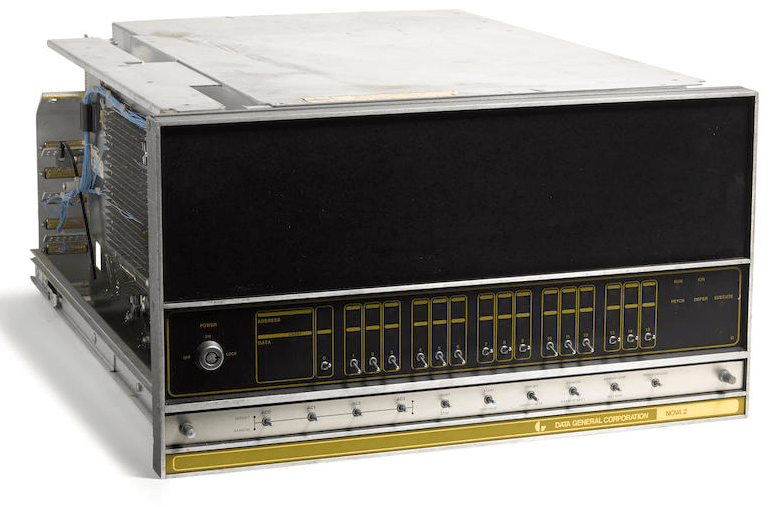
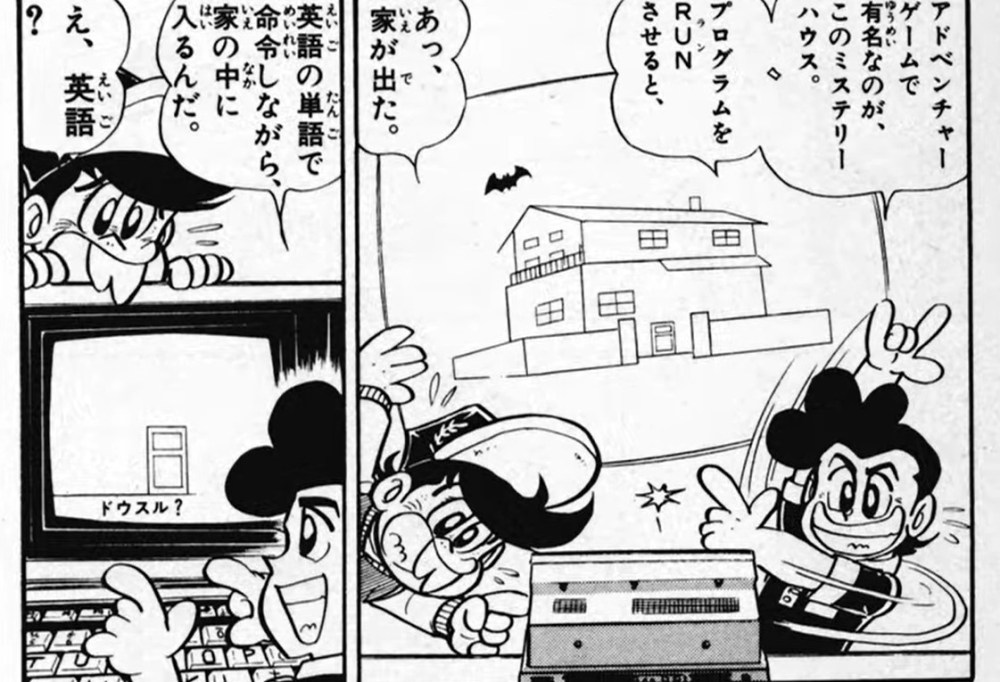


 Renga in Blue