I wanted to knock down one more game from the Rainbow Book of Adventures contest (the first text adventure contest) before moving on to other things. There will be eight left to go (saved for some future time).
Deed of the York is another case like Escape from Sparta where something went awry in the credits. Specifically, the opening title screen indicates a different original author than Chris Harland (as seen in the image above).
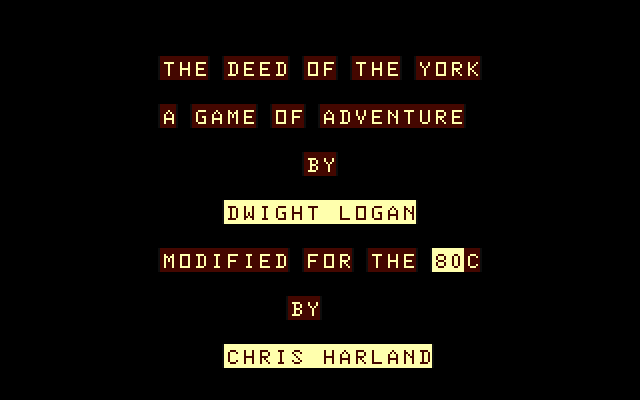
So the game is actually by Dwight Logan, originally? (Oftentimes, the port author isn’t considered an “author” at all although changes can sometimes be major enough to warrant that title.) Further muddying the waters is the book’s biographical note:
Chris Harland is a bilingual high school student in the “Great White North” [Regina, Saskatchewan, Canada]. Some of his interests include sports, money, computers and rock music. Chris wishes to thank Dwight Logan and Gerald Nunn, whose initiative and help respectively ensured the program’s creation.
The description of Dwight Logan being the “initiative” certainly seems counter to the idea of him writing it in the first place. This ambiguity also raises a question on the nature of Gerald Nunn’s “help”. Just to be safe, I’m crediting all three.

The author-location also reinforces the point I made about authors coming from everywhere across the map for the contest; the author is not from Ontario or Quebec (the two computing hotspots at the time) but Regina, Saskatchewan. We have encountered the place once before with the deeply surreal game Fantasyland. (While “ranking” doesn’t make complete sense here, I’d say Fantasyland is still the most surreal game this blog has encountered.)
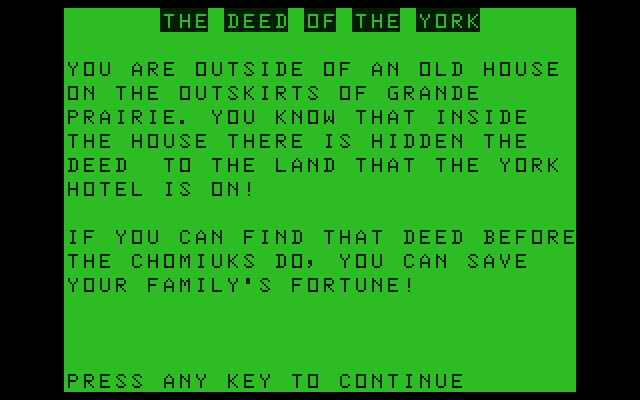
Your grandfather has died and the deed to the York Hotel is hidden somewhere in his abandoned summer home; your job is to find it without dying.
The game also informs you that you need to start by typing the word PIZZA. It then gives you an absolute blank prompt, no room description at all, before PIZZA is entered.
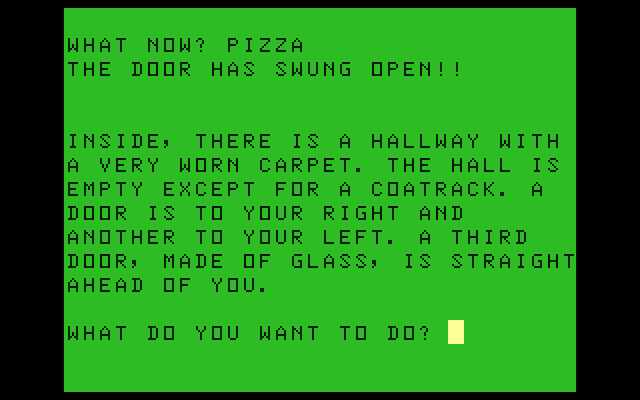
If you can’t tell yet already, this is another game in the wildly-bespoke category, where every location special-codes various commands. Some sample code to illustrate, which only operates in one of the map rooms:
56 IF LEFT$(C$,7)>="SMALLER" THEN 164

57 IF LEFT$(C$,5)="LARGE" THEN 69

58 IF LEFT$(C$,7)="FOLDING" THEN 69

59 IF RIGHT$(C$,6)="SHEETS" THEN 68

60 IF LEFT$(C$,4)="BACK" OR RIGHT$(C$,4)="LEFT" THEN 34

61 IF RIGHT$(C$,4)="DOOR" THEN 169

62 IF RI6HT$(C$,5)="CHAIR" THEN 65
What makes this even harder to deal with than other games of this kind is a.) a number of crashes, which I’m fairly sure are authentic bugs rather than issues on the emulator’s end…
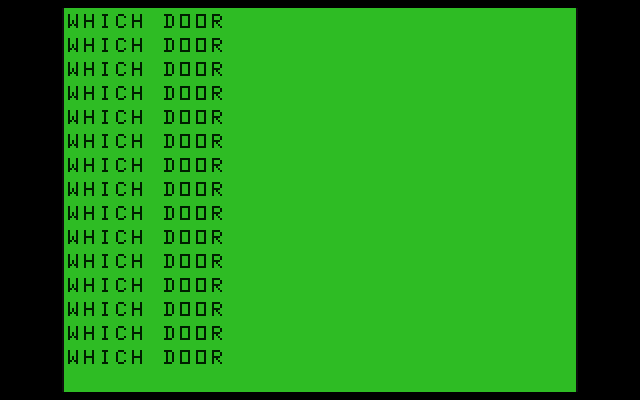
My attempt to OPEN GREEN DOOR at one room.
…b.) and also the fact it uses LEFT/RIGHT/STRAIGHT/BACK as directions (as shown in the code), and the map is completely wrecked besides. To map things out I used west for LEFT and east for RIGHT.
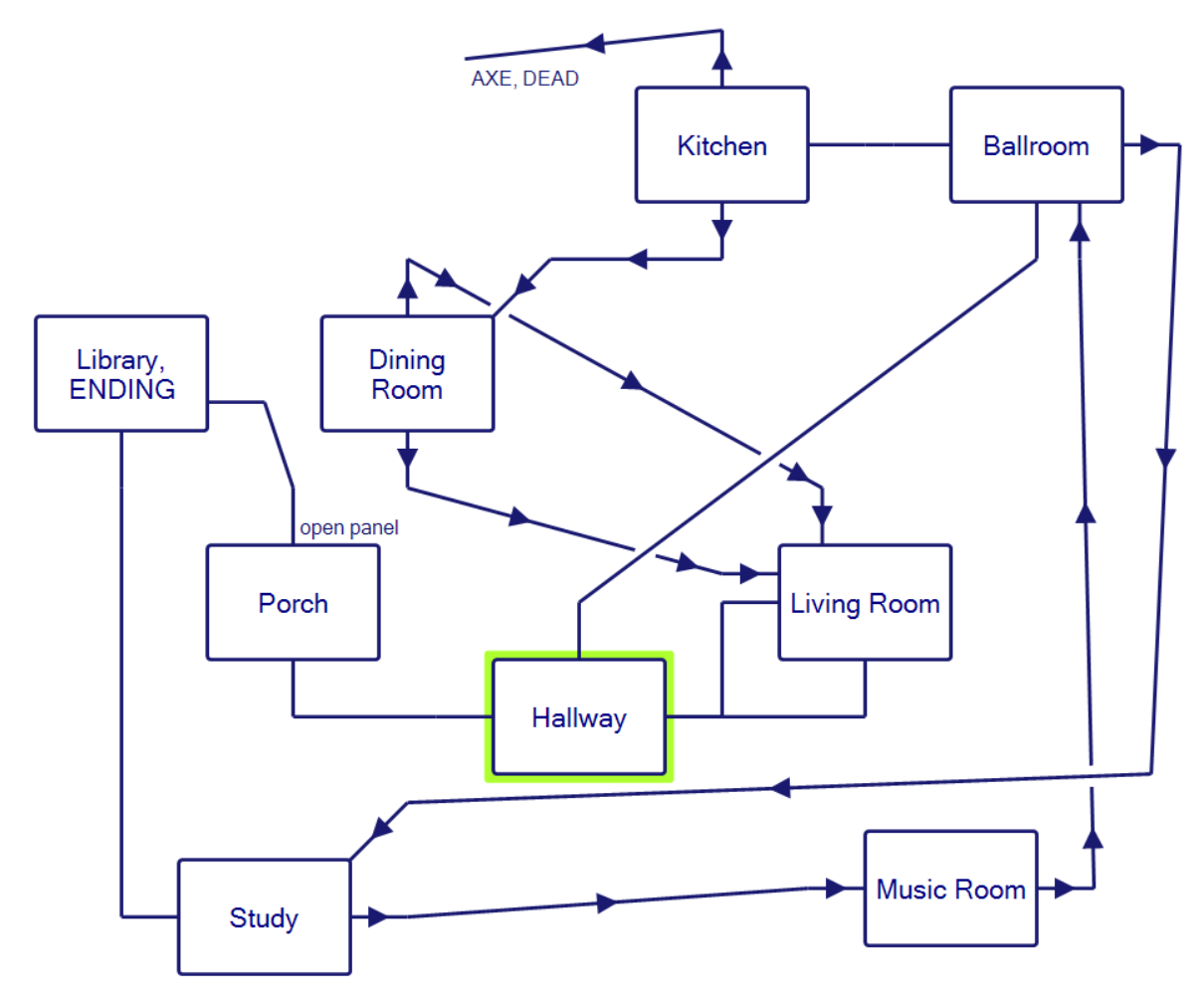
From the opening room (the hallway) you can go STRAIGHT to a ballroom or BACK to the same hallway, you can go LEFT and BACK or RIGHT and BACK as well. That is the end of the game’s consistency in terms of directions, as everything else is chaos.
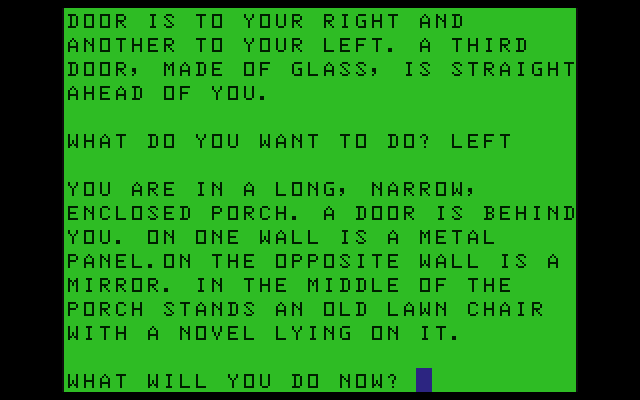
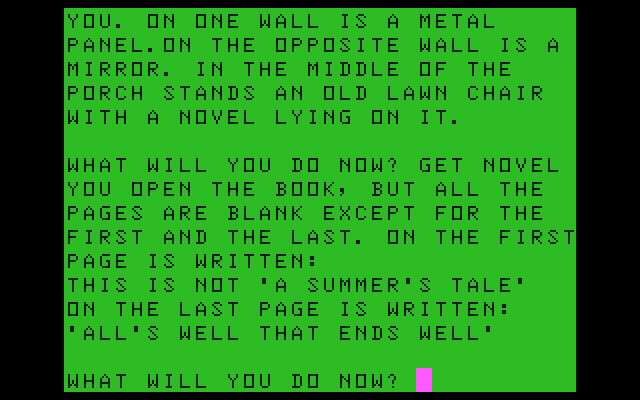
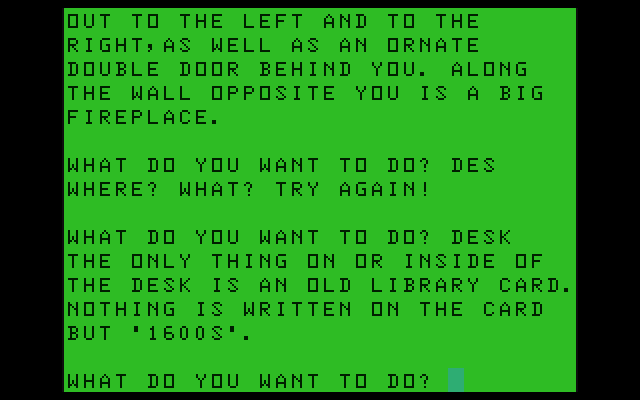
As the second screenshot indicates, there are no items. GET NOVEL is actually interpreted as NOVEL and then the game describes the novel. This is one hint of multiple ones around the house as to what the right action is to do to get the Deed (you need to type one specific thing in one specific room).
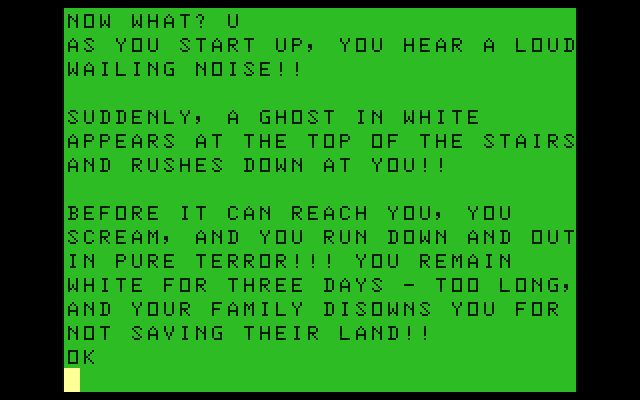
Otherwise, the house is full of deathtraps, or at least game overs. The ballroom has a stair, and going up results in meeting a ghost and losing you the game.
In the cheekiest moment, going through a door causes you to be hit by an axe, and this is followed by a left-or-right prompt.
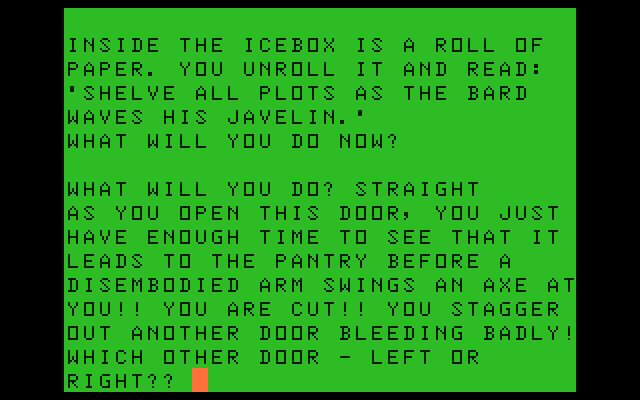
Picking right ends the game (in a hospital) and picking left also ends the game (you end up dead).
Amidst all the chaos, the key is to realize in fact you are getting a consistent set of clues and all the game is really asking you to do is apply them. In addition to the ones I’ve shown, the starting room has a coatrack with the initials W.S., and a couch is engraved WILLIAM & ANNE.
You need to get into a library (the only way I found was by referring to a PANEL, not any of the L/R/A/B directions) and then, at a library with books (where the game repeatedly insists you can’t refer to the words in the parser), just type the word SHAKESPEARE.
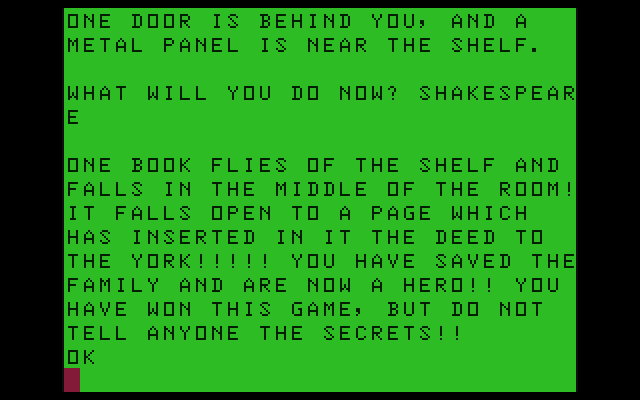
Conceptually, I like the idea of a one-puzzle game spread out across a house where you’re trying to find one hidden thing. In practice, the puzzle was not in solving what was getting hinted at (which was fairly incessant) but rather in dealing with the parser in the first place, and that saying the word SHAKESPEARE somewhere in particular might even be useful (usually it just gives a blank prompt!)
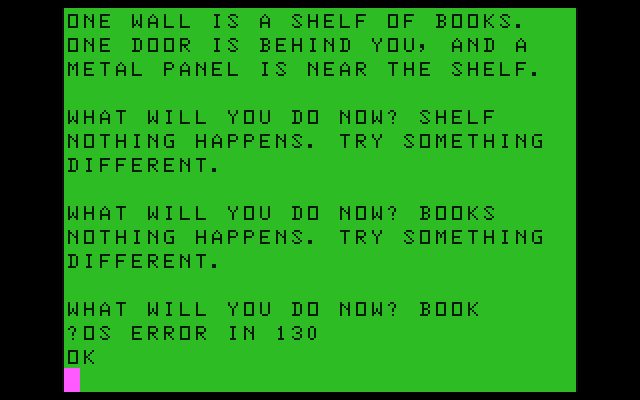
Also messing about with the books in the library can crash the game.
I’ll mark this on the list (along with Raymer’s The Room) as “interesting concept for the time, but implementation couldn’t rise to the occasion”.
Coming up: One more Britgame, and then The Coveted Mirror.


I think this must be the Dwight Logan in question:
https://peacecountrysun.remembering.ca/obituary/dwight-logan-1088636749
There’s also a Gerald Nunn who’s a software developer in Victoria, BC but who got his electrical engineering degree at the University of Saskatchewan from 1985-1989.
I’m not exactly sure how the chronology all lines up, but based on this I’d guess that Harland might have moved to Regina from Grande Prairie, where Logan had been one of his teachers at some point. There also seem to be a few Chomyc/Chomik families that are native to Grande Prairie, so the “Chomiuk” reference in the game’s introduction might be an inside joke from his time there. Additionally, I would guess that Nunn might have been a high school friend of his in Saskatchewan.
Just guesses, though.
I ported this game to MC-10 a while back. I recall fixing a number of bugs. I hope they are all the worse ones you ran across. This has got to be among the earliest Canadian BASIC text adventures. Thanks for the walkthrough.
Dale Dobson describes a pretty wild one of the bugs here where the word SHAKESPEARE it looks for can actually grow into multiple copies until it crashes
https://gamingafter40.blogspot.com/2014/10/adventure-of-week-deed-of-york-1983.html?m=1
did you have a specific post about Deed of the York? I didn’t see anything on your blog but search sometimes fails me
No specific post. I’ll go back and look if I have any notes and maybe put something up. I do recall that growing SHAKESPEARESHAKESPEARESHAKESPEARE problem now that you mention it. I’m pretty sure I fixed that one. I’m curious if you have any sense of any earlier Canadian text adventures? I know you’ve mentioned some early ones coded in an obscure “B? C? A?” language trapped on a magnetic disk at the U of Waterloo, which might be earlier (I’d really like to get my hands on that code). But anything else? The other early Canadian one I have is “Another Haunted House Adventure” by Geoff Wells, February 1983. Maybe “Explore/Manticor” by Jim Butterfield (Jon Bradbury?) counts? 1981? Maybe 1980? Maybe “Fantasyland” by Vincent Sorensen 1982? But these might be more CRPGs…
explore is earlier than that, we’re talking like 1979
You can find all that stuff on the TPUG CD
https://ia600500.us.archive.org/view_archive.php?archive=/3/items/tpugusersgroupcd/TPUG%20Users%20Group%20CD/TPUG%20Users%20Group%20CD.iso
do check out the PET catalog in particular, that’s where all the very early stuff is
I have tried some very early Canadian text games from this which aren’t really quite adventures but would still be of interest to you
Click to access view_archive.php
oh also I did Fantasyland already
https://bluerenga.blog/tag/fantasyland-c64/?order=ASC
the disks you’d want to look at are
(O)G1 – SIMULATION I
(O)G7 – SIMULATION 2
(O)G9 – SIMULATION 3
Although G1 in particular has the very old stuff
one of the misc disks I just noticed a game I hadn’t seen last time I went through here:
(O)Z2 – SCUBA ADVENTRUE
no idea what this is
Scuba Adventure seems to just be an animation.
To Jim, Re: early Canadian text adventures
I’ve done a lot of research/preservation work on this subject, and here are the basic facts, off the top of my head:
The first known Canadian adventures were written at the University of Waterloo on a Honeywell mainframe by Marc Niemiec and Brad Templeton in a unique B/C variant that Niemiec created. The history behind them is a bit complicated, but they’re quite early, with the initial work dating back to ’77-’78 and continuing through ’79-’80. I’ve been in touch extensively with both authors and other people who were involved with the mainframes there at the time, and I was able to help preserve all of the remaining code and game files. I was also able to uncover some history behind another early (but lost) adventure game written there.
Long story short: Templeton’s game code (Martian Adventure), only survives in an early version that’s too fragmentary to do much with, although the finished game’s executable still likely exists in a backup archive, but can’t currently be run for various technical reasons. Niemiec’s main game (New Adventure), is luckily much more intact and complete, but will require an extensive reconstruction/porting project to ressurect it. I have this slated to begin fairly soon, after I wrap up a few other long-term preservation projects I’ve been involved in, and would welcome some help with it. If you’re interested, let me know and I can give you more details.
As for the earliest Canadian adventures for home computers, here are a few others that I’ve dug up or worked on in some capacity:
‘Treasure Hunt” and “Magic Garden”, by Jack Valero of Nepean, Ontario, for Heathkit H8 and H89 CP/M, from 1980. Lost, but I’m actively searching for them.
“The Guardian of Time”, for CP/M, by H.A. Lautenbach of Toronto, from 1981/1982. I dug this one out of a misnamed file in an old CP/M archive a while back. It was written with the ADVEN-80 system.
“Arsène Larcin”, for Apple II by Éric Primeau/Logidisque, from 1982. The first known French language adventure (well, sort of) from Canada, aside from an early French translation of Adventure/Colossal Cave at the University of Montreal which is now lost. Jason covered this one extensively here on Renga, and I chimed in on it a bit at the time.
I know there are a few other things floating around, but my notes are always a mess. I’ll have to get back to you on that.
P.S. Jason is probably referring to the Bonnycastle/Butterfield games for PET. Not quite adventures, as he mentioned, but Butterfield also did a well-known PET port of Adventure/Colossal Cave circa 1982, and his “Explore” may be the first known Canadian CRPG. Explorador de RPG covered it.
I remember the discussion on Guardian of Time, I don’t think I mentally flagged it at the time as Canadian. Not anywhere in particular on my list, it’ll just show up sometime.
since Arsene Larcin is in French and has ASCII graphics for the map it might be a good one to give the Jim Gerrie treatment to
Rob,
Thanks so much for that rundown. I’d be happy to help in any way I could. Any chance you could get me a text listing of Martian Adventure or New Adventure (either as ASCII file or scan)? I’ve done some re-coding of fragmentary text adventures before such as “Let’s Compute Adventure” by “Let’s Compute” magazine, March 1991 (my LCADVENT). The magazine folded and the final installment of a multi-installment text adventure was left incomplete. I extrapolated the likely narrative and completed the program. I did something similar for Crowther’s original Fortran source for the original Adventure. I know C and could possibly render any B/C source into operational BASIC programs for folks to try.
Jason,
I think Arsene would be a nice project to try to translate and port to BASIC, if possible. But I think its a machine language program, so I’d have to figure out or reconstruct the map/narrative messages from walkthroughs or a deep dive into the raw binary. I’ve done that with the UK’s “Planet of Death,” but it’s a tough slog.
regarding the games in F, there’s some discussion and links over here
https://intfiction.org/t/anyone-know-anything-about-f-lost-adventure-game-language-from-the-university-of-waterloo/49972
including to the data files here (I don’t know if Rob has anything different)
https://plover.net/~davidw/uwadventure.html
To Jim:
Yes, it would be great to work with you on this project, if you’re interested. Your porting/reconstruction skills and experience with many vintage text adventures seem like a perfect match for the job. Can you give me an email address to contact you by? I found a couple online, but wasn’t sure which one to use.
To Jason:
The stuff on that site is Ken Wellsch’s port of Platt’s Adventure 550 (and related code) done in C on a Unix system at Waterloo a few years after Niemiec and Templeton had graduated and moved on, so it’s only tangentially connected to their games. Niemiec started with his own port of Adventure into his new “F” language variant/system around 1977, ultimately leading to New Adventure, which is an original game. Templeton started Martian Adventure in early ’78 using his friend/classmate Niemiec’s system, and developed it in parallel to New Adventure, IIRC. Unfortunately, the version of GCOS that these Honeywell 6000 series mainframes were running at the time is still wrapped up in commercial rights issues and can’t currently be emulated properly, so reconstruction and porting via fragmentary code and data extracted from binaries is the only preservation option. It’s going to be difficult, but I’m committed to getting it done one way or another, and it will hopefully serve as a “first course” to several other more complex games that I have in the queue which will need to be preserved in a similar way.
Rob,
I’m at Cape Breton University in Nova Scotia: jim_gerrie@cbu.ca
I’d be happy to try to help to try to resurrect these programs.