This is the first visit of the All the Adventures project to Ireland. I can’t fully say “this is the first adventure game from Ireland” due to the possibility of something slipping through the cracks (and also the fact I haven’t finished 1983) but we can still assert 1983 as a general starting point; anything that came before that was too obscure to be noticed by the various modern archives. (We have an author upcoming from Northern Ireland with a game from before 1983, but it wasn’t written there, and of course in a political-border sense it’s a different country.)
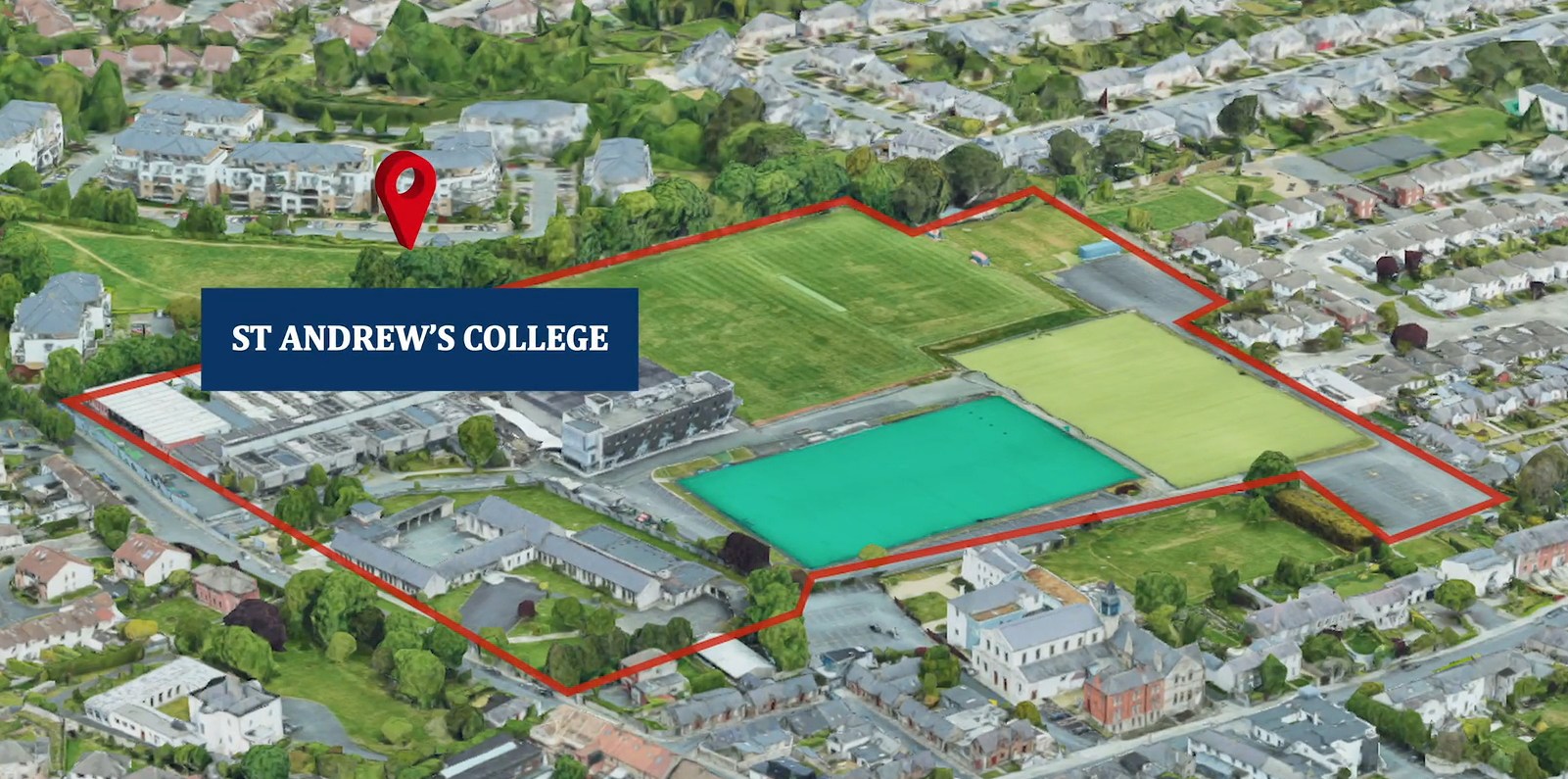
From a 2021 video introduction to St. Andrews College Dublin, an international school for elementary through high school students.
1983 does seem somewhat late given how much adventures were booming in the UK just adjacent; this isn’t a situation like New Zealand with physical isolation from computer distributors. So it’s worth a rewind:
December 6, 1921 marked the start of Ireland as an independent country with the Anglo-Irish Treaty, giving independence to 26 counties in the south with six counties of the northeast (Northern Ireland) remaining with the United Kingdom. Ireland’s economy remained tied closely to the UK, however, with exports in 1924 at 98.1% and imports at 79.1%. Exports focused on food, while manufacturing in particular languished, with a small number of firms (mostly in Dublin). The biggest manufacturer, Ford, employed 7000 in 1930, but the Great Depression ended up causing the majority to get laid off. The next largest manufacturer, Guinness (who produces not just alcohol but also barrels), employed 3200. Besides those two companies, most doing manufacturing did no exports at all.
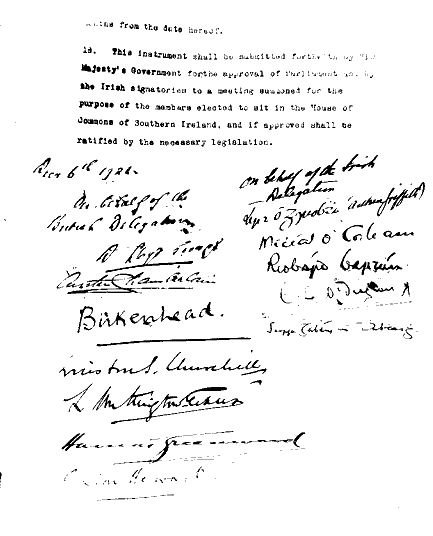
Signatures on the Anglo-Irish Treaty.
This situation led to a policy of import-substituting industrialization; in short, trying to reduce dependence by building locally. The economist Keynes gave a speech in Dublin fretting over “national self-sufficiency” and a “disastrous reduction in a standard of life”. Protectionism and tariffs arose in the 30s in an attempt to cause the transition, although this was interrupted by WWII, where Ireland remained neutral. (Or perhaps “neutral” in quotes; the Irish intelligence service G2 regularly shared information with the British, and Nazi attempts to introduce a wedge in relations were shot down.)
However, post-WW2 and leading through the 1950s, it was starting to be clear that protectionism was not the answer; Ireland’s economy was sluggish, and protectionism extended to the political arena as well with a knock-on effect. Tweaks in policy in the late 1950s started to lead to a boom, to the extent that Ireland being welcoming of foreign companies is a general policy which holds to this day.
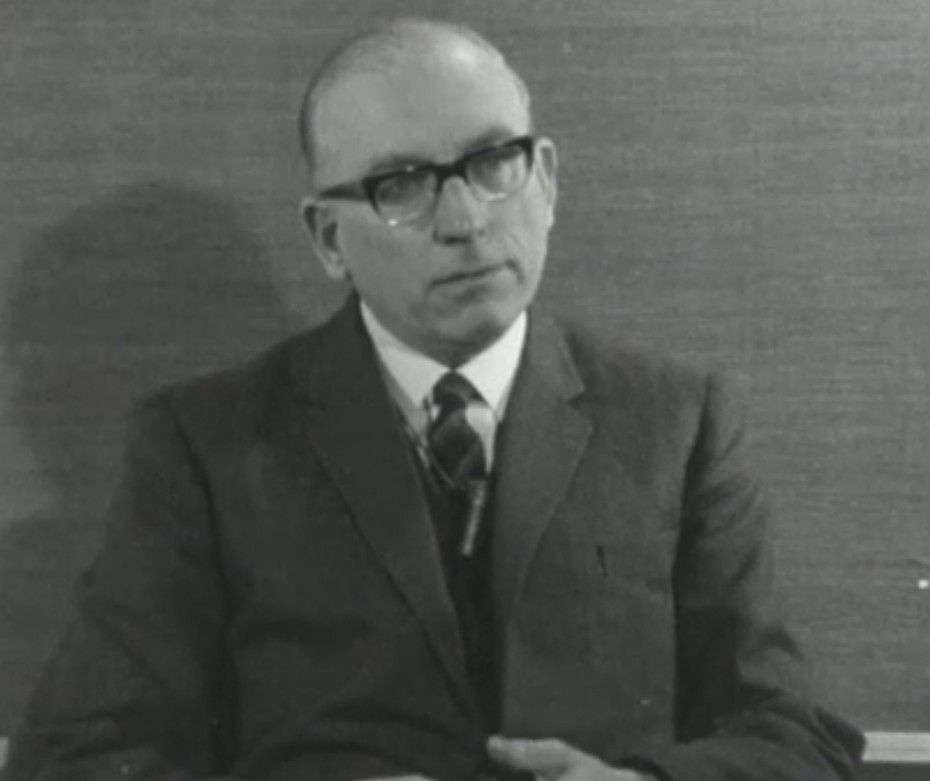
TK Whitaker, Secretary of the Department of Finance in 1958, the one who introduced the First Programme for Economic Expansion. It was the centerpiece of Ireland’s new economic policy. Picture from a 1969 video interview via RTE.
Surrounding all this, for our purposes, is the rise of computing. IBM was the first to arrive, in 1956. One of the agriculture companies (Irish Sugar) was the first to get a computer, installing a system through British Tabulating Machine starting in 1957 in order to manage payments for farmers. Quoting Gordon Clarke, an Irish mathematician that was pulled to England for training before returning to Ireland:
I was assigned responsibility for a number of installations, but particularly for the ICT 1201 in the Sugar Company. We had to ensure that the computer could not be blamed for any delay in its payments to farmers. It was a valve-based machine and had no conventional memory. The program was stored on a drum whose capacity was 1024 words of 40 bits. Subroutine calls had to be preceded by appropriate placement of the return address. Each instruction included the address of the next instruction, and branching instructions included two such addresses. The programmer had to take account of the latency of the drum rotation and place the next instruction in the most efficient location to save time.
IBM and ICL were the big companies through the 1960s, with DEC setting up their manufacturing in Galway for the European market in 1971; they cited tax policy, an English speaking workforce, and the forthcoming entry of Ireland into the European Common Market (which indeed happened, two years later). Quoting John Eyres, who worked at DEC from 1974 to 1977:
I developed a model with the finance department to select high margin products which would take advantage of Digital’s 0% tax on profits from products manufactured in Ireland. This model significantly improved corporate profit after tax and helped overcome opposition from design managers based in the US (powerful people in the Digital world).
Despite these favorable winds for mainframes and microcomputers, with educational and personal computing, the environment didn’t change the fact that the basic GDP-per-capita was lower than the United States and the United Kingdom. Personal computing was expensive.

In current US$. World Bank, CC-BY-4.0. After 1980 both the UK and Ireland declined, setting the stage for games like Urban Upstart.
The most prominent early entrant to the arena was Apple, which had a three-day exhibition at the Burlington Hotel in Dublin which was the public’s first exposure to personal computers; they ended up selling almost all their product to schools. Apple decided to put their European manufacturing in Cork (see: the exact same conditions which swayed DEC). This ended up influencing the decision of John Boland (minister for education) in 1981 to make a bulk purchase of Apple IIs for schools (that is, the iconic education computer for Ireland was the Apple II, not the BBC Micro).
Commodore also tried to enter the market at this time; their PET was considered solely a business computer due to cost, but they started to have popular success with the lower cost of the VIC-20 and the Commodore 64 (with the downside that when Commodore tried to sell the C64 to schools, Apple had already been entrenched and the C64 was considered a “games machine”). The ZX series via Clive Sinclair of course also invaded, although due to timing it was more the ZX81 and especially the ZX Spectrum which struck big. One testimonial:
I always refer to that school trip from St Kieran’s College in Kilkenny to Dublin in late 1981 or early 1982 where one of my schoolmates brought me to the Grafton Arcade and into Tomorrow’s World, the main computer shop at the time. I can’t put into words how mind-blown I was. At this stage I think I’d only been near the Apple II in school. To be able to touch and play with real computers was the most exciting thing I’d ever encountered.
Then I saw the ZX81 and it was love at first sight. In comparison to all the clunky behemoths with their clear 1970s heritage, here was something that was tiny and modern. And “cheap”. I had to have one.
Still, because of economic hurdles, the entrance into the market was slower than that of mainland Britain, which is why Ireland’s first adventure game (probably, at least tied with other contenders) only was made in 1983, by Edward (aka Eddy) Carroll.
Eddy talks at length about his background in the interview above, and how he first was introduced to computers at school, but using Commodores rather than Apples:
I went to school in Booterstown in Dublin [St. Andrew’s College] and it was quite progressive at the time because the government had decided that every school was going to have its own Apple II … in this particular school the guy in charge of computers decided that wasn’t going to do it. So he got his own funding and fundraising and bought a couple Commodore PETs and continued to buy them and we ended up with probably about fifteen Commodore PETs, all networked together using a thing called Hydranet which was a very early local area network that ran over serial ports…
I only have been able to find record of Hydranet in relation to Amiga computers, but it’s plausible they started prior to Amiga and it hasn’t been documented yet. (It’s also plausible Carroll was mixing up memories. However, the person who made the Hydranet cards was Graham Heggie who also created the original dongle, an anti-piracy device that connects to a computer port, so he certainly was making hardware back then.)
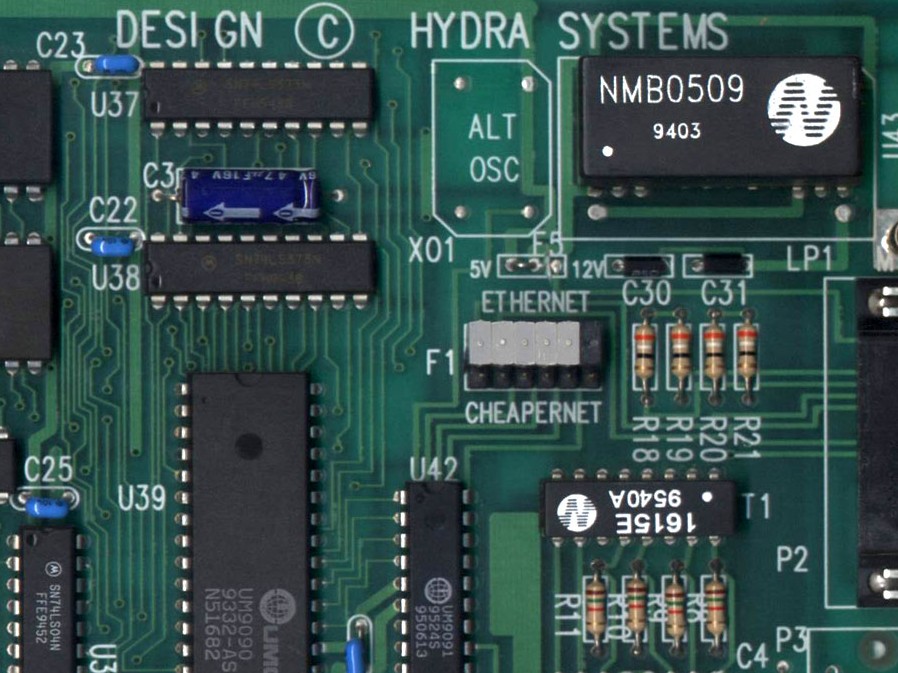
From the Amiga Hardware Database.
…there was a computer club that ran in the afternoon and anyone who wanted to could go along. So when I was in first year after school I heard about this and I went one September and it was an absolutely tiny, tiny, room, so literally no room even to turn around, so you had people sitting at keyboards and then everyone else standing looking over their shoulder … I stood there one evening and I was looking over somebody’s shoulder and they typed in a simple BASIC program … I was like “wow I can see how that works, that’s unbelievable” and I was basically hooked so I started spending most of my time there.
St. Andrew’s College opened a new building in 1983 including a new computer room; Carroll is referring to the old one.
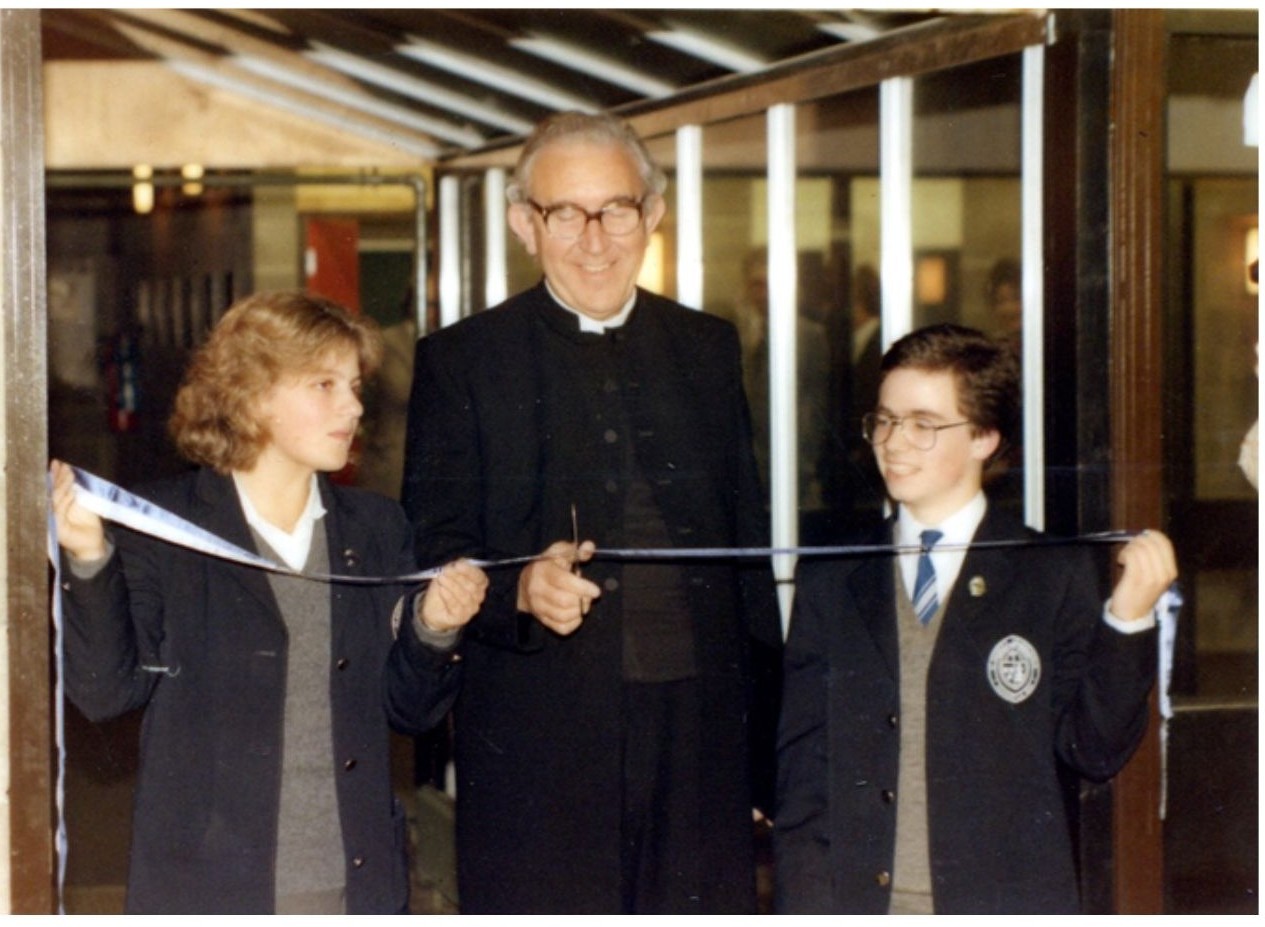
From the official school history. “Houseroom Area 5 opens in response to a need for a Computer Room, a Home Economics Unit, Cloakrooms and Changing Rooms.”
A few months later I managed to persuade my parents to get VIC-20 for Christmas which would have been Christmas 1981 … the VIC was followed a year later by Commodore 64 and then a couple years after Commodore 128 … a user’s group of Ireland was formed … I went with a few friends and we ended up on founding committee and that ran from, I think, maybe 1980 to 1983.
Carroll became very interested in the technical underpinnings of the computer (learning assembly from Nick Hampshire’s book VIC Unleashed); he wrote a 1983 article about how to get fast sprites on the Commodore 64, and he has a demoscene page including credits to an “Ultraload (Tape Turbo)” program and a demo that pretends the C64 is an Amiga. The reason he has a two-hour interview online in the first place is his development of a piece of software known as SnoopDOS (a “system monitoring tool” for Amiga that was/is very popular amongst Amiga hackers).
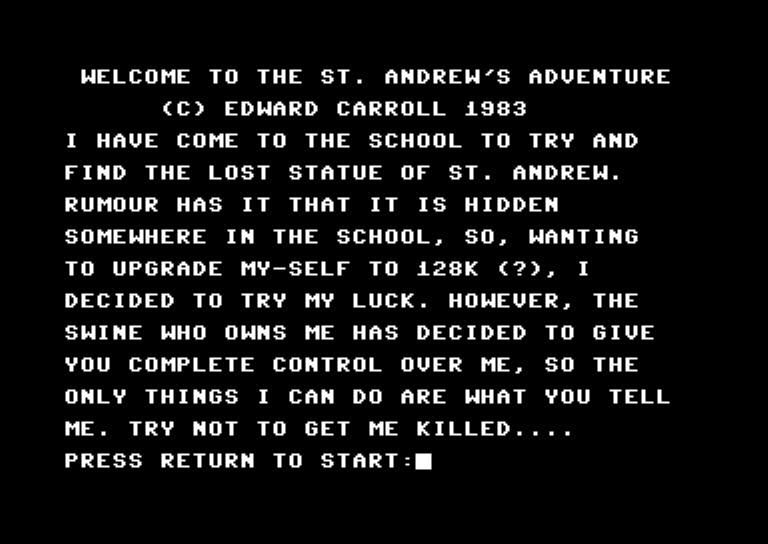
Listed amongst his programs is his one game St. Andrew’s Adventure. This is clearly a school-friends-and-family sort of game; it was written as a satire-simulation of the school the author went to. Out of various personal-location games we’ve seen (like Williamsburg Adventure and The Case at KAXL), it’s the densest in terms of in-jokes. In a normal circumstance (say, playing/reviewing a current IFComp game) this might make me grumpy, but as a window into history it’s fantastic.
Our goal is to find a missing statue of St. Andrew.
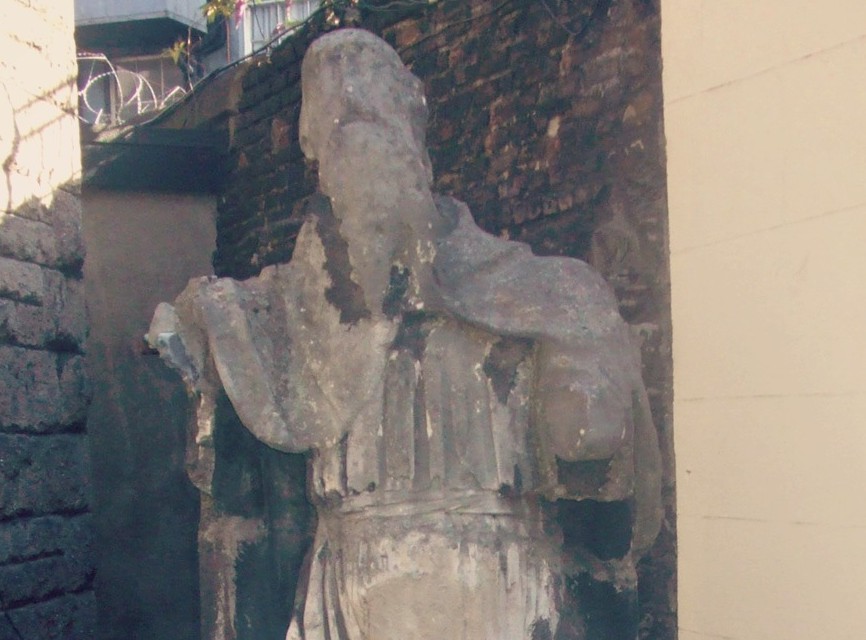
I have not seen any “statue of St. Andrew” lore specific to the school. In Dublin itself there is a heavily damaged statue at St. Andrews Church, and a local legend holds that in the late 1700s members of the Daly Club would use the statue for target practice.
Starting with a general meta-layout (meaning this is a simplification of the different areas):
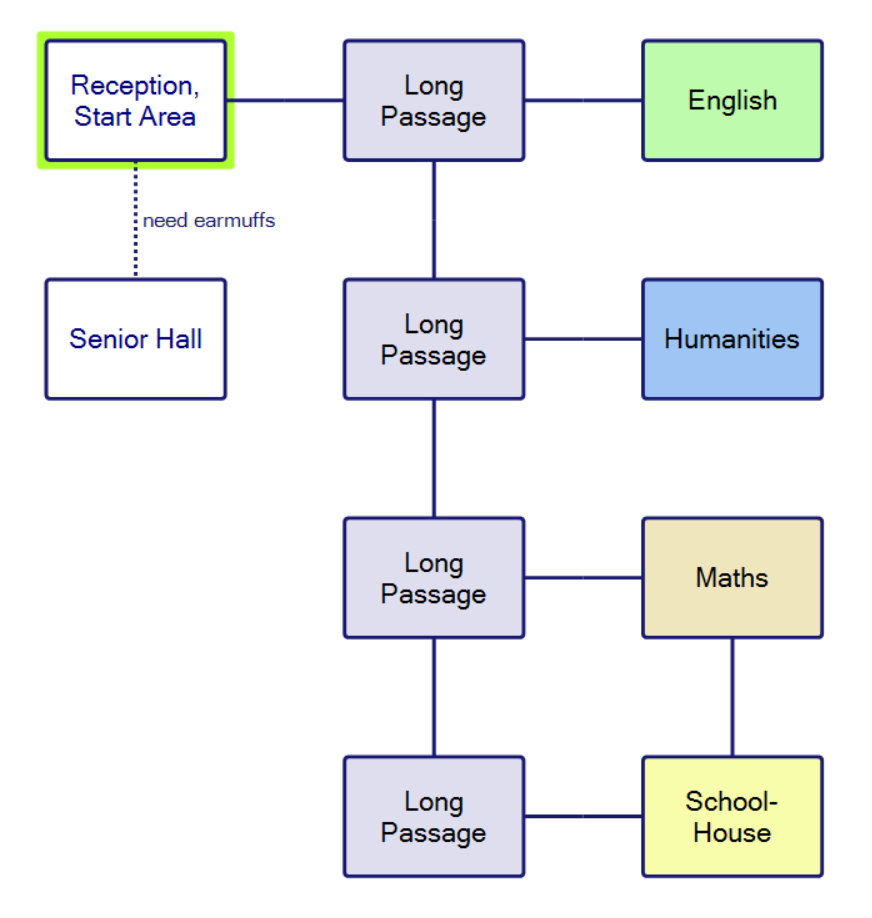
The player starts near some “general” locations like a library and kitchen, and then can go into a long hall which branches into four curriculum regions, each which has its own hub. Most of the map is wide open to start, and for me a majority of the gameplay was simply mapping things out. Zooming in to the start:
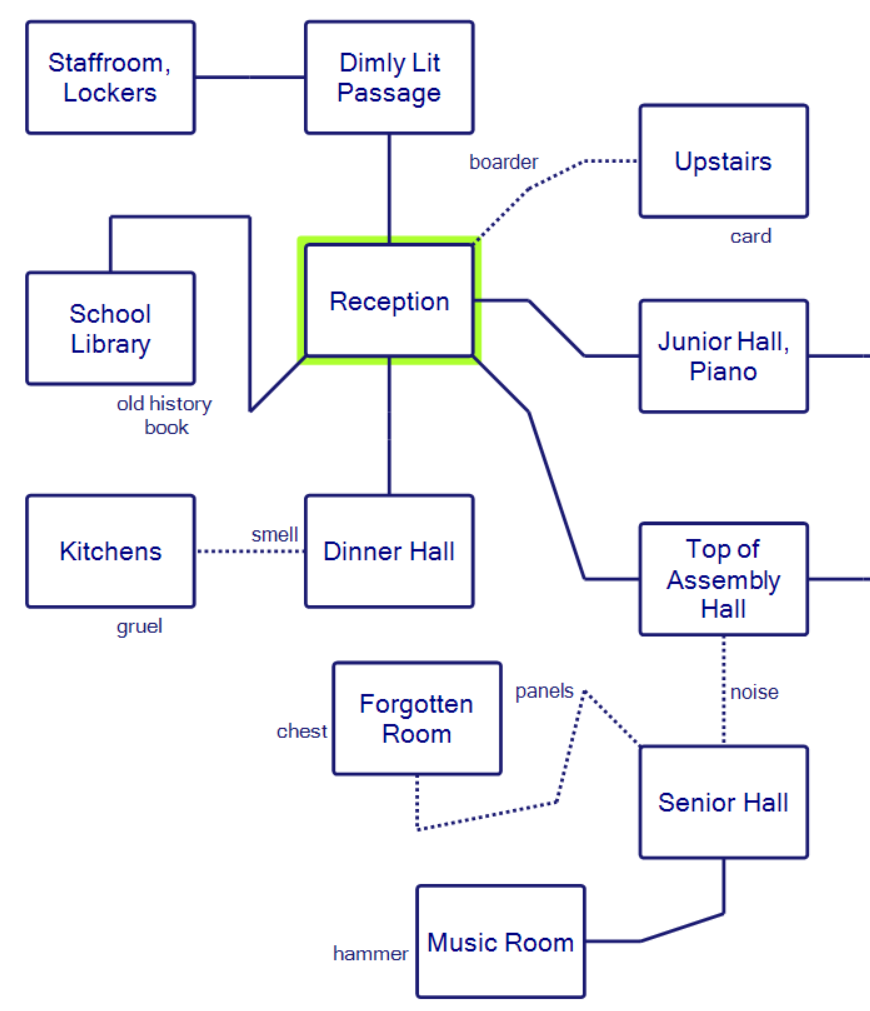
The Senior Hall is where the chest the player is questing after is hiding, although finding it is not quite the end of the game.
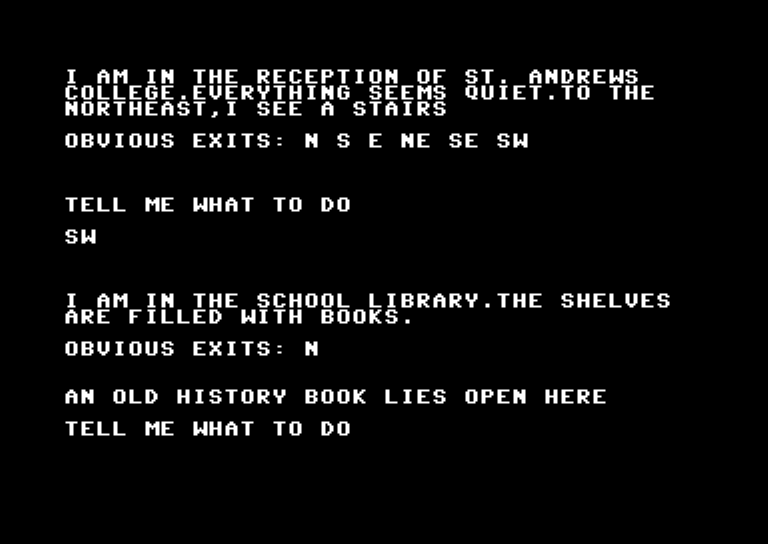
It seems intended by the author for the player to wander in the library early, because there’s a book that explains what’s going on in more detail. There’s nothing stopping someone from finding this information much later in the game, though.
MANY YEARS AGO,BEFORE THIS SCHOOL WAS BUILT,AN OLD STATUE OF ST. ANDREW WAS HIDDEN IN A WOODEN CHEST.THIS CHEST WAS SO STRONGLY BUILT THAT IT WAS IMPOSSIBLE TO OPEN WITHOUT A KEY.THE STORY HAS BEEN FORGOTTEN BY MOST PEOPLE BUT IT IS SAID THAT THE KEYS AND THE CHEST ARE BOTH TO BE FOUND WITHIN THE ROOMS OF THIS SCHOOL.A CHEST WHICH WAS CAPABLE OF HOLDING THE STATUE WAS RECENTLY FOUND IN….
THE REST OF THE PAGE IS MISSING.
Unfortunately, this is the sort of game where it’s unclear if things held within the room description can be interacted with, or if all objects that can be used are displayed as separate text (like the book in the library). To the north of the start is a dimly lit passage which mentions a locked office (complete red herring, the parser doesn’t understand any attempt at interaction) and to the west of that are lockers with a similar reaction.
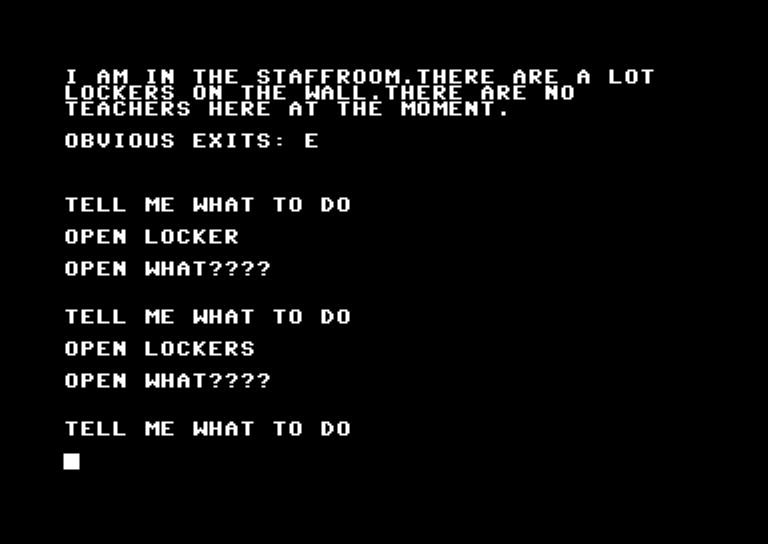
In some games, handling the lockers (even when not mentioned on their own) would be essential.
So you might think all objects are separated out from the description text, but this is not a consistent rule as you’ll see later.
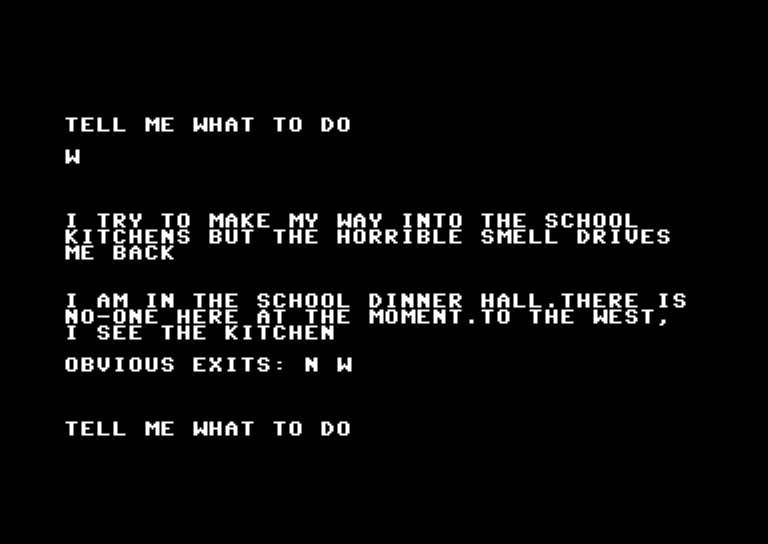
The start area presents three different exits which are blocked off. First is the kitchen, where the smell of gruel is too much to handle.
Second is a set of stairs with a BOARDER on top. The shock causes us to fall down the stairs. (This repeats if you re-enter.) This has to be some kind of in-joke.
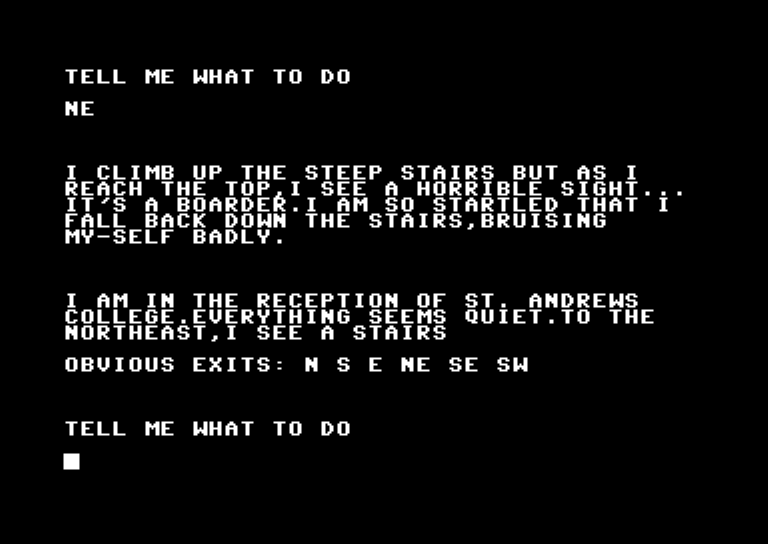
Third is an assembly hall with music that’s too loud to get by. This goes to the senior hall and close to the end of the game.
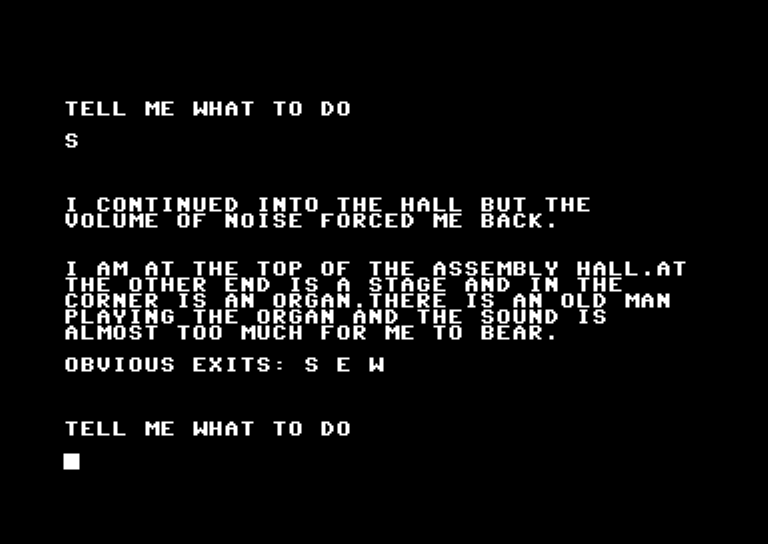
All three will be defeated by objects, so we need to start piling some objects, but first, two more obstacles, seen in the long passageway that leads to the various hubs:
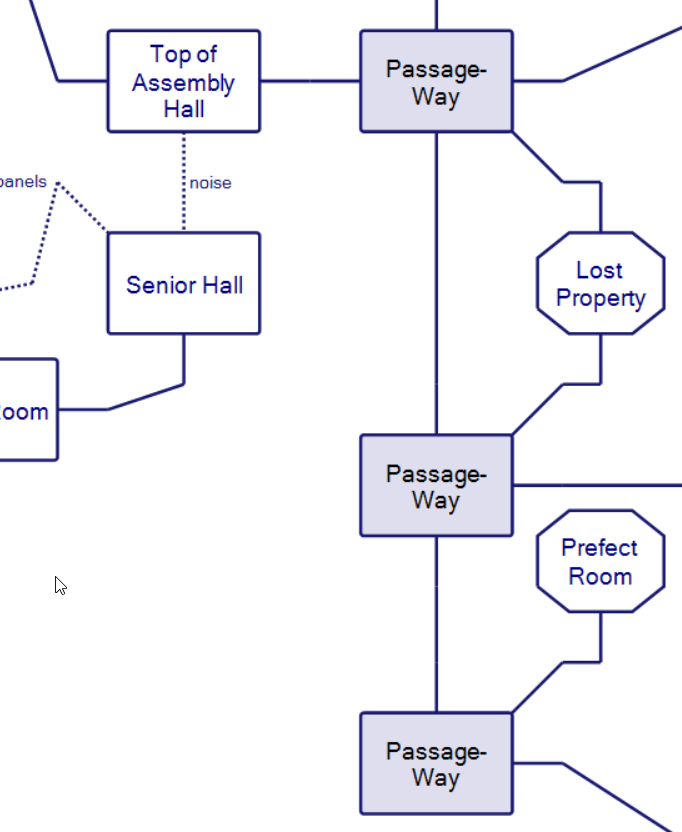
The Lost Property room and the Prefect Room are both “fake-out” rooms in terms of world modeling; they don’t exist as actual rooms, but the game gives text and prompts as if you’ve entered one, but you get booted immediately after a scene happens. With Lost Property, by default, you are asked if you want some lost property, but get booted upon saying YES because you need 10p.
I AM IN THE LOST PROPERTY OFFICE. MR. O’MAONIGH IS HERE.HE ASKS ME: ‘DO YOU WANT SOME LOST PROPERTY?’
MY REPLY IS:
For the Prefect Room, again via YES/NO, you are asked if you want to join a poker match, but without money you are told you need some to enter the game.
Moving on to hubs:
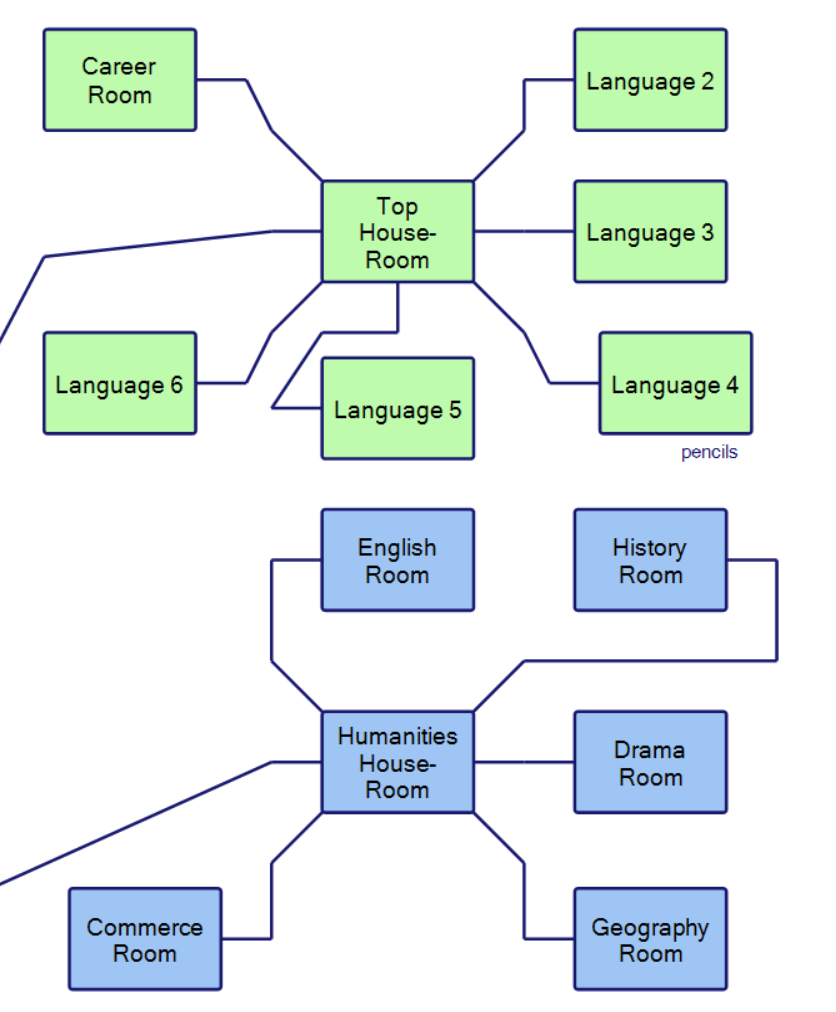
There’s almost nothing in the Humanities or English areas; you can find some pencils in Language 4 (red herring), but that’s it. The point is generally the colorful descriptions (or intentionally mundane ones).
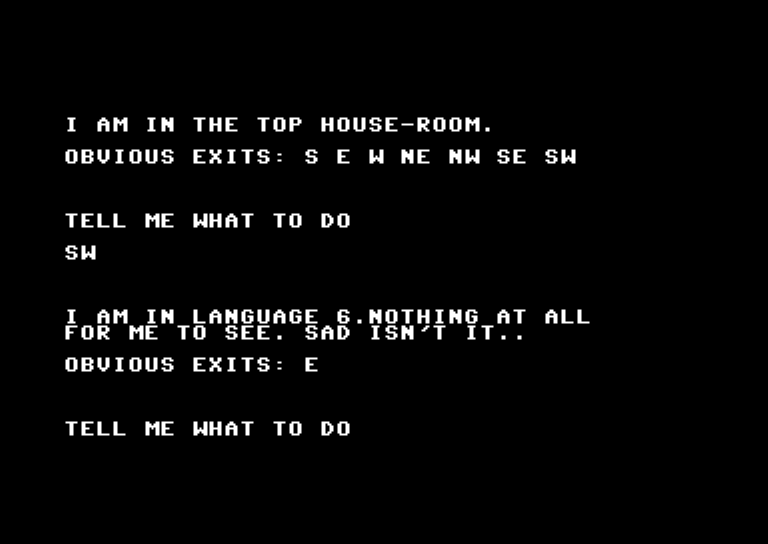
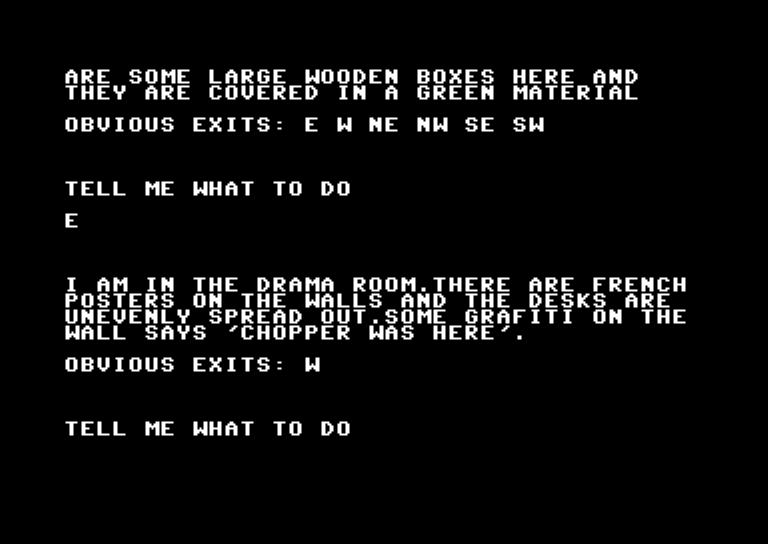
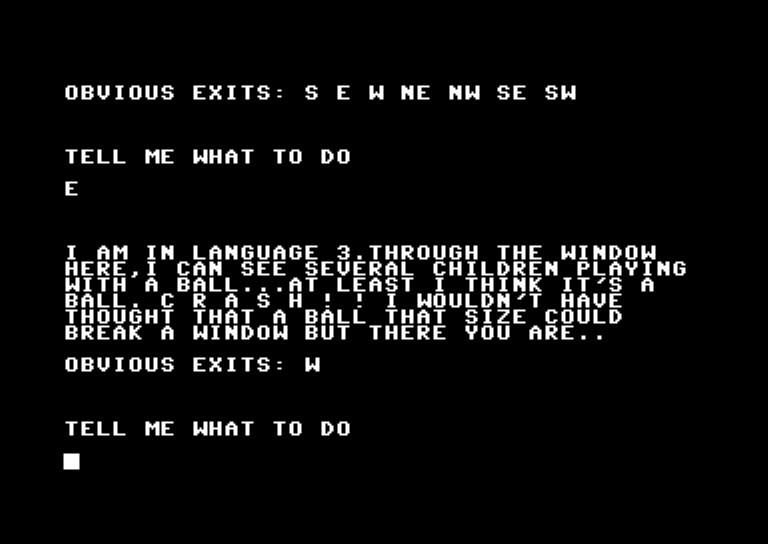
This crash happens over and over when you enter the room.
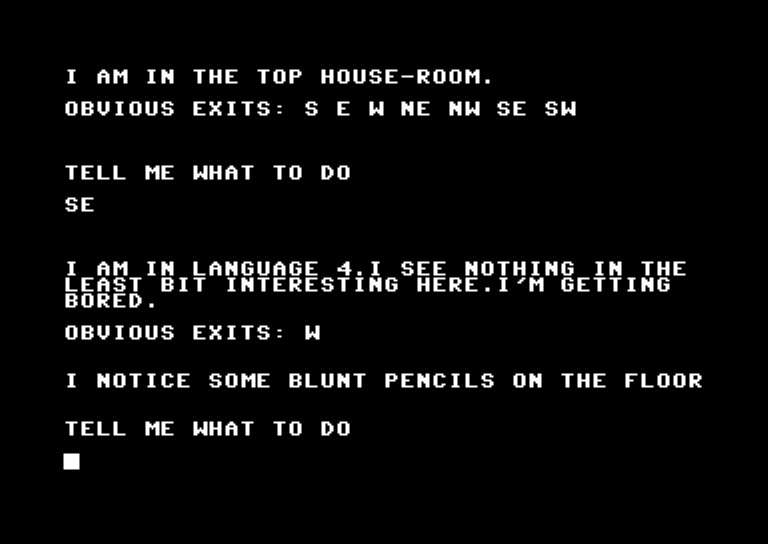
The southern hubs are science and math.
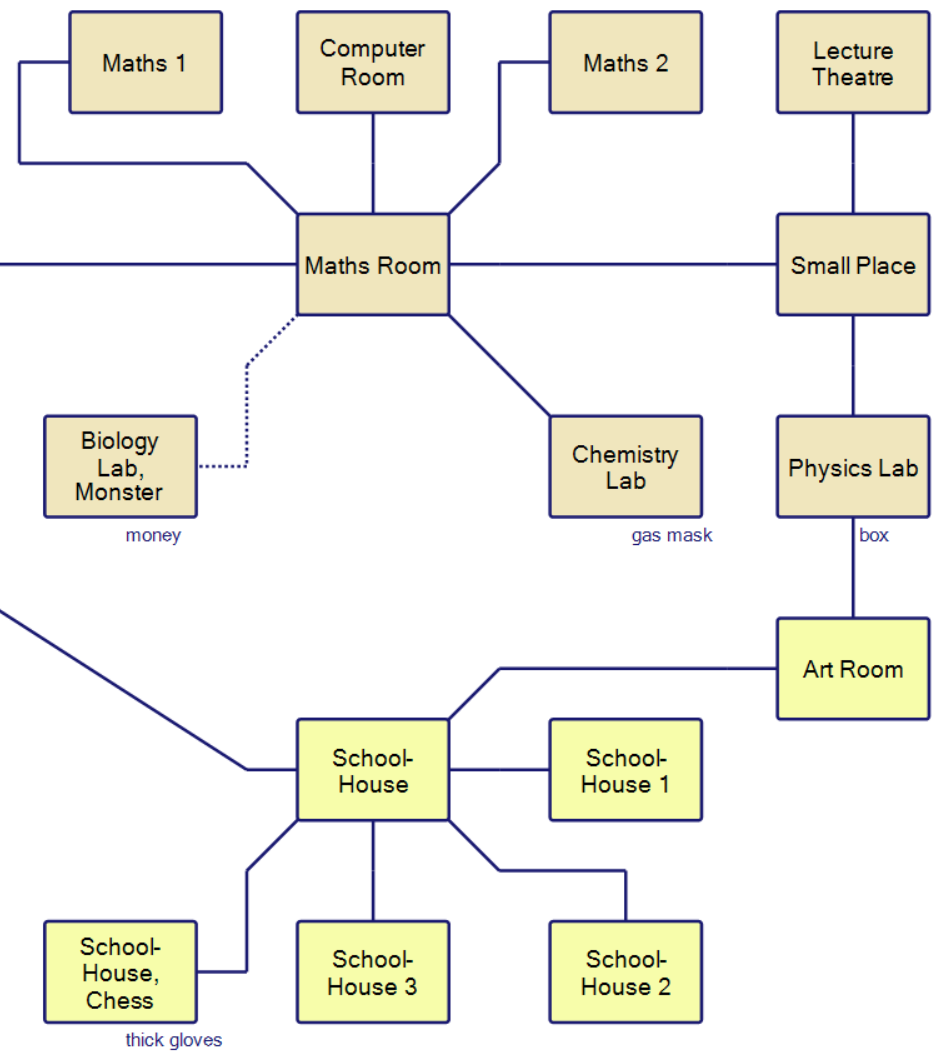
One room has a gas mask, another some thick gloves, and yet another (a physics lab) has a BOX SUITABLE FOR CARRYING HARMFUL SUBSTANCES.
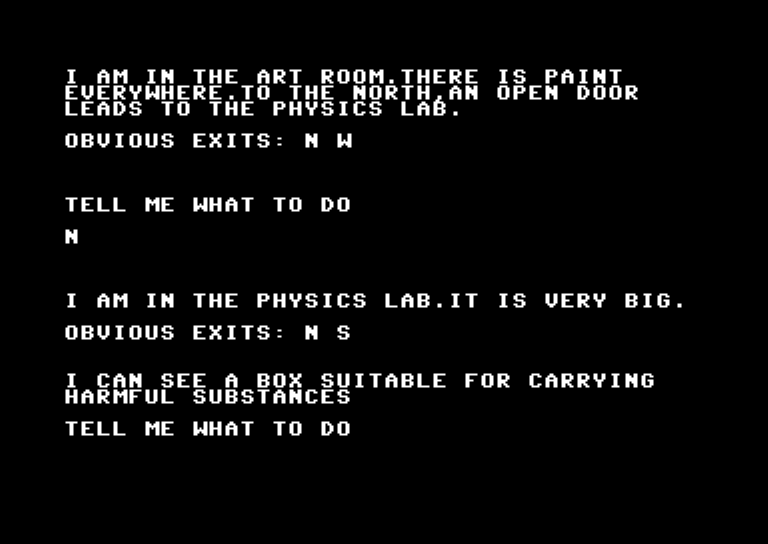
The in-jokes and “isn’t this classroom making you bored by just standing here” type descriptions remain.
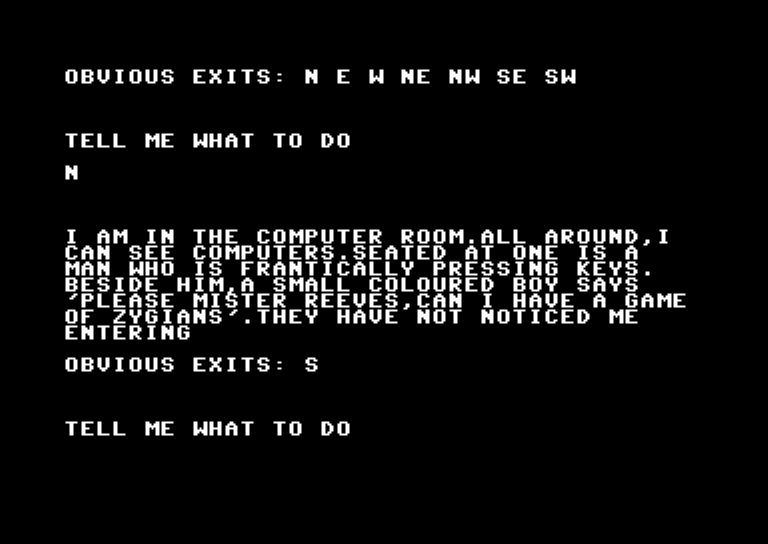
In a professional modern product this would be irritating, but in context here it’s a snapshot of student life in 1983.
One room will directly kill you.
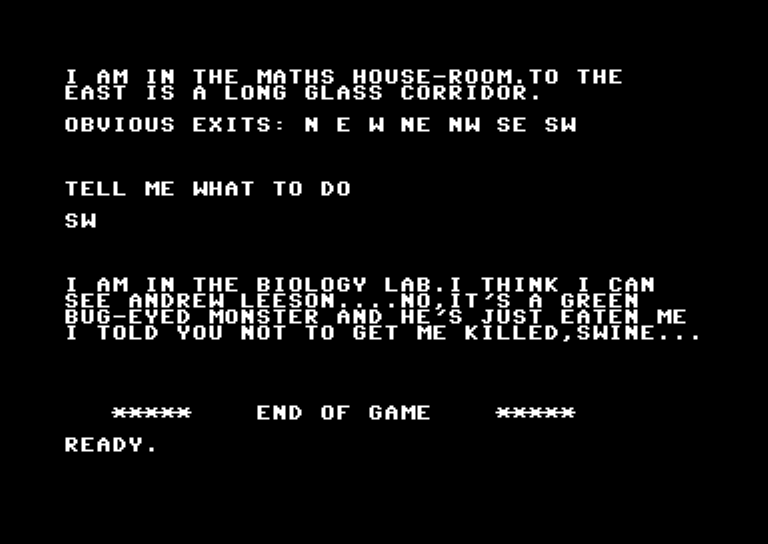
One thing I haven’t highlighted yet is how the avatar has an antagonistic relationship with the player. Some games have played quite explicitly with the relationship but in a “friendly” way (like Cyborg); this is the first time I’ve seen straight out rebellion.
The gas mask is sufficient to enter the kitchen from earlier.
I AM IN THE SCHOOL KITCHENS.THERE IS A GIANT BOWL OF SOME SUBSTANCE IN THE CORNER AND ABOVE IT IS A SIGN WHICH SAYS ‘SCHOOL DINNER’.THIS HAS BEEN CROSSED OUT AND REPLACED WITH ‘GRUEL’
This is where I hinted not all objects were listed separately. You can take the gruel, as long as you have the box. Once you have the gruel, this is sufficient to gross out the boarder, and find an ACE OF SPADES.
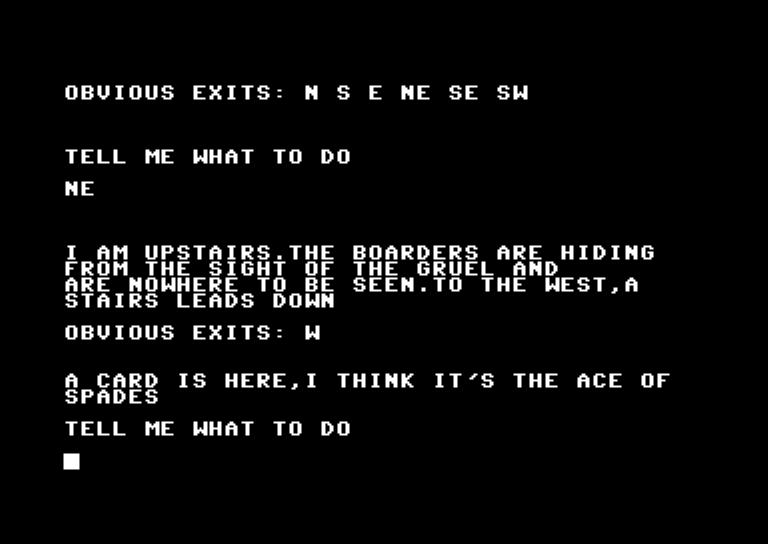
Unfortunately the player still doesn’t have a method of getting past noise, nor no money for the lost items place or the poker game. However, the gruel is sufficient to kill off the monster. This is where the money is hiding.
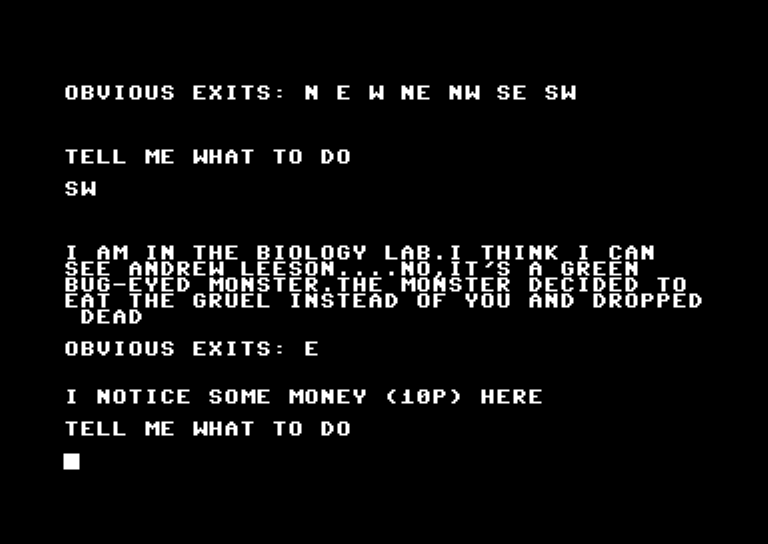
Next is an order-of-operations problem: you need to go gambling with the money before going to Lost Property, because if you only have 10p, you can only use Lost Property once. By gambling, you double your money.
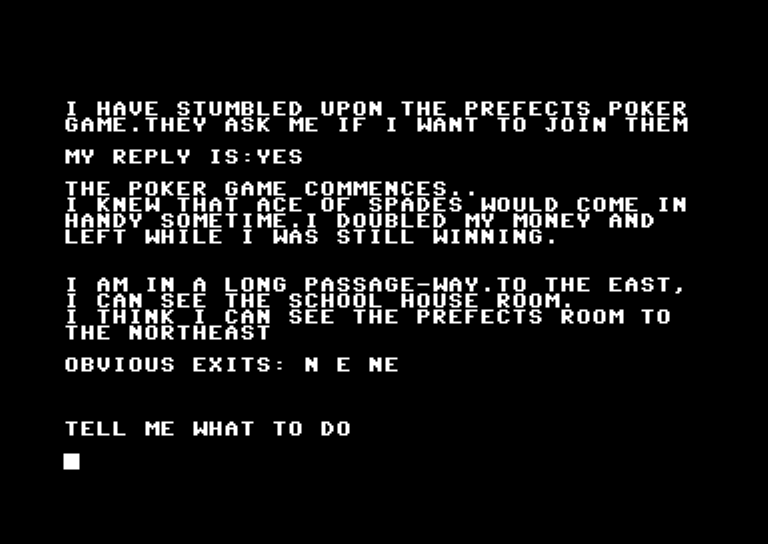
Visiting once the office with money gets you earmuffs, and a second time gets you keys. They just let you pay for lost items with cash? The earmuffs, at least, are sufficient to get by the booming organ.
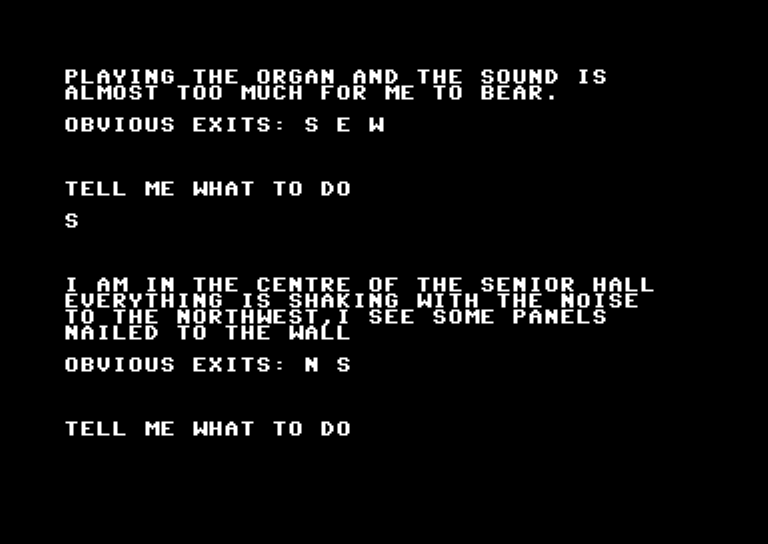
Near here is a hammer; with the hammer you can GET NAILS, and it took me a while to find the right parser command (and the fact the panels are within the room description made me nervous I was taking things the wrong direction, despite the gruel from earlier).
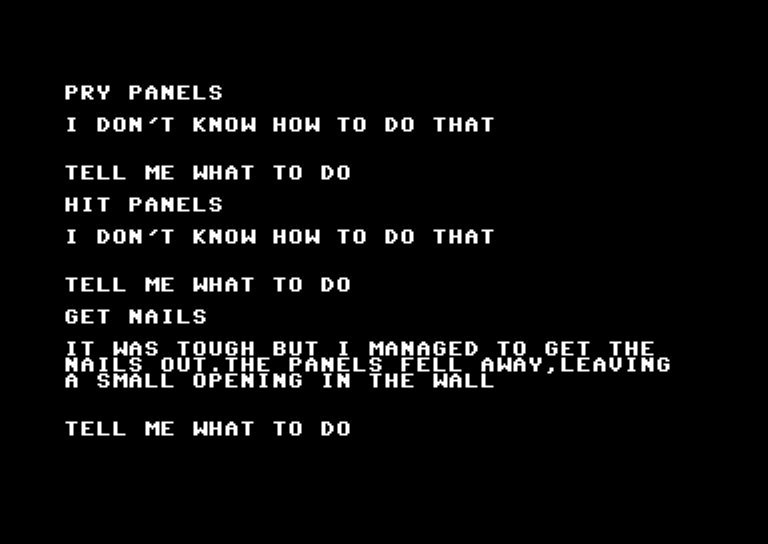
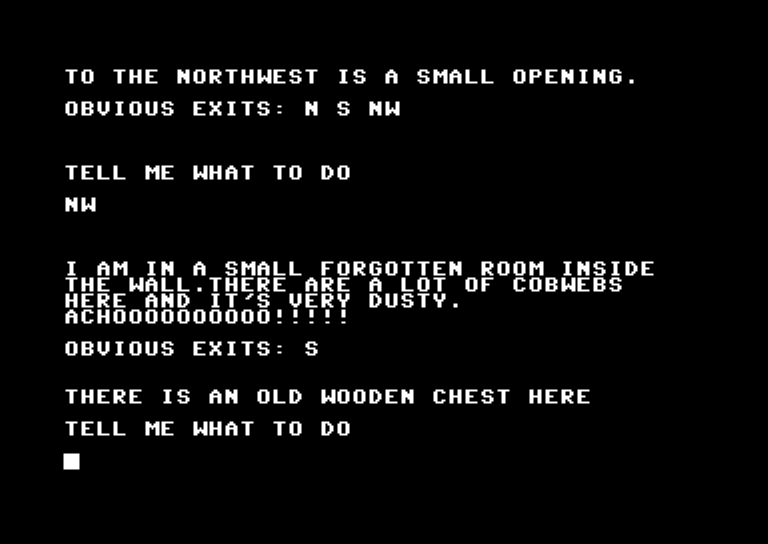
This goes down a secret passage with a chest. The end goal! Using the keys you can open the chest, but that isn’t quite the end of the game.
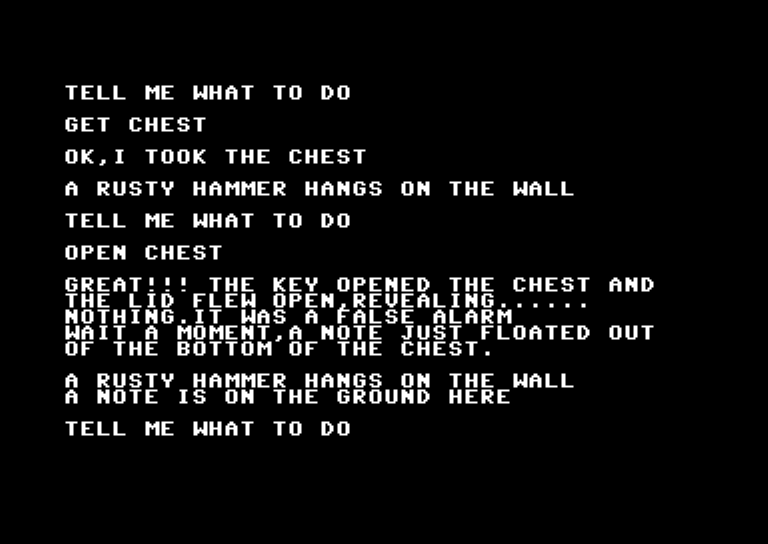
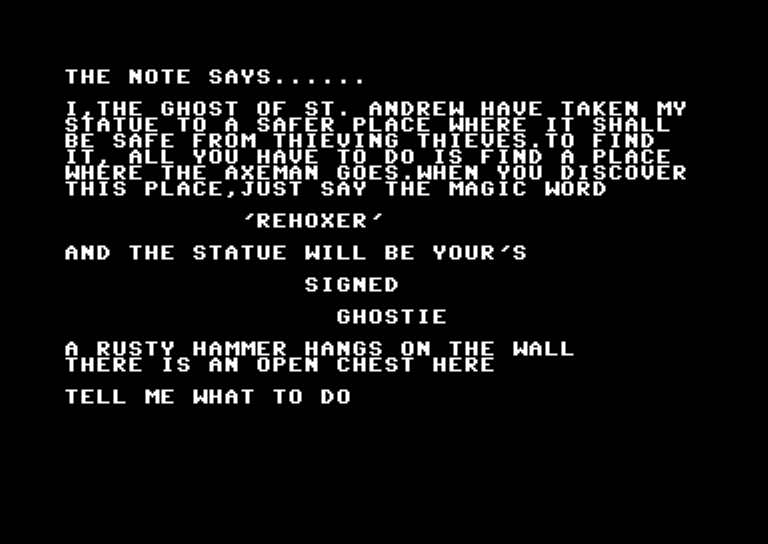
REHOXER is given as a one-shot magic word. It needs to be used in the right room (“A PLACE WHERE THE AXEMAN GOES”) otherwise the ghost will kill you. I’ve shown off the correct place earlier so you may be able to solve this puzzle on your own before I reveal the answer.
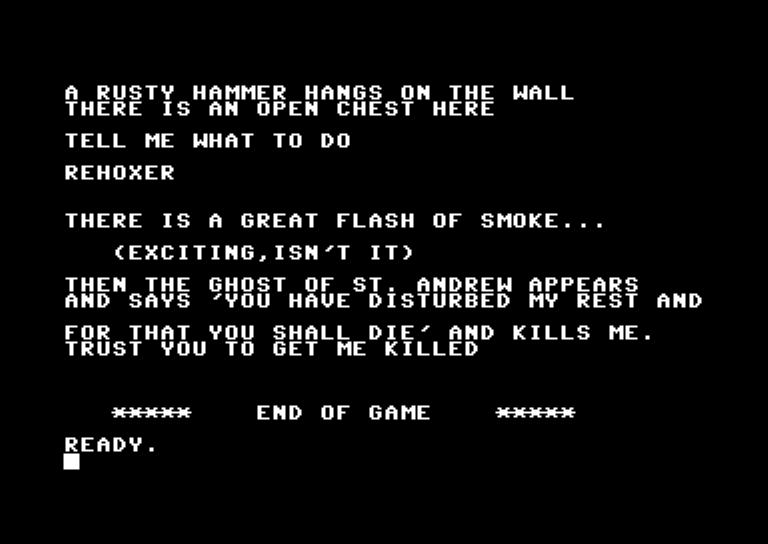
This only took me about sixty seconds to work out, but I had fun; it reminded me of the brief moment of riddle solving in Uncle Harry’s Will with a large enough environment that the last part of the poem felt like a real scavenger hunt.
The drama room with the “CHOPPER WAS HERE” message is the right place to use the magic word. (I first thought in terms of a play with a person holding an axe, so I checked the room description and realized the match.)
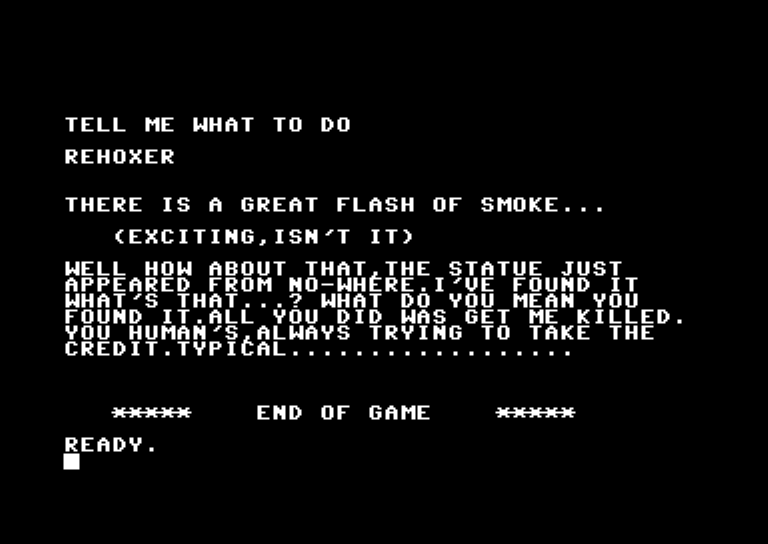
Here ends a milestone in adventure history. It may not be important as a game-in-itself, but it did respect my time (I didn’t even need to consider using a walkthrough) and I did get a certain gleeful joy from the in-jokes on teachers who have no doubt retired and/or died long ago.
I AM IN LANGUAGE 5 AND I THINK I’M GETTING DEPRESSED.
Coming up: three games from the Tandy CoCo contest, followed by another British game, and then we’ll finally get to The Coveted Mirror.


 Renga in Blue

Is the “boarder” thing maybe a posh joke? Like they are so posh they run away from bad food?