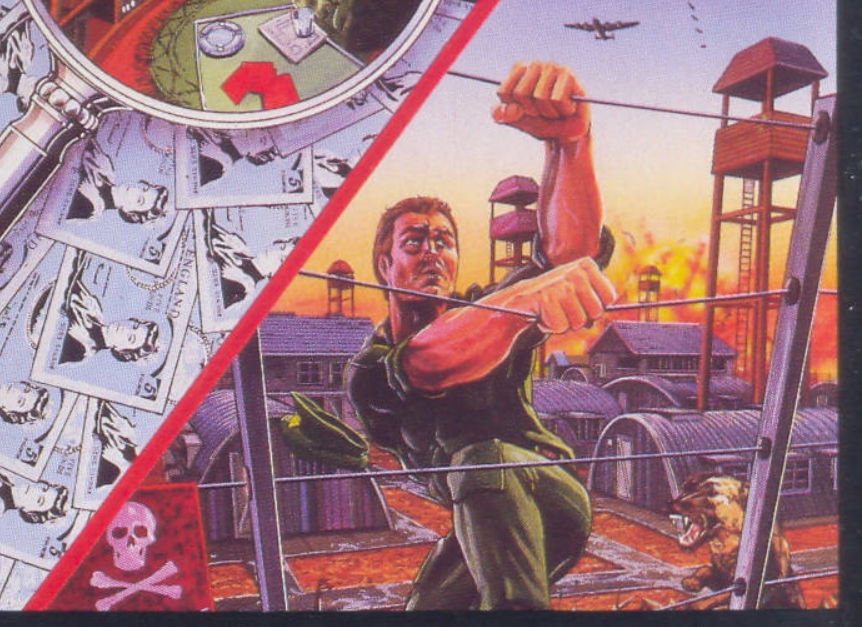
We hit one part of the Eno/Stalag two-pack recently; Eno was a whimsical and short treasure hunt, while Stalag asks us to “Escape the German prison camp before its bombed”. When originally sold by PAL Creations, Eno was one of the “bonus game” choices and Stalag was one of the main ones, so theoretically speaking the company thought of Stalag the more substantial of the two games. Once again, we don’t have the Tandy Color Computer version but rather the one published in the UK by Dragon Data for the more-or-less-compatible Dragon 32.
Via World of Dragon.
I’ve found mention of PAL Creations work being sold by another company called Jarb Software but I’ve been unable to verify it. They’re just as obscure as PAL Creations so it doesn’t really help.

I have discovered a letter by one of our authors (Paul Austin and Leroy C. Smith) but I’m going to save going over it until after we’re done with this game.

Rather than escaping a prison with active guards, the guards have already left, and we’re trying to get out before bombs drop. I’m not sure how realistic this scenario is but I’m willing to roll with it.
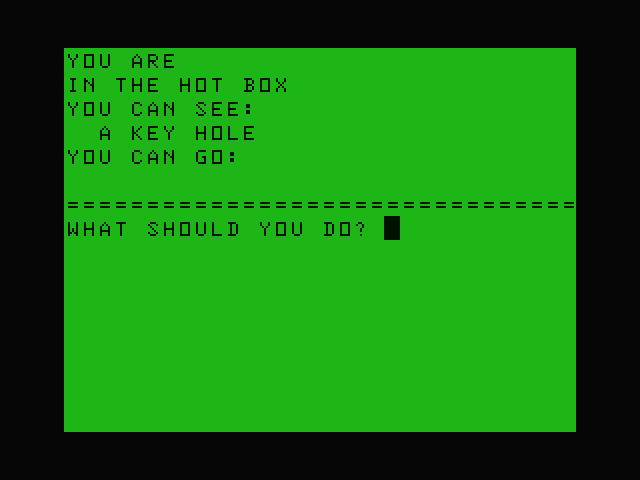
You start with a NEEDLE in your inventory and just PICK KEY in order to get out of the Hot Box. Then the map gets wide open. Most of what’s on the map below is accessible right away.
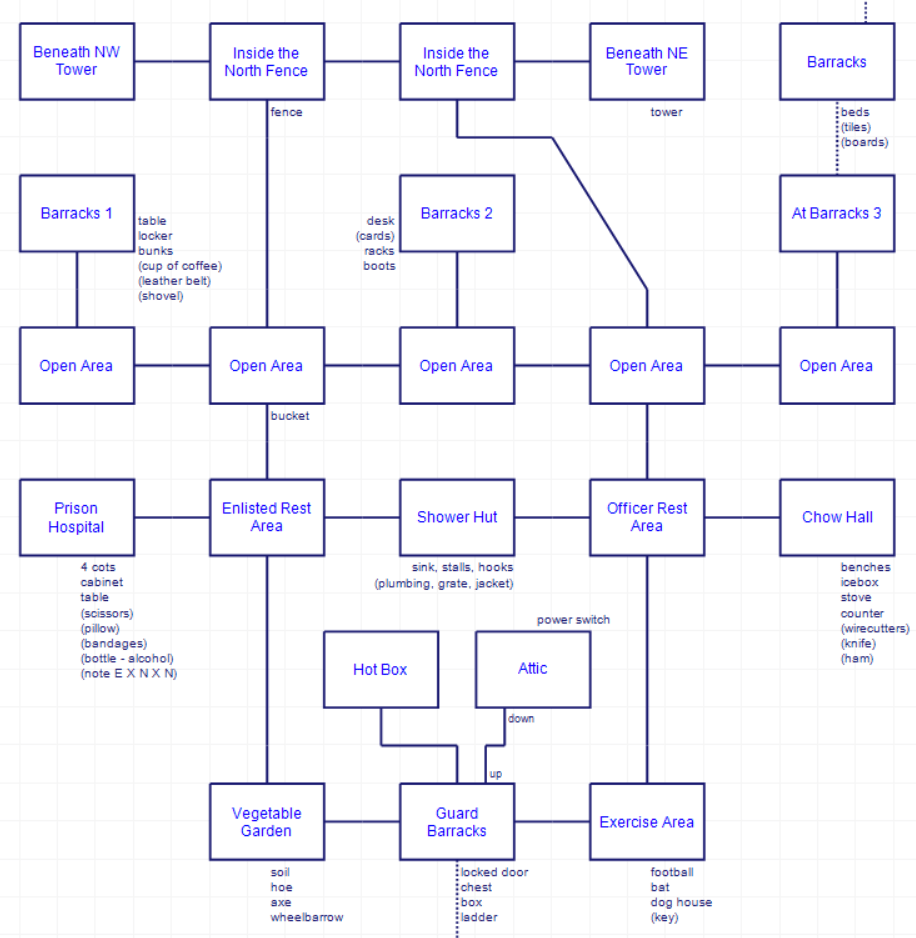
Most of the game’s map.
There’s far more items than you need. This is a little bit like the Eno aesthetic writ large. We had a similar open style with Earthquake but that game was better; everything was divided in stores, and in hitting a particular puzzle often involved thinking about what store you needed to visit. Here, there are some themed areas, but you also might just need a key hidden in a football near a dog house.
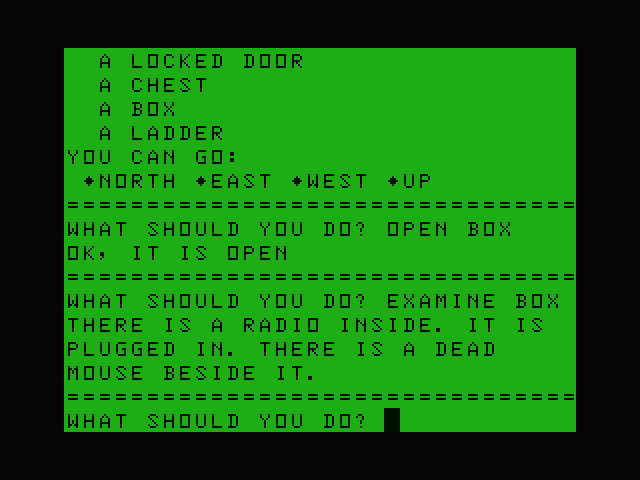
Just outside the hotbox, after escaping with the needle. Nothing here is relevant other than the door which has a number combination lock.
I will mention right away there’s a SHOVEL that’s necessary but annoying to find. It is stuffed in a LOCKER in one of the barracks, but if you LOOK LOCKER you will just find a BELT. You need to look a second time to find the shovel. I admit I’ve hit this type of puzzle multiple times now (usually with backpacks, but ok) and it catches me still about half the time. (I mean, why wouldn’t we see the shovel? It’s just a locker, it can’t be that hard to see what’s inside.)

The game’s excess of items isn’t just accidental, it is actively deceptive about possible escapes. For example, you can find WIRECUTTERS hidden at the Chow Hall, and take them over to fencing, and without anything else being done you get fried:

However, you can go up the ladder at the start and find a control for the electricity. Switch the controls off lets you safely touch the fence, but unfortunately, the wirecutters just break when you use them.

The entire route (including shutting off the power) is a red herring.
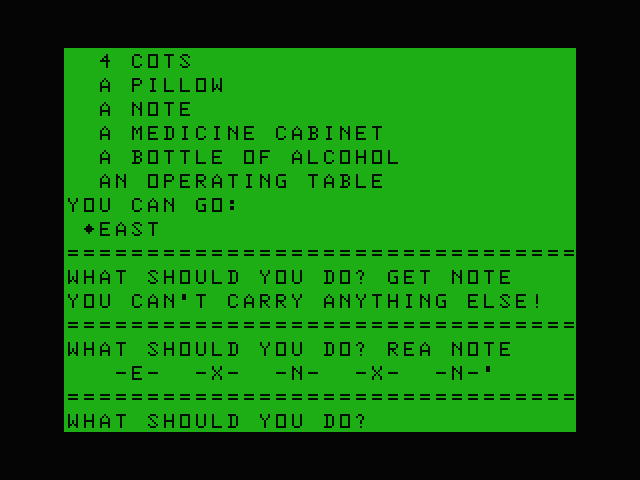
Another bit that might be a red herring. You can find the note by noticing a bulge in a pillow and applying scissors, but I never found the text here to be relevant.
The clue that is relevant is from a jacket hanging off a hook.

For mysterious adventure-game reasons the number goes to the lock at the start. The whole purpose of getting into the area past the lock is to then find a can opener randomly lying around.

Incidentally, you can also find a “depression” outside that you can use the shovel to turn into a “deep hole”. The game does not let you ENTER the hole and as far as I can tell the whole room is meaningless. It doesn’t even work as a red herring, really; at least having a land mine blow up trying to enter the hole or something along those lines would give confirmation this is the wrong route, but we don’t even have that pleasure.

With the can opener you can get some ham from a can and use it to distract a dog, then get a football nearby, which as I already alluded to, can be cut open to find a key.
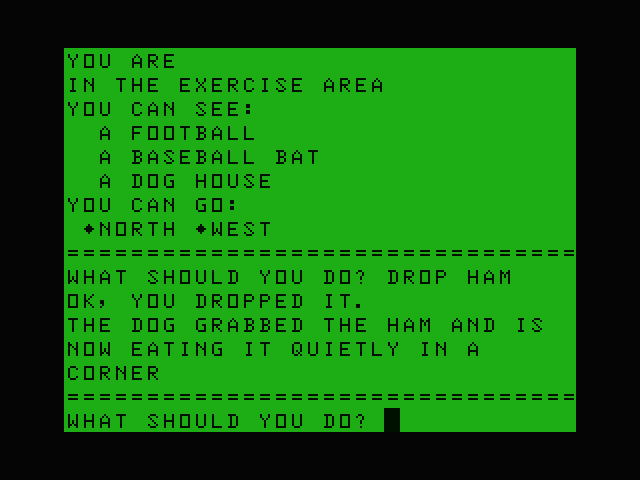
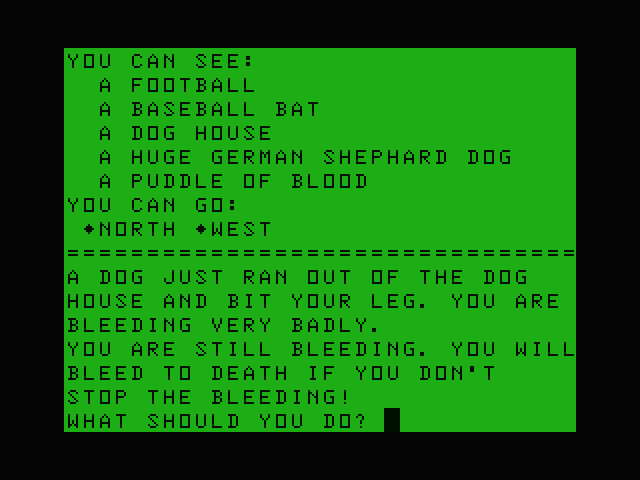
What happens without the ham. There’s bandages but there’s no command I could find to use them so you eventually just die. The only verbs are GET, DIG, CUT, LOOK, OPEN, PICK, PUSH, HELP, DROP, READ, CLOSE, EXAMINE. Did I also mention there’s no save game feature?
With the key you can get into a previously-padlocked barracks at the northeast part of the camp. Then you can move some tiles followed by some boards to find a secret hole.
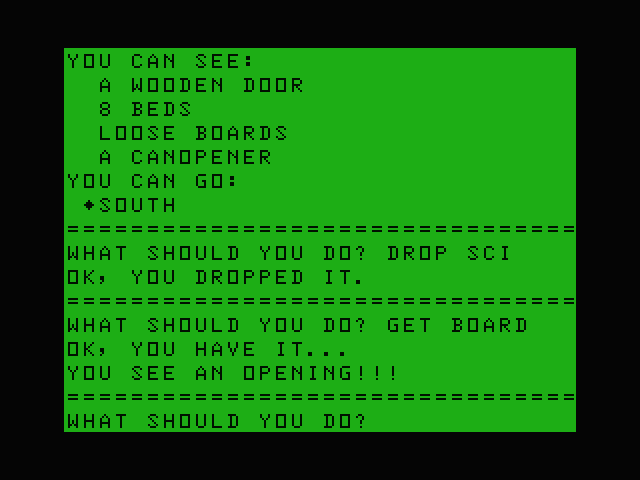
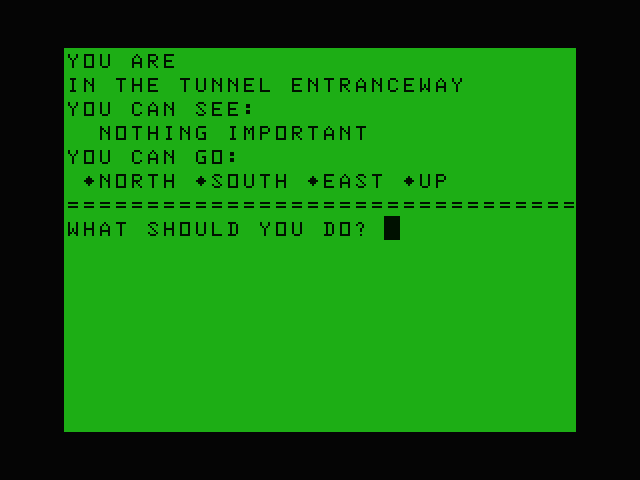
You need to choose east as the route to get out. This more or less matches the map.


This sets up a sequel which was advertised but I have yet to find a copy.
Alastair at CASA calls this game “a considerable improvement on Eno” although I disagree; Eno may have been short but it was solvable without wasting time on bizarre dead-ends and the lack of a save feature didn’t really hurt it. Here, while the game is made up of simple elements (really, EXAMINE everything and try to bust an object open if it is suspicious) I found the gameplay sequence itself tedious. The bandages were especially egregious; the game gives its verb list up front so I can’t say the puzzle was guess the verb, but rather “guess that this thing you would think might have an effect actually doesn’t”.
OK, back to that letter I mentioned. This is in regards to Mansion of Doom, another PAL Creations game I have yet to get to, and shows up in the May 1984 version of Rainbow magazine. The magazine had reviewed Mansion of Doom and Mr. Leroy C. Smith of Pal Creations had some complaints.
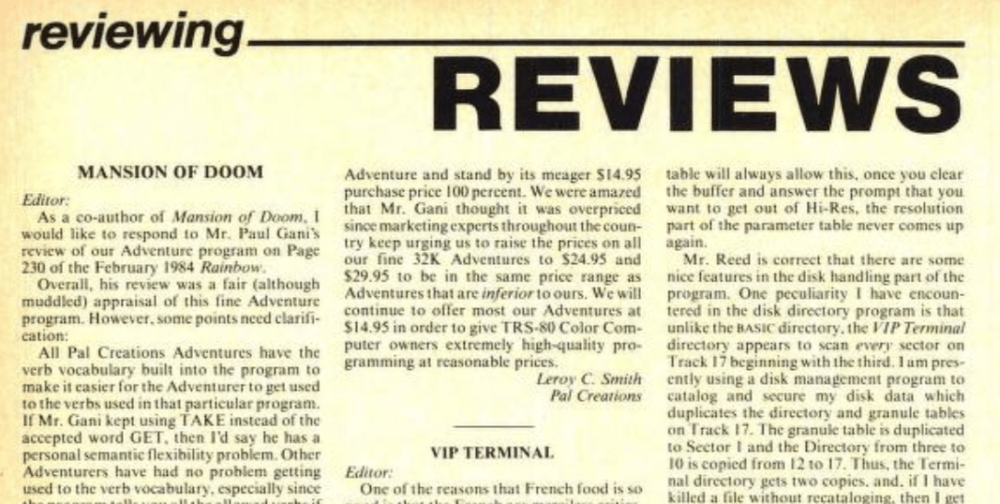
First, the review (by a Mr. Paul Gani) had complained about how the game accepts GET but not TAKE as a verb. The response:
If Mr. Gani kept using TAKE instead of the accepted word GET. then I’d say he has a personal semantic flexibility problem.
Second, in response to a complaint about the lack of saving games, Mr. Smith shows his prowess with market research:
We also decided against having a save feature in our Adventures since most people would rather try to solve an Adventure from start to finish. If they can’t solve it in one night, then all they have to do is turn the computer off. and they can try to solve it another day.
The people demand the lack of a feature! Furthermore, Mr. Gani found the game to be “overpriced”, which the author also had to respond to:
We stand by its meager $14.95 purchase price 100 percent. We were amazed that Mr. Gani thought it was overpriced since marketing experts throughout the country keep urging us to raise the prices on all our fine 32K Adventures to $24.95 and $29.95 to be in the same price range as Adventures that are inferior to ours.
Yes. Many marketing experts. I’m sure.
The complaints about GET/TAKE and the lack of save remind me of the book by Don Norman, The Design of Ordinary Things. One of the main theses of the book is that many “user errors” in product use are really designer errors. He cites an example of people on a particular piece of software mixing up the right time to press the ENTER key and the RETURN key; the designers were adamant about their design and users were blaming themselves for the error.
And did they ever lose their work as a result? “Oh, yes,” they said, “we do that a lot.”
Similarly, citing “personal semantic flexibility” as a reason not to add a single synonym reflects the same sort of user hostility (it isn’t like there aren’t synonyms! both EXAMINE and LOOK are verbs). Not including a save game feature is lazy and potentially a technical snarl, sure, but claiming the users are truly desiring this lack of a feature is incredible folly (since the ones that really don’t want to save their game don’t have to!)
Relatedly, here’s a short video on “Norman doors” which baffle their users who pull when they’re supposed to push. User error, or design error?
Maybe this is all a little harsh; we’ll get to Mansion of Doom (1982) eventually and see for ourselves.


 Renga in Blue

I must admit I wasn’t expecting a reference to Hogan’s Heroes in a random text adventure.
Honestly, the whole get/take thing isn’t something you can necessarily assume the player will be able to get. It’s not uncommon for games to have three letter parsers and thus unless you tell us that get/take doesn’t work we’ll just assume we can’t get/take it for some reason. I’ve recently been playing a game that has such a broken parser that I didn’t even realize that was how the game worked until hours in. It being missing shows a lack of care in how the player plays that usually indicates a spiraling lack of quality.
re: the lock it goes to, I can almost see if it was a Nazi jacket that they’d set the code to be something they could easily look up if they needed to
but why would it use the number from Hogan’s jacket?
Pingback: Game #139: Special Operations (1984) – The Wargaming Scribe