High Technology, Inc., is a company now almost entirely forgotten, were it not for the fact they — as one of the small number of initial distributors for Apple — produced the first television ad for an Apple product, in 1977.
They had a spectacular flame-out with Apple in 1980, having their contract terminated in March, resulting in a lawsuit in June. High Technology filed a $70 million dollar suit for breach of contract. Apple claimed the termination was because they wanted High Technology to stay within a six-state region, but they were going outside that area; High Technologies claimed “tortious interference with the Company’s business relationships with dealers.”
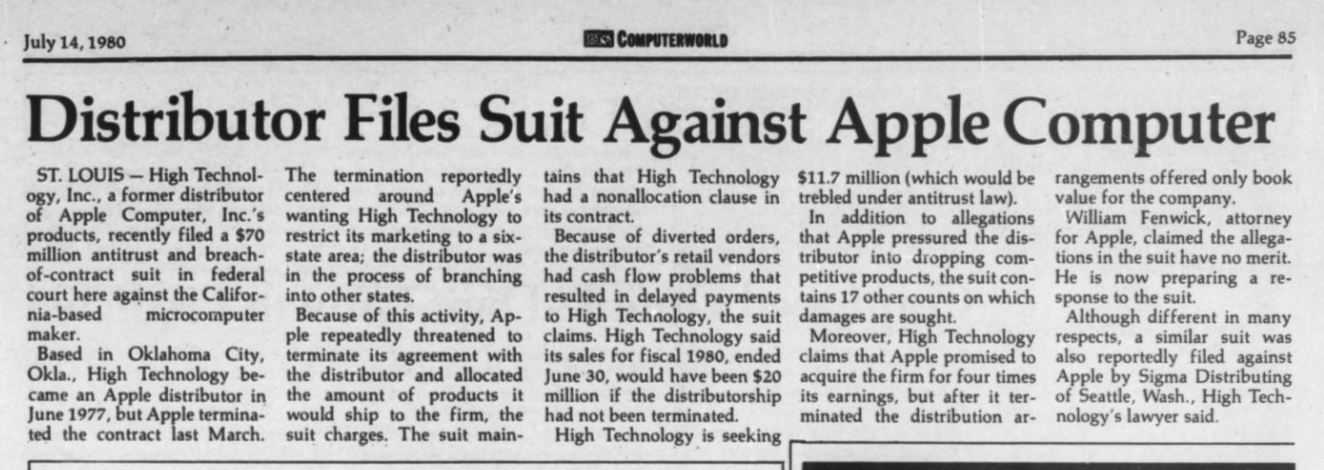
A second former Apple distributor — the one that is our focus today — also flamed out in a 1980 lawsuit: Omega Northwest (although this one for, as Apple claimed, “unpaid indebtedness to the Company and for fraud”).
To back up a little, in the 60s the businessman Richard Lawrence founded Omega Northwest as a camera company in Washington state; they extended to hi-fi audio and then eventually computers, with multiple branches (Seattle, Bellevue, Lynwood). For Apple, they made a spin-off subsidiary, Sigma Distributors, who focused entirely on Apple and worked on distributing across the northwest United States.
Their main emphasis was hardware and while they did get into software, by ’83 the president (still Lawrence) was keen on simply handing off software distribution to other companies.
In 1981, a vice president at the Sigma subsidiary in the software section — Larry Franks — decided to get into the adventure business, hiring a software analyst at Boeing (Christopher Anson) to lead the effort, who himself hired the programmer, Alan Clark. Clark made a BASIC program first as a proof of concept for an adventure system, then the two of them (Clark and Anson) turned that into a machine language interpreter. By the end of the year Anson went to work on the spinoff company, Ultrasoft.
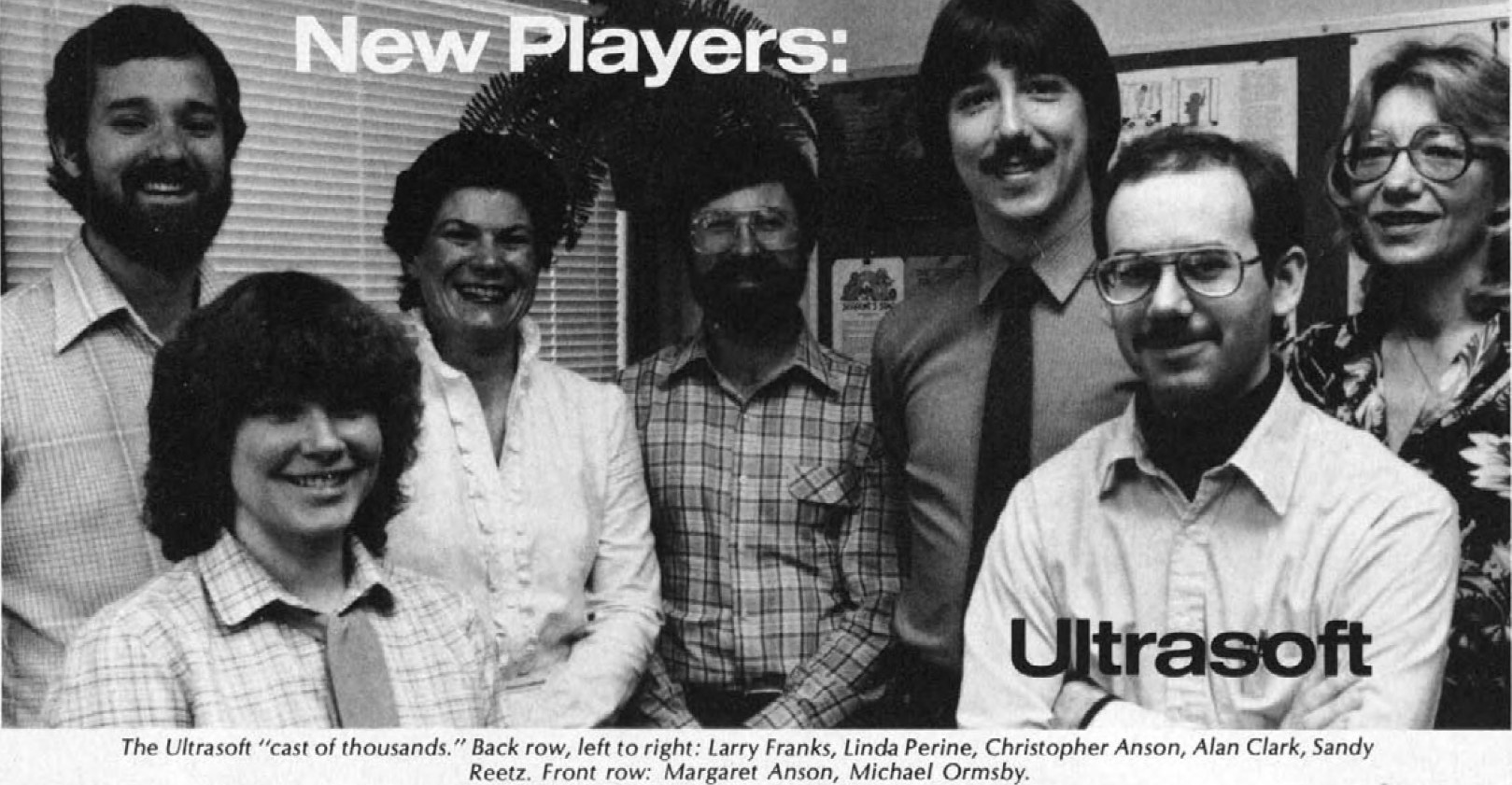
All this is from a Softline article, and I want to quote a specific part:
The moment of conception for Ultrasoft can be traced to an observation by Clark that most adventures, and most entertainment software in general, were written by hand. He had an idea that, with the tool-using approach that Anson had brought from Boeing, he could write better adventures more efficiently
This is a little true. You can certainly find random adventure games for sale in 1981 written from scratch (like Oo-Topos) but the most prominent adventures — the Scott Adams games and On-Line Systems games — both used tools like Clark is speaking of. So the statement about “most adventures” being written by hand isn’t incorrect, per se, but almost is misleading.
The main thing to keep in mind is that unlike almost every other game we’ve seen for the Project, The Mask of the Sun came from a long-standing company that was large enough to tussle with Apple in a lawsuit. This is not a “bad thing” in that they have a sense of organization that some of our other companies have lacked, and that means (for instance) they hired a professional artist, Margaret Anson, who had a team that did storyboarding (rather than making a single 19-year old produce so much art they had a mental breakdown).
There are some other parts of the Softline article worth highlighting — the company was very proud of Ultracode, their generalized game-writing tool which got touted on the back of the box — but I’ll spread the details out over my multiple posts on this game.
Now it’s time for plot!
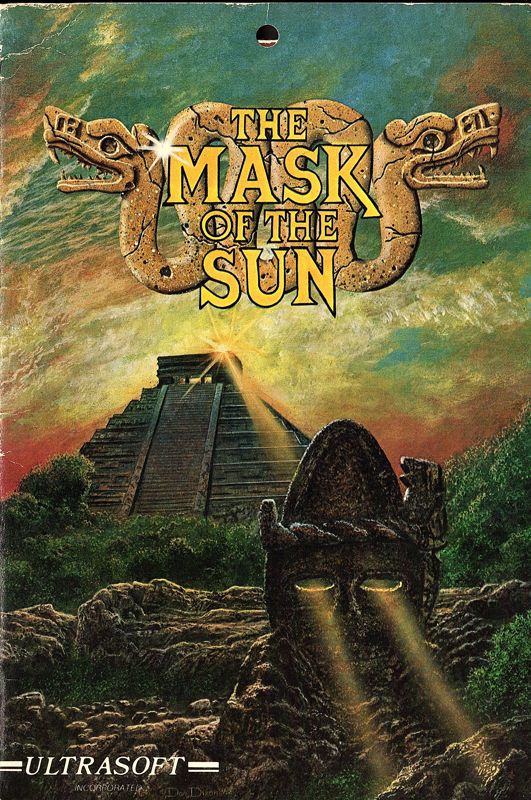
Via Mobygames.
We are Max Steele, archaeologist in the Indiana Jones vein, and while we recently found “the scrolls of the monks of Lhasa” they were stolen by our “colleague” Francisco Roboff. In retribution we nab an amulet from said colleague, and do research back in the United States to find out it is a “Pre-Columbian artifact from central Mexico that is surrounded by legend and folklore.”
However, the amulet has some sort of “curse” that lands us in the hospital with our body fading away, and we find out that a mysterious “Mask of the Sun” affiliated with the amulet might hold a cure.
You immediately send a telegram to everyone you can think of who may know about the amulet. Finally, you receive a message from Professor de Perez, of the University of Mexico in Sanchez. He has a map from the University that relates the amulet and the Mask to several Aztec ruins. With only this to go on, you depart for South-Central Mexico, to meet Professor de Perez at an airfield near one of the potential sites. The rest of the adventure is for you to discover!
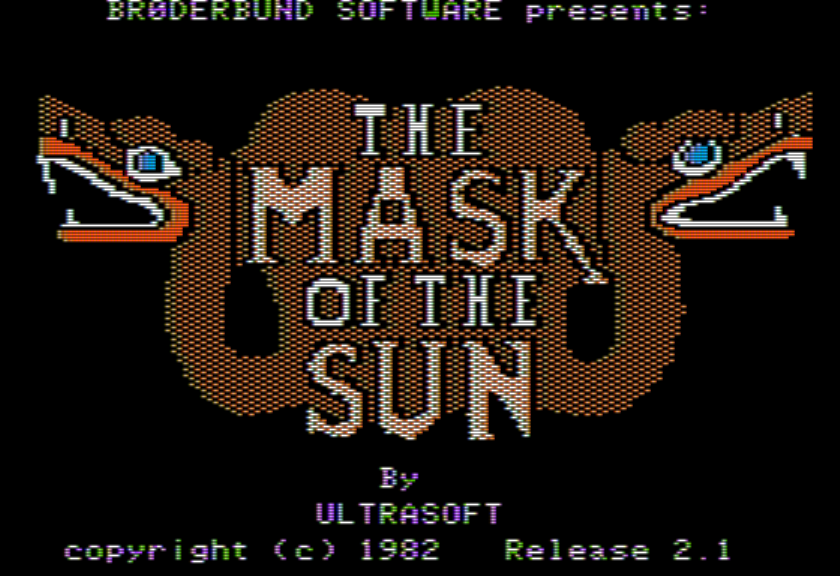
I’m playing with the most updated version published by Brøderbund.
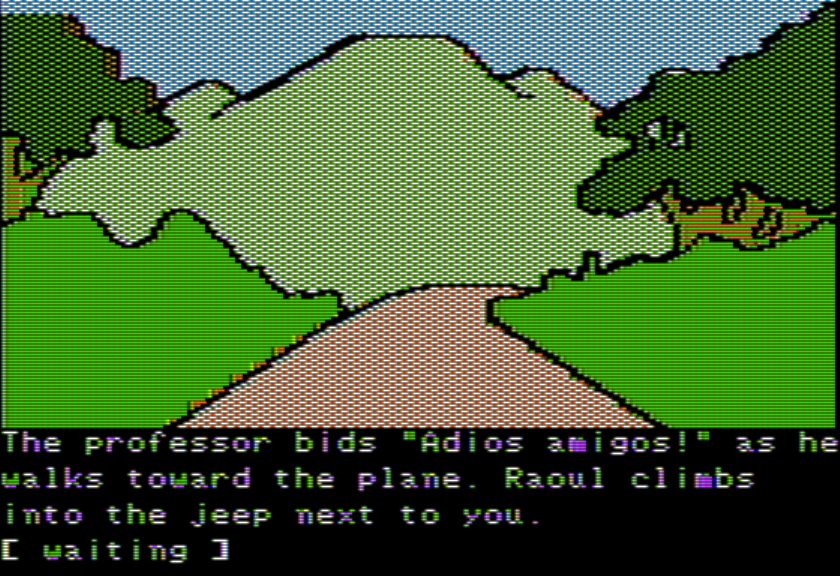
You start right as the plane has landed, with the Professor and his student Raoul outside. You get both a jeep and some supplies to go with it (a map, a lantern, food, a shovel, and some rope). The food is described as “tasty food” so despite the fancy underpinnings the game is still rooted in Crowther/Woods.
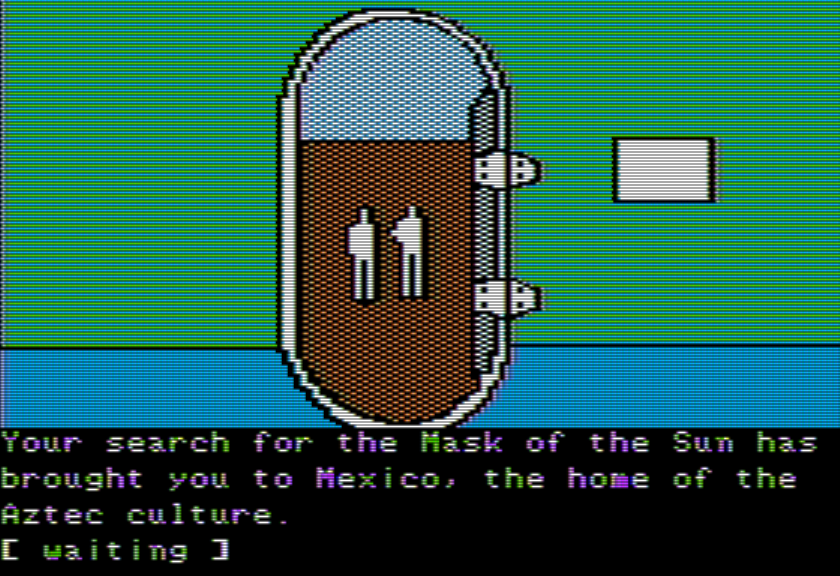
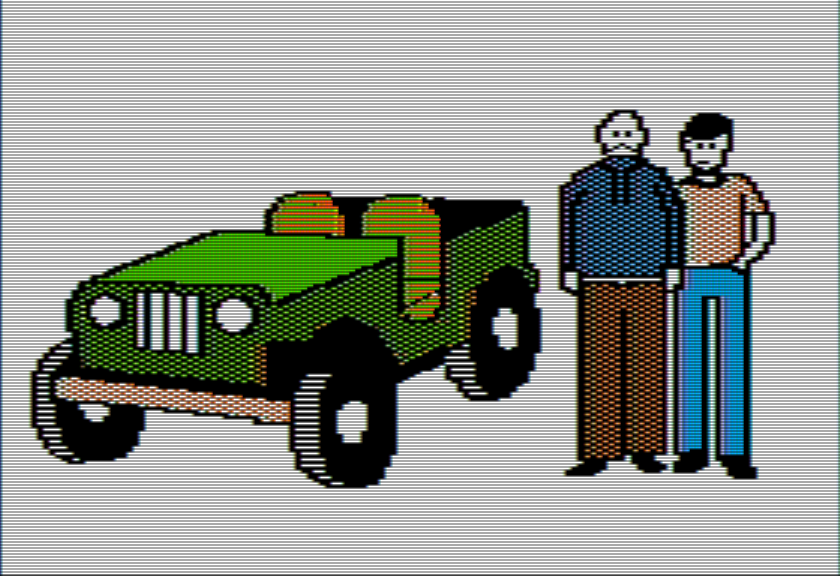
This is “animated” with the image getting closer and closer. One of the touted features of the Ultra system is a fast enough drawing system to have animations.
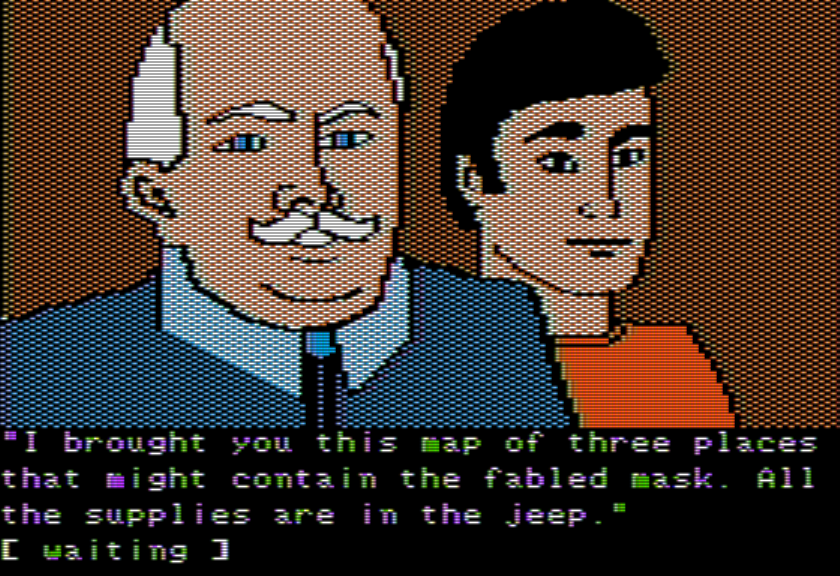
The map is a nice touch; rather than just randomly wandering out and finding out directions arbitrarily on the fly, there’s a sense of goals.
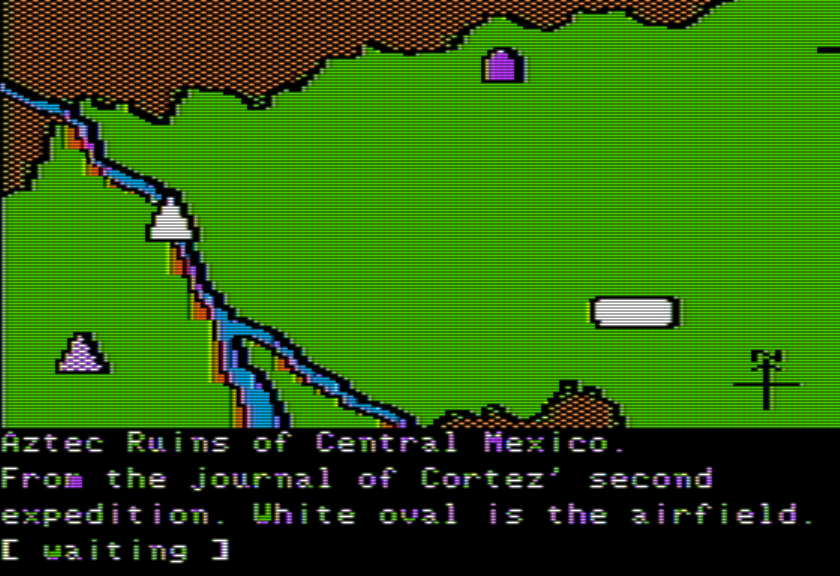
To go anywhere we need to hop in the jeep first, and driving has an “animation” showing multiple slides.
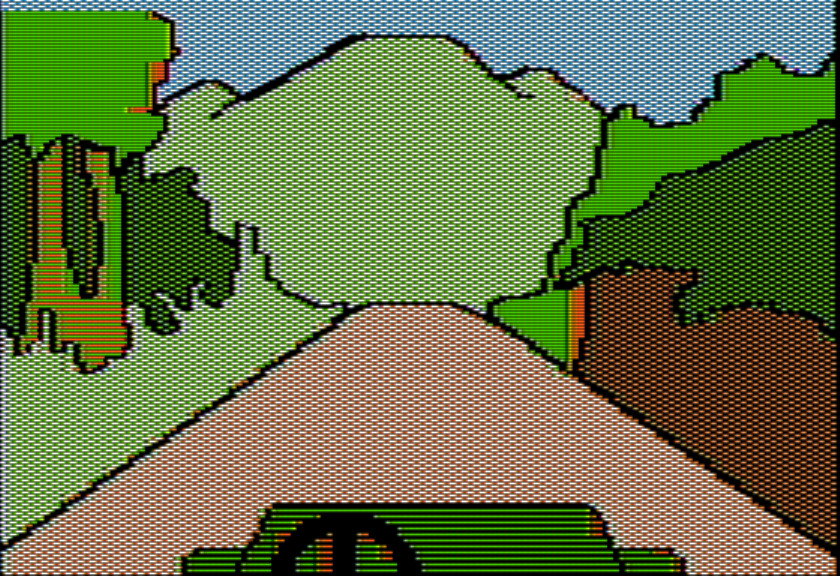
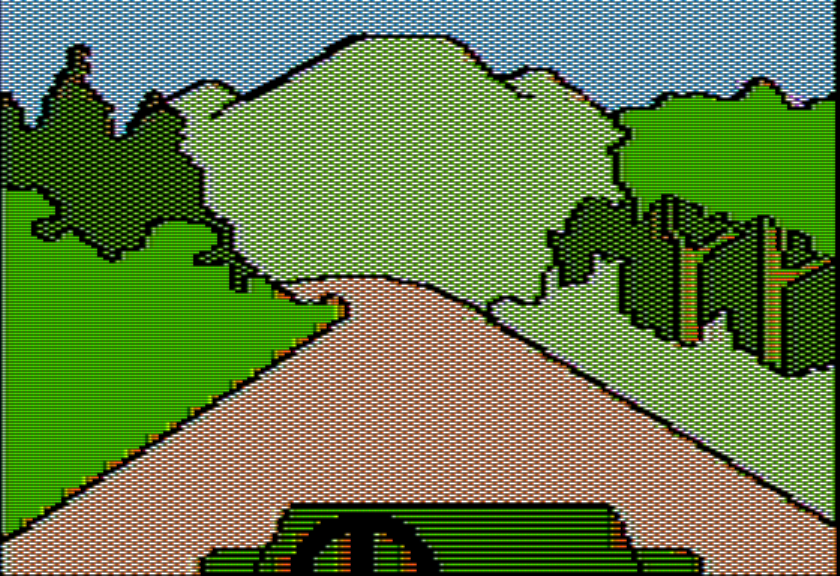
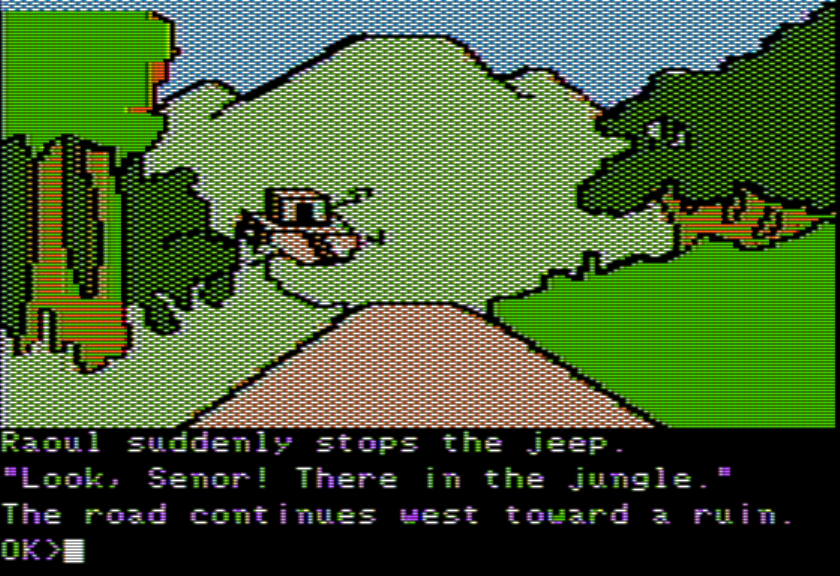
There’s a branch where you choose to drive either west or northwest. Picking northwest, as it seems to lead to the closest ruin:
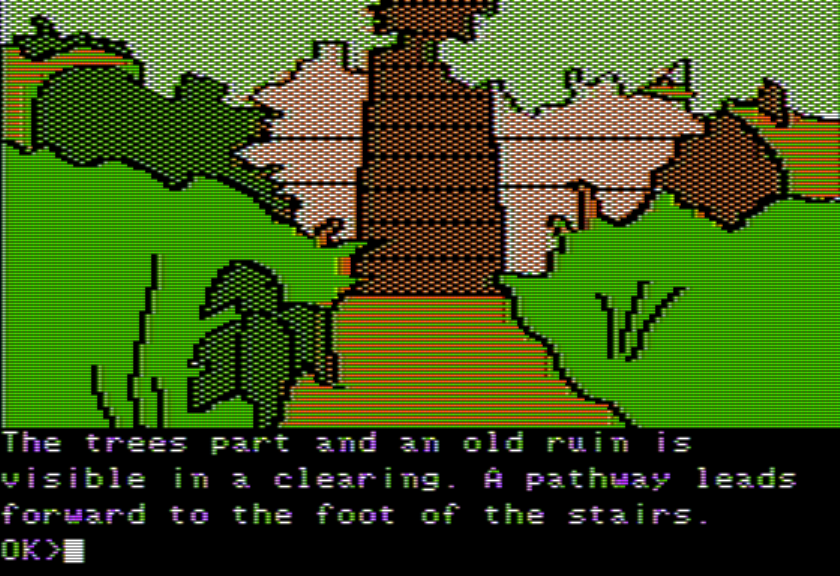
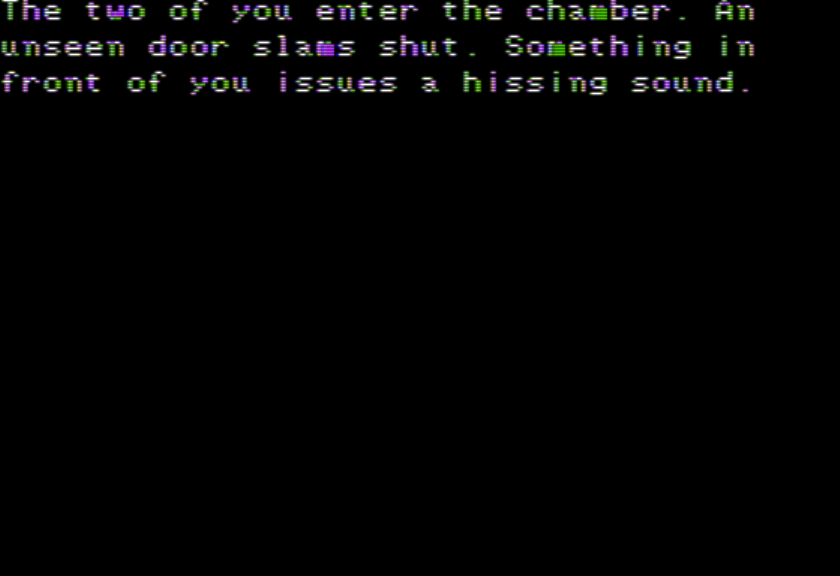
There’s a “darkened doorway” at the top of the stairs. Going inside causes the door to shut and there to be a hissing sound in darkness. Unfortunately, the lantern requires matches to light, and the game did not give any at the start.
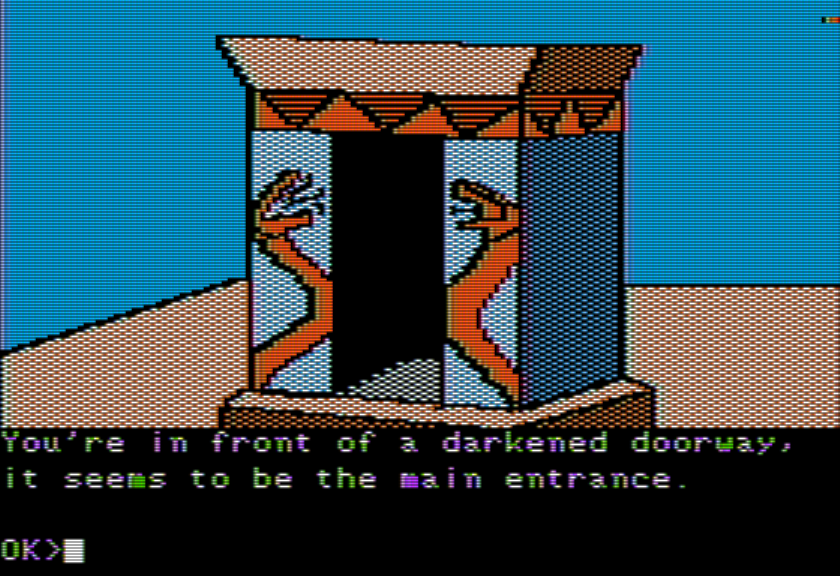
This seems like a good place to stop while I scout out the territory. Certainly I can say from what I’ve seen so far this is one of the most polished of the games I’ve played for the Project so far; the art has the feel of late-80s Apple II as opposed to the vector squiggles of this time. (Queen of Phobos had animation and some really good style where it leveraged the vector art for a terrific atmosphere; the games with Incrocci illustrations like Masquerade didn’t have them added in until after 1982.)
Mask of the Sun’s parser, on the other hand, does not seem as polished as the authors want to claim, but I want to get a little deeper in the game before I make any over-arching claims about it.


Pingback: The Mask of the Sun: Inside the First Ruin | Renga in Blue
Pingback: Lazy Reading for 2024/04/21 – DragonFly BSD Digest