PREVIOUSLY….
Ken and Roberta Williams released Mystery House in 1980, kicking off their Hi-Res Adventures line. These adventures made their way to Japan as imports, as players used dictionaries to help them through. Programmers in Japan started writing their own adventure games, starting with Omotesando Adventure, a text-only game that utilized the ADVEN-80 system published in an American magazine. Tsukasa Moritani, dentist and computer enthusiast, made his own game, Mystery House, very loosely based on the American Mystery House, and worked with computer store owner Naoto Oyachi to make a publishable product, kicking off Micro Cabin’s software line.
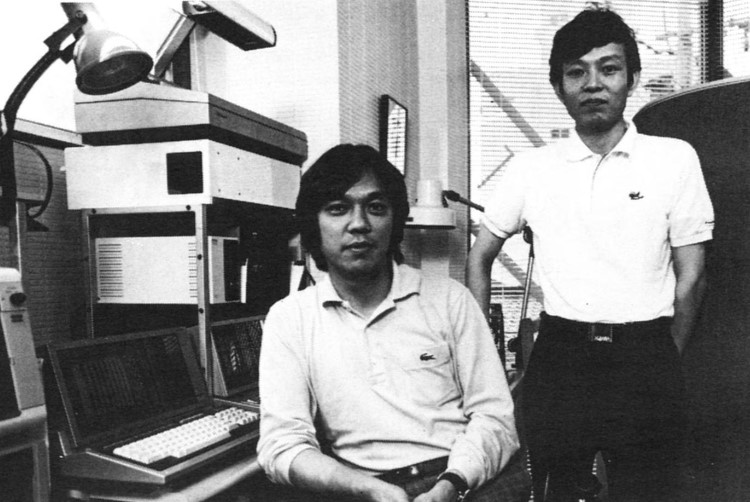
Naoto Oyachi, sitting, and Tsukasa Moritani, standing. From Technopolis September 1983.
Mystery House came out at the start of the summer; by the end there was a sequel, also by Tsukasa Moritani. Based on the fast turnaround time it was roughly the same engine (on Sharp MZ-80B), but with a larger area (three floors) and the exact same quest (find a treasure in the house). Also, a higher price tag (9800 vs. 7800 yen). It eventually made it to a diverse set of systems like the NEC PC-6001, FM-7, and MSX.

From MSX Game World. Notice the price is 3800 yen, cheaper than 9800, but this was released in 1984 when the original was two years old.
(The rest of this assumes you’ve read my prior post on the first Japanese Mystery House game. Feel free to take a digression and come back.)
The two versions I have access to are NEC PC-6001 and MSX. I have tried both and there are significant difference in at least the opening. The PC-6001 version starts you outside…
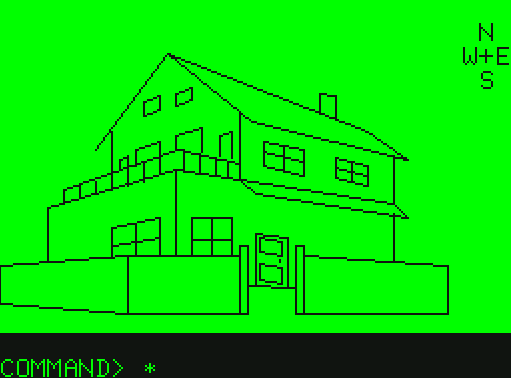
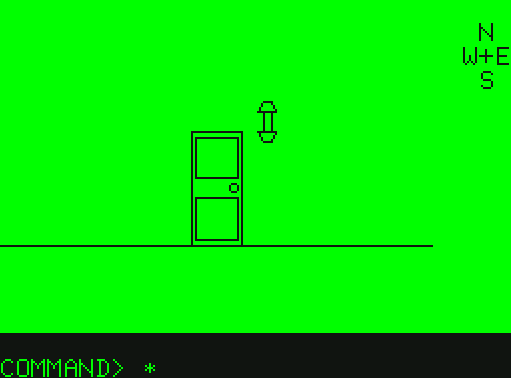
…and has the front door unable to open. You have to walk your way around to a side door.
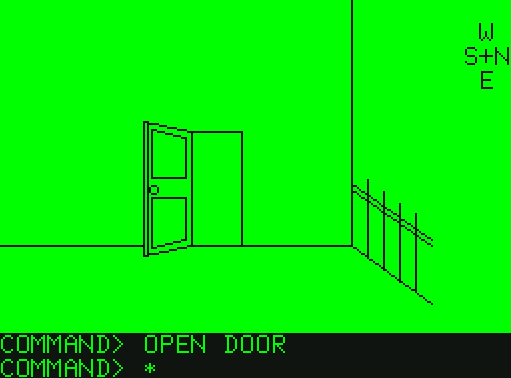
The MSX version, on the other hand, lets you open the front door right away.
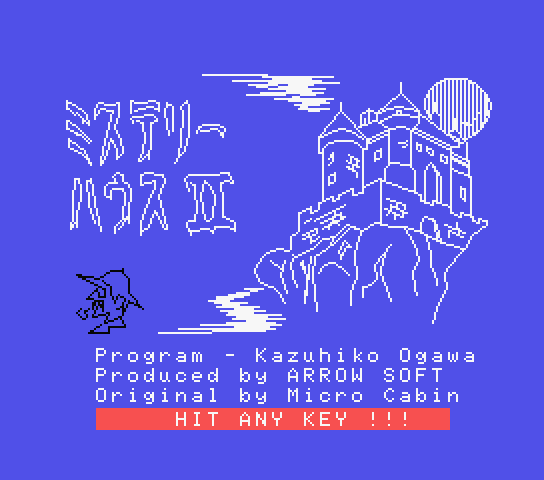
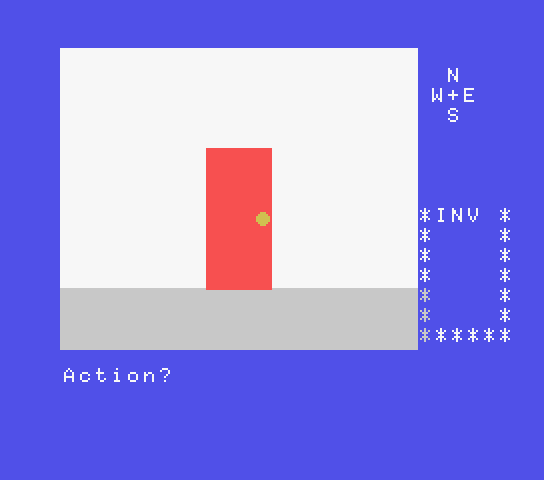

The NEC PC-6001 one also lets you type verb and noun as one command, and works more or less like the FM-7 version of Mystery House we played. The MSX version has verb and noun as separate prompts, but importantly does not require also switching to a separate screen to type. Directional commands are given via the parser rather than relational direction keys. That makes playing the MSX version of Mystery House II much more tolerable than Mystery House I.
Another contrast is the handling of the 3D-view. The PC-6001 edition allows you to see “left” and “right” in addition to “forward”.
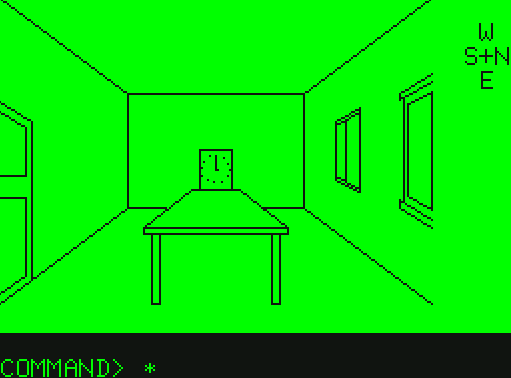
Whereas the MSX 3D view is tunnel vision, where you can only see in the direction you are facing. For example, upon entering the house this is your view:
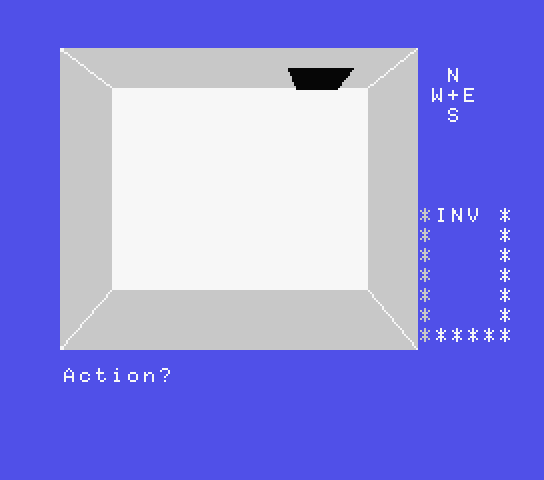
However, in addition to the door behind you that you entered, there are doors to the east and west.
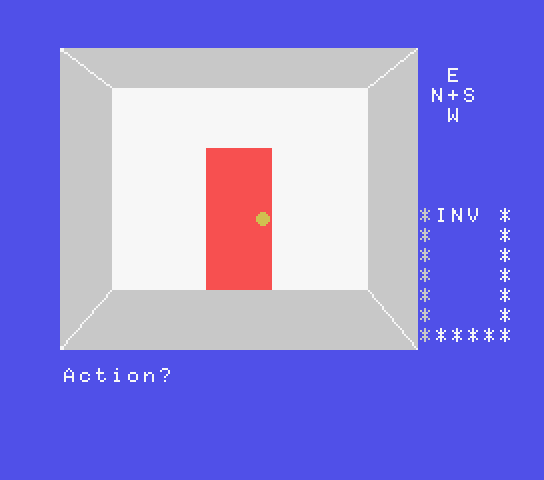
You are restricted to two items in your inventory at a time, and it looks like the inventory selection is far greater than before.
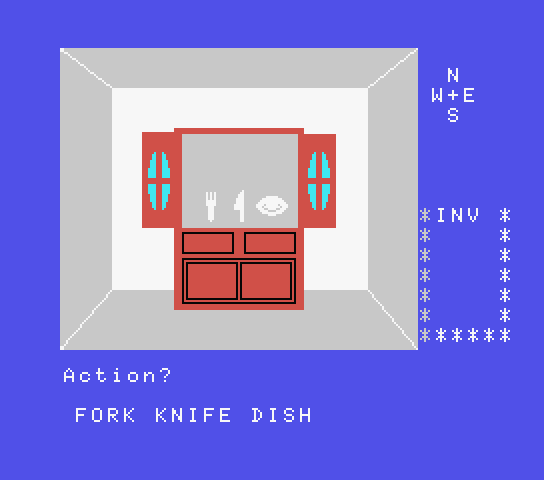
Immediately to the east of the start there’s a cabinet as shown above. You can take two of the items…
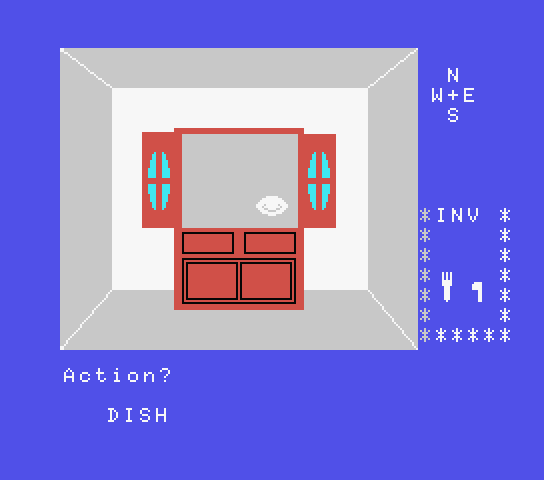
…but now if you also want to take the DISH you are stuck and have to drop something.
There are two other reasons to stick with the MSX version:
1.) As you likely already noticed, the screens are in English. That’s because the MSX version (and only the MSX version) has a translation patch.
2.) Even more importantly, there’s a walkthrough specifically for the MSX version.
However, I reserve the right to vacillate and change my mind back. At least according to this Japanese fan site by “furuiotoko” the MSX version is disappointing compared to the original and was “changed considerably” so I’m going to stay alert.
To finish off for now I want to quote another part of that fan site. Mystery House was — when the author was a child — their first adventure game, so the moment was magical:
From that moment on, I immersed myself in the world of this mystery house … It was a game that was completely new to me. In the virtual space on the computer that appears in front of you, doors open when you open them, items disappear when you take them, new discoveries suddenly unfold in front of you when you examine them … It’s probably because I personally loved this kind of secret exploration of the mansion, but I’m sure there are many other people who were equally impressed by this game.
The author invited two friends over to play, and they were trying to solve the ladder puzzle (the same one I was stuck on, where you can fall and die if you climb). One friend suggested moving the ladder, and another suggested busting open the wall behind. When this successfully made a hole, their excitement reached a “peak” of a kind that would never be duplicated again.


 Renga in Blue
I’ve been always a Spectrum child, so most of my initiation in IF came from Spectrum Adventures made in PAW. So, for me, pictures in adventures were just a comodity, a deprecable luxury. The format were composed of the text and the parser.
So, I’ve never were fond of HI-RES games, and all those adventures with very short descriptions and very ugly pictures that cover most of the screen.
Thanks to this article and the reactions of those children playing Mistery Mansion, I can see the appeal. And I can see the purpouse of all those adventures that inherit from the Sierra line. It is another paradigm: the First Person Adventure; before mouse and real time control were common, and now I can see it is worth it.
I know that sometimes this paradigm can confuse us, hardboiled IF players, you know, Jason, when an object is in the screen but it is not described, and viceversa… but yeah, now I understand.
I love finding this kind of testimonial since one of the things I’ve been tried to dig into is the historical-experiential aspect. I know a lot of people don’t think of “what I felt at age 8 when I first played an adventure game” is part of history but it really does show how people responded when these things were new and can have a ripple effect on what people like when they’re older.
The best text needs no graphical embellishment. Beyond Tenniel’s sparingly used gothic images in The Alice books I have always felt them to be at best an unnecessary extravagance and at worst a form of mind control over one’s own perceptions. I have never played a text adventure wheré the experience has been augmented by graphics. Perhaps the ocasional ASCII art of Dungeon and Warp pass muster.
I disliked graphics back in the day. When I was playing text adventures, our little community in the UK hated games with graphics with a passion… they were a waste of the limited memory we had available to use to create our games. Now I appreciate graphics a lot more and I do think they can add something to a game when they’re well done and specifically drawn and designed to the strengths of the machine.
Your comments about graphics or even book illustrations as “a form of mind control over one’s perceptions” is interesting. Especially for me, as I’m one of the 1-4% of the population who don’t have a mind’s eye. When I read something I don’t picture anything so, for me, flowery, length passages of descriptive text are absolutely pointless and I just skip over them. It’s probably why I’ve never been interested in Infocom games or modern IF.
As someone who didn’t really grow up with text adventures outside of some weird freeware ones from the pre-Inform days, I find that most of the time a text adventure with pictures is the worse for it. It’s not just that sometimes they play that game of hot potato where you have to figure out if something in the picture but not in the text is something you need to worry about; It’s that they’re almost never high enough quality to make up for the lack of text space and the banal description of a scene you get. I’d rather have a Scott Adams game than a Scott Adams game with pictures.
That said, I do feel like when well done images come into play they work wonderfully. The alienness of an alien, the grotesqueness of violence in a horror game, or just a well-done forest image. Text is very nice, but some things can only be properly brought upon by an image.
There is a particular kind of subtlety that images can do and text can’t (Obviously, there are DIFFERENT kinds of subtlety that text can do much better), and that particular kind is very well-suited for interactive media. Text games quite often run into the problem of how to simultaneously make something “be right there for you” without calling attention to it: they can either say it’s there, or not say it’s there, and the very act of saying it’s there flags it as important, while deliberately avoiding it often feels dishonest. A graphical image can have something be visible without calling attention to it much more easily than text.
That’s something I notice a lot in film – an establishing shot of a room can show you important details without calling attention to them, in a way that a book usually can’t – it can give you a lot of details without changing into the narrative mode of an infodump.
Chacun à son goût Strident. I understand where you’re coming from. I suffer from synesthaesia, where letters are perceived with different colours. It has helped in my days as a proof reader. I understand some blind people hear noises as colours. Apparently under test conditions many blind people heard trumpets as yellow.
I suppose each side of the old battle between the “thoughtful difficult crossword” and the “instant emotional narrative” as almost described by Graham Nelson is always going to have its adherents. I think modern text adventures are too self consciously of the latter variety. Modern society is of course geared towards instant gratification thanks to technology of all forms; most people born into it would find the concept of playing a mainframe adventure from the seventies as alien as reading a dusty old copy of War and Peace from a library, removing their headphones at the supermarket checkout to interact with the person serving them or cooking a casserole in a pressure cooker for many hours. I believe the sociologists call it baselining.
I read a disturbing report recently whereby babes in arms had been seen pressing the glass facades of shops in the expectation of something appearing on them, having been weaned so early on handling mobile phones. We are producing people who cannot interact comfortably with anything that does not contain a microchip.
I find it moderately funny to see this sort of thing here, I just sort of never expected this “kids have no patience” talk here. Not that I disagree, but I also note it’s not exclusive to the younger, even people who weren’t born with an iPad in their hands can fall victim to this sort of thing. By the same token even people on the younger side can still appreciate the older things, since I’m definitely one of the younger people here, young enough that say, Columbine isn’t a thing that I remember hearing about.
Frankly, I’m not so sure it’s necessarily technology guiding this change as algorithms and enough content getting regularly released that following the stuff is a full time job. I remember seeing somewhere that there are enough new games being released on Steam each day that it would take you a year to play them all. And that’s not even all the games being released, and that’s just one medium. Do you really need to work at any one thing when there’s another ready to give you all you need? I wonder what the long term effects of that are going to be…
Pingback: Mystery House II: The MSX Version | Renga in Blue
just for reference (it was posted yesterday), Chronologically Gaming played Sharp MZ Mystery House II here
I still plan to go back to the NEC PC version sometime