I’ve finished the game; my previous posts are needed for context. You can read my complete Ringen series including the 2019 content here, and my series starting from the DOS port here.
Nearly to the end, this game has a serious issue with how events are triggered: it relies heavily on random number generation. This is an issue I’ve brought up multiple times but it’s worth a re-fresh:
Suppose you have an event that happens 1% of the time in your game, checking every turn. How likely is it that it will take over 100 turns to see the event?
Intuitively, many people would think it quite unlikely. Another way to phrase the question is “how likely is it to get 99% — the failure state — 100 times in a row?” This is simply .99 raised to the 100th power, or approximately 36.6%. That means more than a third of players will be failing 100 times in a row.
How about 200 times in a row? That seems unlikely, right? Well, no, it’s actually 13.4%. Remember this is a designer who likely was thinking “oh it’ll be about 50, at worst about 100” and more than 1 of 10 in players are now waiting double the “maximum”.
Surely not 300 turns in a row? That’s still around 5%, or 1 in 20 of all players. Especially in the context of a text adventure, 300 turns is a very long time.
The curious thing about Ringen is there is at least a little acknowledgement of this problem. Let me go back to the scene with Legolas appearing, and giving Sting (which turned out to be central to my last leap and winning the game).
I will try to help you out of here, but first I will try to find our mutual friend Gandalf. In the meantime, help yourself the best you can. Fortunately, I have found your dear sword, Sting. Take your magic weapon, and you will have something to defend yourself with! We’ll meet again soon!
The Legolas encounter can occur any time in the game, with a 1% chance. The source code also adds an extra condition that Legolas will appear automatically if you exceed 200 moves (what I ended up doing on a rest was just walking back and forth between two rooms, and it did take until move 201 for Legolas to show up). So, under normal play conditions most players will eventually do enough turns to see him.
The problem is that the upshot — the thing I was missing — is a random roll that happens after you get Sting. What you want to happen is have the “small trolls” appear again (the ones who thought you were a wizard). However, in actual practice, they weren’t showing up for me; at first this was just by chance, but then I went to check source code and tried to get them to show intentionally and still had enormous trouble. I went to over 300 moves without seeing them (1 in 20 isn’t that unlikely! It’s just your natural 20 in D&D!)
They see the glittering sword you are holding, shout wildly, and run away in total confusion.
In the process of doing this, one of the trolls drops some clothes. (This is non-obvious; you have to either look at the room again or return to it later and be observant.) You may recall last time I was trying to translate “trollham” and I went with “troll-skin” knowing there was some ambiguity. K had it right in the comments: you’re supposed to dress like a troll to win the battle against the Balrog. The other items you’ll need are Balin’s axe and the wizard staff (technically the One Ring because the game doesn’t let you drop it, and you need to escape with it, but the Balrog can see you either way so it doesn’t matter if you are wearing it).
Before taking on that battle, a couple more RNG instances —
Back at the dragon I was confused about an inclined room to the north where seemingly every direction drops the player back down to the start. I was a victim, again, of RNG: going north sometimes will drop back to the start, but sometimes drop into a “royal” room instead.
I may not have every room (see: RNG, even testing 20 times there’s no guarantee you didn’t miss something) and on my winning run I didn’t even bother entering; it’s just treasures like a crown and a shield. (They would help with the 200 point thing with the wizard, but a.) I didn’t bother with the wizard on my final run b.) I already had enough treasures to fill my inventory, so for any extra treasures to count I needed to cash them in at the Pawnbroker, something I never figured out how to do.)
I also had an encounter with Arwen. I believe this triggers if your points are above a certain level and then your random number gets lucky again, and it is worth mentioning because it redeems the wizard scene slightly: she gives you a tiara and tells you explicitly the wizard now wants to see you, making it not so arbitrary any more to visit him.
Ei strålende vakker alveprinsesse får se deg. Hun stopper opp og ser på deg med et fortryllende vakkert smil, og sier :
`Jeg er Arwen Undomiel av høyalvenes folk.
Jeg må straks tilbake til mine egne, så jeg har ikke tid til å prate.
Ta denne tiaraen, Ringbærer, den vil kanskje kunne hjelpe deg.
Trollmannen ville treffe deg på sitt oppholdssted. Gå dit!’
Prinsessa forsvinner i en sky av flagrende gevanter.
A beautiful elf princess comes by and sees you. She stops and looks at you with an enchantingly beautiful smile, and says:
“I am Arwen Undomiel of the people of the High Elves.
I have to get back to my own people now, so I don’t have time to talk.
Take this tiara, ring bearer, it may be able to help you.
The Wizard wanted to meet you at his location. Go there!”
The Princess disappears in a cloud of fluttering robes.
Finally, the bit with the earthquake that opens a gap is not linked to the picking up the ring — it eventually just happens. This allows you to visit the Pawnbroker and the west side of the lake and the Palantir without worrying about Gollum swiping the ring.
You may incidentally wonder how I handled reclaiming the ring from Gollum. I just made sure he didn’t steal it in the first place. I don’t know the exact logic (I studied the code and I’m still unclear) but when I was ready for the final challenge, I put on the ring right before entering the earthquake passage; there’s enough time to get to the Balrog and kill it before taking the ring off, and Gollum can only steal the ring if you’re visible.
With all that taken care of, while approaching the Balrog in troll clothes he pauses, giving you enough time to act.
The Balrog seems to hesitate a bit.
What are you going to do now?
A little parser struggle here; “use axe” doesn’t work (even though that’s what you’re using), you have to “kill balrog” instead.
You attack the Balrog with Durin’s axe!
The giant monster roars furiously and strikes after you!
Durin’s holy axe seems to have a life of its own!
Suddenly it flies from your hand and hits the monster in the eye!
The monster takes a step back, loses its footing, and stands swaying.
What are you going to do now?
Using the staff, which before gave out stunning light:
The Balrog falls with a terrifying scream into the abyss.
You have defeated the Balrog!
This is not the end of the game. The fact this keeps going a little longer is arguably the classiest part of the game; not only is there one last dramatic moment, but the ending feels like a real denouement. So many of our fantasies have had an abrupt “you got all the treasures, you win”; even the ones with an “endgame” generally have not let the plot wind down gently.
You are following a road that runs east/west.
This is the widest road yet; the floor is worn from long use.
A fresh breeze comes from the east!
>e
Okay.
You are walking on a wide east/west road.
A breeze is felt from the east, and there is a faint daylight coming from there!
There are multiple rooms going out and you can find some of the random treasures here; on my winning run there was a platinum egg and Boromir’s horn. Just right after the exit:
You are on the east side of the Gate Hall. To the east, the mountain opens up.
You can see the blue morning sky a stone’s throw away, from a wide portal.
Just a few more steps, and you’ll be outside!
From behind the stones, a horde of Uruk trolls suddenly jump out with cries and block the entrance.
In the middle of them sits a black, shrouded figure on a black horse. It is a Ringwraith, a Nazgul!
With a thunderous voice the Nazgul says:
`Stop! Who are you, walking in troll clothes?’
ha ha ha yeeeeees
You see, I knew exactly what was about to happen: while Sting scared some trolls and caused them to drop some clothing, surely it was put in the game for a nobler purpose?
Nazgul illustrated by Margrethe II of Denmark for a Danish edition of Lord of the Rings.
>kill nazgul
Sting flashes furiously, and with one blow you knock the stunned Nazgul off his horse! The Uruk trolls recoil in surprise.
What are you going to do now?
You can now go east to escape (if you do anything else, you get pelted with spears).
Du er utenfor de store portene i Dimrill-dalen.
Mot øst strekker den store porten seg, og du kan se et lite vann blinke under deg. Morgenhimmelen er blå, og den lave sola skinner på fjellet over deg. Under et steinkast mot vest gaper de svarte åpningene – dystre og skjebnesvangrende. Bare litt til nå, så har du klart det!
>ø
Ok.
Du er på et platå øst for de store portene.
Under deg er den grønne dalen, og speilsjøen ligger som et prydblad og funkler under den lave morgensola; som nå endelig kaster sine stråler på deg. Intet troll kan nå deg her. Du har klart å komme igjennom Tåkefjellene. Som Ringbærer har du trosset alle farer, og fått med deg Ringen, Den Ene, gjennom de dype minene i Moria – Gratulerer!
You are outside the great gates of the Dimrill Valley.
To the east stretches the Great Gate and you can see water shimmer. The morning sky is blue, and the low sun shines on the mountains above you. A stone’s throw to the west, the openings gape black and gloomy. Just a little farther!
>e
OK.
You are on a plateau east of the gates.
Below you is the green valley; the mirror lake sits like a leaf and sparkles under the low morning sun, which now finally casts its rays for you. No troll can reach you here. You have managed to get through the Misty Mountains. As a ring bearer, you have defied all dangers, while taking the ring, the One, through the deep, the mines of Moria – Congratulations!
This had the most satisfying ending I’ve seen in a text adventure for a while. Despite the action being steps forward, there’s something much more dramatic and tangible here than the usual passage (with the brief tangle with the Nazgul at the end).
It almost makes up for the terrible RNG parts. There’s no real “points” here to balance, but I did have multiple hours wasted on what turned out to be bad dice rolls, and the game was never transparent about what was going on behind the scenes. I think the intent works better in a computer lab: multiple people playing in such a setting are more likely to collectively trigger certain events, so if one person meets Legolas the others know he is around somewhere.
The treasures came off as superfluous, even with the point-total aspect to the wizard (why should I care about the platinum egg on the way out?), but again, there’s a collective-group sense to them: if this is a game people are burning processor power over a whole semester on, forcing the addition of a restriction to computing time, an extra element other than just beating the game helps.
If nothing else, it helped I felt like I was “in the world” of Tolkien more than Ring Quest, despite that game’s bigger sweep of focus (and boosted ability scores handed over to Frodo, who was able to solo the Balrog).
Checking against the MUD, the author included many of the same rooms, but mixed up their geography. I still don’t know where to find the sulfur in MUD-form (to get by the dragon) or how to find the name on the third riddle (it would be amusing if it could be brute-forced just like Ringen; there’s no apparent wizard substitute on the MUD). As you can just walk out of the region in the MUD it loses much of its tension. The original product was in the end more satisfying, even if I had quite slow progress due to the Norwegian.
Original notes for translating the room descriptions to MUD form.
Coming up: A completely unknown and undocumented game by a (relatively) famous company. It hasn’t even been mentioned in this blog’s comments before.
Some progress, although I confess to looking at the source code for one puzzle; I have absolutely no regrets whatsoever based on what I found.
The 1984 Norwegian translation of Lord of the Rings, considered a superior version to the 70s one. Via Reddit. There’s a third translation called Ringdrotten from 2006 which adds more dialectical flair.
Just to clear up an issue I had last time, I somehow translated “en skitten striesekk” as a “pile” rather than a “sack”; I was reinforced in this by trying to “ta striesekk” (ta=take) and being denied, leading me to think it was an item that was not meant to be taken. You have to refer to the noun as a “sekk”, and then holding it will passively increase your inventory limit. (I should have done my image search.)
Regarding the cylinder (“sylinder”) I wasn’t sure about, I hadn’t randomly done “bruk sylinder” with it anywhere
Sylinderen utvider seg svært raskt. Snart er den helt oppblåst, og det viser seg til slutt at den har blitt til ei stor og sikker plastflåte.
The cylinder expands very quickly. Soon it is fully inflated, and has turned into a large, secure plastic raft.
“Plastic”, eh? In any case, it meant this was a “you’ll know where to use it when you see it” type item, not something where (I originally had in my head) I need to find a matching sphere and pyramid, or I need to find a hole in a door that it becomes a key for.
The magic staff similarly reacts to “bruk”, and creates a burst of light. If you’re being chased by trolls (from off the area to the north, say) they’ll scatter. The only problem is you can’t use the staff to assault their position because they just keep respawning in the same turn.
Finally, a fun encounter after getting the mithril armor gifted by the elves (which again, like, the sack, gets used passively, you don’t specify you wear it):
En liten flokk med småtroll kom nettopp gående ut av en sidegang. De bråstopper da de får øye på deg.
Med et triumferende rop støter den ene et spyd rett i magen din !!
Spydet skrenser av, og det faller ned brukket.
`Han må være en trollmann !’, skriker den ene hest, og alle trollene forsvinner forsvinner i ei voldsom fart.
A small group of trolls come out of a side passage and stop suddenly when they see you.
With a triumphant shout, one of them thrusts a spear right into your stomach!
The spear snaps, falling to the ground broken.
“He must be a wizard!” shouts one of the trolls, and they all quickly disappear.
This left me with a magnifying glass and a knife unused. I tried a restart and found that items were shifted a bit — placement of some things are randomized (like treasures) but others are not (seemingly the “practical” items like the magnifying glass and the raft). I found some stones (which turn out to be flint and can make sparks, but don’t light anything I can find) and Boromir’s horn (which you can play, bringing your spirits up, but doesn’t do anything useful I’ve found).
One last random-position item is some rope, which breaks the practical/treasure dichotomy, but seems to be purely optional. On the far north of the big corridor (with the trolls guarding making any progress farther) there’s a branch to the east leading to a “star room” (“covered with deep-blue silk walls and glittering stars”) followed by an otherwise-undescribed “wizard’s room”. The Star Room includes a hole with a hook next to it, and if you use the rope there you can climb down to the troll dungeon (the same area that you can get tossed into involuntarily by being chased). I think the only reason to do this is there’s a random chance the trolls will kill rather than capture, so the rope is a sure thing, but sometimes the rope is randomized to be out of reach anyway.
You may notice a very important item mentioned on the map. It can’t be reached from the dungeon (I think); I’ll get back to it.
After either being tossed in the prison or entered via rope, there’s a message below giving a hint how to escape.
The lower dungeon.
This is a small hole roughly carved out of the rock. An exit is up. On the dirty and dusty wall is a sign: “I, Gloin, was here. There is a secret exit from here, which the trolls do not know about, made by us dwarves. Just say the name of the legendary Bilbo’s nephew, son of Drogo, and you will escape — but watch out for trolls!”
FRODO works here. You can then go south and east to find what the game describes as a climbable wall, except nothing I’ve thrown at it works (trying to actually use the verb climb has the game respond if you mean up or down, suggesting that the directions up and down are overriding, but neither works anyway).
Veien mot øst er blokkert av en mistenkelig glatt og skitten steinvegg. Det virker som om det skal være mulig å forsere denne.
The route to the east is blocked by a suspiciously smooth and dirty stone wall. It seems as if it should be possible to climb over it.
I threw a ton of verbs out here with no luck, but since I’m using an English-Norwegian dictionary, I could be missing something totally obvious.
If you go south a bit from here there’s a “stone table” which seems like it might be moved over to the wall (so you can get high enough to climb). No verbs here work either and the noun isn’t even recognized, suggesting to me I’m wrong here, but given the wall has completely stumped me I can’t discard anything.
With the aforementioned wall (probably stuck by a verb), the “maze” which might just be a trap in the undergrowth, the trolls, and the witch with the riddles being my only real obstacles, I cracked at each one for a while alternating but just had no luck at all. The trolls seemed the most promising since you can pull them away from their guard spot and they have lots of reactions, but there seems to be an endless supply of them so it doesn’t matter. I started to suspect (especially on the wall) I was having a verb issue, so decided to dive into the source code.
That’s making a set of names (vicci, dicci, sicci, etc.) by random choice. I decided to try them out on the Huldra (“Witch and sorceress, what is my name?”) and got lucky my first try: “‘Correct — and never come back!’ A hole opens up in the floor.”
The hole leads down to the One Ring, behind the trolls.
Trollenes skattekammer!!
Ei stor, flat steinhelle dekker mesteparten av gulvet. I et hjørne er det ei sjakt hvor det stiger opp råtten stank. Går du ned dit vil du ikke komme opp igjen samme veien. Det er ei dør mot sør.
Du ser:
En liten gullring uten inskripsjoner. Dette er Herskerringen, Den Ene.
The Trolls’ Treasury!
A large, flat slab of stone covers most of the floor. In one corner is a shaft with a rotten stench. If you go down, you can’t come up the same way. There is a door to the south.
You see:
A small gold ring with no inscription. This is the Ring of Power, The One.
While the ring is often depicted with the Black Speech on it, by default the One Ring is plain, and the words only appear when the ring is heated up. This is depicted in the Peter Jackson movie:
From here you can drop into the prison or just use invisibility to saunter away. Note that wearing the ring for too long will cause Doom so you should take it off again once safe (“If you wear it too long, Sauron will be able to capture you in his power”).
After getting the ring, an earthquake hits and a new exit in the long hall busts open, leading to the east. In my play sequence I explored that first before looping back, but let me explain how you were supposed to find the witch’s name (Vicci / Dicci / etc.) in the first place. I needed the source code again.
There’s a scene with a wizard — back at the Star Room — where the wizard appears and tells you some information.
You are looking for the ring you have lost, but it is well hidden in the trolls’ treasury. There is no way you can get past the guards alone, but there is a person in Moria who can help you. somewhere in the mountains lives an old witch who knows an entrance to the treasure chamber.
He then tells you the name, based on the random choice at the start of the game.
I spent a long time (without checking the code) trying to get this scene but never could. Eventually — after about two hours of effort — I gave in:
5410 IF RN%=20 AND NOT(TB%) AND SC%>200 THEN 6420
SC is referring to the score. You need 200 points for the scene to trigger.
(… incomprehensible yelling goes here …)
If this was a low threshold, this moment might be semi-acceptable, but 200 is a tough score to hit: you need to visit all the rooms (visiting a room gets a point), and you need to get somewhat lucky in the layout of the items (some which can land in the post-ring area which you are about to see). You only get points for items if you’re holding them so you need to shuffle your inventory to high-value items even if you aren’t using them. If you wander into the Star Room with these conditions you’ll trigger the wizard.
It’s one thing to know that as a goal you need score, but prior to this, there was no indication that score was anything more than a progress marker. I was storing all the items in a central chamber as there was no obvious “treasure bonus spot” and because I was reloading after dying, I wasn’t necessarily including “explore every side room” in my save file — after all why would you expect a stop by a Rose Garden would cause a wizard to appear all the way across the map?
I can’t be sure but I think it’s possible to simply get unlucky with item placement and have it be impossible to reach 200 points. After figuring all this out I ended up going back to guessing the name randomly (and saving right beforehand) because it was so much easier.
Going back to the newly created hole (post-Ring finding) and going east:
To the north is an opening, while the main corridor continues from east to west. In one corner is a dirty, heavy stone slab; impossible to carry. In the middle is an area which appears to have writing, but it is so small you can’t decipher it.
This is where the magnifying glass comes in handy.
Jeg, Filur, risset dette.
Durins øks i menneskehender
skal en gang beseire
den grusomme Balrogen.
Ild skal sprute og glør fyke
når mennesket i trollham
ødelegger det uhyret
som har kuet Durins barn,
og jagde dem vekk fra minene
de en gang for lenge siden bygde
med sine egne hender.
I, Filur, carved this.
Durin’s axe in human hands
shall one day vanquish
the cruel Balrog.
Fire shall burst and embers blaze
when the man in troll-skin
destroys the monster
that has subjugated Durin’s children,
and driven them from the mines
they once built long ago
with their own hands.
“Trollham” which I currently have as “troll-skin” is a curious word and the translation may be important for the final puzzle of defeating the Balrog. (Does the Mithril count?) It does seem like us (Frodo) will be the one doing the killing/wounding, but we’re not human? (Can “mennesket” refer to a Hobbit rather than full-on Human? Does this depend on which translation of Lord of the Rings you’re using?) I did run into Legolas later so rather than doing the deed ourselves we may be handing the sacred axe (the one the “scary dwarf” kills us over) off to someone else. This conflicts with another piece of information later, though.
While in this area, almost inevitably, Gollum shows up and steals the ring. I bet you can figure out what “min dyrebare” means.
Ååååhh, min dyrebare !! Min egen Ring, endelig !
I have not found where he ends up to get the Ring back (my guess he somehow lands in prison, which I haven’t checked, or he still keeps eyes on you — there’s still a “shadow” that appears once in a while, although I’m at a 25% chance of that being Sauron instead).
Just exploring without the ring — you can drop down into a Great Hall, and then off a side passage reaching a Secret Chamber (so-named because of an unmentioned exit to reach there); going north then goes to an Even More Secret Chamber and the palantir.
This is the palantir of Orthanc.
This ball, and three like it, were made long ago by the elves.
With such a palantir you can see things that are happening far away, and things that will happen in the future.
Use this too many times and Sauron gets you, but you can get a few hints. Notably Aragon says something about “the key” being in the blackest depths (there’s a key later just lying around, so maybe he doesn’t mean a literal key)? Gimli, more helpfully, has a palantir appearance where he says…
The dwarves only accept the Ringbearer touching Durin’s axe! If you have it, you will be fine!
…meaning ring + axe is safe. (I need to get the ring back from Gollum first, though!)
Incidentally, near here is where I ran into Legolas, and unfortunately it’s another cryptic trigger like the wizard so I don’t know the exact conditions.
Towards you comes a tall, sturdy figure dressed in white elven clothing.
It’s your dear companion Legolas who is finally here to help! He hugs you with a friendly embrace, and says in a low voice:
‘I will try to help you out of here, but first I will try to find our mutual friend Gandalf. In the meantime, help yourself the best you can. Fortunately, I have found your dear sword, Sting. Take your magic weapon, and you will have something to defend yourself with! We’ll meet again soon!’
With long, firm steps, Legolas walks away down a hall and disappears.
I have not put Sting in action yet. There’s another, more regular encounter in the same area: a “pawnbroker” dwarf who says something about trading treasures. (I have thrown out many verbs with no luck, and this even includes checking for verbs in the source code.)
We accept all valuables and give good prices!
Have a good trade with Thorin!
Across from the pawnbroker is a lake; if you remember way back 2000 or so words ago, I mentioned the cylinder was really an inflatable raft, so it can apply here…
You set out on your raft. Just before you reach the other side, the raft hits a sharp stone and flips over!
The raft drifts away, but you make it to land safely.
…leading to what I assume is the last section of the game.
I found a gold key on the other side, followed by a dead dwarf with a fairly unhelpful message:
Couldn’t …. the great monster … cruel … 20 feet high … no chance … while I am still alive … Listen … my last words … not pr … the balrog out…. by … !!
Balin.
The letters cut off (“pr”) might represent some sort of Norwegian word puzzle, and if that’s the case, I would prefer someone who knows the language well just tell me because that’s past my skill.
ikke pr … balrogen ute
There’s a “secret chamber” with a door where it says you need to people to open it — maybe we get Gollum along for the trip? — a cave with an exit so burdened with cobwebs the game says to not bother (hard to know if that’s serious or not) and then of course the Bridge of Khazad-dum. Rather than chasing us up to the bridge, the Balrog is lurking at the end.
Like this, but the sides are reversed, and also it’s just Frodo. Via coolminiornot.
Keep in mind this is being done without the One Ring on, I’m just mapping ahead:
Mot øst er det en svart og bunnløs avgrunn!! Ei smal og spinkel steinbru buer seg over denne til østsida. Dette er Khazad-dum, dvergenes forsvarsverk mot øst. Brua er så smal at bare en angriper vil kunne passere over i bredden – og vil derfor være lett sårbar.
>ø
Ok.
Du er på steinbrua Khazad-dum!
Dette er ei spinkel steinbru over ei bunnløs kløft. Under deg kan du bare se mørke. Mot øst de første salene som fører ut i friheta!!
Føttene til den enorme Balrogen tårner opp over deg !!
Det stygge uhyret løfter ei meterstor hånd for å fjerne det ekle, lille krypet som rekker han til knærne !
Balrogen ser hånlig på deg. Før du får gjort noe har han knust deg som et egg under de svære labbene !!
To the east is a black, bottomless abyss! A narrow, thin stone bridge arches over to the east side. This is Khazad-dum,
the dwarves’ defenses to the east. The bridge is so narrow that only a single attacker can cross — so will therefore be vulnerable.
>e
Ok.
You are on the stone bridge of Khazad-dum!
This is a thin stone bridge over a bottomless chasm. Below you you can only see darkness. To the east are the halls that lead to freedom!
The giant Balrog towers above you!
The hideous monster raises a meter-long hand to remove the nasty little creature that reaches his knees!
The Balrog looks at you with a sneer. Before you can do anything, he has crushed you like an egg with his giant hands!
It certainly feels like I’m close to the end; I need the ring back, mainly, although I suspect I’ll need to do something other than just be wearing the ring and holding the axe in order to win.
I’ve done some major exploration of Moria, which is very open. I get the impression that part of the goal is “touristic”, just letting the player inhale the air of Tolkien’s universe without having too many puzzles in the way.
Moria, as shown on a movie poster by Dan Mumford. Source.
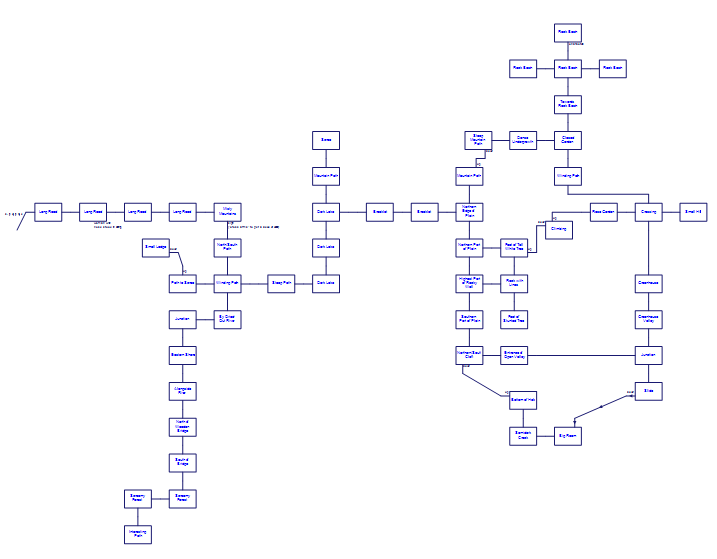
Let’s start with a meta-map. (If you haven’t seen one of mine before, this is a map where the directions are only vague, and is intended to show the general interconnectivity and sort things into regions.)
The maze may be an absolute trap — at least it seems to be one room that loops, and any items that you drop get swallowed up — and the trolls are an obstacle I haven’t gotten past yet. (And the point of them may not be to go past, but I’ll get into that later.)
The start area is central in more ways than one. There’s multiple holes visible in the ceiling from the start that you can’t reach, but you can go through the on the other side. That means multiple places will drop down back to the starting room (whenever they occur, I’ve marked them in red).
Regarding that “shadow” I saw just east of the start room, it appears at random at any point during the explorations, so is an “event” like the pirate appearing in Adventure. You can simply just wait in place (or as happened to me often, test to see if particular exits work and get lots of “dead end” type messages) and it will re-appear. There’s a knife nearby and I tried to USE it while the shadow was visible but Frodo is apparently “clumsy” and “unaccustomed” to handling one and just manages to cut himself instead. That’s not to say an aggressive approach will always fail but for the moment in my gameplay the shadow (my guess is, Gollum having reclaimed the ring and lurking invisible) is just something that happens.
Another possible random encounter is a “flokk med småtroll” (“group of small trolls”) although as long as you move to a different room when they appear they won’t cause trouble. (Orc in Norwegian is Orker; when I first encountered the flokk I briefly wondered if småtroll was intended to mean orc.)
Just to the north of the start is the axe which promised death, and I took it with no ill effects (but I theorized one might come in the future). Indeed, later (I don’t know if “at random” or on a timer) a “skummel dverg” (“scary dwarf”) arrives and looks at you; it may simply run away, but if you happen to be holding the axe, he’ll return with friends.
Dvergen ser skarpt på øksa du holder og piler rundt hjørnet. Etter noen sekunder kommer en hel flokk dverger løpende mens de roper noe opphisset. De river fra deg den hellige øksa og hugger deg ned.
The dwarf looks intently at the axe you are holding and darts around the corner. After a few seconds, a pack of dwarves comes running while yelling. They rip the holy axe from you and cut you down.
Closing out the central area is a pile of straw to the west of the axe, and a “wing of literature” to the east. Randomly, that wing has an elf hat and a pearl necklace, but also the inside text of the One Ring written in Black Speech.
(“One Ring to rule them all, One Ring to find them, One Ring to bring them all and in the darkness bind them.”)
Proceeding in that same direction leads to a “square room”…
…where branching off to the north is a pyramid (“some notes of music can be heard in the distance”), a “rat’s nest”, and finally a dwelling of a “huldra”. The huldra is a Norwegian mythical creature/sorceress that is usually depicted as young…
…but for the purposes of this game, it is old, and surrounded by toads. She asks if you want to solve three riddles; if you fail, you’ll get toad-ified.
Ei gammel trollkjerring sitter foran en stol oppstøttet av silkeputer.
Hun vrir det heslige ansiktet sitt til et groteskt grin og sier:
`Er du beredt til å svare på tre vanskelige og skjebnesvangre gåter?’
An old witch sits in front of a chair, propped up by silk pillows.
She turns her ugly face into a grotesque smile and says:
“Are you prepared to answer three difficult and deadly riddles?”
This was in MUD-Ringen and the riddles are the same, except that the translation of the creature is of a “ogress”. This is one moment we have confirmed from Pål-Kristian Engstad himself that this was added by him to the home computer version.
… I have only made this creature up from my imagination. It might or might not be very Tolkienish, but it always made the players wonder. I have personally always felt that the passing through of Moria was too briefly explained in Tolkien’s works, but that is in a way nice, since it allows to imagine what actually is there (or might be there).
The first riddle asks about a being who covets something round (Sauron) and the second, trickier riddle asks about which dwarf “made the great gate in the west.” Despite the gate in question being the Doors of Durin this refers to the dwarf Narvi.
He’s in the Rings of Power television show. (I like the dwarf parts, not wild about anything else.)
I have no idea the answer to the third riddle.
Deep in the mountains, in the Mines of Moria.
Witch and sorceress, what is my name?
It might be in-game rather than trivia (since the author already admitted the character was non-Tolkien). (And before anyone asks, “name” or “my name” do not work.)
Moving back to the main path, you reach a crossroads, then can go south down a slide (back to the starting room) or north past a “greenhouse”.
Du er inne i et fabelaktig drivhus av en dal!
Et mylder av vekster gror her, og det er ganske mørkt. Mot sør er ei åpning og mot nord fortsetter hagen så langt du kan se. Stien mot nord er smal, men brukbar.
You are inside a fabulous greenhouse of a valley!
A multitude of plants grow here, and it is quite dark. To the south is an opening; facing north, the garden continues as far as you can see. The path to the north is narrow but usable.
Off to one side is a “low hill” with an herbal drink; this herbal drink serves as healing (in case of, say, clumsy knife handling). Farther on is a dense undergrowth “maze” I mentioned earlier which may be a trap rather than a maze.
Du har gått deg vill i krattskogen!!
>ø
Ok.
Du har gått deg vill i krattskogen!!
>v
Ok.
Du har gått deg vill i krattskogen!!
>n
Ok.
Du har gått deg vill i krattskogen!!
Reversing back to the beginning and heading west is what I’m calling the Gorge Area.
To the far west is a Maritime Room with a cylinder (no idea what it does); the most important room is a hall with a bag of gold dust and some elves that appear. They will shout “troll” if you appear normally, but if you happen to be holding the elf hat they’ll have a different reaction.
Jeg er Gloriendel, lederen for denne lille flokken. Jeg ser av ditt hodeplagg at du er venn av alvene. Er du Ringbæreren?
I am Gloriendel, the leader of this small group. I see from your hat that you are a friend of the elves. Are you the Ringbearer?
Saying “yes” has Gloriendel give some advice about an “enormous monster” known as the Balrog which “has been in Moria since the dawn of time.” According to the elf, the One Ring has “a power greater than the Balrog” and that if you have “received the wizard’s mark” you may be able to overcome him.
You then receive a gift of mithril armor.
While you can go directly to the throne room area by going up where you meet the elves, I’m going to loop back to near the start where the knife was, and go east to what I’m calling the Huge Corridor Area.
As the name implies, the geography is dominated by a large corridor, although you can go up to a “window” to get a scene that I remember from MUD Ringen.
Du er ved vinduet.
Du ser utover et majestetisk slettelandskap. Fra ditt utsiktspunkt høyt oppe i fjellsida har du utsikt over fjell og daler ute i det fri, og den klare fullmånen som belyser landskapet. Mot sør strekker Tåkefjellene seg, og mot vest de gresskledte slettene i ditt hjemland. (Snufs!) Det er ikke mulig å presse seg ut av vinduet, men det er et hull i gulvet her, og mot sør ei vindeltrapp.
The direct translation from the MUD is:
You are standing by the window. You have a majestic view over the scenery from here. From this spot high up in the mountain you can see past mountains and valleys out in the free, and the clear full moon shines upon the landscape. Southwards the Misty Mountains extend, and to the west there are the grassy plains of your homeland. (Sniff!) You cannot squeeze yourself through the window, but there is a hole in the floor here, and a spiral staircase in the south end of the room.
I had theorized this was pulled from the original just due to how unusual a description of state of mind is in MUD-rooms. (In general, the DOS game has lots of “scenery” rooms so leans to MUD-like already. I can see why Pål-Kristian thought of porting it.)
The corridor includes a black staff and a necklace and at the far north are two trolls that will spot you right away (I assume the One Ring mitigates this). You can run away by climbing up, or you can try to run down the corridor instead and get captured and thrown in troll-jail. It’s then possible to break out and this seems to be a new area, but I’m going to save describing the dungeon for next time because I haven’t explored thoroughly yet. The important point here is that possibly you need to get captured to win the game.
The lower dungeon.
This is a small hole roughly carved out of the rock. An exit is up. On the dirty and dusty wall is a sign: “I, Gloin, was here. There is a secret exit from here, which the trolls do not know about, made by us dwarves. Just say the name of the legendary Bilbo’s nephew, son of Drogo, and you will escape — but watch out for trolls!”
One branch off the corridor leads to a “secret meeting room” with some stinking sulfur which will be used for a puzzle in a moment. In the meantime, let’s go to the last section I’m talking about today:
There’s a throne room described as being where the “Mountain King” held court, with a small side offshoot behind some drapes containing a magnifying glass. To the east is a “holy room” (with a “scent of incense and myrrh”) next to a “gold room” (everything is made out of gold, but you can’t pick it up) with an empty bottle. Curiously, the spiritual room is right next to a Vampire room, where some bats will bite and poison you if you hang out too long. The game explicitly mentions the medicine at the greenhouse as curing the poison.
Under the ceiling are several thousand small vampire bats. The floor is covered in excrement and there is an intense smell.
Back at the throne room just to the north is a dragon’s lair. This was in the MUD version and I kept getting shoved out of the room because of my scent being detected, but while holding the stinky sulfur it is possible to enter safely.
A fifty-meter-long dragon lies sleeping here. There appears to be an exit to the north, behind the dragon.
The problem is that going past the dragon just hits a slide, which goes back to the start! So I have no idea why you’d bother with the dragon in the first place. I still don’t know if the game’s norms allow this to be a “scene” for fun or if there must be some deeper significance (or at least a treasure).
Speaking of treasures, you may have spotted there have been items like the gold dust and the necklace which seem to serve solely as treasures in the Crowther/Woods style. I don’t know yet if that’s how they’ll work out; the game’s sole objective given at the start is escape, but perhaps the treasures count as points and Frodo can afford a small beach vacation before tackling Mount Doom.
Æons ago, in the pre-pandemic year of 2019, I wrote about the Norwegian game Ringen, based on Lord of the Rings. I only knew about it from a vague reference in a list of Tolkien games which gave the game as being from 1979, written by “Hansen”, and later converted into a region of Genesis MUD (that later made it to VikingMUD). VikingMUD’s section is still mostly the same as the original, so I was able to play through and theorize about what the original Ringen was like.
Back in September, two articles dropped on the site spillhistorie.no (run by Joachim Froholt) about rescued Norwegian games, both written by Robert Robichaud. The first was on SVHA Adventure (which I’ve now played) and the second was about an authentic version of Ringen in Norwegian. The game originated in 1983, not 1979, and was originally by Halvor Nilsen, not “Hanson”. There’s quite a lot of detail to the article and I am going to give a shorter summary here; the important thing to point out right away is there’s actually four versions: the original on mainframe, a port made to C64 done direct from the mainframe source code by Pål-Kristian and Per Arne Engstad, another port to DOS, and finally the leap to the MUD systems. Enough survives of the mainframe version it may eventually be restored, the C64 version is lost, and the DOS version is the one I’m about to play.
One curiosity about the title screen above is that it refers to Lord of the Rings using the title of the second translation of Lord of the Rings into Norwegian (“Ringenes Herre”), which came out in 1984, after the first version of the game Ringen. In 1983 the only translation available was one by Nils Werenskiolds in the early 70s (“Krigen om Ringen”) which was written in an old-fashioned “riksmål” style and is considered inferior.
From TolkeinGuide, the trilogy without dust jackets.
The University of Tromsø was the fourth university established in Norway (1968) after Bergen, Oslo, and Trondheim. All four obtained computer science programs. Of the four, Trondheim had more an engineering focus (with their MIT and Norsk Data links, see SVHA Adventure for more), Bergen emphasized numerical analysis, and Oslo included theoretical work on programming languages (with their first professor, Ole Johan Dahl, co-inventing the first object-oriented programming language). University of Tromsø was singular for, if nothing else, their location, still the farthest north on Earth of any university.
Their far-north position made them an optimal place to do astronomy and geophysical research (with phenomena like the Aurora Borealis); the Department of Physics is where their computing first started. Their computer science was hence of a pragmatic sort, working hand-in-hand with science, and through the 1970s leaning towards engineering. For example, they did work on the Tandberg line of terminals.
They were always small, and failed to break out as their own graduate college separate from math and science; according to a paper from History of Nordic Computing:
The department was the youngest and smallest of the four departments of the Faculty of Mathematical and Physical Sciences. As a result, it was constantly in the minority when the voting for lecturing capacity had taken place.
In the Fall 1983 term, a student named Halvor Nilsen decided to write an adventure based on Lord of the Rings, using Norwegian for the game rather than English.
It was mostly to test what I had learned during my studies on a “proper” project, partly because I was interested in both Tolkien and computer games.
The game was finished and popular by December; so popular that Nilsen added a time-limiting function in a January version.
Welcome text, via the mainframe Ringen source code.
Word of the game spread outside the school, and Pål-Kristian (age 15) and Per Arne Engstad (age 14) had heard about it. No story of stealth this time, they just asked for and got a login:
Getting into the University computer room was pretty easy. I just asked, and they gave me a username. Everything was fine as long as I behaved, was quiet, and let the students have their space if they needed it.
Having played it and wanting to have it on their home computer, they ported it to C64 (based on printed Pascal source code) and again later to DOS; they considered professional publication, but:
I was fifteen in the fall of 1985, and my brother was 16. At that time, the internet didn’t exist. There were no real game companies in Norway, I think. Who should we have turned to? In addition, it was never, at least as I remember it, the intention that we would make money from this. In any case, I was driven by the fact that it was incredibly exciting, both with the programming itself and also that it was possible to make games in a fairy tale world. We could have contacted Halvor to get something together, but we never did.
You can see the exact details on Rob’s post, including how it got ported to MUD systems. Regarding game companies in Norway, spillhistorie.no has a story about the Norwegian version of The Quill, but it is true they did not have a regular “gaming industry” making things easy like with the bedroom coders of England.
From spillhistorie.no, and we’ll return to this in 1984. The start of The Quill (English version) is coming soon to this blog.
The main difference between the mainframe and DOS versions is (allegedly) an exploration section cut at the start; the DOS version instead starts right in the action, as you’ll see in a moment.
To get into the DOS version the program asks for your name (and for it to be your real name, not something silly) and a date (which the game emphatically states must be a real one) in the format MM/DD-YY, with the “/” and “-” characters exactly. This might not seem like a challenge, but the Norwegian character set is needed to play (there’s a SETUP.BAT that will do that for you) which means the keys are changed. Shift-7 gave me a “/” and “/” gave me a “-“. I also found after some fiddling:
; gives ø or Ø ‘ gives æ or Æ [ gives å or Å
The game really does need the characters; you can type “på” (that is, “on”) to wear the One Ring if you have it, and “pa” does not work. If you are a Norwegian speaker, you may think “of course, pa is an entirely different thing, you wouldn’t treat that the same” but there are games like Skatte Jagt from this era that just ignore non-Latin characters. The spelling-substitute of “paa” doesn’t work either.
Letter blocks from Etsy including the three Danish/Norwegian characters.
The fortunate thing (from my perspective) is that the game contains a relatively complete verb-list in the instructions.
`Nord’,`Sør’,`Vest’, `Øst’,`Opp’,`Ned’: directions, first letters work so you can use “Ø” for east
`Av’, `På’: Wear or take off the ring
`Bruk’: Use (according to Rob’s article, this gets used generally for most objects)
`Kast’: Drop
`Se’: Look (get room description)
`Si’: Say
`Ta’: Take
`Undersøk’: Examine
Unlike the game Ring Quest where the player was essentially every character at once, Ringen squarely identifies the player as Frodo. You’re with the Fellowship, about to pass the Misty Mountains, when you are attacked by trolls and separated from the group; you lose the One Ring in the process. The action picks up with troll soldiers in hot pursuit; your goal is to enter Moria, find the One Ring, and escape on the other side (I will assume with a Balrog encounter somewhere).
Du er fanget mellom trollsoldatene og den glatte, kalde fjellveggen! Trollsoldatene beveger seg veldig raskt opp fjellstien du brukte for å flykte. Trøst og bær hvis du ikke kan komme deg unna!!
You are trapped between troll soldiers and the slippery mountain wall! They are moving quickly up the path you used to escape. Say your prayers now if you can’t get away!
I was stuck here for a bit; the player has no inventory and none of the directions work. I needed to catch on to the fact that the game lets you examine things embedded in descriptions (rather than separated as “items”); in this case, you can examine the mountain wall (“fjellveggen”).
Still checking vocabulary with image searches. Source.
Doing this reveals a message: “Ennyn Durin Aran Moria: / pedo mellon a minno. / Im Narvi hain echant: / Celebrimbor o Eregion / theithant i thiw hin.” Translated in Norwegian:
Durins Dører, Herren over Moria:
Tal, venn, og tred inn.
Jeg Narvi gjorde dem:
Celebrimbor av Eregion
risset disse runene.
This is the famous “say friend and enter” door. Unlike the MUD’s door where I needed to say “mellon”, this one uses the word “venn” (friend in Norwegian).
>si venn
Sakte deler fjellet seg foran deg, og en stor port glir utover. Innenfor kan du se ei mørk trapp. Plutselig skjer mye på en gang. Opp stien kommer trollsoldatene i stor fart rett mot deg ! Du rygger inn i porten, og i det samme smeller den igjen med stor kraft !! Du er fanget inne i fjellet !
Slowly the mountain splits before you, and a large gate slides open. Inside, you can see a dark staircase. Suddenly, everything happens at once. Up the path, the troll soldiers rush at you with great speed! You back into the gate, and it slams shut with great force! You are trapped in the mountain!
The game is fairly open from here, and I’m fairly slow at playing it (see: Norwegian, although it is close enough to Danish this isn’t as bad as I’d thought it would be). I’d like to share the first couple rooms just to get a sense of what the game is like.
Dette er et stort rundt rom.
En stor, støvete gang går mot øst, mens en liten, ubetydelig gang går nordover. Det er mange sprekker i taket; noen er små, mens andre er store nok til å krype inn i. Hullene er dessverre alt for langt oppe for at du skal klare å nå dem.
This is a large round room.
A large, dusty corridor goes east, while a small, insignificant corridor leads north. The ceiling has many cracks; some are small, others are large enough to crawl into. Unfortunately, the cracks are too high up to reach.
Heading east:
Steinkammeret.
Det er steiner overalt her inne. Dette kammeret må en gang ha blitt brukt til vaktrom, til tross for at det nå bare ligger gråstein på bakken her. Det er bare en utgang; mot vest.
Du hører lyden av lette fottrinn, og i den ene øyenkroken ser du en utydelig skygge som beveger seg langsomt.
Stone Chamber.
There are stones everywhere. This chamber must have once been used as a guard room, even though there is only grey stone on the ground. There is only one exit, to the west.
You hear the sound of footsteps, and in the corner of your eye you see a vague shadow move slowly.
I tried examining the shadow but was told everything I needed was in the text; it isn’t permanent so I’m not sure what’s going on here. Maybe examining the mountain to get the riddle was a one-shot thing.
One more room for good measure; back to the start and then north:
Sørenden av et langt, lavt rom. Østveggen er overgrodd med fin, hvit mose, mens vestveggen er glatt og
trist. Gulvet her er nydelig utskjert i berget, men taket er ruflete og svært fuktig. Det er noen hull i øst- og vestveggene, og på ei steintavle nedfelt i gulvet står det risset med noen dvergeruner:
“Død over den som våger å røre Durins hellige øks!”
Du ser:
En liten vanndam.
Ei lita stridsøks tilsmurt med blod !!
South End of Long, Low Room
The east wall is overgrown with fine white moss, while the west wall is smooth and dull. The floor is beautifully carved into the rock, but the ceiling is ragged and quite damp. There are holes to the east and west walls, and on a stone tablet embedded in the floor there are written some dwarven runes: “Death to anyone who dares to touch Durin’s holy axe!”
You see:
A small pool of water.
A small battle axe smeared with blood!
You might think taking the axe would be Bad somehow but taking it doesn’t seem to have any effect. (Yet? Or maybe this isn’t the axe the message is referring to.)
Lots of exploration next time, and likely a big map. I’m going to approach this from scratch first before I compare with my original Ringen map (which already is very different, given the MUD had a large outdoors section).
I have occasionally heard the word “archaeology” applied to the rescue and documentation of old games. (This very blog is even mentioned in a book titled Retrogame Archaeology.)
I’m not going to quibble; however, if I think of “real” archaeology, I think of exploring and digging in sites that may have other things built on top of them, and where the entirety of the original is not recoverable but where inferences can be made based on that which remains. So far, nothing I’ve done (like helping preserve Wander or Journey) has been like that. It’s been more like finding some secret book in an archive and placing it on display.
Playing Ringen is the closest to archaeology I’ve done. It was translated and ported to a MUD, where expansions and additions were made, so trying to work out what Ringen from 1979 was like is necessarily uncertain.
There’s enough clues I can make some guesses, so let’s give it a try.
…
VikingMUD (based on the more general LPMud codebase) has a variety of built-in verbs that have to do with combat and social interaction. You can attack monsters or wield and unwield equipment; you can form parties with other players and DEFEND them from attack; you can smile, wave, comfort, and so forth, and the general effect is to produce an effect other players in the room can see.
This is essentially different than the standard text adventure model, where verbs are more universally related to object interaction. In such a model, if you can RUB RING, you can try the verb RUB on any item in the game (and may get an unhelpful response, but it’s still clear the verb exists as an action).
You can do puzzle use of verbs in the LPMud, but they’re specific and custom to a room (or object), not universal across the game. The game might allow UNLOCK DOOR in a room specifically oriented for it, but UNLOCK anywhere else will get a response of “What?” (The only comparable games I’ve played are the Wander ones, like how in Aldebaran III there’s a BRIBE verb that exists while in jail.)
The fact all verbs are custom means, in practice, that puzzles reliant on verb-object interaction are heavily curtailed. One hurdle is technical difficulties. Suppose the game author wanted the player to WAVE FEATHER. WAVE is a social verb and expects to be used in that fashion (WAVE AT FRIEND) so the desired format may not even be parsed correctly.
Additionally, in a game design sense, an act like WAVE FEATHER in a specific spot would be too hard for the player to come up in practice without heavy text-hinting. There is an early spot in the Ringen portion of VikingMUD with this kind of text hint:
Long road. You are walking along a hard and flat path through the Hollin forest.
There is a big sign here saying something important. An old root of a tree.
There are two obvious exits: east and west
A wicked woman with her nose stuck in (he he) the tree-stump
The woman says: If you aid me, I’ll reward you, I promise!
>PULL WOMAN FROM TREE
You try to pull her out, but you fail!
You’re simply not strong enough!
The woman says: If you aid me, I’ll reward you, I promise!
Note that only this very specific phrasing (PULL WOMAN FROM TREE) is even recognized. I suspect the solution simply involves raising the “strength” statistic of my character. This happens to also be the first quest given in the Adventurer’s Guild in the game.
1: Witch quest (unsolved, 59)
2: Orc Slayer (unsolved, 69)
3: Forgotten Word (unsolved, 82)
4: Bright boy (m/f) needed! (unsolved, 82)
5: A girl and her teddybear (unsolved, 94)
6: Quest for the murderer (unsolved, 97)
7: Sheriffs key (unsolved, 98)
These facts combined together suggest to me the task here was designed solely for the MUD system. That’s not to say it’s impossible this scenario didn’t appear in Ringen (maybe there was no “strength check” and the action automatically worked?) but it feels very MUD-specific.
The ogress with the riddles who I mentioned in my last post probably also wasn’t in the original game. The character is most likely Fuithluin (with a misspelled name?) who didn’t appear in known Tolkien lore until the Book of Lost Tales in 1983. Ringen was made in 1979. ADD: See this comment; in an old Usenet post, Pål-Kristian Engstad confirms he added the ogress himself, although he didn’t get the idea from Tolkien:
I can’t help feeling a bit touched by your friends information. I have coded Moria in two MUDs; Genesis and VikingMUD, where I have placed an ogress as a part of a quest.
There is nothing in the works of J.R.R. Tolkien which supports this idea, and I have only made this creature up from my imagination. It might or might not be very Tolkienish, but it always made the players wonder. I have personally always felt that the passing through of Moria was too briefly explained in Tolkien’s works, but that is in a way nice, since it allows to _imagine_ what actually is there (or might be there).
This leaves the dragon puzzle, which I’ll quote the full context of:
You have entered a big hall. On the walls hang some faded flannel carpets, and there is a huge wall-to-wall carpet on the floor. The air is filled with a stinching smell of sulfid, and thick smoke streams out of an opening in the northern wall. There are two additional openings in the western and eastern walls, though not as frightening as the one in the north.
There are three obvious exits: east, north and west
>n
You are in the dragons lair!
A dragon, fifty yards long, lies here sleeping in a huge room. Fire and sulfur streams out of its big nostrils as it breathes. It grunts and stirs asleep, but if you value your life, you should not disturb it. Instead of passing it, consider retreating slowly to the south, through the opening. It looks like there is an opening northwards too, behind the dragon, but I do not advice you to try to go there!
There are two obvious exits: north and south
The dragon fums with rage and sends a cload of fire towards you.
You’re blown back into the big hall!
You are badly hurt as you hit the cold wall…
It did not even open its eyes, so it is evident that it has a very keen sense of smell.
It is impossible to pass the dragon now, so I propose you find a way of fooling its nose, that is, if you really want to pass.
In a text adventure, I’d be tempted to find some mud I could roll around in, or masking perfume to wear, or even somehow capture the smoke smell from the big hall. There aren’t any manipulatable items in Moria I’ve been able to use, and the verb >RUB is considered a social one (that is, it wouldn’t normally be overridden by a bespoke puzzle use).
(Also, of all the puzzles, I’d really like to know the solution to this one, so if anyone knowledgable happens to be stopping by, drop a line in the comments?)
…
Taking out the puzzles, that leaves the geography: what was part of the original game? My source indicates the game was expanded in addition to translated.
The general layout does feel more MUD-like than adventure-like. What I mean is that there are portions of the map that look like this:
It’s not the presence of a dead end here that’s at issue as much as how long the path leading to it is. This is perfectly normal layout in MUD design, because you might have some jockeying with monsters where having nine rooms of space to maneuver is genuinely different than just two. Additionally, social interaction means that “plain” locations may become important, as the players create their own meaning.
However, this is still a shot-in-the-dark guess; the expansions made when the game was translated may consist only of adding rooms “along the edges” and not making hallways longer or the like.
Other than that, I would guess the “main rooms” are essentially like their originals. This one in particular (which I’ve quoted before) feels much more adventure-like than MUD-like due to the reference to the main character’s feelings:
You are standing by the window. You have a majestic view over the scenery from here. From this spot high up in the mountain you can see past mountains and valleys out in the free, and the clear full moon shines upon the landscape. Southwards the Misty Mountains extend, and to the west there are the grassy plains of your homeland. (Sniff!) You cannot squeeze yourself through the window, but there is a hole in the floor here, and a spiral staircase in the south end of the room.
The lore details also strike me as someone trying to “write from a book” so to speak. For comparison, here’s a portion of the first fully extant Lord of the Rings-based adventure (LORD, from 1981, made in Finland but written in English):
You are now in the great living-room. On one wall, there hangs the picture of Old Took’s great-grand-uncle Bullroarer, who was so huge (for a hobbit) that he could ride a horse. He charged the ranks of the goblins of Mount Gram in the Battle of the Green Fields, and knocked their king Golfiabul’s head clean off with a wooden club. It sailed a hundred yards through the air and went down in a rabbit-hole, and in this way the battle was won and the game of Golf invented at the same moment.
There is an exit to the east. Delightfull odours can be smelled from the western end of the room.
(Text courtesy Juhana Leinonen, who was at the Finnish Museum of Games and sent some pictures; the game isn’t available anywhere else at the moment.)
…
I’m closing the case on this one for now. I have a lead on a contact so I may write about this game more in the future, but I’m happy at the moment to flee to the comfort of single-player gaming.
I managed to find a torch and do a little mapping, this time with the actual names of places attached.
I didn’t find anything that remarkable, but here’s some of the scenery. Upon entering the main complex:
This must once have been the main junction in the Mines of Moria. There are exits everywhere. Westwards there is a rough opening which leads to the top of a wide stairway. To the north and south there are wide openings. To the east, there is a small round hole, which may be 6 feet (2 meters) wide, but it is still small when compared to the other exits. In the floor, just near your feet, a steep shaft leads down into the deep. Small steps have been made out of the rock, but it looks dangerous all the same. A steep spiral staircase rises from a corner of the room.
There are five obvious exits: down, east, north, up and west
After a bit of exploring:
You are standing by the window. You have a majestic view over the scenery from here. From this spot high up in the mountain you can see past mountains and valleys out in the free, and the clear full moon shines upon the landscape. Southwards the Misty Mountains extend, and to the west there are the grassy plains of your homeland. (Sniff!) You cannot squeeze yourself through the window, but there is a hole in the floor here, and a spiral staircase in the south end of the room.
I found King Durin’s Hall, but it was already raided.
King Durin’s Throne Hall! It is said that the King of the Mountains used to keep his court here, before the trolls took over almost all parts of Moria, and made it uninhabitable for dwarfs and humans. By the western wall there still is standing the grand throne of the King, but no one is ever here. To the south is a portal to a smaller room, and to the east a wide passage.
I also ran across an ogress who wanted to pose riddles; I declined as I was still mapping at the time.
You’re in the rat trap. Left-overs lie scattered on the floor and hords of small mucky rats run to and fro. West there is a white-clothed opening of pentagonal cross-section, but a little down to the south, there is a square door. On the door there is a little yellow sign:
“Nothing ventured, nothing gained.”
There are two obvious exits: south and west
>SOUTH
This is the dwelling of the ogress. It is a dark cave with a crackling fire-place in a corner of the room. The walls are covered with soft carpets, and the only exit is to the north, where you came from.
There is one obvious exit: north
An old wicked ogress
>
The ogress turns her hideous face into a grotesque grin.
The ogress asks: Are you prepared to answer three difficult and fatal riddles?
I found the eastmost point of Moria and the exit, which is a little more ignominious than you might imagine.
The corridor ends! The corridor gets aborted here, due to a peculiar looking wall. There is a shimmering curtain in the north wall.
There is one obvious exit: west
a bulletin board (7 unread)
>
examine curtain
It is the exit out of the Mines, since it is not finished. Just enter it, and you will end up in the village.
Indeed, testing the curtain, it leaves the whole Ringen area. In case you are curious about the bulletin board (a built in system for the MUD) …
Thread: YEAH!!!
FIRST!!!
lol
… you aren’t missing anything.
Finally, I suffered death by bat.
The Bat Cave. Up under the roof there hangs thousands of small vampire bats. The floor is covered with bad-smelling excrements, and it is an intense vapour here. Some of them beasts moves and and wheezes load. I would higly recommend you to get out of here, or else you would end up being a non-volantary blood-donator.
There are four obvious exits: east, north, south and west
a big bat
a bat
a bat
a bat
a bat
You notice Big bat approaching you with murder in its eyes.
You notice Bat approaching you with murder in its eyes.
You notice Bat approaching you with murder in its eyes.
I actually managed to run away before all my hit points were gone, but later on when mapping I came back to The Bat Cave from a different way (without realizing the exit went that direction!) and was thusly slain.
I was then without a torch, but I had a suspicion that I could visit the ogress of riddles even in the dark, so I went back with a “guest” character and found her dwelling was lit. I was then challenged to what turned out to be Tolkien trivia.
The ogress turns her hideous face into a grotesque grin.
The ogress asks: Are you prepared to answer three difficult and fatal riddles?
>say yes
You say: yes
The ogress says: Thank you, here comes the first:
Round it is, made of purest gold.
A creature covets it more than anyone other.
The Lord of Darkness. What is his name?
>say Sauron
You say: Sauron
The ogress says: Excellent! Here’s the second:
A dwarf made The Great Western Gate.
What was his name?
>say Narvi
You say: Narvi
The ogress says: You know your things, I hear.
Now to the last, and decisive riddle:
Deep in the Mountains, in the heart of Moria.
Ogress and witch, what is my name?
>say Fuithluin
You say: Fuithluin
Ogress says: Wrong, so wrong fool!
Ogress says: Hmm, what should the punish be? Hmm… What?! Do I not have the
mushroom?
Ogress says: This must be your lucky day. I can’t transform you to a toad,
yet…
Ogress says: Out, out! You miserably fool!
That last one’s pretty obscure and only from the Book of Lost Tales (ogres don’t come up as a topic in the main Lord of the Rings books, and they get only a passing mention in The Hobbit). I’m fairly sure my answer is correct but I haven’t been able to find any alternate spellings. Anyone have an idea? I may be wrapping this one up soon even if I can’t resolve this puzzle (or the dragon one I mentioned last time) just because there’s not really a “quest” to solve in order to escape Moria.
Part of the depiction of the door from the book Fellowship of the Ring.
Last time I left off at this famous door:
You are standing under a polished vertical wall.
As the moon shines upon the grey face of the rock, faint lines appear, like slender veins of silver running in the stone. At first they are no more than pale gossamer-threads, so fine that they only twinkle fitfully where the moon catch them, but steadily they grow broader and clearer, until their design can be guessed!
In the book and movie, the Fellowship opens the door using the Elvish word for “friend”. (Quoting from the book, “the elven-tongue of the West of Middle-earth in the Elder Days.”) Thanks to Mike Taylor, I realized I couldn’t spell Elvish correctly.
>say mellon
Suddenly the star shines out briefly and fades again. Then silently a great doorway gets outlined, though not a crack or joint has been visible before. Slowly it divides in the middle and swings outwards inch by inch, until both doors lay back aginst the wall.
>east
You run into the mountain!
A dark place.
A deep sound roams through the room, followed by a shock of damp air! Something has shut the Hollin Gate! You are trapped in the Mines of Moria! The only way out seems to be on the other side of Moria, the Eastern Gate by the Dimrill valley.
The problem: this is the total kind of darkness, and I had no torch. Fortunately, there were no pits for me to fall into or grues to eat me or the like, so I did some mapping by “feel”, that is testing every direction in every room.
>w
A dark place.
>w
You can not go that way.
>u
You can not go that way.
>d
You can not go that way.
>n
You can not go that way.
I have no idea the room names, but “Cave” is the default in Trizbort, and that seemed as good a name as any.
The map is of course so far incomplete, and I got stopped by a dragon (I couldn’t see the dragon in a description, but I still saw the result):
The dragon fums with rage and sends a cload of fire towards you.
You’re blown back into the big hall!
You are badly hurt as you hit the cold wall…
It did not even open its eyes, so it is evident that it has a very keen sense of smell.
It is impossible to pass the dragon now, so I propose you find a way of fooling its nose, that is, if you really want to pass.
Now, VikingMUD (which I’ve been playing on) does have torches, but you have to buy them … which means I need a real character, not a guest … which means I have to get some money … which means playing the “main” part of the game … which means I might (gasp) have to interact with other players. Eek!
Actually, it’s ok — I’ve played many MUDs in the past — but it does feel a little weird trying to document a single-player old text adventure embedded in a multi-player social game, so I was a bit thrown for a loop. It looks like I’ll need to slay at least a few monsters before I can go back into Moria.
According to the one and only source I’ve found, Ringen was originally written in Norwegian by an author going by “Hansen”, probably at the University of Tromsø. (ADD: This is not quite accurate — I now have updated posts as the original game has been found. You can jump up to the new posts in sequence here, or keep reading until reaching the 2025 posts for the full story.) It’s based on the area around Moria (shown above) in Tolkien’s Lord of the Rings books.
Late in the 1980s it was translated into English and ported to the online MUD Genesis by Pål-Kristian Engstad, and in 1991 Per Arne Engstad took the same area and added it to VikingMUD.
While I’m not generally writing about MUDs — although I did write about MUD1 a little — I made an exception here because the original source is lost. Genesis MUD has since done major modifications to its Tolkien area, but VikingMUD’s is roughly like it was in 1991, so I played that game (as a guest) and went through to the “Ringen” area (from the newbie room, go south, east four times, north four times, then east once).
So far all I’ve been able to do is explore above-ground.
Long Road. A fairly broad and flat road it is, and it seems to continue eastward for quite a while. Surrounding is the mighty Hollin forest, or Eregion, as elves liked to call it. It is not to be confused with the Great East Road further north, which leads to the hobbit Shire, since this one probably will lead to the Redhorn Pass, and not to Rivendell, where Elrond holds his house.
There are two obvious exits: east and west
>EAST
Long road. You are walking along a hard and flat path through the Hollin forest.
There is a big sign here saying something important. An old root of a tree.
There are two obvious exits: east and west
A wicked woman with her nose stuck in (he he) the tree-stump
The woman says: If you aid me, I’ll reward you, I promise!
The woman says: Please help me get free from the stump!
Other than the scenario above, which might be a puzzle (?) all I’ve seen so far is scenery, things to examine, and orcs that want to kill me.
You are on a path that winds along side a dried out river. This once was the mighty Sirannon-river, which came gushing and foaming from the Misty Mountains. The path goes up, steeply to the east, where it meets some steps in the rock. To the north the path gets wider. A small footpath leads west towards a scree. The dried out river continues somewhat south.
There are four obvious exits: east, north, south and west
Urk arrives searching for human flesh.
Urk screams uglily and starts bashing and slicing you!
You notice Urk approaching you with murder in its eyes.
The enemies are the “mobs” from the MUD system I’m playing on. They did kill me twice but otherwise I’ve been able to basically ignore them and get on with looking around the map. I’m considering them “outside the game” so to speak, assuming they aren’t really part of the original Ringen. Of course, the original game may have had some sort of enemies and combat system, but it would have been different than the MUD’s system, and without hearing from the author or translators it’s impossible to know details.
I did run into Bilbo Baggins …
Bilbo Baggins arrives.
Bilbo says: Think about it! The whole party was lost!
Bilbo says: Howdoyado that? Oh, see you later, ok?
Bilbo Baggins leaves east.
… although he seems to be just a “peaceful” wandering character; I wasn’t able to get any interaction out of him.
The literary-adaptation angle otherwise seems to be restricted to geography and map references.
You are wading across a green and slimy brooklet The stones are very slippery, so take care not to fall! The main path continues east and west.
There are two obvious exits: east and west
>EAST
This is the east side of a green brooklet. The path continues east between some gentle slopes.
There are two obvious exits: east and west
>EAST
This is the northern edge of the plain in front of the Misty Mountains. Paths from the west, north and south meet here, and to the east there is a long and narrow wall of rock. To the south however, a plain covered with soil, pebbles tussocks opens, and to the south-west extends the Sirannon Lake.
I’m not discounting the possibility there’s something else hidden though, because the sign near the old woman mentioned earlier has this:
This is the new area made by Sir Rogon. Please use ‘bug’ and ‘typo’if you find my English terrible.
It is rumoured that great treasures and terrible monsters dwell under the Misty Mountains, in dungeons called Mines of Moria. If you only could find the entrance!
The closest I could find to a possible entrance is the famous “friend” door.
You are standing under a polished vertical wall.
As the moon shines upon the grey face of the rock, faint lines appear, like slender veins of silver running in the stone. At first they are no more than pale gossamer-threads, so fine that they only twinkle fitfully where the moon catch them, but steadily they grow broader and clearer, until their design can be guessed!
There are three obvious exits: north, south and west
I haven’t found any command that works here. It’s possible Ringen is just meant to have some open exploration and that’s it, but I suspect there’s at least one thing hidden I haven’t unearthed yet.




 Renga in Blue
