Archive for the ‘IFComp 2015’ Tag
By Mathbrush. Played on computer using Gargoyle. Finished without hints or walkthrough.
“Well,” I thought, booting up the game, “if nothing else this will be the first game ever made where you play as a magical flying nautilus.”
It contains a list of items and requirements to travel to your next world. As you continue to read, you realize with surprise that you will not just be travelling to the next world.
You will be creating it.
The main novelty is the world is entirely open on a three-dimensional grid, where the edges invoke different opposites (windy/calm, for instance). Puzzles generally involve floating to particular objects and maneuvering them to a particular environment.
The chunk of red ice bobs upward. It now lies far to the north and far below you.
A lot of work was put into the directions and the fact objects float about, but in practice I found myself typing >GO TO OBJECT a bunch and eventually I was there. I imagine the author spent months getting to code to work correctly to get to the point where it could mostly be ignored by the players (which is both good and sad at the same time).
Unfortunately, the puzzle simplicity also meant I just randomly wandered after grabbing an object until something happened. The player gets “special abilities” but they never get used in any combinatoric way that requires puzzlement; it’s pretty easy to just blast through without thinking.
I still can’t be too hard on a game for being easy, and while the ending payoff is not as powerful as it could be the plot is pleasant enough and the sort of thing that only could work correctly in interactive form.
Some major spoilers on the ending after the shell…

…
S
E
R
I
O
U
S
.
.
S
P
O
I
L
E
R
S
…so I gather the main character has created “Earth” so the last scene occurs after a very, very long life. I was disappointed that nothing could be done with the bathysphere in the way of communication or violence or peace. For me this mute hanging scene led to something awkward instead of what should have been epic.
Perhaps I’m missing some syntax, though? Should something have happened in that scene?
By Orihaus. Played using the Chrome browser. Not finished.
While I was stationed with the colonial forces near the Namib, a visiting British officer had told me that the whole project of colonialism functioned on the same mechanism to a weapon they had, called the Maxim Gun. A beastly thing that could tear a man in half, it cemented their rule in terror — and fired with a unique mechanism: each shot would power the action of the next, an eternal cycle of violence. A machine that fed on blood, where the greatest effort on the part of the operator was to release the trigger.
At the time I considered him an old fool, but here I am — finger on the trigger, hesitant to fire.
-Marcel III : August 2nd, 1907
A confession: I’ve been playing off a randomized list (using this website) and my To Burn in Memory review should have occurred quite some time ago. I kept loading it up, plodding through a few moves, and finding something else to be busy with instead.
I think the issue was I had trouble getting a hold of the genre and setting. Here’s the blurb:
Explore a city that never existed, and uncover its secret history through the memories of a woman that lived its darkest moments.
Ok, fine, we are in “mysterious exploration” mode, but what time period? Is this fantasy or modern or historical or quasi-historical or futuristic or retro-futuristic?
Normally the blurb is not a problem, but then the game starts with:
Behind, paved pathways connected the cardinal points of the circular structure, and at their intersection rose a delicate white tower, starkly contrasting the silhouetted black spires of the horizon. Arcades accentuated the circumference of the terrace, as the sun fell on the water like a scar.
Sharp prose touches, granted, but I still have no idea how to visualize what I’m reading. This description could easily fit any of the settings I listed above.
This state persisted until roughly when German artillery circa 1908 get mentioned, but still I don’t have any concept of what type of architecture is going on and I had to suffer a muddled state of imagining the superimposition of the architecture of ten different cultures without getting to decide on one.
There were watches that seemingly did not tell time. A nice thought abstractly, but what were those watches doing then? I’m reminded of the reflective setting of poetry, but I don’t have to walk through poetry like a room.
In any case, I gave up and just let the mood carry me. I especially liked the mechanic many rooms had to activate a memory — which invoked some sort of personal anecdote about war or the city or some random moment of the past. These were fascinating as vignettes in themselves (see the top quote), even though I often had no idea of the overarching action.
Still, the gameplay got wearying. Even though everything is delivered in a delicious-looking interface involving simple clicking, the entirety of the plot seems to be finding keys for doors. In a way, I’d prefer the keys to be gone to allow pure exploration; as things went, I had to keep backtracking in circles because it was not obvious when I found a key if it went to a door I’d already seen. The lack of a map meant I also ended forgetting which areas I had yet to explore.
Eventually I ran out of my 2 hours of judging time. There’s a lot of prose, and some of it is nice to muse over. I presume there is some sort of ending, but perhaps this is the sort of game where it doesn’t matter; the journey is the point.

By Katherine Morayati. Finished twice on iPhone, three times on computer with Gargoyle.
Thus rose, like a techy Tower of Babel, the Saturator, which (the pitch goes) detects your emotional undercurrent – your presence, basically – and infuses the room with simpatico ambience and portent, like an air freshener for mood. (The original tagline said “incense for mood,” but marketing thought that sounded too hippie, someone higher-up and unbuttoned asked whether there was a type of incense not for mood, and thence went the afternoon.)
Laid Off from the Synesthesia Factory is a slice-of-life set in the near future concerning a woman who was just let go from a job involving the artificial generation of senses.
This is sort of a mystery in the Her Story sense, but rather than solving a murder, you are working out the details of the protagonist’s life and world.
Your next thought: How you have managed such disarray in a week’s span. You feel as if you have been dropped into a spot-the-difference picture, the kind from a children’s whodunnit book, where you are expected to solve the mystery of how you murdered your life.
It has some of the best writing I’ve seen in IFComp so far. There’s been classy, witty, and wry, but this work manages to pull off straight literary. There were parts were I just stopped and pondered, spinning the prose in my head and savoring the words.
You consider PR. The problem: to succeed in doing PR for others you must first prove you’ve succeeded in doing PR for yourself. You must turn all the glop that is you into a tantalizing direct-to-consumer product, call it Aspirational You. Aspirational You is something special. Aspirational You does not evaporate or sweat under heat; she solidifies, like a cake. If she were knifed the blade would come out clean.
The merging of tech-lingo and vividly painted emotional states runs pretty much all the way through. I found it both strong and novel.
The main action is pretty simple: the character is in her apartment planning to go on a date, then drives over. Technically speaking a story will execute without any intervention from the player, but it is an unsatisfying one and solves none of the mystery.
My main issues were technical, but they involve enough spoilers I’m going to give some space.
.
.
.
.
.
.
.
.
.
.
.
.
.
.
.
S
P
O
I
L
E
R
S
.
.
.
.
.
.
.
.
.
.
Arriving at the date for Brian has the protagonist leave shortly after if she doesn’t approach the lake, and I had some trouble realizing I just needed to GO NORTH to keep the scene going.
There’s a second date invitation from someone named Russell which involves turning off a different exit and I was completely unable to do this. I have no idea the syntax. This is compounded by two tricks the game does: 1.) have action move forward if a parser command is not recognized and 2.) remove the UNDO command. I ended up having to restart and attempt SAVE at the crucial moment. Having to RESTORE repeatedly just to find parser syntax got grating and I eventually gave up.
In any case, these issues were minor and this is the sort of interactive fiction I’m going to be pondering long after the contest is over.

Real life synesthesia involves linked sense impressions, like particular tones stimulating particular colors. One of the most common forms is “number line synesthesia”, where the number line appears as a literal shape in space. Many people who have it who don’t realize others don’t see numbers the same way. [Image source.]
By Richard Goodness. Played with Chrome browser. Successfully won without hints.
TOMBs of Reschette is a self-proclaimed “Videogame About Fighting Monsters”.
It initially presents itself as if the fervent imagination of a 10-year old’s fantasy campaign was written out in prose by an adult. It gives all the cliches within the dungeon crawl a giant bear hug.

It’s got a straightforward Twine interface where you tromp through dungeon rooms clicking the standard “North”, “South”, “East”, “West” with items you take applying automatically in the appropriate places.
My first attempt lasted 10 turns. It led to an infection by TOMB Worms leading to destruction of every human life on the planet.
My second attempt led to:
You have defeated the Wompiru! You gain 9,000,000,000 XP and the Treasure of the TOMBs of Reschette: All of the Dubloons and Gems that you could ever possibly carry!
Also, the ceiling fell on me and I died. Game over, again.
At this point I was unsure if there’s any way to “win” and thought TOMBs might simply be a succession of amusing deaths; but once I started solving puzzles the game turned into something else.
(major spoilers below)
.
.
.
.
.
.
.
.
.
.
.
.
S
P
O
I
L
E
R
S
.
.
.
.
.
.
.
.
.
.
.
.
.
.
.
.
.
While it is possible to kill enemies for XP, Dubloons, and Gems, those values are entirely meaningless and it is possible to win with 0 XP. There’s even a superfluous system for raising various statistics that (as far as I can tell) do nothing.
The successful route to winning involves giving the creatures peace. While the route is pretty simple once it’s clear combat is a bad idea, the fact the underlying puzzle is that combat is a bad idea made for a satisfying experience.
By Arthur DiBianca. Played on computer with Gargoyle. Finished, using walkthrough twice.
> u display
You tap the little display, and the message changes.
A panel on the top of the box slides open, revealing three buttons: white, gray, and black.
> u white
Click. A small hole opens on the bottom of the box, and a white rope unfurls from it.
Um, did I mention the box was levitating? Sorry, that was a real oversight. It’s levitating about three feet above the floor.
Grandma Bethlinda’s Variety Box drops the player in a blank room with a box, and invites the player the discover everything they can. The box proceeds in a series of stages that are akin to mini-puzzles. The only commands possible are USE and EXAMINE (U and X for short), resulting in a strikingly minimalist experience rather like the author’s game last year, Excelsior.
It reminds me of two game subgenres I generally enjoy. It’s missing crucial elements from both.
The first is the My Crazy Uncle’s House game, found in such exemplars as Hollywood Hijinx, The Mulldoon Legacy, and Finding Martin. The player tends to be tossed into a strange house full of random gadgets and the enterprise tends to be an excuse for puzzles.
The box felt like it could have easily been a side exhibit in Mulldoon. However, even though all those games have a cursory plot, it still has a plot and player motivation nonetheless. The fact this is just a set piece gives it faint momentum and I had initial trouble working up the energy to play. (Even the title is unclear: is this Crazy Grandma Bethlinda or instead Awesome Grandma Bethlinda Who Spoils Her Grandkids?)
The second genre is what I term the puzzlebox-clicker, with examples like Windosill (shown below) and Samorost.

While the interactions between objects in this sort of game can be arbitrary — the only way to find out what a thing does is to click and find out — the visual novelty carries interest even on clicks that make no progress. In GBVB, when nothing happens, it’s just nothing. The substitute would be engaging prose, but here it’s mostly just functional.
Still, I found this game a vast improvement over Excelsior and it held enough charm I wanted to see it to the end.
The charm comes from the fact that the box is not without character; there is a “voice” inside helping you out.
“Sorry. Rotate horse to engage crank.”
> u horse
You try twisting it. It shifts slightly, but refuses to turn.
The message on the display changes. A tray bearing a desk bell extends from the left side of the box.
> x display
“Whoops! Ring this bell to unlock horse.”
By making the puzzle structure essentially have an invisible character, Grandma Bethlinda’s neatly avoids the problem Excelsior had of feeling cold and distant.
Mild spoilers about a puzzle I was stuck on:
.
.
.
S
P
O
I
L
E
R
S
.
.
.
.
.
.
.
.
.
There’s a puzzle I’d normally approve of where you indirectly control a little robot figure by manipulating lights; the robot man starts by reading a newspaper and as you dim the lights the little robot goes to bed. Unfortunately the first few moves of the “correct” path give no feedback at all, so I assumed I was doing something wrong. The feedback only occurs after the player is already near to solving the puzzle. It would be helpful if the messages were more continuous so it’d be obvious to players they were on the right track.
By Chandler Groover. Not finished.
Sorry. Animal Cruelty Simulator 2015 (Now With Sound Effects) is not my thing.
By Megan Stevens. Finished on computer.

Let me get this out of the way first: the structure and interaction aren’t too enthralling:
So let’s talk about the story instead. It’s built of artifacts; a father has collected his daughter’s newspaper writings from different countries.
It is very fragmentary. I was often unclear what was going on. I know enough about Syria to give context to the screenshot at the start of this review, but it still comes off as a photograph of a story rather than a sequence of action. There are other passages suggestive in themselves but they don’t carry anywhere.
But at a time like this, in a place like this, justice is scarce for women. Worst of all, there was nothing Cat or I could do to help except stand back and let her try to reenter life.
At the end, Much Love details how the story is based on the life of war correspondent Marie Colvin. I found her brief biography the most compelling part of the work, which indicates to me the wrong story is being told. Perhaps this would have been better as interactive non-fiction?
By Alan DeNiro. Finished twice. Played on computer with the Firefox browser.
You start following the brook. Despite not being anywhere near your Poli Sci class, you feel at home. Silver minnows dart in your direction as you walk, as if you are a magnet and they are iron filings.
The brook widens. You don’t see any signs of human habitation, only animal tracks: deer, hare, red bear.
After an hour of walking, nothing looks familiar. The topography, if it’s mimicking the game, is procedurally generated. Meadows, mounds, faery rings of mushrooms beginning to sprout.
The plots of Alan’s games are often puzzleboxes in themselves. I’ve often found myself needing to re-read and take notes get to make sure I understand the setting.
Unbeknown is no exception. The main character is playing what resembles a modern survival game like Day-Z or Rust but things quickly go sideways.
It’s a lovely, short thing, and I do recommend everyone try it.
But–

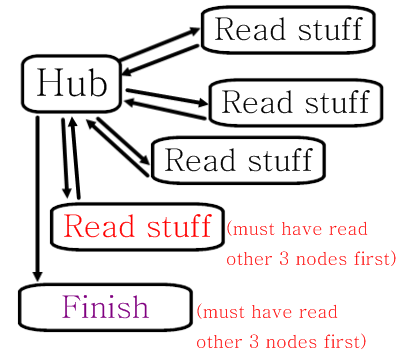
–it does suffer from a lack of choices. While this isn’t literal, my experience felt like the diagram above.
There are two endings which seem to hinge solely on a final choice. However, neither ending comes across as a “choose which ending you prefer” moment, rather, they give different knowledge and it feels like the puzzlebox is incomplete without both of them existing simultaneously.
RANDOM THEORY TANGENT
I’ve been trying hard to figure out why some minimalist Twine works bother me and some do not. Here is my current theory: if there are choices presented that look like they should affect the main part of the plot, it’s allowed at least the first time to “fake out” and railroad back to the main story, but at some point during the game there should be plot choices that feel like they have genuine influence. This feeling needs to be tangible; completely hidden stats don’t help with this. Just having a choice in one of X endings does not count. Having the only branching be alternate endings leads to what I might call “the home video Clue effect” (named after the movie which originally had 3 endings which showed randomly in different theaters, but the home DVD/VHS/bootleg Youtube clip/whatever has the three endings play one after the other).
I am expecting, given a plot-related choice, to have some role in shaping the story. That doesn’t even necessarily mean different nodes — perhaps passages are inserted in the main branch which acknowledge choices of the reader. When agency is presented as possible but then denied I feel like some sort of social contract has been violated.
Lots of adventure games have purely linear plots, but there is traditionally tons of room for variety at the small-scale level; trying to work out puzzles, examining and moving around at one’s own pace. If that interest is stripped out than what’s left is the ability to shape events at a macro level, but if that is denied there’s not much to work with at all other than clicking on the next word.
END RANDOM THEORY TANGENT
Sorry for the sidetrack there. By way of apology to Mr. DeNiro, I’d like to mention I’ve enjoyed all of his work and want to point everyone towards his very first IFComp entry from 2001, The Isolato Incident. It got 22nd place so I reckon many of you haven’t tried it, but it is very much worth a go.
By Wes Lesley. Played on computer with Frotz. Finished without walkthrough, but checked after for hidden endings.
With the Royal Coffee in one hand and the royal bunny slippers on your feet, you arrive in your office. Well, ‘office’. Just a fancy name for the room where you keep your chair. And ‘chair’ is just a fancy name fancy people use to say ‘throne’. Honestly. You’d almost think a throne was something special.
The blurb for The King and the Crown prepares us for a “very short game”, but I ended up playing for about an hour. What happened?
First, note that the blurb does not lie. This is a one room game where you play a king who needs to find your scepter and crown. For me this occupied all of 10 minutes.
On the way, I noticed the parser was rather more clever than the previous games I played from this comp, and even the error messages were fun to read.
> get crown
Okay, so you want me to ‘get crown’ and I can respect that and I totally get where you’re coming from but then it went [sounds of rocket taking off and crashing and exploding] and I hope you’re not mad at me because I really tried my best.
I mean, uh… You can’t see any such thing.
After finishing, the game mentions “five points to score, hidden in the game”, with some suggestions. This is where my hour playing comes in.
I probably had fun for 3/4 of it. This is the sort of game where the fun in playing parser comes out, where you have the freedom of thinking of something and trying it rather than seeing a list of things to try and picking one; even the failures had funny admonishments.
The other 1/4 I got annoyed because of the specifics of the hidden points.
S
P
O
I
L
E
R
.
.
.
.
.
.
.
.
.
S
P
A
C
E
.
.
.
.

There’s a hidden point obtained via an “abracadabra” magic word. I knew I was supposed to use it but the timing eluded me totally and I needed the walkthrough. (Also, I misspelled it every time I tried to type it, including right now in this very post.)
The worst (but in a way, most interesting) point came from optimizing the steps so that all the other points were obtained as efficiently as possible. This made no temporal sense and required cheap meta tricks like wearing the crown without first typing >TAKE CROWN. As grating as this was, I appreciated that it made me think of my parser commands outside the box. It was sort of “speedrunning for IF” which, like a real speedrun, leverages the glitches in the system (example: in Mario 64 jumping through walls to skip levels).
If the hidden points were true easter eggs like the Last Lousy Points of a traditional adventure, I wouldn’t be so annoyed, but the game’s structure made it feel like solving them was a requirement for a full experience.
By Alex Butterfield. Finished, but with extensive use of hints. Played on computer with the Gargoyle interpreter.
The main character, Bernadette, has burnt toast setting off a smoke alarm. She’s now trying to avoid a fine caused from the resultant “nuisance call” to the fire department by setting a real fire.
Ooooo-kay? Roll with it. I’ve seen stranger acts in News of the Weird.
All the action occurs in the five rooms of Bernadette’s apartment as she tries to set some sort of blaze. There’s the usual set of domestic obstacles including an obstinate fan and a stuck washer door.
What elevates this game somewhat above the typical “my lousy apartment” story is the backstory that the main character has just broken up with her boyfriend Ash, and there are telltale signs of story spread out among the items; not artificial things like diary pages, but rather a beard added on a Buddha by Ash or a gas oven that doesn’t work because the PC can’t pay the bills.
Unfortunately, bugs and verb issues are pretty prevalent:
> get pillow
Lifting up the pillow, you reveal an unopened bill. Apparently the tooth fairy wasn’t
fooled.
> get bill
Taken.
> get pillow
Lifting up the pillow, you reveal an unopened bill. Apparently the tooth fairy wasn’t
fooled.
or
> search sink
The square sink is empty.
> x sink
Hey, there’s a butter knife in there! Ash must have missed that one when he took the rest of the cutlery. Probably because he’s never been within three feet of the sink!
It took me five attempts on the cigarette lighter before I came across USE. (Tip: if your object requires USE, it doesn’t have enough verbs coded in.)
The worst offender had to be the branch, which requires a verb use so outrageous I would like to hear if anyone came up with that on its own. (I did use the appropriate item first, but the response was not helpful at all; the proper thing to do would be to _strongly_ hint at the correct phrasing after the failed attempt.)
I ended up losing faith in my ability to anticipate what the parser wanted and starting using hints through the entire rest of the game.
Then the fire started and part two of the game got going, and I hit the biggest “wait, really?” reaction I’ve had in any IF competition, ever. Switching to spoilers…
S
P
O
I
L
E
R
.
.
.
.
S
P
A
C
E
.
.
.
.
.
.
.
.
.
.
.
…I get that the ex-boyfriend is not very nice, but does anything he do imply he needs to go to prison for attempted murder? Trying to match the parts of a threatening message to frame someone is an interesting puzzle, but the in-world implications! — I’m used to amoral PCs, but this was staggering.


 Renga in Blue