Let’s get the title out of the way first: if you’re like me, you looked at it and felt slightly unsettled. Isn’t it supposed to be Jason and the Argonauts here? Allow Bob Davis (who collaborated on this one with Ken Williams) to explain:
VI [Videogaming Illustrated]: One last question. Why did you slip the Ulysses character into the story of Jason?
BD [Bob Davis]: I bastardized it because Columbia Pictures had made a movie about the subject, and I wanted to avoid potential copyright problems. Reality has to intercede somewhere!
Amidst 1981, On-Line Systems (later Sierra) was busy at work on Roberta Williams’s Time Zone; in order to keep their Hi-Res Adventure series going, they released Cranston Manor in 1981, followed by Ulysses and the Golden Fleece.
VI: How did you become interested in computers?
BD: I’m actually a virgin — or rather, a rookie. I’ve only been at this a year. Before that, I sold chickens, and before that I was a professional musician. Not too glorious. Now I’m on staff at On-Line, where my job is programming, helping to come up with new games.
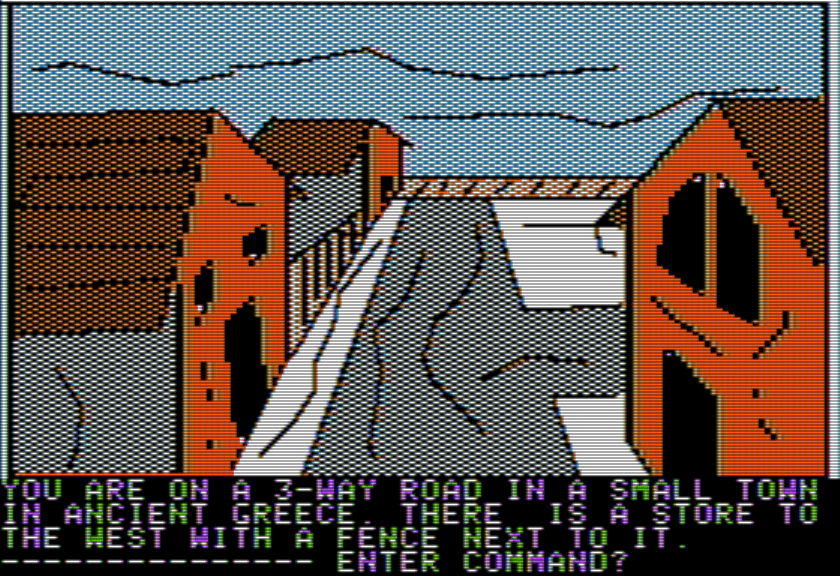
You start in a town-castle-forest area.
Head south and west and you reach a castle and are stopped by a guard.
If you leave without talking to the guard, you’ve softlocked the game, because the castle “no longer accepts visitors for the day”. Whoops. TALK GUARD lets you in to see the king.
The king tells you have “a legendary fleece of gold, far off to the north” and offers bags of gold and silver and a ship.
ASIDE: The Jason mythology has him as heir of the throne of Iolcus, but it gets taken by his half-uncle Pelias; Pelias sends Jason on what ought to be a suicide mission to get the Golden Fleece in order to get him out of the way. The king of this game gives the quest almost apathetically.
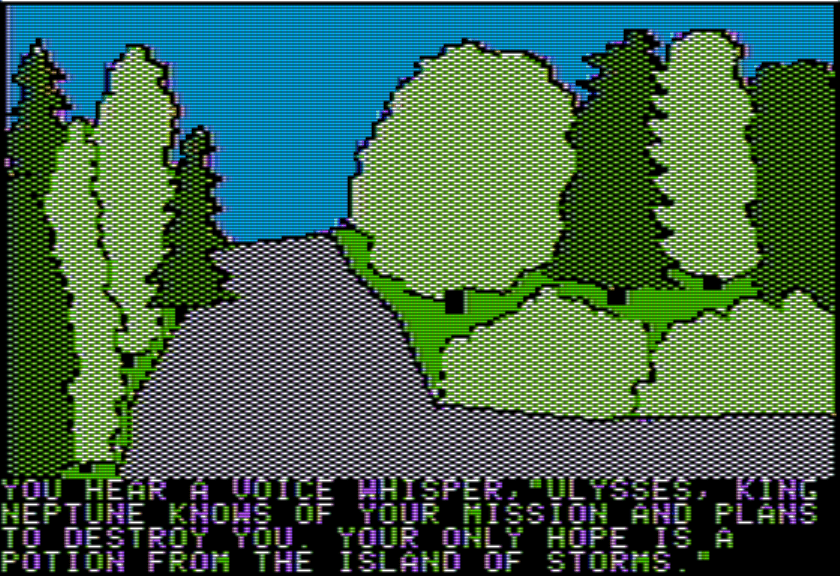
Here’s the forest:
There are two points of interest. A voice warns you about King Neptune, which is the only juicy plot-related tidbit so far.
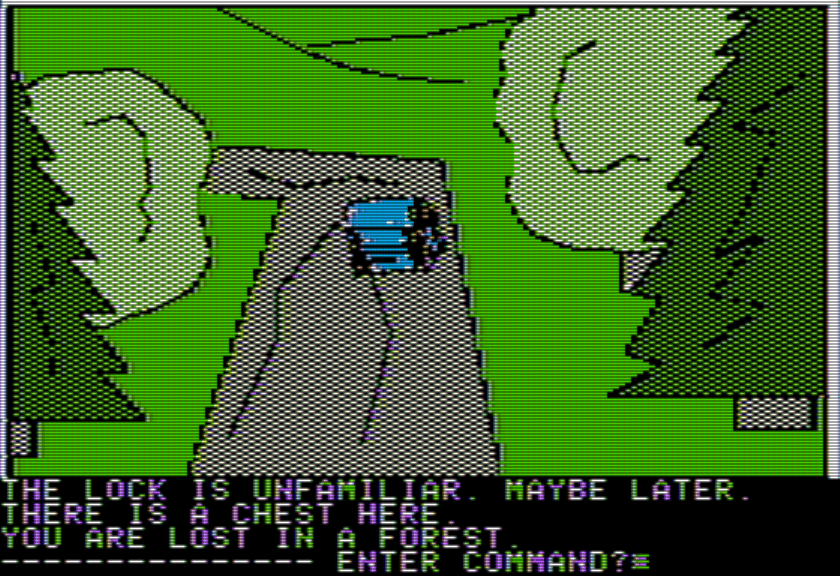
There’s also a chest with a lock that looks “unfamiliar” but we can tote it along with us.
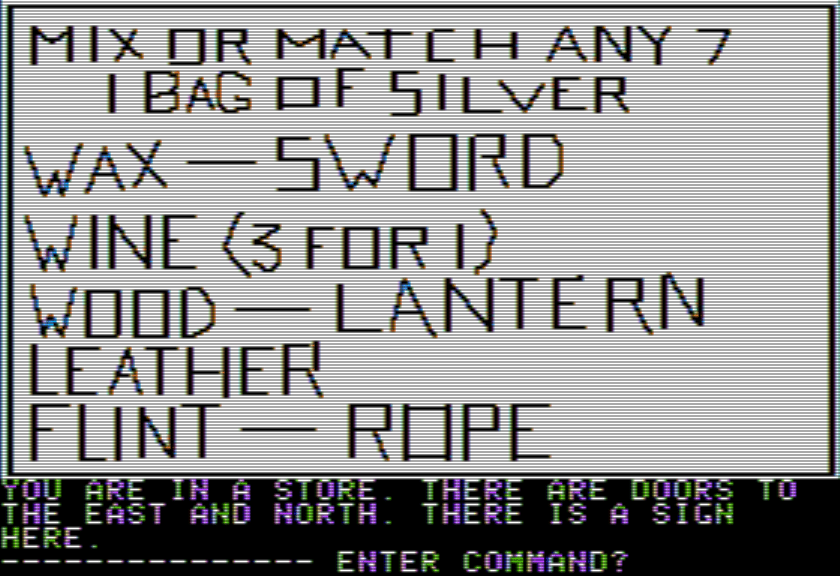
The city has a store with a nasty trick.
I mentioned getting a bag of silver from the king. The sign mentions you can pick seven items, but there are eight listed. So you have to pick the one item out of eight to leave out. I guessed the wood because it seems likely there might be a tree we could chop, but I have no idea for the moment.
The gold, incidentally, is used to recruit a crew…
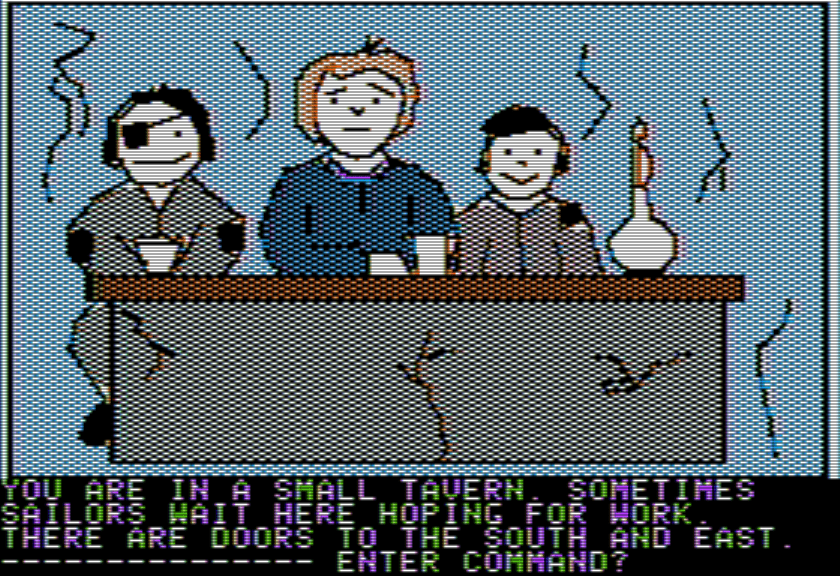
HIRE CREW works while holding the bag of gold. It mentions that several men rush forward and “you think one of them is Hercules.” Is he incognito, pretending to be someone else? Is the eyepatch fake for a disguise?
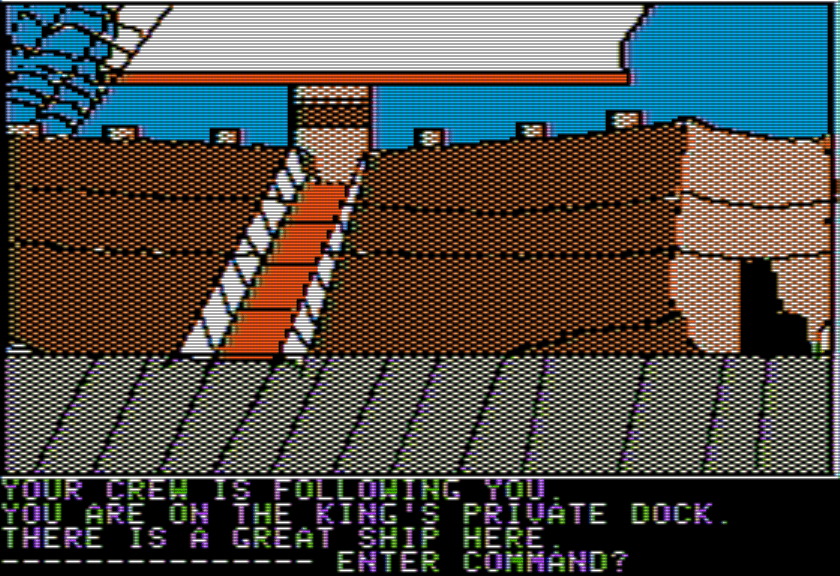
…who you can then lead to a ship at the king’s private dock.
Here I was horribly stuck. Getting on the deck of the ship I could LOOK SHIP
THE “MINERVA” IS EXTRAVIGANTLY SUPPLIED AND EXQUISITELY DECORATED.
but couldn’t launch. Verbs like EMBARK and LAUNCH don’t work.
I finally hit upon GO OCEAN
but that sufficiently exhausted me I decided here was a good break point.
One last bit before I close out: south of the tavern where you can hire the crew you can run across a thief who steals your chest (which I still haven’t unlocked). The thief dumps the chest out in the forest so you can get it back, but it hasn’t changed any (I thought maybe the thief would unlock it for you and leave behind a “useless” item which was useful in an adventuring sense, but no dice). I’m still not sure what the whole point of the sequence is.
Meanwhile, the police saw me talking to him, came over & said, “Don’t talk to him anymore! He might be dangerous!”
But I then said, “Don’t worry officer, he’s my freind from the sun.”
The above is from a story Roger M. Wilcox wrote in fifth grade; in 1981, he used it as the basis of his 12th game (previously: In the Universe Beyond).
This continues the weird-science theming of his previous game, but rather that exploring a reverse-gravity planet, we’re on THE SUN.
You are in the engine room. Visible items:
Better-than-asbestos suit. Empty fuel line. Empty bucket. Strange dark goggles.
Obvious exits: East
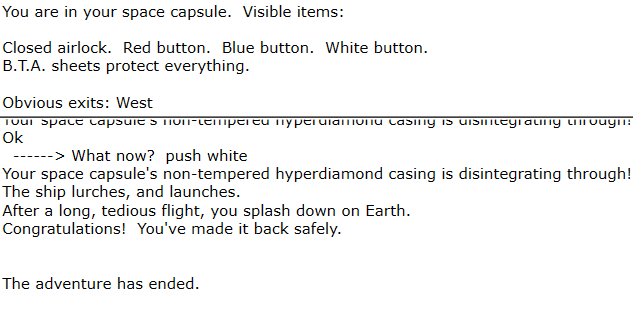
We start on roughly the same ship as last time, except now we start with different gadgetry (see above) and we’re out of fuel. The suit has a yellow button which shoots out a cold ray, but it doesn’t do anything helpful in the ship. Heading back to the main control room and trying out the red button kills us:
Whoosh! The airlock opens.
The console couldn’t take the temperature!
The capsule disintegrates from the inside out!
2015 picture of The Sun, via NASA.
Before pressing the red button we need to press the blue one (covering the inside of the ship with a transparent cover) so opening the airlock (red) doesn’t melt us. White would take off, but we are told: NO FUEL.
When opening the airlock, it’s “too bright to see”, but the “dark goggles” suffice to adjust for that (nice touch).
You can GO SOLAR and be asked
Are you just going to walk through the solar flare?
and of course the right choice is YES. This takes us to a river bank with a “river of salt”. Going in I was able to fill a bucket with the salt, then FOLLOW RIVER to a
=Deadly gronk gronk=
LOOK GRONK isn’t useful (“You see nothing special.”) and there’s no way to just go by. (“The gronk gronk won’t let you pass!”)
Hang out long enough and “A silvery line extends from one of the gronk gronk’s fingers, and hits the photosphere.” Hang out even longer and you die:
A silvery line extends from one of the gronk gronk’s fingers, and hits you, piercing your suit!
The heat of the sun vaporizes you! You’re dead!!
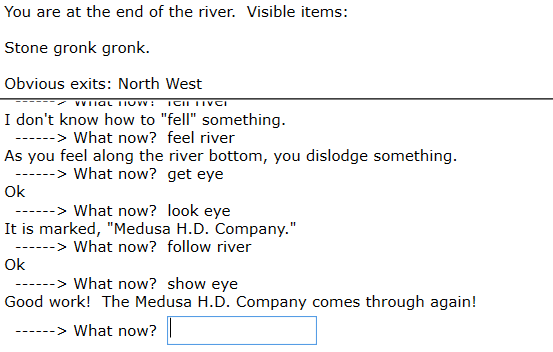
I’m imagining just a giant hand with no rest of the body, even though that’s not directly implied in the description. I was (as was also typical with Universe Beyond) horribly stuck and checked for help, and found I could FEEL RIVER to unearth a “hyperdimensional eye” which is manufactured by “Medusa H.D. Company”.
Hmm. This is the reverse of the usual puzzle, but:
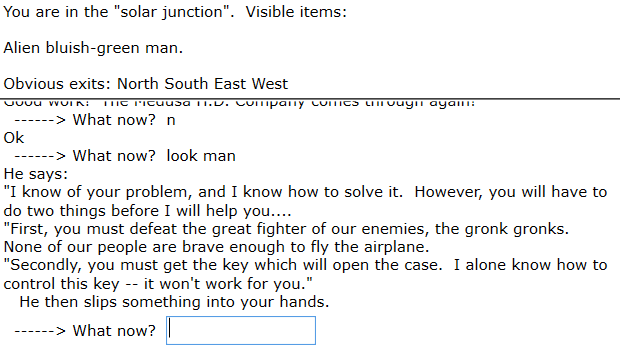
Yes, this time, we get to be the medusa. Going north, we have an encounter with a friendly alien who has quests for us and then hands off a gold credit card:
Wilcox has issues with exposition, but here, I’ll just suppose my universal translator got garbled.
Looking at the card reveals S followed by a smudge; you can CLEAN CARD to see the word Srill, which will be used in a moment.
You are in the Solar Challenger’s cockpit. Visible items:
Green button. Black button. Orange button. Landing field out window.
Obvious exits: West
Green takes off and lands. When you take off you find the “Gronk gronk fighter” the alien was speaking of. If you press the black button, a cold ray shoots out but the fighter evades it. The orange button requests a password — that’s just the “Srill” from the card. This activates SADAR which allows for better aim:
For the key, to the east of the alien there’s another “solar disturbance” you can try to enter. If you do this one, though, the disturbance fries you; you have to pour salt on it first. This lets you go inside and find a “large hyperdiamond”, although the only noun that works on it is “diamond”.
However, this is not the key yet. The yellow button that shoots a ray I mentioned earlier now gets used:
A ray of cold shoots from your fingertips, freezing the hyperdiamond extensively.
BREAK DIAMOND then turns it into a “hyperdiamond key”, and I’ll confess I was just coasting on hints at this point. Concentually the idea of needing a key and “carving one out” is nice (and one that has appeared in other adventure games) but there really is no inicator or hint here of needed actions; the “frozen hyperdiamond” has no description.
The key lets the alien (assuming you’ve downed the fighter as asked) open a nearby case and get some fuel.
With the fuel you can take off to safety and escape.
With this game (and his previous) Roger M. Wilcox got fixated on a “sequential scene” sort of narrative. It felt like I was locked in a non-interactive book where my goal was to solve a riddle to move on to the next page. Linear adventure games can work, but there needs to be non-linearity within the scenes themselves; ways to learn more about the world and the puzzles by playing with the materials. The vehicles-without-instructions somehow had this aspect, but there’s only so much fun to be found from realizing the red button needs to be pressed second rather than first. While there were a few items that could be examined for hints, I felt frustratingly disconnected from the objects of the world.
I still had fun anyway. Again, for emphasis: these generally were private games not for distribution. I appreciate the window into a young author’s experiments, and the sheer optimism required to adapt one’s work from grade school for a computer that wasn’t even out at the time the story was written.
The policeman then told the city that he was friendly & that all of the people could come back out again. Then all of the people came out & started making freinds with him.
Several minutes later, though, it was time for him to go back to the sun.
He then waved goodby to his freinds & was off to his space ship.
After that he had gotten into his space ship & was off to the sun.
As far as I know now, he is back safely on the sun.
This is my fiftieth game for 1981. My list of games is in flux; one time it did make exactly 100, and I’ve added a few since, but I’m still comfy saying I’m roughly halfway.
Cape Canaveral picture from NASA.
Given Roger M. Wilcox wrote 9 of those games, and I’ve only done 1 so far, I really should knock down some more so I don’t cram them in at the end. As a reminder, he wrote a series of “private games” in high school that were generally not distributed (although he got Vial of Doom out in the 80s) and they only got exposed to the world in 2012 when he put the games up at his website.
This is his 10th game overall, giving him vastly more experience than a lot of the “professional” effort we’ve seen sold in a box (or at least a Ziploc bag), and Interstellar War (his game #9) was decent, so I was game to try this one.
I played the original TRS-80 edition, in order to preserve the typos that all of you readers out there love and enjoy. (The Windows port changes the spelling to Cape Canaveral. Spoilsport.)
If you look at the guard HE BARELY SEEMS TO HEAR YOU! so that was a hint to YELL:
THE GUARD MISINTERPRETS THE DIRECTION OF THE SOUND, AND RUNS OFF LEAVING THE ENTIRE COMPLEX UNGUARDED.
That’s easy to explain quickly, but note in real time that took me two sessions and about 15 minutes of gameplay to work out; no direction commands work, and you can’t GO CAPE or GO INSIDE or anything like that (after the guard moves there’s a GATE); it isn’t even 100% clear the guard is stopping you.
Inside, there’s GREEN PLANTS (you can take them), a SCIENTIST, and a SPACE SHUTTLE. If you LOOK SCIENTIST you are given a mission.
We were both barred from entering and expected as savior of the universe. Odd. I guess the guard just missed a memo. I hope the other universe we are questing to destroy doesn’t have any people in it. Also, “you will be richly rewarded” sounds like a king giving a mission, not a scientist at NASA.
Typing SAY QMY$ zips us inside the space shuttle.
The first thing I tried was pushing the blue button.
THE SPACE SHIP DESTROYS THE PLANET BELOW WHICH IN TURN BASHES IT TO DEATH AND YOU DIE INSIDE IT.
That sounds bad. Perhaps we should have been given a user’s manual before attempting to save (checks log) the entire universe.
The white button launches you to THE MILKY WAY GALAXY, the blue button then punches you to the “other side”
THE STARS BECOME SMEARED AS YOU CRASH THROUGH THE LIGHT BARRIER AND THE EDGE OF THE UNIVERSE.
YOU TRAVEL IN COMPLETE DARKNESS FOR A WHILE, THEN RE-ENTER AN ENTIRELY DIFFERENT UNIVERSE.
and pressing the white button again puts the ship near a planet.
I wasn’t able to get farther than that with just ship controls, but going west in the ship, I found a helmet, a large belt (with a hook), a maser pistol, and a canister which produces weak gravity. I worked out I could HOOK CANISTER, assumingly creating an “anchor” so I wouldn’t float off wherever I went.
I then found I could SAY QMY$ to leave the ship while in space, but this just sucked me in the void. I was extremely stuck and had to check Dale Dobson’s walkthrough; there are multiple other spots of absurdity where I had to use it later.
This turned out to be one of those puzzles where the information in the command HELP is almost completely and totally necessary to make progress.
THE SPACE SHIP’S ON-BOARD COMPUTER IS NAMED SCOTTY.
This indicates — for no in-game reason I could find — that BEAM is a verb in the game. However, this is universe where things are reversed, so if you BEAM DOWN you still die. You need to BEAM UP.
THE AIR IS NOT BREATHEABLE. YOU DIE OF SUFFOCATION.
…and you also need to WEAR PLANTS, which provide sufficient oxygen for you to survive.
¯\_(ツ)_/¯
Yeah, I had to look that one up too. This does make me wonder, in a most extreme Mythbusters-build sort of way, if there was some way to make it work. Nevermind you’d think NASA would have provided us with a proper space suit.
Moving on, I dug up a BLACK CYLINDER and a CAN OPENER. The can opener worked on my large canister to unearth a smaller canister inside with even less gravitational pull, and I have no idea how the belt hook managed to stay attached. The cylinder has a switch on it (you have to SWITCH CYLINDER, and that was walkthrough use #3) and it lets you cut down a forest. Why the forest itself wasn’t helping with my oxygen problem, I don’t know.
The cylinder “EMITS A WHIR” when you switch it on but it’s not clear what it does until this happens.
The lower-gravity cylinder unearthing was all there to help jump over a ravine just past the forest.
The “piece of slate” is just north of here and throws off sparks when you hit it, and the “radium power source” comes from opening the pistol.
I was stuck yet again, but on an easy one this time — I needed to examine the trees after I cut them. This led to a HANDLE WITH GAS NOZZLE. I could then LIGHT NOZZLE with the piece of slate (from the screenshot above), and then CUT POST, revealing a secret entrance to a cave.
Here you had to DIG ROOF to find the key. I confess I was just clinging to the walkthrough for dear life now.
Going in, you can make creative use of the shovel to find a KEY (see above) and then find a dead end with a LEAD WALL WITH PEEPOLE NOTCH. The key lets you UNLOCK the WALL and then PUSH WALL to move it out of the way. It falls down to become a SIX-SECTION LEAD PLATE and reveals a passage to the east.
Well. That’s an object you don’t often see. I tried to TAKE CENTER but was told my inventory was full, so I had to drop some items (really).
That “six” on the “six-section lead plate” was intended as a hint — you can FOLD PLATE into a LEAD CUBE. With the LEAD CUBE in hand the center can be safely taken.
Fortunately, 1 move = 1 second, so that gives you time to run back to the starting point, BEAM DOWN back to the ship (BEAM UP kills you, of course) and fly the ship back to Earth Prime.
LEAD BOX CONTAINING CENTER OF THE UNIVERSE. Wow. For the finale, you just need to drop it, and the scientist is suitably impressed.
OK, I think it’s safe to say 1981 Wilcox had at least a little awareness of how goofy this one was.
But seriously, folks — now that I think about it, the planet also sported a forest of trees. Why didn’t those trees make oxygen? [Thinks of an excuse] Oh, of course, silly me! Any oxygen they produce should have fallen off into space, what with the reversed gravity and all. Yeah, that’s it, that’s the ticket. (“So why does the planet have ANY atmosphere at all, in that case? And how does your lit-nozzle blowtorch burn?”) Um … hey, look over there, it’s Scott Adams! [ducks and runs]
I’ve finished the game. It was a slog, but at least there was one remarkable conceptual idea at the core of Circle World.
From the Museum of Computer Adventure Games.
Rather than spoiling what the idea is, I’ll let it build up over my gameplay.
Before continuing with the action, I want to hit something that dmstelzer commented on, which indirectly touched on an important point: Circle World is not so much based on the original Ringworld as the sequel, The Ringworld Engineers.
Fans pointed out that the original Ringworld, being of connected parts, would not be in stable orbit. Larry Niven invented the “ramjet” as the futuristic tech helping keeping the Ringworld intact, and made the plot of his second book revolve around the ramjets failing. The book includes finding a “Mars” area with a control room; in Circle World, the control room is in and you can reach it near a “Mars Island”. If I was previously familiar with the book I would have had an easier time realizing how the control room was linked.
…
As I mentioned before in my last post, you can ride a “disc” to a “machine city”. There are two other locations the disc can go to: a library…
I incidentally switched to the C64 version, with the same BASIC code, simply because of emulator headaches. The “LUWEEWU” will be important later.
…and a control room.
LOOK VIEW responds with SPACE AND A LOT OF STARS
(It does not go back to the starting area with the altar and volcano, even though I could swear I made it back the first time — I think I was just confused.)
The library was my first useful stop. Reading the yellow book that was there:
POWER SOURCE=MOTOR+GENERATOR+WIRE+SWITCH+FUEL
This gave me an inkling of the foozles that need to be collected to fix the Ring–er, Circleworld. Some of them I knew about already:
The generator is right below the library in a “celler”, along with a “silverbox” (with red, blue, and green dials).
Some OIL at the machine city counts as fuel.
The gold wire (that wouldn’t transport in the disc) counts as the wire.
The motor and switch still eluded me.
West of the library is a GREAT CHASM. The chasm includes a “bridge” that is lowered. If you take the silverbox and turn the blue dial, a “frail” bridge appears. This links the library to the machine city area.
A “zoomed out” view of the overall map up to this point in the story. Dotted connections are teleports.
This means that you can take the gold wire from the machine city back to the library without using the disc; however, you cannot take the generator from the library back over to the machine city (heavy object + frail bridge = bad). This was the first hint there was going to be some complexity in how the sub-areas related to each other.
Bring the gold wire over to the library initially seemed useless — there was still nothing to fix, and although I didn’t know it yet the ultimate goal was to bring all the parts to the Control Room — but east of the library there’s another obstacle.
YOU ARE AT:SUNFLOWER PATCH
A NIGHT SCAVENGER IS BLOCKING YOUR WAY
HE WANTS YOU TO TOSS HIM
SOMETHING OF VALUE
YOU SEE
NOTHING
OBVIOUS EXITS ARE-
WEST
Well, gold is of value?
THE SCAVENGER TAKES YOUR GIFT AND DISSAPEARS
Except … that loses the wire which I needed. What do I do? (You might be able to guess before I get there.)
Past the night scavenger is a rocky cliff with a closed door; the green knob opens it up.
ASIDE: That’s the last use of the silverbox; here’s what the red knob does.
YOUR COMMAND? TURN KNOB
WHICH ONE?? RED
YOU DIE
How descriptive!
MOVING ON: Inside is a secret tunnel with a RADAR/SONAR unit. Past that is the altar/volcano area at the start of the game! So this is the way to reach that place even though the energizer disc doesn’t go there, it only goes from there.
The altar still had two mysteries left undone: the meaning of the “A HERO’S NAME IS THE KEY” message and what to pray for. I’m pretty sure I was wrong with Hercules and I was just praying for HELP when the game said
SOMETHING OF VALUE
This is a hint as to what to pray for, and also, the exact same text as with the night scavenger where he had to throw our gold wire.
COMMAND? PRAY
WHAT FOR?? GOLD
This makes the gold wire appear. I admit being somewhat impressed by the minimalist hint, but keep in mind this is all conveyed through a fog of misunderstood commands and non-existent descriptions.
For that other puzzle, the solution is in a screenshot from earlier where I looked at an ivory statue of a HELMETEDBIPED.
LUWEEWU
This cases the mirror to swing open and reveal a secret room with a key.
The key can be taken back to the machine city and a tool shed, which opens to reveal a SWITCH, a WRENCH, and SCUBA GEAR. (The SWITCH is one of the missing items for fixing the Circleworld, so we just need the MOTOR.) The scuba gear lets you go into a lake that previously drowned you; there’s a lake shore to the east of the volcano area, and a lake shore to the west of the machine city, but it didn’t occur to me they were the same lake! Having the scuba gear opens up the map connections even more:
You need the SONAR/RADAR to see the AIRLOCK going DOWN.
Going UP from the lake leads to Mars Island, with a frozen waterfall that you can blast with your laser/flashlight…
YOU ARE AT:DRY RIVER BED
YOU SEE
FROZEN WATERFALL
OBVIOUS EXITS ARE-
SOUTH
YOUR COMMAND? BLAST LASER
WATERFALL MELTS
…and a laboratory.
The “alarm” indicates just grabbing the motor is a bad idea. It causes the door to close and lock behind you. What you can do is grab the nylon, work your way around and above, tie the nylon to a beam, and swing down Mission Impossible-style. The alarm still goes off when you get the motor (using the wrench) but you can climb out (don’t forget to grab the cloth mask, as well).
So, that’s all the parts: time to be heroic? I realized by this time the control room was the ultimate destination, but still couldn’t get the gold wire there with teleportation. However, there was still the “hatch” in the lake left unexplored. This leads to the aforementioned control room, connecting up the entire map.
Using the system I remembered from Escape from Mars, I dropped everything off and was able to PUSH SWITCH.
SUPERGRID IS ON
For the ramjets, it’s a lot less complicated — there’s just a lever there and you pull it, but “YOU CAN’T QUITE REACH IT”. It seems kind of ridiculous when you think about all the heavy stuff you’ve been toting around, but the only way to reach the lever is the CHAIR found back at the library. One long toting trip later — fortunately, if things are timed, it isn’t super-tight — and
RAMJETS ON!
…and no expected victory message. You have to go all the way back to the altar and check the CRT one last time.
Most of the Aardvark games have gotten creative with geography:
Nuclear Sub had the entire map get flooded as part of the escape, changing the nature of the map
Escape from Mars had two hidden entrances to the same place (and you didn’t need to find both)
Deathship had a puzzle where two items need to be brought together, but neither item can make it all the way; the solution is to have them meet in the middle
Trek Adventure let you enter some rooms from a duct system, but later let you enter the same rooms in a “normal” way
Pyramid had a trap that only triggered if one passed “through” the room, that is, entering from one side and exiting the other, but it was safe entering and leaving from the same side
Circle World falls in the same category, for which I’m glad, because it’s the element that sustained me to the end. In most adventures from this period, all of these areas would be entirely distinct (like Timequest) but here, all of places you can teleport to are connected, and in order to win you need to “unite the map”. Structurally (and admittedly, only structurally) I found the game very satisfying.
Unfortunately, Circle World also shares the dodgy implementation of the other games; arguably, a good game trapped inside a bad one. I just wish the Aardvark crew had the chance to try their ideas on something more modern, without having to cram extra-tight BASIC code into a tiny disk capacity.
A Kzin, from the graphic novel version of Ringworld illustrated by Sean Lam. Larry Niven also put in them in an episode of the Star Trek Animated Series, so they’re technically crossover into that universe, too.
Voltgloss found out that if you have the mysterious NIPWEED in your inventory, and you get raided by the Kzin, it takes the nipweed back to its lair and goes to sleep. By my stealth method of “peeking at the source code” I have determined this (probably) means the obstacle is no more.
Voltgloss also deciphered his way past my verb frustration with the LASER/FLASHLIGHT object. When you LOOK LASER (you can’t refer to the noun as a FLASHLIGHT) the message is
FLASHLIGHT ON/OFF OR BLAST
which is meant to suggest literal syntax. You can type
FLASHLIGHT ON
to turn on the flashlight part of the device, or
BLAST LASER
to fire the laser. This is really bizarre at a theoretical level — not only is the same object treated separately with two nouns, one which normally doesn’t work, but the format for the secondary mode is is NOUN-VERB instead of VERB-NOUN, and “ON” is only sort-of a verb (it gets used in this era as an abbreviation akin to “N” for north or “I” for inventory).
(By the way, this game doesn’t let you type N for north. You have to type GO NORTH in full, or since you only need the first two letters of each word, GO NO. I am trying hard to not linger so much on the parser this time like I’ve done with other Aardvark games, but jeepers, they’re making it hard.)
From the Museum for Computer Adventure Games. We’ll see the gizmo the protagonist is using in a moment.
The flashlight is enough to combine with the “THE LIGHT IN THE FOREST” clue to get to a PARACHUTE hidden in the dark forest. Once I had this parachute, I went back to the volcano where I slipped a fell last time (due to the rope not being long enough) and managed to make it safely down.
This is another bizarre move for the game, and I’m not talking about the ENERGIZE typo. The disc is right there in the room, even though the PLAQUE is the only object described with “you see”. You can GO DISC and EN DISC. (I already had the ID card from digging at a beach.)
This is another new area, with a RAMJET #3, a GOLD WIRE, some OIL, a locked door, and a chasm.
I haven’t made progress with any of them. The gold wire is interesting in that you can’t take it back with you on the disc. Trying to GO DISC with it in your inventory leads to:
YOU CAN’T TRANSPORT WITH THAT
In the usual cryptic form of the game, it doesn’t tell you what “that” is, but I only had the one new item; when I dropped it I was able to board and zip back. I wanted to transport the gold wire in particular because of one other puzzle I solved. Back at the altar I mentioned a book with a “hero” message.
A HERO’S NAME IS THE KEY
SPEAK IT OUT, I TO ME
If you try to PRAY at the altar the game asks what you want to pray for, so I went through some heroes and hit gold with HERCULES. (Any hero that starts “HE”, like, uh, “HERO” will work.) The game then said
SOMETHING OF VALUE
and left it at that. Was that just a clue? Did an item appear somewhere? I have no idea. What is the status of the message even in a meta-sense; am I supposed to imagine some booming voice spoke it, or it was a whisper in my head, or am I literally listening to the computer narrator injecting themselves into the story? I thought, perhaps, the gold wire was “of value” and holding it while praying would be of use, but that’s clearly off the table.
Graham Nelson famously wrote that adventure games are a “crossword at war with a narrative” but with Circle World, it’s like the referee entered the fight and knocked both the crossword and narrative senseless with a chair.
ADD: Now that I’m back in the game, after the Machine World the disk is going to multiple locations but not the starting volcano. I could have swore it just warped back, but this game is disorienting. That means (while I can’t go back yet) there are some more locations to go to.
Ringworld (1970) is a science fiction novel by Larry Niven about a group (two humans, aged 200 and 20 respectively, a “Pierson’s puppeteer” known as being cowardly, and a member of the warlike-catlike race known as Kzin) that explores a massive artificial ring around a star, which has a habitable surface area of three million Earths.
From a 1988 edition.
I could go at length about the book but a.) despite winning the Hugo, Nebula, and Locus awards, I’m only mildly enthusiastic about it and b.) despite being advertised as direct fan-fiction, the game at question today is only tangentially connected.
Circle World, the first adventure game of Bob Anderson, is another in the roster of Aardvark’s adventure games, which includes Deathship (dire), Vampire Castle (their most straightforward game) and Trek Adventure (their best game of 1980).
If you were hoping for more parser improvements since last time, I regret to inform you: no. The parser may have even degenerated. It still only looks at the first two letters of each word, with very little feedback given on commands.
It was originally for Ohio Scientific computers like the other games, but that edition isn’t anywhere on the internet, so I went with the Commodore PET version instead. It’s just BASIC source code (which you can peruse at GitHub here), so any differences are likely quite minor.
Like three of the other Aardvark games (Deathship, Trek Adventure, Nuclear Sub) the game starts on a vehicle headed for destruction, the difference here being the vehicle is an entire ringworld.
I’ve found the RAMJET in question, but I can’t examine it or otherwise interact with it.
I’ve got access to a bucket, sand, an ID card, a shovel (which I used to get the previous two items), a laser/flashlight, a rope, candles, and nipweed (whatever that is).
You can PRAY at the altar where the message-of-destruction is; the game asks what you want to pray for, but I haven’t found a response that causes anything to happen. Near that same altar is a BLUE BOOK
YOUR COMMAND? READ BLUE
A HERO’S NAME IS THE KEY
SPEAK IT OUT, I TO ME
and a GREEN BOOK.
YOUR COMMAND? READ GREEN
THE LIGHT IN THE FOREST
I assume the latter message means I need to bring a lit item to a “dark forest”…
…but neither the laser/flashlight nor the candles do anything without a match. (I suspect I am just using the wrong verb on the laser/flashlight combo.)
There’s also a section with a rope and a volcano where you can tie the rope to go inside, but you fall and die; the rope doesn’t seem to be long enough.
YOUR COMMAND? TIE ROPE
TO WHAT?? WOOD
THE ROPE UNCOILS AND IS 30 FEET FROM FLOOR OF THE PIT
YOUR COMMAND? GO DOWN
YOU ARE AT:VOLCANO PIT
YOU SEE
PLAQUE
YOU FALL TO YOUR DEATH
In addition to the headaches above, there’s a KZIN that will randomly come and scatter your items.
A CAT-LIKE KZIN HAS WANDERED THROUGH-TOOK ALL YOUR POSSESSIONS AND SCATTERED THEM
This appears to be the “pirate character” a la Adventure that other games have felt obliged to include, but here the items really do scatter all across the map so when it happens you have to scour the entire thing again. So far it is small:
The game advertises itself as “our largest yet” but that might not mean much, given the file size is only a smidgen above Aardvark’s other games (10K instead of 8K). Still, there are likely a few places I’m missing.
I’ll keep hacking at this for a while, but the opaque parser combined with the Kzin-scattering above makes for an infuriating experience. I’m happy to accept any advice; you don’t even have to bother with ROT13. Don’t hurt yourself, though — there’s a walkthrough out there for this one.
(Link for online play here. Click “Disk Directory”, then checkmark “load as BASIC”, pick “CIRCLE WORLD”, and “Load”.)
I finished the game, but I had to wreck my original plan in the process.
From the Museum of Computer Adventure Games; one of the Digital Fantasia covers which makes the game feel like it’s going in a psychological/philosophical sci-fi direction. (It is not.)
The time machine has a forward and a reverse button. Pressing the button leads to an animation. It is too blinky in GIF form so I’ll give you a still.
Just imagine the “background symbol” keeps changing.
I don’t know if there was some other intent to how the buttons work that the author decided to axe, but in what I played the buttons work entirely at random.
The above locations are merely for color. The really important places are:
1. The swamp with the brontosaurus
2. The ship Mary Celeste
3. The sphinx area
I’ve given screenshots already of places 1 and 3 in my last post; here’s #2.
Each has a glass prism; once the glass prisms are added to the time machine, one last area is unlocked, where Dr. Potter is being held by the “outlaws” and the evil plan must be foiled.
The ship is the most straightforward part of the game; there are no real obstacles other than finding where the glass prism is in the first place (you have to climb up a “rigging” and it is randomly up in a crow’s nest). There’s a lot of items, though: salted beef, biscuits (this is a UK game so “cookies” for you Americans), rope, a torn sail, and a thread and needle. ADD: Or, based on the comments, the biscuits could be the ship’s variety, although I think the scene after is much better if they are cookies.
I mentioned a brontosaurus last time who didn’t want a ham sandwich; but apparently, biscuits go over well.
The brontosaurus lumbers off into the swamp with the biscuits
Handy tip for time travelers! Past the dinosaur is a small boat which is busted, near an island. (Where did the boat come from? More time travelers?)
With a ROPE, NEEDLE, and SAIL, you can FIX BOAT.
Thats better! Its shipshape now!
I have FIX on my standard list of verbs to test out when starting a game so I knew it worked, otherwise I’d have had more trouble with this puzzle. You can then take a SHOVEL from the sphinx area to the island and dig up the second glass prism.
The third glass prism requires going in the a secret tunnel at the sphinx.
This puts you in a long hall. At one end there’s a lever (near a spear) where pulling the lever indicates a grinding sound from the end of the corridor. Trying to go to the other end just finds a solid wall. I sussed out this was a timed thing, but when my original attempts to RUN to arrive fast enough were for naught, I tried to use the spear and a rock (from the above screenshot) to hold the lever in place. I eventually had to to resort to hints: the command is JAM LEVER, not PUT ROCK or INSERT SPEAR or anything like that. (Theoretically, what’s interesting is that I was focused on applying the right verb to the direct object I was using, not the indirect object I was applying the rock to.)
With the lever jammed up, I was able to enter a “small door” at the wall and find a temple. It had a statue; CLIMB STATUE led to the third glass prism.
The “growling noise” was a dog at the foot of the statue. You can either KILL DOG (with the spear) or (according to a walkthrough I checked) FEED DOG with the beef. Alternate solutions are very rare for this time; it’s fun to see one tied in with a moral choice.
With the three prisms in the machine, a new destination is added (although the buttons still work at random, so you have to hit them a bunch of times to reach it).
… and here my game was wrecked by bugs. The prism disappeared on me. (I also had an earlier bug where trying to use the boat to get to the island led to the shovel disappearing from my inventory). I said I was going to pass on the BBC Micro version, but I had to switch to get to the end. On the way, I found the usual much-more-minimalist prose:
Im in an old cellar. There is a strange glass machine in the middle of the floor! Large enough for a person to stand in!
I’m in a Cellar
The ham sandwich was left out, but more significantly, all of the “red herring” time travel locations are left out — no 2001 reference, no Mount Doom, no nuclear wasteland. This is simultaneously worse and better at the same time. Worse in that by narrowing down on the “important” locations the time travel antics don’t feel much like time travel any more, but better in that the randomly-operating buttons have less locations to visit (often in the TRS-80 game I needed to try 10+ times to reach a specific place). So many decisions in game design aren’t unilateral “good” or “bad”, but tradeoffs.
In the BBC Micro version of the finale, you arrive at a grass plane with a metal plate. You have to CROWBAR or PRISE PLATE (not PRY) to get it off, and then find a robot guard; the “outlaws” are robots. (Twist!) With a pistol you can SHOOT ROBOT (“BANG!”); past the robot is a GENERATOR.
You can SMASH GENERATOR (it turns into a Broken Generator) which opens up a “Guard-Room” with Doctor Potter inside.
Meh. I enjoyed the setting and setup of the TRS-80 version but the later (but bug-fixed!) minimal version lacked texture. I did appreciate the puzzles were essentially easy, but it meant the parts I got stuck on (like the rock and the lever, and realizing CROWBAR could be a verb in addition to a noun) were verb issues rather than grand insights.
It’s still true the segmented map was psychologically pleasing. I have the additional theory that this sort of map is easier to contain in memory; I could be out in swamp land and want to head back to the Mary Celeste and immediately know the exact steps I needed to make rather than having to check.
These are the three time travel zones that have glass prisms.
Also, this was a marked improvement over The Golden Baton; I did genuinely want to see what happened next in the story, as opposed to feeling I was being buffeted by random puzzles. So I’m still happy to try more Howarth games; however, even though he has another 1981 offering for us (Arrow of Death Part 1) I’ll be saving that for when we’re closer to 1982 so I don’t have a large gap between that game and Arrow of Death Part 2.
As a Newspaper reporter you are sent to investigate the eccentric professor who lives in the old house on the Moors. What is his secret and why is his house now deserted?
— From the cover of the BBC Micro version of The Time Machine
Brian Howarth’s second Mysterious Adventure was again originally written for TRS-80 and converted later to the Scott Adams database format; I’m going to just go with the TRS-80 version this time rather than trying to play two versions at once.
For a bit of color, here’s the title screen from the Acorn Electron version, via Everygamegoing.
I was genuinely excited to get to this game, because
a.) despite “time travel” being roughly as standard as “fantasy”, there’s more flexibility for the adventure author to get creative
b.) the plot presented itself as integrated rather than slapped on
c.) based on prior my time travel adventures, the genre forces a self-contained geography
Let’s discuss the last point a little more–
Past a certain level of experience, writers tend to go too long more than too short. While forcing minimalism is not always a guaranteed route to quality, and there are some top-notch writers who are also long-winded, brevity can temper some of the rougher excesses (I gave an example of this back when I posted about Chou’s Alien Adventure).
While we don’t often think of creating imaginary map geography as “writing”, it can be its own form of artistic creation. Crowther/Woods Adventure was based around a real cave, and had a solidity to it despite some truly random parts; authors who tried to mimic this later didn’t necessarily fare better. For example, both Goblins (the 1981 version) and Intergalactic (from the Atom Adventures collection) turned out particularly dire. Both examples share a need for contiguous terrain, and interlinking designed for sheer pain.
The time travel games we’ve seen, by their nature, force small sections; authors discovered you sometimes don’t need more than a handful of rooms to indicate an era. It becomes much harder to make a sprawling cavalcade of bad decisions. (1982’s Time Zone might bust through this by its sheer size, but that was on six floppy disks.)
As the intro text indicated, you start out not as a mad scientist, but as a journalist looking for one.
Rough opening: the above is a tiny maze, where you have no objects and more or less have to drift at random. If you step wrong, you end up in quicksand.
I was seriously stumped upon first hitting this point. Late the same night I tried one more shot at the section on my cell phone, and hit upon (after my second turn) the command GRAB BUSH:
Whew! That was a close shave..Better watch my step!
Rather than hammering on the unfairness of the guess-the-verb here, I want to point out it is fascinating that I broke through the puzzle by tackling it in an entirely different environment. One of the standard pieces of advice for adventure gamers is to play with a group, but here I managed the same effect by having my brain “reset” as if I was enlisting a member of my Clone Army.
Proceeding onward, I found a house with gloves and a bellpull.
I was able to punch through a nearby window while wearing the gloves.
This is what happens if you aren’t wearing the gloves.
Inside I found: a key hidden behind a picture, a pistol, a flashlight, a ham sandwich, and a room with a mysterious machine.
The cassette player had a tape. Playing it led to this message, given “slowed down” in real time:
I’m unclear on the sequence of events that led to being able to send a cassette player through time but not Dr. Potter himself. I can envision a few scenarios (sample: the tape is a “failsafe” Dr. Potter had set up prior to his trip to allow recording from the future), so I wouldn’t call this a true plot hole.
But hey: rather than just a treasure hunt for glass control prisms, we have a lost person, a mysterious enemy, and the fate of the world at stake (in a way that feels more concrete than just fantasy-bad-guy-is-bad). Good plot thread!
Oddly, the “forward” and “back” seem to rotate through options, rather than being “future” and “past”. I don’t think I’ve seen the future yet. I’ve made it to a scene with the Sphinx:
…a swamp with dinosaurs…
Well, one so far at least.
…and a ripoff from the book (and movie) 2001.
I’m still exploring to learn more, so this is a good stopping point. Based on the opening map (see below), I’d say the “forced brevity” idea is holding out.
I wasn’t too far from the end, but there was a fair amount of parser struggle to get there.
Via Mobygames.
Let’s take care of the raft first. I went as far as searching for synonyms for RIDE (not the first time I’ve whipped out a thesaurus to play an adventure game), but I still had to look at hints; the elusive verb was SAIL.
I then found a lake with nothing useful on it — it turns out the lake is the final destination of the game. I went back to whacking at the places of the castle I was still stuck on.
First, a chunk of glowing quartz in the “sorcerer’s lab”. The quartz is non-portable (I didn’t quite understand if was “stuck” or just too big). I had a staff with runes around it, so it felt magic-ish enough to try WAVE STAFF.
There’s a helmet that also has runes on it, and if you’re wearing the helmet you can then examine it (which previously had “unreadable” runes that you can now read) to get a magic word. Say the magic word…
…and you are finally awarded with the quartz, and no other assistance. Well, drat. (The glowing doesn’t even substitute for the lamp, unfortunately.) I succumbed to the lure of the hint sheet, because, rather arbitrarily, you have to wave the quartz at the adjacent room, with a lizard man.
It wasn’t an unsolvable puzzle, surely — there wasn’t much left to work on — but I still felt all manner of grumpy after finishing this part. It’s quite standard for magical items in text adventures to have arbitrary effects only discoverable by experimentation, and in theory that should be fine, but in practice stumbling into an answer by chance rather than some thought process just isn’t that satisfying.
Moving on! SEARCH LIZARD yields a jeweled knife. The only other part of the castle I had yet to solve was the gorgon, and I once again reached for hints, because I had the right idea (use the small mirror) but the wrong action. You have to HOLD MIRROR before entering the room with the gorgon.
I suspect the vast majority of players, including myself, thought of using the mirror here, but where stymied when the desired effect didn’t happen automatically. I can conceptually see how HOLD MIRROR might be, to the author’s eye, declaring action in a way that isn’t otherwise present, but for the player who visualized this as already happening, it is intensely irritating.
The parchment with the gorgon gives the final steps for getting the baton. I already knew how to get to the lake, and I had the horn at the ready.
I guessed THR was THROW, but what was I throwing? Well, by process of elimination, the only major item I hadn’t used: the jeweled dagger I got from the lizard man.
The Golden Baton was hurt by two elements I’ve observed before: 1.) it’s hard to include undocumented magical items without a lot of guesswork and 2.) without complex daemons and/or characters, difficult puzzles arise from amping up the obscurity of verbs and arbitrariness of action. Also, the fantasy world is fairly drab compared to the lore-dense opening. I honestly can’t recommend this game except for completionists.
Don’t worry, Howarth fans: this is only the first out of eleven games. There’s still time to improve! (A review from 1985 notes “Later titles in the series appear to be far more intriguing.”) In fact, I have started Mysterious Adventure #2, and it’s already better than #1, so look forward to that for my next post.
I didn’t get much farther than last time, but I hit an almost perfect variation of the Parallel Universes Problem, so I wanted to share.
From the Museum of Computer Adventure Games.
(Definition: situation where the user is in a playthrough with different conditions from another playthrough, and where the difference between the “parallel universes” is non-obvious. I first coined the term in relation to the game Kidnapped.)
I had previously been stopped by an armored figure, but only in the TRS-80 version of the game.
I had *not* been stopped by the same character in the BBC version. I thought, vaguely, perhaps I hit a bug, or just a situation where the defeat gives an item and it was set up so the later version was more forgiving when the puzzle was to be solved.
I had missed a slight difference between the two universes. In the BBC universe, I was wearing a RAGGED OLD CLOAK (from the first room of the game). In the TRS-80 one, I was carrying it, but didn’t have it on.
The cloak makes you invisible to the figure, so you can move on. There is no message or indicator why you can get by (I found the “invisible” thing from the game’s hint sheet).
This opened up two areas for me. First, the inside of the castle (see above), which includes a hunting horn (you can BLOW HORN but I haven’t found a use for it yet), a HELMET (there’s runes on it, just like a STAFF on the road to the castle), a LAMP, a LARGE HAMMER, a magical QUARTZ, a SMALL MIRROR, and a LIZARD MAN. I haven’t tried to face off against the lizard man yet, but I did run across a gorgon, and the results were unfortunate.
Getting in here required a KEY I found by throwing the rope up the tree I mentioned last time.
I would think the SMALL MIRROR would help, but the result above happens even if you’re holding it. I don’t know if there’s some extra verb involved, but I’d be surprised if the mirror didn’t factor into the solution somehow.
The second area I opened — by lighting the lamp — was a series of caves underneath the hut (or “cabin” if you’re playing the BBC version).
The cave layout is slightly different in the BBC version.
I found a padlock which I was able to smash using the LARGE HAMMER from the castle. Inside was a RAFT. I have no idea how to use the raft.
I found some slugs (easily defeated with salt I had) and a crab (who is distracted if you throw the dead slugs). The crab is next to an underground lake, which seemingly begs to have the raft used on it.
This is one of those kind of games where an item only works in the right spot and just gives a vague hint if you’re doing it wrong, so it may be I need to just try (say) THROW RAFT elsewhere. “RIDE” is clearly eliminated as shown on the screenshot above, though.
Other than checking up on the armored figure I’ve been trying to resist hints; I’ve been warned the puzzles are pretty arbitrary on this one so I don’t know how productive it will be to hold off on reading more hints, but I’m going to hang on a little longer.
What I am going to do is drop playing the BBC Micro version for now; I’m finding it too confusing to switch back and forth between the universes (I’m still referring to the HUT as a CABIN by accident) even though it’s fascinating that the author decided to change so much between the two versions.









 Renga in Blue