It wasn’t that long ago this blog visited Toxic Dumpsite, published by Adventure International in a two-pack with Spook House by Roger Jonathan Schrag, another one of our teenaged auteurs.
Via Giant Bomb.
I didn’t have a great time with the first game but I was misunderstanding the initial setup (that you could look in four directions in each “room”) as well as some of the author tendencies (like the ability to LOOK BEHIND and LOOK UNDER things). There are enough quirks that I didn’t want to wait for too long until tackling game number 2. Yes, I could re-read my old blog post, but there’s an author’s vibe that transcends words that’s hard to cling on to. I hope I can give this game a fairer shake than the last one.
I do have a little historical info I lacked last time. Back in 2009 Dale Dobson interviewed the author. Regarding the inclusion of graphics and the ability to look in different directions:
I think I just saw it as a natural progression. I really enjoyed the Scott Adams Adventures, but I thought it was time to turn up the volume and inject a visual aspect. Facing different directions in a room was just part of adding a dimension to the experience.
This indicates we’re talking about a completely separate thread of development than the line started by Deathmaze 5000. This is quite believable to me as the method of movement is different and the light vs. heavy density makes for very different game types, even if both games are technically in the “first person adventure” genre. I never expected the obscure-and-on-a-different-platform game The Haunted Palace to have had any influence either.
Carl and Rebecca are the author’s brother and sister.
Mr. Schrag also explains that he had no “engine” and simply added code on the fly as he went:
I believe when I went to write Spook House I took the code from Toxic Dumpsite and tweaked it. So I did a lot of code reuse.
But I don’t think I actually wrote an engine per se, probably because I didn’t sit down beforehand and spec out the functionality for an engine. Rather, I just sat down and started writing an adventure. And when I discovered I needed a widget to do X, I coded a widget to do X.
Once again we have a hard time limit, once again 30 minutes done in real time. We are trapped in a spooky house and there’s a time bomb set to explode.
The sign is described as being nailed to the wall, which I immediately noted given the trauma I suffered through the last game.
This game has a much different feel from the previous one, which was mapped out in an “industrial” way; this map tries to be a bit more of a maze. The very first room from the start (to the east) flips around the player a bit, and I was able to explore for a while without solving any puzzles.
Passing through you can find a platform.
You can get to the platform in the distance easily, but I didn’t understand the graphic here at first. I’ll come back to this later.
You can turn north find a “fireman’s pole” to slide down, which lands you in some water.
You can swim around a bit for what seems to be just atmosphere…
Either our character is short or being overdramatic. I wasn’t able to die by just swimming around even though the “sinking” message keeps happening.
…but eventually end up on shore, where there’s an anchor and an exit leading up. This is followed by a “strobe room” which literally flashes.
Also, locked door here to the east.
South of that there’s a rotating room which spins around in real time.
If you drop an item in this game, you can’t pick it up again unless you’re facing the same direction you dropped it at. For this spinning room (if you drop an item, with, say, DROP ANCHOR) it means you have to hit the “enter” key at the correct time (having typed GET ANCHOR or whatnot) to pick it up again.
One exit here leads to a trapdoor dropping you back to the entrance, and another one leads to a ramp with a ledge. I was stuck for a while and looped back to that platform I previously mentioned, where I realized it was meant to be the sort of distance I could jump. One JUMP TO PLATFORM later and I found myself at a dead end with a mirror.
Being trained by the author’s previous game, I made sure to LOOK BEHIND the mirror, yielding a rope.
Since the only obstacle I had pending was a ledge at a ramp, and the only items I had were a rope and an anchor, I put them together to make a grappling hook.
This took me only a few beats to puzzle out, but I originally thought of the anchor as much heavier and not really plausible as a grappling hook.
Once up the rope I found a locked door and a “nail file”. Remembering the sign from the start, I tested out a few attempts at using the file before I came across PULL SIGN WITH FILE.
This file can then be used on the locked door by the beach to land in an endless corridor. I have not managed to get out of it.
That’s certainly an encouraging chunk of progress! The locked-door style gameplay endures here but with some more colorful traversal methods. Despite this having a less “grounded” plot than Toxic Dumpsite I’m having more fun with this one and the environment feels more tactile.
1.) figuring out, of the items I already found, which were part of the Key of Time
2.) finding the item on Peladon
3.) resolving the spider on Mutos
4.) finding the item on Mutos
For the first part, I brute forced things by making a beeline to a single object, picking it up, and quitting the game. That gave me a score.
As the above screenshot implies, the “Dr. Who specific” items (the jelly bears, the scarf, the sonic screwdriver) do not give any points and so are not part of the Key. The bananas from the slime world, the ray-gun from Skaro, the white crystal (not blue crystal) from the fog planet, and the large rock from the Moon all gave varying numbers of points.
This doesn’t mean all the other items are useless. If nothing else, you can give the jelly bears to the Time Lord at the very end who will eat it, just for a little role-playing. Some of the uses turn out to be very abstruse.
For example, I found out (rather too late to help) that typing READ RENTICULATOR will give a number, and that number matches the currently held number of key objects.
The main issue here is that the only information given is the item name; there’s no clue or concept of what the item looks like and it would even make some kind of sense to read the thing.
Moving on to the item on Peladon: I was very, very, close to resolving this one, even though it is a spectacularly unfair. I got lucky (?). Remember I had said sometimes the Peladonians are friendly, and sometimes they are not? They are friendly only right here:
By having this happen, in this location you can now go EAST (the only way to spot this is to LOOK or to return to the room).
I just happened to be lucky enough to hit the right moment to TALK but failed to capitalize on my luck, argh. Anyway: one sionated cumquat. Moving on to Mutos, where I need a walkthrough for both these parts…
…actually, let me back up a bit first and talk about beating the game as a whole. It turns out nearly every location can be handled without taking items from other places; that is, PELADON, SKARO, DIETHYLAMIDE, HIDAOUS, and DARK SIDE OF THE MOON can be visited in any order. You might think hitting Skaro (with the ray gun) is better to go to first, because of the ray gun, which blasts nearly anything into powder. However, you can just evade any creatures that appear without fighting, talking, or doing anything (except the Peladonians, as just mentioned).
If you get 40 TARDIS resets — as the Jim Gerrie version of this game gives you — it means you usually can beat the game in time. I ran a Monte Carlo simulation which failed essentially only once every 100 times. (That means you kept trying to reset making it to GALAFRY at the end and landed on SKARO repeatedly, or something like that.) If you go to the minimum the game’s source gave, 21 visits, you have more like a 25% chance of failure for no fault of your own. And that’s not accounting for the fact this probability is for someone who already has the game solved!
Ok, back to the main narrative. Finishing MUTOS is dependent on items from PELADON and DIETHYLAMIDE. The ray gun does not work on the blue spider; if you recall from last time, that’s where I was getting softlocked on Mutos. It turns out — more or less arbitrarily — that you need a blue crystal, and you need to GIVE SPIDER. I tried, on a different run, giving the crystal, and it didn’t work because I was using the wrong parser syntax.
There is no special item hidden here, and the blue spider is not blocking anything. It turns out the game needed another leap, and in another context I’d call this a clever puzzle, but here it was just infuriating.
Specifically, the “dig here” location lets you use the PICK from back on Peladon, and it digs a different route into the sewers than using the grate. However, there is another identical-looking room which is not marked as such, but digging also works here. Assuming you’ve already defeated the blue spider, you’ll find it here.
The dead blue spider is the last part of the Key.
The game presented what is generally pure exploration (with the weird meta-puzzle of finding key objects) but somehow felt the need to toss in two painful object-related puzzles at the end. Perhaps it is for the best.
As I’ve observed before, fan fiction can hit above its weight class in this era, given the space limitations on text; you don’t actually have to spend the time describing what a Dalek looks like. Unfortunately, I really had trouble feeling like I was ever “in the world” due to all the problems I’ve outlined so this will not satisfy a player who is mainly wanting to pretend they’re hopping around the Dr. Who universe. This is even more a pity in that Dr. Who seems wildly appropriate for adventure games (odd, convoluted solutions to things that don’t really involve violence); fortunately, there will be plenty of more such games to come in the future, including a licensed one in 1984.
But for now, we’re going to return back to the United States, for one piece of unfinished business, followed by a well-regarded Apple II game: The Mask of the Sun.
An Unearthly Child, the first serial of Dr. Who, aired in 1963; in 1967, the Doctor made his first appearance in comic book form, via TV Comic issue 800.
Dr. Who is on a planet with his grandchildren (John and Gillian) and is facing off against spiders. The comic authors were somewhat unclear about the general mood of Dr. Who (which involves outwitting more than shooting alien species) but here he goes full blaster.
From the blog Die, Hideous Creature, Die! which includes details about the Doctor cheerfully destroying a species.
In Dr. Who Adventure I got to use a Dalek ray gun on a spider and it crashed the game, which somehow seems appropriate. But let’s rewind:
I had left off on planet Peladon. One thing I hadn’t experimented with was the verb SEARCH, which works in any random room for hiding hidden things. I ended up hitting zero going through the entire planet, even when trying SEARCH multiple times, except for back in the Maze:
I originally visualized this as a lockpick or a guitar pick; this is the kind of pick for digging.
The discovery of the item also let me test out just what the map was like, where I discovered that every direction (north, south, east, west, up, down) looped back to where the pick was. This indicates that escape from the maze is more or less random, so I shouldn’t sweat mapping it.
I also discovered, on a later playthrough, that you don’t always find the pick when searching — and it isn’t a matter of searching multiple times, but rather, you have to “loop again” and that resets the chance of the search working. I don’t know if this is true generally for the map, but if so, then trying SEARCH multiple times won’t help at all; you would need to re-enter each room multiple times, and try SEARCH each time, hoping for the random chance of the designated object showing up. I’m not up to that level of suffering yet though.
The “peladonians” are the “wandering random enemy” of the planet, but they’re only sometimes an enemy. Here are two separate attempts to TALK with them.
Success or failure seems to be random. HIDE on the always hand always works (when it is a creature you can hide from at all, there’s a nasty spot later where you can’t). You can also simply just move to an adjacent room, it isn’t like the aliens have any physical reality to them; it’s just a dice roll if you see one in a particular room, and if you step out and come back in they’ll be gone unless the dice roll makes them show up again. We’ve seen this kind of behavior most recently in Africa Diamond; somehow it was more irritating in that game, I think because it kept switching through what creature might show up, whereas here — being always the same encounter on the same planet — it has a vague tinge of realism.
Leaving the planet behind I hopped around a little. Note that not all of them have real episode equivalents, or at least, the author was mis-spelling from some half-remembered episode.
GALAFRY (the actual planet of the Time Lords, but spelled wrong) PELADON (as already seen) SKARO (the planet of the Daleks) DIETHYLAMIDE (probably invented for the game) HIDAOUS (probably invented for the game) DARK SIDE OF THE MOON (a Cybermen base from the episode The Invasion) MUTOS (not a planet; the derogatory term for an alien race on Skaro)
I did a lot of hopping around, for our purposes let’s visit the remaining planets as listed in order.
SKARO
Because it isn’t Dr. Who without Daleks. (Upon the Who “reboot” starting in 2005 it seemed like Daleks might have finally been done away with, but alas.)
I admit, I was initially tentative about exploring here, but Skaro turns out to be safer than some other places, as there aren’t instant-death spots like passing TARDISes and the geography, while jumbled up, isn’t mind-rending.
Stepping out of the TARDIS I found some jelly babies. They’re one of The Doctor’s favorite snacks, and one of the common elements I’ve found across a few planets (that is, some sort of “personal object” of The Doctor is lying around). They’d be my first candidate for the “key of time” items just because of the theming but if so, I haven’t found one on any planet yet.
The atmosphere is nice; it turns out you can ignore red screaming sirens, though.
The most important thing I found (via SEARCH in a random room) is a dalek ray-gun.
You might think I would immediately go back and try to use it on the actual daleks, but I was still slightly nervous at this moment and didn’t want to force a confrontation. You’ll get to see the gun in action later though.
DIETHYLAMIDE
There is no planet Diethylamide, a place of fog and mountains. That’s ok, not everything needs to be a reference.
I’m missing some exits in the northwest that almost certainly just go to death. The reason why is that it turns out to be horrible to test death-exits in this game.
There’s no save feature, and if you die, you simply go back to Time Lord Central and have to hop into the Tardis and type RESET a lot to get back to the planet you want. It isn’t even the time spent that was grating as much as the act of intentionally hurling bodies just to check every direction (N/S/E/W) to make sure they’re all accounted for.
There’s a troglodyte wandering around, and it likely is responsible for the occasion where you get knocked unconscious and sent somewhere random with your items missing. Lying around the planet (or requiring a SEARCH in one case) I found a DESIONATING RENTICULATOR, a BLUE CRYSTAL, and a WHITE CRYSTAL.
No idea what any of this does.
HIDAOUS
A slime world, again made-up for the game. There’s not much I can find (although I haven’t bothered mapping thoroughly yet), just a landing point, a set of “LOST IN THE SLIME” rooms (with a SKULL hidden therein) and a tree with some bananas. I expect I’m missing something, or maybe the author just ran out of disk capacity.
DARK SIDE OF THE MOON
Where Cybermen are hiding, based off a real series.
I know the Cybermen are supposed to be a threat on par with the Daleks, but I’ve never quite felt the same level of concern with them.
In the game version, they are at least a little more deadly than the Daleks since you can wander into death:
Still, in essence the procedure is the same: hide if you see a threat. I’ve snagged a long scarf (Tom Baker ahoy) and a “large rock”.
MUTOS
A planet with a mysterious monolith, and the one I’m definitely not done mapping yet.
There’s a bit where you can find a sonic screwdriver, and also a sign which says to DIG HERE. DIG works to use the PICK to go down into a sewer, although it seems like you can get the same way from another direction. Either way, the moment where my mapping ceases is right here:
There’s a spider where I softlocked the first time through (no items, no way to escape, HIDE doesn’t work) and the second time through, ray-gun in hand, I managed to hard crash the game.
I think maybe there’s supposed to be a PRINT statement there, but when trying to replace the line then playing through again it still seems to be buggy.
So this is at least a good place to do a write-up. My big problem, other than that stalling point on Mutos, is figuring out what the Key of Time parts are. The magazine article claims there is a way to tell what the parts are, and I have no idea. The game has a score but the only way to check it I’ve found is to quit the game. I’ve tried taking items to the Time Lord who needs the pieces at the starting area but I haven’t got a positive reception yet. Maybe I need all the pieces at once.
Cybermen from The Invasion, one of the “lost” serials of Dr. Who, since the BBC didn’t routinely start archiving their materials until the late 70s.
Tarro, where today’s author (James Smith) was located.
Australia started broadcasting Dr. Who back in the 1960s roughly contemporary to when they were being made in the UK, but the broadcast history was not straightforward; episodes needed to be censored for “early evening general viewing” — that is, unedited they were considered suitable only for adults — and some of the early serials just never aired at all.
In 1981, the first licensed Dr. Who animation was created, as part an ad for Streets ice cream in Australia. It used Tom Baker, right before Peter Davison took over the mantle of the Doctor. The Logopolis serial (where the switchover between Baker and Davidson happens) was already broadcast in the UK, but it didn’t air in Australia until March 1982.
1982 also saw the first Dr. Who text adventure I’ve been able to locate in any country, written in March 1982 and published in the July 1982 issue of the magazine Micro-80. If you check my dates, you’ll see Baker was still “the current Doctor” from the author’s perspective.
The source is for TRS-80 but I am playing Jim Gerrie’s edited version for TRS-80 MC-10. In his blog post about the game he mentions bug fixes, including one where you can get “mugged” for an object but it doesn’t fix your inventory count, meaning you eventually can hit your inventory limit with 0 items. He also made some random values a little nicer and I’m not that gung ho about authenticity when it simply is going to be pain.
You do not seem to be “The Doctor” but just “you” sent along on a TARDIS the Time Lords have managed to scrouge up. I assume you are a Different Time Lord.
After Dr. Who collected the Key to Time and defeated the Black Guardian, he received many praises and went on to greater things. The Key itself was again broken into its component pieces and scattered throughout the universe.
But the dark forces threaten, and in order to save the universe, the Timelords again need the Key. You have been chosen to go forth and locate it for them.
The Key of Time is from Tom Baker’s run, specifically starting with The Ribos Operation in 1978, where the Doctor is asked by the White Guardian to find the six segments of the Key, bringing balance to the universe. The main gimmick to note for our purposes is that the pieces of the key are disguised as other things; in the first serial, a lump of Jethrik crystal is the first part of the key.
X pieces of some item of power makes for an extremely common videogame plot, so it is not shocking James Smith picked up on this as a game device. Your job is to bounce around planets searching for the Key, given that the pieces will be disguised.
You start on Gallifrey. It is terribly easy to get lost, and at one intersection I got rammed by a passing TARDIS.
I did manage to find a “throne room” where the parts apparently get delivered after finding them.
However, upon exiting the throne room I got stuck in a series of junctions which I’m sure are a fairly simple maze, but since I didn’t have any objects yet I had to restart the game.
So I decided it was best to hop into the TARDIS and start time-hopping.
You will be given a TARDIS (rather old and unreliable, but the best available) that has the coordinates of the planets on which the six parts are located pre-programmed into it. By RESETing its controls you can travel between the six planets and Gallifrey. As usual, the six parts are disguised as other things, and you will have to use your intuition to figure out which is which. (There is a way to tell … )
All the planets are inhabited, and most inhabitants tend to be antisocial. Whether you TALK to them, HIDE from them, kill them, OFFER them gifts of appeasement, or simply ignore them is up to you. Most objects are obvious, but some are hidden and have to be SEARCHed for. Only one key part is on any one planet. Beware the maze on Peladon …
Of course, it was terrific that the first place I landed in an effort to avoid mazes was Peladon, the place of three moons and constant storms.
From a recent Big Finish series set on the planet. “Journey to Peladon, member world of the Galactic Federation and home to intrigue and adventure. With each passing generation, industrial exploitation and deadly political games are taking their toll on the planet.”
sigh Well, let’s try it. I stepped out to a trail, only to find some Peladonians coming nearby. As the instructions mentioned HIDE, I tried the verb out, landing me in the maze.
There was really nothing for me to try than wander randomly. I did hit some non-maze paths but quickly landed in the maze again. I eventually had to simply restart my game and go back to the planet from the TARDIS. This isn’t as easy as it sounds, since RESET from the TARDIS lands you on a random planet; you can’t choose.
The destinations are GALAFRY, SKARO, HIDAOUS, PELADON, DARK SIDE OF THE MOON, MUTOS, and DIETHYLAMIDE. You can also just end up in SPACE which in case it is simply another reset.
I wanted to be stubborn and finish what I could on Peladon, so I eventually got there after about twenty resets. The TARDIS incidentally comes with a limited number of resets in this game, and that number is intended to be random! (One of the values made nicer in the MC-10 port is making this random number of resets simply be the maximum from the range.)
Even when not explicitly in the MAZE (as three of the exits go) the map is fairly maze-like and is the sort of game where if I go EAST from one room, I immediately need to test WEST back the other direction to see if it returns, since I’m likely to get a nasty surprise.
The wandering Peladonites turned out not to be a threat — I could just go somewhere else when they showed up — and the only other thing on the planet I managed to find is an Aggedor.
Perhaps I need to return with some music?
From the Alien Species Wiki: “The Aggedor is a wild beast native to the mountainous regions of planet Peladon … The ancient natives of Peladon viewed the Aggedor as a sacred animal and symbol of great power, to be feared and respected. The creatures can be domesticated and trained, and are susceptible to some kinds of music. The Doctor was once able to hypnotize one such beast with his watch while singing a Venusian lullaby.”
This game has been a hassle to get going, so I wanted to report in for now. Hopefully I’ll have visited all the different planets next time. I don’t think this is be like G.F.S Sorceress with a dense plot — this still is only a type-in with limited space — but at least the random elements (whatever they happen to be) should make for an interesting write-up, even if it turns out to be suffering on my part.
PAL Creations is another one of those early-80s companies I haven’t found much on about other than that they existed. They worked out of San Diego, and advertised in Tandy Color Computer magazines like The Rainbow, with games like SKI LODGE (“Manage a Vermont ski lodge”) and SCAVANGE HUNT (“Find the items on the list and return them lo Hickory Ridge to free your niece Rebecca from the hermit of Medicine Tree County”). To give you an idea of the obscurity-level, the ad above mentions 20 games; as of this writing, Mobygames only is aware of the existence of 5.
Our game today is ENO (“You inherited a million dollars. Just one catch – first you have to find it!”) which was given away as a “bonus game” option for buying one of their regular games. It also ended up being published by Dragon Data (the Welsh company I’ve written about here) in a two-pack, Eno paired with a prison-escape game called Stalag.
We’ll pass on Stalag for now and stick with Eno, which has the noteworthy attribute of being quite short. So far, if someone has wanted to write a short game for sale, they’ve generally landed in gamedisk or tapedisk format; see Space Gorn for an example. Eno’s publishing demonstrates two other options, being published as part of a “pack” or being given away in conjunction with another game.
It is weirdly both modern and ancient. Let me just narrate what happens straightforwardly and then explain after.
You are simply tasked with finding your wealthy deceased relative’s inheritance, and the “living room” clue is indicative of the full environment of the game. The entire game is in the living room, just it is divided into small sub-areas to make a 15 “room” map.
You start in the center (“Living Room”) and then can move around to each of the pieces of furniture in the room, the TV in the far east, and the fish tank to the northeast.
The verb list (past the usual directions and INVENTORY) is severely limited, but at least the game is good enough to list it in the instructions: PUSH, TAKE, LOOK, DROP, TEAR, TURN, READ, OPEN, HELP. You can, if you want, mechanically try all the verbs on everything in the room, although the game discourages this by having some items in the living room be deadly.
For example, TURN TV (in a valiant attempt to change the channel) results in electrocution.
Both end tables to the west have doors that can be opened. The southwest end table has some smelly nurse shoes; the northwest end table kills you.
The game wants you to type HELP here before moving on to the next screen.
The very important room happens to be to the north, where there is a picture of a black cat. You can move it to find a safe.
It will then prompt you for three numbers if you try to OPEN SAFE, and if you get one number wrong you get a game over.
Although not technically “death”, and even though the game restarts, the “world fiction” technically begins where you left off.
So the rest of the game is a matter of figuring out three numbers, and which order those numbers might go in. This acts a little bit like a Rhem puzzle where there’s a symbol somewhere that only marginally relates to what you’re looking for, but you’re supposed to make the connection anyway. While I only found it in the middle of my searching process, the first item related to the number sequence is hidden under a cushion to the southeast.
This gives you the order you are supposed to enter numbers into the safe, and the source of the numbers: the number of black cats the house is supposed to have, the number of fish the house is supposed to have, and the TV channel showing a space show.
You incidentally cannot find a black cat in the house despite the picture. If you move the rug in the opening room, however, you can find a dead cat under a loose board.
You can count up the fish at the tank to be 29, and as already seen in a previous screenshot, the TV is tuned to channel 11.
Unfortunately, 1-29-11 doesn’t quite work. You’re supposed to examine the cat further and notice it ate one of the fish.
That is, the live-cat count is supposed to be 1, and the live-fish count is supposed to be 30. 1-30-11 opens the safe.
While a modern reaction, I imagine that this brief review by Alastair from Computer Solution Archive captures what people from the 80s likely thought of the game.
No wonder Dragon Data bundled this with another adventure game, this effort is no more than magazine type-in quality.
I don’t actually disagree, but weirdly enough, I liked it? Notice how it
somewhat fits the one-room adventure genre, which really didn’t start kicking until the late 90s
fits the “reduced verbset” genre, which is spread through all adventure gaming but never got “respectable” until probably the 2000s with games like Midnight. Swordfight.
has the clue-finding feel of a modern escape room
tries to make the deaths participatory and comedic
Despite the lack of a save file system, the game being very very short means it doesn’t matter; it’s more polite than a Super Mario “troll” level anyway. In the very specific circumstances here of a reduced-verb short game (where you hand-wave over realism) it works, just in the context of the early 80s market there isn’t much it fits with. The only slightly comparable game I can think of is Mansion Adventure which had its difficulty in clue-interpretation rather than object manipulation.
We will be seeing more from Paul Austin and Leroy Smith (including the other half of this commercial package, Stalag) but next up we’re going to head over to Australia for some Dr. Who.
Previously, we’ve encountered Softside magazine issue 47 (August 1982) with the game Operation: Sabotage. The same issue had a piece by Peter Kirsch entitled Anatomy of an Adventure.
In it he dissects his framework in BASIC that he has used for all his games up to that point:
Early in my adventure writing career, I created an adventure interpreter, or skeleton, as I call it, to serve as the backbone of each of my adventures. It has since been updated many times (now at version 4), but basically remains the same tool.
Magical Journey is clearly version 1, as the same skeleton structure of that game is clearly similar to the general structure Kirsch describes. I’ll go into it in a moment, but a few points from the article:
He gets introduced as “author of most of SoftSide’s Adventure of the Month series.” Alas there is no further biographical information.
He notes “The days of simply finding treasure and returning it to a storage location are gone forever.” which is a curious comment given how many Treasure Hunts there still are in 1982, but Kirsch got it out of his system back in 1980.
He tries different layouts before putting “a final version of my adventure map on a giant piece of heavy paper.”
He ran out of memory in writing Titanic Adventure and had to make cuts.
His games eventually all had ports for TRS-80, Apple II, and Atari; for making the Atari port used a special routine since the Atari BASIC doesn’t support string array, making a single string and treating it as an array by cutting the part he needs.
His parser on TRS-80 and Apple II uses the last three letters. He explains this “alleviates some of the annoying keyboard bounce in the TRS-80”. His Atari parser uses the first three letters because of the Atari string array issue meaning he makes the strings with padding. (I’ve played most of the Kirsch games on Atari, which explains why I didn’t recognize the last-three-letters style parser.)
He found Atari BASIC easier to debug because he could change something and still keep running the program, unlike on Apple on Atari.
Applesoft BASIC has the issue where if you use A has a variable and you write it before a THEN statement it interprets ATHEN as the command “AT”, so parentheses are required.
For the skeleton, he does something relatively distinct from other BASIC authors to start things off:
He has every single room description as a PRINT statement, and manually sets room exits along with these statements. From Magical Journey, where A is the variable which indicates the room the player is in:
10 IFDT=1THEN320ELSEONAGOTO11,12,13,14,15,16,17,18,19,20,21,22,23,24,25,26,27,28,29,30,31,32,33,34,35,36,37,38,39,40,41,42,43,44,45,46,47,48,49,50,51,52,53,54,55,56,57,58,59,60,61,62,63,64,65,66,67,68,69,70,71,72,73,74,75,76,77,78,79,80,81,82,83,84,85,86
11 PRINT”IN A FOREST.”:W=1:N=3:E=1:S=1:GOTO350
12 PRINT”ON TOP OF A TREE.”:D=1:GOTO350
13 PRINT”AT THE BASE OF A MOUNTAIN.”:S=1:E=4:GOTO350
14 PRINT”ON AN OPEN PASTURE.”:W=3:GOTO350
15 PRINT”ON TOP OF THE MOUNTAIN.”:D=3:GOTO350
This is wildly atypical. Consider Hog Jowl mansion (written July 1981, printed January 1982 in 80 Micro), which starts with room descriptions but uses DATA statements instead:
50 DATA “IN A DUMBWAITER.”,0,0,2,0,21,0,”IN A LONG HALLWAY.”,0,6,3,0,0,0,”IN A WORKSHOP.”,0,0,0,2,0,0
60 DATA “AT THE BOTTOM OF A SECRET PASSAGE.”,0,0,0,0,0,0,”IN A LABYRINTH OF TUNNELS.”,0,9,0,0,0,0
70 DATA “IN A TORTURE CHAMBER”,2,0,7,0,0,0,”IN A LABYRINTH OF TUNNELS.”,0,11,8,6,0,0,”IN A LABYRINTH OF TUNNELS.”,0,12,0,7,0,0
80 DATA “IN A LABYRINTH OF TUNNELS.”,5,0,10,0,0,0,”IN A LABYRINTH OF TUNNELS.”,0,0,11,9,0,0,”IN A LABYRINTH OF TUNNELS.”
This is the method given in other tutorials at the time, like the booklet for Deathship. Kirsch used DATA for objects and verbs, so clearly had a notion of just using a “data table” for exits rather than having to specify what the variables equal each and every time. My guess is due to the Atari string handling he didn’t want to deal with changing the method.
The remainder of the skeleton also follows the Magical Journey structure fairly closely. There’s a routine for display exits (“IFN>0PRINT” NORTH”; :B(2)=N”), a player input routine, special routines for movement, taking, and dropping, and then the whole list of other verb routines. This is followed by DATA statements for objects and verbs, and then — quite importantly for me, as you’ll see — the line
3000 PRINTA$” WHAT?”:RESUME390
What’s going on here is that the game is set up to automatically send errors to 3000. The intent is for anything that confuses the parser past what it can understand has at least some grace and a sequence reset back to resetting the parser. In practice, it means that if there’s a bug in the main code, it will stop what’s going on and jump straight to WHAT, as opposed to breaking out with a custom error message explaining what’s wrong, making the game much harder to debug.
Unfortunately, I only realized what was going on fairly late in my process of debugging Magical Journey.
For a while, I thought the issue above was potentially some sort of parser misdirection, but no; in the portion of the code that handles removing and adding objects to the player’s inventory, there was a straightforward typo. See if you can spot it:
That should be K2=1 to 5, with an equal sign, not a minus sign.
Or consider the hungry dwarf I gave a screenshot of last time:
There’s a farmhouse with an oven, pie filling, and pie crust, and you can BAKE PIE with them all together, but after YOU HAVE JUST BAKED A RHUBARB PIE. the game told me WHAT? and gave me no item. Spot the error:
810 PRINT”YOU HAVE JUST BAKED A RHUBARB PIE.”:PE=1:A$(59)=”RHUBARB PIE”:H$=”59)=A$(59):A(59)=25:K3=21:R$=””:GOSUB1100:K3=25:GOSUB1100:M$=””:K3=21:GOSUB1200:K3=25:GOSUB1200:GOTO5000
A few more along these lines happened, so I was simultaneously exploring the map and then every once in a while searching the source code for a misplaced character. This was as close to the metal as adventuring gets. (I also hit one inexplicable bug at the very end which I’ll get into later.)
Fortunately, the game itself was extremely simple in terms of puzzles. Find SNAKE FOOD, it goes to some RATTLESNAKES.
A GIANT CHICKEN wants to eat some CORN.
This leaves a golden egg.
For an only slightly more elaborate example, some FLYPAPER was next to some FLIES was near a GIANT KILLER FROG.
The meta-map of the game seems slightly elaborate…
…but for the most part there is only a handful of obstacles that block your way. In addition to the pie mentioned, a troll needs a toll which you can offer with a SILVER DOLLAR (not marked as a treasure) found down a pit. Even a dragon is relatively easy to defeat.
Two rooms away are a GAS MASK and some SLEEPING GAS, and the dragon is described as wide awake.
The only part slightly messy to juggle is that the game can return you to the start in two cases; in one case (passing through a dwarf house) you need to take the warp back, because it puts you at a treasure (a gold watch) before returning to the starting area.
To get back to the starting area to the main junction you need the shovel, so if you’ve left it behind, this means your game is softlocked, which is kind of rude for what is clearly intended as a beginner’s game.
The only slightly less obvious puzzle; you throw sneezing powder to defeat a MADMAN swinging an ax.
My major hang-up turned out to be at the very end. Quite inexplicably, after getting in the cave past the dragon, and heading west, the game decided to always crash, or at least stop with WHAT? when trying to show the room name, then end up in endless loop. This turned out to be the last room.
The end room is marked in red.
I still have no idea the reason for the crash. I ended up having to add some code to essentially hack my way out of the bug:
300 N=0:W=0:E=0:S=0:U=0:D=0:Y=0:CLS:PRINT”YOU’RE “;:IF(DK=0)*(A>5)DT=1
305 IF A = 72 GOTO 82
310 GOTO10
Line 305 is mine. Rather than going to the select-a-room routine, I just have the game jump directly to the relevant line that displays the room name (82). This bypasses whatever is going on with line 10 to have a bug.
With this fix in place, I could finally see the last room.
Pressing the button congratulates you and then tells you how many of the 17 treasures you found.
6000 PRINT”CONGRATULATIONS! YOU’VE MADE IT ALL THE WAY THROUGH AND BACK.”:IFNT=17PRINT”YOU FOUND ALL 17 TREASURES.”:GOTO6100
6050 PRINT”YOU ONLY FOUND”NT”TREASURES, HOWEVER. THERE ARE”17-NT”STILL OUT THERE SOMEWHERE.”
6100 INPUT”TO PARTAKE ANOTHER JOURNEY, HIT “;A$:RUN
I should possibly be thankful for the bugs. Other than the interest of the “rucksack” holding all treasures while ignoring the inventory limit, there wasn’t much of theoretical interest, but I essentially had to study all of the source code in order to make it to the end. The adventure wasn’t an abstract magical journey as much as one programmer’s journey — badly typed by someone else in the past — as interpreted by some quirky source code.
Unfortunately, some of the rooms remain inaccessible, including one to the west of a room “near the magic garden”. You’ll see on my meta map it currently goes to the opening forest, but it isn’t supposed to do that — it is supposed to go to a tool shed where you can find a ring.
Feel free to check the source yourself to try a diagnosis (including my extra line 305). It seems to have trouble with room numbers 72 or larger (jumping to lines 82 and up). Alternately, you can download a disk here I have prepared that can be run directly with the emulator trs80gp (just drag and drop the file on the emulator). I can’t guarantee there aren’t more bugs. (For example, colors of keys will change when you drop them, but at least that isn’t important for winning the game.)
This game returns rewinds us back in time a bit to February 1980.
That was extraordinarily early in our journey. While Scott Adams (with Alexis) had cranked out his first six games, and Greg Hassett had a library of work, there were only a handful of adventure games available on home computers otherwise. Dog Star Adventure had been printed in Softside, but there otherwise guidance was limited how to write an adventure game, and you had odd experiments like Dante’s Inferno from Softside January 1980, which was done entirely with movement.
Treasure Hunts were still heavily the norm, making up 2/3rds of games.
1979 is the most representative part of chart here. By the end of 1980 the share of Treasure Hunt plots compared to others became less than half.
Magical Journey also brings us back to a familiar name: Peter Kirsch. He has been the editor (and often author) of the Adventure of the Month series (Arrow One was the latest one featured here). Not long ago I found, in a 1982 volume by Hayden (the book publisher who also put out Crime Stopper) a Softside compilation that also included an adventure game by Kirsch dated Februrary 1980.
Via The Internet Archive. Some games are reprints, some (like Magical Journey) appear here for the first time. I assume Softside couldn’t fit every game submission, especially ones prior to the August of 1980 when they went full-sized.
The REM statement giving the author and date on the first line is missing from all current archived versions.
MAGICAL JOURNEY
BY PETER KIRSCH
FINAL VERSION
FEB. 1980
Hence I technically had this game on my list, but as 19xx.
It is nice to have both temporal and author context; it’s one thing to play an author we’ve seen a lot of now produce something with a “retrograde” feel of collect-the-treasures (his later work went heavy on “cinematic scenes”) but we can also see a little bit of his “scene based” approach in primal form.
There’s incidentally only the TRS-80 version; the porting to Atari and Apple II didn’t happen until the Adventure of the Month series started.
Fun innovation to start: you have a sack for the treasures, meaning you don’t have to worry about the inventory limit in regard to treasures (of course, wouldn’t get rid of the inventory limit entirely, early 1980 here).
This was intended to be a quick game to throw out but I ran into a wrinkle fairly quickly. But to narrate like everything is normal, you start in a bog-standard forest, climb a standard tree, grab some twigs (see above), find a shovel, climb a mountain…
…then go down into darkness. It asks you to make light. I was puzzled at first and thought I had missed something, but no, I had scooped everything up available.
W/S/E in the opening Forest just loop.
That leaves the TWIGS, which I certainly don’t visualize as being light-providing in size, but I tried RUB TWIGS anyway, whereupon the game said WHAT? and then showed me the room description.
Doing some deciphering, I found the line in question that was supposed to trigger (by searching for the word TWIG).
930 IFD(B)13THEN950:ELSEIFE$=”IGS”IFI(2)=1THENDK=1:R$=”BURNING TWIGS”:K3=2:GOSUB1100:H$(2)=R$:PRINT”GOOD DEDUCTION! YOU HAVE CREATED A SMALL FIRE AND YOU CAN SEE!”:GOTO5000
Wild note: the game looks at the last three letters of the noun to find out if you have, in fact, typed in the word TWIGS. I have never seen this in a parser before. Finding the comparison line in the book:
930 IFD(B)13THEN950:ELSEIFE$=”IGS”IFI(2)=1THENDK=1:R$=”BURNING TWIGS”:K3=2:GOSUB1100:H$(2)=R$:PRINT”GOOD DEDUCTION! YOU HAVE CREATED A SMALL FIRE AND YOU CAN SEE!”:GOTO5000
That’s, erm, exactly the same. Well.
I decided to try to keep going — maybe the bug was only isolated. You explore the tunnel here a little, find a locked door and a spot that’s soft…
…dig in what is apparently a one way passage to land in a forest…
…and find multiple colored trees with multiple colored keys hiding and a note. Trying to read the note gets the message WHAT?
830 IFD(B)6THEN850:ELSEIFE$=”OTE”IFI(12)=AORI(12)=1OR(A-20)”*(I(12)=0)THEN?”NOTE SAYS: “CHR$(34)”THERE ARE 17 TREASURES HIDDEN. CAN YOU FIND THEM ALLPRINT”CHR$(34):GOTO380
Well, here is a typo at least. A-20 is supposed to be A=20. But even fixing that, you can’t read the note.
So I’m going to have to do some repair to the code and report back. I did manage to explore out a bit more and I can give a few teaser screenshots.
This is broken too. Your bottle does not fill.
It does seem like that Kirsch already has the “continuous journey” idea in mind given the treasure-holding sack and the one way passage, although I’m unclear if I skipped anything, and if those skips were because I missed a puzzle or if the game’s code is literally broken.
I suppose having to diagnose type-in typos makes for the authentic early-1980 experience!
Last time I had left off in town, near the fringes of two mazes. First, though, I needed to visit a beach:
You are on a rocky beach at the estuary of some mighty river. A road leads to the northwest.
Rather like Zork III, you’re supposed to wait. There’s no cue or clue to this.
> wait
OK.
> wait
OK.
> wait
OK.
In the distance, there is drifting a large wooden chest.
> wait
OK.
There is a large wooden chest drifting a few yards offshore.
> wait
OK.
There is a large wooden chest bobbing about in the waves at your feet.
> open chest
What e’er it be, ’tis wondrous heavy, but you wrench it open straight. If the sea’s stomach be o’ercharged with gold, ’tis a good constraint of fortune it belches upon you.
O most potent gods! What’s here? A corse! Shrouded in cloth of state, balm’d and entreasur’d with spices.
She is alive, she moves. You manage to help pull her out before the chest is again pulled away from you by the waves.
Her name is Thamis, and she leaves you the spices in gratitude before departing to seek her lost family.
There is a large wooden chest drifting a few yards offshore.
You are on the beach.
There are exotic spices here!
That’s supposed to be Thaisa, daughter of King Simonides, who in the play Pericles is rescued by some fishermen and brought back to life.
There’s not really great reason to wait here nor reason to expect something is coming, except for the severe lack of red herrings in Phoenix games. (Although remember that cloud? That is a red herring, and I think perhaps the first I’ve ever seen in one of these.)
This makes the puzzle painful but not impossible; however, there’s a moment that’s even worse. You can keep waiting for another effect.
OK.
A small wooden chest is washed up at your feet.
> get chest
OK.
> inv
You are holding:
A ten times barred-up chest.
The chest (via Richard II) will foil being opened, you have to deal with it later.
ROSALIND maze next:
You are in the forest of Arden. High on a nearby tree there is fixed a piece of paper bearing the name ROSALIND.
This doesn’t sound so bad when I describe it, but in practice it was hard to spot what’s going on. For the majority of the “gimmick” Phoenix mazes (all of them, in this game) I’m used to some sort of random generation aspect that resets upon exiting the maze. Here the maze is generated only once, so it is possible to leave and come back.
The gimmick is then that if you are in a room marked “ROSALIND” you are on the right track, otherwise you are off of it. If you meet ROSALIND again, you’re back to the first room of the appropriate path.
The next part is kind of arbitrary (…sort of a common attribute for this last leg of the game) but you find a sleeping man and can say MORTIMER to wake him, the word the starling has been saying in the cage. You don’t need the starling after this point and can go back and get the tame shrew.
Suddenly the starling croaks “Mortimer!”
You are in a clearing in the forest of Arden.
There is a sleeping man here.
> MORTIMER
The cry of MORTIMER! arouses the sleeping man; in the undergrowth you hear a disturbance and see a green and gilded snake, which was waiting to wreath itself about his neck, slip away with indented glides. The man is grateful to you for waking him in so timely a fashion and says “Should you ever be in the tavern, call for my friend Parolles!” He then loses himself in the forest.
The name is randomly generated but thankfully the game does not bust saves here.
After this comes the fog maze, which I’ve already talked about. I should mention that, structurally, entering here is a one-way trip, which means the whole business with the teleporting basket/treasures needs to be utilized before this point because otherwise you’ll hit your inventory limit. As you’ll see, you still need two of the treasures, and it is hard to predict which two.
You are in the middle of a drooping fog as black as Acheron (sic).
It is impossible even to see the ground.
> w
>From the gloom there comes a voice which you seemingly recognise as that of the poor tormented creature that lived in the hovel, although in the fog you see nothing. He leads you for a while and then stops at (he says) the very brim of a cliff whose high and bending head looks fearfully in the confined deep. You then hear him no more.
You are in the middle of a drooping fog as black as Acheron (sic).
It is impossible even to see the ground.
> jump
You fall forward, with your eyes shut. After a while you open them to see…
You are at the foot of a high cliff, at whose dread summit you can now see a creature above all strangeness. Methinks his eyes are two full moons; he has a thousand noses, horns whelk’d and wav’d like the enridged sea: it is some fiend. Therefore, thou happy father, think that the clearest gods, who make them honours of men’s impossibilities, have preserv’d thee.
The valley you are in leads down to the east towards a Brave New World.
There is a longbow here.
All this is incidentally a King Lear reference. This is the part where the Earl of Gloucester is depressed and wants to commit suicide, but Edgar (his oldest son) tricks him in disguise (as “Poor Tom”) by taking him to what he says is the top of a cliff, but is really the bottom. Gloucester faints, and Edgar (now in a different disguise) acts like Gloucester fell down the cliff and was saved by the gods, who didn’t want him to die yet.
Then comes the house where I can shoot the arrow (this was correct)…
> shoot arrow
Let your disclaiming from a purposed evil free you so far in our most generous thoughts, for you have shot your arrow o’er the house and hurt a brother.
…and the constable, who is simply zeroing in on the fact you have a weapon (the longbow). You need to leave it behind to go in. Before showing that, a side trip:
You are at a dead end, the only exit being to the north.
There is a fretful porpentine here.
To get the pointy beast, we need to be carrying one of the treasures. I’ll give you the full list and see if you can figure it out.
There is a pair of yellow stockings here, made of silk and bearing the name Malvolio!
There is a diamond necklace here!
The Plantagenet crown is here!
There is a miniature portrait of the lady Portia here!
There is a gold ring here!
There is a sceptre here, which shows the force of temporal power!
A pearl is here, left by a base Indian, though richer than all his tribe!
There is a figured goblet here!
There are three thousand ducats here!
There is a scroll here.
There is a bracelet here!+
There is a ten times barred-up chest here.
There are exotic spices here!
There is a topaz here!
There is an antique viola here!
There is a signed copy of the Iliad here!
The Boar’s Head Drinking Trophy is here!
There is a furred robe here!
There is a valuable Touchstone here!
There is a piece of agate here, carved into the likeness of Queen Mab!
Some Shakespeare productions go all-out with Malvolio’s yellow stockings; they double as porcupine protection when used on the hands.
With the aid of Malvolio’s yellow stockings you succeed in grasping the porpentine. It then fastens itself to your shoulder.
Utah Shakespeare Festival, David Pichette in Twelfth Night.
Returning to the main track:
> e
You are in what appears to be a tavern, although it is quite deserted. There are various exits, apparently sealed off, but also a small archway to the west and a larger one to the east.
This is where you can use the word from the forest, and the ten-times barred chest gets resolved.
A man in courtly dress enters at your summoning, to whom you explain the nature of your Adventures in Arden. He sees that you are carrying a barred chest, which he opens for you. Inside there is a sapphire! The courtier hands you the jewel from the ten-times barred up chest, and goes.
Moving on, I found I had already defeated another obstacle (“a mighty Colossus lying here, evidently slain by a
poisoned arrow”) and was able to grab a “highly-inflated bladder which appears to have been used as a balloon at some Twelfth-Night party.”.
Trying to move on I was stopped by Lady Portia, and I expect everyone else playing this game was too:
You pass the lady Portia, who asks you what you did with the ring. If you had known the virtue of the ring, or half her worthiness that gave the ring, or your own honour to contain the ring, you would not then have parted with the ring. In fact you were best to cut your left hand off and swear that you lost the ring defending it.
At least it is a direct reference to the end of The Merchant of Venice! The gold ring is the other treasure you need to keep rather than send forward with the magic basket.
Reloading and returning with the gold ring in hand leads to the final two obstacles.
You pass the lady Portia, who notes approvingly that you still have her ring with you.
You are in a street. To the west lies the colossus, to the north there are some rather unexciting streets, and to the east lies a gorgeous palace, outside which there stands a watchman. He is thin, for watching breeds leanness, leanness is all gaunt. For some must watch, while some must sleep: so runs the world away.
I solved the watchman first, but that’s the actual end of the game, so let’s head north:
> n
You are in a network of streets: they lead NE, NW and S.
> ne
You are in a network of streets: they lead NW, SW and S.
> nw
A goldsmith passes you in the street and greets you as Arthur of Ephesus, and tells you that he has made a chain for you in accordance with your orders. Although you feel that you are part of some great comedy of errors, the goldsmith insists on leaving the chain with you.
(This is using the same name given earlier at entering Brave New World. The gold chain confusion happens in the play Comedy of Errors.)
If you then leave through the streets, the goldsmith realizes his error and gets his chain back. You are instead meant to explode the balloon to scare him away from his residence. This could have been absurd on the level of a bad Discworld puzzle, but we’re also down to the end of the game, and the balloon is the only unused object, so–
> explode bladder
You manage to rupture the bladder by striking it against the quills of the porpentine. It explodes with a loud
>> BANG <<
which makes the porpentine look even more fretful, and pieces fly in all directions.
There is a noise of general alarums and excursions, and the goldsmith rushes up, agitatedly muttering something along the lines of "Burglars! Gunpowder! Hoist with my own petard!"
He then runs into his shop to investigate, carefully re-locking the door behind him.
To get by the watchman, you just then hurl the poor porpentine.
You grab the porpentine, despite its prickliness, and hurl it at the watchman. The creature darts its quills fretfully at him, and he struggles to shake it off. You seize on the opportunity to dash past him, just evading a falling portcullis, and run down a passage to find that…
You have arrived at the palace. There is a formidable array of courtly characters here, some, such as Portia, King Richard and Thamis, known to you, and others, such as Coriolanus, Rosencrantz and Guildenstern (who are NOT dead) and Silvia (who is she?) previously unknown. They congratulate you on staying the course.
There is a diamond necklace here!
The Plantagenet crown is here!
There is a miniature portrait of the lady Portia here!
There is a sceptre here, which shows the force of temporal power!
A pearl is here, left by a base Indian, though richer than all his tribe!
There is a figured goblet here!
There are three thousand ducats here!
There is an Egyptian vase here!
There is a bracelet here!
There are exotic spices here!
There is a topaz here!
There is an antique viola here!
There is a signed copy of the Iliad here!
The Boar’s Head Drinking Trophy is here!
There is a furred robe here!
There is a valuable Touchstone here!
There is a piece of agate here, carved into the likeness of Queen Mab!
You are holding:
A sapphire.
A golden chain.
A laundry basket.
A gold ring.
A pair of yellow stockings.
A shrew in a cage.
You scored 425 points out of a maximum of 425.
You are entitled to the title King, aye, every inch a king!
You may now return to the twentieth century confident of your own prowess!
Of note: as far as I can tell, there is only one ending, no matter your point score. Arriving without having sent over any treasures, for instance:
You scored 255 points out of a maximum of 425.
This entitles you to the title Thane of Cawdor.
This means to beat the game you technically just need to get the shield via stabbing (the whole ghost scene in summer I believe you can skip), get the gold ring and stockings from Lady Portia (requiring solving the Spring variant of the puzzle with the frog toe and the knights), handle the man in the hovel (which requires getting the word from Ariel), and make it through the end sequence with the colossus and porpentine. Being able to skip treasures is not unusual — even Acheton allowed a few missing — but this is the first time I’ve seen the end text otherwise be unchanged.
Theoretically, this means the game can be approached a different angle in terms of fairness — if a puzzle is really tough to solve (I give the crown to finding the second chest at the beach) it can be discarded as merely optional to the whole enterprise. One could even think of the extra treasures as “post-game content” akin to the challenge levels of modern games.
To close things out, I’m going to clip some portions of reviews and comment on them.
Sinclair User, December 1989.
You don’t have to know much about Shakespeare to play the game, because although the situations come from the Bard of Avon’s well-known plays, the solutions are the usual adventure stuff; get newt’s eye, put in cauldron, pick up torch, and like that. To some extent this makes the whole thing pointless; it’s just a series of Shakespearian references splodged together, without actually testing your knowledge or appreciation of the works; a bit like someone reeling off lots of jokes but forgetting the punchlines.
This is from ’89 when the commercial version of the game came out, and makes a fascinating contrast with modern norms (and the spirited debate in the comments of these posts). The reviewer here was upset that Shakespeare trivia knowledge is not required. The “fax box” also says it is a game that it is a “Text only adventure that may help with your Shakespeare” which suggests the reviewer approached it sincerely as an educational game!
Modern norms have the dependence on outside knowledge in adventure games as an anathema (Graham Nelson in his Bill of Rights puts the concept at number 16, “Not to need to be American”.) There’s really two questions here: 1. just how dependent is the game on knowing Shakespeare, really? and 2. how bad is outside knowledge in the first place as a game design move?
For point 1, as I’ve already observed a few times, knowing Shakespeare at least helps with some aspects conceptually. Knowing that Cassandra is in reference to the gift of prophecy, for instance, can help realize she is warning you about deadly maze obstacles. (But again, it isn’t necessary, and I personally only found out about this particular reference after solving the puzzle.) I think what is more interesting (in a game-design-theoretic sense) is how familiarity with Shakespeare helps not so much solving a puzzle actively as much as parsing what is going on with the language. Consider the nourishing meat pie
You are on a moor. The ground is black here, as though scorched. The only path leads to the north, but there is a hovel to the southeast.
There is a nourishing meat pie here.
> get pie
OK.
> eat pie
Although the cheer be poor, ’twill fill your stomach. You eat of it with pleasure until a man dressed as a cook enters and reveals to you that two of the ingredients in the pie were named Chiron and Demetrius. ‘Tis true; witness his knife’s sharp point… I’m afraid he stabs you.
I immediately realized the reference to Pies Made of People, but imagine someone who was not familiar with Titus Andronicus. The text is not terribly explicit about what “Chiron and Demetrius” even refers to and the line after switches action in an almost abstract way. All this is simply a simplification of Titus’s lines in the original play:
Why, there they are, both bakèd in this pie,
Whereof their mother daintily hath fed,
Eating the flesh that she herself hath bred.
’Tis true, ’tis true! Witness my knife’s sharp point.
Later, at the cliff (the one at the fog where you jump), I admit I was somewhat overwhelmed by the language and had simply tried JUMP because it was the typical adventure-game thing to do at cliffs, but a less canny player with the same confusion might get stuck for longer. I haven’t seen King Lear, so I didn’t know the reference until I looked it up.
Regarding question 2 — how bad is having the references, really? — I’m not so sure they’re terrible in this context. This isn’t like a traditional fantasy that suddenly expects you to recognize the rules of cricket. The fact we’re being subjected to a blizzard of Shakespeare references is given up front, and I had genuine fun learning about characters I didn’t know and scenes I didn’t remember. I think the idea of a game being intentionally past its bounds is not intrinsically terrible as long as the “educational” part is telegraphed.
Now on to some modern takes! I’m referring to the reviews via the IFDB page.
In reference to the puzzles:
…the ones in the last of the three structural sections of the game appeared to overuse the “try a random object in a random situation and see what happens” kind of approach (at least, to me) but most of them were logical and elegant.
— Valentine Kopteltsev
I put “solve” between quotation marks because there are very few actual puzzles in Avon. There are many unannounced death-traps, a lot of riddles where you get only one chance and you must have found a clue beforehand (no lucky guesses!) and a few easy mazes.
— Rovarsson
Two very different takes, here. Logical and elegant, or “very few actual puzzles”?
Contrast with Murdac is useful here. In that game (for example), there was a moment where you revive a Frankenstein-type monster, use a plank to make a previously dangerous passage safe, then make sure to dive in an alcove out the way so it pushes forward until it busts through a physical wall that was previously a barrier. This involves holistic thinking about the entire map, the physical situation, and the items the player is carrying.
While I wouldn’t call Avon puzzles “self-contained” exactly, but in terms of physical space they tend to be isolated. The seasons makes for some continuity across time rather than space that needs to be accounted for; otherwise, they are structured via a web of references where you need to spot that, for example, a particular word causes a particular effect.
I think the latter part of the game (post-cliff) really does feel a bit like Just One Riddle After Another (although to be fair it made about 5% of my total gameplay). By contrast, the flipping between seasons was the wrinkle that really made me think of the game as an adventure game rather than just a sequence of puzzles, as I had to worry over (for instance) the fact that the toe of frog works to solve both a spring and a summer puzzle.
The approach is different; not worse, but different. For a player who likes to “inhabit” the worlds they are exploring — imagine they are physically lifting that lantern to read the words on the wall, and listen to the drip of water — I can understand why it might not come off so well. If you approach the text of the game a cavalcade of wordplay, it feels much more pleasant.
Or maybe I’m off–
The whole was a perfect exercise in mimetic immersion for me and I really felt I was in Shakespearean England when I played this.
— Canalboy
Not every game can and should have the same goals. Avon tried for something relatively unique (Graham Nelson did The Tempest, but that’s still a much different animal) and I feel like there’s some untapped corners of the game design possibility space coming out; essentially the classic “wordplay game” (like Counterfeit Monkey) being done by reference and allusion as much as by the simple fact one word anagrams into another.
Coming up: two short games, followed by a Dr. Who game that, oddly enough, does not originate from the UK.
(My prior posts on Avon are needed for this one to make sense. Start reading here.)
If you were to quit, you would score 374 points out of a maximum of 425.
So I am definitely closer to the end than expected. It turns out putting treasures in the basket gets them to somewhere Good as the score increases. That doesn’t mean they all should go in the basket, though!
Some of the insights that follow came on my own, some came from hints provided by Morningstar in my last post (thanks much) and some came from a walkthrough (mainly when I was worried I was softlocking something due to saved game shenanigans again, although I looked up some other things while I was at it).
Rather than insight-sequence (where I explain the order I solved things, and where I got them from), I’ll do the puzzles in narrative sequence, starting with the farmer.
You are at the remains of a chicken farm. A fox has clearly visited this place and killed half the stock. The only way the farmhands will let you go is back to the west.
A farmer is standing here bemoaning the loss of his livestock.
“What! all my pretty chickens and their dam, at one fell swoop?” he mutters. “I asked my keeper, Puck, to get the fox’s earth seen to, but he went away saying that he’d put a hurdle round the earth in forty minutes (and that was hours ago.)”
I mentioned I had trouble even conceiving what to do here, and that was really the core of my problem. Was I supposed to find more chickens? Find Puck? Find a fox? Scare off the farmer and farmhands so I can get by? Do some funky magic word that causes the farmer to turn into a hat?
The answer is none of these, although the last question above was the closest. I need to warp back to the moment of entering the town with the drug squad:
A rather dull-looking constable appears, cries “HAVOC”, and lets slip the dogs of war. In fact, a small chihuahua appears and stands barking at you.
“Drug squad,” says the constable. “I must search you for certain substances.”
In fact he finds nothing prohibited and he and the dog slope off.
This keeps you from taking the season-warping potion to the north part of the map. I theorized maybe it was possible to slip the drug by, but what I should have been paying attention to was the summoning of the chihuahua. Specifically, it is done by the constable crying HAVOC. Back to the farmer:
> havoc
A small chihuahua appears, barking wildly. “Of course!” says the farmer, “that’s just what I wanted. I don’t think a hurdle would have kept the fox in anyway. A dog’s a much better idea. But I must reward you – take this touchstone – they say that it’s of great value to alchemists.”
So the basic question I should have been asking was: how do I get a replacement animal for guarding the remaining chickens? I likely would have happened upon the solution faster. I can see how that kind of makes sense with the text, but the Shakespeare layer was befuddling me.
This moment was fascinating in an abstract puzzle-solving-philosophy sense, but let’s move on: it turns out I was entirely done with Winter after this encounter (I know this with certainty from peeking at the walkthrough). I was also done, as I suspected, with Spring, so I could jump to Summer:
You are in a walled graveyard. For those making a return journey, the way out is to the west, as the eastern exit is blocked by impenetrable grass. However there is more graveyard to the north.
This puzzle was about the grass. Here I was stymied by the grass and any verbs I attempted were rebuffed to the extent I suspected this puzzle needed to be solved “from the other side”, so to speak, but no, I had already had the means to solve this, and it was totally reasonable. I needed to make a stop here when I was being an ass:
Feeling a bit of an ass, you munch your way through the barrier of long grass and succeed in clearing a path through it. You are outside a disused chapel (to your east). There is newly-made track back to the west.
This just yields a treasure (a pearl), but still counts as progress.
Lady Portia and the caskets, 1892 engraving.
Then I prodded more at the puzzle where you get warm and melt after Lady Portia’s final gift. Morningstar’s hint led me to think the toe of frog (which allows swimming) helps with cooling off, and indeed it does: swimming will cool you off. But the problem is, the toe of frog only works on one season, and I needed it to survive the knights (from Spring). So was I solving the knights problem wrong?
After laborious testing I finally buckled to the walkthrough (in fact, this is the puzzle I wondered about softlocks so it caused me to break open the walkthrough in the first place) and found out, you could go to the river and —
> wash
You wash your face and feel much cooler as a result.
This is my nomination for worst puzzle in the game. Note that only WASH, alone, by itself works, or WASH FACE. However, there’s no reason to suspect that a face wash does the trick, since you just “feel warm” as you are dying. So really the only reasonable thing is to somehow type WASH alone, because … ???
I don’t know. Through all of the Phoenix games I’ve felt like while I have had to occasionally guess the verb (see Hezarin and shouting) I’ve never had to worry about phrasing in general; the parser has generally been well-behaved. This violation stung rather like the dagger being plunged into King Duncan.
As far as I can tell the puzzle doesn’t even make a good Shakespeare reference! Yes, the line about “melt, thaw, and resolve itself into a dew” is from Hamlet, but it doesn’t constitute a strong enough connection to really justify the puzzle existing in the first place. Why does finding the third treasure cause us to start melting? I still don’t know, and that’s after reading the walkthrough on the section (which was provided by the company Topologika itself to people reviewing the game).
With that taken care of, and another peek at the walkthrough to be sure, I had essentially everything prior to the capitol (with Cleopatra, the shrew, the Rosalind maze, etc.) resolved. I’ve gotten a smidge farther there as well but I think the narrative will be best all in one go, after I’ve finished the game, which I predict will be with my next post.
This post is mostly intended to lay out exactly everywhere I’m stuck (for my benefit just as much as yours) although I have made some small progress, including to a new area.
I will officially declare this the threshold if people want to drop full on spoiler hints, but please do so in ROT13 (unless you are “playing along” and have not checked hints, in which case feel free to use plaintext). I’d still like to hit my goal of finishing by the end of February.
But first, that progress I mentioned–
Romeo and Juliet at the balcony, Illustrated London News (1855), wood engraving.
Last time I had leaped off a balcony to my doom, but I hadn’t tried it (as Matt W. suggested in the comments) while holding the bat wool. Seemed logical enough:
You are on the ground floor of Dunsinnin. There is an exit to the north and some steps up.
There is a sceptre here, which shows the force of temporal power!
> get
OK.
> u
You are on the first floor of Dunsinnin. There is a balcony to the south
(Soft! what light through yonder window breaks?) and some steps down.
> s
You are on the balcony of Dunsinnin, which looks out over Birnham wood. The only (apparent) way to go now is back to the north.
> jump
As you leap off the balcony the bat’s wool begins to grow, taking the form of a giant bat, to which you clutch desperately. On the bat’s back you do fly, getting an Ariel view of the wood. After a while you land and the bat’s wool regains its former state.
You are standing on a flat plain. From here it seems that all the world’s a stage, and all the men and women merely players: they have their exits and their entrances to the north, south, east and west.
Regarding the scepter (or rather, “sceptre”), it has more attached to its treasure description than normal.
> look
You are in a cell, which clearly belongs to some holy man, as you can tell from the religious decoration of the room. The only way out is by a door to the northeast.
Is this a dagger you see before you? Yes, I believe so.
There is a bat’s wool here.
There is a dog’s tongue here.
There is a diamond necklace here!
There is a large laundry basket here.
There is a miniature portrait of the lady Portia here!
There is a gold ring here!
There is a nourishing meat pie here. There is a sceptre here, which shows the force of temporal power!
There is a figured goblet here!
There is a shield here.
There is a clerical collar lying discarded here.
There is a piece of paper here bearing the word “TEABAG”.
There is a topaz here!
There is an antique viola here!
There is a signed copy of the Iliad here!
The Boar’s Head Drinking Trophy is here!
There is a furred robe here!
There is a piece of agate here, carved into the likeness of Queen Mab!
(This is not every treasure I’ve found, but a lot of them. The likeness of Queen Mab also feels suspicious but not as much as the force of temporal power.)
Phoenix games have not shied away from having a treasure also be a utility item, but this game (seemingly) hasn’t gone that route. I still have fair certainty the scepter will be used in the future. Perhaps it will be used to go to the future? My maximum score (so far) suggests I really am missing a whole section of game, which might be a fall season for the grand finale section of Avon. (Are there any notable fall scenes in Shakespeare, though?)
Another breakthrough involved the Undiscovered Country, which I’ve finally waded through. I had a “scroll” from the capitol that I always suspected was connected with the mazes…
> read scroll
The scroll bears the following message:
‘By indirections find directions out.’
> read scroll
The scroll bears the following message:
‘What do you read, my lord? Words, words, words.’
> read scroll
The scroll bears the following message:
‘Though this be madness, yet there is method in ‘t.’
…but I hadn’t apparently tested reading the scroll while in the Undiscovered Country itself, as the scroll text changes.
> read scroll
The scroll bears the following message:
‘When the wind is southerly I know a hawk from a handsaw.’
This gives fairly transparent directions for each direction to go.
> read scroll
The scroll bears the following message:
‘Then westward ho! Grace and good disposition attend your ladyship!’
There are two exceptions, one being a text for “BACK”. (“You yourself, sir, should be old as I am, if, like a crab,
you could go backward.”) BACK is an understood verb in the game, but it isn’t a common one, and I’m still unclear what actual action is being undertook here (are we walking backwards, maybe?) Of course, this game has been halfway in wordplay-world where actions aren’t meant to always be literal, but rather perhaps punning.
The other exception you’ll see in a moment. After enough successful moves you find the princess Imogen from Cymbeline, a play I knew nothing about. (Set in very early Roman Britain, ~10-14 AD, involving the vassal king. The 2014 movie changes the premise: “For years Cymbeline, King of the Briton Motorcycle Club, has maintained an uneasy peace with the Roman Police Force.”)
You are in the undiscovered country, from whose bourn no traveller returns. There are paths in various directions.
The princess Imogen is here. Sleep, the ape of death, lies upon her.
On her wrist there is a valuable bracelet!
We can steal the bracelet just like the play and walk away. Alternatively, we can kiss and/or wake Imogen, either before or after taking the bracelet.
> kiss imogen
One kiss! Rubies unparagon’d, how clearly they do’t! You notice, on her left breast, a mole cinque-spotted, like the crimson drops i’ the bottom of a cowslip.
> wake imogen
The princess wakes with a yawn and wanders away with the bracelet.
The kiss description in particular is colorful enough to be suspicious, as is the fact taking the bracelet gives you no points. I think I’m missing some puzzle juncture here (it comes straight from the play, though), but I’ll list it out when I give my full Unsolved Report.
To get out from the princess encounter, you need to follow a special scroll message.
The scroll bears the following message:
‘I am but mad north-northwest.’
It’s not “go north, then go northwest”. It’s as one single command. I have never, ever seen this in a text adventure before.
> nnw
You are on the bank of a river which flows from the north and disappears over a waterfall. There is also a maze of paths to the southeast.
Cymbeline, Act II. Iachimo steals a bracelet from the sleeping Imogen. Art by Samuel Begg from the late 19th century.
Before my Unsolved Report, I need to mention I snuck by one of the other mazes, the one in the fog. This was a matter of order of operations; after you have dealt with the hovel (where you say FATHOM which was obtained from Ariel) you get an encounter there.
From the gloom there comes a voice which you seemingly recognise as that of the poor tormented creature that lived in the hovel, although in the fog you see nothing. He leads you for a while and then stops at (he says) the very brim of a cliff whose high and bending head looks fearfully in the confined deep. You then hear him no more.
You can then jump down to a completely new area! It first asks you for a name, which knowing Phoenix has to be an exact particular name or you softlock.
> jump
You fall forward, with your eyes shut. After a while you open them to see…
You are at the foot of a high cliff, at whose dread summit you can now see a creature above all strangeness. Methinks his eyes are two full moons; he has a thousand noses, horns whelk’d and wav’d like the enridged sea: it is some fiend. Therefore, thou happy father, think that the clearest gods, who make them honours of men’s impossibilities, have preserv’d thee.
The valley you are in leads down to the east towards a Brave New World.
There is a longbow here.
> e
Some are born great, some achieve greatness, and some have greatness thrust upon them…
Since you are fast achieving greatness, what name would you wish to go under?
Arthur
O Arthur, Arthur! Wherefore art thou Arthur?
What’s in a name? that which we call a rose by any other name would smell as sweet. Thank you.
You are at the edge of the Brave New World. To the east you see a high house with a small opening in the wall, to the west a steep valley, and to the south a track.
The track goes to a dead end with a “fretful porpentine”, the house is a little more cryptic.
You attempt to enter the house, but a constable seizes on you as a potential trouble-maker and bundles you out again.
I’m very puzzled what the best approach is. Maybe there’s a name we could have picked to avoid trouble-maker status? Or some item from our vast array of treasures would prove our respectability? Or maybe some action way back in a previous season marked us for a softlock right at this moment?
You can also (given the longbow, plus the arrow you can get right before the maze) shoot an arrow, but I’m again mystified, in this case even how to parse what happened.
> shoot arrow
Let your disclaiming from a purposed evil free you so far in our most generous thoughts, for you have shot your arrow o’er the house and hurt a brother.
That’s everything new, so let’s do the updated meta-map.
I can confirm now (or at least be 95% sure) I’m not missing any region to the south. The Rosalind maze may hide a new area, and I suspect the Brave New World section goes farther (maybe a lot farther). I still haven’t broken 200 and the maximum score is 425.
WINTER PROBLEMS UNSOLVED
Just the farmer and the chickens. I don’t have a single iota which direction to go on this puzzle.
Also possible: you can sneak by the drug-sniffing dog with the phial, meaning you can enter the Eastcheap town in a different season (and get back over to the main part of the game via some other method, as the town is usually only accessible in winter).
I am extremely skeptical there’s a way past the bear, but I should list it just in case.
SPRING PROBLEMS UNSOLVED
Nothing really? You need to eat the toe of frog in order to swim (allowing you to survive the knight attack) and the effect seems to only last through spring, meaning it is tempting to suggest it gets used elsewhere; there’s a beach in the town past the capitol, for instance, which has nothing there, suggesting it is a possible embarking point or final destination.
Speaking of the capitol, spring is during the Ides of March so you get stabbed; my suspicion is you simply have to wait until summer, but again I want to mention the event just in case.
SUMMER PROBLEMS UNSOLVED
Surviving getting the third treasure from Lady Portia (I still turn warm and melt upon winning the last contest). There’s a decently long timer suggesting you can get pretty far across the map while affected.
Does the sleeping princess lead to anything useful other than the treasure she wears?
I’m still unclear what the starling does (“Mortimer” which it says does get recognized as a magic word, though) and I also haven’t found a use for the shrew.
The Rosalind maze is still unsolved, and I haven’t been able to do anything once in the Brave New World area past the fog maze.
ANY-SEASON PROBLEMS UNSOLVED
There’s technically some “impenetrable” grass at the graveyard which is present in all seasons.
You are in a walled graveyard. For those making a return journey, the way out is to the west, as the eastern exit is blocked by impenetrable grass. However there is more graveyard to the north.
It has resist my attempts to the extent I think it comes into play as an exit rather than entrance (for instance, maybe the Brave New World area loops back and exits here).
The cloud that might be a whale, camel, or weasel still presents nothing useful. It comes from a scene in Hamlet…
Hamlet: Do you see yonder cloud that’s almost in shape of a camel?
Polonius: By the mass, and ‘tis like a camel, indeed.
Hamlet: Methinks it is like a weasel.
Polonius: It is backed like a weasel.
Hamlet: Or like a whale?
Polonius: Very like a whale.
…and maybe it is just for color … but knowing this author, everything is important.
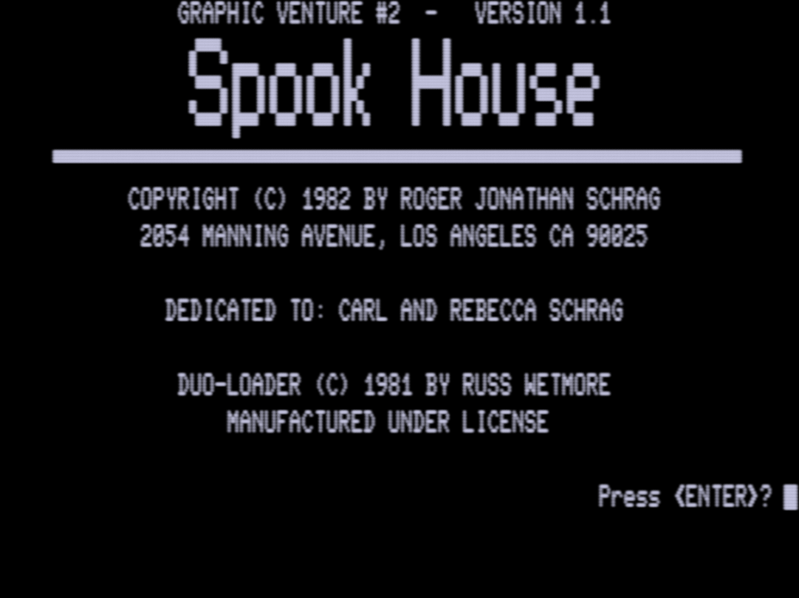

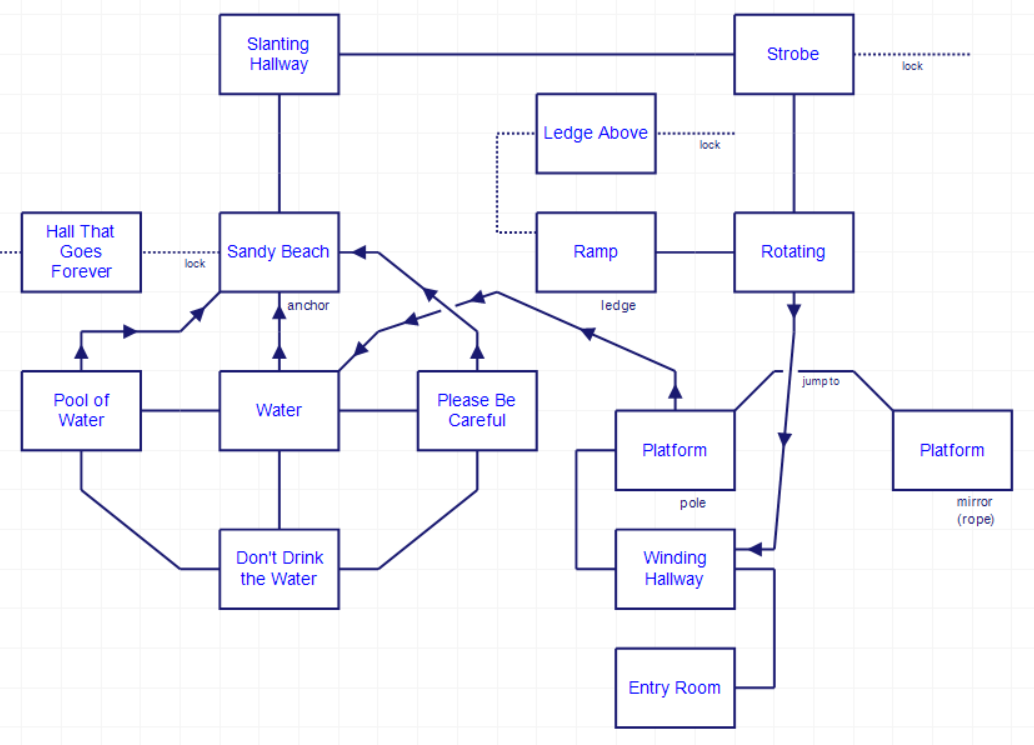
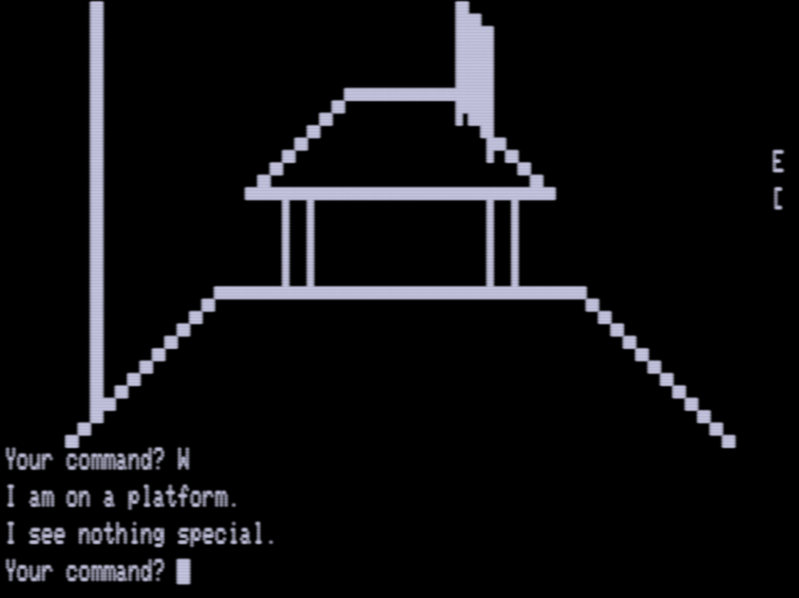
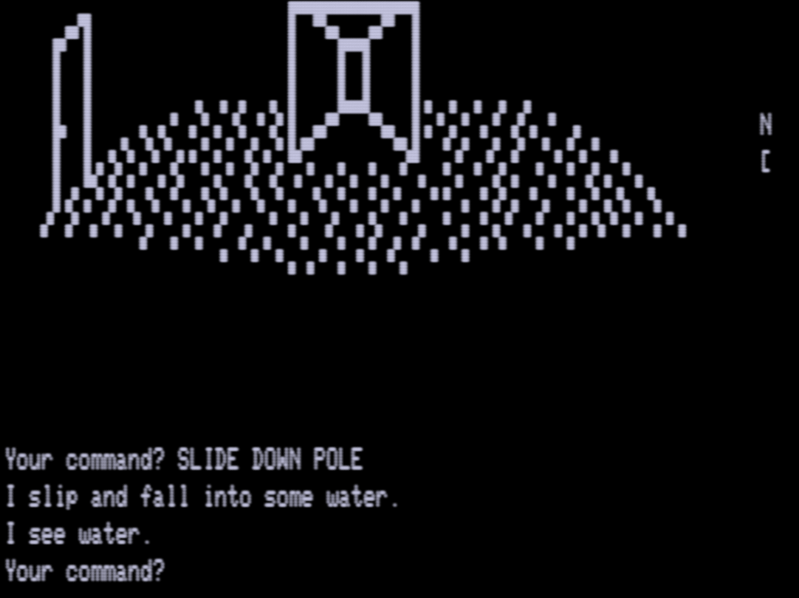
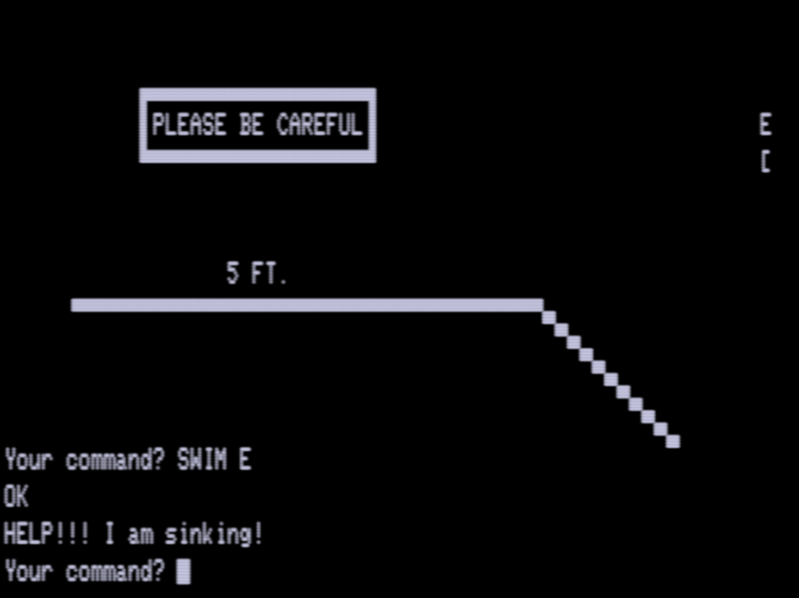
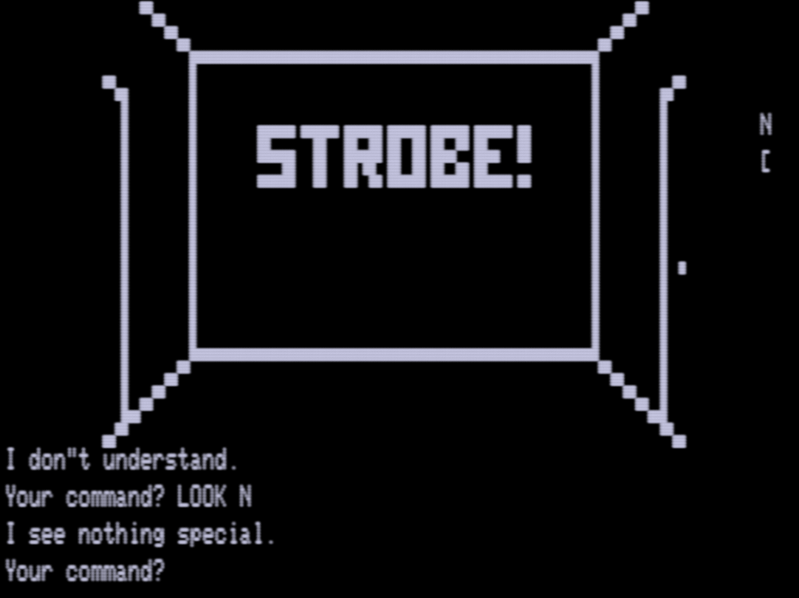
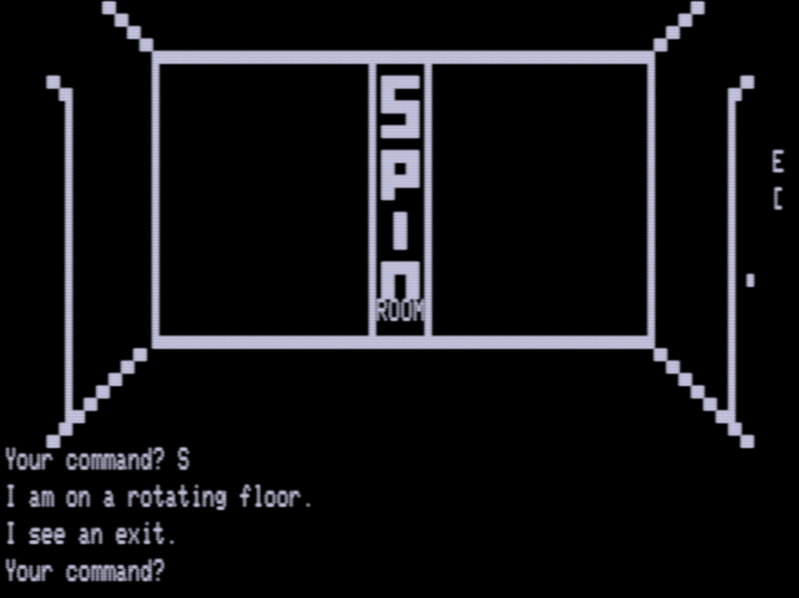
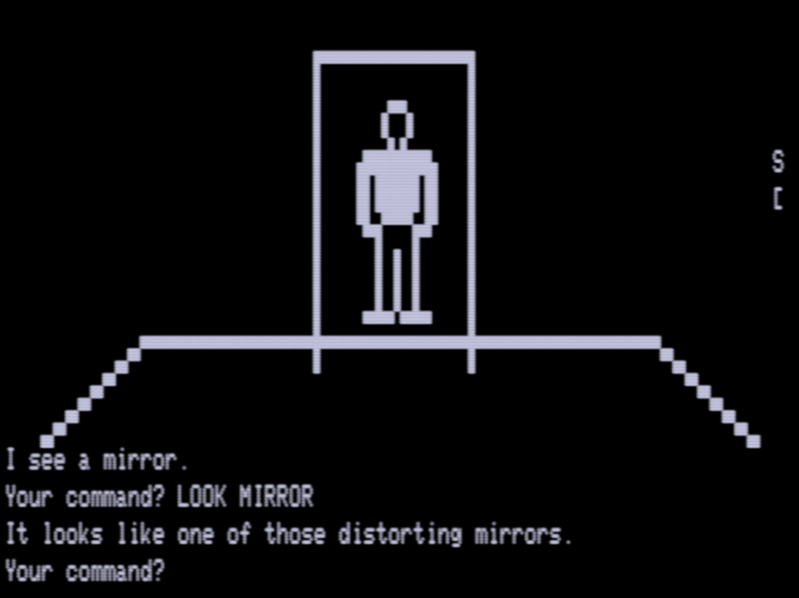
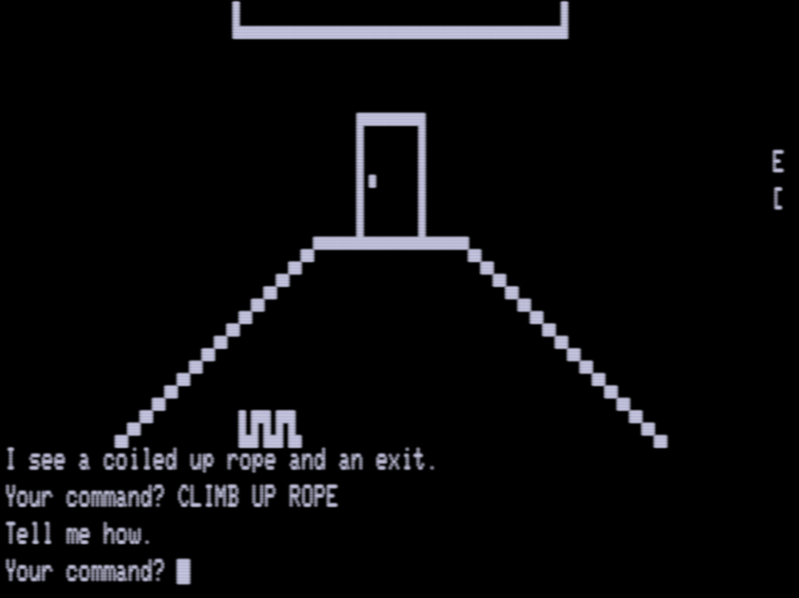

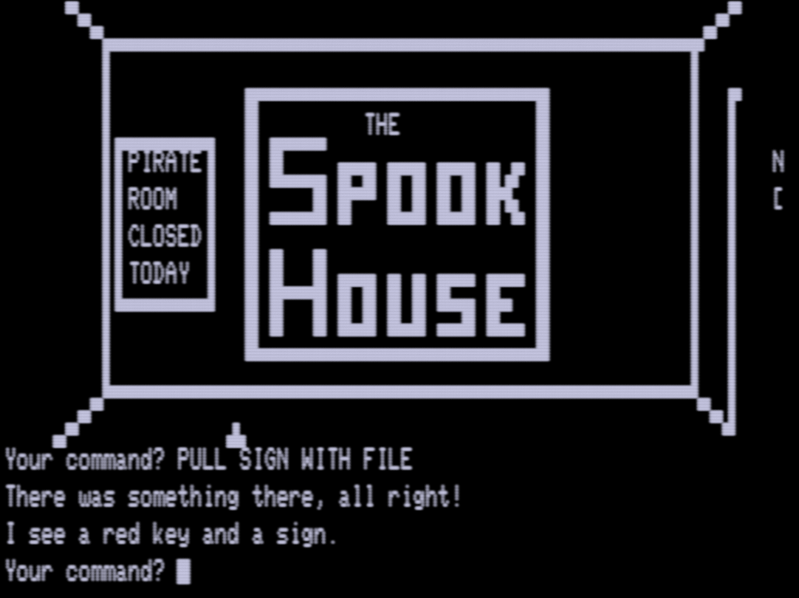
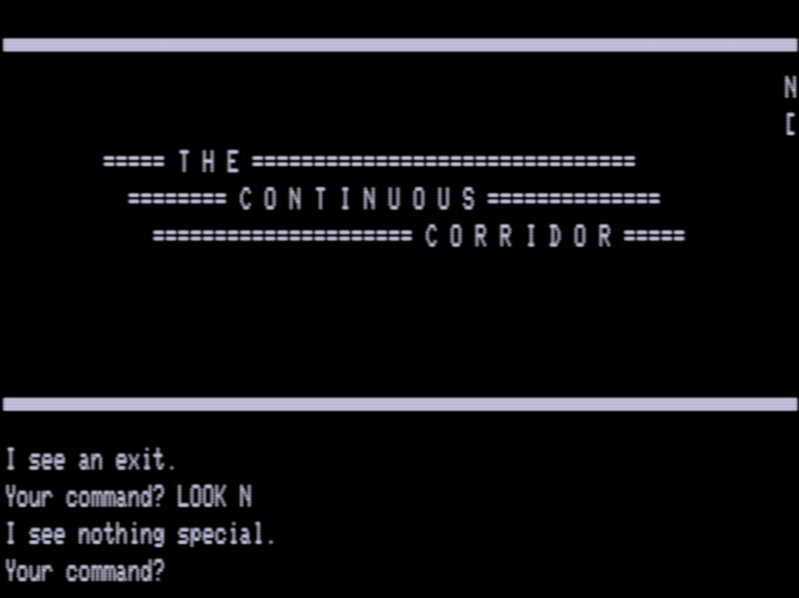
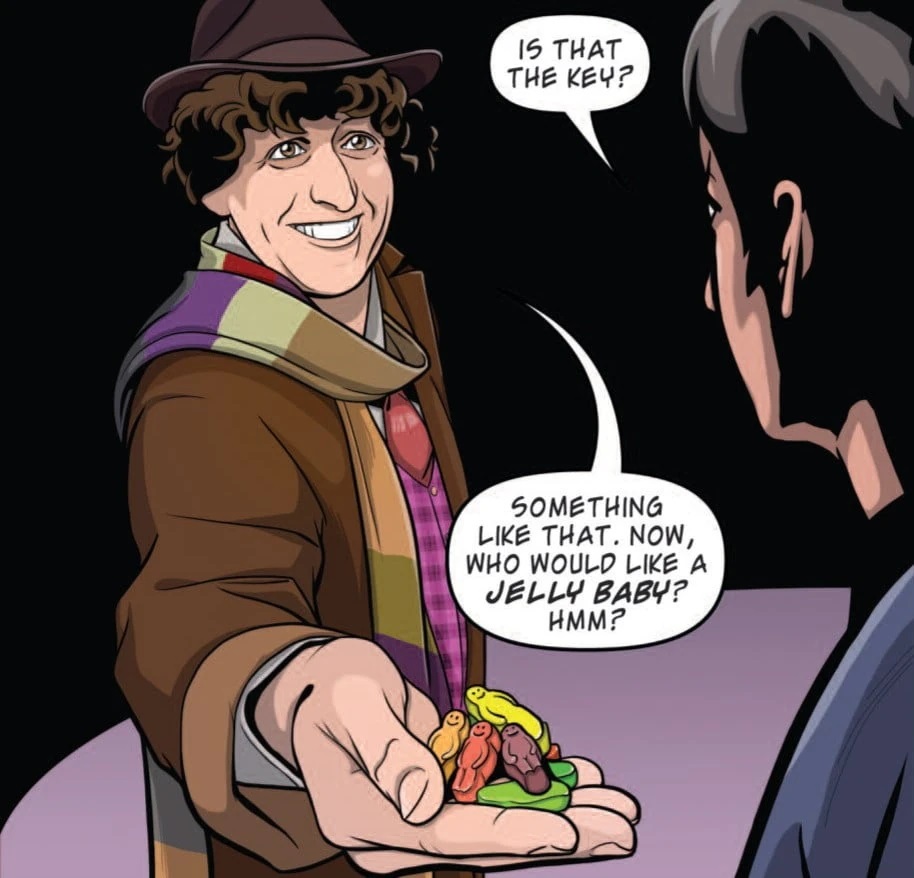
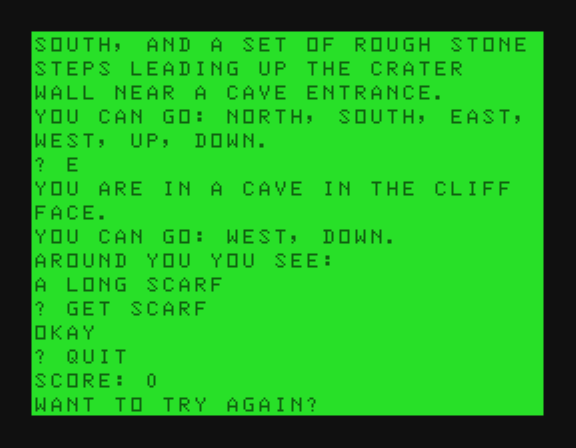
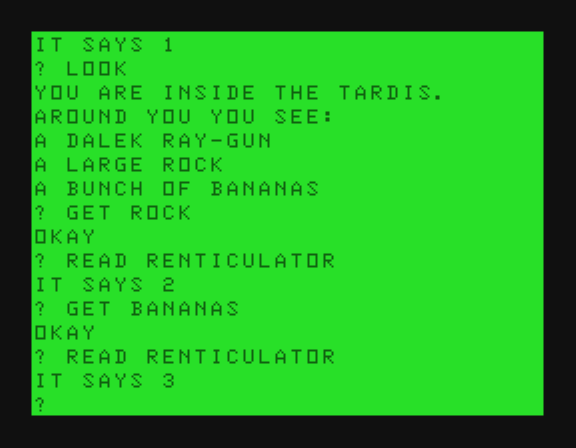
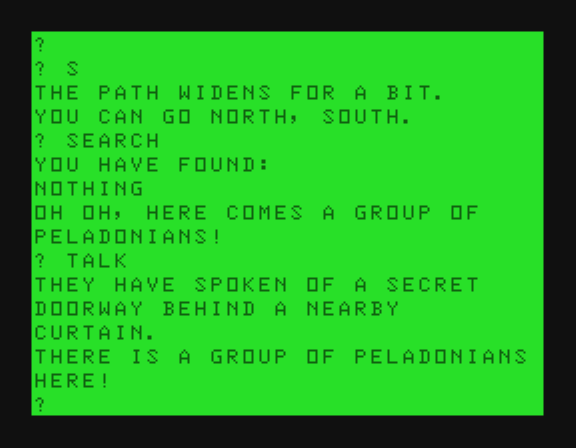
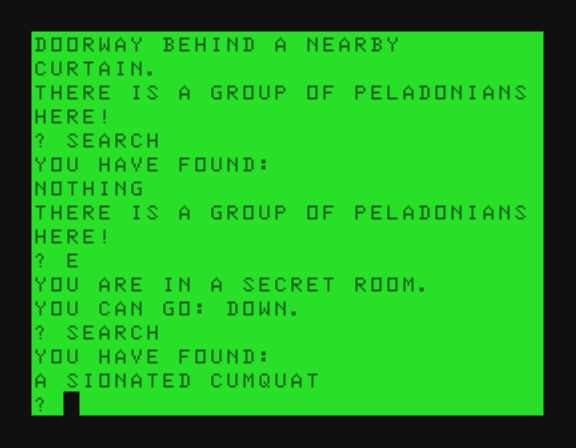
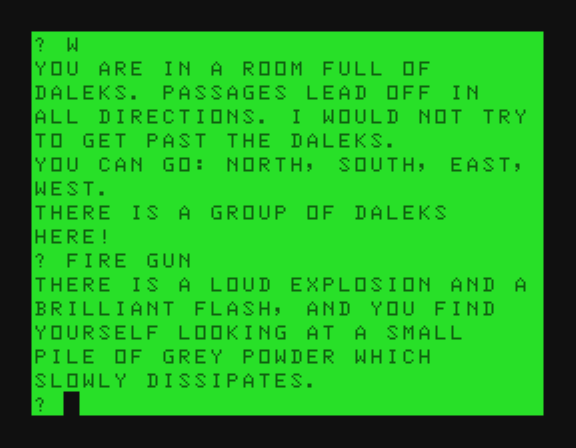
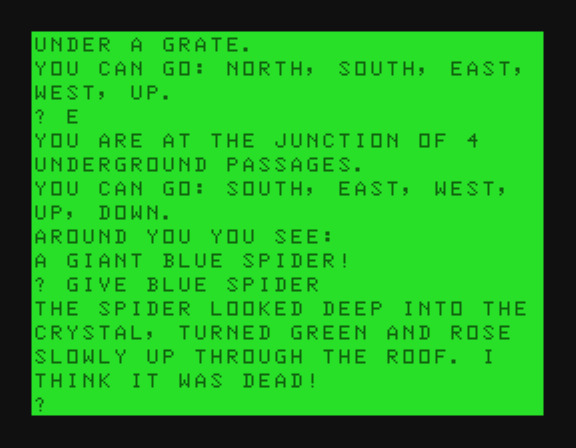

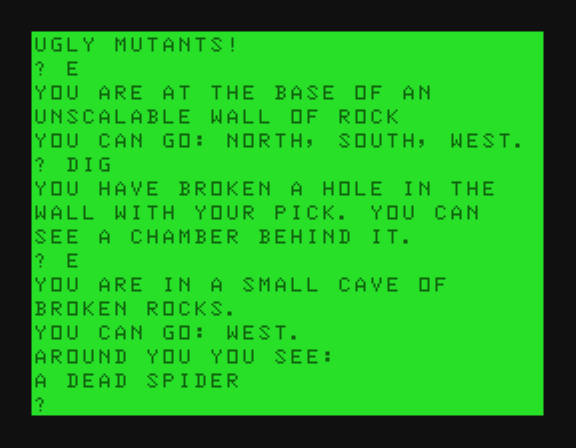
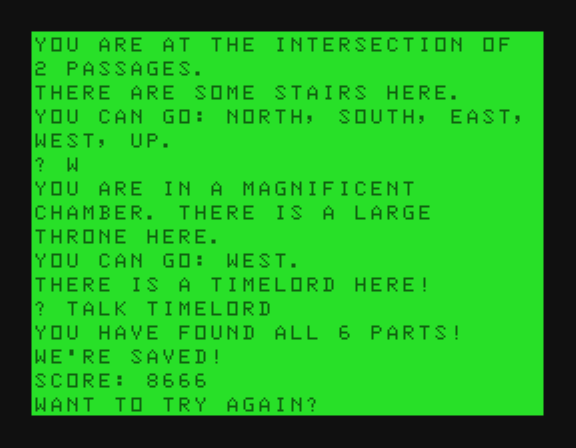


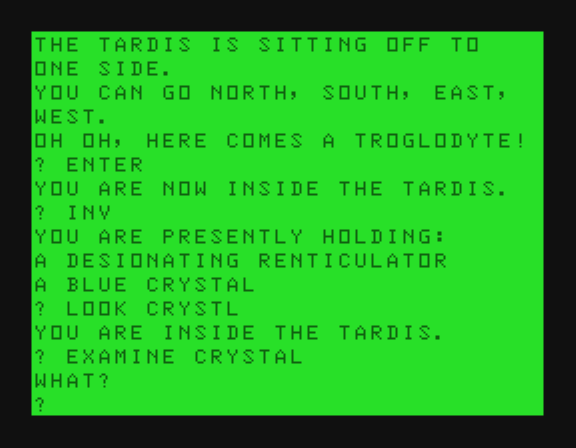


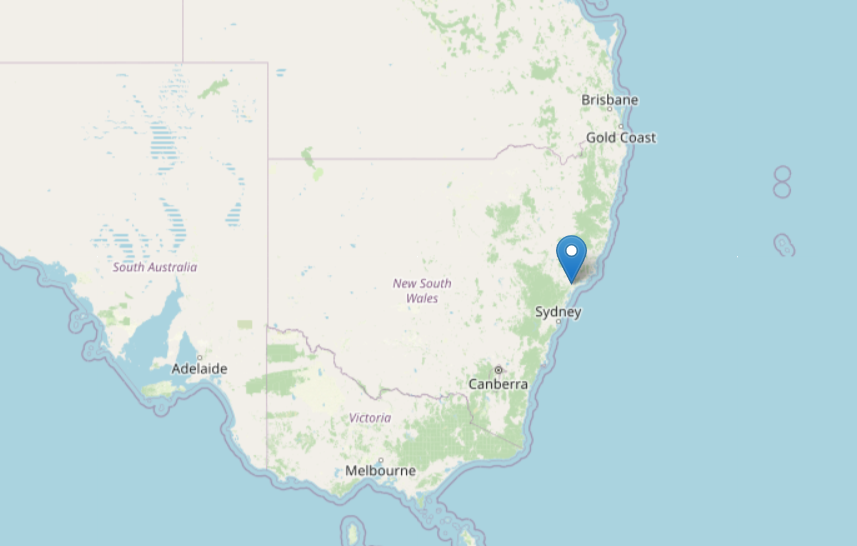

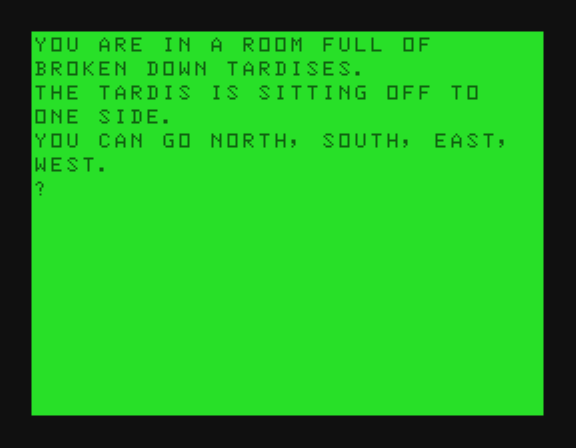
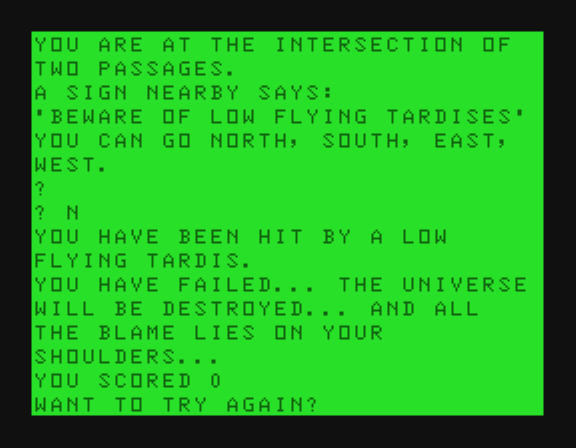
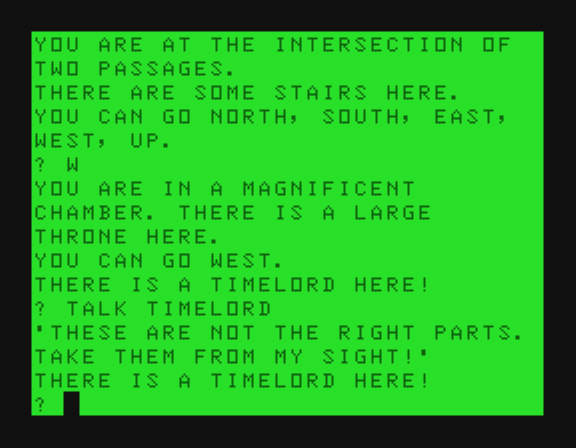
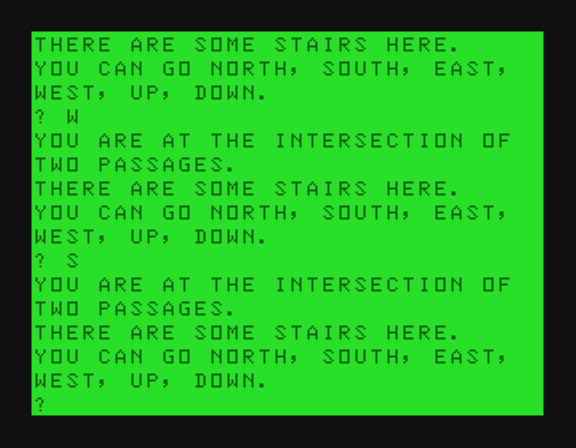

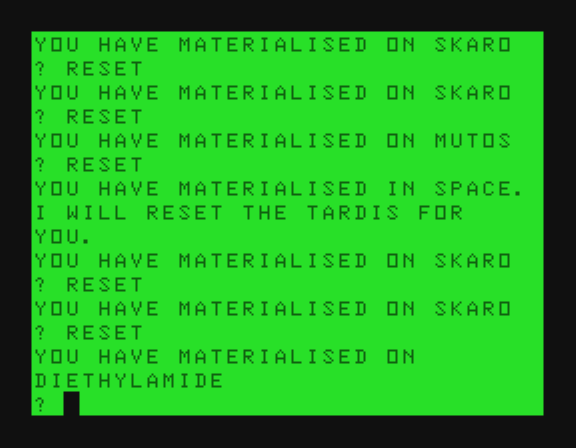
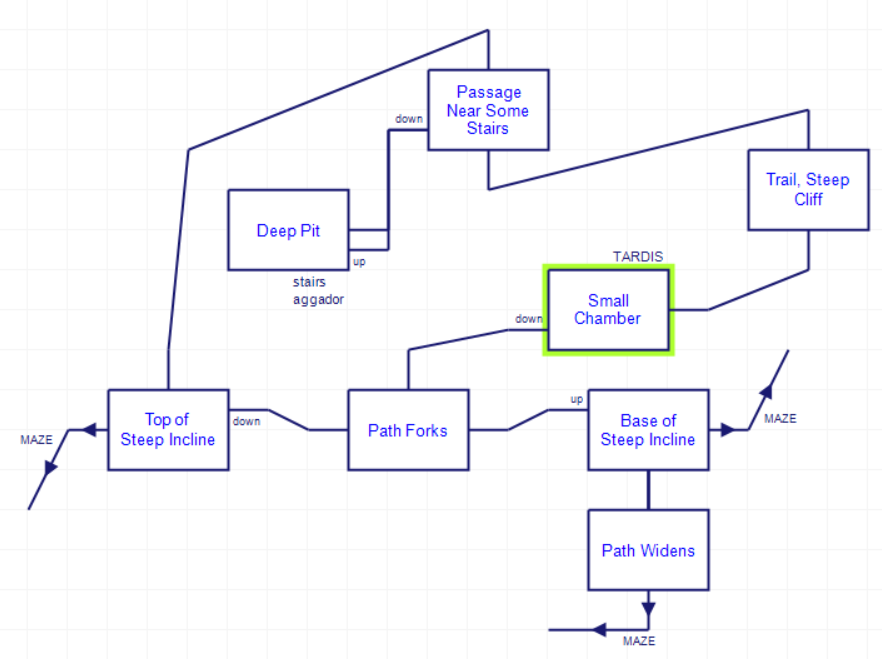
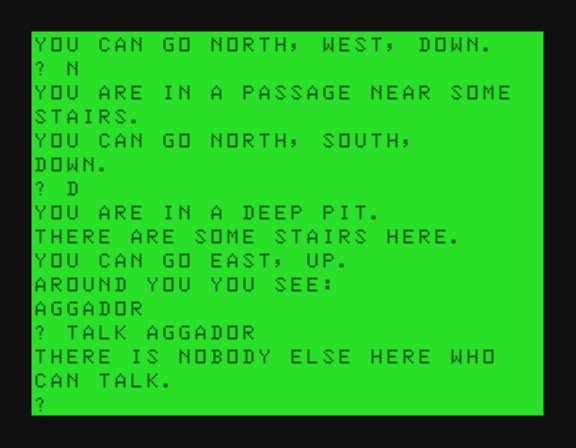
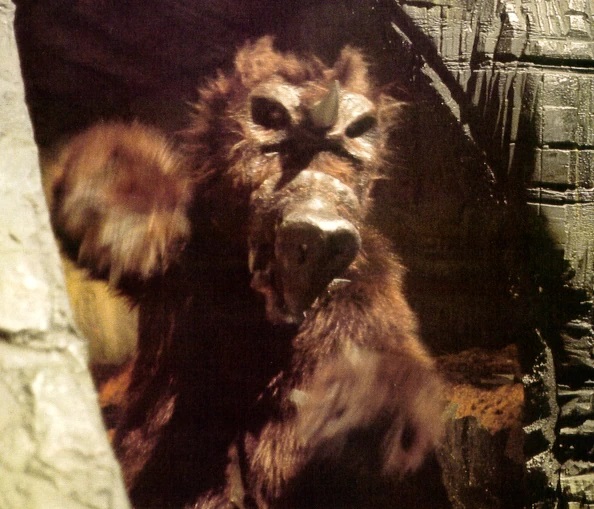

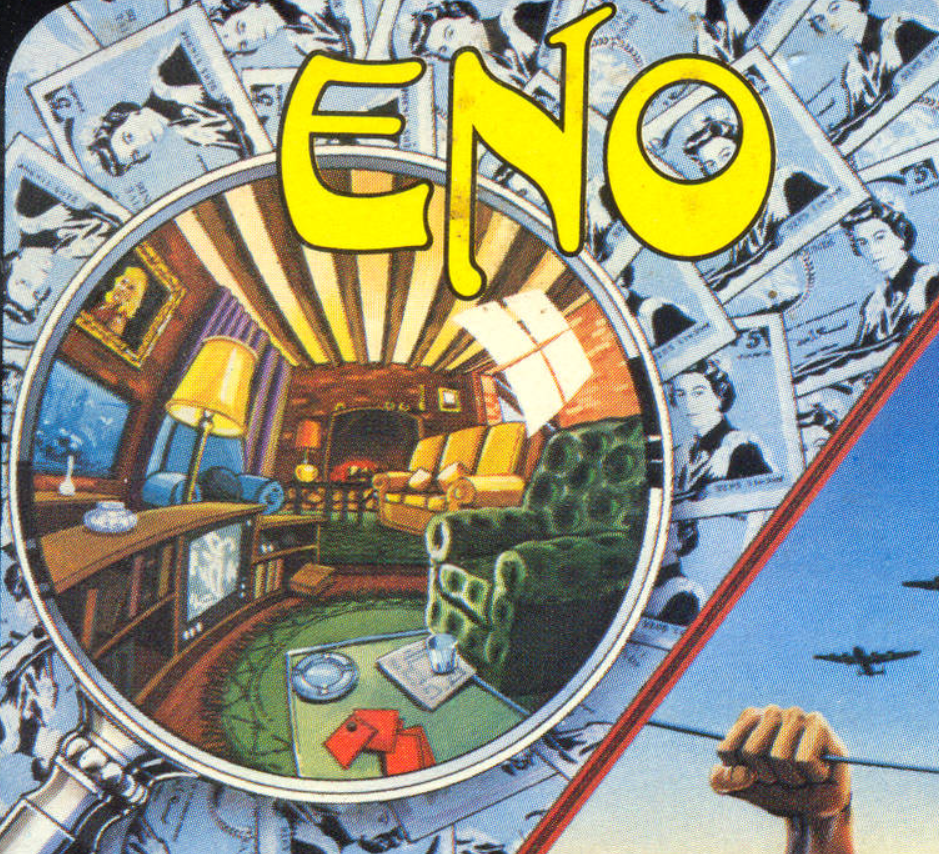
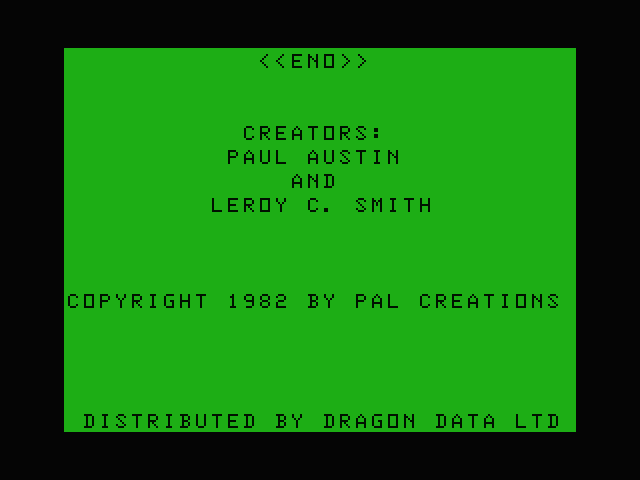
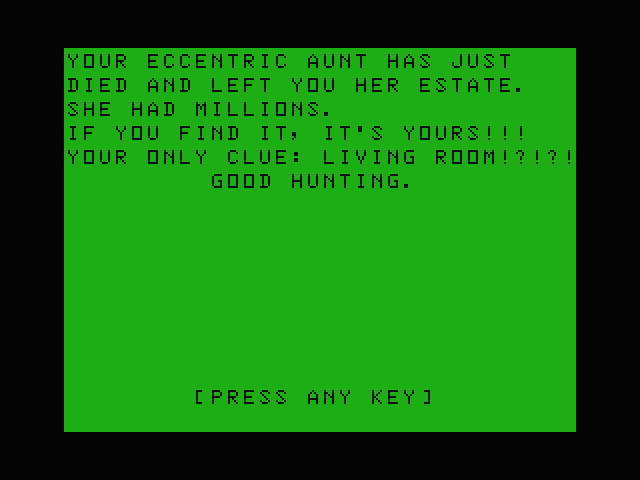
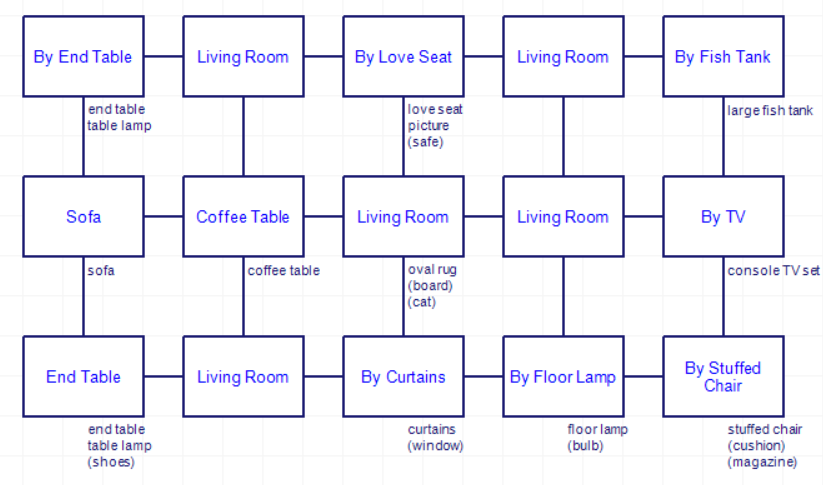
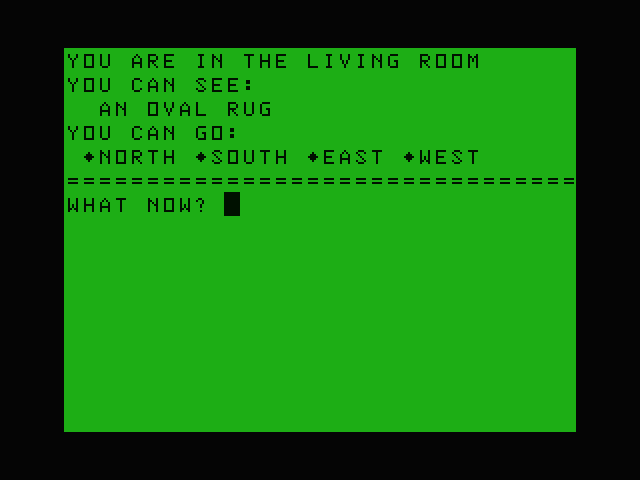
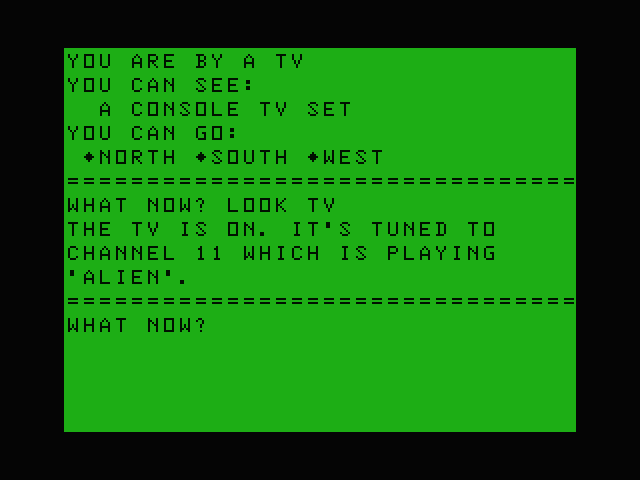

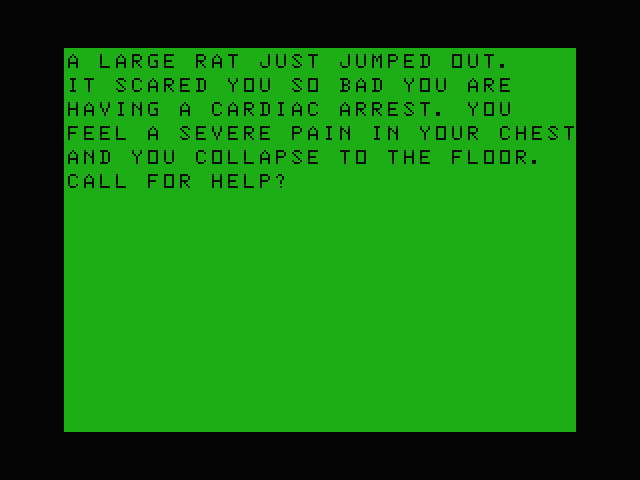
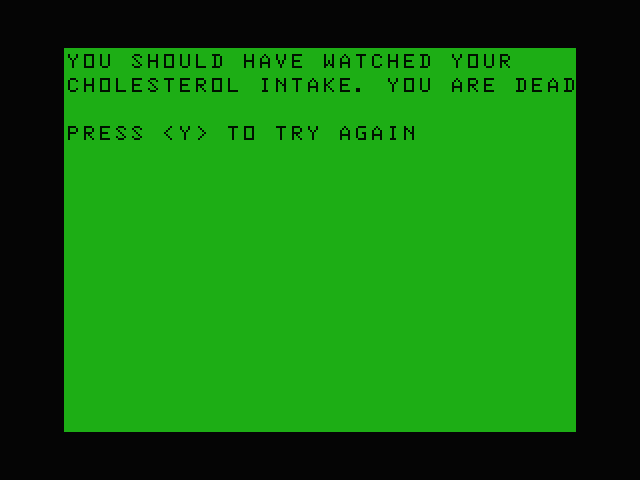
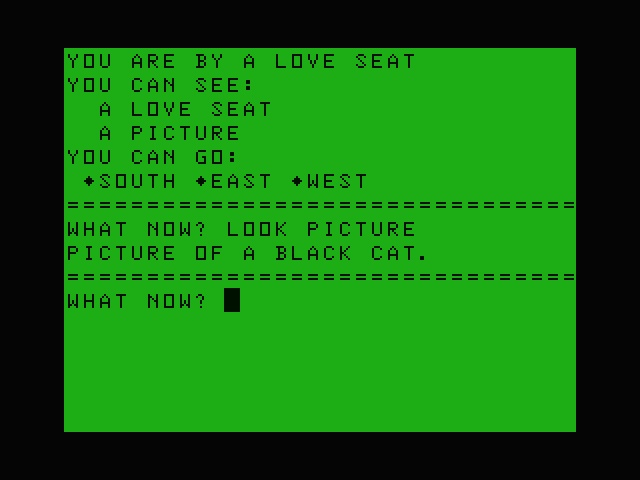
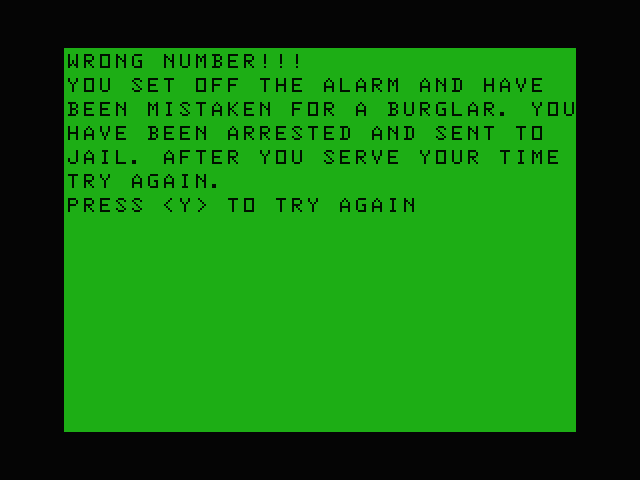
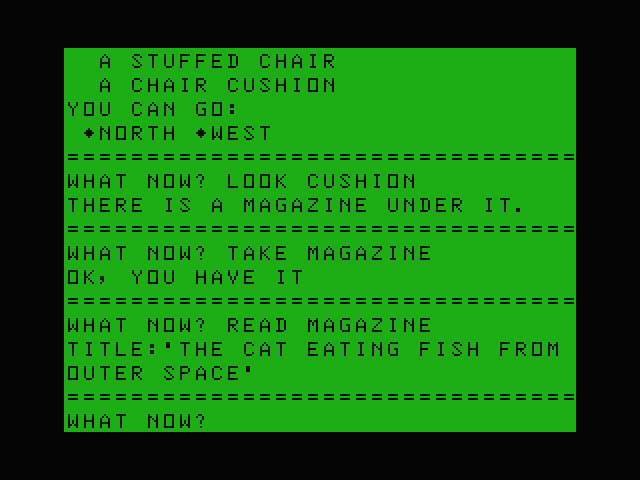

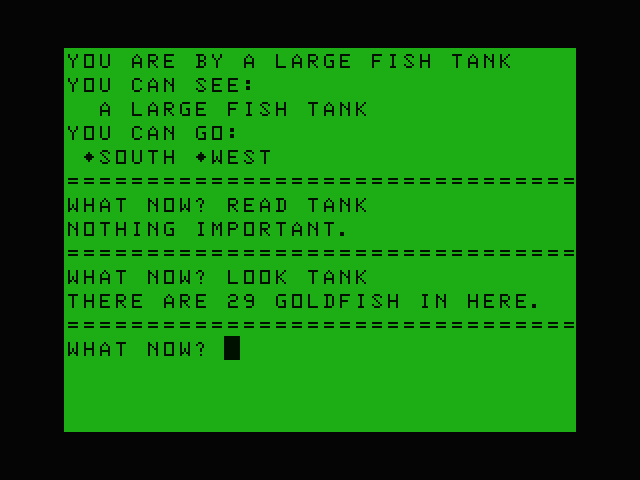


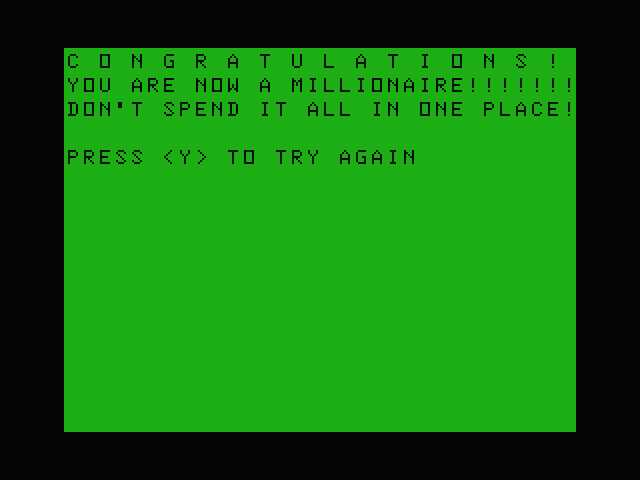

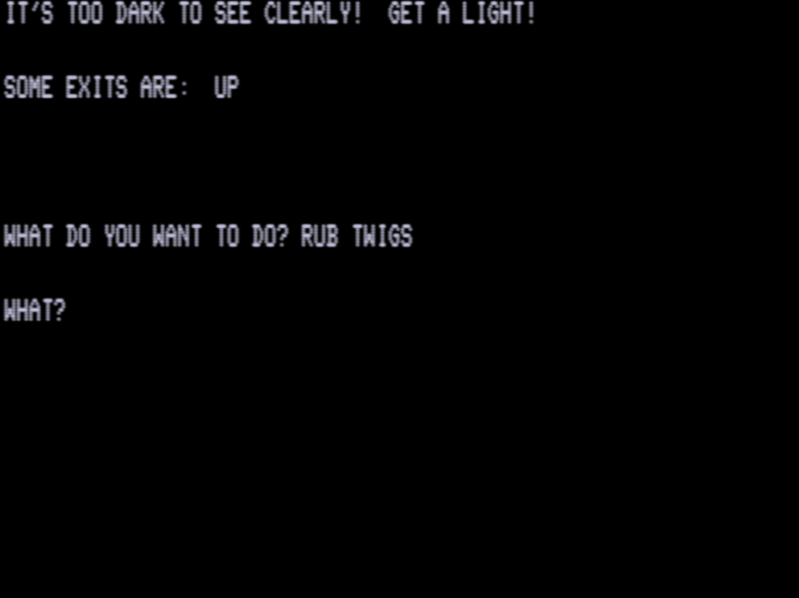
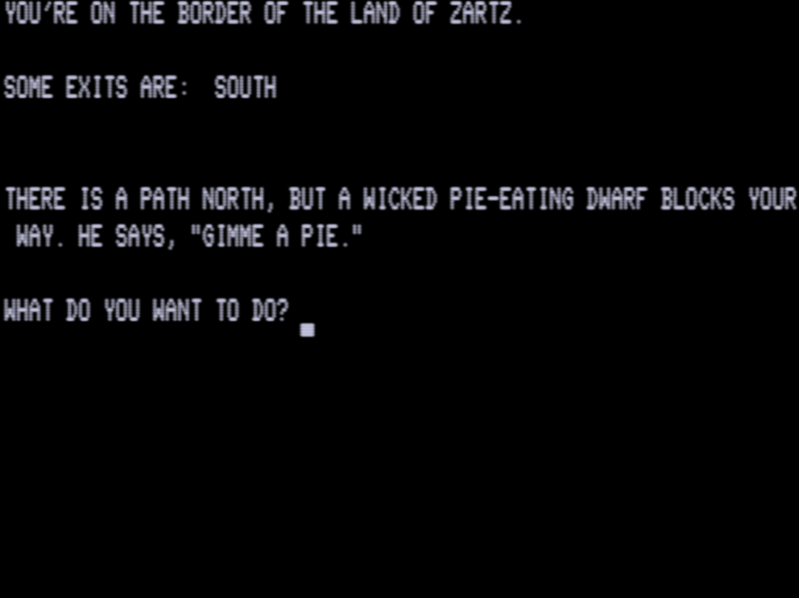

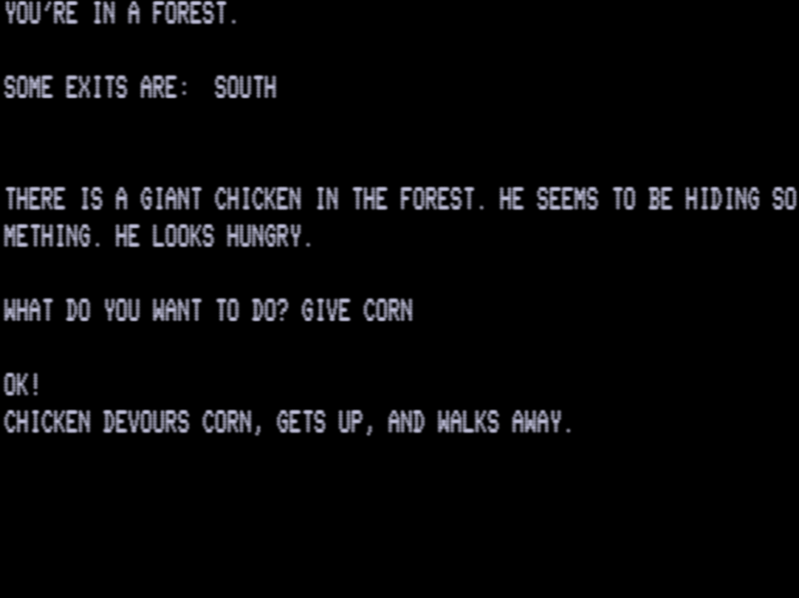

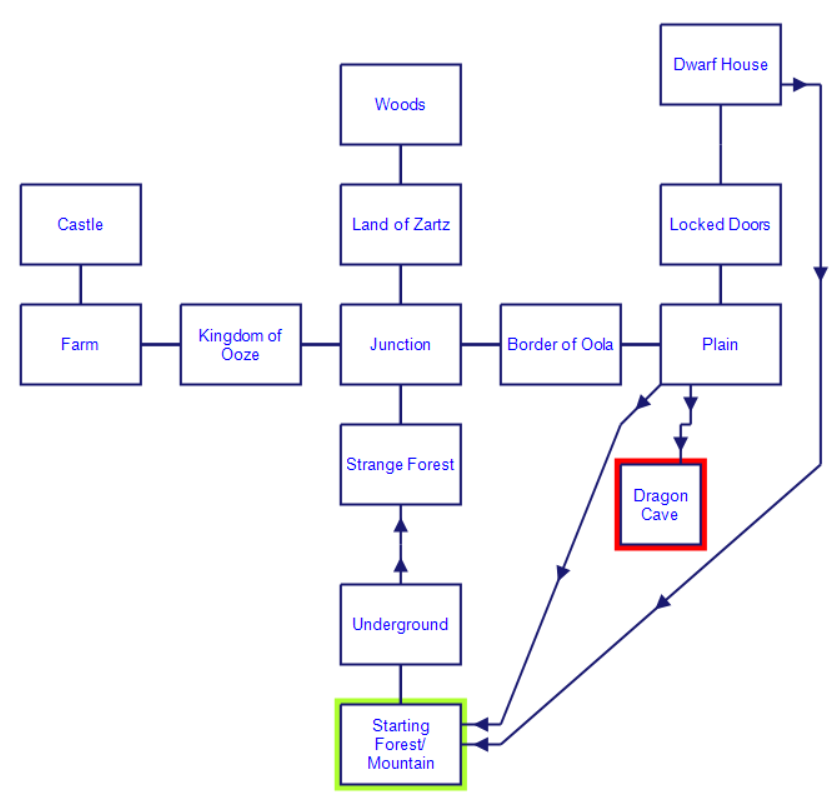
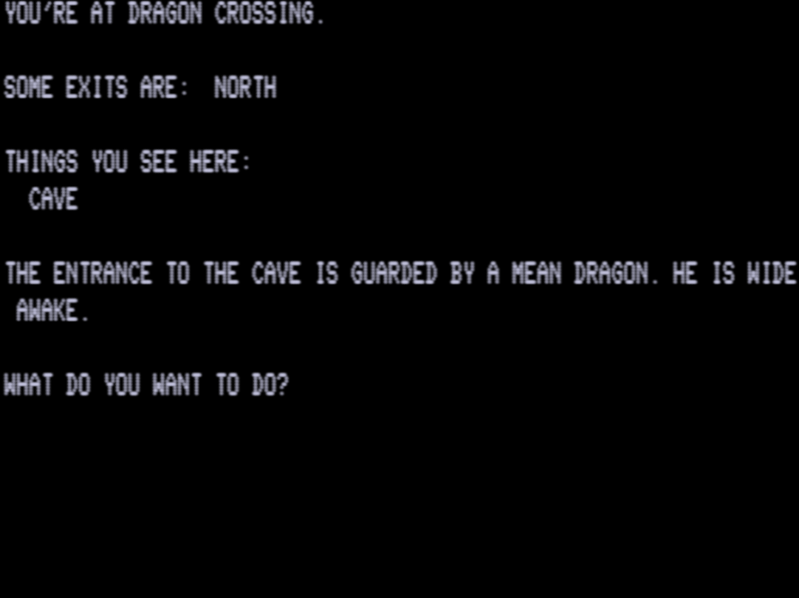
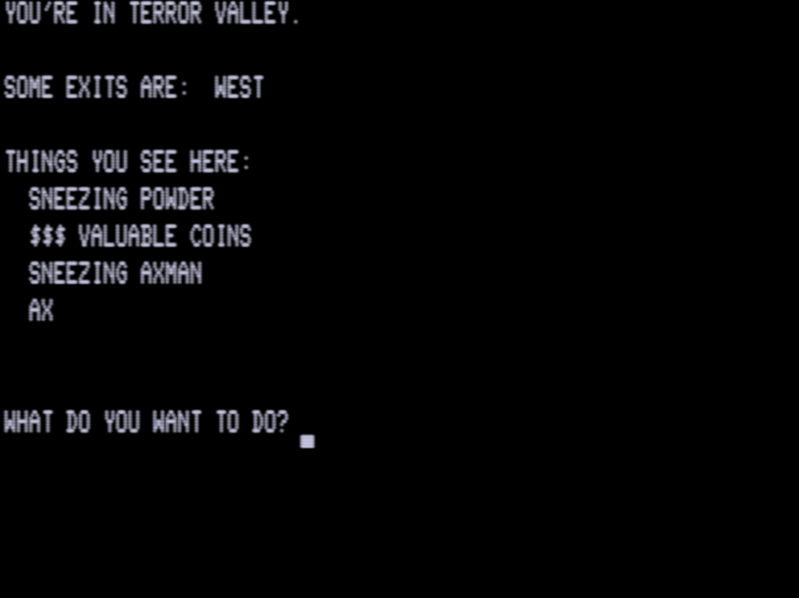

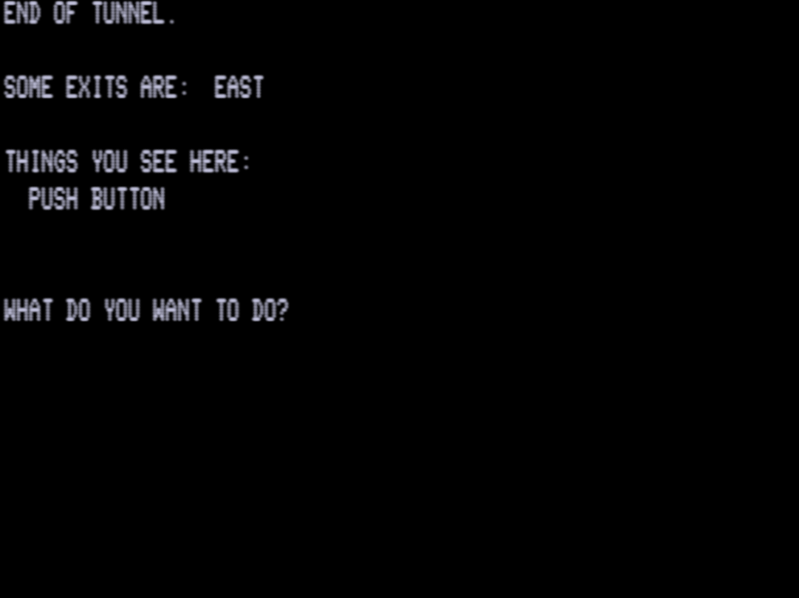
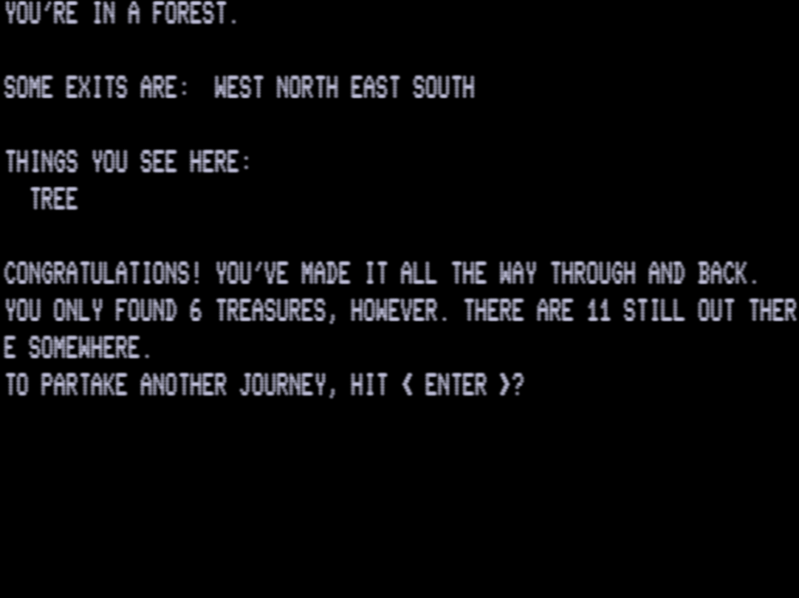

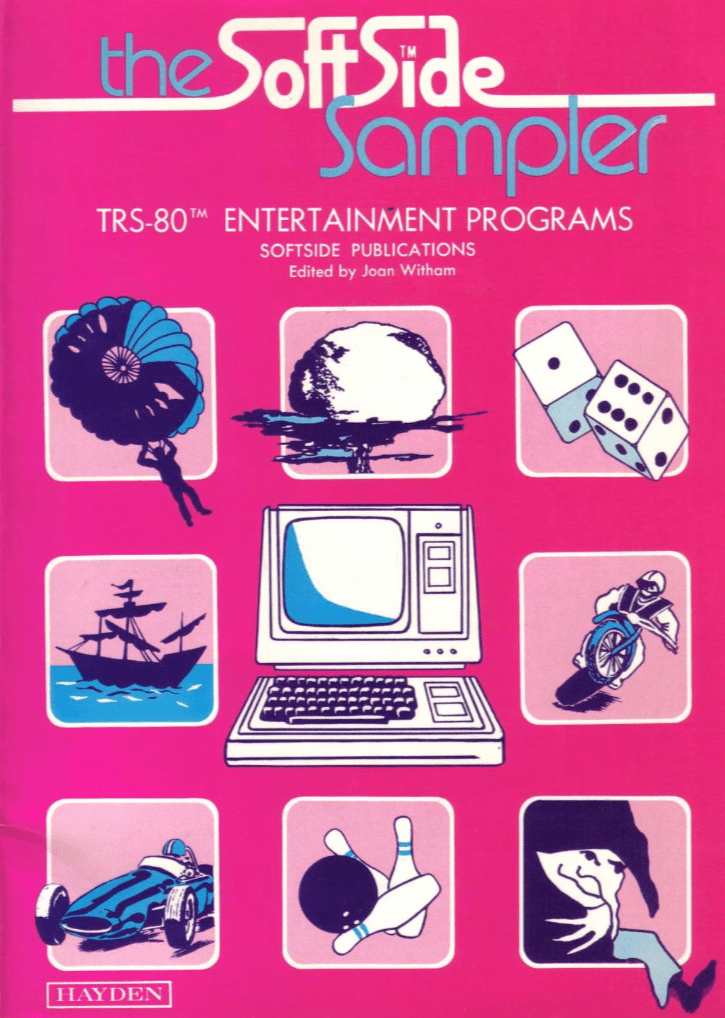
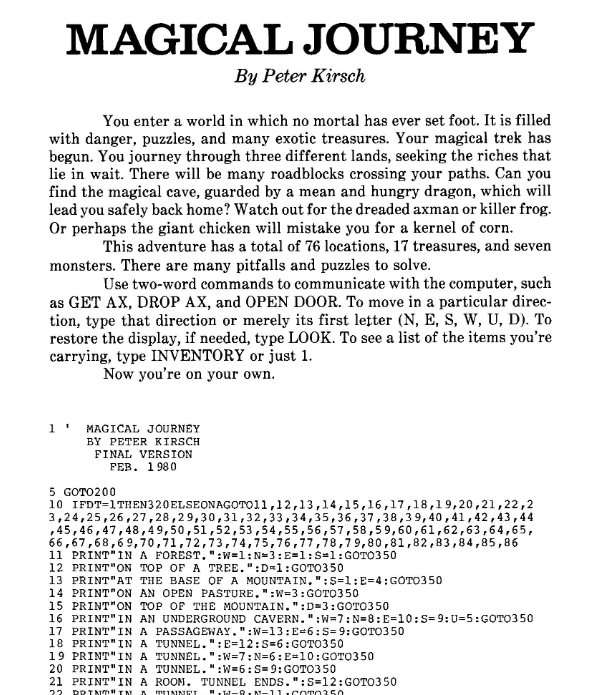


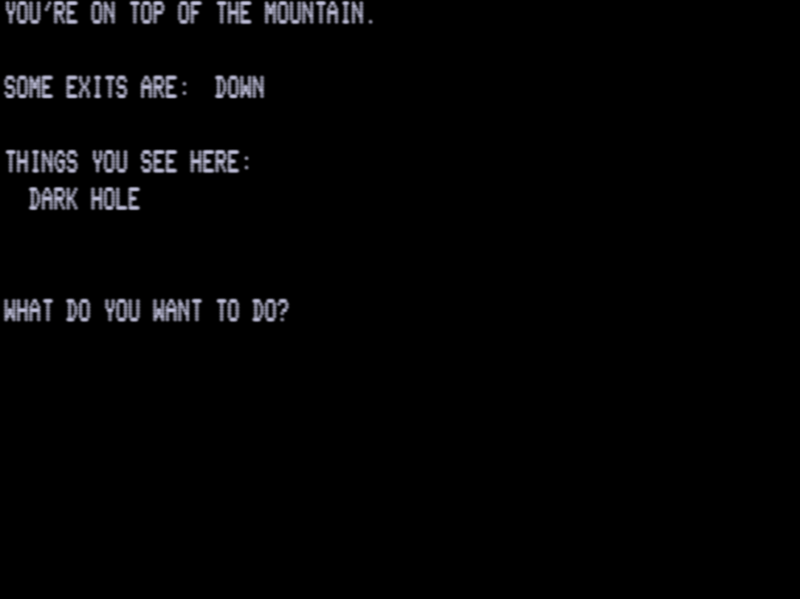


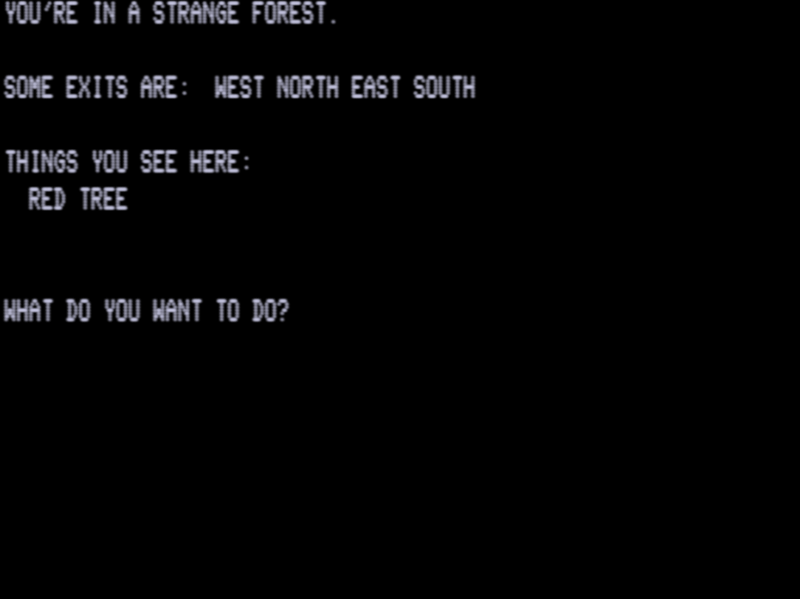
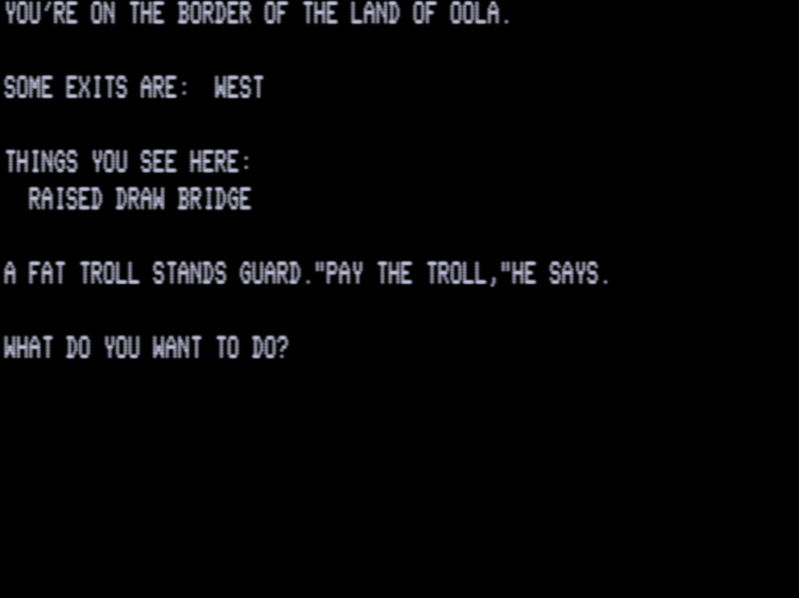
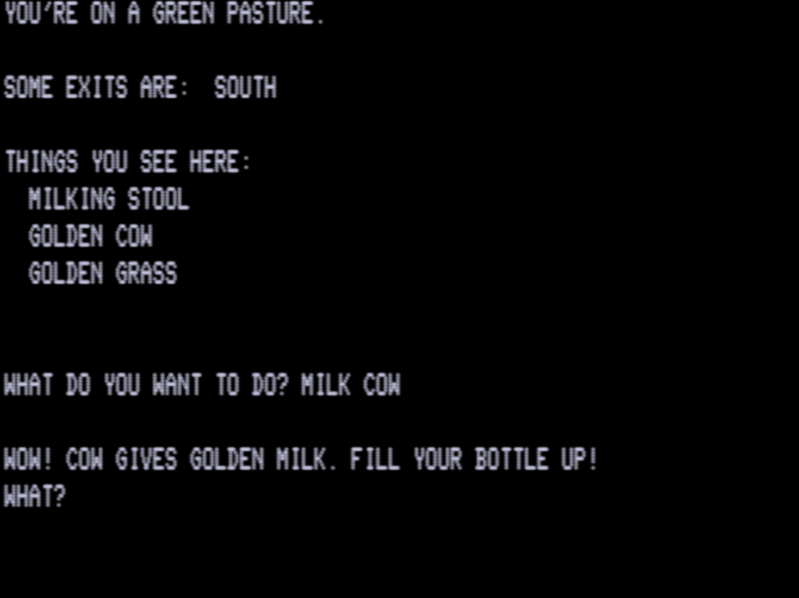

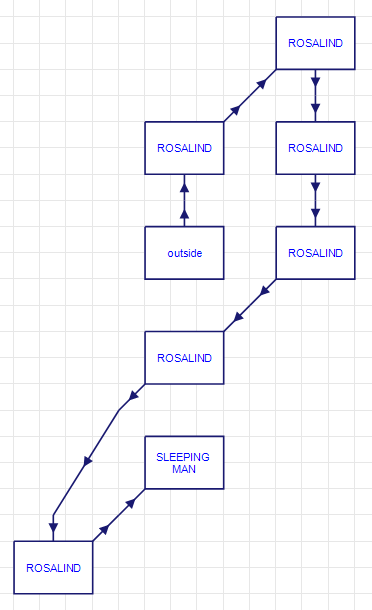

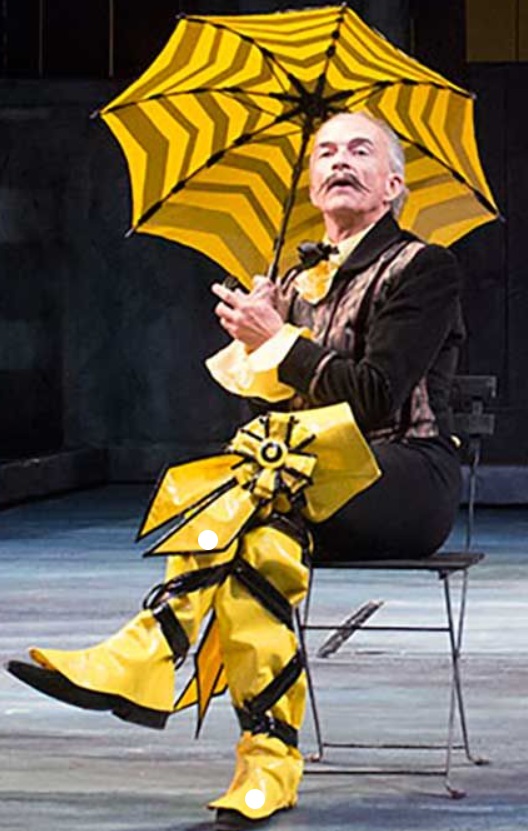


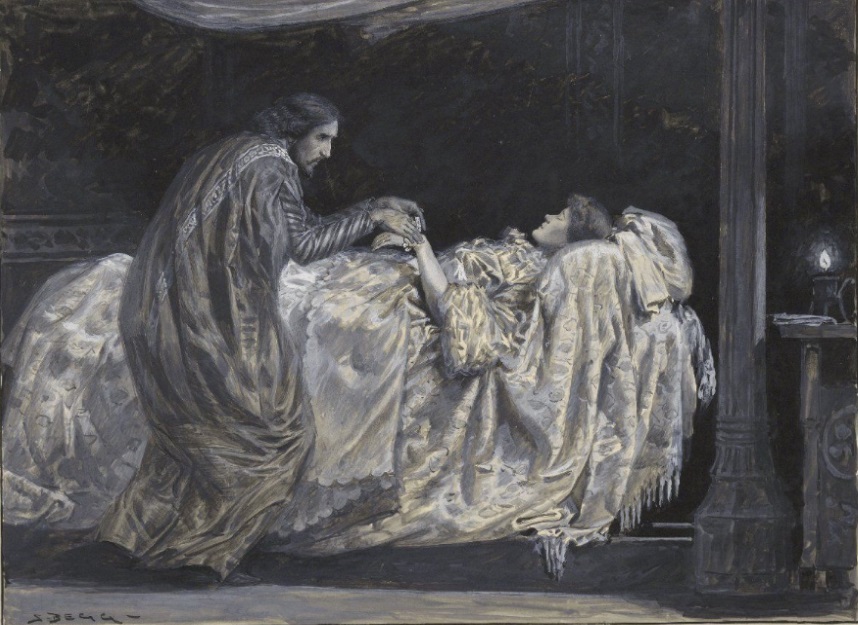


 Renga in Blue