conquering one bit where I had previously tried a verb correctly, but not on the sub-noun the game wanted, revealing a new area
using an item from the new area to bust through the bricked-up door, but it’s pretty esoteric; this leads to the treasure-deposit room
solving one final puzzle in the treasure-deposit room which is really esoteric
For the sub-noun issue, I warp back up to the bathroom with the gold taps.
I had tried TURN BATH with the notion of perhaps running the water (and to be more literal, RUN WATER) but was running into the generic refusal message so moved on. I was instead supposed to type TURN TAPS. (Which, sure, I guess the game suddenly wants to start referring to sub-nouns now! That will come back again shortly.)
LOOK TOWN advertises one of the co-author’s other games:
IT’S SO FAR! FOR A CLOSER LOOK YOU WILL HAVE TO BUY MEXICAN ADVENTURE!
I tried hard mucking about the roof to see if I could fly the broomstick anywhere, but no dice. In the process, though, I tried to BURN BROOMSTICK (well, at least it is a verb I knew works) and the game informed me I needed a draught in order to start a fire.
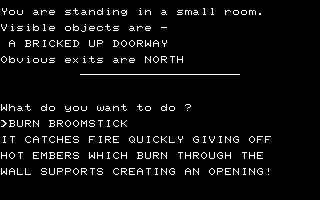
If you recall, the bricked door help mentioned a draught, so I brought the broom down and tried burning there:
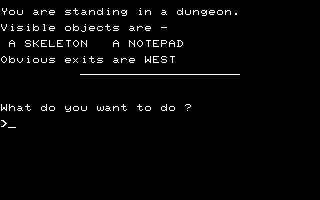
There was no real coherent thought otherwise; I wasn’t solving a puzzle as much as solving a trail. With the door busted open I could enter the final room, which is a dungeon with a skeleton. LOOK SKELETON reveals a NOTEPAD, and looking at the notepad indicates the treasures go here.
Our task is to collect the house’s treasures and make them harder to find.
So I dropped the treasures I had (bottle of wine, gold ring, bracelet, book) and I was informed by SCORE that I had only 69 out of 100 points. I did a large search (more than an hour) across the house trying to wheedle out more treasures, including trying to unscrew the gold taps (since they are described as gold).
There was really only one treasure remaining, at it was there at the dungeon the whole time.
I don’t think there’s a “reasonable” way to solve this. I had the intuition something unreasonable was happening so I checked the source code. The only time I recall seeing a comparable puzzle was with Avventura nel Castello where I had to pick up a bone from a skeleton (even though a bone isn’t described).
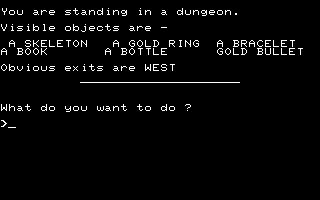
You don’t pick up a bone. You pick up the skull. I combed over the source code and there’s no hint for this, and there’s no message that happens when you get the skull — it just lands in your inventory. You can then LOOK SKULL and find it has a golden bullet, which lands in the room you’re in (probably the dungeon).
Now typing SCORE confirms we have all 5 treasures and the win.
As I predicted, the source code includes a big pile of bespoke commands. I don’t recommend anyone coding a text adventure like this ever.
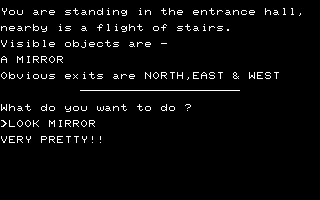
This screen is from the later MZ-700 version, which doesn’t change anything other than the starting room (you begin at the pond rather than the rock).
This is still fascinating in a historical sense because it might seem all the various tutorials we’ve seen (like the Ken Rose ones) are maybe being a little overmuch about the difficulty, but clearly here is a pair of authors who couldn’t conceive of a different way of handling a parser other than listing every single verb-noun combination a player might possibly type.
Except: remember, Secret Kingdom did have a decent parser! It must have come after this game. I think we can now assume the publishing order matches this ad listing’s order:
Game 3: Haunted House by A.J. Josey and Geoff Clark
Game 4: Secret Kingdom by Geoff Clark.
…meaning I’ve been going in reverse order. (I figured out what the G. stood for as it gets listed with Mexican Adventure. Still not sure about Josey, but you’ll notice Dark Star is solely that author’s work.) After combing over the source code, I don’t think Colditz is connected (other than the Sharp programmers in general were clearly struggling to write a parser).
I weirdly had fun puzzling this out, but that’s mainly because Rob joined me in the comments to similarly take whacks at it, and I was thinking in a meta-sense of this being a mysterious artifact. I never got any sense of being in a haunted house. The game does try for random atmospheric messages and there’s even a bit where a ghost can steal your treasure if you try to wear the bracelet or drink the wine, but given the vast majority of what I typed in gave error messages I was not “engrossed” in a story sense, but rather as a historical challenge meant to be conquered.
No source code diving yet. I managed get at least part of the “vibe” of the parser, although some authorial decisions still mystify me.
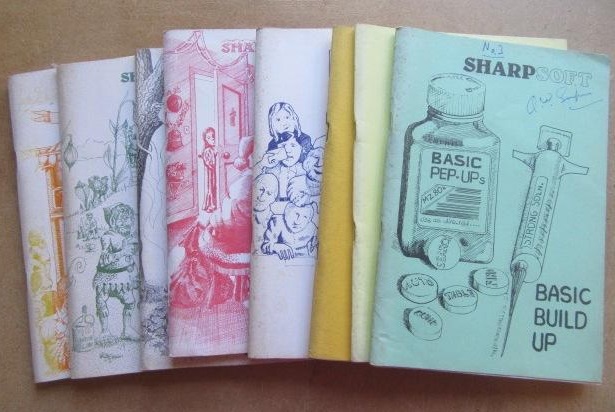
Sharpsoft User Notes, via AbeBooks. Books 3 through 6 cover 1982.
“GO” (as in “GO NORTH”, “GO UP”) seems to be purely for directions, and furthermore, the way the parser works is to simply strike the verb out and just look at what was typed for the noun. This means GO EAST works the same as EAST. However, this also means other perfectly natural GO statements won’t work; for example, typing GO UNDERGROWTH gets parsed as UNDERGROWTH and hence:
I DON’T UNDERSTAND WHAT YOU MEAN BY THE COMMAND ‘UNDERGROWTH’
Earlier when I was trying to GO POND and it wasn’t understood, the game is simply wanting ENTER there instead.
YOU FIND A DEEP HOLE IN THE POND AND HAVE DROWNED!!
(Für Elise plays, mourning our player avatar’s loss.)
The purpose of the hollow log is simply as a floatation device, so as long as a player is holding the log, they won’t die going in the pond, and will be able to find a key instead.
Using the key you can then unlock the (otherwise not-visible) door at the front of the house, and go inside. Despite the threat from the rock, we are not trapped in.
The Sharp speaker is used here to add a “catcall whistle” sound to this moment.
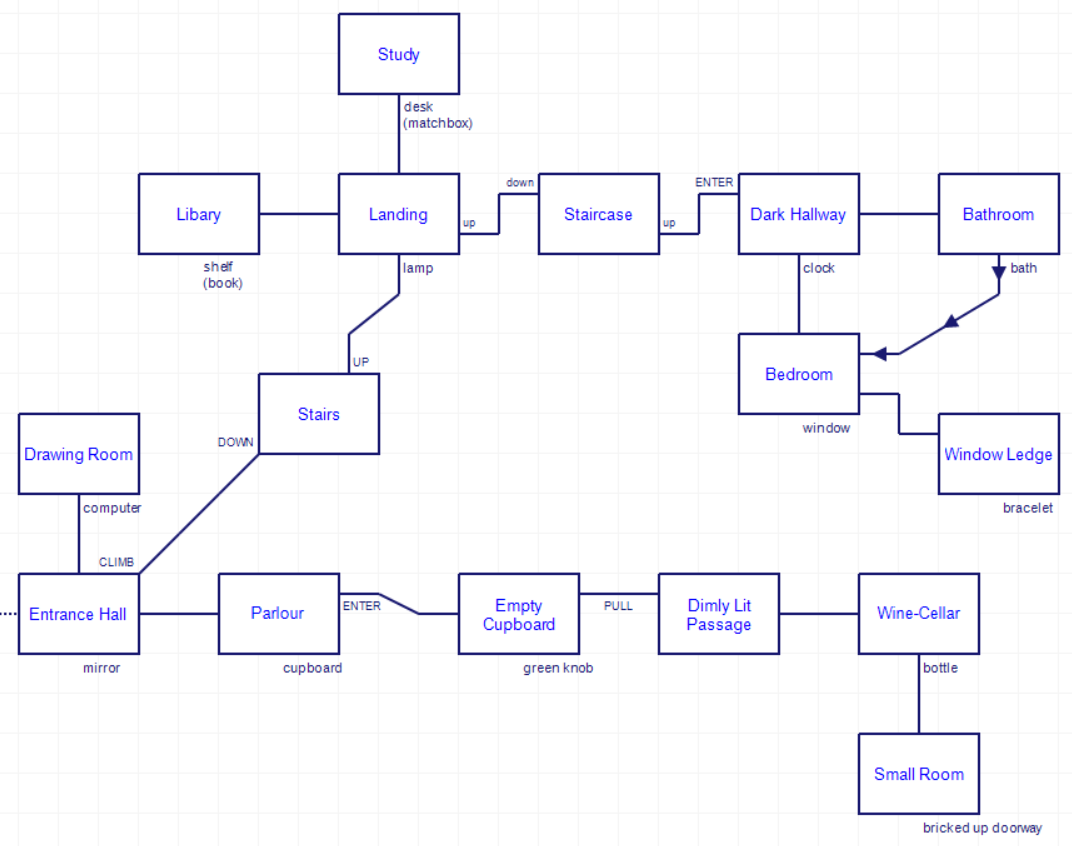
I don’t yet have a full map of the inside, but at least I’ve got more to explore than last time.
Just to the north is a COMPUTER in a drawing room, and we are told it is a SHARP MZ-80K. I tried to insert my tape a few ways and was having trouble, so just went straight to HELP which told me to LOAD CASSETTE.
It’s unique for the desire to acquire treasure to be a secret objective that requires revealing a little ways in. I’m still not sure where we are supposed to drop the treasure; not outside, which suggests perhaps we aren’t taking the treasure with us, like how The Great Pyramid had us simply sort the treasures in a particular room. (On the other hand, Katakombs initially asked us to take the treasure to a Dark Crypt, but in the end a golem broke open the way so we could take the loot away for ourselves. I guess we “passed the test” so the denizens acquiesced.)
Heading up the stairs next, I found a library with a book that has gold leaf. This book does not let you open, read it, or interact with it anyway, so it’s just a treasure. (This is one of the vibes I mentioned — the game is cheerful about simply not letting you mess with a thing outside the context it is intended for.) Also upstairs is a study containing a desk with matches.
With the matches in hand you allowed to try to BURN things, but a ghostly voice stops you and says it is dangerous to play with fire.
Present in the hall upstairs is a LAMP, which foiled my attempt at taking it with “A STRANGE FORCE”. Again, interpreting the vibe can help: this means you shouldn’t be thinking of taking the lamp at all, but doing something else with it. Indeed, if you look at the lamp, it is described as “oriental”, implying the right action is RUB LAMP.
Upstairs there’s a bedroom with a window you can enter, taking you to a ledge with a bracelet (a treasure) in addition to a bathroom with a BATH that is described as having GOLD TAPS, imply treasure-ness, but I haven’t been able to scavenge anything.
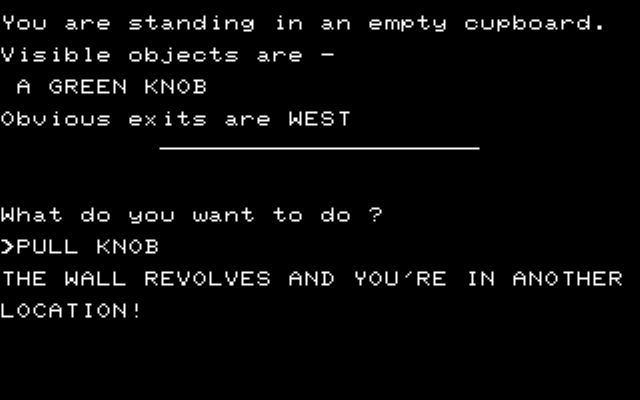
Down at a “Parlour” there’s a cupboard that is enterable, and a green knob. Typing PULL KNOB reveals a basement area.
Inside the basement there’s a bottle described as valuable (still don’t know where the treasures go) and the room that is currently mystifying me:
I haven’t found a way to refer to the supports (and burning doesn’t work). Typing HELP indicates there is a “draught” but I’m not sure what to do with this information. Whatever is supposed to be done here seems to be entirely bespoke (that is, I need the exact two-word phrase in order to move further).
I realize for you just reading along, it may not be apparent how badly the parser is doing. It absolutely is awful. Even ENTER (which I thought before was honestly coded) gets befuddled here; when I tried to ENTER BATH the game says I DO NOT UNDERSTAND WHAT YOU MEAN BY THE COMMAND ‘ENTER BATH’. With essentially no reassurance than any verb in particular might work, the game has a much stronger aura than normal of “guess what the author wants”. In this case I’m not even sure if the magic phrase will involve DOORWAY, DOOR, SUPPORT, SUPPORTS, or BRICKS as the noun. So it might be possible I run across a solution but don’t pair it with the noun the game is hankering for. To find something worse I have to go the very bottom with games like Deathship which didn’t even bother to describe what happened if you did an action successfully.
Again there is the lure of the source code. I don’t think there’s any going back if I check (given what I’m likely to see is a list of complete phrases that lead to completing the game) so I really still want to hold off if I can.
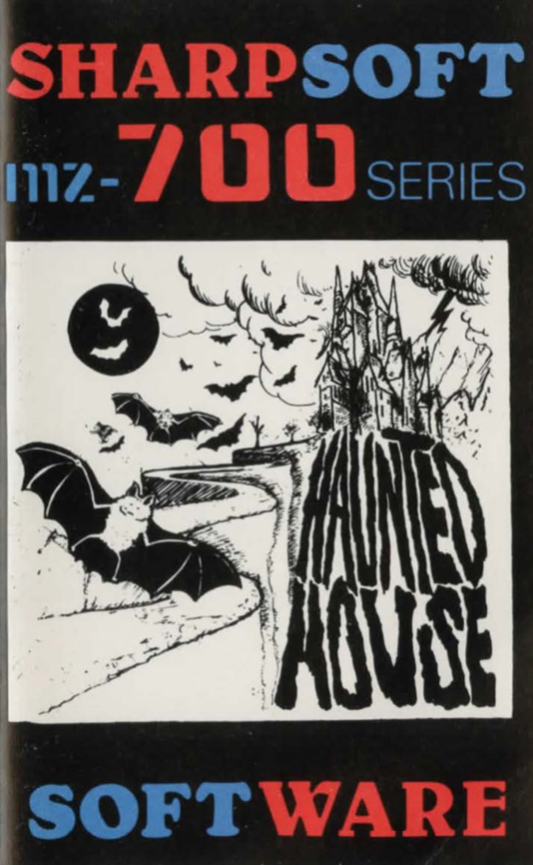
Today we re-visit the Sharp series of computers, and specifically the Sharp MZ-80K, the original built from a kit. Haunted House is the third game we’ve had from Sharpsoft. We’ve already tried out Colditz (1981) and Secret Kingdom (1982). The author of the latter, G. Clark, is listed as a co-author for this game, along with A.J. Josey. However, it is faintly possible (for reasons I’ll get into) that one or both authors also worked on Colditz.
(I realize they’re not technically pseudonyms, but I still always feel like an author is mysterious when they use their initials. If nothing else, it makes it impossible for me to search if they’re on Facebook or LinkedIn or whatnot and still making things.)
From the Museum of Computer Adventure Games.
I don’t have an additional history to throw at you here that wasn’t already in my last two posts, except I found a review that points out “all the Sharpsoft games” are £5.85 and this was considered expensive. We’re getting the deluxe experience, everyone!
The start of the game includes some music, so I’ve made a video to let you get your Beethoven on:
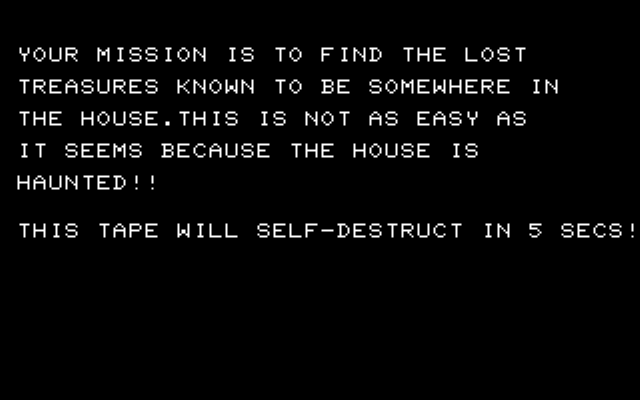
It does not set up this “introductory adventure” as spooky to me, but whatever works.
I know there’s 100 points but not what those mean. “Extensive vocabulary”, heh.
I’m not sure what the objective is yet. Normally with this ambiguity I would automatically say “take the treasure to the right place” but haunted house games do often have an “escape” or “kill vampire” theme so I’ll hold on that until I’ve had confirmation.
There are only four starting rooms, in a two by two square. At the start, to the northeast, is the room shown above with the warning. The rock seems to be unmovable and unclimbable.
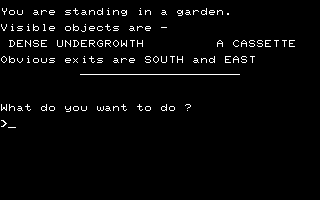
To the northwest is some undergrowth concealing a cassette (you can find it with LOOK UNDERGROWTH, looking at the cassette reveals it is a standard C12).
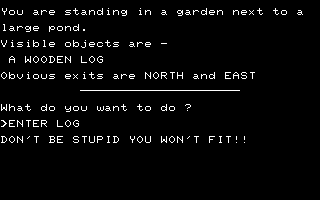
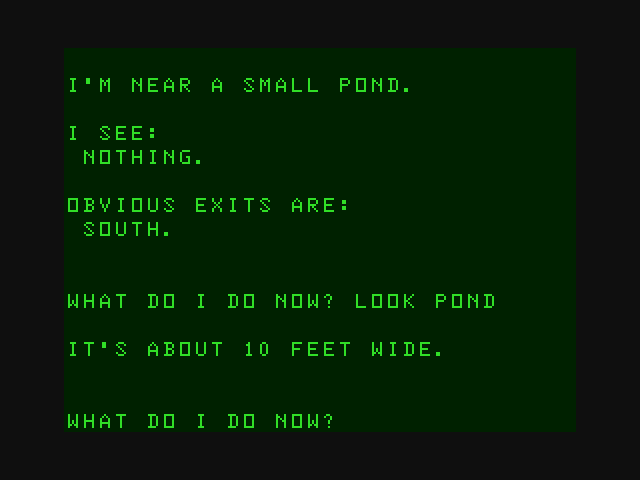
To the southwest is a pond with a log. The log is described as hollow and the pond is described as having shallow parts.
The last room, to the southeast, has a GARGOYLE which is also a GRIFFIN, somehow.
You’ll notice there seems to be no way in the house. The HELP command at the house indicates you should UNLOCK DOOR, and the game does seem to indicate a door is present if you try to unlock it (“YOU DON’T HAVE THE KEY TO THE DOOR!”) and there is otherwise no way to see the door is there. (You can look at the house, but the game just says it looks haunted and you shouldn’t go there.)
Now I suppose I should mention the relation with Colditz —
The parser is dodgy, much dodgier than in Secret Kingdom. I could see a writing progression going Colditz – this game – …. – Secret Kingdom with improvement between games.
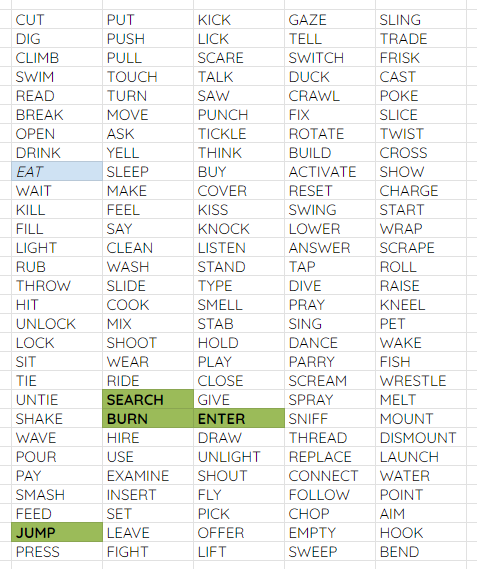
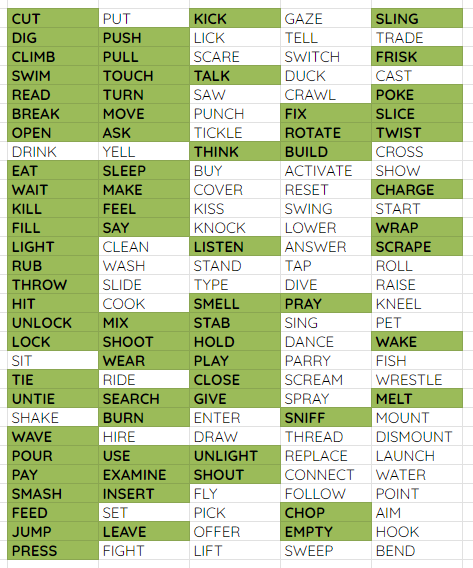
To illustrate, here is my verb hunting list:
That’s almost too tiny to do anything, and I think JUMP has an auto-reject message as “A FRIENDLY SPIRIT STOPS YOU.” EAT doesn’t really eat, it just goes EAST; that is, only the first two letters are being used to parse EAst. WE, NO, and SO also all work, suggesting this is a two-letter parser overall, but then if you take that non-visible door and try to UN DO (rather than the full UNLOCK DOOR) the game says
I DON’T KNOW WHAT YOU MEAN BY ‘UN DO’
The phrase “UNLOCK DOOR” is hard-coded in so that you have to be standing in that exact spot for it to work, and you have to type the full phrase.
All the parser reject messages follow that same form (I DON’T KNOW WHAT YOU MEAN) so you can’t puzzle any extra things out other that what is on the list. Despite the pond and log seemingly both hiding something, I haven’t been able to get help from either. I even used my entire verb list specifically on the LOG just to be sure.
Come to think of it, this is in some ways worse than the Colditz parser — even though that was a one-letter parser at least it became clear early on what worked to communicate, and the game tried to hand out explicit command combos. Here, it’s like the parser is pretending to be one that understand things but falls incredibly short even though the game clearly requires some “normal” parser commands to make any progress. At least I don’t have to type LOOK DETAILS rather than LOOK to examine the room.
I’m going to keep taking my best swing at this a little while longer, but this seems a candidate for assuming that puzzling out directly from the source code will be part of the game.
ADD: If someone wants to play and doesn’t want to deal with emulator wrangling, I dropped a copy in the comments where you just need to start the mz80k executable, then load the save state.
Ken Rose’s Adventures in Adventuring column has featured in this blog once before, where I wrote about the first three installments, including Journey to Planet Pincus. The column was printed in the bi-monthly magazine Softline (essentially an extension of the Sierra brand, at least when it started) and was meant to teach people how to program their very own adventures in BASIC.
Today I’m going to take down the remaining issues of 1982.
Just like the previous three installments, there’s a prefatory article explaining the thing being taught; unlike the previous three, the source code has no commentary with REM statements. My guess is as the games started getting longer it became harder to justify the print space. The September article even discusses the increasing length:
You’ll probably notice that as these programs become more sophisticated, they become longer. Most of the length is taken up not by the logic of the program but by the descriptive words needed to flesh out the story. In fact, in most commercial adventure games, the program takes up very little of the disk. The bulk of the disk is filled with the wordy descriptions used to make the game interesting.
The articles still explain what’s going on section by section. I’m hence treating these as “teaching exercises” rather than full-fledged attempts at games; each games tries to emphasize one particular aspects of adventures as opposed to being complete experiences.
I did manage to avoid having to type in any of the type-ins. Werewolf and Minotaur I found on this disk at the Internet Archive. It was uploaded from “crates” via the Rhode Island Apple Group, and this particular disk comes from the Big Red Computer Club (a public domain distributor similar to Brunswick Publications). However, I couldn’t find any Apple disks that had the Diamond game.
What saved me is the Atari. All the programs from the Adventures in Adventuring series were converted to Atari and then sold on disk. You can find the files in a thread here.
Brian Hall, credited on the disk, chimed in: “Seeing pictures of the floppies really warms my heart! This was one of my first paid projects during high school.” When asked how he got attached the product, he responded: “I think I had approached them with the idea, and they agreed. I *think* that came as a result of having been mailing them high scores (when mailing in a high score was a thing!)”
However, there’s a catch! Disk 2, the one shown above, is corrupted. I used the Atari Explore disk utility and was able to rescue Diamond and Minotaur; Diamond is the file that I didn’t have in Apple form. I have a hacked version of the disk here (with the menu for disk 1 — pick option 2, Please Pass the Zork, which will actually play Diamond).
So the upshot is I’m playing July on Apple II, September on Atari, and November back on Apple II. All three only give credit to Ken Rose (and given Michael Rose — who after some Internet scrounging I am 98% sure is Ken’s younger brother — was pretty explicitly mentioned in Jan. and May, I’m not going to assume he’s not involved here, but it is faintly possible).
The Werewolf Howls at Dawn
The easiest way to control time is to set up a counter that keeps track each time a move is made. These moves can be called hours, or minutes, or stardates, and they can be incremented every time another move is made. This is the technique illustrated in this month’s program.
This is essentially a 5-minute game. The idea is you’ve been bitten by a werewolf and have a limited number of turns to get some wolfsbane which will cure your condition, so the game is showing off how a “timer” works in a game.
The room descriptions, at least, are colorfully done. There are regular messages indicating your slow transformation into wolf-form.
Tight limit, but very short game.
Curiously, the parser has regressed: it’s the type where you type in a verb, and then if it applies, you type in a noun. This game is so simple the author apparently wanted to isolate just the time-changing aspect.
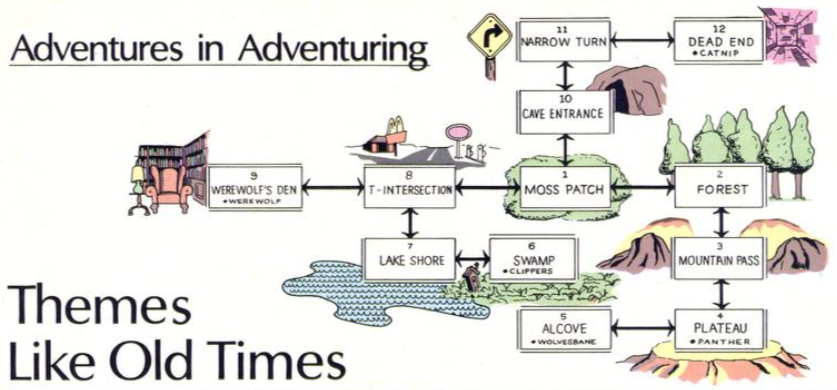
This is just a bit west of the starting location, rather than right where you start, even though the narrative essentially picks up with you bonking the werewolf on the head.
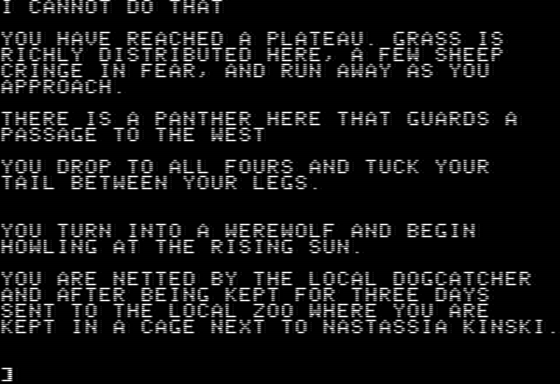
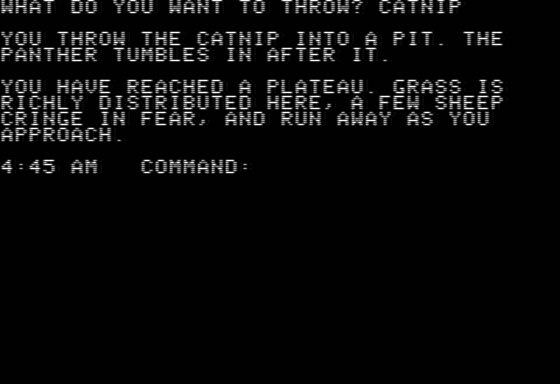
You just need to grab some CATNIP from the cave and some PLANT CLIPPERS from a swamp. Then you need to pass by a panther, with THROW CATNIP.
Remember you type THROW and CATNIP separately.
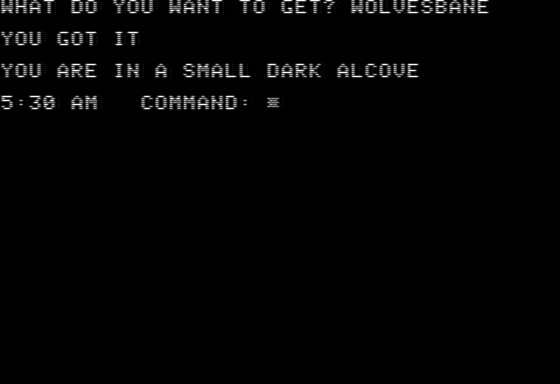
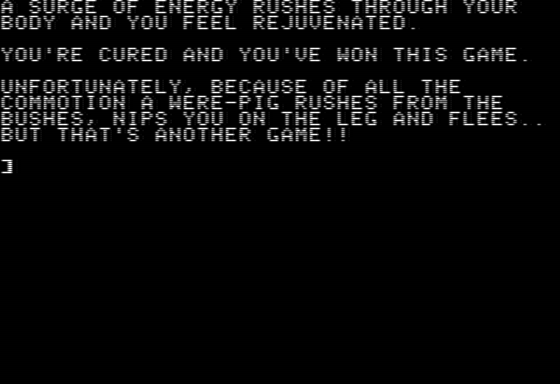
Past the panther is an alcove with the medicine you need. The clippers need to be used to CUT first, then you EAT.
This game isn’t that surprising in context; if all I was doing was demonstrating a global timer, I’d also want the game to be short in order to quickly show off how it works (and how it’s not just a simple “move” increment but actually using a clock). The only part I’d do differently is make sure that typing in something wrong (like a bad direction) would not increment the time, and discuss the idea of how meta-moves and mistakes shouldn’t count, because something as simple as a typo can then kill the player.
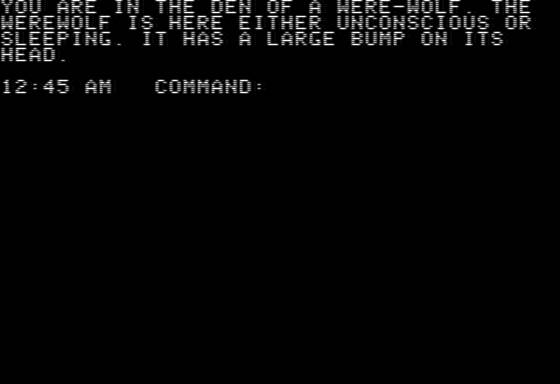
That’s a funny-looking werewolf den.
The main issue is that not everyone would encounter this game in context! It was, as I mentioned, on a public domain disk, and made it to an unofficial DOS port. I imagine some people popped it open expecting something a little more substantial, when something substantial might have actually interfered with the demonstration.
The Case of the Pig-Headed Diamond
The September article is titled The Thing’s the Thing and is “about” objects. Again the game is quite small.
This month we’ll deal with the handling of objects in an adventure program — how to pick things up, use things, and drop them. Our adventure has a mystery theme, in that we will be trying to recover a stolen diamond of little value.
The game has switched back now to a two-word parser. I’ve been wondering if all these games were really written in sequence for the articles or if there was a certain amount of scrounging from the archives, so to speak. Again, the map is quite simple:
The room descriptions have been nuked for functionality. (And less room in the magazine.)
There are no room exits so mapping is slightly slower than the previous game (which was good enough to mention every possible exit in descriptions). The overall effect is for the game to feel even more like a demo than Werewolf.
You first need to grab a shovel, and then use that shovel to dig out a ladder from a garage. Why the garage has a dirt floor is left unclear.
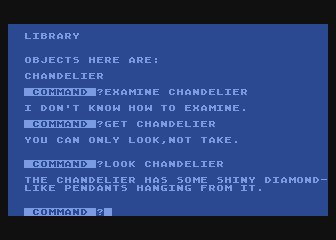
Then take the ladder inside to find a chandelier.
You can use the ladder to help grab the diamonds.
CLIMB LADDER
YOU HAVE OBTAINED SOME DIAMOND—LIKE PENDANTS HANGING ON THE CHANDELIER. YOU CLIMB DOWN THE LADDER.
…and then the Atari BASIC broke down and kept insisting on “TWO WORDS PLEASE” over and over after making the heist. Oh well. I think I’ve seen enough here.
There’s a pig in the bathroom for some reason. Also, you can grab ice cubes rather than diamonds.
ADD: Matt W. in the comments points out the actual goal: bring the ice cubes back (the chandelier is a fake-out) as well as some matches. If you drop the matches first at the bank, then drop the ice, you’ll get a “win”.
4020 IF OB(3) = 1 THEN PRINT : PRINT “THE MATCHES FLARE UP AND MELT THE ICECUBES AND OUT FALLS A CHEAP INDUSTRIAL GRADE DIAMOND. NOT MUCH, BUT ENOUGH TO WIN.”: PRINT : GOTO 4100
I would much prefer to teach good game design at the same time as teaching the programming, but I suppose the author felt it was appropriate here to noodle around with fake-outs, especially given the number that appear in the next game.
The “adventure” part is so barren I can understand why this game was left off the Apple II disk. It really is just a demonstration.
The Labyrinth of the Minotaur
For the November article, Ken Rose feels obliged to teach us about mazes. Could we skip teaching the masses that one, please?
Ever since Adventure, it has been almost a requirement that an adventure game contain a maze. Perhaps the neatest among the current ones is the maze in Zork I, because of its complexity and the necessity of exploring it thoroughly.
I assure you it is not “almost a requirement”, especially given the author’s own Palace in Thunderland did not have a maze! To be fair I think the percentage of adventures with mazes has been roughly 80%, not counting “confusing geography” as a maze, and some of that no-maze percentage comes from multi-title authors like Scott Adams and Peter Kirsch who shook off the need to have a maze in all their games.
I can say of all the games, it is the only one that felt “substantial”; it took about an hour to map out.
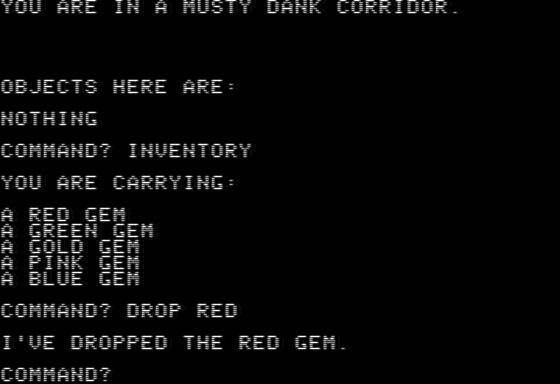
The game gives only five gems to map 20 rooms. You can do the “relay” method to an extent (take the red gem you used in the room 1 and transfer it to room 6) but that only works if some of the exits don’t warp you back a significant way, and you might notice a room two away from the exit room goes nearly back to the start.
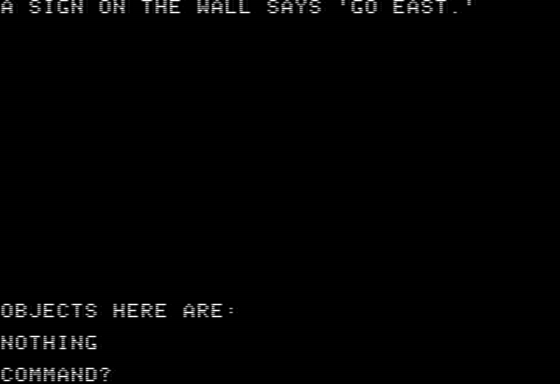
In addition to that annoyance, the game includes death rooms next to signs.
Worse than a death, this is a softlock. You have to test out N/S/E/W to realize they all loop after here and your game is over.
Another sign tells you “Don’t go west” and the exits of east, south, and west all kill you. (That is, both following the sign and following its opposite by going east are both deaths.)
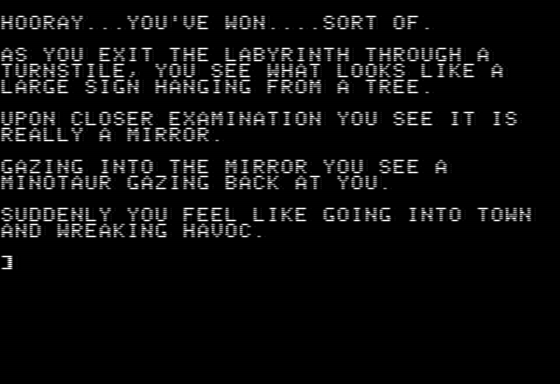
You’ll finally hit a sign that says ABSOLUTELY DON’T GO NORTH and that’s when you finally do want to go north, escape, and reach the twist ending.
I’m not sure why being cooked by the minotaur earlier made sense, then.
The maze is a “cheap” way to extend game time. It forces the player to slow down and map and requires almost no design thinking on part of the author. And I guess people were still having … fun with it? At least I appreciated the moments of cruelty mixing things up, even if I only muscled through by using save states on my emulator.
Postnote
The author indicates the development so far has been systematic…
Those of you who have been following this series of articles can probably see how we have been using various routines to build up from very primitive programs to some level of sophistication. If you entered the game late and are feeling a bit bemused by all this, pick up earlier issues of Softline and you’ll be able to see why these things work as they do.
…and I’m not quite so sure, given it isn’t using the exact same structure every time. For example, in Minotaur the maze data is all saved together as one data file, and only uses N/S/E/W:
10010 DATA 2,7,1,1,1,7,3,2,3,8,3,3,3,4,5,4,5,5,5,5,21,
16,16,16,1,1,7,7,4,8,8,9,4,9,10,8,5,15,15,15,7,16,11,11,
17,7,12,12,8,13,13,12,9,19,14,14,15,15,14,15,11,16,16,
6,12,17,17,11,13,18,18,18,18,20,20,20,20,20,20,20
while Diamond splits things up, and includes UP/DOWN directions.
10020 DATA 3,1,0,0,0,0, “LONG SHADY ROAD”
10030 DATA 5,2,0,0,0,0, “BOTTOM OF HILL”
10040 DATA 0,0,5,0,0,0, “DUSTY GARAGE”
10050 DATA 8,2,6,4,0,0, “OPEN FRONT DOOR”
10060 DATA 0,0,0,5,0,0, “OVERGROWN GARDEN”
Any of the source code could be helpful for a budding adventure writer, just if I was building the series I would have tried to build up the source code so later months always duplicated prior months precisely. We saw something approaching this systematic approach with Basement and Beasties. At least the line numbers essentially match in terms of section organization. For example, moving around in Minotaur starts at 1410:
1410 IF VIS = “NORTH” THEN R = N(R)
1420 IF VIS = “SOUTH” THEN R = S(R)
1430 IF VIS = “EAST” THEN R = E(R)
1440 IF VIS = “WEST” THEN R = W(R)
and it does as well in Diamond, just the logic has sightly different structure:
1410 R1 = R
1420 IF VIS = “NORTH” AND N(R) > 0 THEN R = N(R)
1430 IF VIS = “SOUTH” AND S(R) > 0 THEN R = S(R)
1440 IF V1$ = “EAST” AND E(R) > 0 THEN R = E(R)
1450 IF V1$ = “WEST” AND W(R) > 0 THEN R = W(R)
1460 IF V1$ = “UP” AND U(R) > 0 THEN R = U(R)
1470 IF VIS = “DOWN” AND D(R) > 0 THEN R = D(R
I can’t claim this is arbitrary as teaching material, then, although I’m most curious where things eventually lead, as there are three more months to go in 1983. Will there be a “culmination” adventure including all the previous learnings, or will the series just fade out?
I had the nagging feeling there was some frustrating, brand-new way of hiding stuff I had to muscle through, and then I could make it to the end of the game. I was essentially correct.
Close-up from the Digital Fantasia “blue” variant box. Via the Museum of Computer Adventure Games.
Bach to the maze!
And specifically, something where I was looking at what I wrote and re-considered my position. Here, I’ll go meta:
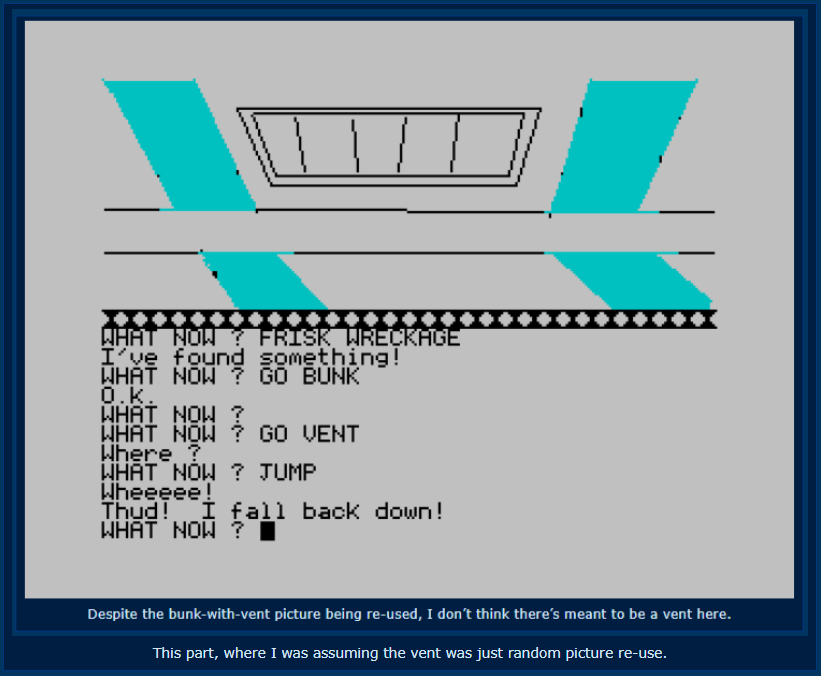
This part, where I was assuming the vent was just random picture re-use.
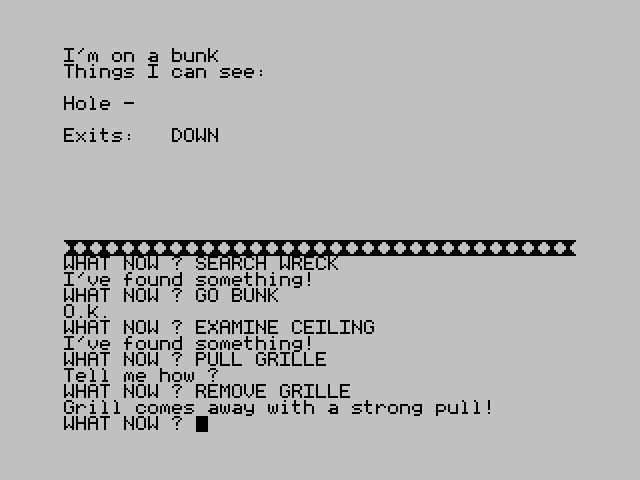
Given finding the bunk in the first place required searching some wreckage (and it is the only place where SEARCH works in the game), I thought it highly improbable there was nothing here, but I concluded after failing enough times it was a situation where I needed to come back later (maybe pushing a different button elsewhere opens a secret). Not an unreasonble conclusion, but the vent picture in particular kept nagging at me, so I kept trying a whole slew of things, like LOOK UP (on my regular checklist, but it didn’t work here) and, for what I believe is a first for this blog, EXAMINE CEILING.
Colossally frustrating. I have trouble believing I could — in the real circumstances — be searching so thoroughly and never come across a grille that’s right there. At least I got saved by the ZX Spectrum picture; the TRS-80 and BBC Micro version have no such help. (Dave Dobson needed a walkthrough here and somehow that didn’t bother him, but I’ll get back to that.)
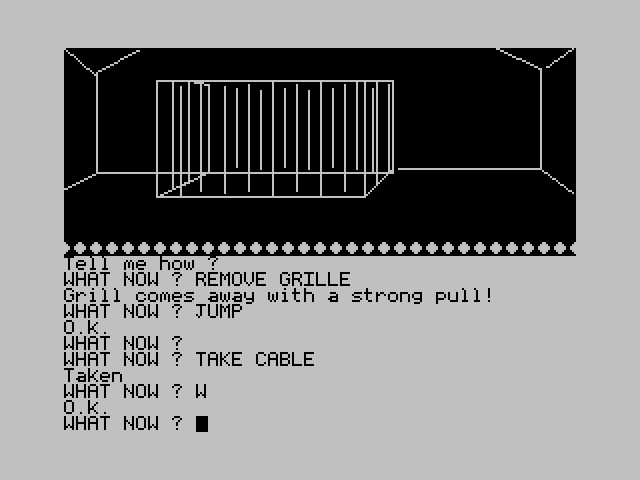
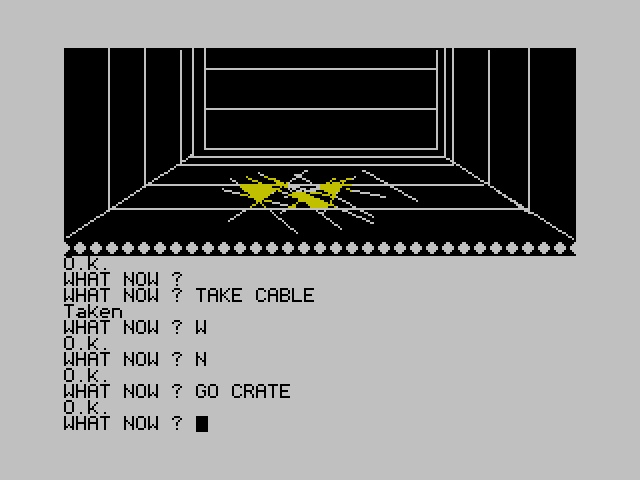
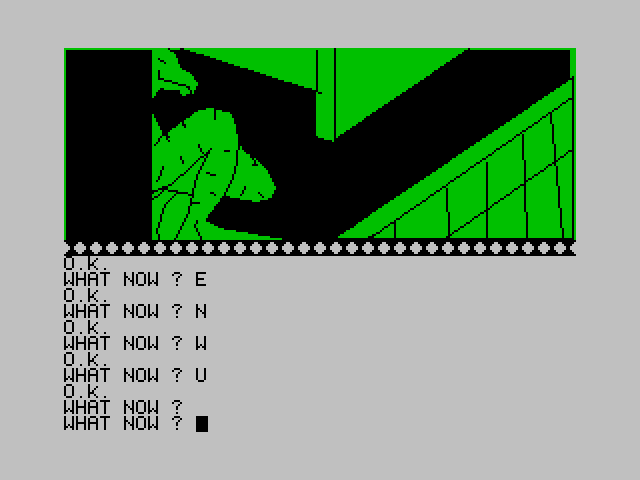
It’s also unclear from the description (and attempts to enter) that you need to JUMP to enter, you can’t just GO in.
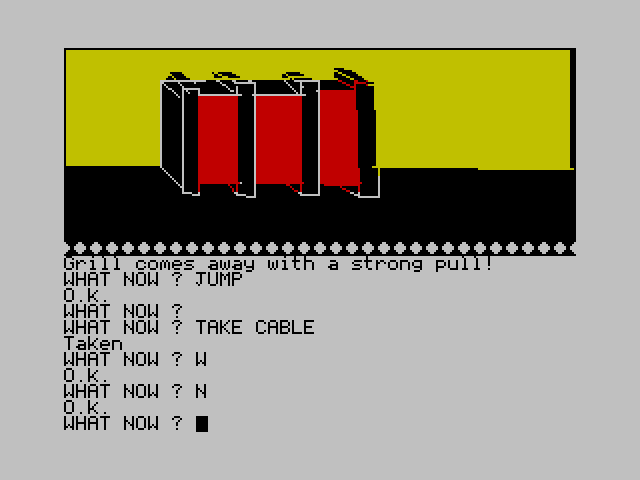
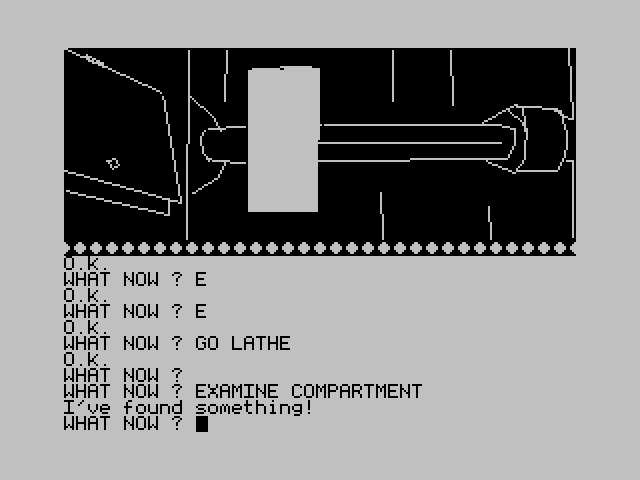
Just above is an area with a cable. I immediately guessed that went back to the lathe, but I wanted to explore a little further before testing that.
Don’t go in the cage; you’ll get locked up and die of hunger. While unmentioned, you probably have the satisfaction of the creature dying of hunger first.
The storage crate here has a square block. Remembering that the oven needed something ROUND in a hole, and that the cable probably goes to the lathe … I immediately knew what to do next, except for the eternal “struggle with the parser” bit.
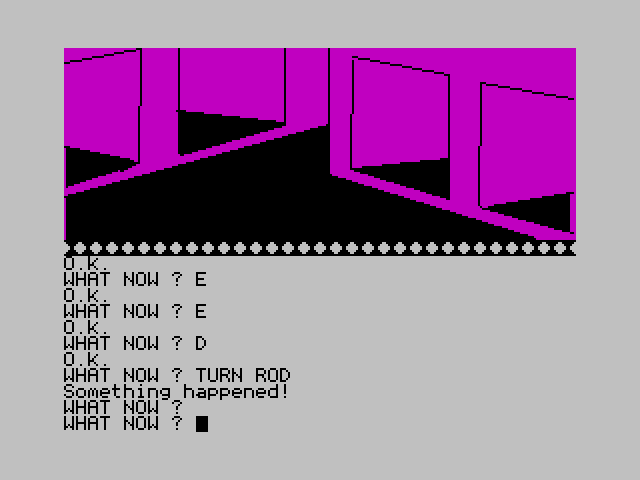
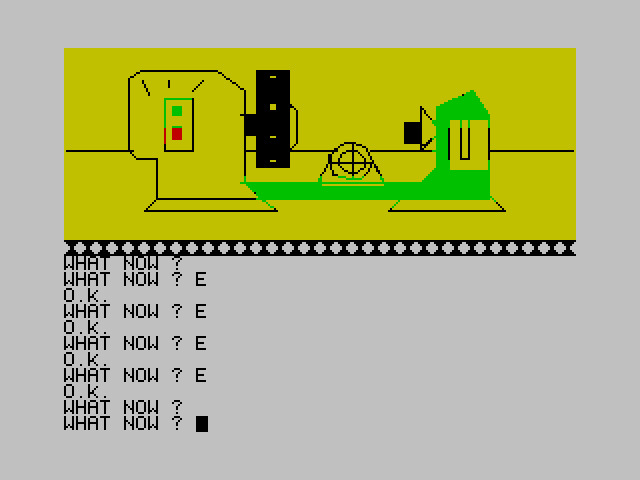
Specifically, you need to FIX LATHE while you have the cable (not PLUG CABLE, or INSERT CABLE, or ATTACH CABLE … you’re not really fixing it in the classical sense, are you? …).
Something happened!
Lathe works
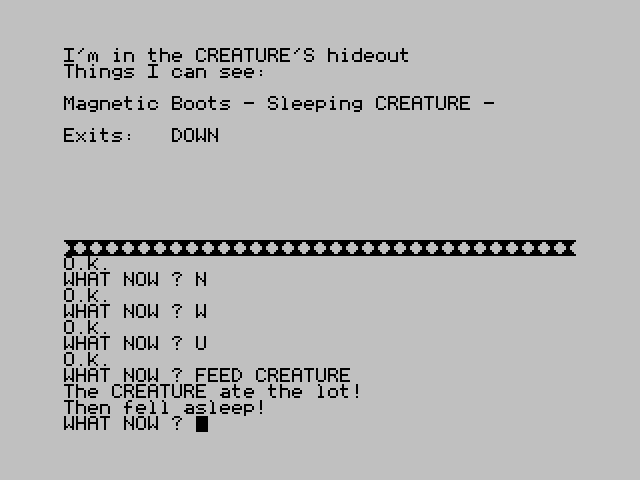
Then you can TURN CUBE (??) in order to insert the cube in the machine and transform it into a ROUND BLOCK. With this in hand you can go back to the oven and FIX OVEN (not INSERT ROUND BLOCK, of course). With the mix I mentioned last time (including the tablets) you can make a poisoned fruit cake made especially for the creature.
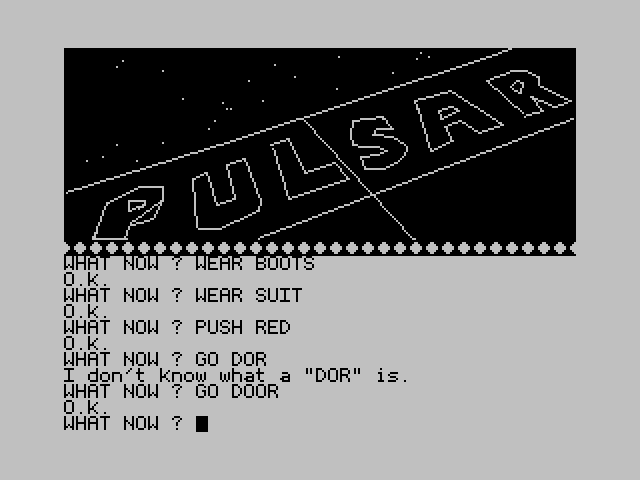
I then took the magnetic boots, and the space suit from the locker, suited up, went over to the airlock with the orange button, and–
I’m blasted into deep Space!
I’M DEAD!
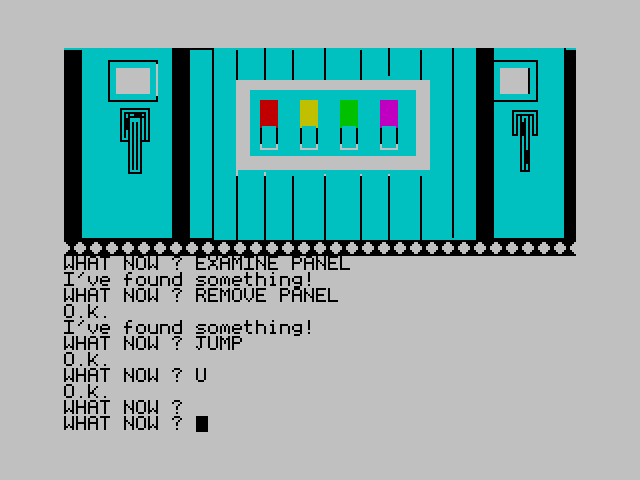
Well. That wasn’t supposed to happen. Fortunately, I already had a bead on an alternate exit, because I went around trying EXAMINE CEILING on all the bunks and found the Captain’s Bunk (which already held the tablets) also held another secret.
I admit I was annoyed at the game enough at this point that I just checked a walkthrough. I was missing the fact at the lathe you could GO LATHE. Urf.
Because I had already been noodling with the MAKE command off the verb list, I came across MAKE SCREWDRIVER without too much trouble, which is apparently enough to allow REMOVE PANEL back at the Captain’s Bunk. You do not refer to the clips that hold the panel down despite them clearly being part of the issue. It seems like for every basic action, the game insists I try phrasing it four different ways before it’ll work.
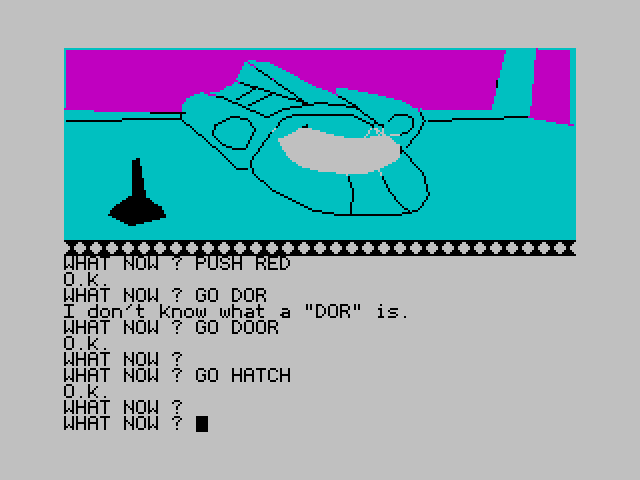
The rest is straightforward: you walk into an airlock, out the ship to a shuttle, and escape. (Putting on those boots and suit in the middle there, and pressing the white button at the Bridge from a while back was needed to let the airlock open.)
Look. Object Hunt: the Game can be fun; I already noted that Jigsaw essentially uses it as its premise (but also with a prevent-change-in-the-timeline plot and delicious prose). The gameplay here was essentially overwhelmed with me having to check if there were any more obscure ways to EXAMINE a thing I was missing, cojoined with an epic parser struggle. There was a creature to worry about, I guess? But it just peacefully hung out waiting for you to bring some poison, and was only a threat if you decided to take a nap. (There’s technically a time limit too — after enough turns the natural daylight cycle of the ship turns off and you need to leave the rod on, and your rod can run out of energy. I never came close to this being a problem.) The overall plot effect was the most un-heroic disaster escape ever made.
Both nimusi and Exemptus at the CASA Solution Archive had similar disappointment to myself over the game. Exemptus additionally points out the larder (the room) works as a container that you can pick up and carry around with you.
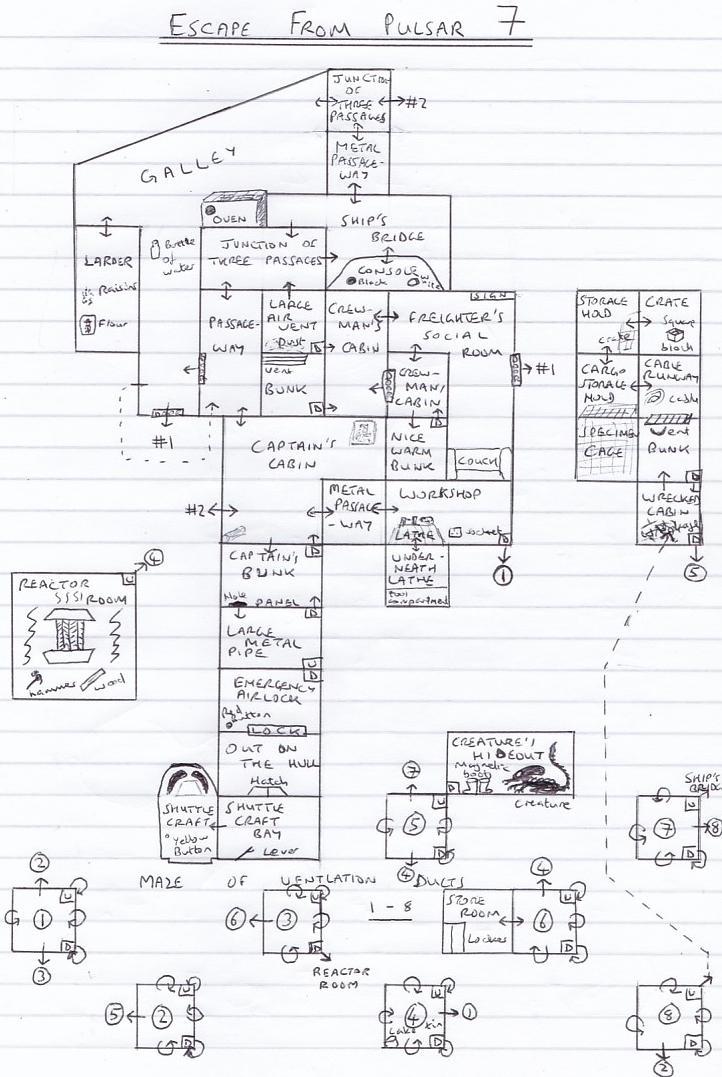
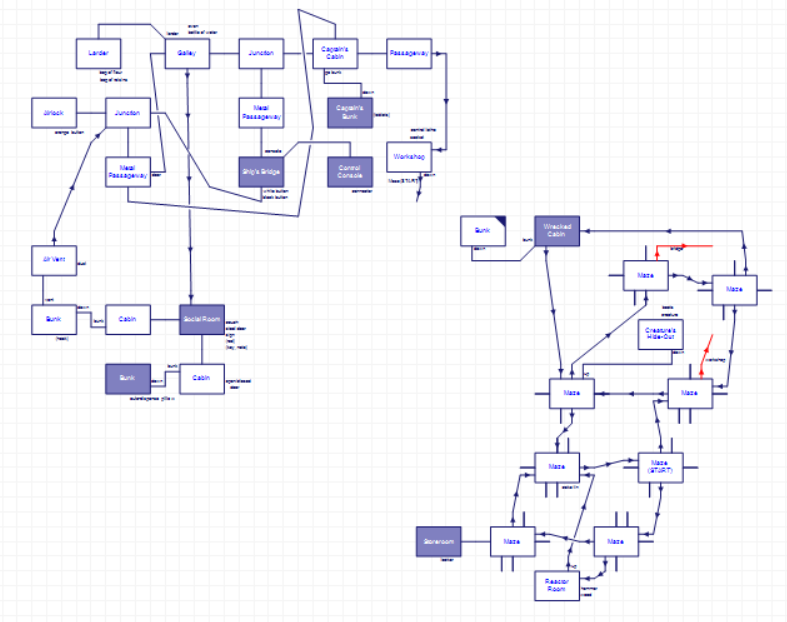
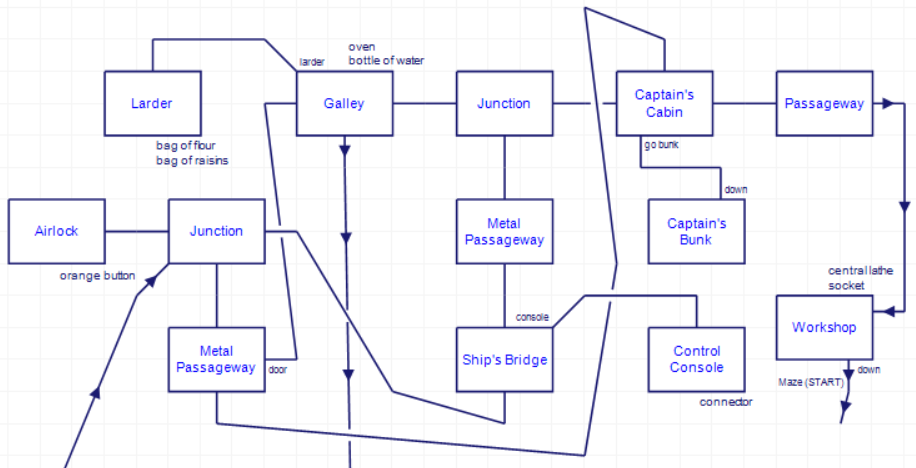
Map of the whole game, via Sudders from the CASA Solution Archive.
Escape from Pulsar 7 was an entertaining challenge — not too arbitrary, and tough for (mostly) the right reasons. Maybe I’m just personally biased toward the science fiction side of things, but I had a lot more fun on the Pulsar 7 than in Howarth’s fantasy worlds.
I totally agree that this was better than the Arrow of Death games. Needed some of your tips there!
It’s easy to brush over such disparity with “it’s just subjective” and move on, but given how often my opinion has matched Mr. Dobson’s, it’s worth some thought about what’s going on. I don’t think it’s just because of being sci-fi. Studying his post, he had to use the walkthrough on three crucial parts:
I had to reference a walkthrough to learn that SMASH LOCKER (once the hammer has been found) is the way to access its contents.
There are two points where we have to EXAMINE CEILING from a bunk to find somewhere new to go — I missed this entirely and needed a walkthrough nudge, as the first ceiling entrance I found was clearly visible.
I spent quite a bit of time in the Pulsar 7’s airlock trying to figure out how to keep myself from getting blasted into space. Even when I was wearing the space suit and magnetic boots, the result was always the same. A much-appreciated walkthrough informed me that there’s a secondary, well-hidden emergency airlock.
For the second moment in particular, not only did I not need to check a walkthrough, I found it enraging when I solved it. Is this a possibility where using a walkthrough makes a puzzle more palatable? I certainly have encountered games before where people have given thumbs-up but I long suspected that the thumbs-up is conditional on not lingering too long trying to figure things out. Perhaps Dobson was being more casual here about when to check hints and moved on as soon as the experience started to be trying.
Still, though, better than Arrow of Death Part II? That game featured a clever unfolding structure which overlapped, and had reasonable enough puzzles I made it all the way with no hints at all.
For the record, my current ranking is something like
Pulsar < Golden Baton < Arrow Part I < Time Machine < Arrow Part II
but maybe (as my final theory) some people are more immune to guess-the-verb troubles.
How could this location not make someone mad though?
I was getting tripped up by how you look at things in the game. When a text adventure author wants to hide things in the items of a game that gets revealed, they have a few options:
a.) Just have one consistent command, like LOOK, for everything.
b.) Have examining and searching be considered separate actions.
c.) Add in LOOK UNDER or LOOK BEHIND.
d.) Require some specific “movement” command like MOVE or PUSH.
In addition to all the above, a game might have a “second order” style looking, where a description of an object has something inside it that can be looked at (as we saw with El Diablero and the thread).
Now, none of the above necessarily are “good” or “bad” design on the face of it, but they need to be implemented in such a way that the game is careful about feedback. Jigsaw (1995, Graham Nelson) has finding hidden objects as a mechanic, and introduces this early with a rolling stool.
Vestry
The vestry once held surplices. Today, it holds a surplus. Debris, broken furniture, blown-in leaves, panes of dusty glass and mildewed cloth, all unwanted.
There’s even an old Victorian piano stool, but no sign of a piano.
>examine stool
An old wheeled piano stool, wide and tall, with a hinged and padded seat.
>search stool
You can’t see inside, since it is closed.
That makes the bit after not-so-frustrating:
>look under stool
There’s a charcoal pencil underneath the stool.
>move stool
It rolls a little.
>look
Vestry
The vestry once held surplices. Today, it holds a surplus. Debris, broken furniture, blown-in leaves, panes of dusty glass and mildewed cloth, all unwanted.
There’s even an old Victorian piano stool, but no sign of a piano.
On the floor, underneath where the stool used to be, is a pencil.
You can incidentally just move the stool; either way, the game is training you that LOOK UNDER works different than EXAMINE or SEARCH. At the very least, there are no conflicting messages, where a player thinks they did a thing, but did not actually do a thing.
Now, back to Pulsar 7, and first off, something I had on my map last time and neglected to mention.
This is a “wrecked cabin” that is inside the maze. The only thing you can see is “Wreckage” and EXAMINE WRECKAGE responds
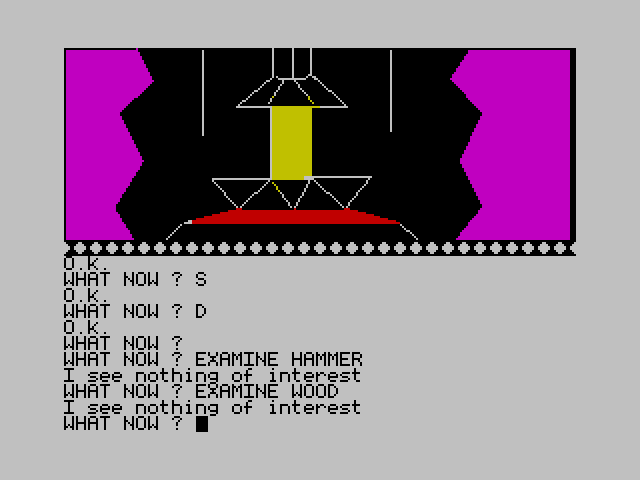
I see nothing of interest
If you instead SEARCH, or, weirdly, FRISK the wreckage:
I’ve found something!
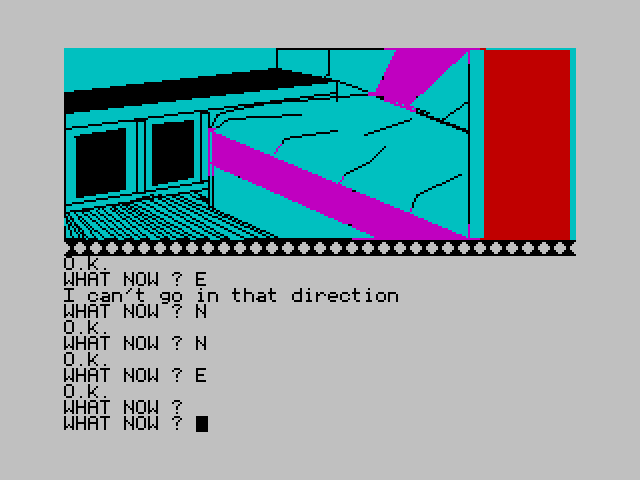
This reveals a bunk. The bunk appears to have nothing.
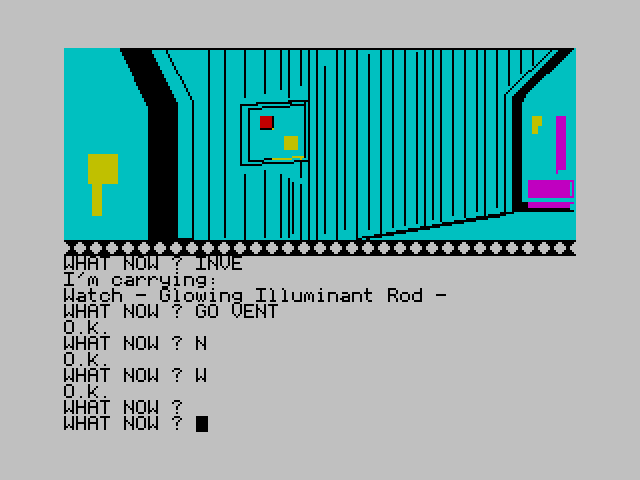
Despite the bunk-with-vent picture being re-used, I don’t think there’s meant to be a vent here.
I even tested EXAMINE BUNK and SEARCH BUNK, keeping in mind Arrow of Death Part I had a moment where you could search the name of the room you were in (even though it wasn’t technically an object). I still found nothing (and later in the game, where I tested every verb on my list for reasons you’ll see in a second, I still found nothing).
This would normally be a discouraging dead-end, but thinking about the situation later, I realized I hadn’t done the same test in other bunks. Normally, EXAMINE NAMEOFROOM gets a “missing noun” error, but it at least lets you examine the bunk. I remembered it being weird that the captain’s room had nothing in it…
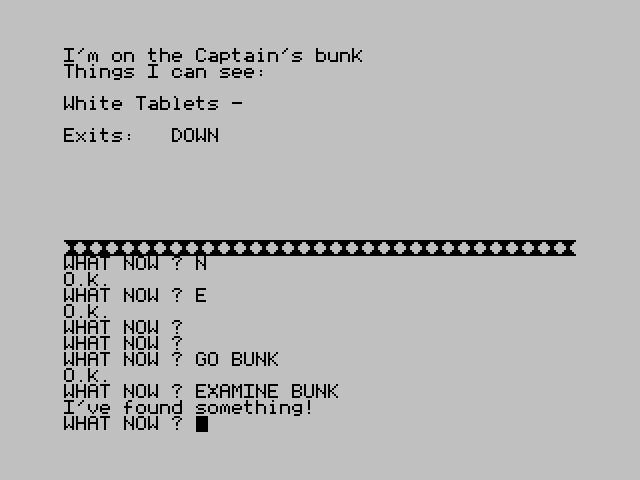
…so doing GO BUNK and then EXAMINE BUNK, I hit paydirt:
These are sleeping pills (which you can verify by trying to eat them, you fall asleep and get eaten by the creature). If you’re holding them with the other cake ingredients when you MIX CAKE, the tablets disappear from your inventory too, so I’m guessing they made it in.
I realized while I had looked at everything in the game, I hadn’t done both EXAMINE and SEARCH. It turns out SEARCH is (maybe) only useful at the wreckage, whereas EXAMINE works on more things. I had mentally been mislead by “I see nothing of interest” since I had (essentially unconsciously) interpreted the act of searching to be equivalent to examining, even though I was well aware authors have a tendency to separate them.
So my progress after came in pinpricks, finding out things I could examine and gathering more stuff:
Marking where I found things, or was able to make progress since last time.
Back where I was able to MOVE COUCH at the start, finding a rod underneath, I tried EXAMINE. (Which, again, I thought I had already done, but apparently I just used SEARCH.) This found me a small key (no idea where it goes) and a note.
Says:
…as the only surviving member of the PULSAR 7 crew…
That is, it is a note you wrote! This doesn’t seem to be amnesia as much as the protagonist has more knowledge than you do (which has been a odd running theme the whole time — surely the protagonist knows the layout of the ship).
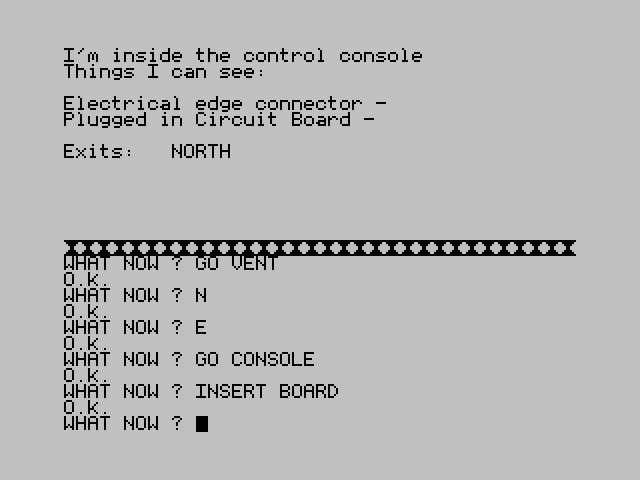
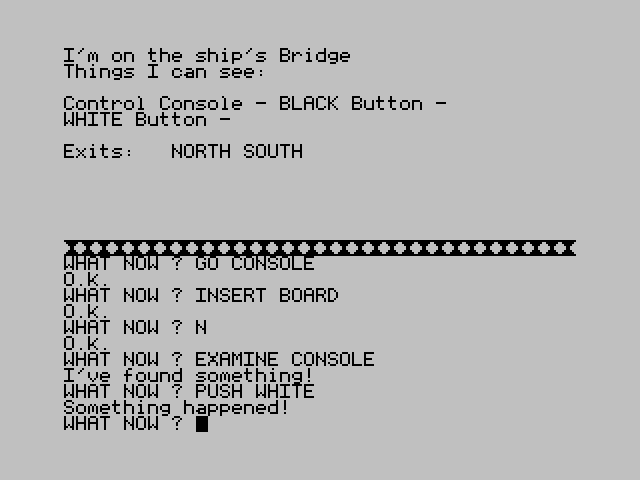
Newly inspired, I finally found at the PILLOW DISPENSER I could MOVE PILLOW and find a circuit board. Using the circuit board, I then went over to the bridge and the “Console Control” and was able to INSERT BOARD.
Outside at the console, I tried EXAMINE CONSOLE and found a white and a black button. The black button does nothing, the white button says “something happened” but I have been unable to figure out what that things is. I assume it comes up later.
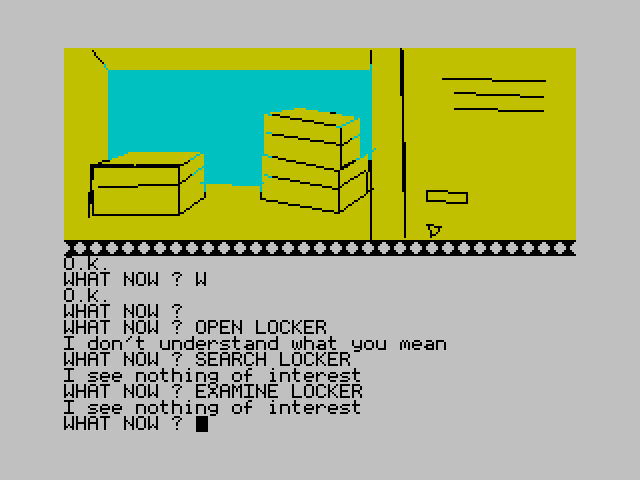
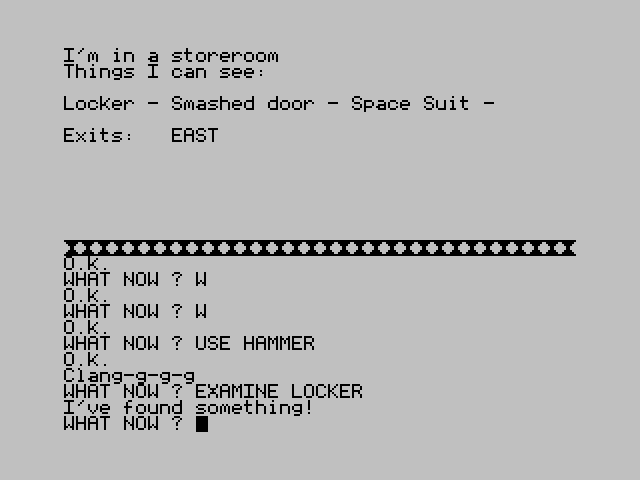
Not part of the examine-fest was finally being able to open the locker.
I was trying to direct actions against the locker (and had tried every single one on my list) with no luck; I needed to be directing my verb on the tool I was using. USE HAMMER breaks open the locker, and then EXAMINE LOCKER reveals it has as spacesuit.
Which I can’t use yet, because I need the magnetic boots the creature is guarding still. Hmmf.
To give my current issues:
a.) I still can’t use the oven even with the pill-poisoned cake mix. I noticed FIX OVEN seems to give a coherent response, just I don’t have the right item for it, and EXAMINE OVEN notes a round hole. My guess is I use the lathe to make something that goes in.
b.) Except I can’t get the lathe working either. I assume the socket is a power plug so I need a cord to connect the two. Is it just hiding out there? Do I need to start frisking everything too in case that’s considered a separate verb sometimes?
c.) I still have a key I don’t know the use for, and I don’t know what pressing the white button did.
d.) Surely there’s something at the wreckage with the bunk? I tried every verb I could both in the “bunk room” and standing next to it.
I’m hoping I’m just missing one item that will chain-reaction the rest of this thing. I will take a hint if anyone knows one of the examine-spots is ridiculous somehow.
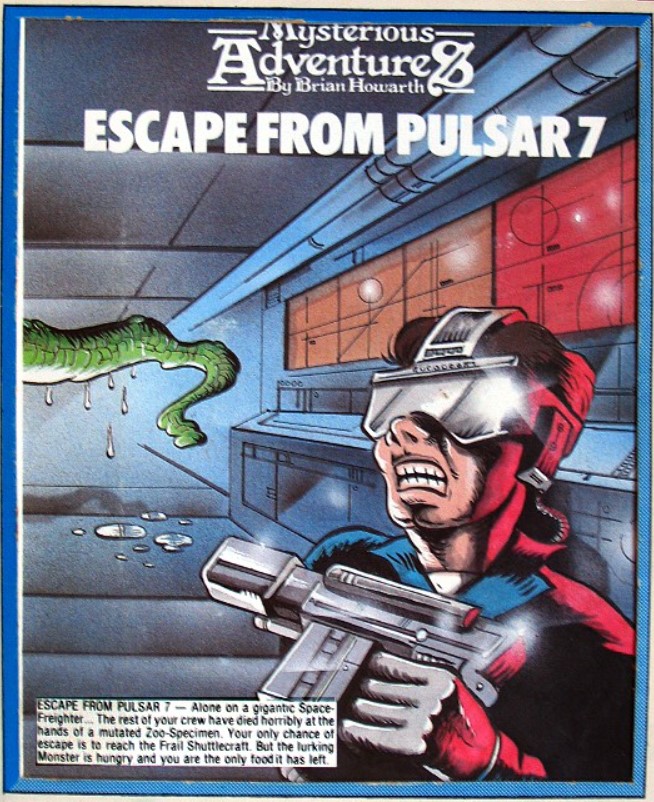
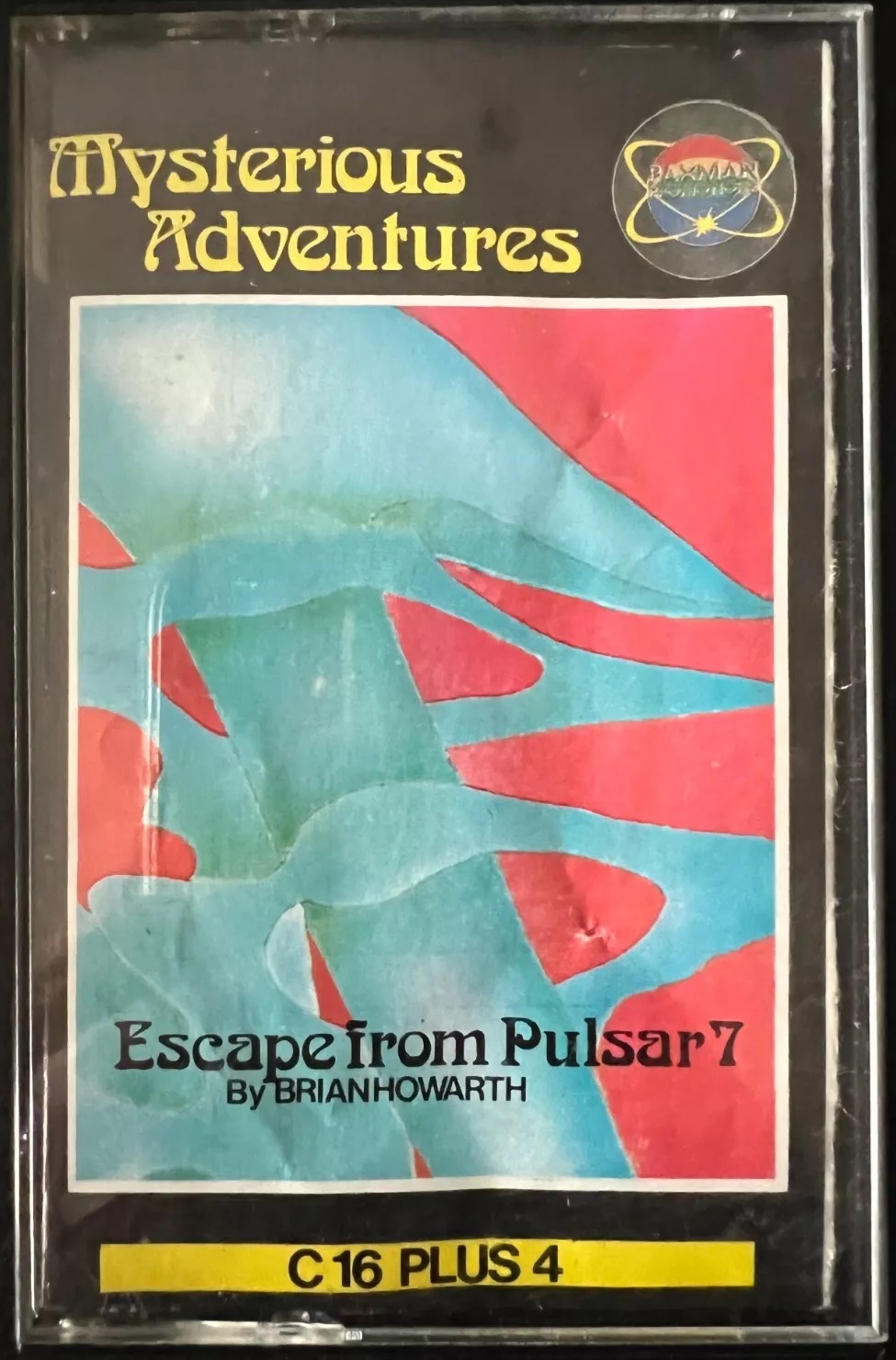
We are back in the house of Brian Howarth, whose Mysterious Adventures series started with Golden Baton, followed by The Time Machine, Arrow of Death Part I, and Arrow of Death Part II.
Howarth still had a friendly relationship with Molimerx who kept publishing his games in TRS-80 format (Dale Dobson used that version in his playthrough) but he also had his own spinoff company Digital Fantasia in order to make BBC Micro and (eventually) ZX Spectrum ports.
The new element here is that Mr. Howarth had a collaborator: Wherner Barnes. According to an interview with Brian in Retro Gamer, Wherner was
a dude who was around the same age as me who I knew from a group of my drinking buddies that went fell-walking in the Lake District and the Yorkshire Dales
and … that’s all we have. This is despite the collaboration happening for 3 of the Mysterious Adventures games (that is, about 25% of the series). I don’t know how the division of labor went — was this a situation where Howarth was just editing what someone else wrote, or was this more of a 50-50 split, or what exactly?
From the Molimerx version of the manual.
Well, at least we can get into detail about the game itself! The premise is that we are part of the crew of the space freighter Pulsar 7, with a mission to obtain and deliver the ore Redennium to planetoids in the Xanotar system. An alien creature was given as part of the payment from one of the planets.
The creature, normally peaceful, had managed once to escape from its cage and roll around in some Redennium. Unfortunately, this led to disasterous effects in the days ahead, as the creature grew at an alarming rate and started to kill and eat crew members.
Everyone is now dead except for you and the still-hungry creature. Your goal is to reach the freighter’s shuttlecraft and escape.
We’re back to the curious ZX Spectrum graphics system (I have an explanation here of how it works) which is why there’s “color bleed” from the blue onto the black.
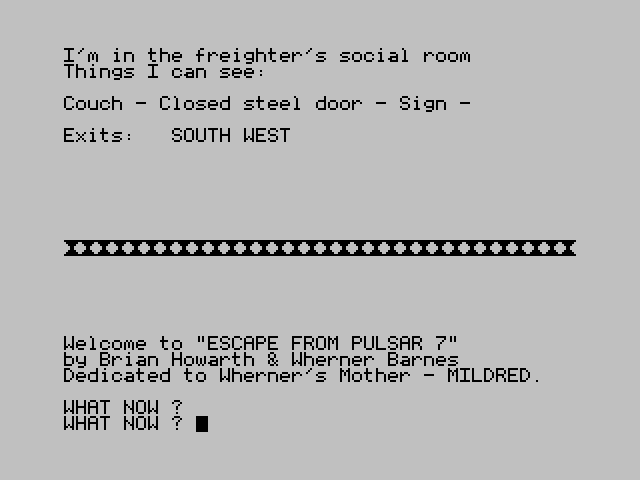
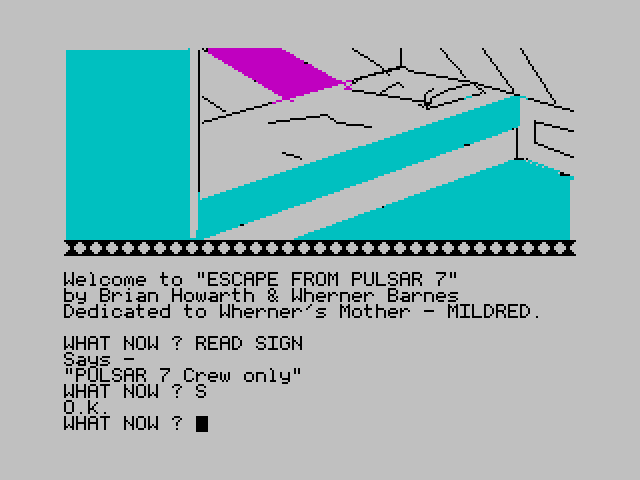
We’re also back to how the graphics system is oriented with the text system, which is you need to hit ENTER to switch from the picture and back. Enough information is given on the text portion you really need to be looking at that most of the time. Hence gameplay involves playing the game like a normal Scott Adams joint, except every time you enter a new room, you’re supposed to peek at the room’s picture (a process with a very small draw speed at authentic speeds) and flip back again afterwards.
When you see blanks after WHAT NOT? on my screenshots, that’s just me switching modes back and forth.
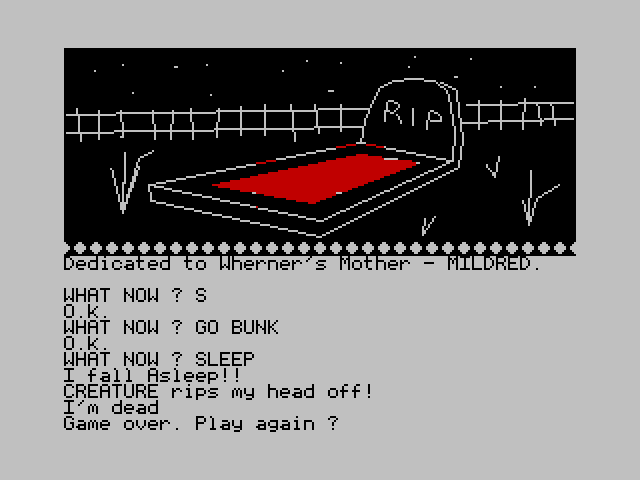
You start at a crew social area next to two rooms with bunks. If you want to speedrun Death%, go into one of the bunks rooms, GO BUNK, and then SLEEP. Fun!
Ready for submission at the next Games Done Quick. This also is not quite the fastest — you can just SLEEP anywhere, including the spot you start at, to get the same result.
With the bunk to the south, there’s a door you can close; by closing the door, the game says “Something happened!” and the bunk has a “auto-dispense pillow” but I haven’t found anyway way of taking it or manipulating it. Perhaps this is meant to tempt you into the SLEEP death above.
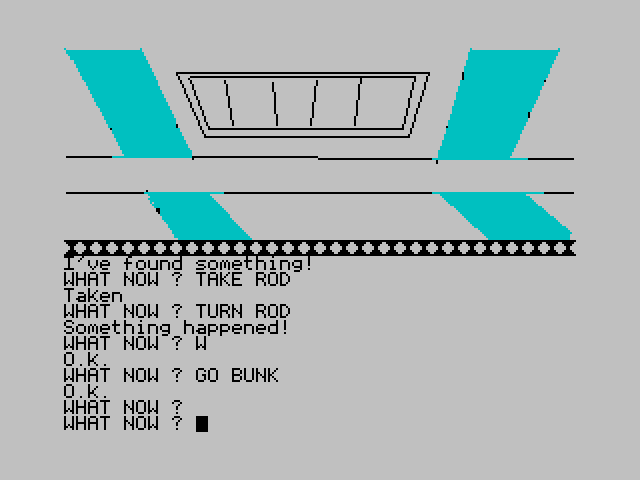
Back in the social room, you can MOVE COUCH…
I’ve found something!
…which reveals a “Dull Illuminant Rod”. You can then TURN, TWIST, or ROTATE the rod and it will light up. You can turn it off again the same way (unclear yet if the creature utilizes light in any way, but I could see needing to turn it off for stealth reasons).
To the west is a bunk with a different setup: there’s a vent visible.
You can GO VENT and then sometimes — sometimes! — die by the air blasting and blowing dust into your lungs. As far as I can tell this is entirely random. (I tried LISTEN and SMELL, both understood by the parser, just in case there was some indication the vent was running and was unsafe.)
Past the vent is the main part of the ship. You’ll notice it is a bit twisty and while I could see a ship being a touch labyrinthine I can’t make topological sense of what’s going on here.
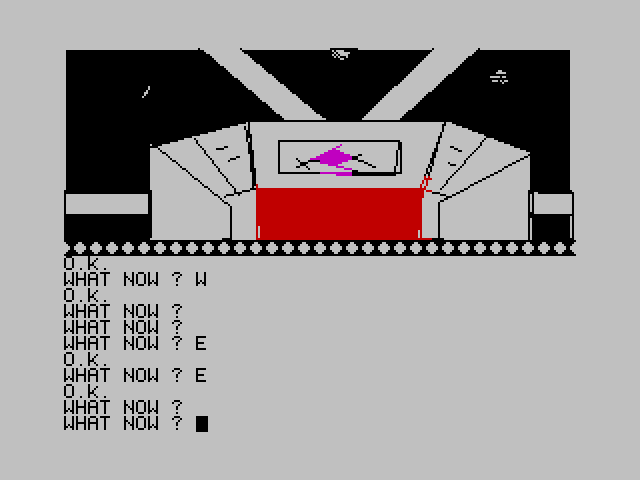
To the west is an airlock where you can push a button and it blasts you into space. I get the impression this is the route we need to take to find a shuttle, just we need a little bit of safety first.
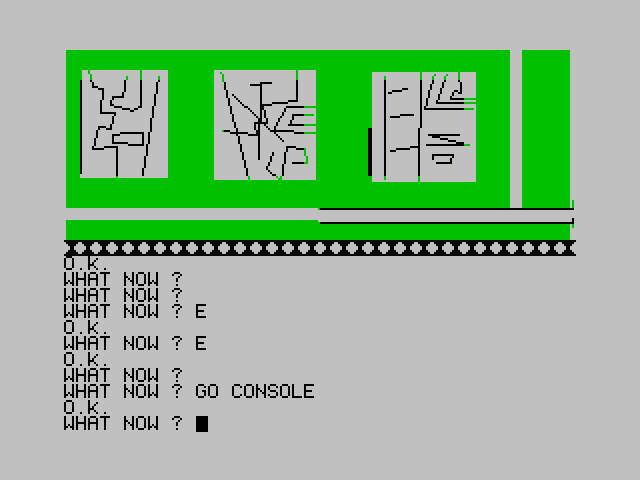
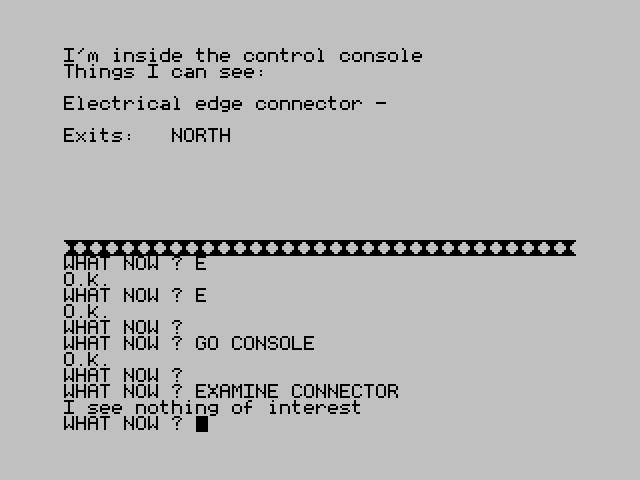
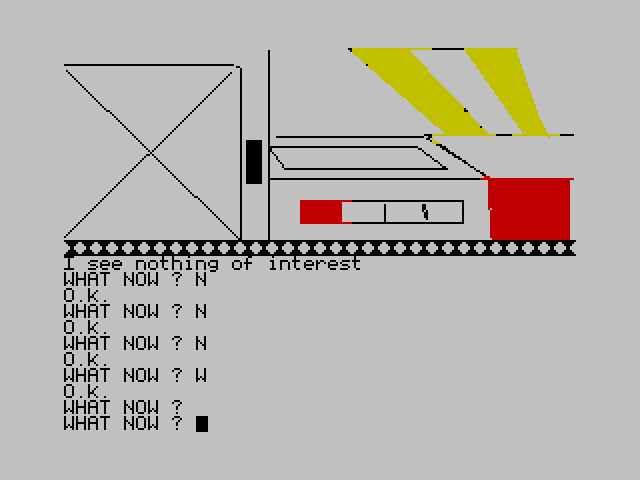
The “Ship’s Bridge” has an console with a Electrical Edge Connector (not mobile). I don’t know what to do with it.
The “Galley” connected to a “Larder” has a bottle of water, a bag of flour, and a bag of raisins.
I found a cake tin later and was able, after fussing over the parser enough, to make a CAKE MIX. (POUR the water in the tin first, then MIX while holding everything.) Unfortunately, I haven’t been able to actually do the final deed of cooking the cake. I even enlisted my verb list to help.
It seems like a lot of coverage! But given the cake, and a bit later where there’s a locker that can’t be opened, this isn’t the greatest of parsers — “knowing” a word in the vocabulary database isn’t the same as having a good response to using it, or at least a response that makes clear why the action isn’t working. There’s a “closed steel door” at the start of the game (which you arrive at the other side of after using the vent); “OPEN DOOR” says “Sorry” and you have to just imagine what’s going on, since the room is enterable from the other side (and then you’re trapped in again).
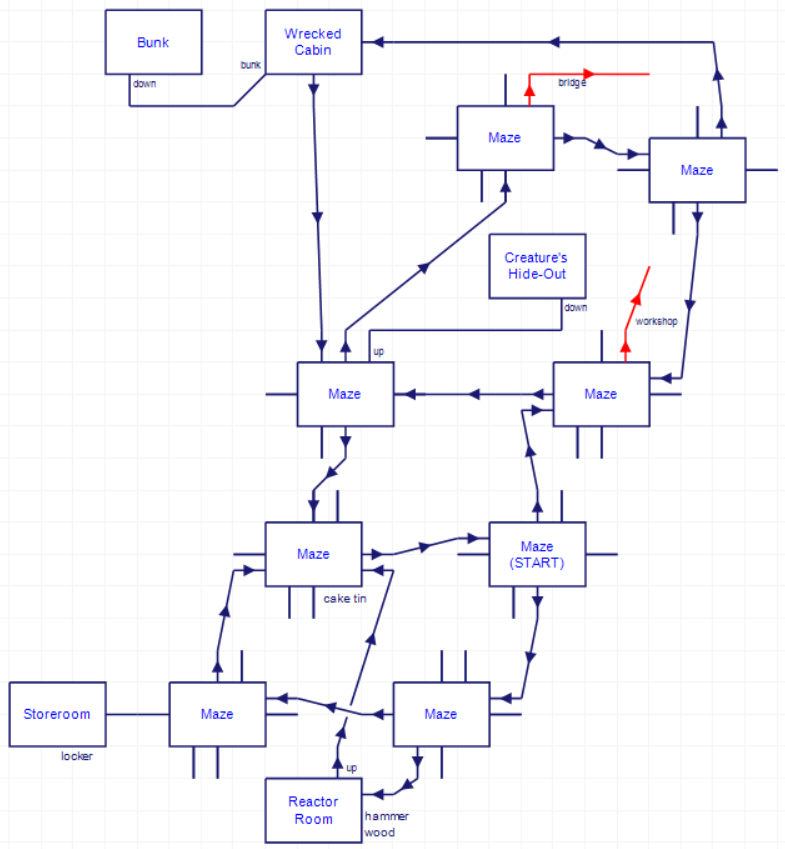
Other than the places I’ve mentioned, there’s also a “workshop” which you can only enter in one-way. It has a lathe (which the game says needs repair) and a socket (which I have not been able to manipulate or get a description of).
Going down from the workshop leads to a maze. The maze has a lot of “loop back to the room you’re in” exits, so when mapping them out I used a line stub to indicate the loop for a cleaner image. Additionally, “up” is on the northeast side and “down” is on the southeast side of each room.
Other than the cake tin I already mentioned, you can get to a reactor and find a hammer and peice of wood. (Yes, spelled that way.) I haven’t found a use for either yet.
The “creature’s hide out” is where you can finally encounter the beast while awake.
If you duck out right away you’re safe; spend any time and you die.
CREATURE rips my head off!
My best bet is I need to finish baking the cake by fighting the parser boss, and somehow that will be sufficient to distract the creature long enough to get the boots. After that?… maybe we’ll be led along a chase. There’s multiple places where you can go into a “bunk” which feel like they’d be used for hiding; there’s also one extra steel door that can be left open or closed leading from the “metal passageway” to the “galley” on the main map. It is possible this will be a “preparation puzzle” where we have to yoink the boots first, then do a series of puzzles to make it safely to the airlock for escape. This means while I haven’t been impressed with the game as of yet, things could pick up.
One last thing: the locker in the maze. Can’t go in, can’t lock or unlock either. I am truly baffled.
This issue of Time called Castaneda the godfather of New Age. The best article I’ve read on his legacy (and his “cult” of “witches” that cut themselves off from their families) is this one from 2007.
First, let me go over two chunks of contents from before the cave that I had missed. Neither is necessary for the win.
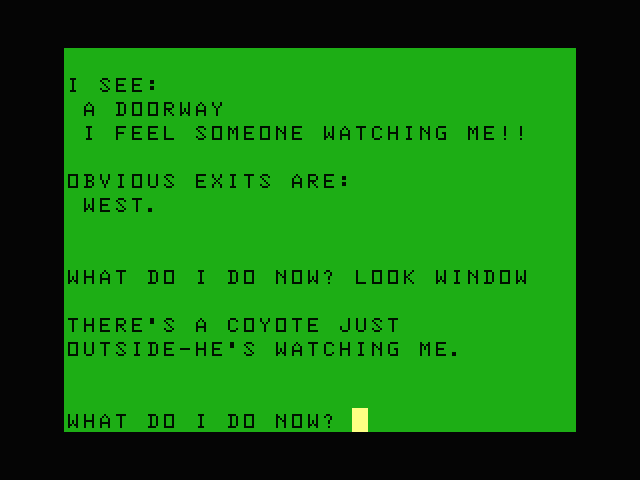
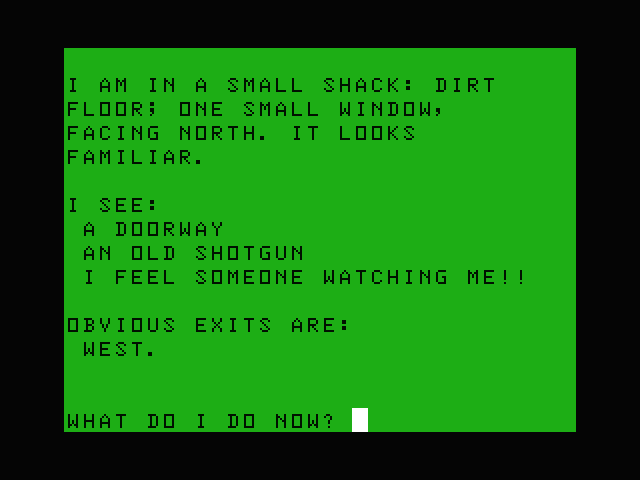
The first moment is right here, at the shack. I had never worked out what being watched meant, and I could swear I tried LOOK WINDOW here. Maybe I misspelled it WIDOW and didn’t notice and moved on.
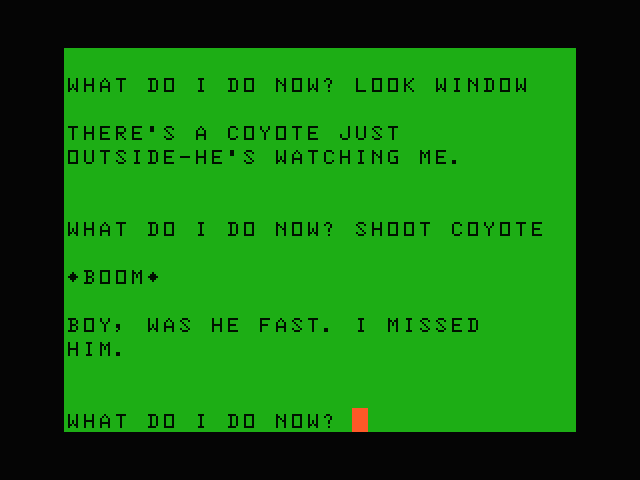
You can shoot the shotgun (which I also had never used) at the coyote.
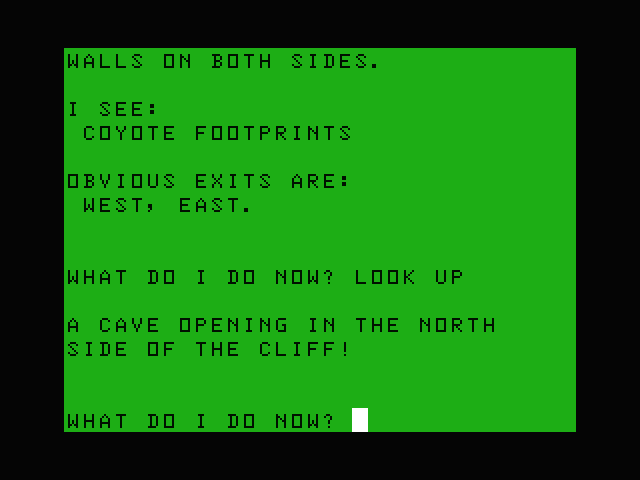
You can then go outside to find footprints, and later, if you go in the canyon, you can see more footprints and LOOK UP to see a cave.
This is how you’re supposed to know about the cave without guessing based on geography.
The other scene I missed involves the place with the machete.
There’s a hole you can climb in and up and it seems to be the bottom of a well (that is, the well seen in the desert) but I had warped out without thinking of it much. If you wrap around on the map there’s a wall you can PUSH, breaking open a passageway, and that allows light to come in so you can see some inscriptions in the southeast corner.
Then if you go down to the bottom of the well and SAY UP you get warped to the top. This is entirely unnecessary, and I had to check a walkthrough because it wasn’t working (it turns out I was trying it while I had already crawled partway up, but you need to use the word at the bottom). However, the inscriptions that explain dreaming aren’t readable until you have the mask, so I understand the author’s sequencing as some players wouldn’t be able to dream-warp yet (and I respect the fact he left open the possibility of an alternate solution).
My winning game did neither of these scenes so I can confirm they are not strictly necessary. One last thing before returning to the action: after entering the cave and before riding the beast, I missed an important room. This is back where I found the bell:
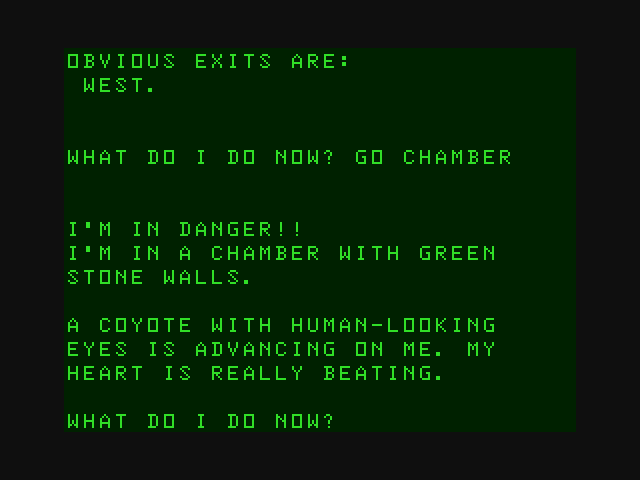
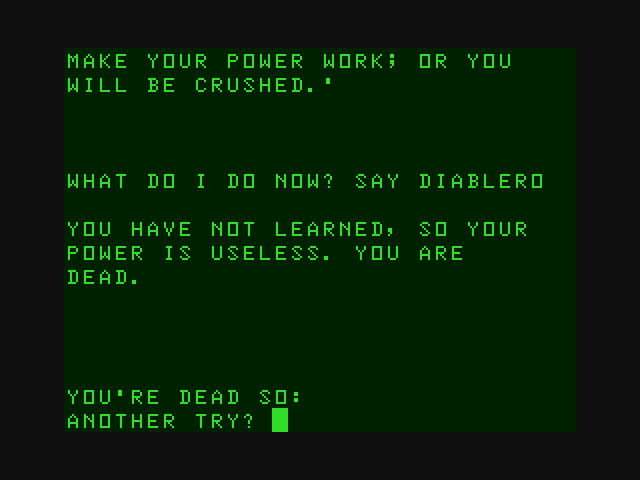
You can GO CHAMBER (somehow, probably because of the sound, I parsed the room as geographically close to the noises but not having a literal door, even given the word “inside”). There you can have a confrontation with the coyote. You’re not ready yet — the twig needs to be dipped in the oil of cactus blossoms, as told us by the lizard. So let’s save that:
Back to where I left off, I had been swimming in a pond and made it to a “block” which referenced a mysterious yellow bull. I was stuck, but I should have been paying more attention to one of the messages while in the water. For the initial dive, if you try to keep using SWIM DOWN to go farther, you get the message
CAN’T GO.
but if you do this at the third lake with the ruins, going down at the “bottom” instead says
I CAN’T SEEM TO GET ANY DEEPER.
These being different messages should have been a red alert: there is a way to go deeper. You need to be holding something heavy.
You need to be holding the granite block.
This lets you go to a fourth pond, leading to a tall pillar by another chasm. You can PUSH PILLAR to knock over the pillar and walk over it.
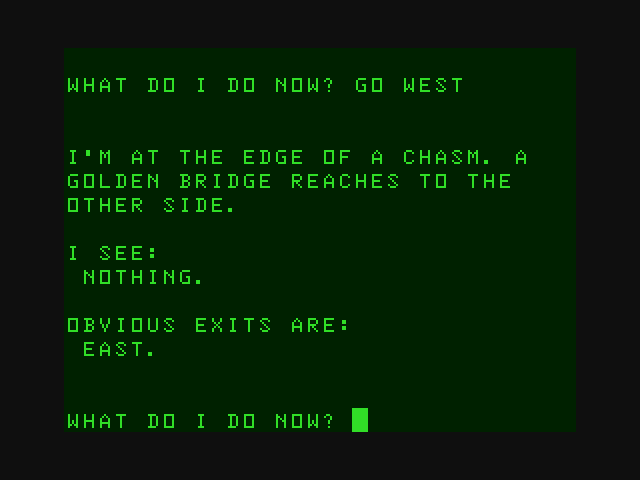
The path eventually leads to the north side of the same chasm we started at.
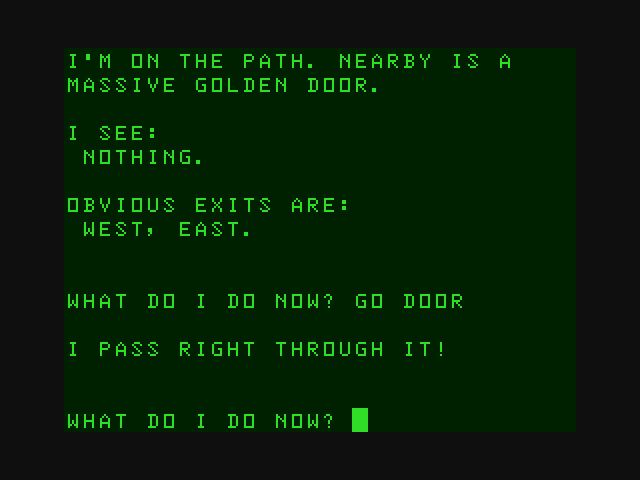
The north side of the chasm, importantly, includes a golden door. Try to open the door, and it proves to be an illusion. You can just walk through.
Lizard buddy! I tried the SAY REVEAL code from before and was told
LISTEN WELL, FOR ONCE YOU BREAK THE YELLOW BULL, THAT WHICH WAS UNREAL BECOMES REAL.
To the west are some clay colored statues of bulls. None of them look yellow normally, but fortunately I had been obsessively trying GAZE on everything in the game, and finally it paid off.
Don’t take and break the figurine right away! As the lizard warns you, unreal things will become real, so the golden door that previously you could just walked through now seals shut.
Yes, this is a softlock, although the player was pretty amply forewarned; I had to set this up on purpose to get the screenshot.
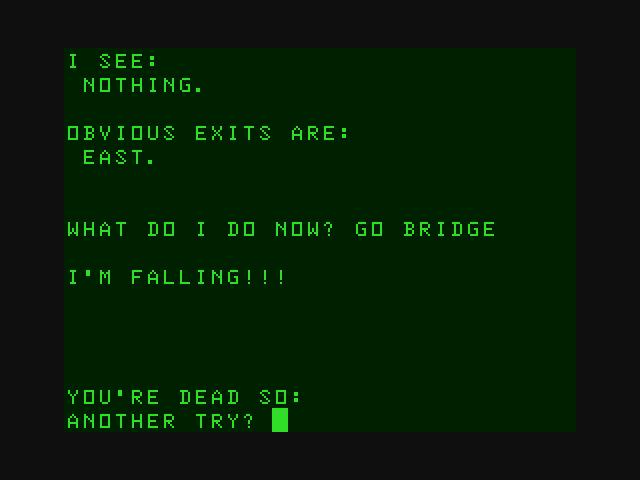
However, this also means the golden bridge and golden statue become real as well! So you can walk across the golden bridge now without falling in, and the golden statue lets you touch it, and more dramatically, push it so it falls into the chasm.
I did something goofy in retrospect here and went through the chasm section again trying to figure out where the golden statue landed, but the smell is coming from the spot the statue was, not where it went. I was just supposed to look, as the room now had a DEPRESSION.
Twig powered up! So now it was time for a confrontation with the coyote, and the game’s final trick. This is yet another moment of participatory plot, where the player themselves needs to figure out what’s going on to get the final revelation.
Pause a moment to breathe, and formulate what you think the answer is.
From World of Dragon.
If the coyote wanted us to lose, why would he tell us what we needed to do to use the magic?
Yes, our teacher was El Diablero the whole time, in some cases putting us in a significant amount of danger. This is not absurd for the Castaneda-verse.
In Castaneda’s fourth book, Tales of Power, he essentially finishes his initial “sorcerer’s journey”. He is ready at the end to take his final test with don Juan and don Genaro, and is taken to the edge of a cliff, where he must jump.
Don Juan and don Genaro stepped back and seemed to merge with the darkness. Pablito held my forearm and we said good-by to each other. Then a strange urge, a force, made me run with him to the northern edge of the mesa. I felt his arm holding me as we jumped and then I was alone.
This works terrifically as literature, but is a bit more sad when it is given as literal, which Castaneda always clung to until the end. I’ll leave the sordid details to the article I linked (but at least one person seems to have died trying to enter the “other world”). I should emphasize none of this was really known to the general public in 1982, when El Diablero came out.
Which is good, since I don’t know how well I’ve conveyed this, but: the game was magnificent.
Not a masterpiece, maybe not even a high scorer if I tried to come up with some acronym (Morpheus Kitami gave it a try). The writing is obviously sparse and one could imagine the brutal reviews if this was turned straight from text to novel form, but in terms of the game’s premise it works: it felt like I was reckoning with nature as intellectual and sparse, and the parts where the words counted they were used effectively.
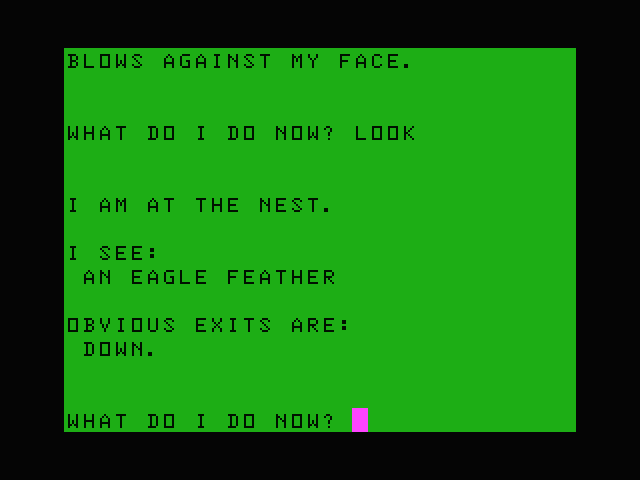
I AM EVERYWHERE AND NOWHERE AT THE SAME TIME. A STEADY WIND BLOWS AGAINST MY FACE.
Despite the grand cliche at the end, the story was genuine and serious, and it gives the player freedom to do some things out of order while still driving to an ending. There are two moments of participatory plot where the player moves events forward simultaneous with having a revelation about what’s really going on.
Amnesia is definitely old hat by now, but this is the first adventure game we’ve reached that’s had it. Kalish invented the amnesia adventure plot for this game. This is the first time we’ve had “memory unlocking”.
(No, seriously! The other references I’ve made have been sort of a quasi-amnesia. Ferret had amnesia, but it was only tangentially relevant and the game is only sort-of from 1982. Mystery Fun House has come the closest by hiding the player’s objective in their shoe, and that game also did some wonderful moments of participatory plot; the protagonist knew what was going on, just the player had to figure it out.)
The puzzles were rough and could use tweaking, and a couple bugs caused distress (I didn’t even discuss how the inventory count gets messed up by the magic twig, causing your inventory limit to go down permanently by one). But this is the sort of game I was hoping to find through All the Adventures, something known to very few which deserves a more public viewing.
This was Ken Kalish’s only text adventure.
It would have been nice to be able to do more text-only adventures as a way to do story telling, but graphics adventures supplanted the text ones.
Odd comment (since Infocom was just getting started in 1982) but I can understand it being easier in a business-pragmatic sense to do graphical games, especially for a US author that didn’t have a thousand shelves he could toss a ZX Spectrum tape onto.
Next up: Speaking of endless shelves of ZX Spectrum, we’re headed back across the pond to hit one of those games, with a much simpler plot than El Diablero. (Which happens to have graphics! I might instead do one of the other ports, I haven’t decided yet.)
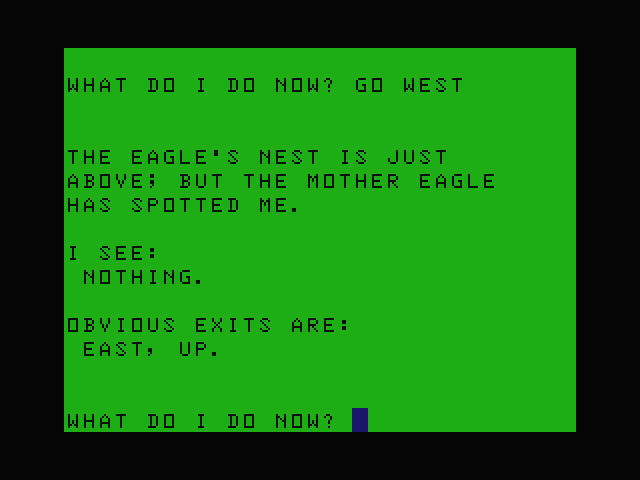
Nearly almost immediately after finishing my last post I made a breakthrough. This is not that uncommon for me. The act of writing sometimes helps me think, and having my tasks laid out with pictures can also help me zero in on what to do. I had listed as task number one to try different teleport destinations, and it occurred to me, regarding the scene with the eagle…
…that I could possibly DREAM my way straight to the nest, avoiding the eagle confrontation that way.
Remember, the mechanics are such that you can DREAM a place to go to it, then AWAKEN to return right where you left off.
I flailed a bit trying to transform with the eagle feather. I should mention I still have no idea how to transform — it isn’t needed for immediate progress — and I’m starting to suspect it is location-specific rather than a new general power.
I then tried a bunch of plausible dream locations — trying to imagine what the author might go for from the Sonoran Desert — and while RIVER and STREAM didn’t work, I hit paydirt with DREAM CAVE:
HIS POWER PREVENTS ME.
I technically was already able to bypass this. It turned out to be the hardest puzzle of the game so far. Let’s save that for a bit later.
I also did some verb-testing on each of my objects in turn; with BREAK, I finally got a hit when I reached my bowl:
The key was the missing item needed to unlock the box, and the box has a blue pebble and paper that gives instructions.
This opens a small area with an “ancient Mayan mask”. Wearing the mask is sufficient to translate the various inscriptions. They essentially already reinforced what I knew about the mechanics of the game, although the second message is subtly different; remember it shortly.
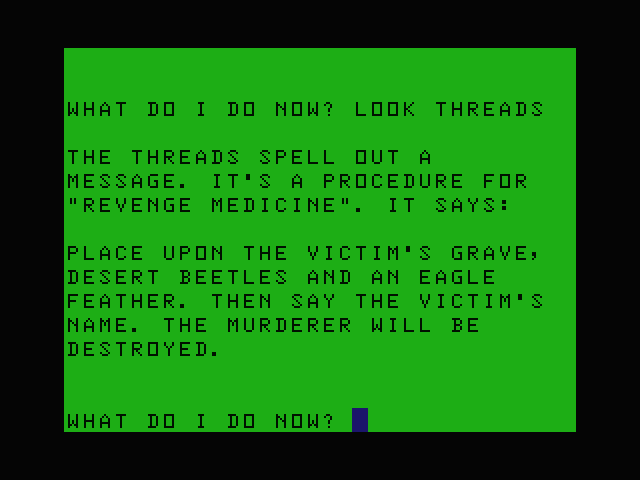
I next had the the tombstone to reckon with. The MAT, woven with blue and white threads, can be examined further. You can LOOK THREADS.
Second-order nouns — where you have to examine something in an description obtained via examining — are pretty rare in this era. I usually miss them and I’d argue in this case it’s unfair you don’t get any sense that there’s more to see from the first description.
I already had everything collected for this. The beetles came from using the machete on the cactus.
From a Computerware ad in Color Computer News, November 1982.
Heading over to Uxmal’s grave, I enacted the revenge medicine:
I absolutely loved this moment; no, we haven’t had our teacher built up as a character that much, but this is still a participatory plot twist rather than one just given to us. (See, relatedly, participatory comedy and participatory deathtraps. See also the “research puzzle” in Anchorhead which leads to one of the biggest plot moments of the game.) If nothing else, I’m pleased that the game actually appears to have a plot, even if a small one?
The next phase simply involved typing REVEAL to all three of the major critters (snake, crow, lizard) and finding the lizard was willing to chat.
I already had a magic bush, so I had a guess I could TAKE TWIG whilst there.
I have not dipped the twig in anything; I don’t think I’ve seen the oil yet, but it is faintly possible I’ve missed something in the initial areas of the game.
With all this reckoned with, I needed to reach the cave still. I was misunderstanding part of the mechanics of dreaming, in a way that feels like Castaneda getting told about some layer of reality he’s missing (or being informed in Journey to Ixtlan that not everyone needs drugs but he wasn’t smart enough to enter altered-reality at first without peyote).
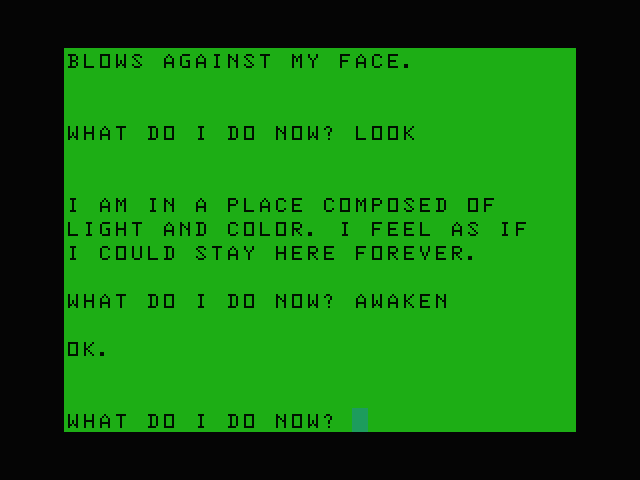
You can DREAM, just on its own…
I AM EVERYWHERE AND NOWHERE AT THE SAME TIME. A STEADY WIND BLOWS AGAINST MY FACE.
…and then AWAKEN, and you’ll be in the same place you started.
You can DREAM (LOCATION), which will take you to a location on the map, and then when you AWAKEN you will land back where you started. El Diablero is preventing dreaming of the cave.
However, you can also DREAM, no set location, and while everywhere and nowhere at the same time, you can AWAKEN (LOCATION). This can be used to arrive at the usual locations (like the well) but also can be used to bypass the power preventing you from arriving at the cave.
(Hence: “As you go, so can you return” doesn’t mean just that awakening is a power, but that awakening can be used just like dreaming with a specified destination.)
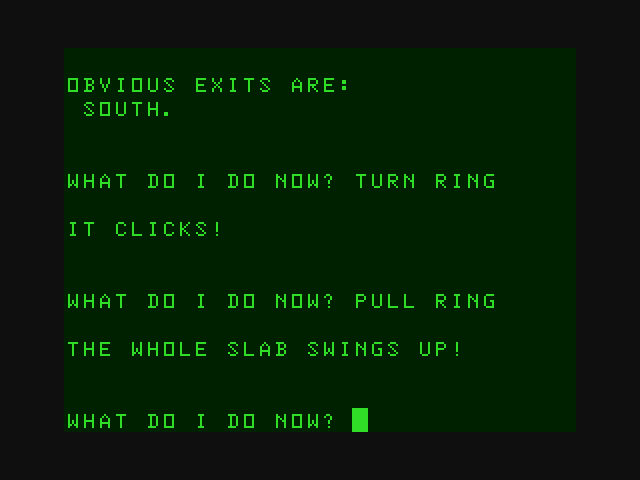
To the north is a ring on the floor which, quite straightforwardly, can be turned and then pulled to open some stairs. (I guess TURN isn’t used for shape-changing after all.)
If you’re wondering about the visual change, I switched to the Dragon version of the game here and switched the color scheme while I was at it.
The reason why is an item that shows up shortly after. You go down the stairs to a long east-to-west section by a chasm.
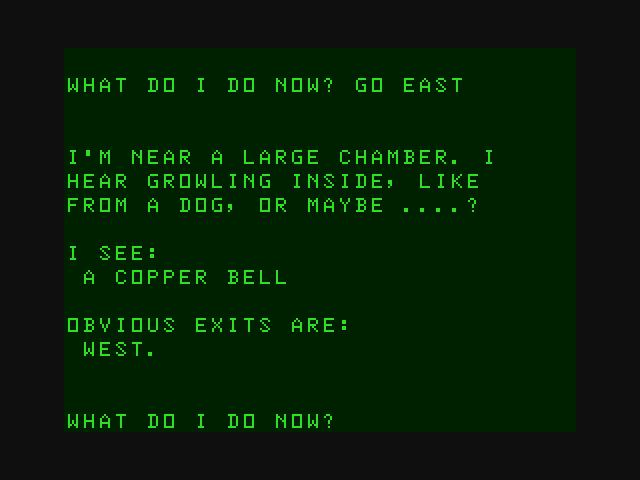
On the east side there’s a “copper bell”.
Trying to RING BELL caused the screen to clear (and no, that’s not supposed to happen). I was only using the first copy I found at the Tandy Color Computer Archive and likely one of the other copies works, but just in case I had an emulator issue I switched computer systems to the Dragon and found the issue resolved itself.
Going west to the “columns” (which have the message “FOR HE WHO SERVES”) and ringing the bell reveals a beast who is ready to give us a ride.
Before journeying deeper into the cave with beast-buddy, let me cover the two extra rooms to the west. One room has a “gold statue” but it seems to be illusionary:
MY HAND PASSES THROUGH IT! AM I IMAGINING THINGS??
Farther west is a bridge which seems to also be a fake-out.
However, since I’m stuck later, I can’t discard either room entirely.
Back to where we left our ride running:
This leads to another self-contained section where part of it is under water. I’ve marked the water sections in blue:
South of where you land there’s a skull; north is a pond. You can jump in the pond and then SWIM DOWN. This goes into darkness, but I realized I could SWIM EAST while underwater to reach a new area.
The first area you can pop your head out on is deadly. The game gives you plenty of forewarning about this, but I tried swimming in all possible directions anyway but I died of poison in all cases. (This is far more polite than the average 1982 game, which would just have the death happen without warning. There was even that mechanic with the blue/yellow shading earlier which was intended to hint at danger level; I suspect the author might have been annoyed at some deathtraps in a different game but still wanted to use them.)
Returning to life again, we can dive even deeper to swim east yet again, finding a safe pond to exit. This leads to a “granite block” adjacent to some “ruins”.
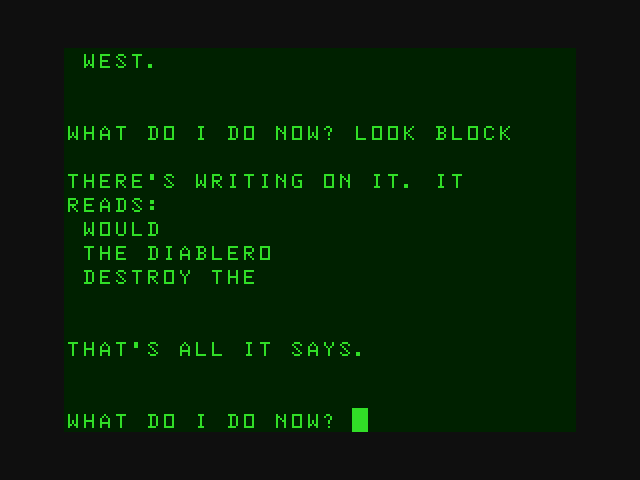
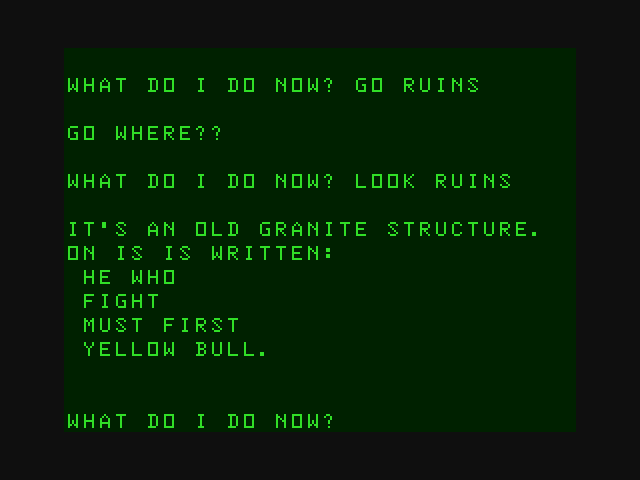
Combining the two hints together gets
HE WHO (WOULD)
FIGHT (THE DIABLERO)
MUST FIRST (DESTROY THE)
YELLOW BULL
with the catch that I have no idea what the yellow bull is, BULL isn’t even a recognized noun in the game, and I’m at a dead end. So I might have missed something in that whole sequence or I might be a few cryptic leaps from victory. (Do also note I haven’t found an appropriate twig-dipping spot yet either.) I’d still like to finish at my next post but I suspect the game will push hard enough back it’ll have to be two.
“A diablero? You are crazy! There are no diableros.”
“Do you mean that there are none today, or that there never were any?”
“At one time there were, yes. It is common knowledge. Everybody knows that. But the people were very afraid of them and had them all killed.”
“Who killed them, Genaro?”
“All the people of the tribe. The last diablero I knew about was S⸻. He killed dozens, maybe even hundreds, of people with his sorcery. We couldn’t put up with that and the people got together and took him by surprise one night and burned him alive.”
“How long ago was that, Genaro?”
“In nineteen forty-two.”
“Did you see it yourself?”
“No, but people still talk about it. They say that there were no ashes left, even though the stake was made of fresh wood. All that was left at the end was a huge pool of grease.”
— From The Teachings of Don Juan
My main key to progress from last time is to realize that I probably should just try anything that might possibly be a verb that is referenced in the game and in the manual. Doesn’t matter if no other game might consider such a thing: this game does not do its magic by SAY BLAHBLAHMAGICWORD (or at least, not so far).
Regarding the manual, I haven’t talked about it yet, as we only have the Dragon version. But Gus Brasil pointed out it was essential for something so I spent some time looking over all the notes.
From Museum of Computer Adventure Games.
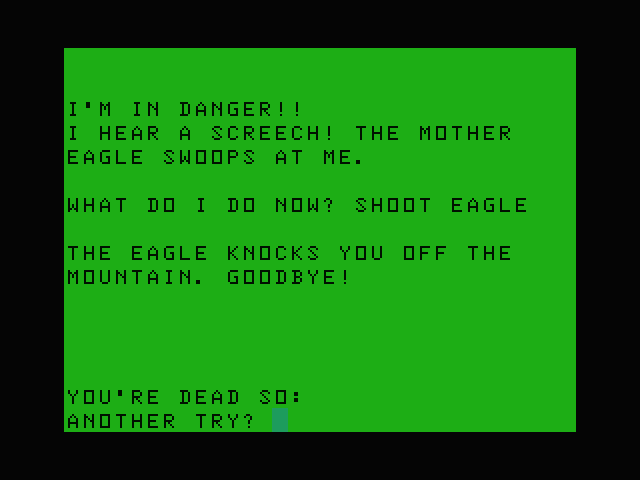
When a location description is preceded with the words “I AM IN DANGER!”, there is only one correct response which will prevent you from being killed. There are no second chances, but there are subtle warnings. which can prevent you from getting into situations for which you are not prepared.
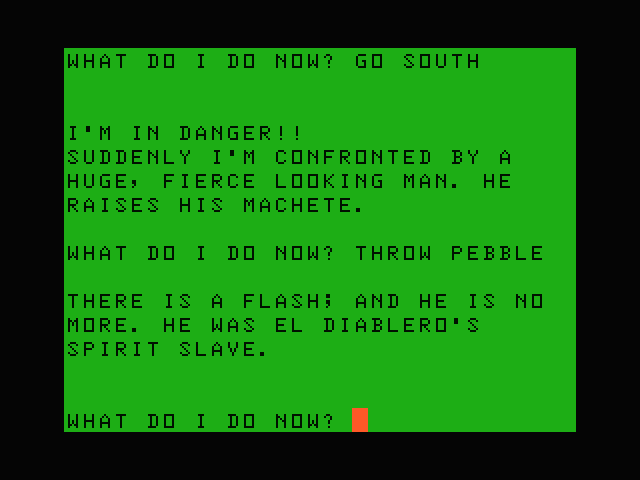
I’ve seen this already with machete man, and we’ll see this again shortly — this is indicating the way the code works, which really requires typing one specific thing in response. “Not prepared” suggests these will not be self-contained (like a puzzle where you have to WRESTLE the enemy but there’s no items or knowledge involved).
The manual also says you remember a poem on waking up:
Remember well the power word,
Remember that which twice you heard.
Awake to that which dwells within.
Throw off the yoke of ignorance.
I spent a long time trying various interpretations, and especially looking for anything early on that indicated something had been encountered twice. The closest was the shack which the game says you recall being familiar.
I still haven’t reckoned with being watched.
I tried using SAY on each one of the words in the poem in case any of them was a trigger: this was close to right. I needed to test each one as a verb. While in the shack:
Oho! This leads to a room with no exits or anything you can interact with, but you can AWAKEN to get out.
I discovered after some mucking about that you can DREAM OBJECT. In particular, at the well you can DREAM WELL. If you LOOK, though, it appears that nothing has changed; however, attempting to type DREAM again, the game says:
NOTHING.
And you are able to AWAKEN — even after wandering away from the well — to jump back to it. If you do something in the “real world” while you are dreaming it still stays.
I hadn’t unearthed the box while in “real world” state, but it stayed here after teleporting back to the well from awakening. This seems too elaborate to be a bug but I’m not sure what’s going on. It’s not the normal world-separation I’m used to with this kind of mechanic.
You can DREAM WELL while not even next to the well, and it’ll jump you over there; this puts you in the “sleeping state”, so awakening will warp you back to where you started dreaming. DREAM CANYON works similarly, taking you over to where the poisonous snake is. It’s almost like a warping “checkpoint” system?
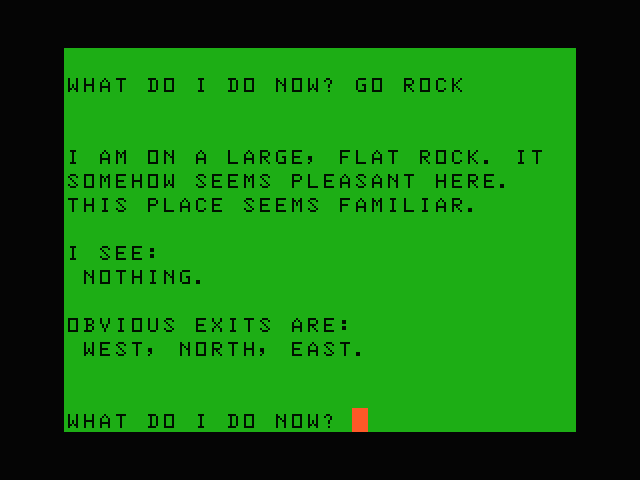
Because you can dream of places you are not even at to travel to them, that lets you warp to a new area. I was able to DREAM ROCK to go to one of the flat rocks I had been seeing in the desert but had been unable to get to.
I found out, after the fact, that I had typed GO ROCK in one of the rooms which describes it being nearby but you aren’t close enough yet. If you are to the west or east of the flat rock, GO ROCK works.
Just to the south of the previous location.
The “looking familiar” means this is a “remember” spot. Using REMEMBER here says
I USED TO PRACTICE THE SORCERY TECHNIQUE OF “GAZING” AT THIS SPOT!
You can GAZE ROCK and find it has a blue shade. This seems to be a hint that blue = safe (the blue pool is safer than the yellow one, that is). There’s another rock you can walk on which is more ominous. You “start to feel anxious”, and gazing upon it gives a yellow glow.
Flat rocks marked with colored squares.
So the end result is I figured out GAZE and DREAM a little out of order, but the game lets you. For the new location with DREAM, you can dream about the mountains in the distance.
At the top of the mountain is another REMEMBER moment.
None of the verbs I might suspect seemed to be understood. I almost thought I had progress by pretending the parser understood more words and typing TAKE FORM OF CROW, but all that’s happening is “FORM” and “OF” get ignored — the game understands that as TAKE CROW, not shapechanging.
This doesn’t work either.
I can at least report two other locations found off the mountain. One is some “rich soil” where it immediately occurred to me to try planting the seeds.
I have been unable to take the bush afterwards, so I don’t know what purpose it serves. LOOKing just says I’ve never seen one like it before; gazing does nothing.
Off in another direction is an eagle’s nest.
I assume shape changing is needed here for progress.
I’m fine with speculation/hints now, although do use ROT13 as usual. I especially want to know if I am missing out on the shape-changing for puzzle reasons (in which case I’m happy to keep whacking on it), or frustrating-parser reasons (in which case I’m happy to spoil). To recap where I am:
1.) I can DREAM in addition to GAZE in order to teleport to other places. (There may still be teleport destinations I can infer, I should make a full list.)
2.) I supposedly can shape-change but I have no idea how.
3.) I’ve planted the seeds, getting a bush, but the bush doesn’t want to be interacted with.
4.) I now have an eagle to get by, in addition to machete man. Regarding the snake that causes death upon being picked up, I’m guessing that’s a non-puzzle and the snake is just a shape-change target. The same might be true for the lizard.
5.) I still haven’t used the bowl, the mat, the shotgun, the debris, or the brush. I still don’t have a rope for getting into the well. I still don’t have any way of helping the blighted cactus.



































































 Renga in Blue