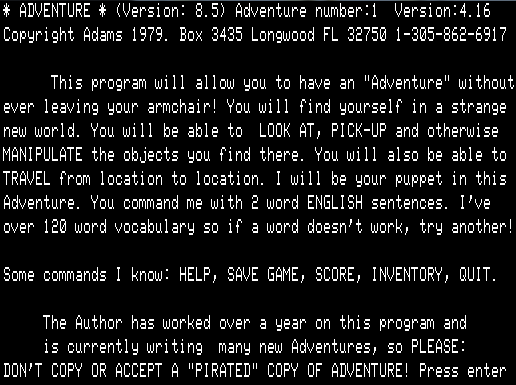
I had three treasures left to go. Their method of extraction is spoiled below.
…
Adventureland’s structure has some tight redundancy; items serve more than one purpose. For example the
Rusty axe (Magic word “BUNYON” on it)
not only serves as a tree-chopper, but as a magic item.
The humble lamp used throughout as a mere light source has a second use as well. There’s a bit of scrawl in the maze that says “ALADIN WAS HERE”.

Knowing I was still missing treasures, I tried on a whim:
> RUB LAMP
A glowing Genie appears, drops somehting, then vanishes.
I got a *DIAMOND RING* this way. (The typo is in the original text.)
…
I then worked on the bear from my last post some more. Getting frustrated, I asked David Welbourn for a hint, who said “You can defeat the bear without any tools but yourself.”
The most direct route isn’t too helpful.
> KILL BEAR
Bear won’t let me
Maybe if I threw something?…
In fact, it’s downright deceptive, which is counter to the usual policy interactive fiction has about hinting from the text. Throwing the axe (the only thing you are allowed to throw) breaks the mirror and is the wrong approach. Instead:
> YELL
Bear is so startled that he FELL off the ledge!
Poor bear. I guess he was evil too?
…
The last treasure required the ultimate gesture of defeat, the walkthrough. I did not feel bad about spoiling this time.

So yes, RUB LAMP works to get one treasure, but a second RUB LAMP gets another treasure.
This is what I have called Bad Frustration. I could see someone trying a second RUB LAMP if they’re in the process of lamp-rubbing, but after there is no plausible way to think through the answer. If I ever codify Advice for Puzzle Makers at some point, one of the rules would be this: Think about if your player is unable to solve a puzzle. Is there a clear route to get on the right track, or will it require enough luck that the player will feel like they have wasted their time? You want a response of “oh!” to a puzzle solve (even if it had to be looked up) not “oh…” with a head-shake of frustration.
Doing RUB LAMP a third time is at least amusing:
A glowing Genie appears, says “Boy you’re selfish”, takes something and then makes “ME” vanish!
I’m DEAD!
I can’t in good conscience recommend Adventureland to modern audiences. Not because it’s impossible to have fun — I did — but because Scott Adams himself got better as he went along; not every game was a treasure-hunt. The actual minimalist style does have a soothing meditative quality to it, although if you’re just wanting to experience that you might try J. Robinson Wheeler’s ASCII and the Argonauts; it has the same modern-feel-with-retro-style that many indie-games shoot for these days. Since text adventures are inherently retro, that’s possibly the only way to achieve the effect.

When people talk about being “stuck” in an adventure game, usually they mean there is some specific puzzle they can’t get by.
I’ve got exactly one puzzle I know I am stuck on.
I’m on a narrow ledge by a Throne-room
Across the chasm is another ledge. Visible items:
Very thin black bear. *MAGIC MIRROR*
> GET MIRROR
Bear won’t let me
I’ve some *ROYAL HONEY* that will make the bear happy and cause him/her to fall asleep, but since the royal honey is a treasure itself that causes me to lose points.
The extra problem is, I’ve got more points missing than just one treasure worth. I don’t know where else the other treasures might be. So I am clearly “stuck” somewhere but I have no idea what I should even be doing.

The map I have so far, excluding the maze. Click the image for a PDF version.
Let me summarize what I’ve seen:
* It turns out there is a HELP command dynamic based on what room you’re in and it can actually be helpful sometimes; solving the puzzle would have taken me longer otherwise. For instance, there’s a sunny meadow with a sleeping dragon where HELP gives you this message:
A voice BOOOOOMS out:
There are only 3 ways to wake the Dragon!
One puzzle involving an explosion I may not have worked out without the HELP command.
* A sequence later I needed to drive away the dragon to steal its eggs. I feel somewhat bad about that. I guess the dragon is evil so that makes it ok?
* There’s a tiny maze. Scott Adams must have felt obliged to provide a maze. It took all of five minutes to map.
* There’s a room I assume is a joke
I am in the memory chip of a COMPUTER!
I must have took a wrong turn!
but at this point I suppose I need to question everything.
* If you go down from the ledge near the swamp you end up in Hell. Whoops.
* With some deaths there’s an interesting afterlife scene:

I don’t think there’s a treasure here, but given the Acheton trick I’m not going to rule it out.

Also known as the Concours de Fictions Interactives Francophones 2015; voting is now open.
The three entries are here.
Since these things often pass by the English-speaking interactive fiction world without a trace, I decided to try translating the opening of each. I took liberties with grammar and accuracy is not guaranteed.
—
WARNING: This game contains scenes of blood.
It’s late.
The day was long and exhausting.
You’re content to be finally alone in your room to enjoy a well-deserved rest.
All is quiet about you: this promises to be a tranquil evening.
Or maybe not?
L’Envol (The Flight)
Une participation de Anonyme au concours francophone de la fiction interactive, édition 2014. (Anonymous participant)
In a soft bed
You are lying in bed under a quilt. Everything is quiet. The dim glow of your bedside lamp casts strange shadows while gently illuminating the room’s furniture and objects.
Your room’s window (facing your bed) is open.
You can also see a guitar, a bedside table, a wardrobe (which is closed), a chair, and a desk.
—
It is winter and night is beginning. Street lights that line the street reflect the windows. A few cars rumble past noisily on the pavement.
Couples walk by, dressed in thick overcoats and hats. A chestnut vendor reads a newspaper by the light of a fire.
The imposing Teatro delle Muse appears at the corner of a street, grabbing your thoughts. You enter through a small door set into a much larger one made of raw wood. The door closes behind you.
Comédie (Comedy)
Une fiction interactive par Edgar Havre
Entrance
The theater entrance is narrow with high ceilings. There are imposing crude wooden doors with a small opening for the staff.
To the north there are grand encircling windows of gold which suggest an enormous hall. Carpets are lined with purple velvet cords, and two corridors lead visitors to the top of some stairs.
You can see a man of powerful stature.
—
The curtains close. Just before they shut, she takes a fleeting look in his eyes and tries to smile at him.
It is in vain. Her lips do not move. Not just there; despite his efforts, his face also remains frozen.
The curtains are closed now. The wires that hold her up fall, followed by the wooden cross.
“At the next performance, I will,” she promises (as always).
Sourire de bois (Wooden Smile)
Un conte interactif par un soldat de plomb unijambiste (An interactive story by a one-legged tin soldier)
On stage
The show has just ended. She knows from experience she still has some time until the next performance.
She has time meanwhile to rest, and to collect decorative things that are damaged and might otherwise be discarded. Over time she has made a collection of memorabilia.

If you aren’t familiar with how Greenlight works, people vote for games to appear on the Steam service. (There are no downvotes, only upvotes.) Games with enough votes will eventually be able to appear on the service for sale.
Three games by IF luminaries have just appeared. If you care about the success of interactive fiction, please vote!
Jack Toresal and The Secret Letter (Mike Gentry and David Cornelson)
http://steamcommunity.com/sharedfiles/filedetails/?id=371862595

The Shadow in the Cathedral (Ian Finley and Jon Ingold)
http://steamcommunity.com/sharedfiles/filedetails/?id=371866777

Hadean Lands (Andrew Plotkin)
http://steamcommunity.com/sharedfiles/filedetails/?id=380279925


This is going to sound like a bizarre statement to anyone who has played a Scott Adams game, but Adventureland is the first game in my chronological series that has felt modern.
To anyone scratching their head, some clarification is needed. While yes, the game is simply an excuse to collect Treasures and put them in the right location and get a high score, and yes, the text is absurdly minimalist, everything is also compact.

Aboveground.
The adventures I’ve played so far have a certain expansiveness to them (see Zork: Open spaces, painful geography) with a giant map and a lot of confusion. While I’ve appreciated this style with space lending to world-immersion, I’ve also missed the feeling of small set-pieces that come from, say, a tightly structured IFComp game.
Using the TRS-80 as opposed to a mainframe with spacious memory forced Adams to think small. The swamp at the beginning (see map) gives a good idea of what I mean by “set-pieces”:
I am in a dismal swamp. Visible items:
Cypress tree. Evil smelling mud. Swamp gas. Patches of “OILY” slime. Chiggers.
Some obvious exits are: NORTH EAST WEST
The evil smelling mud can be used to cure bites from the chiggers (which are themselves useful in a different puzzle). The mud also will wake up a sleeping dragon (found just to the north) if you bring next to him. The swamp gas has a property useful in a puzzle, and the “OILY” slime I have not actually figured out yet.
The tree can be used in two ways:
> CLIMB TREE
I am in a top of a tall cypress tree. Visible items:
Spider web with writing on it. Ring of skeleton keys.
Some obvious exits are: DOWN
> GET KEYS
OK
> READ WEB
Chop ‘er down!
> DOWN
OK
> CHOP TREE
TIMBER!
(Room description changes to: -HOLLOW- stump and remains of felled tree.)
> ENTER STUMP
I am in a damp hollow stump in the swamp. Visible items:
Old fashioned brass lamp. Water in bottle. Sign “Leaves *TREASURES* here, then say: SCORE”.
Some obvious exits are: UP DOWN
While the text might only be appreciated now as a sort of anti-poetry, the tight implementation gives the locations in my mind a stronger imaginative force than the hundreds of rooms of Acheton.
I’m about 3 hours in — I supposedly have 70% of the treasure — and having reasonable fun. Likely the last 30% will get me stuck. Perhaps the last lingering puzzles will be hideous; it’s hard to know.
Adventureland nearly has the distinction of being the first text adventure available for home computers. It is slightly edged out by a port for the Heathkit H8 of Adventure which debuted in August by Gordon Letwin (who later went on to make the port Microsoft Adventure) and started being sold in Issue 4 of the magazine REMark (fourth quarter of 1978).
However, Adventureland is the first one made specifically for home computers; specifically, the TRS-80. It started being sold January 1979 through an ad in Softside magazine. Scott Adams himself says it was the first venue in a video interview. He mentions testers which presumably tried the game in 1978, but with commerical products it is standard practice to date them by when they first are commercially available.

Every other source out there says 1978 including the thoroughly well-researched Digital Antiquarian.
However, even the title page of the game itself says 1979

although it should be noted that this is a later revision of the game and it is possible an early title screen said “1978” since that is undoubtedly when the coding of the game occurred.
[ADD: Jimmy Maher makes a pretty good argument in the comments that due to the lag time of the magazine publishing that 1978 is sound, still. Note that would still make the port of Adventure the first available text adventure for PC. I am hence changing the title back to 1978.]
Scott Adams’s adventures all used a particular data format which can be run with the interpreter ScottFree. For at least Adventureland I’m going for the classic experience with a TRS-80 emulator, although there are plenty of more modern options available.
I’ve been having more fun than The Digital Antiquarian did (I’ve avoided reading his article too closely because it looks like it has spoilers, but I caught the quote “Which is not to say that Adventureland is exactly playable, at least by modern standards.”) I’ll get into gameplay details next time.
I’ve discussed how Acheton has many, many, ways to die. This is not unusual in an adventure game.
What *is* unusual is that in order to get all the treasures you need to die once.
Spoilers for this and the endgame follow.
You are in a bare room with exits off in all directions. On the ground is a heavy stone slab bearing the words ‘Abandon hope all ye who enter here – ANON’.
> off
The lamp is now off.
> e
You fell into a pit and broke every bone in your body.
You appear to have died. Do you want to be reincarnated?
I first essentially interpreted this as an out-of-game question, just like a RESTORE/UNDO/QUIT menu.
> no
You are in Hades. The place is lit by the eerie glow of fire and brimstone. The souls of the dead walk with heads hung and gloomy faces, trying to perform impossible tasks. The sound of demonic laughter echoes around, sending shivers down the spine.
> e
You are in Hades.
Anne Boleyn wanders past with her head under her arm.
.
.
[wander for a bit]
.
.
> s
You are in Hades.
There is a loud clatter as a party of Hell’s Angels rides past in fiery chariots.
There is a beautiful crystal skull on the ground near you!
> get skull
OK.
> anon
You get an odd feeling of weightlessness. Suddenly, the rock above opens and you float upwards through the resulting hole. Just as you arrive at the top, the rock snaps shut again and you discover …
You are in a bare room with exits off in all directions. On the ground is a heavy stone slab bearing the words ‘Abandon hope all ye who enter here – ANON’.
On the unfair-o-meter, I didn’t find this Ludicrous once I found there was a treasure in the afterlife, but I needed hints to figure out how to get out. The random Dante reference in one room did not translate in my brain to an escape via magic word. (Incidentally, DANTE works also as the magic word.) The main difficulty was discovering the whole section exists in the first place, since for the longest time I immediately restore my game upon dying.
…
I’ve been harping on unfair parts in Acheton, but there is a saving grace: you don’t need every treasure to win. You won’t get a full score, certainly, but “finished and filling in missing points” has a different feel than the brick wall of being stuck in the middle.
You are in a 12-foot high rock chamber. There is a massive walk-in safe on the east wall. The west wall bears an inscription, and there is a bright yellow star apparently painted in the middle of the ceiling. A spiral staircase leads downwards.
> e
You’re inside the safe.
Placing all the treasures in the safe and then closing it results in…
> close safe
As you close the safe, the ground shakes slightly and a large slab of rock detaches itself from the ceiling, just missing you as it falls, and blocks the stairs.
A deep sonorous booming voice intones slowly:
ONE …
TWO …
THREE …
FOUR …
[etc, etc]
FIFTY FOUR …
FIFTY FIVE …
WELL DONE!! YOU ARE NOW FULLY QUALIFIED TO ENTER THE MASTERS’ SECTION.
I tested all the way down to forty-five treasures and still was able to enter the endgame. Omitting ten treasures is enough to skip most of the heavily obscure sections.
Upon entering the last section, you must face the fury of…
Wheeeeeeeeeeeeeeee… >>oof<<
You are in a high, circular room with highly polished walls which sparkle and shimmer in all colours of the rainbow. Lighted passages lead off to the north and to the south. The room itself is lit by chandeliers hanging from the ceiling.
There is a large basalt disc here.
There is a very large granite disc here.
…Towers of Hanoi! (CUE ENTHUSIASM) (CRICKETS)
To be fair, you don’t have to solve the whole thing; just move enough discs around to clear a hole that you enter for the final arena.
> d
You are in the gladiators’ arena. The crowd, consisting of former
successful adventurers, hushes as you enter. Once again, you hear the
booming sonorous voice, saying:
“LET THE FESTIVITIES BEGIN!”
Your opponent is:
A hissing vampire with large blood-stained protruding canines.
The following weapons are available:
A huge two-handed axe.
A vial of poisonous gas.
A five foot spear.
A two-handed broadsword.
A silver-tipped cane.
A small dagger.
A wooden crucifix.
A pointed wooden stake.
A large spiked mace.
A keg of gunpowder.
Which weapon would you like?
The rest of the game involves matching the right weapon to the right creature.
Which weapon would you like?
stake
You throw the stake at the vampire. He tries to dodge but seems unable
to do so. The stake pierces his heart, and he collapses in a heap of
dust.
This could nearly be considered choice-game mode — you can’t move around or do anything other than type weapon names — but there’s one last trick.
Your opponent is:
A black knight on a black charger.
The following weapons are available:
A huge two-handed axe.
A silver-tipped cane.
A keg of gunpowder.
Which weapon would you like?
NONE
The black knight charges into the arena, his lance pointing straight at you. At the last moment you jump to one side. He attempts to swerve, and in doing so becomes unseated and breaks his neck on landing. The crowd seems uncertain whether to cheer or not.
AXE works, but this is the only way to get the last 3 points of the game.
You throw the keg of gunpowder at the dragon, which is quietly blowing smoke rings at the time. A stray spark ignites the gunpowder and blasts the dragon into little bits. The crowd rise to congratulate you, master gladiator.
You leave the arena, to the applause of the crowd, and receive your laurel wreath.
You have scored 1500 points out of a maximum of 1500. You are now a Grandmaster Supreme of Acheton, and have been elected to the Ruling Council. Please communicate with the relevant authorities to claim your seat.
Congratulations!
Do you want another game?
Before I sign out, I should point out the commercial versions (covers above) are slightly different than the mainframe version I played. Primarily, the weapons that were just there in the arena are spread out through the whole game, and have to be brought to the endgame to get a complete resolution. While collecting the weapons makes the arena at the end seem less like an arbitrary surprise, there’s so many finicky things to worry about in Acheton I’d rather do without.
Consequently I’d recommend the mainframe version (Acheton.z8 from here) for anyone that wants to give the game a try. I’d think it’s still worth trying if you don’t go for a full score so you can skip the more obnoxious parts.
I can’t say Acheton is as good as Adventure or Zork, for 3 reasons:
1.) Acheton has multiple “cruel” bits were you can unknowingly break the game and not find out until many hundreds of moves later. Zork had a few points like that but it was obvious when it happened right away. You could lose a treasure in Adventure via the bridge, but it was essentially intentional on the player’s part and an acceptable puzzle to force the player to plan a way of getting their treasure back.
2.) Without light most of Acheton is unexplorable. Acheton’s lamp timer is very tight, and there’s just no chance for “noodling around”. Adventure had a relatively generous time limit, and Zork went one better with an unlimited light source.
3.) Adventure had both the pirates and dwarves, and Zork had the highly satisfying thief (who as far as game mechanics are involved, I still contend is one of the best NPCs in IF). Acheton has this guy:
A fearsome looking stone idol glares at you malevolently with its single green eye from the opposite end of the room.
> get eye
OK.
You wrench the eye of the idol from its socket. As you do so, the idol starts to glow faintly and emits a hollow groan. It then grabs at you, but fortunately you jump back just in time. The idol then blunders around the room searching for you for a few minutes, and you have a number of narrow escapes before it appears to give up. It then sits down in the lotus position, and then gradually fades away from view.
After taking the eye, the idol has a random chance of showing up and killing you the rest of the game. Not only is this far less interesting than intermittent battles with dwarves or the thief, the best strategy is to save taking the eye as the very last treasure, nullifying having the enemy at all.
As I was preparing this, Emily Short made a massive post which seemed to cover every text game event ever.
This is just 2015, roughly in chronological order. If you want more detail, a lot of the events mentioned here are mentioned there as well, complete with organizer commentary.
While this list has mostly competitions, it’s not intended to be exclusively about them. Anyone who intends a Kickstarter, conference, public reading, etc. is welcome to let me know and I can add it to the list.

This competition for interactive fiction in French goes from January to February.

ParserComp 2015 is a ranked, long-form game jam for parser games (also sometimes called text adventures).
Writing window: November 1, 2014 through February 1, 2015
Polish window: February 1, 2015 through February 14, 2015
Voting window: February 16, 2015 through March 14, 2015
Imagine a World

February will see the Kickstarter launch by Adri of
a multimedia text adventure called “Imagine a World.” It’s a prequel to the world of Glitch, an MMO by Tiny Speck that shut down a few years ago.
Shufflecomp II

The sequel to Shufflecomp will be announced in Feburary.
The original premise was
You sign up by sending me a list of eight songs that you think might make for good games. I shuffle them up, and send each participant eight songs. They pick one and make a game vaguely inspired by it.
(The image above is from songs used last year. From left to right: White Houses, Smooth Criminal, and Chrome Country.)

I might not normally include this is a “text game event”, but there are a large number of text games in contention for the IGF Awards, including the majority of the “Excellence in Narrative” category.
The IGF Awards take place on the evening of the third day of Game Developers Conference, and are a major celebration of the best in indie gaming, with thousands watching the award presentation before the Game Developer’s Choice Awards are presented. The 2014 IGF Awards, including custom interstitials from Mega64 and Hey Ash Whatcha Playin’?, are available for online viewing. The Festival Awards will take place March 4, 2015.

This competition of is for short works (90 minutes or less). Both parser and choice interface works are allowed.
March 1, 2015 12 p.m. CET: Deadline for submission of intents.
April 1, 2015 7 p.m. CET: Deadline for entries.
April 1, 2015 12 p.m. CET: Entries will be released to the public.
May 1, 2015 11.45 p.m. CET: Voting deadline.
May 2, 2015: Results will be published.

Formerly a “competition” for interactive fiction, the rebranding as a “festival” indicates a new focus on showcasing and promoting new games in a friendly, less competitive environment.
March 1, 2015: Deadline for authors’ intents to enter.
April 1, 2015: Deadline for games to be submitted.
April 4, 2015: Festival opens.
May 4, 2015: Festival closes; ribbons awarded and games archived.

It is the intention of the Windhammer Prize to promote the gamebook genre, and in doing so deliver to readers new and original adventures that express the innovation and creativity that can be found in authors of interactive gamebook fiction today. In pursuit of this objective the Windhammer Prize values most those gamebook entries that expand the boundaries of the genre. If you believe you have an idea for a work of interactive fiction that is both original and innovative then this competition is definitely for you.
Entries are accepted from August to the beginning of September; voting closes the end of October.
This competition includes a unique incentive:
The publication of winning entries is a commercial opportunity being offered by Tin Man Games that is available to First Prize and Merit Award winners. Publication will be offered as an idevice app that includes these three winners within the one 2014 compilation title.

The Interactive Fiction Competition is an annual event begun by passionate hobbyists in 1995 to encourage both the creation and the discussion of new interactive fiction works (also known as IF). While the definition of IF has evolved in the years since then, the IFComp’s format and schedule have remained stable since the 1990s. Anyone can judge the entries on a one-to-ten scale, and the laurels go to the entries receiving the best average rating.
Deadline for entries is near the end of September, while judging lasts until November.

WordPlay is our free festival celebrating the most interesting uses of writing and words in contemporary games. Each year there will be a curated game showcase, talks by creators about the craft, and ways for the public to learn about making games.
The festival occurs early November in Toronto.

This competition for Russian interactive fiction goes from November to December.
Please feel free to let me know about anything that should be added.

Hot off their success of 80 Days inkle is gearing up to finish their third Sorcery! game.
This one is big, complicated and different, and we think will up the ante on the kind of gameplay a text-driven choice-based game can achieve.

Using the same engine as Blood & Laurels, the folks at Versu are set to release Bramble House:
Bramble House is the only home that fifteen-year-old Penny has ever known. Penny is bound in service to the witch Stregma, forced to deal with everything from mundane dishwashing to evicting monstrous guests.

This one is enigmatic, but Brianna Wu has a new project intending to
…create an entirely new category of interactive novel you can play on your tablet or phone. It will be visual, it will interactive, and it will allow the reader to decide where the story goes.
I am unclear what’s going to be new here, but–
Our goal is to empower everyone out there to tell their own stories, and unleash a new wave of games from people of colour, members of the GLBT community, people with disabilities. Our long-term goal is to replace Twine.

Sunless Sea promises a release in February.
Explore a vast underground ocean in your customised steamship! A PC & Mac game in glorious 2D, Sunless Sea is a game of exploration, survival and loneliness set in the award-winning Victorian Gothic universe of Fallen London. Take to the helm and set sail for the unknown. Light and darkness are your greatest allies, but a stout set of cannon and a gunnery officer with a grudge will come in useful too.

Sol Invictus will be out for mobile devices Janurary 8th.
For three years the soldiers of the Black Lance Legion have watched as the Invaders turned their solar system into a hellish, desolate wasteland. Humanity’s most advanced fighting force lurked in the shadows, doing little while their species was forced to choose between eternal enslavement… or extinction.

Tin Man Games has created many gamebooks with an impressive engine for computers and mobile devices, and in 2015 intends to release
* Caverns of the Snow Witch, a conversion of the Fighting Fantasy book by Ian Livingstone
* Bloodbones, also originally a Fighting Fantasy book but by Jonathan Green
* To Be or Not to Be by Ryan North, a CYOA by the author of Dinosaur Comics
* The Gatekeeper’s Oath and Lords of Nurroth, both original gamebooks (the first more about spells and puzzles, the second more of a traditional combat outing)

Choice of Games (and their associated label, Hosted Games) has quite a few new works scheduled for 2015:
The Hero of Kendrickstone, by Paul Wang, author of Mecha Ace. You are a young adventurer, seeking fame, glory, and a square meal.
The Lost Heir. The start of a trilogy by @Lucid, author of Life of a Wizard and Life of a Mobster.
Choice of the Petal Throne. Takes place in the world of Tékumel.
Shadow Horror. The latest from Allen Gies.
Killing Time: You are a high-priced assassin, traveling the world and killing people in far away places.
Volunteer Firefighter.
Demon Lord of the Labyrinth. You are a demon lord, recently escaped to the Material Plane, trying to rehabilitate an old labyrinth.
A Wise Use of Time, by Jim Dattilo, author of Zombie Exodus. An insurance executive, you awake one morning to find yourself possessed of the ability to command the flow of time. How did this happen, and what are you going to do with your new-found powers?
MetaHuman, Inc., by Paul Gresty, author of The ORPHEUS Ruse. You’re a division head that suddenly becomes CEO of a huge multinational corporation that’s busy developing sorcery/cutting edge technology; you have to deal with typical corporate shenanigans (employee embezzlement, workplace romances gone sour) while trying to fend off the sinister “majority shareholders” and figure out what happened to the previous CEO.
Champion of the Gods, by Jonathan Valuckas, author of the Fleet. You are a demigod, striving to make your way in a sword-and-sandal world.
Hollywood Visionary, by Aaron Reed. You are a movie-maker in 1950s Hollywood, trying to craft your first feature.
Versus, a new series by Zachary Sergi. A sci-fi yarn where you are on a prison planet, fighting to return home.
Heroes Rise: The Hero Project: Redemption Season. A new game in the Heroes Rise world, with a new main character, where the player is a contestant in season two of The Hero Project.
Ratings War. You are a journalist in a cyberpunk future.

Reflections is a parser-based game that will be out in 2015. It is
a story about gypsies, magic, death, life, and the Power of the Blood.
Paul O’Brian and Christopher Huang’s work on Empath’s Gift is currently in limbo but should also hopefully see the light of day in 2015. It is about
a summer college campus where a group of gifted students gather.

Aaron Reed and Jacob Garbe project an April release date for Ice-Bound: A Novel of Reconfiguration, played via either iPad or a computer with a web camera.
Half of the Ice-Bound experience is an 80-page full color art book: the Ice-Bound Compendium. Filled with Holmquist’s personal files, unfinished chapters and alternate drafts, collages of research and strange, distorted transmissions, the book mingles Holmquist’s story with those of his creations. It isn’t clear where these images came from, but one thing is certain: KRIS desperately wants to see it.
Interaction involves showing pages of the book to the artificial intelligence in the game.

DestinyQuest is a web-based gamebook, based on the earlier paper-based version by Michael Ward. Act I is already available.

Robb Sherwin’s Cyberganked mashes together The Bard’s Tale, text adventures, and a CGA aesthetic.

Jim Aikin has been hard at work on The Only Possible Prom Dress, a sequel to Not Just An Ordinary Ballerina from 1999. Both are old school text adventures:
Same location, but greatly elaborated. Similar plot premise. Lots of new characters. A few of the puzzles are related to those in the first game, but most are completely new.

Sword Daughter, an adaptation of a gamebook from the 1980s, is currently in beta.
All your life, you dream of adventure: knights, dragons, magic rings, chests of gold, and all the danger and glory that awaits a professional swordswoman. But every dream has a cost. You are on your way across the desert wastes to compete in the Warrior Games when your caravan is attacked. Orcs and bandits murder your father, capture your companions, and leave you for dead.
Now alone in the world, will you choose to seek glory, vengeance, treasure… or love?
Back in 1987 GAMES Magazine printed an article titled They Take the High-Tech Road to Adventure profiling the company Infocom. I remember as a child reading the article many (many) times and dreaming of working there.
Because GAMES was (technically, still is) a puzzle magazine, they felt obligated to include a bonus; specifically, a transcript from Leather Goddesses of Phobos which included enough information to solve the puzzle from the game.
This is not a puzzle genre that ever took off, but I did find a perfect moment in Acheton for an experiment. Read this transcript and figure out how to get past the large sheet of glass.
There is a turquoise amulet here!
There is a bunch of keys here.
There is a lump of lead on the floor near you.
There is a small box of matches nearby.
There is a mink coat with bulging pockets lying in a heap nearby!
There is a large glass palantir here!
There is an antique porcelain plate here with a small pile of salt
on it!
There is a small earthenware pot here, labelled “London Dry” on one side.
There are some magnificent quartz crystals on the ground here.
There is a three foot black rod with a rusty star on the end nearby.
There is a small pair of scissors here.
There is a large old-fashioned mercury thermometer here.
There is a pair of dull brass tongs here.
There is a beautifully fashioned Stradivarius violin here!
> n
You are in a spacious room which has a large sheet of glass blocking
an exit to the east. Etched into the glass are the words “Find the
right key, though no lock there be”. Passages lead to the north and
south. An icy breeze comes from the north.
> u
You are in a small chamber above the slab room. An icy draught blows
in from a passage to the north.
> n
You are in a spacious room which has a large sheet of glass blocking
an exit to the east. Etched into the glass are the words “Find the
right key, though no lock there be”. Passages lead to the north and
south. An icy breeze comes from the north.
>