By Claudia Doppioslash. Finished using iPhone.
The Man Who Killed Time pushes the limits of minimal interactivity. Cat Scratch at least had multimedia elements, but this is almost a literal ebook written in inklewriter with no multimedia and almost no choices (two of them, both minor).
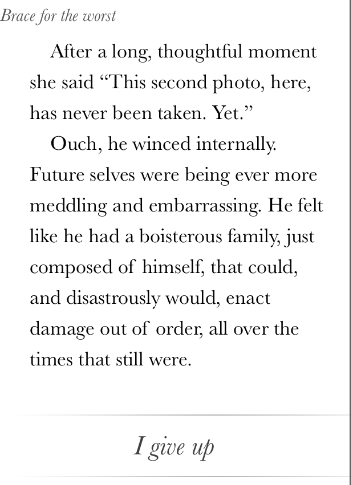
A sample: here you click on “I give up” to continue reading.
Therefore, let me switch reviewer hats and ask: does it hold up as a short story?
Before getting into the plot, I should mention — contrary to the author’s apology in the blurb — the writing is pretty good. I noticed some wonkiness in the grammar:
Outside it was a shabby, and overgrown day, in some metropolis or other, in the years when those fascinating cars, that resembled more horses drawn coaches than anything else, were in fashion.
(Way too heavy on the commas. Plus, “horses drawn coaches” likely should be “horse-drawn coaches”.)
On the other hand, there are parts that could go toe-to-toe with any author, professional or not:
It was the case that he never forgot a good building. They all resided somewhere in his memory, in their own sort of Heaven, surrounded with picturesque valleys and enchanting woods. In life they couldn’t each have their own surrounding park, but he made sure that in his mind they had a grand one.
The story has the form of a traditional detective story; an angst-ridden protagonist is visited by a stranger with a case.
Excerpt here, the angst is due to the protagonist … well, not “killing time”, exactly, but developing a form of energy which uses potential unrealized reality as power. I am unclear why this kills time or has the effect it does (which has the Detective trapped in an unfamiliar universe) but I was willing to let the mysteriousness pass with the notion it would be cleared up later. Unfortunately the clearing up never happens, and I was reminded of one of those dangling plot threads of the TV show Lost with a grand setup leading to no reward.
The mystery is similar: a visitor brings a photo (mentioned in the top excerpt above) which is of herself, in the future. She requests the Detective investigate, although I was not 100% sure what she wanted to know. Again, this might have been cleared up later, but it was not.
The ending involves the Detective departing though “time” I suppose, and has one of those dangling artistic endpoints which can occasionally mark a good short story, but doesn’t work here. In the cases I’ve seen it work, some sort of satisfying action occurred in the plot, and while there might be incidents before and after, they clearly aren’t what the author is interested in nor is it necessarily the business of the readers to know.
I was instead wanting to learn more. Having said all that, if the author plans a sequel I would very much like to read it.
By PaperBlurt. Played to completion using the Chrome browser.
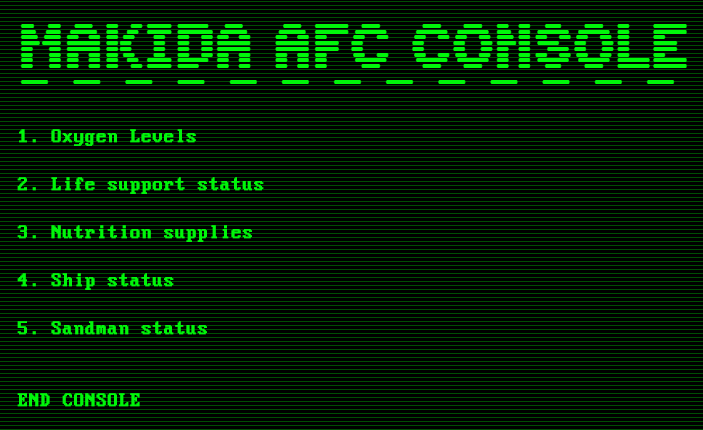
Capsule II involves a long spaceflight where hundreds of millions of people are kept asleep in cryotubes, but a series of “sandmen” are awoken throughout to take care of any problems on the way.

There’s a lot of snazzy changes in graphics and fonts, which is good, because a large chunk of the story isn’t interactive.

(Clicking all the links above simply assert that the ship is okay.)
The protagonist goes along their daily routine and fends off boredom. I oddly found this the most compelling part of the work, because when the accident happens, I started to feel uncomfortable.
.
.
.
.
.
.
.
.
.
.
.
.
S
P
O
I
L
E
R
S
.
.
.
.
.
.
.
.
.
.
.
.
.
.
.
Out of the hundreds of millions of passengers in cyrosleep, a single tube breaks. Heading to the problem, the main character discovers Todd, who awakens and is miraculously alive, but with brain damage.
The main character then treats Todd … badly. I’d rather not recount details, but note this is still in the essentially non-interactive portion of the game.
(“of course I’m not crazy!! I just wanna manipulate people a bit!! nothing wrong with taht, adn Im jstu gald tot haev a freind aigan woh I cna paly wiht adn gte to kown IST GONA BEE SOOO MUTCH FNUUUUUU!!!)
Todd eventually is rechristened is Nilo and disturbing things start to happen. Entire sectors of cyrotubes start to break down for mysterious reasons. Nilo discovers fresh meat and the Sandman cooks it.
There’s a small measure of interactivity near the end, but as far as I can tell, it is token and not where I’d want to have it. I could easily see this being a much better story if
1.) The weird abuse of the mentally damaged Todd was skipped over. He could come out apparently normal but with the same sort of actual strangeness as Nilo.
2.) The interactivity starts far before things get out of control. The player can reject the “meat”. The player can try to do things to confront Nilo early. Perhaps none of those things might work, but as things are designed, the interactivity might as well not be present at all.
On top of that, I found the entire premise far-fetched. Who would design the flight to only have one Sandman awake at a time? Barring the obvious mental problems already highlighted, what if a current Sandman has a run-of-the-mill heart attack? What if there is a problem — not implausible on a giant spaceship — that requires more than one person to fix it?
How is it the main character consumed all the books and movies on the ship so quickly? Was nothing digital? Even just a plow through Project Gutenberg’s current selection would take almost a lifetime to get through.
Would a ship sized large enough to house 500 million people be even remotely practical?
Would 500 million people agree to be watched over by only one person?
By Felicity Banks. Played on iPhone to completion.
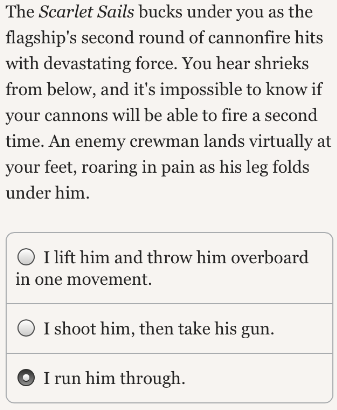
After many IFComp games which subverted their genre premise, Scarlet Sails was something of a relief. It’s a straight pirate romp in a magical universe. It’s in the ChoiceScript engine, and is the power fantasy you’d expect; it’s possible to end by being captain of the largest pirate fleet on the seas.

Scarlet Sails came at the perfect time; struggling to understand (let alone review) the crazy gimmicks I’ve seen so far came close to draining my sense of fun, but this game was a blast. I cranked my gun fu to maxmimum and sailed off to a happy ending.
The downside of being firmly enmeshed in genre is there weren’t any memorable bits of prose. I would like to spend a moment analyzing structure, though.
The standard ChoiceScript format is delayed branching (I’m not even extrapolating here; this is an official statement by the CEO of the company).

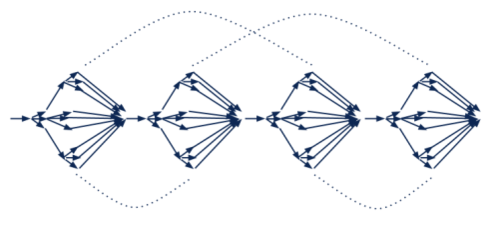
While the “main nodes” reach the same plot points each chapter, decisions in prior chapters can affect later ones. This is done via the use of statistics, and is subtle enough I think the typical “node chart” is underselling the gameplay short.
Here is a straightforward example: early in Scarlet Sails you have a choice between buying certain items (like fresh fruit or a new sword). This drains your selection of gold coins, meaning that if the gold coin count is reduced too much it shuts off options later (like bribery or gambling). Since the options are numerical, it isn’t easy to draw nodes in a cause-effect sense. Maybe there’s enough later to gamble and not bribe, but winning at gambling will allow bribery again.
The items you buy aren’t straight open-a-branch type purchases either; they provide enhancements to various statistics which can make it easier (but not guaranteed) to reach certain plot points.
That is, buying a new sword isn’t necessary to be good at swords, but this decision will need to be compensated for later via sword practice.
Is this sort of numerical adjustment even possible with a straight node chart? If the game was done as a stateless chooose-your-own-adventure book, it would explode into a blizzard of nodes.
Many choices were along the lines of: out of two different choices in chapter one and two different choices in chapter two, if you pick three of them then you’ll have a particular plot point available in chapter five. This sort of dynamism leads to long-term planning and the feeling that each choice has some story effect (rather than, say, the feeling of reading a footnote).
In other words, the combinatorial explosion of choices led more to the feeling of playing a game rather than just reading a story. I don’t necessarily have a problem with the latter (my favorite of the competition so far is very ungamelike), but I’d also rather not pretend two games are equivalent just based on their maps.
By furkle. Played on iPhone. Not finished.
SPY INTRIGUE is a Twine game about someone who enters a futuristic spy school and goes on missions. This is a terrible way to describe the actual feeling of playing.
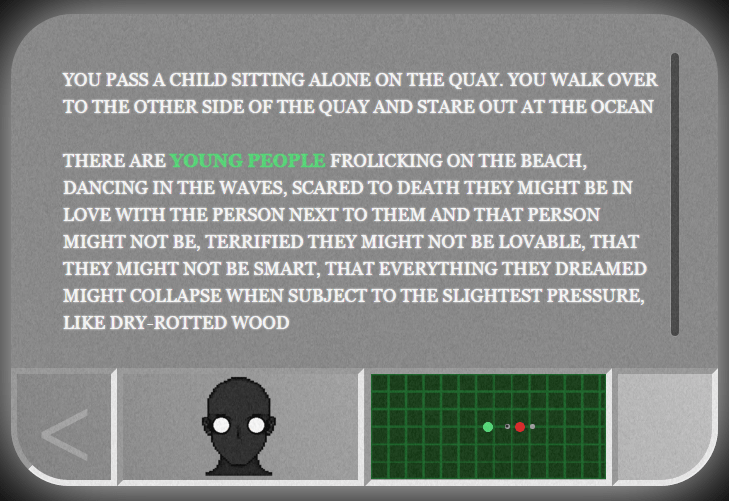
First, to clarify, “Not Finished” is not because I got frustrated or something like that: SPY INTRIGUE is a very long game. After more than two hours I was — I’m guessing a bit here — only halfway. I would have kept going, but the game crashed upon trying to pick the 3rd mission (“SyntaxError: Unexpected EOF”).
I should also get out the way that everything (with an interesting exception) is in ALL CAPS like the clip above. The general effect is not like an angry internet commenter but more like an ancient TRS-80 game or perhaps an essay by FILM CRIT HULK. I’m not sure if the net result was good or bad, but it did allow for some interesting effects where the text read more like poetry than prose.
However, the game also freely mixes high poetry with random humor. The player is the only spy at the school because all of them died of “spy mumps” causing their heads to explode. Instant oatmeal is used as a weapon (OATMEAL TIME OATMEAL TIME OATMEAL TIME OATMEAL TIME). The main character’s attitude is of a stoner out of their depth (who is it one point subjected to actual drugs).
At some points the humor and poetry happen at the same time. The protaganist flies to the second mission on a rocket, and midway thinks they are going to die and goes into a beautiful monologue about the first dog in space … whose name they don’t remember, so they call him “Skywalker”.
So far with all this, SPY INTRIGUE would be a fun and goofy and mostly puzzleless romp, but then the deaths elevate things to the next level. Whenever the character dies the game switches to “no caps” mode and gives a short story:

I am unclear if the stories are meant to be out of the life of a single person or multiple people. The very first one (in a ridiculous whismy part of the main portion of the game) involves a haunting suicide.
The effect was to have me actively searching for ways to die; in a weird bit of gameplay finesse I would backtrack from successfully passed obstacles in an attempt to fail them so I could read another death story.
All this means there’s a meta-level I haven’t worked out yet. I wouldn’t be surprised if it’s all a dream in the mind of an old man who only exists as part of a virtual reality simulation. Due to the length I would recommend SPY INTRIGUE for after the competition; rushing doesn’t do it justice.
By Hanon Ondricek. Played in browser with Firefox. Not finished.
Keeping with the “busting expectations” theme, The Baker of Shireton was what I expected from the blurb (fantasy universe game about a baker who turns into a hero) but there were two crazy wrenches in the mix. One is both terrible and genius while the other is just terrible.
The just terrible part first: the opening scene is a time-management baking simulation. Figuring out the appropriate ways to type the actions I wanted caused intense frustration. I still do not know the syntax for picking up just pans with dough in them; if you put pans in the oven without dough, they simply disappear from the game altogether. I kept having to juggle items in a meta-game sort of way that had absolutely nothing to do with the world itself.
Finally checking the walkthrough:
Baking bread is much easier than my testers made it. Don’t mess with the pans. Don’t struggle with specifics.
The people testing your game are there to inform you when something is wonky with syntax. Fix the thing they’re having trouble with. Your players will have the same trouble. There are multiple appropriate choices here, one being simply jumping in with [You don’t need to pick up the pans; just BAKE BREAD and the pan will get moved to the oven automatically.]
I kept having trouble. Trying to GET BREAD FROM OVEN doesn’t work. Type GET BREAD just would get one bread but not necessarily the one from the oven.
From the walkthrough I learned about TAKE ALL BREAD. Grr! I pretty much gave up on trying to communicate and started to rely exclusively on the walkthrough.
So that was the terrible thing. After the spoiler space I’ll into the terrible/genius thing:
.
.
.
.
B
R
E
A
D
.

.
.
S
P
O
I
L
E
R
S
.
.
.
So the baker is not just in a fantasy universe, but a massive multiplayer game in a computer; he or she is a bread-selling NPC.
The “world simulation” system needs to be exploited to make any progress. For example, it is possible to accidentally set the bakery on fire and die; after doing this, this message comes up on restart:
*Age of Aeons Patch Notes*V.12.017
*Patch#0000009712733094
*Fixed situation in which vagaries of the physics engine
*could cause some buildings in Shireton starting area
*to burn down unexpectedly, breaking multiple
*low-level starting quests. We apologize
*for any inconvenience over the weekend and request
*you contact Customer Service if you
*have any questions. Thanks! -o=O AoA Team O=o-
I fully acknowledge the brilliance of this; restart did not actually restart, because the events of the last life caused the programmers to change the world.
This is on the other hand terrible because I have no idea how I’d figure it out. I always save and restore, restart is an absolute rarity, and there is no clue to the special meta status of restart before seeing the message above.
Even with the extra advice from the walkthrough I didn’t get much farther at all until my 2 hours had elapsed. I’m fine with how character action was communicated, generally (I’m used to combat MUDs with people swarming in text all over the place) but I couldn’t stop picking up the wrong bread or dropping things in the wrong place and when I had something bad happen it was more often because my intent was misunderstood than anything else.
By Moe Zilla. Played using Firefox to completion.
In Forever Meow you are a cat who is upset about an empty food dispenser, triggering a bit of an adventure.
It has a variant choice interface where advancing when there is no choice involves pressing a key rather than clicking a link. This was actually quite a good idea, and I wouldn’t mind having it mimicked even in other circumstances.
You rush toward the bottom drawer, targeting its rim for a mighty pounce from your furry hind paws.
You leap powerfully, as though up into the sky…!
Part of the fun of this sort of game is inhabiting another creature; doing all the meows and hisses and so forth of a real cat. While the game delivers on this front (even letting you do the persistent repeated meow if you like) it lacks … well, the actual feeling being a cat.
This is one of the weird times I think a parser might do a better job; the freedom to be able to >MEOW at any point in the story (not just those given by the choices) or experiment with easter eggs like >PURR or whatnot would lend a great deal to the atmosphere.
There’s likely a way to maintain a typing-less interface while still maintaining the simulation feel, but I’m not certain how. Possibly a series of consistent buttons that can be used at any time? That still runs the risk of the feeling of mechanized responses rather than discovery.

By Brendan Vance. Played with Firefox to completion.
If there is an overall theme I’ve seen so far in the competition (as far as a random collection of work by entirely different authors of different backgrounds can have a theme) it would be “subversion of expectations”.
In the case of In the Friend Zone, I expected from the slightly jokey title and initial quote referencing the “friend zone” (the place “nice guys” get banished to when they get rejected from a more serious relationship) that this game would be an over-the-top metaphor for bad dating. Men Are From Mars, Women Are From Venus in Twine form, perhaps.
While I suppose the metaphor idea isn’t 100% false, it’s delivered in such a surreal fashion it’s more reminiscent of The Prisoner:
“Was the preacher not persuasive? Will you not wait in the pews for their master’s return? Heh. Trust me, Pilgrim: Priapus ain’t coming back.”
The bouncer peers close at you. “Now, hold up a second. Where’s your number? You just gonna show up at The Eye without a number?”
The bouncer wears a shocked expression, yet their eyes flash with mirth. “Is that wise?”
“Tell you what, Pilgrim. Let’s trade faces. You give me your name, I give you lucky number seven. Then you can jump the line.”
After a sustained time of trying and failing to understand what was going on, I entered what I call “zen clicking mode” — randomly picking whatever choices came up and reading the text in random excerpts rather than trying to make sense of it all.
“But then, one day, awaken: realize your dreams were all the same one. The people you desired were all the same person. The appendages you coveted were all the same appendage. The images that filled your blood were all the same image. Recognize the same fragmented mask peering back at you from everywhere; the same howling want you sought to fill with each acquaintance. Feel the shroud of Doom chewing at your guts.”
After getting to the end, I then replayed to try to get a better sense of what happened. It only marginally made more sense.
I’d like to ask some questions about specifics of the story, but a few words on the interactivity first: this is another map with keys-applied-to-locks structure, where the keys are “questions” the player accumulates. There are hence no puzzles, just obstacles and exploration. I found it less problematic than the similar structure of To Burn in Memory because of the simpler geography and the fact the questions aren’t matched to specific locks. Still, it made me wistful: is there a better way to allow geography in a puzzleless game that still requires some measure of exploration to complete the story?
Spoilers — really, more like questions for discussion after playing — begin after the mask:

.
.
.
.
.
.
S
P
O
I
L
E
R
S
.
.
.
.
.
So the protagonist is searching for “{player’s choice of name}” (I’ll refer to them as Bob) but in the first scene they enter a church to Priapus (who “built the walls” of the area of the story) where it seems _everyone_ is searching for Bob. So is this some sort of metaphor where Bob isn’t even a person, but some generalized idea of perfection? If so, what does being a “friend” mean? If not, does this imply there’s an actual person with many suitors, or are all the people in the protagonist’s head and they simply represent different variants of desire?
Trading your name for a “number” in the excerpt above changes your face to a “Nice Guy”. What is the difference between a Nice Guy and any of the other characters searching for Bob? What purpose do the numbers serve? None of the Nice Guys of any of the numbers actually seem to be able to see Bob.
Why are questions necessary to get closer to Bob?
At the ending, the guard says “We didn’t build the walls. They’ve only ever been yours.” implying the protagonist is somehow acting as Priapus, but then says “You’ve come as far as anyone, Pilgrim. Far as Priapus himself, I’d say.” which implies the opposite. What’s going on here?
By Tom Delanoy. Finished three times on a computer using Firefox.

The Insect Massacre casts you as a computer monitoring a research lab; a PhD student named Sally has been murdered, and you switch parts of the lab to monitor as the investigation unfolds.
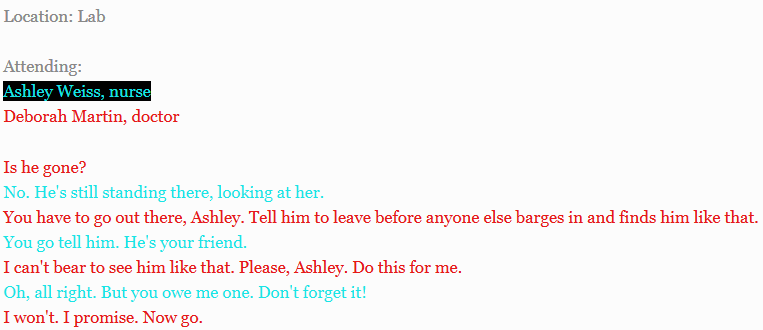
The text is done entirely in dialogue. The most noticeable issue is a delay with each …. line …. being …. delivered …. slowly. It is a bad sign when my gameplay consists of clicking, doing some other chore or switching to another window, then coming back a minute later to continue reading.
Also, an uncomfortable amount of the dialogue is devoted to how beautiful Sally is.
I wish I had her hips.
If you had, you’d be dead now.
You know what I mean.
Sure, but don’t you think it’s morbid?
What?
Being jealous of a dead person.
Hey, that’s not what I meant! I only wish I had better hips. That’s all.
Thus the primary adjective I’d use to describe this game is “awkward”. The awkwardness is doubly amplified by a severe lack of choices. These only occur at the very end, so to discuss them I’ll need the traditional spoiler space.
.
.
.
.
.
.
.
.
S
P
O
I
L
E
R
S
.
(seriously, only read if you’ve already played or have no intention of playing)
.
.
.
.
.
.
.
.
.
.
.
.
.
.
.
.
.
.
So it gets revealed by the options given near the end that the computer itself was responsible for the murder, in collaboration with Sally who killed herself so she could upload herself into the system. That makes it sort of a … love story? However, the only way to reach the appropriate ending is to murder a group of people in the hydroponics bay by locking the doors and shutting off the oxygen. This consists of a sheriff, biologist, and a deputy. If the murder doesn’t happen, a scene occurs in engineering with engineer Soto who wants to shut down the computer to stop getting accused of Sally’s murder, but since Soto doesn’t die in the earlier scene, I don’t see how this particular fate can be avoided. Either a.) it becomes obvious the computer was acting on its own to murder the trio in the hydroponics bay, and gets shut down or b.) Soto still gets accused and shuts down the computer anyway. I supposed the intent might be this is a doomed romance, and Sally and the computer will be deleted no matter what the circumstances, but things were ambiguous enough it felt more like “plot hole” than “tragedy”.
To summarize: The Insect Massacre is a mostly static story with far-too-slowly appearing text and the only significant choice occurring near the end. I find the plot concept as a whole interesting, but the interactivity and endgame needed a better delivery.
By Mathbrush. Played on computer using Gargoyle. Finished without hints or walkthrough.
“Well,” I thought, booting up the game, “if nothing else this will be the first game ever made where you play as a magical flying nautilus.”
It contains a list of items and requirements to travel to your next world. As you continue to read, you realize with surprise that you will not just be travelling to the next world.
You will be creating it.
The main novelty is the world is entirely open on a three-dimensional grid, where the edges invoke different opposites (windy/calm, for instance). Puzzles generally involve floating to particular objects and maneuvering them to a particular environment.
The chunk of red ice bobs upward. It now lies far to the north and far below you.
A lot of work was put into the directions and the fact objects float about, but in practice I found myself typing >GO TO OBJECT a bunch and eventually I was there. I imagine the author spent months getting to code to work correctly to get to the point where it could mostly be ignored by the players (which is both good and sad at the same time).
Unfortunately, the puzzle simplicity also meant I just randomly wandered after grabbing an object until something happened. The player gets “special abilities” but they never get used in any combinatoric way that requires puzzlement; it’s pretty easy to just blast through without thinking.
I still can’t be too hard on a game for being easy, and while the ending payoff is not as powerful as it could be the plot is pleasant enough and the sort of thing that only could work correctly in interactive form.
Some major spoilers on the ending after the shell…

…
S
E
R
I
O
U
S
.
.
S
P
O
I
L
E
R
S
…so I gather the main character has created “Earth” so the last scene occurs after a very, very long life. I was disappointed that nothing could be done with the bathysphere in the way of communication or violence or peace. For me this mute hanging scene led to something awkward instead of what should have been epic.
Perhaps I’m missing some syntax, though? Should something have happened in that scene?
By Orihaus. Played using the Chrome browser. Not finished.
While I was stationed with the colonial forces near the Namib, a visiting British officer had told me that the whole project of colonialism functioned on the same mechanism to a weapon they had, called the Maxim Gun. A beastly thing that could tear a man in half, it cemented their rule in terror — and fired with a unique mechanism: each shot would power the action of the next, an eternal cycle of violence. A machine that fed on blood, where the greatest effort on the part of the operator was to release the trigger.
At the time I considered him an old fool, but here I am — finger on the trigger, hesitant to fire.
-Marcel III : August 2nd, 1907
A confession: I’ve been playing off a randomized list (using this website) and my To Burn in Memory review should have occurred quite some time ago. I kept loading it up, plodding through a few moves, and finding something else to be busy with instead.
I think the issue was I had trouble getting a hold of the genre and setting. Here’s the blurb:
Explore a city that never existed, and uncover its secret history through the memories of a woman that lived its darkest moments.
Ok, fine, we are in “mysterious exploration” mode, but what time period? Is this fantasy or modern or historical or quasi-historical or futuristic or retro-futuristic?
Normally the blurb is not a problem, but then the game starts with:
Behind, paved pathways connected the cardinal points of the circular structure, and at their intersection rose a delicate white tower, starkly contrasting the silhouetted black spires of the horizon. Arcades accentuated the circumference of the terrace, as the sun fell on the water like a scar.
Sharp prose touches, granted, but I still have no idea how to visualize what I’m reading. This description could easily fit any of the settings I listed above.
This state persisted until roughly when German artillery circa 1908 get mentioned, but still I don’t have any concept of what type of architecture is going on and I had to suffer a muddled state of imagining the superimposition of the architecture of ten different cultures without getting to decide on one.
There were watches that seemingly did not tell time. A nice thought abstractly, but what were those watches doing then? I’m reminded of the reflective setting of poetry, but I don’t have to walk through poetry like a room.
In any case, I gave up and just let the mood carry me. I especially liked the mechanic many rooms had to activate a memory — which invoked some sort of personal anecdote about war or the city or some random moment of the past. These were fascinating as vignettes in themselves (see the top quote), even though I often had no idea of the overarching action.
Still, the gameplay got wearying. Even though everything is delivered in a delicious-looking interface involving simple clicking, the entirety of the plot seems to be finding keys for doors. In a way, I’d prefer the keys to be gone to allow pure exploration; as things went, I had to keep backtracking in circles because it was not obvious when I found a key if it went to a door I’d already seen. The lack of a map meant I also ended forgetting which areas I had yet to explore.
Eventually I ran out of my 2 hours of judging time. There’s a lot of prose, and some of it is nice to muse over. I presume there is some sort of ending, but perhaps this is the sort of game where it doesn’t matter; the journey is the point.







 Renga in Blue