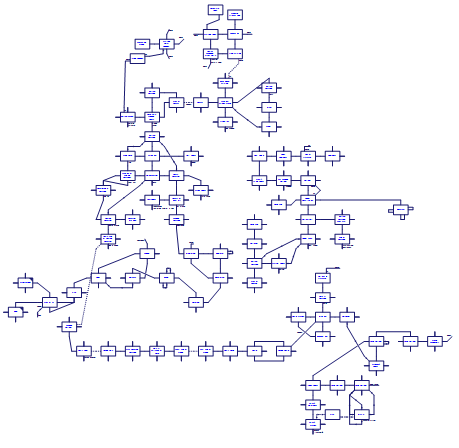
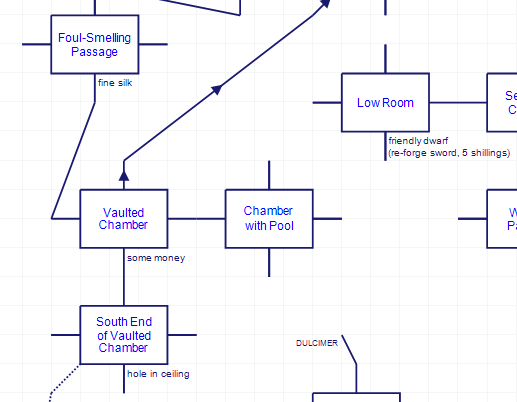
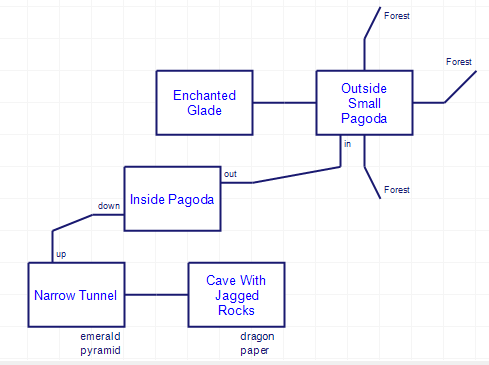
My map in progress; incomplete, but probably not terribly so.
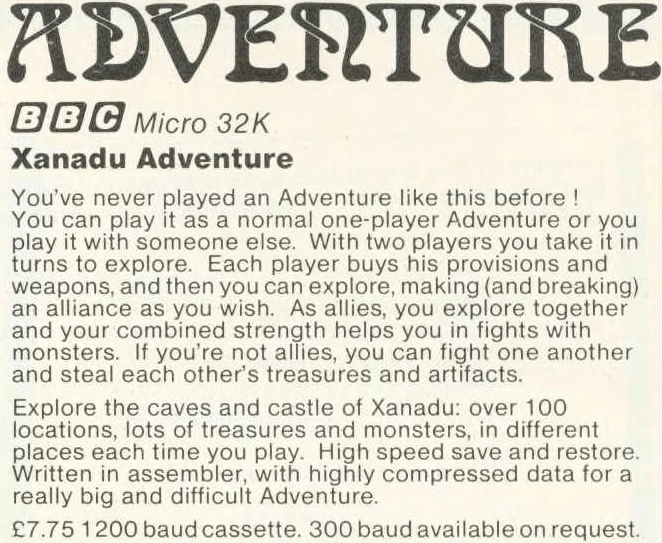
As I mentioned last time, difficulty for Xanadu likely points in a very different direction than Quondam. According to the ad copy for the game there are “over 100 rooms” and I have 95 or so of them mapped, so it feels like I might already have most of the layout of the game. There have been some puzzles along the way but they have all had a very cribbed-from Adventure feel that made them easy to solve. For example:
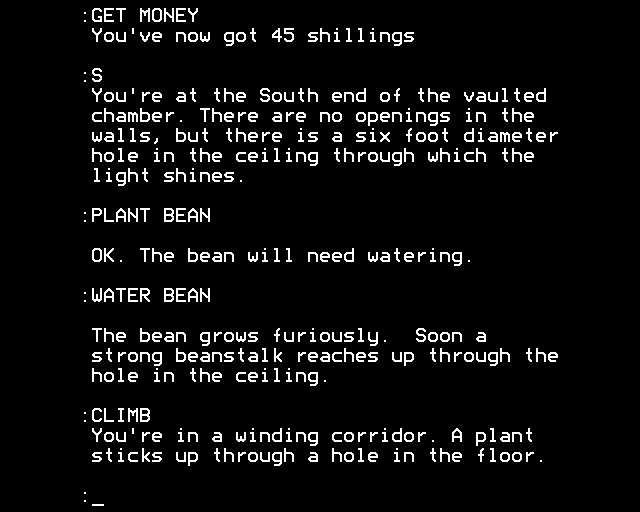
You’re at the South end of the vaulted chamber. There are no openings in the walls, but there is a six foot diameter hole in the ceiling through which the light shines.
It was not shocking to find a beanstalk was needed.
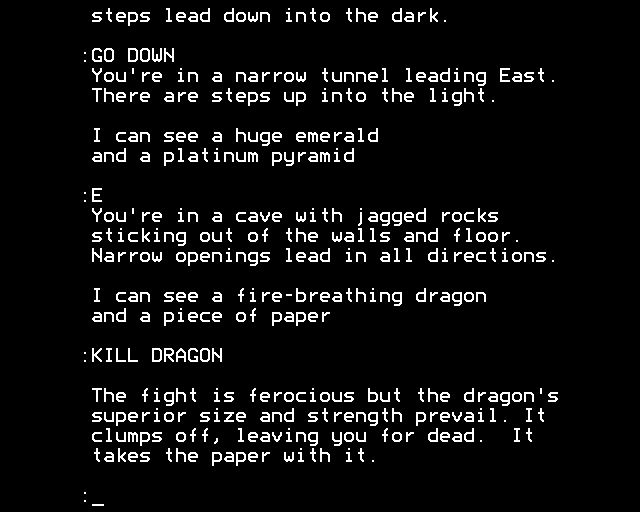
Backing up a little, one of the things I did in Madness in the Minotaur that I now believe was a mistake was to keep iterating on new random layouts for too long before settling on a “final map”. This time I saved my game immediately on my first attempt and kept going to that save, with all the objects already in their places (there’s still at least a little randomization done mid-game, which I’ll get to). This meant I could treat item locations as normal and immutable on making a map. I may still find something in the layout is impossible to reckon with later, but for now I feel like I’ve had a lucky draw, especially given the dragon from last time. Remember I died in two steps? This time I bought a sword and tried my luck, and managed to slay it.
MINH, when used in a nearby “Magic Room”, teleports treasures to the aboveground, and if no treasures are at hand, teleports yourself to the aboveground. It also works to teleport back again. It is, in other words, good for optimizing steps, although I haven’t got to that phase yet.
Nearby the dragon corpse was a small chasm, but help was nearby (at least in my iteration):
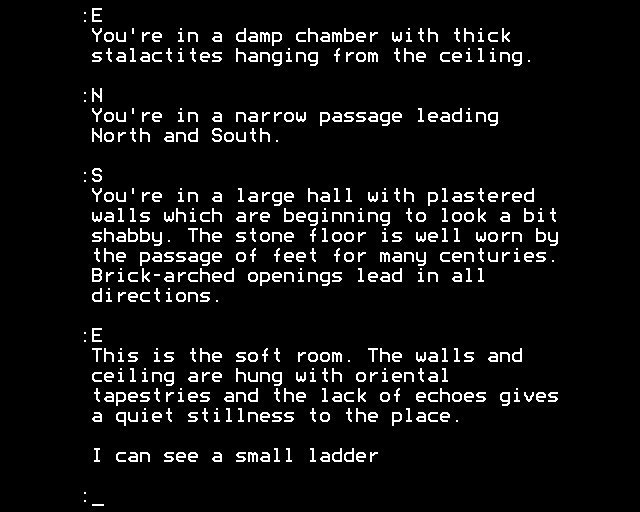
I think the ladder doesn’t have many places it can go, because you get stopped trying to take it down passages going the “wrong way” (it’s described as too big to carry), I assume with the intent to avoid breaking some puzzle later?
The chasm area incidentally had some keys which unlocked the grate I found at the start, so there’s yet another passage to the surface.
Shades of The Hermit’s Secret (except in that game nothing needed to be optimized).
There’s a shockingly tame maze; nothing much to say about it other than I found a “growbag” (needed for that beanstalk earlier) and a “dulcimer” (needed shortly for a different puzzle).
Just past the beanstalk, exactly like Crowther/Woods, there is a door that needs oil. Going even farther, there’s a troll demanding a treasure, although we finally have one deviation, since I haven’t found the FEE/FIE/FOE/FUM eggs and I’m not sure how to toss a treasure to the troll without losing it. I can still preview the rest of the map, though.
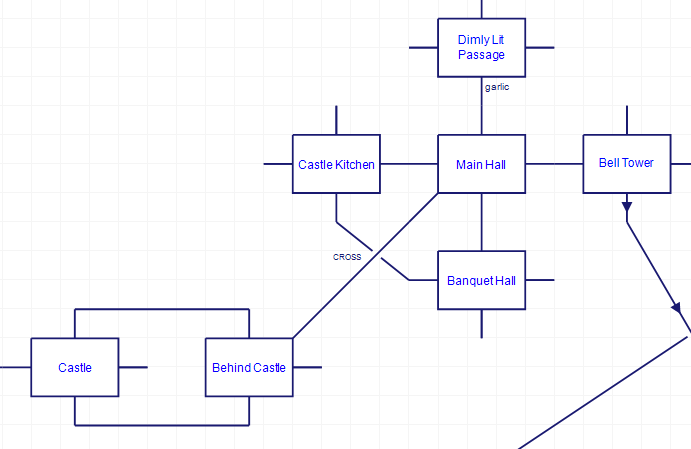
Past the bridge is a castle, with an interesting “trap room” with two phials were one of them says “poison” and the other one says “transporter”.
As far as I can tell, if you drink the poison or not is random, so if you get it wrong you just need to restore a save and try again.
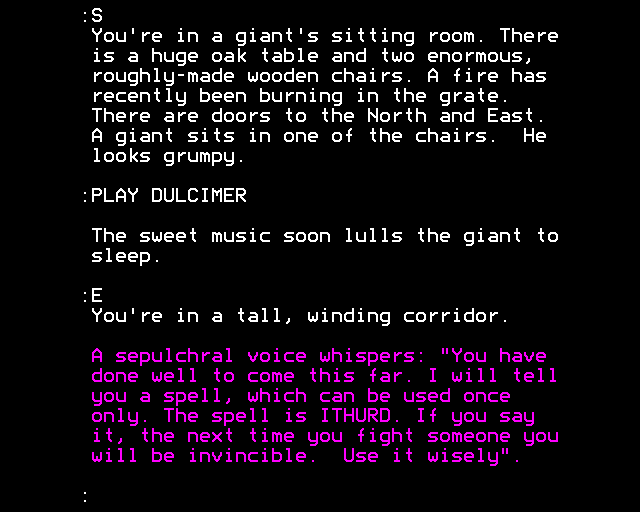
There’s also a giant (…again similar to Adventure, although you never meet the giant in that game…) which can be lulled to sleep.
The magic word you get here can be one instead that teleports you back to safety aboveground. I have one puzzle I haven’t solved yet via “normal” means — a giant cockroach with skin too tough to break through — by using ITHURD instead. I don’t know if that’s “wrong” or just one possible approach.
So far, so standard. If I didn’t know better I think I’d wandered into the most standard Adventure clone we’ve seen yet, but unless various commenters of the past are playing a very long con, things are about to get very sticky as I try to liberate all the treasures I’ve seen. I suspect there’s a lot of under-the-surface difficulties that don’t manifest until I’ve started sending up cargo.
Let me give an example of what might come up. There’s a very short side room trip that’s needed to fill a bottle with water for beanstalk-watering.
Oh yes, there’s a dwarf that fixes broken swords. I have yet to break a sword. The several times I encountered a second dragon (randomly, after the first one with the paper) I straight-up died, with no chance to break anything.
Technically, going in the Chamber With Pool and filling-up takes three precious turns of torch light. Original Adventure let you fill a bottle outdoors, but it’s not possible here because the stream is dried up. But what if there was a puzzle to refill the dry stream, not for any holistic benefit, but just to save the three moves it takes to get water underground? That’s the kind of evil contortion I’m keeping my eyes out for.
Paul Shave (see previously: Atom Adventure, Pirate Island) went for broke with his last adventure, moving from the Atom to the more capable BBC Micro. Back in 2014 he was contacted by Anthony Hope (one of our regular commenters); Paul helped Anthony beat Xanadu Adventure, and as Paul himself stated in this interview:
I’m pretty sure he [Anthony] was the first.
In other words, at the time of release, it was too difficult for anyone to beat. Will it dethrone Quondam as the most difficult adventure ever?
From Every Game Going.
Having built up that hype, I should add the caveat that “difficulty” is not really a linear spectrum and has lots of elements mashed inside. Judging by Atom Adventure (which Anthony Hope claims is sort of a mini-version of Xanadu) the difficult aspects go in a rather different direction.
Quondam involved paying attention to extreme object micro-interactions, and was tightly packed with nearly every action requiring some sort of puzzle to be solved.
Xanadu’s difficulty is in randomization and optimized timing. Regarding the latter, most games — even the evil Phoenix mainframe ones — gave a lamp with a relatively generous lifespan that doesn’t require watching every step. The Paul Shave games all have, on the other hand, given exactly the amount of light needed, and not a step more; this gets to the level of being cautious what entrance to take into a cave as one entrance uses up a precious extra move of light and will eventually cause failure.
The randomization I’ve seen places some objects at random, so despite the absolute optimization condition above, you still have to deal with improvising a path (and Atom Adventure, at least, occasionally gave a literally impossible layout).
Absolutely tight limits and randomization make for an incredibly high-pressure experience. The closest comparison I can think of is Madness and the Minotaur (which I played last year) but while Madness and the Minotaur arguably had even more randomization, it at least tried to provide ample opportunity to “refresh” decaying health and light sources, going as far as randomly spawning a new refresh after one gets used up. I don’t expect any such niceties here.
As is usual for authors still under the shadow of Crowther/Woods, the objective is to gather treasures. As is slightly unusual, the instructions state you need to DEPOSIT the treasures rather than DROP them to get points. The instructions don’t give how many treasures there are or even a maximum possible score.
Before embarking further, I should also note this odd portion from the instructions:
There are lots of dwarves and dragons about. To kill them, you need weapons (you can kill them without, but it’s very unlikely). A sword has a weapon count of 10, an axe’s count is 5. To kill a dragon outright, you need a weapon count of 20; for a dwarf it’s 15, but if you throw an axe at a dwarf you always kill it. Your chances of killing monsters are proportional to your weapon count.
It sounds like all the weapons being carried contribute to your weapon “count” (as opposed to just using your best one), so if you have a sword, an axe, and a ??? you can outright kill dragons, but only have a probability of doing it with a sword. This feels weird and uneasy and I suspect there’s a trick hidden here somewhere.
The “1 or 2 Adventurers” question is interesting, but I’m going to ignore that feature for the moment.
You start in an “adventurer shop”, and no, you can’t just buy two swords right away for some dragon hunting action; the shop runs out. I’m unclear what’s optimal here but I’m the “messing about” portion of my gameplay so far so I’m trying everything out, including the postcards.
Speaking of postcards, I did my usual process for ultra-hard games and created a verb list right away. MAIL is not on my usual-test list but I thought it might work on the postcards.
A few to keep in mind as I move forward: MEND is quite out-of-the-ordinary (only previously seen in Hezarin) as well as SCARE (which I’ve seen maybe twice?) I also wouldn’t immediately think to SING anywhere, and USE being in play means I’ll need to test it in lots of places. Some of the typical magic-item manipulations like WAVE and RUB are out of play, but there’s always magic words.
After shopping, you go out to find a locked grate, Adventure style, and no keys; your first treasure, a ruby ring; and an empty bottle.
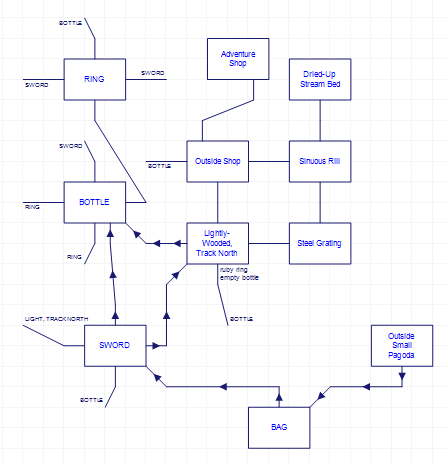
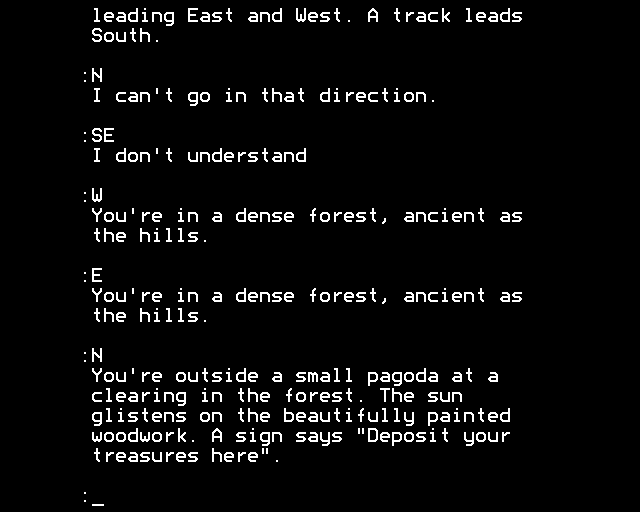
There’s a mostly unmappable forest (I tried, you can see my attempt above, but items started getting moved around and some exits shift at random); the only purpose of going in is to finding a pagoda.
Thankfully for maze-mapping, the “diagonal” directions of NE/NW/SE/SW are not allowed.
In addition to the outside being a treasure deposit area, you can go IN and then DOWN into darkness for what I assume is a random experience. I only got two moves in before getting wrecked by a dragon.
I’m assuming the dragon’s placement is random, and I’d get something less aggressive on a second playthrough. I’ll have to keep throwing dead bodies at the cave and return with a report.
We just saw a one-move game in the May 1982 edition of Softdisk. While we’re going through light adventures let’s knock one more down, appearing in the very next month.
The actual title of the last game we played was The Room, the filename is A.SHORT.ADVENTURE.
As you might tell from the title if you’re a Star Trek fan, yes, this is an original series reference (the Gorn have also shown up in Discovery….?) To get you in the mood, witness Captain Kirk’s hand-to-hand technique in this slow-moving battle from the episode Arena:
Truly unmatched in the history of martial arts using Styrofoam scenery.
Moving on to the actual game, the title screen gives it as “by Anthony Chiang” and “Chiang Mini-Adventure #1”. The mini part is serious: this is very short.
This is almost more text than the rest of the game.
I should put extra emphasis — unusually short. It’s easy with modern gaming to find endless parades of 15-minute confections on itch.io, some even highly acclaimed, but adventure games circa 1982 tended to longer. I assume (given the last game we just saw) the Softdisk format allowed for publishing tiny projects that would normally never survive to us today.
YOU’RE INSIDE THE SHIP’S DOCK
OBVIOUS EXITS:
NORTH
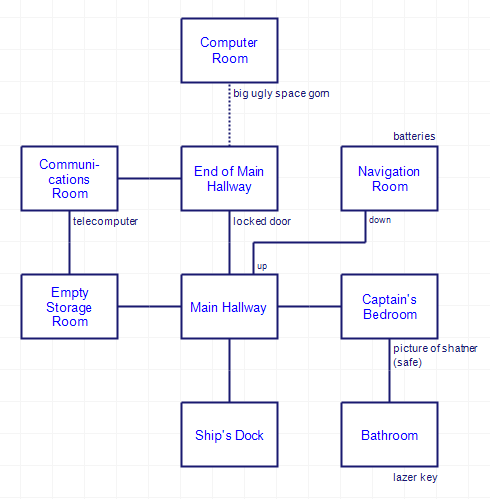
Here’s the entire map:
In one of the Aardvark opuses they’d have everything criss-crossed multiple times with abstruse object interactions that take hours to detangle. Here, you pick up a “LAZER KEY”, walk a few steps away, unlock a door, and find the SPACE GORN.
WITH ONE MIGHTY SWISH OF HIS TAIL THE SPACE GORN SLICES YOU IN HALF. REST IN PIECE.
.
Just missing a few steps along the way: there’s a picture of William Shatner you need to tear down with a safe behind. You can OPEN PICTURE to find the safe combo inside (there’s a hint elsewhere to do this) and find a disintegrator gun. Fresh batteries for the gun are laying around in the open nearby. A quick hop back to the Gorn, and, victory?
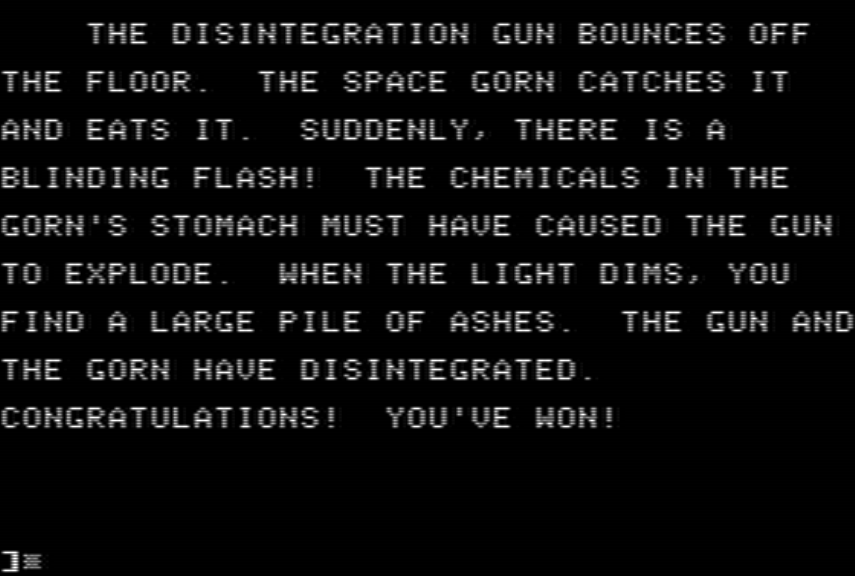
Hmm, at least one catch. Given how little there is to work with … what if we had the Gorn shoot the gun instead? That doesn’t quite work, but the Death Dreadnaught technique works perfectly.
Again: this is, objectively compared to modern games, a minor bit of fluff. But compared to games from the time, intentionally tiny adventures (maybe not action games) are unusual; most self-respecting authors would pad things out with a few more deathtraps or obscure puzzles or at least a maze or two. I have the feeling there are many games like this that were made but — not having an appropriate commercial outlet — were never passed on. The closest comparison I can think of is the early Roger Wilcox work, and the only reason we have those is the author dug up his old tapes and tossed them on his own web page many years later.
And if for some reason the short works bother you, don’t worry; our next game is going to be both long and very heavy and I suspect might be the eventual winner of Most Difficult Adventure of 1982.
Softdisk Magazette we’ve previously experienced with the Daniel Tobias games, the surprisingly clever Planet of the Robots and the unfortunately bland Smurk. They took a hiatus from adventure games after their January 1982 issue until one arose again in May, of a very unusual nature indeed. So unusual, it is (as of this writing) not entered into any games-listing archive. It took major effort to find a copy, as May 1982 is strangely missing from the places I checked; I almost gave up until encountering Softdisk Supreme, a CD with nearly all the Apple II content they ever published (except for some Penguin/Polarware games that had to be removed for copyright reasons).
Having said all that, The Room is Paul Raymer’s only game credit, and only minimally counts as a game. Yet: it somehow accidentally wanders into being the first escape room game (beating the next-earliest candidate by a year), and the first single-command game.
I think most readers are familiar with the former, but let me explain the latter, which is something of a rare breed which only makes sense to talk of with text adventures. The game Aisle by Sam Barlow (of later Silent Hill: Shattered Memories and Her Story fame) is the most prominent example:
Late Thursday night. You’ve had a hard day and the last thing you need is this: shopping. Luckily, the place is pretty empty and you’re progressing rapidly.
The game presents a perfectly ordinary scene in a grocery store, but what’s unusual is then it lets you type nearly any command you might think of. Try to wave at the woman in the same aisle? Lie down and sleep? Rip open bags of pasta and eat them on the spot?
The pasta is a seething mass of off-white food. You tear at the plastic bags until the curls and tubes and twists and shells cascade onto the floor and into your hands. Scooping up a collection of different shapes you cram the pasta into your mouth. It is dry, it is hard. That’s what your body is saying. But you learnt something a while back–that your body (your eyes, your hands, your heart) isn’t always right. No, you’ve learnt to listen to your mind. And your minds says: soft, warm, slightly salty pasta. Tangy sauce. What a feast!
They spoil your fun, they take you away–or so your body says. Your mind knows better; you’re still in Rome eating pasta, drinking wine–everything is fine.
The game is essentially stateless: it simply generates a new story based on your command at that juncture, with no continuation. (The stories don’t even all have a consistent background setting — the main character has multiple possible backgrounds and it picks one depending on the act.)
While I enjoyed Aisle greatly, I’m an even bigger fan of the spoof version, Pick Up the Phone Booth and Aisle (link to play online here).
The Town Square
You are standing in the middle of a pretty town square in the center of a nondescript New England town. Like most any other nondescript New England town, there’s not much to see or do here, but maybe you’ll find something amusing and enjoyable to do.
A shiny metal phone booth sits in the center of the square.
>EAT BOOTH
Ah, yes, the gnocchi flowed freely that week in Venice! She looked at you pleadingly as she bled slowly on the checkered tablecloth, gasping, “My love, do you forgive me?” As you opened your mouth to answer her, a low plooping sound descended and all became black.
Several weeks of hell in total darkness followed, culminating with your joining a bell choir and learning from a young boy how to cook Italian food with moss.
Elegance, Silence, Violence! You wind up sitting alone in a shopping cart somewhere, a lonely old man.
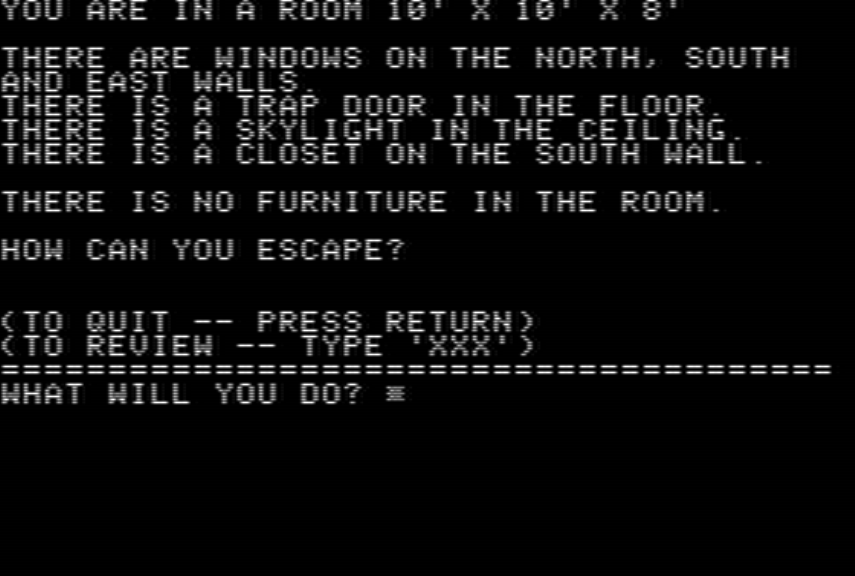
So it is with The Room (1982).
You have one command, and only one, and then the game either tells you about success or failure. Unfortunately, if you try an unsuccessful escape — and it recognizes some wacky ones, like SUPERMAN or DYNAMITE — it just says that whatever you picked “IS NOT THE WAY” as opposed to comedically depicting Superman running into a wall or something. The weird thing is the game could have done this without much extra effort — the author took the time to list a wide variety of escape attempts, and the parser is Eliza-style, meaning it just searches for the keywords, so even sentences work. Without that it’s just the one-off joke of what actually works to escape the room.
Since this is a one-command game, it seems appropriate for me not to spoil the answer here. Please make your best attempt to escape in the comments!
260  REM  THE ROOM

270  REM  A MYSTERY PROGRAM

280  REM  USING ARTIFICIAL INTELLIGENCE

290  REM  BUT NOT MUCH

300  REM  PAUL RAYMER

310  REM  VI/II/MCMLXXX
Into space we go. I missed a few exits, and two seriously random magic word locations. Complete spoilers follow, and make sure you’ve read my other posts first before going on.
My favorite of the Dian Girard book covers. Unfortunately, she passed away in 2017 so I can’t ask any questions about her work.
So I had a nagging feeling I was missing yet more rooms, and indeed I was.
You are standing next to a large ornamental urn on the south-most edge of a lovely terrace.
A flight of stairs leads down to the east.
N
You are at the south end of a wide flagstone terrace. There is a table here with several chairs sitting around it, as if the owner was expecting company.
This region I missed yielded two more treasures, plus an apple that worked on the angry hog I had met earlier who was then my friend. (Unfortunately, the hog did not dig where I thought it would, but somewhere else instead; this was a highly obscure bit I needed a walkthrough for, as I’ll explain later.)
This led to yet another way into the underground. I also found a room in the warehouse with oil I had somehow previously missed; filling my can with oil (as opposed to water, hello Adventure clone) let me make friends with the angry robot.
The robot takes the can, sniffs delicately at the oil, sips a little of it, and murmurs, “Pennsylvania State, 1975. Excellent vintage!” He vanishes through a secret door.
The robot clearing out led to a whole new set of rooms I hadn’t visited, including a salamander defeated by a nearby ice cube:
You are in an alien shrine. Well, not alien if you’re a gnome, I suppose, but it certainly is wierd!
A fiery red salamander blocks your path. The heat from its glowing body is almost more than you can stand.
KILL SALAMANDER WITH CUBE
With what, one lousy little ice cube?
YES
The salamander shivers violently, then sneezes, coughs, and falls flat on its face. It really is amazing what you can do with one tiny little ice cube!
Fairer than original Adventure’s prompt about the dragon; this felt like a question that really was meant to be answered as opposed to an interface glitch.
Besides the salamander there’s a gas mask (that takes care of the spot I mentioned last time where you get dizzy)…
You’re in a somber little room where a marble tomb stands in silent sorrow on the floor. The lid of the tomb has a carved outline of some sort of animal and the simple word, “JENNY.” A withered wreath completes the pathetic picture. The only exit leads west.
There is an old gas mask dumped in a heap here.
…and a bit where I could redeem my green paper from the start of the game for a rare coin.
Off my checklist last time I also mentioned treasure being hidden somewhere by the pirate; this just involved wandering randomly in the Gnomish Vaults until I came across the right place, where there was indeed a Pirate Chest that would not have been there had I not already had my items swiped.
You are in the Gnome King’s dungeon.
A magnificent diamond is gleaming by your feet.
Aha, the Gnome King’s little treasure chest is here.
There’s a vial of rare perfume here.
There is a rare and valuable coin here.
Past here I was really close to done but definitely needed a walkthrough (by Richard Bos, who did amazing walkthroughs for the Phoenix games). The downside is I found out the code for the buttons was 235 without understanding why (it just opens the passage between the two button rooms, so is yet another optional transport-puzzle). It did reveal two parts I would have not worked out alone under any circumstances:
1.) At a “curtain room” in the underground you can type PIRATE to get to a secret room. I worked out on my own I could type WATERFALL to go to the outdoor waterfall and CURTAIN to get back again — these are both off the list of words I had in my earlier post — but I never saw PIRATE anywhere. Even stranger, is while in the secret room, you can get to a second-level secret room by typing JENNY (see the tomb above). Even knowing the existence of the word, why would anyone think to type it there in particular?
PIRATE
You are in a secret room.
A jeweled Gnomish shovel has been left here.
JENNY
CONGRATULATIONS! You have found the Supersecret Room!
A platinum figure of a burro is standing here!
2.) Nearby the curtain room there’s a muddy room. This is where the hog/pig is useful. There’s no real prompting for this to happen, but it’s at least semi-logical:
You are in a room with a big oozy mud puddle in the middle of the floor. The walls are wet, and strange fungi fill the crevices and corners. Exits lead north and west.
DIG
As the pig roots around happily in the muck, its snout turns up a magnificent pearl, as big as your fist!
Taking all the treasures back, and waiting very briefly, leads to final victory. Remember the nosecone of the rocket? It launches on its own once all the treasures are present.
There is a great rushing sound, and a tremendous sense of force and motion. Through the porthole in the nosecone you can see the earth first dropping away and then rushing up to meet you! The rocket lands gracefully in front of a cheering throng of people. As you climb out of the hatch, they rush up to escort you and your treasure through customs and into a life of health, wealth, happiness, and celebrity!
The game possibly outwore its welcome by a smidge, but I do appreciate the ambition of it. There were so many linkages and passages and extra passages and secret passages and optional puzzles I lost count of how many ways there could be to reach a particular area. The walkthrough I mentioned earlier doesn’t even list the WATERFALL password, or the one using the memory room.
Perhaps the most interesting thing is that the alternate routes started to get to be too much? I’m not sure why that happened, given Zork does something similar, and I never felt trouble there. Something about the Zork geography (and lamp time limit, which I never ran into with Hermit’s Secret) made for an extra feeling of danger, and extra feeling of gratification when I had more entry points. Here, realizing there was yet another magic word that worked in a random location started to feel … random. The universe just wasn’t quite tight and convincing enough for me to understand why JENNY led to a supersecret room with a burro.
A clip from Richard Bos’s map.
Still not bad for a first game, and since this is a first game, not just a one-off, we’ll get to visit Dian Girard again in 1982. But for now, let’s move on to a new discovery I recently made which marks a significant first in adventure games (or at least, the earliest of a type anyone has ever found).
In addition to being a member of a science fiction club, Dian Girard wrote books and stories herself.
This is from a 1974 volume where authors were asked to write stories predicting the future of 2020.
She published a number of short stories earlier in her life (including one from the collection above) and a story entitled Invisible Encounter from a 1982 collection (the year of this game). She later wrote a set of sci-fi/comedy books. Here’s the description from Hypneratomachia (2009):
Hard on the heels of the side-splitting, hair-raising bestseller Tetragravitron, comes an all new adventure of Captain Spycer, that voluptuous, redheaded, space heroine, and her trusty crew–robot Peter Decade, scaly red Col. Krabchake, lewd and lecherous Prof. Groppe, and that wide-eyed innocent Brian Lefarge–are off to save the universe in their cosmic-powered ship. In this new challenge, our stalwart crew is looking for the evil masterminds behind some mysterious force that sucks the power out of stars, leaving their satellites frigid and lifeless.
As you might have guessed, they also lean on the bawdy side, making it possible that the mysterious unnamed sixth game she wrote is the infamous Granny’s Place, also published by Temple Software and using the same system as the other games. We’re save worrying about that for a future day and dive back into the underground world of The Hermit’s Secret.
My actual gameplay of late has not felt like narrative, but not like puzzle either. I’m not sure a good analogy, but let me describe in two ways:
a.) you’ve figured out how to map “standard” mazes in adventure games before, and drop a bunch of objects and fill in spots; there are no twists. You aren’t really doing a puzzle, and it certainly doesn’t come off as some kind of narrative: maybe an “activity”?
b.) you’re writing a research paper about genealogy. You are studying various family trees and following them back and finding connections. This isn’t a puzzle, really, but it certainly isn’t a narrative, even though there’s an “implied narrative” in the process of parents having children. It’s not drudgery and perhaps even kind of interesting.
My gameplay in the last few days have been a little from columns a and b. Even though there’s been a puzzle or two, they’ve been quick solves, and really, all I’ve been doing is taking the three distinct underground maps and trying to merge them together. (Kind of four, but the sequence I figured things out led me to already know how something was connected the moment I found it.)
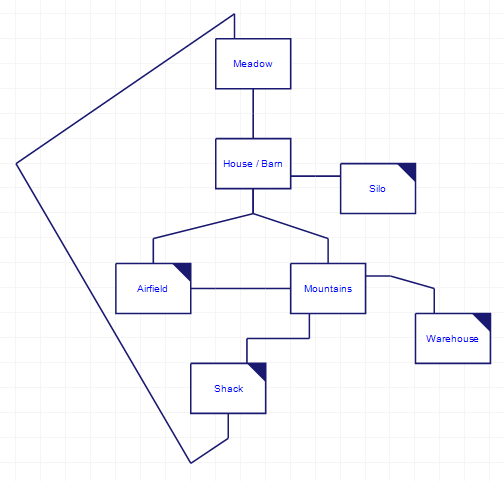
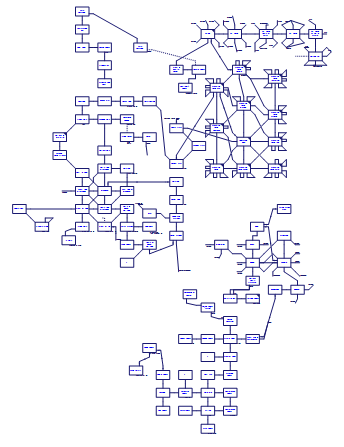
To explain, let me first update the meta-map from last time:
Now there are four entrances to the underground, all marked as shown. The “silo” was next to the barn, and I thought it might be an isolated puzzle when I found it (that is, getting in would lead to a single room but no extra exits or geography):
You’re standing in front of a large tall stone silo.
There is a small black box by the door. It seems to be a voice print lock of some sort. Paths lead in most directions.
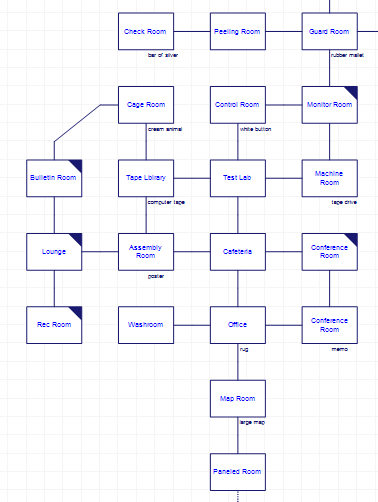
I found out how to get in by wandering the “bureaucracy area” from last time. One room has a tape; another, a tape machine, and in yet another, a presentation room with a button. Spooling in the tape and pressing the button gets a curious message I still haven’t fully deciphered:
This is a large control room. There are big switches and even bigger machines all around you. Exits go south and east.
There is a glowing white button in front of a display screen. The screen says “ACCESS RESTRICTED – CONFIDENTIAL” and has a list of words: CURTAIN WATERFALL DAVE SHACK REMEMBER MEADOW.
“Dave” seemed like a distinctive word. If you go in the underground through the shack (which I’ll go into detail on later) there is a sign from “Dave” talking about claim jumpers being shot, and I suspect he’s supposed to be the hermit of the title. While back out at the silo (I just started a fresh game) I tested each of the words off the list and DAVE hit paydirt.
You are inside the silo door.
A broad curving gray surface fills the room from top to bottom. It is about ten feet in from the outer stone wall of the silo. There seems to be a doorway in it some distance to the north.
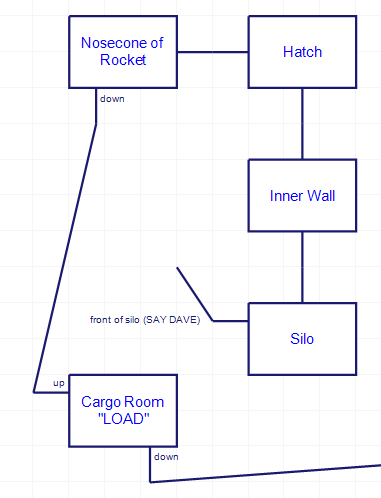
This turns out to be only a few rooms away from the nosecone and the cargo room from last time where all the treasures go. This makes it really convenient to use the treasure stash and pop from there either back outside (with the DAVE word) or inside (through the bureaucracy area).
In case you’re curious, here’s my current latest haul, although there’s a bracelet and fossil I know I haven’t bothered to tote back yet. (Also, there’s still a glass treasure that shatters; it is possible the rug is soft enough to absorb it? I also found a fur muff at the end of my last session that might work to keep it from breaking.)
There is a lovely emerald here.
There is a wonderful little jeweled airplane here.
A magnificent diamond is gleaming by your feet.
A valuable erotic etching has been left here.
An expensive ruby necklace is lying here.
A very valuable stamp is lying here.
There’s a beautiful — and expensive — gold ring here.
There’s a nice persian rug on the floor.
There’s a big bar of silver here.
Despite the list building nicely, I feel like there’s a lot of map to go. Before I start showing off pictures, I want to explain that any “corner mark” that you see represents a room where I’ve tested exits. That is, I didn’t just trust the text (or at least my own reading skills) to put which directions I could go, but did every possible direction possible to see which would work. The game is generally good about listing directions but I did have one spot (in what I’m calling the “third underground”) with a “secret exit”:
You are standing by an immense stone idol. The fantastically carved vaults of an ancient temple stretch out to the south.
NW
Sorry, there’s no way to get through in that direction.
You are standing by the Great Idol.
SW
Sorry, there’s no way to get through in that direction.
You are standing by the Great Idol.
SE
You have found a secret staircase. Dark openings lead north and northwest from here.
Perhaps the author only put one, but the presence of one (and my own downfall of forgetting to mark exits) made me check all of them, and there were a few that were only vaguely described which I might have otherwise not have gotten.
Having gotten that out of the way, let’s finish off the bureaucracy section:
Other notable locations include a “cage room” with a mongoose which you are able to pick up assuming you have an animal cage from elsewhere (one of the other “undergrounds”)…
You’re in some kind of animal care center. Empty cages, their doors hanging ajar, line the walls. Some of them are small, and others are disturbingly large.
A pretty little cream-colored animal with a bushy tail is sitting on the floor, looking at you.
…a “map room” which is clearly meant as a meta joke…
You are in a large room full of charts and graphs. Corridors lead north and south from here.
A large map completely covers the west wall.
READ MAP
Well, it’s sort of hard to describe. It has a lot of little boxes on it, connected by lines, with names like “Steep Path,” “Grassy Meadow,” “Rocky Tunnel,” and so on. Very odd, really.
…a room with buttons where I am unable to refer to any of the buttons…
You are in the Check Room.
There is a large panel in the west wall. It is firmly shut.
Next to the panel are ten buttons labeled 0 1 2 3 4 5 6 7 8 9.
…some minutae like a rec room and lounge which make the life of the dungeon keeper feel black and dreary…
You are in the employee lounge. There are chairs and tables, a small microwave, and all the usual things.
Exits lead north, south, and east.
S
You have reached the recreation room. There are some old ping pong tables here, and a dartboard without any darts.
There is a doorway north of you.
…and a robot blocking passage to the south. I have a theory on how to get by but I haven’t had time to test it yet.
You are in a large paneled east-west hall. It’s quite fancy, with carpet on the floor and indirect lighting.
A huge, heavily built robot rolls menacingly around the room, sensors blinking, and refuses to let you pass.
Importantly, on the other side of the robot is one of the other undergrounds, the one reached by entering from the shack.
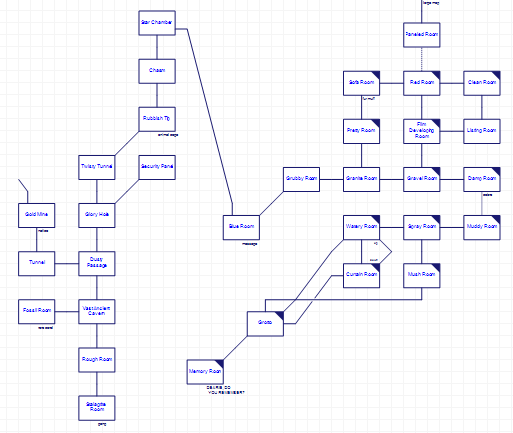
This second underground is enterable from the shack guarded by the thirsty dog — this is where the warning sign from “Dave” appears.
You are at the entrance to an old gold mine. A dark rocky tunnel leads off to the south, and there is a ladder going up to some higher level.
There is a notice nailed up one one wall.
READ NOTICE
“Claim jumpers will be shot on sight. This means you!”
It’s signed by someone named “Dave.”
Oddly, enough, there’s a heavy gong in one location. It is to the south of an unsteady bridge where the game specifically calls out a weight limit, and to the north there’s a hint that a gong is needed in a particular place:
This is a lovely little room that looks like some kind of beautiful luminous blue jewel inside. A narrow opening heads off to the northeast, and a smooth path leads upward.
There is a message scrawled on the stones. The walls shine with a lovely irridescent glow.
READ MESSAGE
Some demented person has scrawled on the floor “Bongo, Bongo, Bongo, I Don’t Wanna Let The Gong Go.”
This suggests to me that the gong needs to go up out of the Gold Mine Underground and back through the Bureaucracy Underground in order to fulfill its destiny (which requires beating the robot).
There’s otherwise simply a lot of geography to trudge through, leading down to a very curious “memory room”, which feels like it came out of a Phoenix mainframe game (and I also have no idea what to do with it):
You are in a small, many-sided room. There is an obvious exit to the northeast. Some roughly carved letters on the south wall say “DEARIE, DO YOU REMEMBER?”
I should finally mention there’s got to be another link between the second and first undergrounds, as there’s a button room that’s a clone of the previous one I mentioned (“ten buttons labeled 0 1 2 3 4 5 6 7 8 9.”) I would suspect an elevator but the game doesn’t even recognize the noun “button” so I’m at a loss as to how to operate it.
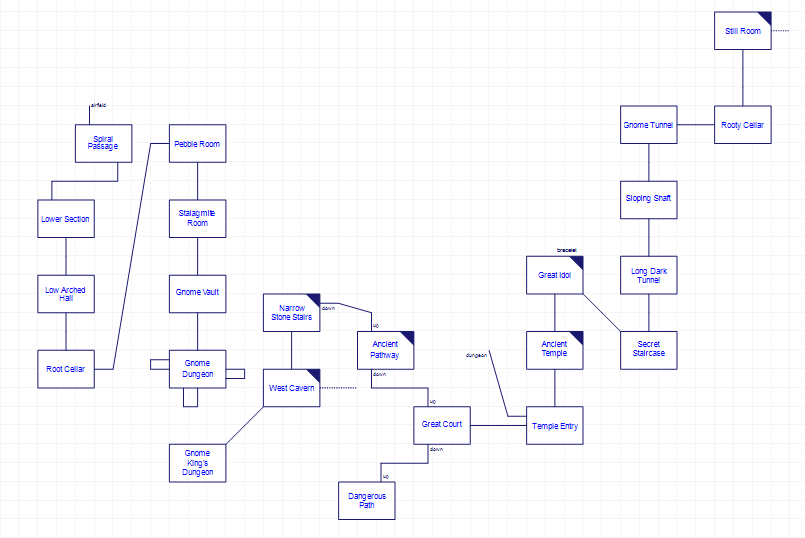
The third underground (which I’ll term The Gnomish Underground Empire) comes beneath a air control tower at an airfield.
The Gnome Dungeon represents a maze of some kind which I think has randomization, so I’m likely just going to save mapping it for when I’m desperate; sometimes it connects to the “Gnome King’s Dungeon” which I have placed below it.
I haven’t been able to connect this one up, although I assume there’s a link somewhere.
Also present is the “secret stair” I referenced earlier; it leads to a “still room”, and testing one of the directions there gave a unique response indicating there’s a secret passage somehow.
Tree roots have grown down into this room, piercing the ceiling and walls until it looks like a forest inside. There are exits leading north and west.
N
You are in a neat square room with an odd device in the middle of the floor. It has a big metal container, some copper tubing, and smells like something gone sour.
The only visible exit goes south.
E
You bruise your head painfully on the rock wall.
Again, there isn’t so much “obstacles” as much as “stuff I haven’t finished mapping yet”; there is one abyss I can’t get across, but the room description suggests I’ll reach the other side from some other route rather than finding a way across as if it were a puzzle.
You are at the west end of a gigantic cavern. The towering walls remind you of some sort of gothic cathedral, and your eyes peer vainly upward in an effort to see the ceiling. Faint wisps of mist eddy around you like lost souls. A narrow opening leads southwest, and the cavern stretches out to the east, where a bottomless abyss crosses the floor.
The abyss effectively blocks you from crossing the cavern.
I have intuition I’m closing in on the “exploration stopping point” — where I’m doing finding new rooms just by virtue of wandering and now need to look hard at what puzzles remain and what objects I have access to and start finishing the game. Every time I look there’s been a new area, so I’m not going to bet on it; the author was clearly fond of the “imaginary landscape” portion of Adventure (terminology she uses in the PC Mag article) and since she didn’t have her notions filtered through the technical limitations of Scott Adams TRS-80 games, she kept to the same hundreds-of-rooms mentality as original Adventure without compromise.
The Los Angeles Science Fantasy Society is one of the earliest “fan clubs” for science fiction, founded in 1934. Their clubzine, De Profundis, was first published in 1957.
One of the members, Dian Girard, is the author of our game today, and significantly, the author of five more games after: Phantom’s Revenge, Castle Elsinore, Monster Rally, Valley of the Kings, and one we don’t even have a name for. I say “significantly” because she seems to be the first woman who was also a “solo author” to have produced multiple adventures. The one-off Miser from the previous year was by Mary Jean Winter; Roberta Williams and Alexis Adams both worked as part of teams (although Alexis did get sole credit for Voodoo Castle) and the other women who have come up so far have been co-authors (like Christine Johnson with Mad Venture or half the team that made In Search Of… Dr. Livingston).
In other words, she was one of the multi-game auteurs at the time, one who, like Scott Adams, produced an article for outlining her methods. There’s a fair chance you haven’t heard of her — beyond the current modern obscurity of text adventures — because her work was originally published by a company not known for games, Norell.
Norell was one of the very early publishers focusing on DOS, and if they’re remembered for anything at all now it is their Pack & Crypt software, essentially the first widespread compression format. Unfortunately (for them) they charged for both compression and decompression utilities, whereas others made their decompression products free, so while it had been well-poised to become a format suitable for the BBS age and the ascent of IBM-compatible clones, they were essentially dead by 1986.
From PC Mag, Feb-Apr 1983.
But back to games: a summer 1982 catalog listed Original Adventure, and two of the Girard games were out by the end of the year.
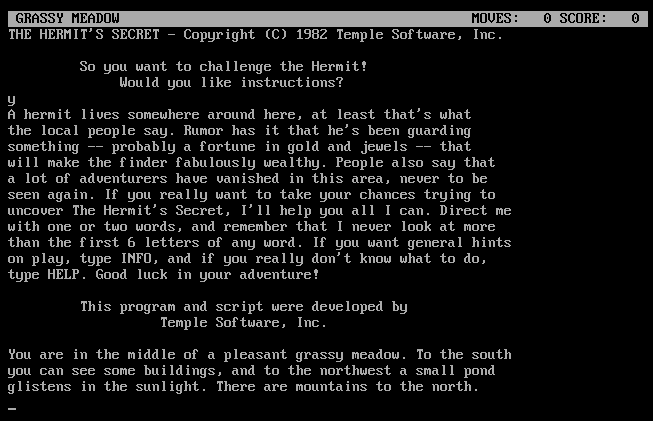
The Adventure port is of note because Gillogly originally did one extremely early using the C language (1977 while at Rand, later it went in the BSD Unix compilation) and it looks like the Gillogly/Billofsky version is simply a port of that. It’s also of note because The Hermit’s Secret has a strong foot in Original Adventure to the extent it might borrow some code elements (it keeps variants of dwarves and the pirate, for instance, although heavily reskinned). There clearly was also some influence from Infocom, as you can see from just the screen layout:
The screenshot is from the re-published version by Temple Software. No Norell versions are available anywhere and that means the two games Temple never picked up (Monster Rally and Temple of the Kings) are currently lost altogether.
That’s the iconic static status line “moves” and “score” dropped in the corner, there. The parser also accepts some element of full-sentence parsing — you can FILL CAN WITH WATER, for instance — but not everything as it does not accept (for example) TAKE ALL.
As implied from the ad-copy earlier and the title screen, and especially by the derivation-from-Adventure feel, this is a treasure hunt, and as the INFO screen of the game informs us all the treasures go into a room with a sign marked LOAD. It took me a long time to find this room, because the game is quite large. Essentially, the main design decision here is to have, just like Adventure, long descriptions which can’t (generally) be referred to, and where the only items where interaction works are separated from the text. This allows a lot of text without much cost (unlike Infocom, which had to bother describing things with the EXAMINE command).
You are walking along beside a merrily bubbling stream. There is a high cliff north of you, and there is a small path to the southeast that winds down the side of the mountain.
N
You are standing at the bottom of a waterfall that cascades like a white veil down the sheer cliff face. A steep path goes northeast from here, and another path leads south.
NE
You are on a steep path that forks at this point. You can go north or east into the mountains, or to the southwest where a waterfall cascades down into an icy mountain pool.
On the three descriptions above, you can fill a container with water, which solves an early puzzle, but otherwise the rooms are there for trekking by and making a map.
The above is what I have so far, a great deal of which is outdoors; I’ve only solved an absolute minimum of puzzles. Much of my time was spent wandering and checking exits. For example, there’s a “mountain” area which doesn’t look so terrible once laid out, but was sufficiently maze-y with “loops” that I had to drop objects in each room and test every possible direction.
Also, one of the exits randomly goes between a choice of two rooms, which is guaranteed to give me a headache.
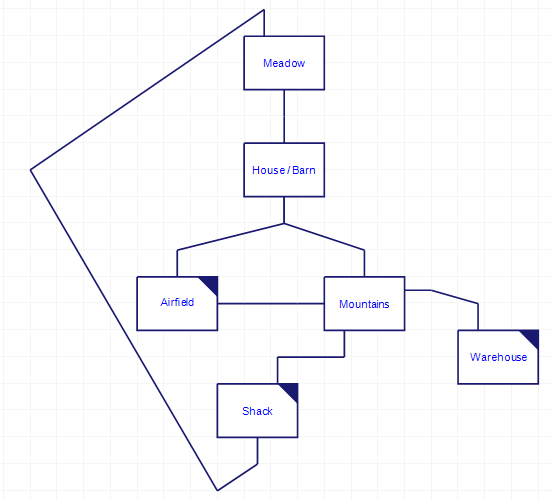
Here’s a metamap of the general layout:
The most confusing thing — and it took me genuinely an extra 15 minutes or so to reckon with it — is that going north far enough loops around; that is, you can start at the Meadow and take northward directions to eventually loop back to the Meadow without anything particularly mazelike on the way.
The three marked places (Airfield, Shack, Mountains) all have passages leading into darkness, and that’s where the underworld part of the game is. To get into any of them you need a light source first, which requires entering the shack by solving a minor puzzle with a thirsty dog.
You’re at the hermit’s shack.
There is a large dog, panting slightly, lying across the the doorway. He eyes you with interested anticipation. There is an empty water dish sitting next to the shack.
POUR WATER IN DISH
The dog laps up the water, wags his tail in a friendly manner, and then wanders off to lay down under a nearby tree.
Other than the lamp, there’s a megaton of other items, including treasures, all lying around in the aboveground.
gold ring, ruby necklace, crystal sphere (breaks when you drop it, like the vase in Adventure), emerald, jeweled airplane, valuable etching, keys, a rare stamp (found by using the keys to unlock a mailbox), green paper (“Gnome Industrial – One Unit Voucher”), card (which says “Gnome Industrial” and has a brown stripe)
Two hours in I finally made it to the underground — passing through the warehouse on my meta-map above — and found a bureaucratic complex.
You are in a small conference room. The walls are painted standard off-white, and the furniture all looks rented.
The only exits lead west and south.
S
This is a rather large conference room. The walls are paneled with golden oak and the furniture looks quite expensive. There’s even a built-in bar at one end. One exit goes north, and another leads west.
A yellowing old memo has been left on the floor.
GET MEMO
An old memorandum
Okay.
READ MEMO
“ALL LAB PERSONNEL –
Be certain that megarat cages are securely locked, and all lights are left ON at the close of your shift. In event of a megarat escape, close safety doors immediately and notify Plant Security. These animals are dangerous. Take no chances.”
(Megarats are the “grues” of the game and keep you from wandering around in the dark.)
This setup feels like it’s trying to do something akin to a Zork parody, but with some Adventure-style characters still tossed in. A “very short man in a brown business suit” tries to kill you with an axe, and you have later encounters with “assassins” who you need to kill with the axe. Unfortunately, your aim isn’t great, so it’s quite possible to miss and die without being able to do anything, but here’s what happens when things go well:
You killed a small dark-robed assassin! No sooner does he fall to the ground than six little men in dark suits run out and snatch up the corpse. A moment later a little black hearse labeled “Utter Gnome” roars by and vanishes into the darkness.
There’s also another gnome which scarfs treasures (both in your hand and off the floor) and spirits them away somewhere, just like the pirate/thief.
The very last thing I found in my play session — and it seemed a good stopping point to come here and communicate with y’all — is the room where treasures go.
A broad curving gray surface fills the room from top to bottom.
A slender ladder leads up the surface to some higher level.
U
You are in a cargo room. There is a large bin against one wall, and the word “LOAD” is stenciled on its side. Exits lead up and down along slender steel ladders.
U
You’re in the nosecone of a rocket. A fascinating array of dials, buttons, and switches are set into a control panel in front of a comfortably padded chair. A steel ladder goes down to the cargo room, and a smooth steel corridor leads east.
The treasures go in the “cargo room”. The positioning below the rocket makes me wonder if for the endgame, rather than random getting teleported to an endgame area, our objective will be to take off into space. Because riding into space toting a hold full of treasure would be… awesome? I guess we’ll see.
With the exception of one very difficult puzzle and one slightly odd action (I needed hints for both) this wasn’t terribly hard; perhaps the most interesting thing about the game (other than the technical aspects I’ve already remarked on) is the main quest itself, which involves taking a sword only a small distance from one place to another. There is something sanctified about the act.
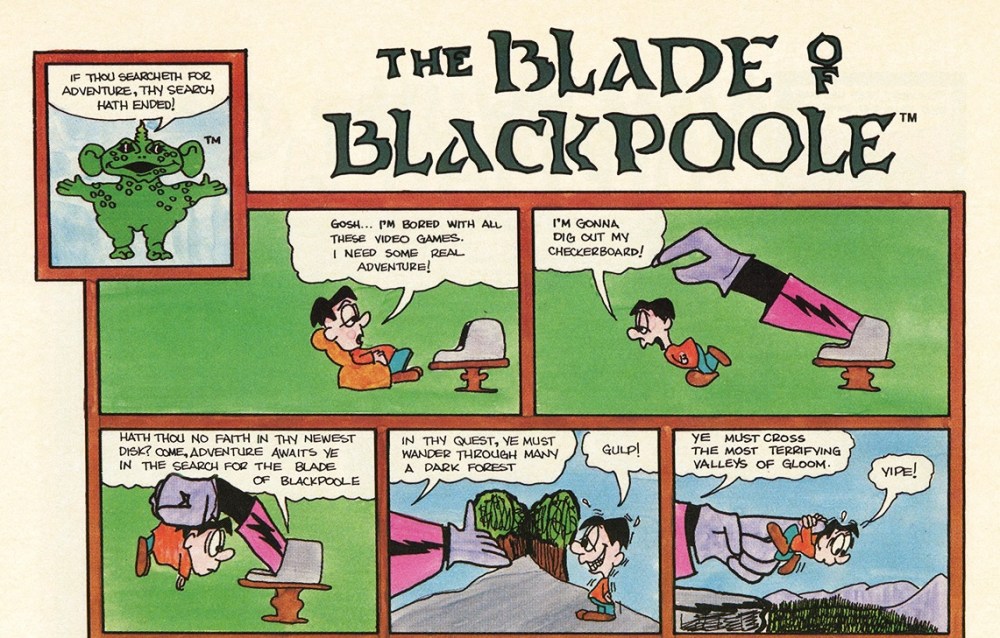
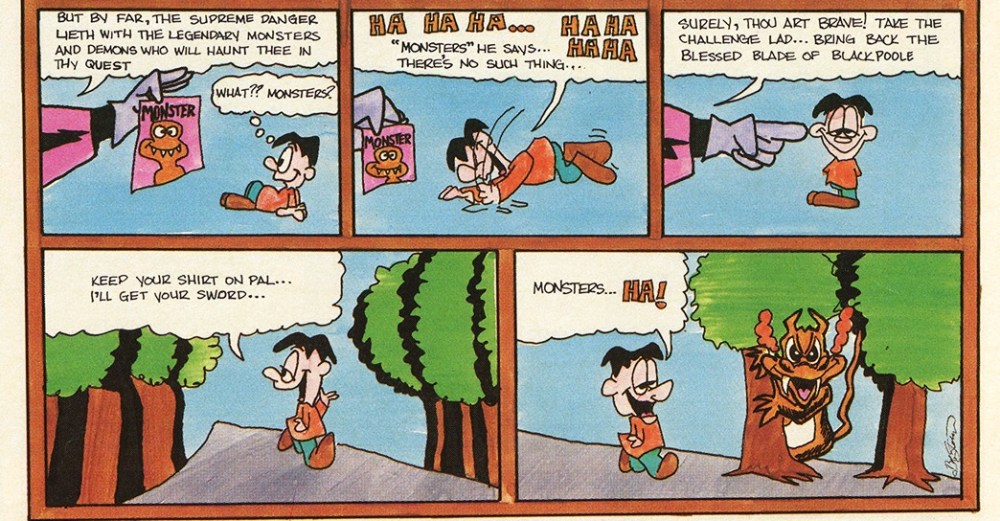
The comic writer for the ad is confused here: you’re not “bringing back” anything, just restoring the sword to its rightful place.
Continuing directly from last time, I had a monster in a river, and I was quite stuck.
Moving forward another hour, I was still stuck. The game has a built-in HELP feature so I tried it and the game told me to keep the monster smiling. Moving forward yet another hour, I was still (still) stuck. It was time to unleash outside-the-game hints.
I found out that I had missed one item. Back at the tavern at the start you can spend one gold coin to buy some ale. This means, incidentally, you can’t buy all the items in the shop (to recap, that’s knife, staff, lamp, pole, honey) but need to leave at least one off. Since I had already used the other items, I restarted and avoided buying the knife, and spent 1 gold coin on the ale instead.
The ale is still somewhat tricky to deliver — GIVE ALE TO MONSTER just has the game claim the monster is too far away. The trick it to simply pour the ale into the river, which works (!?).
I feel zero guilt about spoiling this puzzle.
Fortunately, the rest of the game went much smoother. I was able to get the boat out to a lake with an island in the middle. I still had the magic book and the prayer (SOLOCIN) I hadn’t used, so it was not hard to find the first right action.
The second right action which I did not find on my own — but I’ll just explain here to save time — is that you are also supposed to GIVE BOOK to the statue, and you’ll get a key in exchange. I’m not sure if this is unfair or not.
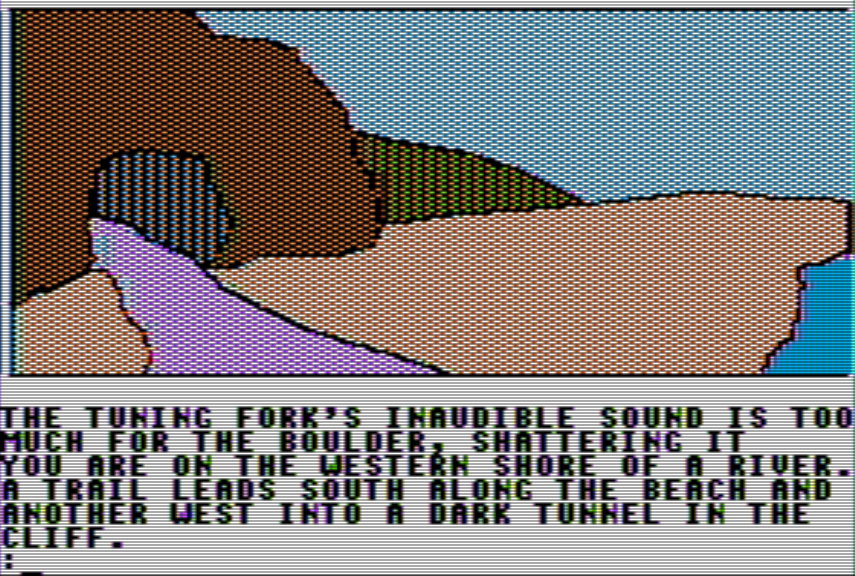
Going back to the clue from saying SOLOCIN, I think what it is cluing is a boulder not too far from the island which you can break open by hitting it with a tuning fork (found nearby the start of the river).
Dale Dobson somehow solved the puzzle by accident without realizing the tuning fork was causing the boulder to implode; he had just tried to GO WEST and the action happened automatically. This is interesting in a theoretical sense, since using the item automatically ought to be helpful and more friendly to the player, but if the jump is too much it could lead to a player having a puzzle solved for reasons they don’t understand, which is arguably a worse situation.
Inside the cave is a spot for a sword, and a maze.
Nearby there is a sign that says SPEAK NOT THE NAME MYRAGLYM UNTIL SHE IS HOME.
This is where the sword goes. I just had to find the actual sword, but it was not far away. I initially assumed it was in the maze, but random walking through the maze (not even mapping, I was tired) yielded a scroll with two magic words, and a longbow. (One of the words on the scroll, incidentally, causes all items to disappear — that is, it softlocks the game.) I thought maybe I still needed to search the maze and actually map it, but first I combed around the lake to make sure I hadn’t missed something, and I had.
Going DOWN (not SWIM or any permutation thereof) lands you in a place with a lizard.
One of the words on the scroll caused a magic arrow to appear. I dropped the scroll (as seen above) switched to the arrow, using it to SHOOT LIZARD.
With the lizard dead, I found the Sword of the quest, took it back to the shrine I had seen earlier, and spoke the word MYRAGLYM.
This teleports you outside, fortunately back to before getting taken away by the bird. You then are extremely hungry, and I hope you left your honey from the start of the game in a convenient spot, otherwise game over. (I had, by luck.) Then you need to return to the tavern which already knows of your achievement:
In an evaluative sense, the game went up to “pleasant diversion” but only had one really clever puzzle (the boat) which more or less got canceled by the terrible puzzle right after (getting drunk from river water). The most fascinating aspect was the quest itself, where a sword gets moved from one place to another, as it isn’t like some terrible wrong is otherwise being averted, or evil madman being thwarted. Temple of the Sun is the only other adventure of this era that I know of that has a remotely comparable arcane-ritual-as-quest.
Interesting on a secondary level is the number of influences. We can trace all these games back to Crowther/Woods Adventure, and Apple II graphics games to Mystery House — here specifically, the “biome journey” of Wizard and the Princess — but we also now have the third major influence of Zork. By late 1981 the sales of Infocom were starting to make them a serious force in adventure games; by contrast, in late 1980 they had only had a smattering of sales.
Despite roughly an comparable number of unexciting puzzles on a surface level to other games at the time, the slight edge of polish was enough that the game never felt “janky”, even when pointing out in an objective sense how verb difficulties like with the quicksand should never have happened in the first place. There is a sheen of professionalism from mimicking some of the aspects of Infocom that it gives sufficient warmth to override other qualities.
…
I have a decent notion of what I’m going to play for the next few games, but one thing I haven’t done lately is take requests. I can’t make promises, but if there’s a 1982 game that you really want bumped higher on the queue, I might consider it. (The reason Planet of Death and Inca Curse kicked off 1981 is because frequent commenter baltasarq requested it. I do pay attention, even to the people who keep valiant hope up that I might go back and do some more Eamon games.)
1.) Would you like to listen to me talk about text adventures (and interactive fiction in general) for an hour and a half? A new episode of The Memory Machine Podcast just dropped, as hosted by Nathaniel Lockhart.
For this episode of the podcast, Nate has on Jason Dyer to talk about the wide and wonderful world of interactive fiction, from its nascent period with “game books” all the way up to present day interactive fiction competitions.
2.) There was an early prototype of Infocom’s follow-up to Hitchhiker’s Guide, The Restaurant at the End of the World, with work by Stu Gallery. It was a very early prototype without much available if you just compiled the code.
Adam Sommerfield has gone and made the game slightly more playable, taking some of the partial-code bits and filling them in:
Also partly coded was the restaurant itself (Milliways); referred to as the Pub (likely just a partial copy and paste from the first game). You can access this room by typing “pub” and pressing Enter, you will jump to the Pub but it is a one-way trip and you will need to restart to get back to the ship.
I want to stress that this remains 80% Stu Galleys original code, it’s just been connected up and i’ve added a more fleshed out ship as originally intended (based on available plot descriptions).
3.) Speaking of Hitchhiker’s, long-time readers may remember my write-up of the knock-off game Galactic Hitchhiker from 1980, written for the rather obscure UK101 system. The game holds the current record for first newly-written commercially published text adventure game in the UK.
Jim Gerrie later did a “fixed” port which is playable online, and smooths over some of the rough edges in terms of interaction.
However, if you’d like to play online but still want complete authenticity, Anthony Hope now has the version for you: Link here. He ported it to BBC Micro, which has the same machine language (6502) as the original machine, so managed to make it more or less a one-to-one conversion.
Sirius Software, founded by Jewell and Terry Bradley, was one of the more prominent Apple II publishers of the early 1980s as they were joined early by the legendary Nasir Gebelli. Nasir was born in Iran and went to the United States in 1979 after the Revolution (his family was connected to the royal family) and ended up getting a reputation as the best Apple II programmer alive; he later went to Japan as a contractor with Square and worked on games like Ridge Racer, Final Fantasy, and Secret of Mana.
This game — and their three other text adventures from 1982 — have nothing to do with Nasir. Specifically, in 1982, Bob Blauschild cranked out Critical Mass and Escape from Rungistan, and Tim Wilson wrote Kabul Spy and today’s selection.
The Object of the game is to recover the magical sword MYRAGLYM and return it to the altar from whence it was stolen. Rumors speak of a secret chamber near Blockpoole in which the sword is said to lie.
There’s a couple remarkable technical things to comment on straight off the bat.
First, if you compare with, say, one of the On-Line games, or anything from Highland, you’ll notice the font/picture layout is somewhat different. This is because both the On-Line games and many others from the time used Apple’s built in graphics mode which naturally put four lines of the system-font text on the bottom. This made it hard to have much length to text. This game instead has a custom-created font that is displayed in graphics mode (rather than as raw text) to get more textual real estate.
Additionally, we’re finally at a phase where developers can be influenced by Infocom. It uses LONG and BRIEF as ways of changing room descriptions (to either always show a full-text room description each time, or only have a shorter version of revisits) and allegedly — according to the manual, at least — has a full parser system which not only allows for indirect objects but combination commands like GET ROCK AND SHIELD.
The game lays out a whole bunch of items to start with, five of them being from a shop (you start with 50 gold, and each item costs 10, so there’s no reason not to just buy all of them):
a rock
a hammer
a long staff
a jar of honey
some rope
an old lamp
a knife
a shield
One of the common themes through the game is a tight inventory limit (6 max. although in practical circumstance you have to leave some room to pick up more items) which constantly had me shuffling what I was holding; later, there is a “one way pass” where I’ve just been having to guess what’s useful. On one hand, the limit forces a little more thought as to what item goes to what puzzle, but constantly shuffling back to piles feels slightly less like having an adventure and more like being a delivery driver.
Attached to the shop is a tavern where you can get the plot, assuming you skipped the brief mention in the manual:
Any permutation I’ve tried of TALK TO MEN works. Despite the manual acting like there’s a lot of possible dialogue content, you can’t go Infocom-level deep and ASK MAN ABOUT (specific topic).
The opening otherwise has you pretty trapped in; the main way out is blocked by a carnivorous plant which will chomp you if you try to go through, and none of the items on that starting list work to get by it.
I thought for a while I’d be making one of my “intro to the game but I haven’t gotten very far” until I finally worked out what was going on with another obstacle, some quicksand.
I assumed the goal here was to escape in some fashion so I was trying to use a rope to lasso things, and crucially, the verb SWIM didn’t seem to do anything.
YOU ARE SINKING INTO THE QUICKSAND
I finally realized that if you attached a direction to the verb SWIM, it would work; that is, you could SWIM WEST or SWIM NORTH to get out, or progress farther with SWIM EAST. (This is one of those stopping points I suspect the author didn’t even think of; the verb ROW shows up later, also with consistent use of direction, so with SWIM they likely didn’t even process what a misleading response there was when SWIM was used on its own.)
Swimming leads by a white potion (yoink!) and this place:
For everything in the game so far (and everything past this point) ever item or creature you can refer to is mentioned in the text description, but here the bees are entirely unmentioned in the text. You can only see them in the picture. Assuming you have the honey you can GET BEES, then take them back to the carnivorous plant and feed it (who will then be happy enough to let you pass).
Before moving on to the next section of the game, I should mention there’s also a.) a hermit looking for a particular jewel that you find hiding behind a tree, b.) a boat in a river that can only row back and forth and seems to be purposeless, although it is a setup for a nifty puzzle later and c.) the white potion shrinks you down and kills you.
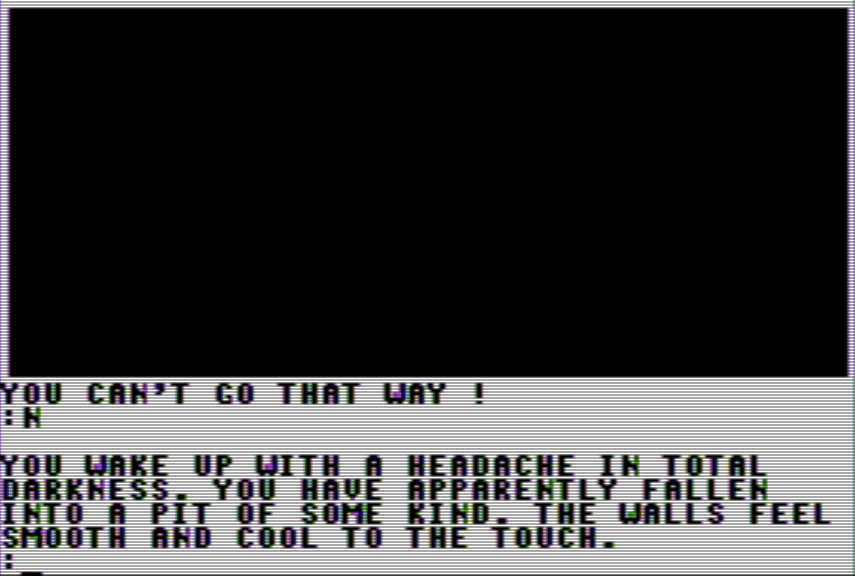
Moving on past the plant, there’s yet more forest, and one place in particular which is too dark and you fall…
…but somehow in complete darkness can still tie a rope and climb up.
Once past the pit you can find a torch which then you can light a lamp with. This lets you return past the dark area and find an amulet, which turns out to be the jeweled item that the hermit was looking for.
The book gives a “dangerous” prayer (I still haven’t been able to use it yet, but I assume when I find either the magic sword of my quest or the shrine it goes to it comes into play) but the riddle is more immediately important: it indicates that there’s one spot (near a large bird nest) where you can SING and get picked up.
This is the “one-way” moment I mentioned earlier. I assume you eventually will be able to loop back to the main map, but for now I’m having to just guess what the character’s inventory ought to be.
There’s yet more forest and a cliff you can apply the rope (again) on — and yes, I didn’t have the rope the first time so had to restore my game — and then (after picking up a tuning fork I haven’t found a use for) comes a fairly neat puzzle involving a river.
The setup reminded me of the boat from the start which was stuck in a lake with nowhere interesting to go. However, the boat was too big to carry. What if the white potion which killed me earlier also worked instead on items?
Very slick! Taking the miniature boat in hand, I was able to drop it in the northern river — it popped back to regular size. I then discovered I forgot the staff (from all the way back in the shop) that I needed to use as an oar, d’oh.
Another restored game later, I had both the boat and “oar” at the river, and pushed my way up to a river monster.
This is a good place to pause, not only because it makes a nice dramatic cliffhanger, but because I haven’t solved the puzzle yet (at least with the items I had handy). Despite my quibbles this game been a reasonably fun so far; the custom-font as opposed to system-font and at least slight nod to parser convenience has made the package feel more “professional” than many other pre-1982 games. This is a vague and hard-to-nail-down concept but I’ve often felt like I was playing a “straight from the coder’s bedroom” product — even when this wasn’t literally true — and a stray typo or graphical bug could happen at any moment (and they sometimes did). Here, even though I did spot one typo early, and even given the slightly crude art style, this feels like a game I could see come out of professional packaging.























 Renga in Blue