Archive for the ‘Video Games’ Category
It is the year 2101 and war has broken out between Earth and the distant planet Zekloke. This alien power has established a large military complex on Mars which will soon become a great danger to Earth. Hidden in the massive installation are several secret documents containing the plans for an incredible defense shield — strong enough to stop an entire fleet of spacecraft.
You are a special agent and have just succeeded in sneaking into the alien complex. Your mission is to destroy this threat to mankind and return with plans for the powerful defense shield. The outcome of this mission will decide the fate of mankind.
While we’ve had regular visits to Softside magazine via their Adventure of the Month series, that was a “side series” distributed on disk and tape. They were still printing games in their pages, and Operation: Sabotage by Ray Sato was printed three times: first in their August 1982 issue, again in their December 1982 issue (for different platforms) and yet again in their Best of Softside collection.
The original platform was TRS-80, but I played the Apple version, as the type-in version was recently uploaded by eientei (who normally types in unpreserved Japanese games but I suppose wanted some variety).

The biggest breath of fresh air here is that the game is easy. This is really genuinely solvable, and if we exclude Fun House (which was for kids) and Smurf Adventure (which was public domain and had essentially no puzzles at all) it makes for the easiest game so far of 1982. This isn’t necessarily a bad thing; the goal seems to be to tell a story more than pose some stumpers, and the game compensates for the low puzzle difficulty by adding quite a few red herrings, so many that it is deceptive to refer to all of them by the same name. Let’s do some splitting:
Background scenery: the outdoor forest in original Crowther/Woods Adventure which you could technically think of as a maze, but mainly serves to make the outdoors feel bigger than it really is
Side events: or in some cases easter eggs, like the stabbing of Julius Caesar from Time Zone
Passive deceptions: like when Ferret had a door with a key in it that appeared to require the newspaper-under-the-door trick, but the door is genuinely unopenable; no real player thought is needed other than the willingness to shrug and move on
Active deceptions: rather than “unsolvable puzzles” this is “items that actively seem like they solve real puzzles that are real, but don’t”; referring to Ferret again, there is a gold key that doesn’t go to any locked door, with the additional catch that taking it along requires leaving behind a silver key which is required
There was once upon a time in the late 90s where I remember Internet discussions claiming that any red herrings were bad form; I think those with that opinion were excluding background scenery and possibly side events. It is the genuinely rare game that doesn’t have some bit of scenery to make the world realistic, although some of the British-style ones (like Zodiac) fit the norm. In Hamil the nearly complete lack of red herrings serves as a clue, since some locations that might “feel” like scenery in a normal game are a little easier to cope with knowing something has to be meaningful to every element.
Operation: Sabotage does all four kinds of red herrings.

Let’s get to the gameplay! To quickly re-explain the plot from the top of this post: you need to sneak into a base, steal plans for a shield, set the base to explode, and escape.

The opening room is a case in point: the blue button opens the airlock and sucks you into space. It probably is mostly a side event although I could see it being a passive deception in trying to work out how to avoid dying. There isn’t really any item or button later that indicates a need to noodle here, though.
The passage you are in then goes south, to a decontamination chamber with a blue button.

This is basically a side event; there’s some indication later of radiation, but you don’t need to deal with it at all.

Then there’s more or less an item frenzy; without doing much puzzle-solving other than getting a CROWBAR and using it to open a locked cabinet in a room immediately adjacent, you can get:
a laser pistol
a key
a computer destruct program
batteries
an electronic control baton
a black device
a calendar
There’s various other buttons you can noodle with, like an “entertainment center” with two buttons that let you turn a movie on or off, and a red button in a bio lab that unleashes a monster.

You can win after typing SHOOT MONSTER enough times (the combat seems to be purely randomized) although this entire scene is just a side event; there’s no item reward. This means that the entire first chunk of the game we are able to sneak in an enemy base with no obstacles whatsoever. The aliens from Zekloke seem to be far too heavily reliant on robots for security, which you’ll see in a moment.

One of the buttons teleports you, as above, and takes you to the second (and last) portion of the map.

The octagons on the map are where you get attacked by androids. They require a shoot-out just like with the monster (and you can randomly die, just like with the monster).

However, you don’t have to deal with the combat at all; take a look at the above screenshot. Notice we’re in the robot control room and there’s a computer. You can just SHOOT COMPUTER and it will de-activate all the security robots.
You can also find a silver pill in a medical station (I assume it helps if you get hurt, but again you don’t need to worry about it), some nitroglycerin (useless), a portable radio (useless), and an multi-room setup where you can detect radiation with the black device from earlier, push a button to unlock a nuclear reactor, another one to turn it off, and then the ability to walk in and try to blow up the computer in the room. This kills yourself and is entirely useless

This is a multi-room active deception. The nitroglycerin also seems tempting here, and the player even starts the game with a (completely useless!) plastic explosive. No, all you need to do is find the computer center and insert the “DESTRUCT PROGRAM” that had been so helpfully lying around.

The author clearly put a lot of work into the entire nuclear reactor sequence, yet also put the method of starting the base’s self-destruct mechanism right in the open, so I’m not sure what the gameplay intent was. I did like the whole nuclear sequence but I found it after I had already discovered the self-destruct.
With the self-destruct active, you can use a “LAUNCH CASETTE” from a desk to then escape.

(I like how this is just a description of how close you are to finishing your mission, rather than using an abstract score.)
To get the plans, there’s a SAFE in the southeast corner of the map. This is the only part I was briefly stumped, as I did foolishly think the PLASTIC EXPLOSIVE would still be useful for something. (In other words, this is the one time the active deception briefly deceived me.) The game lets you try to THROW it and nothing happens, and there is no method of setting for detonation. No, you’re just supposed to take that electronic control baton from earlier and USE it. This causes the SAFE to swing open and reveal the PLANS, easy peasy.

I don’t know if the author really set to make an “easy” game or just landed on one anyway. It was refreshing to feel like the plot was mostly incidental and I could just noodle with the items given and see if I could discover some new effect with no pressure. The overall effect was definitely not of infiltrating a dangerous alien base, but honestly, after Time Zone I think I’ve proven myself in that respect and could use a vacation.
If you want to download the Apple II version, I have the original version here and a “decoded” version (which runs faster) here.

We’ve had lots of people writing adventure games from the United States and Britain; one person likely from Scotland; another few writing from Australia. There is a country that has been conspicuously absent: Canada.
It is odd they’d be left out; they do have a tradition of games that goes back to at least Microchess from 1976. The author, Peter Jennings, was later a member of the Toronto PET Users’ Group, founded in 1978 and still ongoing. They were at one point one of the largest Commodore enthusiast groups in the world.
It all started in the summer of 78. I decided to buy a TRS 80. Some how a Newfie friend of mine (Fred Wilson) convinced me to buy a PET instead … It came with a free program (Lunar Lander) and a copy of Pet Users Notes #2.
After tiring of Lunar Lander I typed in “NIM” from the Users Notes. Six times I typed it in and it wouldn’t work *@#$!! Humm! seems to be written by some chap from Toronto named Butterfield! I called him on the phone and he invited me down to his home. While I was there I met a friend of his (Peter Jennings) who was writing a program called Microchess. Impressive!!
— From “Lyman Duggan, TPUG’s Founding Father”, from the September 1982 issue of The TORPET
Vince Sorensen, the author of today’s game Fantasyland (aka Fantasia Land) hails from Regina. We know this because it says so in the source code.
1 REM MAY, 1982
2 REM VINCE SORENSEN
3 REM 55 LLOYD CRES. REGINA, SASK.

He was also a contributor to TORPET. Here’s a clip of his review of some C64 games in the September 1983 edition:
When I first got my C-64. the only game that I could find for it was called Froggee. It’s a fun game. but there’s only so long you can keep playing the same thing over and over. I almost went back to my VIC. but happened to run into another or TPUG member who had a C-64. and was saved. He directed me to a place that sold more C-64 games than one could imagine.
It is interesting from a game-history standpoint to have someone switch from VIC-20 to C64 but be tempted to switch back just due to game selection, despite the heavy technical advantage the C64 has. (He even points out later that Omega Race is better on the VIC than C64; to be fair, that might be the actual best of all the VIC-20 games.)
I would say this is the first time a game for the All the Adventures project is from Canada, but John O’Hare (who had three games from 1980) is mentioned as a member of the Toronto group in an issue of TORPET. So it is likely those were the first Canadian adventure games, just I didn’t have a nationality marked at the time. Sorry, Canadians! (UPDATE: No, O’Hare was just someone in Illinois who was a member, see the comment by jcompton. Alas.)
It is still safe to say Fantasyland, despite being all the way out in 1982, is extremely early in Canadian adventure game history. This isn’t as odd as it might sound; for instance, the first commercial game made for consoles in Canada had to wait until 1983 with BC’s Quest for Tires. (You can read the details as well as terrific pictures of every version at Ernst Krogtoft’s blog.) The earliest computer game company may have been Software Magic, which I quite recently wrote about, and they only started advertising in December of 1981. (ADD: Rob from the comments mentions Speakeasy which goes back to 1978.) So while the Toronto PET Users’ Group came early, the commercial market got a slow start, meaning a little lag time is understandable (while we’ve seen some freeware, the vast majority of adventure games have been commercial).
Vince Sorenson incidentally has credits for one other game, a version of hockey using ASCII characters which is two-player only. It later surfaced in the Keypunch Software series, which appropriated old “public domain” software and resold it (how public domain it really was is often unclear).
(If Keypunch sounds familiar, they were the ones with the Cavern of Riches port stuffed on an “Adventure Pak” that was impossible to beat due to a scoring bug.)
Returning back to Fantasyland, being written for VIC-20 (with the C64 literally just being copying the BASIC code) in under 8K it falls into the same club as other super-minimalist games.
FANTASYLAND
BY VINCE SORENSEN
SOME COMMANDS ARE…
QUIT, SAVE, HELP, GET,GO, LOAD, DROP, USE, LOOK, FIGHT, NEW.
REMINDER – ONE TREASURE IS DISGUISED!
We’ve seen various angles for how to handle extra-small sizes (like the Bruce Robinson games): reduced verb lists, cut-down parsers, room descriptions that are just the name and any items nearby. This game includes all of them with a streak of complete and total surrealism. I’ve played some very bizarre games for the Project, but this genuinely might top them all.
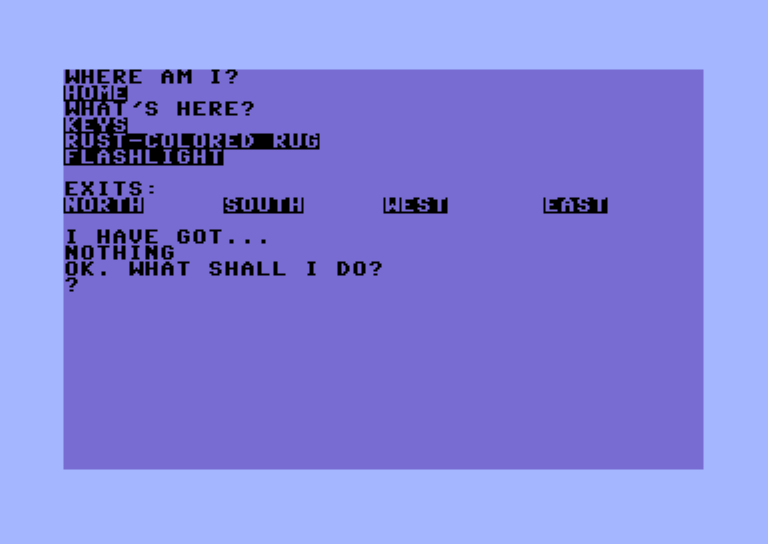
The opening room seems to be random; the item placement at first seems to be not. I say “at first” because one of the commands you can type is NEW GAME, and then things get weird indeed:

I’m going to suspect the above — which starts you with two items, including one I suspect is not meant to be portable — is a genuine memory bug. But the game is so utterly wild I wouldn’t put anything past it. Some screenshots to demonstrate:
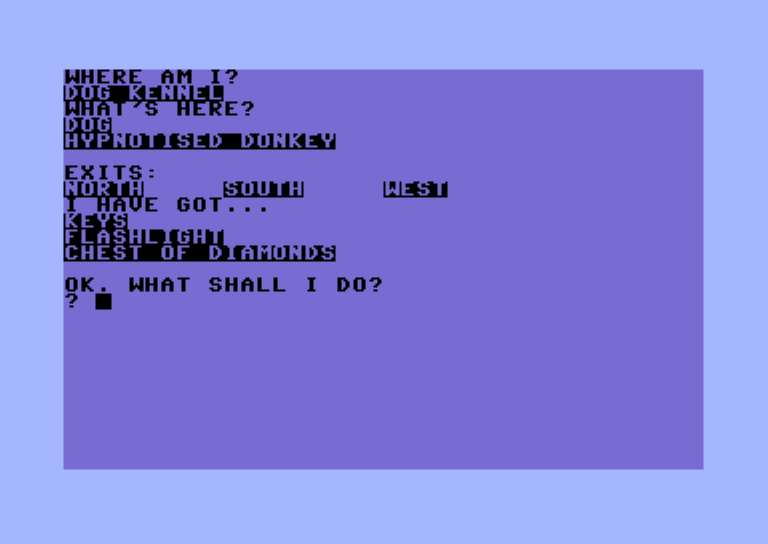
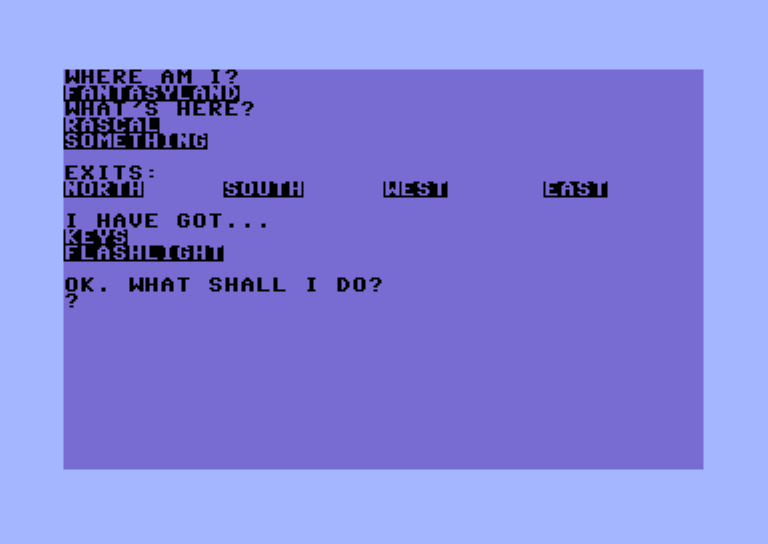
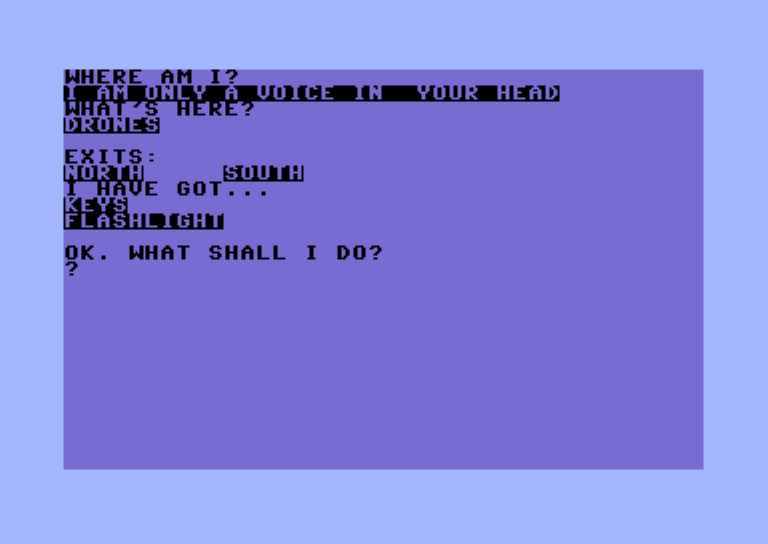
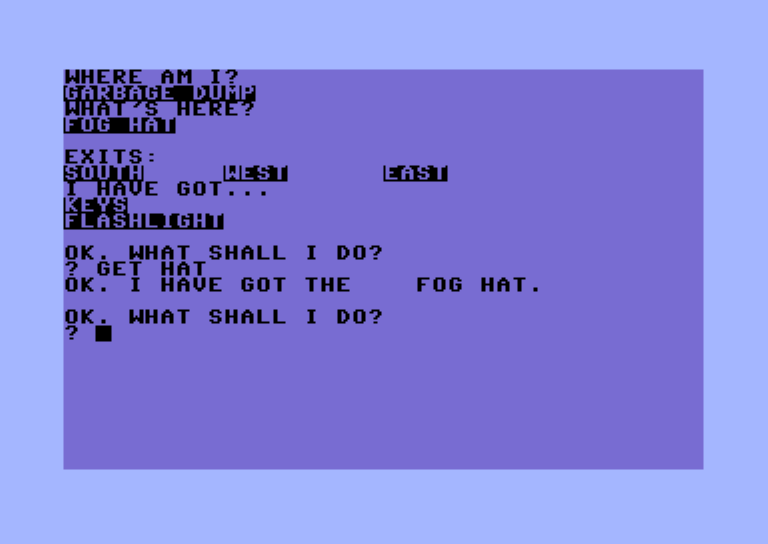

The goal is to find five treasures. You just need them in your inventory, you don’t have to drop them anywhere.

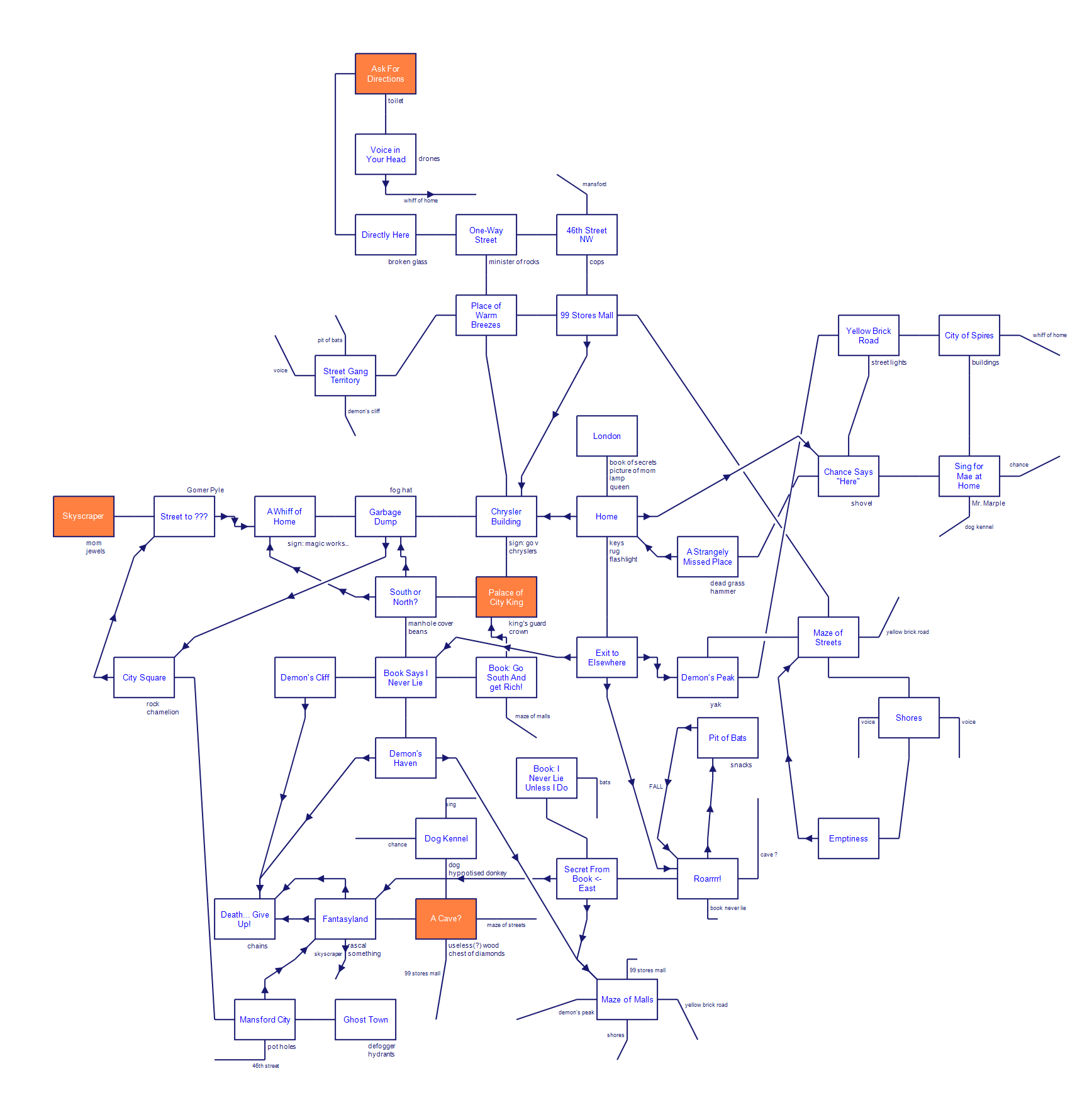
A sample of the total chaos of the map. Click here if you want to see the whole thing.
I’ve only found four of the treasures, which I have marked above.
1. Find a chest of diamonds. You need to be holding KEYS in order to take them.
2. Find some jewels nearby MOM. MOM needs a picture of herself in order to let you take them. If you use the picture MOM will give you a BOOK OF SECRETS.
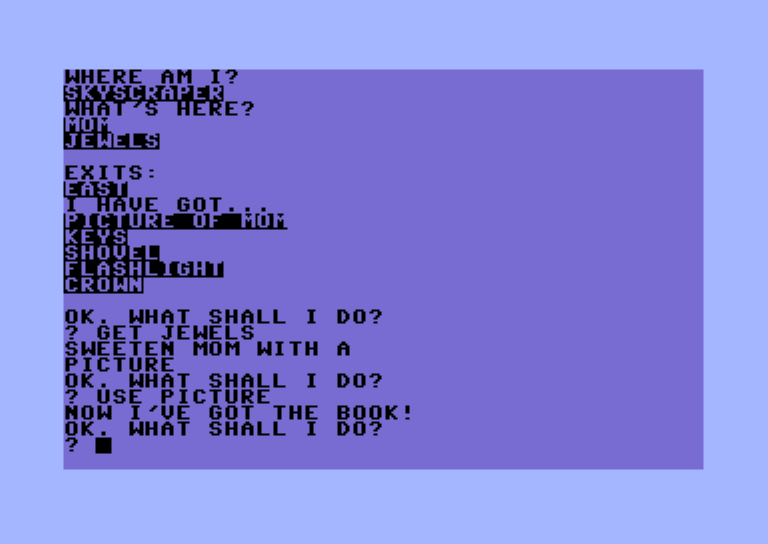
You can use the BOOK OF SECRETS to teleport to other places. If you hold the BOOK OF SECRETS for too long it will get stolen by a wizard.

Yes, the COPS are an inventory item in the above shot, and that isn’t a bug.
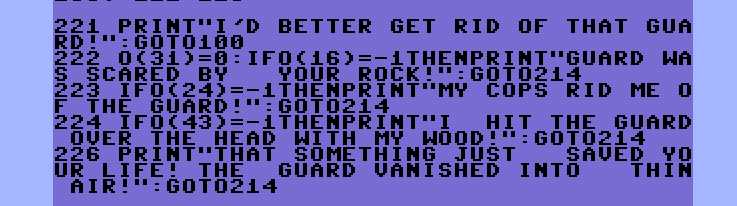
3. Take a crown by a guard. The game seems to have been designed so the guard stops you, but I haven’t been able to trigger that.

The source indicates multiple solutions (that involve you having the right item in inventory, one possible item being the COPS), and let me just quote:
4. The “secret” treasure is a toilet.

5. The source code indicates something about digging up a statue with a SHOVEL. I have the shovel but despite checking the map thoroughly I have not seen a statue.
Given the BOOK OF SECRETS does a teleport, and there are other rooms that vaguely hint at magic words…

…it is perhaps possible there is a secret area only reachable via magic, but the game hasn’t been welcoming enough for me to try to tussle with it longer.

I will say that Fantasyland is fascinating in the sense of — despite having just treasures to collect — being something entirely different. I can’t think of another game to quite compare it to. That is, even with the absolutely sparest of elements there’s still the potential for variety. There’s been a few truly erratic maps (see Intergalactic from Atom Adventures) but nothing at the level we have here, and where you have a MINISTER OF ROCKS who can’t even be referred to by the parser but is just there for color.

I tried bringing the ROCK and using it to see if the Minister would be impressed, but alas.
For my next game I was going to be writing about a Canadian game, but I wanted to get a mystery out of the way first: the company Software Magic, which sold TRS-80 software but has almost no Internet presence whatsoever.
It first pokes its head out early in 1982 with ads for “Potions”; here’s one from Computronics, March, 1982:

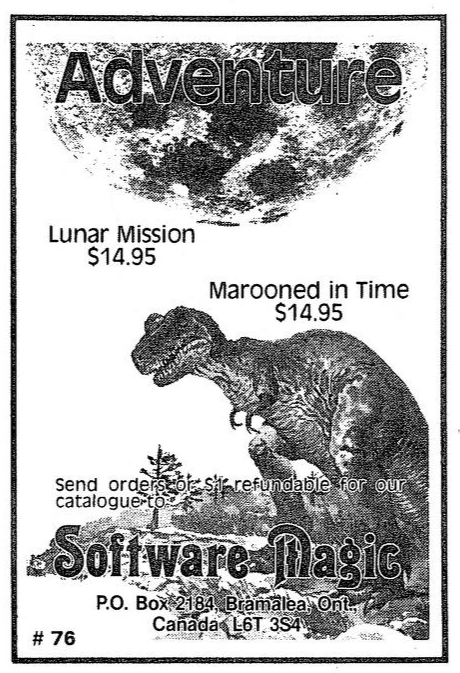
Later the same year, starting at least by October they started advertising a catalog you could get for $1 with “adventure, simulation, D&D and arcade programs”. The November edition of 80-U.S. in particular advertised the adventure games Lunar Mission and Marooned in Time.
Dale Dobson over at Gaming after 40 is the only person in the entire history of the Internet who seems to have ever had any encounter with them, as he somehow obtained the spring 1983 edition of the $1 catalog in his younger years. The entire catalog — just a few pages — is at the link above.
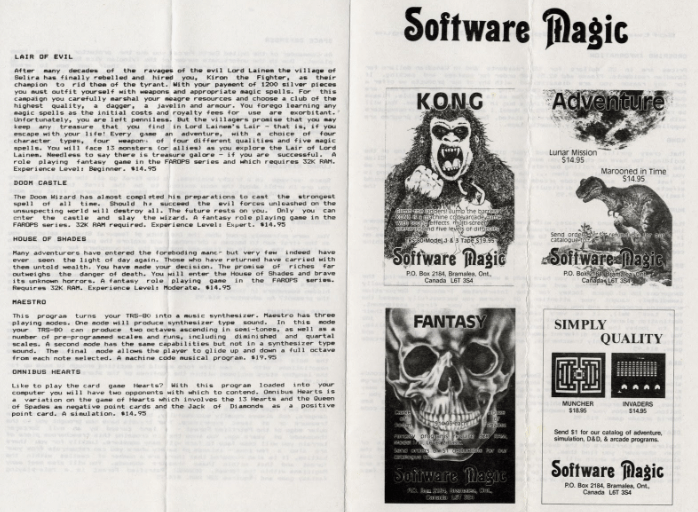
There are 16 products listed; 3 of them are adventure games: Gods of Mt. Olympus, Marooned in Time, and Lunar Mission. Based on the ad I showed earlier at least two of those were from 1982.

Out of all sixteen games, none of them are available in any archive. All have vanished. What makes this more distressing is that other than the French Canadian house Logidisque there doesn’t seem to be any earlier companies in Canada devoted to publishing games; in other words, what was quite possibly the first English-language Canadian videogame publisher is a ghost.
I’ll get into the Canadian-made adventure game we do have a copy of next time; this seemed like too big a side mention to put into a footnote. Also, I wanted the faint possibility that someone in the future who recognizes the name Software Magic might happen across this post via Internet search and enlighten us in the comments what happened with them.
I’ve reached the ending, and if you’ve arrived here from elsewhere you should read the previous posts on this game first.
Last time I left off being sent to find a kill the Master Mystic and bring back proof of his defeat. (Spoiler: he does not get “defeated”, exactly.) I received an ivory key and found a heptagon of doors to explore.
The heptagon included:
1. A “fix-it man” that quickly throws me out

2. An entomologist
3. A philosopher who wants a book of law

4. A “bored” terrorist who is in the same room as a vending machine
5. An exterminator; the game specifically says you need to TIPTOE to go inside, otherwise he throws you out
You can unlock other doors, but unlike Asylum 1, there isn’t a high density where you have to check over each and every one; there’s signals once you are outside each door that it goes somewhere, like “you smell bug spray” for the exterminator.
After a quick-runthrough of the encounters above I decided to go back to the original hexagon and check for more exits. There were three on the “outside ring” that were unlockable with the ivory key.
Two of them led to a short passage which links directly with the heptagon (it is shown in the map above). Each of the short passages includes an extra passage; when entering, I saw rats in hallways but shortly after died from rat poisoning via the exterminator I had met earlier.

The third led to a brand-new area which took a while to map.

Part of the trouble were “revolving doors” (which I’ve depicted on the map as barrels in the corners). When stepping in any of the adjacent squares, you get spun around rapidly with the screen flashing before getting flung in some nearby direction. I suspected something useful in the 3 by 3 gap of my map. I tried spinning around quite a few times before concluding this was a trap of some sort that needed to be evaded with a new item from elsewhere or I needed an alternate route to get in.

The spinning is out of your control once entering a revolving spot. I would show the animation but there’s also a lot of blinking.
The other parts of trouble are another teleport (from northwest to southeast, at least how I have my map oriented) and a very random area marked “BEWARE THESE HALLS” which is nearly impossible to map (the only reason to go in is to pick up a knife, which I’ll discuss more of shortly).

Once I had the issues above settled I had, newly found, a knife, a rope, a banana peel (which you slip and fall on when you first encounter it), and a rat suit. Unable to be picked up was an electric catapult, which you can try to ride by sitting and pushing a button.


I discovered a few things messing around with the items:
a.) if you examine the banana peel you find a caterpillar (yes, that goes to the entomologist)
b.) if you drop the peel and walk around and step on it a second time you get approached by a lawyer who tells you that you should sue and gives you a law book (yes, that goes to the philosopher)
c.) if you STAB ME WITH KNIFE you find out it is a trick knife
The last one was an absolutely random find: I was messing around with the fact ME was on the vocabulary list and trying to ATTACK ME WITH BANANA PEEL and finding out that this makes you considered violent so you get warped to electro-shock therapy and then the starting cell (this is useful for fast travel). So I tried STAB ME WITH KNIFE as well:

This was immediately after an electro-shock treatment, which I guess didn’t work.
Going back to that list in order: the entomologist eyes your catepillar as you walk in:

In “thanks” he parades his trained army ants, which then proceed to eat you.

The philosopher is a little more peaceful: he takes the law book and leaves you a “nirvana scroll” in trade.

I guess legalese has this effect on people.
For the knife, I was truly, horribly, stuck, and needed help from Will Moczarski, who explained that I needed to go over to the bored terrorist and do a repeat performance of the stab-self-with-knife scene.


Ugh. Even thinking in a cartoon-y, stereotypical sense, I’m not sure what about this would impressive to a terrorist. This has my vote for worst puzzle in the game.
This leaves behind a vending machine, wherein you can insert a coin.

If you attempt to insert a coin the game states “Broken! Please tell the author of Asylum II immediately!” This might normally be a problem except I already met the author of Asylum II.

Back at the maze area with the revolving doors, there’s also two rooms with people: a “picnicker” who throws you out shortly after you enter, and William Denman. And yes, you can refer to Denman as INMATE:

He goes off to fix the machine and then disappears from the game.
Heading back to the machine and inserting a coin in the now-functioning machine, I got a bomb. Let’s take a solve-it-yourself moment, since everything you need to solve the puzzle is in this post: do you know where the bomb goes?

Remember that attempting to use the catapult results in your splatting into the ceiling. But what if there was no ceiling?
PUT BOMB ON CATAPULT
PRESS BUTTON ON CATAPULT

Now you can safely use the catapult. I’m unclear why the landing is safe (you don’t have a bean bag or whatnot breaking your fall) but nevertheless, this causes you to land in that 3 by 3 area from earlier inside the spinning doors. There you can find a jar. I quite quickly realized the jar’s usefulness:

I had a suspicion that ants + picnic would make an interesting combo, and the game provides another “you’re the axe murderer this time” moment.


This leaves a lunch, which is … a curious trade for a human life. (To be fair, given the meta-aspect of the programmer being in the game, the chicken suit scene, the rocket belt, etc., I don’t think we are supposed to read into this any kind of cruelty. It’s more like the inmates are all actors in a play where you just need to find the right bits to move the script forward.)
Here I was fairly stuck except for one thing: I could go back to the plastic surgeon, who asked if I wanted yet another new face; I said YES and gave over a coin (you can give “coins” plural which hands them all over, which is a mistake) giving me the face of Captain James T. Kirk.
Well then. That didn’t help me with my lingering last dilemma, which was the rat poison. I did realize the exterminator that I could TIPTOE to had to be the one dispensing the poison, so he needed to be eliminated, but my various stratagems were failing. After fiddling around with all the items I had I finally … looked up a hint to realize I needed to use the rope. TIE INMATE WITH ROPE:

OK, fine. This one was actually logical.
Now that he was tied up, I could enter the rat area in peace, which led to a new short map. I needed to take my rat suit with me and WEAR SUIT upon seeing rats in order to live in peace.

I didn’t find much, other than a machine I remember being the Time Machine from Asylum 1 (which seems to be just filler graphics here), a locked door I couldn’t get through but which turned out to be important, and Dr. McCoy himself from Star Trek.

The “transporter” is broken and needs fixing. There was still a “fix-it man” that I hadn’t made any headway with, so I toted the transporter over and … still found myself getting thrown out. Hmm.
It turns out you can have the plastic surgeon do his work again, and it works. I’ll just give this as a sequence of pictures. I had the lunch already in hand. Maybe you can have it make sense. Is there some Duran Duran reference I’m missing?


The inmate fixes the transporter once the lunch is delivered. Pressing the button on the transporter tells you
OK…. nothing apparent happens.
Huh. I was ready for suffering a lot more frustrating when my finger slipped and I tried to walk into a wall, which normally displays SPLAT! (Remember movement is by arrow keys in this game.) I instead walked straight through the wall. Interesting!
There was only one locked door of interest left in the game, back in the rat maze, so I tried the pass-through trick there:

This doesn’t kill you but rather literally restarts the game from the start as you’ve been sent back in time. Oops.
Given there was no time to react it clearly was some sort of “held condition” in order to enter without being time-nuked, but what? Items didn’t help, but there was one other thing I could change:

If you try to do this again, it rotates back to Hitchcock, then Kirk.
Not clear what would happen, I went through the door to the Mystic again, who says something about “I see a rat, but don’t smell one!” This is while wearing the rat suit, so you need to drop it off first:

You also need the nirvana scroll here, which is fortunately not too hard to realize given we’re nearly out of items to try solving puzzles with and the design clearly intended to be “tight” and have everything get used:

He then says “I see the light!” and disappears, leaving behind a dragon ring, also providing a hint to look under your desk. Yes, we were supposed to “kill” him, but the ring works fine. However, if you just make a beeline for the Doctor Exit with ring in hand it doesn’t end well:

Long, long, back, I had found a picture under the desk (because I obsessively checked under every desk and bed the entire game, given what happened with Asylum 1) but hadn’t been able to get it. I assumed some secret button would activate the access, but no, it’s just parser frustration. So frustrating I had to check Will Moczarski’s post; you must type GET PICTURE UNDER DESK exactly with that syntax. Argh! The game had been so good about avoiding parser annoyances like Asylum 1 only to have a trip-up at the end.
Picture in hand I took it over to the surgeon and showed it off, who used it as a reference to reconstruct the player character’s original face. Then I was able to exit with the ring:

I was then told “Stay healthy! We will need you very soon!” followed by:

Considering the whole series (keeping in mind Frank Corr wrote the first one solo and co-wrote the other two):
Deathmaze 5000: still the tightest “plot” but with a few terrible puzzles like the “turn, turn, turn” one; the red herrings hurt rather than help in the end, and there’s “magic physics” to contend with not in the other games
Labyrinth: a much more diffuse layout which feels less like a story arc, but with puzzles fair enough they genuinely can all be solved without hints
Asylum 1: weird, curious, sprawling, and requiring tons of patience; I think the big change between 1 and 2 is less of a need to exhaustively test keys, plus it has some large-ness for its own sake
Asylum 2: only two large maps so it feels much more in control than Asylum 1 in terms of the player experience; you don’t need to prod through each and every room to find what’s important.
This feels like a natural learning curve; not exactly “getting better and better” but trying a new thing then realizing the flaw with that element and fixing it in the next version. It would be nice to see where this journey goes next, but unfortunately, this marks the end of William Denman’s adventure games, unless you count the ports from TRS-80 to other systems. Will Moczarski has more detail and screenshots if you’d like to see more about what they’re like.
Oddly, this is not the end of the line for first-person adventure games in 1982, but unlike Asylum (which got reasonably famous with its ports), the game I will be playing in the future is known by almost nobody at all. (It is for Apple II and I am not referring to The Prisoner 2; it is far enough away that’s all I will say at the moment.)
Asylum II went completely wild, which I suppose is thematic. Prior posts needed to understand this one.

The C64/Atari tape version of the game, via eBay.
To make two caveats before I begin:
a.) I switched from using trs80gp in Model 1 emulation to Model 3 emulation. Normally I prefer Model 3 (the graphics look a little crisper) although I was having trouble getting the game to start in Model 3 mode. Over at the trs80gp Discord I asked about it, and JRace realized the version I had been using had this data added on to it:
BUY ALL YOUR UTILITIES FROM:
ZETA MICROCOMPUTER SOFTWARE …
P.O BOX 177 RIVERSTONE NSW 2765
THIS PROGRAM MODIFIED USING “OFFSET”
(C) 1983, ZETA MICROCOMPUTER SOFTWARE.
It appears to be from some sort of convert-tape-to-disk software; tapes could have copy protection just like disks but there was software to get around that.
One of the versions available (asylum2b from here) did run fine with Model 3, so I swapped over. The upshot is the screenshots are a little mixed this time. See if you can spot the difference!
b.) I had to use hints twice. One puzzle was kind of clever and obnoxious at the same time, one I was fooled slightly by inconsistent behavior.
Let’s finish dealing with the fuses first. Last time I had managed to get everything in the dark, but my attempt to bring a fuse back to the circuit box to fix it failed. I speculated offhand I might just be typing the parser command wrong, and that turned out to be correct: PUT FUSE IN CIRCUIT seems to work (despite FIX and REPAIR both being verbs they don’t apply here).

Now, for the inconsistent behavior: I had given a stethoscope to a hypochondriac, causing him to keep appearing and running away, shouting about GERMS. Before I had given the stethoscope I had tried using my AXE and I was picked up for violent behavior, just like all the other times I tried violence, so I figured that was that.
Once the hypochondriac is in his “germ phase” after handing off the stethoscope…
He runs off screaming ‘GERMS! GERMS!’
…you can then attack (even just a KICK seems to work). He will drop some pills and run away, but you will not sound any kind of alarm.

I pretty quickly sussed out what the pills were for, but I first want to go back to the rocket belt. I had, recall, found myself flying into a wall and dying. I ended up being baffled enough I just checked hints outright here. The clever bit has to do with leveraging the geography of the game.
You see, as you are moving with the rocket belt, there’s a message about “accelerating”; however, the rocket doesn’t last forever, and if you keep going there’s a message about “decelerating”. So what you need to do is find an extra-long hallway; in fact, the longest one in the game so far, the one on the very top of my map.

This part of the puzzle was gratifyingly clever (even though I didn’t solve it myself). I first used the term unexpected re-purposing back with Deathmaze 5000, and here the game transforms something mundane (not only mundane, but useless “maze filler”) into a puzzle.

This wasn’t the entire puzzle, however. As the animation above implies, you still die on impact even after the long hall. The way to survive is to also drop that bean bag I’ve been toting around on the far end; it will break your landing. First off, I had an unfortunate issue of visualization (like this confusion regarding an urn in Adventure 430). The item is described as a “bean bag”, not a “bean bag chair”, so I was imagining something small, like these throwing beanbags as the first image on Wikipedia. Second, I had the same mental state treating items as I did back with Deathmaze 5000 where I was able to carry around a snake by carrying the “box” that it was in; I thought that if you just dropped a bean bag (which is described as in a box that you can open) that it was treated on the ground like a physical box.

On crash-landing the rocket leaves behind a copper wire, which is one of the supplies the scientist needs. As we have the battery we just need the magnets, now.
Back to the pills. I remembered the plastic surgeon needed drugs, so with some trepidation I toted the pills over.


Horror and comedy wrapped into the same moment.
Well. The most obvious step was to make a stop by the “mad movie producer” who had been throwing me out.

With camera in hand I quickly got accosted by a guard who seemed to be a fan.

Thinking about the items I had left to use (not many) I handed over the bird costume and he took it away “gleefully” to change leaving behind a uniform.
With uniform in hand I was aimless for a while until I tried yet another whack at the phone with the axe.

This time, success! Also, the phone is described as having a “receiver”, so you can hack at that as a separate item.

The coins I haven’t used yet (although I have a suspicion where they go); the magnets can now go with the other items to the scientist.


By the way: essentially everyone you can refer to as an INMATE. Adventure games in general often feel like staged plays, where the right items just happen to be available in the right places and in the right quantities to solve puzzles that are in just the right sequence to be resolved by the items you have. Or: characters are cooperative in very specific ways that just happened to be oriented around the world-verse you’re in to make progress. Why would the scientist go through the trouble to build a time-stasis machine just to leave it behind? It makes sense if a.) they’re an inmate being told what to do and b.) they’re taking part in a staged play of sorts. b.) is reinforced by plot events which you’ll see in a little bit.
I really had nothing left to whack at other than the psychologist, so it seemed to be time to give the time stasis a whirl. Prior visit led to me dying from boredom, so maybe let’s make time pass a bit quicker?


The smock is the doctor’s outfit! Is that it? Are we done with the game. Ha. Ha ha. No. But we can go through the Doctor’s door now.


The entire dialogue is:
It’s amazing you have gotten this far! You are smarter than we realized! However, your escape isn’t to be this simple! If you can find the Master Mystic and rid us of him, we will let you go free! We will require proof of your success! We will give you a pass key. Go to your room and rest! Good luck!
So the entire process was a test of sorts, like Zork III? (It’s one of those things that’s an easy way to explain away all the different adventure tropes.)
This lands you an ivory key. I haven’t tested it thoroughly, but I can say the door to the far east of the opening maze is now unlockable, and it goes to a series of corridors similar to the hexagon, except now it is a heptagon.

A partial map so far. Alas, not nearly as easy to make clean looking as the hexagon was.

An Asylum II “master disk” from eBay. It is easy to forget when seeing so many high-quality pictures of original media that a lot of players from the era had their disks look like this; copies with a fair chance of being pirated.
Continuing directly from last time, I had mentioned a sound that meant an item had dropped somewhere in the maze. I just had to find it.

This had a gold key.
Finding a key in Asylum is both thrilling and exhausting. Thrilling in the ability to open possibly many doors, and exhausting in the ability to open possibly many doors; that is, upon obtaining a key, you have to check every available door.
The gold key unlocks two doors I had left to deal with in the opening area.

One of them (on the west side) held a rocket belt. If the player wears the rocket belt and turns it on, it causes the player to fly forward, hit the wall ahead of them, and die from impact. This is functionally identical to the FART command from all the way back in Deathmaze 5000 (except the impact doesn’t kill you in that game). I don’t feel like making a new GIF file for the rocket, so you get to reminisce about the farting instead.

The other one leads to a room with a circuit board. I’ll get back to it in a little bit.

The only door I still haven’t opened in the starting area is the one on the east, which no doubt leads to another giant complex of rooms that will take ages to map.
Taking the gold key over to the hexagon, I was able to get at three new rooms. One had someone mumbling scientific terms that you could hear while outside the door, so it was not shocking to find a scientist. The scientist needs a battery, magnet, and copper wire.

There’s additionally the sound of someone saying ACTION! whilst in the hall; using the gold key to unlock the door yields a “mad movie producer”.

Finally, most intriguingly, there’s the door marked DOCTORS ONLY, the one that was mentioned at the start of the game as the exit to the asylum. The key works!

This is an interesting design finesse! Already, the exit is available quite quickly (compare to Asylum); I would have expected the key to be held back longer, but no, the only real obstacle between you and freedom is a doctor’s uniform. Not that the game won’t pull a twist, but I could as easily see it simply now making the doctor’s uniform only discoverable after epic struggle.
With all these places unlocked, I was now quite stuck. The movie producer was not impressed by my bird costume, I had nothing the scientist wanted, and the only thing to do seemed to be to whack at the circuit board yet no action I tried was working. Fortunately, the game comes with a VOCAB command to list every single word it understands.

This goes for multiple pages.
One that struck my eye is SCRAMBLE. It was highly unusual; could it work on the circuit housing?
Indeed it could: the game says
The fuses in the fuse box are scrambled.
This made me immediately think of the phone. You see, I had tried to CHOP it earlier with my axe hoping to get some spare change, but that causes an alarm to be sounded and my hapless avatar to be sent for electro-shock therapy. I thought perhaps the alarm was now disabled. This was not the case.

However: after the electro-shock therapy was through, rather than getting sent back to the starting room, the lights were all shut off.

Fortunately, a search through the entire maze is not necessary again to find what fell on the floor: it is nearby. You can now get a BATTERY, one of the items the scientist wants.
You can also use the candle and matches to light your way at least temporarily, but I haven’t found any more changes to the asylum. I tried the phone smashing yet again, thinking the total frying of the fuses might have now made the alarm totally gone, but no: you just get sent back to the electro-shock room except the shock doesn’t work! I also tried using the replacement fuse I had from the electrician and even though REPLACE is on the verb list it doesn’t work (unless my parser form is lacking). I vaguely suspect I’m supposed to keep the electrician alive somehow so they can fix the issue themselves, but you really are requires to kill him in order to chop out with the axe. Maybe the axe scene just needs to get saved for later? Or maybe the fuse box thing doesn’t get fixed at all, and we are supposed to have a copper wire and magnet to go with the battery and we’ll be able to get a flashlight from the scientist (that still doesn’t sound right to me, but I’m just throwing things out there).
I’m not quite ready to nudge at hints yet. One of the advantages of having a dungeon-crawler style map is the feeling like there’s always another wall or room that can be poked at; I still have yet to test significant wall-smashing with the axe, for instance. However, given some of the abstruse puzzles of prior games, I might be better served by giving up sooner rather than later. I’ll probably try the clock-trick I did back with “One of the Most Deeply Inscrutable Puzzles in Adventure Game History” and give myself an hour on a timer to make progress before taking a peek. (Hints are fine in the comments as well, but ROT13 only please!)
This continues directly from my previous post on Asylum II.

My mostly-finished map of the opening area. T1 warps to T1, T2 warps to T2, three doors including one to the far east remain locked with my current resources.
In the previous Asylum game, there was a scene with you being “walled in” to a small area and then being chased by an axe-wielding assailant. An approximation appears in the manual.

The way to defeat the murderer is to hand over a note that says LOOK UP. In the Asylum-verse, looking up anywhere in the game causes a piano to fall on your head.

From the DOS version of the game.
This is true of both the player and of other characters! So handing the LOOK UP note to the murderer causes them to look up, which kills them. With enemy defeated via piano, you can then nab the axe, and chop your way out of the sealed area.
The Asylum II copies the same scene, but with a reversal.

In this area, there’s nothing at all that happens until you arrive at the location marked “axe” and pick up the axe. You then hear building happening in the distance (this causes the “dotted wall” to get sealed off) and an electrician appears with a sign.

The implication here is: now you are the axe murderer! And indeed, the way to move on is to KILL ELECTRICIAN WITH AXE, which will let you take both the sign and a fuse he is carrying. Also, just like the first game, you can go to the sealed up wall and CHOP WALL WITH AXE to continue. Unfortunately, I haven’t had anything useful happen with my new-found items. I tried chopping up a psychiatrist (which you’ll see in a bit) but the game just chastised me for violence and sent me to the starting room.
Nearby this axe room is a corridor with 20 doors.

All these doors are closed but unlocked. As you walk around you hear doors slamming and footsteps running every few steps.
Last time I picked up a steel key from one of the rooms to the north. (I should put north in quotes, “north”, since the game has never given out a compass. I just had to pick a direction to be north by random.) The steel key works on the doors, but since they’re already unlocked, the key should be used to lock them. After all 20 doors are locked:

You never see a body or the like, but after the scream, you can find a box with a candle and matches. Again, like the axe/fuse/sign, I have yet to find a use for them, but it is still nice to have progress.
Other than that, the opening area has a pay phone, the hypochondriac, and three locked doors to deal with. I’ve only seen one other thing that kind of qualifies as a puzzle, and that’s in the starting room; if you look under the desk you see “a picture” but are unable to refer to it because you can’t see it. I’m not sure if that’s a bug or some such, as I checked in the C64 and DOS versions and nothing like that happened. My best guess is the picture gets revealed later in the game but the TRS-80 version is coded so it is already “in the room” even when the game doesn’t recognize it as such.
Moving on to the door to the west:

This map is not entirely accurate, and I’m not meaning just the doors not filled in yet (neither the fork nor key I have work). I mean this is actually in the shape of a hexagon. At the midway-spots on the top of the bottom there’s extra 90-degree turns, but since that’s not really possible to do in physical reality, I compromised and squished it down.

Upon entering this area there’s a clunking sound, which suggests to me a new item somewhere, especially because in the DOS version of the game it says “something has dropped in the maze”. I have yet to locate where in the maze this might be but I suspect I need to scan through all the opening area again.
(Yes, I’m mainly playing TRS-80 still; I checked in on DOS, and C64 was giving me some control issues so I haven’t tried it yet.)
Moving on: upon entering PSYCHIATRY we have a psychiatrist “talk to us soothingly” and then after two turns more we die by getting bored to death. This gives enough time to react and do an action or even escape. I mentioned already trying the axe; I also tried the sign but the psychiatrist ignored it. I’m not sure violence is the answer to this one.
I was also able to bust into a plastic surgery room, but I need anesthetics it seems?

Finally, I managed to get into an unlocked ELECTRO-SHOCK room. This causes the screen to blink fast and for you to get sent back to the opening room (just like if you try to kill someone random with an axe).

I’ve got a couple threads to pull on; finding the thing dropped in the maze, trying to chop more walls, maybe seeing if I can bust open the pay phone (I have a feeling I’m supposed to bring money and make a call, though). Instead of the puzzle-solving end I can consider the object-using end; I’ve got a bean bag and a bird costume (!) still, and all of the items from the south portion (candle, matches, fuse, sign, axe) that likely have more uses. Nothing occurs immediately to mind, but the entire Med System series has always had at least one slightly random action, so I’ll try some more patient prodding first before inevitably collapsing and resorting to hints.

Med Systems has been one of our more innovative companies featured here, making the first person adventure games Deathmaze 5000 (TRS-80 and Apple II), Labyrinth (TRS-80 only) and Asylum (TRS-80 only).
Asylum II is a direct follow-up to Asylum, and gives main credit to William Denman while just crediting Frank Corr with “graphics”. Given the amount of graphical re-use from the prior game it may be Frank Corr was not involved at all.
The game did end up on platforms other than TRS-80 through a confusing route: by 1982 Med Systems had been merged with Intelligent Systems, and somehow between that year and 1984 they had a.) started publishing software under the name Screenplay and b.) been bought (?) by the parent company AGS Computers, Inc (source here). Asylum II got re-published under the Screenplay label (as just “Asylum” with the “II” dropped) with improved graphics for Atari, DOS, and C-64 systems; the last is what seems to be their most famous product.


I’m going to stick with the TRS-80 version for consistency with my last three play-throughs, but I may poke in on the Commodore 64 version from time to time just to see what the graphics look like. I can say there is at least an immediate difference: the room you start in has a “nut fork” in the TRS-80 version and a “credit card” in the C-64 one. Both can be used to unlock the door of the cell you start in.


The objective, as with all these other games, is to escape, although an inmate two doors down from where you start gives you some helpful tips on how to do that.

They also suggest to find a doctor’s outfit.
My first choice before playing in earnest was how to make my map. This is essentially an old-school Wizardry-style dungeon crawler but in adventure game form. I’ve done a spreadsheet with borders filled in (on Deathmaze) and I’ve done raw pencil and paper (on Asylum). It had been long enough since the last two games I poked around if there were any new solutions, and I ran across the software Dungeon Scrawl. It seems to mostly cater to people making tabletop RPG campaigns, but it works with the kind of map I need as well.

Well, mostly work. On corridors I did not explore yet but just saw in the distance I put a “half exit” that doesn’t fill the whole square. I was able to map out various doors quite well; all the ones that I were able to get in I used the “nut fork” on. This led to me having a bird costume, stethoscope, steel key, and bean bag loaded up in my inventory. However, you’ll notice there’s some spots on the maze marked with “T”; that’s where the corridors became inconsistent. Unfortunately, starting with Labyrinth, the various Med System games have used teleports to induce non-Euclidean geometry, and I’m guessing that’s the case here. I haven’t experimented yet to figure out if I’ve made any errors or they truly represent teleports, in which case I need to decide how to tweak my mapping system.

Look, pretty isometric view! Kind of a pain to play with it set this way but it makes the maps look like Aaron Reed’s book.
I did have one encounter even given my tentative stepping out. Once you have the stethoscope a “hypochondriac” encounters you in the hall.

If you give the stethoscope over they start habitually using it, but also running away and shouting GERMS! The hypochondriac then keeps appearing and I assume I have to do something about the germs next.
I’m definitely not “stuck”; I’ve still got quite a bit of map to keep making, and the doors on the west side on my map are only part of what seem like very long rows. I suspect I might be running into a scenario like the original Asylum, which had a five-sided figure (where it wasn’t obvious it was five sided!) and even though Dungeon Scrawl technically can handle the situation I’ll need to fall back to pencil-and-paper for a bit.

I’m guessing I’ll need a coin for this.

A door I have yet to open. I vaguely recall in Asylum 1 that opening such a door resulted in getting a lobotomy.
(Want to skip ahead? This game’s been played by Will Moczarski over at The Adventure Gamer.)
00290 REM This is the Haunted House Game. It was conceived
00300 REM primarily by Rich Stratton, with Rich Gould and
00310 REM Norm Hurst.
00450 REM November, 1979
We’ve got a namespace clash here with Haunted House (1979), the TRS-80 game intended to fit in 4K on two sides of a tape. This instead was for a DEC PDP-10 mainframe, as found in this directory at bitsavers. I don’t have any other biographical context on this game’s creation other than the names found above. However, it is fair to say (from the content) that the authors would definitely have been in their teenage years.
You are in the Ghost’s Study. It is filled with books and magazines about famous ghosts.
What next? READ BOOK
Hmm..this seems to be written in Swedish!
Each page says..
‘Oh, yah…on chancer der boom-boom!
VIRDE !’
I discovered (and played) Haunted House via the website 8bitworkshop, which has a lovely online BASIC interpreter which lets you simulate various flavors of old BASIC, including the original Dartmouth one. Amongst games I was familiar with (like Wumpus and Star Trader) it had Haunted House listed, which I hadn’t heard of before.
Occasionally, someone asks I how I drudge up all these old games; part of the trick is being alert for when something new pops up amidst the very common.
For any transcripts that follow, I am mashing together paragraphs for readability. Additionally, while the November 1979 version isn’t archived, we have versions from March 1980 and June 1982; I’m playing the latter.
This is the latest version as of 2-Jun-82.
Welcome to the Haunted House.
Do you want Instructions? YES
You are about to begin a perilous journey. You will wake up and find yourself in one of the many rooms of an old mansion—a mansion which has been abandoned and is now infested with Evils and Unspeakable Deaths of many kinds. You must escape from the confines of the house. By using single-word comands you may move through the maze of old rooms. You have the following items with you:
TOILET PAPER
CROWBAR
LANTERN
FLASHLIGHT
RADAR JAMMER
MACHETE
A CAN OF GHOST REPELLANT
MATCHES
A DICTIONARY
FLY-SWATTER
Use your common sense to tell you what to do….
Type ‘HELP’ for help.
Select your difficulty level: 1 (easy) to 9 (hard).
?
Straight off here we’ve got a very unusual thing, and I’m not even referring to the difficulty level — implying this is an adventure-roguelike with randomized elements, like we’ve covered before — but the fact that you start with nearly all the objects already in your inventory. You can find a key and treasure, but otherwise the tools are permanent parts of your inventory. The game hard-codes the “INVENTORY” command that way:
10270 PRINT “You have with you…..”
10271 PRINT ” TOILET PAPER, a CROWBAR, a LANTERN, a FLASHLIGHT,”
10272 PRINT ” a RADAR JAMMER, a MACHETE, A CAN OF GHOST REPELLANT,”
10273 PRINT ” some MATCHES, A DICTIONARY, and a FLY-SWATTER.”
10280 PRINT “You have collected…..”
10285 FOR N8=1 TO 30
It’s interesting how rare this is amongst adventure games; it makes sense for an infiltration (like Spider and Web) or hiking trip to have a well-prepared character, but there’s often still a reluctance to give the main character too much to start with.
The difficulty, incidentally, just sets
a.) light level — you have both the lantern and flashlight that work, and can refill the lantern with kerosene if you find it and the flashlight with batteries if you find them.
b.) how soon you need to DEFECATE
Directly from the source code:
01670 IF Q$=”DEFECATE” THEN 1690
This needs to be done in a room with a toilet (if you don’t you attract wolverines who eat you) plus the game prompts you after:
06600 PRINT “What next”;
Then to survive you must type WIPE to which the game says “Good. You have saved yourself from the wolverines.” Otherwise:
You neglected to clean up. A pack of wolverines have been attracted by the scent and have devoured you.
While you get started in a random spot, the overall map structure is not random. The game has a slightly different feel to the opening when you start in a basement torture chamber complex…
You are in the torture chamber. Great place for some discipline. You can’t see past your nose since it’s so dark down here. The smell of death is omnipresent.
What next? E
You are in the torture chamber. I’d get out before you undergo a little head shrinking. But who knows which way to go?
What next? E
You are in the torture chamber. You’ll have to find a way out fast, or learn to be a masochist.
…versus a hallway on one of the upper floors.
You are in the Foyer. There is a heavy oak door on the north wall. There is also a doorway to the south.
There is a small box here.
What next? LIGHT FLASHLIGHT
The lantern casts eerie shadows on the wall.
What next? OPEN BOX
Inside the box there is nothing….it’s empty
What next? S
You are in a Hallway. To the north and south are doorways. To the east is a large staircase heading up into the darkness.
What next? S
You are in a Hallway. To the north and south are doorways. To the east is an archway with darkness beyond.
The boxes mentioned in the second excerpt are both filled randomly and placed randomly. They might contain something valuable (like coins) they might have a deadly snake, or the might have an “ambiguity”.
You are in a Bathroom. A toilet sits in the corner. To the north and south are doors.
There is a small box here.
What next? OPEN BOX
Inside the box there is an ambiguity.
What next? READ AMBIGUITY
You can’t read a AMBIGUITY , FOOL!!
As befits this sort of game, you have multiple gruesome ways to die.
The ghosts have strapped you to the bed and smothered you!!!!
A failure to use GHOST-REPELLANT.
You are surrounded by darkness…..thousands of dwarves and goblins, no longer afraid of you, attack and devour you!!!! AAAAARRRRRRGGHHH!!!
You ran out of your light sources or forgot to turn one on.
The bats have pecked your eyes out and you you have bled to a hideous death!!!!
You didn’t turn on the RADAR-JAMMER when bats are around.
Essentially, the perma-tools in inventory are each applicable to a particular obstacle, so surviving is mostly a matter of knowing the right command to do when. The parser is the very crude bespoke type so the right syntax to use something isn’t necessarily obvious. It isn’t terrible to work out but a single wrong move in the wrong place means death (as opposed to a gentle error message letting you try again) so I dove for the source code early to get a verb list so I wouldn’t be quite so irritated while playing.
01460 IF Q$=”CHOP” THEN 7500
01470 IF Q$=”SWAT” THEN 9570
01480 IF Q$=”SPRAY” THEN 7470
A secondary goal is to get treasures for points, but the primary goal is simply to escape. There are a couple ways, some with a random chance of death.
First, you can find a bedroom with a window. You can OPEN WINDOW; the game will then prompt you what to do next. The response the game wants is TIE SHEETS (although it only bothers to check if your first three letters are TIE, you could say TIE NONSENSE and the game behaves the same).
You have tied the sheets together and they are lowered out of the window. They don’t look very strong…..What next
Then if you go DOWN the game has a partial chance of just killing you, and a low chance (10%) of letting you escape.
Second, you can find the Foyer to the game, have a key randomly obtained from one of the boxes, and escape straightforwardly (no chance of death).
Third, you can follow the senator Ted Kennedy. He can appear randomly.
You are in a Hallway. Your fate is in your
own hands.
SUDDENLY……
an icy chill races down your spine; Someone is behind you!!
you turn……..
It’s
!! T E D K E N N E D Y !!
He offers to show you the way out; will you follow him? YES
CONGRATULATIONS!! You have overcome all odds
and escaped from the house!
You are no longer in the house or the game.
You were in the house for exactly 18 moves.
You scored a total of 124 points.
There is a 50% chance if you try to follow you will die instead because he takes a wrong turn. Also, you can summon Ted right away by READING the DICTIONARY that you start with in your inventory.
What next? READ DICTIONARY
You open the dictionary….it says…
Ahhhh…too bad. It is written in ghost language.
Do you know how to read ghost language? YES
What does IARANDME mean? I AM A NERD
That is CORRECT!! You must be a NERD to understand ghost language.
All is not lost however. All you have to do is talk to …
!! T E D K E N N E D Y !!
He offers to show you the way out;
will you follow him? YES
Ah Ted, shouldn’t we be going left here??
TED, left…. NO TED, LEFT…..LEFT!!!!!
ooops, looks like Ted missed that turn, but he’ll be back in a week to pull you out (or rather dredge you up).
Incidentally, if you get the anagram wrong, the game gets upset that you were lying about knowing ghost language and kills you.
Despite the game’s written-by-teenager-ness, it does follow in our adventure-roguelike category, and it is useful to ask the same question we’ve asked for the other games: does it work? Does anything work? I think starting with all the tools was necessary, given the game will otherwise sometimes drop you in a room where you’re just going to die otherwise; this evades the problem some games like Lugi had of giving the player a puzzle but hiding the solution so well for a particular random seed it was impossible to solve. I also did like the randomly placed non-descript boxes; for some reason they worked more atmospherically than scattering items would, just because of the possibility of empty boxes or a trap.

One of the floors mapped out, although I can’t guarantee complete accuracy because the game is fussy about describing what exits are possible from each room.
The most erratic aspect is the complete lack of worry on putting the player near the exit. One time I started right at the Foyer; the only reason I couldn’t just walk out immediately was a lack of a key. And of course the DICTIONARY provides immediate exit. However, since this game is really leaning on the slot-machine end of things (but far less painful than Conquest of Memory Alpha) I think the chaotic setup works as is; it wouldn’t necessarily work with games that are less obviously goofy larks.
This is my finale post for Zork III, so make sure you’ve read my other posts about Zork III before this one.
While I had discovered the area of the game with a “beam room” and so forth about 40% of the way through my gameplay…
>n
Beam Room
You are in the middle of a long north-south corridor whose walls are polished stone. A narrow red beam of light crosses the room at the north end, inches above the floor.
The corridor continues north and south.
…I remembered the beam being the start puzzle to the endgame of mainframe Zork, so I wanted to save it for after I had everything else taken care of first. There’s some interesting (and slightly confusing) aspects the game has for people who enter this section early (which I’ll get into later), but for my own game I only had two things left to do.
First was a secret action which I got essentially by luck. When you fall into the lake any items you are carrying drop in. I originally got the feeling that such items were lost forever, but you can dive in and find them:
>d
Underwater
You are below the surface of the lake. It turns out that the lake is quite shallow and the bottom is only a few feet below you. Considering the frigid temperature of the water, you should probably not plan an extended stay. The lake bottom is sandy and a few hearty plants and algae live there.
There is a lamp here.
Out of the corner of your eye, a small, shiny object appears in the sand. A moment later, it is gone!
(Mind you, the lamp is ruined if you do this with that item specifically, although you can make do with the torch.)
The “small, shiny object” is a medallion, one of the items you need. Rather frustratingly, there is a 50% chance picking it up will fail, and if you stay in the water too long you will drown. So there is a chance for some people they would assume there is some extra puzzle other than just typing GET SHINY over and over. I died after 5 failed attempts, which has about a 3% chance of happening. Game designers, would you really be happy with 3 out of 100 people being in this circumstance? (I know, I’ve gone over this before, and it is a flaw I don’t see in modern games nearly so often, but everyone once in a while it does happen.)
The last remaining issue was the battle with the hooded figure.

From the Zork User Group hintbook, via the Museum of Computer Adventure Games.
I was able to kill the figure entirely through raw persistence, which was a puzzle in itself (my first combat took, without exaggeration, about 50 turns, and it is possible to straight-up die if you’re unlucky) but that still felt fairly unsatisfying even though it caused my score to go up by 1.
I ended up needing to check hints. I think I get (by reverse engineering later events) how this was supposed to be puzzled out, but at least at the time I didn’t manage.
>hit man with sword
A good parry! Your sword wounds the hooded figure!
The figure is hurt, and its strength appears to be fading.
The hooded figure attempts a thrust, but its weakened state prevents hitting you.
>get hood
The hooded figure, though recovering from wounds, is strong enough to force you back.
The hooded figure attempts a thrust, but its weakened state prevents hitting you.
>hit man with sword
A good slash, but it misses by a mile.
The hooded figure attempts a thrust, but its weakened state prevents hitting you.
>hit man with sword
A good stroke, but it’s too slow.
The hooded figure attempts a thrust, but its weakened state prevents hitting you.
>hit man with sword
A quick stroke catches the hooded figure off guard! Blood trickles down the figure’s arm!
The figure appears to be badly hurt and defenseless.
The hooded figure attempts a thrust, but its weakened state prevents hitting you.
>get hood
You slowly remove the hood from your badly wounded opponent and recoil in horror at the sight of your own face, weary and wounded. A faint smile comes to the lips and then the face starts to change, very slowly, into that of an old, wizened person. The image fades and with it the body of your hooded opponent. The cloak remains on the ground.
As the early part of the excerpt indicates, this is only possible at the exact right moment. I tested it multiple times and I’m fairly sure I’ve also had a situation where it the figure went from not-wounded-enough straight to dead after a good sword blow, making the hood-nabbing impossible. I had tried every iteration of yielding or stopping the combat I could think, so I had the right concept, just the wrong action.
I think the point of the puzzle was to suss out, from the description of the Dungeon Master (which is given fairly explicitly on death)…
He is dressed simply in a hood and cloak, wearing a few simple jewels, carrying something under one arm, and leaning on a wooden staff. A single key, as if to a massive prison cell, hangs from his belt.
…that we are supposed to try to match; that is, we need the hood to complete our ensemble in the first place.
Clearly, the authorial goal (I think Marc Blank is the person making the choices here as opposed to Lebling, but I’m not sure) is to intentionally have a bit of the flair of randomness which was admittedly present back in Zork I to craft a puzzle around. Having circumstances, say, where exactly five turns of hitting are needed before the action, would feel a bit mechanical a suck some of the appeal out of the combat system. The game also is extremely forgiving on death, so in a ludological sense needing to have a “rematch” with the hooded figure may be an intended part of the narrative.
The end result of the two resolutions was give me:
A wooden staff
A strange key
A vial
A cloak (being worn)
A hood (being worn)
A sword
A lamp
A very ancient book
A golden ring (being worn)
A golden amulet (being worn)
A torch
I also had a chest (too heavy to be carried at the same time as the items above) but I used it to immediately solve a puzzle in the end game.
Beam Room
You are in the middle of a long north-south corridor whose walls are polished stone. A narrow red beam of light crosses the room at the north end, inches above the floor.
The corridor continues north and south.
>put chest in beam
The beam is now interrupted by a chest lying on the floor.
This allows pushing a button to the south, which consequently allows entering a “mirror room” to the north.
>push button
Click. Snap!
>n
Beam Room
There is a chest here.
>n
Hallway
This is a part of the long hallway. The east and west walls are dressed stone. In the center of the hall is a shallow stone channel. In the center of the room the channel widens into a large hole around which is engraved a compass rose.
The hallway continues to the south.
A large mirror fills the north side of the hallway.
The mirror is mounted on a panel which has been opened outward.
>n
Inside Mirror
You are inside a rectangular box of wood whose structure is rather complicated. Four sides and the roof are filled in, and the floor is open.
As you face the side opposite the entrance, two short sides of carved and polished wood are to your left and right. The left panel is mahogany, the right pine. The wall you face is red on its left half and black on its right. On the entrance side, the wall is white opposite the red part of the wall it faces, and yellow opposite the black section. The painted walls are at least twice the length of the unpainted ones. The ceiling is painted blue.
In the floor is a stone channel about six inches wide and a foot deep. The channel is oriented in a north-south direction. In the exact center of the room the channel widens into a circular depression perhaps two feet wide. Incised in the stone around this area is a compass rose.
Running from one short wall to the other at about waist height is a wooden bar, carefully carved and drilled. This bar is pierced in two places. The first hole is in the center of the bar (and thus the center of the room). The second is at the left end of the room (as you face opposite the entrance). Through each hole runs a wooden pole.
The pole at the left end of the bar is short, extending about a foot above the bar, and ends in a hand grip. The pole has been dropped into a hole carved in the stone floor.
The long pole at the center of the bar extends from the ceiling through the bar to the circular area in the stone channel. This bottom end of the pole has a T-bar a bit less than two feet long attached to it, and on the T-bar is carved an arrow. The arrow and T-bar are pointing west.
How was one supposed to work out interrupting the beam was needed? Even though I solved the puzzle right away I have no earthly idea. I remembered the puzzle from Zork mainframe and applied that solution. Importantly, the mainframe version of the puzzle had a different feel to it: you have your inventory reduced to the iconic sword and lamp, but you need to interrupt the beam! I remember feeling a pang at leaving the sword behind; so even though the puzzle didn’t have good motivation, at least it led to a good narrative moment. Here, the empty chest (or likely a few other item choices, like the empty grue repellent can) hardly makes for the same poignance.
The “Inside Mirror” room is just as headache-inducing as I remembered. 12 years ago when I wrote about the scene I compared it to Myst, writing “Myst is really awkward and difficult described as text”. To sum up what’s going on:
The room is a vehicle that can shift around on a track. The track only goes south/north.
The short pole is sort of an anchor that keeps the vehicle from turning. You need to raise it first to be able to get rotation buttons to work.
The red and yellow panels are buttons which both rotate clockwise when pushed.
The black and white panels rotate counterclockwise when pushed.
The mahogany panel moves forward, and the pine panel opens the vehicle.
The long pole and arrow indicate direction.
With these functions sussed out the solution is pretty straightforward: lift the short pole, turn to the north, drop the short pole, move to the end of the track, lift the short pole again, spin so the exit is on the north side, and open. Voila.
>PUSH PINE
The pine wall swings open.
>N
As you leave, the door swings shut.
Dungeon Entrance
You are in a north-south hallway which ends, to the north, at a large wooden
door.
The south side of the room is divided by a wooden wall into small hallways to
the southeast and southwest.
The wooden door has a barred panel in it at about head height. The door itself
is closed.
Your sword is glowing with a faint blue glow.
Now, anyone familiar with the game might know I skipped over something: the Guardians of Zork.
These are statues standing on either side of the track that will wallop you if they see you, which can happen if the vehicle is wobbly (that is, you don’t stabilize with the short pole). I only found this after after the fact looking at people writing about the game, though! The Guardians are meant to thwap anyone who they see, but if there is a stable mirror passing through it looks like they’re just seeing the other Guardian.

There’s a part that makes this even more confusing. Let’s suppose you’ve gone through this and find you haven’t completed all the tasks in the first part of the game. I’m guessing there’s a couple results based on the circumstances, but here’s one if you leave an item behind.
>knock on door
The knock reverberates along the hall. For a time it seems there will be no answer. Then you hear someone unlatching the small wooden panel. Through the bars of the great door, the wrinkled face of an old man appears. He looks you over with his keen, piercing gaze and then speaks gravely. “I have been waiting a long time for you, and you are nearly ready for the last test! I will remain here. When you feel you are ready, go to the secret door and ‘SAY “FROTZ OZMOO”‘! Go, now!” He starts to leave but turns back briefly and wags his finger in warning. “Do not forget the double quotes!” A moment later, you find yourself in the Button Room.
Your sword is no longer glowing.
This gives you a “teleport” command that now works to jump past the mirror altogether. However, you still can’t get back using the vehicle (at least from everything I’ve tried). The only way back through is to ignore the mirror vehicle and walk, on foot, past the Guardians.
>sw
Narrow Room
You are in a narrow room, whose east wall is a large mirror.
The opposite wall is solid rock.
Somewhat to the south, identical stone statues face each other from pedestals on opposite sides of the corridor. The statues represent Guardians of Zork, a military order of ancient lineage. They are portrayed as heavily armored warriors standing at ease, hands clasped around formidable bludgeons.
Your sword is no longer glowing.
>examine guardians
The guardians are quite impressive. I wouldn’t get in their way if I were you!
>se
You can’t go that way.
>s
The Guardians awake, and in perfect unison, utterly destroy you with their stone bludgeons. Satisfied, they resume their posts.
**** You have died ****
This is doable if you’ve got the flask from the sailor. The liquid will make you invisible for a turn, long enough to scoot by the Guardians safely. But there’s only one dose, so you need to use the FROTZ OZMOO in order to come back.
So we have a weird circumstance, where
a.) the flask is technically optional
b.) however, it is not optional for someone coming to visit the Dungeon Master early
c.) however, who would arrive at the Dungeon Master early and keep playing, rather than load a saved game?
Also! You can, weirdly enough, move the mirror vehicle a bit (you can’t ignore it entirely), get out of it, and then walk north past the Guardians on foot. This requires the invisibility again.
So the vial is intended to give a little extra flexibility — was the ability to use it to avoid finishing the mirror puzzle more or less inadvertent? The manner of obtaining it (saying HELLO SAILOR) I’ve already prodded at as a design flaw, but it works a little better if it considered optional. I still never found anywhere in Zork III to give a clue on the phrase, though.
Going back to the door, here’s what happens when you have done everything correctly and have all the relevant items. This means: hood, amulet, ring, key, staff, book.
>knock on door
The knock reverberates along the hall. For a time it seems there will be no answer. Then you hear someone unlatching the small wooden panel. Through the bars of the great door, the wrinkled face of an old man appears. After a moment, he starts to smile broadly. He disappears for an instant and the massive door opens without a sound. The old man motions and you feel yourself drawn toward him.
“I am the Master of the Dungeon!” he booms. “I have been watching you closely during your journey through the Great Underground Empire. Yes!,” he says, as if recalling some almost forgotten time, “we have met before, although I may not appear as I did then.” You look closely into his deeply lined face and see the faces of the old man by the secret door, your “friend” at the cliff, and the hooded figure. “You have shown kindness to the old man, and compassion toward the hooded one. I have seen you display patience in the puzzle and trust at the cliff. You have demonstrated strength, ingenuity, and valor. However, one final test awaits you. Now! Command me as you will, and complete your quest!”
Narrow Corridor
You are in a narrow north-south corridor. At the south end is a door and at the north end is an east-west corridor. The door is closed.
The dungeon master is quietly leaning on his staff here.
Your sword has begun to glow very brightly.
The way the game is structured (especially with the ability to loop back) this is really where the endgame for Zork III starts, as opposed to starting at the beam with Zork mainframe. It is consequently fairly short and feels odd in a plot-drama sense.
brief aside on endgames of old school text adventures
Crowther/Woods Adventure had a simple, impossibly abstruse puzzle, but tried to make it a finale with a giant collection of items from the game and a giant explosion. Warp tried a very long impossibly complicated sequence of puzzles. It really seems like you’d optimally want something in the middle, something that is both a narrative and game climax, where the narrative speeds to some dramatic reckoning and the puzzles perhaps involve putting together prior insights but aren’t necessarily hard in order to keep things from getting driven into the ground. It is shockingly hard to find a game that has those two parts in combination. Hezarin managed to have a nice final showdown with a the titular wizard, but got absurdly hard. (Is the absurdly hard part a bad thing? Should the culmination actually be testing the most extreme puzzle skills?) The only game from All the Adventures so far that I think really stuck the landing is Level 9’s take on Adventure, which pushed hard on difficulty, true, but not absurdly so, had the cave slowly flooding for added drama, and included one of the best puzzles in the entire game (or all of 1982, even) in the form of “rescue all the elves”.
end aside
Mainframe Zork had a trivia quiz which seemed to encapsulate “include some element of all things from the journey before”. This gets understandably cut here, but without a replacement, it is just a single straightforward puzzle.
Here, the Dungeon Master follows you around and you can give him commands, like STAY or PUSH BUTTON. There’s a parapet by a cell door which is quickly recognizable as an elevator of sorts.
Parapet
You are standing behind a stone retaining wall which rims a large parapet overlooking a fiery pit. It is difficult to see through the smoke and flame which fills the pit, but it seems to be more or less bottomless. The pit itself is circular, about two hundred feet in diameter, and is fashioned of roughly hewn stone. The flames generate considerable heat, so it is rather uncomfortable standing here.
There is an object here which looks like a sundial. On it are an indicator arrow and (in the center) a large button. On the face of the dial are numbers 1 through 8. The indicator points to the number 1.
To the south, across a narrow corridor, is a prison cell.
The dungeon master follows you.
>master, stay
The dungeon master answers, “I will stay.”
>turn dial to 3
The dial now points to 3.
>s
North Corridor
Your sword is glowing with a faint blue glow.
>s
Prison Cell
You are in a featureless prison cell. You can see an east-west corridor outside the open wooden door in front of you. Your view also takes in the parapet, and behind, a large, fiery pit.
The dungeon master is standing on the parapet, leaning on his wooden staff. His keen gaze is fixed on you and he looks somewhat tense, as if waiting for something to happen.
Your sword is no longer glowing.
>master, push button
“If you wish,” he replies.
Prison Cell
You are in a bare prison cell. Its wooden door is securely fastened, and you can see only flames and smoke through its small window.
You notice that the cell door is now closed.
This sequence here incidentally traps you. The thing to realize is to mess with the elevator first and find there is a special bronze door in the “cell” when you set the number to 4. Then go through the same sequence above, but while you are calling the the master from within the elevator, have him set the dial to 1 and only then push the button. Then you can pass through the bronze door:
Treasury of Zork
This is a large room, richly appointed in a style that bespeaks exquisite taste. To judge from its contents, it is the ultimate storehouse of the wealth of the Great Underground Empire.
There are chests here containing precious jewels, mountains of zorkmids, rare paintings, ancient statuary, and beguiling curios.
On one wall is an annotated map of the Empire, showing the locations of various troves of treasure, and of several superior scenic views.
On a desk at the far end of the room may be found stock certificates representing a controlling interest in FrobozzCo International, the multinational conglomerate and parent company of the Frobozz Magic Boat Co., etc.
As you gleefully examine your new-found riches, the Dungeon Master materializes beside you, and says, “Now that you have solved all the mysteries of the Dungeon, it is time for you to assume your rightly-earned place in the scheme of things. Long have I waited for one capable of releasing me from my burden!” He taps you lightly on the head with his staff, mumbling a few well-chosen spells, and you feel yourself changing, growing older and more stooped. For a moment there are two identical mages standing among the treasure, then your counterpart dissolves into a mist and disappears, a sardonic grin on his face.
For a moment you are relieved, safe in the knowledge that you have at last completed your quest in ZORK. You begin to feel the vast powers and lore at your command and thirst for an opportunity to use them.
Your potential is 7 of a possible 7, in 377 moves.
The puzzle is oddly simple to finish things off, but I also do appreciate it not requiring an absurd act either. However, I do remember being blown away by mainframe Zork’s ending, and not quite as much here.
The last sentence is remarkable. That was the ending?
I was stuck by it as a lens of sorts: here is a new art form, one raw and unrefined, with the potential to be serious and profound.
For me it was the most gratifying moment of playing Zork.
The thing about this is: the last sentence of mainframe Zork is not the same as Zork III. Mainframe ends at the sardonic grin. Zork III ends with “You begin to feel the vast powers and lore at your command and thirst for an opportunity to use them.”
This changes the tone drastically. The first almost seems like a cruel cosmic joke, with it left ambiguous just how happy the protagonist is about their situation. The second ending is much more explicit about the protagonist’s position, and it dampens the effect. I can see why it’d be more commercially desirable but I certainly would not call it “the most gratifying moment of playing Zork III”.
Let me round things out with two reviews or at least comments, one from the period and one recent. First, from the 1984 Kim Schuette Book of Adventure Games:
If you play this game the same way you play other adventures, you’ll never get anywhere. This time you must consider sensitivity, trust, and human compassion. Yes, educational value occurs here, as well as a lot of interesting puzzles, some of which have alternate solutions … The game pays superb attention to detail. Did you know, for example, that the chest is watertight?
Regarding “the same way you play other adventures”: from the perspective of 1982, this was something very, very, different. We’d certainly had games that interrogated the idea of killing monsters (including a direct parody of killing the troll from Zork in House of Thirty Gables) but the scene with the chest, which really doesn’t have a puzzle at all, and just demands you have the patience to allow yourself to get “ripped off” of the valuables in the chest, was nearly without precedent.
On the chest being waterproof: later versions of Zork III removed this, but the earlier versions let you fit the lamp in the chest. This allows for a solution to the dark dilemma where you put the lamp in the chest, close it, enter the lake, grab the chest from the lake, get out on the south side, open the chest and get the lamp, and then use the lamp to safely reach the key. (The dark rooms just don’t have a description, sadly.)
Here’s some quotes from Gold Machine’s coverage last year two years ago (god where did time go):
Zork III begins in a no less innovative way that challenges the amorality of the Zork trilogy as well as our own assumptions about adventure games. Unfortunately, Zork III: The Dungeon Master fails to escape the diminishing gravity of Dungeon. The result is a sputtering conclusion to the Zork trilogy.
I agree with the evaluation here: in their plot-essence, the new parts of the game stronger than the old parts. However, many of the new puzzles get foiled at least partly by random aspects, somewhat; even the chest puzzle has a random number of turns before the man first appears to offer the rope, so one player might leave the room too early while another would get the encounter even though they do the exact same commands. On the other hand, the elements from original Zork, despite lacking that random aspect, don’t add the same thematic gravitas.
On the other (other) hand Zork always had a feel of a ramshackle combination of parts, ideas jammed in at random, so it is a remarkable feat that Zork III managed a coherent theme at all, so I’m still able to admire the end product.
Now, this might normally be my goodbye to the Zork Trilogy, but I do still plan to return to the (relatively recently unearthed) 1977 source code to compare gameplay. I’d also like to take another shot at the weird Zork-clone that happened on PLATO systems that I wasn’t able to finish (and given the lack of information/hints on the Internet, nobody has been able to finish).
For now, though, I’ll going to do a one-shot visit to a game I can nearly guarantee you haven’t heard of before, followed by a return to Med Systems and the first-person adventure game Asylum II.






 Renga in Blue