I managed to finish the game, with some help from Rob digging through source code in the comments. I was in fact very close to the end, but it required a leap of absurdity to get through.
Back side of the packaging, from videogamegeek.
Specifically, on one of my runs I had found a POMME (apple). It was nowhere remarkable or specific, it was just another item in a room.
If you have a load of inventory you try to fence with the apple contained within, it gets no offer.
This is meant to be a pun. The apple is in fact an Apple, that is, an Apple Computer, the secret computer we are looking for! I was threw off by both the fact it was not very secret, but also the level of removal from the language; I think if I was holding an APPLE the pun might of occurred to me, but since I was mentally translating it, I only visualized it as a real apple, maybe for use in some specific event later where someone can be bribed with food.
Now, the problem is — as the instructions specify — we are supposed to then make a getaway with a vehicle. The VOLER (steal) verb comes into play again. Rob wasn’t sure where, but he knew that it was possible to steal some keys. I wasn’t seeing any scenes at either the bar or the restaurant until I realized it was possible to ASSEOIR (sit). You get offered a menu and then can order, and then have an encounter where you can try to steal.
You are told you need to order a dish so as to not raise suspicion.
In the scene above, we’ve been caught, and the manager searches Larcin and confiscates all the stolen items.
There’s a similar scene at the bar; I wasn’t able to steal anything resembling a car key in either one.
What actually worked was stealing at the register! Maybe there’s valet service such that the car keys get stored there?
You fortunately don’t need to say specifically you’re going for TROUSSEAU (keychain) but this was still quite random as the VOLER verb usually gives a “don’t understand” message.
I did have to go through the process twice. The first time through, I took the keys down to the parking lot and went trying to unlock doors none of them would open. Trying to steal again at the register led to failure, but if I ended the burglarizing session, and then went back to the register to try again on a fresh day, I was able to get another keychain. The second one worked.
Thus ends a very odd game that straddled between feeling like a strategy game and an adventure game. I would say it counts as an adventure: the chain is a puzzle which requires the magnet to solve, the moment-to-moment action felt more like roleplaying than the “big picture” style gaming that strategy normally involves, and realizing the odd pun with the apple is not something that’d be part of any strategy game. It’s still essentially a very minimal adventure game with strategy game dressing.
I’d like to end with another source that Rob found, of an interview done with the Louis-Philippe Hébert and the young authors of Logidisque’s first game (Têtards, or tadpoles). Roughly 1:19 is when Hébert starts speaking.
I’ll quote part:
Il ya un choc culturel parce que on découvre tout à coup un nouveau médium. Un nouveau médium donc une nouvelle possibilité, de créer de nouveaux objets … ça nous pousse que dans nos dans nos traditions, parce que évidemment la plupart d’entre nous avons une formation littéraire ou cinématographique …
There’s a cultural shock because we’ve suddenly discovered a new medium. A new medium, and therefore a new possibility, to create new objects … that pushes us in our traditions, because obviously most of us have a literary or cinematographic background …
We’ve only had a few people for All the Adventures (like Robert Lafore) who styled themselves in this period as “writers” or “artists”; Hébert here is recognizing that the leap over mediums is difficult to make, and he claims that young people in particular have a certain “banalité de demain”, that is, banality of tomorrow, where they have an easier time dealing with the new medium that seems to be “the future” as they were born into it.
Coming up: a large and very difficult puzzle-fest with an elaborate magic system. Back to roots!
Two quick corrections from my previous post before I move on with the game.
First off, it turns out you can’t just type (for example) RESTAURANT to jump from the third floor to the first floor and go all the way to the relevant room, at least in normal circumstances. I swear I had it happen once, but it may have been a glitch or me misunderstanding some text in the French. The right way to travel between floors is to hop in L’ASCENSEUR (the elevator) with the command ASC and then it will give you a choice of floors. Pressing a number will go to the relevant floor, then pressing “9” will step off. There’s still some extra movement conditions (like if you’re sneaking in a room, you have to use SORtir to get out first before you go somewhere else on the same floor) but that essentially covers everything.
Secondly, as more than one person has pointed out, “voler” (which can be typed as VOL) is described on the commands screenshot as taking a noun, so the meaning shifts from “fly” to “steal”. I was still baffled for a bit after because it seems like it doesn’t work for stealing items (it doesn’t work as a synonym for “take”).
I finally did find that at the roof of the hotel, there is a PISCENE (pool) with a locker room, and if you go in the locker room you can VOL the lockers and take money directly. For all the other thefts you make, you’re grabbing items to trade with a fence (which I’ll show off in a moment).
The overall structural design is that the night you go sneaking, you have fifty turns; after the fifty turns are over, you TERMINER, which finishes the session. After this, a fence comes and visits your room, and offers money for each of the items you’ve stolen that are considered “valuable”. You then pay off your bill and have a new bill to keep staying at the hotel.
The third item there is what FUMER (smoke) can be used on, although the game just tells you that you can’t because it’s very illegal. Given how much loot we’re swiping, it seems odd our main character has an issue with breaking the law.
Since the stealth happens at night, it is by default dark, and if you try to start stealing things without remedying this fact you’ll have a chance of simply tripping in the dark and giving yourself away in that fashion. Fortunately, room 001 seems to always have a LAMPE.
Although taking it doesn’t automatically work. Here, we hear noises and hide in a corner but it turns out to be a false alarm.
Once the lamp is safely taken (just random), the dark is no longer a problem. Now we normally can have free reign of the hotel: we can use the PASSE from our room to unlock any locked door, and the lamp will keep us from stumbling in the dark. Mind you, we still might randomly have an attempt at swiping an object fail:
Here, we wake the person by trying to pick up the brooch, and escape via having the reflexes of a cat.
There’s one other obstacle that can come up, which is a chain across the door.
The MAGNET I mentioned in my last post works; you can TIRer (pull) the chain and you get congratulated for being clever. I was originally puzzled because the use of the object is passive (that is, the magnet is used automatically if you’re holding it) so I didn’t realize the magnet was being used there. I was visualizing security so shoddy I could just yank the chain by hand and it’d break.
So this game technically had one puzzle (two if you count the light). You might also count the “square key” I’ve found, which I have yet to be able to use, and the fact I have no idea where the computer is. I’ve checked every single room; an excerpt:
Note these are randomized each game, and even randomized within a game; I had a save state where I went back to a room I had visited in a prior iteration and found a second object that wasn’t there before. I think that’s supposed to represent guests moving things around. I do suspect I might be missing something involving the various guests, but I have yet to get any commands to work when I see one.
Note that shot above shows the outside of one of the two penthouse suites (601, 602) but both of them were empty!
The only even vaguely suspicion room was one with a DISQUE, which I am assuming is of the computer variety. (The fence describes it as a DISQUE DE GRANDE VALEUR — that is, of high value — but only offers $10 for it. That wouldn’t buy even half a French-translated Sierra game.)
Perhaps if I’m lucky enough to run across DOCTEUR O’BRIEN in my travels there’s some action that works (maybe he’s toting around a device that unlocks a secret door?) Keep in mind (based on the interview from 1984) the author said sometimes he couldn’t beat the game, so it is quite possible I just rolled a bad seed and have to replay to see certain conditions.
On top of that I’m not sure what the square key is for. It could go to a vehicle; studying the instructions, after you swipe the computer you’re supposed to make a getaway in a car.
Or maybe something is supposed to happen only in later burglar jaunts? I’ve only tried out the first two, maybe there’s some developments when you hit number five. The game loop really just has you visiting each and every room so it’s not easy to check if something small has changed.
The source is in BASIC but has resisted my very light prodding to see if I can find any enlightenment; I might need to resort to fierce prodding instead.
The center of gravity of Canada’s computing history has always been Ontario. A group at the University of Toronto in 1945 started a committee and took a tour of the United states in 1946, visiting essentially every major computer. Planning started in 1948 on what would be dubbed the UTEC, with a functioning version assembled in 1951. The full-scale version ended up not being built, because it turned out to cost essentially the same to buy a Ferranti Mark I from Britain, but the UTEC was still essentially Canada’s first general-purpose computer.
IBM’s presence in Toronto dates all the way back to the 1920s, and hence when they started in electronic computing it became their major center of research.
1968 photo taken by George Dunbar of Leslie Mezei, showing computer art made at the University of Toronto on an IBM 7094. Source.
One of the (many) candidates for “world’s first personal computer” was the MCM/70, first shown in May 1973 at the Fifth International APL Users’ Conference in Toronto.
In 1969, a census of existing digital computers and process controllers found the majority (1045 out of 2037) being in Ontario. However, in second place there was Quebec, at 485.
Sperry Canada, for instance, started there in 1950 (the geographical positioning being somewhat motivated by military considerations, as Quebec had closer proximity to the by-plane Greenland route over to the USSR). Concerns with French-speaking separatists led the Canadian government to have an interest in developing the Quebec economy; thus while Circuit Design Corporation put a research group in Toronto, they put their manufacturing in Quebec City aided by funding from the Canadian government.
Our unity is not secure if people in some extensive regions have to put up with opportunities and standards well below those of other Canadians…
Jean Marchand, Canadian politician
It is still true an idle listing of Canadian computing accomplishments has the word “Ontario” appear a disproportionate number of times. While what has been argued to be the first videogame came out of Toronto (Bertie the Brain, 1950)…
Photo by Bernard Hoffman for LIFE Magazine.
…and while Peter Jennings (also Toronto) made what is arguably the first commercial Canadian game (MicroChess, which did well enough that it helped fund the making of VisiCalc) and the first Canadian game company we know of is not from Toronto but still Ontario (Speakeasy Software, 1978)…
By early 1978, we had four titles ready for the Apple II — “Bulls and Bears”, “Warlords”, “Microtrivia” and “Kidstuff”. Trying to fit them into 16k and make them worth buying was certainly a challenge. This was before floppy disks! The only means of reproduction was audio tape. I found a company in Ottawa that produced educational audio tapes for doctors and talked them into replicating our tapes. The only problem was that only 50% of them worked and we didn’t know which 50% they were! So our 8 and 10 year old kids would load them one at a time on our home machine and pick out the good ones. Talk about cheesy technology.
…Quebec did eventually have their own accomplishments in videogaming. For us, starting specifically with the company Logidisque, founded by Louis-Philippe Hébert.
Louis-Philippe Hébert was an author with a strong interest in computers and the intersection between the two; he did a thesis while at the University of the Montreal in the 60s entitled
Application de principes mathématiques à la lecture et l’écriture de textes
that is,
Application of Mathematical Principles to the Reading and Writing of Texts.
While writer in residence at the University of Ottawa from 1977-1978 he got a Apple II and learned to program, making his own word processor. He got to meet with Steve Wozniak himself a year later while visiting California, who asked:
How come a smart guy like you writes in French?
The same year he formed a group dedicated to computers, and two years after that he registered the trademark for Logidisque. They published their first games in 1982, and they appear to be the first original games from Quebec.
I should emphasize regarding the term original games. Hugo Labrande has identified companies that sold translations, most notably Computerre, some which came before Logidisque, so they’re not quite the first company from Quebec to sell games, just “original” games.
It makes sense given Louis-Philippe Hébert’s long interest in electronic text (and rugged continuing use of French despite ribbing by the Woz) that’d his company would release the first original French-Canadian adventure game, Arsène Larcin by Éric Primeau.
From boardgamegeek.
The author Primeau joins the ranks of many, many teenaged adventure authors: he was 17. A friend of his knew someone who worked in a company located close to Logidisque; both Primeau and his unnamed friend got invited by Hébert for a visit in May of 1982. While there Hébert showed off the trading simulation game Caraïbes; Primeau was invited to try making a port, which he finished in a month.
To follow up, Primeau pitched a text adventure game. He had seen Scott Adams on a friend’s TRS-80 (specifically, Mission Impossible) and was influenced to try his own game, which he worked on starting in June, finished in time to be published nearly the same time as Logidisque (and Quebec’s) first game, Têtards. As French games were just getting started it not only is Quebec’s first adventure but one of the first adventures worldwide to appear in French. It was sold as a “roman interactif”, or interactive novel, reflecting Hébert’s literary bent (this was before Infocom started using “interactive fiction”!)
As the name suggests this is a spin-off of Arsène Lupin, the gentleman-burglar created by the French author Maurice Leblanc in the early 20th century. I’m not going to go into lore, as there doesn’t seem to be any specific references in this game; just as an aside, note that the original author had Lupin face off against an “unlicensed” version of Sherlock Holmes (Herlock Sholmes) and while most his thefts were of “realistic” artifacts some of his stories involved fantasy items like the Fountain of Youth.
You, as, Arsène Lupin Larcin, have arrived at the Hotel Majestyk, and your task is to find a secret computer.
Unlike Mad Martha where you picked a name to separate yourself from the avatar, here you are picking what name to sign in with, which would no doubt be a pseudonym. So this doesn’t quite remove the player from the avatar in the same way; a player can choose to still pretend they are Larcin but sign in with their real name.
You start in your room, 303.
“OBJETS DE VALEUR VISIBLES: RIEN DE PARTICULAR…” is simply “visible valuable objects: nothing special”. The two money values represent the amount in your pocket (starting at $0) and the bill to pay for the hotel room (at $300).
Inside 303 there is a “GARDE-ROBE SECRET” (secret wardrobe). Entering the wardrobe you can find a PASSE (pass-key).
Movement is incidentally quite irregular compared to a regular adventure game. While the above was the result of using ENTRER (enter) and getting out again is a matter of using SORTIR (leave) once you leave the hotel room there are no compass directions. You are instead able to consult a map and type the name of the place you want to go.
While I’ve seen modern games go this route and it isn’t that dissimilar from, say, the “big map” view of a Lucasarts-style game where you just click on your destination instead of type it…
Return to Monkey Island map, via Mobygames.
…what is quite irregular is that you also travel between floors this way. For example, you can go straight to the restaurant on the ground floor by typing RESTAURANT.
There’s otherwise not a lot of direction as to which rooms to start poking around in; the main catch is that this is an adventure-roguelike. The location of the computer is randomly generated each game, and the various characters move around in random ways. In the interview I linked earlier, even Primeau himself admitted he couldn’t always beat the game.
Même moi qui ai conçu ce jeu, je ne suis jamais assuré de trouver l’ordinateur: je sais comment gagner, mais je ne suis pas certain d’y parvenir.
Even I, the designer of the game, am never sure of finding the computer; I know how to win, but I’m never certain I’ll succeed.
So this might get a bit fussy! There does seem to be things resembling “puzzles” (I have, for example, found a magnet, although I’m not sure what it’s for) but this might possibly fall on the side of a strategy game. (Even given the Scott Adams inspiration, this is understandable, given the author’s previous immediate job was porting the strategy game Caraïbes. The irregular movement concept likely comes from there; it is a game set in the Caribbean where you type the word of the place you want to go when you are at a port, kind of like the later game Pirates!)
A random room I’ve broken into. I’m pretty sure the “television” and “magnet” are placed at random and would be elsewhere on a different playthrough.
This means the game might be absolutely horrible to beat; while there’s nothing as confusing as Madness and the Minotaur there could be a situation with a puzzle where the only reason you can’t solve it is that the random number generator failed to go your way! There is one advantage I do have: the author was nice enough to put full command lists.
Ignoring the “location movement verbs” which are really just nouns, the game has a parser which clips the first three letters of each word, getting:
VER (verrouiller = lock)
TIR (tirer = pull)
PLO (plongée = dive)
SOR (sortir = leave)
PRE (prendre = take)
DEP (deposer = drop)
DEV (déverrouiler = unlock)
ASS (asseoir = sit)
LEV (lever = stand)
ECO (écouter = listen)
VOL (voler = fly)
ENT (entrer = enter)
NAG (nager = swim)
FUM (fumer = smoke)
BOI (boire = drink)
JOU (jouer = play)
What’s FLY there for? Are we escaping by helicopter? And it looks like you can’t be a cool French gentleman-burglar without some kind of cigarette.
I’ll try a stab at visiting every room (using the power of saving my game to not waste time) and report in next time what encounters I have.
(Thanks to Ethan Johnson and QuarterPast for help scrounging images, and Hugo Labrande for doing a great deal of research on this topic before I arrived. I also found John Vardalas’s book The Computer Revolution in Canada quite helpful.)
We’ve seen Chris Evans once before, with the two-pack Mines of Saturn/Return to Earth, originally published by Evans himself under Saturnsoft, but later picked up for distribution by Mikro-Gen.
Mad Martha ended up being incidentally important to Mikro-Gen’s history. Briefly: Mikro-Gen went to the ZX Microfair in August of 1983, being placed next to a small company known as a Crash Micro Games Action (of Crash magazine). The two struck up a relationship and Crash received a copy of Mad Martha and gave it a good review (it “prove[s] how much fun a BASIC written adventure can be”). Crash had enough reach that the company Mikro-Gen ended up being one of the well-known British companies through the 80s.
Via Spectrum Computing.
I mentioned the Crash story before, but what I didn’t mention — because I didn’t play the game yet — was how inexplicable the Crash story was. That’s because this game is very bad, and I’ll pull out another review made when the game was published just to show I’m not talking from future-perspective. (And yes, art is subjective, etc., but I tend to be pretty good at figuring out where the boundaries are of “this works as long as you accept norms A, B, and C” but even going up to the Greek alphabet won’t save this game.)
I will grant the game does one very solid thing at the start. While the intro text starts with “you, as Henry Littlefellow” it then asks for your name (for example: “Jason”), and consistently addresses you by that name, clearly establishing Henry Littlefellow as someone different. This is similar to how Softporn Adventure made sure the “puppet” was entirely different from “you”; the “puppet” has a somewhat sleazy objective so it helps to be separated a step.
(In addition to our name, the game asks to pick a difficulty level, 1 to 3 — I’ll come back to this later.)
Henry — that is, the avatar, not us — is wanting to go on a night on the town, and do so by stealing his wife’s cash and sneaking out. His final goal is to turn his 50£ into 100£; however, his alert wife is waiting with an axe and will do Henry in at any mis-step.
Waking up the baby? Axed to death. Tripping over a cat? Axed to death? Wandering out to the bar to spend all his wife’s money on beer and then amble home? Still axed to death, but this time with feeling.
Each location in the game has graphics; first the graphical view is shown, then a text description.
The parser is extraordinarily slow. To be fair, all the Brit-games for ZX Spectrum have been slow, but this one is spectacularly slow, as in the machine needs to be cranked to 7x or 8x times speed to even have a reasonable response time. The author’s previous games didn’t have this problem, so I don’t know what happened; the only other comparable game I can think of is the unoptimized version of Basements and Beasties.
That might be acceptable if the parser was good; it is not.
> examine bed
You examine the china utensil!
Inside it’s rim is a small key
Yes, examine just ignores whatever noun you put and chooses one for you. In general, the parser only accepts the right command it is fishing for and no others.
After “open door”.
Through door 1.
I eventually stopped trying to interact with things, here I was still flailing.
Through door 2 is the room with the baby, and once you enter the baby starts crying.
You can “give dummy to baby” in order to calm him down, then grab an old lamp from the floor and pop over to door 3.
The cabinet has some OIL that you can use to FILL LAMP, and then as long as you’ve picked up the matchbox you can LIGHT LAMP. This is needed because the room beyond the door is dark and you’ll trip over the cat and die (via axe) without light. The rest of the map, incidentally, also requires you to hold the lamp lest the same fate be suffered (including in, say, a bar or a casino).
The matches are used passively, you just go direct to LIGHT LAMP while holding them.
Past the door is a “lounge”, and examining the couch will examine the family portrait instead (of course) revealing a safe. With the key from earlier in hand you can open the safe…
…and then get dropped into a mini-game.
Here’s where difficulty comes into play: it determines our number of lives which apply through this game and the mini-game immediately following this one.
Here, we move slowly back and forth and pound bills slowly appear on the ground while the cat wanders around trying to trip us underfoot. Number keys move up and down, Henry moves either left or right automatically. and if Henry has hit the far side of the scrolling screen, he turns around the other direction.
Picking up a bill creates a dot on the ground and you can trip over the dots and lose a life; the cat also is death. Strategy-wise, I found it best to start by just moving up and down quite a bit while the bills started piling on the ground, and then once the screen was dense enough to find a horizontal stretch with lots of money and let Henry just go (he might trip over a cat on the way, but that’s only one life).
Immediately after this game comes Frogger.
It took me exceedingly long to get through here; one thing I was doing wrong at the start was pounding the keys (5 through 8, 5 is left, 8 is right) rather than just holding, which registers the movement a little better but does make it difficult to stop.
The traffic moves left to right, and the key rather confusingly moves constantly to the right but wraps around from the right side of the screen to the left. You have to push “down” on the key to pick it up, and the time is very tight to both grab the key and make it back — you basically can’t spend any time at all adjusting and have to jump into traffic right away. I did one step left, and then held down; this let me get down about two-thirds of the way, and then I had to let the key go for a moment to avoid jumping under a car, then pressed it to resume. Then I had to immediately turn back direction and pray as the timer is such you can only win with two or three seconds to go at most.
Note how the game is here referring to Henry, while in the parser it refers to you.
With the keys in hand you finally get to wander outside.
Other than a jail (if you wander into it, game over) and your house (which you have to voluntarily enter back into, but Martha is waiting, game over) there’s a casino, bar, and cinema.
The card is just laying around outside; you’ll need it for the casino.
The bar must be visited first. A drunk will ask you to buy him a drink; do so, and he’ll give you a movie ticket.
With the ticket you can get into the movie theater… .
…where there is a tie lying around. You should wear the tie, because the club requires a tie in the dress code to get in.
Once in, you need to play one more mini-game to win: bet on the Wheel of Fortune. You can distribute 1 pound at a time on multiple numbers, or put them all on the same number, or do some mix; after you do so, the wheel spins around. The number of spins it makes gets the odds that a winner receives back.
Having picked five numbers, and the Wheel mid-spin.
At this point the game was tiring me so I just used save states. Fortunately, if you save, spin, and see the wheel hits a particular number, reloading and betting on that specific number will not change that behavior. That makes it easy to win to the end, and be rewarded with text-character graphics dancing ladies.
That’s it. Everything’s over. Hitting a button resets the game. Given Henry’s wife is still waiting with an axe I expect his night of pleasure to be cut short off-screen.
This sounds almost amusing just narrated out, but the incredibly finicky parser hid some extremely basic puzzles and some amazingly painful mini-games.
Dismal and painful to play. It was well known back in 1983, as Mikro-gen spent a bit on publicity. You were meant to get into the tongue-in-cheek mood of the game, but it is so bad that you’d rather get a dental drilling.
— Exemptus, from Computer Adventure Solution Archive
Slow, terrible puzzles and some god-awful arcade sequences.
— Gunness, also from Computer Adventure Solution Archive
Computer & Video Games did a October 1983 review (not too far off from when the Mikro-Gen version came out) and it was a full page as scathing as I’d ever seen from that era.
The review goes into technical issues with the game itself and calls it “user hostile”.
I tried doing useful things with the potty, but was not rewarded. I tried opening the window without success. I opened the door, and found myself in a corridor, from where I entered a bathroom, complete with “throne” and toilet roll. Neither of these objects reacted when I tried to use them, nor could I have a bath. I concluded that I was extremely clean and must be in need of a laxative.
A very slow parser where a fair number of the commands are going to get sucked up due to objects just not being implemented ends up being one of the most intensely frustrating experiences 1982/1983 can offer.
There’s probably something interesting to be said regarding the “degenerate hero” genre in Britgames; 1983 games will include Denis Through the Drinking Glass where the husband of Prime Minister Margaret Thatcher really just wants to go get a drink. We’ll have to build up to some other games before making any conclusions, I reckon, including — unfortunately — another game from 1983, Mad Martha II.
Via Mobygames. “If you upset the Pope, on your own head be it. I’m not going into the fiery furnace because of your irreverance. And speaking of the Pope — don’t in front of Ian Paisley unless you want a right earful of the Armagh twang.” I’m sure this made sense to Brits of the 80s, but I’ll save researching for another time.
So I fully intended to post about one more short game to finish 2024, and while I found something short, it turned out to be uniquely bad in an unusual way, making for a longer post than expected. It will land here eventually.
In the meantime, let’s look back at 2024! And what I hope is the last full year devoted to games from 1982, as we genuinely are in the final stretch, and you can read that post I just linked to see the remaining games. Only a few on there are ones I expect to be “long”, that is, take more than three posts. (My next “long” one upcoming is Cornucopia, which is allegedly Cotton’s hardest, so more comparable to Catacombs than Goblin Towers.)
If you want to just read everything I posted last year, you can go to my Big List, hit everything in 1982 starting from Crime Stopper up to Espionage Island; also snag the six from 1981 starting from Escape from Colditz, and also two from 1980 (Magical Journey, Bally’s Alley).
If you just want a sampling, I picked some interesting moments. I don’t consider these the “best”; I appreciate all the games I play, even the ones that play poorly.
Let’s start with my most popular new post of 2024, where I go through the newly-unearthed campaign known as Mirkwood Tales and compare Crowther’s D&D experiences directly with his writing of Adventure. I then go on to give some new information on Don Woods leading to the Software Toolworks version of Adventure, the only one that paid the duo royalties.
Schrag was into making games for the challenge of coding, and he made multi-directional look graphics games for the TRS-80. Despite us having other first-person adventures before (like Asylum and The Haunted Palace) this is the closest in feel to a proto-Myst. Includes one absurdly unfair puzzle.
Dragon’s Keep by Rae Lynn MacChesney, Margaret Paul Lowe, Al Lowe, and Michael MacChesney
Dragon’s Keep got the attention of Sierra On-Line; this eventually resulted in Al Lowe being the main developer on Leisure Suit Larry. This was interesting to study as it goes very different against the tide of regular adventure games, and I managed to unearth some new history on a story that’s been told before.
Based on the eventually-revealed-to-be-fiction books of Carlos Castaneda, and the biggest surprise of the year. It manages to leverage its sparse prose as a benefit, on top of a unique setting and some brilliant puzzles.
A randomized clone of an even more obscure game which contains an absolutely bizarre trick which leverages the computer’s “crash error” system as a game mechanic.
A pair of homebrew adventure games made for the Bally Astrocade. As wild a technical achievement as that sounds, with plenty of misadventures just trying to get the games to even work.
The most pleasant thing for me to play all year; Infocom still holds up even to modern standards. I’m particularly happy how I managed to weave in historical details and textual analysis with what people have previously written.
The start of German, Italian, and French adventure gaming respectively, with lots of historical details. I was particularly invested in getting the details of these out to English-speaking audiences; there’s a lot about early European gaming we still don’t know.
One more bonus pick; an elaborately animated game originally for Tandy CoCo with a fascinating historical story attached, and some analysis about what influences game creation.
If you’re a regular reader and want to plug any of the games in particular from last year, feel free.
Transylvania had an unusual amount of care (and available time!) put into the graphics, with Penguin’s cutting-edge software; Critical Mass had dynamic real-time events that felt like one of the necessary steps on the road to King’s Quest and modern point-and-click games.
Q: I think it’s fair to say the Broken Sword games don’t contain quite the same material, but they have a certain character to them that’s rather distinct. Is there a commonality to the character behind your games?
A: Yes. You could call it puerility. In my heart I know my games were being puerile early on.
I theorized last time I was stopped by parser troubles: indeed I was, and after I resolved the issue it was smooth sailing to the end.
The right command here is to
SWITCH SWITCH
I can’t even blame the system. Just one regular synonym (like PULL or FLIP) would have made this better.
With the switch pulled, the only effect was to have the landing light off. However, this gave me a sudden idea: what if this is where the explosive went? I was thinking of there being a “drama time” event where after turning the light back on, a vehicle would try to land and set the explosive off. (Drama time in that there’s no reason why turning a light off and on again would summon a vehicle — it’s just a matter of the event waiting until the player already has things in place.) However, that’s not quite how things worked out, but it got me to a solution anyway.
Since DROP PLAS(TIC EXPLOSIVE) was getting intercepted by a question as to where, I knew I was on the right track. Since the bulb is in the way, the trick is to UNSCREW BULB…
THE BULB POPS OUT AND SMASHES ON THE ROCKY GROUND
..and then DROP PLAS(TIC) / INTO LAND(ING) works. Then you can SWITCH SWITCH (sigh) again:
The tank moves and leaves its original position unguarded. Not the result I was expecting, but I’ll take it. (You can even go east and see the tank sitting there, but it doesn’t see you or do anything.) On to the last portion of the game!
The path leads to a volcano, and then a METAL PLATFORM and a part I expect a lot people got stuck on. I’d experimented enough with the PEN LIGHT (from the guard that we killed with a knife) that I knew SHINE PEN got the response that I could do that, but not yet. Hence, when a moment came up where there seemed to be not much useful to do otherwise, I was ready:
The secret base has a SAFE where the 27/09 message back at the guard hut applies (remember I knew that 2709 was understood by the parser). The only fussy part is the method of entry: the game directly asks if you want to try entering a code, and you type YES, and then only after you type 2709.
That is, you can’t treat what the game says as a rhetoric question.
Opening the safe reveals a BRIEFCASE and PLANS FOR A MASSIVE INVASION; this must be the “secret” we’ve been sent to find.
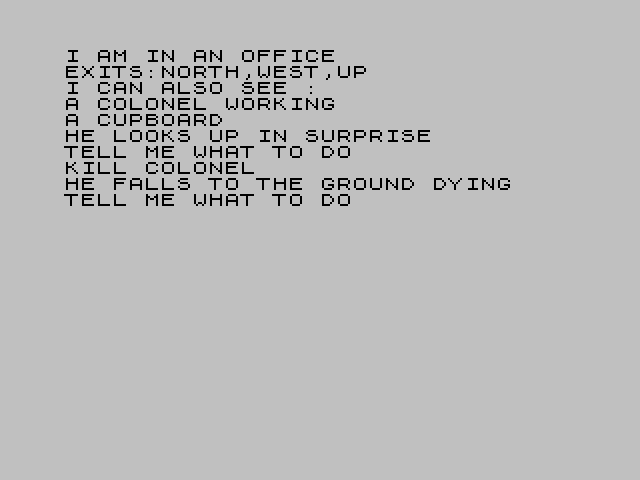
Just south there’s a colonel, and we can just straightforwardly KILL him, and take his jacket stored nearby. There’s a guard later that then mistakes you for the colonel so you can get by.
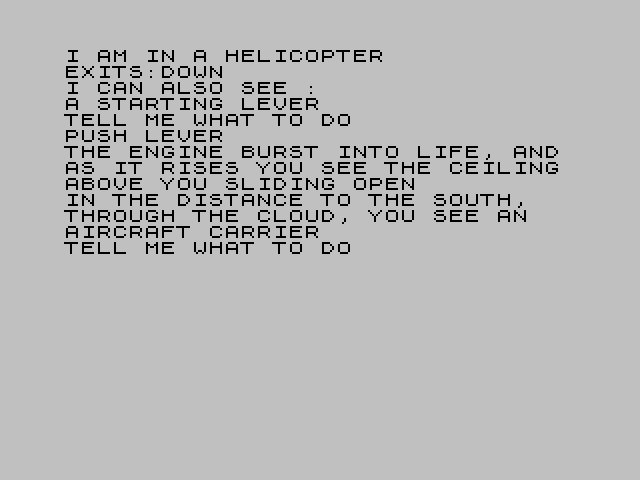
This is followed by a helicopter you can use to escape. Just make sure you don’t PULL LEVER which gives the highly deceptive “I CAN’T DO THAT YET” but instead PUSH LEVER.
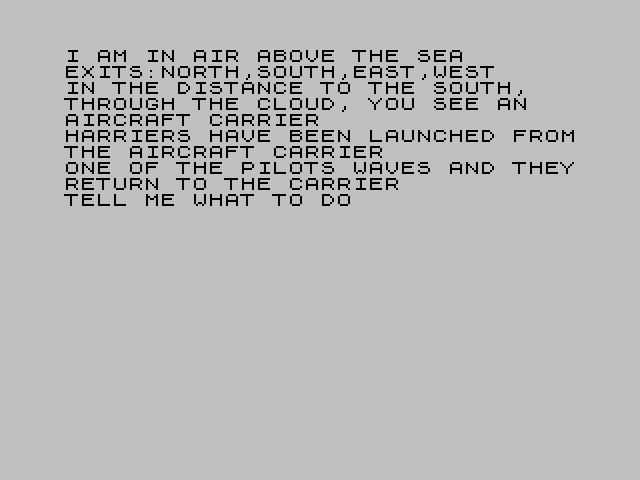
Making a beeline for the carrier is not healthy, as indicated above. You need to first fly around a little and then some harriers fly by and spot you.
I think you need to also have dumped the colonel’s jacket first before doing this.
Then you can safely land to victory.
Adventure E by an entirely different author!
The game was … fine, I suppose? There’s very little of the complexity allowed by a Scott Adams game (with timing, multiple attributes, etc.) All of the previous games (A through C) required odd leaps of logic that didn’t really happen here; the “hardest” puzzle probably was the use of the plastic explosion which I admit I solved by accidentally trying to cause a different effect, but it still didn’t strike me as unfair.
I do think the system itself really held the games back. With very little possible in the way of custom messages, and I CANT for everything, this is weak parser; a Greg Hassett game from 1980 does a better job in communicating why an action didn’t work. I think the ZX81 system itself (and the fact the original games even worked on ZX80!) can somewhat be blamed; even the most talented of modern authors would have trouble squeezing more out.
And we in the UK were working with so little memory, compared to our peers in the US. One of the first Artic releases was 1K ZX Chess. We crammed a chess playing game into 1K. The reason that UK programmers and technical people got so good was because we were working with 1k, and then maybe 16k. In the US they were working with up to 64k. We had cassettes and they had floppy disks.
On the other other hand, I can tell you once we reach most text adventures being aimed at the ZX Spectrum, we’re not in a land of milk and honey. But at least they were capable of more.
Coming up: Not sure! Brian Cotton was supposed to take longer to beat, so I’ll try to find something small to finish off the year.
This is the last of the Charles Cecil games made with Richard Turner for Artic Computing. (Previously: Inca Curse, Ship of Doom.) Ship of Doom had the kerfuffle calling it a “digital nasty” due to a particular scene; after publishing Ship of Doom, Turner had his talk with a Whsmith manager about how his art was “rubbish” (as Charles Cecil notes, “…we weren’t worried about logos and marketing. We wanted to make games.”)
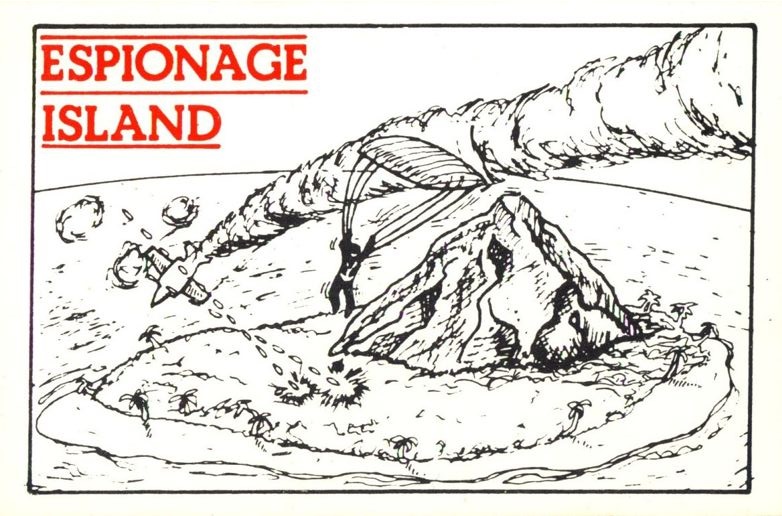
Espionage Island is the adventure that came after that talk, so the cover isn’t just plain text anymore.
From Mobygames.
The text adventure engine (based off a 1980 Practical Computing article) still hasn’t changed; plenty of I CANT messages for “I understood that verb but I’m not going to do it for whatever reason” and I DONT UNDERSTAND for when the verb is out of range. (The remaining games, E through H, do change things up, but we’ll save discussing that for when we reach 1983.)
We are, straightforwardly, on a reconnaissance mission to an island, looking for a “secret”. I think realistically we might get a camera or something (at the very least there’s a “disguise” not mentioned in inventory) but we otherwise just start sitting in a plane that was “hit by enemy fire”.
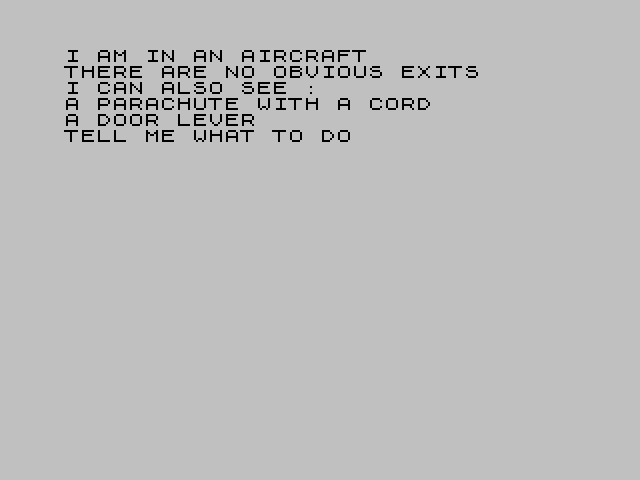
You can GET PARACHUTE, WEAR PARACHUTE, and PULL LEVER to be on your way. This leads to MID-AIR whereupon PULL RING will open the parachute, and you land in a DARK BUNDLE, and then get stuck by the parser.
This is one of those things that looks simple from the author’s end that’s still easy to get stuck by: you’re just supposed to DROP PARACHUTE, and now things open up.
Well, we start in a jungle rather than a beach, that’s different.
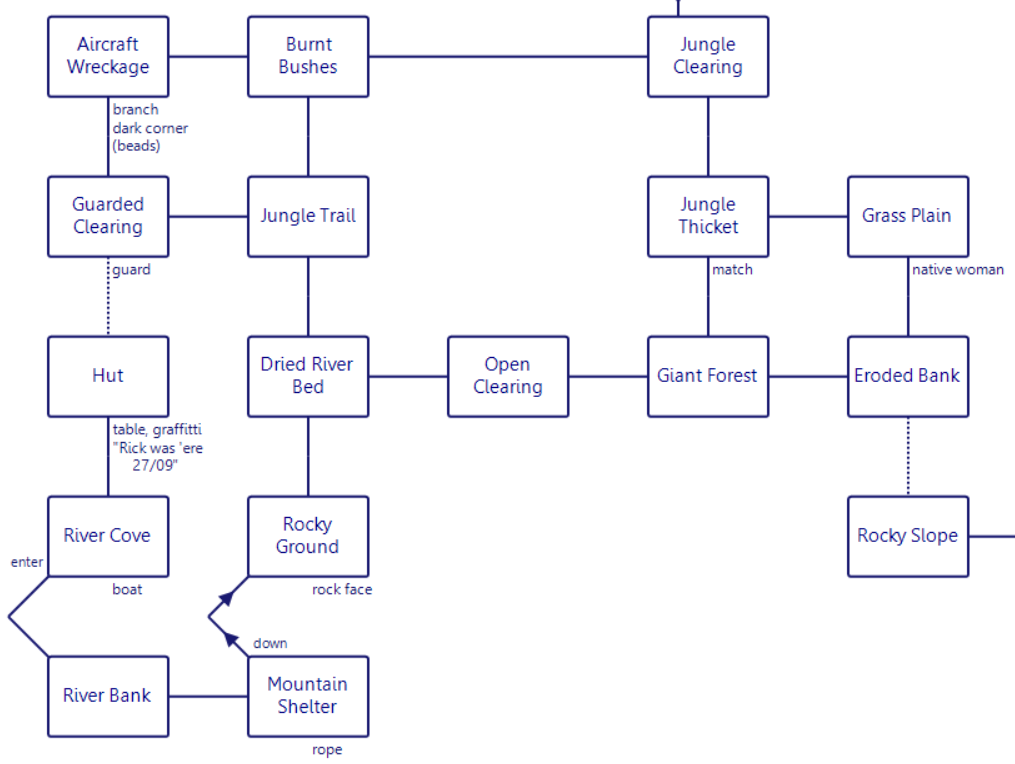
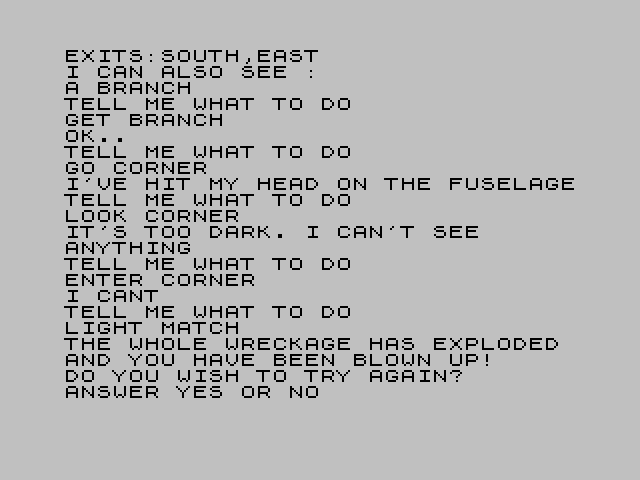
To the south there’s a “match” in a jungle thicket, and to the west is the crashed fuselage of our plane. There is a branch you can just grab, and a “dark corner”; if you light a match to look more closely, you die.
I’d say something about “ah, this is one of those games” but this is the only unexpected death I’ve come across so far. For example, a bit farther south there’s a guard, and going south farther kills you, but the game certainly gives sufficient forewarning.
Back at the plane, you can TOUCH CORNER or FEEL CORNER and feel a string; pulling the string reveals some BEADS. The beads can go over to another part of the island where there is a NATIVE WOMAN.
The player can SCREAM at the woman and get killed, but it took me major effort to find any other way to interact.
With the knife, you can eliminate the guard.
Past the guard is a “hut” with graffiti on a table that reads “RICK WAS ‘ERE 27/09”. After some testing I found 2709 is recognized as a word so I’m guessing it goes to a keycode combination later.
South farther is a river with a boat. You can head downstream with the boat, but not too far!
I suppose this death didn’t have much warning, but I still thought I was about to go off a waterfall.
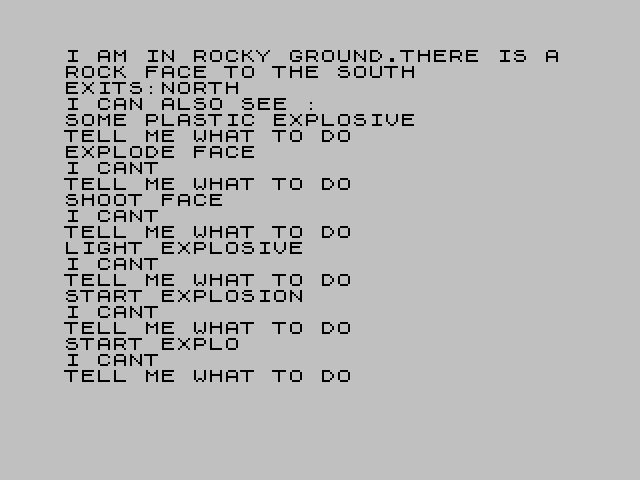
If you (properly) take the boat only for a short trip, you can find a rope, then slide down back a “rocky ground” near a “rock face”. I am still suspicious that the rock face hides something but I haven’t had any luck.
A sneak preview ahead in time: there’s a plastic explosive later, but I wasn’t able to get it to blow open a hole here.
So that leaves the player with the knife, a gun swiped from the dead guard, a penlight swiped from the same, some rope, the match that blew things up earlier, and the branch by the crashed ship. To the southeast there’s an ERODED BANK with a gap and dropping the branch will allow crossing:
This leads to a swampy area which serves as a maze.
I actually ran into this area before going through the beads-knife-rope sequence, so I didn’t have much at hand to do mapping, so I started by trying EAST, SOUTH, WEST, NORTH, just in case this was a grid rather than a more randomly-connected area.
This leads to the next area! So I had the solution to the maze right away, although I still spent the time mapping partly just to be sure I didn’t miss something, but mainly so I can share the many arrows with you, the readers. This is proof that just because a map is messy to diagram, it doesn’t mean it is difficult to travel through.
Past the swamp is “marsh land” and then a mining site.
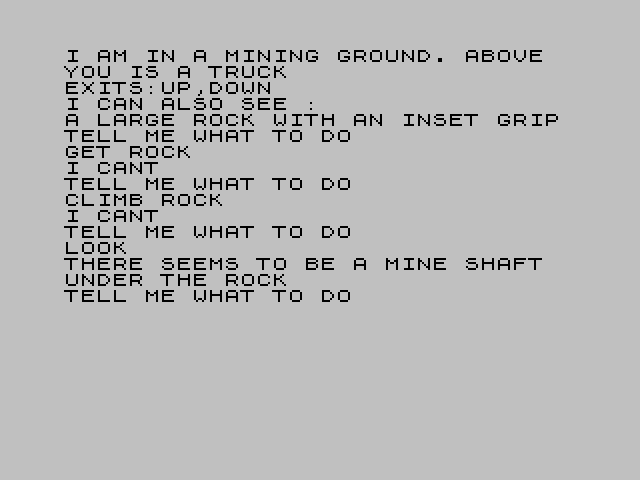
The ROPE seemed the most pertinent item, and I realized after some noodling the game allows you to TIE ROPE, followed by the prompt WHAT TO? You can specify to the rock hiding a shaft, then to the vehicle. Then you can hop on the vehicle and drive it forward in order to pull the rock.
Genuinely satisfying, and I didn’t struggle with the parser here! It helps that everything is just TIE or PUSH.
This opens a tunnel with a PLASTIC EXPLOSIVE (which you saw a preview of already, and I have yet to use). There’s warning sign about danger below and if you ignore the sign you get trapped in a ROCK CELL.
The way forward is to move on, going back outdoors to where there is a LANDING CLEARING and a CONTROL UNIT containing a switch which is set to green.
Unfortunately, my moment of smooth parser interaction was followed by utter pain: no verb I tried was able to interact with the switch.
I tried making my verb list and then applying each and every verb on there, no joy.
Just trying to move on, there’s a tank patrolling. Unfortunately, a tank is rather larger than a guard and neither the knife nor the gun is of use. I might think the plastic explosive could do something but again, no joy with the parser.
I’m unclear if I’m stuck here because of the aforementioned parser issues or if there’s some “legitimate” puzzle I’m missing. But just to summarize, I have
a.) a rock wall that may or may not be hiding something
b.) a switch that doesn’t want to work
c.) a tank I have been unable to get by
d.) and just for completeness sake, going down from the mine leads to a “cell” but I suspect that’s just a trap.
The IFComp has been a central fixture of the interactive fiction community since 1995, and before that, there was the AGT (Adventure Game Toolkit) contest that ran from 1989 to 1993, and even before that, a single contest in 1986 was dedicated to the predecessor of AGT, GAGS. You could consequently argue contests have been an essential fixture of the text adventure form since 1986. (Jimmy Maher has written more extensively about the contests here and here.)
However, there was a major contest which started even earlier! In 1983, 1985, 1987, and 1988, the company Falsoft, publisher of Rainbow Computer magazine (dedicated to the Tandy CoCo), had an adventure game contest culminating in the winners getting published in a book.
These were genuine contests with judging and a winner and a runner-up and so forth, but since the first contest showed up in 1983 I am going to wait on most of the details until then. Here’s an excerpt from Lawrence C. Falk (editor of the first book) just to give a sense of what was going on:
The idea for The Rainbow Book Of Adventures began before there was even a Rainbow. Thanks to Scott Adams, Byte magazine and those wonderful people who brought you the original Adventure on the big mainframes.
“Wouldn’t it be nice,” dreamed I one day, “if there could be a whole book of Adventures just for the Color Computer?”
I had just finished reading Byte’s Adventure issue of December, 1981, and seen one of Scott Adams’ famous Adventures on an Apple computer at my not-too-friendly local computer store. Just the day before I had discovered how to get by the snake in the Colossal Cave. But I wanted to play an Adventure on my CoCo.
None to be had. So I wrote one. Just to see whether I could do it. Name: Vampire! Play time: Around 30 minutes. But I did learn how to move things around, including myself.
(I know, you want to know what happened to Vampire! So do I. I let a friend market it for me and it sold, I think, about three copies. Besides, working on the thing late at night was scary, anyway.)
…
Well, yes, it would be nice if we could have a book of all Color Computer Adventures. But there weren’t many out there, so we began publishing a magazine called the Rainbow instead. (This isn’t exactly how it happened, but it is close enough.)
As the Rainbow grew, we started to get some Adventure submissions, and, pretty soon, started an Adventure contest. We decided that each winning entry would be published in a book. And here it is.
There’s some 1982 business to check in on, as a pair of articles showed up by Jorge Mir about how to write adventures for the Tandy CoCo.
July 1982 had “Rainbow Adventure”, essentially a sample game, and he expanded on the technical details for his August 1982 template he called ADVMAKER.
Aside: Mir mentions whipping together a short game using the template for gatherings.
The sample game, Rainbow Adventure, is not terribly impressive, but keep in mind the context here is like the Ken Rose articles, where the point is to explain how adventures work.
What I am going to talk about this month is writing an adventure. And, next month, we will be giving you an outline of an adventure generator that will help you write your own adventures. It is a sort of help for those who will be entering the RAINBOW Adventure Contest.
This was the era where the programming was the big roadblock; design could wait.
The player starts on a “Kentucky Street” (Rainbow was out of Prospect, Kentucky) with no real direction what to do. This is one of the sorts of games where you find out the final objective when you get there.
There is a very slight amount of maze-iness around the start, with two “winding road” rooms and the player starting with no inventory so not having a way to distinguish between the two (or even knowing there’s exactly two). I nabbed a “shiny object” from a dead end (turns out to be a key) and a sign at a pawn shop explaining you can sell jewelry there, and used those two items in order to confirm the map below.
The shiny object, as already mentioned, is a key, not jewelry, so you can’t sell it. Finding what you can sell is the most curious part of the game, and is interesting in a theoretical-ludic sense. Near the Pawn Shop is a Clothing Center with a mirror. The mirror informs you that you have a watch.
You don’t otherwise see the watch in inventory, and can’t READ WATCH or the like. I first thought the watch might be used to track some kind of timed puzzle, but no. Once learning you are wearing a watch by seeing it in the mirror, you can sell it.
This is one of the odder disjoints between player-knowledge and avatar-knowledge I’ve come across.
With the watch sold you have money, and you can go over to a computer store. There (using the key to help open a case) you can obtain a computer and a tape, and then use the very specific parser commands LOAD TAPE followed by RUN COMPUTER to learn about a bus.
With this powerful increase of knowledge, you can go over to a BUS STOP, hop on a bus, and end up a a post office. There you can open a mail box and find a copy of Rainbow Magazine, winning the game.
I wonder if anyone had come across the game without realizing it was meant to be a sample programming game; it feels very slight otherwise. Fortunately for posterity, we will see Jorge Mir again: he entered the first contest, with two fairly extreme programming specimens, one being an expansive adventure in 4K and the other being a one-room adventure in 32K. The latter is the first example we have of a “room escape game”.
But that will wait for 1983, which we are inching closer to! Honest! Next up: the last of the Charles Cecil games written for Artic Computing.
As I suspected from last time, my initial issue was simply a missing exit. At least the author was trying to be actively deceptive and it wasn’t just me overlooking a simple chunk of text. At the far east of the maze, you can go UP.
Given the giant is peaceful and I had a limited number of verbs to work from, I quickly narrowed down to GIVE probably being the most useful thing. Except: the game did not seem to understand my commands like GIVE WAND. After fussing for long enough I eventually realized I needed the syntax GIVE WAND TO GIANT. (This is not the death-by-grammar moment but it gives a clue of the issue.)
As I was using a save that hadn’t tangled with the goblin yet, I had the lunch in inventory, and it turned out to be the correct use.
Hmm, so my fortification with calories was not the right way to defeat the goblin. Let’s put a pin in that, and nab the rope, as it clearly went to the hook.
Note that TIE isn’t even recognized as a word by itself — this is grabbing the whole phrase TIE ROPE TO HOOK here and the command isn’t otherwise comprehended by the parser. Clearly the author’s Zork influence is coming into play, but with a negative effect (since TIE ROPE ought to be understood, and even the Infocom parser would have taken it! but the author wants to include the feeling of full-parser commands).
The section after straightforwardly allows you to scoop up two treasures; the trip is one way since you have to drop down from the rope, but the other side of the grating is available. You just need to make sure to bring the iron key, otherwise you’re softlocked.
Now, the iron key is past the goblin, so that second screenshot means I got by the goblin somehow without eating the lunch first.
I did, and this is the spot of the game that is horrifying. In fact, we may have a new grand champion for most deceptive parser message ever, and honestly, I don’t think anyone is ever going to beat it.
You see, despite the response indicating you are trying to “stab” the goblin, KILL GOBLIN is interpreted an entirely different way than KILL GOBLIN WITH SWORD. If you just KILL GOBLIN, you’re trying to stab it with … your hands, somehow? KILL GOBLIN WITH SWORD is the way to specify you’re using the sword, and if you do that then the battle runs along cleanly and you can win.
Primal screaming isn’t enough to represent how infuriating this is. I can see how it happened: the author, enamored with a multi-word parser, wanted to have the two commands be different, but forgot to convey to the player that the two commands might be, in any sense, different.
Just like Catacombs, there’s no game-cut-off victory message if you win.
To be clear, this isn’t somehow conveying the superiority of two-word parsers: it just means that as layers get added, the author needs to start being more and more careful about the potential for deceptive responses.
I did promise a look at the Classic Quests version of the game, and strangely enough, it matches this one almost exactly! You start in the cottage rather than inside it, and the description is written differently. There’s also a loft, and I have no idea why the author added it.
Screenshot of the Amstrad version.
There’s a little more text added, like instead of just stating you’re lost in a forest, the game says:
You are lost in a forest of pine trees, the ground is covered in thick undergrowth making movement difficult.
There’s not nearly as many textual changes as you might think, given the improved DOS capacity. It’s quite possible that Classic Quest Catacombs is closer to the original than I first suspected.
Note that structurally, everything is the same! There is one other very, very important difference.
You are in a small side passage leading north-south. The walls are very pitted here as if somebody had been hacking at them with an axe or something. There is an extremely fierce Goblin here, he is brandishing an evil looking axe.
The goblin sees an opening in your defence and strikes you in the chest. You have fully recovered from your wounds.
>KILL GOBLIN
(with sword) You nick the goblin’s arm with your sword. The goblin lands a blow leaving a gash in your sword arm.
>KILL GOBLIN
(with sword) You nick the goblin’s arm with your sword. The goblin launches a fierce attack and you stagger back under a hail of blows.
Yes, the game automatically applies the sword if you type KILL GOBLIN, and even lets you know if you are doing so. At least Brian Cotton was learning!
This is the second game of Brian Cotton, after Catacombs (1981). Maybe.
I say maybe, because this game is quite a bit simpler; while we’ve had authors write a “beginner game” after their initial stab (see: Pirate Adventure, Mission: Asteroid) this feels simple in a learning-how-to-make-games way. That is, while Catacombs was published first, Goblin Towers may have been written first. While I’m not done yet, unless there’s a major turn of events this will be finished in two posts rather than four.
TO RECAP the story so far: Supersoft, a company founded by Pearl Wellard and Peter Calver in 1978, published one of the first professionally distributed text adventures in the UK, Catacombs; maybe the first. (Since writing that article more missing 1980 games have come up. Some might be vaporware — that is, they may have never truly existed — and the ads for them make them all look like amateur-garage companies, meaning the “professional” moniker still gives Catacombs some distinction. Of course, “professional” is a loose word to be using for the UK market in 1981, so there’s some hand-waving here.)
Goblin Towers was published after Catacombs, still in 1981. The original version was for Commodore PET, which we don’t have, but a C64 follow-up came after which we do have. This is unlike the situation with Catacombs, where no copies of earlier variants are available and we only have the 1986 “Classic Quests” re-issue, which likely added content and text.
The 1983 copy shown above (cover via Lemon 64) has a fair chance of being similar to or even identical to the PET version of the game. This is the version I’m playing, although I also compared a little with the Classic Quests version. To simplify my narrative, I’ll save talking about changes in the re-write for when I’m done with the original.
The premise is that there’s a castle with rumored treasure, and we need to go fetch it all and bring it back to the starting building, getting points for each treasure placed.
Unlike most the games of this sort, I don’t think the most direct inspiration is Crowther/Woods Adventure, or even Scott Adams Adventureland. I think the author was inspired from Zork.
Now, this is a much spicier assertion than it seems because this was written in the UK. Infocom was not common in the country, and in the land of expensive disk drives it was never terribly popular through the 80s. However, in addition to the newspaper giving the same vibe as the leaflet from Zork, and the lunch, there’s combat with a goblin you’ll see shortly which resembles the fight with the troll. There’s not that many forward ramifications — they’re all still pulling from the same original source, after all — but even when looking at the US market, there haven’t been many people inspired by Infocom yet. I’m guessing Cotton’s exposure was to mainframe Zork, not commercial Zork; this game likely was written in 1980 when I don’t think any commercial copies of Infocom had made it over the pond yet.
Another point of resemblance: Crowther/Woods Adventure kicks things off with a grating, and Zork has an early grating but changes it so it must be unlocked from the other side. The same thing happens here; there’s a grating, but even with a key (found later) you can’t open it. The game says it must be unlocked from the other side.
The starting way to enter is instead at a large inviting castle:
Quite early on is a side passage with a goblin combat (which, again, feels a lot like the Zork troll fight).
I died a fair number of times and I thought perhaps I was meant to come back later with a special object or at least more “experience points” helping, but I gave it one more go after eating the packed lunch and was victorious. I guess our hero was just a bit peckish. It’s hard to murder on an empty stomach.
Past the goblin are some stairs going up and down, with two relatively straightforward puzzles associated with both directions.
On the down side, there’s an iron key (I haven’t used it yet) followed by a cell with an emerald (treasure) and a loose block. You’re simply supposed to push the block. This opens a passage to a diamond, and a route to go outside (you’re not trapped, this is just an alternate route out, like Zork).
On the up side, there’s a locked chest, and a room with a message: “Cassim forgot about it but Ali Baba didn’t.” This indicates that to open the chest you need to say the words OPEN SESAME. (Cassim is Ali Baba’s brother who tries to steal the treasure, who forgets the literal words OPEN SESAME to get out of the cave.)
Reversing back to the goblin fight, and heading east instead, first there’s a crystal wand (haven’t used yet, but it does count as a treasure) followed by a straightforward maze, the kind of maze where going east from A to B usually means you can reverse your steps by going west.
With just a few exceptions.
The maze has a pearl necklace (treasure) and leads to a ledge which has a “hook”. I have been unable to get the hook to do anything. It feels like the sort of place where a rope would go, but I haven’t seen a rope and the verb TIE doesn’t work.
To recap: Out of the treasures, I’ve found an emerald, sapphire, diamond, and pearl necklace. I’ve found a key which hasn’t gone to any locks yet, a wand where waving it everywhere does nothing, and a hook I have had no luck with. Unless I’m missing a map exit (not implausible) I’ve otherwise explored all the accessible areas. The high score is 160 with score coming in chunks of 5 so we’re not talking an excessively long game, but it is possible Mr. Cotton has ramped things up later.



















 Renga in Blue