So we spent about a week puzzling through the 12 puzzles of Krakit, with some answers more certain than others. I’ve already put a lot of solving detail in my prior posts, so go read those if you missed something.
Our contest entry is:
1: Scotland, Edinburgh, 7464
2: New York City, US, 1941
(We thought possibly 1882, but we had no real way to choose between the date of the Statue of Liberty and the date of the song.)
3: Chicago, US, 1942
(Would they repeat the US twice? The actual O’Hare aviation 9-vs-1 action happened at sea, so wasn’t really associated with a specific city. We also never fully parsed out what the Hyde Park “Byrd” thing meant.)
4: Budapest, Hungary, 7
(Very tentative. Roger Durrant also suggested Zurich with its 12 districts and 34 quarters.)
5: Ottawa, Canada, 282
6: Savignano, Italy, 49
(I will be flabbergasted if this one is right, but it’s possible.)
7: Salisbury, England, 70
(Feels pretty solid on location. Very uncertain on number.)
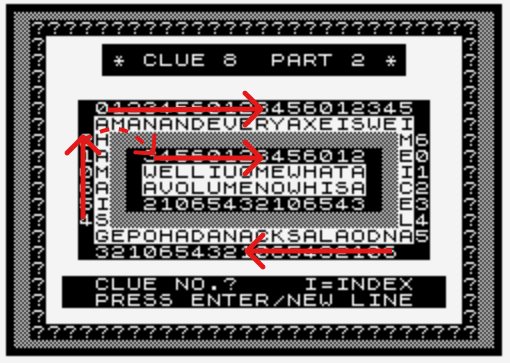
8: Chihuahua, Mexico, 10652
(A self-confirming puzzle, so I think this one is good.)
9: Verona, Italy, 2
(From the play. Easy? Too easy?)
10: Borodino, Russia, 1812
11: Ballaghaderreen, Ireland, 1916
12: Tromsø, Norway, 13
(A complete shot in the dark.)
So, how did we do? Cue the drumroll.
From zx81stuff. This is actually a “demo tape” version of Krakit which doesn’t even have the real clues, just the instructions. An included slip tells you to directly edit lines 225 and 226 of the BASIC source code from “Gladstone Electronics” to whatever your own establishment is called and send information to IPS in Ontario in order to get a customized version of Krakit with your own company listed as distributor.
We did … poorly. But not as poorly as I feared. There was a mixture of “argh, we were close” and “I have no idea”. All this comes from an issue of T-S Horizons, a magazine dedicated to Timex-Sinclair computers (as the US version of the game was run). A “Gary Gogel of Arizona City” somehow obtained a complete solution document that is a full 14 pages long, suggesting some answers requiring ludicrous work.
6 and 12 were clearly complete whiffs. No idea what’s going on there. Would love some future person to work it out (or if Gary Gogel is still alive, for his solution sheets to surface).
2 and 3 may be reverse-solvable. Is 1882 some particular date?
4 really was Zurich, sigh.
7 likely is a date again, but of what?
I guess 9 needed some more time, but there really is almost no information in that puzzle other than the Shakespeare quote. Whatever 413637 comes from strikes me as likely the opposite of a self-confirming puzzle.
For 10, are they just getting their history wrong?
Clue 11 was probably our most impressive solve, so a tip of the hat to redhighlander, but it was essentially a backsolve, skipping an intended chunk of the puzzle. What do the little numbers next to the provinces mean? What does “Find the 4th” have to do with the answer?
Whatever is going on strikes me as tougher than what happened with Masquerade; at least that contest suggested you could confirm your answer by digging up the golden rabbit, and it really was only one thing you are solving for. Here it is like 12 Masquerades, each one with potential for ambiguous answers, or even, possibly in the case of clue 10, the contest makers getting their facts wrong. And of course, no way to check if you’re right on a particular clue of the 12, other than getting all the answers right. This was not a good way to write a contest.
I suspect if the spate of contests overall had been stronger — with clear winners and answers — the idea might have lasted a little longer. The odd contest games happen off and on but are haunted by the same issues: ambiguity, backsolving and potential errors. To give a more recent example, Sirius Entertainment’s Treasure Quest was a 1996 game inspired by, what else, Masquerade, with a million-dollar prize for the first solver. The game had significant errors in the contest puzzles on release. One person (Paul Wigowsky) backsolved the answer anyway but was disqualified due to failing to put his registration number on his submission. While there was a “winner” (yet no publicity photos) skepticism about the winner even being real led to the whole debacle ending in a consumer fraud lawsuit.
As far as I can find, Krakit was wound down without a lawsuit, but I don’t think anyone got far enough to even know whether or not it was “rigged” in such a way to warrant one in the first place.
(By the way, if you still have a thirst for hidden treasure even after all that, we never did solve Alkemstone, which involves a real buried object that presumably is still in the same place it was in 1981.)
I’m not breaking open the envelope on Krakit just yet — let’s say, in a few days? — but we had some industrious commenters at least make plausible stabs at Clues 6 and 11, and I have my own half-way plausible guess on 12. That makes at least a non-random guess on every single answer.
The general theme for all three possible answers is assuming something about the answer, which plausibly resolves into country-town-number, and waving over the fact some of the clue never got used.
For Clue 6, I was trying to decipher the text that was there, assuming hexadecimal (from “Curse” and the fact the letters go up only to F). Adam Sampson suggested to look at the digits that were not given.
Namely, read directly in order, the missing digits are 49BCE, a year which very strongly associated with a particular event: Caesar crossing the Rubicon. The modern day city this was thought to be at is Savignano, Italy.
Could this really be the solve? What does the “half” part mean? What’s going on with the blacked-out squares? The “half” could refer to the blacked-out half, so does that mean the missing part of the text has the digits 4, 9, B, C, E in some amount of repetitions and order? If so, where does the hex code as a whole comes from?
I will say it seems like a major coincidence to have the left-out digits spell out a coherent date which leads to a clear answer.
(I very vaguely suspected it has to do with the code of the Krakit software itself, making for a super-meta puzzle which leverages the medium and makes it not quite a glorified slideshow, but I don’t have a good way of checking how it gets stored in ZX81 memory — it isn’t equivalent to the modern emulator tape file.)
Clue 11 (above) had another “skip”, this time from redhighlander:
HEAR GREEN BALLAD is an anagram for Ballaghaderreen, where William Partridge died. He was part of the Easter Rebellion, which took place in 1916.
So, I would say Ireland (country), Ballaghaderreen (city), 1916 (number).
That’s one serious anagram-coincidence, there, so I’m willing to call this one definite except for the number. We’ve skipped the MU/SL/IN/REST bit entirely, as well as “That is 3”.
For 12, I’ve spent the last couple days tormenting myself in various ways.
My initial assumptions were:
a.) the stars are the only asymmetrical part, so they are important
b.) they likely indicate, in some indirect way, letters/numbers that we can decipher
This wasn’t going anywhere, so I decided to go for the skip. Let’s assume instead
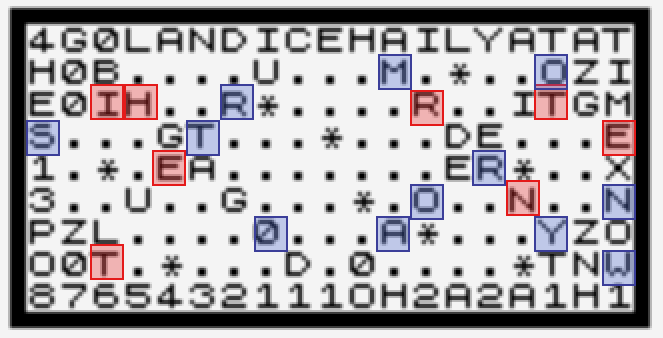
a.) the “packed area” contains letters that we are supposed to anagram (some indicator I haven’t figured out narrowing down which letters, but let’s just try with all of them)
b.) as Carl Muckenhoupt observed, the character repeated in the middle might not be a zero, but a letter ø
c.) the LANDICEHAIL on the top is not meant as a deception, but is rather a clue.
d.) the stars are just “snow” and can be ignored
Putting all these things together, I managed to get Tromsø, Norway, and the number thirteen.
I don’t feel the slightest bit confident in my answer, but it is true the clues that have “spelled out” the answer (1, 8) have included both country and city, so the letters need to include both. Is there some pattern involving the numbers along the top/bottom that makes this all make sense? Since I can technically switch THIRTEEN out for ZERO and have all the letters for it even if my skip is correct I have to coin flip which one of those is right.
At least I have something I can fill out the entire contest entry form with, so we’ll at least have a chance (however small) of “winning”. Please post any extra feedback or alternate solves, and if something is better I’ll adjust accordingly.
One quick general plea: can someone figure out exactly how many bridges Budapest had between Buda and Pest in 1982? Just a naive Wikipedia check gets 6, but that’s a list of “most famous” bridges.
Out of the 12 clues, we’ve solved (or at least have good guesses for) 9 of them, and have 3 left to go.
With my typical adventure games, if there’s any kind of ambiguity in a puzzle answer, there is immediate feedback from the game itself. For a static puzzle, it’s hard to have airtight certainty in answer.
In a puzzle book, you can, of course, immediately check the back of the book. The problem with Krakit (in a contest context) is that there is no back of the book, and while the rules aren’t specific, I’m guessing entrants did not get feedback in order to correct a wrong submission.
This is a common problem amongst puzzle hunts; where I think we can say we have answers with confidence is where there’s some manner of “cryptography” (in a loose sense) involved, where some operation is required to “decipher” material into a sensible text it would take a seriously major coincidence to have a valid answer be a fake.
That’s eight digits accounted for, so I don’t know why the next bit only lists numbers 0-6, which is only seven?
That is, part 2…
… has 0 through 6 repeat, but not 7, 8 or 9. This immediately led me to realize that the only important number is 10652. But what to do then?
The way words are sort-of spelled out suggested to me we simply had a track that needed to be followed. After a few false starts I realized if you start in the upper left, and pick out 1-0-6-5-2-1-0-6-5-2-etc in order, you get the letters mexic/ochih/uahua, where the path resets partway through to the “inner path” (and the number jumps from 2 to 3).
There are all sorts of other ways the clue could have been interpreted, but the absolutely clear spelled-out answer indicates this is a self-confirming static puzzle.
This unfortunately isn’t true for clue 10:
My best guess here is that this refers to Pyotr Ilyich Tchaikovsky and the 1812 Overture (an opus 49). The “to go forward, think retreat” can be interpreted as Napoleon’s retreat and turn around at Borodino, Russia as celebrated in the music. Will Moczarski also pointed out based on the way Russian names work it can be interpreted as Pyotr, son of Ilya, Tchaikovsky.
Still, this doesn’t feel fully certain, and there are some other ideas from the comments (like MendelsSOHN). The lack of an immediate meaning to the retreat part of the clue isn’t the same thing as saying the answer we have is airtight.
We’re down to three completely unsolved puzzles. Two seem like they’d be self-confirming, but that doesn’t mean they’ll be easy to crack.
(I had what felt like a good crack: assume that we mean two-digit hexadecimal, but are only listing the second digit. That is, we are using hex — “curse” — but only taking half of the digits normally needed. The way characters in both regular ASCII and the ZX81 character set works makes it so there are a limited number of choices then for each digit, so it’d be easy to decipher a code. It still just makes nonsense, though.)
(I still feel like the stars have to be the key here, and a lot of the letters are ignorable; this would follow the same pattern as the SEND MORE MONEY puzzle insofar as that one also has many “superfluous” letters and we are just trying to pick out the correct ones.)
I’m going to take a Krakit break and play some normal adventure games, then unseal the answers next week. Please keep sending your thoughts in the comments! That hopefully gives us enough time to reach enlightenment before we try to do back-solving.
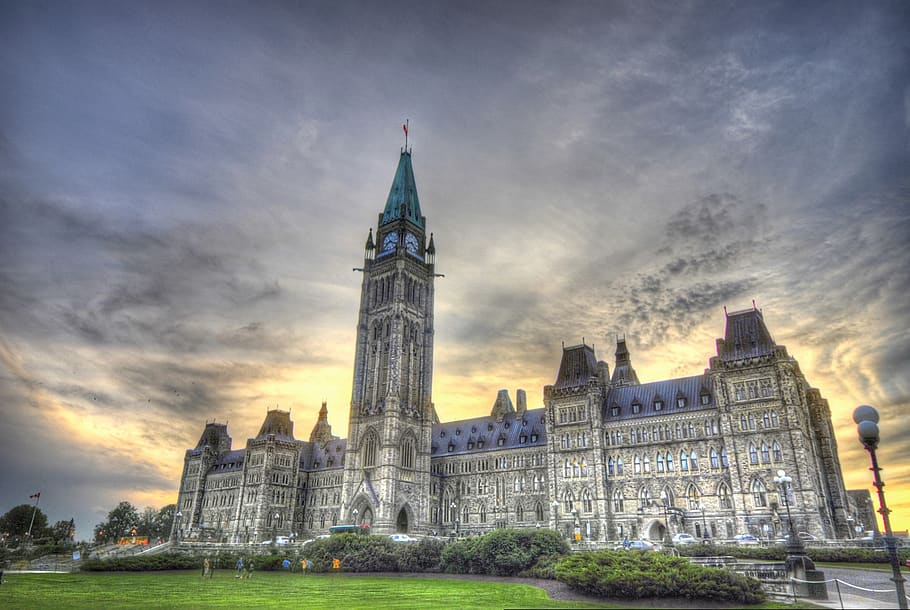
Canadian Parliament, including the Peace Tower. Public domain, via Wallpaper Flare.
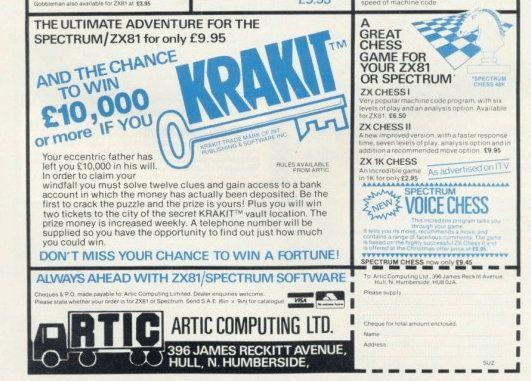
To update on the authorship-mystery of Krakit, Strident in the comments found a reference that specifically gives International Publishing & Software Inc (of Canada and the US) as the creator and Artic (of the UK) as merely a distributor. At the very least, the game seems to have had more mention in UK circles than US one. Not only did the UK have heavier contest-mania, but there was more consumer hardware out there that could run the game. The primary platform for Krakit was the ZX81; the United States equivalent was the Timex Sinclair 1000, which Commodore was actively crushing with its VIC-20 (there was even a trade-in deal where people were buying Timex Sinclair computers specifically to trade in for a VIC-20). Krakit also had a ZX Spectrum version but by the time the US equivalent (the Timex Sinclair 2068) came out in late 1983 the contest was already dead.
Sinclair User, February 1983, with the name Artic showing up much more prominently than IPS. I like how this ad emphasizes the narrative, even though there really isn’t one.
Regarding “of Canada and the US”, yes, I’m not sure which country to blame credit more. For example, this article from December 1982 explicitly says:
The first release I’d like to discuss is called the Krakit Treasure Hunt from International Publishing & Software (PO Box 1654, Buffalo, NY) and International Publishing and Software, Inc. (3952 Chesswood Dr., Downsville, Ont., Canada M3J 2W6). It includes a real treasure for the finder that’s said to be $20,000, with this treasure lode continually increased as time (and sales) pass.
So, this references two companies but with nearly the same name:
International Publishing & Software
and
International Publishing and Software, Inc.
The actual address given for contest registration is a Buffalo, NY one, and the InfoWorld article I mentioned last time referred to the company being in New York; various other articles definitely place the company in Canada, and the address to send tapes is also in Canada. I’m going to go with the assumption for the moment that the company was situated in both.
With that out of the way, let’s get back to the game.
Remember, each clue is supposed to give us a city, country, and number. One thing I was worried about was the possibility that the city and country would mismatch; that is, the city could be in a different country than the country from the clue. However, based on current evidence I think we can say it always matches, which helps if we have a city with no clear country indicator.
This allows for at least a modicum of cross-checking (given the country is sometimes clued along with the city). The number is still the foggiest part, and I’m afraid on some of these we may need to cross our fingers and guess.
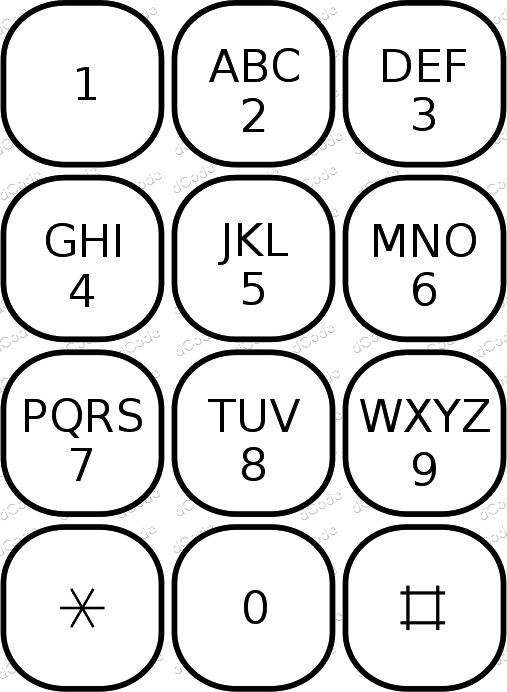
This clue, at least, we can definitively put to rest: it is a phone keypad code. I had some genuine trouble until I realized I could get LAND out of 5263, so pulled up a list of countries ending in -LAND and came up with SCOTLAND. The city is EDINBURGH and the number is just RING changed back to keypad code (7464).
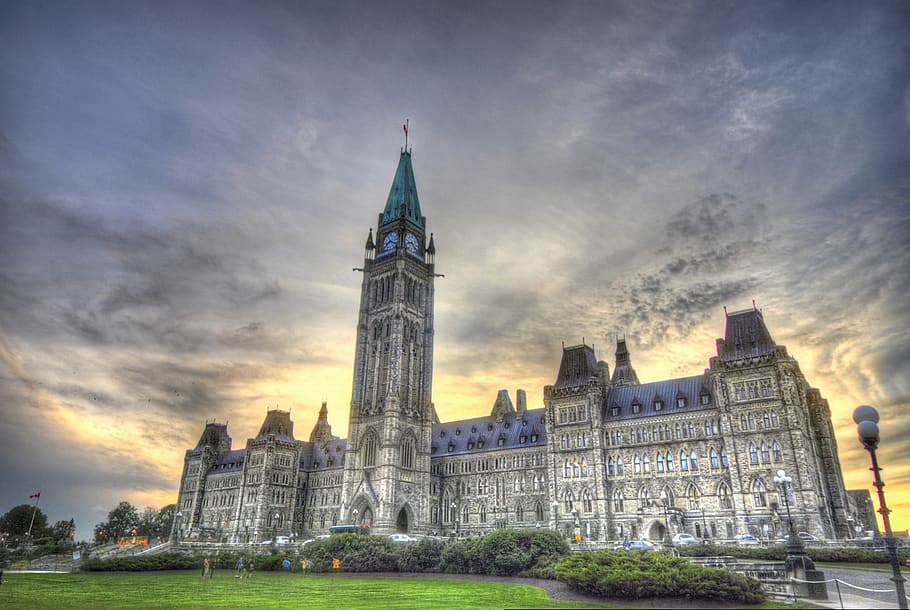
#5 is Ottawa in Canada. The Parliament building, with the Peace Tower, rests on a hill overlooking the Ottawa River and Rideau Canal. Every year in the spring, there’s a tulip festival in Ottawa commemorating Canada sheltering the Dutch princess during the Nazi occupation of the Netherlands.
As the House of Commons had 282 seats in 1982, that’d be the number of seats it was looking for.
In a theoretical sense, the “how many seats” was an important confirmer in the whole thing — there could be some vague coincidences in the text otherwise, but the seats question is such a strange one (even thinking of stadiums, or theaters) it locks things down. I think one of the keys of trying to write this sort of contest question (with no other method of cross-checking) is to have at least one odd and unique part that doesn’t fit the other pieces.
It also would help to have a meta-puzzle that ties things together so we can see if there’s an error, but IPS decided not to do that. Grrr. (Probably? Is there something secret spelled out once everything is written down? Hmmm.)
Moving on to more ambiguity:
This is as Carl points out in the comments, a straight cryptogram:
a divided city,
but not by hate.
how often can the
gnomes cross
from the little to the
great?
My best guess was Budapest (which has two cities, Buda and Pest, and a prominent count of bridges between them) but I didn’t make sense of the gnomes until Roger Durrant pointed out it could refer to Fisherman’s Bastion.
I don’t feel solid about this one, yet, but I’ll still call it the best guess.
Oh to clue 7 and more ambiguity:
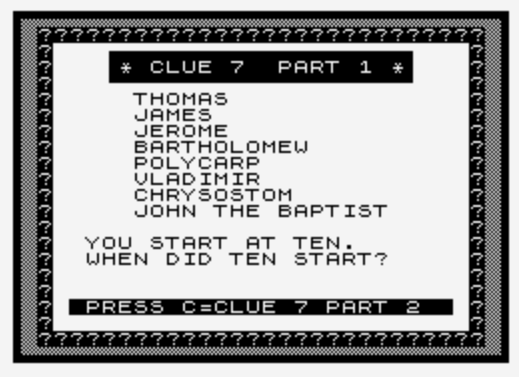
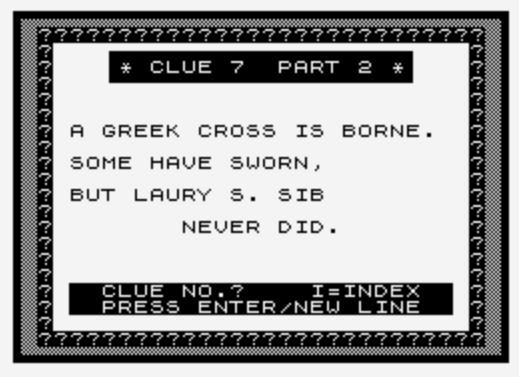
This is a list of religious martyrs, not all from the same branch of Christianity and definitely not always close in time. My guess is this is meant to be a Scattergories-type list just meant to hint at the concept of a martyr, which we then apply to the Ten clue. The most strongly related martyrdom to Ten is ten rabbis, the Ten Martyrs from Judaism; the start point being 70 CE, at the destruction of the Second Temple. So that’d be my guess, although it doesn’t quite tie cleanly into part 2:
Carl points out Laury S. Sib is surely an anagram to Salisbury. Salisbury has a major cathedral one that is not in the regular form a Greek cross (note the clue’s phrasing means this is a good thing). So the place from just this part of the clue is Salisbury, England. I feel more confident here than with the ten rabbis; I admit I’m being stretched to the limits of my religious education here.
So this leaves one other clue (“A CURSE? NO, JUST HALF.”) which we really have made no progress on at all:
I guessed, based on letters only going as far as F, having hexadecimal involved. Carl made another guess that “hexadecimal = hex = curse”, but past that we really aren’t sure. Any thoughts are appreciated, no matter how outrageous they may seem.
Now it’s nearly time to give the rest of the clues, but let me just put this one up in front as it is relatively easy:
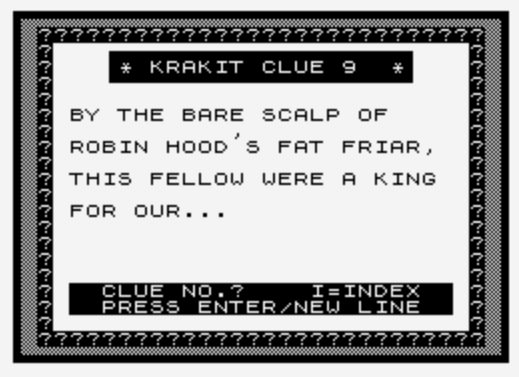
This quote is from Two Gentlemen of Verona. So 2, Verona, Italy. Hopefully that’s that? Let’s get to the trickier ones:
I also have a strong theory on 10 but I’ll drop that in the comments in case I’m wrong. On the other clues I have no idea yet.
Thanks for everyone who has participated so far! I don’t know about making a completely mistake-free “entry” into the contest but maybe we’ll get close.
Since last time, I made two very important discoveries while researching Krakit:
1.) the contest was indeed officially shelved with no winner, in 1984
2.) later the answers were released, and I have a copy (that I have not looked at)
So for our gameplay, we should make an “entry form” the best we can, and once it seems to be final, I will crack open the “real answers” and we can find out how well we did. Maybe we can “win” unlike everyone else from the early 80s? (I’m honestly happy about this. We’d otherwise get an answer list we only “feel” is correct but can’t do any kind of grand confirmation on.)
I’m also a little unclear on the actual authorship on the game. There’s an article in the 1982 December 13 issue of Infoworld which only mentions International Publishing and Software (out in Buffalo, NY) and 10,000 tapes of the game. Quoting IPS president Howard Gladstone:
Some whiz could pick up the tape and figure it out in one day, or it may take two years. We really don’t know.
He then claims the clues took “three months” to develop as done by “four of his-coworkers” who “labored part-time on the project, testing the questions for clarity, intellectual challenge and entertainment.”
The article doesn’t mention Artic (from the UK) once. Was it devised by Artic and IPS served as an “editor” so to speak? Was the president referring to the number of people who worked on the game as a whole (including people from Artic)? Did Artic really only serve as a publisher (which contradicts what various indexes say, which has Artic as author and IPS as publisher)? Or maybe the entire monologue from the president was just blowing smoke for the benefit of the journalist? IPS was the group officially managing the contest, at least, and entries got sent directly to them.
ADD: Correction, the main company IPS was in Canada, although there was still manufacturing out of New York. It also does seem to be the case (see comments) that Artic was just the distributor.
In the meantime, let’s get at the three clues from last time, and then I’m going to put the next four.
Matt W. got this one, giving the hint that the number is 7464. I tried keypad code but didn’t have any luck, so I’m still thinking on this one.
This suggests “The Big Apple”, as in New York, the Statue of Liberty, and Duke Ellington’s song Take the A Train:
You must take the “A”-Train
To go to sugar hill way up in Harlem
If you miss the “A”-Train
You’ll find you missed the quickest way to Harlem
Hurry – get on now it’s coming
Listen – to these rails a-humming – all board
Get on the “A”-Train
Soon you will be on Sugar Hill in Harlem
This suggests the city, at least, but what’s the number? Is it the date of the song (1941) or the date of the Statue of Liberty’s arrival (1885)? Is the reference there to make sure the city is Manhattan and not, say, Brooklyn?
This is reference a WW2 incident from 1942 where Lieutenant O’Hare of the USS Lexington (who was near Bougainville at the time) ended up doing a 9-vs-1 against Japanese bombers and downing 5 of them. The exact quote is:
As a result of his gallant action — one of the most daring, if not the most daring, single action in the history of combat aviation — he undoubtedly saved his carrier from serious damage.
O’Hare Airport in Chicago is named after the same person.
I’m not sure what “Hyde Park Byrd” is referring to; Carl Muckenhoupt has a theory involving a word-grid coming up with Hart, the main character in the musical Chicago.
Even if we’re talking about Chicago, this still isn’t suggestive of a date, but I’d guess 1942 given a lack of anything else obvious.
I want to save theoretical discussion for when we have some more samples, but it does seem to hold that perhaps the clues are too ambiguous to fully nail down. As pointed out in the comments on the sample which we were given the solution to…
…we could read “Tour” as Tour de France and still get Paris, France out of it. But we’d get a different number: the Tour de France started in 1903. I think “TOUR” in quotes for the Tour de France still parses slightly oddly, so I suppose the Eiffel Tower solution feels better but it really is hard to claim the question is airtight. It may be there are some “unspoken rules” throughout the clues that get followed consistently enough we can at least do a little cross-checking, though.
Now, as promised, here are clues 4 through 7. (7 is split into two parts.) I’ll toss up the last chunk of clues next time.
For my 1981 sequence of games I played Alkemstone, a treasure hunt with clues hidden in an Apple II game where the treasure has never been found. While we made some progress, most notably extracting every single clue from in the game (not a trivial task) it remains an open historical mystery.
Alkemstone was odd insofar as it was made in the United States, and the place in 1981 that really had been hit by the puzzle-contest bug at the time was the UK, where Masquerade-mania was at its height. 1982 had a bit of a let-down with the solution more-or-less cheated (see the link for the whole story) but there was still a sense in the air of the possibility of more “contest games”, perhaps in computer medium.
The most famous of these games (which is, genuinely, an adventure game) awaits a future post; as preparation, I thought I’d tackle Artic Computing’s entry into the ring. Artic Computing had an ongoing adventure series (so far I’ve written about Planet of Death and Inca Curse); however, Krakit is not oriented as an adventure and is a pure puzzle game. (ADD: Looks like Artic was only the publisher in the UK, International Publishing and Software was the original maker.)
Still:
a.) it fits into the history to enough an extent without the game I’d feel like there was a gap
b.) it allows for audience participation of you, the one reading this right now
c.) it allows me to do some more game-design-theoretical ramblings about this sort of thing
d.) just like Alkemstone, it appears nobody has ever solved it, which makes it too tantalizing to ignore.
For (d.) I am reliant on a report in Sinclair User (December 1983) which claims that the game has been “withdrawn” from advertising in the UK, with a quote from the director Richard Turner:
A number of people decided not to buy the cassette because their friends told them how difficult the game was.
From zx81stuff.
The 10,000 pounds from the cover (see above) had by that time been upped to 14,000. In the United States the game was pitched as possibly winning the player “$20,000 or more”. (See Computers & Electronics, March 1983.)
The game then seems to vanish from records. The British Newspaper Archive has no post-1983 mentions and I haven’t found any other reference digging through magazines. My suspicion (although I’m only in the 80%-90% range on confidence) is that the contest was quietly shelved with no winner.
So, with a group of smart people reading this and the power of the Internet, can we solve it now?
It does seem to be easier than Alkemstone. It’s simply a matter of 12 self-contained puzzles following a very particular set of rules; unlike the original Masquerade (or the adventure game I’ll be getting to) there isn’t buried meaning amongst a superfluous narrative. There is a very brief narrative of sorts, but I’m fairly sure it has nothing to do with the main game. Your father was a international courier, and has left you some money in a bank, and to get at the money you need to solve the puzzles.
Just to summarize, each puzzle contains a clue that will have a country, city, and number. (The number may or may not be a date.)
There’s a “warm-up puzzle” that the game gives with a complete solution worked out.
I will save the explanation for the comments so you can try to solve it yourself; the actual software leads the player through the solution via a series of multiple choice questions (essentially creating a mini-Socratic dialogue), which is pretty fascinating in itself.
In order to avoid overwhelming people, I just have the first three clues here for now. I do get the sinking feeling there might be some “ambiguous puzzles” where the answer isn’t nailed down securely for each (which might explain why it went unsolved) but I feel like we can at least get a few.
Here’s another “brief update” post on Ferret (the almost-nearly done text adventure that has gone for 30+ posts to write) mainly intended to entice the cryptic crossword fans out there.
One of the rooms from last time, a Vestry in the zombie/cell area, had a secret passage. This passage is one-way, meaning you aren’t supposed to go in on the “main route”, but as has been typical for Ferret, the information might be useful anyway.
Vestry
A small dimly lit area with various coathooks and clothes racks. There is a bead curtained exit to the south. The east wall is panelled in dark wood, above which is a beautiful icon depicting a heavenly female figure. Set in the halo surrounding the figure in a spectacular jewel.
Exits: -S– ——– —
There are some wireless headphones here
-> press jewel
Part of the wood panelling springs back to reveal an opening.
-> e
The wood panel springs closed behind you as you squeeze through the opening.
Priest Hole
A very small dark room only large enough for a person to crouch. The west wall consists of badly made wood panels that allow a little light to enter.
There are some interesting objects here:
a newspaper cutting
a blank sheet of paper
a piece of notepaper
The blank sheet of paper is very meta and I’ll get to it in a moment. Here’s the “piece of notepaper” first:
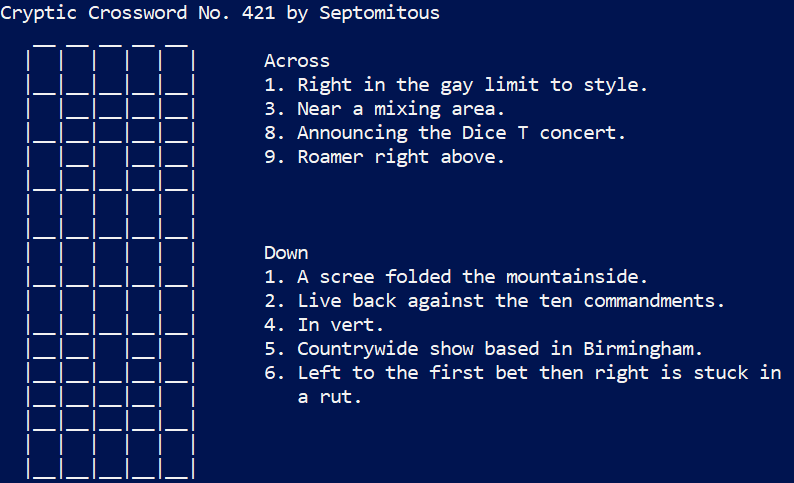
Must remember to reach out to Jeff with these ideas for clues for his wonky crossword for the Parish Magazine.
1. Hector can feel the pressure (8, 2).
2. Right in tout in large stream (5, 5).
3. Get away, morf back, too much heat on Independent Television (6, 4, 3, 3).
4. Top footballer, winning trophies (6, 4).
5. Bristling with fame, loves anchovies, participates (1, 6).
Followed by the newspaper cutting, which requires an image:
If you are having trouble reading that, I’ve filled in some squares:
Note that the middle word (7 across) seems to not have an associated clue, suggesting the word is important for the main game (unless this is a red herring in general).
Now, the blank paper which I’ve been saving:
-> read blank paper
There is nothing written on the paper although it has a strange feel with a lustre that gives it the appearance of very faint highlights and shadows.
There’s a piece of charcoal from back in phase 15 that can be carted over here to find both an extreme meta-reference and a clue.
InFiRe The Retroview November 2056
Just 2 games for this issue, a classic and a wannabe.
Zork
—-
A game-changer written in the seventies (yes, 1970’s) that broke the mould of Adventure and Cave and created a new genre of full sentence parser games. It features all the classic tropes of mazes, dark tunnels and superficial puzzles, some requiring divine inspiration. Everybody should play this game if only to understand the development of games before the move towards more friendly devices. The game was significant enough to inspire a number of sequels and lookylikies. On the downside it appears that the original game is just a collection of ideas thrown into a big pot with no gesture towards an over-arching narrative or plot. This might be due to its origins in MIT where the science of the design challenge possibly offered more interest to the game builders than the need to tell a story. Despite that minor short-coming we awarded it 4.5 stars for its trail-blazing and parsing.
Ferret
——
This game admits to being inspired by Zork, or do the authors mean it’s a bit of a rip-off? Possibly not, due to the sheer size of the thing with a narrative going from end to end, featuring a B. O. Darkins being resuscitated in a land now foreign (after the [unspecified] apocalypse event – naturally). Said Darkins is then on a mission to find survivors and the game claims to contain all the information necessary to solve the puzzles – we beg to differ, it seems to assume access to a good search engine to find some of the more obscure references. Early parts of the game echo Zork with the standard puzzles of the time but once it gets into its stride it becomes more inventive with some elements straddling multiple phases of the game. Phases are an important part of the game as it was designed and released in batches of rooms called Phases – originally a limitation of 16-bit technology, the authors leveraged it to allow the game to continue development in an incremental fashion. 40 years (yes, 40) after inception a final release was posted with an end game – which, as far as we can ascertain, has never been cracked. The final conceit has heavy overtones of a TV series popular at the time of the games’ original release – an innovative (for British TV) series called Blake’s 7 (this was in the early Star Trek era). Players have noted that the Phase is called Liberation (Blake’s ship is called Liberator), that there are 51 rooms (with curious names) on the ship, yet 52 episodes in the TV series. Many theories have been expounded but most seem to revolve around the notion of finding Room 52 – there is a Teleport that understands the room names of the ship so that might be the way in. The Authors – a bunch of plucky Brits (this is definitely a British game) have stayed anonymous but are still accessible through their website. There are innovative features in the game, e.g., a Test feature that runs every action verb on an object – this may have been included due to the usual ‘guess the verb’ problem, and this game uses a lot of verbs. We have awarded this game 4 stars for sheer scope, but it does seem old-fashioned by modern standards.
As always, games reviewed here can be found on ifdb.
Interactive Fiction Review Draft Page 20
For those who don’t want to stare at that block of text trying to find the clue, the part about “Players have noted that the Phase is called Liberation (Blake’s ship is called Liberator), that there are 51 rooms (with curious names) on the ship, yet 52 episodes in the TV series. Many theories have been expounded but most seem to revolve around the notion of finding Room 52 – there is a Teleport that understands the room names of the ship so that might be the way in.” is quite suggestive of something useful for later.
Just as a reminder, I’ve set the game-finish deadline as the 31st, so 9 days remain. Again, I’m willing to have a bit more work happen in the comments if we’re not quite but almost there, and I’m willing to make one more “finished” post if we hit the actual end of the game past deadline, but I’m otherwise switching gears from Ferret to elsewhere.
Rather than narrating absolutely everything from last time, I wanted to just focus on a single puzzle we’ve gotten up to, since this is the sort of thing random visitors (including you, the one reading this right now) might be able to help solve. I will loop around and describe the dramatic collapsing theater escape next time.
We’ve found, after some fussing with a puzzle involving Oscar Wilde quotes, this scroll:
The bottom part (astutuely solved by Matt W.) is a number written in calculator digits, but you have to look at the negative space. That is, look at the grey on the image below:
The number lets us make a phone call but then we are asked to text a “sequence”.
-> type 219934875
Typed.
The communicator emits a beep followed by a ring tone. After 2 rings the line clears and you hear a voice that says “Text Sequence commenced”.
-> type Donne
Typed.
The communicator emits a beep followed by a series of tones. After a short pause you hear a voice that says “Sequence failure”.
The first five questions seem to be relevant for the next discovery, a “graveyard” with an emblem…
The emblem is circular with a crest illuminated with a large bird, possibly an eagle. There is some wording around the crest which is illegible due to age. Beneath the crest is written “Project Casper. ICBM Silo 6”.
…and a satchel with an “answer sheet”.
Our assumption (which might be false) is that the two papers go together, and the solutions to the clues in the first set (cryptic crossword clues? something else?) fit into the second set of clues. I will just add that the list of famous English poets whose last name is composed of five letters is not terribly long. Of very recognizable ones I just get
Blake, Byron, Donne, Eliot, Keats, Hardy
and maybe Wilde or Yeats (who are Irish but someone might confuse for British) could count. (Eliot was born in the United States but moved and became a British citizen.) For more obscure poets there’s
although I suspect the missing poet is off the first list.
As I hinted at earlier, solving here is open to everyone, and for this post (if it is about this specific puzzle) let’s avoid making comments in ROT13 encryption to make it easier for anyone to join in.
This is where I’m leaving the book for the moment; it’s hard with this sort of puzzle to ascertain if you’re sure you’ve made progress but — I feel like I’ve progressed to the point where I can explain the overall logic of the puzzle, even if I’m still very confused on the plot.
If this is where you’ve landed you should read my prior posts about the book first. And of course, this is about as extreme as spoilers can be. While I have to severely disappoint anyone who arrives typing “cain’s jawbone solution” into their favorite search engine, this does establish quite a bit of scaffolding; however, I still have to disclaim that some of this may still be wrong.
The basic gameplay logic is to notice connections about a character that let you organize pages together. They might be personal tendencies to use particular items, or they might be relationships (especially to Henry the dog). As Peter observed with my last post, the narrator lights a “Nestor” (cigarette brand) on both pages 6 and 54, so we can assert (at least temporarily) that those two must be connected. The page 54 mention is explicit, the page 6 one is not:
…venerable whose winter Achilles thought to take from the lips of Cressida. Why not? I set fire to one end of him, gloatingly, and my nerves benefited.
On some pages, the author talks about their own name. I am still unclear if any of these overlap with first name-last name or if they are all different.
Page 15: Alexander, the only noteworthy Pope of my native land, was demonstrably affected. And my namesake wrote a letter, in which he said that Sarah’s left eye was injured, and there appeared a black spot on her breast.
Seems to indicating the author’s name is Pope, although it could be Clement repeated who is simply associating himself with Popes (see page 24).
Page 18: He would be, even to start with, for a course of soup, and then another of dishes, as my namesake said, and another of birds.
Based on the textual reference, seems to be Paul (of Paul’s letters in the Bible).
Page 24: I had always thought that to carry the name of fourteen popes and two anti-popes meant nothing to me either way.
I’ve gone through this one before, based on the pope count (and the fact the name occurs on another page) likely it is Clement.
Page 43: Alexander’s my name. They ca’d me Ecky when I was a boy.
Almost certainly a fake-out; the whole quote is from Robert Louis Stevenson. (It isn’t the only RLS quote, suggesting this particular narrator likes RLS and any other quotes are also from the same person.)
Page 58: Considering it was my name month, I wasn’t having too much luck. Henry, though a bit on the spectacular side—to fly the viscera of his third, of the old family lawyer, at his small flagstaff, a little argued the exhibitionist—was sane enough.
Is this person May?
Page 61: I had always been proud of my namesake, the Great Lexicographer, as we, not unnaturally, called him in the family. But I wondered if part of my life would not rather horribly reverse his. After all he had been born at Colney Hatch.
Based on the birthplace, this has to be John Walker, who wrote a Rhyming Dictionary. (The reverse also hints at the author dying at Colney Hatch?) Is the person just John, just Walker, or both?
Page 73: All the artist in me flared up. After all, my given name was world-famous as the inherited one of a bold, subtle and delightful painter. I was, perhaps, unreasonably proud of that ; took a sort of proprietary interest in “The Mumpers.” Why not? It would have been absurd to concern myself with Hamlet’s one, a thing of dreams only, or to have let my spirit flutter around Runymede.
Another name I’m unclear on; any guesses? This may require more connected context to make sense.
Page 85: I had, it occurred to me, been something of an automaton. But wasn’t I thrusting my head, when bent on such a business in this street, into the twin mouths of two lions, of Mycroft’s brother and of the pale but multitudinous Blake? Often as a schoolboy they had guyed my name to a whiskified objectionable one.
Includes a quote from Giffen’s Debt which suggests the name Giffen.
Page 91: In my youth I had been worried that I bore the same name as Newbolt’s admiral and Shakespeare’s sergeant, and it had irked me when, in my student days, I had been known as the Smiler with the Knife.
I’ve been through this one; the current best guess is De’Ath as a surname.
Page 93: Naturally I looked up. And I tell you I found it awe-inspiring enough to actually see my own name through the window, printed there in great letters for the gaze of all and sundry. With a blush I concentrated again on Henry, and asked myself if his recent activities did or did not constitute the darbs.
I’m not sure what name this is; I would assume some church in the narrative is identifiable enough that it is also possible to identify stained-glass with a name.
The general logic thus seems to be to use these clues shown to establish exactly who the narrators are, connect pages in sets by personal tendencies (and possibly events, but the plot is too confusing to make much headway), and once the pages are in the right sets, it likely will be much more plausible to sort things in order. There might be some finesses to make things easier, like each narrator appears in a “block”, but it’s not certain at this point. I’ve seen a few “murder wall” pictures that attempt to smooth everything out into one line but it really seems like the best bet is to sort by blocks, and not try to connecting everything chronological in one fell swoop.
I still feel satisfied I have some grasp of going on but … I’d still like to finish? I’m still going to keep thwacking at intervals, and if significant progress is made I’ll give an update. In the meantime I do have adventure games to keep writing about, including two (two!) games that were previously lost, one for home computers, one for mainframes.
Oh, and many thanks to everyone who contributed to the Google doc. It’s almost readable sometimes now!
Far, far from here the Adriatic breaks in a warm bay among the green Illyrian hills. Matthew, Mark, Luke, and John. Read Mark Twain and inwardly digest. But I had to keep my wits about me. He pottered about with me and succeeded at last in making friends with Henry. Already he felt that I was leading him to the fountain Ponce de Leon sought, where he who drinks is deathless. And he was not so far wrong.
I really want to get to a point where I can say “this is general logic and structure behind Cain’s Jawbone”, just so I have something substantial to think of in a history-of-game-design sense. However, the book is really elusive and I’m not sure I’m probably going to need to do more guesswork than I like. For this penultimate post I’m going to throw out two pages to look at in detail, and I’ll try to get at the whole mystery of Who Are the Narrators for my finale.
Cain killing Abel with a jawbone, from the British Library. The actual tradition of a jawbone of an ass being the weapon of choice in the very first murder dates to the 7th century.
Speaking of the Narrators, that’s something I’m definite on now: there are multiple narrators. How many is still an open question. Page 3 talks about “my meeting with Clement yesterday” (and is clearly not a dog or a brand of knife or some other trick) while page 24 says:
I had always thought that to carry the name of fourteen popes and two anti-popes meant nothing to me either way. To share it with Giulio de Medici might sound more sinister to the uninstructed.
The number of anti-popes is actually fuzzy, but only one name was on fourteen of the regular popes, that of Clement. So the narrator on page 24 is being referred to by the narrator on page 3.
On one bit I quoted earlier, page 91, I need to backtrack a little:
In my youth I had been worried that I bore the same name as Newbolt’s admiral and Shakespeare’s sergeant, and it had irked me when, in my student days, I had been known as the Smiler with the Knife. Afterwards I found it better in practice to capitalise my third letter. The Blue Rocket was still going down next day ; in fact, I knew too much to let it go up. It even seemed to be succeeding. The snowy-banded, dilettante, delicate-handed?
Somehow I was misreading on the Admiral-Shakespeare portion and I came up with Henry; while there’s a chance one of the narrators is a person-Henry (rather than a dog) the actual admirals referenced by Newbolt in Admirals Are are
William Howard of Effingham
Richard Grenville
Walter Raleigh
Francis Drake
John Benbow
Cuthbert Collingwood
John Byron
Robert Blake
Horatio Nelson
It is unclear if first or last name is meant here. If we go for the big one, the Lord Admiral Nelson, it turns out “Horatio” has an interesting Shakespeare connection, from Hamlet, speaking to the aforementioned character:
I am dead, Horatio. —Wretched queen, adieu.—
You that look pale and tremble at this chance,
That are but mutes or audience to this act,
Had I but time (as this fell sergeant, Death,
Is strict in his arrest), O, I could tell you—
But let it be.—Horatio, I am dead.
Is Shakespeare’s sergeant death? Then, as Nina Reid noted in the comments given the odd reference to the third letter being capitalized, the name here could be De’Ath. (The family name comes from the town of Ath in Belgium.) Death also fits well with the “Smiler with the Knife” clue.
This nearly feels like a slam dunk to me except the surface level text isn’t quite perfect. “I bore the same name as Newbolt’s admiral and Shakespeare’s sergeant” implies that the same name is for both the admiral and the sergeant, and what the logic above does is use the name of Newbolt’s admiral as a clue to find a reference to Shakespeare’s sergeant (of death). However, keep in mind (as I indicated in an earlier post) the cryptic crossword format wasn’t airtight as to rules yet, so a slight deviation might be acceptable here. (At least, for the moment, for my final character list, I’m including De’Ath as one of them. The name also allows for the character to potentially be referenced later in a punny manner where it isn’t clear otherwise who it is.)
On to the two pages! The first one I wanted to bring up is marked page 1, and it does read as if it is the beginning of something, or at least the start of one narrator’s thread:
I sit down alone at the appointed table and take up my pen to give all whom it may concern an exact account of what may happen. Call me nervous, call me fey, if you will ; at least this little pen, this mottled black and silver Aquarius, with its nib specially tempered to my order in Amsterdam, is greedy. It has not had much work since it flew so nimbly for the dead old man. As I watch the sea, Casy Ferris passes with down-dropped eyes. Of course, to-day is the day. Her father reminds me of a valetudinarian walrus. But she has, I suppose, to have somebody. St. Lazarus-in-the-Chine is full, no doubt, already. I think she is rash ; but it is none of my business. Where about the graves of the martyrs the whaups are crying, my heart remembers how. Strange that he comes into my head so much to-day. I hope it’s over some flotsam fish that the birds are making whaupee. But all the nice gulls love a sailor. Ugh.
The “mottled black and silver Aquarius may be referring to this type of pen, although Peter De Wachter points out that the actual name of the pen is Waterman and Aquarius is just the English translation for the constellation. Given how many names are twisted in the story that doesn’t mean it isn’t the same one, though.
It has not had much work since it flew so nimbly for the dead old man.
This implies the same pen was once held by another; are they one of the other narrators who (at the time of the writing of this page) is now dead? Or is this a reference to the farther past?
As I watch the sea, Casy Ferris passes with down-dropped eyes. Of course, to-day is the day. Her father reminds me of a valetudinarian walrus.
This feels like it should be all sorts of clue in terms of an exact day of writing (“to-day is the day”) perhaps indicated somehow by “Casy Ferris”. But who is that? I would think there is some sort of pun/wordplay and the author is referring to something or someone specific, and the father being a “valetudinarian walrus” is another wordplay-addled hint to the same. Anyone with wordplay skills see something useful?
(Incidentally, one of the wordplay elements I have not been looking for but was used by our author in crosswords was hidden words, that is, where words are secretly put within the exact letters used. “Melon garden hides a secret” could indicate “LONG” as hidden in the letters MeLON Garden”.)
St. Lazarus-in-the-Chine is full, no doubt, already.
Is this referring to St. Lazarus in China? If so, why?
I think she is rash ; but it is none of my business. Where about the graves of the martyrs the whaups are crying, my heart remembers how. Strange that he comes into my head so much to-day. I hope it’s over some flotsam fish that the birds are making whaupee. But all the nice gulls love a sailor. Ugh.
Peter points out the “graves of the martyrs” line comes from Robert Louis Stevenson. There is the occasional recurrence of authors and I’m wondering if some of the narrators can be thought to have “preferred authors”; that is, if someone quotes Hardy, they’re a Hardy fan, and only person X is a Hardy fan, so that helps establish which page goes to which narrator. Maybe?
“All the nice gulls love a sailor” is probably a pun on the song All the Nice Girls Love a Sailor. Again, maybe it’s just to indicate what character this is?
The other page I wanted to look closer at is page 54:
I was feeling about as good as man could feel that day. Everything horticultural, in the awful and literal sense of the word, was lovely. Green blood, as I considered before breakfast, I delighted to conserve. I received a letter from Miss Doncaster over the crumbs of toast and the last clear smear of marmalade, telling me that the old man would be coming to-day, on her advice to take mine. I admit that she had stirred me strangely. I lit a Nestor and considered her letter once more. To pestle a poisoned poison behind his crimson lights. That was a nice thing to ask of a comparative stranger. It would have to be scanned. Poor old man ; but everyone must bump up against his Waterloo, and to-day was the day of the meeting at La Belle Alliance. It was not appropriate.
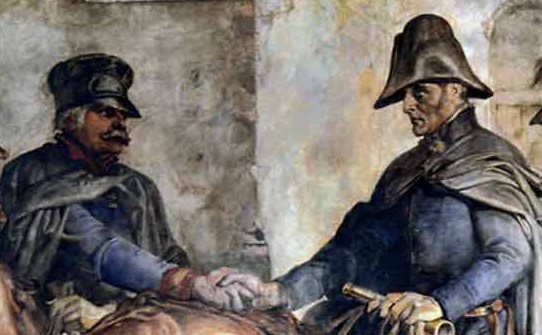
This struck me as the very start to a novel, maybe even the first narrator? It sounds like a 1930s mystery opening, which often has some sort of discussion of a brand new day and a discussion of food. There’s also a clear date indicated near the end of the page; Wellington and Blücher met at La Belle Alliance on the 18th of June, 1815, and I would say “to-day” makes it fairly explicit that the 18th of June is the date of this specific page.
From The Meeting of Wellington and Blücher by Daniel Maclise.
Going back to the text:
I was feeling about as good as man could feel that day. Everything horticultural, in the awful and literal sense of the word, was lovely. Green blood, as I considered before breakfast, I delighted to conserve.
I don’t think there’s any clever puns or secret clues here other than the attitude of the main character (other than it probably is a “man”, and at least one of the other pages might indicate a woman).
I received a letter from Miss Doncaster over the crumbs of toast and the last clear smear of marmalade, telling me that the old man would be coming to-day, on her advice to take mine. I admit that she had stirred me strangely. I lit a Nestor and considered her letter once more.
Is “the old man” the same one being referred to in the pen excerpt?
Nestor Gianaclis was an early cigarette industrialist who put his first factory in Egypt.
To pestle a poisoned poison behind his crimson lights. That was a nice thing to ask of a comparative stranger. It would have to be scanned. Poor old man ; but everyone must bump up against his Waterloo, and to-day was the day of the meeting at La Belle Alliance. It was not appropriate.
This feels strongly like plotting a murder, although the nebulousness of phrase (“poisoned poison”, “It would have to be scanned”) makes me uncertain. If we’re assuming this is the Start of Everything, so to speak — and honestly, this is just intuition and the fact that 1930s British mystery starting with breakfast was a Thing — then maybe this is the first murder that sets things off? There’s reference to a will later, perhaps there is some scheming for money?
I might still be completely off on everything, so feel free to keep contributing comments to the Google Doc which has the text of the novel. Also feel free to simply drop comments here. I’m going to do at least one more post before leaving this behind, and I’d like to have at least a notion where things are going; I’ll probably then keep adding to the Google doc when inspired but will only make future posts if any big breakthroughs happen.














 Renga in Blue