As a Newspaper reporter you are sent to investigate the eccentric professor who lives in the old house on the Moors. What is his secret and why is his house now deserted?
— From the cover of the BBC Micro version of The Time Machine
Brian Howarth’s second Mysterious Adventure was again originally written for TRS-80 and converted later to the Scott Adams database format; I’m going to just go with the TRS-80 version this time rather than trying to play two versions at once.
For a bit of color, here’s the title screen from the Acorn Electron version, via Everygamegoing.
I was genuinely excited to get to this game, because
a.) despite “time travel” being roughly as standard as “fantasy”, there’s more flexibility for the adventure author to get creative
b.) the plot presented itself as integrated rather than slapped on
c.) based on prior my time travel adventures, the genre forces a self-contained geography
Let’s discuss the last point a little more–
Past a certain level of experience, writers tend to go too long more than too short. While forcing minimalism is not always a guaranteed route to quality, and there are some top-notch writers who are also long-winded, brevity can temper some of the rougher excesses (I gave an example of this back when I posted about Chou’s Alien Adventure).
While we don’t often think of creating imaginary map geography as “writing”, it can be its own form of artistic creation. Crowther/Woods Adventure was based around a real cave, and had a solidity to it despite some truly random parts; authors who tried to mimic this later didn’t necessarily fare better. For example, both Goblins (the 1981 version) and Intergalactic (from the Atom Adventures collection) turned out particularly dire. Both examples share a need for contiguous terrain, and interlinking designed for sheer pain.
The time travel games we’ve seen, by their nature, force small sections; authors discovered you sometimes don’t need more than a handful of rooms to indicate an era. It becomes much harder to make a sprawling cavalcade of bad decisions. (1982’s Time Zone might bust through this by its sheer size, but that was on six floppy disks.)
As the intro text indicated, you start out not as a mad scientist, but as a journalist looking for one.
Rough opening: the above is a tiny maze, where you have no objects and more or less have to drift at random. If you step wrong, you end up in quicksand.
I was seriously stumped upon first hitting this point. Late the same night I tried one more shot at the section on my cell phone, and hit upon (after my second turn) the command GRAB BUSH:
Whew! That was a close shave..Better watch my step!
Rather than hammering on the unfairness of the guess-the-verb here, I want to point out it is fascinating that I broke through the puzzle by tackling it in an entirely different environment. One of the standard pieces of advice for adventure gamers is to play with a group, but here I managed the same effect by having my brain “reset” as if I was enlisting a member of my Clone Army.
Proceeding onward, I found a house with gloves and a bellpull.
I was able to punch through a nearby window while wearing the gloves.
This is what happens if you aren’t wearing the gloves.
Inside I found: a key hidden behind a picture, a pistol, a flashlight, a ham sandwich, and a room with a mysterious machine.
The cassette player had a tape. Playing it led to this message, given “slowed down” in real time:
I’m unclear on the sequence of events that led to being able to send a cassette player through time but not Dr. Potter himself. I can envision a few scenarios (sample: the tape is a “failsafe” Dr. Potter had set up prior to his trip to allow recording from the future), so I wouldn’t call this a true plot hole.
But hey: rather than just a treasure hunt for glass control prisms, we have a lost person, a mysterious enemy, and the fate of the world at stake (in a way that feels more concrete than just fantasy-bad-guy-is-bad). Good plot thread!
Oddly, the “forward” and “back” seem to rotate through options, rather than being “future” and “past”. I don’t think I’ve seen the future yet. I’ve made it to a scene with the Sphinx:
…a swamp with dinosaurs…
Well, one so far at least.
…and a ripoff from the book (and movie) 2001.
I’m still exploring to learn more, so this is a good stopping point. Based on the opening map (see below), I’d say the “forced brevity” idea is holding out.
I wasn’t too far from the end, but there was a fair amount of parser struggle to get there.
Via Mobygames.
Let’s take care of the raft first. I went as far as searching for synonyms for RIDE (not the first time I’ve whipped out a thesaurus to play an adventure game), but I still had to look at hints; the elusive verb was SAIL.
I then found a lake with nothing useful on it — it turns out the lake is the final destination of the game. I went back to whacking at the places of the castle I was still stuck on.
First, a chunk of glowing quartz in the “sorcerer’s lab”. The quartz is non-portable (I didn’t quite understand if was “stuck” or just too big). I had a staff with runes around it, so it felt magic-ish enough to try WAVE STAFF.
There’s a helmet that also has runes on it, and if you’re wearing the helmet you can then examine it (which previously had “unreadable” runes that you can now read) to get a magic word. Say the magic word…
…and you are finally awarded with the quartz, and no other assistance. Well, drat. (The glowing doesn’t even substitute for the lamp, unfortunately.) I succumbed to the lure of the hint sheet, because, rather arbitrarily, you have to wave the quartz at the adjacent room, with a lizard man.
It wasn’t an unsolvable puzzle, surely — there wasn’t much left to work on — but I still felt all manner of grumpy after finishing this part. It’s quite standard for magical items in text adventures to have arbitrary effects only discoverable by experimentation, and in theory that should be fine, but in practice stumbling into an answer by chance rather than some thought process just isn’t that satisfying.
Moving on! SEARCH LIZARD yields a jeweled knife. The only other part of the castle I had yet to solve was the gorgon, and I once again reached for hints, because I had the right idea (use the small mirror) but the wrong action. You have to HOLD MIRROR before entering the room with the gorgon.
I suspect the vast majority of players, including myself, thought of using the mirror here, but where stymied when the desired effect didn’t happen automatically. I can conceptually see how HOLD MIRROR might be, to the author’s eye, declaring action in a way that isn’t otherwise present, but for the player who visualized this as already happening, it is intensely irritating.
The parchment with the gorgon gives the final steps for getting the baton. I already knew how to get to the lake, and I had the horn at the ready.
I guessed THR was THROW, but what was I throwing? Well, by process of elimination, the only major item I hadn’t used: the jeweled dagger I got from the lizard man.
The Golden Baton was hurt by two elements I’ve observed before: 1.) it’s hard to include undocumented magical items without a lot of guesswork and 2.) without complex daemons and/or characters, difficult puzzles arise from amping up the obscurity of verbs and arbitrariness of action. Also, the fantasy world is fairly drab compared to the lore-dense opening. I honestly can’t recommend this game except for completionists.
Don’t worry, Howarth fans: this is only the first out of eleven games. There’s still time to improve! (A review from 1985 notes “Later titles in the series appear to be far more intriguing.”) In fact, I have started Mysterious Adventure #2, and it’s already better than #1, so look forward to that for my next post.
I didn’t get much farther than last time, but I hit an almost perfect variation of the Parallel Universes Problem, so I wanted to share.
From the Museum of Computer Adventure Games.
(Definition: situation where the user is in a playthrough with different conditions from another playthrough, and where the difference between the “parallel universes” is non-obvious. I first coined the term in relation to the game Kidnapped.)
I had previously been stopped by an armored figure, but only in the TRS-80 version of the game.
I had *not* been stopped by the same character in the BBC version. I thought, vaguely, perhaps I hit a bug, or just a situation where the defeat gives an item and it was set up so the later version was more forgiving when the puzzle was to be solved.
I had missed a slight difference between the two universes. In the BBC universe, I was wearing a RAGGED OLD CLOAK (from the first room of the game). In the TRS-80 one, I was carrying it, but didn’t have it on.
The cloak makes you invisible to the figure, so you can move on. There is no message or indicator why you can get by (I found the “invisible” thing from the game’s hint sheet).
This opened up two areas for me. First, the inside of the castle (see above), which includes a hunting horn (you can BLOW HORN but I haven’t found a use for it yet), a HELMET (there’s runes on it, just like a STAFF on the road to the castle), a LAMP, a LARGE HAMMER, a magical QUARTZ, a SMALL MIRROR, and a LIZARD MAN. I haven’t tried to face off against the lizard man yet, but I did run across a gorgon, and the results were unfortunate.
Getting in here required a KEY I found by throwing the rope up the tree I mentioned last time.
I would think the SMALL MIRROR would help, but the result above happens even if you’re holding it. I don’t know if there’s some extra verb involved, but I’d be surprised if the mirror didn’t factor into the solution somehow.
The second area I opened — by lighting the lamp — was a series of caves underneath the hut (or “cabin” if you’re playing the BBC version).
The cave layout is slightly different in the BBC version.
I found a padlock which I was able to smash using the LARGE HAMMER from the castle. Inside was a RAFT. I have no idea how to use the raft.
I found some slugs (easily defeated with salt I had) and a crab (who is distracted if you throw the dead slugs). The crab is next to an underground lake, which seemingly begs to have the raft used on it.
This is one of those kind of games where an item only works in the right spot and just gives a vague hint if you’re doing it wrong, so it may be I need to just try (say) THROW RAFT elsewhere. “RIDE” is clearly eliminated as shown on the screenshot above, though.
Other than checking up on the armored figure I’ve been trying to resist hints; I’ve been warned the puzzles are pretty arbitrary on this one so I don’t know how productive it will be to hold off on reading more hints, but I’m going to hang on a little longer.
What I am going to do is drop playing the BBC Micro version for now; I’m finding it too confusing to switch back and forth between the universes (I’m still referring to the HUT as a CABIN by accident) even though it’s fascinating that the author decided to change so much between the two versions.
IFComp 2020 continues apace; I’ve played some interesting games, but I’m going to save any words for close to the end. (Although, look: this one is really good.)
In the meantime, the Project continues, and for this game, the Quest for Earliest Britventure.
Brian Howarth is famous for his “Mysterious Adventures” series of 11 games, starting with The Golden Baton. He originally coded the first several directly for TRS-80, but later converted all of them to the Scott Adams database format*. If you look them up today, those are the main versions that pop up, but I’ve been playing both the original TRS-80 version and the BBC Micro version** from a year later (after Howarth had switched to Scott Adams format), and I can say they are significantly different. I’ve had puzzles I could solve in one version and not the other, up to the point I started just having both versions loaded at the same time.
I’m happy to describe my gameplay so far, but first! — how does Mysterious Adventure No 1 stack up against our three-way tie, in terms of release day? Just as a reminder, we’ve had Planet of Death, The City of Alzan, and Atom Adventure all come out in July 1981, with the first two even being advertised in the same issue of the same magazine. As the picture above indicates, The Golden Baton was first advertised in May, meaning it almost certainly came earlier (by magazine lag time, March or April of 1981). You can see lots more advertising here as collected by Gareth Pitchford.
I would now normally throw confetti and declare this the winner for Earliest Britventure*** — I had, in fact, planned for a while to finish my Quest here — but Gareth found a wildly-obscure-but-fascinating 1980 game which blows all the rest out of the water (I’ll be getting to that one soon). Disclaimer: to a genuine extent, this sort of chronological jockeying is for fun. A few months, in the tangled thread of influences, is not significant enough to wring hands over, especially given the variety of presentations and platforms (the 1980 game we haven’t got to yet is for yet another computer platform). Also, as I discussed with Atlantean Odyssey the second or third to arrive at an idea can be much more influential than the first. That’s certainly the case here — Howarth’s work is still “famous” (as far as text adventures can be), the series starting with Planet of Death casts a shadow over the Spectrum computer world, and while the City of Alzan game itself didn’t influence much the source code was part of a family tree of borrowing and development. Atom Adventure is just a blip on history but it’s essentially a proto-version of the colossal Xanadu Adventure from 1982.
…
The intro of the BBC version is rather long, and reminded me of Tower of Fear, so I have done another dramatic reading. Enjoy. (If it doesn’t show in your browser, you can find it here.)
Dark clouds drift ominously across the rising moon, you cringe as the night silence is suddenly shattered by the fearsome howl of some fell creature deep within the forest.
Weary from travelling, unable to force yourself onward, you sink to the ground and lean back against the bole of a huge, gnarled old tree. As your aching limbs slowly relax, you silently curse the road that led you to this evil place.
The noble cause that initially motivated you to undertake this deadly mission seems to pale into insignificance against the perils that you have, up until now, survived.
Your mission is to recover the legendary Golden Baton, a priceless artifact that has been worshipped by your race for countless generations.
The Baton was stolen from the palace of King Ferrenuil, ruler of your homeland. Many learned counsellors strongly believe that the Golden Baton holds within it a kind of life-force that maintains an equilibrium between the forces of good and evil.
For many centuries, your homelands have suffered no wars, no droughts or famine.
King Ferrenuil fears for the future of his people as the influence of the Baton has been taken from his lands.
Ever since the Baton was stolen, brave warriors and hardy knights were sent far and wide through the world in search of this artifact… none ever returned.
So it was that you started out on your journey, travelling through strange, hostile lands until finally you reached this territory of Evil magic whose name is never spoken. An almost tangible feeling of malice pervades the atmosphere and weariness descends upon the traveller like a pall of death.
You draw your robe around yourself to ward off the icy chill of night and sink into a troubled sleep, mortally afraid of what the coming days may cast upon you…
Summary: There’s a Golden Baton. Find it.
In all seriousness: I’m trying — and somewhat failing — to see from the perspective of the writer. To my readers, is there anyone who likes this kind of lore dump? It would be better if there was some relation to the game, but I reckon a 90% chance everything above is fluff. When I’m amidst the actual-gameplay portion of an adventure, I’ll happily go along with odd textual constructions, but when having to treat a block of text as just text, it’s hard for me to remain unruffled with phrases like “this territory of Evil magic whose name is never spoken”.
…
Art from The Tate’s collection of minimalist work. (CC-BY-NC-ND 3.0 Unreported.)
On the left, Sol LeWitt’s Two Open Modular Cubes/Half-Off from 1972. On the right, Carl Andre’s Equivalent VIII from 1966.
Both are from the minimalist “school”, both in the same museum collection, and they were only made 6 years apart. Yet, there are significant differences in form; the LeWitt piece plays with shadow, while the Andre piece is nearly shadow-free. Andre’s cinder blocks are an arrangement of found materials, while LeWitt’s piece is a constructed sculpture. While both involve “geometric single or repeated forms”, even in that zone the single-offset-repeat of the cube feels much different than the many-block-repeat on the right.
The point here is while we tie the works together with the word “minimalist”, there are still shades of difference within that meaning; we could make sub-schools within sub-schools and still not fully encompass the potential areas of minimalist technique.
This is relevant for The Golden Baton; I’ve used “minimalist” quite a bit to describe this sort of game …
..but also this sort of game.
They’re the same game, by the same person, but the BBC Micro version (the second shot) is sort of an ultra-minimalism, describing locations by one or two words. The TRS-80 version includes a bit more, and the effect on playing is significant.
A few more comparisons just to make the point; I think I can get away with not labeling which is which:
I AM BY A HUGE OLD TREE WITH GNARLED BRANCHES.
I’m by a Tree
I AM IN A CLEARING IN THE FOREST, THERE IS AN OLD HUT HERE WITH THE WINDOWS BOARDED UP.
I’m in a clearing by a Cabin
I AM NOW INSIDE THE HUT, THE FLOORBOARDS ARE ROTTEN AND THERE IS A HOLE IN THE FLOOR.
THINGS I CAN SEE ARE:-
AN OLD BARREL – AN OIL SODDEN RAG –
I’m in a Cabin with hole in floor
Things I can see: Barrel – Oil Sodden Rag –
To reiterate, this did have genuine gameplay effect. In the first room you find a sword hidden in the leaves, and just south there are some brambles.
I AM IN A TANGLE OF BRIARS, I FEEL LIKE A PINCUSHION! THE BRIARS ARE SO THICK I CAN HARDLY SEE ANYTHING.
I’m in a tangle of PRICKLY briars
You can CHOP BRAMBLES which reveals a hidden rope. I found it this easier to realize in the super-minimalist version of the game.
The sword can then be used to kill a wolf…
The BBC version just says I’m by a Path and there’s no north direction specified; you need to GO PATH.
… and past the wolf to the north is a castle. You can swim in the moat.
I AM STOOD AT THE PORTCULLIS, I DONT THINK I CAN OPEN IT.
I’m at a Portcullis
I was stumped in the BBC version, but the slight extra text in the TRS-80 version (and the clarification I wasn’t still swimming) led me to try THROW ROPE.
THE ROPE HAS CAUGHT ON SOMETHING! I THINK ITS SECURE!
I should note this confusion wasn’t just mine; Dale Dobson at Gaming After 40 got stuck here (he played a Scott-Adams-format-with-graphics version), and complained at length about this puzzle being too hard to solve.
Past this inside the castle is a armored figured. In the TRS-80 edition of the game the figure stops you so you can go no farther.
In the BBC version, you can just walk on by. Past the figure I’ve found a lamp that lets me get in a dark cave at the cabin/hut I clipped earlier.
I haven’t been able to solve the armored figure puzzle, so I can’t yet get the lamp in the TRS-80 version! It still helps to know the progression — I know not to fuss with the dark hole assuming I’ll find something to get by the figure — but I’m going to stick with the TRS-80 as my “primary” game for now with the BBC game as a supplement.
(*) Mr. Howarth reverse-engineered the Scott Adams format on his own, and later helped make official ports of those games.
(**) I chose the BBC Micro in honor of the work of Anthony who recently ported the BASIC versions of Pirate Adventure and Adventureland with some fascinating write-ups. Also, for more IFComp reading, he picked apart and ported the C64 game that Nick Montfort entered.
(***) I’m incidentally excluding ports of Crowther/Woods Adventure from all this. I’m also not discussing Level 9’s Fantasy from 1981 because the game is currently lost, although it’s on my Top 3 of Games I’d Really Like To Try — it’s not only historically important from the angle of the company it came from (sort of the Infocom of the UK, although I’d split the title with Magnetic Scrolls) but in being the odd sub-genre of open-world-with-dynamic-characters as seen in other games like The Hobbit.
Allow me first a side trip to a 1980 Med Systems game by William F. Denham, Jr.
In The Human Adventure, you fly a miniaturized ship inside a body attempting to destroy cancer cells. It’s a strategy game in form, rather than a puzzle-based adventure; you have to keep track of your energy and use a LASER and occasionally need to electrify the ship’s hull. I’ve recorded some gameplay below:
I’ll be referring back to this video in a moment.
…
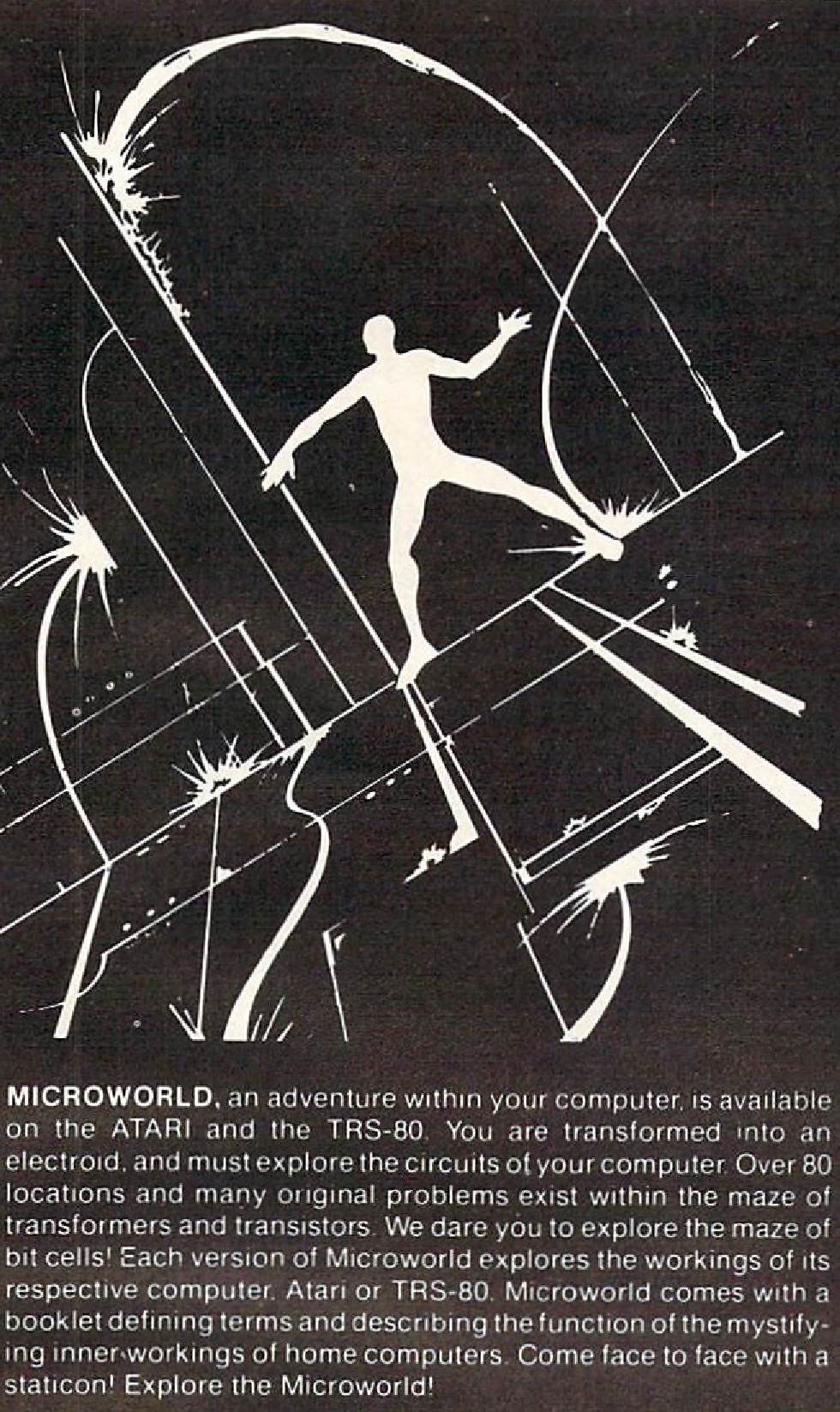
In Microworld, the main obstacle I overcame was nearly identical to that of Timequest which I just wrote about. You can GO LOCATION as a direction.
I had done LOOK COMPUTER only to be told I saw nothing of interest, and there are many other places where an object can’t be interacted with or approached. This computer is where the colored IC chips go; there are 8 of them, and once you insert all of them, pushing the button causes something good to happen (as you’ll see later).
This also resolves the COIL problem I had last time.
Other than the yellow chip shown above, I was missing three more, and I had a massive headache in the endgame.
THE MISSING BLUE CHIP
I mentioned the blue chip which was described as “LOST” and clearly ended up at a lost and found.
While I could LOOK CLERK (who “looks at you expectantly”) I otherwise had no method of interaction. Elsewhere, there was a paper I never even bothered to mention was a possible inventory item, because it seemed like an offhand joke.
You can SHOW PAPER (not DROP or anything else) and it gets confused for some other form. A “check form” I guess? Which is, as far as I know, not how lost and found places work. If you lose your wallet in a store, why would you have a check slip? Wouldn’t that be for a coat-check counter or the like? Am I missing something here?
THE MISSING BLACK CHIP
I’m saving this one for my conclusion.
THE MISSING ORANGE CHIP
Guess-the-noun returns, always an unwelcome guest.
I assumed, after the frustration above, the NPC could not be referred to (and there are lots of places with characters where you can’t refer to them, so this was not unreasonable!) I was wrong: you can use the noun RECEPTIONIST.
Elsewhere there is a sign that says YOUR LOSS IN MY GAIN so the key word here is LOSS.
This leads to the last missing chip, which I returned to the computer.
The computer gave me a tuning fork; given the lack of other puzzles to work on, I knew exactly where it went; I used it to shatter the glass box. This gave me a diskette, which I swiftly took to the RS-232 port and to the outside.
THE ENDGAME
You may notice the voice-activated device connected to the computer. I had sufficient hunch to realize I needed to say something to win the game, and I also had sufficient hunch that the floating binary I found earlier would be important
but I was horribly stuck. The binary doesn’t translate to anything in ASCII.
One room has something of a hint.
Aha, EBCDIC (Extended Binary Coded Decimal Interchange Code)! I assume this gets covered in the 12-page book; I, fortunately, knew about this as an outdated alternative to ASCII. So all I needed to do was pull up an EBCDIC table and…
…find nothing. It spells nothing. Argh!
The trick here is that you are seeing the binary digits backward. Flip all the digits, AND use EBCDIC, and the word SYNTAX pops out. (This makes it a second-order puzzle which I’ve ranted about before, but I don’t have the energy this time; I’m just glad to be done.)
So, the electrons are cheering for me, but what did I do exactly? Does the disk accomplish anything in particular? We voluntarily went in, and getting out came long before getting the disk, so this wasn’t an “escape”. The game doesn’t indicate what’s actually on the disk other than congratulations. I guess we’re supposed to use our imagination.
…
I’m going to take an unusual curve and evaluate Microworld as an educational game: how effective is it at teaching the topic it intends to teach?
Referring back to The Human Adventure (watch the video loop again if you need), notice it has
a.) details within the game itself that clarify what various parts of the body do
b.) a clear map so you can see their inter-relation
c.) gameplay which is directly relevant to the activity at hand, as the player is a foreign body fending off attacks from white blood cells
d.) although not in the video, there’s an “exploration mode” which removes the combat and just allows getting a feel for the layout of the body
Compare with Microworld:
a.) a lot of the detail is deferred to the 12-page booklet, and many of the rooms are filled with jokes
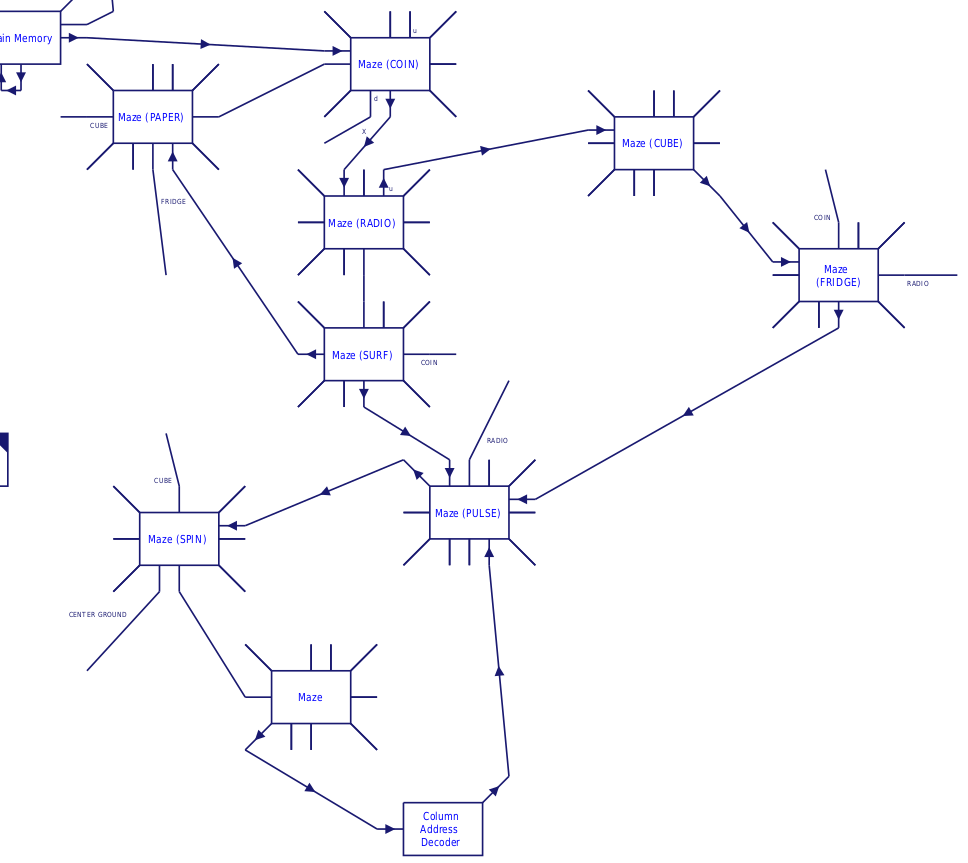
b.) the map is an utter mess even if you draw it out
c.) the majority of the gameplay only has incidental relation to the parts being referred to; even the EBCDIC puzzle doesn’t make a lot of sense in “reality” context
d.) there’s random spots that can trap and kill the player, and a maze that is easy to get lost in, so “free exploration” is discouraged
Mind you, I think Microworld is a better game; Human Adventure is playable but gets dull fairly quickly. However, as a forerunner of adventure-game-education I do feel obligated to point out the flaws in this respect. I’m honestly quite glad for the odd bits of humor, but they were hard to detangle from what was being learned.
c.) is an especially interesting aspect; I think where adventure games and education have the most potential to merge. Microworld nearly managed a perfect shot with one of its puzzles, the one I’ve been saving:
THE MISSING BLACK CHIP (for real this time)
One of the items is a “lonely clock pulse” where it’s possible to WAVE PULSE.
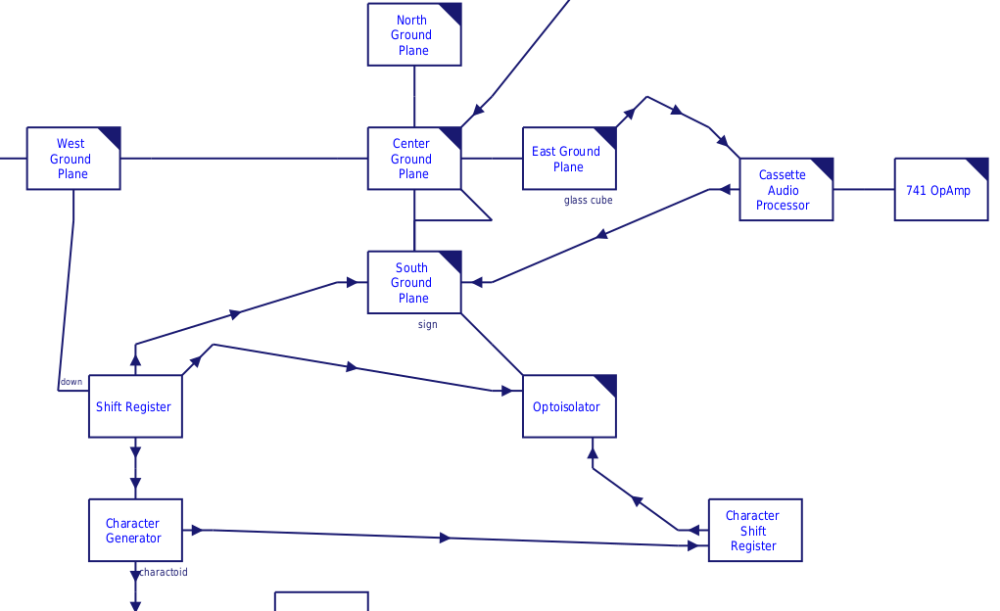
I knew that solving the puzzle was simply a matter of finding the right location. I did it by just random testing everywhere on the map, but it would be possible to solve the puzzle by knowing about microelectronics. Take a look at the upper portion of the map; I’ll spoil the puzzle after.
The flip-flop will reset on a clock pulse!
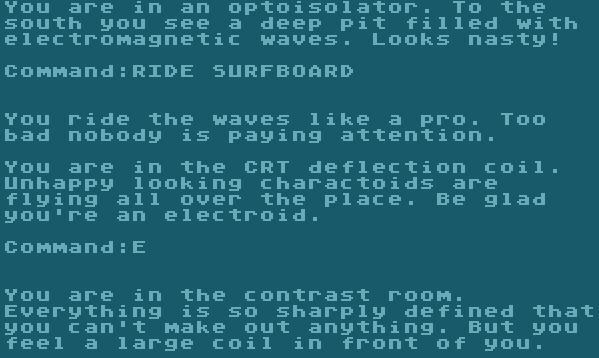
In an adventure-game sense this isn’t the strongest puzzle; I’d nominate surfing the electromagnetic waves for that, but that’s a pun built on the word “wave” which could actively confuse a student trying to understand at the real-electronics level. By contrast, the flip-flop puzzles requires an act that matches with what the piece of circuitry actually does; puzzle-solving and learning are conjoined rather than lateral.
While the author of Microworld, Arti Haroutunian, went on to a game career after (most recently working on the Disney Infinity games) this was his only adventure game. It also seems to be his only educational game, with the notable exception of doing engineering for The Miracle Piano.
The Miracle Piano (for both computers and consoles) hooked up a real piano and asked the user to play music. Getting through a song meant hitting enough notes correct to make it to the next level. When The Mexican Runner did Miracle Piano for NESMania (playing every US NES title on his Twitch stream) Miracle Piano took the longest, at 91 hours and 16 minutes. (Might and Magic was close behind at 87 hours.) While he knew music, he did not know how to play piano; there was no way to win other than to learn how to play piano.
Of course, Miracle Piano is barely a game, but this is the extreme-congruence form of learning via software. How close should the activity and the intended learning really be? Microworld, if it was seriously intended as educational (it may not have been) is a little too far off. We will eventually hit some more educational adventures, but not for a while, so I have time to think about where the optimal balance lies.
BONUS READING: For more detail on The Human Adventure, Will Moczarski included it in his Med Systems marathon. There are lots of strategy games from this era that have not been written about, but alas, the closest we currently have to a Strategy Addict is Kurisu over at This Map is Completed who is chronoblogging through Japanese tactical RPGs. Jimmy Maher also has some very substantial posts on landmarks in strategy games. Speaking of educational games, Maher also has an excellent post on the Dr. Brain series.
The 26th running of “An annual celebration of new, text-driven digital games and stories from independent creators.”
104 games.
You can find them all here.
I have taken wildly-out-of-context clips from each of the descriptions and made a 104-line list, sorted at random.
a mysterious tunnel leading from the cavern
either Cinderella or Prince Charming
an international society of elite occult investigators
an arbitrary task of questionable value
Snapping Turtle was killed in action in the war while saving Silver Bear’s life
a non-profit organization with the purpose of improving everyday life
The Knot, where all mana connects
The world is scary enough without help from the supernatural.
a position in our architecture department.
imitation on demand
The revolution
You and your dog.
the perfect miniature world of The Land Down Under
your IT internship
the season finale
the disastrous sidewalk chalk tournament
solving the riddles of the Tomb of Ilfane won’t be easy,
fantasia on Kipling’s “Just So Stories”
trust as if it all depends on the gods
slay the monsters
dancing on the beach
an aid for mediation
Isaac receives a mysterious letter
peaceful multispecies space station
hopefully disturbing
100 years of years of peace and harmony
the entire public transportation system seems to have it out for you
consuming carelessly
shave your chest hair.
pirate captain cobbles together a ship and crew
The Forever Cat stalks through this universe
sentient swords and yokai warriors
What secrets do you contain?
Evil, sealed away for Aeons
Follow user StaircaseHaven14 on a Neopets-esque site called Ruffians
an evil duke
dive into the neon sea
writhing in pain
a demonic spy in the Cold War between Heaven and Hell
Summon demons, bake cookies
Nero Brashov, vampire and failed businessman, has revenge on his mind.
looking for a way home
cursed hyper-awareness
mostly word puzzles
dangerous monsters, extremely competitive bodybuilders, and hyperinflation
a mysterious briefcase
a missing woman
Faltering light sources. Fear.
a playful adventure of peculiar proportions
If only he would let you see his face.
a hero & a villain start planning their battles over coffee
the kettle dies with dignity
a vast, trackless desert with no food or water
the gnarls of her brain
Fallen London and Flatland
the wine and canapés
If only you hadn’t been too drunk to remember
alone on the open road
and loot what we find!
important episode
the summer of 1920
the Order of the Fiery Doom
unraveling the universe
investigate the cause of the Darkness
when you’re running, you need to stop eventually
all the weekends that will have passed
It’s pretty much going to be all his friends
Save OkayCo from the Flame-Lame Fey and Ed Spray-Spread!
Get ready, young space cadet
the suspects are clamoring to be accused.
thieves have failed to steal it
all that matters
Hooves and bells approach. The school bus is late.
popstar idol!
Maybe it’s time to change careers.
the embryonic state of something more important
Use stealth to navigate his apartment as well as his arguments
an antique store proprietor trying to make ends meet
the end of everything
all is not happy in Happyland.
Piscespunk
life is about enjoying the journey
running out of options
you may not distinguish dreams from reality
search for congee on this rainy night
love story where not much seems to happen
body-swapping
no way to find him other than a series of obtuse riddles
a kingdom in peril, an evil queen to be defeated, puzzles to be solved and YOU are the only hope
purveyor of artifacts, seeker of treasure
the old man had died with no family
You embark to find that voice
Who murdered Jenny Lee?
the cognitive leap forward
the underground tomb of the Pharaoh Haputet
Southern Gothic horror
a place of fun for the whole family
combining a dystopian sci-fi short story with an escape game
Were you ever told you can be anything?
a different story, far worse than unpleasant.
a game within a game within a game
fight a monster using a crowbar, listen to the radio, find secrets
a thinly-veiled attempt to teach comma rules
your family and your heritage
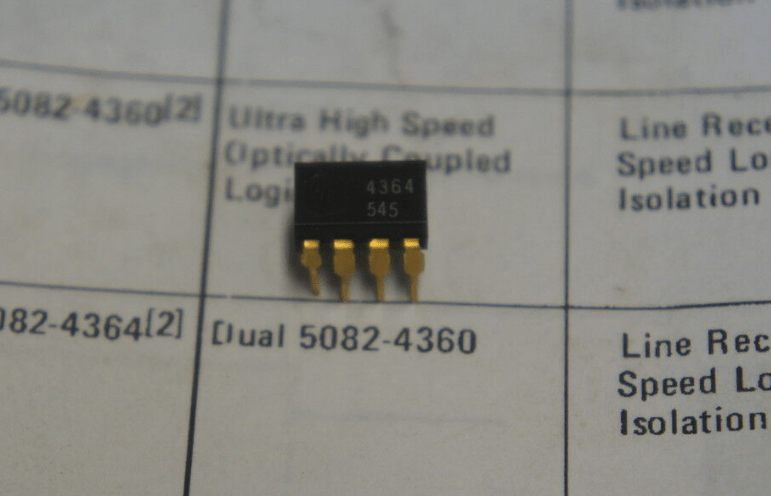
An optioisolator, one of the locations you can visit in Microworld. They transmit information using light. From an eBay auction.
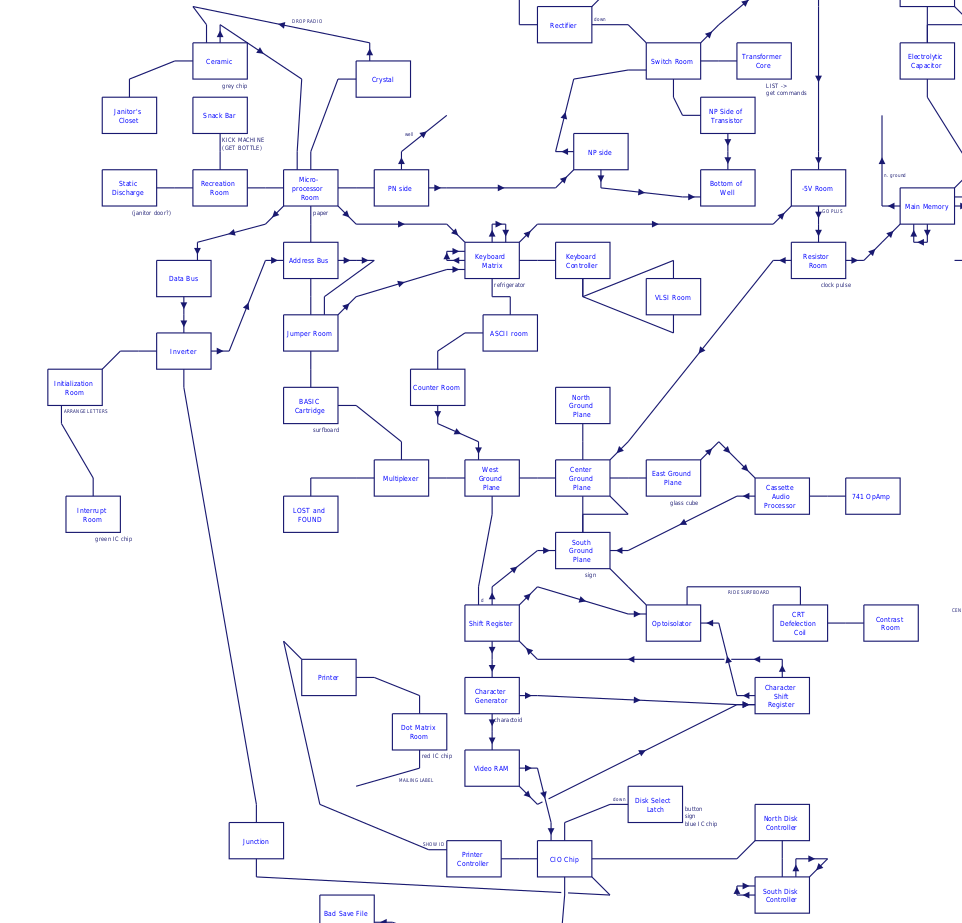
Before I explain what puzzles I’ve solved and have yet to solve, let me give the general layout of the map.
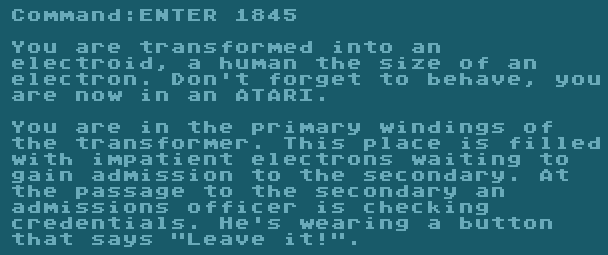
You start, having being turned into an electron, passing through “primary windings”, a “secondary transformer”, a “rectifier”, a “regulator”, before landing on the “ground plane”, possibly passing through a main memory maze on the way.
At the ground plane you can branch in multiple directions including a “casette audio processor”, a “data bus”, a “keyboard matrix”, and “video RAM”.
There’s also a snack bar and the MICROWORLD DISCO which I’ll bring up again later.
Video RAM leads you to a “CIO chip” connected to a “disk controller”, “disk select latch”, “printer controller”, and most oddly, an “RS-232 board”.
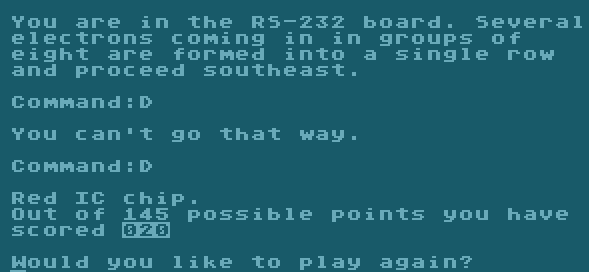
The RS-232 seemingly leads to the “outside” but also a bunch of error rooms where you can lose the game. A sampling:
As the last clip indicates, the same direction can do alternate things.
Described in a topological sense, the connections make sense, but as I was forming my map, it was a jumbled mass. I guess this is the “educational” part of the game (although I’m going to wait until my final post before I judge the educational qualities or lack thereof of Microworld).
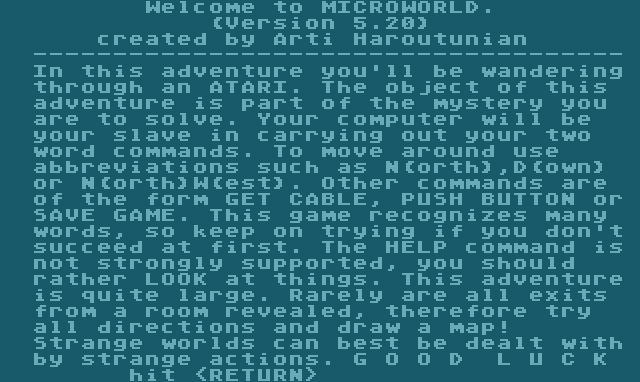
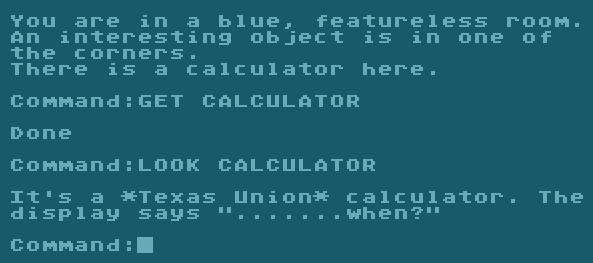
I’m still not certain what the objective is. The opening room states “an interesting object is in one of the corners” and my original thought that this was just referring to the calculator is incorrect; you can GO CORNER.
You are in the west corner of the blue room in front of an ATARI. A disk drive and a voice input device are connected to it.
The disk drive is empty.
The oddly bugged glass cube I mentioned last time (and was unable to open) does contain a disk, so my best guess the final objective is to escape the computer with the diskette and then use it on the computer. (I did manage to escape once, kind of, out of the RS-232 board, although no disk was at hand.)
The other objective related element has to be the assorted “IC chips” through the game. I’ve found a grey chip, a green chip, a white chip, and a red chip (separate from the odd buggy message describing a red chip in inventory when holding the glass cube — I have gathered you’re not supposed to be able to pick up the cube at all). Look at any of the chips and you get the message “all you need is a socket”, which alas, is something I don’t have; I’m also not certain how many chips there are. I did find a blue chip (although haven’t been able to hang on to) and one of the funky out-of-place errors indicated a black chip. This strikes me as a gather-the-Foobles-to-open-a-final-door sort of setup, so even though I’m not clear on where they go, I’m getting the general feel of plot advancement upon finding each new chip.
The most important thing I did was on accident.
You are in the transformer core. A couple of electrons are wandering around aimlessly. They seem to be mumbling something, but you can’t hear a word.
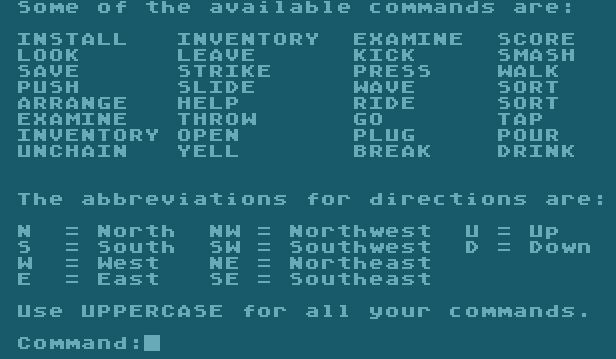
In the room above (in the opening area) I tried to LISTEN just out of curiosity, and hit the parser’s limit of only understanding the first four letters of each word. LIST gives what seems to be the full list of verbs.
This command doesn’t work in the TRS-80 version of the game, but it helped me crack some puzzles open in both a positive-space (what verbs are there) and a negative-space (what verbs aren’t there) sense.
For a positive-space example, there’s a snack bar with a CONTACT-COLA machine. No change is at hand, but KICKing a vending machine worked on another Med Systems game, hence:
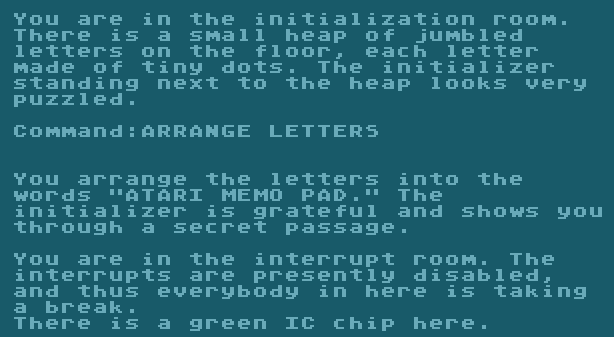
I also, while thinking of the highly unusual verb ARRANGE, suddenly realized a place I could use it.
In a negative-space sense, notice there’s no GIVE command. I was able to sip the contact-cola but that seemed unsatisfying; there was a characteroid with its tongue out, and I realized perhaps the game just means for me to DROP the cola.
This yields an ID card reading “PRINTER MAINTENANCE”, allowing you to sneak into a new area and get the red IC card.
The DROP-instead-of-GIVE also led me to realize the *crystal* radio would be helpful in a room I’ve already mentioned:
STUFF I’M STUCK ON
In a way, the whole map is fair game. The problem with having artful and/or goofy text in an adventure game is it is hard to tell what is a clue and what is just atmosphere.
However, I’ve gotten past some “electromagnetic waves” using a surfboard, only to find a coil I can’t do anything with.
I found the blue chip, but when moving around after the game says it becomes LOST. There is a nearby lost and found, but I haven’t found any recognized syntax, other than LOOK CLERK (“the clerk looks at you expectantly.”)
One part of the maze traps you in a “well”; I don’t know if this is a trap or a puzzle.
Finally, there’s the glass cube I’ve already mentioned with a diskette inside. If you try to smash it persistently enough the whole thing is destroyed (including the disk).
I easily could just be missing some room exits, so I defintely don’t want any hints.
Let’s start with the smooth dulcet tones of William Shatner.
This educational film (originally recorded 1976, revised 1980) about the still-fresh-and-mysterious world of microprocessors has, as far as I can tell, absolutely nothing to do with the game Microworld (1981, by Arti Haroutunian, published by Med Systems, same folks as Asylum) but sometimes I have to just share things.
…
Amidst my review period for games to add to my list, there’s been the occasional reject for non-adventure status, like Dungeon of Htam from 1980:
YOU DISTURBED A MONSTER IN THIS CHAMBER
AND HE SPEAKS
HALT I AM LUM
YOU MAY NOT PASS THRU UNTIL YOU ANSWER THIS MATH QUESTION
WHAT IS
4 x 1 = ?
Other than that, Nellan is Thirsty has been “an adventure for children” but not really an “educational game”.
With those caveats out the way (and the note I’m not done with 1981, although I’ve poked at most of what’s ahead) Microworld seems to be the first adventure game specifically designed as educational.
From 80 Micro, October 1981.
I do not have the “12 page booklet containing a glossary and explanations of the electronics inside the TRS-80”, so I’ll just have to wing it.
I’ve seen the line about “the object of this adventure is part of the mystery you are to solve” elsewhere, including in the game I just played, Timequest. It was truly odd in that one given treasure collection was the obvious goal; here, it might possibly be as well, since I’ve found one item already (a crystal radio) with asterisks around it.
The original version was for TRS-80 but I played the Atari port (by the same author) instead; I’ll compare with the TRS-80 version when I’m done. This is in reverse of what Will Moczarski did when writing about the game; I figure it’ll give a different perspective.
I’m not sure who the game is targeted at. A 1982 review claims it is for an “intelligent child” or an “adventure gaming beginner” but it is designed too annoyingly for either one.
The above exchange is somewhat typical for educational games, which randomly have to toss in trivia questions (What year was Texas admitted to the Union?)
(You have to DROP CALCULATOR to move on.)
I haven’t run across much in the way of puzzles; gameplay so far has mostly been wrestling with a gigantic map where almost none of the directions make sense.
In progress. I’ve marked rooms where I’ve checked every exit; did I mention the game only occasionally mentions which exits go from a particular room so testing all of them is required?
I have run across a great many puns and strange in-jokes, and that’s honestly been the thing keeping me going so far. Some samples:
There is, as you might expect, a maze. The maze has more than five rooms and you have an inventory limit of five items, so there’s some “move one of the items to somewhere else mid-mapping and hope you don’t get confused” aspect to the whole process; the sort of thing you’d give beginners only as a cruel joke.
Also, the only reward has been a “column address room” where nothing seems to happen.
The items have been truly odd: a spinnifax, a crystal radio, a “lonely” clock pulse, a glass cube that looks like a “red IC chip” when you’re holding it (??), a surfboard, a refrigerator (???), and a “dielectric coin” which says “Go PLUS on display error.”
Regarding the last item, that’s a hint for a particular puzzle.
This is the “display error” — the only way out is GO PLUS. This incidentally suggests to me the glass cube/red IC chip thing might not be a bug but a puzzle.
I suspect more META will happen before the game is through. I’m just happy this game is something other than a generic manor or fantasy cave.
My key sticking point was missing one of the game’s invisible norms.
From the Museum of Computer Adventure Games.
Navigation in Scott Adams-inspired games is often not just by compass directions, but by “GO LOCATION”.
I’M STANDING ON A DIRT ROAD. VISIBLE ITEMS:
MARBLE BUILDING. STREAM.
SOME OBVIOUS EXITS ARE: WEST
For the room above, while you can just type WEST, GO BUILDING and GO STREAM are also possible. The game uses this relatively extensively, and it seemed like the norm was that whenever a location was enterable, it would always be mentioned as a separate object (as opposed to implied by the location line).
This was a false assumption.
I AM STANDING OUTSIDE OF A MOUNTAIN. VISIBLE ITEMS:
STRANGE MACHINE.
SOME OBVIOUS EXITS ARE: SOUTH EAST.
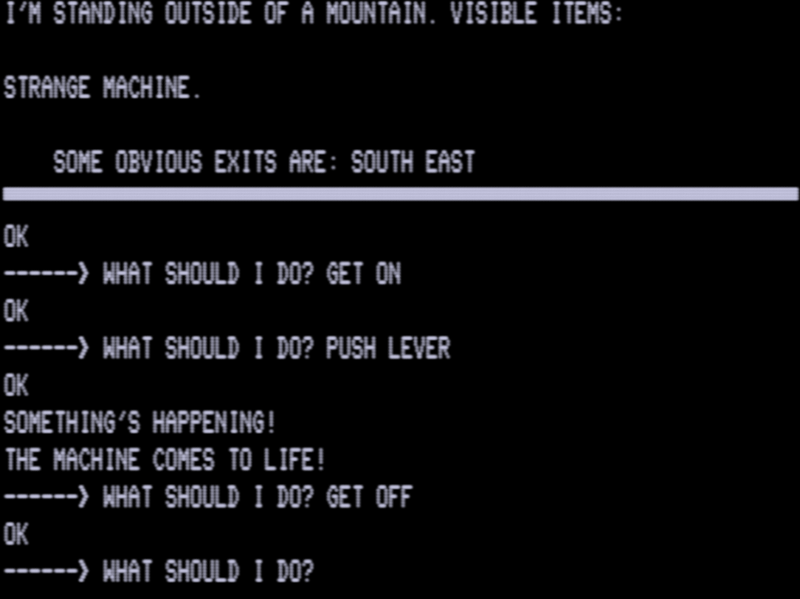
By the description above it looks like east and south are the only exits (if you try to GO MACHINE the game gives the explicit syntax GET ON). However, you can GO MOUNTAIN.
I suspect the author didn’t even think this was really a “puzzle”; one of the items you find up the mountain is a book. The book hints that TURN ON and TURN OFF are syntax for the flashlight and that spinning the brass ring (the one in inventory from the start of the game) could make something interesting happen. If you haven’t found the book, you’re almost guaranteed to run across the flashlight and try to use it. Why would you put a parser hint for the flashlight in the book if you didn’t expect it to be read first?
Invisible norms still haunt pretty much every videogame genre, but to stick with adventure games, consider the norm where the main player has items in their inventory that go unmentioned until INVENTORY is typed. I think most modern authors would not consider that aspect a puzzle, yet it is something players could clearly get stuck on.
I found the remainder of the game fairly satisfying, so if you’re interested, now is the time to veer away before I spoil the rest of the game.
…
The mountain also had a jade buddha treasure and a glove.
This was enough the make the rest of the game go smoothly. The glove I immediately knew was used to pick up the diseased raccoon, which I fed to the lion blocking the cave. This led me to a waterfall (hiding some coins) and a slab.
The SPIN RING worked at a the slab to teleport. Then I was frozen instantly, but already had a coat for that problem.
I ran across the only live human in the game. For time travel in 1235, most games would visit some European area. (I’m not sure how aware people in 1981 were of the word “eskimo” being offensive.)
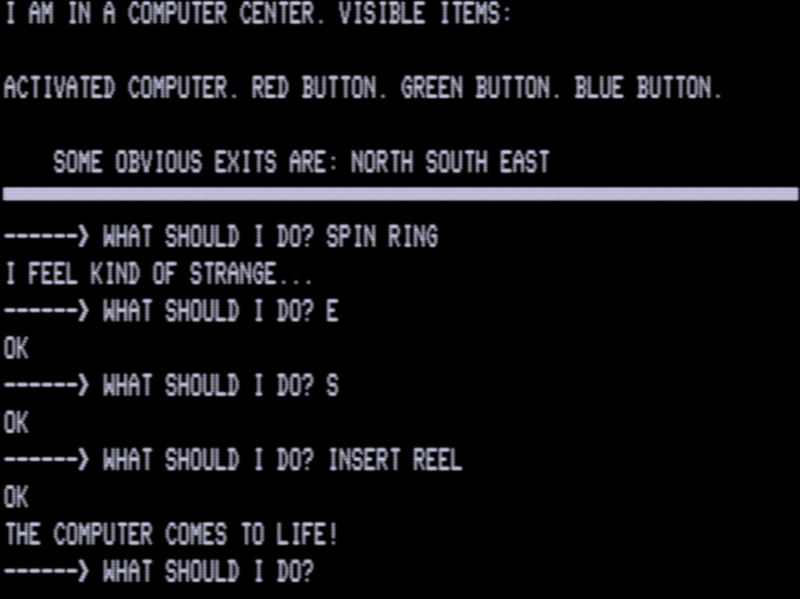
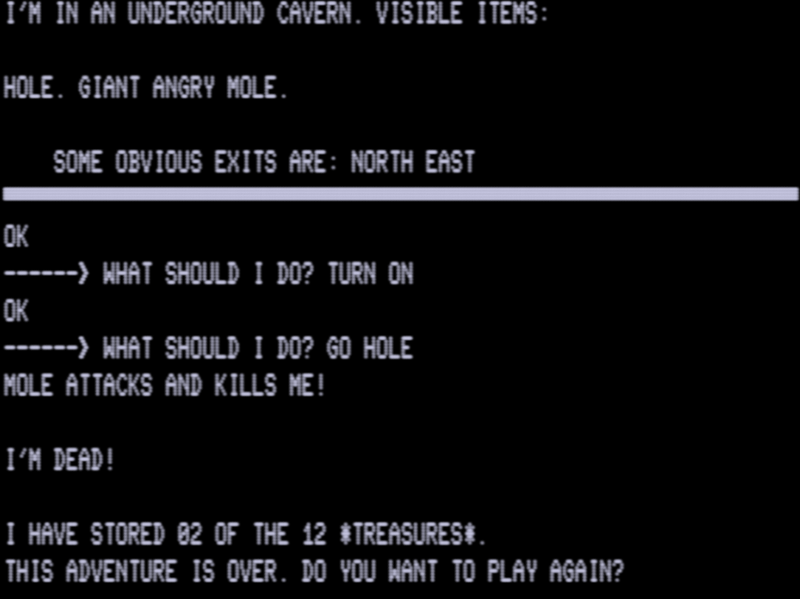
The spear (from the screen above) was sufficient to kill the angry mole I was stuck on last time. Additionally, the ring/slab combination also worked in the future to get me to a computer room.
This led to a few more treasures, and victory.
So: was this really a time travel game?
Genuinely, I wonder what the author was thinking: as I’ve already mentioned, the compartmentalization of time zones made for a good structural organization, but in the end I was dealing more with teleportation than time travel. The far-future computer device uses a reel of tape; one of the treasures is some TECHNICAL MANUALS and the only other gizmo is one that turns sand into a copper bar (Which is sort of impressive but not something I’d time travel for).
The cover (from my last post) suggests some sort of wild trip to the far future, with an odd creature in the center, and this game had none of that. Maybe this was somehow a well-planned enough time travel trip that the protagonist knew not to meddle with areas containing people (paradoxes, etc.) I did enjoy myself, but it was curious to play in a genre that lacked nearly all the elements of said genre.
Timequest is also known as Time Quest, via the printed disk label and the opening title screen, and the title is given on a followup screen as Timequest Adventure. I’m honestly beyond being surprised when this sort of thing happens, although no game can match the pure naming chaos that was Dragon Quest Adventure. Perhaps unsurprisingly, Timequest shares a publisher in common: The Programmer’s Guild.
From the Museum of Computer Adventure Games.
The author of Timequest, William Demas, is better-known for doing the majority of work on Scott Adams Adventure #12 (it was a scenario like Pyramid of Doom where Adams just did some editing) and two “talking games” (Forbidden Planet and Forbidden City) for the TRS-80 published by Fantastic Software.
Timequest, on the other hand, has fallen down a memory hole of sorts; CASA is light on information, Mobygames has wrong information, and its existence doesn’t get mentioned at all in this interview with the author. There are no hints or a walkthrough anywhere, and nobody I can find has played it on video.
This is nearly identical to Journey Through Time in the premise: go through time, nab treasures, 12 in this case. However, the time periods don’t really have any theming; it’s more like you’re using a general teleportation device rather than visiting Nero or printing yourself a brand-new Gutenburg Bible.
Rather unusually, the game does not start with “home base” in the “present” of 1981.
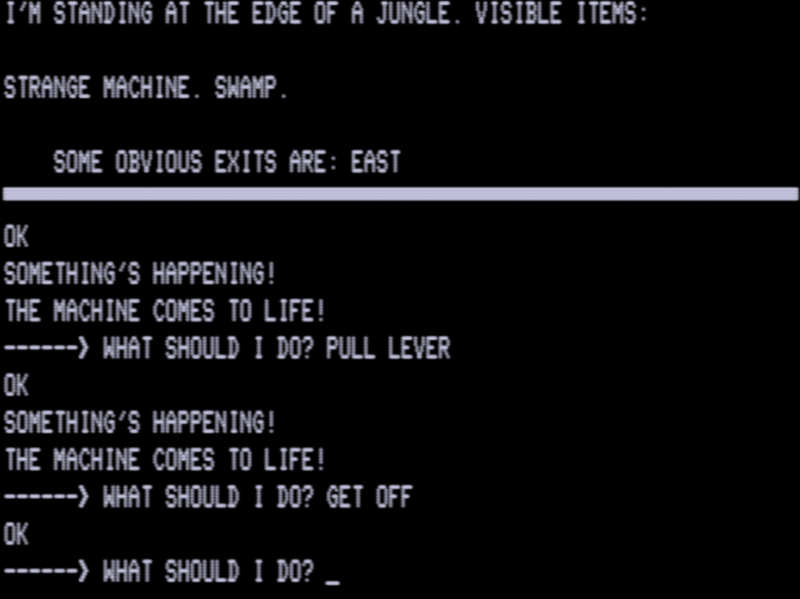
Yes, 1886. I suppose a time traveler’s home base can be any-time and any-where. You can PUSH LEVER to go to 2930 or PULL LEVER to go to 1235. There are no other time periods (at least as far as I’ve gotten).
The “where” is somewhat important, though — there is some sense that you are fixed in location as you travel in time. The machine starts in a basement, but you can drag it outside (PULL MACHINE). If you travel forward in time while outside, you end up outside a mountain.
If you travel forward in time while inside, you end up inside the (fortunately hollow) mountain.
Traveling to the past while the machine is outside is fatal; your machine falls into a swamp. If the machine is in the basement, you get taken next to the swamp instead.
So (as of yet?) there are two 2930 locations, one 1886 location and one 1235 location.
My map so far, but certainly not complete, given I’ve only seen 3 treasures out of 12.
Even though the game doesn’t fully use the “fun” aspects of time travel (historical events and/or setting up paradoxes) the map still gets naturally broken up in sectors, which gives it a crisp and modern feel.
Besides figuring out the time machine itself, the puzzles so far have been straightforward; I found a key in a sandbox and used it to unlock a room that is supposed to hold treasures. The same room had a snorkel which I used to get a fish and gold trident from a river; I also found a flashlight lying around which led me to get a gold chain and shovel. The shovel then let me dig to an underground area in 2930.
I’m stuck on
1.) the underground area, which has a reel of tape, some silver coins, and an angry mole; while I can get in, the angry mole kills me if I try to get out.
2.) 1235 has a cave guarded by a lion.
3.) 1235 also has a swamp which you sink in and die if you try to go in (this may just be a trap)
4.) 2930 has a dead raccoon that is diseased and you die if you try to pick it up (the game implies you need gloves).
So far, I have yet to use a BRASS RING (that you start the game with), a FISH, a FROG, a FUR COAT, and some SAND. The two treasures I’ve gotten which may or may not be of use are a GOLD TRIDENT and a GOLD CHAIN. It is of course possible that the KEY, SNORKEL, and SHOVEL somehow get reused, but otherwise, that’s all I have to work with. (The snorkel doesn’t work on the swamp; you can’t kill either the mole or the lion with the trident.)
The game has me interested enough I haven’t resorted to hacking at the game file itself yet. If you want to try it out, this link will let you play online (it’ll delay, then give an error, then you need to type TYME2 and hit ENTER).
Frog is another William Demas game. This is the first I’ve ever seen an in-game ad for something sold by an entirely different publisher.

























 Renga in Blue