Author Archive
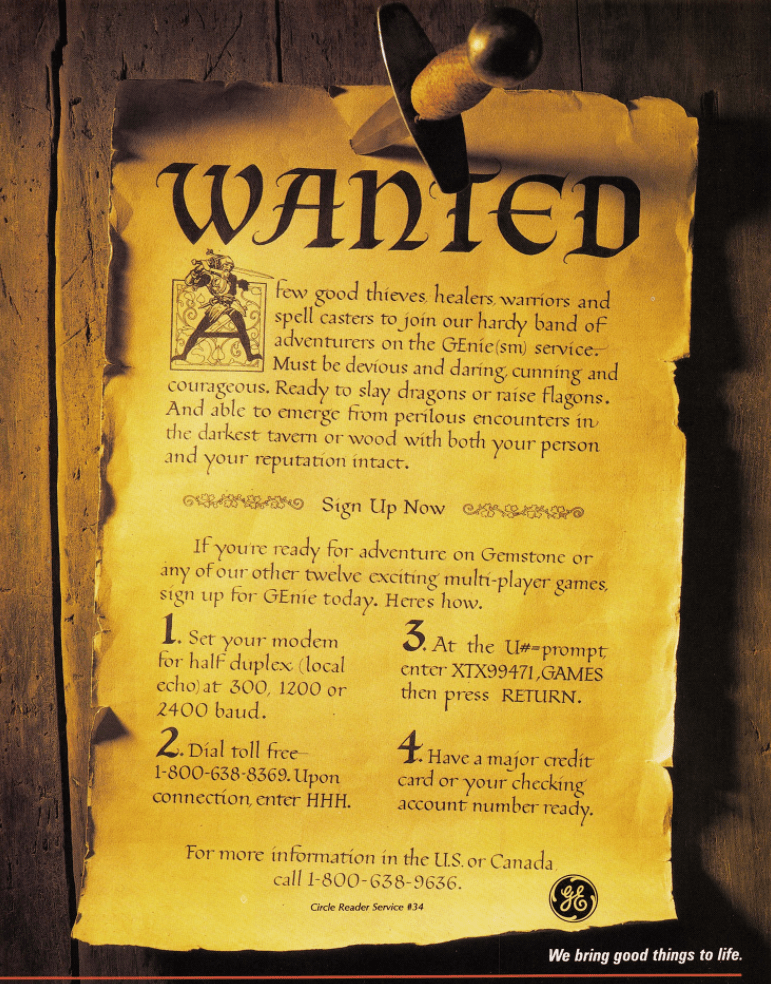
In ye olden times, known as the 1980s through the 1990s, there were a number of online services that someone could direct one’s modem towards (if you were splurging in the mid-80s, at an awesomely powerful 1200 bits per second) including GEnie (General Electric Network for Information Exchange).
GEnie was particularly famous for multiplayer text-based games like GemStone III, but also had single player ones including (according to this letter sent to Jason Scott):
Black Dragon… descend through the dungeon and slay the black dragon
Castle Quest… dungeon adventure
Original Adventure… classic text adventure game
Adventure 550… advanced version of adventure
Dor Sageth… dungeon adventure
Black Dragon, Castle Quest and Dor Sageth have been lost ever since GEnie closed in 1999.
Of course, I’m making this post, and that’s because as of 2021 Castlequest has been found, due to the efforts of Arthur O’Dwyer and the two authors: Mike Holtzman and Mark Kershenblatt. You can read Arthur’s full narrative here as to what happened, but the short version is that back in 1981 Mike had the foresight to send the entire FORTRAN source code of the game to the US Copyright Office. After a lengthy back-and-forth, Mark Kershenblatt managed to get the document in its entirety, which Arthur then typed in by hand. (This is the first I know of a game being rescued by simply getting source code from the USCO. Incidentally, another lost game, The Pits, has a USCO entry.)
The actual writing of the game took place on a mainframe, and Mark estimated the work happened “between September 1979 and May 1980” although the source code is dated February 1980. Using my first-available-to-someone-outside-of-the-authors convention I might be able to shelve this with 1979, but I’m going to stick with 1980 (as also given on the IFDB entry for this game).

Enough noodling about, let’s try the game! (The IFDB link I gave has a link to a version compiled for Windows if you want to try it yourself, or if you’re on a different platform you can follow Arthur O’Dwyer’s instructions here.) For ease of reading I have boldfaced my commands and changed the spacing (the original screen width seems to be 60, but I merged the text into paragraphs).
Welcome to CASTLEQUEST!! Would you like instructions?
YES
You are in a remote castle somewhere in Eastern Europe. I will be your eyes and hands. Direct me with words such as “LOOK”, “TAKE”, or “DROP”. To move, enter compass points (N,NE,E,SE,S,SW,W,NW), UP, or DOWN. To get a list of what you are carrying, say “INVENTORY”. To save the current game so it can be finished later say “SAVE”. Say “RESTORE” as your first command to finish a game that had been saved.
The object of the game is to find the master of the castle and kill him, while accumulating as many treasures as possible. You get maximum points for depositing the treasures in the vault. Notice that the descriptions of treasures have an exclamation point. Be wary, as many dangers await you in in the castle.
Would you like more detailed instructions?
YES
To supress the long room descriptions, type “BRIEF”. To return to the long room descriptions, use the command “LONG”. “SCORE” will give you your present score in the game. “HELP” will give you a hint about an object in the room, but it will cost you some points. To end your explorations, say “QUIT”. Good luck. (you’ll need it).
Would you like more detailed instructions?
YES
To aid you in your travels, you may ask for a hint by saying “HINT object”, where “object” is the item that you need help with (e.g. “HELP CROSS”). Saying “HELP ROOM” will give you some help concerning the room you’re in.
You are in a large, tarnished brass bed in an old, musty bedroom. cobwebs hang from the ceiling. A few rays of light filter through the shutters. There is a nightstand nearby with a single wooden drawer. The door west creaks in the breeze. A macabre portrait hangs to the left of an empty fireplace.
The shutters are closed.
There is a silver bullet here.
Before I make some observations, I should mention Arthur O’Dwyer has a “bug bounty” for any typos ($5 each), but he’s trying to preserve any spelling mistakes as in the original. So “supress” is indeed spelled that way in the original PDF, and “cobwebs” starts a sentence but is lowercase. I’m not going to hunt for any more typos past this point myself (I’m trying to play the game without spoilers) but it’s faintly possible one of you reading this might spot a money-making bug just by reading my play transcript.
So, observations: the instructions clearly have some cribbing from the text of Crowther/Woods Adventure although apparently the authors didn’t refer at all to Adventure’s original source code. We see the technique that happened in Hezarin of having one foot in a treasure hunt and one foot in a kill-the-nemesis plot, and of course, it’s probably Dracula again.
Also, it’s clear we have a mainframe game, as the environmental painting in text includes details most home computer games of 1980 excise for space (the door creaking in the breeze, rays of light filtering through shutters).
GET BULLET
Do WHAT with the BULLET ??
TAKE BULLET
OK
Surely those in 1980 would know GET would be the iconic word here, as in GET LAMP, right? Whenever I hit a game that only recognizes TAKE rather than GET it takes me about halfway through the game before I finally stop getting error messages.
OPEN SHUTTERS
The shutter is open, but there are bars over the window.
Something on the ground outside is glistening brightly.
Incidentally, how did we get here? We’re starting inside the spooky castle. Is there some plot we missed where the details are important (like The Count) or should we just roll with it?
Going back to the room description, it mentions a “drawer”:
OPEN DRAWER
There is a silver cross in the drawer!
My first treasure! Also, my first indication this is the sort of game where you can refer to “scenery objects”, that is, objects given inside the paragraph description — by contrast, every item you could use in Crowther/Woods Adventure was separated out. This can be both good and bad; it adds a little richness to the world where it feels like the player is directly interacting with the environment, but it also means being thorough requires combing through every “object” that gets mentioned, including ones that don’t really exist in code, just in the prose of the room description. Consider the “macabre portrait” that also gets mentioned:
MOVE PORTRAIT
Do WHAT with the PORTRAIT ??
PUSH PORTRAIT
Do WHAT with the PORTRAIT ??
TAKE PORTRAIT
TAKE what???
FEEL PORTRAIT
Do WHAT with the PORTRAIT ??
The “TAKE what???” is a good signal — it means that object doesn’t exist at all to be referred to, even as hidden scenery. That doesn’t mean the portrait is completely a red herring; it may just be it slides via secret button or the like but the parser just never lets you refer to it directly.
I realized from here it would be wise to get a verb list early, so I went through my standard set, applying it to the cross:
READ CROSS
That would be a neat trick.
SEARCH CROSS
Do WHAT with the CROSS ??
EAT CROSS
You can’t be serious.
The “Do WHAT with the” message seems to indicate “no verb found”.

Noteworthy: no moving, pushing, turning, etc. Not going to fiddle with secret things much, I suppose. STAB mentions you don’t have a sword, and CROSS and SHOW are both verbs I might have had trouble coming up with on the spot. (I bet we SHOW CROSS at some point. Just a feeling.)
Moving on, here’s the map as far as I can access it:

You are in the parlor, an old fashioned sitting room. A display case of dueling pistols hangs over the mantle. Stairs lead up to a dimly lit corridor. Open double doors lead west. Two wide hallways lead north and south.
There is some “HORROR HOTEL” writing paper here.
There is an old gun here.
The gun can be loaded with the silver bullet. I’ve run across a werewolf but it hasn’t stayed around long enough for me to take a shot.
A nasty werewolf lunges at you, takes a swipe at your neck, misses and runs away.
A sampling of some other locations:
You are in the foyer. An umbrella near the door is dripping on the thick pile carpet. A black cape is draped neatly over the banister of a grand staircase leading up. A magnificentl archway leads north. Corridors lead south and southeast, a small hallway heads west, and a narrow stairway goes down.
The butler is sound asleep.
(You can’t refer to the umbrella or the cape.)
You are in the workshop. A myriad of tools clutter the workbench and surrounding tables. A thick layer of sawdust covers the floor. Footprints in the sawdust indicate that you are not alone.
There is a heavy steel grappling hook here.
You are at the side of a dirt road that runs north and south. Fresh tracks in the road seem to indicate that a horse-drawn carriage has passed here recently. A narrow path leads east.
N
You are at the bank of a wide moat which surrounds the castle. A small town can be seen far in the distance. The road goes south.
Off to the side is an old rowboat.
TAKE ROWBOAT
OK
CROSS MOAT
You are on the far side of the moat. You can see a full view of the castle here in all its deadly splendor. A small town can be glimpsed far off in the distance. An old sign nailed to a tree reads:
“YOU CAN’T REACH THE VILLAGE FROM HERE!”
(I’m not sure what else to do here; the rowboat is too big to take into the castle.)
You are now in the kitchen. Twelve Swanson’s frozen entrees rest on the counter, below a microwave oven. “THE BEGINNER’S GUIDE TO COOKING” lies on a small table. A swinging door exits south. Other doors lead east and north.
Somebody left some tasty food here.
So far my full inventory is: Silver bullet, Bloody hatchet, Wooden stake, Writing paper, Rowboat, Grappling Hook, Empty bottle, Silver cross, Old gun, Tasty food. Other than the odd bit with the moat above, I’ve run across a locked door and a boarded door (the hatchet doesn’t work to chop it) and the window at the start can be broken but there are bars that I can’t (yet) remove. I’d say the obstacles are fairly ordinary so far? There does seem to be a time limit, although I haven’t tested yet if sunset is game over, the endgame with a vampire, or something else:
You’d better hurry. The sun is setting.
I only have 25 points so far, out of ????. I’m not worried yet; I only have just got the feel of the surroundings, and there’s the built-in “HINT object” or “HELP room” feature I have yet to try if I get stuck.

From the Museum of Computer Adventure Games.
While playing chronologically can have its charms in seeing author development (Greg Hassett comes to mind) it also runs the risk of leaving a bad impression of a particular author. Escape from Traam has a TRS-80 copyright date of 1980 so has a fair chance of being Jyym Pearson’s first game, even though Adventure International published it after Crowley Manor. I am still frankly happy I got to this one second because … well, let’s just watch it in progress.
Last time I was flailing with nowhere to go. I had found a dark cave where I could CLIMB up to a cabin, but no other leads. I was making a conjunction of two wrong assumptions, such that the combination got me stuck.
1.) I assumed the cave, being dark, couldn’t be mapped by dropping objects — this is true for a lot of other text adventures.
2.) I assumed, after enough testing and finding CLIMB always went to the cabin, that was the only outcome.
The dark cave is composed of two rooms, where nearly all exits go loop back to the starting room where CLIMB goes to the cabin. I realized this by testing assumption #1 on a whim, and once I realized there was a second room, I found out that the second room has a different message for CLIMB: YOU’LL FALL.
Some fiddling with the parser later: LOOK has you bump into an object, then TOUCH OBJECT reveals the unknown object is some STEPS. So you can explicitly go CLIMB STEPS. (Notice how the climb in the other case does *not* use a noun. The game is very inconsistent about if a noun or an indirect object is needed and much of my flailing later came from this problem.)

The steps led to an inscription which read THE ALCHEMIST in the same crypto-language as the other messages. I could then go down a hallway and climb up back to the starting ship, which “rolled over” — I guess it covered the exit I went out of? I was then able to find a SILVER KEY there.
The silver key worked on the locked trunk in the cabin, where I found a dictionary and an alphabet which explicitly gave part of the crypto-language. Since I already had figured it out I didn’t need it. (This seems to be a common theme through cryptogames in games we’ve seen so far — both Pyramid and The Domes of Kilgari featured cryptograms I solved before coming across a clue to said cryptogram.)
So in a way, I felt like I had just traveled in circles with no progress. I kept poking around until I tried to DIG GROUND WITH FROND in the inscription room above, revealing an altar and a silver cup. “The alchemist”, aha! I went back to the silver stream and filled the cup, then tried pour it on the altar and the game just has you stumbling clumsily and the water pouring out to no effect. Huh.
After a few loops of frustration, I tried walking out with the filled cup to find a cave-in where I normally went back up to the crashed ship.

Oho. Pearson definitely has a very set scene sequence for this game, so even though there’s no particularly logical reason for the collapse to happen when it does, it’s there to reveal the next piece of the game. The floor (as seen in the graphic above) has a lead brick, so you can pour the cup to get a gold ball.
Fortunately, the cave-in didn’t block the only exit — you can go back through the cave and the cabin still — so I took the gold ball back to the alien who wanted gold, and dropped it.

Climbing the tree takes a one-way trip to a monkey-like creature, who you can pump for information with TALK MONKEY multiple times.

MY NAME IS STAMMD. I SPEAK YOUR TONGUE AND I AM ONE WHO CAN HELP YOU. YOU ARE DOOMED IF YOU STAY HERE. YOU MUST ESCAPE FROM THIS PLANET. YOUR SHIP IS IN ORBIT SCANNING FOR YOU. YOU WERE ON PATROL WHEN YOUR SHIP WAS STRUCK BY A GROUND LASER. YOU HAVE LOST YOUR MEMORY.
How does he know all this? How does he know we have amnesia? How do we not know we have amnesia until we are told about it?
You can keep typing TALK MONKEY but then just get the message, multiple times:
HE SAYS “I HAVE ALREADY SAID ENOUGH TO BE EXECUTED.”
But you still have to keep going, and no, I didn’t realize this on your own. If you keep pestering poor STAMMD enough times he says
FIND KASTAMAN…
which is absolutely essential information, and in fact the only essential information in the entire info-dump. I think the author ran across the opposing desires of wanting a movie-like scene where a friend reveals more to the mystery, but simultaneously tried to fulfill the desire to stuff in another puzzle.

Moving on, there’s a statue with a plaque that translates DICK NIXON, and I’m not going to even try to think about what the author was going for there. What I do want to point out is the above is the result of PUSH STATUE, but trying to PUSH STATUE again does nothing; you have to instead MOVE STATUE. But how is that different…..!??
(Beneath the statue is an insect, which is useful later.)
After that nonsense you come across a forest with a raiding part of Traam. You can LISTEN to get some information about needing to PUSH a PIN on a door, but trying to boldly stride forward farther gets you killed. You can instead CLIMB to get up and across.


As far as I can tell the pendant is a useless item that gets you killed — a traam spots you later with it and asks who you stole it off of.
This is followed by a bit where you go in a storm drain, and run across some deadly poison gas.

I was entirely baffled here, thinking I had pretty much combed every part of the game up to here. This was definitely the inflection point where I went from mostly staying away from hints to hitting the hints hard and often. (Interesting for me how often it isn’t a “natural” progression, but sheer annoyance building up until all faith in the game is lost at once.)
All the way back where I had found the stone cup, I needed to DIG a second time, and I would have found a helmet which protects against the gas. Really?
Look: I’ve certainly played enough games that required digging multiple times maybe that was my fault a little, but there is just so little satisfaction in finding a hidden item that is too far back to be reached in a linear progression. Exploration puzzles are compatible with exploration gameplay; for example, I did find some pleasure in The Golden Voyage where a location yielded more to a second dig. Here the chance of recognizing one’s mistake is incredibly low; the logical thought process has to go from “what to I do against the gas?” has to proceed to “I must have missed an item” and then “I must have missed a SPACE HELMET while digging.” In all seriousness, I could see someone combing over the prior bits of the story and finding their missing object that way, but again, this clashes badly with the linear cinema that this game wants to go for.

Helmet in hand on a fresh game, I was able to get up to the three doors shown above. The LISTEN hint with PUSH PIN applies and I was able to go through. If I hadn’t found the LISTEN clue — and it seems awful easy to miss it — they would get the same terrible loop as the helmet, except this time the resolution to the problem wouldn’t even be an item!
Oh, and then I ran across a human slave in a uniform that warned me the Traam were going to get me so I shot him.

Keep in mind when trying to shoot anyone else the game just says you’re too nice to, or trying to shoot an object claims the gun is jammed. I had no idea the gun was even working, let alone that the right action here was indiscriminate slaughter.
Anyway, now you can take his uniform and wear it. This lets you get by a Traam nearby and find another slave, who asks a weird trivia quiz of sorts.

The correct action is to say KASTAMAN, although I really don’t know how being from Earth is equivalent to knowing to interrogate a talking monkey long after he stopped wanting to say anything.

Using KASTMAN leads to the man unlocking a door, which eventually (after some puzzles I’m going to skip talking about because I’m annoyed enough as it is) leads to a library with a locked book. You need to BREAK LOCK to see some critical information.
UNHOOK AUTO PRESSURE, LIFT DECOUPLING RING, AND PUSH THRUST BAR
After getting that info, there’s not much more to do other than find the exact right room to enter so you get captured rather than killed by the Traam. I don’t know why they capture rather than kill in one specific circumstance.
Since the aliens helpfully leave you with your stuff, the insect (the one retrieved from retrieved from under the statue of Richard Nixon, 37th President of the United States) is now useful:

This lets you find a crack in a particular block that can be pulled out. Then you can crawl and climb down to a dark area where there’s a SHARP OBJECT. LOOK SHARP OBJECT reveals the object to be a spike…

…and I sure hoped you remembered to take the NYLON ROPE with you, because I didn’t! (There is an inventory limit, so you just have to vaguely guess what still needs to be toted along with you after you use it.)

Almost there! Tying the rope to the spike leads you down to a ship; escape involves repeating those directions from earlier (UNHOOK AUTO PRESSURE, LIFT DECOUPLING RING, AND PUSH THRUST BAR)…

…and then activating a beacon once in orbit.

A little compare and contrast — the other Jymm Pearson game we’ve seen, The Curse of Crowley Manor, was much more effective. Why?
It still had, for the most part, a linear setup, with small pieces of geography revealed for each new part of the plot, but
a.) the puzzles weren’t heavily dependent on having to restart because of a missed item; only one item (a vial at the very start) was easy to miss
b.) the parser wasn’t as egregious; I don’t recall guess-the-phrase showing up anywhere
c.) it handled the narrative in much more deft way, with bodies slowly revealed at the start, and info-dumps that more or less made sense — I’m still not sure why the monkey creature knew so much, how the “amnesia” was even relevant, and why they were so reticent to convey a critical piece of information, and why that piece of information proved the main character was from Earth
d.) it doesn’t require shooting a random person
Fortunately, things with Jyym Pearson get more interesting from here; his other 6 games we haven’t got to yet are allegedly much better. His next game — otherVenture #4 — involves your wife being kidnapped for ransom on the same day as the 1906 San Francisco earthquake.
We’re going to swerve away from all that for a bit, because yet another lost game from history has been found recently (in a most unusual way) so I’m going to be playing that next time.
Let’s get meta for a moment and talk about this blog project as a whole.
While I had inspiration from The CPRG Addict and his chronological gameplay, I also have greatly admired The Stack which has a rule about blogging 24 hours after any gameplay has happened. This occasionally has led to entire blog posts about technical issues in playing, or writeups on very small game elements, and I’ve always found them to be glorious.
With adventure games, especially in the early era, it’s quite easy to be stuck running in place for a while. I could of course extract myself with hints — look, there’s even an official Adventure International hint sheet — but I do want to recreate the original experience, which occasionally means being stuck for a while on just five rooms. Sometimes it allows for philosophical asides, or introspection on the actual nature of game-play and being stuck. At least, I consider each “post” to be part of an entire series rather than stand-alone, so if you go to my All the Adventures page, I link to tags rather than individual blog posts. (Even when a game is a one-shot, I use the tag in case something else comes up.)
Past the cryptogram from last time (the alien wants gold, which I haven’t found yet) I found a hill and a cave…

…a silver stream which “steams” (if you try to drink, it “vaporizes your body”)…

…and a forest, where I found a frond, but couldn’t climb any trees.
The cave is just, well, dark. I thought perhaps I could shoot my frond with my hand laser and set it on fire, but I found it was “jammed”. It turns out, even thought you can’t go UP, CLIMB still works.

This leads to a “small deserted cabin” with a locked trunk.
And that’s it. I guess climbing counts as one puzzle. Not much for a week, is it? Part of the issue is I’m not sure if what comes next is
a.) a “hidden puzzle”, that is, some action elsewhere I was supposed to take — even back in one of the locations I’ve already been
b.) a direct puzzle, like getting light to the cave (which may just be impossible) or unlocking the trunk (…but I get the intuition this game really is looking for a key)
c.) something even sillier, like a location I can GO to that I missed; I thought I tried everywhere, but I’ve thought such things before
I am curious how many people from that era really were willing to be stumped that long; even if you only had access to, say, two games — not all that odd — there comes a point where gameplay is just too much grinding with too little progress.
I’ll give it another spin, just to shake things out, but I’m guessing by next time I’ll have referred to that tempting hint page.
Your small space cruiser is in trouble — and even though you survived the initial crash on a bizarre distant world, you may soon wish that you hadn’t! The alien environment of Traam is replete with incredible wonders and sights which no human eyes have ever beheld. You must escape this dangerous world, but be forewarned that if your decisions are not tempered with intelligence and caution, you may not see home again!
We’ve visited Jyym Pearson once already with The Curse of Crowley Manor (aka otherVenture #2), a heavily narrative-driven game without the slightest hint of treasure hunt. Since we’ve rammed through a few treasure hunts lately, I figured his “next” work (otherVenture #3) would be a good antidote.

From the Internet Archive.
I put “next” in quotes because the TRS-80 game gives a copyright of 1980, indicating this was probably written before otherVenture #2, and copyright Adventure International and now I have a headache, since this was clearly published *after* Crowley, which gave a date of 1981. This might normally indicate Pearson wrote the game on his own previous before it got published, but why does it list the Adventure International name to the title, then? I’m just going to jam this in 1981 at the moment and nurse my headache.
The game is a headache, too, at least at the start.

I played the Apple II version which includes graphics by Norm Sailer, just like Crowley. This is partly to be consistent, partly because it’s been a while since we’ve had a game with graphics, and mostly because Will Moczarski and Dale Dobson found that the TRS-80 version has a game-breaking bug. I don’t think either tested all 8 versions of the game file available, but I’m fine skipping that particular piece of suffering.
You start on a crash-landing ship, where you just need to wait a bit for a crash to happen. It is faintly possible there’s something hidden in the vehicle, but I don’t know how to summon it up.

You can LOOK to find things, either with or without an object in front, but no luck here; an alarm eventually sounds, but I haven’t found a lurking glove compartment or anything.
After the crash, I was able to LOOK to get some NYLON ROPE and I could PUSH SHIP to find a HAND LASER.

I’m got stuck a lengthily time on the very next room. There’s a cliff with a bush and presumably you can use the nylon rope to climb somehow, but no syntax I have tested out has been successful.

I went into Extreme Mode, coming up with a verb list via testing off my general list
DIG, CLIMB, READ, OPEN, EAT, THROW, KILL, UNLOCK, JUMP, PUSH, TURN, TALK, LISTEN, SMELL
and then did some lawnmowing. One thing I found is that the game is pretty sensitive in how you mention objects; you can’t just GET ROPE when you find the nylon rope, you have to GET NYLON ROPE. All these are rejected by the parser: climb bush, climb cliff, climb nylon rope, attach nylon rope, jump, lasso bush, tie nylon rope, wrap nylon rope, make lasso, throw nylon rope, make knot.
Finally I hit upon TIE NYLON ROPE TO BUSH. Guess-the-phrase, and especially realize-the-game-uses-indirect-objects, is the best.
Immediately after is an alien warrior reading a map, that I was able to TALK to.

An alien that talks in cryptograms? Sure, I guess.
I’m going to stop here for the moment — the guess-the-phrase trouble took about an hour and a half to get through, and if I go without a break I’m going to get grouchy about it. Feel free to solve the cryptogram if you like!
I managed to eke out a few more locations on my map from exits I had missed, but I’m going to call this one finally cooked. As a guide for future intrepid explorers who want to get farther, I’ll try to lay out in detail everything I’ve found and all my maps.
Before that…
COMPARING PLATO ADVENTURE’S PARSER TO ZORK’S PARSER
It’s not even close. It’s clear PLATO Adventure is trying to emulate Zork’s “full sentence” mode — more words equals more power! — but I’ve seen enough oddities to say it’s only half-baked.
For example, one of the new locations I ran across was an altar with a book. If you READ BOOK the game gives a confused response; the only thing that works is READ ANCIENT BOOK.

What I’m guessing is happening — other than the game not really understanding the difference between an adjective and a noun — is that rooms with fixed items have the code specific to the location they are at. This means a command like JUMP can plunge the player in a pit where appropriate, but otherwise, the game is confused and act likes it doesn’t understand the command at all. We’ve seen this kind of half-measure with the Wander games which can lead to odd abuses, but essentially, it makes the interface feel much more inconsistent. There will always be misunderstood verbs, but having the game misunderstand a verb if the context is wrong makes the user experience as transparent as mud.
For phrases, that means it’s not really understanding there’s a “ANCIENT BOOK” or “BOOK” object in the vicinity of the Altar, but rather, it’s a hard-coded scenario where “READ ANCIENT BOOK” is grabbed as a whole phrase while in the appropriate room.
COMPARING PLATO ADVENTURE’S GEOGRAPHY TO ZORK’S GEOGRAPHY
There are spots, in Zork, where connections are tangled and confused, but the really odd bits are outside (where there’s a “full circle” around the house) and in a maze. The rest makes enough sense I can visualize regions in my head.
PLATO Adventure seems on the surface to draw on identical rooms, but the configuration somehow seems much more random.

Here’s an example; this is the region that gets opened after solving the Dam #3 puzzle. The “Above Dome” part presumably goes down further but I don’t have a rope. On the right side, the various “long” and “vast” halls are vaguely described and connect more like a spreadsheet than a map. (Jumping back to parser issues again, the game doesn’t seem to understand DIG once you have the shovel. I am guessing there is some room hardcoded to understand DIG after all, but it’s frustrating testing out a command where that isn’t known for sure.)
Despite the nitpicks above, the game isn’t terrible to play … it’s just I can’t make any progress. So, here is my summary; it repeats many points I made in earlier posts, but this is meant to collect everything into a single section:
You start outside, and can go down either a trap door or a mountain passage to get into the underground. There doesn’t seem to be any difference between the two, other than you can leave the trap door open if you take the mountain passage. That still doesn’t help with escape, though, because the trap door is too high to reach if you’re under it. I still have no clue how to return upstairs after going downstairs.

What I’m calling the “central area” has a troll (easily dispatchable by KILL TROLL WITH SWORD) a riddle door (solvable either through WELL, SHADOW, or LETTER E), an echo room (just type ECHO to get out), a maze (which seems to be unmappable, just stumble until you find keys, then stumble out) and the Dam #3 clone. If you go in the maintenance room at the central area and hit all the buttons in reverse order (red, brown, yellow, blue) then you’re able to turn a bolt on the outside with a wrench, opening a secret passage to the area with the shovel I mentioned earlier.
I’m stuck on a large rusty steel door that needs oil — you can find a pool of oil, and then “cover an item” with oil, but there isn’t any way I can see to transfer the oil over to the door. There’s also a pit with a plant that needs water, but I have found no water-holding container.
Connected to some of the central rooms is the “round room” randomizer from Zork. This shuffles you to a few other areas, like the temple…

…which has an Ice Room that threatens to freeze you if you hang around, and a rainbow that I can’t get a reaction from.

Another random exit takes you to mines…

…where you can find a diamond and a rusty rod. The game does understand WAVE ROD in all places but nothing has happened anywhere I’ve tried it, even in obvious places like chasms which might spawn bridges or the rainbow which might solidify.

This is most of the items I’ve found. The diamond and rusty rod are missing.
I’m still guessing there’s some interesting material hiding in the places I’ve missed, and I like the askew-Zork-world in a sense, but raw persistence is only going to get me so far. I especially welcome it if anyone can access the source code; there is apparently a way to see it instead of playing the game on the cyber1 server but you need (I think) the author’s numerical code (?).
I am, somewhat disappointingly, quite stalled. I might have to stop my traversals here until I can summon up source code or the like.
It’s hard to put a good fixed narrative on what happened, since I essentially went through multiply forays where I started getting more of the lay of the map, but according to the documentation which lists 148 rooms, I have found only a little more than a third.

Various things I found:
• A curtain of light that I wasn’t able to do anything with; one of these is in the Bank of Zork in original Zork but there’s no way to pass through the wall I could find. I may just have the syntax wrong, or there may genuinely be a change to the puzzle.

• Speaking of changes to puzzles, the four colored buttons are in at the Dam #3, but the only way to get them to work I could find was to push all of them in reverse order, causing the room to start flooding. That led to the bolt outside glowing, and then I could TURN BOLT WITH WRENCH, which for some reason opens a staircase in the ravine below the dam as opposed to (apparently) operating anything logical. I feel like the form of the puzzle was taken but not the exact sense.

• Relatedly, I found the “echo room” from Zork, but the only way to solve it is the original way: by just typing the word ECHO. The solution involving stopping the dam water from rushing by only was added later.
• I found the thief and he on one encounter stole my stuff, and on another encounter killed me. I think if you just immediately flee when you see him he doesn’t do anything, which nullifies the impact a little.

• I found a maze of rooms “all alike”. Rather evilly, if you try to drop items to map things out, they end up getting moved to a “central room” which has a set of keys. I just had to guess my way out.
• The mine area is in, kind of — the diamond is out in the open and you don’t need to do anything special to get it — but the rusty rod with a star on it from Adventure is there also. I’ve tried waving the rod in various places with no success.

You’re locked in here and have to PUSH NEXT to get out. The NEXT button is a PLATO in-joke — it gets used all of the time in navigating the network system.
• I found two riddles in addition to the SHADOW one from last time. One of them was the WELL one from original Zork, and one of them is a regular classic.

My main sticking points are a.) the fact I still haven’t been able to get back outside, to the trophy case where the treasures are stored. b.) I don’t have a bottle of water, and I can’t substitute any other container — I can get an empty gas can but the game is just confused with syntax if I try to fill it. This means the plant calling for water in a pit (like in Adventure) can’t be grown into a beanstalk. c.) Relatedly, there’s a rusty steel door, and there’s oil, but I can’t bring one to the other. Oddly, if I try to fill the gas can with oil the game just says it’s now covered with oil (??).
I do worry there might be some bug stymying my progress. Trying to open an object gives a message about opening a book (I don’t have a book in my inventory) and the wobbly parser generally makes me concerned there’s some command too messed-up to deliver. I’m still going to make honest whacks for a few days but I may shelve this game for the moment and move on with my 1981 sequence a little more.
If you’re interested in playing the game yourself, the cyber1 server has it — you have to follow the login instructions, and when it asks what program you want to run, type “adventure” all in lower case. I still don’t understand how to set it up so save games work.
We’ve gone through many variants of Adventure now, including the recently-unearthed Adventure 448, and one open historial question is: why were all the variants made of Adventure, and not of other games at the time, like Mystery Mansion, Zork, and Acheton?
I can at least theorize. In the case of Mystery Mansion, while it was written in portable FORTRAN, it had messy “spaghetti code” with lots of special exceptions rather than a unified and easy-to-modify setup like Crowther’s original. Zork’s MDL language was not exactly mainstream (although the Bob Supnik Fortran port surely could have been modified?) and Acheton was written for a very custom-to-Cambridge system and reached past its small original circle only when it had its commercial release.
Here to shake things up is the PLATO System, which has been written about voluminously elsewhere, because it housed the world’s earliest computer RPG games. It had graphics and networking long before anyone else did. It spawned both Wizardry and Shanghai.
It also had an adventure game remix of Zork.

Credits, as shown, are to Phil Seastrand, Dave Schoeller, and Mark Ciskey. It was typed in by hand from source about 10 years ago, and assuming the records above are correct, nobody has beaten it since.
The game is technically just called “Adventure” but I have to keep my sanity somehow, so I tossed in the PLATO.
PLATO definitely had nothing like MDL, so this is code written from scratch which has some of the rooms of Crowther/Woods Adventure mashed up with some of the rooms of Zork to form its own thing. It certainly starts feeling like it should be an Adventure clone.

Stepping inside the building cross-jumps to an entirely different universe.

Based on what I’ve seen so far we’re at about 5% Adventure, 85% Zork, and 10% the authors doing their own thing.
There has to be some difference geographically because all directions are NSEWUD — that is, none of the “diagonal directions” are in. Here’s a comparison of the outside maps, PLATO map on top, Zork map on the bottom.


Many of the PLATO Adventure locations are still original, even if they re-insert some of the Zork items, like the wrench and candle in the shed below.

I haven’t explored underground that extensively yet. The Round Room for spinning is in; Flood Control Dam #3 is in.

A riddle room is in but has an entirely different riddle than the original. (Not a terribly hard one, I’ll leave the answer for readers to work out in the comments.)

So far I’m wondering if the reason nobody has finished the game yet has to do with logistics more than difficulty. One of the NOTES attached to the game suggests extending the lantern life because it is relatively short on the number of turns. I also ran across a softlock fairly early

which suggests there might be more. I’m just going to cross my fingers that the lack of winners has more to do with lack of attention than extreme difficulty. (It tweaks the Zork puzzles where I already know how to solve them … how hard could it be? Don’t answer that.)
Two other items of note:
a.) Just like Zork, the parser is NOT two-word. If you want to push the blue button, you have to type PUSH BLUE BUTTON and not just PUSH BLUE. It can honestly be stickier than Zork about the indirect objects; I remember being able to just ATTACK TROLL in Zork but for PLATO Adventure’s equivalent you have to specify a weapon, even if you are only carrying one: ATTACK TROLL WITH KNIFE or ATTACK TROLL WITH SWORD. (Either works!)
b.) The help screens list every room and every item. I haven’t checked much in detail because I consider those slight spoilers, but on offhand glance it does really look like a jumbled Zork. Interesting from a theoretical angle is the opening text.

“The main objective of this game is to make points to gain levels” sounds quite alien to the instructions of every other adventure game I’ve played. It strikes me like the sort of thing you’d write to a group that is *only* familiar with CRPGs in an attempt to describe the adventure genre in a way they’d know. (PLATO, being a graphical terminal, could not run Crowther/Woods Adventure, so undoubtedly many players in 1979 were not familiar!)
Special thanks to commenter Louis N, who clued me in that the PLATO system had an adventure game. I knew the CRPGs well and I had checked through all the files at one point and found no adventures, but it looks like the list I checked was made before PLATO Adventure was typed in. Better late than never. If anyone else familiar with PLATO has potential adventure games to suggest, let me know (I know of one other that might count but I’ll need to test it more thoroughly first).
The ever-prolific Roger M. Wilcox still has seven games left for our 1981 roster, so let’s knock one down, shall we?
His previous two (In the Universe Beyond, Creatures that Live in the Sun) were a bit wacky (that’s technical jargon for “the work of an imaginative teenager who was noodling around with sci-fi ideas and kept cranking games out without worrying about being published”), but this game plays it straight with another collect-a-thon, where the most interesting thing is the title item.
>EXAMINE STAFF
“Slake” is a magical staff composed almost entirely of gold save a ruby on its front tip. Its bottom seems worn from tapping against the ground. It is capable of a “retributive strike” down its middle, which seems divided for this purpose or possibly for another. Its design has three gold snakes wrapped around the entire length of the staff, which is a symbol of weaponry and protection.

The closest I could find to the staff the game is named after. This is a religious staff (a crozier) used by the Eastern Orthodox religion, and is short one snake. (Picture by Kokkarani, CC BY-SA 3.0).
You start fairly traditional aboveground, with a lantern and a passage into darkness. To get the lantern going requires pulling materials from a mound of “white phosphorus” and a “pile of sulfur” (which just happen to be lying around) and MIX them in order to LIGHT LANTERN.

You can use a shovel to dig out some “dirt walls” to find, rather creatively, a “river of wine” that you can use to fill a canteen, as well as a stone called “Staffbreaker” that will be helpful later.
I was stuck for a while on the “Stronghold Entry Point” on the map — there’s a locked gate and no key. I had tried DIG everywhere (including at the aforementioned river of Dionysian bliss) when I hit the realization that while shovels in text adventures usually don’t bother with nouns, it’s still possible to use one.

The key appears in the room description when you DIG SULFUR. This doesn’t really count as guess-the-verb, guess-the-noun, or any sort of standard bad parser behavior, yet I was still psyched out by the parser.
Past the locked gate I was able to get into a treasure room with the staff from the title.

The staff later gets three different uses, all cued by the description text I quoted earlier: the “ruby on its front tip”, the bottom that “seems worn from tapping against the ground”, the middle allowing a “retributive strike”, and it being a “symbol of weaponry and protection”.

For example, proceeding further, you come across a warrior at a “guard station”.
The warrior is swinging a magic sword at you right now!
where the right action is to PARRY.
You parried the swing! In fact, the parry caused your attacker to drop his sword onto the floor. He runs away in fear, leaving the sword behind.
This would have been a hard verb to normally summon up, but I had been stung before by In the Universe Beyond where the hints give information nearly impossible to find otherwise, so I had tried HELP earlier to see if it worked.
I know the verbs PARRY and FILL.
The warrior runs away but does not leave; in order to exit back upstairs (either right after the initial confrontation, or later) the sword left behind must be used against its original owner.

Speaking of odd verbs, just trying to EXAMINE the body indicates two puncture wounds. To find the hidden items — a two-handed sword and a bag — you need to FRISK ADVENTURER.
The second function of the staff is to shoot at stuff; in particular if you jump into a pit (there’s a treasure down there) your way out is blocked by a boulder.

Realizing that you need to “turn” first is subtle and non-obvious. The way I figured it out was fascinating in a ludic-theory sort of way: the game helpfully warns you if you jump in the pit without the staff that you’ve made the game unwinnable, and offers to let you back up. It struck me the only difference between getting the message and not getting the message was having the staff, so the staff had to be the solution, leading me to experiment more and arrive at TURN STAFF. Solving by realizing what was in the negative space, so to speak.
The third use — and more or less the climax puzzle — requires destroying the staff altogether. There’s a stone door where zapping with the staff won’t work, and there’s no key, but you can drop the staff and throw the “Staffbreaker” stone (from back at the river) and cause it to blow the staff up. This is interesting insofar as the staff as it is a treasure, but in being destroyed it makes a new treasure which works as a replacement: gold dust.

I needed to meta-solve past a bug, though. When the explosion happens, the screen flashes RETRIBUTIVE STRIKE! and the main screen returns … but not the prompt. However, game saves were still possible via the menu, so I saved and reloaded, and found myself with an open door and gold dust as was apparently meant to happen.
It isn’t necessarily the climax puzzle because there’s a few side puzzles to mop up (some leprechauns want the wine from the canteen, for instance) the most amusing being a carnivorous goose who can only be satiated by the taste of human skeleton bones.

Untitled Goose Game: The Early Years.
However, I managed to end at 100% treasure without too much trouble after.

The game doesn’t end. You just can take the hint from the declaration of victory and skedaddle whenever.
I did like the game centering around an object with multiple uses that was destroyed in the end. It reminded me of Wilcox making a consistent set of puzzles around an object with The Vial of Doom. The Vial of Doom still remains his strongest game I’ve played so far; The Staff “Slake” isn’t quite top tier simply due to the mundane nature of the treasure hunt, but it still came with some interesting ideas.
I’ve gotten through all the new material and found all the new treasures (all six of them). The ending is apparently unchanged (and I’ve, uh, seen it before a few times) so I skipped getting to that. Special thanks to Arthur O’Dwyer who came up with a full walkthrough that I needed to refer to multiple times.
Just to clarify from my last post, the years ’78, ’79, ’80, and ’82 are almost certainly graduation years. So the initial crew of four at Brown University (Dave Wallace, Dave Nebiker, Eric Albert, Les Wu) did their work in April 1978, and Eric Swenson (“EJS@MC”) converted the game for the MIT system a year later.
April 1978 is extremely early; there were no adventures for home computers as of yet, the first coming out in summer of that year (a conversion of Adventure for Heathkit). Adventureland and Pirate Adventure came later. The authors had Zork to refer to, but other than than that they almost certainly hadn’t seen anyone else’s efforts (like Mystery Mansion, Wander, or Acheton) so this is in the earliest depths of adventure gaming, where people were making it up as they went.
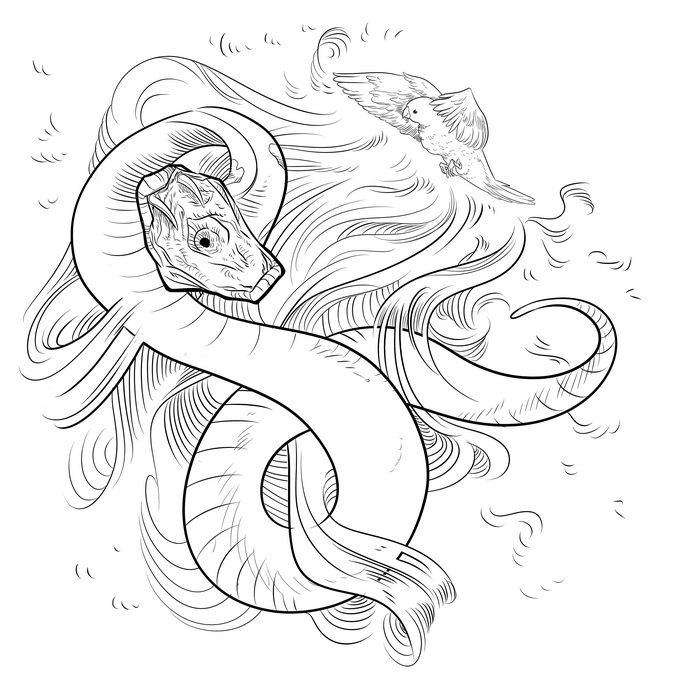
The immortal bird and snake fight, which I’ve now seen on loop across many iterations of Adventure, including Crowther’s original. Even this scene has had additions — in particular Don Woods in his “version 2” Adventure put a scene where you can bring the bird outside to a forest — but it generally has been left untouched. Picture from the AMC Halt and Catch Fire version of Adventure.
When I approach one of these games, I always started with my Trizbort file of 350-point Adventure, assuming it gets used as a base, and then run through the map marking as I go which rooms have been checked. Once I start to hit new geography I add new rooms with a special color so I know they weren’t part of the original map.
I found the Throne Room last time, but I had the bad luck of finding the last extra rooms right at the end of my survey. I had been starting to think the Throne Room was the entrance to all the new material, but no: the new stuff is shuffled up next to the entrances to the mazes (all alike and all different).
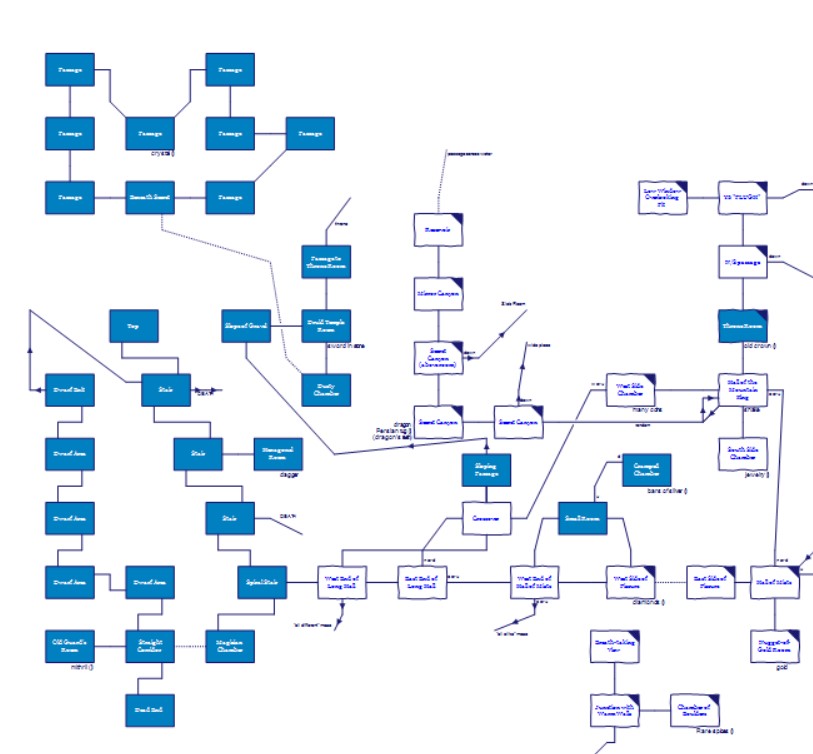
Some tweaks are minor; the silver bars got moved to a new room, the pirate lair got moved slightly for some reason. The essential “main attractions” are a wizard tower and a druid temple. They are essentially independent of the main game, with one exception.
Here is how the wizard tower opens:
You’re on a spiral staircase lit by torches with an eastern door.
The game uses Adventure’s unfortunate feature of “probabilistic exits” to make the geography messy here. If you go up one floor, going east kills you
You enter a thick, cold, gray mist. You seem to be falling forever and the light slowly fades away.
If you go up twice (without interference from the random number generator) and east, you can find a dagger
You’re in a small hexagonal room with a single door in the west wall.
There is a short ornate dagger here.
but in all likelihood you’ll hit a few “loops” that make the staircase seem endless, and if you aren’t being careful, kill yourself as shown above. This has been a source of endless suffering for me in the past (see especially the “secret exit” room from a maze in Adventure 500) but at least here it was thematic — I totally expect a wizard tower to have weird, TARDIS-like geographical oddities going for it.
Incidentally, going one room up again — with an identical staircase room — and trying to go east leads to death
A hoard of angry dwarves charges through the door as soon as you open it. They are brandishing all manner of weapon and you get crushed in their rush downstairs.
but we can get in there from a different direction. Still, the preponderance of confusion and deathtraps feels slightly off from 350-point Adventure.
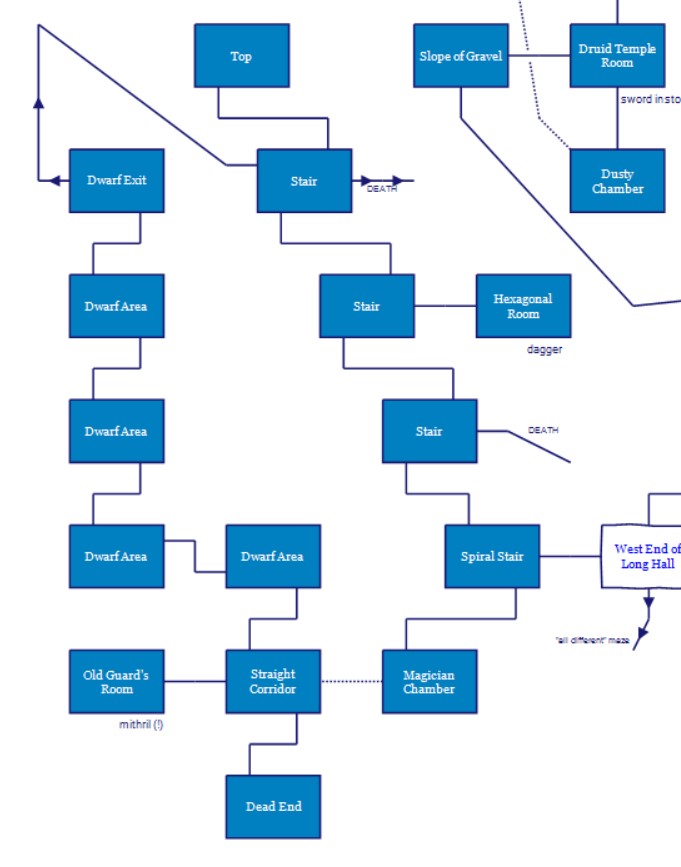
There’s something higher if you keep going up but you need an item first to reach the top, which you can find from the magician himself, who you’ll find by going down rather than up.
You’re in the Magician’s Chamber, a large pentagonal room with a spiral staircase leading up from the center of the room.
The magician’s staff is leaning against the wall.
The Magician is here gesturing frantically in front of the elven door.
There is a massive stone Elven door set into the western wall. The surface of the door is covered with indecipherable runes.
Just like the dwarves, violence is the answer to this one.
THROW DAGGER
Your dagger strikes the Magician, who stumbles back in astonishment and vanishes in a cloud of orange smoke.
It maybe should have occurred to me I just killed a Gandalf-analogue, frustrated at trying to get an elven door open, because the next step is the magic word FRIEND. The source code has the text “Speak, friend, to enter” but I wasn’t able to get it to appear; READ DOOR or READ RUNES don’t work.
(The famous door showed up a year later in a game set in actual-Tolkien-verse, Ringen, although in that game you had to nerd out and use the Elvish version of the word.)
SAY FRIEND
You’re in a long straight corridor ending in a massive slab of stone to the east. To the west a slightly smaller corridor continues while there is a passage leading up to the northwest and another leading down to the southwest.
Nearby you can get a “gleaming coat of Mithril chain mail” which you can’t wear (“The mithril mail is a small size, even for dwarves. You don’t stand chance of getting it on yourself.”) and explore some more Tolkien-fan-fiction room descriptions, before finally arriving back in the magic spiral staircase.
You’re in the Dwarves Great Hall where in the past were held great feasts and displayed the most beautiful of their craft. Now the hall look as if a great battle had been waged here. All the smaller passages leading out have been blocked intentionally. The only exits are wide staircases leading down to the west and up to the east.
Once you’re holding the wizard staff (which you can scoop up after killing the magician) you’re also able to get out of the loop in the spiral stair to make it to the top of the tower.
You’re in the magician’s tower, a small cluttered room filled with all manner of strange artifacts, the purpose of which cannot be kenned immediately. The walls of the chamber are themselves cloaked in shadows which seem to move of their own accord. There is one small window in the wall but it is far over your head and lets in a minimum of light. Torches set in the wall across from the window supplement the meager light but the entire room seems to disapprove of light and gloom clings to all the corners. In the center of the room a spiral staircase descends into to the lower levels of the cave.
There is a dusty old broom lying on the ground.
There is a large map on the wall.
There is an unadorned gold ring on a hook on the wall!
The Magician’s Book of Spells is here.
READ MAP
The map shows a small complex of rooms connected to the throne
room by a passage beneath the throne.
READ BOOK
The book seems to be a big book of fairy tales. This particular tale concerns an adventurer wandering around in a cave.
The ring counts as a treasure and “being royal”. The ring and the crown from last time are useful for a scene elsewhere; one outside of the wizard tower, but only a few steps away.
You are at a crossover of a high N/S passage and a low E/W one. You are in a slightly sloping N/S passage which seems to fall off sharply not too far to the North. There is a ONE WAY sign pointing in that direction.
The new passage (heading north) leads down to a druid temple.
You are in a large chamber decorated like an ancient Druid temple continuing to the west with passages leading off to the north and south. A large stone dominates the center of the room.
The sword is firmly imbedded in the stone!
I needed to check the walkthrough here; GET SWORD just says “You can’t be serious!” and you have to PULL SWORD. You need to be sufficiently royal (wearing both crown and ring) otherwise you get this:
PULL
TUG! GROAN! It seems to be stuck. Shall I keep pulling?
YES
Oh Dear! It seems I pulled a little too hard. The sword has shattered into many tiny pieces.
At least it asks before you step into your own softlock? If things go well, you get a treasure instead. (No, you can’t fight stuff with the sword.)
PULL
Voila! The sword has slid effortlessly out of the stone.
There’s a small area nearby where you can SWEEP with the broom from the wizard tower in hand to find a secret area.
The passage leads northeast and northwest.
There is a large piece of crystal here carved to the shape of a God!
If you have the crown and ring, you can escape and take a secret passage back to the Throne Room.
There is one more secret treasure; the broom is useful elsewhere. If you have your Adventure map memorized, you might know where it goes:
You are in a large room full of dusty rocks. There is a big hole in the floor. There are cracks everywhere, and a passage leading east.
SWEEP
Your sweeping stirs up the dust and reveals a piece of paper on the ground.
GET PAPER
OK.
READ PAPER
“Congratulations. Due to your extraordinary abilities as an adventurer, you have won a full four-year scholarship to the College of your choice — limited to Cambridge Massachusetts. Sorry, but Harvard excluded. Void where prohibited by law.”
The code is structured such that Arthur O’Dwyer and Nathanael Culver suspect changing the diploma from Brown to MIT is the only extra change when EJS@MC converted the Brown game to the MIT system.
I very much appreciate that this piece of early history got unearthed — even relative to other “mods” of Adventure this is quite early, only beaten by Adventure 366 (which only tweaked the game in a minor way) and possibly Crystal Cave (which is more like an entirely new game based on the Adventure base game, and where I’m still very uncertain on the dating).
The broom in particular applying both to the self-contained world of the expanded universe and making a new use for an old location was quite delightful. I think the randomizer was perhaps too heavily abused in the wizard tower, but at least there was a plot reason for it. Just to get very specific at the code level (referring to O’Dwyer’s work again), here is the spot on the stairs next to the dagger.
East goes to the dagger room.
Down goes two steps down with probability 60%, one step up with probability 15%, and loops to the room the player is already in with probability 25%.
Up goes one step up with probability 60%, two steps down with probability 15%, and loops to itself with probability 25%.
Just dropping a few items as reference alleviates the problem here, but it’s still a bit unnerving to play through.
One final update to mention: Adventure 448 is now enshrined within Nathanael Culver’s list of Adventure variants, which means it … exists for real, I suppose?
Adventure 448 is a variant of Adventure that isn’t listed (as of this writing) on Nathanael Culver’s giant list of variants, nor does it appear anywhere in the rec.games.int-fiction archives. As far as I can tell it simply has been dematerialized from history until very recently. I came across it in rather a strange manner —
Last year, early source code for Zork (circa 1977) was unearthed from MIT archives and put up at Github. This later became playable via a telnet link, which I tried out, but didn’t dive into deeply (I will eventually write about 1977 Zork more in depth, but it hasn’t been a priority).
Unrelatedly, Aaron Reed has recently embarked on a “50 Years of Text Games” series, writing about one text game each week; in 1977 he covered Zork. As part of that he mentioned being able to play Zork online, linking to Andrew Plotkin’s page.
Out of curiosity, I tried the link which included these instructions:
You can try the ITS environment online! Telnet to its.pdp10.se, port 10003 (telnet its.pdp10.se 10003). When it says “Connected…”, hit ctrl-Z. Then type :login yourname. (Any name will work.) Then type :zork to play. :advent is also available; that’s the original Crowther version. You can also try :games;adv350 and :games;adv448.
This boggled me for a second — I wasn’t looking at Zork, but rather the last statement, about adv448. I’d never heard of such a thing, and after checking all my sources, nobody else had either. I consulted with Lars Brinkhoff (one of the main people behind the MIT archive finds) and he said someone else had added adv448 to the PDP emulator that Zork was on, and he gave the credits from the source code:
C Modified for the Brown University system, April 1978
C Dave Wallace ’78
C Dave Nebiker ’79
C Eric Albert ’80
C LES WU ’82 (ALSO MADE CONVERSIONS FOR A NBS-10)
C Modified for the ITS system, July 1979 by EJS@MC
The actual game itself doesn’t list any of the names, but just states “Additional features added at Brown University.”
For most mainframe games with a long time span, the vast majority of the work was done early, and the later dates involve bug fixes (like Warp, Haunt, and Battlestar). Given this game passed through at least four different pairs of hands, I’m not sure if the same metric applies; however, for mainframe games I’ve been going by “first time available to people other than the authors”. I can’t definitely say what happened here, but to be internally consistent with the other versions of Adventure I’ve written about I’ll be shelving it on my big All the Adventures list as 1978.
ADD: Arthur O’Dwyer made the point that the years ’79, ’80’ and ’82 are probably graduation years, so that means it was done all in one go at Brown in 1978, with the “modified for the ITS system” happening a year later in 1979. That makes sense to me (and otherwise the sequence listed is a bit mystifying) so I changed the title to be just 1978-1979.
I knew I had to make this game priority on my queue, not just due to the mysterious circumstances of it being unearthed, but due to the generally ephemeral nature of telnet servers (although I hope the Zork one stays up a long time!)
While I’ll need to do another test run, it looks like nothing outside is changed, but the famous building is slightly different.
You are inside a building, a well house for a large spring.
There are some keys on the ground here.
There is food here.
There is a bottle of water here.
I didn’t make a typo: there is no lamp! The game forces you to use the iconic grate before reaching the lamp.
You are in a 20-foot depression floored with bare dirt. Set into the dirt is a strong steel grate mounted in concrete. A dry streambed leads into the depression.
The grate is locked.
unlock grate
The grate is now unlocked.
GO DOWN
You are in a small chamber beneath a 3×3 steel grate to the surface.
A low crawl over cobbles leads inward to the west.
There is a shiny brass lamp nearby.
I find this an interesting change, and not one I’ve quite seen before. Other versions allow skipping unlocking the grate altogether and blazing through with already-known magic words, but here the authors wanted to force one particular narrative.
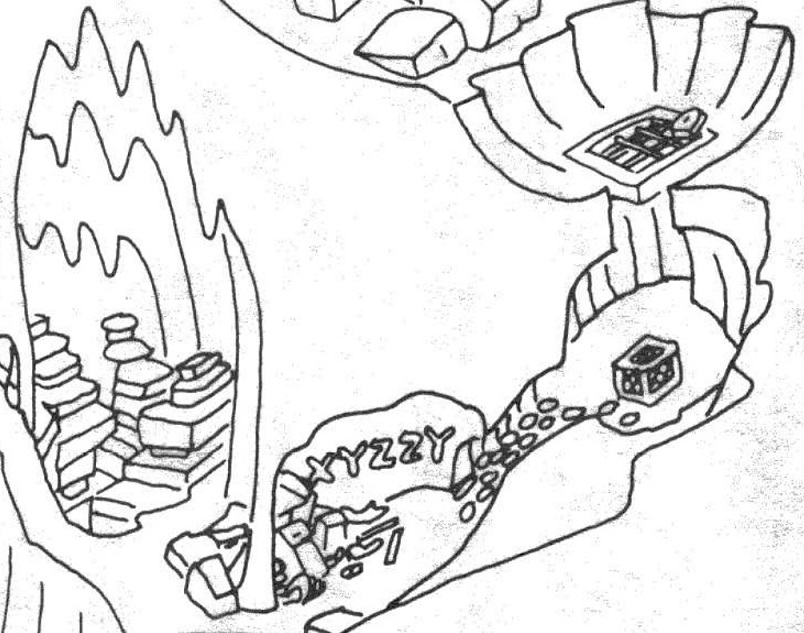
That means in Adventure 448 there should be a lamp in this picture. Detail from map by Dennis Donovan.
I haven’t checked far enough to see all the differences, and assess if the changes are major or minor, but here’s the room north of the Hall of the Mountain King.
You’re in the throne room where the walls are covered with large brightly painted murals of Colossal Cave and the lands surrounding it. In the center of the room is a large throne on a raised dias. To the south can be seen the entrance to a large hall while a low passage exits to the north heading slightly downwards.
There is an old crown sitting on the throne!
The resemblance is strong enough I’m wondering if there’s some relation to David Long’s Adventure 501
You are on the east side of the throne room. On the arm of the throne has been hung a sign which reads “Gone for the day: visiting sick snake. –M.K”
An ancient crown of elvin kings lies here!
but I’ll need to get in deeper to tell. My suspicion is this is just coincidence caused by the fact that the named “Mountain King” strongly hints to writers who want to extend the game that it would be appropriate to insert something royal nearby.


 Renga in Blue