Author Archive
Only incremental progress since last time (and I have been taking whacks at the game at odd hours all week) but part of it had to do with what may or may not be bugs.

From Schuette’s Book of Adventure Games.
The very first room had a lizard asking for “food for the truth”. I didn’t spend an overly long time agonizing here — I figured food would surface eventually — but Voltgloss mentioned there was a puzzle that didn’t work at all on the Apple version of the game, and when I investigated further I found out it was this one. Specifically, there’s a location that mentions “insects” in the description where you can GET INSECTS, but it does not work in the Apple version of the game. Here’s a screenshot from the C64 version:
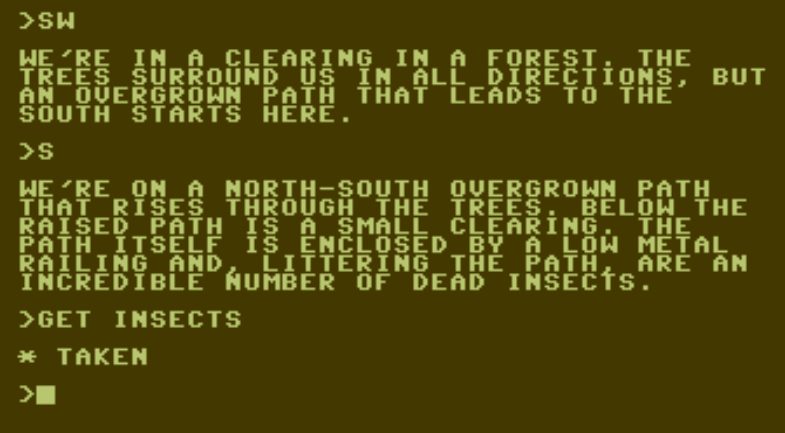
Unfortunately, this means I have to start thinking about objects I might be able to take mentioned as the general part of a room description, rather than separated into their own lines. Ugh.
You can then talk to the lizard (“ASK LIZARD”) and get some information which mostly seems to be for plot flair, but it was still worth going through the effort:

The lizard also confirms the forest is “purely an illusion” and mentions it arrived where it did “through a terrible catastrophe” and that “zoological specimens” have escaped their cages and “the robot is worst of all”.
Switching back to the Apple version (because I’m stubborn, and also I haven’t found a good C64 emulator that handles “turbo mode” well without also making keyboard presses too fast and Cyborg runs incredibly slow) I still was quite stuck. I had noticed that I could WEAR the micro-laser in order to shoot it and the shoulder harness could be worn as well, and with the laser I could shoot at the hostile snake and “cut” the string I found tied in the forest into smaller pieces of string, but I was otherwise combing over every location making sure I hadn’t missed anything.
I decided to try HELP because it felt like it was meant as an in-game resource and not an external “giving up” — this lets you “talk” with the computer you are merged with to get advice. Most places were not terribly helpful, and some hints I knew already, like a spot in the northeast had a tree that was climbable (but I kept slipping when trying to climb it). Oddly, one hint seemed to be misplaced.
SOMETHING IS ODD TO THE EAST.
This happened to the location just north of where I think it should have been.

The path to the “little, shelved room” isn’t necessarily described, but I was blindly trying room exits at the time so I found it almost right away in my first session.
I maybe should have internalized this as a general pattern. There was another hint when climbing a ramp (the same one that has the insects) that there seems to be something below, but if you try to CLIMB DOWN you go splat and die. I tried tying the string into some sort of rope (it was described as strong, so maybe?) but otherwise had no luck so figured this was a puzzle for when I got an object later. But no: this was pretty much required as the next step in the game. But you don’t climb down where the hint is given, but rather one position off from it.

If this was the only place in the game where this happened, I might say the hint was just trying to be sneaky and force the player to think about another location to get down from the same place, but since the other hint location is clearly erroneous, I’m going to guess this one was an error too.
Past the glitch I found some sneakers, matches, a black plastic cube, a power-pack (this helps keep the “your health is reducing” timer at bay) and a stepladder (which helps you get back up to the ramp again).

I also found what was entirely a “flavor maze” when I tried to leave the clearing in an odd direction. The rooms seem to be there entirely just to get the player lost, but I still had to go through the effort of dropping items and testing every direction because I wasn’t sure there wasn’t going to be a hidden item.

I then used the pieces of string I had failed to turn into a rope to make the sneakers wearable, and was able to climb up the tree to find a “strange piece of fruit”.

On a hunch, I took the fruit back to the lizard and tried to give that (rather than insects) and found it worked! Maybe the insects were intended as an alternate solution?

When NASA II told you that becoming a cyborg was a painless experience, you believed them, didn’t you? — and you volunteered. The operation was painless. Until you woke up.
Finishing off our tour of 1981 is Michael Berlyn’s Cyborg, his follow-up to Oo-Topos from earlier that year.
Cyborg is also the last adventure game from Berlyn’s own Sentient Software. In 1982 they’d publish two action games (Congo and Gold Rush) but never found much success and sales; Berlyn ended up at Infocom shortly after where he worked on Suspended, Infidel, and Cutthroats before making many more games for other companies (he was rather notably the inventor of Bubsy during the early 90s mascot craze).

From Mobygames.
Berlyn’s game-writing career started immediately after he had published three novels (I didn’t know about his horror novel Blight when I was writing about him last, it was under a pen name). His book #3, rather relevant to the game here, is The Integrated Man (“In a future where minds are enslaved by computer chips, one man seeks revenge.”) Oo-topos didn’t really fulfill the promise of someone taking the sensibilities of novel-writing directly to games — it’s a hunt-the-treasure game at its core with gobs of mazes — but Cyborg is much more promising right off the start as it plays directly with the ideas of the novel.
Half of your body was gone, sent to the organ bank for people who needed transplants. The other half was merged with a mechanical construct of incredible complexity and sophistication. That would have been barely tolerable if NASA II had left it at that, but they also implanted an electronic brain in your skull.
The game quite intentionally tries to have the interface — and the typical problems of being misunderstood by a parser — part of the world-universe itself.

All room descriptions are given with the pronoun “we”. The command “inventory” doesn’t work
UNABLE TO COMPLY. VOCABULARY CHIP SCAN REVEALS WORD “INVENTORY” UNKNOWN.
and instead BODY SCAN will reveal the protagonist’s possessions. AREA SCAN or just SCAN is used to look at a room description, and MEDICAL SCAN gives the rather crucial CYBORG and BIO levels.

The gimmick of disabling what were then already-established commands like INVENTORY reminds me a little of Nick Montfort’s first game, Winchester’s Nightmare (1999), which disabled abbreviations for literary effect. It doesn’t feel as painful a removal in Cyborg simply because it does fit so smoothly into the narrative frame, even if BODY SCAN is longer to type than I.
The health levels start degrading as you move around so they represent this game’s equivalent of a “light timer” or “hunger timer”. I don’t know how tight the timers are; the game starts fairly open so I’ve not got a “mainline” save game I’m using yet anyway. You start in a 5 by 5 area that is “outdoors” but clearly not outdoors.
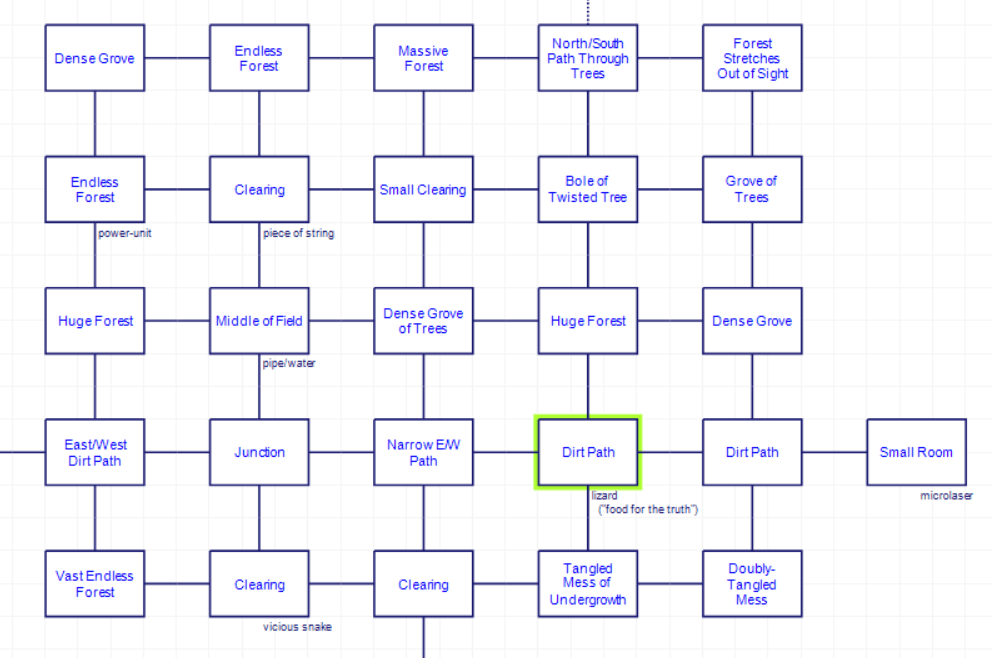
For the “clearly not outdoors” part, some room descriptions may help:
WE’RE IN AN ENDLESS FOREST. A SCAN SHOWS NO ABNORMALITIES, BUT THIS PLACE APPEARS TO BE A MIRROR IMAGE OF THE PLACE TO THE NORTH.
WE’RE ON AN EAST/WEST DIRT PATH THROUGH AN ENDLESS FOREST. DIRECTLY BEFORE US IS A DOORWAY MY LOGIC CIRCUITS SAY CAN’T EXIST, RISING FROM THE PATH LIKE A PORTAL INTO ANOTHER DIMENSION. THE WOODS SURROUND US.
WE’RE ON A NORTH/SOUTH PATH THROUGH THE TREES. THE FOREST IS ENDLESS AND YET DIRECTLY TO THE NORTH IS A DOORWAY. IT’S AS IF A MIRROR HAD BEEN PLACED IN OUR PATH- A MIRROR REFLECTING NOT WHAT LIES BEHIND US, BUT A HUGE, WOODEN-FLOORED ROOM.
I’m guessing where in an artificial spaceship environment of some sort? Despite the NASA II text I quoted earlier (which goes on and on a bit more) the game is vague on details on how we got where we are other than there was some sort of enigmatic malfunction. Quasi-amnesia, I suppose, which works well for a game, since it means the act of exploring is part of the plot. The vivid text helps too:
WE’RE ON AN EAST/WEST DIRT PATH THROUGH A FOREST OF TREES. THE PATH STRETCHES FROM HORIZON TO HORIZON, AS DOES THE ENDLESS FOREST. THE AIR IS STILL, THE SKY CLOUDLESS, AND THE FOREST SILENT.
(“From horizon to horizon” is both lovely and strange, and short phrases after — “the air is still”, “the sky cloudless”, “the forest silent” — are arranged almost poetically.)
So, good first impressions so far! What I can’t do yet is report if gameplay has improved over Oo-Topos, because I have yet to solve a puzzle. I managed to gather a MICRO-LASER, a SHOULDER HARNESS, and a MICROFICHE (with text too tiny to read) but have only so far been able to apply the laser to shoot at a snake who randomly appears and who I’m not sure I’m even supposed to be shooting:

In the forest area, in addition to the hungry lizard from the opening room, I’ve mainly worried about a tangled string attached to some trees I haven’t been able to pick up (that I’m sure is supposed to be used for some puzzle or another). The main sticking points are through the “dimensional doors” or whatnot with more spaceship-feeling areas. There’s a dark area (and no light source), two places that seem to do some sort of identity scan (and me with no card), a vending machine (and me with nothing to put in the slot). I’m still early in the game so I don’t know if these obstacles will be easy or hard, but at least the world feels vibrant enough that exploring isn’t a chore even if I’m not making real progress yet.
As you might guess from the title, viewer discretion advised, may not be safe in some environments, etc.

From a 1981 On-Line catalog. Time Zone didn’t even make it by Christmas and had to be pushed to 1982.
One thing I had no concept of before embarking on the All the Adventures project was how much sexuality was included in early text adventures.
Castle (early version 1974, existing version 1978) had multiple endings where you got to choose between going to Nirvana with a prince, a princess, or both at the same time.
You’re in Nirvana with the handsome prince, no longer a frog, AND the beautiful damsel, no longer in distress, who are tied for the title of world’s best lay!
I suspect this element came from the 1974 version, just because of the sheer rarity of a plot choice causing multiple endings, by which I mean it seems to have been conceived independently of the general tide of adventure games. Other than the Interactive Fiction series (again not following traditional adventure schemes at all), the next game I can think of which had a plot choice affect the ending (as opposed to ending being affected by not getting a full point score) is the December 1981 Softside game Black Hole Adventure.
When you exclude the Adventure variants and the Cambridge games, nearly all the mainframe games (like Aldebaran III, Mystery Mansion, Library, Battlestar, Haunt, and Lugi) had some sort of element that was at least raunchy if not outright sexual; after a (required-to-win-the-game) scene in Haunt, you get a football for having “scored a touchdown”.
With commercial games, the elements were much rarer; Odyssey #2 had an “easter egg”, and City Adventure was more up-front about the game’s objective but it gave itself a PG rating in print advertising and it cuts off before anything happens (and requires taking a TRS-80 to bed). The apparent prudishness of the genre had more to do with commercial prospects than inherent technical matters.
The commercializing issues were felt by the author of Softporn Adventure, Chuck Benton, who had originally written the game to teach himself programming on the Apple II in order to entertain himself and his friends. He decided to polish it up for the marketplace but computer magazines would not take his ads. (This is curious given there were ads for Interludes, a program meant to suggest activities for couples, but maybe the “adventure” aspect made the product feel sleazier?) However, Chuck Benton had the good fortune to meet Ken Williams at AppleFest who bought some copies, and later contacted Benton wanting to be his publisher.

From the original manual.
On-Line’s reach with retail was sufficient to get the game into stores, which apparently was bought with other On-Line products in a sandwich, like a surreptitiously inserted issue of Hustler. As Benton later described, it seemed that nearly anyone with an Apple had seen it.
A year later — after he had moved on from the game industry, Ken Williams called and indicated interest in a graphical game, offering royalties. As Benton needed money at that moment he turned down 1% royalties for a flat $5000 payment, and he says he would be “sailing the Caribbean right now” had he taken the royalties, as the new series became Leisure Suit Larry. He had, as of this 2006 interview which I’m pulling my information from, played and enjoyed the first Leisure Suit Larry (essentially a remake) but hadn’t tried any of the others. He did not mention what he thought of the Japanese PC-88 (and FM-7 and PC-98 and Sharp X1) conversion Las Vegas, which keeps it as a regular text adventure with graphics, and is the Hi-Res Adventure that Sierra On-Line never made.
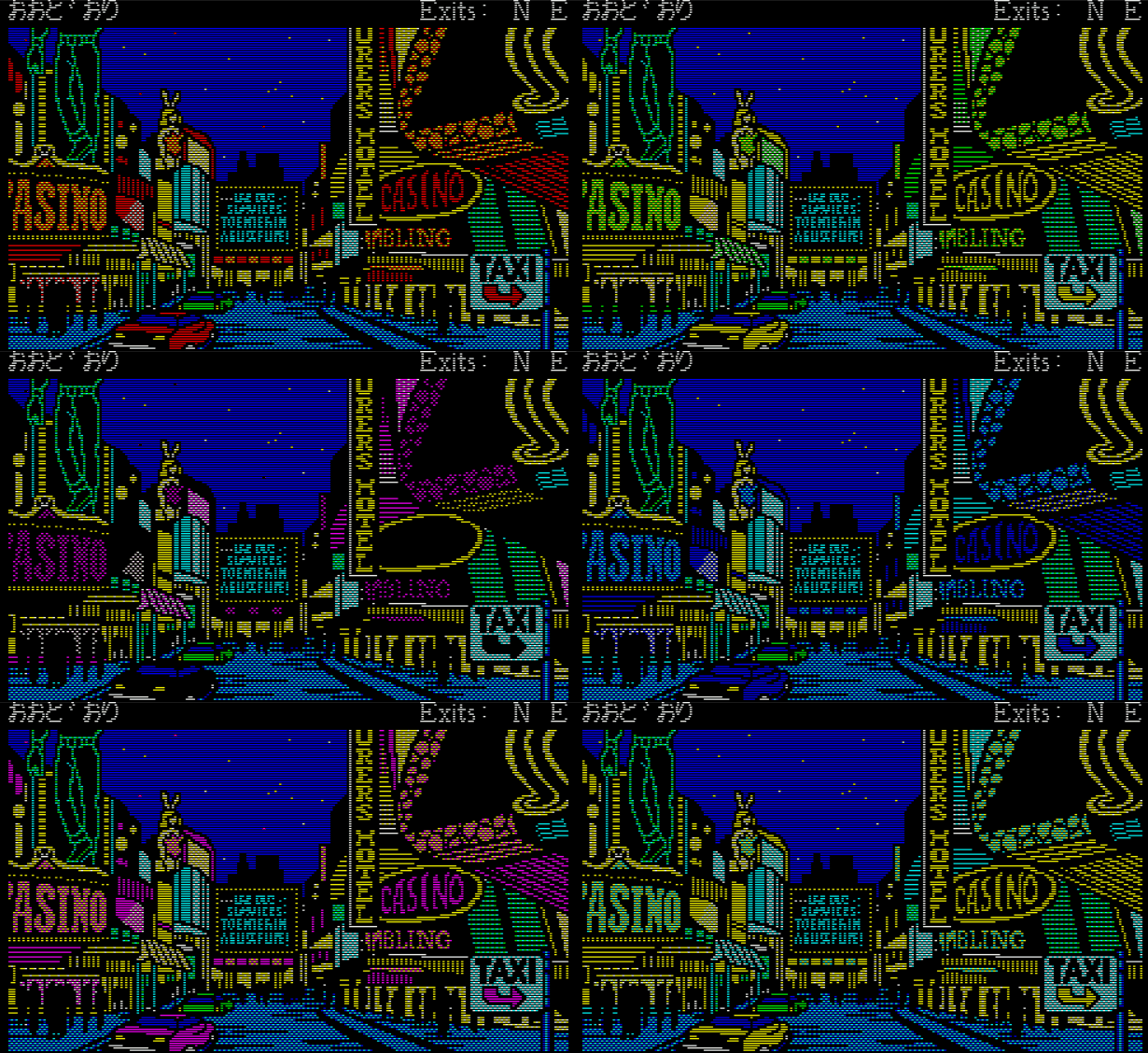
This really is a direct conversion which has the same map and commands.
I had heard of this game for a while — at least 20 years — and had never gotten around to trying it. Oddly, I hadn’t heard any gameplay discussion (Jimmy Maher did a piece, but I saved reading it for after I finished), just the usual oversized history points.
So I had some half-formed expectations in my mind. The game did not meet them.

The three locations are a BAR, CASINO, and DISCO, and the game requires hopping back and forth between them in a taxi.
First off, I have to be clear: you are most definitely not playing “you”. The author’s first game was Scott Adams, and that shows here not only in the general format as shown above (with the minimalist top part, and much more verbose bottom part with joking descriptions and the like, given the Apple II gives a lot more room than a TRS-80); it shows in the idea through out all the games that “I am your puppet” — the “I” being the avatar inside the world as controlled by the player. Sometimes the Scott Adams avatar has a little bit of characterization (like Savage Island) but not so much as here:
I DREAM ABOUT GETTING THIS NICE A GIRL. I HOPE YOU PLAY THIS GAME WELL ENOUGH SO I CAN HAVE MY JOLLYS WITH HER! YOU COULD MAKE YOUR PUPPET A VERY HAPPY MAN……………
I had (incorrectly) figured the game would have put effort in making the avatar feel like a player-insert, but the game goes out of its way to do the opposite. So even though it isn’t involving a 3rd person (like Leisure Suit Larry) it means even if you personally aren’t keen on the game’s overall objective — having sex with three women in one night — there’s at least some distance going on where it is clear the game considers the main character a pervert and leverages that for humor.
There’s also a bit more twistiness to the plot than I expected. The three small areas (bar, disco, and casino) have one woman at each that need to be taken care of in that order. However, what ends up happening with woman #2 is not what our hero would have hoped for, and the person you might expect to be woman #3 turns out to be someone different entirely. This isn’t like a dating simulator; sometimes when the main character gets to an objective, he still doesn’t get what he wants. (Also — and given this is the era of Revenge of the Nerds this has to be marked as a bonus — despite our protagonist’s obsession with women as objects, every encounter is consensual.)
…
The bar, where you start, has a button which asks for a password. Nearby there’s a bathroom and what might be the first death by toilet in adventure games.

There’s a wedding ring in the basin (useful later) and the graffiti includes the secret word BELLYBUTTON. This lets you go back to a room with a “big man” who wants $1000 to visit a “funky hooker” upstairs.
You don’t start with $1000, but it isn’t too hard to travel to the casino and win the money. There’s a slot machine where the odds are bent to eventually gain you money, so on an emulator it is possible to just keep saying to play again and eventually rack up a large amount of cash.

The other option is to play blackjack, although the easiest way there to make money is to save the game, bet everything, and restore if the hand is a bust.
With the money in hand you can also purchase a “rubber” which is necessary to “score” with the “funky hooker”.
THE SCORE NOW IS ‘1’ OUT OF A POSSIBLE ‘3’…..SO CONGRATULATIONS!!!!!!!
This gives you access to some “candy” in the room which goes the next woman, who is in a disco. (The one our protagonist apparently “dreams” about).

In addition to the candy you need to gather some flowers and the wedding ring I mentioned earlier; she’ll then tell you to meet her at a wedding chapel, which feels like it is missing some steps, especially since when you go to the wedding chapel (at the casino) and MARRY GIRL our protagonist asks “what am I doing?”
You can then meet the woman at the wedding suite, score a second point, but find in the process she ties you to the bed and runs off. I had a knife with me when this scene happened so was able to CUT ROPE; I’m guessing it’s game over if you don’t. (This is what I mean about the protagonist not exactly getting what they want — not only did they question getting married, they didn’t exactly have a great experience with #2.)

Interlude: at one point in all this you need to flip through a TV to distract the pimp and get back upstairs, because the rope that the protagonist was tied up with can be used to reach a new area with some pills.
For the last woman, it might be — based on the expectations of our puppet — a “blonde” in the casino with the “tightest jeans” who is a “36-24-35” and a “smile that dazzles me.” She’ll take the pills I just mentioned in the interlude above, but then will run off to her boyfriend and she’s completely out of the game. (Imagine if a modern dating simulator did this!)
This fortunately opens a new area, where the protagonist finds “Eve”.

There’s an apple you can get through other shenanigans (I won’t go through every detail) but it leads to completing the game.

You need to plant some “seeds” in this location and water them.
Some of the humor is on the Porky’s level, and a few scenes are just strange, like the bit where if you take wine with you in the taxi your taxi driver will grab the bottle and chug it and there’s an extended scene which ends with the protagonist getting run over and the game jumping straight to the Apple II prompt (there’s not even a one-in-three chance of revival like the screen I showed earlier). I will say the author neatly evaded some pain points as mazes and light sources from this era. The parser is still not perfect (I had to struggle at times, including coming up with USE to apply the rope) and there’s nothing in the prose that raises above what is essentially a prank game originally written for friends, but I can at least understand how the startlingly high sales were more than just a fluke.
If nothing else, out of all 1981 games, it perhaps has the longest legacy of all. Even Zork is moribund as intellectual property, but there still keep appearing new Leisure Suit Larry games, including one from last year.


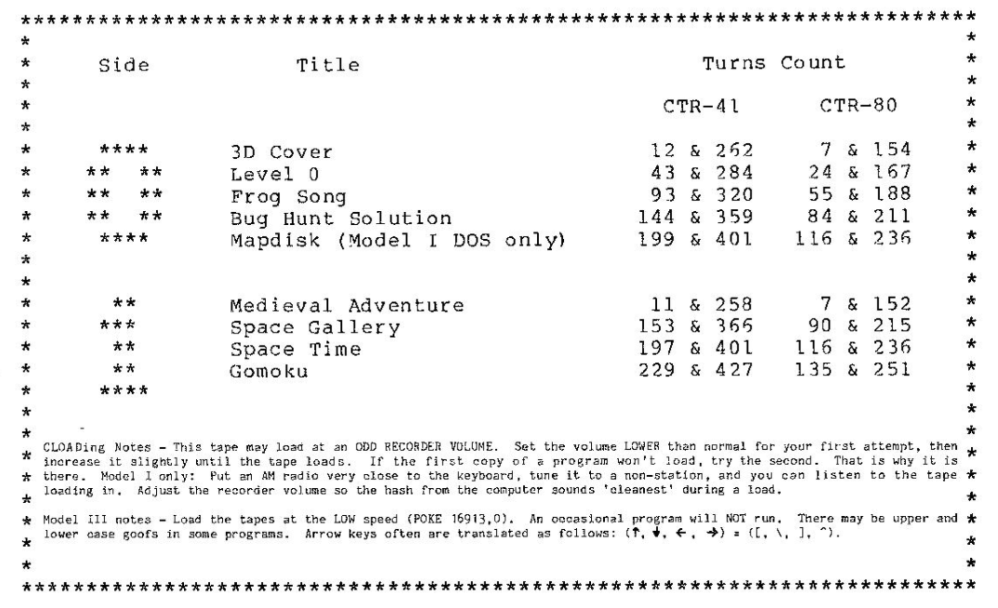
CLOAD, July 1981.
As specified from the source code
10 ‘ WARREN MELNICK — ADVENTURE IN ANCIENT JERUSALEM
VERSION 3.1 04/25/80
COPYRIGHT (C) CLOAD 1981
this is another written-in-1980-published-in-1981 work put out in CLOAD, but unlike Medieval Adventure which we looked at last, there isn’t any interesting design experimentation for redeeming value. This game is just bad. Other bad games we’ve had (like Haunted House and Alien Adventure) at least had some MST3K-ish humor and charm to them; this one just comes off as hateful, and I’m not even meaning just the murderous Arab stereotype tossed in there.
In this ancient mideastern adventure you will be able to GET, LOOK AT, and EXAMINE the objects that you find. You will command me in one or two word english sentences. You will find yourself in a street in Jerusalem, the ancient biblical city. You must explore the city while out-maneuvering Arabs that will kill you if you invade their quarter of the city, avoid burning your eyes out in the Dead Sea, etc. But, as a reward, you will find nine treasures hidden within Jerusalem and the other places that you will visit. You will score 10 points for each treasure that you store, plus 10 points for getting through the Golden Gate of the original temple.
Jim Gerrie did a port which removes the two killer Arab references in the game, if for some reason you want to play this. There’s a bit of historical context here, in that Jerusalem in 1980 was a hot source of strife and Israel “annexed” East Jerusalem during that summer (this game was written a few months before that, and what the “annexing” meant legally goes into details I don’t fully understand and this game doesn’t deserve).

You start dumped into a maze.
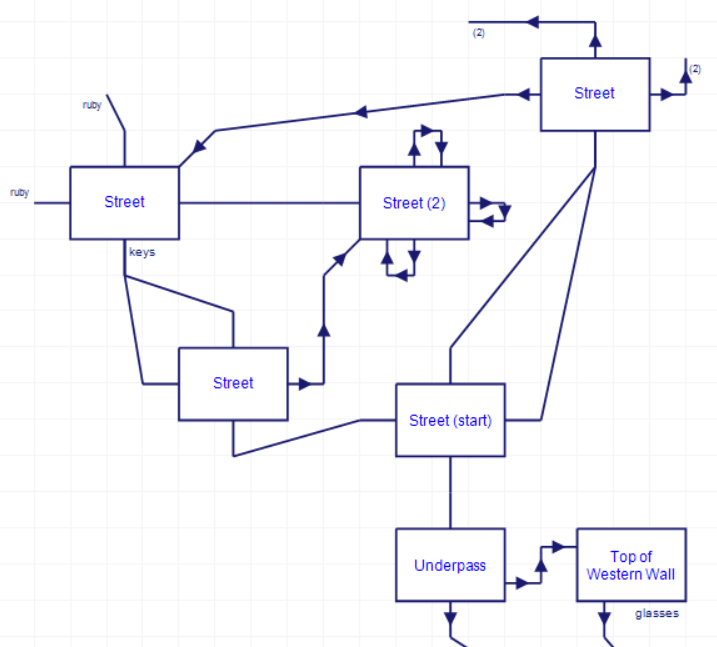
Not that unusual for an game written April 1980, but what is unusual, and even would make the more cruelly designed games of this time period hesitate, is that that just by stepping in the wrong direction you can softlock the game. Namely: the “author mental script” is apparently to find the glasses from the Top of Western Wall, then head south, but going south from the Underpass will prevent you from getting the (absolutely necessary) glasses.
Also, there was a weird bug where a gate with a “ruby button” which is supposed to appear later actually appeared in the maze. I even had it marked as a landmark on my map, but when it mysteriously disappeared my mapping took an extra 15 minutes because I was baffled at the inconsistency.

Past the weirdly designed maze is
a.) a Golden Gate where it is supposed to be, although there’s a ruby button and trying to press it just prompts the game to ask “How?” I don’t know, how buttons are normally pressed?
b.) a dead end for no purpose other than killing the player
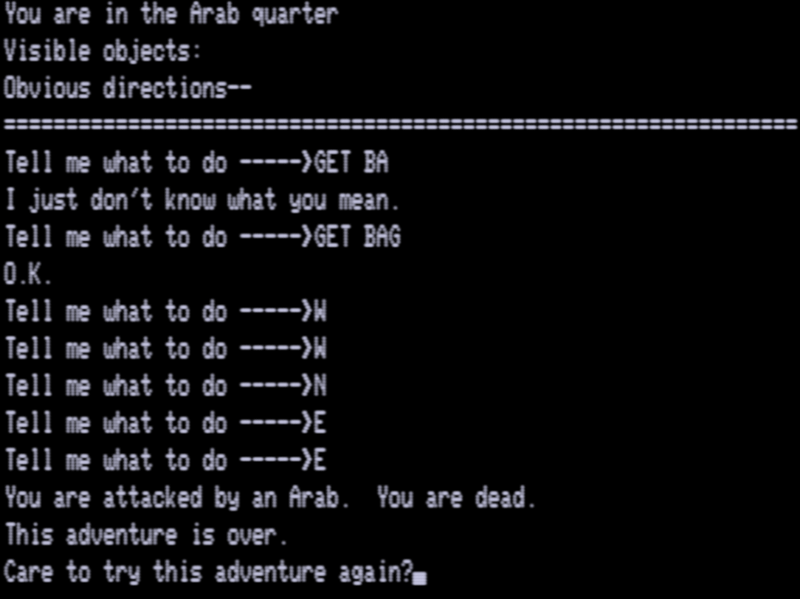
There’s some circa ’79-’80 events which might motivate someone to write this, but I still just find this moment worthy of a double facepalm.
c.) a synagogue where you can use the glasses to see into a hidden chamber, then go down one way to reach the Dead Sea, where you can walk along and find some treasures, and then die

and assuming you want to make a full map, die again multiple times, in a game with no save feature.

I’ve encountered plenty of instant-death before, but somehow making a whole region this way (where you nonetheless need to test everything to be sure) just feels over the limit.
I had to look up Gaming After 40’s take, who himself had to check the source code. If you type HELP anywhere the game says
Pray for your life!!
and if you follow the prompt with PRAY, there’s the prompt
AMEN to Jerusalem!
which indicates, possibly, a keyword can be used (in the first room of the Dead Sea area) where you can SAY AMEN to get warped back. Except any SAY will work, so you can SAY FORGETTHISGAMEIMOUT which works equally as well.
One of the treasures from the Dead Sea area is a ruby ring, which enables the protagonist to PUSH BUTTON back at the Golden Gate, then get into Paradise, mopping up four treasures including SILVA HALVA:
40250 DATA”North Paradise”,0,7,0,0,0,0
40260 DATA”West Paradise”,0,0,7,0,0,0
40270 DATA”South Paradise”,7,0,0,0,0,0
40280 DATA”East Paradise”,0,0,0,7,0,0
There’s no way out of paradise other than SAY WHATEVERTHINGYOUWANT.
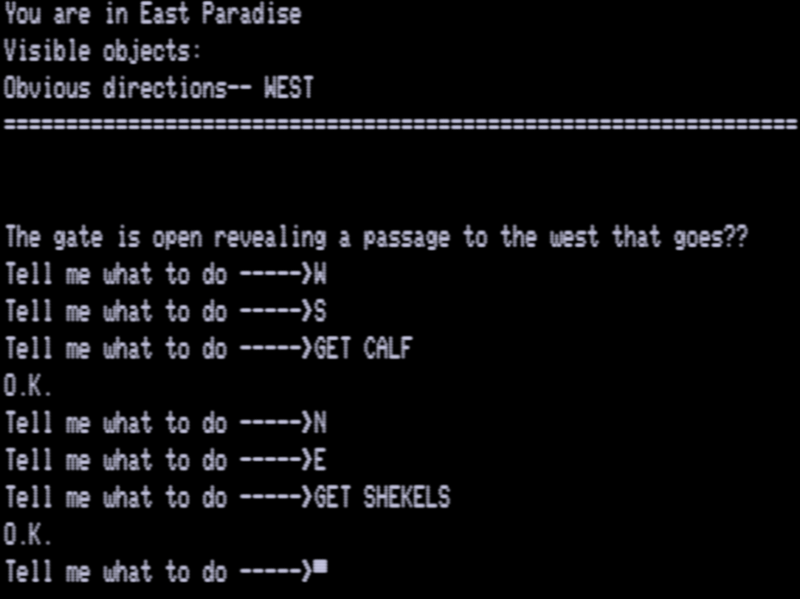
Also, one of the objects is a GOLDEN CALF, which seems weird given the context it appears in the Bible.
Then everything can be gathered back… where? There’s no clear indicator at all where the treasures go, so it’s a step-by-step test of DROP STAFF / SCORE / GET STAFF in each location until finding that the Western Wall permits the score to rise when treasures are dropped.
I found out after-the-fact that READ WALL specifically at that place (the wall itself isn’t ever mentioned as a referable noun, and of course walls are theoretically everywhere)
I see some writing there!! It says:
Leave *TREASURES* here
Finding it this way is honestly more tedious than doing the score test.
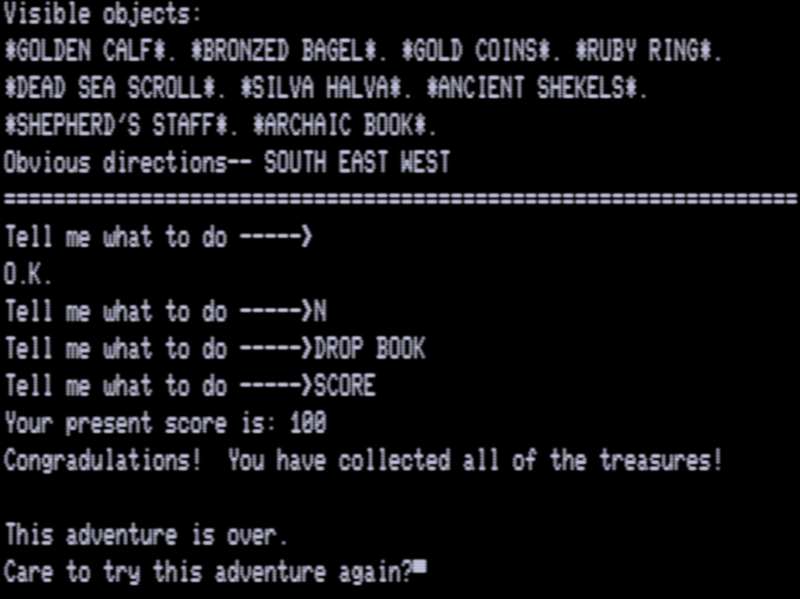
Grr. At least we’re now very close to 1981 being done — it’s just Softporn Adventure and Cyborg to go.
Congrats to B.J. Best for obtaining first place with And Then You Come to a House Not Unlike the Previous One.

The game is hard to describe in a genre sense other than “meta”; you’re playing something called “Infinite Adventures” with a friend named Riley that generates mini-adventures, but then you can step outside the mini-adventure to the “real world”, and then go to other games in that same computer system, and then–
Look, just try it. It’s good.
The full list is here. One caveat is that there the IFComp site — rather than linking to a download — links to the IFDB entry, but right now not all the IFDB entries have playing links. You can download everything as a complete set, though.
(Incidentally, B.J. Best also got 6th place with an Aventuron game, a system I do recommend highly. Everything by default feels like a warm fuzzy C64 game, or maybe Atari ST.)
First, an apology: I had somehow, in my scan of 1980 games last year, looked at this game and decided there was no 1980 copyright date in the BASIC source code so kicked it up a year. Then, I went back recently to play it, and found the 1980 copyright after all. Oops. No matter: this was written in 1980 and published in the April 1981 issue of CLOAD (previously seen with: Frankenstein Adventure, Troll’s Treasure, Elephant Graveyard), so it’s a perfectly fine moment to play it.
Whether I’m able to play as intended is another story.
Heralding the 2-player Medieval Adventure! You and another adventurer race around a palace looking for all the goodies, then bring them back to your home base. The one that gets ALL of the treasures to his/her base wins. But finding them is not easy, and keeping them safe from your opponent is even harder! A thief in the night…
The gimmick (courtesy the authors Hugh Lampert and Mike Greenholz) is that, while a treasure hunt, two players are using the same TRS-80, and in between “turns” they switch off. Doing movement between rooms counts as a turn. It’s perhaps clearest if I give screenshots:
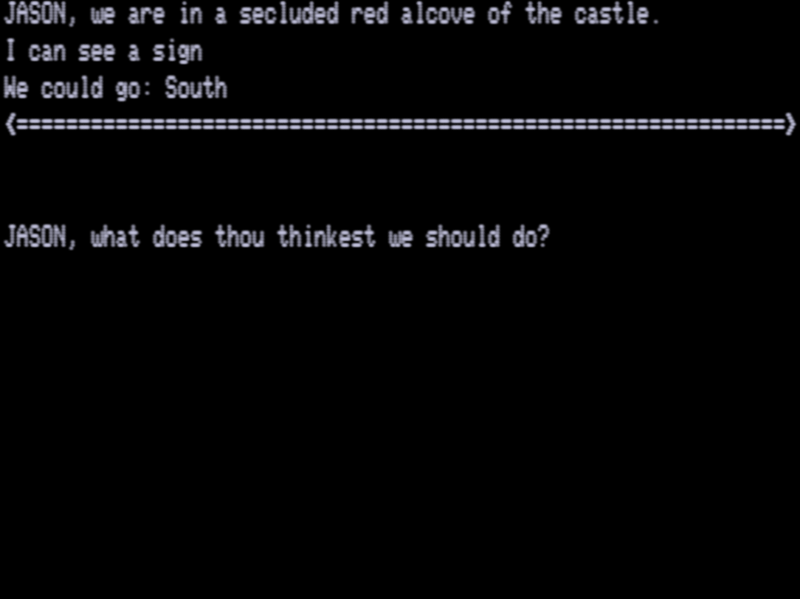
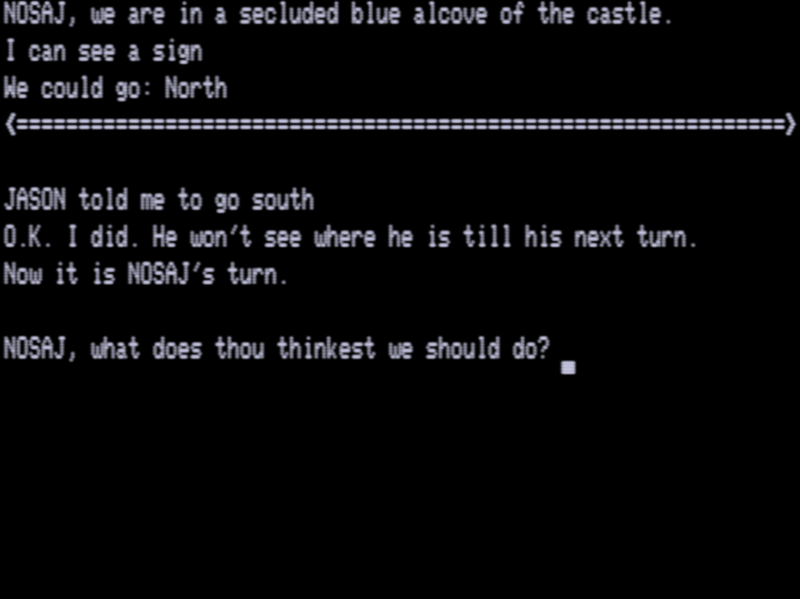
It seems to be essentially impossible logistically to have information be “hidden” between the players. For one thing, there isn’t a “prompt” to switch players, and you can’t assume that just having the screen “clear” is a prompt (for example, picking up an item will clear it from the room description but it will stay the same player’s turn). Nor can you even assume that movement is the only way for a turn to end (for example, there are opportunities to fall unconscious; the game then switches and announces the last player’s command).

While one player is unconscious there’s also screens like this one, where the “switch” all happens within one screen. Having one player be unconscious is the easier way to play single-player, as I’ll discuss later.
So I’m assuming both players are watching each other player and swapping accordingly, but then how can it be a competition? The only way I can see stealthily scarfing treasures from an opponent’s base is by the opponent not knowing of the intruder. There’s additional what seems like should be hidden information — like a revealed magic word — which could technically help the player who didn’t find the word if they are closer to where it gets used.
Zyll (a 1984 game) handled this by having all info displayed on screen halves, so a crude “divider” of sorts could be devised, but even with weird contortions here I’m just not sure an elegant solution. Also, wrestling up a friend to play a dodgy TRS-80 text adventure is not as easy as you’d think, so I just tackled this one solo, controlling both players.
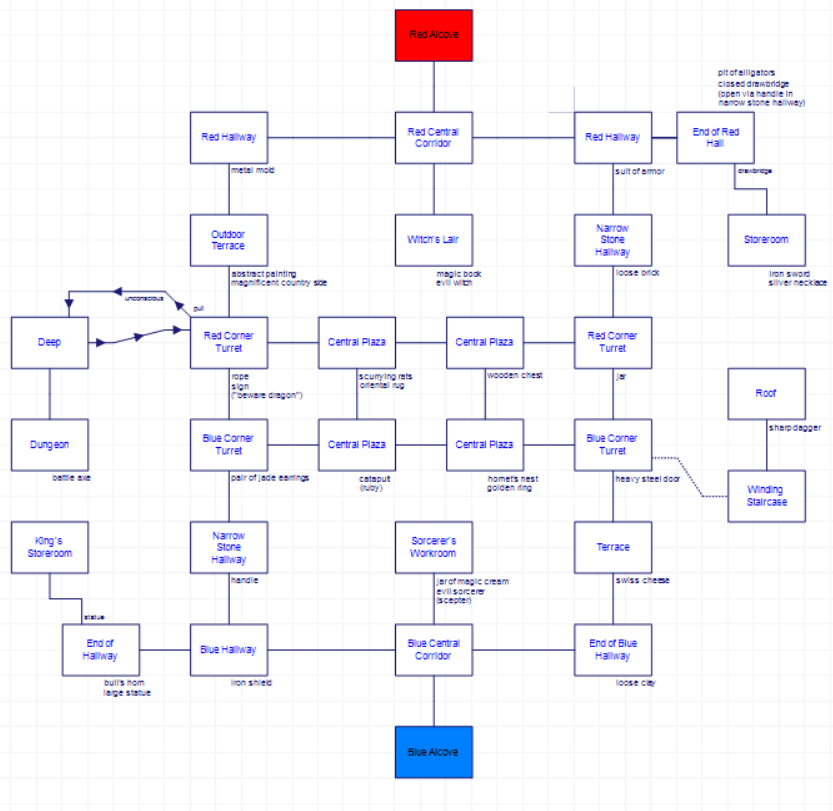
The players start on opposite sides of the map, in a “red alcove” and “blue alcove”, in what is essentially a symmetrical layout, kind of like a board game. The alcoves are where the treasures go. Heading south, west, and south from the red alcove leads to a terrace; so does heading north, east, and north from the blue alcove.
While the rooms are symmetrical, the puzzles and objects are not. There is some sense of trying to make sure elements from both the red and blue sides are required for certain things. For example, there’s a “metal mold” and some “clay” that can combine to MAKE KEY. I’ve marked them on the map below; in this case they are positioned symmetrically.

Here’s another, more elaborate sequence marked in order:
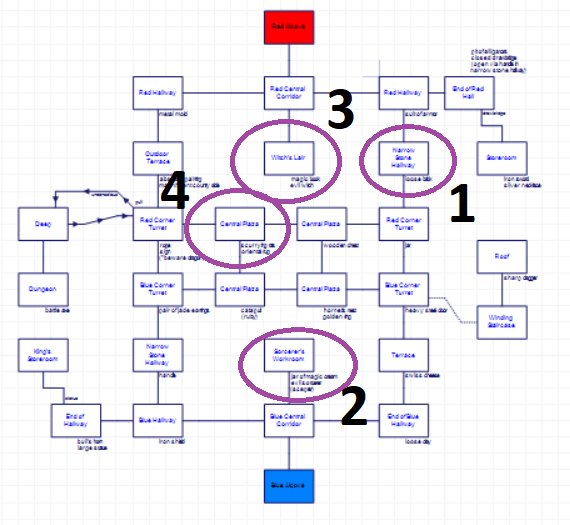
There’s a magic word BOO that gets found on the north side of the map (marked 1 below) that can be used to defeat a sorcerer on the south side (marked 2, he runs away). The sorcerer’s room has some “magic cream” that can be used on a symmetrical room on the north side (3) with a witch to defeat the witch. The witch has a “magic book” with the word ALAKAZAM which can be used on an entirely random room near the center to get a treasure (at 4). I checked the source code to find where ALAKAZAM gets used but a fully “honest” playthrough would have required laboriously checking each room.
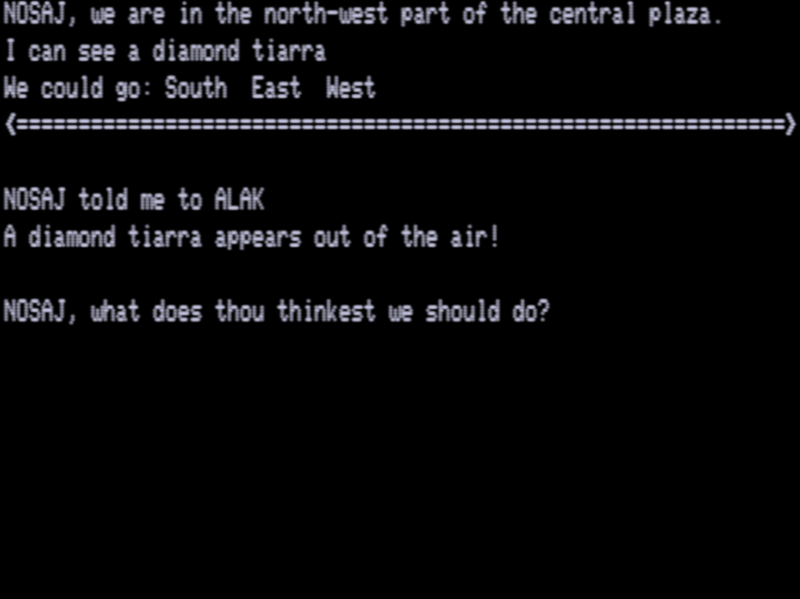
At random intervals, a “dragon” will appear. If the current player has a weapon (like a sword) they can KILL DRAGON, otherwise they will get knocked unconscious. Once the mechanic here is realized the dragon is mostly just an annoyance.
The two players can meet each other and fight.
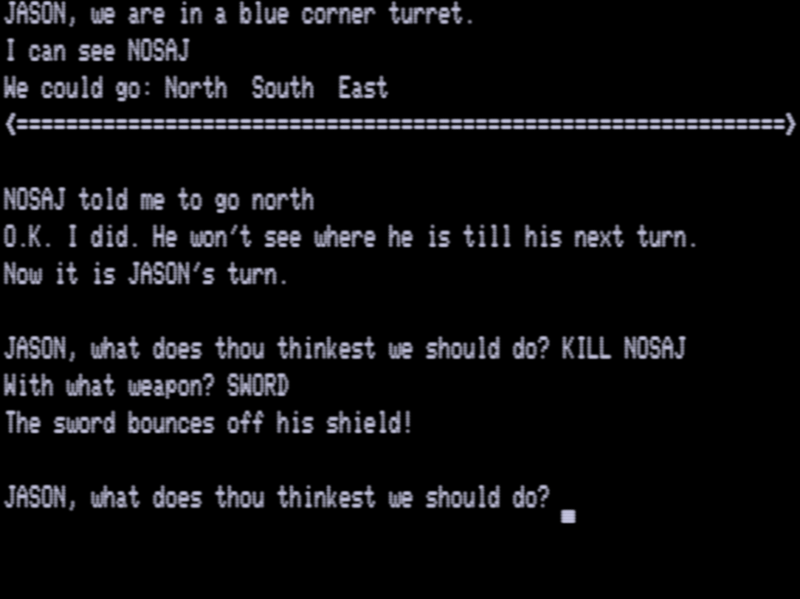
This is where various types of weapons and armor come into play. If someone has a shield, as shown above, they defend against a sword. If someone has armor, they defend against against a blunderbuss shot.
521 IF R=1 AND N(2)=-2 THEN PRINT”The sword bounces off his shield!”:GOTO 40
522 IF R=3 AND N(4)=-2 PRINT”The ball bounces off his armor!”:GOTO 40
If I’m understanding things correctly, there are two weapons (an axe and a dagger) that are not defendable against. Both are a little trickier to reach than the sword or the blunderbuss; one requires falling down a trapdoor (and going unconscious for a set of moves while the opponent is allowed to run around) and one requires having made a key (with the mold and clay mentioned earlier).
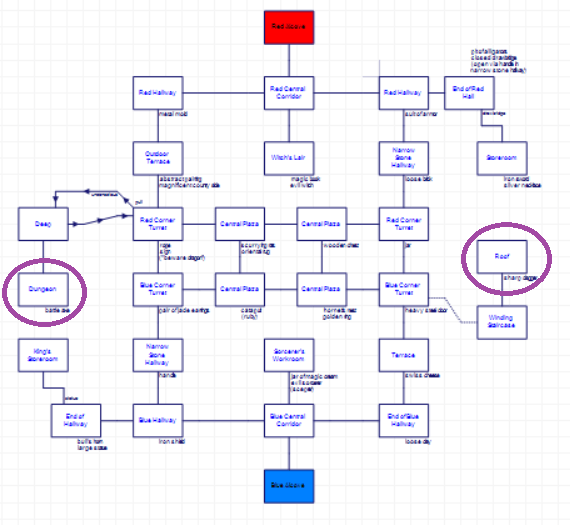
Axe and dagger locations marked, in their symmetrical positions.
It’s interesting insofar as it isn’t RPG combat — there’s a bit of puzzle-light offense/defense going on but the usual multiplayer competitive schtick of pitting stats against each other isn’t here.
In actual practice, of course, I was really going for a “cooperative” win, or something like a “helpmate” in chess puzzles (where both sides cooperate to get checkmate, even though they are on “opposing” sides). I really only saw one moment where the split-character aspect was interesting; there was a handle that pulling it made a sound and indicated something changed elsewhere, but not exactly where.
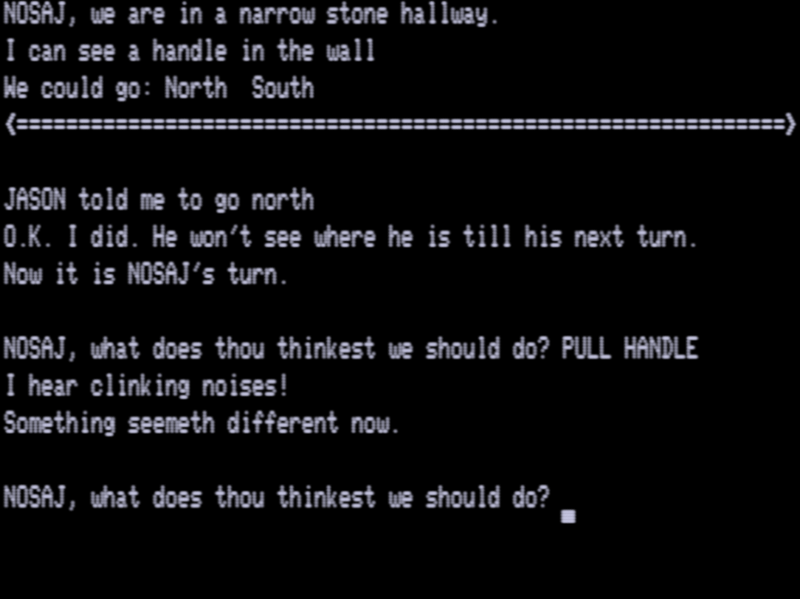
This “somewhere else” turned out to be diagonally across on the map, at a crocodile moat with a drawbridge; the drawbridge was lowered by the handle, and it was much faster nothing this because I had one character pull and the other character see the drawbridge.

The whole pit/drawbridge setup was useful for another reason, shown above: it was a quick and reliable way to go unconscious. After I had done enough experimentation I put JASON permanently on ice (only typing GO PIT when he woke up) and having his doppelganger NOSAJ collect all the objects to win the game. Most of the puzzles are relatively straightforward…
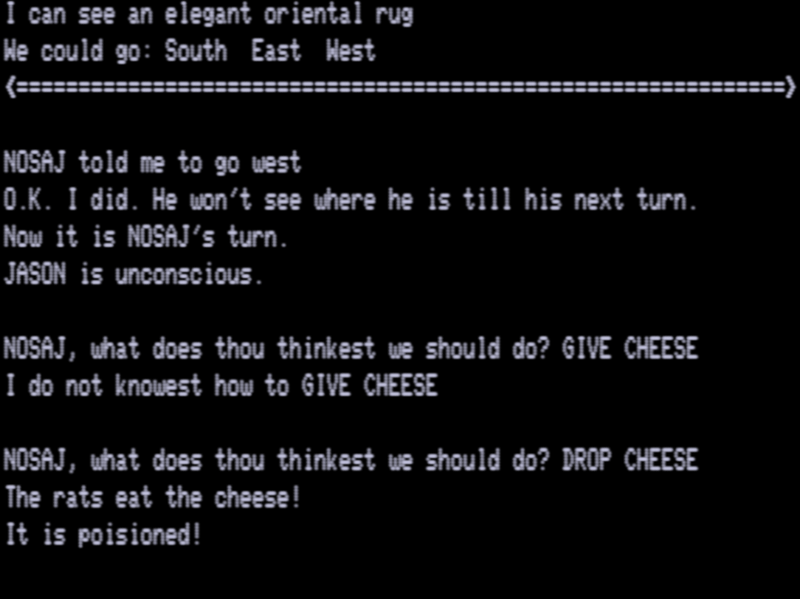

…and after a fair amount of annoyance I finally managed to collect everything for NOSAJ.

I can say I sincerely doubt this game was ever finished in a “proper” way, that is, in a competitive setting, not even for the weird setup, but because there is no ending to the game unless one person gets all the treasures. It would seem more logical for when all treasures are distributed the final scores are compared, but no, this is the only way the game stops:
6040 IF SC(1)=210 PRINTNA$(1);”, you have 210 points! You win!”:PRINT”Sorry “;NA$(2);”.”:STOP
6045 IF SC(2)=210 PRINTNA$(2);”, you have 210 points! You win!”:PRINT”Sorry “;NA$(1);”.”:STOP
It’s still fascinating as a look at a genre, the competitive multiplayer adventure game, which, much like the adventure-roguelike, never took off. CASA lists seven other multi-player games out of its entire database; there’s likely the odd BBS door game not listed, and some MUDs might have reduced enough RPG elements to qualify, but we’re still talking about something rare. Even in more modern settings (like the Seltani system) the default for multi-player adventures is cooperative.
Perhaps that’s simply because the idea is broken, but it’s still interesting to see someone try.
Oddly, this is one of the fastest games I’ve beaten in a while; the last time I remember an experience this brisk for All the Adventures was … Roger M. Wilcox Adventure #1. I can’t say he’s gone full circle, because the puzzles are more sturdy (despite some curious science) and there will be three more games to come in 1982, but maybe a lasso shape of some sort.

As I indicated in my last post, this is the third of a trilogy, so possibly the author didn’t feel obliged to go for long. We’ve gathered our trash/treasure and for some reason got captured, even though our trash collection could have been anywhere on the island and there were no “savages” to be seen.

The complete map.
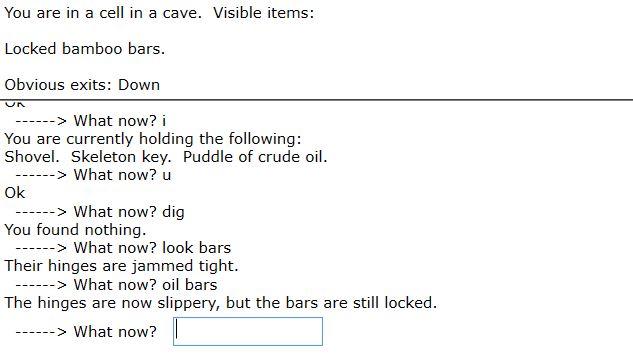
It is also unclear why directly below the “Cell” you start in there is a “possessions room” which has the skeleton key and shovel that you were toting around last time. How nice of the captors to let you keep exactly the items needed to escape. In the same room you can DIG to find some oil that you can use to oil the “locked bamboo bars” which are then openable with the skeleton key.
There’s a small smattering of rooms including a “stone pick” which lets you get past a cave-in, and when everything is collected there’s also a spear, battery, a “churn with heating elements”, steel wool, flash powder, a piece of string, and red treated paper.
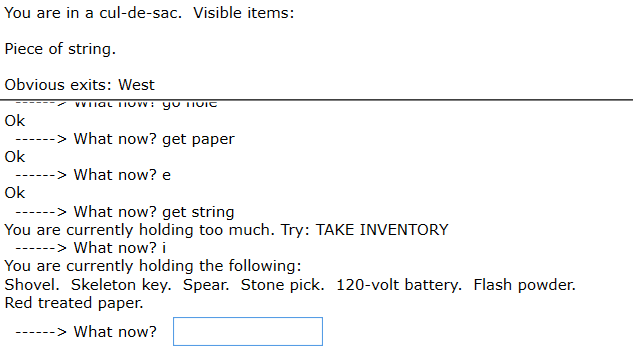
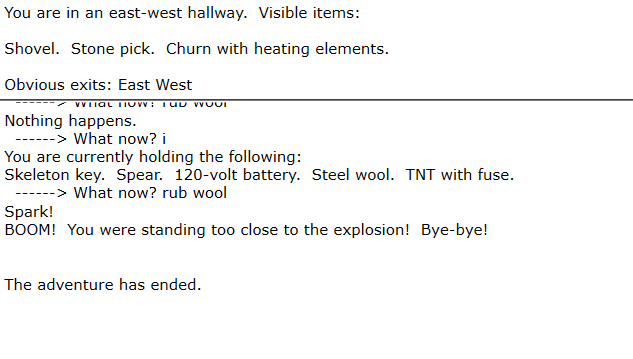
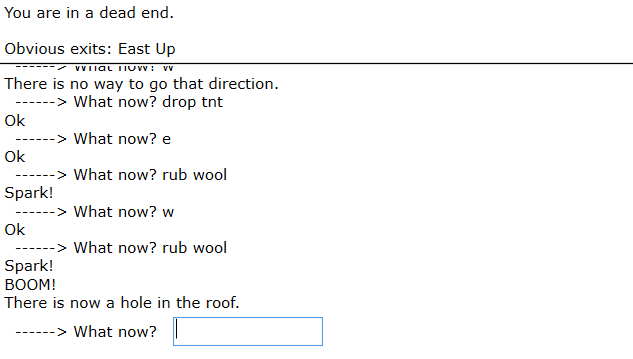
I wasn’t sure what was going on with the latter three but I had suspicion there was enough items I should try the WRAP verb mentioned at the start of the game. Lo and behold, a makeshift stick of TNT emerged (sure, why not), which I was then able to place at a dead end. Then rubbing the steel wool on the battery caused a spark, which blew the TNT up, which either makes a helpful hole in the ceiling or an unhelpful hole in your body depending if you are holding it when the explosion goes off.
Then there’s really not much more too it — there’s a face-off with a “savage” where THROW SPEAR takes care of the problem (ugh)…

…and when you find your old speedboat the motor is still out of gasoline. You can dig some oil up with a shovel and use it in the churn (?) to somehow get gasoline…

…which works on the motor. Voila:

Given how small and straightforward this one was, allow me a philosophical aside.
If you’ve been keeping track, I really am nearly done with 1981 — Softporn Adventure, two CLOAD games for TRS-80, and Michael Berlyn’s Cyborg. Likely, barring high difficulty in Cyborg, I’ll be wrapped up before the end of the year. So I’ve been poking ahead at 1982, and boy howdy, the list of games is starting to get big.
Now, I already realized ahead of time this was coming, but as I do preliminary research roughly a month or two ahead, I’m “experiencing” the list for the first time. I realize there is to some extent All the Adventures will never be “finished” but I am still determined to play all the games. But how much should I write about all the games? While there are plenty of “meaty” games — more than any previous year so far, including 3 games from Infocom — there’s still honestly a good amount of “gather 10 treasures, yay you won” sorts. I’m thinking for particular games I should revert to a shorter format. (Of course every time I start thinking that, I hit an oddity like Atom Adventure which appears as standard as possible yet does something radically different with its gameplay.) On the other other hand, part of why I started the project is I felt like one-paragraph reviews that I was seeing for historical games were deeply unsatisfying for knowing what’s really going on.
I’m still vacillating on this, and in all honestly I’m probably just going to revert to writing about everything. But such thoughts have been passing through my head. I would like to hear, assuming a condensed format for some of the minor works, what you find most useful/fulfilling to read.
Roger M. Wilcox bequeaths us one more set of games to (finally!) round out his 1981 selection. They were originally a trilogy. The original titles are
In Search of Trash Island
Hidden City of Trash Island
Escape From Trash Island
although the first two he later combined into a single game, Trash Island. A password from that game is needed to go onto the last one (which I’ll play next). And in case you’ve lost track (and I know I have) these are games #16, #17, and #18 of his complete collection of twenty-one adventures which started in 1980 with Misadventure and were never “published” until recently, except for uploading adventure #7 (Vial of Doom) to the Internet sometime in the 1980s.
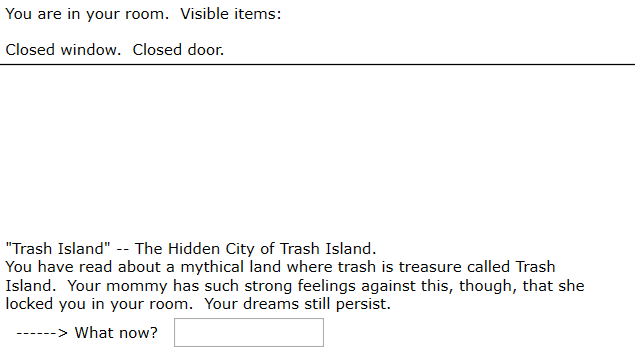
The opening gives me a Where the Wild Things are feel, although rather than a sailboat, we’re going to escape our room and put together a speedboat.
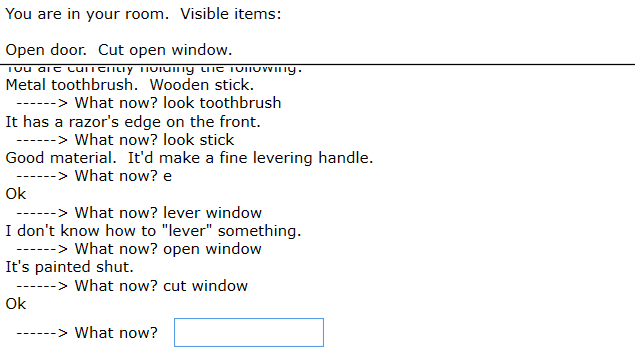
After escaping is a fairly small area where the goals are to a.) gather items to form a speedboat b.) gather items to form an engine for the boat and c.) make a shovel (which won’t be used until arriving at Trash Island).

One of the items is glue, and I’ll let you guess what the result of PRESS BUTTON is. Ew.

Weird concept here: you find a sign about dropping *TRASH* but in this particular area there are no items marked with asterisks, that is, no treasure. It took me a while to puzzle out what was going on, but fortunately (as you’ll see shortly) when I finally had my vessel ready I grabbed every item I could in case it was a one-way trip, including the sign. Given that Escape from Trash Island is the last title I had the (correct) guess that it would be a one-way trip.
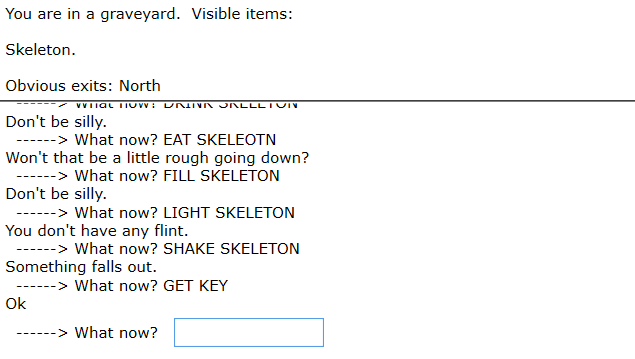
I did my usual technique of rattling down a bunch of verbs that I’ve seen before, and it turned out to be super useful in this game. I didn’t know what to do with the skeleton until I hit upon SHAKE; sort of a meta-solve, since I wasn’t shaking as an intentional action, but as an attempt to try everything. (The skeleton key is incidentally useful for opening a “fiberglas” factory which has some of the materials for the speedboat. With those materials plus the glue…

…you can MAKE the boat. MAKE is another case where I was just running down a verb list and found it useful, since the game takes MAKE on its own (and explains you don’t have enough material yet, assuming you’ve done the verb early). This meant I knew one of my goals fairly quickly. FIX I was productive with in the same way (I could FIX a broken engine) as was CONNECT, where I attached the stick and the scoop (from one of my earlier screenshots) to make a shovel. I wasn’t even thinking about those two objects going together at the time, but I’d rather the game err on understanding more than I really typed in as opposed to being too stringent and not understanding when I’ve clearly typed the right command.
With the engine (which you can fill with gas) and the motor you can be on your way, although it took poking source code to realize the correct verb for getting the motor running. (I even tried REV MOTOR but somehow didn’t come across START.)
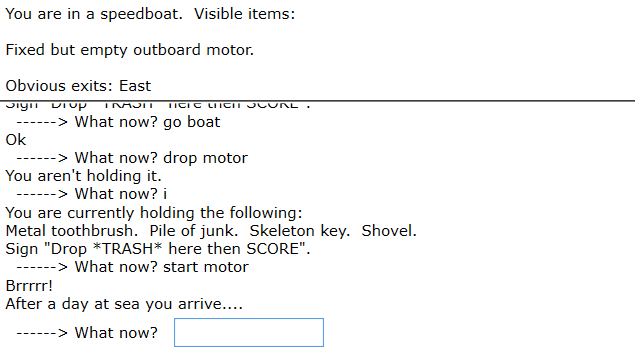
This enters “part 2” of the game, and was previously a separate game altogether. There’s just a short area with a beach and the shovel is useful to find some random objects like a “lodestone” and a “bottle of moonshine”. The moonshine can be used to burn away some scrub, although I had parser difficulty in that BOTTLE is treated separate from MOONSHINE.

Past this point the main gimmick of part #2 is revealed, and it is oddly similar to the one from Hitch Hiker’s Guide to the Galaxy, except all the treasures are marked with asterisks, Scott Adams style, and they’re all items like a TRASH CAN or SEWAGE. The best moment was having a regular bottle with vitamins that, once used, becomes trash; that is, by removing the “intended use” of the item, it becomes a treasure!
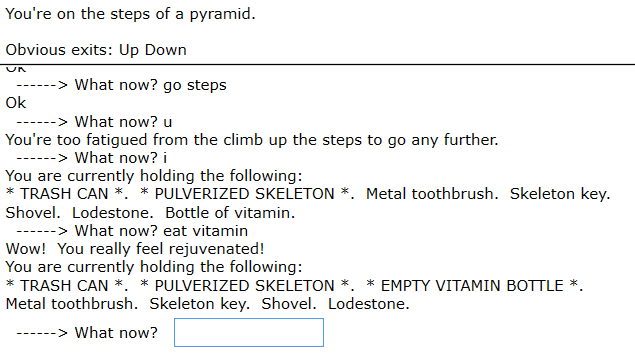
Most of the items are fairly straightforward to find; there’s no convoluted constructions needed, just mapping out a (minor) maze with an in-joke within.

The only difficult part is that it doesn’t appear at first that there’s any good location to do the usual “drop the treasures” gain points thing. However, if you remember, I grabbed a sign earlier that said to drop the trash here; dropping the sign created the treasure room where the sign was placed. Then all the trash in the same place is worth points.
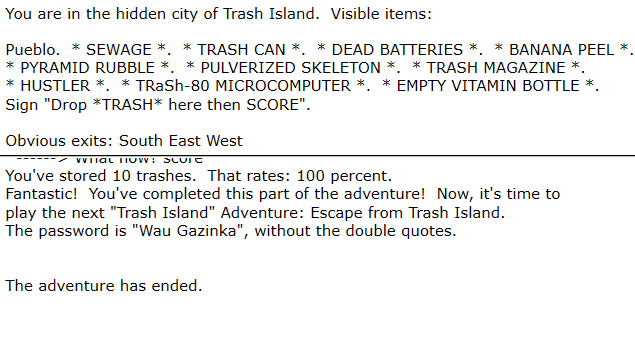
Notice the Hustler tossed in there. No wonder Mother disapproved.
This was all relatively smooth and pleasant so far. It feels like Wilcox maybe got the attempts at trying to be difficult out of his system. (Except for the bit with the sign, which was apparently only added after parts 1 and 2 were combined.) There’s still not much in the Wilcox programming oeuvre resembling complex systems that can really make hard puzzles pleasing — it’s gathering and combining objects — but when the gathering is straightforward and kind of silly it makes for a decent hour’s play.
We’ll see if the finale holds up, though!
The most cunning thing about Supersoft’s version of The Hitch Hiker’s Guide to the Galaxy might not even appear that much from someone approaching from afar, but as someone who has now trudged through far too many treasure hunts (collect X items, place in position Y) once I caught on to what trick the game was pulling my thought was “oho, that’s even thematic”.
You see, my thought last time that you’d collect items in the “Five Artefacts Inn” was correct. My thought that the cheque from Zaphod Beeblebrox was going to be one of the items was wrong — in fact, the game isn’t asking you to collect treasures in a traditional sense, but “artefacts”. What five items would you consider the most valuable to you? Would they necessarily be the most expensive? In the Hitchhiker’s universe, you probably can even guess what one of the items is.
Speaking of the Hitchhiker’s universe…
…fan-fiction can be something of a writing “cheat”, by invoking deep characters without doing much work; just a minimalist-style mention of an established character can unlock images and associations that weren’t really “earned” by the author. That’s not necessarily a bad thing in context, and it means a scene like something like the Bugblatter Beast (as shown above) might merit an extra mark or two in mental vividness, as would a mention of a babel fish, or Marvin the paranoid robot.
The game just doesn’t have enough disk space to ramble on about the weird gimmick of Peril-Sensitive Sunglasses or the terribleness of Vogon poetry and resorts to shorthand (although it does have a piece of graffiti regarding an “Ode to a Lump of Green Putty I Found In My Armpit One Morning”). It isn’t good or even recommended, but at least it’s understandable.
…
So one of of pieces I was stuck on — the Vogon captain that was stopping me — I simply had neglected to look at the gun, which stated it was OFF and then — well, in the bizarre manner of the two-word parser, the command to switch it on was ON GUN.
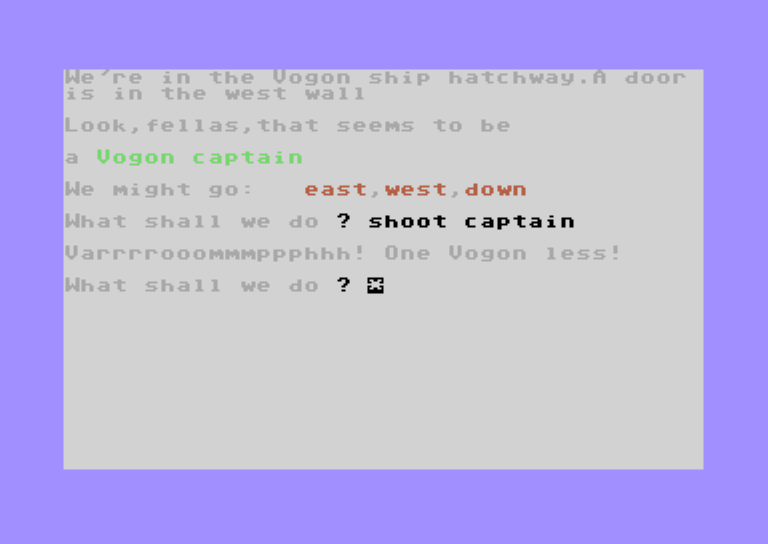
Nearby I found a book of Vogon poetry, and a “navigation room” unlocked by the keys I found last time. (Incidentally, I only realized this much later after checking a walkthrough, but the keys came from the bowl of petunias. If you pick the bowl up and drop it again the keys show up, and I had used the bowl to map a room of the maze in the Heart of Gold, so by appearances the keys just randomly materialized in the maze.)
The navigation room includes the “lump of green putty” graffiti, and on a whim I tried to READ POETRY while I was in there.
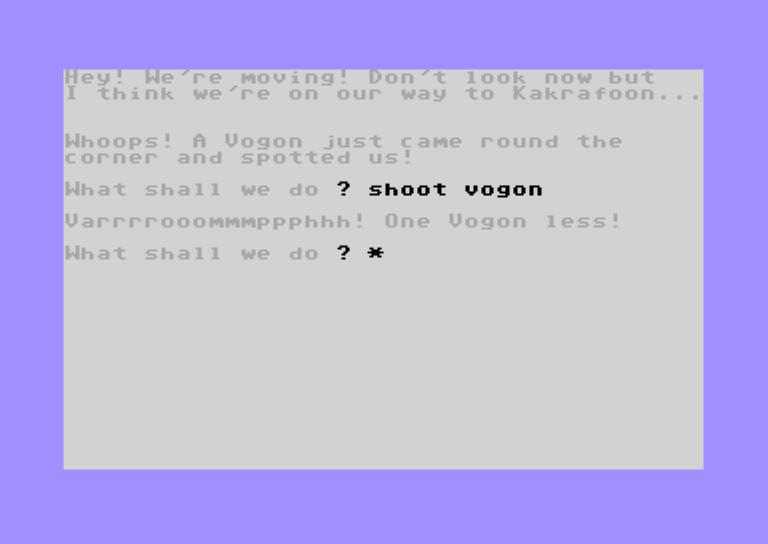
This causes the ship to move from Earth to Kakrafoon (and if you read the poetry again, back again). The Vogons incidentally start appearing on Kakrafoon and you have to keep the gun handy to shoot them. You need to shoot them the moment they appear — and there can be multiple ones in a row — otherwise they kill you. To add additional distress, the gun has a time limit; if you leave it on long enough it melts away (and you don’t have time to switch between OFF and ON while the Vogons are appearing).
Moving on, I explored Kakrafoon a little…

This bit was much easier than the equivalent puzzle in the Infocom game.
…but was quickly stuck with a Great Green Arkleseizure that is described in a room but you can’t even refer to. With my small verb supply and item supply exhausted, I flew back to Earth and tried poking at the Heart of Gold again.
I did, alas, need to look at hints. I had stuck myself again by the Parallel Universes Problem. There’s a lever that says “don’t pull” so I had tried to PUSH it, and I had also tried dropping the improbability drive from Hong Kong in the same room, and I assumed I had done both at the same time, but apparently not. (I think I had dropped the drive and done PULL, which kills you no matter what — and no, you can’t rescue from being ejected into space, that whole sequence giving you some extra turns to survive was just a red herring.)
Doing things properly causes the Heart of Gold to fly to Betelgeuse, which fortunately does not have any Vogons on it, just a few obtuse locations and puzzles.

The most immediate obstacle is an “Algolian Suntiger” at the “Maximeglon Museum of Diseased Imaginings”, which is defeated via a very special method which actually rises to the level of “good puzzle” presuming you are somewhat familiar with the original Hitchhiker’s series.

There’s at least fair hint that the poetry is execrable from just trying to read the poetry book on its own without knowing the source material, but not “cause all sentient beings to run away” bad.
This is followed by some rapid-fire references, like the Restaurant at the End of the Universe, with a Pan Galactic Gargle Blaster. Remember that cheque from Zaphod Beeblebrox? Here’s where you use it. That’s one expensive drink.

There’s also some shenanigans with a coin that yield some chocolate and cheese-flavored tea. The chocolate is useful in a truly bizarre way.
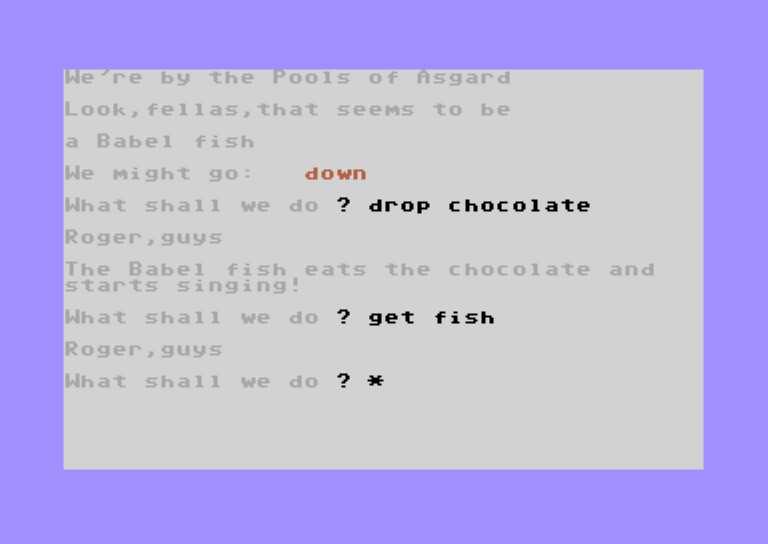
If you don’t drop the chocolate first the babel fish runs away if you try to get it and the game is softlocked. I had to check the walkthrough for this, and it qualifies as the most random puzzle of the game. Look, the Infocom version of the Babel Fish puzzle is in a way technically harder — certain it involves many more steps, but this one is so baffling and unprovoked I still don’t get it.
You can also get a hint from Deep Thought which happens to be hanging out.
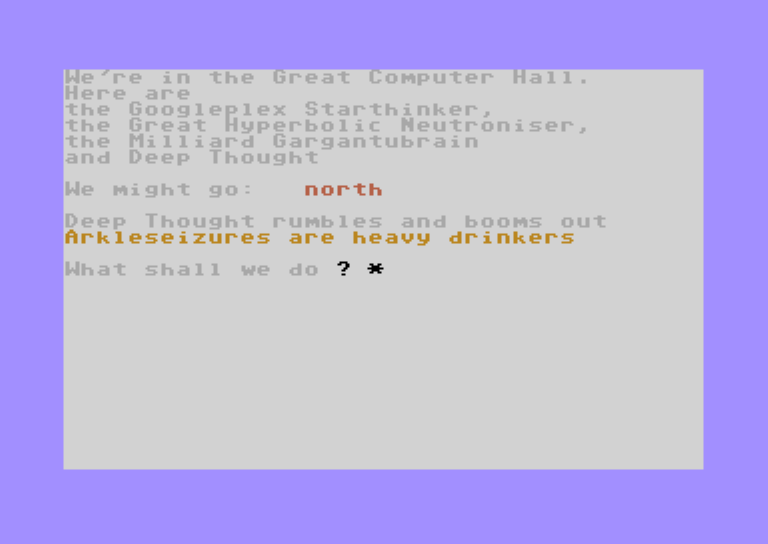
Taking a break from figuring out the Great Question. Maybe if you come at the right time you can get the chocolate explained.
Other than that, I found a towel (horray!), a rubber duck underneath the towel (…ok?), some peril-sensitive sunglasses (which make everything dark so you can see items or room exits and is useless) Marvin the Paranoid Android (who you can try to take, but will run off muttering that he has a “Brain the size of a planet but life’s still depressing”, softlocking the game).
Flying back to Earth, I took a stop by the white mouse that hadn’t been cooperative before and dropped them some cheese-flavored tea. I was then able to pick the mouse up. Then hitching a ride on Vogon Poetry Air again I went back to the Arkelseizure:
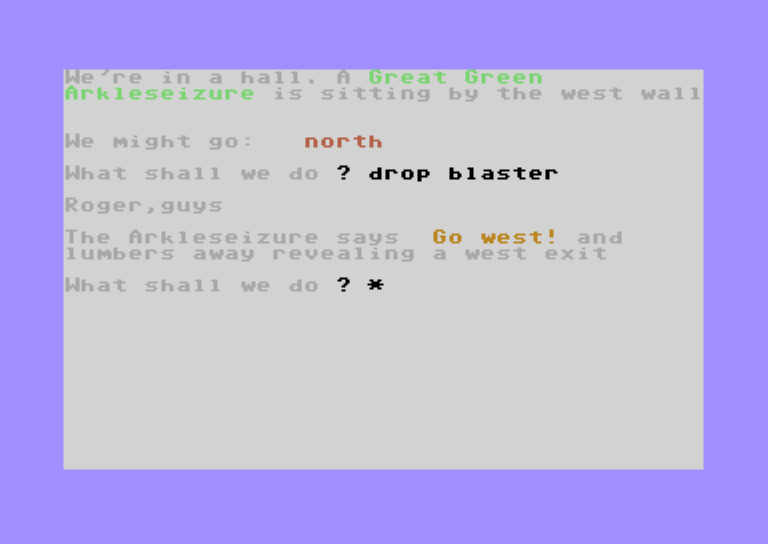
If you don’t have the babel fish to hear this, the game is now softlocked.
Past this is an elephant (easily scarable via mouse) yet another tiny maze (not worth even bothering with) and most usefully, a "robot stabilizer" and "The Hitchhiker's Guide to the Galaxy", which informs us DON'T PANIC but otherwise doesn't have useful info.
I admit I was here fairly stumped, other than I realized that while holding the robot stabilizer Marvin was carryable without walking off. I hadn't really figured out the treasures yet, and some experimentation had already indicated some obvious items (like the cheque) didn't boost the score. I just started trying things and found that, the "artefacts" needed are…
…(drum roll please, and maybe you want to predict before I list them)…
…(let me know if you guess all five)…
…the babel fish, the Hitchhiker's Guide, Marvin, the rubber duck (?) and the towel (!). Froody.
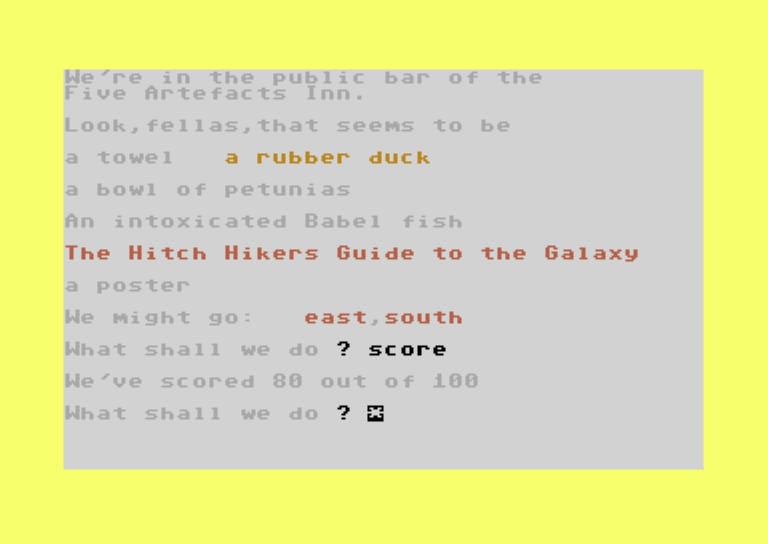
With all five safely stowed, you are congratulated with:
Well done! We’ve finished
Well. At least I was not stuck on this game for “13 – 14 years” as noted by Andrew Williams, who wrote a walkthrough.
I will have to say I did “feel” a little bit like I was in some strange variant of the Hitchhiker’s universe. Maybe the off-market one, or a game Ford Prefect himself made in-universe on a lark. What I wouldn’t call it is a cynical cash-in; for its time it was certainly fits in the quality at the time, and even Infocom wasn’t quite Infocom yet.
(Galactic Hitchhiker was still better, though.)
Not the 1984 Infocom one written by Douglas Adams and Steve Meretzky, but the Supersoft one by Bob Chappell.
We haven’t had much yet at this blog on legal tangles; the history of adventures is not chock-full of them like, say, Atari. I’ve skipped over EduWare’s Space I and Space II games despite them being listed at the Interactive Fiction Database as they are really RPGs (the CRPG Addict covered them here) and they were even based so much on a pencil-and-paper RPG (Traveler) that Game Designers’ Workshop dropped a cease-and-desist. I also didn’t mention how with The Prisoner (by the same company!) the producers got permission from ITC Entertainment to open a Prisoner-themed restaurant (??) hoping that would be sufficient cover. Other similar violations were generally done with a computer-games-aren’t-that-big-let’s-hope-they-don’t-notice stance. (This is how Atari was in contrast — it started making “real money” early, and roughly the same time all this was happening they sold millions of copies of Space Invaders for the Atari 2600, as opposed to thousands or hundreds.)

The original version (the tape picture from earlier) was for Commodore’s earliest computer, the PET. This screenshot is for the later C64 version.
It’s certainly tempting to look at the opening screenshot “with kind permission of Douglas Adams and Pan Books” and be skeptical, but at least the Pan Books part was true: Bob Chappell wrote a letter asking if he could make a game based on Hitchhiker’s and they sent back a letter saying yes. After finishing his game he sold it to Supersoft for “500 pounds worth of equipment and assorted programs”. Keep in mind this is extremely early in the UK commercial adventure game market; Hitch Hiker’s was first advertised Summer of 1981 around when most of the other releases I’ve highlighted (like Planet of Death) landed (one earlier game, Catacombs — first advertised March 1981 — was also by Supersoft, although it isn’t available for download). So we’re talking about a request for a license at the very tip of an industry, it is understandable they were a little informal with it.
As Supersoft in 1983 tried to come out with versions of the game for Commodore 64, Vic-20, and Dragon, Douglas Adams’s agent Ed Victor came knocking; a settlement was made out of court, and Pan Books footed the legal consultation bill, so it wasn’t like there was simple amateur confusion going on, just it was easier to avoid a legal fight altogether and settle. It is possible Supersoft had a leg to stand on but Douglas Adams himself wasn’t involved in the original deal, implying shaky ground; it is also possible based on the wording of the letter the rights only applied to Chappell’s original PET version of the game but the physical letter hasn’t surfaced to confirm or deny this.
Unsold copies of “Hitch Hiker’s” was destroyed as part of the settlement and the game was put back onto the market later as Cosmic Capers. (Incidentally, the weird anomaly of Galactic Hitchhiker which I covered last time went entirely untouched by the legal stick, but it stayed on the fringe system of the UK101. No doubt had an attempt been made to republish it would have raised the legal sirens.)

Additionally, the somewhat … unimpressive … text and interaction of the game is still fitting in with most of the product in the UK at the time. You can see what feels to modern eyes like a modern-shovelware-grab-bag, but for the time was a normal commercial game written in BASIC.
Based on a December 1981 review from Computer & Video Games magazine it wasn’t ill-regarded (“a well thought-out attempt to reproduce the imaginative radio/T.V. series”); this is, simply put, yet another typical-for-the-market minimalist treasure hunt with a light dusting of Hitchhiker’s.
Having said all that, I can’t defend the end result. I’m not having a good time so far.

My no-doubt incomplete map of the starting area.
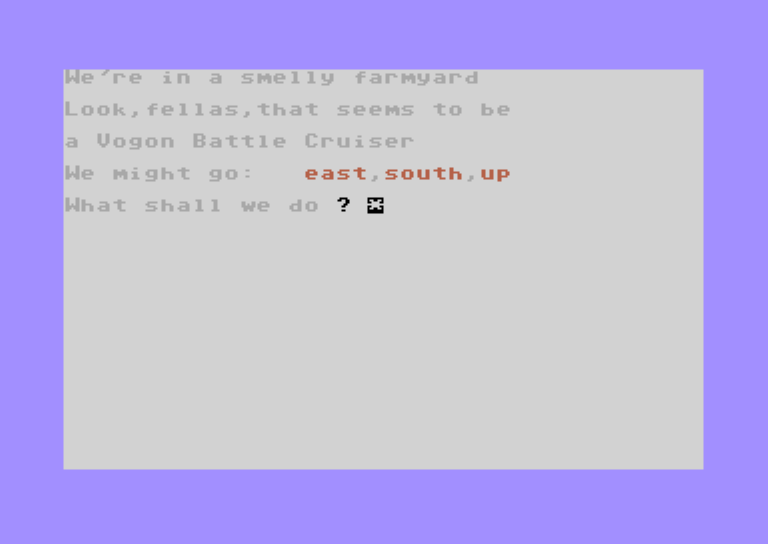
You start in a Quiet English Village near a Five Artefacts Inn (where I presume the “treasures” go) and find, minimalistically and randomly, a white mouse — no doubt one of the hyperintelligent ones involved in the compute that answered the Ultimate Question — a rusty car engine (marked as being an Improbability Drive that is made in Hong Kong), a bowl of petunias, the Encyclopedia Galactica, a Vogon Battle Cruiser (shown above) and The Heart of Gold (also inexplicably parked nearby).
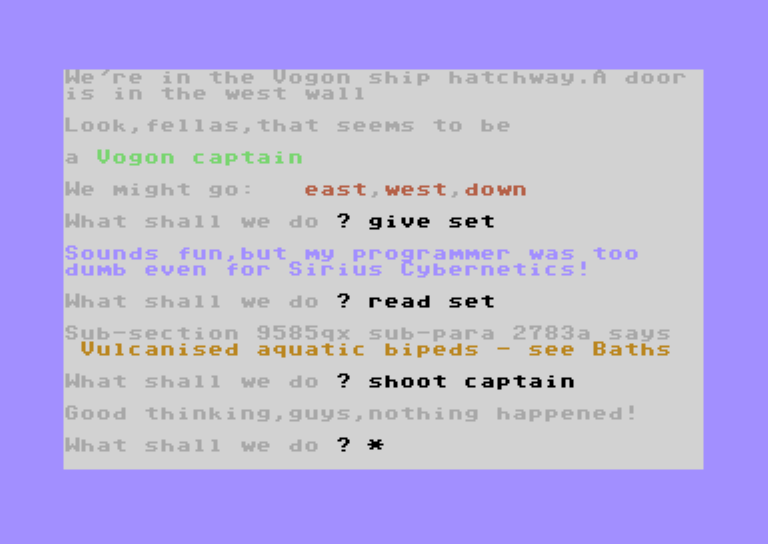
There’s a Kil-O-Zap energy gun I found that I attempted to use on the Vogon captain here. No luck getting by yet. The “set” is the Galactic Encyclopedia, and there doesn’t seem to be a way to read any entries other than the one about aquatic bipeds.
The Heart of Gold does not resemble that from the books/radio show/play/etc. and is mostly just a maze.

The maze has an energy gun (which I already mentioned but haven’t used yet), an Arcturian MegaDonkey steak, some keys that appeared randomly, and a cheque signed by Zaphod Beeblebrox that I assumes is one of the Treasures. There’s also a very tempting lever:

PULL LEVER only is bad at randomized times. (I tried to see if some item I could hold affected it, but no — you just wait for the dice roll to go your way.) When it does trigger, you get zapped into outer space, rather like the scene in Galactic Hitchhiker where you need to wave a scarf, except here there is no scarf.
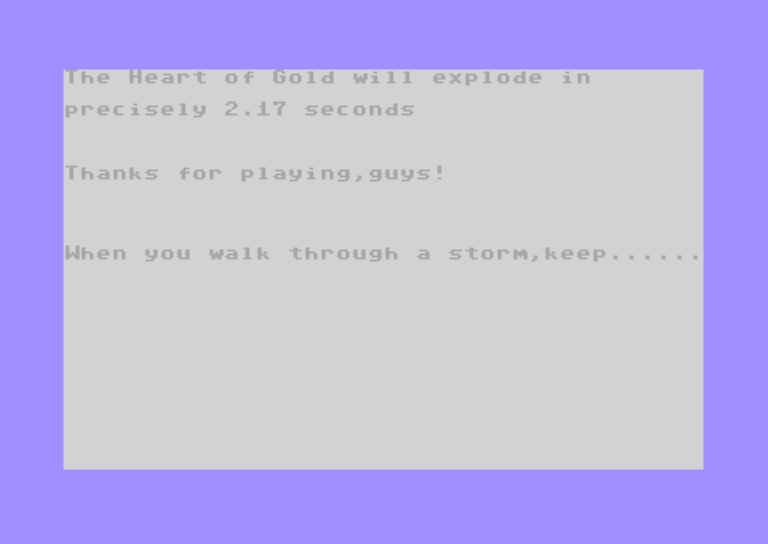
Maybe that direction is a dead end? You do get a number of turns floating in space before death which strongly suggests there’s some way of flagging down a passing ship, but I don’t even have my towel with me, and WAVE isn’t a recognized verb besides. Other than the typical “go”, “get”, and “drop” there’s just
READ, OPEN, CLOSE, KILL, SHOOT, PUSH, PULL, SAY, PANIC
which isn’t much to work with. At some level having less options to test is nice, but the situation is too heavily constrained as is on the window it shows the player; the least it could do is allow the player a few extra actions for breathing room.
Given only the Vogon captain to work on otherwise there isn’t much for me to whack at, but I’m going to keep trudging at this a bit longer before giving up. I’m not sure why I’m putting so much solving energy into such a dodgy game, but I guess I found the story of its creation a little more motivating than normal. (I’ll still take hints in ROT13 format if anyone wants to give them.)


 Renga in Blue