This is a game I’ve technically had on my list from the very beginning of the Project but I had it marked as 19xx. It wasn’t until a reader pinged me last year that I found out about when it was made; the manual had very recently been uploaded to the Internet Archive.
The manual means it was worth the wait and makes for one of the few late artifacts from Mad Hatter Software. Mad Hatter is a company I still find mysterious. We have a summer 1979 catalog which indicates Tim Quinlan is the proprietor and it claims to be their sixth edition; the 1979 catalog sells four of the Greg Hassett games (House of Seven Gables, Journey to the Center of the Earth, King Tut’s Tomb, Sorcerer’s Castle) and Quinlan was apparently in the same circle of people as Bob Lidill (of the Captain 80 Book of Basic Adventures) who reports Tim was “a character and always wore a top hat.”
This is the sixth catalog that we have produced since our start in the summer of “78”. Our first one listed six games for the TRS-80. By the time we hit the West Coast Computer Faire last November, we were offering 36 items for the APPLE, PET and the TRS-80. The winter edition listed about 60 Items and this one rings in with over 150.
Of the six initial TRS-80 offers, I’m guessing some or maybe all are by Tim Quinlan himself, like Budget Planning Program and Othello III, both copyright 1978, taking the “variety pack” approach to development.
How his “star adventure writer” ended up being a 12-to-14 year old is unclear, but North Chelmsford, MA (where Greg Hassett hailed from) and Dracut (where Mad Hatter was located) are fairly close, so I assume it was just meeting locally.
But back to our concern today, Bob Nicholas. He wrote two adventure games and I’m playing game #2 immediately after this one. Both tout featuring GRAPHICS & SOUND; for the sound mainly it is a “walking sound” upon move between rooms and a dirge upon dying. I have a clip to demonstrate.
As you can see from the clip, the graphics are fairly unique; a TRS-80 character mode illustration in the upper left, objects and room name to the right, commands on the bottom.
You start at “home” and your object is to gain treasures (not unique) and fame (slightly unique). Fame is simply the game keeping track of how many monsters you’ve killed as a separate stat. You gather/kill as much you like, head home, and SAY HOME to declare you are done with the game.
Other than giant-pixel art, the other big trick the game pulls is to have objects placed randomly. That is, the initial room always has a couch and a fireplace, but in one game the couch may conceal a coat, while in the next it may have matches.
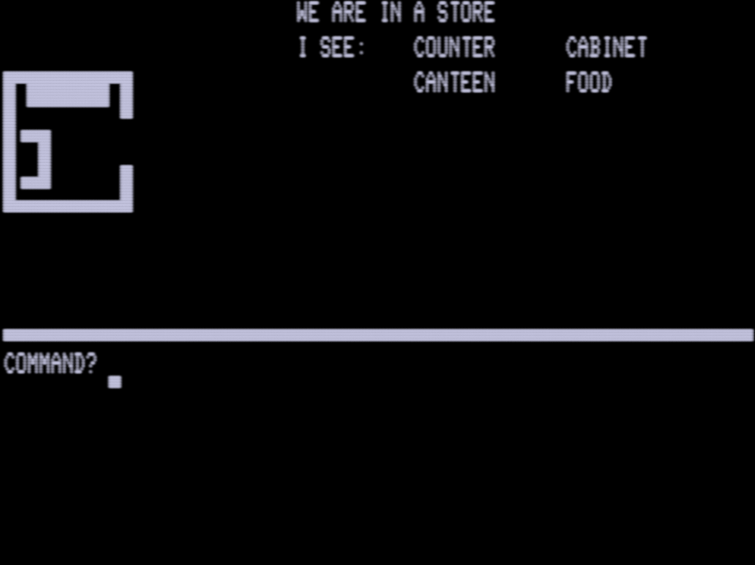
After some initial “your house” rooms where you have to LOOK in everything and scoop up whatever random items might appear, you hit the road, visiting a store on the way:
This just gives you an error if you try to GET things. Since you are in a shop, you need to BUY to pick things up, which works as long as you have your wallet with you. For this iteration the wallet was in my icebox.
There’s a cave that needs a LANTERN and MATCHES to see, and I was stuck for a while because I didn’t realize ON was a verb.
The game understands a very meagre set of verbs; directions, LOOK, KILL, ON, PULL, UNLOCK, BUY, READ. This ends up being confusing, for, say, wearing a coat — which also uses ON, and you need to do before going in the cave, otherwise you’ll freeze — or eating food. I have no idea how to eat food. If you have an OPENER and CANS you can open the cans and then you will automatically eat, but there’s a FOOD object that I never was able to use.
After typing ON COAT.
There’s not really any puzzles past this point other than “make sure you collect all the keys” and “don’t hang around near a monster without killing it, and don’t try until you have the SWORD”.
(Oh! I should talk about the MASTER that appears. The game’s “puppet” takes a “Igor from Frankenstein” like attitude and responds to every command with MASTER. There was a fair amount of hand-wringing over “who are you communicating with” in this era, with the weirdest example from 1980 being CIA Adventure pretending you are speaking with a “partner” who is doing all the actions.)
Assuming you have been doing LOOK on every item, by the time you encounter any locked things you will have found KEY1, KEY2, and KEY3.
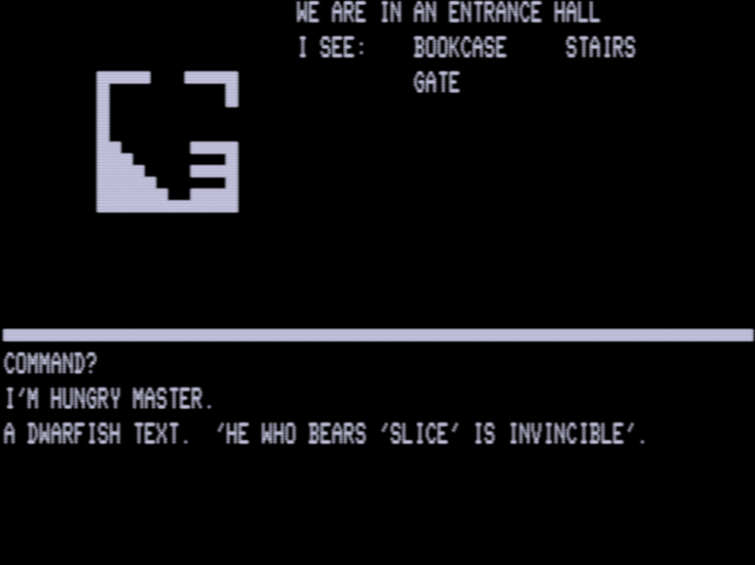
You’ll eventually hit a small dwarven complex.
I was able to unlock the gate but never got through it. GO GATE doesn’t work. No directions work.
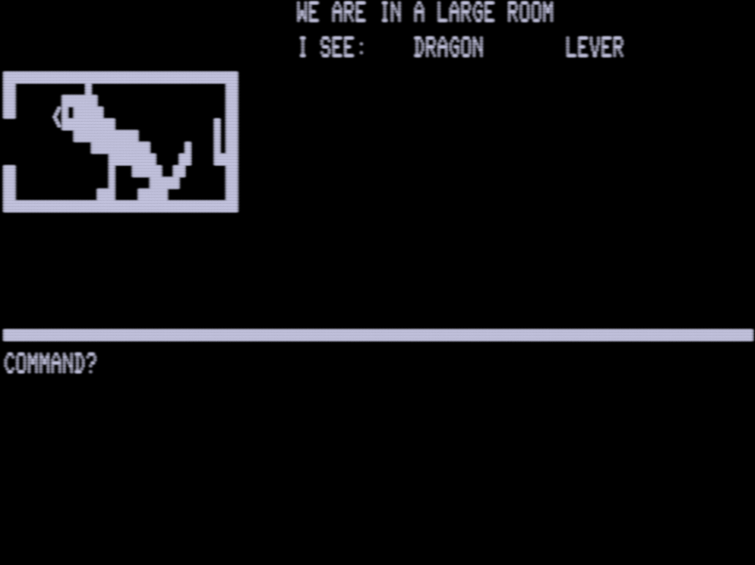
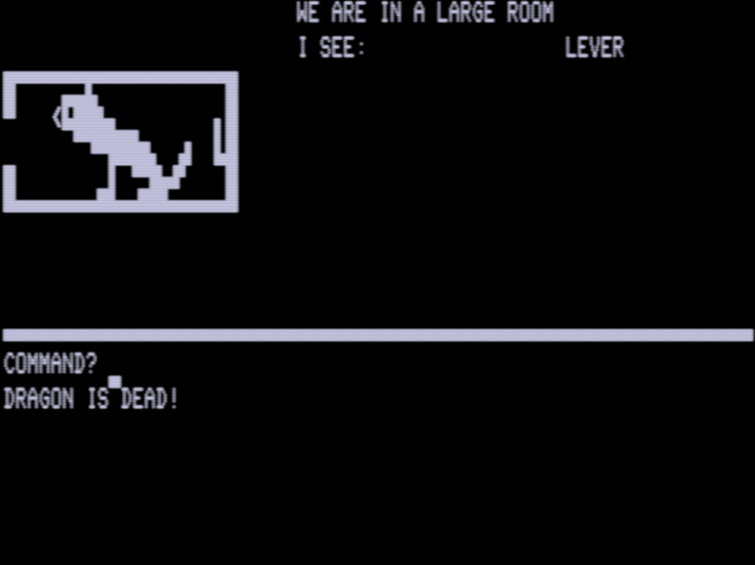
A few steps later you reach a dragon, and then KILL DRAGON / SWORD for glory.
After killing the dragon you can pull a lever to land back on a mountain and on a route that you can use to backtrack to home.
I’m unclear on if sometimes the random spawning makes it literally impossible to get 100% in treasures, but I didn’t find the game enjoyable enough to repeat and find out. There’s also a difficulty level you can set which changes lamp light / number of matches / amount of time it takes before you need food, but since this is such a linear game, the only real optimizing you can do is saving your game, examining everything available to look at, restoring the save you just made, and then only examining items with secret objects.
What’s fascinating about this game is that sound, graphics, randomization are all relatively unique and ambitious for this time frame, but it ended up being more rubbish than the more slavish copies of Adventure (like Cavern of Riches). Such can be the dues of the attempted innovation.
The other Bob Nicholas adventure, incidentally, uses the same system more or less, but because it is oriented as a mystery, it works better than this one. (Not much better, but it ends up being at least kind of hilarious, as you’ll see next time.)
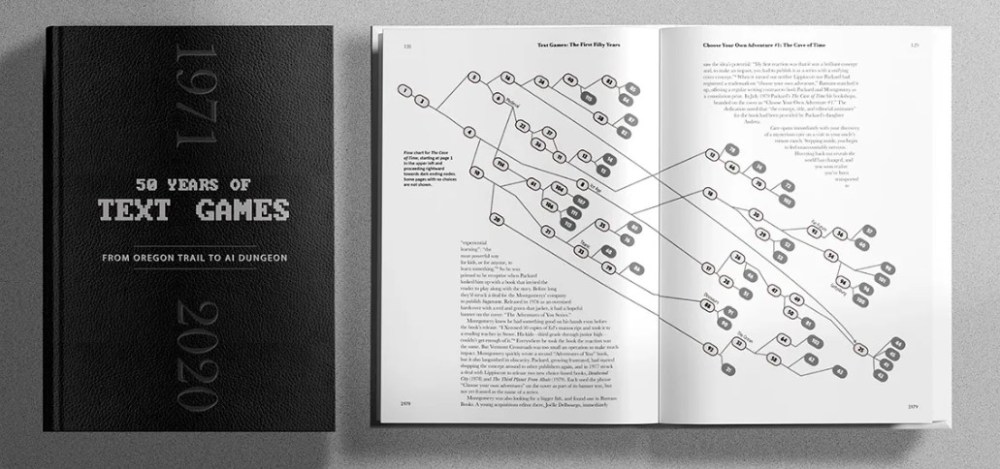
Throughout the year of 2021, Aaron Reed embarked on an epic project: going through 50 years of text game history, picking one game for each year, and writing about one each week. Given the intercross of my readership, perhaps you’ve already read it.
I received a review copy of the “Collector’s Edition” printed book version — as funded through Kickstarter — which comes with a bonus booklet (“Further Explorations”) of both individual games and some “genre” explorations, like “one room games”.
The choice of text games is very wide, and while it includes quite a fair number of “traditional text adventures”, there’s early simulation (ROCKET, Super Star Trek) more academic experimental narrative (Patchwork Girl, Screen) and for some reason, Dwarf Fortress, which sneaks in by virtue of the original being ASCII characters.
ASCII admittedly makes for a stunning page.
The writeups are universally entertaining and deftly mix historical and theoretical study. Example:
Designer Steve Meretzky recalled that one of his goals with Planetfall was “to try to concentrate on a single NPC. By devoting the writing time — and more importantly, the precious disk space — to a single character, that NPC could be much deeper and more interesting.”4 Meretzky only had around 100K of space to work with, but he stuffed as much Floyd as he could fit alongside the game’s parser, rooms, and puzzles. The cheerful robot can be given orders to do things you can’t, useful to solve at least one puzzle. He can hold things for you, and reluctantly give them back when asked: “Okay,” he says, “but only because you’re Floyd’s best friend.”
See how this passage integrates an actual quote by the author of the game (the footnote goes to an essay by Meretzky) with the development constraints (noting the 100K) with the actual gameplay effects that the character has.
The book’s design is stark and attractive, with interspersed maps (isometric and elsewise) and careful layouts that separate game text from the main text.
This is about as good a book as is possible given the premise.
The only weakness, really — and this is acknowledged by the author — is that the premise of one-game-a-year-or-bust does end up being limiting on some explorations. Tradewars 2002 is included, but I can’t help but think of all the games before and after that had to be left out to make a stronger analysis. (LambdaMOO in 1990 and Achaea from 1997 also represent online gameplay but are still very different beasts.) The main book hits a massive 623 pages, though; this is a matter of there needing to be thirty books rather than just one, so the one will do for now as something humanly writable and readable.
To be fair, the wild jumps between genres can make for interesting connections; the early text experiment Uncle Roger is nestled between A Mind Forever Voyaging and Plundered Hearts.
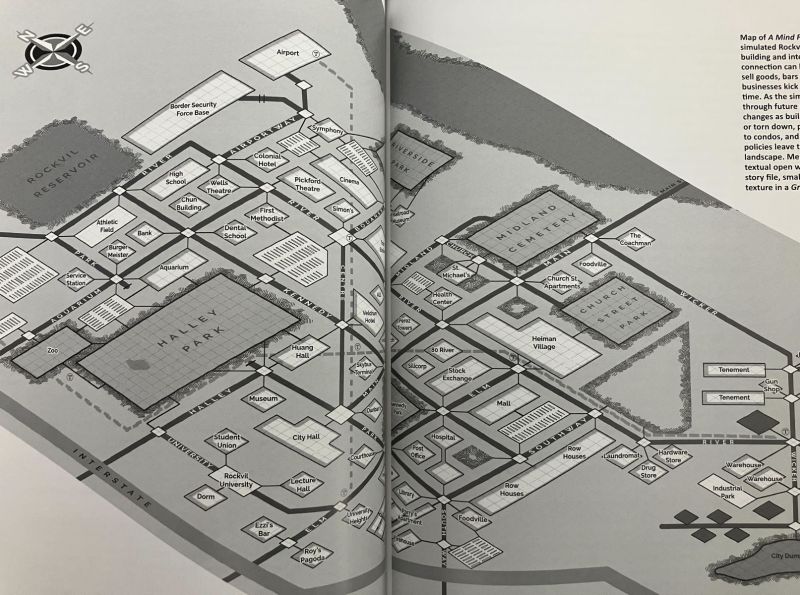
Speaking of A Mind Forever Voyaging, here’s an internal map which reflects one of the other issues:
Namely, there are some staggeringly attractive two-page maps, but due to being a book format with a crease in the middle, are hard to fully take in; see how some of the center names are hard to read. The picture from the top of this review (taken from the author’s Kickstarter) looks fantastic when spread out, but in my copy I genuinely have trouble following some of the connections from the left to the right side.
The book is also (understandably) in black and white, and that means some of the color pictures from the original articles had to be taken out. Silverwolf (apparently the most popular article of the whole project) sadly loses its captions like “This Priscilla Langridge may or may not be the same as other Priscilla Langridges.” On the other hand, a fair number of images have been added, and the printings of the black-and-white reproductions are stellar.
This still is a marvelous volume which makes me hope to live for Aaron Reed’s inevitable next volume scheduled to arrive in 2071, 50 More Years of Text Games.
As of this writing you can pre-order the book here.
Disclaimer: I have no personal connection to Aaron Reed. He mentions this blog in the book several times.
There is no kind of computing that I enjoy more than either playing or writing ADVENTURES. These come closest of any programs currently available to matching my pre-computing-days-mythological-picture of what a computer should do. When you are playing an ADVENTURE the darn machine seems to speak English. Instead of inputing “1” to go up and “2” to go down, you just tell the computer “GO UP” and it does it. It even talks back to you in English.
— Rodger Olson, from the Aardvark June 1981 Journal
From the Museum of Computer Adventure Games.
Playing Aardvark games has been a curious journey so far; their original development system has been a Ohio Scientific computer with an 8K capacity, and they’ve more or less stuck with that through their production process. Because they had some ambitions in terms of environmental complications (worlds that connect up mid-way in unexpected ways, having a submarine fill with water and all the rooms change accordingly) they’ve all had a strange complexity even though the parser only understands the first two letters of each word. This is still true for their 1982 output!
So they’ve had creatively cool concepts let down by high enough game difficulty that the parser’s flaws stick the player like mud. Earthquake (a collab between Bob Anderson and Rodger Olsen) is advertised as being “for beginners” so it had a little better chance of being good out of the gate. (Whether this difficulty designation was baked in to the game from the start or whether it was decided after the fact is unknown.) Less time struggling against difficult puzzles means less time for the parser to go awry.
At least, the general concept here is top-notch.
I’m playing on C64, it’s the only port I could find.
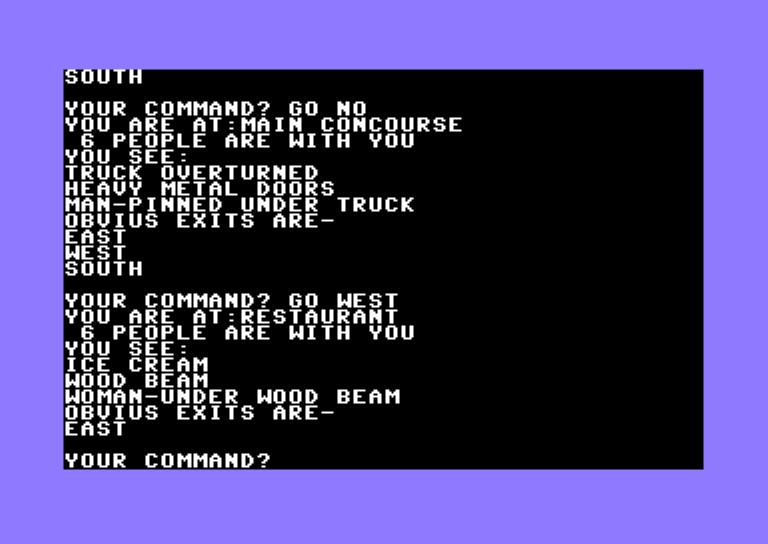
You’re in a mall: after one turn an earthquake happens.
Other than the man immediately needing help in the starting room when a truck flips on top of him (ow) various other people become trapped (under wooden beams, in stuck elevators, etc.) and you need to rescue all of them. As you rescue them they get added to your group and start following you. They don’t need to be rescued in any particular order but you need all of them to escape for perfectly logical reasons — this is a Collect All the Gems of Fnord Plot but made realistic.
Additionally, this is an open map — you have access to nearly everything in the mall straight away. You know how so many adventure games could be made easier with a single shopping trip? This lets you visit all the stores — you need a rope? gloves? a ladder? shovel? All of these things are accessible right away. There’s far too much to carry it all (and do you really need a jigsaw puzzle?) The general feel is hitting an obstacle and thinking back to what store might have the item you need. This is a major shift in thinking; one person who had acid fall on him, so I thought about where I’d get a base (grocery store) rather than run through a regular inventory list. (While it didn’t really go there, this briefly suggested to me an adventure game that was more like Scribblenauts, where there’s enough item accessibility that you are more limited by your creativity than by your access.)
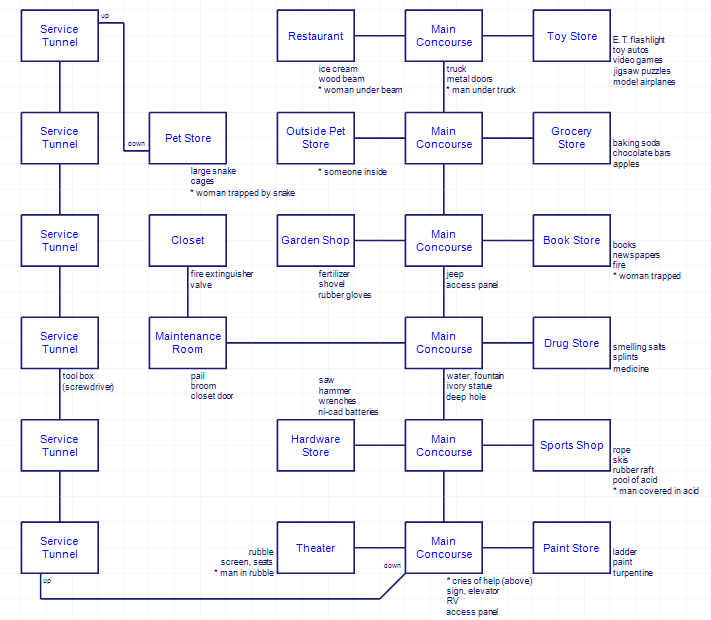
Most of the map, nearly all accessible without puzzle solving.
There’s a man trapped in rubble in a theater; you get the shovel from the garden store to dig him out.
A woman trapped by fire in a bookstore is rescued via fire extinguisher.
Some acid is neutralized by baking soda.
For a woman trapped under a wooden beam you need to grab a saw from the hardware store to cut the beam out.
There’s a few trickier ones. A man trapped in a hole needs to be rescued via a rope tied to a statue. There’s some water dripping into the hole and there’s a valve that can be turned to increase the water flow (so the man could just swim up) but it does go fast enough to really fill up the hole.
A woman is trapped in a pet store; you only hear her first on the outside but can’t get in. You have to go in an access duct (using a flashlight + batteries) and then find the woman is trapped by a snake. You need to go through the animal cages and find a mongoose, who you then drop at the snake to scare it away.
There’s an elevator that’s stopped at higher than ground floor; you need to take a ladder to it first and climb up, to find a “reset switch” and turn it with a screwdriver.
The parser is absolutely unforgiving here. I tried INSERT PHILIPS and TURN PHILIPS and TURN RESET and FLIP SWITCH and lots of different variants.
The woman inside the elevator is unconscious but you can use smelling salts to revive her.
From the elevator you can also visit a second floor.
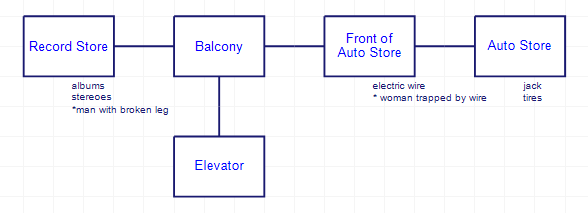
The remainder of the map.
One woman is trapped by an electric wire (get rubber gloves from the garden store) and one man has a broken leg (grab a splint from the medical store).
You can also get a jack from an auto store in order to rescue the man at the very beginning of the game. Once he’s rescued, you should have 10 people, which is enough to flip the truck over. Far more satisfying than gathering 10 random treasures. Then everyone can join the ride (I assume a roomy back where people can pile in) and you then turn the ignition and hit the gas to escape.
Fun! The parser is still rubbish but the easier puzzles make reckoning with it smoother (although plenty of objects are still described by two words where you have to guess which one works). The parser mangling still makes me sad because this is otherwise solid and it otherwise would make my “recommended” list for 1982. I don’t think this structure is one an author at the time would normally go for, but just like Nellan is Thirsty having a different target audience led to innovation.
Also, making a disaster game is an innovation in itself, even in modern times. Disaster Report went for 4 iterations, although the masterpiece in the genre is the SNES game SOS, involving a ship that’s flipped like The Poesidon Adventure. The Wikipedia page on disaster games is otherwise quite minimal except for firefighting games, which make their own genre.
EXTRA BONUS THOUGHT: Even though there’s lots of “useless objects” in the mall their presence works in practice; you might be toting around a wrench but it ends up being clear you don’t need it. In a more modern game this trick might get more annoying; people would expect an item description and interaction and the ability to combine things and so forth. Weirdly, the low-tech and even low-ability-parser kind of work for the game here, allowing a game design possibility that would otherwise be much more work and maybe not even feasible.
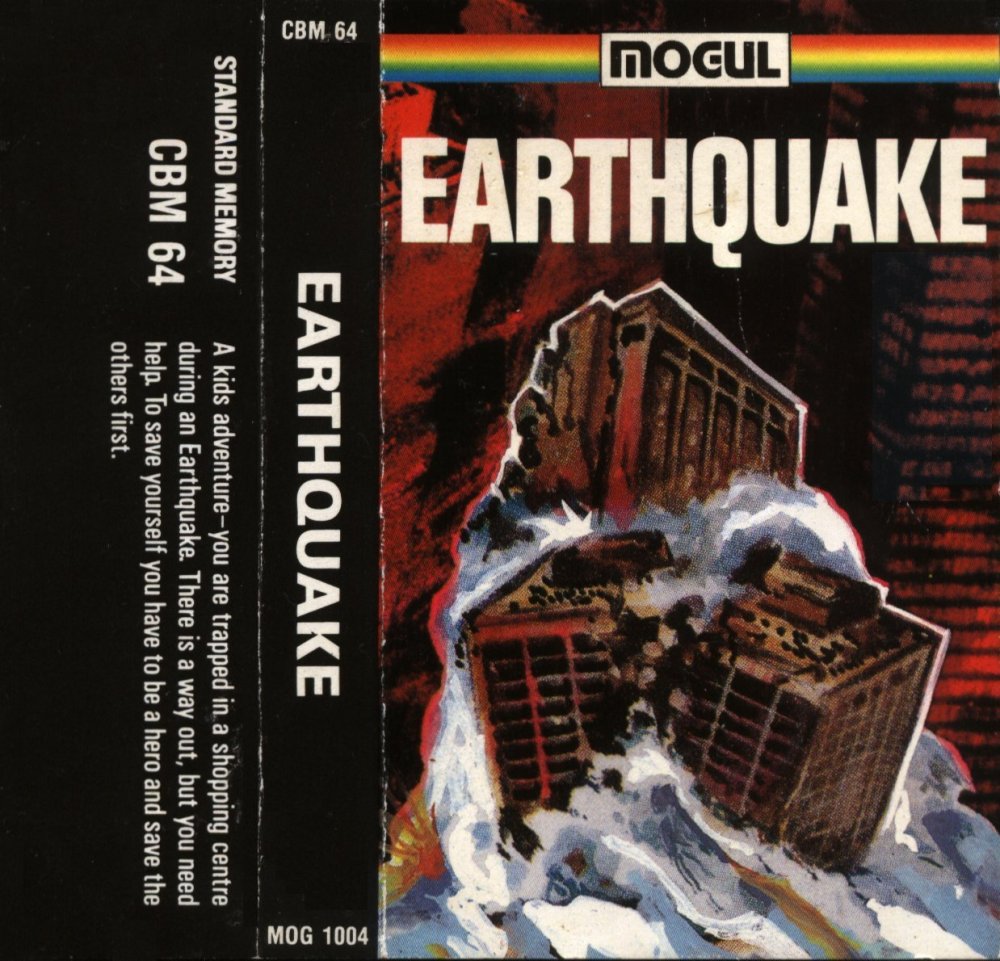
Tape cover of the game as later published by the company Mogul for C64. Via TZX Vault.
Next up I’ve something very different, a book review! This will be followed by two 1980 games I’ve been putting off (with graphics and sound) before arriving at the dreaded Very Hard Britgame, Pimania.
Behind the scenes here at All the Adventures, the way I started 1982 was to dump the entirety of CASA’s database for that year into a spreadsheet, add games I knew it had missing (either cross-referenced to Mobygames, or from my own research) and use a randomizer tool. So I theoretically have a list of the order of all games I will be playing up to the end of 1982.
However, the list has many messy notes, and I quite often deviate. I try to keep my “big games” to be at a pace of once every five or so, I try to keep a good mix of platforms and origin countries, and with multiple games by the same company / magazine / person I try to spread them out over the year. Sometimes I’ll find a game is best considered with a pair (like the two recent VIC-20 games by Charles Sharp Jr.). Sometimes I’ll add a little hidden theming.
And sometimes, well, I don’t have any master plan at all, but here: my next game from the spreadsheet is probably janky, and I just wrapped up (mostly) The Haunted Palace. I just didn’t have the willpower. I dug around to find a game that was a.) short and b.) probably had a semi-reliable parser. Enchanted Cave by De Crandell and Joe Peterson mostly fit the description, so I decided to give their next game using their same homebrew TRS-80 engine (EXPLORE) a try. No need for new history background, even, since everything about them got covered in my last post.
The most memorable part of Enchanted Cave for me were the “trap” red herrings, like a key which unlocks two different doors, but the more obviously available of the two kills you. (There’s a clue warning about this beforehand. It wouldn’t be “fun” if it was just a left-right door thing where only one is correct, but with the “fake door” being in a totally different and more accessible place than the real one it diverged into comedy.)
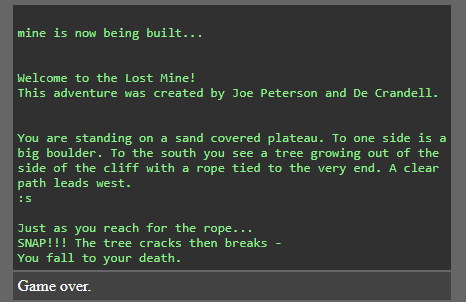
The authors must have liked that moment too, because they put a similar one in at the very start of Lost Mine.
Taking a climb down the already-available rope is death.
Rather, what you’re supposed to do is move the boulder, revealing a new rope, then take it down to a nearby spot with a cactus and climb down there instead.
The “steel grate through which you can see a large room” will be important later.
This is also like Enchanted Cave in that we are given no motivation to start with. That game had no treasures to collect; this one doesn’t either. We’re going into a strange and dangerous area and trying to get out the other side alive for … fun? Sure, I can roll with that, it is a good overall metaphor for adventure-game-playing anyway.
Despite two more sudden trap-deaths later, the game’s emphasis on making a tight and straightforward puzzle-laden experience. This feels less aimless than the authors’ previous game.
After heading down the rope, you go down into the bottom part of the mine complex (marked dark blue). There’s a “ghastly sight” with a skeleton that “appears it hasn’t eaten in a hundred years” the end of a long chute, a room with a bucket and “glass cutter” inside, and what looks like an “emergency case” of glass which contains a miner’s pick.
Not a tough puzzle. If you try to break the case, an alarm sounds and guards (where do they come from?!) arrive and riddle your body with bullets.
The pick can go back a little bit to a wall near the elevator and let you dig through. There you will find a food container (!?) which can then be taken to the skeleton who hasn’t eaten in a while.
Magic word in hand, you can then head upstairs (pink/purple on the map).
There you can find a mine cart with a third (and I believe last) instant death scene.
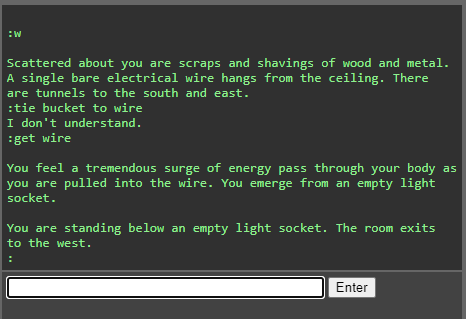
There’s also a curious room with symbols of lightning bolts followed by a room that asks you to insert a coin in a slot (that is lit by a grate exposed to the outside). There’s also a pit that appears to have something on the other side but is too large to jump. These will be dealt with in a moment; the next thing to do is to grab a “bare electrical wire” which does not kill you but rather sends you through the wire to an outlet on the other side.
This drops you in a small area with a “round slab of rock” that has a spear with a rope. ZWOOF which we got from the skeleton works here:
I admit this is the last room I tested, but fortunately it isn’t a big map.
The spear/rope combo can be used on the pit to then get a coin.
Normally the coin would then go straight to the coin slot, but you get zapped trying to carry it to the appropriate room (the one with the lightning bolt symbols is along the path). The clever bit here is to put together the grate seen above-ground with the the fact you can see the same grate down below in the coin slot room.
The hacksaw can then be used on the last obstacle (the minecart) to achieve victory.
This game was solid, pleasant, and oddly kind of rare. Yes, the setting is incoherent and pretty much generated around the puzzles (feeding a skeleton? hacksaw for a coin?), but those puzzles were straightforward, not attempting to be too hard, and even led to one clever moment (the grate connection). The engine doesn’t seem to be able to handle complex daemons and the like; I’ve said before this can be a great weakness of some games, but that’s only if they endeavor to be chock-full of hard puzzles in the first place.
The parser isn’t even that good, really; it only understands a small sample of words. But the game never tried to do anything so ambitious that it wasn’t already clear how to do what the game was asking for; it’s all bread-and-butter verbs like CUT, THROW, and CLIMB.
We’ll see if that pleasant buzz continues, because I’m going to now play the game I was hesitant about before, and the return of the company Aardvark. They’re the ones that published Deathship, arguably with the worst parser ever made, and with only incremental improvement in their games after. I’m hoping they’ve learned enough now from experience.
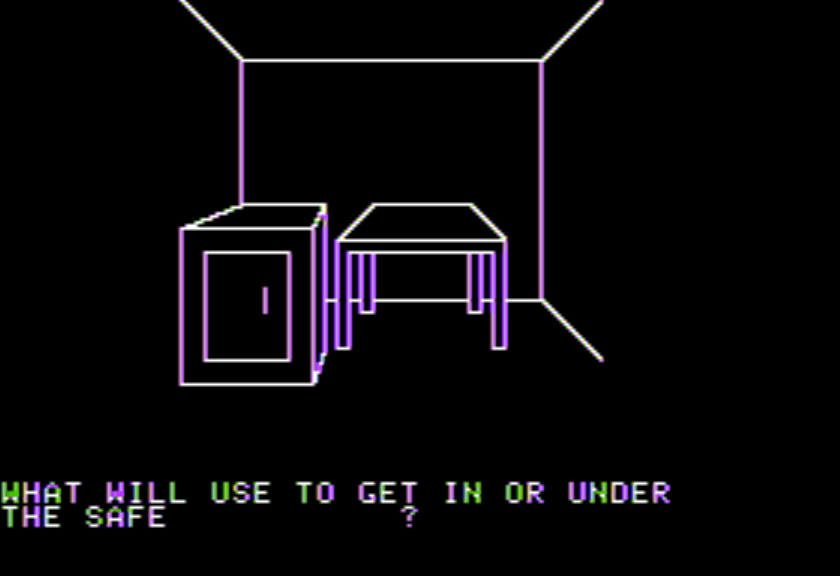
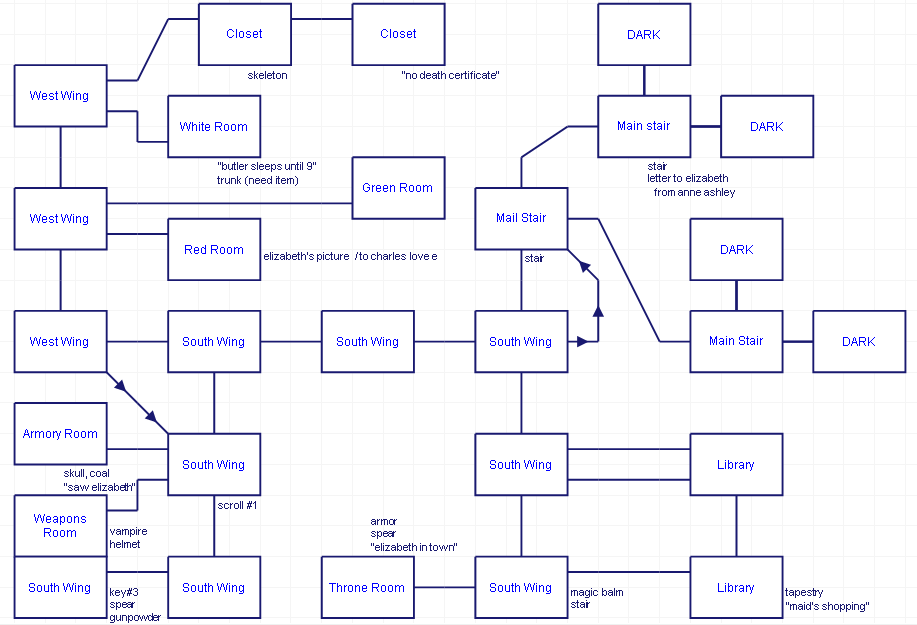
I think my experience of The Haunted Palace is best exemplified by a safe that I found fairly early but had trouble opening. It’s on the west side of the ground floor, as shown here on the map:
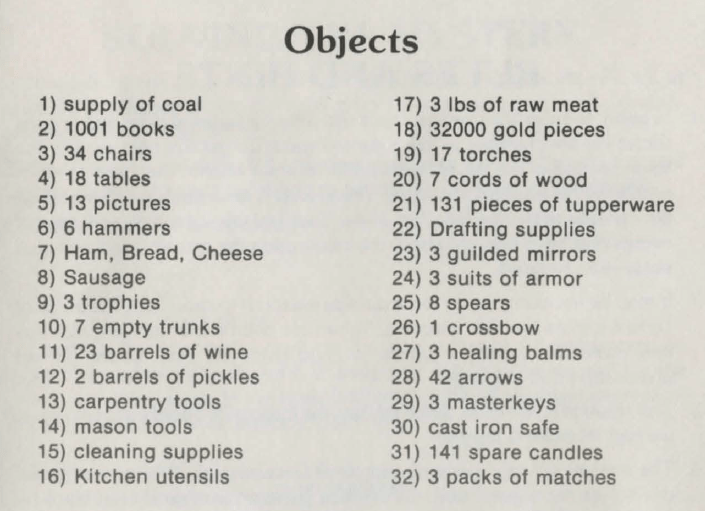
I had actually seen mention of the “safe” in the manual already, by the long list of objects catalogued by the steward (including, improbably for the 19th century, Tupperware). There was one and only one safe. Surely the safe would be interesting!
I was unable to get the safe and trying to OPEN SAFE results in WHAT WILL USE TO GET IN OR UNDER THE SAFE ? where the game is technically prompting for a single object. (I’m not sure if I fully understood it was doing that when I first saw the message; some games say a prompt to this effect because they want you to USE the object directly that you want to try out.)
I had to pass by, but in my most recent session I did figure out the safe. I’ll return to it later.
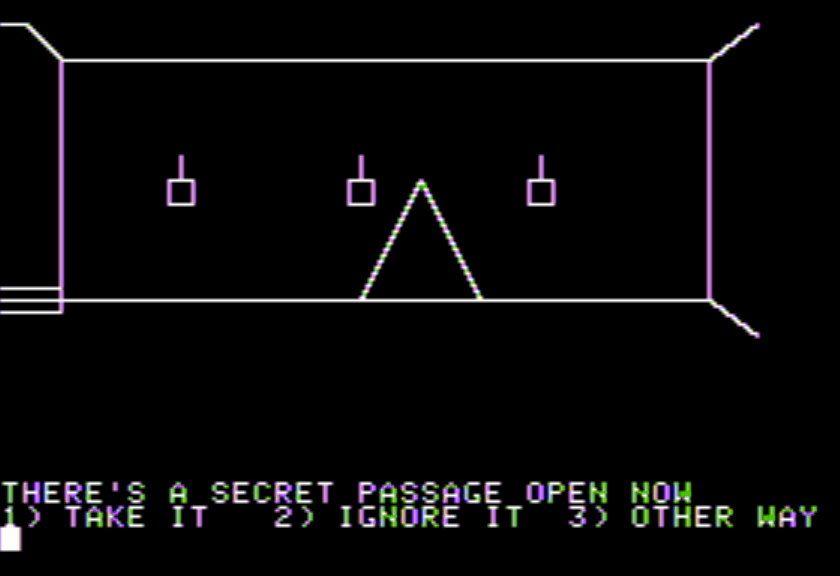
One other big discovery from my last session is I was using secret passages wrong. Specifically, i had the “reveal message” that happened using the hammer and chisel (and clued in the manual!) to open a passage, but got stuck in a wine cellar. It turns out you can just USE WISDOM to spot the secret door, and even though no graphic displays with the message you can move forward anyway and a choice will trigger. This gives the impression the author had a grand mechanic in mind but threw in the towel implementing it more than once.
If you leave and come back, or do something else first, you’ll need to USE WISDOM again.
This particular secret door, incidentally, just leads to a dungeon cell with nothing. Oh well. However, this does mean you can escape the wine cellar area now with this mechanic, but it doesn’t do anything about the non-working stairs. I now suspect the game is incomplete and the stairs may literally never have been implemented.
I suspect this because I made it to the last floor.
Now, I admit to being rather confused getting up to floor 12, being I only went up two flights of stairs from the ground floor to get there, but the way “floors” is divided up in the game seems to get vague and approximate.
I still was in the dark getting up there, but I was getting used to just reading the text anyway.
The chapel to the west seemed kind of important, given one of the “room clues” a message about a casket hidden there, but I tried searching multiple times in every direction and found nothing.
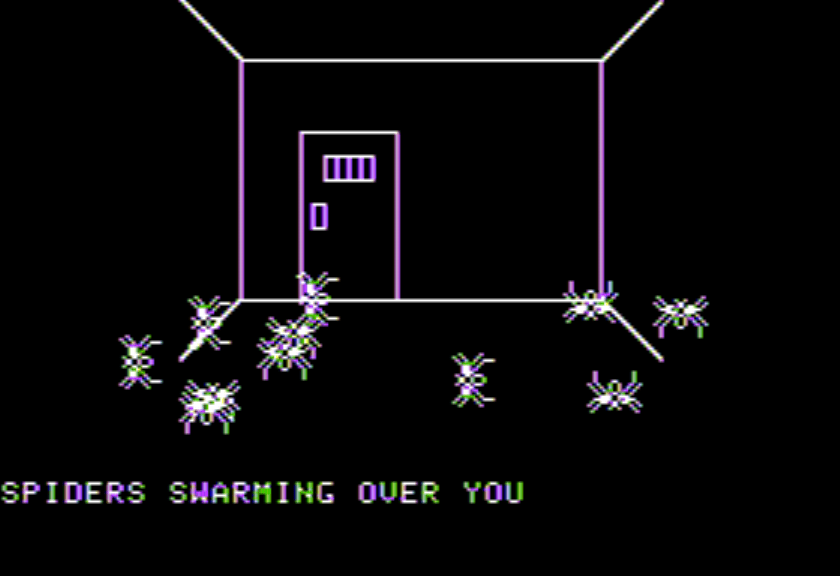
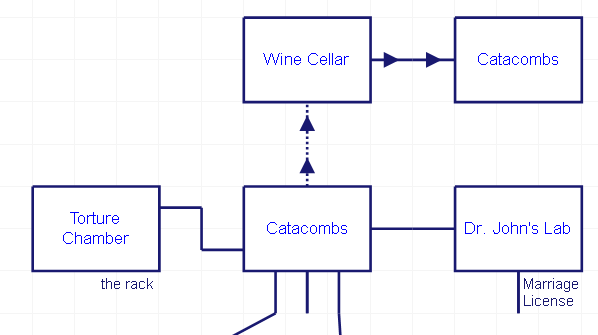
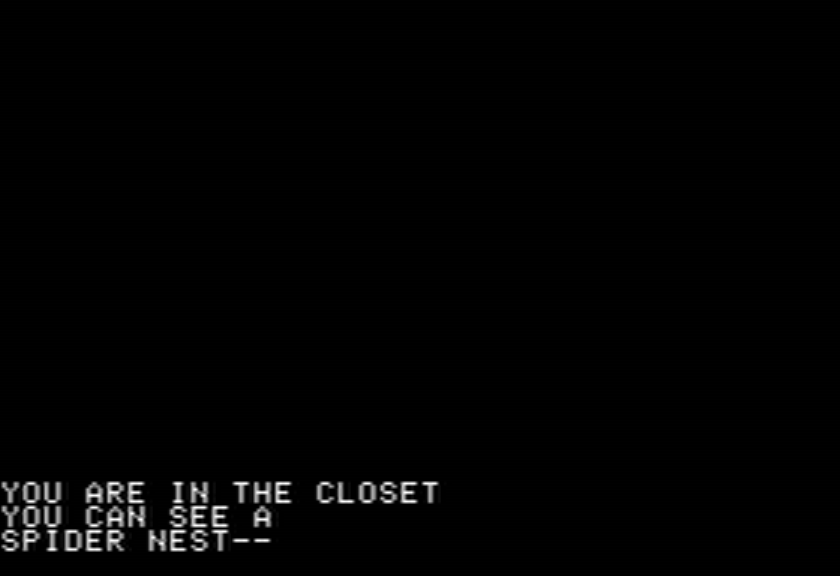
There was another important room I managed to overlook my first time around because a USE WISDOM was needed. You’ll notice a dotted line to the east of the Tower Dungeon. That lets you sneak into a Lavoratory, and then past some spiders…
…into a torch room! The long awaited torches, in basically the last room of the game. Finally some light.
Except … no light. Using the torch didn’t work, even with matches in my inventory. If you’re curious how I got the spider shot, there’s a glitch where if you ATTACK a monster in the dark the room will get lit up. This can admittedly be unnerving in some cases.
I eventually — after some fussing and disbelief — turned to the source code. It’s in straight-up BASIC which I was able to pull up as plaintext. The issue seemed to be here:
2305 IF U(1) = 1 THEN : GOTO 2390
2306 IF U(1) = 3 OR U(1) = 12 THEN : GOTO 2420
2308 IF U(1) = 17 THEN : GOTO 2600
2310 IF U(1) = 17 THEN : GOTO 2600
2312 IF U(1) = 11 THEN : GOTO 2500
This is code that triggers after trying to USE an item. Specifically it checks what types of item it is. 2390 is code for eating. 2500 is the hammer and chisel (or alternately a pick axe). You’ll notice that 2308 and 2310 are duplicates. Since there’s unused code for light sources after, I’m guessing one of them meant to jump to 2700, not 2600, probably with a different number than “17” with the equal sign.
2700 IF DK = 0 THEN :W$ = “BUT ITS NOT EVEN DARK!”: GOSUB 1002: RETURN
2702 W$ = “NOW YOU CAN SEE AGAIN”: POKE – 16304,0: GOSUB 1002: RETURN
However, I’m not quite motivated enough to go through the fix, because — well, I’ve seen all the rooms of the game (or “seen” in some cases), the wine cellar stair was clearly a fake out (there’s not even data for a floor beneath the cellar) and I’ve found all the clues while poking through the source code. I’ve seen in-game all the clues except two, but I’m just going to cut and paste them anyway. Assume, somehow, whatever broke the game is unbroken, and I discovered the incinerated body. (Remember the body that kicked it off, where the gender couldn’t be identified?)
DIAMOND RING IN A HEAP OF ASHES
BLOOD STAINED SCARF
MARRIAGE LICENSE-ED S. & ELIZ. ASHLEY
LETTER TO ELIZABETH FROM ANNE ASHLEY
ELIZABETH’S PICTURE/TO CHARLES-LOVE E.
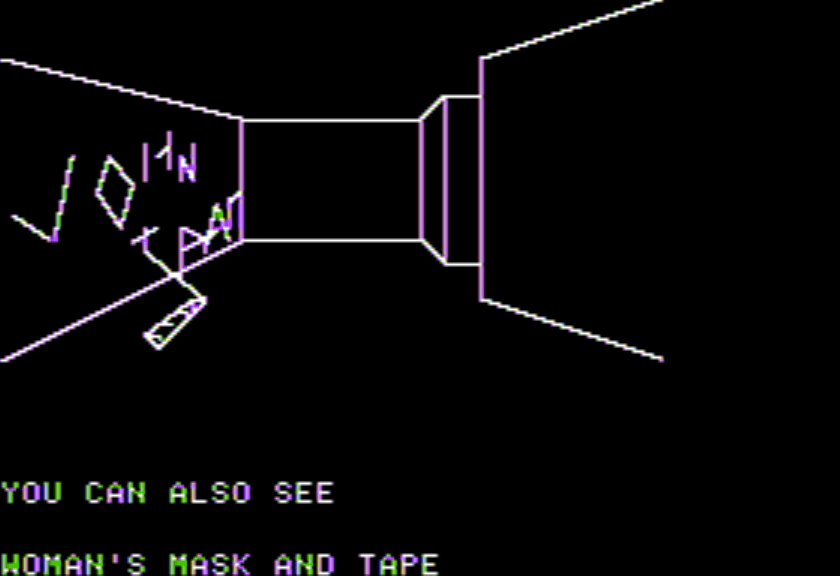
WOMAN’S MASK AND TAPE
CLUE-BUTLER SLEEPS IN UNTIL 9 A.M.
BOAT TICKET TO BOSTON
UNPOSTED COPY OF EDWARD’S NEW WILL
CLUE-THERE IS A CASKET IN THE CHAPEL
CLUE-TOWN GOSSIP-SOMEONE SAW ELIZABETH
MAID’S SHOPPING LIST-ONE NEW UNIFORM
A NOTE TO CHARLES-MEET ME TONITE IN..
…I CAN’T HIDE THE TRUTH ANYMORE…
CLUE-CHARLES WAS ONCE A FAMOUS ACTOR
CLUE-NO DEATH CERTIFICATE FOR VIRGINIA
SYBIL SAID-HE BETTER NOT LEAVE US OUT
..I CAN HEAR HERMAN’S CRIES EACH NIGHT
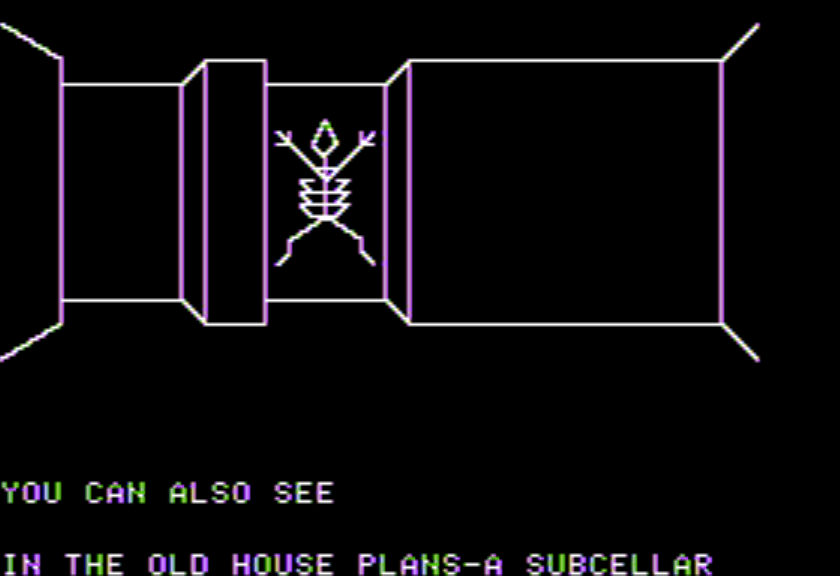
IN THE OLD HOUSE PLANS-A SUBCELLAR
KEY #2 MISSING FROM EDWARD’S KEYRING
I’ve seen all of these except “DIAMOND RING IN THE HEAP OF ASHES” (I assume the casket) and the “BOAT TICKET TO BOSTON” which seems like redundant information.
I scoured the source and there doesn’t seem to be a “winning condition” where you leave in “victory”. This seems to be all about the mystery contest, where we need to now identify whodunnit.
I’m going to put my speculation in the comments, and all y’all reading this are welcome to join in. I’ll then make a final summary post sometime next week (unfortunately, unlike Krakit, I haven’t found a published “solution” to confirm ours against).
One last thing, though. The safe. I did open it. There was GUNPOWDER in one of the barrels which I hadn’t tried, and it worked.
I thought maybe it’d have some secret item to unveil the missing casket, but alas: it’s the same key we found outside, under the rock, the one we’ve been toting around the entire game. This feels like a metaphor for the act of playing The Haunted Palace.
In all seriousness, I enjoyed myself in a bizarre way, but more akin to an archaeologist unearthing secrets rather than “playing a game”. But I’ll save talking about that for my conclusion post.
Well: I found a secret in the cellar. Then I got trapped.
Fortunately, the cellar isn’t terribly big, so my technique of using HAMMER&CHISEL everywhere worked. I also discovered my character’s WISDOM and INTUITION were both large enough to spot secret doors, although I can’t guarantee I’ll find all of them with that. The game has gaping enough bugs that it may simply be a feature that never got implemented correctly, and Sibyl doesn’t have any particular advantage. (For example, sometimes when using the chisel the game locks into a “checking your baggage” message; you can USE HAMMER&CHISEL again and it will break out of that and work correctly.) It is hard to say without both knowing what is really going on and some serious testing.
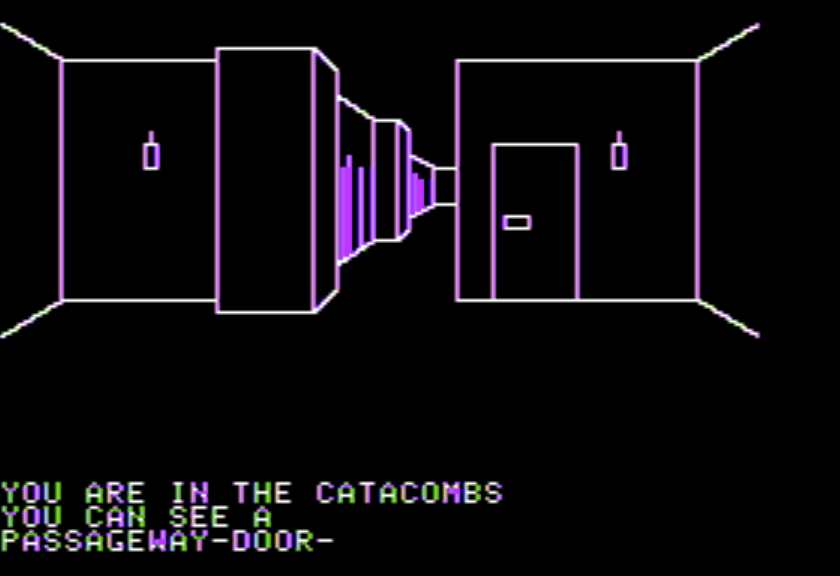
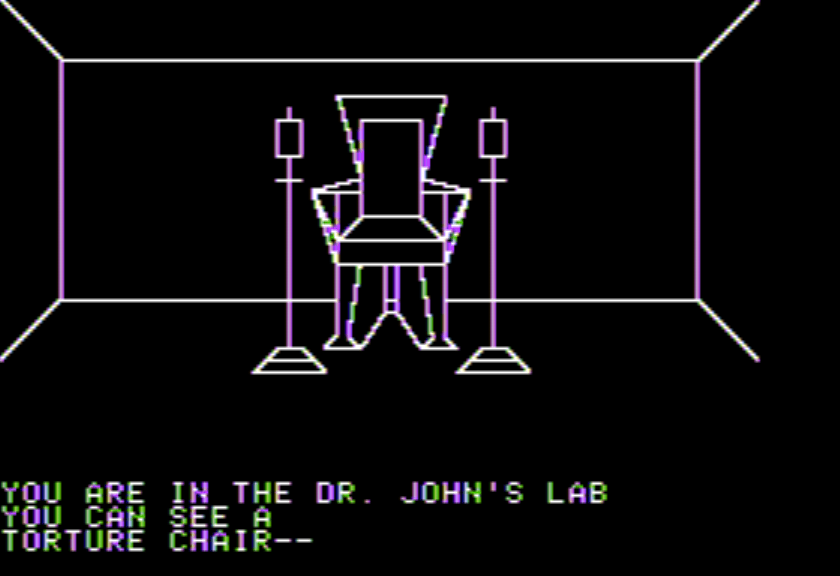
For example: going north from the Catacombs gets the situation on the top of the post. But wisdom also indicates a secret passage to the south, and one from the Lab also going to the south. I haven’t been able to open either one as the chisel doesn’t work in either.
The secret passage that I was able to open leads to a wine cellar. Good enough, except that while a secret passage is detected on the way back to the south, there seems to be no way to open it.
We can move on to another room, more catacombs, and some stairs. Trying to CLIMB STAIRS just warns the player YOU CANNOT CLIMB THE STAIRS HERE! I don’t know if the game is literally broken (not unlikely) or if there’s some undisclosed reason for getting stopped (also not unlikely).
I honestly thought perhaps this would break me into the endgame and I’d be done, but no. I puzzled for a while longer and decided to tackle the dark area upstairs. I still had no luck with MATCHES or a CANDLE, but the game specifically mentions a TORCH so I assume that’s the only thing that will really work. Despite many, many, duplicates of other items, I have not found any torches scouring the available levels. It is possible the torches are through the darkness; that is, the game has intended for you to wander in the dark for a bit.
This is unusual for an adventure game. People copying Crowther/Woods Adventure often did something akin to a pit you’d eventually fall into (Zork started with pits, but then the Attic was upstairs and also dark, hence the grue was born). Otherwise, the games of this era at least generally prohibit certain actions in the dark, like picking up items (our recent game Murdac was really loose and only disallowed reading, but it also had an unlimited light source found early).
As far as I can tell, the only thing wandering in darkness does is make it so while screens will appear, they will only do so quite briefly before the room is plunged into black. I could theoretically record video and get screenshots that way, but I decided to roll with what the game was giving me.
At the very least, it really is an impairment not to see the visuals, because there are enough passages that loop back it is very easy to get a mangled map where portions clearly repeat but there isn’t enough information to know exactly where.
Still, I was able to find a SKELETON KEY and a MAGIC CLOAK, and by now I really seem to be immune from most enemies. (There’s also been MAGIC BALM I’ve been finding where using it gives your strength a considerable boost.)
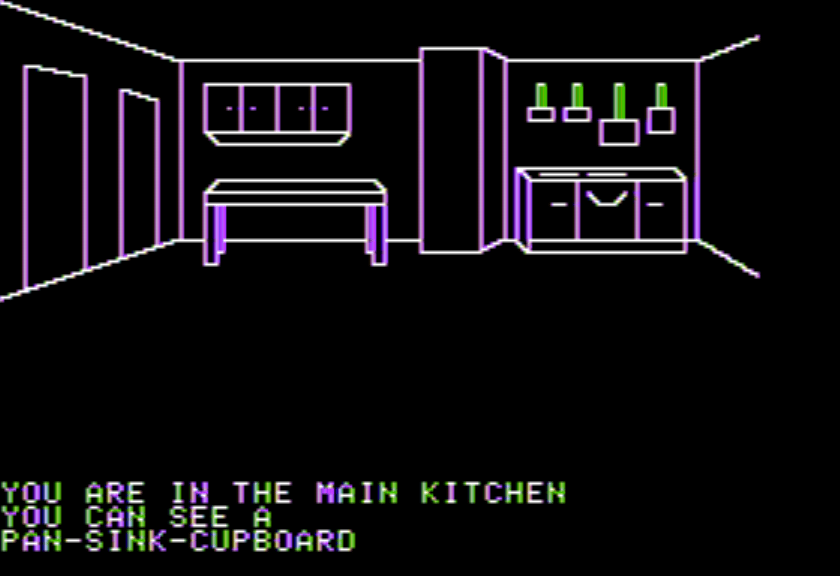
I did also find one lit area, a kitchen complex. A few screens:
There were a series of food lockers, including two meat lockers, where, confusingly, typing OPEN MEAT LOCKER gave me an “ERCORP” in each one. I only found out later (through the heavily damaged and confused inventory screen, where some of the entries are invisible) what I was holding.
Yes, that’s two corpses I’ve been toting around. No detail on what kind of corpses they are.
I’ve never played a game before that felt so ruined and cursed. I don’t know if I’ll make it to the end; I don’t have confidence it is even possible. But I still have more dark parts of to map to get to, and I’m still holding out hope there’s a torch out there somewhere.
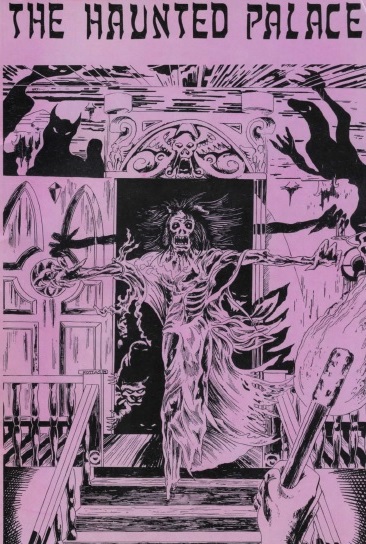
The much more sedate inside cover of the manual. The Atari title screen states U.F.O. is a subsidiary of Crystalware, so it isn’t really a different company.
I have mapped the ground floor and the floor beneath (“Level II” and “Level I”) fairly thoroughly; I’ve gotten through some of Level III.
My time since last has mostly been occupied by exploration, although I’ve also managed to become deadly. Let me explain the deadliness first.
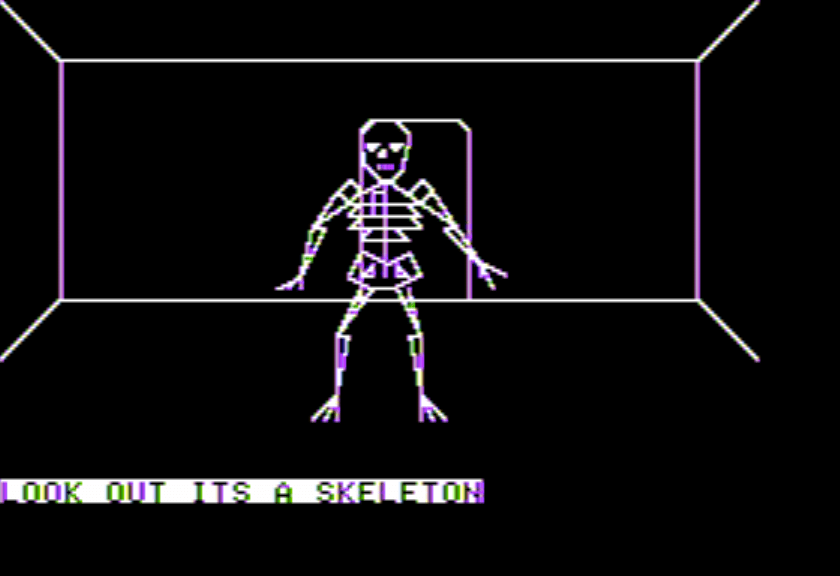
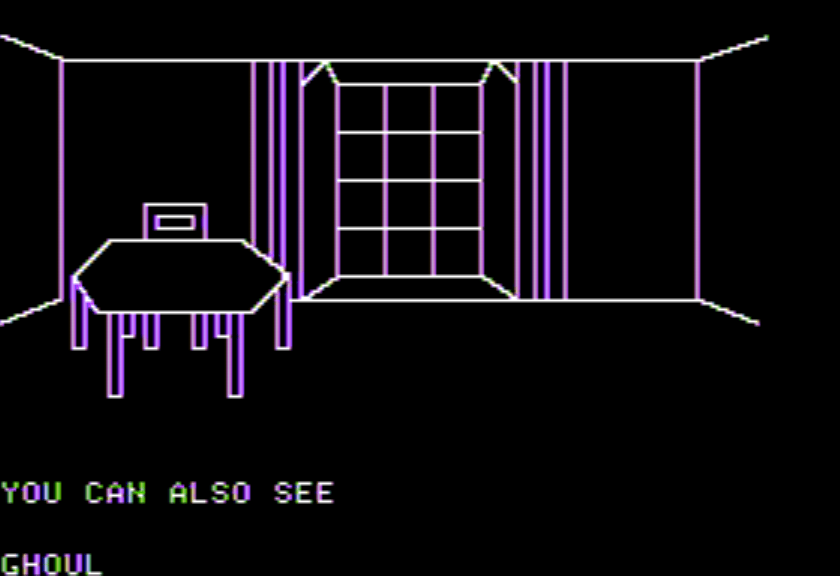
I need to backtrack on one of my statements: none of the monsters are only text description. If you can’t see one, you need to turn around and you’ll get a picture like the one above. So far I’ve run into ghouls, skeletons, demons, and vampires.
All of them use the same basic mechanics of trying to hit you for X damage while you try to hit them back for Y damage. If you have armor — one of the random plate mail armors scattered about the castle — it might get shattered mid-combat (or even sometimes right at the start before the hitting starts). Otherwise, your weapons skill plus some modifiers including I think strength and dexterity make up however much you hit the monster for. If that isn’t a large enough number, the monster then hits you back.
In my experience, if you have no armor when the monster hits you back, you are dead.
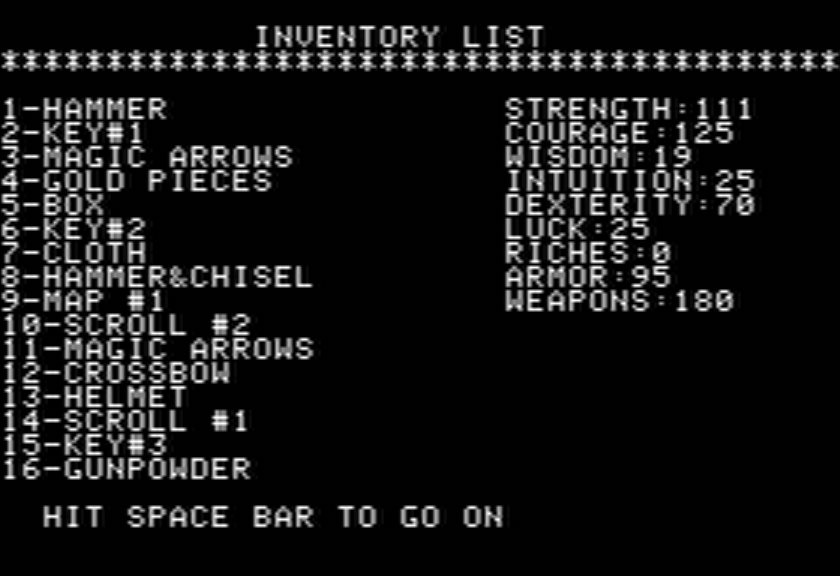
Fortunately, the way the weapons number is determined allows for easy carnage: each weapon you pick up increases your weapons value. There doesn’t seem to be any inventory limit I can find, so you can swipe up spears, magic arrows, crossbows, etc. and all of them will contribute to your weapons value. Once my weapons value passed 250 or so I started to kill pretty much everything in one hit.
Before I was an absolute killing machine, but still pretty dangerous. Having magic arrows with no way to shoot them still increases weapon score.
Incidentally, the “Courage” value I have found to go up as I’ve killed more monsters. Fall of the House of Usher required a particular courage score to win; I don’t know if that is the case here. If it is, I won’t have too much trouble with my current character getting up to snuff. (If I wasn’t playing the former war hero it might have been more difficult. I still need to test if Frederick gets a weapons multiplier compared to the other characters.) The manual, while indicating the mystery should be solved, is somewhat evasive how that gets exhibited by the player.
In order to solve the mystery you must collect a series of clues and find the secret hidden chamber where a demon waits. To get the right answer you must read all of the background material and examine the three exhibited articles in this manual thoroughly. The answer is not a single word or phrase, but consists of piecing together all the clues and recounting the sequence of events that have brought about the curse upon the mansion and how that curse may be lifted.
Speaking of stats, I found out (by studying screenshots of the Atari version of the game) that you can USE WISDOM or USE INTUITION. This doesn’t work on any of the other stats. So far, I’ve always got the message
YOU HAVE NOTICED NOTHING SPECIAL
but keep in mind those are my character’s dump stats. I may just not be able to use them at all. I do have the suspicion they’d help find at least one secret passage. Referring back to the game’s manual:
On going through my dresser this evening, I found a portion of an old mason’s worksheet. Next to one of the rooms I could clearly see a 5 foot space which appeared to be some type of secret passage. It appeared to lead to a small room. With hammer and chisel in hand, which I got from the Sculptor’s Studio, I set off to find the entrance.
Although I have lived here all my life and as a child played many a game of hide-and-seek, I have always found that the Palace seems a different place at night. To conserve candles and Mary’s work load, there are areas where there are no torches and which I hadn’t explored in years. Using my map I managed to locate the room and begin to chisel on the morter between what appeared to be two loose stones. In no time at all I had freed one of the stones and from then on the work became considerably less difficult.
— Lord Edward Stuart’s Diary, Saturday, December 14
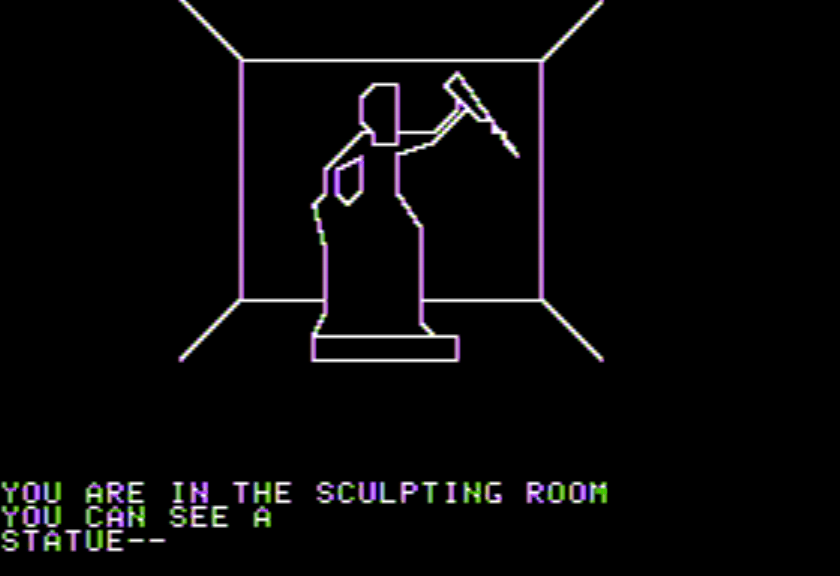
There is a Sculptor’s Studio, and there is indeed a hammer and chisel inside. What I don’t know is where they go to; I haven’t gotten to the point of USE HAMMER&CHISEL on every single wall. Part of my reticence is I’m not sure how broken the game really is.
For example: I have a CANDLE and some MATCHES now. On the second floor of the Palace, there are some dark areas:
However, my attempts at doing USE CANDLE or USE MATCHES or LIGHT CANDLE or LIGHT MATCHES all get the response NOTHING HAPPENS. (???) I’ve pretty thoroughly scoured the map otherwise and found no torches, although they are recognized as a noun in the game. I still am guessing at the moment the game intends torches to be the light source and they’re just hard to find, but I still have the lingering thought maybe the game is literally broken and light is impossible.
The game still has fairly deranged graphics in the hallways which don’t give me hope. Also not encouraging: the message YOU HAVE PICKED UP A EMPTY upon opening a cabinet with nothing in it.
Weirdly, the graphics in individual rooms aren’t too bad, and sometimes have been genuinely evocative. It feels as if there was a nice concept and core to start with, but the game was shipped out incomplete.
That second screenshot is from the cellar, which has been a smaller map than the other two.
Torture chambers and dungeon cells.
There’s a map feature I haven’t mentioned up to now which is plainly apparent above — sometimes you have multiple exits off the same direction. The way the game handles this is to have multiple doors side-by-side, and when you press D to enter a door, the game prompts which door (left, middle, right) you wish to use. It more or less works, but the game already has a lot of friction so I’d rather have done without this feature.
This will prompt 1.) left or 2.) right upon pressing D.
One last environmental feature which seems to be random but is honestly creepy: sometimes maggots or rats will appear. I tried fighting but had no luck; the best that I can do is run away. Sometimes it takes a couple of attempts, and the rats/maggots don’t leave a particular area after they’ve appeared.
I’ll grant this has the right amount of creepy, and the disjoint with the perspective graphics makes it even more cursed.
I’ve still been finding many “clue” messages but they’re for the most part repeats of ones I’ve already found. The most interesting has been a picture:
This tracks with the “meet me tonite” message, the fact Elizabeth was seen in town, and even the weird fact that the Butler wakes up later (I guess he’s out with Lady Elizabeth shenanigans). I don’t now how this translates to the mystery. If this is just repeating Fall of Usher then Elizabeth was killed by Lord Stuart’s ex-wife (who is still alive, and there already was the clue she didn’t have a death certificate), and that’s that, but that doesn’t quite mesh with the extra information so there might be a twist.
I don’t have a good sense how close I am to the end of the game. I’m going to guess halfway. What I’d really like to do next (assuming I don’t magically resolve my light problem) is find the subcellar. Not only does Lord Stuart’s diary imply the existence of such, but there’s a clue directly in the game:
However, given my character’s lack of visual insight I need to hope USE HAMMER&CHISEL on the right spot will work. (Maybe my MAP #1 or MAP #2 would help, but the game won’t let me read them. Nor will it let me read my SCROLL #1 or SCROLL #2, or read the BOOKW, or any of the various letters. Did I already say this game is janky? This game is janky.)
With a last triumphant whack of the hammer, a major portion of the wall gave way revealing the passageway I had seen on the map. I soon found myself in a musty spider infested passage and proceeded South. After walking just a few feet I found a door. The passage must have been the remnants of an old hallway sealed up long ago. On entering the room I first spotted a large old chest. Surely, this must be where Edgar had hidden his gold. Within a few moments my elation had turned to horror as I turned my gaze to the far corner of the room. There, crouched beneath the sign of a pentagram, was the most loathsome creature I have ever seen. Its yellow eyes gleamed dully in the light of my candle and its 7 foot tall body was covered with a sickly grey matted coat of fur. Around it were strewn various skull and human bones and next to was a stack of fetid rotting entrails. I dropped my candle and was plunged immediately into total darkness.
I flailed about and rushed blindly to escape. In my confusion, I rushed headlong into the thing and reached out to grasp its slimy fur. With a scream I reversed my direction and found the door. In a stumbling flight of terror I crunched into hard stone and banged my head on the low overhang. After what seemed like an eternity I lunged through the entrance to a moonlit room and rushed into the hall.
I now sit in my room. The rain still beats upon my window and the image of that horror is still etched forever on my feeble mind. I can feel myself tottering on the edge of sanity. There are footsteps coming down the hall. I can hear the sound of Virginia’s voice calling me … the knob is slowly turning and my door swings ajar … for a moment I can see nothing but a dark shadow in the door. There is a brilliant flash and poised in the doorway I can see it … as I scream I can feel my sanity leave me as thunder shakes the helpless house …
Curiously, this game gives no year. Based on other factors I’m guessing early 19th century, and it does give the date the body is first found: Wednesday, November 27. I will hence assume 1839 (where that date fell on a Wednesday) which also happen to be when Edgar Allan Poe was publishing.
In the morning, the butler Charles had found the a body charred in the furnace; Elizabeth had already (allegedly) left for Boston when all this occurred.
A search of the house reveals a mysterious “blue scarf” that is beneath Lord Stuart’s night clothes; the body is never identified. By December Lord Stuart starts to hear footsteps and scratching. The family cat, Herman, goes missing.
On December 13, Lord Stuart writes:
1:00 P.M. Today, in the old library, I made quite a find. In the old house plan there are quite a few rooms in the palace that were apparently sealed up when it went through reconstruction 60 years ago after the fire. I remember Edgar, my grandfather, was quite a miser. Perhaps, there is some of the old family wealth hidden in one of the old rooms. After the servants are asleep, I think I will do a little treasure hunting myself tonight.
There’s some other fragments of interest; he knows that his steward Michael has been skimming off his cash; Sybil (the steward’s wife and another playable character) never liked Elizabeth and seemed pleased when she left. The Lordship’s inheritence is going to Elizabeth and his butler (for his long servce); nothing is going to Michael or Sybil.
There’s literal fragments mentioned later in the manual, as “scraps of paper found in the trash bin by the furnace”.
… and my lord I mean to inquire about your maids daily purchase of 30 lbs of raw entrails. It is beyond my comprehension how you … the Butcher
… your Butler Charles has been seen boasting in the pubs that he has newly come into a great sum of money … paying in gold coins and raising quite a riot in the city …
… would like your help and cooperation in this matter. Seven of the townspeople have disappeared in the last month and were last seen in the vicinity …
… saw your wife Elizabeth just recently in the company of …
There’s a letter from Lord Stuart to Elizabeth, which seems to be written close to the start of the game; he mentions how most of the staff has left, how “at night the house seems alive”, that the family cat somehow still is crying at “the North Wing upstairs”, and that
When it is all over I shall send for you and we shall leave this evil house together to start a new life somewhere near London. I count the days until we shall be together again and the curse that seems to have fallen on this house is lifted.
There’s a schedule of the maid, Mary, showing when candles are lit, when breakfast is prepared, when things are cleaned, when candles are snuffed. Curiously, “Search for Herman” (the cat) is explicitly listed at 8 AM.
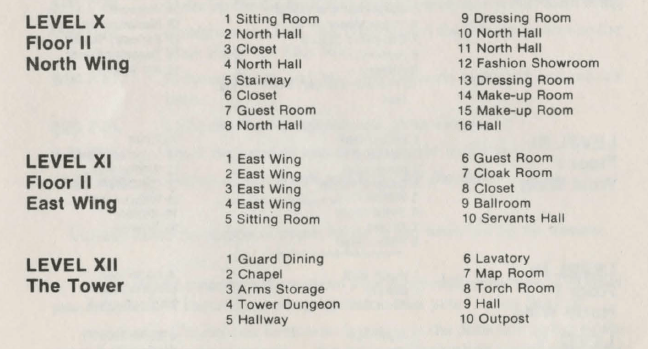
Courtesy of the head steward, there’s a complete (?) listing of rooms at Stuart Palace. There are a full 12 floors, all the way from a torture chamber at the bottom and “Guard Dining” at top. There’s also a listing of “objects” immediately after.
Based on the voting, Frederick the gardener narrowly won over the butler. People seemed to think the butler did the killing. Given the supernatural elements, it is faintly possible that the player could be unawares that they committed some horrible crime. If you’re actually thinking the butler is the full instigator, when he’s a playable character, that would be unique indeed. I’m not sure how that’d even work game-design wise, since every character starts the same way (outside the Palace, then you go in and start investigating, with no more info than what was given above) and with the same goal (solving the mystery).
In his youth, Frederick was distinguished as a war hero. His knowledge of weapons and arms is extraordinary. He is of moderate physical strength and intelligence. His [sic] of the Palace is fairly limited. He is 44 years old and is missing his left arm.
RICHES, ARMOR, and WEAPONS all start at zero. If the manual isn’t lying, then our character will have some skill multiplier when they get a weapon.
Dexterity is moderate, not terrible (maybe it would have been higher but, well, left arm; our hero is still clearly athletic). The wisdom and intuition are trash compared to Sybil’s (she gets 101 and 102). The manual hints at hidden passages and the like and I’m guessing we’ll just have to find them ourselves rather than have our character pipe up for us.
We start with a HAMMER. This works as a weapon (if we USE WEAPON it gets wielded, and you’ll see a combat a little bit later). The Lord of the House incidentally starts with a KEY, the Butler has some MATCHES, Michael starts with a BOOK, the Maid has a KNIFE and Sybil has … TUPPERWARE. (Given she has the power of divination, perhaps it’s the best start of all; you need to carry some holy water you find, maybe?)
Let’s concentrate on the first floor. Unfortunately the map is confusing enough I haven’t quite gone through everything yet.
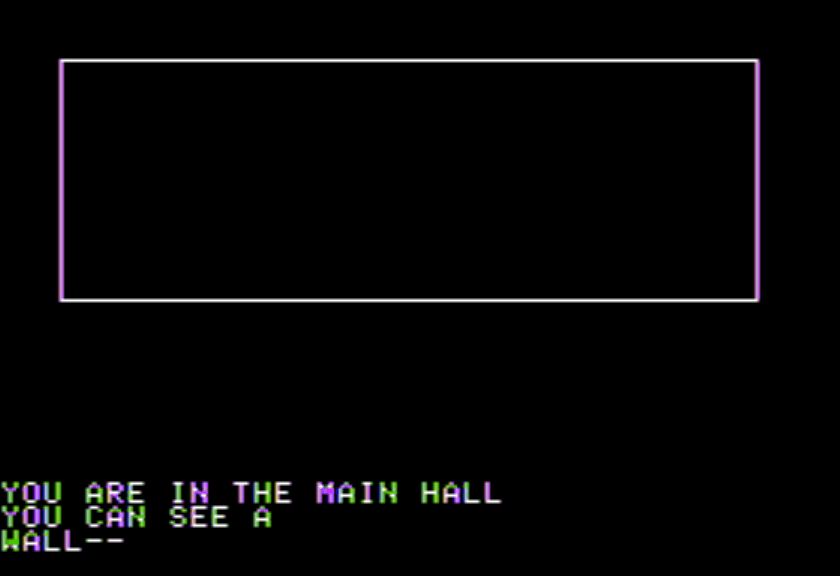
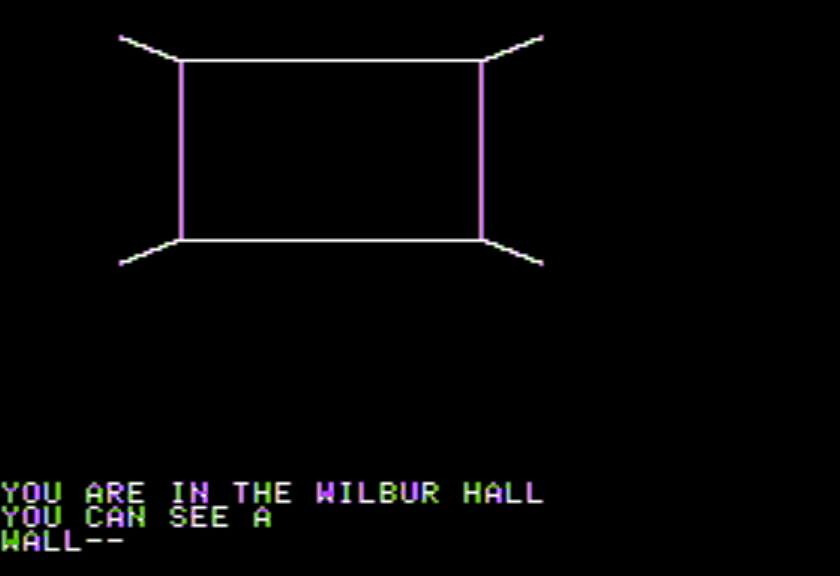
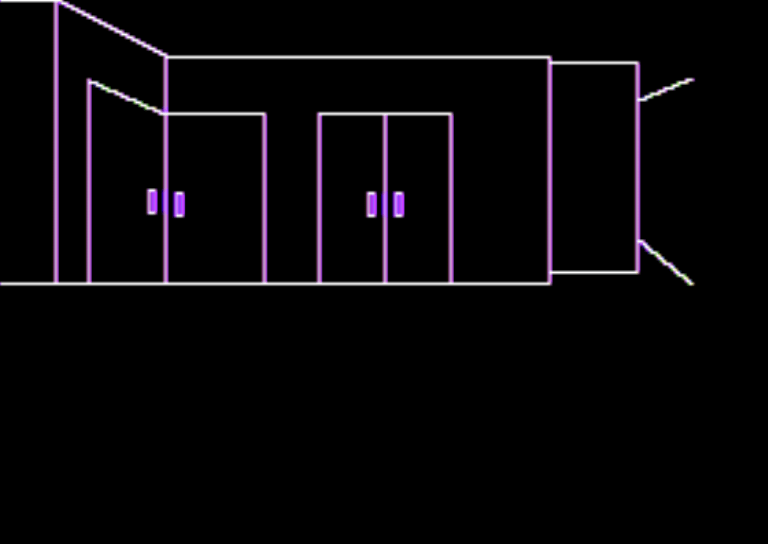
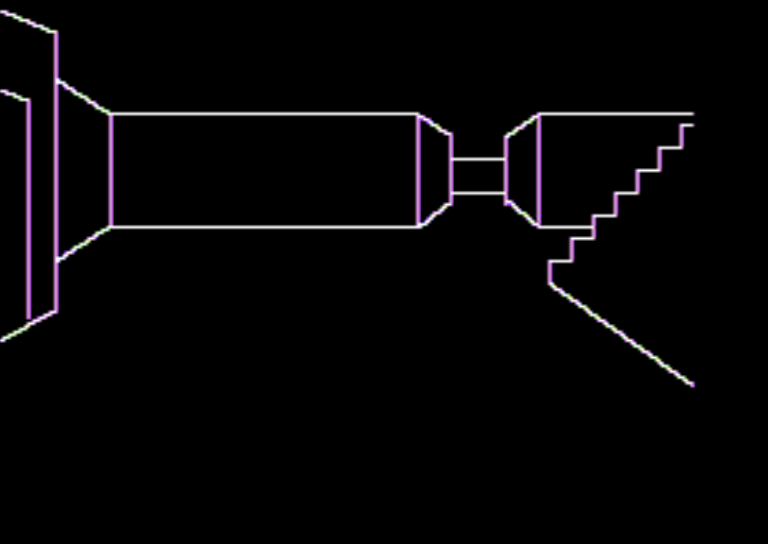
This is designed sort of a hybrid between a typical 3D-map dungeon crawler game and a regular adventure game. Sometimes objects and rooms are repeated, but there are enough unique elements you have to map everything carefully. The only way to proceed is for each spot on the map to look all four directions; that is, press N L E L S L W L (turn and look) as sometimes things are only visible from certain angles. Additionally, you can’t fully trust the graphics you see. This is especially true of the passages and hallways; for whatever curious reason the game has many ways to render a “wall”.
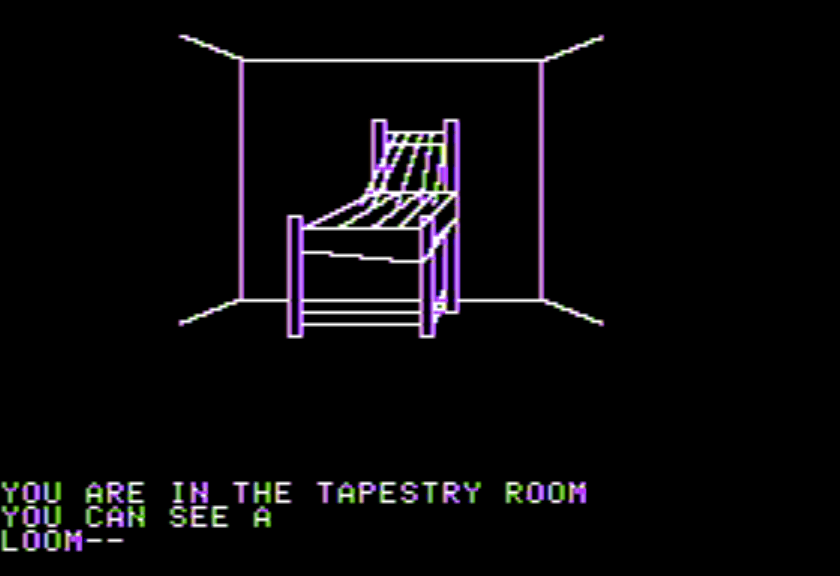
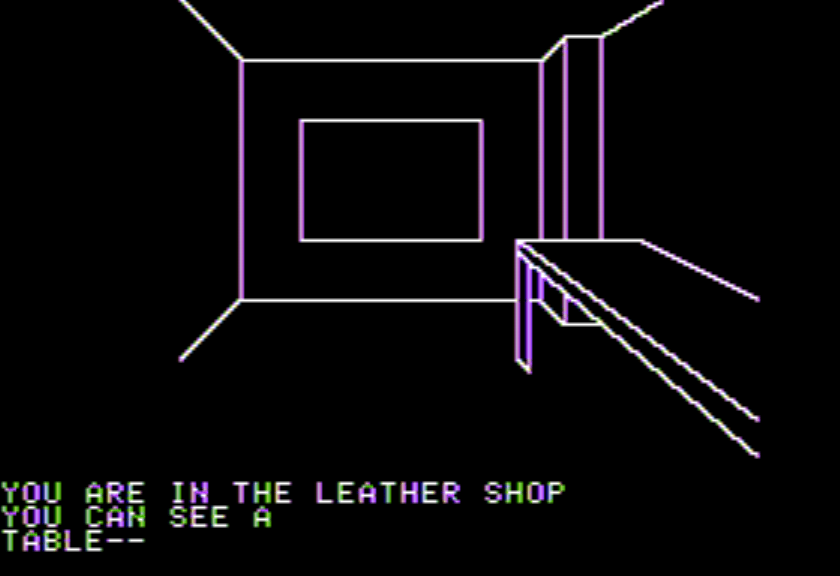
I had to simply shut off the Wizardry portion of my brain which reflexively wanted to map using the distance to walls on-screen. It just isn’t dependable enough to figure out. Rooms are a little more consistent; here’s three views of a leather-working room (notice how all the views show different items).
Sometimes the objects are just scenery (like the table), sometimes they can be interacted with (like the chest).
Some rooms have a “clue”. In one case this was clearly a “note”; in other cases I’m not sure where the clue comes from at all. Hearing things in your head? The Palace whispering its secrets?
THE BUTLER SLEEPS UNTIL 9 AM
CHARLES WAS ONCE AN ACTOR
SOMEONE SAW ELIZABETH IN TOWN
NOTE TO CHARLES: MEET ME TONITE IN–
MAID SHOPPING LIST: ONE NEW UNIFORM
NO DEATH CERTIFICATE FOR VIRGINIA
Virginia is Lord Stuart’s first wife, who allegedly committed suicide 10 years ago. I’m wondering if we’re playing a higher-attenuated character if we’ll get more clues, or maybe some of the clues on different levels will be harder to hear without a higher intuition.
One last thing to mention, although I implied it last time: the game has combat.
The ghoul is text-only. I also ran into some maggots in a hall that did actually display, so it seems to vary based on the enemy.
It is possible to run away, but since I had the hammer with me, I decided to engage.
I managed to score a hit of 126 (I assume 201+ would mean I won) but was slain by a hit back.
Note the “did you learn enough” message here — just like many of the other Crystalware games, this one had a contest with it; $500 for the first to send a correct entry form:
Play the game and explore the mansion until he or she feels they have solved the mystery. It is not necessary to win the game to enter the contest.
The fact it mentions winning the game means there is a way to also win. This matches with Fall of the House of Usher, where you can get information to work out the resolution to the mystery. Incidentally, the House of Usher also has a Virginia and an Elizabeth. I don’t know if this is intended to be sort of a remake, but this does have more characters, so this might have a slightly more complicated plot.
In 2018, John Bell wrote a Facebook post for his group Crystalware Defense and Nanotechnology, giving an introduction to his forthcoming game Clonus 2049 A.D. as well as a six minute narrated introduction. He had just survived a heart attack and had renewed purpose:
Crystalware survives and I,some have said one of the grandfathers of the creation of the modern graphic adventure games and a pioneer in the future working on World of Twine – a quantum leap in Augmented and Virtual reality. Will I survive to finish.. I hope so. I am posting an audio we made for Clonus, a game I made and the mythos was revised after 9/11 and done by a Hollywood actress who wishes to remain anonymous. It is my vision of the future – which still haunts me and has since I worked at Lockheed in 1966 with Nuclear Missiles and the Navy. I cannot ever tell what I know but this is the effect that knowledge had on me.
John Bell – a dream in 1966.
Clonus 2049 A.D. had been in progress since the 1990s. Regarding World of Twine, John Bell posted in 2019 about a dream he had of looking at an expensive haunted house that he was able to purchase because the World of Twine Virtual Reality game and novel now made him rich.
I woke up, now inspired to get out my new book and maybe soon to marry the woman of my dreams who would be my last wife. My son, of course, would inherit, the mansion as would my young wife. We would do the concert for the Give Me Shelter Concert for the poor, and also set up Homeless United in Los Angeles, and leave a mark on cyber history as well as set up shelters for the homeless from coast to coast in America, with our new modular design. Yet WOT would be the most amazing computer simulation and massively multiplayer online role-playing game – MMORPG – of 2020.
He died in 2020, never able to fulfill this dream.
I bring this up not to disparage the efforts of the man, but demonstrate his fundamental ambitiousness, pushing many projects all at once, even 35+ years after the game we’ll be discussing today.
A 2019 post from the World of Twine page.
The difference between John Bell in the early 1980s and the John Bell before he died is that he managed to accomplish at least some of his goals, and with his company Crystal Computer (or Crystalware, or U.F.O.) he (and his wife Patty Bell) managed to put out over 20 games in the span between 1980-1982. This might not be that unusual for this time — Adventure International lists over 70 in that same time period — but Scott Adams only wrote a smattering of those, while John and Patty seem to have produced more than half of their catalog themselves. Additionally, all the games are “premium”; most cheeky might be Galactic Expedition, which had a “base game” which cost $39.95 and six expansions that cost $29.95 each. (This also doesn’t include all their other projects as mentioned in their newsletter, like three movies, a “videodisk fantasy” laserdisc, and a series of educational software using the Crystal Theory of Alternative Education.)
Byte Magazine, December 1980.
According to his newspaper profile clipped earlier (which might be exaggerated a bit, but let’s go along with it for now), John went from high school to the army in 1972, getting a medical degree from Fort Sam Houston and practicing at a base in Germany for two years before returning to the States and landing in software development.
I don’t feel like the head of a big corporation. I wrote a few programs then I ended up with a big distribution network. We (he and the other programmers) want to stay creative so we have other people to do the busy work.
The first Crystalware game, House of Usher, is a sort of top-down action adventure, kind of a proto-version of a survival horror game. It doesn’t not count as an adventure game for this blog as the stamina value changes dynamically and there’s heavy structural reliance on action combat.
A fair number of the Crystalware games follow this model, presumably using the same source code to an extent. The CRPG Addict played quite a few before bailing and discarding them as not-CRPGs. He started getting very tired of the games indeed.
Quest for Power is another insulting game from Crystalware, a company that was either knowingly scamming its customers or so clueless about what made a good game that they must have never played one.
Ow. I am here to tell you that The Haunted Palace is a very different game than all of the ones experienced by the Addict. I can’t guarantee it is a good game, but at least it breaks the pattern.
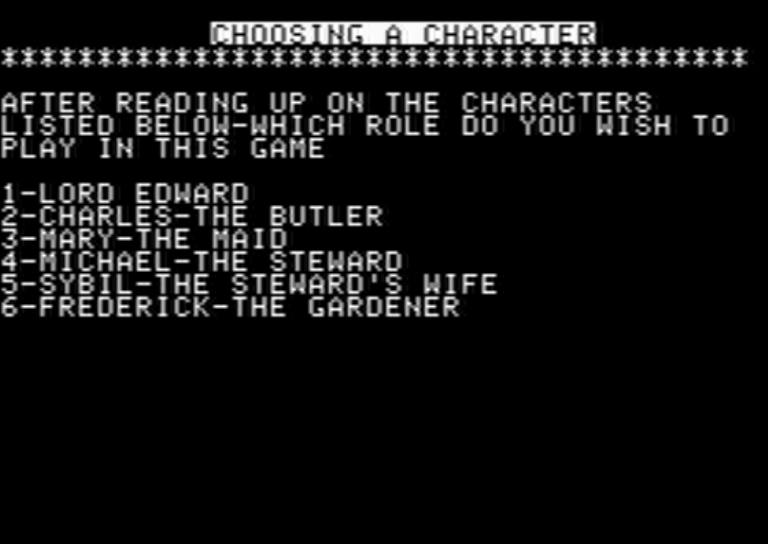
There has been a murder. It all started with the grisly discovery of a charred body in the furnace. The corpse was so badly burned that the mortician couldn’t even tell what sex it was. You can choose to become any of of the six characters in the game. Your role is to find out who is responsible for the murder.
This is a first-person perspective game with directional movement allowing turning. It’s something in feel between Asylum (with “dungeon crawler” style movement) and the Japanese version of Mystery House (also with directional movement but made up of 1 by 1 and 2 by 1-sized rooms).
The manual is fairly extensive, extensive enough that I’m going to save a thorough look for next time. However, the starting choice of character is essential. Unlike many games of this sort, you are not playing an “outside” character coming in — you’re part of the Stuart household, whomever you pick. It’s a bit like a LARP in that sense.
LORD STUART – An Oxford grad in his 50s with a heart condition. His first wife (Lady Alice) committed suicide and he fell in love with a Lady Elizabeth and has been living with her in the Palace for 10 years.
(You cannot play as the Lady — when the charred body is discoved she is away in Boston.)
CHARLES (THE BUTLER) – With the Stuarts for 40 years.
MARY (THE MAID) – Young, carries a knife, “knows a lot of the town gossip”.
MICHAEL (HEAD STEWARD) – Manages the Stuart fortune.
SYBIL (STEWARD’S WIFE) – Doesn’t like the Palace, has ESP ability.
FREDERICK (THE GARDENER) – Former war hero, doesn’t know much about inside the Palace, only has one arm.
Other characters, but non-playable: Herman, the Cat. Virginia, the first wife. Elizabeth, Edward’s current wife. Jonathan Stuart. The Guest.
The characters come pre-built with stats: strength, courage, wisdom, intuition, dexterity, luck, riches, armor, and weapon. So someone like Sybil will have higher intuition while someone like Frederick will have higher weapons ability. I don’t believe there is a way to “build stats” like an RPG (although I will keep an eye on this); this suggests a setup akin to Maniac Mansion where certain actions only can be done by certain characters.
The manual is unclear but you press “C” to enter “command mode” where you can enter a regular parser command. “L” will look. Otherwise, N/S/E/W turn in that particular direction, M moves forward, and D opens doors. There’s no “relative direction” turning, that is, no equivalent to the left or right arrow keys in a dungeon crawler.
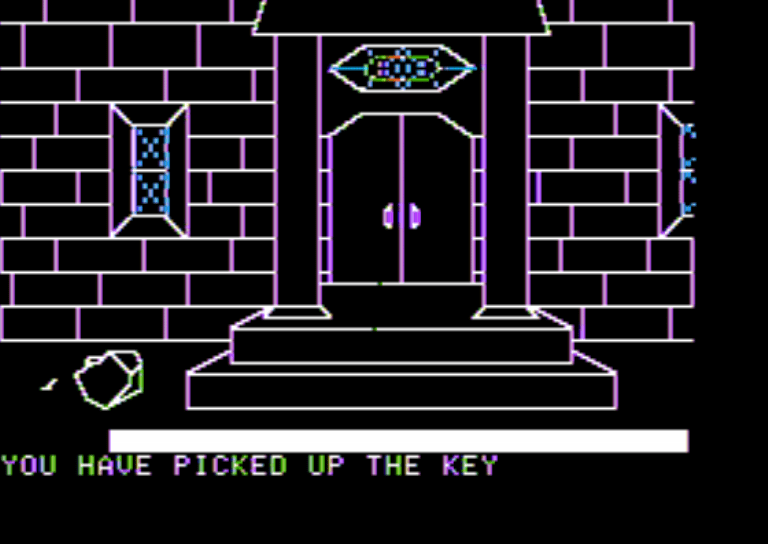
You start locked to facing north. There’s a rock you can move to find a key and unlock the front door.
Upon entering, you flip the disk to side 2, and the “freeform” 3D portion of the game starts. Below I have all four views from the first location, north/east/south/west. (I can’t say “room” — again, seems to have large open portions, so the same room may contain multiple nodes.)
I haven’t explored much yet, but I can already tell from my minor wanderings it might be confusing to be able to tell when it is possible to advance forward and when you are “blocked” by the scenery.
I haven’t played much more partially because: I want you (the one reading this right now, and assuming you aren’t going through my backlog) to pick which character I should use. Feel free to make an argument which you think is better. I can’t guarantee I will stick with it for the whole game if something is wonky (some door that I can’t open without a strong character and there doesn’t seem to be any other way through) but I’m going to try my best. The manual includes pictures for all six so I’ve made a collage.
Lord of the Palace, Butler, Maid, Steward, Steward’s Wife, Gardener.
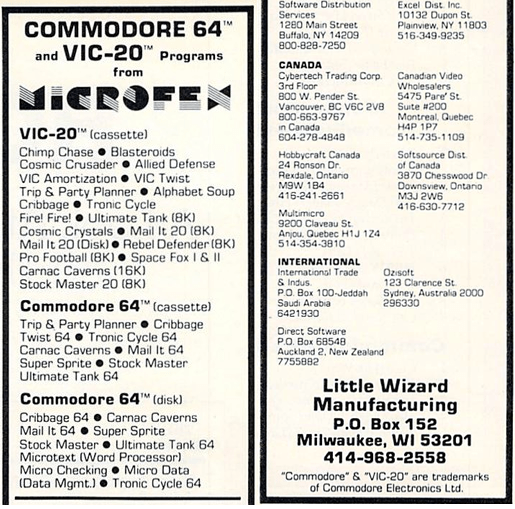
Microfex is another one of those mysterious early-80s computer companies that has fallen through the cracks, remembered for almost nothing. There is a Mobygames page, but as of this writing, it has only one game on it. Specifically, Ultimate Tank, so let’s start with that game.
Or is it different? The wizard iconography (which is repeated across publications) suggests Little Wizard is simply the manufacturing branch of Microfex.
This is emphasized by another ad which includes Ultimate Tank, and does not mention the name Microfex:
Commodore Power Play Issue 3, 1982.
This ad from Compute! Gazette, September 1983 includes both (it is tall on a page, so I placed two parts side by side):
You’ll notice from the ad some international distributors mentioned. One in particular turns out to be helpful: the Australian company OziSoft.
OziSoft started as a computer game distributor (see above) and eventually became Sega’s distributor to the whole Australasia region, being redubbed Sega OziSoft. As Sega’s distributor they are a well-documented company with some big history surrounding them, including directly setting off the entire Australian game classification system with Night Trap.
EUGENE PROVENZO: Well, it could be very exciting but what happens is that as the new systems come in, for example, the Sega CD-ROM systems, what happens is that the video game suddenly becomes increasingly interactive and videolike, filmlike, and so what happens is that we have something close to film rather than a traditional video game of space invaders or even the recent Nintendo games.
KERRY O’BRIEN: So that the violence becomes more real?
EUGENE PROVENZO: Much more real and you end up having the question of: is the video game now something close to film, video, or is it in point of fact a new type of interactive television?
However, we are dealing with the OziSoft of 1983, right when they were starting. Specifically, a small portion of the ad above and one of the companies it lists:
“MI” is just a code, but given it has Cosmic Crystals, Ultimate Tank, and other VIC-20 games listed on the other ads, it must be the same company (that is, Microfex / Little Wizard). The MI suggests it is using the Microfex name for the abbreviation.
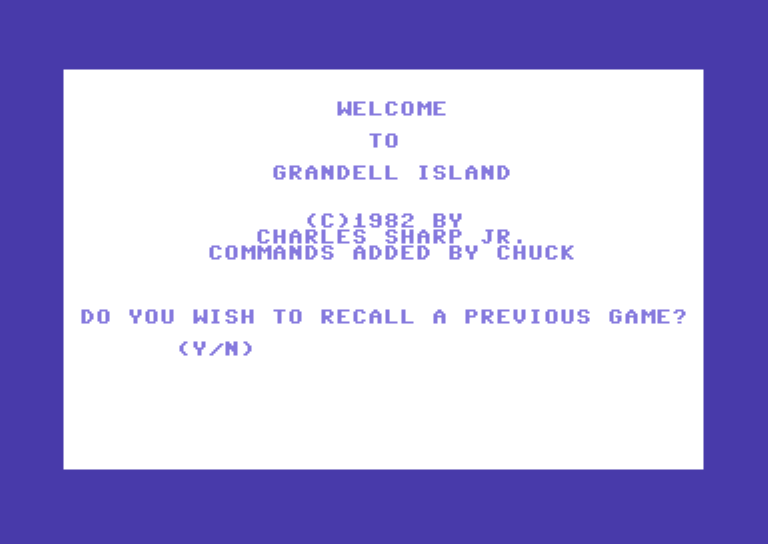
Included on the list are Cribbage (MI 007) and Grandell Island (MI 008), both by Charles Sharp Jr., he of the Young Arthur game for VIC-20 we just saw. So while the version we have extant of Grandell Island has no publisher listed and is for C64 (and a 1982 date on the title screen), we can firmly say there was a VIC-20 Microfex version.
(That seemed like a lot of work for a minor detail, but remember this company which apparently distributed as far as Saudi Arabia has almost nothing out there about it!)
For the record, here’s what Cribbage plays like:
I strongly suspect Grandell Island came after Young Arthur’s Quest. Even though the C64 version I played had some tweaking (with a “commands” list added by someone named “Chuck”) it feels less broken.
It’s still pretty broken, though; it’s kind of like writing a text adventure where, while it does keep track of inventory, essentially every action is custom-created for a particular moment while nothing is consistent.
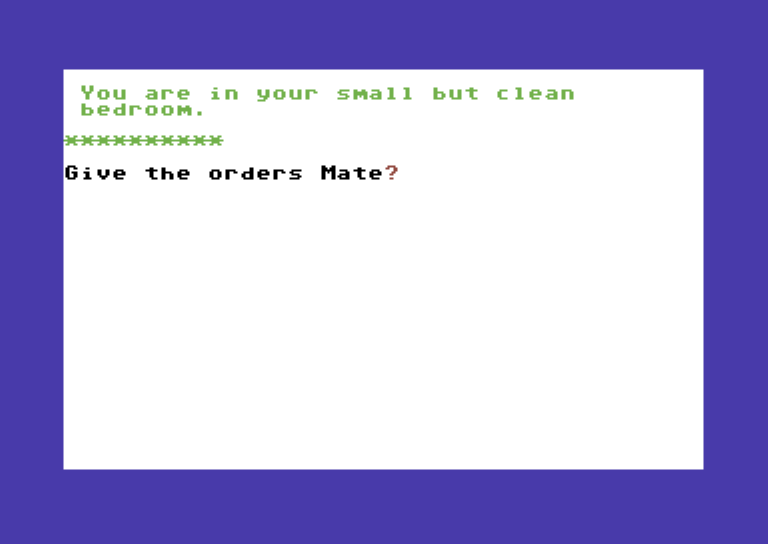
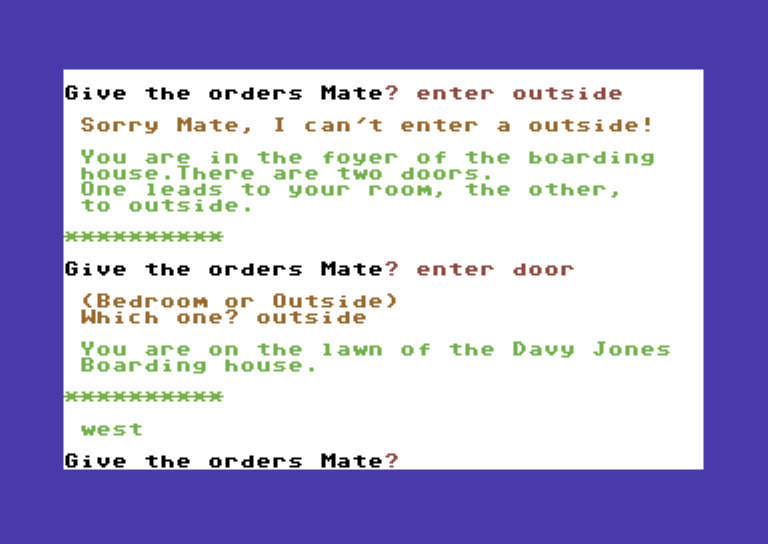
A good example is at the very start of the game. Knowing that Young Arthur used a lot of LEAVE and ENTER for directions, I did LEAVE BEDROOM instead of trying a direction. Good so far. This landed me in a foyer, but then when I tried to LEAVE FOYER things went awry:
Here, the command switches from LEAVE to ENTER DOOR. Of course, since there two doors, the game needs to have a custom prompt just for you to specify which one you mean, and this is the only place in the game this type of prompt appears.
The only purpose of that section was to show the main character waking up and going outside. It is kind of like one of the dodgy amateur movies like Manos: The Hands of Fate which has 5 minutes of car travel with nothing happening. That’s how long it took me to get outside.
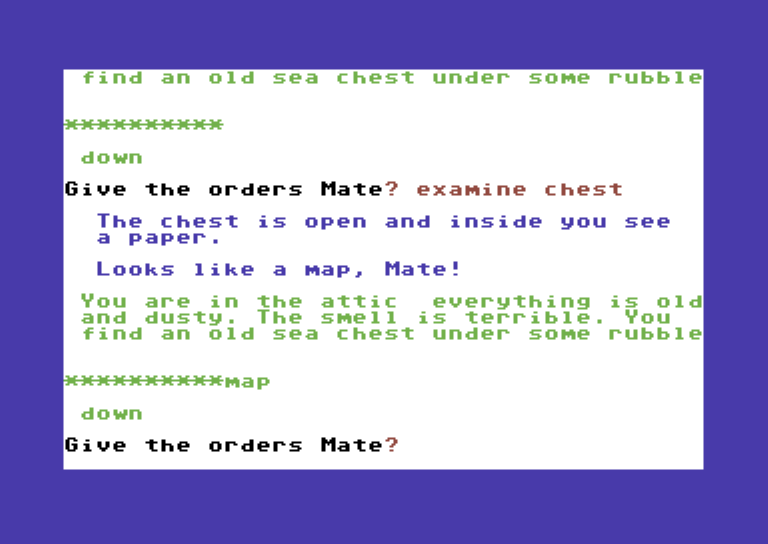
Once outside, you can visit a lighthouse; you need to CLIMB STAIRS to go up but just use the direction DOWN to go down. There’s a tavern you can visit where the command QUESTION BARTENDER works (fortunately, there’s a command list, that’d be hard to find) followed by BRIBE. (Your inventory does not indicate you have money, but it works anyway.)
I’m pretty sure the above scene is technically unnecessary. All you really need to do for the first part of the game is raid the Commodore Grandell’s house, go upstairs, fail to break into a chest, go back down to find a maid cleaning, and BRIBE the maid with your invisible money.
This doesn’t quite unlock the chest right away; you have to go downstairs and unlock a drawer at a desk, and that desk has the right key to go unlock the chest. There’s a strong sense of narrative sequence yet a simultaneous issue with the sequence not being a terribly interesting one.
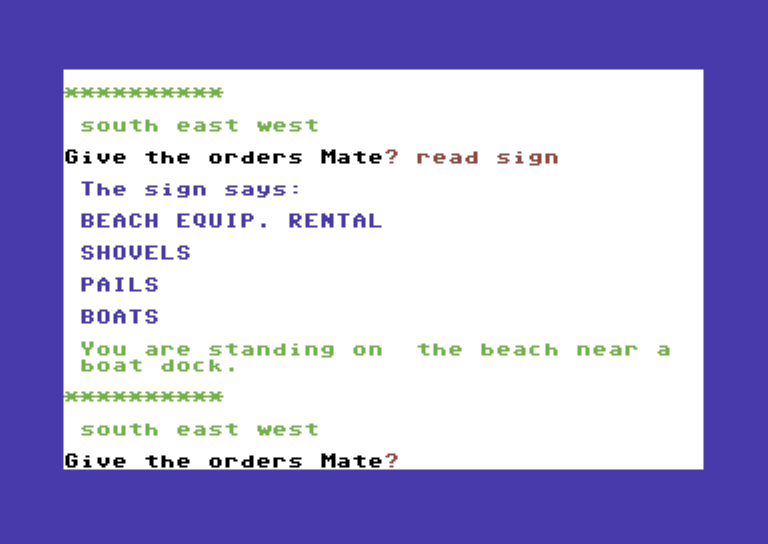
Now, the next step is to go by the docks and examine them where you will find a previously invisible shack and a sign you can read.
You can then rent a boat and hop in, trying to get to the promised Palm Island.
The map is slightly tricky; you have to imagine you’re starting the boat on the green portion of the first island, but not going all the way to the green portion of the second island (otherwise you crash). Even on a tiny mini-game the game is inconsistent about travel, argh!
I have circled the intended start and end square. So you have to start with 3-north, not 2-north, but end with 2-north, not 3-north.
The whole point of getting to the island is not to start digging for buried treasure, but to get a clue from a parrot where to dig.
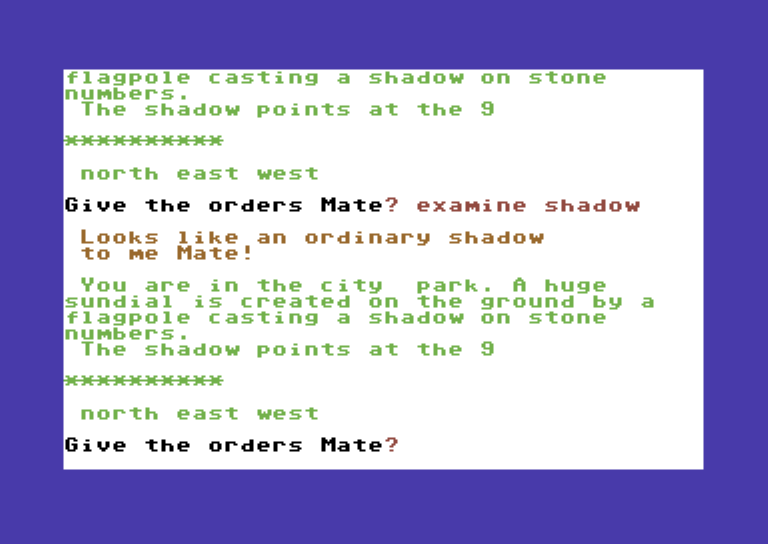
So the next step is: travel back to the original island! There’s a room with a sundial which seems the obvious thing the riddle is referring to.
When the sun is at its peak is clearly referring to the “12 noon” position. Really the issue here is a parser one. You can’t DIG 12, and as far as I can figure out you can’t wait for the right time and DIG SHADOW. You have to DIG HOLE; the game then asks where, and you type 12.
This is an author who was clearly enthusiastic about adventure games; there’s a “script” of events that maybe seem reasonable on paper? The interaction design was just miserable to slog through; if the parser was easy to use (at least even relatively speaking) somewhat easy puzzles would be fine. However, most of my game was occupied by working out how to communicate, not what I wanted to do in the narrative universe.
I think this is a case the author might have benefited from one of the systems like The Quill that eventually came out, but this was just a little too early (and no such system surfaced on the VIC-20) so he had to resort to awkwardly-cobbled together BASIC code.
I do want to emphasize I am still grateful the game exists. I know for some of these “lesser” games it may seem like I am just spinning in place, but each new game gives me a little better idea what authors faced in this time period, and even though the wild inconsistency of the parser made for a poor experience, at least it was a unique one.
























































 Renga in Blue