Every decision is scored. The Island keeps you under constant surveillance and monitors your every movement. The score is set to zero at the start of the game and is incremented or decremented based upon whether or not your actions are those of an individual. The more individualistic you are, the greater your score will be. This score is revealed only upon winning, losing, or suspending the game and is closely linked with your chances of escaping. Many doors will be closed to you until your score reaches a high enough value. Since this score is mostly invisible to you, you must weigh and verify your own decisions to determine if they are in your own best interests. The authorities (i.e., computer) will give you no help.
From the front cover of the original manual.
Prisoner 2 has at least four versions out there, probably more. This ends up being important later.
For Apple II, there’s versions 1.0 and 1.01. I started with 1.0 (which gave me a code of 444 to start) and switched later to 1.01 (which gave me an entirely different code, 314). 1.0 seems to always give 444 as a starting code while 1.01 changes it. There’s also versions for the Atari and MS-DOS. The DOS version is lost, but the v3.0 of the Atari port is available.
Here’s Highretrogamelord playing through the opening on Atari:
The bit at the start with the airport (where you try to type a destination but the game types “THE I” for you before cutting off) is in 1.01 but not 1.0.
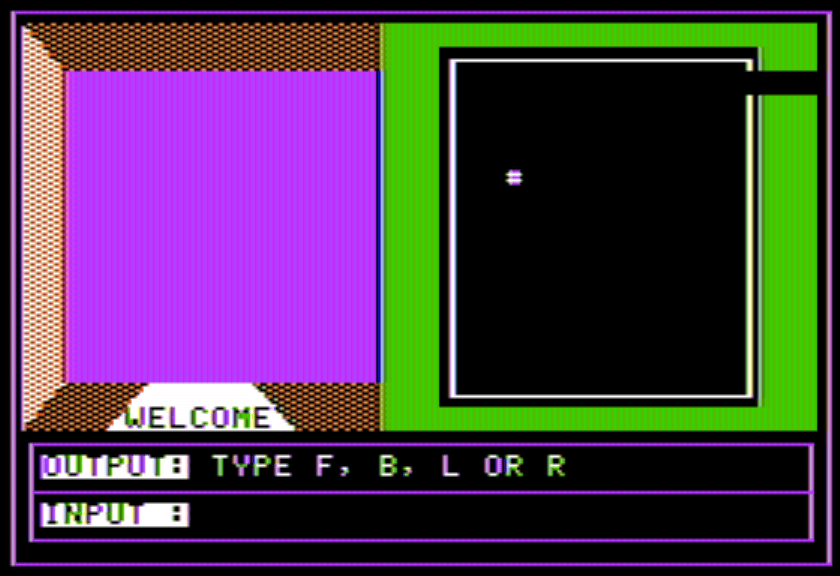
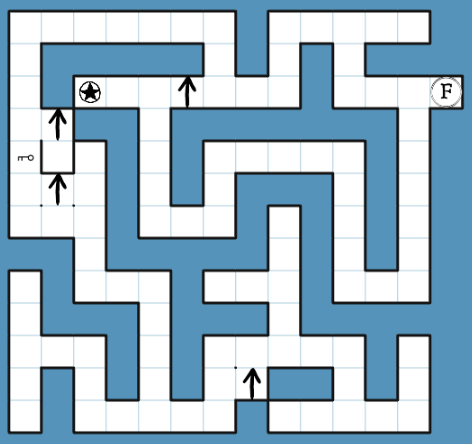
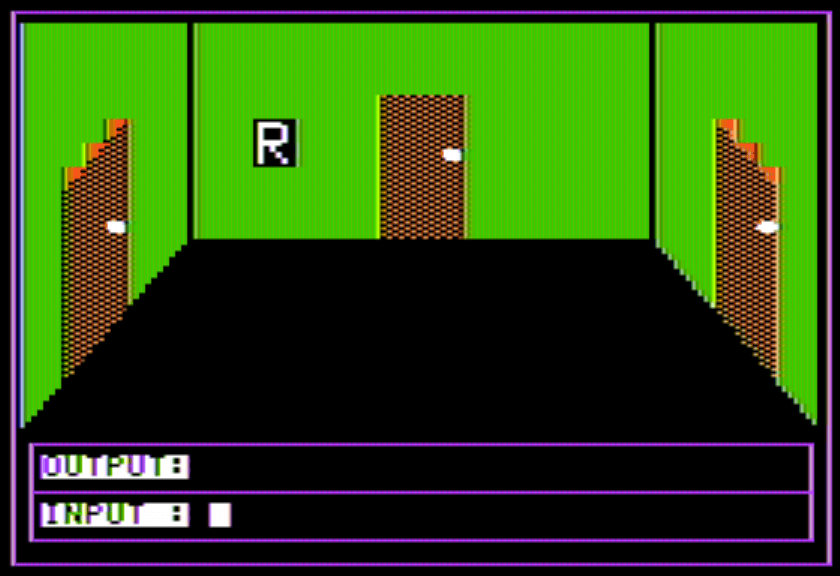
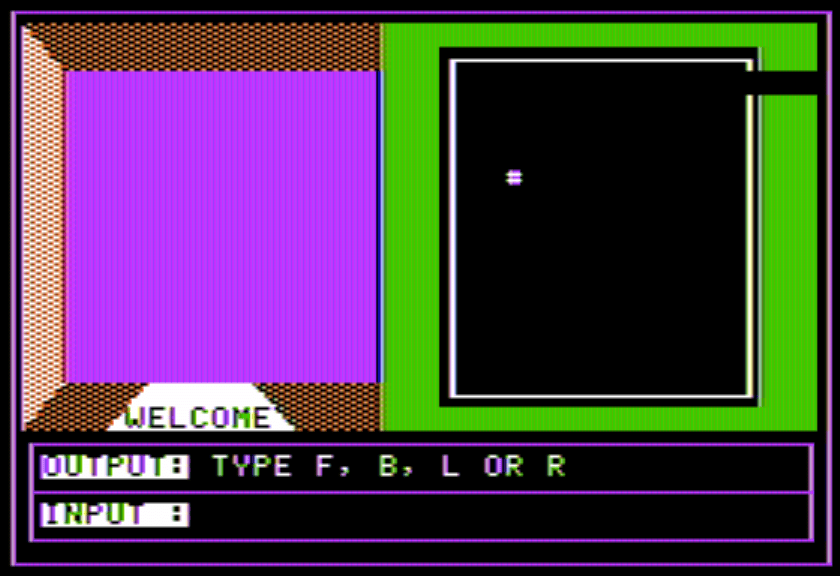
The opening maze was simply a top-down invisible maze in the original The Prisoner, but it is a much odder 3D-maze here. I’ve heard it compared to Wizardry, but Wizardry lets you turn around. In this maze you are always facing north, while using F, B, L, and R to move north, south, west, and east respectively. Here’s my map from playing 1.0:
Star is the start. F is the finish. Up-arrows are teleports that jump you back to start, saying “WHAT COMES UP…”
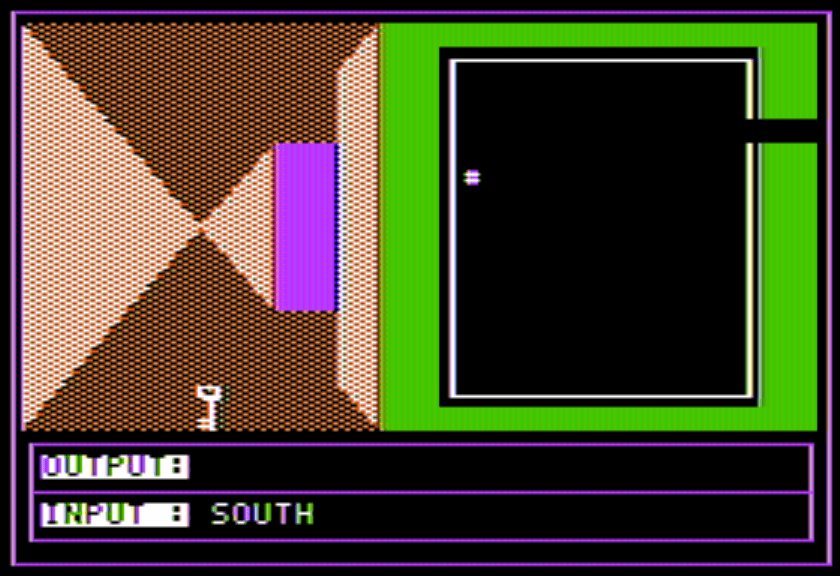
The weird effect of not being able to turn is that you can move “south” without seeing it, meaning there’s an extra layer of obfuscation to the game. At least with this map you have to discover the issue quite quickly to get anywhere (the third turn goes “south”) but check out this map I got playing 1.01 (note this is generated randomly, so if you play it will be different):
Yes, there’s a key not present in the other version.
With this map, just going straight east will result in getting teleported back to the start. I could see someone getting frustrated thinking there is some trick to skipping the teleport as opposed to realizing you can make a turn.
Also interesting about the new map is that it is more or less a straight shot to the exit, meaning players are likely to miss the key.
I don’t know if that means the key is elsewhere in 1.0, or that feature got removed. I did check the map quite thoroughly so I don’t think there’s a hidden exit.
You exit at 6 (just as the show, and the original game). The map is in four rows, buildings 1-5 on top, 6-10 on the second row, 11-15 on the third, 16-20 on the bottom, and is surrounded by a picket fence.
I mashed together screenshots like one of the old maps from Nintendo Power.
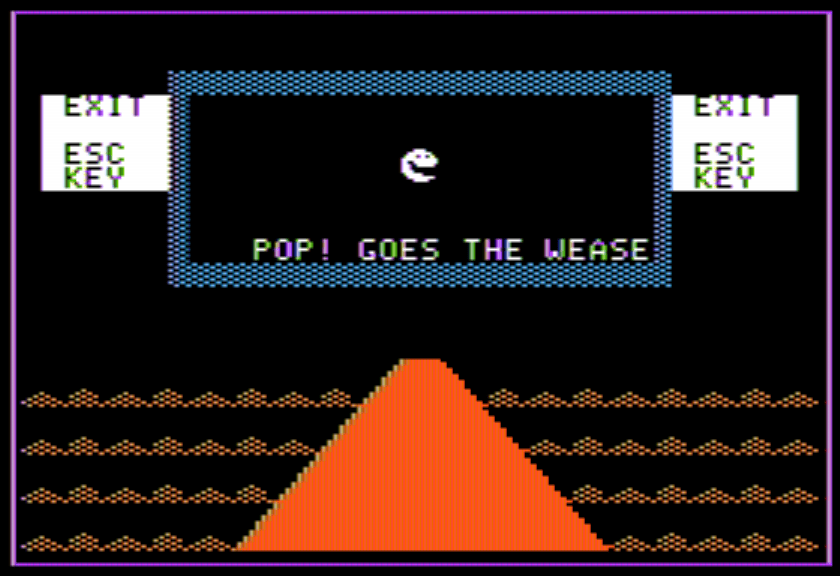
If you attempt to climb the fence, a bouncing ball appears (I assume meant to represent Rover from the original show) and you get warped back to the start.
The bouncing ball is not that menacing in Apple II format, but I’d recommend taking the minute to see the original from the TV show if you haven’t:
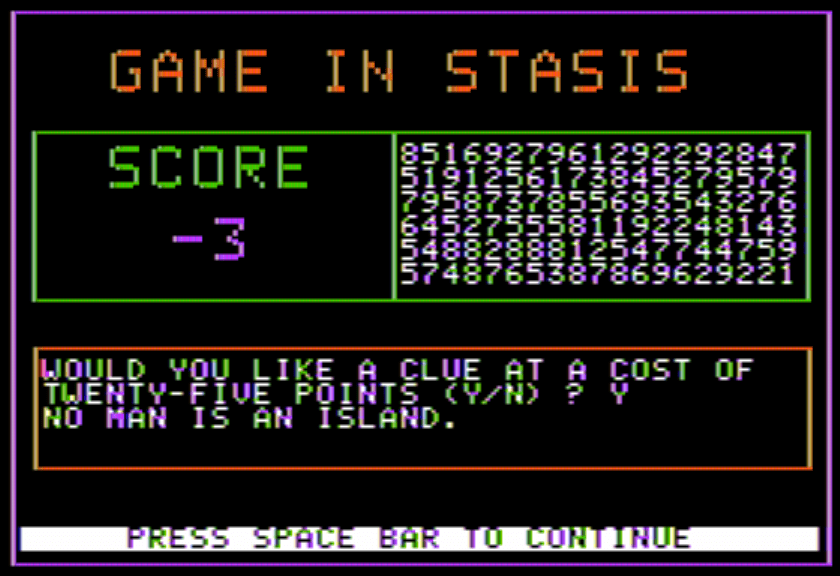
Moving on: you can CTRL-C out to “put the game in stasis” whereupon it will give a score. I started with a score of -3. You can also get a “hint” at a cost of 25 points.
I then tried all 20 locations.
1 — HOSPITAL
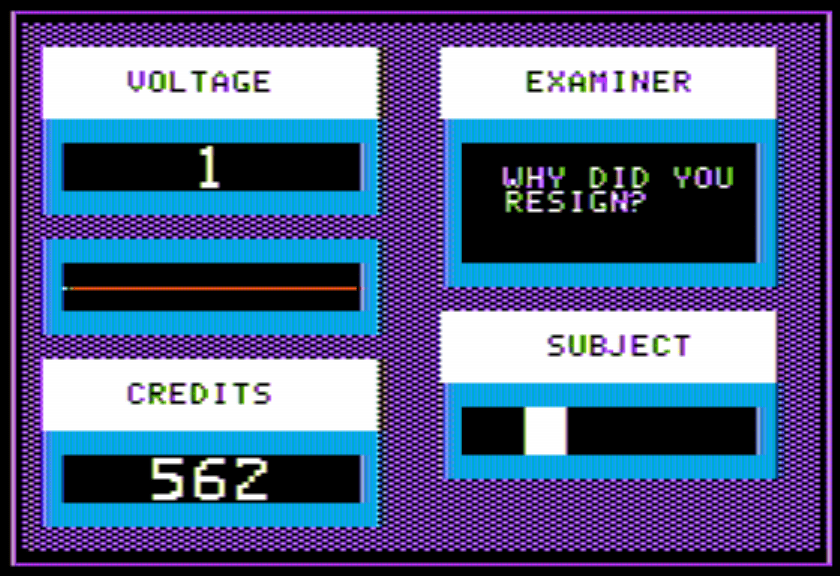
There are doors with a choice of Free Association (press L for left), Shock Treatment (F for forward), and Psychomotor Skills (R for right). B exits. I believe these were separate buildings in the old game.
Psychomotor Skills asks you to push the buttons the game asks for.
Shock Treatment asks for … I’m not entirely sure.
You get asked why did you resign, which I guess you can game over with if you like by typing your code.
However, if you type anything else, you are just told the subject is easily shocked and sent on your way.
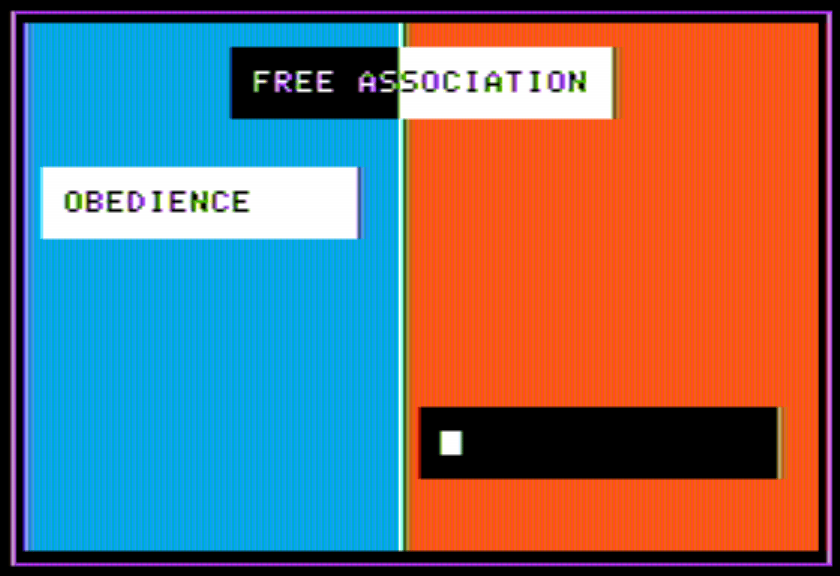
Free Association is a slightly colorful version of the original, where you are supposed to say words in response to other words.
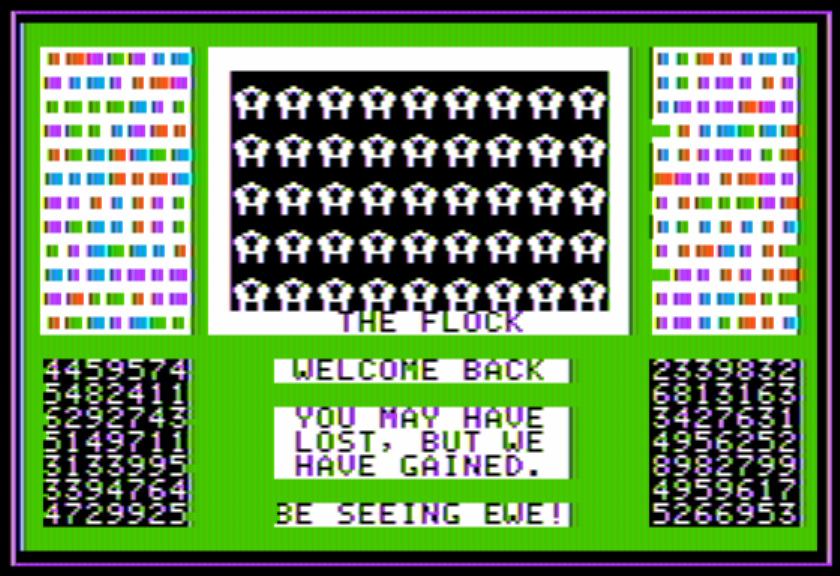
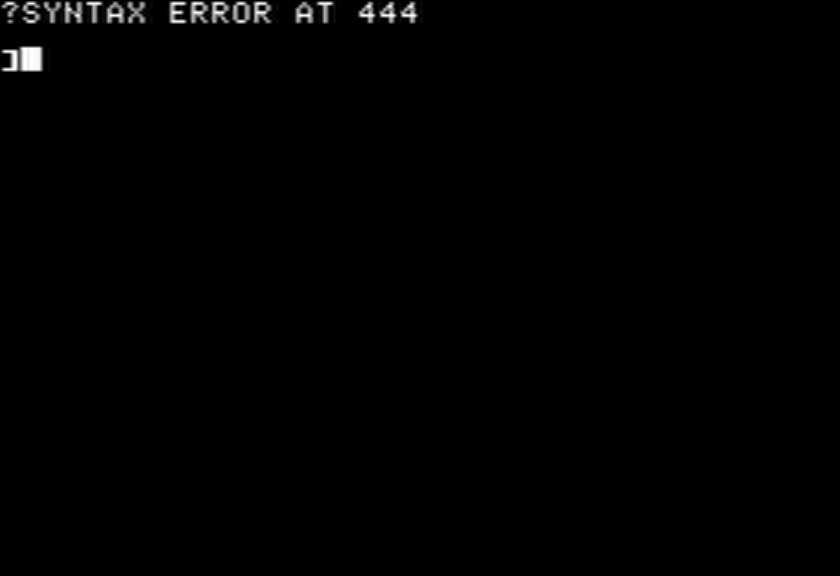
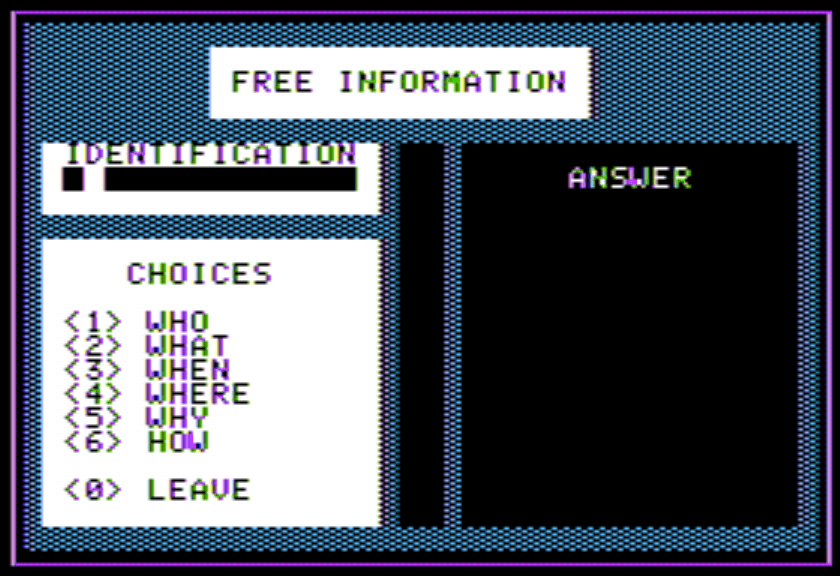
If you type FREEDOM you hit an Easter Egg of sorts.
This shot was taken with v1.0 and the old code.
Huzzah! I only found this post-game in the first version. The point is to make you think the game has crashed and you respond with the usual Apple II syntax of LIST 444 to debug the code. It is slightly less believable here, since the game doesn’t feel like it is about to crash otherwise, but I still can see an Apple user from the time being fooled into typing the code.
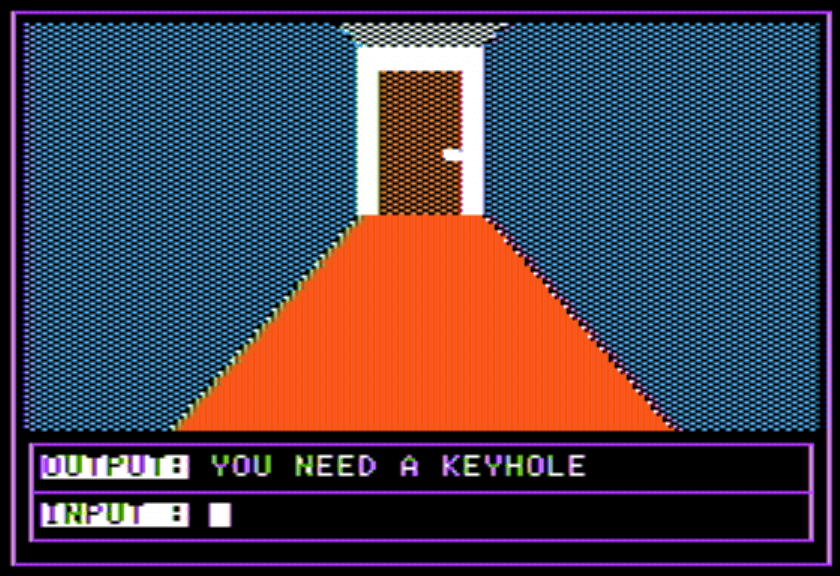
2 — CARETAKER’S HOME
It tells me I need a keyhole.
3 — TOWN HALL
It tells me I need a toga (which can be obtained at the clothing shop at the southwest of the island). Once inside:
I can type one of the number options but nothing happens and I get booted out.
4 — SWITCHYARD
I only found out the name of this thing by buying a MAP from the general store later and doing LOOK while in the room. This also gives the “official” names of all the rooms.
Once entering: there are a series of three doors, and there’s a letter in the middle left.
I don’t know yet what any of these mean. There’s no equivalent to this in the original game.
5 — CARNIVAL
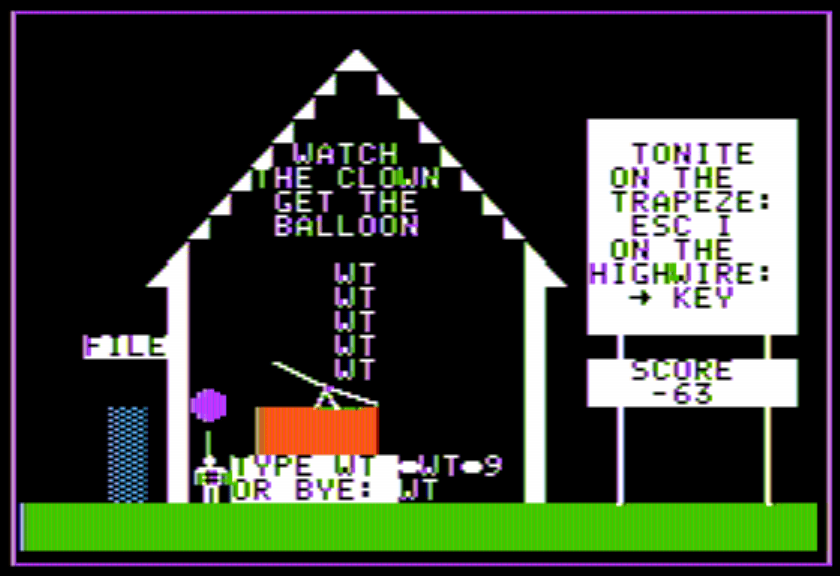
You need a clown suit (again from the clothing store) to enter here. Then you can add weights to cause a clown to go flying and lose some score. This is just as inscrutable as it was in the original game. I seem to remember there was intended some way to “break out” but it didn’t even work for me?
6 — CASTLE
This is where you come out at the start. If you go back in the map resets.
7 — BANK
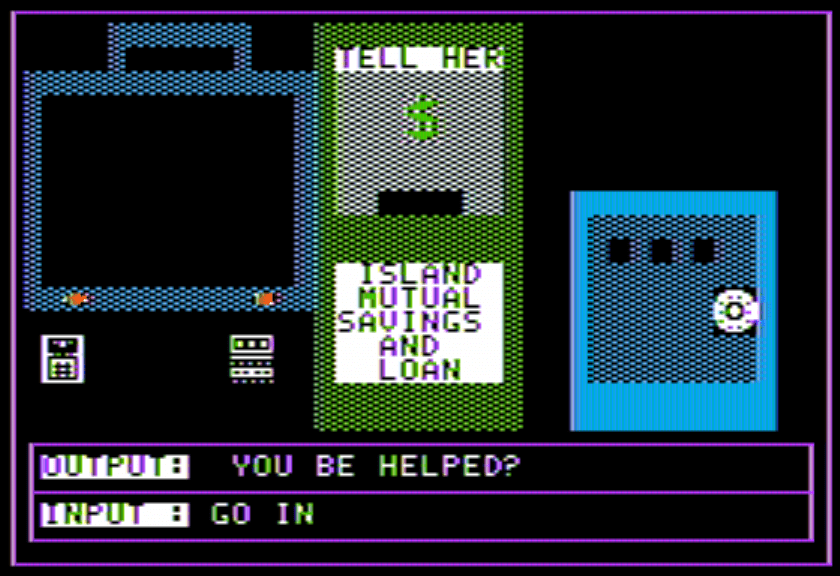
This asks for an account number. You don’t have one.
8 — COURTHOUSE
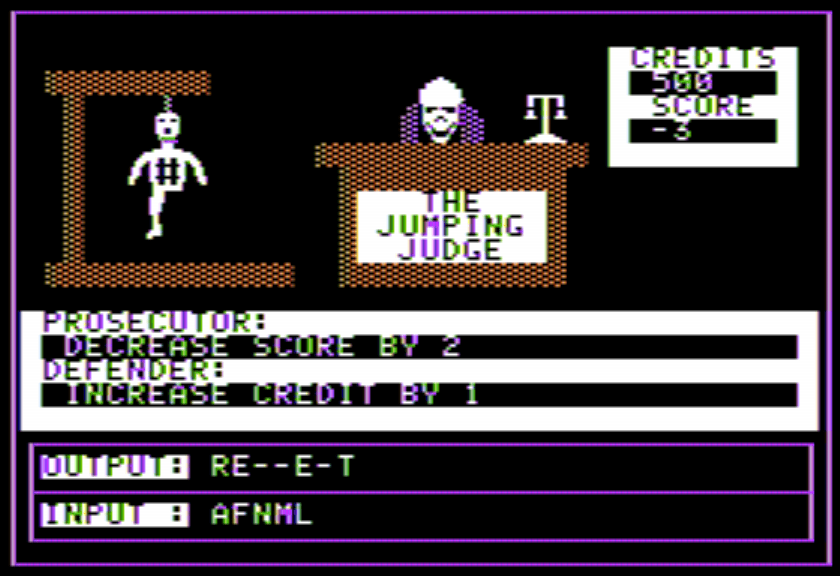
You are asked upon entering if you will put yourself on trial. If you do so it starts a game of hangman.
This is the only way I’ve found to increase score (it helps that the score is on the display as you are playing). The score boost seems to be better with less mistakes to the letters. If you lose you get a GUILTY verdict and thrown out and the “doubling” part (DECREASE SCORE BY X, INCREASE SCORE BY Y) gets reset. I’m unclear what relation the prosecution/defense lines have to the game, because I hit “guilty” once with the prosecution being all the way up to “reset to new game” and nothing happened.
Eventually after enough wins there’s a “TILT” message followed by WINNING IS LOSING. You can go back in the courthouse afterwards and repeat the whole process.
9 — THEATER
There are slightly unsettling nursery rhymes shown on a loop.
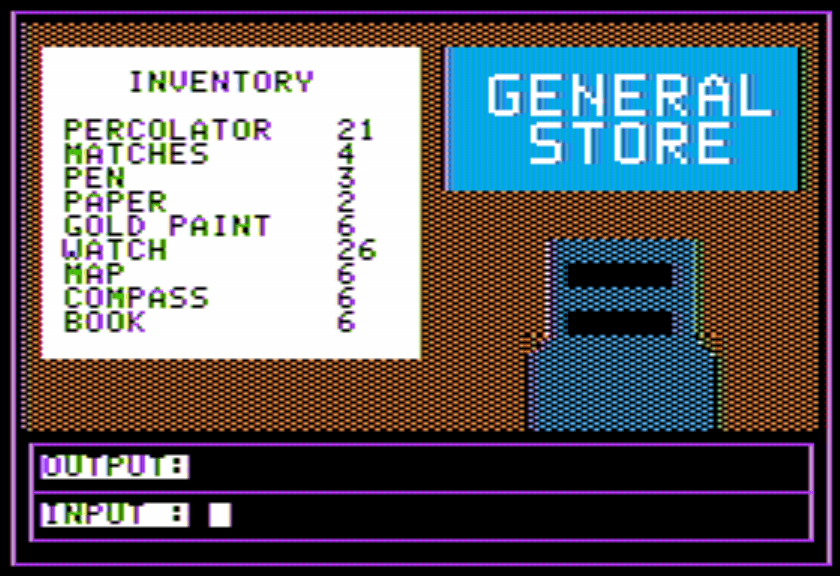
10 — GENERAL STORE
You can buy stuff, including the MAP I mentioned earlier, and a PAPER and BOOK which are useful for the next two places on my list. For some curious reason the shopkeeper will “adjust” their prices when you enter but all they do is increase all of them by one.
11 — NEWS STAND
I can’t get in. First it requests that I have PAPER, but then after it says THEY WON’T LET YOU IN even after holding the PAPER. This is true even when my score is up.
12 — LIBRARY
You buy a book from the general store and go in, where you get to burn books.
13 — SCHOOL
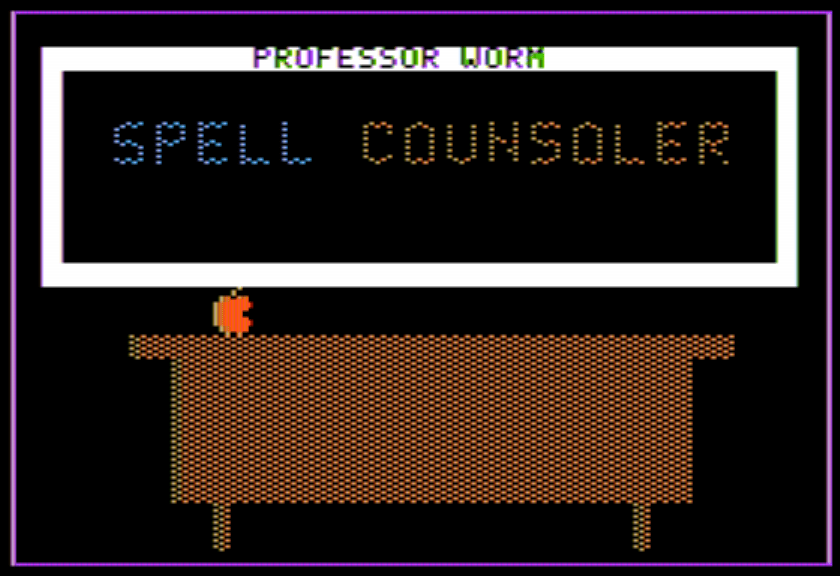
Professor Worm challenges you to spell words. The letters you type don’t always correspond to the letters on your keyboard so this is harder than it sounds. I have yet to get any of the words right.
14 — CAT AND MOUSE BAR
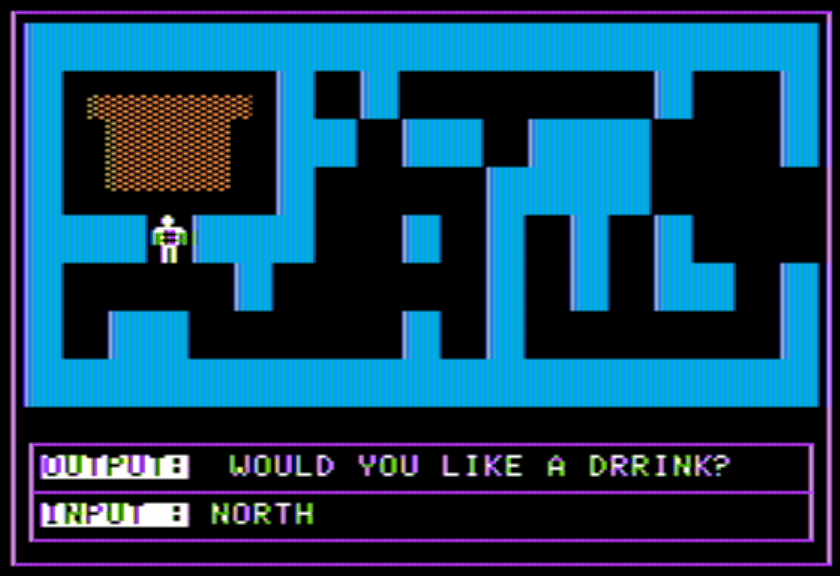
You have an above view where you can move around with U, D, L, and R. You can walk up to the bar and buy a drink, whereupon nothing happens and you reset back to your starting place. You can go to the right to leave.
15 — CHURCH
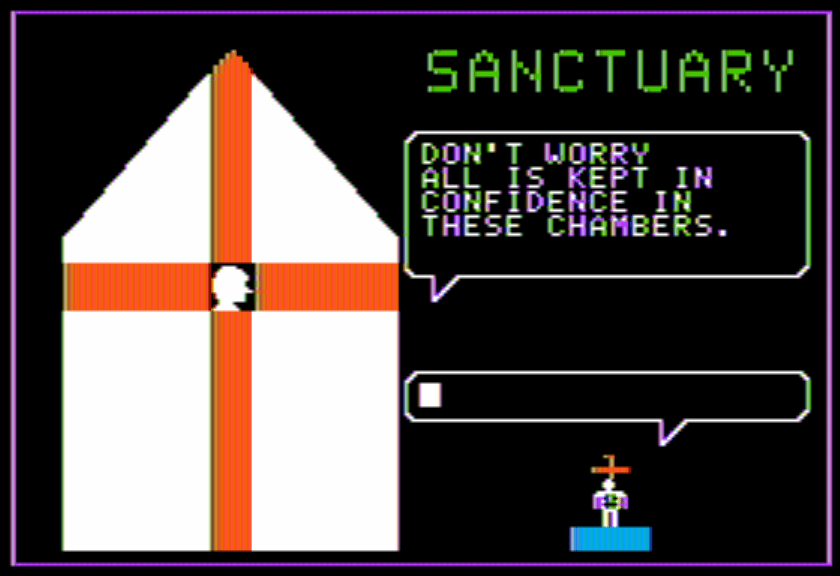
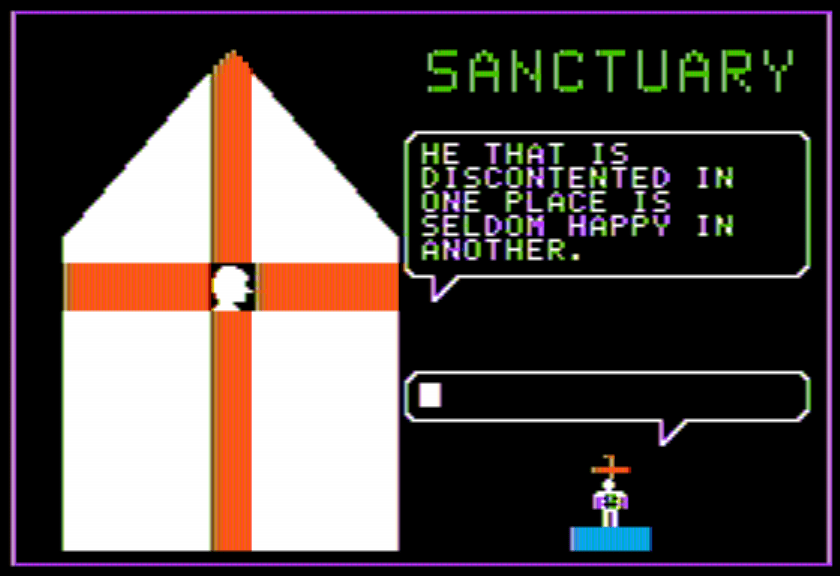
You can confess your sins, or give out your resignation number, or whatever I guess. There’s an open text parser and there’s ambiguous responses. The text parser has a limit to the character count that the original game didn’t have.
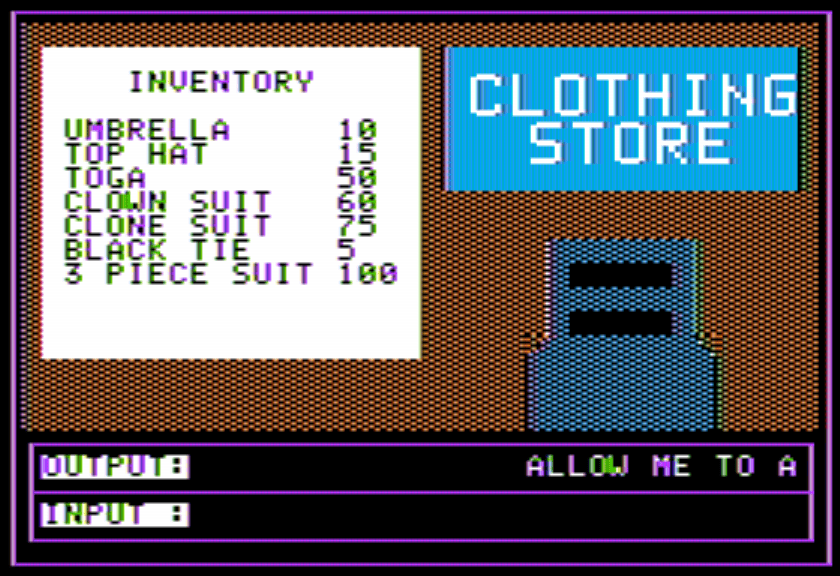
16 — CLOTHING STORE
The TOGA and CLOWN SUIT I mentioned earlier are here. I guess you can buy all the rest of the items and find out if any cause an effect somewhere.
The shop-keeper is in the middle of saying ALLOW ME TO ADJUST MY PRICES. Just like the other store all just go up by 1.
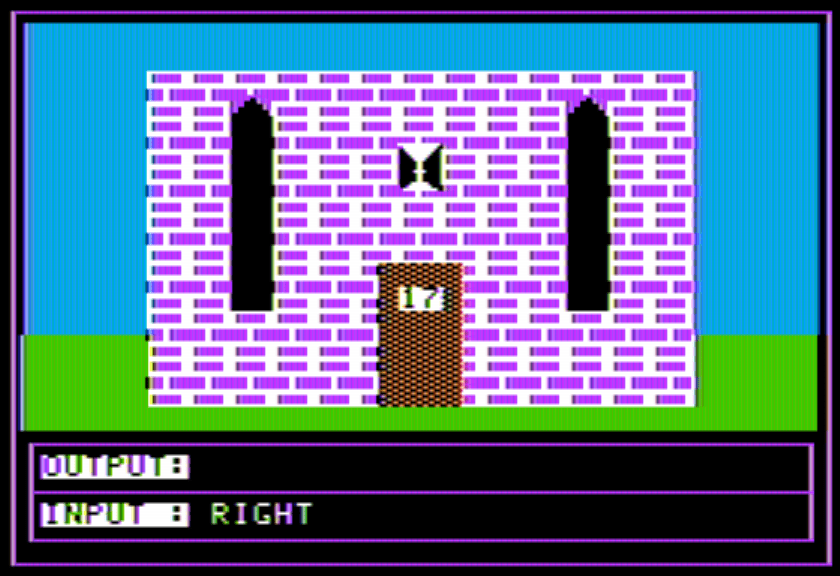
17 — GRAIL HALL
More doors like the switchyard.
18 — RECREATION HALL
There’s a pit you can cross by stepping on platforms without falling into a pit. It is fairly tricky and I haven’t managed yet. It seems (based on other locations) like it might take significant effort but only with the result of my score goes up by 5 or something.
19 — GEMINI DINER
There’s a list of items. If you read the menu and try to buy any of the items it says they’re not on the menu.
20 — CASINO
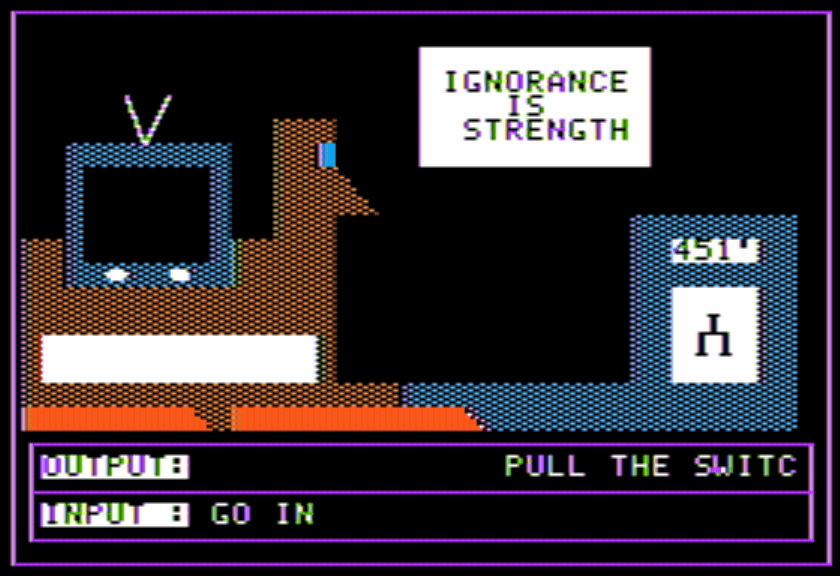
There are three slots. One slot gives vacuous statements that are either from 1984 or are 1984-esque.
Trying to use the second machine gets the response YOU DON’T HAVE THE MAKINGS. You don’t have a dollar, either.
That’s quite a lot to chew on and I’m not sure what I should be messing with. The original game just let you get into various shenanigans that seemed like escaping but weren’t, but the real way to escape was to go to the caretaker and tell him the right phrase. Here, I need a “keyhole” to even make it to the caretaker, and who knows if the phrase has changed. I suppose I should farm hangman a few more times for points (the word list is pretty small) and buy all the gear from both stores to see if they cause any new effects.
One other thing I should do is comb over the manual more, and in fact, I want to talk about it a little, because it is far more “in universe” than the original manual was, which gave straightforward if enigmatic advice. (“7. Above all, this is a game of psychology. While the Island is trying to keep you off balance, you must try to hoodwink the authorities. From your knowledge of the Island, try to guess how their minds must work. Your one hope for escape is to second guess them.”)
For the new manual, it is written as if from a journalist who is writing about the Island, titling it “A Wolf in the Fold: The Conspiracy Behind the Microcomputer”. The supposed journalist rambles about modern life and technology and mentions a journal that appeared as a mysterious text file called BOTTLE:
I tried to meet this Caretaker — I’m told he represents whomever is in charge. His house was easy enough to find, but his door was locked. I’m not so interested in answers that I’m willing to cool my heels until I’m let in. It’s time for me to leave.
Let’s see, if I can’t confront the top, I’ll sneak out through the bottom. My “official” map says there’s just a white picket fence surrounding the place. Yes, I see it there, down the street. Just climb over and . . . What the Hell is that? I’ve run into watchdogs both animal and electronic before, but nothing like this! It’s after me! I can’t outrun it …
A later section called THE KEY TO ESCAPE has the journalist allegedly explaining the secret:
Perhaps it takes an objective eye to see what one is facing, for I believe that I have discovered, from the bits of information I have gathered, the way out of The Island It’s all so deceptively simple. All one needs to do is CANCEL THIS LINE … CANCEL THIS LINE … CANCEL THIS LINE … INTERRUPT … INCOMING MESSAGE … BEGIN
This is followed by some text which is not from the journalist at all.
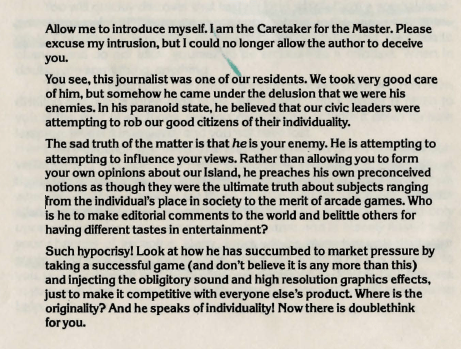
For those who don’t want to read all that (you’re tired and this is a long post, you’re on mobile, I’m happy for you or I’m sorry that happened, etc.) I just want to draw your attention to the fact it comments on how game is a remake and the commercialism implicit therein:
Such hypocrisy! Look at how he has succumbed to market pressure by taking a successful game (and don’t believe it is any more than this) and injecting the obligatory sound and high resolution graphics effects, just to make it competitive with everyone else’s product. Where is the originality? And he speaks of individually! Now there is doublethink for you.
I’ll attempt to bust open a few doors next time, or at least get caught by Rover in a more creative way. In The Prisoner 1 I missed an “ending” where you supposedly escaped and yet you really hadn’t (matching the episode Chimes of Big Ben where Number 2 figures out that he hasn’t made it to London but still is in the village). I’m hoping there’s some equivalent in Prisoner 2. I’ve put the relevant episode below with a time-stamp for the ending:
David Mullich’s work might be one of the most famous Apple II games of 1980 — insofar as Apple II games from that year could get famous — but I found it too janky and difficult to control to really get the experience the author was hoping. Some of this was certainly intentional: the premise has you on an Island trying to escape, with a confusing array of events trying to pry out the reason why you resigned from your top-secret job (rendered in-game as a three-digit code).
I absolutely admire the high concept of having a secret that the game then tries its best to pull out of you. I still can’t think of anything quite like it, and it meshes perfectly with the medium; that is, despite the game being based on a TV show, it does something the TV show could never accomplish.
Just like how I could admire the method of defeating the dragon in Crowther/Woods conceptually while decrying the actual effect in real gameplay, the same happened here: I just had so little congruence with what was going on the end result was more me admiring the meta-structure of the thing rather than getting any Art out of it. I can understand, given the scale being tipped heavily to Craft over Art in this era, lingering for while; additionally the person of Mullich himself is intriguing biographically, and he went on to work on important games like I Have No Mouth, and I Must Scream and Vampire: The Masquerade — Bloodlines.
All this might be moot, because Mullich had a second shot at the same material with Prisoner 2; not the earliest “remake” because you have to count, say, graphics getting added to Goblins, but certainly early. The original was a combination of text and ASCII art coded off-the-cuff in BASIC; this game instead is rendered in attractive Apple II graphics, looking like something that might come out of On-Line Systems were it not for the heavy social awareness and nightmare scenario.
Just like the original you have to navigate out of an initial maze…
…and then try to escape, visiting 30 building sites in the process. But while I’ve run across at least one activity that is identical, the buildings have a much different feel and I expect some activities are different.
Also, the original solution of just walking in to the Caretaker and telling him you’re playing a computer game doesn’t work.
I originally planned to play this simultaneously with the first Prisoner game, being informed it was essentially the same game with graphics, but I discovered quite quickly it was different enough it needed its own posts. That doesn’t mean my playthrough here will necessarily be long — and I can already tell there is some identical content — but I do like having another swing at the universe with some of the rough edges removed. Maybe it will go better this time. (Are the rough edges what made it Art, though?)
I’ll report back at my efforts to get into all the buildings next time. At least some of them don’t let you in at all (which I don’t remember happening much in the original!)
We have had games authored by very young people, most notably Stuga, written when the authors were 10, 12, and 14 respectively, and where a later commercial version would go on to become the “Zork of Sweden”. For today’s game we go even a little bit younger, but to explain, let me first jump back in time more than usual–
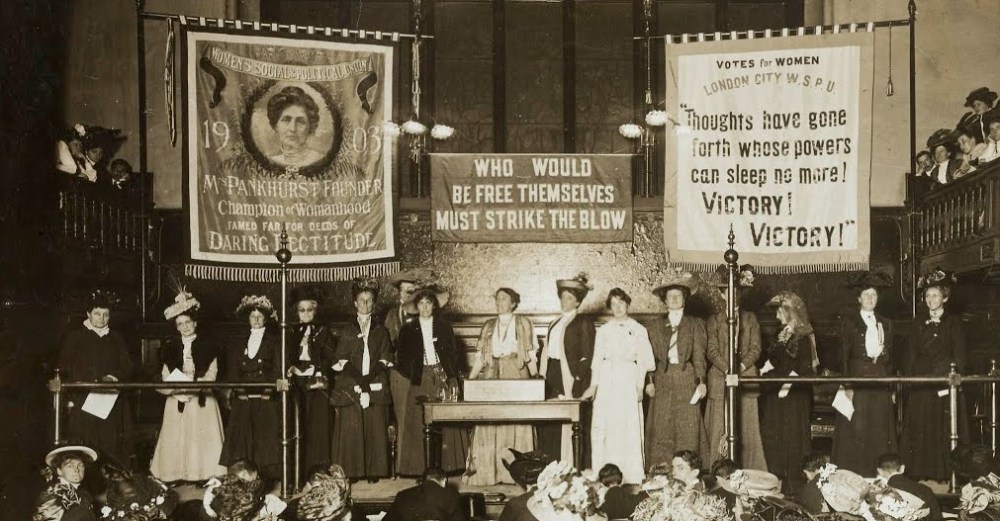
1908, meeting of suffragettes at Caxton Hall prior to the “Rush of the House of Commons”. Via Museum of London.
Caxton Hall in London has been the site of many significant at least noteworthy meetings, like the first Pan-African Conference (1900), Crowley’s Rites of Elusis (1910, “Saturn” through “Luna”), Churchill press conferences during World War II, and the announcement of the Russell-Einstein Manifesto (1955), warning of the dangers of nuclear weapons. Russell himself:
I am bringing the warning pronounced by the signatories to the notice of all the powerful Governments of the world in the earnest hope that they may agree to allow their citizens to survive.
With less fanfare, there was an April 1956 meeting chaired by Dudley Hooper of the London Computer Group, intended to unify people from different fields with a common interest in computing:
The Group aims to encourage the spread of knowledge in the computer field and to act as a focal point for the exchange of information. It is thought that understanding of an “integrated” approach can best be achieved by an organization providing facilities for individuals each with a specialized knowledge and interest to meet and discuss their common problems, scientist alongside manager, accountant alongside engineer, linguist alongside actuary.
This group merged with another scientist group a year later to form the British Computer Society, a still-active group and one of the oldest and most distinguished in the country.
The Society spun off sub-groups, like the Computer Education Group formed in 1965, which published a quarterly bulletin, Computer Education. Significant for our story today, the Computer Education Group had another spin-off in the 70s called the Small Computer Users Group, with a renaming to Mini-Computer Users in Secondary Education (MUSE) before landing on Microcomputer Users in Secondary Education (also, conveniently, MUSE).
Anthony Hopkins, vice-chair of MUSE in 1980, surrounded by some teachers. From Scunthrope Evening Telegraph, November 11, 1980.
One of their goals was supporting members in having good software; a complaint in early British education technology was a lack of appropriate software for the topics teachers wanted, and to that end MUSE had their own catalog. At the start of 1982, they had about 100 programs in their libraries mostly for the PET, Apple II, and 380Z (the latter using the CP/M operating system). This was even before the BBC Micro hit and swept up most of the schools.
Sadly, we don’t have much left of MUSE’s actual items. They seem to have been fairly straightforward and technical.
Despite fairly open conditions (teachers just sent in what they wanted) the entrance into the MUSE library was not automatic. For example, the group EZUG (Educational ZX-80/81 Users’ Group) had a committee of three who assessed the appropriateness of material sent in for inclusion into MUSE. At the start of 1982 there were “about 50” programs sent for ZX computers, with only 14 accepted. Eric Deeson (founder of EZUG and a member of the committee) also noted that:
Unfortunately, teachers, like other people, are often somewhat frightened of submitting their own programs to outside scrutiny.
Despite all that, the catalog contained at least one adventure. Specifically, Dragon Adventure, made “around 1982” according the main author, William Stott, who was a teacher at the time in Hillington, the borough at the far west of London. Quoting Stott:
The basic framework of game locations and puzzles (including any violence directed towards dragons and trolls!) was produced by a group of Year 5 children on a wet Friday afternoon (thanks to Tracey, Tracy, Julia, Joanne, Amanda and the others). I put this into a finished game so the children could try out their own work, and also wrote a version for the Commodore PET (the other Y5 class had loan of one – my class had the use of the only BBC in the school that term).
Year 5 in the UK incidentally indicates ages from 9 to 10. So this has the youngest authors yet of any game we’ve seen, and this is also first mass classroom project adventure I know of. The game was spread across Hillingdon and made it in the MUSE distribution library for a while, before said library closed up shop during the late 1980s.
It was converted to run on the Acorn Archimedes around 1990, and was further updated in the late 90s for the more modern RiscPC with the addition of sound samples and pictures of the items carried. It has been available in RiscOS format as a free internet download since 1999. Over the years it has been occasionally used in various classes I have taught. Various minor changes have been made in response to the sorts of things children tend to type in and try to do in the game.
As far as why it was justified for MUSE, Stott explains
Its aim is to stimulate memory, language work and discussion within small groups, and to help foster a logical approach to problem solving. Within the UK National Curriculum for English, the program helps to develop oracy (both the speaking and listening), spelling and reading comprehension skills.
Stott continued to use the game in his classroom and converted the game again to a z5 file and the modern Glulxe format. This is the version I’m using because it does not seem (after some comparison with a video) to be much different from the Archimedes version. I’d really prefer to grab either the BBC Micro or Commodore Pet versions but both seem to be lost with the ashes of MUSE.
The introduction does differ on the two platforms, although both convey the same information. The Archimedes does it with straightforward instructions, while the more recent port has a dialogue.
The faces of the council members look grim. Gilgern continues to speak.
“Of course, something must be done soon,” he says in that gruff, hearty voice you have come to dislike so much. “Must restore public confidence and encourage the return of people to the land. Can’t just leave the place to the likes of dragons and trolls. We must all make money again. Isn’t as though it’s just arrived, dragon’s been there for years. Just that people found out about it, that’s all.”
The dragon you are tasked with removing can be either:
a.) slain dead with the Sword of Erondil found at the Castle of Abercorn
b.) made to leave by breaking an enchantment that holds the dragon
I want to emphasize how staggeringly rare this is for 1982 (assuming this content was all in circa 1982, but again, no archive to check). We have two ways of approaching the central task of the game. Could this be a case of the children, led to brainstorm freely ideas for the story without making a game in the traditional way, came up with the story branch notion themselves?
(It turns out to be a very minor change, so I don’t think it is a part that only ended up in the modern port, at least.)
The game’s environment is fairly open with lots of inventory items to juggle. In the modern port, there’s a “rucksack item” that you can use to hold everything at once; that would have been too far ahead of its time to put in the 1982 game.
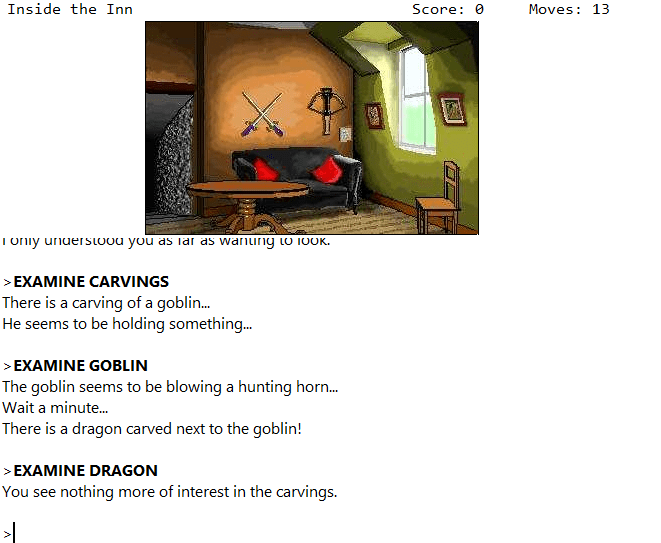
Early on there’s an inn with a silver coin and an important clue.
I managed to rack up a package with some parts requiring assembling (with screwdriver), an empty mug, some matches, an old boot (with the aforementioned screwdriver), a flute, an old lamp, and a bell, all just by wandering around.
(Oh, and a parachute, but that turns out to be a red herring.)
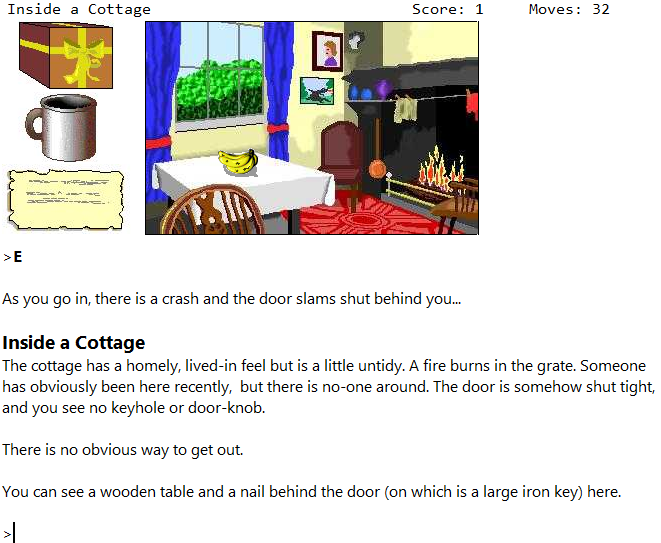
There’s a cottage where the door closes and locks behind you. If this happens early you are stuck. In a classroom context this could be trouble, quoting Stott again:
These newer versions [referring to the modern ports] make it easier to recover from unwinnable game situations without having to restart (demanding less teacher attention!).
I admit I’ve never thought about having students play adventure games to learn English but having the teacher run around solve “tech issues” which amount to getting the students out of their softlocks!
You do need to go in the cottage because it has a key and some bananas; if you’ve got the lamp with you, you can RUB it to teleport out.
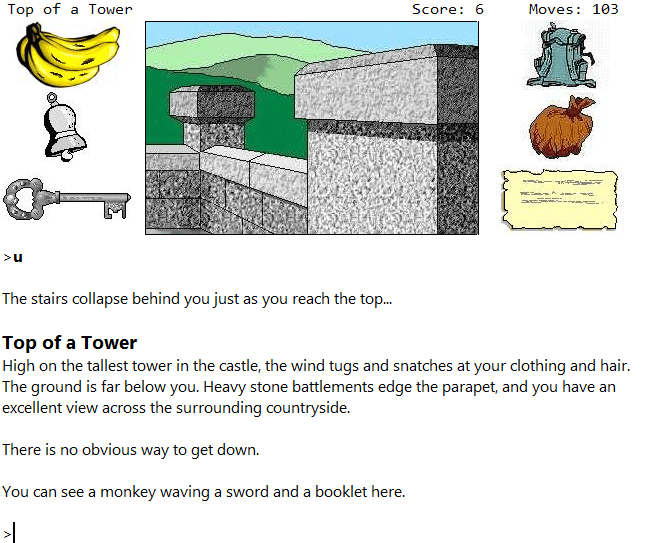
You can take the key over to a castle and unlock it. Climbing up some stairs has them collapse behind you, at which point you encounter a monkey with a sword. Hence: bananas.
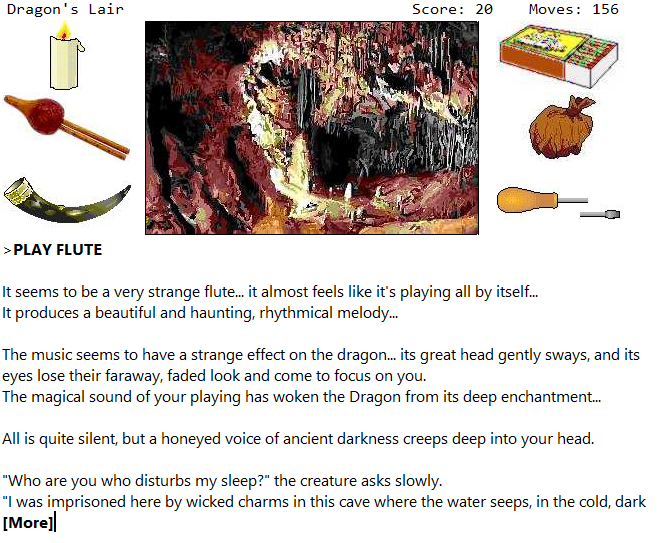
In addition to the sword you get a booklet about playing enchanted music (this uses the flute from the big item scoop-up earlier). This represents the two ways of defeating the dragon. You go down to a cave (with three different routes to get there) and either KILL DRAGON with the sword or PLAY FLUTE. The latter gets more points so there’s clearly some judgment on the game which is “optimal”.
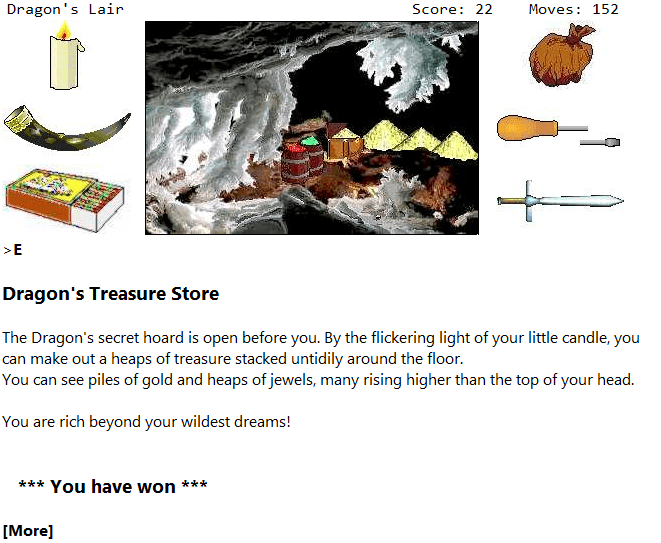
Either way, there’s still one more obstacle to go: finding the dragon treasure. This is the only spot in the game that caused me difficulty. You’re supposed to ring the bell (another random item out in the open) and wait for a troll to appear, then hand over the bell; the troll will trade with you for a horn. Then the horn can be played to get at the final secret.
It helped to go in with style expectations: this was going to have a bunch of objects that each applied to one puzzle only, and the puzzle-object correspondence was going to be pretty simple. But in this context, with a game by children and for children, there’s nothing wrong with that! The slightly unstructured map I’m guessing is also genuinely theirs, and I’m really hoping they stumbled into the idea of a peaceful or violent ending (at the very least they designed in the violence, given the Stott quote from earlier about “including any violence directed towards dragons and trolls”).
There’s two other “student games” from Stott, Goblin Adventures and Fairytale Adventures. I’m still unclear when they were actually written — possibly 1990? — and if they’re 1990, and you don’t want to wait excessively long for me to reach that year, you can try them from the archived Deansfield Primary School website here.
(And thanks to Ethan Johnson for helping on some MUSE research for this post.)
The fancy version of the game has an auto-map. I wish I knew if the original had one; it is technically possible, but Nellan is Thirsty (another children’s game, it’s funny how aiming for beginners created modern features) is the only one we’ve seen yet from the era that has had one.
Coming next: “He can make even the act of putting on his dressing gown appear as a gesture of defiance.”
Recently I played a game by John Olson of Kansas (as opposed to John Olsen of Oregon), Island Adventure. Purely by random chance another Olson game came up next on my list, except I was somewhat baffled at first because my brain interpreted it as Oregon John; that is, I was expecting a game with complex coding, interlocking puzzles, high enough difficulty to give trouble, and a scenario where every item is important. No, this is instead Kansas John, the one with simple coding, lots of items that don’t mean or do anything, and some of the most straightforward adventuring I’ve played.
Honestly, in its original context, it isn’t bad: it was published in Chromasette, sister publication to CLOAD. CLOAD was for the TRS-80, Chromasette for Tandy’s follow-up, the Color Computer. (I’ll get back to what I mean about context later.)
It also — despite being founded by the same person who had been editor-in-chief of CLOAD since 1980, David Lagerquist — is a lot rarer than CLOAD, and the picture above is the only one I’ve found of any genuine physical Chromasette tapes. The issue at question here is January 1981, which includes an animated line movement demo as the “cover art”.
The premise lands you in a mansion where you need to retrieve a diamond.
You start with a pry bar and need to bust your way in.
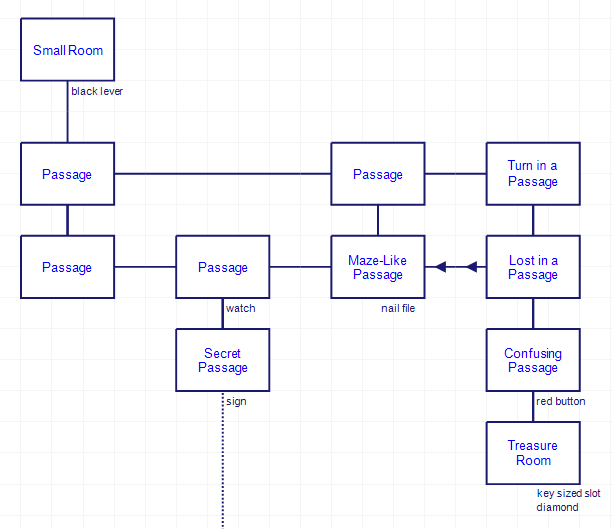
Inside there are lots of shabby furnishings which have various hidden items, and really the big task is trying to nudge anything at all loose.
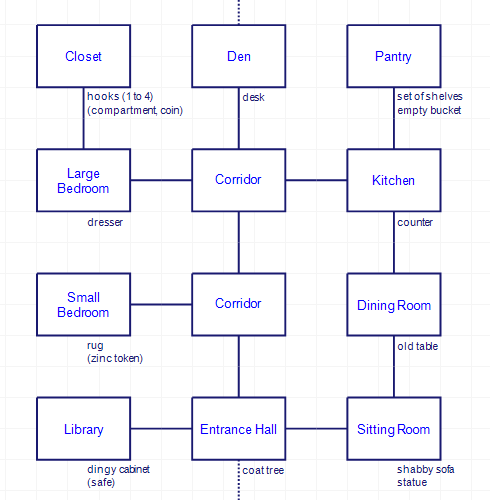
The coat tree hides nothing.
The main challenge is the verbs being picky.
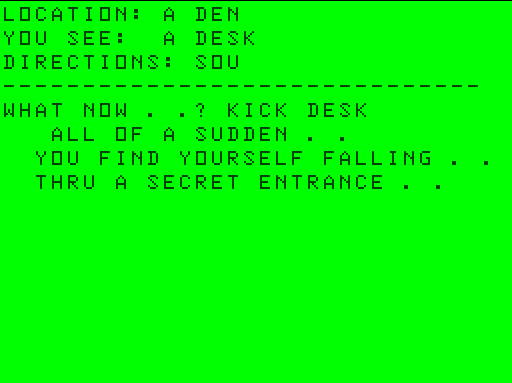
For example, to get the hidden item out of the rug at the Small Bedroom, you can’t just LOOK at it, or MOVE it, you have to completely TAKE it. To be fair, this gets you a zinc token which might be a bit small to see just by moving.
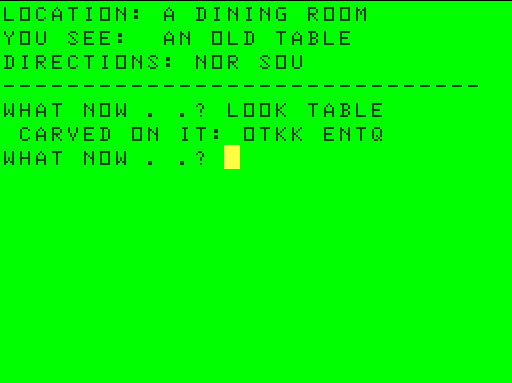
A table gives a cryptic hint: OTKK ENTQ.
The letters just shift one ahead to be PULL FOUR. There’s a closet with four hooks and PULL FOUR reveals a secret compartment with an aluminum coin.
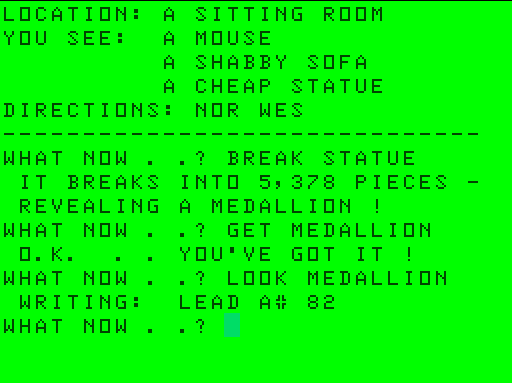
A third artifact, a medallion, is hidden in a cheap statue.
The initial instructions mention BREAK STATUE. I always love it when instructions give a completely explicit hint about an action in the game.
There’s a safe you can find by moving a cabinet, and the three things I mentioned (coin, medallion, token) give “atomic numbers” that can be used to open the safe.
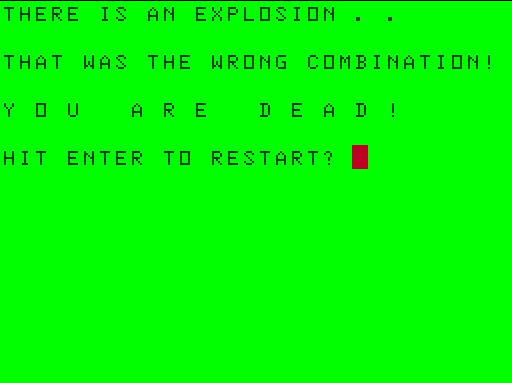
There is, as far as I can find, no hint as to what order to put the numbers in. Normally trying all six combos would be no sweat, but entering the wrong combination kills you. I got it right on the fifth try (13/82/30).
The items are a key and a notebook; the notebook gives you the hint to KSED KCIK (read backwards).
Winning then is a matter of making sure you don’t pull levers or push buttons.
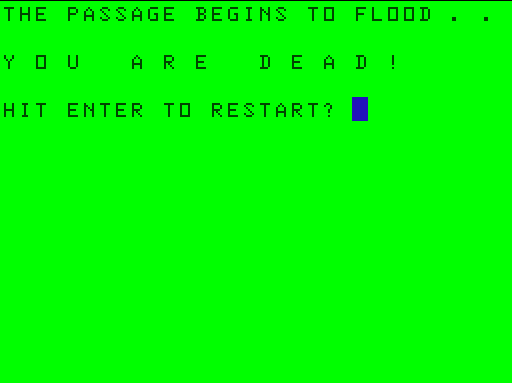
For example, a tempting red button floods the passage you’re in.
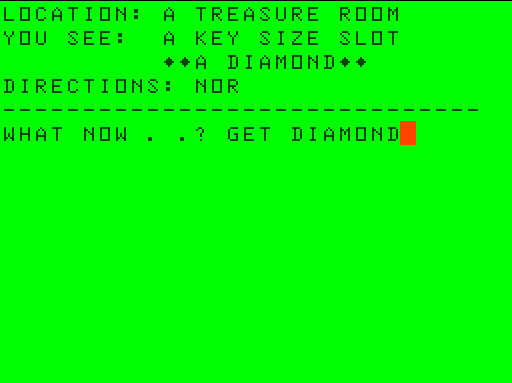
There’s another trap when you reach the diamond.
Going through with the action above without using the key first drops you in a trapdoor. You need to insert the key and then the diamond is safe to take, and that’s it! There’s no more twists.
So back to context: this was a single game tossed on a monthly collection, and as such, despite it being a 10-15 minute game at most, didn’t “feel” like a rip-off. Despite a gaggle of useless objects like a flashlight and a nail file the extra parts had some comedy mixed in came off as intentional rather than bad choices.
The bucket does nothing either. In a walkthrough all you need is the key, since the code to the safe doesn’t change.
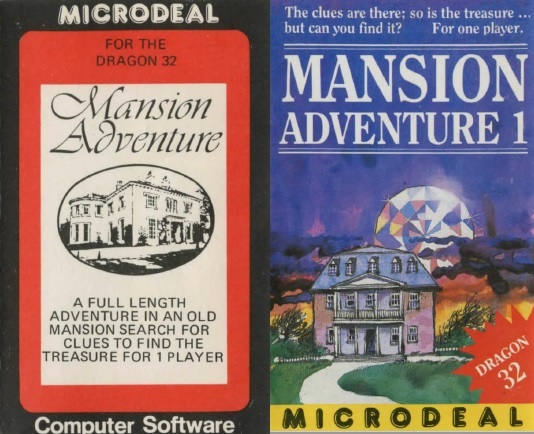
However, this wasn’t the only format the game was published in! It was published by the UK company Microdeal more than once.
We’ll see Microdeal again as this was the first in a series; I’ll get more into their history on a revisit.
So this was fun enough for a short game, but I’m not sure how I’d feel if I bought it standalone expecting a serious experience. Fortunately, I got a reaction from someone writing in the 80s so I can clock how one person felt:
Microdeal have inevitably produced a series of adventures for the Dragon, including Escape, Flipper, and Mansion Adventure, or at least they call them adventure games, Personally the only one I thought was of lasting interest was the Mansion Adventure, but then we all have our different tastes.
— Exploring Adventures on the Dragon, Peter Gerrard, published June 1984
This honestly seems inscrutable to me — the game was enjoyable enough for what it was but “lasting interest”? On the other hand, in addition to the multiple Microdeal versions there was a Plus 4 port and an (unofficial) VIC-20 port and in modern times it has been ported twice more (once by Barry Hart, once by Jim Gerrie) so maybe the utter simplicity is the appeal.
A mouse and a spider sometimes appear. They’re just for scenery.
Addendum: IF you chip away the deathtraps and dealing with finding the right search-verb, there are really three puzzles: the OTKK ENTQ code, entering the atomic codes, and the KSED KCIK puzzle. This makes it essentially a proto-version of the style of adventure with no object manipulations of note but more a focus on self-contained puzzles (like The Daedalus Encounter or Safecracker: The Ultimate Puzzle Adventure). This does make the game of note in the innovation category and is perhaps why Mr. Gerrard indicated “lasting interest” in his brief review.
Coming up next: one more game that is straightforward and simple but for very different reasons than Mansion Adventure, followed by an ambitious Apple II game that wants you to die.
(Assuming you can see video embeds, above is the trailer for Play Misty for Me, a 1971 movie with Clint Eastwood that seems to be the rough predecessor of KAXL.)
In my last post Rob sleuthed out another piece of information on The Case at KAXL that seems worth mentioning. This will be a short post but maybe it will help the actual Doug Rogers (out of the 20 or so I have looked at) find this page via a Google search one day.
First, the game states it is Copyright 1982 by Doug Rogers on the title screen of the GW-BASIC version. Since GW-BASIC wasn’t invented yet, we know it has to be a port; the file itself has a preserved timestamp of 1986-04-18, so it was made (or at least the last version was saved) in April of 1986.
I strongly suspected the original source was TRS-80 because of the odd case glitches. Look at this screen:
Notice how “sign” and “keys” are in lower case but the other objects start with an upper case letter. This suggests this was written on a computer which didn’t account for case. With TRS-80 in particular we’ve seen glitches where someone developed on a TRS-80 without case but then an oddity occurs when the same game gets moved to a later model that does have case. (That is, even when the display isn’t showing case, that still gets stored as data.)
The display is also wide, suggesting more than 40 columns, that is, not an Apple II (you could turn the classic Apple II into 80 column mode but the card that enabled that also put in lower-case mode letters).
However, this is still hand-wavy explanation, and the real evidence came from the fact it was later published for TRS-80, Model 4. All the way out in 1993 (!) but still:
TRSTimes was launched in 1986 when Lance Wolstrup had found out that 80 Micro no longer was going to cover the TRS-80, and lasted all the way to 1995.
Therefore, it is with some sadness that I declare this to be the very last issue of TRSTimes. I hope that our readers have benefitted from reading our publication. My appreciation goes out to all the many people who, over the years, shared their knowledge with us, especially my good friend, Roy Beck, without those articles TRSTimes would not have lasted past the first year.
Goodbye … and thanks.
The printing of KAXL ripped out the copyright date, no doubt it seeming awkward to publish a game 11 years after it was written. The presence of the new piece of information led me down the road of more Doug Rogers but unfortunately nothing has panned out.
This long lag time isn’t that odd for the TRS-80 community. Moreso than, say, the Apple II, they had a tradition of amateurism and retaining source code, and even now the major archive maintains a heavy amount of personal source code, and the proprietor (Ira Goldklang) will even rip your old disks and keep them private just for preservation purposes.
In order to keep a TRS-80 publication going all the way to 1995 a little amount of pulling out of the archives seems to be necessary.
Anyway, to compensate for such a short post, let me mention what’s coming ahead: two “short” games, followed by an Apple II game which I consider one of the most important for 1982 and I have been looking forward to reaching for a long time.
There is a real KAXL radio station. It services the Bakersfield, California area with a Christian contemporary format.
This game has nothing to do with the real station, but I just wanted to clear that up; because of how radio station names work we can say the fictional version is somewhere on the western half of the United States (since it starts with “K”, starting with “W” would indicate stations on the eastern half).
This game is otherwise utterly mysterious. There’s an Internet Archive page for it but it isn’t listed (as of this writing) in any of my sources. It is in GW-BASIC format for DOS, copyrighted 1982 by Doug Rogers. Was it written in that format? Probably not. GW-BASIC first appeared in 1983. In 1982 DOS is just rare overall; the only DOS-developed game we’ve seen so far is The Hermit’s Secret. There’s also textual irregularities which suggest to me a port from another platform.
Nevermind. At least the premise is interesting. You get a panicked call from a radio station and need to investigate. No specific goal immediately given. Was it corporate espionage? Murder? Zombies?
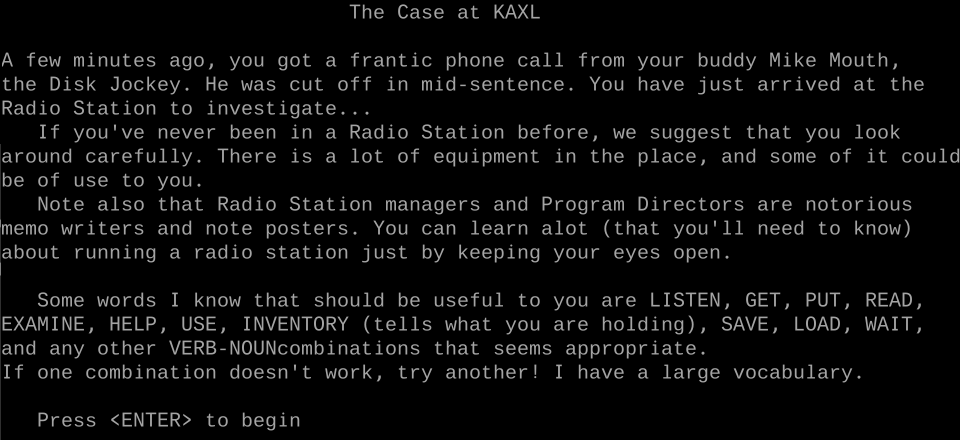
The details about “If you’ve never been in a radio station before” and casually mentioning “Radio Station managers and Program directors are notorious memo writers” strikes me that the author, at least, has/had radio station experience. In fact, this feels like a My Office Game, cousin to the My Home Game, filled with details that aren’t really part of the game proper but are part of a real radio station.
The map structure is fairly simple; there’s a main hallway I have shaded in color above with branches. No rooms are locked off except the one at the very back, and for that room there’s keys just sitting on the desk of the first room, because given the story scenario, there would be keys laying about in the first room. So the design is from the end of verisimilitude, while inserting a story scenario.
You arrive at the station at midnight to find the front door strangely unlocked.
The entire game involves exploring the different rooms of the radio station and looking at things. According to the ratings book in the office, the station is currently number 1 on the charts. The station ID recorder is broken (announcing the name of the station, as is required) so it has to be entered in manually at the hour. There’s a large studio with microphones and an old piano.
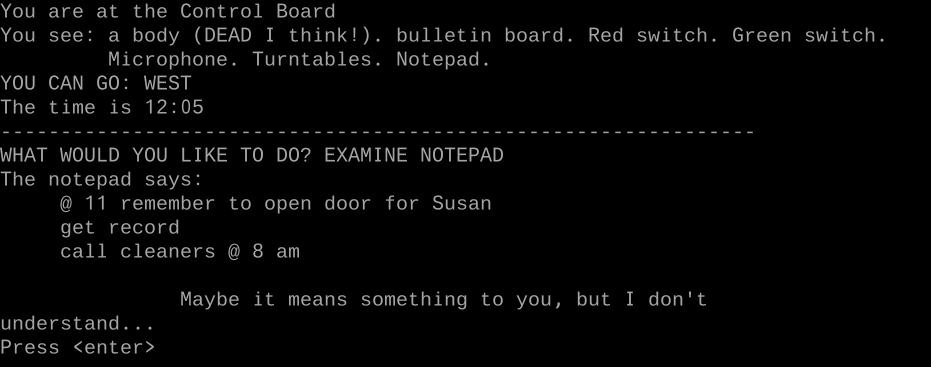
The open map means it can take a while to make the main discovery, the dead body of Mike, the one who called us on the phone.
The game isn’t clear from here but the idea is to gather clues as to what happened. You keep in them in inventory akin to getting items in a standard Treasure Hunt.
Items include a broken record (“MISTY”), lipstick, a lovenote (between Mike and a “Susan”, the same one that got let in the studio late), a cigarette (there’s also randomly the faint smell of smoke), and a transmitter log.
Once you collect enough information, you can go to the phone at the front desk and USE it. You’ll be prompted who to call; you can call the POLICE.
If you have enough evidence gathered, the police will ask you to help them locate where the murderer might be happening. When I played, I had already gotten stabbed so I knew where to go.
As a game, this was pretty easy and slight. The only challenge I had was realizing the premise in the first place (gathering evidence then calling police).
Just scenery.
As a conceptual premise it was unusual, though; even our “easy” games have generally had arbitrarily map layout meant as service to the game’s puzzles. Here, there’s a radio tower out back for no reason other than that’s what should be there, and the door there is locked only because, logically speaking in the real world, that door would normally be locked. Not because there was a puzzle that demanded a key.
Via Your Computer (Australian version), July 1983. The ad mentions Doomsday Mission as being priced at $25.50. In 2023 Australian dollars that’s about $98, which converts roughly in US dollars to $66.50.
I was fully prepared to write a failure post here, but then I decided to give things one last try and made it to the end. Phew. The Earth in saved and I’m ready to outwit any evil AI that surface in the future by using prompt engineering to show how it stores copyrighted material verbatim with the power of adventure game puzzles.
When I got stuck I tried poking through the binary but the text messages weren’t that helpful. The only thing I found was this: a new way to die.
The first thing I managed to resolve was more or less a parser issue, although it was essentially a lack-of-feedback issue: how to make the object described in a circuit diagram. I knew MAKE was a verb, I knew the game understands MAKE DIAGRAM, but it normally says
I HAVENT GOT ENOUGH.
without detail on what might be missing. You need, specifically, in the room with you: the diagram, a sonic screwdriver, electronic parts, and a small box (which otherwise has no description at all and prior to this working I thought might be cardboard).
That’s one of my tasks done but I couldn’t use the deactivator yet without making it to the computer. One of my other issues was getting stuck in a cell with a cassette and being unable to escape with it. I had, unknowingly, already soft-locked my game long before. A prior screenshot:
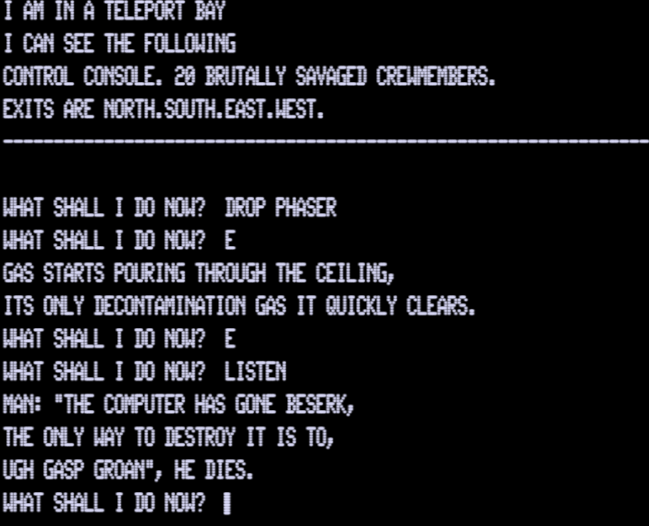
LISTEN was the softlock. You’re supposed to LOOK MAN first and see a bracelet he’s wearing; once you get the narrative moment from him you are no longer able to take the bracelet.
This is one of those situations where you could easily have found the bracelet without realizing there was even an issue there; no doubt the authors didn’t even think about this problem.
While wearing the bracelet I could sneak in, grab the cassette and use the bracelet to teleport out. (It just sends you back to the room with all the bodies.)
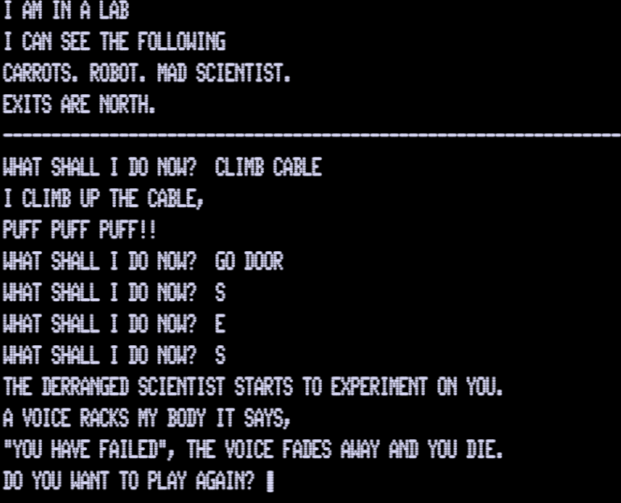
However, playing the cassette was still a problem. I left a ROBOT in a LAB with a MAD SCIENTIST, and you can PUT the cassette in. Nothing happens. The ROBOT has two slots, and something needs to go in the other slot.
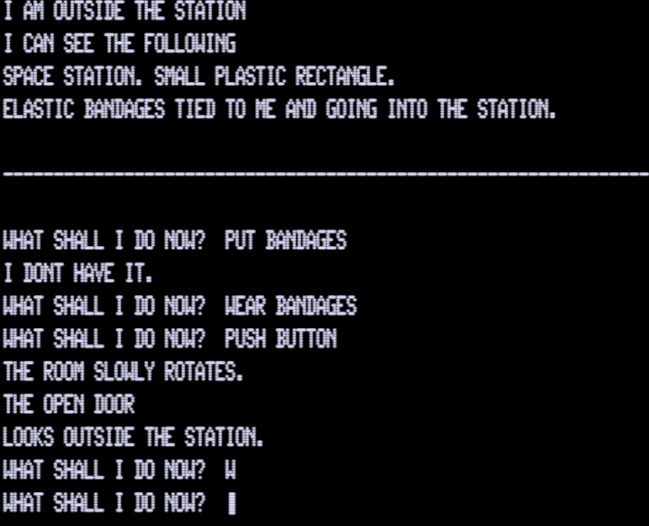
That something is outside the airlock. Last time one of the spots I thought might have been just a matter of parser trouble was in fact that. I was in a space suit ready to hop through an airlock but kept floating away. I had flexible bandages that I could attach to a hook, but no way to grab them. You’re supposed to WEAR them. Fair enough, I suppose.
I was unable to get anything useful here; the only reaction I got from the rectangle is typing TAKE RECTANGLE while holding a kitchen knife from the first floor of the station.
I TRY TO PRY THE RECTANGLE OFF THE STATION,
SNAP…THE KNIFE BREAKS.
This is in fact where I was prepared to throw in the towel, as by process of elimination (and my peeking at the binary, which really didn’t help much otherwise) I knew the rectangle had to be what goes in the slot.
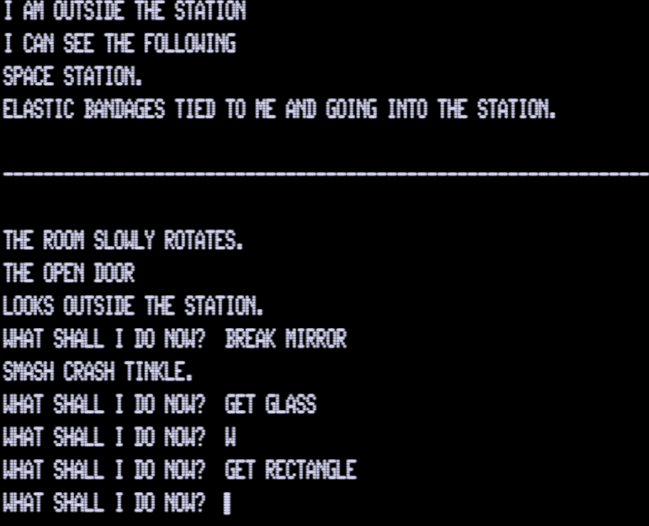
I tried every single item I could think of to do some prying, but then got an idea looking at the knife, as it is explicitly described as BLUNT. Hmm. I didn’t have a sharpener, but I did have a mirror I could break into glass shards. The problem is when breaking it I always had a security guard (the same one who doesn’t like you shooting a phaser at the MAD SCIENTIST) kill me. However, if you break the mirror outside (or inside, but before passing through the airlock) the robot doesn’t appear.
This is still glitchy because the robot catches you if you fire a phaser outside. I also wish the rectangle was described as needing cutting, since trying to use the kitchen knife suggests prying.
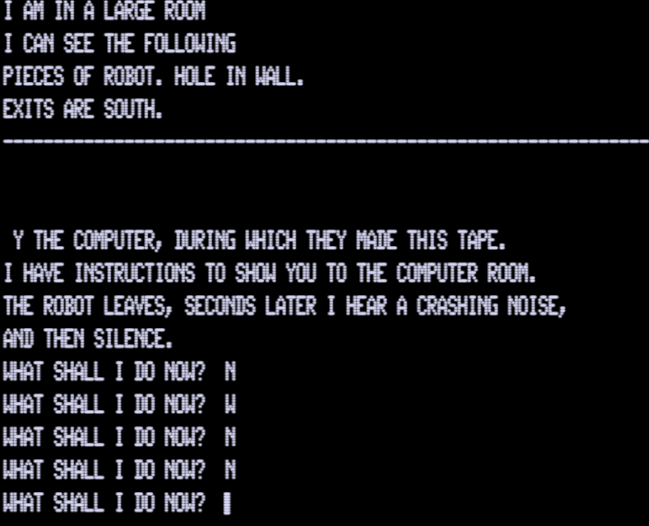
With both rectangle and cassette inserted back at the robot I was finally able to get it to play:
The mad scientist is still hanging out. You never deal with him, you just finish off the computer and escape.
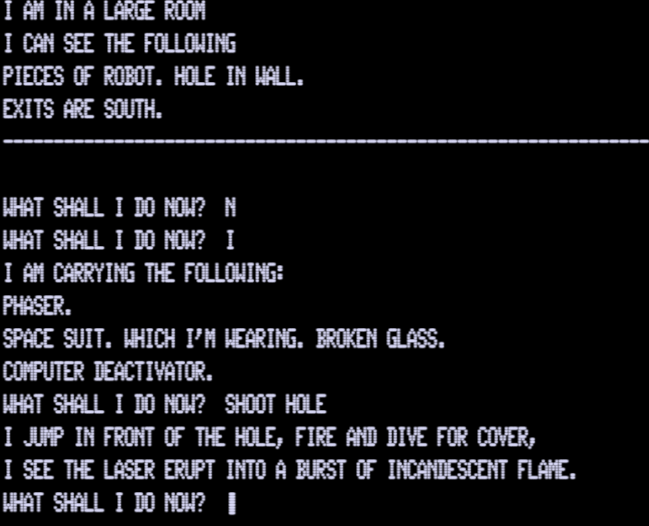
The robot went over to a previously empty “large room” and bashed open a hole, destroying itself in the process.
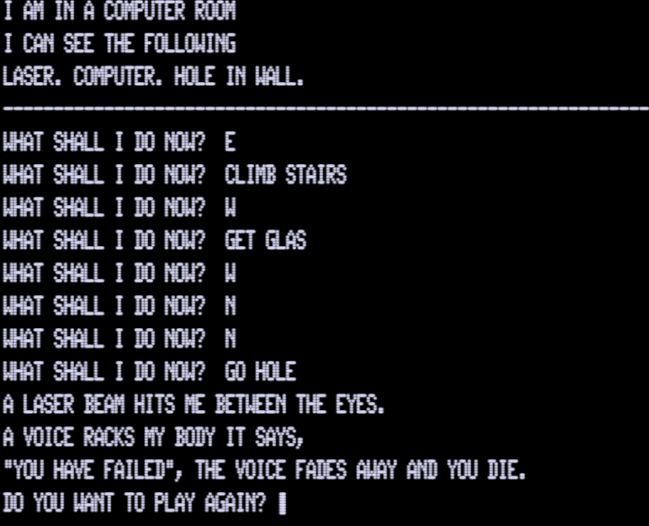
One last obstacle! If you just try to go in you get fried by a laser (the game is helpful here and will even have the laser attempt a potshot if you LOOK HOLE; weird that now is when it starts caring about being fair).
Fortunately, the phaser works here:
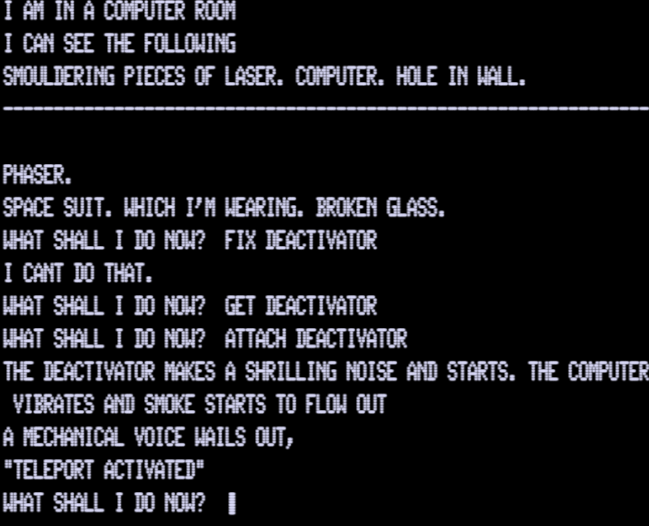
Deactivator in hand, you can go in the hole and ATTACH it to the master computer. I went through quite a few verbs before realizing this was the right one.
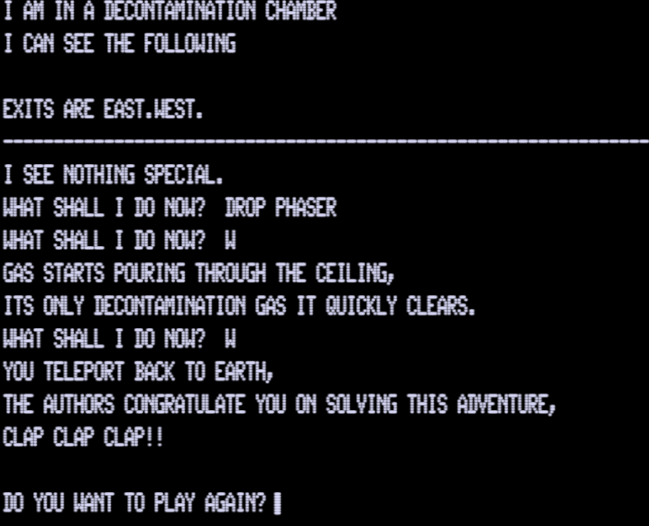
With the teleport activated the end is just a matter of walking back to where you started and winning. Except don’t forget to drop your phaser otherwise the gas still kills you, oops!
So while that was ultimately satisfying for me to play, I hardly can recommend it for others, especially with the three-days-stuck portion in there, the dubious softlock, and the cavalier approach to death. I do want to highlight this ended up being more interesting than the prior games closest in spirit, Death Dreadnaught and Domes of Kilgari. Dreadnaught only had one interesting puzzle (killing the creature) and was otherwise about wandering and soaking in atmosphere; Domes of Kilgari had lots of deathtraps but they felt like they were there because the author couldn’t think of any other obstacle. Here, there was some decent thought put to the world modeling, an actual plot sequence that had more to it than “a sequence of deathtraps”, and some variety in the way players move through space.
Australia will still remain a scarce source of adventure material for 1982; while one of the most notable adventures of the year is from there, I’ve got that one closer to the back end of my list. Can’t burn all the good material early!
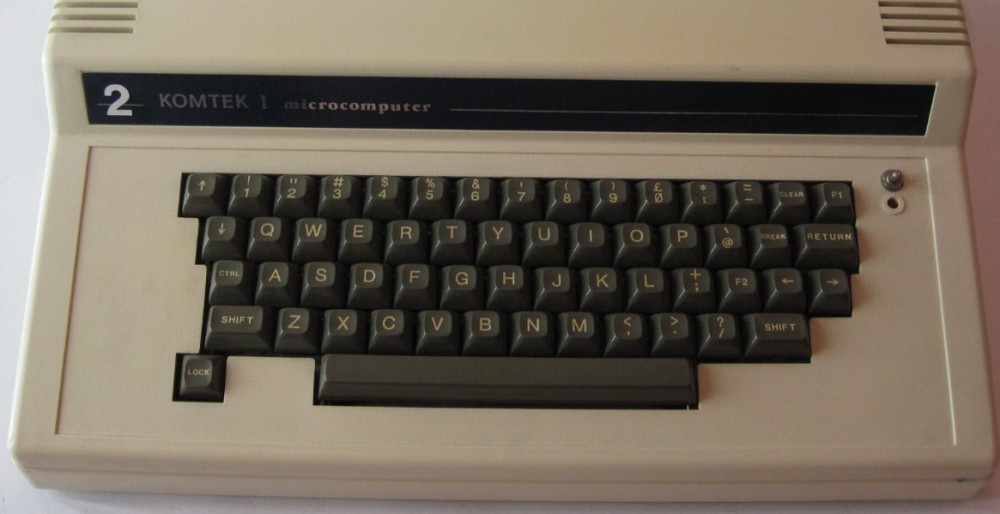
A Komtek-1 as mentioned in the ad on the top of this post; it’s an even more obscure TRS-80 clone than the System 80 is.
The Haunted Palace, the original, is a poem written by Edgar Allan Poe, and was published in Issue 4 of the Baltimore publication American Museum of Literature and the Arts.
From the cover of Issue 2.
In the same year (1839), the whole of it was incorporated into Fall of the House of Usher (as being written by Roderick Usher), so the two are technically connected.
But evil things, in robes of sorrow,
Assailed the monarch’s high estate;
(Ah, let us mourn!—for never morrow
Shall dawn upon him, desolate!)
And round about his home the glory
That blushed and bloomed
Is but a dim-remembered story
Of the old time entombed.
And travellers, now, within that valley,
Through the red-litten windows see
Vast forms that move fantastically
To a discordant melody;
While, like a ghastly rapid river,
Through the pale door
A hideous throng rush out forever,
And laugh—but smile no more.
The enmeshed aspect is relevant for the game The Haunted Palace, and especially in evaluating the mystery, because this has the clues for multiple plots mashed in and only some of them might be relevant for the target questions: a.) who is the burned body? and b.) who did the killing?
It is not all that odd for a mystery plot (interactive or not) to have red herrings, particularly ones signaling that possibly someone else did the killing. This gives the detective leads to trudge through. Deadline gave reason to incriminate everyone in the Robner house, but not everyone was guilty and not every piece of information was technically relevant. Similarly, here, I am approaching with the notion that it is literally impossible for every clue to be relevant.
I am also going to take the game essentially on good faith. The fantastic blog El Explorador de RPG recently had its own playthrough observing bugs and missing pieces; it is equally possible the “soft” materials (the manual and the list of clues) have flaws of their own, but if I assume parts of the puzzle are broken I can’t even approach a solution.
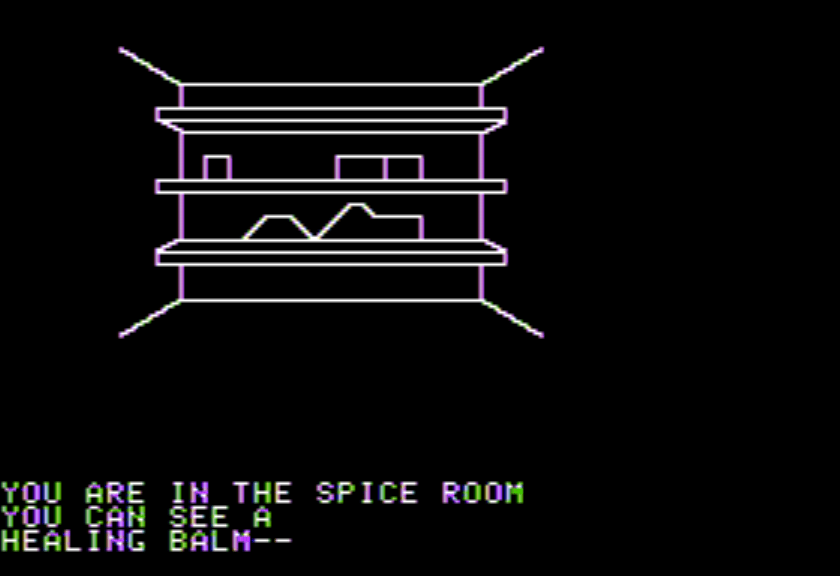
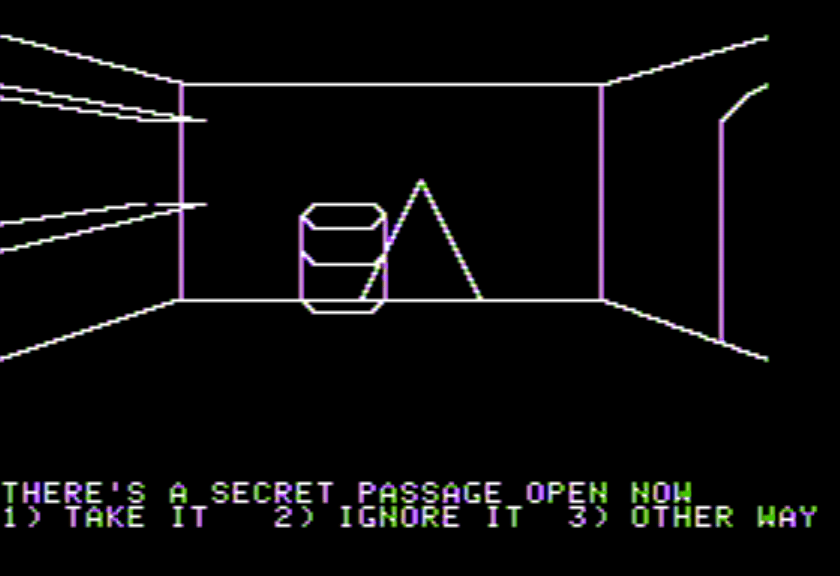
The proprietor of El Explorador de RPG also, importantly, managed to find the lair of the Beast. Following his instructions I found the actual secret room is to the east of a “spice room”, strangely enough in a well-lit portion of the castle.
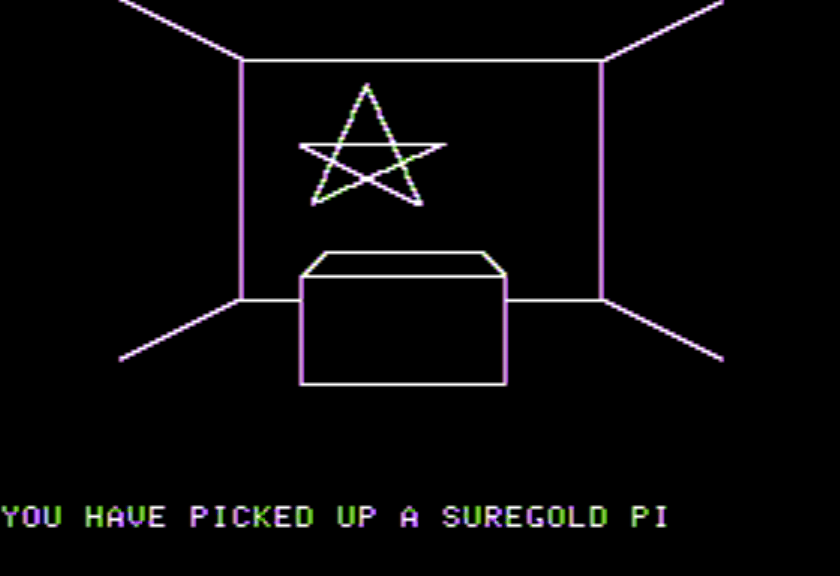
The Beast incidentally doesn’t move, nor can you attack it. I was able to break open the treasure (with a hammer) and get a SUREGOLD PI, which means (??)
Maybe the text got cut off? Your guess is as good as mine.
There’s no ending to the game, which I already sussed out; you’re supposed to use the information you have now to solve the mystery, but since it is a contest you send in for, there’s no confirmation in the game itself.
Having the Beast be genuinely present is an important clue, insofar as we can take all information about it at face value. Let me explain what I mean by comparison.
The Crystalware Fall of the House of Usher plot involved a man whose ex-wife was thought dead but is not dead, and she murders her husband’s new wife. The first game even had a winner of the associated contest (according to their newsletter).
This game has all the same characters (husband Lord Edward, ex-wife Veronica, current wife Elizabeth) and even some clues that hint at the Usher plot (missing death certificate, bloody scarf) but there isn’t any concrete evidence in the game itself the ex-wife is alive. I suspect it’s a little like the Haunted Palace poem being embedded in the main story; the characters are being used as a framing device.
There’s also two clues trying to signal the caretaker and his wife might be at fault (references to greed in the manual, “SYBIL SAID – HE BETTER NOT LEAVE US OUT” in the clues). However, again, there is no concrete evidence that this all added up to murder, nor is it even clear how the murder would help make sure Lord Edward’s will came out to their liking.
Going back to the full list of clues, I’ve crossed some out:
DIAMOND RING IN A HEAP OF ASHES BLOOD STAINED SCARF
MARRIAGE LICENSE-ED S. & ELIZ. ASHLEY
LETTER TO ELIZABETH FROM ANNE ASHLEY
ELIZABETH’S PICTURE/TO CHARLES-LOVE E.
WOMAN’S MASK AND TAPE
CLUE-BUTLER SLEEPS IN UNTIL 9 A.M.
BOAT TICKET TO BOSTON UNPOSTED COPY OF EDWARD’S NEW WILL
CLUE-THERE IS A CASKET IN THE CHAPEL
CLUE-TOWN GOSSIP-SOMEONE SAW ELIZABETH
MAID’S SHOPPING LIST-ONE NEW UNIFORM
A NOTE TO CHARLES-MEET ME TONITE IN..
…I CAN’T HIDE THE TRUTH ANYMORE…
CLUE-CHARLES WAS ONCE A FAMOUS ACTOR CLUE-NO DEATH CERTIFICATE FOR VIRGINIA SYBIL SAID-HE BETTER NOT LEAVE US OUT
..I CAN HEAR HERMAN’S CRIES EACH NIGHT
IN THE OLD HOUSE PLANS-A SUBCELLAR
KEY #2 MISSING FROM EDWARD’S KEYRING
What is most definitely in the game is the Beast, and so the references in the clues are relevant: to the maid having to get an enormous amount of food from the village, the fact that her calendar has her from 8 to 9 am looking for a cat, that the Butler doesn’t wake until 9 am (quite specifically!), that the maid needs a new uniform (likely summoning demons is a messy business).
. . . and my lord I mean to inquire about your maids daily purchase of 30 lbs of raw entrails. It is beyond my comprehension how you … the Butcher
As described by Lord Edward in the diary section of the manual, which he stumbled across looking for lost treasure of his ancestors:
There, crouched beneath the sign of a pentagram, was the most loathsome creature I have ever seen. Its yellow eyes gleamed dully in the light of my candle and its 7 foot tall body was covered with a sickly grey matted coat of fur. Around it were strewn various skull and human bones and next to was a stack of fetid rotting entrails.
While there are mystery stories where one heinous crime happens entirely unrelated to the main murder being solved for, I think it is a safe assumption (or 95% safe) that the Beast somehow figures into the death. (If it isn’t, there is so little evidence to work with we might as well guess randomly the solution to the mystery.)
The evidence about Elizabeth being missing (and the “DIAMOND RING IN A HEAP OF ASHES” clue) suggest she is the victim. At the time she was supposed to have left to Boston but never made it there (the ship ticket and a rumor she was in town). There’s plenty of clues that she also became the butler’s lover. Would the Butler have done it, though? He was the one that discovered the body but given he was seen spending copious money in town his relationship seems to have landed him in an advantageous situation. (Also, the explicit 9-o-clock wake up time indicates to me he was unaware of the maid’s activities, and again, I’m assuming the Beast is involved somehow.)
So what motive did the maid have to kill Elizabeth? Well, the maid is mentioned as being tied in with the rumor mill; she would definitely have heard about the Butler and Elizabeth being together, and particularly, the Butler paying for bills in gold coins. This could only reasonably happen if the treasure room was the source.
Just Elizabeth knew about the treasure, but she was sharing with the Butler since they were having a romance. (I am adding this condition to have something later make sense.) The maid had been capable of summoning the Beast in various places (there are pentagrams in multiple places in the castle, although the one in the secret room is the only one that is drawn), so she (by my theory) followed Elizabeth and used the Beast to kill her and dispose of the body. The Butler never knew about the treasure’s location so never found it; His Lordship had his encounter in the diary but just ran away.
This doesn’t still explain the “mask of a woman” clue. I don’t see a mask being held by masked tape fooling anyone except in the most extreme of circumstances. If that isn’t a red herring, I suspect the maid simply dressed as Veronica to scare Lord Stuart away (the diary mentions him hearing Veronica only, so this is just a guess); presumably the treasure is large enough to make it very hard for the maid to get away scot-free on her own without the household entirely cleared out.
So (if my solution here is correct), if we picked the maid at the start of the game, we are in fact the killer! There’s no real “narrative change” to the universe, just the revelation of clues, so this is possible, but if we play the maid, probably we should be vacuuming up all the clues laying around (like the picture of the Butler with Elizabeth) and destroying them.
I’ll call that a wrap for this game! We are technically not done with Crystalware yet, as there was another game with the same engine, Glamis Castle. From an ad at Atarmania:
According to ancient legend and records this castle is one of the most haunted sites in Great Britain. One Lady Glamis, known to be in league with the devil, liked to send out a destructive demon to harass the townspeople. She finally was burnt at the stake on Castle Hill, cursing as she died all future generations of the Lyon family. Her demon still seems to haunt that spot, murdering the curious who stray up to Castle Hill after dark. The curse stipulated that each succeeding generation would have at least one child, often female, who would be a vampire. When an heir comes of age, there is a secret ceremony in which the heir, his father, and the steward take crowbars and chip away plaster concealing a hidden chamber, known only to them, that Earl Patie used when he gambled with the devil. Another tradition says that a creature, half-man, half-beast stalks the passages in the walls of Glamis to insure the fulfilling of the curse. The mystery, of course, is to determine the location of this secret chamber. Our game, occupying 2 disks, will have as exact a replica of the castle as possible. It’s definitely one of a kind! And we will be offering a $500 prize to the first person daring enough to solve the centuries old mystery of Glamis Castle.
The game was published, but we currently lack a copy. I’m not quite at a rush to return to the world of Crystalware yet anyway. I appreciated the uniqueness but the broken aspects made the whole thing collapse under its own weight.
I’ve made good progress on the game. The way it has gone almost feels like the opposite of what a modern player would want to experience, yet there are aspects of the style that allow unique choices that are tough to replicate without that roughness. It’s easier to just explain in context —
A Dick Smith System 80, from Classic Computers New Zealand. This was a very popular clone of the TRS-80 in the Australasia region and there is a decent probability Doomsday Mission was developed on one. It was sold as a Video Genie in the UK, a PMC-80 in the US, and a TRZ-80 in South Africa. The clone originated from Hong Kong via EACA International Limited.
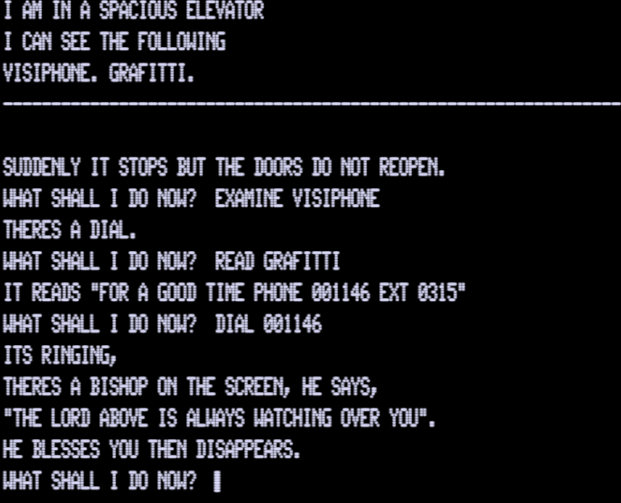
— so continuing directly from last time, I had found an elevator with a strange message. In a literal-world sense this would be a gag, but it occurred to me not long after hitting “Publish” on my last post that it might be a clue of some sort.
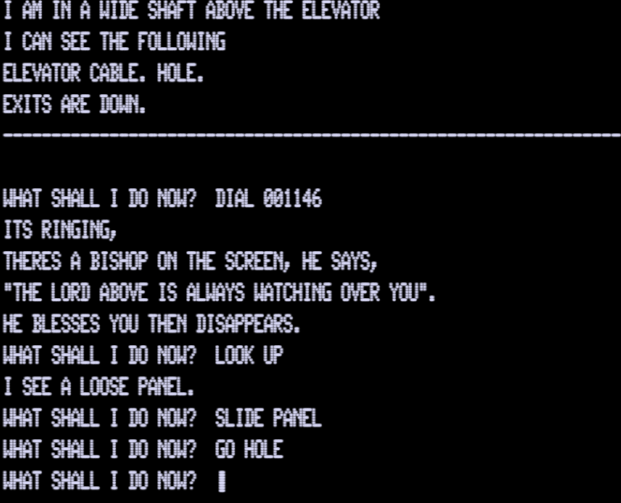
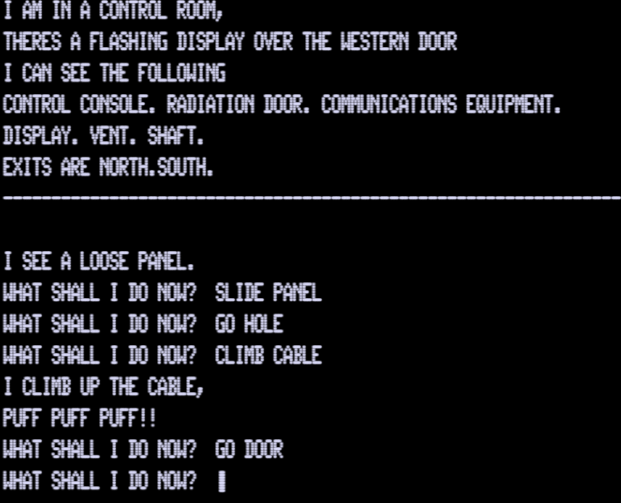
I tried LOOK UP which revealed a secret panel. After finding the panel you can SLIDE PANEL revealing a hole, then GO HOLE to get to the top of the elevator. There’s a cable you can then climb to make it to the second floor.
This results in a second floor chock full of more ways to die.
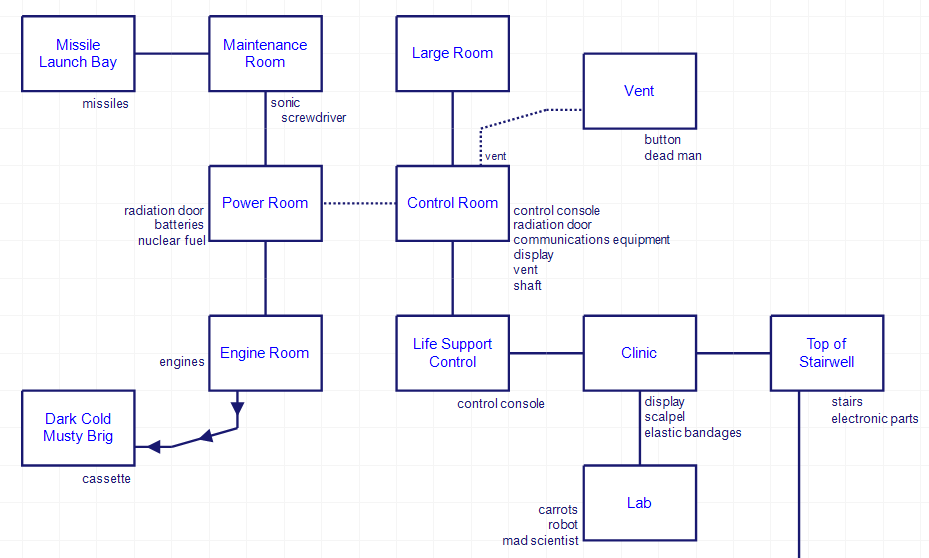
Heading south a bit leads to a Clinic with a scalpel and some badges; adjacent is a Lab with a mad scientist.
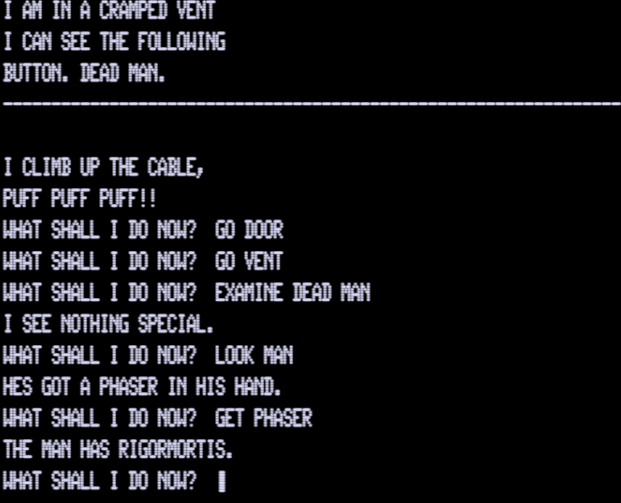
The route to avoiding death here involves a vent by the elevator. You can find a dead body of a crewmember holding a phaser held tight via RIGORMORTIS.
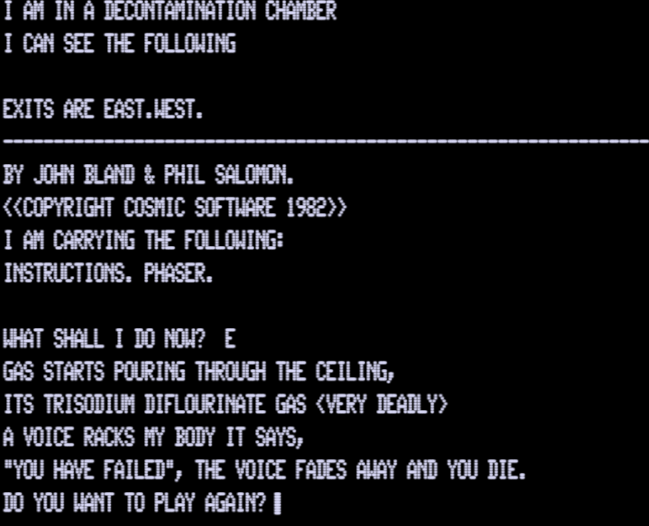
This moment is effective due to the opening of the game. The very first step kills you with gas. Since dropping the starting phaser to avoid the gas is not intuitive, most players (myself included) will have experienced an army of clones being killed over and over before finally getting through. Even though none of them are part of the “diegetic text” of the plot — that is, the “real”, “final” plot where we succeed — they still have an effect of the player. (See also: Pyramid of Doom.) The ghost clones gave me a fairly nervous reaction upon seeing the phaser, rather emphasized via the method of obtaining it, via sharp implement:
You can’t shoot the scientist, but the phaser works even if you aren’t shooting it.
The carrots let you see better so that when you go down stairs to the first floor (skipping the elevator) you can see the way up again. The robot has two slots for cassettes which I haven’t used yet.
Having a kick opening with dying the exact same way over and over is not really polite even in a modern time-loop game, so the dramatic effect was uniquely historical. I also like that in its most refined form, this is just a “take object X and bring it to person Y” puzzle, but the extra plot elements indicate depth beyond a node on a puzzle flow chart.
Moving on to more forms of death, past the radiation door:
The radiation can be taken care of by swiping the space suit from the first floor, which doubles as radiation protection.
More hazards still await. In addition to a PHASER the game starts you with INSTRUCTIONS that ARE PLANS TO DISARM THE MISSILES ON THIS STATION. Well, here’s the missiles, so let’s try it:
Just having an alleged shutdown button there would have just been a trap, but by having the instructions tossed in the player’s inventory from the beginning, throwing a psychological shadow, the trap became delicious. The final method of death is from dropping into a cell, the same one you see after using violence:
This isn’t necessarily a loss here but I haven’t figure out yet how to get out. The obvious choice of sonic screwdriver (Dr. Who’s chosen open-all-doors implement) doesn’t seem to work, although I may just be using the wrong verb. You can use violence to get a security robot to come by but they just eat the key to the door and otherwise ignore you (you don’t immediately die at least).
The radiation area also has batteries. After enough time the life support shuts off and the lights go down. You can insert the batteries in a torch from the first level (that’s torch = flashlight, this is an Aussie game) for the light, and for the life support, you need to be wearing a space suit when the drama hits and there’s a lever in a LIFE SUPPORT CONTROL room that resets things so you don’t need a suit on.
I assume there will be some logical reason we can’t just keep a suit on the rest of the game.
So to summarize what I’m up on:
1.) the missiles are booby trapped and may just not be disarmable at all; there might be a way through the booby trap
2.) escaping the cell (which might be easy?)
3.) surviving going through the airlock on the first floor
Regarding the airlock, I did find the BANDAGES could tie to the HOOK, but I was unable to translate that into using them as a safety net or the like. This may simply be again a matter of finding the right verb.
I do have the suspicion I close enough to the end to be able to wrap up in one post, although I also suspect I will have at least a few more ignominious deaths along the way.
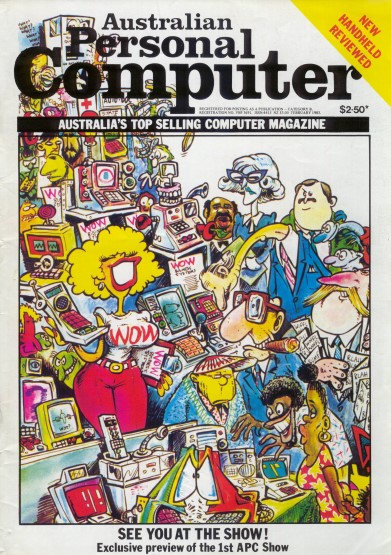
If you want a perspective on the Australian computer industry at the end of 1982, a good place to check is the February 1983 issue of Australian Personal Computer, which has a long section devoted to the upcoming Australian Personal Computer Show and a list of all the vendors showing.
Some of them are simply Australian branches of well-known international companies (like IBM Australia, or the publisher Addison-Wesley). Some of them are local computer groups (like Atari Computer Enthusiasts). Some are hardware sales groups (ComputerWave). But not many at all are local software houses.
Lothlorien Software produces a range of educational software whose key-note is ease and simplicity of use in both tutorial and lesson-making modes.
Each tutorial program presents and drills material, giving immediate corrective feedback. Teachers can rapidly compile sets of lessons to add to the comprehensive set provided on the master diskette.
Also see: Microbee: “…on display will be the recently developed Wordbee word processing package, Pascal and Logo, to provide a variety of educational environments and a range of options not allowed under Basic.”
A skim through ads for 1982 indicates the same: lots of emphasis on import. In other words, Australia’s home-grown software industry was taking a while to develop. It still wasn’t at zero, one exception being Cosmic Software, as owned by Tom Theil.
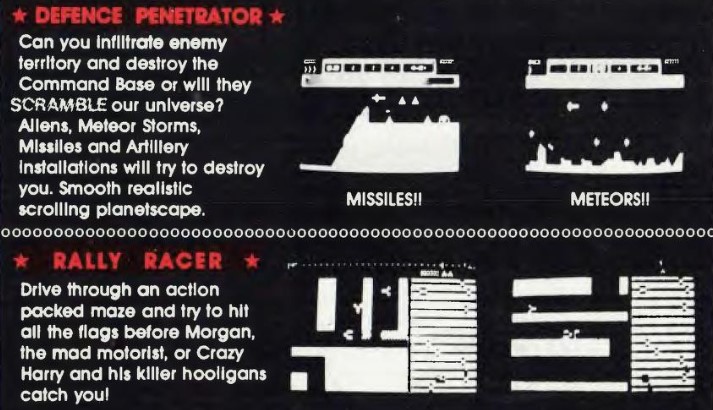
They mostly were known for arcade game conversions for TRS-80 that are genuinely decent, although quite frank in their clone-ness.
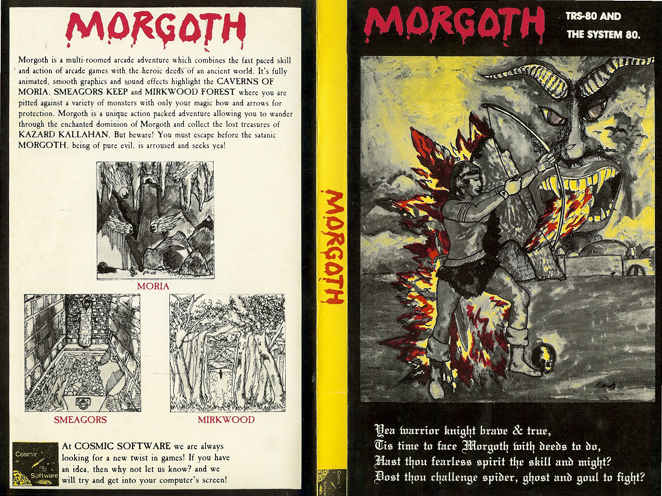
They worked with at least one outside group, Malabar Trading, who did Outland (sort of Missile Command with a city being attacked but where you have crosshair shooting) and Morgath (a series of three “action adventure” segments put together into one plot).
Every game I could find of theirs was published in 1982, and that includes what seems to be their sole adventure game, Doomsday Mission, as written by John Bland and Phil Salomon. Being a fairly technically solid outfit otherwise it is not surprising their TRS-80 adventure (even if it was another “outsider publishing venture”) would not be in BASIC but in machine code.
(And before I start showing screenshots, I need to give thanks to George Phillips, who helped me get this running in trs80gp. The emulator needs to be in Model I mode; additionally, it can’t have any disk drives attached at all, which is doable with trs80gp -m1 doomsday.cmd -dx.)
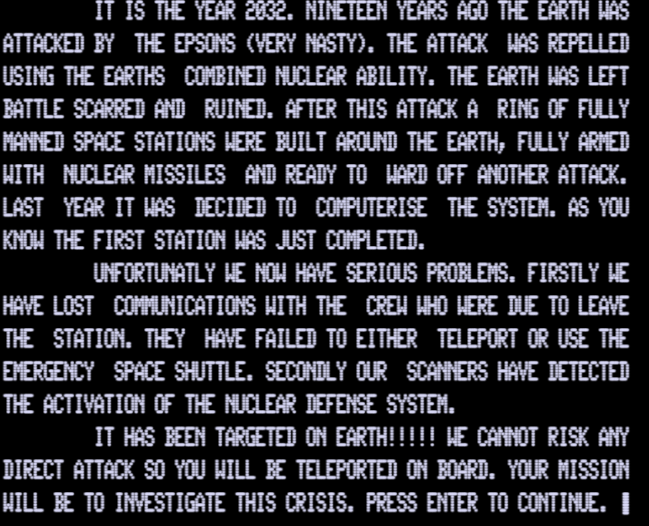
The plot involves the building of an orbital space station able to fire nuclear missiles at any alien attacks. The wise powers that be have decided to give control to the stations over to large language models the machines, and things have gone horribly wrong.
This has what I informally call a “kick opening”, where the game kicks you pretty hard with an opening puzzle, leaving you stuck with few options. (Another example is Savage Island, Part II, where you had to either HYPERVENTILATE or BREATHE DEEPLY.)
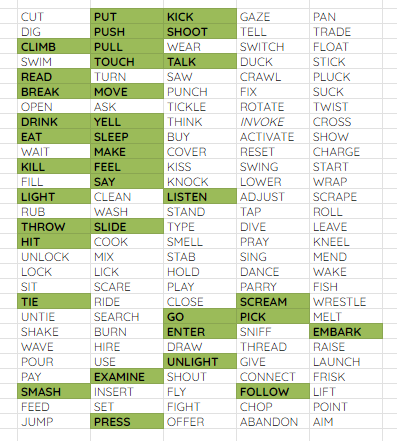
I started almost immediately by making a verb list which usually only happens on pretty hard games:
MAKE and LISTEN are the two worth keeping track of; they’re not always typical nor are they easy to summon up in a game context. (MAKE is typically used for something like getting a plan for a bridge which you then have to assemble with MAKE BRIDGE. It can be hard because you are making something which doesn’t technically exist as a noun in the world yet.)
Rather unusually for a kick opening, this is honestly a good puzzle. I solved it by thinking about the reaction to using any kind of violence. If you shoot the phaser you’ll get a fatal backlash from the space station:
When making the verb list, literally every attack variant was intercepted the same way (BREAK, HIT, KICK, etc.)
After some contemplation I realized since there were intense sensors for weapons or violent activity, it would be in the station’s interest to stop a PHASER from getting through. So I just did DROP PHASER as the first action, and made it through the gas safely.
No weird actions, just a slight subversion of expectations as: while you start with a helpful inventory object you need to immediately dump it.
Past the initial puzzle is a much more open map, one feeling vaguely reminiscent of Star Trek, just with a lot more dead people.
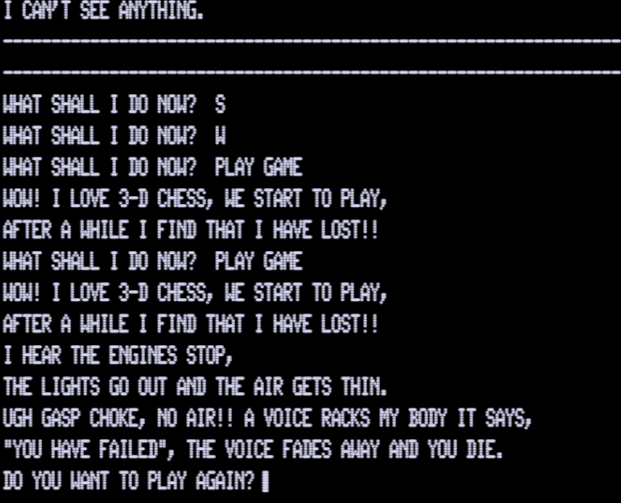
There’s a 3D-chess game that you can kill time with before the game kills you.
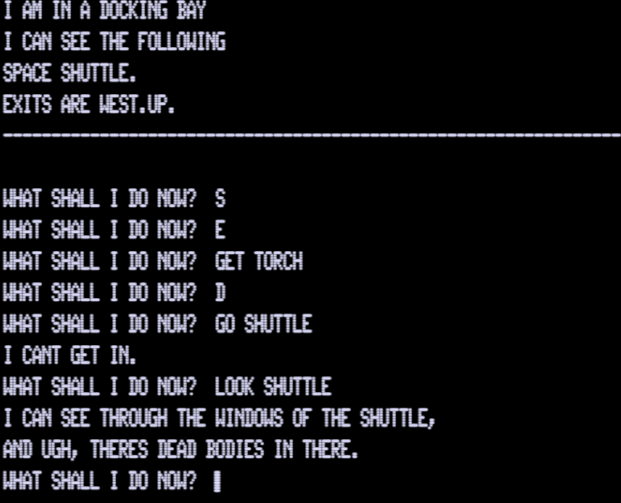
There’s a SPACE SHUTTLE in the bay below that is full of dead bodies and that I haven’t been able to enter.
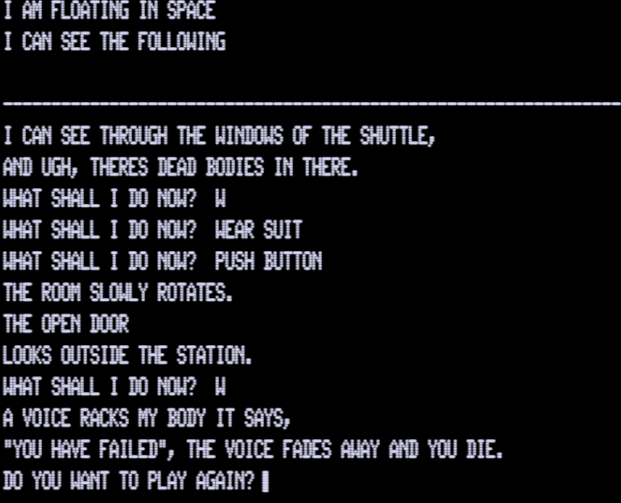
Next to the space shuttle is an airlock. While there’s a space station, stepping out of the station kills you as you float into space. There’s a hook nearby I assume you need to attach a tether to, but I haven’t found any appropriate item.
There’s an ELEVATOR which traps you in with a weirdly non-thematic message.
I’m otherwise fairly stumped on progress, although I still need to make a couple more circles of the map for secret interactions.
You can also hop in the bed and SLEEP for some reason.
Despite the amateur feel, there’s clearly some passion being tossed around which I appreciate. Also,
“THE COMPUTER HAS GONE BESERK, THE ONLY WAY TO DESTROY IT IS TO UGH GASP GROAN”, HE DIES.
implies the man is saying the actual words “ugh gasp groan” as he’s dying, which is hilarious to imagine. Hence I would normally follow by saying “I’m not ready to check hints yet” but as far as I can find there are no hints, so I guess I’ll have to just figure it out then.
(Or hack at the binary, where the text is plaintext. But that’s definite last resort.)















































 Renga in Blue