Author Archive
I’ve finished the game, and this post assumes you’ve read my previous posts about The Phantom’s Revenge.

Poster from the 1925 film version, still the closest to the book. Via Fandom Wiki.
Breakthrough number one was simply with the parser, regarding the guard dog. PUT LEASH ON COLLAR gave the cryptic message
There isn’t any switch on it.
which I thought meant some dog-slang I didn’t know (I’m a cat person), but after further investigation I realized the game was simply mis-parsing and thinking was hitting an actual light switch or something similar. I ended up just ramming through the entirety of my previously made verb list…
…and hit paydirt with GIVE.
This is a large rectangular room that was used as an office by the prison warden. Obvious exits lead east and north.
A large dog with a spiked collar is sitting here. He looks like he might bite if you annoyed him.
GIVE LEASH TO DOG
The dog growls ominously, but lets you clip the leash to his collar. Once leashed he seems much calmer, even friendly.
This lands the dog and leash in your inventory. The game is still pretty finicky here, as despite the two being described together, there is a difference between dropping the leash and dropping the dog. The dog will you kill you if you DROP DOG normally — that gets interpreted as also unleashing the dog. You need to DROP LEASH instead if you want to drop the dog temporarily, but fortunately for all this you don’t need to bother given the place to unleash the dog is only a few steps away:
E
You are in a small antechamber of some sort. It is simply, but attractively, decorated with nooses and pictures of famous condemned criminals. Passages lead east and west, and there is a doorway in the north wall.
E
You are in a grim looking door-lined hall. To the east is one particularly massive iron-bound door that is ajar. There is a large dark opening to the north.
A nasty looking prison guard is leaning against the cell door, and you hastily draw back, afraid he’ll see you.
DROP DOG
The dog narrows his eyes and snarls, showing ivory-white teeth. Suddenly he realizes he is free, and with a puzzled look he hesitates between you and the guard.
Finally he seems to decide that he hates the guard even more than you, and races toward him! The guard — dense, but no fool – runs like hell, with the dog snapping at his heels!
This is the other side of the starting prison cell, and you can now head north to snag a gold nugget, one of the other treasures.
With the dog out of the way, you can get in the warden’s office, described as a TREASURE TROVE in the room name.
This is the warden’s office.
N
This small square stone room was used to store the warden’s treasures; particularly the things he took away from prisoners. The only exit is a dark doorway that leads south.
This is where the black figure’s stolen loot goes to. (The figure is, as Voltgloss observed from the comments, The Persian, usually cut or merged with other characters for movie versions, although he shows up in the 1925 silent as the Inspector Ledoux.) Just like classic Adventure, after you have items stolen a chest appears with the trove as well, and taking the chest away from the trove causes the theft to stop altogether. On my “final run” I had nearly all my treasures stolen. It was easier than managing the inventory limit, to be honest, and only took to making transfers from the trove back to the wharf (the final deposit place of loot) near the very end. I never considered this as a strategy for original Adventure because the Pirate area in the maze is inconvenient to get to, and the Pirate is less persistent than the Persian is about filching things.
There is a lovely little chest here, full of jewelry.
My next moment of enlightenment was also a little meta. It went back to a portion of the game I thought I had already mapped and resolved, a storm drain with one treasure.
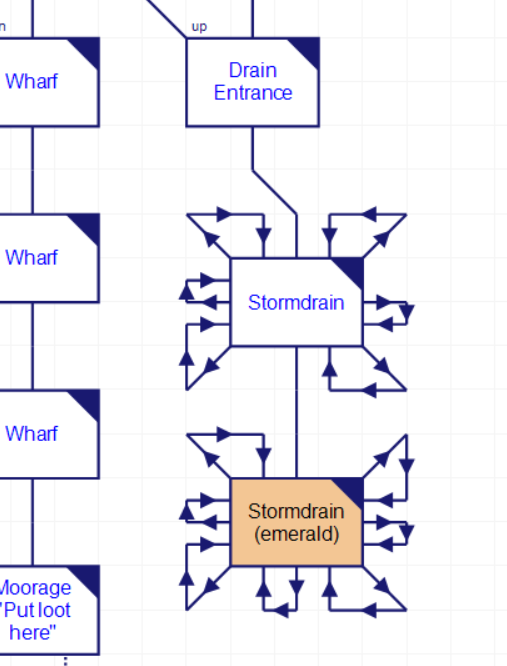
However, when I tried to go back to the area (on another run-through) I got stuck, and despite going north many, many, many times I was not able to get out with the emerald. Given the fact I did nothing special the first time, and none of the items I was carrying seemed to affect the area, I tried again and managed to get out. It simply is random, and the kind of random that one player (me the first time through) might luck through at first, but another player (me on the second) might roll unlucky 25 times in a row. I never worked out the actual percentage chance of escape, but if it’s, say, 10%, that means there’s an 11% chance that you could get unlucky 25 times in a row.
You are in the stormdrain.
N
You are in the stormdrain.
N
You are in the stormdrain.
N
You are in the stormdrain.
N
You are in the stormdrain.
N
You are in the stormdrain.
N
You are in the stormdrain.
N
You are in the stormdrain.
So, going back to the “mazes” I couldn’t get out of as they seemed to be single-room (the Catacombs and the Living Forest), I tested the theory I was just getting unlucky and kept trying to get out. The catacombs follows this theory exactly, so I found a “jeweled idol” and was able to escape the way I came.
There are thousands of strange twisted trees all around you, and oddly dressed people are running back and forth among them. The forest is there wherever you look, endless, frightening.
The Living Forest I was merely able to leave, so I knew I was missing something. I especially knew I was missing something because of this message:
BREAK MIRROR
The Magic Forest is axe-proof, bullet-proof, and maybe even Adventurer-proof. Your attack has no effect.
The mirror isn’t described in the room, but I was clearly presuming right that one was there. I thought to SING (one of the verbs off my list) but no dice:
“The sun shines bright on Pretty Red wing …”
I practice in front of the mirror every morning!
I ended up needing to check hints from Exemptus. There’s some “sheetmusic” I already used to play on an organ and open a secret passage, but apparently it also counts as vocal music if you’re holding it when you sing at the Forest.
It’s a toccata of some sort … “Don Juan Triumphant.”
SING
Your high note shatters the mirrors into a thousand pieces!
WOW, you really HAVE got a voice that shatters glass!
LOOK
You are in the Magic Forest.
A litter of broken glass covers the floor. You can see passages leading north, south, and east.
One solitary iron tree stands in the middle of the room.
To the south there’s a “tiny brass cricket” and I admit I had to check hints here again. Despite no indication otherwise you can READ it.
There was engraving on its back, but most of it is worn away. The only readable letters are “-UM-“.
This suggests you can JUMP, which warps you to a room with a ruby, yet another treasure.
You have found a tiny little room painted all in green. Big gold letters on one wall say “JUMP ROOM”. A steep narrow tunnel leads down to the west. If you go down, you will not be able to come back up.
There is a wonderful ruby here, carved to look like a cricket.
My only obstacles that remained were the two types of rats, the little ones and the big one. For the little ones, I hadn’t tried the cheese yet (I tried it on the big rat but just hadn’t gotten around to testing it on the others):
The mice eat the cheese a nibble at a time. They seem a lot friendlier now that they’ve been fed.
This yields a pretty heavy “Russian urn” and you have to be careful because getting back to the opera house requires climbing down a fragile rope ladder, and if you’re carrying too much it breaks.
With that resolved I technically had every single treasure. The big rat doesn’t block anything, the area it leads to you has alternate routes, but I looked up what to do:
A giant rat, easily eight feet high, bares its sharp front teeth, twitches its whiskers, and refuses to let you go by.
kill rat
Oh, sure! By yelling “BOO” I suppose?
yell boo
The giant rat looks startled, shocked, and keels over. I guess the poor thing had a bad heart.
Once the hypothetical came up the answer was easy; I hadn’t thought to KILL RAT. The game otherwise emphasizes the essential uselessness of the verb so it wasn’t at the forefront of my mind.
The theoretical question is a lot easier than Crowther/Woods asking if you are sure you want to engage in fisticuffs with a dragon. You’re still engaging in the parser here in the same way you’ve always done, you don’t have to switch modes and imagine it is possible to interact with the hypothetical narrator. Additionally, for someone who has trouble, the puzzle is genuinely completely optional.

Passing through the room marked in red (with the rat) lets you access the “Southwest Shore”, but there are multiple ways to arrive at the same place, most of them very straightforward.
I still must have missed some kind of puzzle (or maybe I was playing too slow and number of turns matters?) because I didn’t get the full spread of points. After you drop the last treasure at the wharf you just need to wait.
There is a strange idol here, covered with jewels.
(etc, some treasures skipped, you need to drop the white scarf before a jade horse or the jade shatters)
There is a rather dusty — but valuable! — tiara here.
There’s a wonderful little marble statue, signed by someone named “Picasso,” standing here.
There’s a gold nugget, off of a watch fob, here.
There is a delicate white silk scarf here.
A small gold ring lies gleaming on the floor.
WAIT
There is a sudden roaring sound as the motor of the launch comes to life. Hurriedly, you cast off the single mooring rope. The launch races off across the sea and finally comes to rest on a lovely, idylic beach. The local inhabitants all crowd around to celebrate your arrival, and proclaim National Adventurer Day, especially in your honor!
Your final score is 321.
You need 14 more points to reach the next higher rating.
You have become a Junior Grandmaster!
I’ve been puzzling over if there’s some sort of real story here with consistent lore, or if the author decided to tag what she thought were neat elements of the Phantom of the Opera story. There certainly seems to be some kind of logic:
- we know from the dive mention of computers that we’re referring to at least the 1970s, 1960s at latest
- there are a number of very ancient things, like a “yellowing program” from the 19th century, that indicates everyone involved ought to be dead
- yet we have someone who appears to be the Persian and a protagonist who is the Phantom
- we also have a single guard who is guarding our protagonist at the start
The timeline suggests that Erik (the Phantom) is too old to be the same Phantom.
There is a strange old prison near here, long abandoned except for a few caretakers, and some half-mad vagrants. A few people say that the prison is haunted by some sort of ghost, and that it guards some fabulous treasure. A lot of people have gone to search the old place, and have never been seen again.
Are we some sort of undead? Like an actual ghost? All previous renditions (that I know of) have Erik be a man, just a deformed one, but I could easily see a different take given we live in a coffin. At least the terror of the old prison and opera house would keep people in the waterfront town from filching the treasure lying around, but I’m unclear if we have been imprisoned a very long time, only to now initiate our revenge, or if this is recent events (why the loss of memory then, though)?
We do get a bonus point if we are holding a photo of Christine when the boat picks us up.
I still thought the lore was effective; unlike Dr. Who Adventure, this leveraged the “fan-fiction shorthand” well to make particular elements much more suggestive than they might otherwise be. I especially liked being able to teleport directly from the location the treasure gets stashed at to the private box reserved for the Ghost.
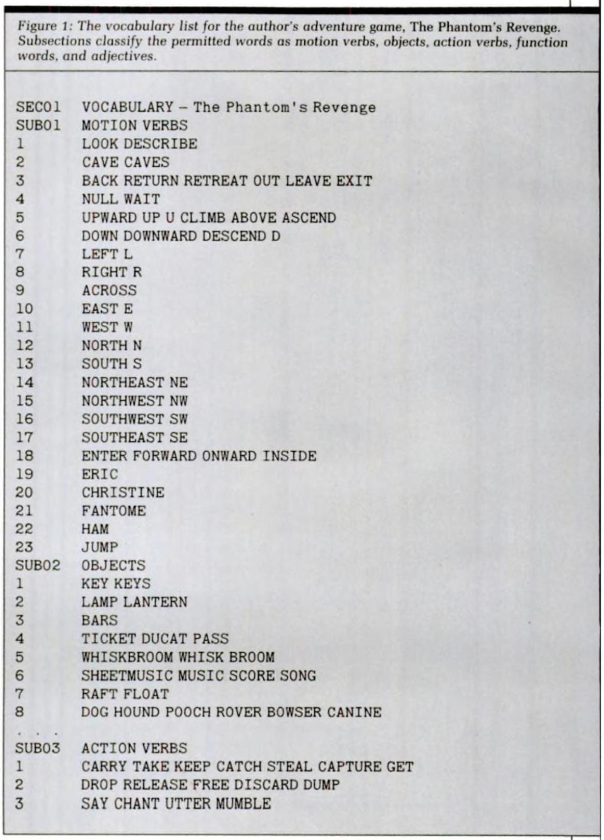
From the Girard article Do-It-Yourself Adventure. CHRISTINE is listed as a movement verb but I never found out where it gets used.
This was very tightly constrained via the Adventure framework. Dian even mentions in the article above
My own adventure games are built from two basic parts: the driver program and the text files or “script.” The script contains all of the vocabulary words that the driver recognizes, plus the object and place descriptions. There is also a builder program that converts the text in the script to machine-readable tables. Because the games are script-driven. I can build 70 to 80 percent of a new game without ever touching the actual program source code.
which can suggest something like the Scott Adams interpreter, but also suggests to me that the game has to be a treasure hunt and is limited in movable-characters to dwarf and pirate analogues. Still, it’s about the best game this kind of paint-over could attain.
I worry about future games with the same engine branching out, but we need to wait until 1983 anyway until we get there. Coming up next we’ve got two more prison escapes (short ones), two 1982 games written by people who comment on this blog, and finally an incredibly difficult game based on a British TV show where the TV show itself involves playing adventure games.
(This is a direct continuation of my prior posts on this game.)
In addition to Norell having a port of Adventure to DOS, as mentioned in the thread here, Chuck Crayne also made an entirely different CP/M port of Adventure under the label California Digital Engineering. It’s a regular port with 350 points.

Based on investigation in that thread there’s no obvious hints that parts of the code were re-used for the original Crayne games, but it’s useful to see yet another connection. Even if the DOS engine was made “from scratch” deep familiarity with the original engine surely had some influence.
Weirdly, it is possible The Phantom’s Revenge is also making yet another Adventure-port reference, this time to Gordon Letwin’s port (originally Heathkit, and eventually the TRS-80 game Microsoft Adventure) but I’ll be getting to that.
My progress didn’t feel like “solving puzzles” technically even though I marked some of the puzzles off my previous list. Nobody thinks of the keys in original DOOM as being “puzzles” — there’s a blue door, you find a blue key, now you can open it. Similarly, here there were items I found that defeated obstacles where the use was 100% clear, the hard part was finding the item in the first place. The gating was by geographic-discovery as opposed to ratiocinating about a puzzle-dilemma.
My gameplay loop hence has felt different than my standard adventure playthrough. As illustration, here’s part of my map as I left off last time:

This is at the prison area (the YNGVI room is up on top) and some of the rooms have already been marked; this mark means I have checked north, south, east, west, northeast, northwest, southeast, southwest, up, and down, and made sure I haven’t missed any exits. The room descriptions have mostly been nice about listing all exits, but since my last session I’ve discovered one quite intentional deviation — and sometimes I just misread stuff — so this kind of care is necessary for play.
The “Dungeon” for example, I poked in and out of quite quickly on my last pass, but I had not marked it yet so I knew it still needed checking.
A sense of horror fills you as you realize you are in an old torture chamber. There is a rack, with tongs and braziers. One doorway leads west, and a dark opening is to the south.
The door of the iron maiden is open, showing a dark path that leads north.
S
You are wandering through the rat-infested dungeon.
The dungeon doesn’t say anything about exits, and in fact all exits work: this is another small maze.
This is the dungeon.
E
This is the dungeon.
S
You are wandering through the rat-infested dungeon.
The whole area is full of dust and cobwebs.
OK, this is technically a puzzle, but it is heavily telegraphed: I was carrying around a whiskbroom with nothing to show for it yet, and one of the dungeon rooms quite specifically talks about dust and cobwebs.
Your efforts raise a thick cloud of … achoo! … dust, and dislodge a trapdoor that swings open to show a dark opening in the … achoo! ACHOO! … floor.
D
You have found your way into an ancient crypt. The stones under your feet are worn, as if by the footsteps of people long dead, and the whole area seems old beyond belief. A narrow flight of stone steps leads up to a dark opening in the ceiling, and there is an equally dark arched doorway to the east.
Again, in a general gameplay sense, while this was a new discovery in the sense of a “wanderer explorer”, it didn’t feel like I had resolved some tricky gate. I think a good comparison is an RPG where you’re finding some new path in a dungeon, but not doing any work to get there other than look carefully. It still can be satisfying gameplay but it doesn’t happen as much with modern game density (and the implicit idea that a puzzle that isn’t really a puzzle is a bad thing).
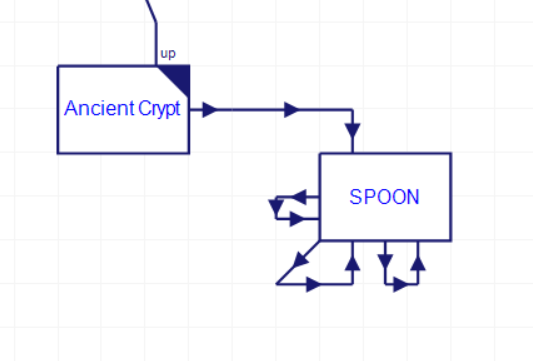
Here’s another snapshot of map creation in progress. I tested every exit from the Crypt and marked it as “done”; then I moved on the room to the east, some Catacombs (“You are in a vast and silent catacomb, lined with the tombs of un-named, ancient dead.”) and found it was another maze, so I dropped an item (my trusty spoon, used at the start of the game for digging a whole and now my opening maze placeholder). So far on the image above I’ve tested west, southwest, and south, finding it to be looping.
Continuing my way around, I found every exit to be looping. In such a case I’ve also been testing my various magic words: FANTOME, HAM, and YNGVI. I’m not expecting any of them to work as they already have their locations, but I want to be careful about false assumptions. I’ve also found, by accident, that CHRISTINE is another transport-word, but I don’t know where it goes (“You can’t go in that direction, sorry” — like FANTOM and so forth do in the wrong place).
I don’t know yet if this means if the Catacombs is a puzzle that needs resolving, or just a softlock we’re supposed to avoid. I’ve also been stalled such in a Magic Forest quite near the Phantom’s “coffin” residence for similar reasons, although going north or south causes a unique effect:
There are thousands of strange twisted trees all around you, and oddly dressed people are running back and forth among them. The forest is there wherever you look, endless, frightening.
There is a tattered page of sheetmusic lying here.
D
You are in the Magic Forest.
There are thousands of strange twisted trees all around you, and oddly dressed people are running back and forth among them. The forest is there wherever you look, endless, frightening.
There is a tattered page of sheetmusic lying here.
N
With a sickening “THUD!” you hit your head against the cold, hard surface of a Magic Forest tree.
You are in the Magic Forest.
There are thousands of strange twisted trees all around you, and oddly dressed people are running back and forth among them. The forest is there wherever you look, endless, frightening.
There is a tattered page of sheetmusic lying here.
It could be that the Magic Forest is a puzzle and the Catacombs is a softlock, or they’re both softlocked, or they’re both intended as puzzles. I don’t know yet. It was time to move on (via a saved game) and explore more rooms, though.
The Warden’s Office have exits listed to the north and east, but I hadn’t tested them yet to a guard dog. (“A large dog with a spiked collar is sitting here. He looks like he might bite if you annoyed him.”) Incidentally, trying to attach the leash the dog says “there isn’t any switch on it” so either I’m going up the wrong tree or I am genuinely missing an item. It turns out only north is blocked by the dog, and east leads to a whole new area, so I kept mapping:

This is mostly of a “warden’s house”. You’ll notice not all rooms are marked; this means I haven’t done the thorough-exit check yet. In the Antechamber, I hit gold and hadn’t bothered to loop back yet:
This is a large rectangular room that was used as an office by the prison warden. Obvious exits lead east and north.
A large dog with a spiked collar is sitting here. He looks like he might bite if you annoyed him.
E
You are in a small antechamber of some sort. It is simply, but attractively, decorated with nooses and pictures of famous condemned criminals. Passages lead east and west, and there is a doorway in the north wall.
SE
You have found a secret passage that twists around through the prison walls. There are dark, forbidding openings to the east and northwest.
The game quite explicitly left the exit to the southeast unmentioned. This means my test-all-exits has not been in vain but it also means, since there’s at least one, I have to keep going. From an author’s perspective, sometimes it is tempting to violate some gameplay norm once for effect, with the knowledge that it only happens once; from the player’s perspective, they don’t know if the gameplay norm will be violated in the future, so they have to imagine it can occur an infinite number of times!
this is a nice comfortable study. There is a fireplace, some comfortable chairs, and the walls are lined with books. There are some rather plain doorways to the north and east.
There is a beautifully carved jade horse here.
E
You are in the warden’s bedroom. It is rather plain, and the only doorway leads west.
There is a document lying on the floor marked “ONE ONLY”
This document solves another puzzle, the guarded gate. It technically is slightly ambiguous (so requires a little thought process) but in practice I knew immediately where it had to go, so the effect was more like finding the blue DOOM key.
The warden house area incidentally has a newspaper clipping which help get through yet another door:
This is the east end of the prison exercise yard. There are high stone walls all around you.
There is a yellowed newspaper clipping lying here.
GET CLIPPING
Okay.
READ CLIPPING
“Operatic soprano Mille. Christine Daae has the perfect combination for a star: a magnificent voice coupled with a perfect face and figure. The beautious Mlle. Daae, born 112371, shines like a diamond on the stage of the Paris Opera.”
The oddly-given date suggested I should use the number at the vault in the office, and indeed it works (you just type the number like it was a magic word), although the only item in the vault is another treasure (a “lovely pink diamond”).
I shouldn’t be quite so blasé about the puzzles because there were two “obvious” puzzles I didn’t recognize right away. In one case I mentioned both parts in my last post: a card that said “Joe sent me” and a “dive” that wouldn’t let me in the back. By writing my post and reading it over I realized they had to go together.
This is obviously a low dive. Big burly men in black shirts, fallen women, and computer freaks of all sorts line the dirty bar. A crazed young man is frantically pushing buttons on a big machine with bright blinking lights. There is a small, inconspicuous door in the east wall.
E
This is a well-concealed backroom, filled with strange sounds. The air is heavy with odorous smoke. Cheap chairs line the walls, and people of all sexes lean back listlessly with sheets of paper in their hands and odd dark-screened devices in front of them. Some are muttering to themselves, others laughing.
There’s a very expensive Persian rug on the floor.
There’s no acknowledgement the item even does the solving, someone might run into the Parallel Universe Problem and solve it by accident. Also, that second room is described as a HACKER’S DEN in the title description, which strongly suggests to me another room specifically in Microsoft Adventure:
YOU ARE IN A STRANGE ROOM WHOSE ENTRANCE WAS HIDDEN BEHIND THE CURTAINS. THE FLOOR IS CARPETED, THE WALLS ARE RUBBER, THE ROOM IS STREWN WITH PAPERS, LISTINGS, BOOKS, AND HALF-EMPTY DR. PEPPER BOTTLES. THE DOOR IN THE SOUTH WALL IS ALMOST COVERED BY A LARGE COLOUR POSTER OF A NUDE CRAY-1 SUPERCOMPUTER.
A SIGN ON THE WALL SAYS, “SOFTWARE DEN.”
THE SOFTWARE WIZARD IS NOWHERE TO BE SEEN.
THERE ARE MANY COMPUTERS HERE, MICROS, MINIS, AND MAXIS.
This might just be coincidence; there is no scene similar to the Microsoft game where taking a computer causes you to get punished.
The second “obvious” puzzle I missed was involving the “big round black thing, with a hole in it”, and to be fair that description is vague. However, if you grab it and take INVENTORY you find it is actually a “LARGE BLACK INNER TUBE” — in other words, it lets you travel along the river. I had already traveled along the river but didn’t realize it was helping! I did have one other river location I had missed earlier (before I had the tube) leading me to a new area:
There seems to be no end to the river. Your eyes rest in fascination on the debris that floats along beside you. There is a narrow dark niche cut into the east bank here.
E
This is a dark niche in the east bank of the river. An ominous vaulted opening leads off to the east, and the river rushes by on the west.
E
You are moving along the watery path of an ancient Roman aquaduct. A dark vaulted opening leads west, and there is a rather ornate mosaic-covered archway to the south.
S
You are standing in the vast hall of an ancient Roman Bath. Everywhere you turn your lamp you see fabulous mosaics of sea creatures and lovely naked nymphs on the walls. There is a large arched opening in the north wall, and a hole in the floor where the tiles caved in. If you go down, you won’t be able to come back up.
There’s a piece of rare coral here, carved into a mermaid.
Still, even with this moment of realization this still felt more like expanding the map in an RPG (without puzzle-blockers) than in an adventure. I did technically solve two other things: I played music at an organ and found a new treasure…
There is a magnificent pipe organ against the south wall. Its gleaming pipes, pedals, and manuals seem to fill the room.
PLAY ORGAN
The organ swings slowly out from the wall, revealing a dark opening in the south wall.
…and I tried digging at the beach and found a pearl necklace…
There is a small patch of sand here, and the seawater laps gently back and forth just south of you.
DIG
Your digging uncovers a lovely pearl necklace!
…but really, I am only just now filling in the last pieces of the jigsaw puzzle’s borders before starting on the hard work of the “stumpers” of the game. My updated obstacle list:
obstacles: single large rat, multiple rats, guard dog, going west at starting prison cell, the magic forest “maze”, the catacombs “maze”, figuring out where CHRISTINE gets used
(Oh, I was able to get to the prison cell from the other side but I still get stopped by a guard, and there’s clearly a room there I need to see. So it’s the same puzzle, now just I have two ways to get to the same place.)
(Previous post on this game here.)
I need to dig back in the history bin in order to contextualize some design choices made with The Phantom’s Revenge, and one particularly wild moment that threw me aback.
I need to talk about Jim Gillogly, Walt Bilofsky, and Software Toolworks.

The above clip (Softalk, December 1982) I already used in my discussion of The Hermit’s Secret, but I left out talking about The Original Adventure, which was published before either Girard game. What makes its presence here something of a puzzle is that the Gillogly/Bilofsky edition — which adds several puzzles and an endgame — was first published by an entirely different company, Software Toolworks.
In 1980, Walter Bilofsky was working at RAND in Santa Monica, and had a Heathkit H89 that he assembled out of a kit as a home computer. With his computer he wrote an enhanced C compiler (rewriting an earlier compiler called Small C made by Ron Cain), and started selling it for $40. Bilofsky originally wanted to sell the product for $80 and wanted to split profits with Cain, but Cain was not interested (early hacker ethos, he just wanted to spread the gospel of C) so he halved the price instead.
This was the start of Software Toolworks, and in early 1982 Walter started selling a version of Adventure.1 Just like Small C, this was based on pre-existing code, this time from 1977 by Gillogly (in C) although the Software Toolworks version adds three treasures and a new endgame. This means, yes, I should go back and play it at some point since it isn’t just a port. It incidentally is the one commercial version which eventually (in later ports) got an official endorsement from Crowther and Woods and started paying them royalties.
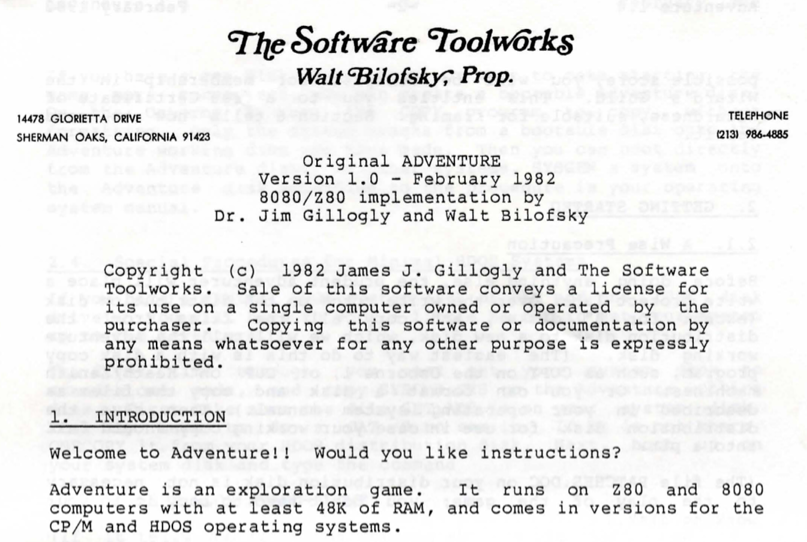
From the Museum of Computer Adventure Games.
The software was compiled for the CP/M operating system and HDOS and ran on Bilofsky’s beloved H89; it was not originally sold for the DOS operating system but my guess is the Norrell version (which we do not have) was arranged so a DOS version was available. This isn’t an enormous technical leap (the operating systems are fairly close together) but it means that Mel Norrell had C source code at hand that was a quite direct port.
This program was originally developed by Willie Crowther. Most of the features of the current program were added by Don Woods. The UNIX version was implemented in C by Jim Gillogly, and expanded and moved to the 8080/Z80 by Walt Bilofsky.
And by quite direct, I mean it even includes a feature left out of some versions, which is you can enter commands in the wrong order. That is, LIGHT LAMP works, but so does LAMP LIGHT. This tends to only be true of derivatives of Crowther/Woods Adventure; even parsers that recognize verbs and nouns like Avon insist on them being in the right order.
Guess which game also allows verbs and nouns to be given out of order?
There is a rather battered old spoon on the floor.
SPOON GET
Okay.
It’s not exact one-to-one code — for example, the weird “blank response” verbs aren’t broken in the Software Toolworks Adventure — but I feel like that the engine here had to have been created by directly eyeballing what came out of Adventure if not at least cribbed in part directly.
This explains, for example, why there are still people functionally equivalent to the dwarves and pirate in this game, despite it being Girard’s second published game. It comes off as a “re-skin” and the way puzzles work — mainly by not letting the player go through a particular exit — also gives a similar feel.
The maniac(s) — that I saw last time and had trouble throwing an axe at — serve as the dwarves. I had been typing THROW AXE, but I needed THROW AXE AT MANIAC (again, not exactly like original Adventure).
There is a nasty-looking maniac here, eyeing you.
One sharply honed knife is thrown at you.
It missed!
This is the middle of the stage. Far above you can see huge flats of scenery held in place by guy wires and ropes. Just in front of you is the orchestra pit, and beyond that stretches an endless sea of seats, upholstered in red plush. There is a small curtained exit to the east.
THROW AXE AT MANIAC
You attack a maniac, but he moves nimbly out of the way.
TAKE AXE
Okay.
THROW AXE AT MANIAC
You killed a maniac! An incredible giant rat lumbers out of the shadows, gobbles up the corpse, and leaves squealing.
Alternately, a ghoul may come out to drag out the carcass. The ghouls also serve as the games “grues” or “pits” and will get you if you wander in the dark.
The pirate, on the other hand, is a “tall dark man”.
There is the sound of heavy breathing from the darkness behind you.
This is a large dressing room obviously intended for a star. It has a pretty dressing table, and a screen covered with roses, cherubs, and an incredible collection of love letters. They are all addressed to someone named Christine. The only doorway is in the east wall.
There is a rather dusty — but valuable! — tiara here.
GET TIARA
Okay.
E
A tall dark man wearing an astrakan hat and evening clothes slides slyly out of the darkness, comments “I’ll just relieve you of that,” and lightly snatches up your treasure before vanishing into the shadows.
The references to Christine made me highly suspect we were dealing with this fellow:

Returning to my main point: you would think the strong restriction mechanically to Adventure would make any notion of a plot twist impossible, but The Phantom’s Revenge does something to pull it off anyway. It feels a bit like “engine abuse” akin to building a tower defense game in a Baba is You level but that just made me even more impressed.
So, returning to the game’s content itself, here’s a meta-map of the environs.
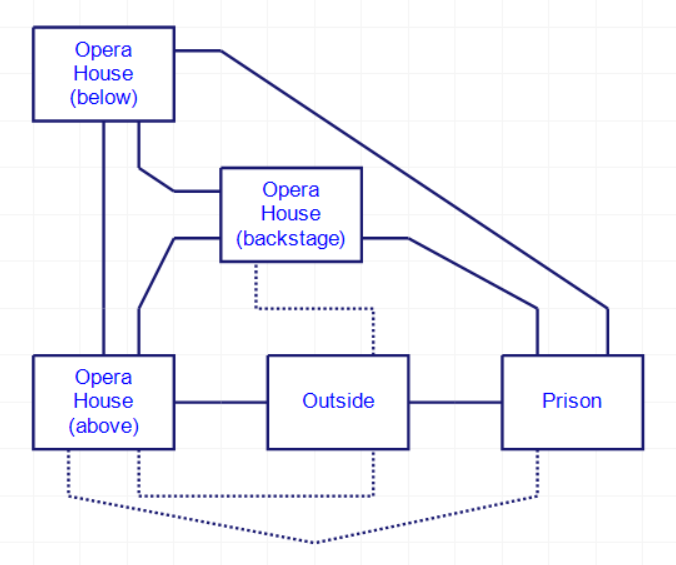
You’ll notice lots of dotted lines. Those are for the magic words that allow fast travel. They tend to be (or at least have tended so far to be) easy to find. As Andrew Plotkin pointed out in the comments, we saw one with the phrase “Yngvi is a louse” which originated in the short story The Roaring Trumpet and immediately became a meme in the sci-fi/fantasy community.2

Picture from The Roaring Trumpet as it first appeared in the fantasy fiction publication Unknown, May 1940. Story by L. Sprague de Camp and Fletcher Pratt; illustrators for this issue were Cartier, Hewitt, Isip and Schneemann.
“Ham” is a little more indirect, but still obvious:
You are in a small alley, walking under a lovely blue sky. You can hear some traffic noises to the south. There is a weatherbeaten door to the north that says “Deliveries.”
There is some rudely scrawled grafitti on the wall.
READ GRAFITTI
It says “Every ham wants center stage,” and looks like it was put on in a hurry with a spray can.
HAM
It is now pitch dark. If you go on you’ll probably be eaten by a ghoul.
LIGHT LAMP
The lamp is now on.
This is the middle of the stage. Far above you can see huge flats of scenery held in place by guy wires and ropes. Just in front of you is the orchestra pit, and beyond that stretches an endless sea of seats, upholstered in red plush.
There is a small curtained exit to the east.
More ominous is “FANTOME”.
You are at the south end of the wharf. There is a moorage of some kind just south of you, with a broad harbor beyond. Far off on the horizon there is a small island with a grim building on it that fills you with indescribable horror.
S
You are standing in a rather large motor launch that is moored to the end of the wharf. There is a neatly lettered sign in the stern that says “Put loot here.” The name on the side of the boat is FANTOME.
FANTOME
You are in a private theatre box, furnished with two red and gold chairs. A small sign on the wall says “Reserved for the Ghost.” The whole room is draped in red velvet except to the east, where a gap in the curtains lets you see the stage. The only exit leads northeast.
There is a tattered page of sheetmusic lying here.
As the “put loot here” message implies, I did find the place where the loot goes, and you have the typical satisfaction of a score increase when making the deposit. What I found puzzle is the location. Hermit’s had you deposit at a spaceship, and leaving the planet seemed like an appropriate end to the game. Here, we are leaving our ominous prison/opera house to an even spookier island filled with “indescribable horror”?
There is some sense to this, which I’ll be getting to. But at least at that moment I was quite puzzled.
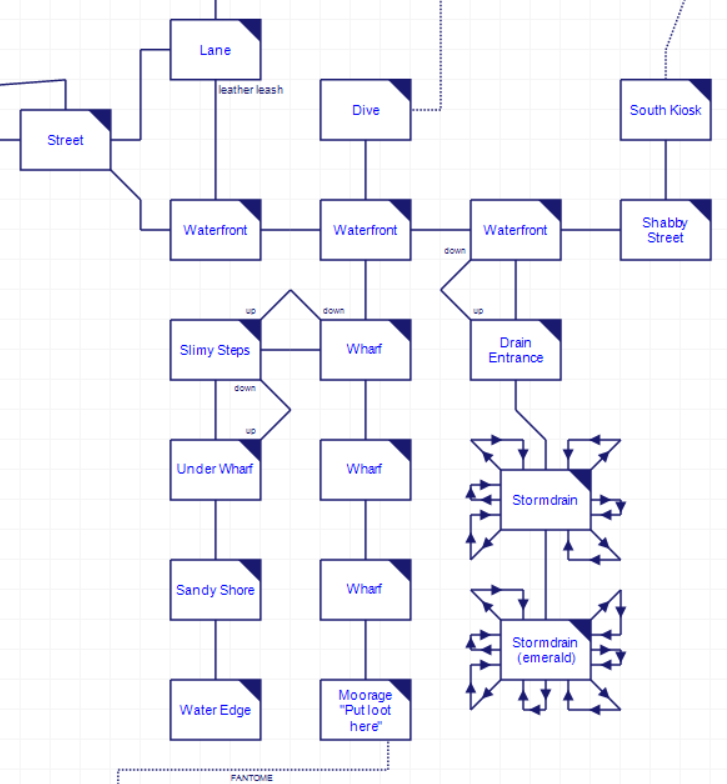
I’m not going to give all my maps yet — they’re definitely works in progress — but the picture above shows part of outside.
You are in the middle of a short section of waterfront. The entrance to some sort of low dive opens to the north. South of you the boardwalk stretches out into an old creosoted wharf, and you can hear the roar of the surf.
N
This is obviously a low dive. Big burly men in black shirts, fallen women, and computer freaks of all sorts line the dirty bar. A crazed young man is frantically pushing buttons on a big machine with bright blinking lights. There is a small, inconspicuous door in the east wall.
The presence of people, that is, normal people walking around, not maniacs throwing knives in the dark — makes for some interesting spice to the atmosphere. There are people here living (and playing some manner of arcade game) but surrounded by a decaying opera house, prison, and distant creepy island. None of them talk, but this feels appropriate for the decay.
Well, mostly none — if you try to go east, a bouncer stops you, which is one of my unsolved puzzles. Also nearby there’s a “guard kiosk” to the prison which requires a pass and I have no pass.
South of the dive is the “loot here” place, and underneath there is a beach which serves no purpose I could find. Mind you I waited many terms, being burned by both Zork III and Avon requiring you to hang out on a beach hoping something shows up.
There is a small patch of sand here, and the seawater laps gently back and forth just south of you.
S
This is where the ocean meets the land. The waves roll in and out in hypnotic sequence.
The prison area has a bunch of curious items lying around (like keys, a whiskbroom, and a “round black thing” where you get no further description); I was able to use the keys to unlock an “iron maiden” which opened a secret area blocked by a dog. Going in a different direction led to a river where I was able to ride a grate (?) down a river before making it to a mysterious underground lake.
You are at the mouth of a large river that runs here from the north. South of you it feeds into a large underground lake.
S
This is the north east shore of a peaceful underground lake. You can see only water and the massive stone wall enclosing it.
The underground lake connects to the backstage rooms of the opera house, including an area blocked by many rats and an area blocked by one giant rat.
This is a rather dirty tunnel that slopes up to the south.
It turns into some sort of gravel covered area to the north.
A giant rat, easily eight feet high, bares its sharp front teeth, twitches its whiskers, and refuses to let you go by.
FEED RAT
The rat gobbles up the cheese, and then starts to eye you as a possible second course.
The upper portion of the opera house has some seats (a small maze, a gold ring is there), an office with a safe (which I haven’t opened) and, weirdly enough, a Gutenberg bible as one of the treasures.
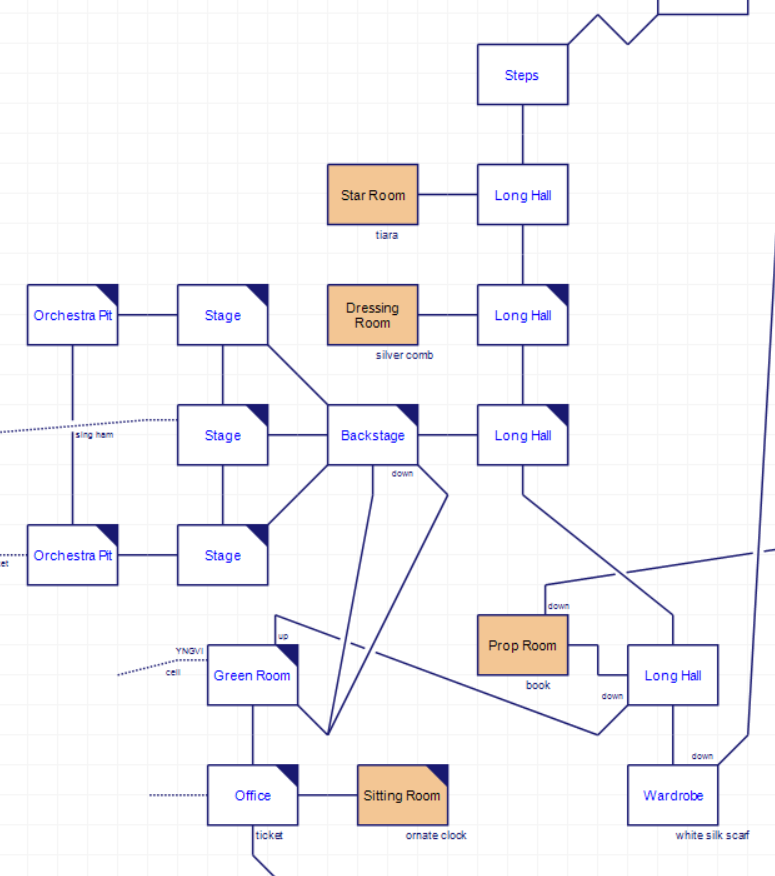
Treasures marked in color.
As the pictures above imply, a good number of the treasures tend to be just lying around (again Adventure-style) although managing to get them all to safety (the wharf) without theft is somewhat tricky to coordinate (just like Adventure) and the lamp is running out of power at the same time and must be conserved (also just like Adventure).
The bit that wasn’t just like Adventure is one of the last pieces I mapped:
This is a small, rather oppressive drawing room. It is decorated in black, with a few touches of crimson and silver. Dark forbidding doorways lead out of all four walls.
There is a framed photograph of a lovely woman here.
N
As you walk into this black draped room, and see the great ebony coffin that is its only feature, you feel dizzy and suddenly faint. Then, with a rush of exultation, memory returns to you! This is your home, your secret lair. YOU ARE THE PHANTOM!
While the situation still doesn’t completely make sense to me, multiple pieces clicked: the reason we started in prison, the ambiguous opening, and most importantly the reason why we’d be gathering treasures to take to a spooky island — I assume to enact the “revenge” that we are seeking. I am curious if more plot points, I suppose again via room description, get dispensed along the way.
The curious design aspect here is that while I found the above revelation pretty deep in my wanderings, it would have been possible to discover it early. It wouldn’t have undermined things, exactly, but it was a more effective moment when I had the oddness of the situation hanging as I was making a map. I admit I didn’t trust it would go anywhere — The Hermit’s Secret never really did — which is part of why it took me by surprise.
So the man in black is someone else entirely. Since I haven’t found his lair I don’t want to speculate yet as to his identity (and of course the game might not give a satisfying answer).
A list of everything I’ve found so far:
treasures found: silver comb, tiara, ornate clock, framed photograph, russian egg, emerald, book, ivory bracelet, platinum brooch, gold ring, opera program
items found: spoon, cheese, ticket, white silk scarf, round black thing, whiskbroom, leash, keys, musicsheet, little card (“Joe sent me”)
obstacles: single large rat, multiple rats, guard dog, safe, dive, guard station, going west at starting prison cell, and I still need to map out a “magic forest” near the coffin
Yes, I should try the leash on the dog, I’ll get to it, but I suspect I’ll need to do something else to make the dog peaceful first. This is a game where coming up with the initial map is overwhelming and solving puzzles really has to come after already spending several hours just soaking up the locations.

The seats maze just for reference.
1. The copy at the Museum of Adventure Games is marked 1.0 and seems to be the earliest. It is dated February 1982. Even though some sources say it was released in 1981 I’m sticking with 1982.↩
2. Fortunately the air was warm enough so Shea didn’t mind the loss of his garments from a thermal point of view. Around them the dungeon was silent, save for a drip of water somewhere and the occasional rustle of a prisoner in his cell. Across from Shea there was a clank of chains. An emaciated figure with a wildly disordered beard shuffled up to the bars and screamed, “Yngvi is a louse!” and shuffled back again.
“What means he?” Heimdall called out.
From the right came a muffled answer: “None knows. He says it every hour. He is mad, as you will be.”
“Cheerful place,” remarked Shea.↩
We last saw Dian Gerard (or Dian Crayne, or J. D. Crayne) with The Hermit’s Secret, as published by Norell Data Systems; she followed up the same year with The Phantom’s Revenge.
Treasures, puzzles, and danger are waiting for you. Over a hundred rooms, a fascinating and challenging adventure.
For my general history see my Hermit’s Secret post, but I have two pieces of news regarding Dian to add:
1.) Monster Rally, previously a lost game, has been unearthed. (Described as: “a large text only horror/fantasy epic weighing it at circa 300 locations”.) We’ll make it there in 1983. Oddly, the rescued copy is credited to Dian’s husband, Chuck Crayne, and despite all the games of this line being credited to Dian, he may have done some uncredited collaboration on the others. They at least worked together some; the pair are credited together in 1985 with the book Serious Assembler.
2.) Exemptus has investigated the game Granny’s Place — a game that lacked a name as published by Temple Software — and concluded Dian Gerard/Crayne was responsible for that game too. He goes into the reasons why in the post, but I wanted to highlight the use of encryption to “sign” the code:
The table of messages in the game files is encrypted with a 1-byte XOR operation. This is not uncommon, but guess what the value of the encryption byte is: hexadecimal DC, the initials of her name. So basically she signed the code.
Before getting into The Phantom’s Revenge, I wanted to look backwards a little at the formation of the publisher Norrell, as it explains how at least a little how what normally seems like a “utilities company” had more connection with games than it might seem at first glance. We can trace the story back to 1975 and, weirdly enough, the Sphere computer, which only lasted from 1975 to 1977.

Byte Magazine, September 1975. Ben Zotto has a long presentation here done at the Computer History Museum if you’d like to see more.
Despite the short life span of the computer, a company formed — Programma Consultants, headed by Mel Norell — producing software for the Sphere as well as a newsletter.
Our main function is to provide reasonably priced software program products to users of 6800 based machines. Specifically, we have been providing support software for the Sphere Series/300 System since June 1976.
The above statement was written in June 1977, when Sphere was already applying for Chapter 11 bankruptcy. It incidentally reports that Sphere was “in the hole” for $600,000.
While the Sphere was alive, Programma produced a replacement operating system (OS/1) and published some games, like a chess program by Chuck Crayne (that’s Dian’s husband, remember) and a “Tank War Game” by Scott Adams.
Simultaneous to this, the accountant Dave Gordon discovered computers in 1977, originally putting down payments on both a TRS-80 and a Commodore Pet; when saw an Apple II, he canceled both orders and went all-in with Apple. He scrounged (and pirated) software. According to a July 1983 profile in Softline:
From the first day he got his computer, Gordon seemed intent on acquiring every public-domain program written for the Apple. His enormous appetite for software drove him to user-group meetings, software stores, and the homes of fellow Apple owners. A hustler, a trader, a Brooklyn-turned-L.A.-bum, Gordon copied and traded software as if it were bubble-gum cards.
Gordon became friends with Norrell (no doubt due to Gordon meeting everyone in the computer community) and formed Programma International with him in 1978, expanding past Sphere computers to computers more generally. Programma became (in)famous for putting out a blizzard of software in the next two years of high and low quality. While they generally stayed associated with Apple, they went into PET, TRS-80, Atari, and the Exidy Sorceror as well.
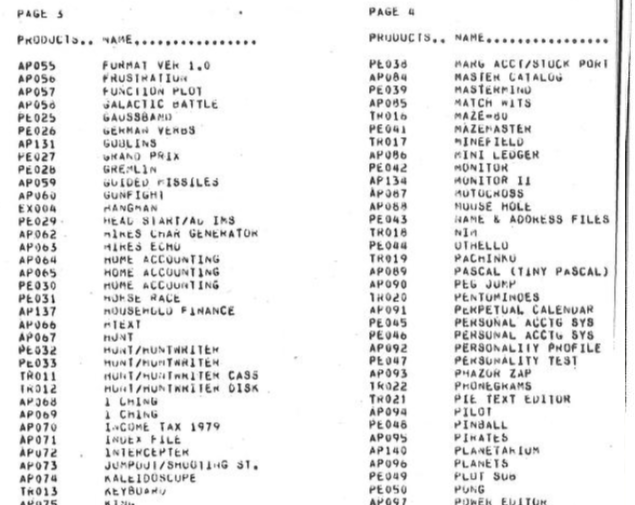
The catalog I just linked includes Disk Magic, Apple II software by Dian Girard. It sold for $25.
This utility program allows the user to examine and modify diskettes created for the Apple ][ from the physical sector level and without the limitations imposed by standard DOS commands. It is possible to determine actual remaining disk, space, release system space for program use, fix damaged files of all types, and restore some files that have been deleted. A comprehensive manual included.
The company was having trouble by late 1980 and got bought by Hayden Book Company. Gordon stayed on as a vice-president, but Gordon was soon out due to personality clashes and formed the new company Datamost.
Norrell went off to form Norrell Data Systems instead. One of their earliest products was Rocket Command for Apple II, an arcade game that looked a lot like something that would come out of Programma instead, and in fact there was some confusion about this at the time; Mel Norrell wrote in to Softline to correct them on giving credit to Programma for the game.
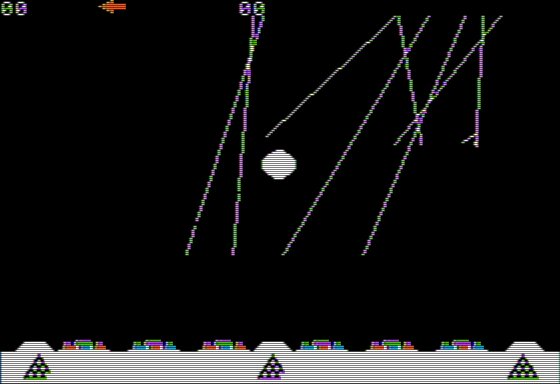
Just a Missile Command clone.
After this, though, the catalog essentially settled on utilities for DOS. It is nice to know that Norrell as a person (albeit under a different company) had a brief moment of massive game distribution before switching gears.
Enough wandering, let’s get into the game:
So you want to challenge the Phantom!
Would you like instructions?
yes
There is a strange old prison near here, long abandoned except for a few caretakers, and some half-mad vagrants. A few people say that the prison is haunted by some sort of ghost, and that it guards some fabulous treasure. A lot of people have gone to search the old place, and have never been seen again. If you want to explore the old place, I’ll help you all I can. Direct me with one or two words, and if you’re stuck, type INFO for general information, or HELP for some basic instructions.
This program and script were developed by Temple Software, Inc.
You are in a tiny stone cell. The only light comes from a small barred window, too high for you to reach. There is a massive iron-bound door set in the west wall. It is ajar.
Impenetrable gray stones surround you on all sides. When you look cautiously around the edge of the door you see the back of a burly uniformed guard, and hastily retreat.
There is a slightly moldy piece of cheese on the floor.
There is a rather battered old spoon on the floor.
Despite there being of plenty of room for text I feel like we’re missing some context that’d be in a manual. We’re still on a Treasure Hunt (I think) but we start stuck in a prison instead, and then need to break out before we start exploring.
Trying to just leave to the west has us stopped by the burly guard.
The guard is a little out of condition, but take it from me, he’s MEAN! You can’t get past him without the proper resources.
It’s possible we’ll reckon with him later. I would have been stuck longer but I brought out my standard verb list to test and DIG happens to be quite early:
As you dig frantically at the east wall, the stones slowly loosen! Suddenly, several of them fall to the floor, along with a bright gold ring that had been embedded in the mortar! The ring rolls across the floor and vanishes under the door – leaving you with a heap of rubble and a hole in the east wall.
The map then opens up a bit, so while the bottleneck only lasted a short while, it did serve some purpose in giving some sense of atmosphere and plot that the author’s previous game lacked.
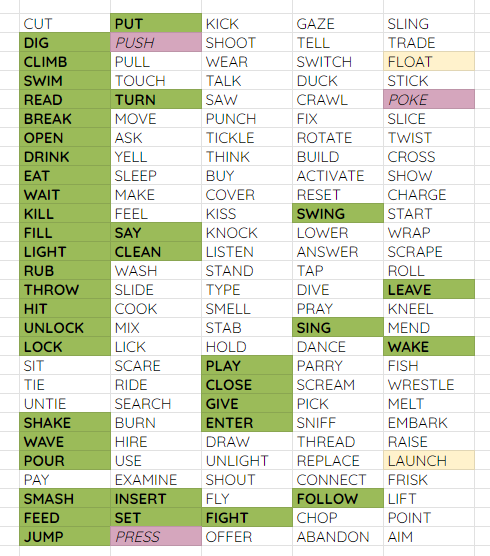
Just for the record, I did finish my verb list:
Purple items are verbs that give “blank responses”. This apparently happens with these specific verbs in other Norrell games, so it is a common codebase bug. For two of the words (FLOAT and LAUNCH) the game reacted like they were nouns instead. Notable green-marked verbs are SING, FOLLOW, and WAKE, none of which are easy to think about while in the midst of puzzle crunching.
After making the prison escape:
You force your body through a tight east-west crawl, moving along carefully on your hands and knees.
E
The tunnel you are in is dark, and you feel the floor ahead of you carefully, fearful of open pits or traps. The floor is dry, gritty, and seems to be made of great slabs of stone. There is a strong current of air coming from the southwest.
SW
You are crawling along through a dark, low ceilinged tunnel. The floor is fairly smooth here, and you can feel fine soft powder that might be dust. There is a dim light to the southwest, and an equally dim glow to the east.
SW
You are walking on a tree-lined lane, under a blue sky. West there is a busy street. As the lane curves off to the south it turns into some kind of waterfront area. There is a storm- drain opening to the north of you.
There is a strong leather leash lying here.
Knowing Girard’s last game, this is going to be a big map to tame, so I’m not going to be foolish enough to try to convey everything in one go. But a few observations based on what I’ve seen so far:
1.) This is still clearly using the “Adventure codebase” in feel, even if it isn’t literally the same code. The “dwarves” throwing axes are still in, just reskinned, in an admittedly nicely thematic way.
You have crawled into a low-ceilinged room where strange gray and green fungus covers the walls. There is a small dark opening in the northeast wall, and a slightly larger passage to the south.
A strange figure in a tattered old uniform (obviously some prison guard driven half mad by fear) lurches around a corner, throws an old fire axe at you — which misses — and then staggers off cursing into the darkness.
An old fire axe is lying nearby.
2.) Fairly early on there’s a magic word that warps you straight from some caves and prison cells over to an opera house. Using the same word in the same place wraps you back again; it gets treated as a “direction” like north or south rather than magic.
You find yourself in a vacant stone cell with doors to the north and south. Some demented soul has scratched the words “YNGVI IS A LOUSE!” on the west wall.
YNGVI
This is the Green Room of the opera house, where the performers and their friends used to gather after the show was over. There is a doorway to the south, and a passage leads upward.
S
This room seems to be the office of the opera manager. It is neatly decorated with playbills, and has a large desk and swivel chair. Doors lead out of all four walls, but the west wall is steel and has a combination lock on it.
There is an old theatre ticket here.
READ TICKET
It says “ADMIT ONE – CENTER SECTION”
3.) Exploring some abandoned cells I found a “maniac” but throwing an axe does nothing so I don’t think they’re meant as a normal hostile mob.
There is a vacant cell here, and the only exits are a doorway in the south wall, and a rather small hole in the floor.
D
There is a nasty-looking maniac here, eyeing you. This is the west end of a long east-west tunnel. A dusty passage goes south from here, and a narrow hole leads upward.
This already is more coherent than The Hermit’s Secret, and since I already know what I’m in for (big map that unites in multiple ways) I’m feeling positive about this one.
I have finished the game. You can read all my entries in order here.
I should preface a little, for the benefit of those who normally don’t read this blog and are here just for this game: this isn’t really a “review blog”, even though you can interpret what I write that way. I’m trying to understand the full span of adventure games, and extract what knowledge I can and place it in historical context. That means some elements of a game may be bad choices, but serve a purpose, or at the very least be “good enough” in a particular setting.
This game was extremely important for Italy, and it had wide enough commercial spread it was some people’s first adventure, or even first computer game of any kind. In this interview with the author from only two weeks ago, in addition to the live comments, there’s this top comment that attests to lasting influence:
Mi sono appassionato alla programmazione proprio grazie ad Avventura nel Castello che giocavo rigorosamente al buio con i miei cugini su un M19. Oggi è il mio lavoro e la mia passione! GRAZIE
I got into my passion for programming specifically because of Avventura nel Castello, which I used to play only in the dark with my cousins using a M19. Today it is both my job and my passion. Thank you!
(M19 refers to the Olivetti M19; Olivetti was one of the big local computer manufacturers; they had started out in typewriters.)
If the game is treated as a place to visit (where you don’t necessarily care about winning) it manages a strong atmosphere; the vast majority of the castle can be reached without solving puzzles, and any new areas are small. So I could see someone playing the game off and on over years, maybe getting to a new place just by sheer persistence, meaning my playthrough is not representative of how people responded at the time.
So while I’m going to be a little hard on this, I’m doing it out of love, but also with the presumption it should be a game played from start to finish without large pauses in the middle.
Last time I was hopeful that perhaps I could turn things around and not rely on poking at hints every other puzzle.
cough
No, sorry. Things got even worse. There was one nifty trick remaining, but the rest of the puzzles were mean in some aspect. (One of the mean parts was also wonderfully audacious in its cruelty, but let’s just see it in context.)
Let’s get a reasonable part out of the way first — relatively speaking, you have to refer to a thing in the room description again:
You’re in a short room crammed with hunting and war trophies. Fixed to the walls are stuffed animal head of all kinds, weapons, shields, even an entire suit of armour that probably belonged to a rival clan chief killed in battle by the Laird himself.
What are you going to do? EXAMINE ARMOR
It is the armour of Sir Crawford, the valiant warrior wizard who, for many years, held MacCallum IV in check with his prowess and his fearsome arts. The armour still maintains a haughty bearing, and even seems to stare at you, leaning on the sword.
You’re in the trophy room.
What are you going to do? TAKE SWORD
Done!
“Reasonable” is relatively speaking. This is still referring to a “second-order” object — that is, it’s an object that gets referred to in the description of an object, and you have the realize you can try to go ahead and take it. I had this in my head because with some different suits of armor (back in the main hall of the castle) I killed myself trying to grab a pike:
You’re in a large hallway, the floor of which bears the signs of the passage of countless generations. A row of armour is lined up along the wall, each holding a long pike.
Towards the centre of the hallway, there appears to have once been a door, now bricked up.
What are you going to do? TAKE PIKE
You take the pike and pull it towards you, but the armour doesn’t seem to want to let it go. Should you pull it a wee bit harder ? YES
With a firm tug, you finally manage to get hold of the pike.
The armour, unbalanced, wobbles slightly……
and as you step back with the tip of the pike gripped in your hands, the armour falls with all its weight onto the other end of the weapon, piercing you through and through.
This is how it was used in battle!
So I was at least somewhat prepared to grab the sword. The sword is described as having a “spell” on its blade. You can try to read the spell and the game mysteriously asks if you mean to read it out loud.
What are you going to do? READ SPELL
Should you say it out loud? YES
Nothing is happening.
Back down past the ogre that the cat ate last time there are two things: a dwarf holding a diamond, and a chest. (Both locations are marked on the map below.)
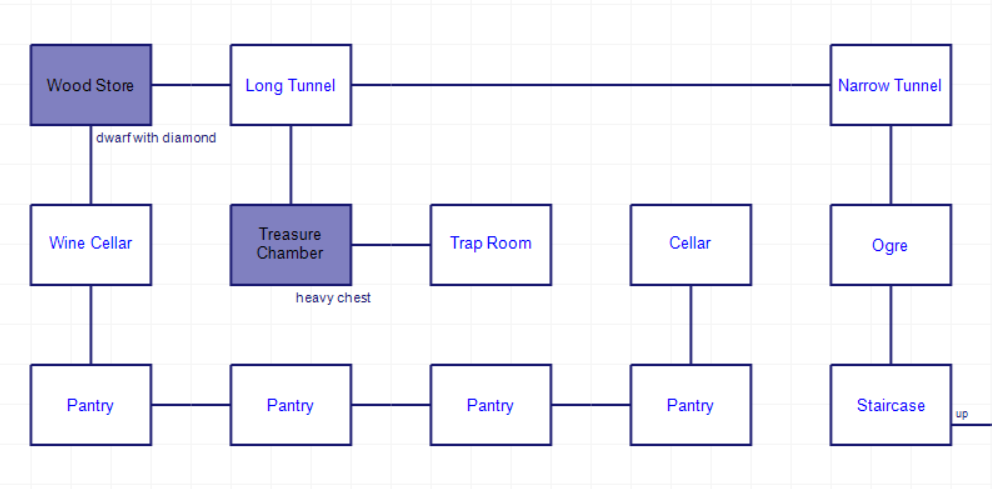
The chest is where the spell goes, and yes, it’s very arbitrary:
What are you going to do? OPEN CHEST
The ghost of Malcolm’s faithful squire, Edgar MacDouglas, rises to defend the treasure of his ancient Laird from the foreign defiler.
You’re in the treasure chamber.
I can see a heavy chest.
I can see a ghost.
Yes, if you go back and look at the sword, and specifically the armor, it seems to be someone who defined the Laird family of the castle, so it makes some sense after the fact that the spell on the sword would help oppose a spirit who identifies with the Lairds. It’s still very after-the-fact reasoning, and made worse by an extra obstacle: when you try to read the spell out loud voice is cracked.
Your throat is dry with fear…
You can’t speak…
The ghost takes advantage of this to attack you.
I very briefly mentioned last time some honey milk I fed to a cat; the cat is takeable without giving over the milk. I had unknowingly soft-locked the game. The milk is supposed to be saved so you can use it on yourself, although you have only one turn, the one immediately before stating the spell.
What are you going to do? DRINK MILK
Lip-lickingly delicious!
What are you going to do? READ SPELL
Should you say it out loud? YES
With a long, desperate wail, the ghost returns to the nothingness from which it came.
The honey is sort of a hint about throat control, but this puzzle was, at the very least, kind of mean. The chest, ghost-free, yields up a hunting horn.
It is decorated with hunting scenes that wrap around in a spiral from its mouth. Galloping riders are seen to chase their prey, while large birds circle overhead.
The one after is as well:
You are in the wood store, where dry branches and logs of various sizes are stacked in perfect order.
I can see a wee dwarf with a big diamond.
What are you going to do? EXAMINE DWARF
He’s quite small.
What are you going to do? EXAMINE DIAMOND
The more you observe the wonderful gemstone, the more you become overwhelmed by an unbridled desire to possess it.
You do need the diamond, but can’t steal it away or defeat the dwarf in combat or anything like that. You’re just supposed to GREET (or in Italian, SALUTA) it:
The dwarf is so happy to finally meet such a courteous person that he simply gives you the diamond.
This is one of those puzzles if you run 20 people through, someone is bound to get it just by trying naturally, but it is hard to work out what the natural thought process for a solution might otherwise be.
The game then rather cheekily warns you to be careful with the newly-acquired diamond:
It’s magnificent: the light reflected and refracted by its a thousand perfect facets creates an infinite play of colour. You are fascinated by it, and would observe it for hours and hours. I think it’s of inestimable value, and you should treat it with utmost care.
However, remember: this is not a treasure hunt! We don’t care about treasures. We care about getting out of the castle. Somehow (…magic?…) the bludgeon from down the basement (the one that required using a bone to get) is able to smash the diamond, and we can then get a key.
On the first blow of the bludgeon, the diamond shatters into a thousand pieces.
Conceptually, I see the point here: the narrator has been a little bit off-kilter since the very first puzzle, so the very strong suggestion to treat the diamond with utmost care can be thought of as giving instructions to do the opposite. That doesn’t stop the puzzle from being amazingly cruel.
The key and the horn are the two items needed to escape. We need to head back to the maze, the one I mentioned last time led to nowhere when I mapped it out, but we got an explicit hint I hadn’t applied yet:
‘Only by the good use of sense will you find your way out from the labyrinth’
This is a puzzle we’ve seen before but somehow the phrasing threw me off here. It works both in Italian and in English, and by making that statement, I’ve given the hint that wordplay is involved.
‘Only by the good use of sense will you find your way out from the labyrinth’
We’re not using “our senses” (as I first read it) we are using the word “sense”, giving the sequence south, east, north, south, east. (Without having read the hint first, this just returns the player to the entrance.)
In Italian, the word is SENNO, which might seem like it breaks, but the Italian word for “west” is “ouest”! So S, E, N, N, O is the solution in that version of the game.
What are you going to do? E
You’re in the large secret room, under the castle tower. A current of icy air
hisses through invisible cracks.
I can see a lever.
I can see a stopped old pendulum clock.
I imagine for people who didn’t ping at the walkthrough for items this puzzle was completely stumped; here, I was just mostly stumped. The key is not the kind of key to unlock things, but the kind of key to wind things. You can WIND the clock, causing it to start ticking. It was close to but not right at midnight, and when it reaches midnight:
A stone block shifts, revealing a spiral staircase.
This leads you to the roof, and once again, you have to make arbitrary use of a magic item.
You’re at the top of the tower, where your gaze sweeps above the fog covering the peatland, and towards the distant mountains.
I can see a flag in tatters.
What are you going to do? TAKE FLAG
The old flagpole evades your grip… and suddenly gives way, making you lose your balance. You fall down onto the parade ground.
(Or you can try fiddling with the flag, but that’s a red herring, it kills you.)
You have to use the horn. Now, we hit the one part where the English version is much harder than the Italian version. You would think to BLOW HORN, but no, that verb is not understood. I was completely baffled and checked the required verb in Italian, which is SUONA, which I’d still translate (in the context of using the word on a horn in English) to “BLOW”. But they (Adam Bishop, the translator) translated it to SOUND, like SOUND HORN. This is the first time I’ve had that as a required verb in an adventure game, and it may be the only time I ever see it. Yes, it technically is grammatical, but more along the lines of terminology from a prior century.
What are you going to do? SOUND HORN
The ancient horn sounds across the moor, echoing off the distant mountains. A black dot rises from the mountains and grows larger as it approaches. Quickly it reaches the tower: it’s a large golden eagle that lurches towards you with its claws extended.
What are you going to do?
This is a fake-out; you can’t type anything before being interrupted. Oh also, you needed the parachute here, otherwise you die; theoretically an easy puzzle to resolve after dying once, but someone might have dumped their parachute back in the first room where it would be inaccessible and have to restart the whole game.
You have no chance:
The eagle grabs you, quickly lifting you up to a great height.
The eagle flies for a long time while the landscape races beneath you… … … … … … … … … … … … . .. … … … … … … … … … … … … … … … … …Loch Ness appears in the distance… … … … … … … … … … … … … . .. … … … … … … … … … … … … … … … … …Suddenly, the eagle lets go of you.
You gently descend in the dying daylight. Below you are the dark waters of Loch Ness. The wind pushes you towards the centre of the lake. By chance, you land on a small outcrop of rock.
While you fold away your parachute, you look around:
You’re alone and abandoned on a black rock peaking above the icy waters. Let me correct myself, you are not alone: the Loch Ness Monster (Nessie among friends) is there to keep you company.
The Loch Ness Monster is not trying to be your friend.
Arbitrary magic is your friend again. This is solvable in a “well, there’s nothing else I can do” sense but not in a logical sense.
The ancient horn sounds across the moor, echoing off the distant mountains. A black dot rises from the mountains and grows larger as it approaches. Quickly it reaches the rock: it’s a helicopter from the Royal Archaeological Service, which throws you down a rescue ladder. You climb the ladder as the monster’s jaws snap shut inches below you.
You are informed the horn is Malcolm the Fourth’s thought to be worth “a million pounds or more”, but upon landing we get charged with crimes.
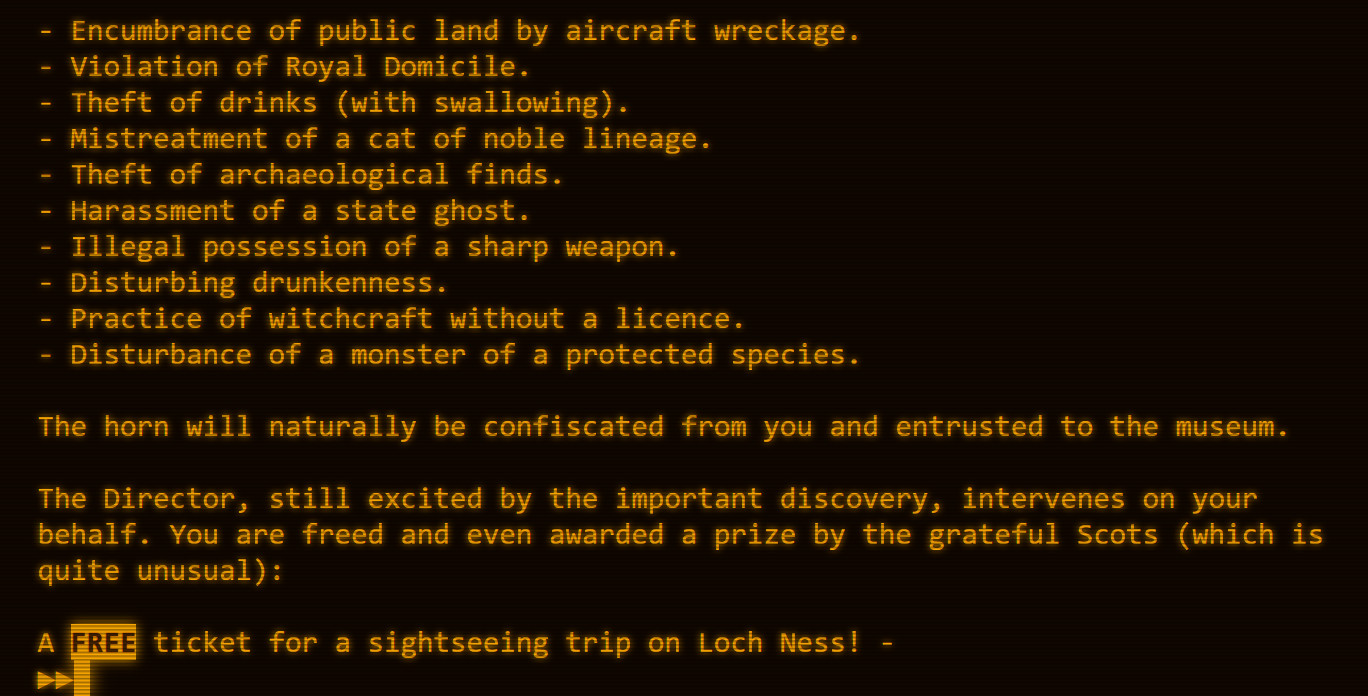
At least the game compensates you with what I think is the best title for winning a game I’ve ever heard.
Anyhow, console yourself: you have finally earned the 1000 points that give you the right to boast the coveted title of:
THE DEVIL’S LIEUTENANT!!!
Look: I loved original Adventure as a child, but I never came close to beating it. I was able to explore most of it — even the part past the plant, which was one of the easier puzzles — and while I didn’t solve the golden eggs puzzle until I was a grown adult (so had to sacrifice treasure at the troll) I still had a grand time and have many core memories exploring the dense caverns. Similarly, while I’m sure someone will chime in they somehow solved this game without help, I’m guessing a lot of the people this game influenced treated Castle Adventure as a destination to explore, with the fact there were unplumbed secrets making something of a bonus.
And certainly: the text has a great sense of attitude, both in the Italian original and the relatively literal translation. The deaths were amusing and while the softlocks were terrible they weren’t overwhelming either; you also don’t have to bother with a light timer like so many Adventure clones felt obligated to include.
So while I only recommend this for the historically curious (English version here) I’m glad that it exists.
(Continued from my previous post, please read that one first before this one.)
Two of my biggest weaknesses struck me since last time: magical effects that require testing in arbitrary locations, and missing room exits.
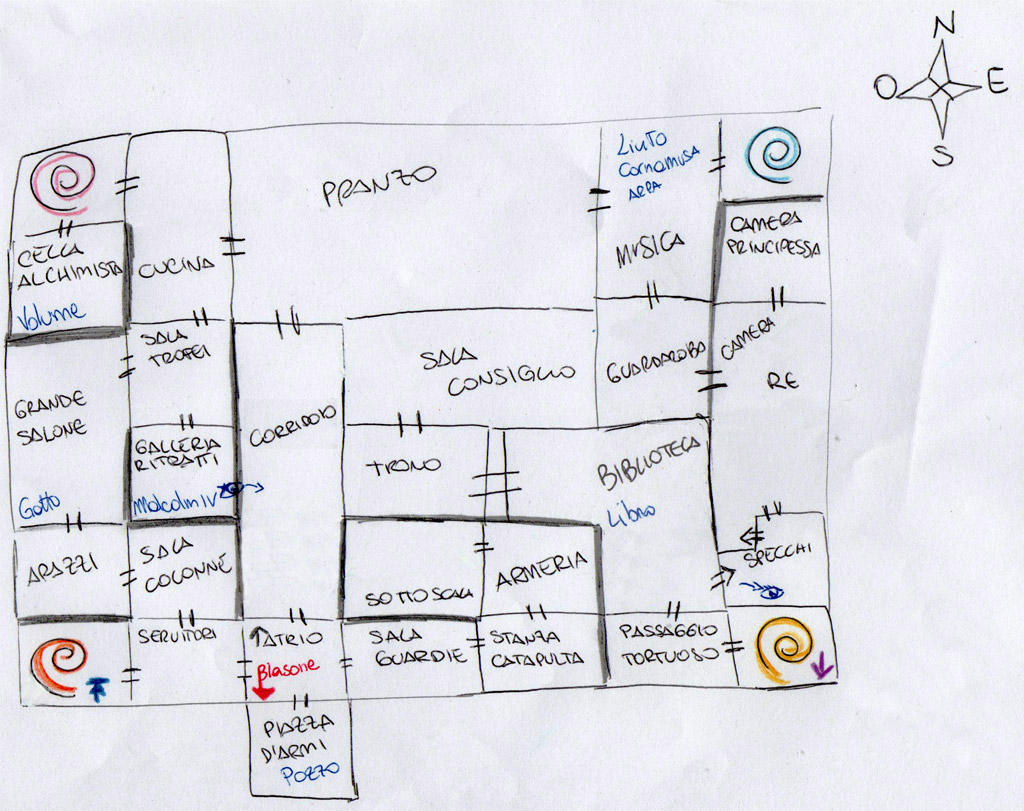
Ground floor, from Oldgamesitalia. Includes some new rooms which I’ll be talking about.
Before getting to that, let me talk about my waste of time. Specifically, I decided to try mapping the maze, which I last time described as absolutely classical, but no:
What are you going to do? DROP LUTE
Paths of a twisted gravity snake away in front and behind.
You are in the maze.
If you drop an item for mapping purposes, it goes away to the start of the maze. The start of the maze is the only room that has a unique room description. This means, for many purposes, the maze would be unmappable, but I decided to at least test the exits of all four directions from the start, just to see if there was an immediate route back that could be used to distinguish some of the maze rooms from each other. Here’s a map part-way through the process:
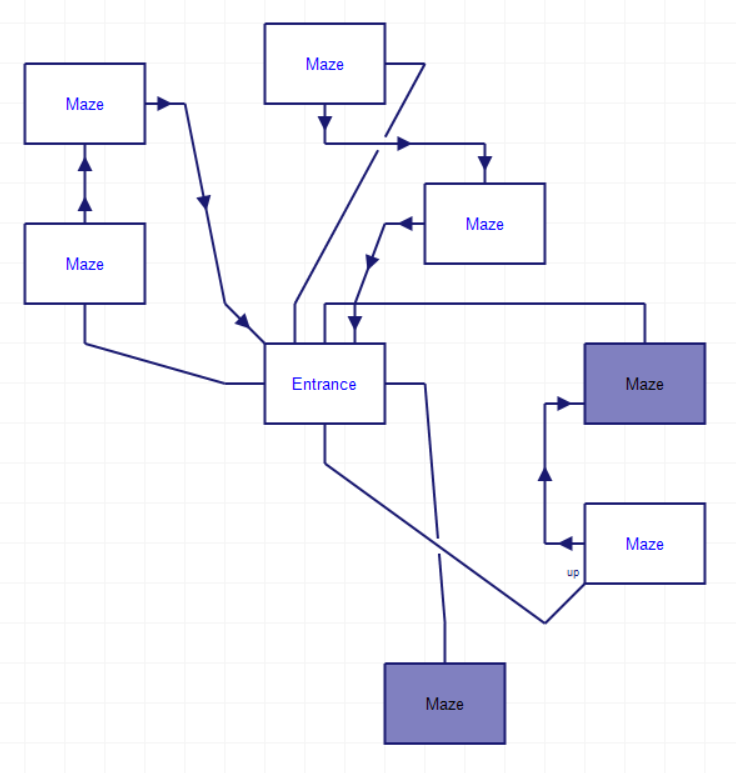
Notice I have two rooms marked in blue; those two were “indistinguishable” based on the information I had at that moment; going north in both cases leads back to the entrance, and I couldn’t tell if they were two separate rooms or both the same room. I also had a few “second step” rooms tossed in there; while I didn’t have a “return exit” for going west from the entrance, I knew going north and then east would return to the entrance, so I wanted to put that information in.
I might have eventually still given up, except I had a breakthrough later here:
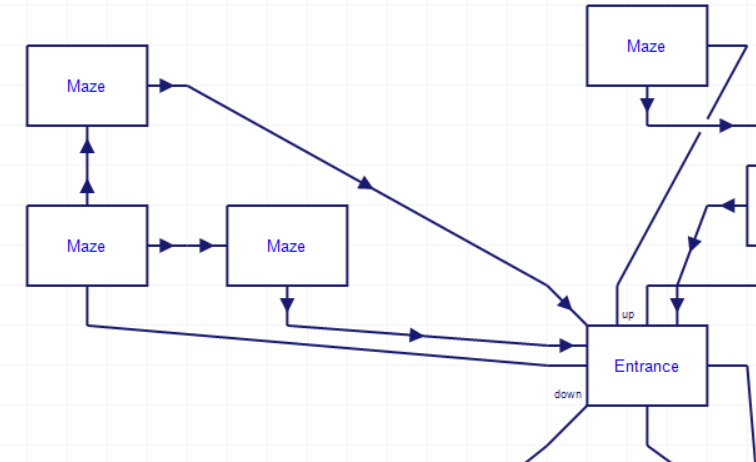
I found that going east and then heading south from the room to the west of the entrance would return back to the entrance. It occurred to me the exact same effect could happen with a loop — that is, a room exit that just goes back to the room itself — so I tried assuming it was a loop, and testing the loop once, twice, three times, and four times; I was probably simply looping back to the same room over and over.
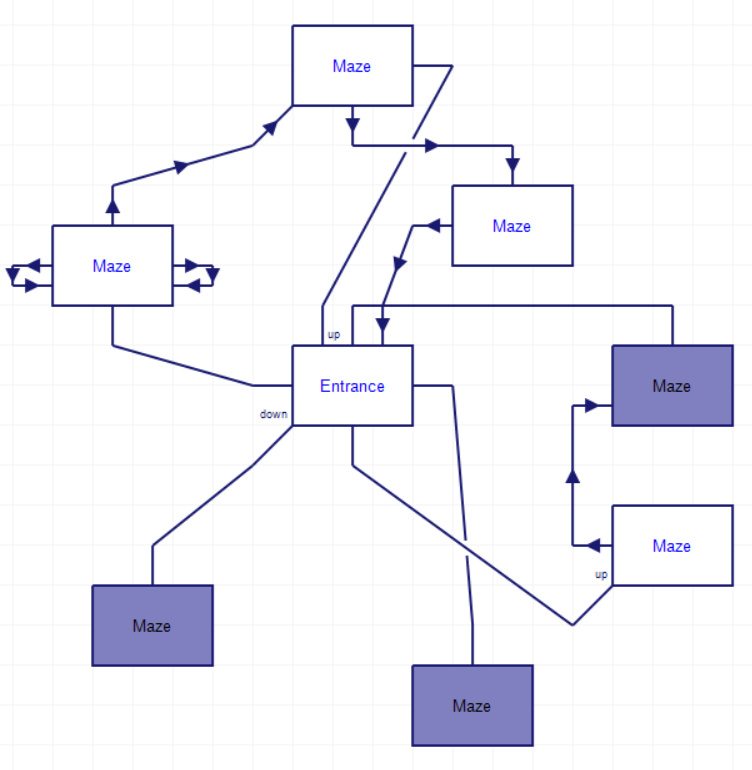
The loops were enough for me to start telling the rooms apart, and filling in the rest of the maze, consolidating rooms I knew to be the same.
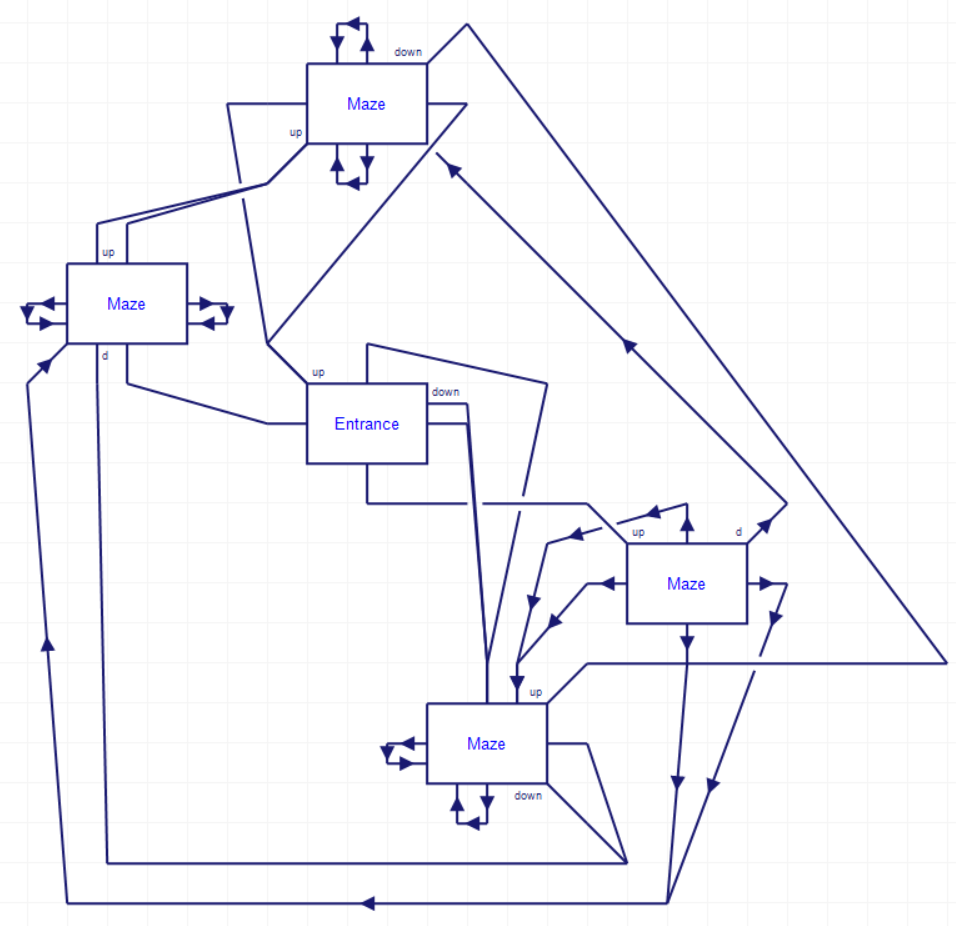
Now, the grand effect of this was to find a maze with nothing! So either I did something wrong or there’s a gimmick later; I think I’ve found the clue for the gimmick, and it is the sort of thing that doesn’t work until you know about it. I’ll come back to it later. That means this was all likely a “peek behind the programmer curtain” moment; we weren’t supposed to have been able to map this at all, and the maze without the gimmick wasn’t designed with a solution in mind. (Another related moment happened back when we were playing Ferret; we had used the bolt from a weapon dropping as a room marker for mapping purposes, and discovered there was only one “room”. This was a bug because the desert was supposed to swallow up everything dropped. The single room was simply a mechanic to allow a giant desert without having to implement one, so the system could re-use the same place and change the player’s “coordinate”.)
So, with the maze being useless, I plodded around back in the castle proper, and finally poked at some hints, as I was getting especially frustrated at the basement section, which seemed unresponsive to anything I tried.
You are in the castle dungeon, once called ‘The Tomb’. The floor is covered in skeletons.
I can see a hole on the wall.
Trying to EXAMINE SKELETONS gets “It is our common fate. But can’t you think of something happier?” and SEARCH SKELETONS gets “He who seeks finds.” (The latter seems to be standard for typing SEARCH anywhere.) So I assumed I was supposed to be bringing in an outside item, but no: you’re supposed to pick up a bone even though it isn’t described in the room. (The narrator promised it wouldn’t have any more undescribed objects! Naughty!)
With the bone in you can use it to push the button in the hole without having it slice your hand off.
What are you going to do? INSERT BONE
A blade comes down sharply, slicing the bone cleanly in two. Lucky it wasn’t your arm!
A crack slowly widens…..
This leads over to another room with a “studded bludgeon” and then an exit back to the ground floor of the castle. I have yet to put the bludgeon to any use.
While I was mid-way through typing this post out Matt W. managed to figure out the puzzle in the comments, and he had an extra comment worth highlighting:
I remember when Marco Innocenti submitted the first Andromeda game to the IFComp there was a bit of discussion about how the Italian IF scene tended more toward elaborate descriptions and intuitive leaps in the puzzles than the English-speaking parser scene, which led to some agita when some players got stuck early. The unmentioned parachute reminded me of that, though it’s very fairly clued by the try-and-die and doesn’t waste any of your time since it’s the first move.
After some more struggle (and let’s be honest, some loss of trust in the game after the bone puzzle) I decided to peek at what to do next. This was a little fairer, as I missed examining something:
What are you going to do? LOOK
You are in a long room with a high-arched ceiling supported by two rows of tall columns. The columns, though eroded by time, still bear the signs of patient workmanship by skilled masons. In the centre of the room, a shorter stone pillar rests on a low pedestal.
I had already tried to examine the columns with no luck, and mentally I thought that meant I covered the “shorter stone pillar”, but no, that thing is a PILLAR, not a COLUMN.
What are you going to do? EXAMINE PILLAR
On the capital of the pillar is an engraving, bearing, in silvery metallic letters, half of a powerful magical word: ‘ID’
Fair enough. The game being explicit about it being half a word means it immediately occurred to me the other half was the page from the library I had already discovered (“IOT”, making the word either “IOTID” or “IDIOT”). In case you’re curious, the same joke happens in Italian, as “idiota” is the word for “idiot” so the magic fragments are “id” and “iota”. Either way, you put them together backwards:
What are you going to do? IOTID
The sound of the magic word echoes among the ancient vaults…
An entire wall of shelves rotates on itself. I glimpse a large room.
You’re in the library.
I can see a book on the lectern.
This opens up a throne room.
You’re in the ancient throne room, where the Laird used to administer justice and receive subjects. At the sides of the room are two rows of niches where the Laird’s personal guards stood. The imposing wooden throne is finely crafted, down to the smallest details. In front of the throne is a walled-up door, which must have once been the main entrance from the hallway.
The throne has an uncomfortable cushion, where you can discovered a wooden box underneath. You can find a scroll in a language you can’t read in the box, but take it back to the library and the book, which turns out to be a Gaelic dictionary, and TRANSLATE SCROLL WITH BOOK.
What are you going to do? READ BOOK
It’s a dictionary of ancient Gaelic.
What are you going to do? TRANSLATE SCROLL WITH BOOK
It says:
‘Only by the good use of sense will you find your way out from the labyrinth’
I had incidentally tried to do LISTEN while in the maze already (there’s a sound of chains, but it always comes off the same — at least prior to reading this clue). I still intend to go back there, but I haven’t made it yet as I got distracted by another magical word.
You are in the war room, where all the most serious and important decisions were made. In terms of furniture, there’s a round table surrounded by eight chairs.
What are you going to do? EXAMINE TABLE
A wise maxim is engraved on the edge of the table: ‘Not all swords wound with their blades’
(Not this bit — I don’t actually know what it goes to, but since it’s right next to the Throne Room I thought I’d mention it now.)
No, it turns out — again poking at hints — you can take the bagpipes from the music room over to the book with human skin, and play the bagpipes in order to open the book. I have no idea why you’d do this. (The Italian intuitive solution thing again, I guess?)
You are in the Alchemist’s cell. All around are crucibles, pestles, copper stills and bizarre glass containers of extremely contorted shapes. On the shelves are many heavy tomes of magic, alchemy and spells. In the centre of the room is a small table that rests on three legs shaped like the paws of some monstrous animal. On the table is a single heavy volume bound in black leather:
“The Sorcerer’s Apprentice”
What are you going to do? PLAY BAGPIPES
The volume opens to a page carrying a finely decorated bookmark.
The page gives us the magic word BIGMEOW.
You may recall I already found a cat (who I was able to pick up via the use of milk). BIGMEOW causes the cat to get huge and to eat us.
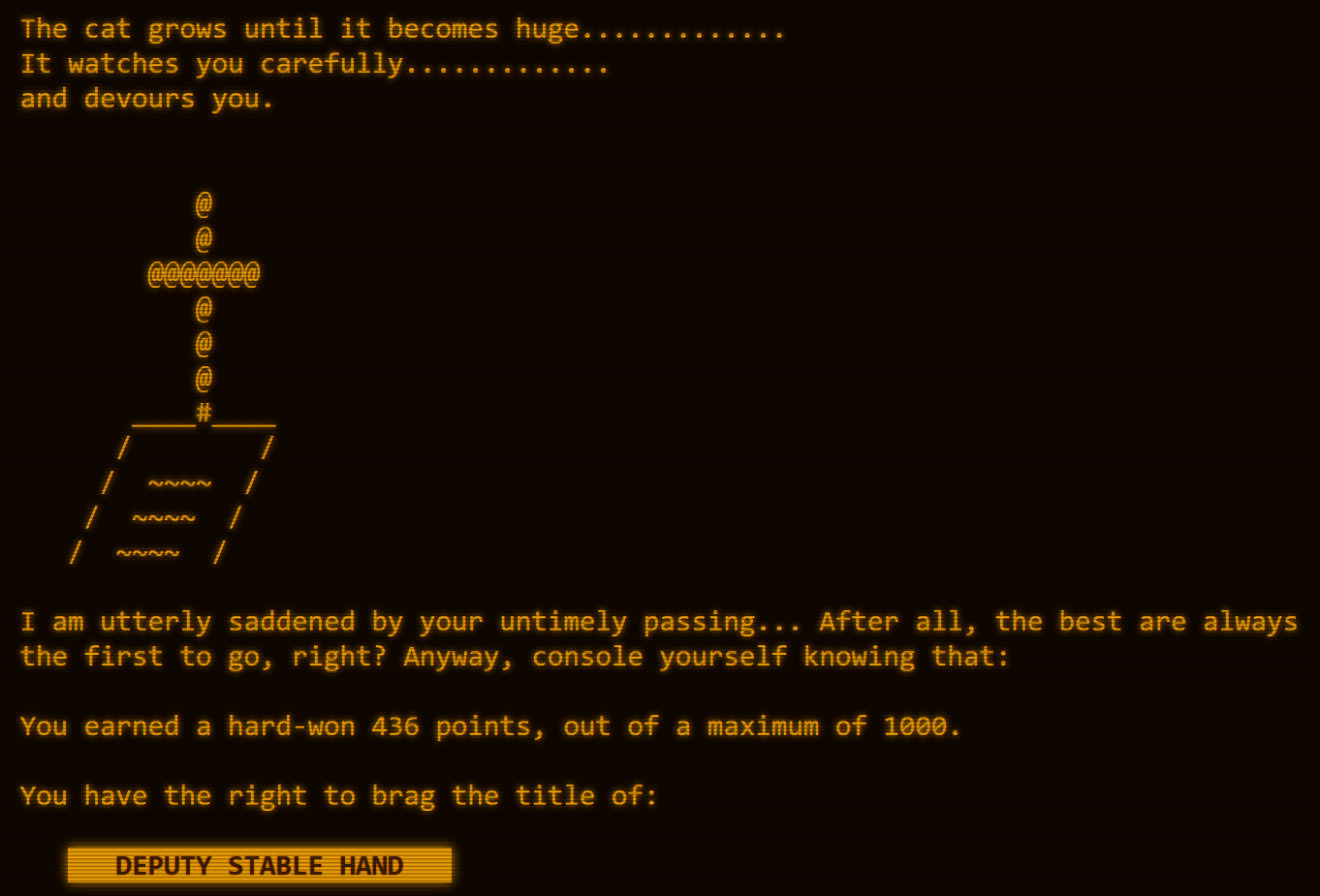
The ASCII art is also in the original.
So hungry cat needs a target, eh? Well, there’s one more place that I also extracted via hints. I had thought (after testing twice) that the spiral staircases leading to ramparts only led up — all four have the same room description, too — but the one in the southeast, and only in the southeast, also goes down.
What are you going to do? D
You are in a room with a spiral staircase.
What are you going to do? D
You’re in a room with a spiral staircase, and a narrow passageway to the north.
What are you going to do? N
You’re walking along a large tunnel carved into the rock that forms the
foundations of the castle.
I can see a ferocious ogre with sharp fangs.
What are you going to do? BIGMEOW
The cat grows until it becomes huge………….
It watches you carefully………….
observe the ogre carefully……….
The cat devours the ogre and dies of indigestion.
Again, not terribly fair, but I’m still taking this moment to do a “reset” since I’m a little more than halfway through the game (based on the score) and try to avoid hints for a bit longer. Some of the issue is simply vibing with the unwritten rules (like how the “pillar” is part of the main room description paragraph but still important, or the bone can be there and not mentioned even when you try to look, or the extra-down-exit trick, or the arbitrary bagpipe location) so perhaps the back end of this will go a little smoother than the front half.
No guarantees, though!
It is in some ways mysterious that we haven’t had more adventure games in languages other than English.
Still, as we’ve seen from Australia and the UK, for adventures to be made there needs to be infrastructure in terms of number of computers in public hands, and companies willing to publish games. So while we have Acheton dating back to almost primeval days, and a single odd 1980 game for the UK101, we really don’t have UK adventures start going until 1981. For Australia, the only 1980 example we have is almost completely plagiarized from a game in a 1979 US magazine.
Alternately (or additively), a country may just not have had exposure to adventure games. They specifically might have missed the “mainframe wave” created by Crowther/Woods Adventure. Japan didn’t really have the adventure game concept “filter in” until Omotesando Adventure in 1982. (As presented in the magazine which printed it, adventures were a “New Type” of computer games.) They started their exposure with Mystery House and other Apple II imports instead of mainframe games.
In the case of Italy, they had local mainframes (even developing some back in the 1950s) and they were already well-established with home computer amateur development by 1980. Yet, it took until 1982 for an adventure game to appear.
A game that is essentially required to be played in English would not necessarily have made in-roads. For one of our authors today, Enrico Colombini, his first exposure to adventures was indeed the classic Adventure, but on a foreign mainframe (or at least mini-computer) and essentially by accident.
Enrico started the electronics store EC Elettronica in 1980 with his wife (Chiara, also a co-author on today’s game) and two of his friends; that same year they were exhibitors at a fair in Milan. They were setup near a Motorola stand with a “expensive looking” computer that was very large, and Enrico wandered over and read the iconic opening from the screen:
You are standing at the end of the road before a small brick building. Around you is a forest. A small stream flows out of the building and down a gully.
Since the booth workers didn’t mind, Enrico started typing, using his “rough English”. He “persi il senso del tempo”, that is, lost all sense of time. He eventually came to a sword planted in a rock making a humming sound, but had to stop when the fair closed. The sword in the rock is not from Crowther/Woods Adventure, but rather Adventure 550, with additions by David Platt. Once extracted, it actually sings when used on an ogre.
The sword halts in mid-air, twirls like a dervish, and chants several bars of “Dies Irae” in a rough tenor voice. It then begins to spin like a rip-saw blade and flies directly at the ogre, who attempts to catch it without success; it strikes him full on the chest.
However, Mr. Colombini never got to that part, because the adventure program was gone the next day.
EC Elettronica had a PET 2001 to keep track of company stock, which was eventually replaced with an Apple II (and disk drives). The computer was used for recreation in addition to work.
In quel periodo tutto era nuovo, e quasi ogni programma era interessante.
In this time period, everything was new and nearly every program was interesting.
Enrico came across a disk marked Apple Adventure, and found a game recognizably close to the one he had played, so was able (after some hacking to fix the save file mechanism) to play to the maximum 350 points. He credits it with teaching him English.
This is a straight port by Peter Schmuckal and Leonard Barshack, so I haven’t written about it before.
Enrico Colombini and his wife (Chiara Tovena) then embarked on writing their own game, self-publishing for Apple II early in 1982 under the name Dinosoft at a local shop in Pescia, creating “una confezione molto artigianale fatta con adesivi letraset“, that is, “a very artisanal package made with Letraset stickers”.
From the author, and unfortunately the largest image of this we have, but I guess it fits with the “artisanal” part.
Some “firsts” are obscure (like Bilingual Adventure), some are well-known and celebrated. Avventura nel Castello ended up being one of the legendary Italian games, and had multiple reprints: in 1984 for J. Soft (still Apple II), in 1987 for Hi-Tech (for DOS), in 1996 (independently, also for DOS) and finally in fancy modern form in 2021, including a translation into English (Castle Adventure).
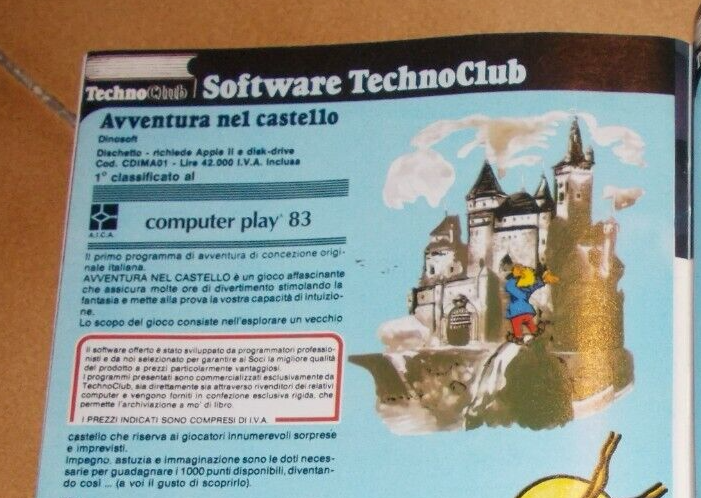
Advertising for the J. Soft version. Via eBay.
I’ve been playing the English translation and cross-checking with the first Italian version for Apple II. I can say they are fairly close, and the original is just as wordy as the newer version is. This is Apple II, with a whopping 48K of memory, and the author — clearly thinking directly of Adventure — has the memory space and inclination to be wordier than Scott Adams.
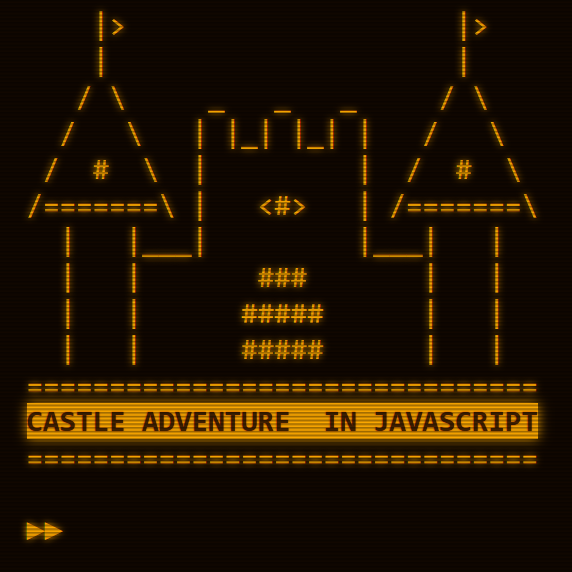
This opening genuinely is duplicating the original opening.
You’re piloting your single-seater over the desolate Highlands of Scotland.
You’ve just flown over Loch Ness…
Suddenly, the engine misfires.
The controls aren’t responding!
You’re plummeting!
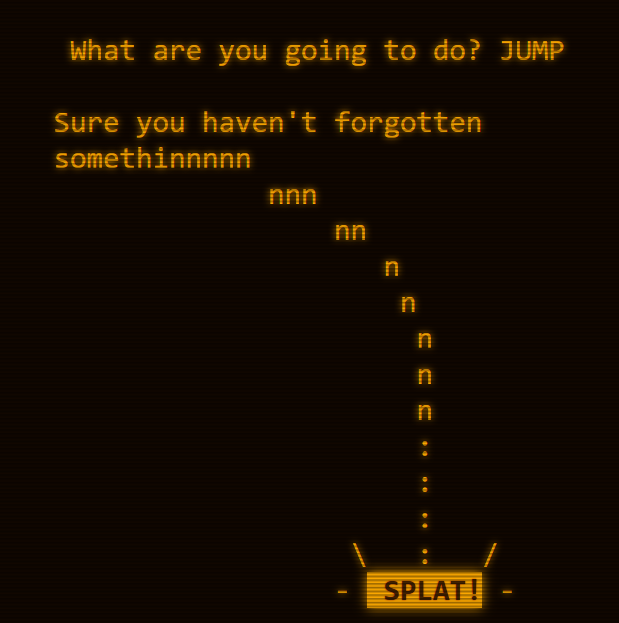
You’re supposed to guess the “aren’t you forgetting something” that there’s a parachute, and TAKE PARACHUTE (GET doesn’t work).
What are you going to do? TAKE PARACHUTE
Oh, look. There is a parachute. I hadn’t seen it.
I promise you that, from now on, I’ll be much more careful, and will
scrupulously report all the objects around you.
Anyway, you’ve got it on now.
You’re plummeting!
(This is probably the fairest “get an item that is not described in the room” puzzle we’ve seen in All the Adventures. The text cues what to do quite strongly. See Escape from Colditz for an unfair example.)
In Italian, the game wants PRENDI PARACADUTE.
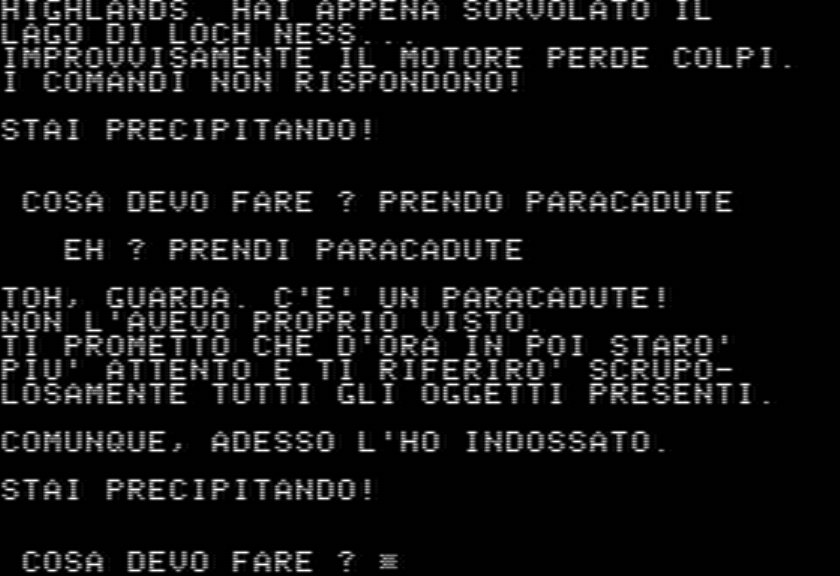
The conjugation is important. I struggled for a while because I was typing PRENDO PARACADUTE (“I take the parachute”) rather than PRENDI PARACADUTE (“You take the parachute”). This is the “I am your puppet” style perspective where you assume you are a step removed from your avatar. This can differ based on the norms of how a particular language approaches adventure games. I remember having a bewildered discussion with an Italian back in the 90s claiming saying “you” want to do something felt bizarre when “I” was the one in the story, but they were insistent that I was being the bizarre one.
This game also quite specifically wants the imperative. So the next step isn’t SALTO (thinking “I jump” in present tense) or SALTI (“you jump” in present tense) but rather SALTA, in imperative.
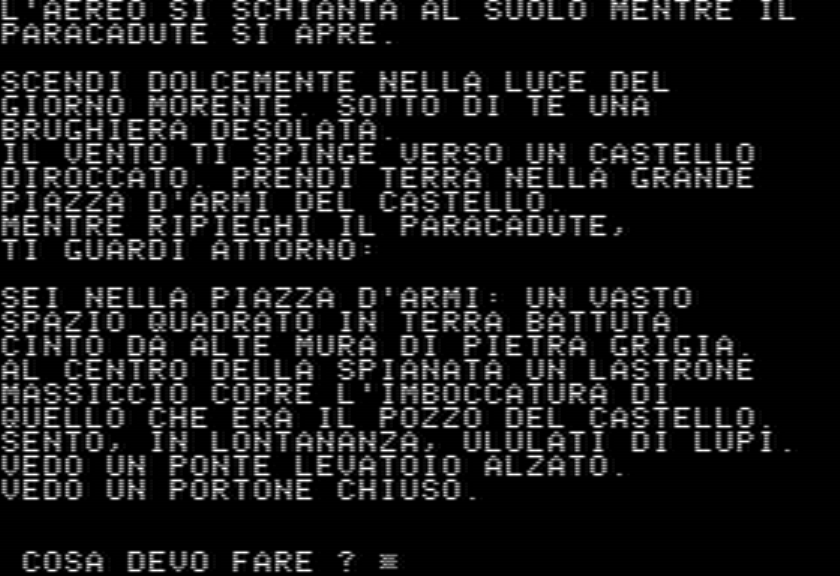
Switching back to English:
What are you going to do? JUMP
Just in time!
The plane crashes to the ground, as your parachute opens.
You gently descend in the dying daylight. Below you appears a desolate moor. The wind pushes you towards a ruined castle. You land in the castle’s large parade ground.
While you fold away your parachute, you look around:
You’re on the parade ground: a vast, square, beaten-earth clearing, surrounded by high, grey stone walls.
In the center of the courtyard, a massive slab covers the mouth of the castle’s well.
In the distance, you can hear the howling of wolves.
I can see a raised drawbridge.
I can see a closed door.
There’s not much we can do with the massive slab or drawbridge (I think) so the only way to make progress now is to open the door and go in the castle.
What are you going to do? ENTER DOOR
The door slams shut, without leaving the slightest crack.
You are in a large atrium, immersed in darkness. An eerie phosphorescence emanating from the walls allows you to just about distinguish the contours of the room.
A marble staircase rises upwards, dimly lit by the greenish light, but gradually disappearing into the darkness.
I can see a coat of arms painted on the ceiling.
Here we are trapped, and now our main objective is to escape.
My map so far, just of the ground:
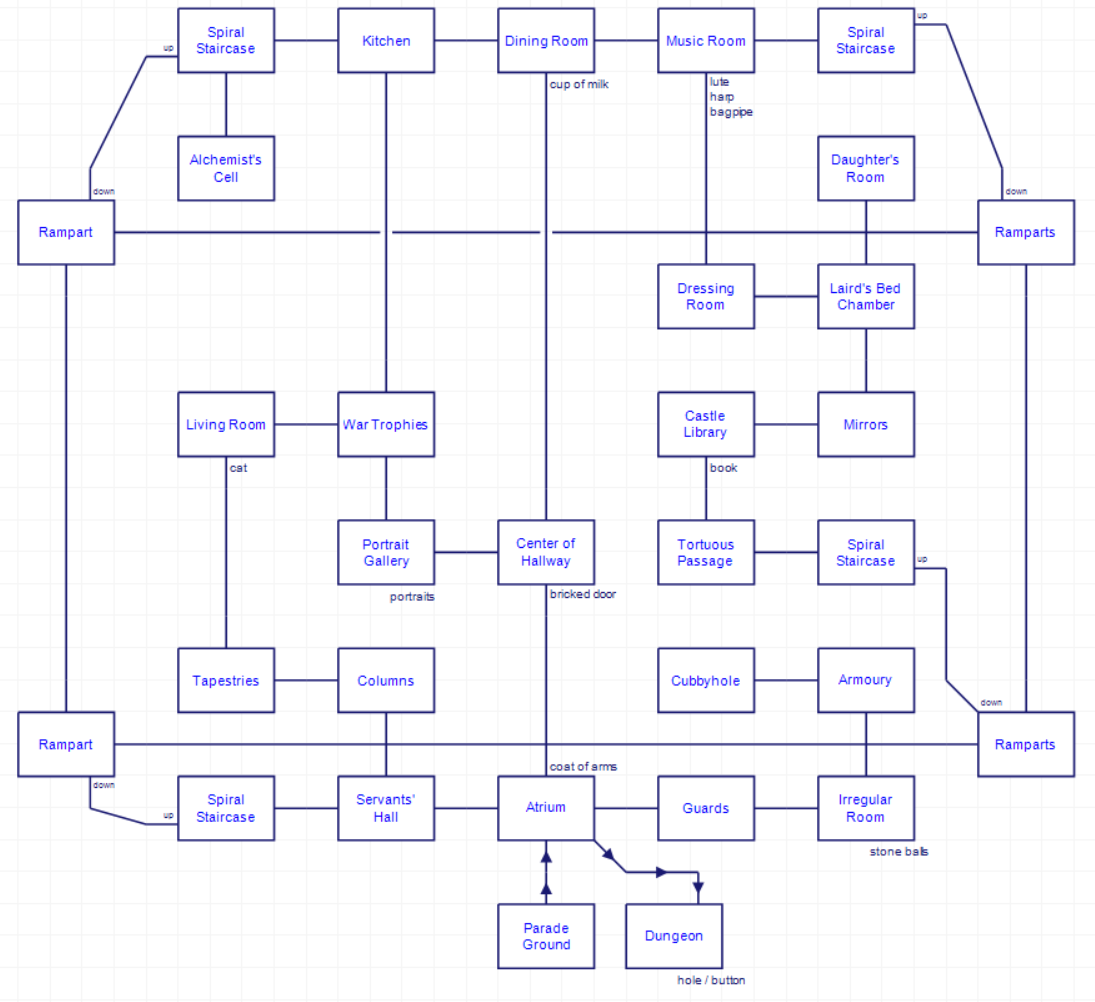
It’s nearly all accessible and peaceful, and even though there’s some vivid descriptions, sort of sparse. This game is not trying to stuff itself with items. That might mean there are enough floors that we get lots of items, or it might just mean there’s hidden things. I’m going with the presumption that anything in the room description can’t really be used and only the items that get listed after are important, but if I get seriously stuck I’ll reconsider.
First, a tour of the ground floor, then a quick trip to the basement, and then I’ll show off the maze on the second floor.
You’re in a large living room, furnished with numerous sofas and comfortable armchairs. In the centre of one wall is a monumental fireplace, built with blocks of carved stone.
Although the fire has been out for centuries, the room still seems to be illuminated by a wavering reddish light.
I can see a cat crouched on the ground.
Using the presumption I just spoke of, the sofas and fireplace don’t need to be fiddled with, but the cat is important. You can feed the cat some milk from the kitchen, and then can pick it up. I haven’t found any birds or mice to sic it on yet, though.
Elsewhere:
You’re in an elongated room without any furniture. The walls are lined with portraits of clan chiefs, lairds and dignitaries who have governed the castle and lands over centuries.
The portraits seem to stare at you with malevolent eyes. One in particular, that of MacCallum IV, seems to follow your movements with a gaze full of murderous hatred.
This feels like it is just meant to be lore. You can’t move the portrait or take it. While I’m at it, though…
What are you going to do? PULL PORTRAIT
Gonnae no dae that. I’d prefer not.
…does the Italian actually attempt the equivalent of a Scottish accent? That’s past my pay grade (or rather, my dimly-remembered college Italian).
Other map highlights include:
- a rampart that you can walk around, where you can see fog and hear “cawing of the crows”
- a mirror room that takes a little while to exit because you can accidentally run into a mirror rather than get out, this seems to be random
- a music room where you can play the bagpipes: “You deserve to be part of the Royal Scots Dragoon Guards! (…playing the drums)”
- a library with a book on Ancient Gaelic; inside the book is a sheet with the word “IOT”
- a mysterious bricked-off door
- some “heavy stone balls” in a room with pieces of an ancient war machine that can’t be picked up
- an Alchemist Cell with a book bound in human skin that requires a “tool” to open it
The last one’s a bit spookier than the others, but there’s still no active antagonism going on.
You are in the Alchemist’s cell. All around are crucibles, pestles, copper stills and bizarre glass containers of extremely contorted shapes. On the shelves are many heavy tomes of magic, alchemy and spells. In the centre of the room is a small table that rests on three legs shaped like the paws of some monstrous animal. On the table is a single heavy volume bound in black leather:
“The Sorcerer’s Apprentice”
Going down, on the other hand, is a bit more threatening. The way down is to look at the seal in the opening atrium.
The clan motto is written there.
“The sassenach will fall”
Suddenly, a trap door opens beneath your feet.
You are in the castle dungeon, once called ‘The Tomb’. The floor is covered in skeletons.
I can see a hole on the wall.
What are you going to do? EXAMINE SKELETONS
It is our common fate. But can’t you think of something happier?
You’re in the dungeon.
I can see a hole on the wall.
What are you going to do? EXAMINE HOLE
It is narrow and deep, and, at the end, there’s something that looks like a button.
You’re in the dungeon.
I can see a hole on the wall.
What are you going to do? PUSH BUTTON
Should you stick your arm through the hole? YES
A blade snaps down, slicing your arm cleanly off.
While you’re bleeding to death, let me tell you that you’ve been behaving rather recklessly.
I assume I just poke the button with something long, but I haven’t found a great candidate yet. Going up from the Atrium gets you trapped in a different way.
What are you going to do? U
You’re at the top of the stairs. The steps end abruptly in front of a smooth stone wall.
What are you going to do? EXAMINE WALL
I cannae see any holds or cracks.
You’re at the top of the stairs.
What are you going to do? PUSH WALL
The wall rotates on itself… and snaps shut behind you.
You’re at the entrance to the immense magical maze, of which it is said that all passages lead to this one room, from where neither man nor thing can escape. There are two skeletons on the ground. On the wall, written in blood are the words:
‘Impossible to get out of here’
This seems to be an absolutely classical maze, as those who derived their games more or less directly from Adventure are cursed to make.
I’ll hopefully have that mapped out by next time, and maybe figure out a use for the cat. As far as how long this goes, I’m not sure; the game lists 1000 points total, but it isn’t a normal rate of score increase. Even without doing much I had around 100 points, so I suspect if we normalized to, say, Scott Adams game length, we’d have a 100 point game. Some of the Scott Adams games took a while to get through, though!
I have finished the game, and as usual, it helps to have read my previous posts.
So I had a slightly wrong presumption from last time; the ruins I had marked 1, 2, and 3 were out of order. You actually do “ruin 2” last and the other two in whichever order you like, or even skip them.
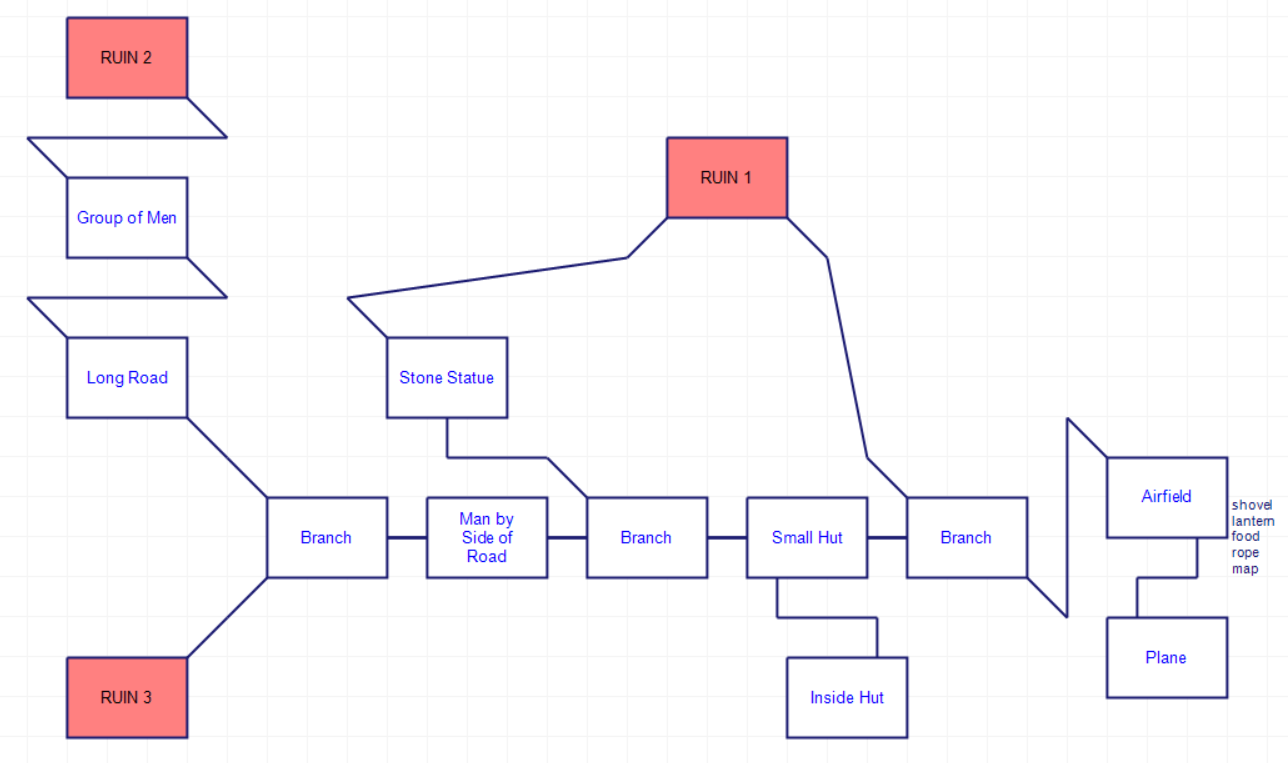
And yes, the “skip them” implies that what you get from them is technically speaking optional. I’ll explain when I get there. Let’s get back to the action:
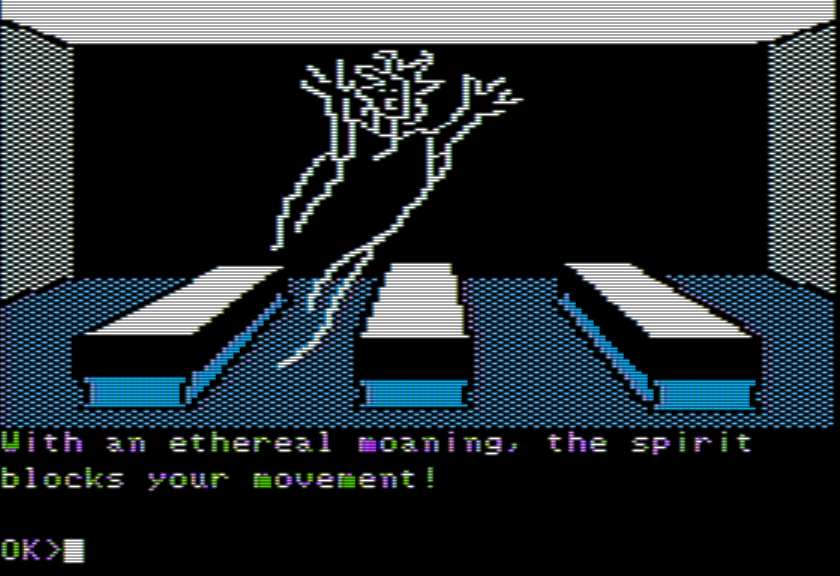
Not to the skeletons, but to the phantom where you could just wait out before getting a gold bowl. You were in fact supposed to try to talking to it.
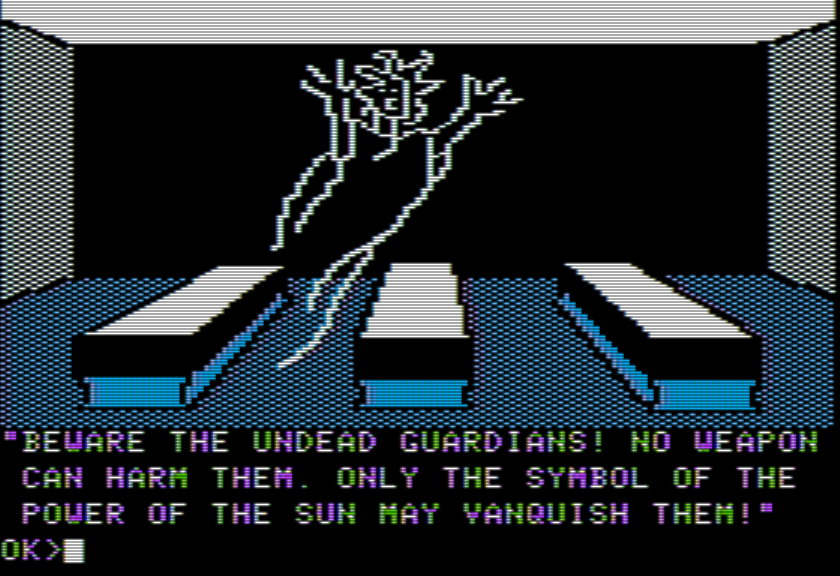
Yes, I looked that up. This hint is sufficient to realize the cursed amulet we’ve been toting around is somehow usable on the skeletons (even though USE AMULET and WAVE AMULET and so forth I tried were useless). You’re supposed to get rather more violent and HIT SKELETON WITH AMULET. Thus I could get away with the silver bowl.
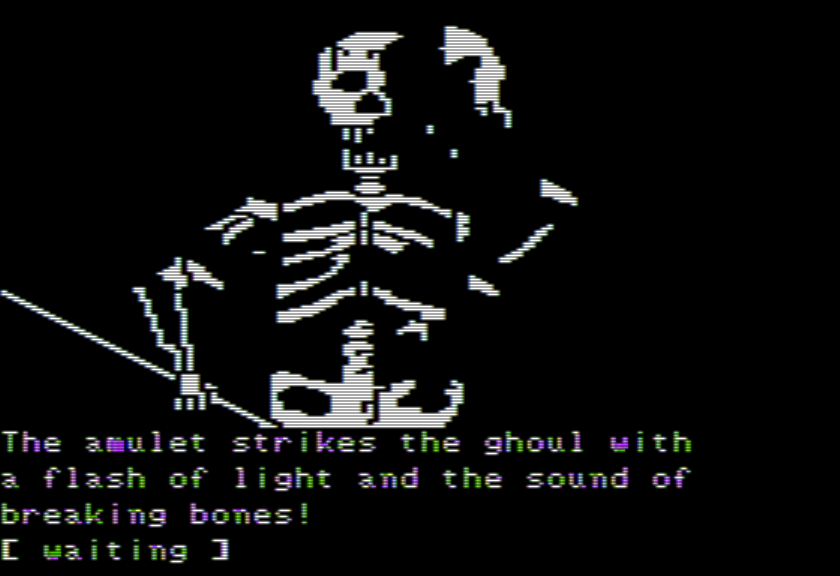
Let’s now go to Ruin 3:
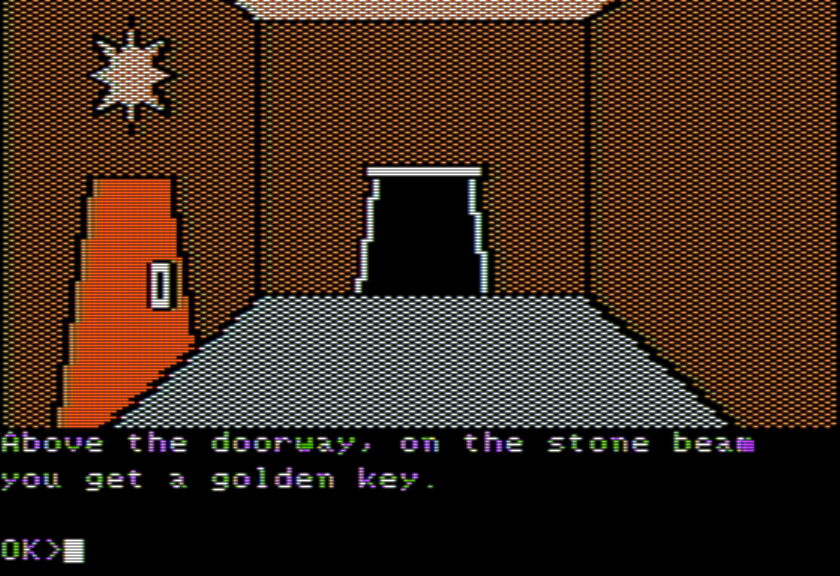
Again, I looked this one up.
I had not bothered to SEARCH the various doors (just looking won’t work) so I missed the golden key as shown. Even on a SEARCH frenzy I wouldn’t have thought to apply it to the door. The golden key lets you enter the central area (only one of the doors is needed).
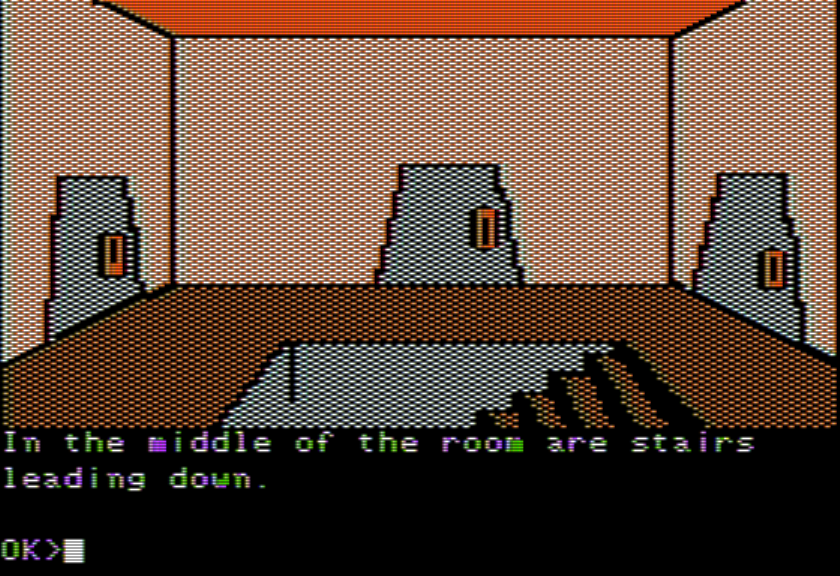
Down the stairs you can run across a slight bit of maze before encountering a pool. LOOK POOL gives you an image, and that’s the only thing you need from the ruin.
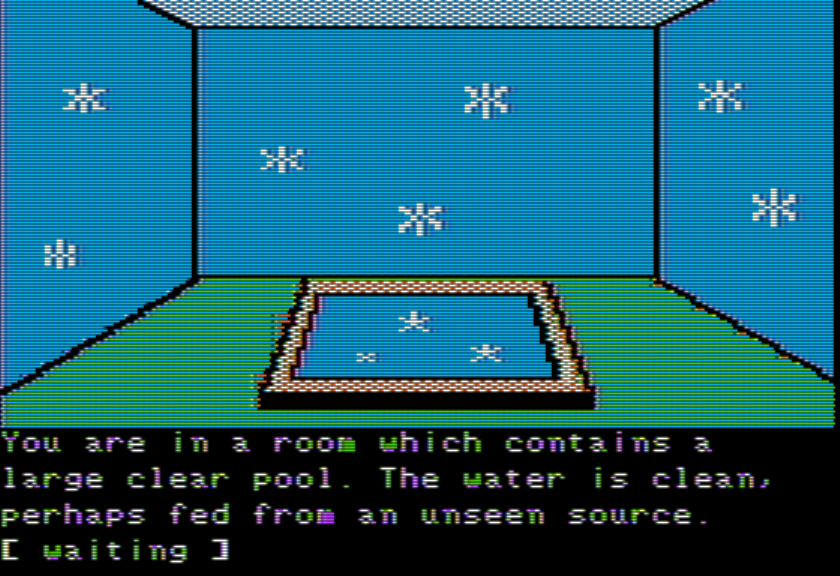
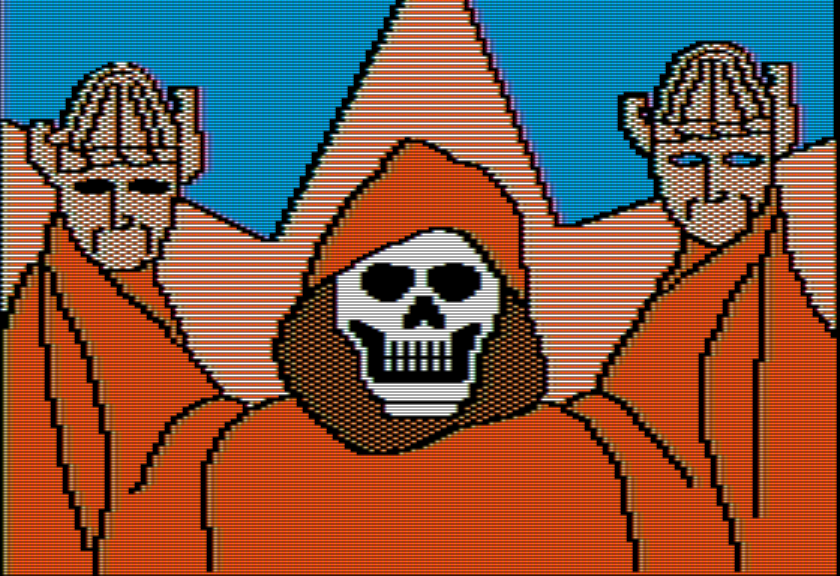
It didn’t register to me to pay close attention to the image — I thought this was indicating some kind of blessing / curse was laid down that would trigger (in a useful way) later.
With that taken care of, it was time to try to figure out the fog room past the corpse, where I kept dying and dying. Taking the bowls and putting them into the order mentioned by the corpse, here’s the pictures you get by examining them.
Maybe they’re meant to represents maps?
Remember, the way this game works is: outdoors you go compass directions, indoors you go forward, left, right, or back. Compass directions aren’t understood at all indoors.
Unless… you’re in this one room, and then you can go southwest.
Oh, and we lose our sidekick.
This fails both at the level of being a breach of game-interface trust (by having an exception indoors for a compass direction) and for making any sense (why would we know what direction southwest is)? I checked walkthroughs and none of them explain the connection of the bowls. Perhaps my trusty readers have an idea.
I’m guessing Ultrasoft extrapolated the puzzle from Crowther/Woods Adventure. That game had a much better use of the idea in the “maze of rooms all alike”. You are explicitly told by a pirate (as they steal your treasure) that they’re going to hide it in the maze, so you know there is supposed to be something there. While every exit in that particular maze is N/S/E/W, leading to a pattern, there is never the implication that the interface has really changed, and there’s another maze (All Different) which does include the diagonal directions. Combining those together makes it satisfying to find the one odd exit, northwest to find a chest:
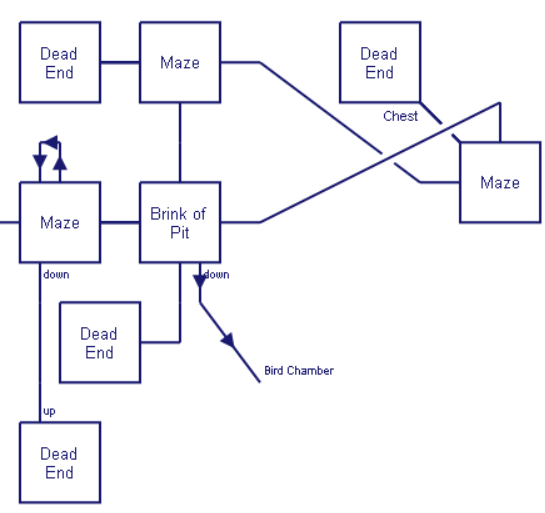
That is, pure use of direction nevertheless built up a puzzle by making the player form an implicit rule that was not not really a rule, and realizing that facade causes a breakthrough. This differs greatly from the case in Mask, where by all appearances (for absolutely everything else in the game, including the moments after) being indoors shuts down the ability to navigate by compass directions for reasons that could not possibly change.
Ugh. Oh, by the way, we’re now on a timed puzzle, just like you’d expect from a later Sierra On-Line game.
It’s unique for this time, for sure. With the game on “authentic” timing it went too fast for me to react and I just had to guess until I got lucky. Getting past, there are faces on the wall:
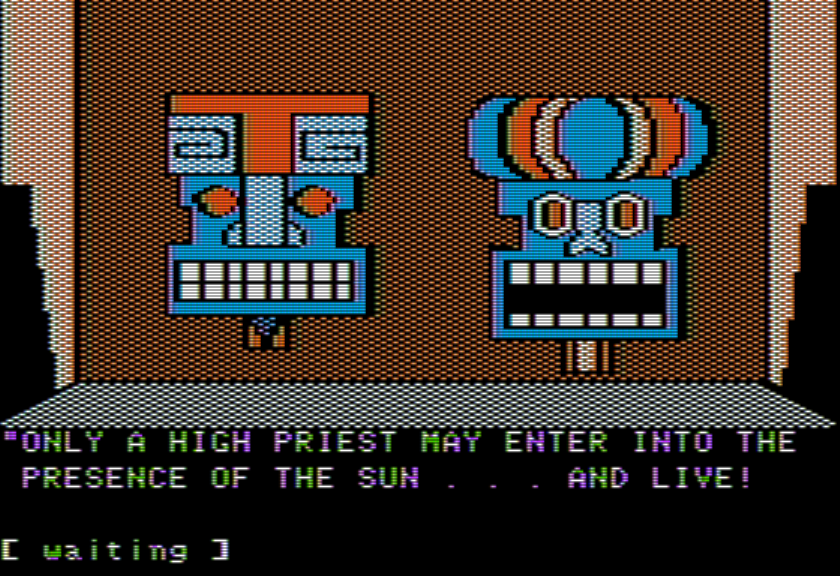
They demand the word that marks us as an initiate of the sun. And here I have missed something, and it is kind of the fault of the parser, but more the fault of the way the world universe describes itself. We need to go back outside to the idol with the detached head. (Well, not on this save game. This save game is soft-locked. I mean restart with a fresh file and imagine we fast forward.)
Typing LOOK STATUE before repairing it gets “The idol is broken, but it looks like a stylized jaguar.”
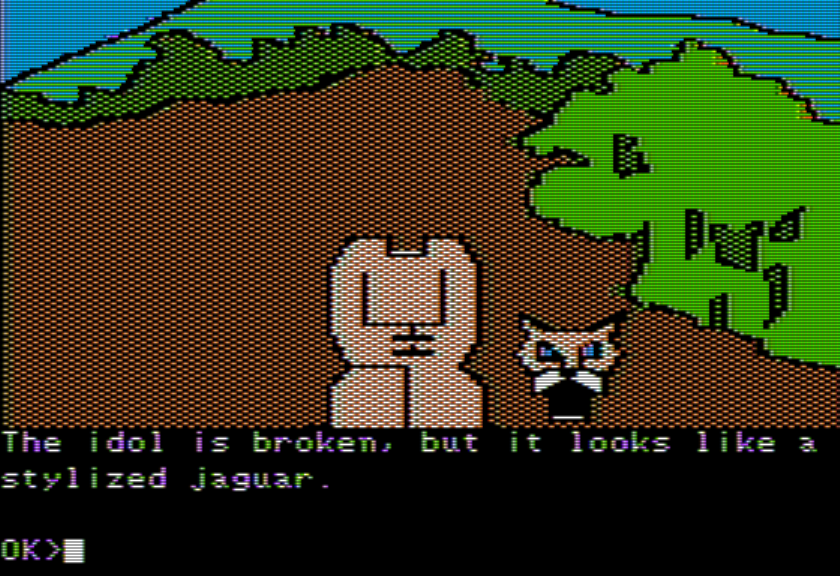
If you GET OUT OF JEEP and then LOOK STATUE again, something different happens.
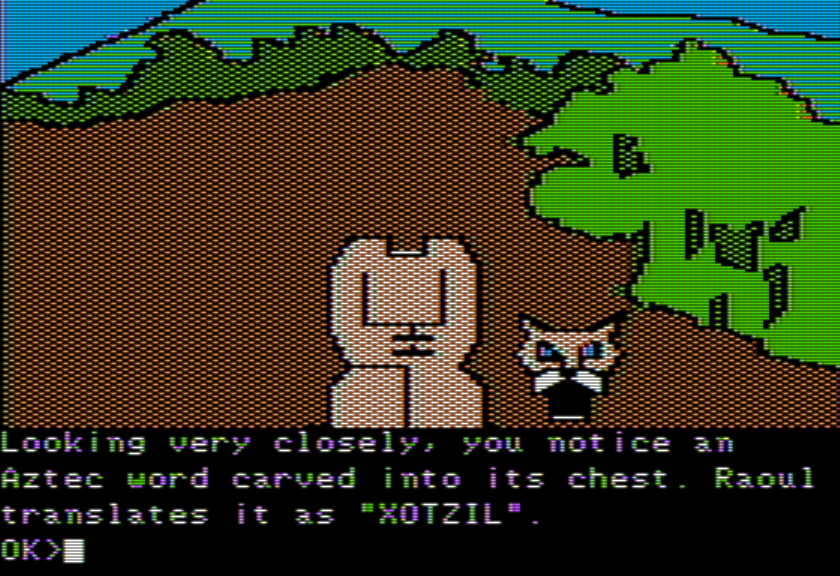
It was not clear to me at all anything was mechanically different here; there’s no visual indicator you’re in or out of the jeep. This isn’t quite as unfair as the fog puzzle — SEARCH STATUE gets the reply it “doesn’t work here” obliquely implying you aren’t close enough — but it still is the case that repairing the statue now causes the clue to be lost forever.
So, fast-forward back to the faces, with the new magic word in hand:
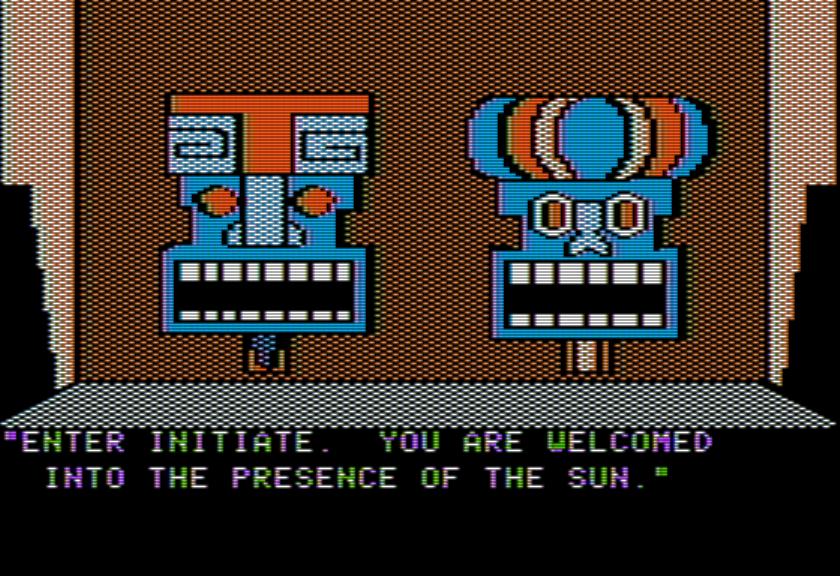
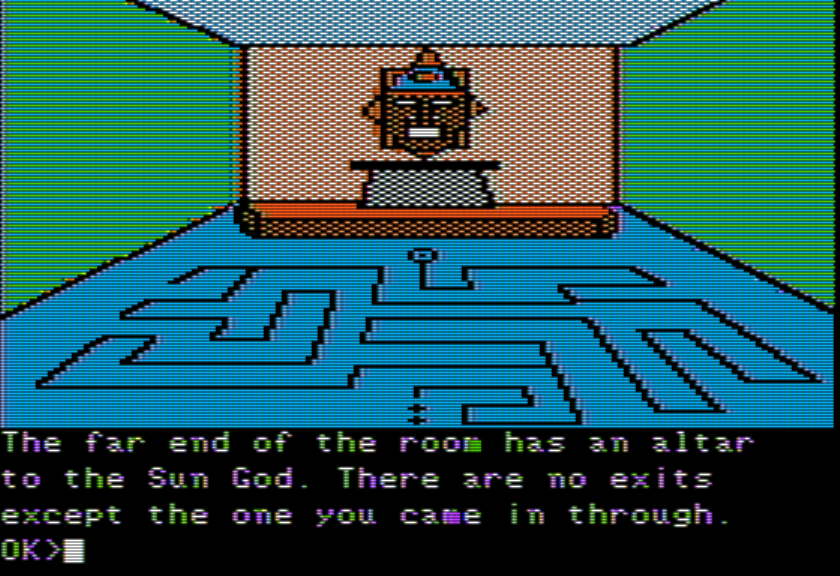
Searching the altar reveals a place you can drop the amulet.
I chipperly grabbed the mask and went on my way, and found myself sealed off. The game even suggests checking the altar for secrets, but it already was sealed off.
You have enough information that you may be able to figure out what happened. I don’t think it’s a good puzzle — this is a softlock moment, here — but it’s an interesting puzzle. Take a moment to think.
Back where the image was at the pool, the skull-person was holding two masks, one that had black eyes and one that had blue eyes. What this is meant to imply is there is a second mask, and we have the fake mask. We need to search again after finding the first one.
This is the True Mask. Once you wear it your disease is cured.
All the world colors go funky and it lets you see a secret passage to escape from the altar room.
The rest of the game is mostly straightforward except tedious. You need to wander through the ruin until you escape. There’s one direction that goes to a maze which is entirely useless to bother with. To make any progress you have to first answer a riddle.
Then there’s some wrong directions and more maze rooms and a maze which you don’t have to even map (according to Kim Schuette’s Book of Adventure games) because if you take 52 steps eventually you’ll run across your rival, the one who set off all this curse business in the first place.
He demands the mask. Give it to him.
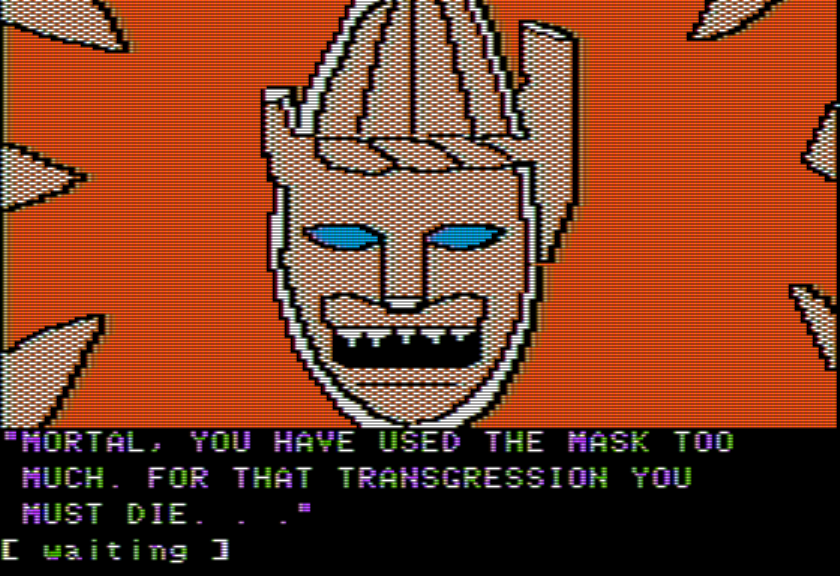
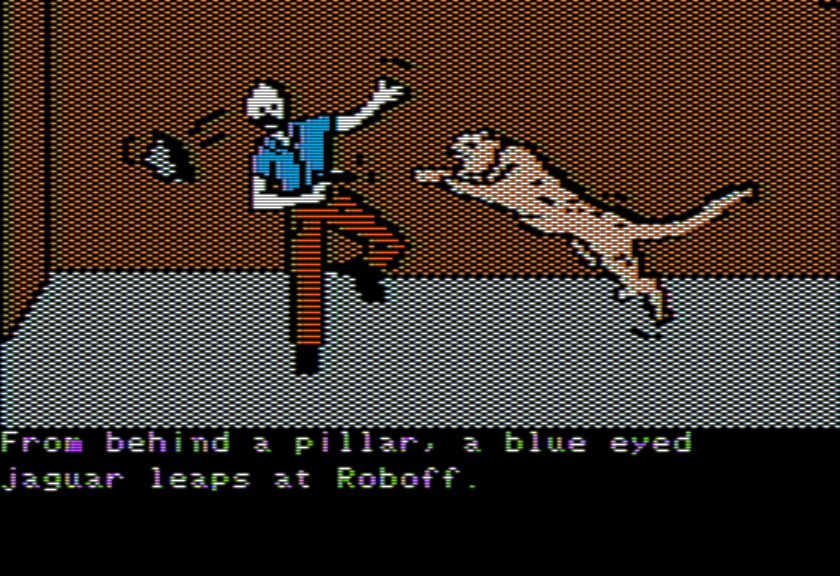
I hope you got the flute at the very start of the game!
I very much appreciated the “outsider” design, which led to having two major sections that were solely devoted to dispensing clues rather than items. This idea of information as an item isn’t exactly novel for 1982 but making entire sections devoted to just information definitely is. With a single author I’d call they were “enthusiastic and promising” and look forward to what they were doing next. With a whole company, who knows if they can learn from their mistakes, but at least there’s another Ultracode title we’ll eventually make it to.
As far as what we can learn from their “company” model, I did want to give one more quote from that Softline article:
“We do have a number of interlocking teams that generate these products, and we want to give credit where credit is due,” he [Larry Franks] says. “When a single author in a software firm is credited with a product, I really suspect that a lot of essential support is being ignored.” There were five authors listed for Mask of the Sun and seven for Serpent’s Star. “We’ll be sticking to that. The names will change some, as the original core management has gotten out of the production end and into just the tool-designing and business management end.”
In this era we had enough “bedroom coder” types that there often really was only one person involved; I think this quote applies better as prophecy more than ruminating about the years before. However, as games start to get more elaborate with coding and animation, we need to be careful about crediting everything to one person.
I never got any farther based the skeletons than I did last time, but I did scoot by to scout out the rest of the map and the remaining two ruins. My presumption that this is gamebook-style structure is holding out; it is very clear for reasons you’ll see that the ruins need to be done in order, and there is at least one “self-contained” road encounter which could come straight out of a Fighting Fantasy book. Just to give the basic map the game gives again first…
…followed by my own map, where I have squished the ruins into single rooms.
For out-on-the-road encounters, a straightforward early one (if you just head west) on the very first road has a hut with woman who asks for food and gives a flute in exchange. Straightforward as we start the game with food.
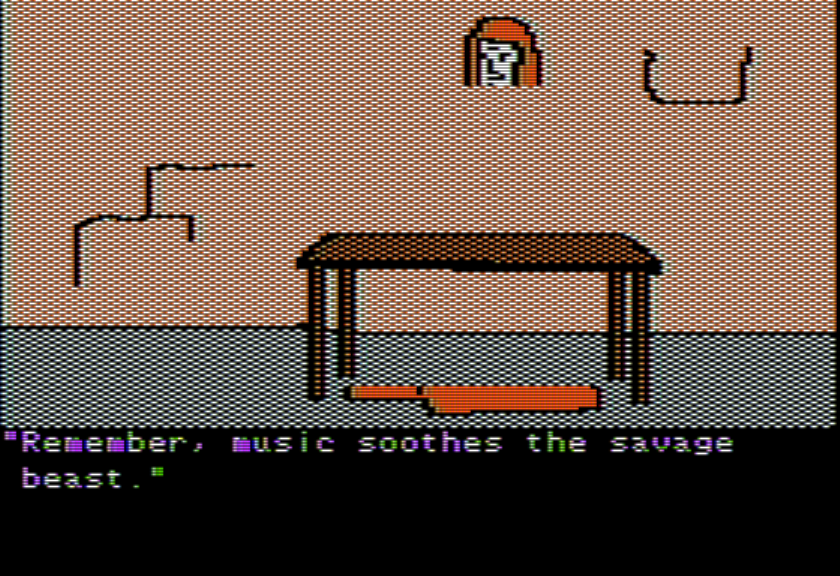
This is mid-animation of the woman disappearing.
Nearby there’s an idol with a head removed. You can pick up the head, put it back on, and have a jaguar walk away. Again, really a set piece rather than a puzzle (I haven’t seen the up-shot yet).
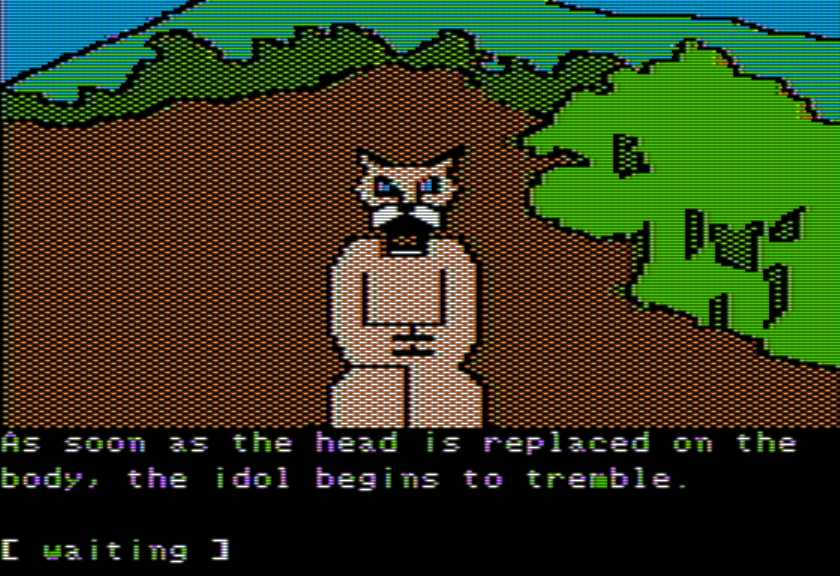
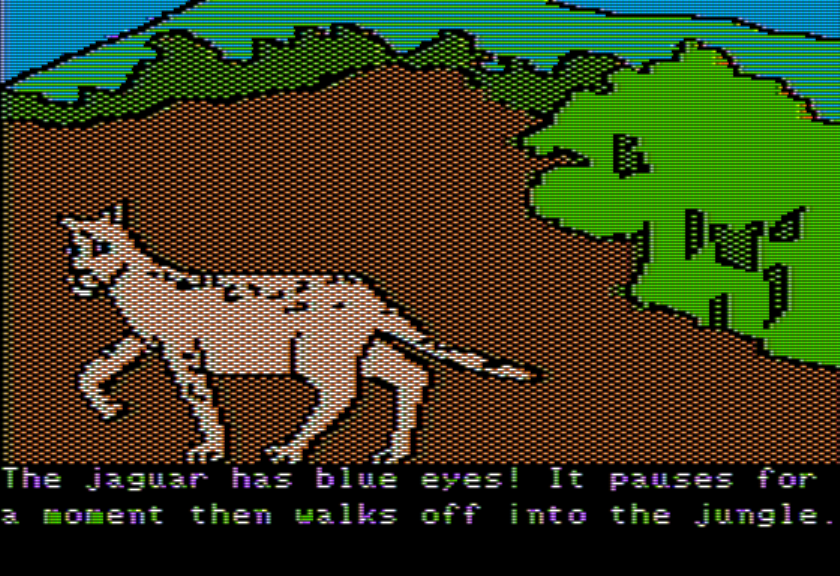
This is animated.
Then, City of Thieves style, a man somehow knows I am suffering under a curse, and offers to trade a cure.
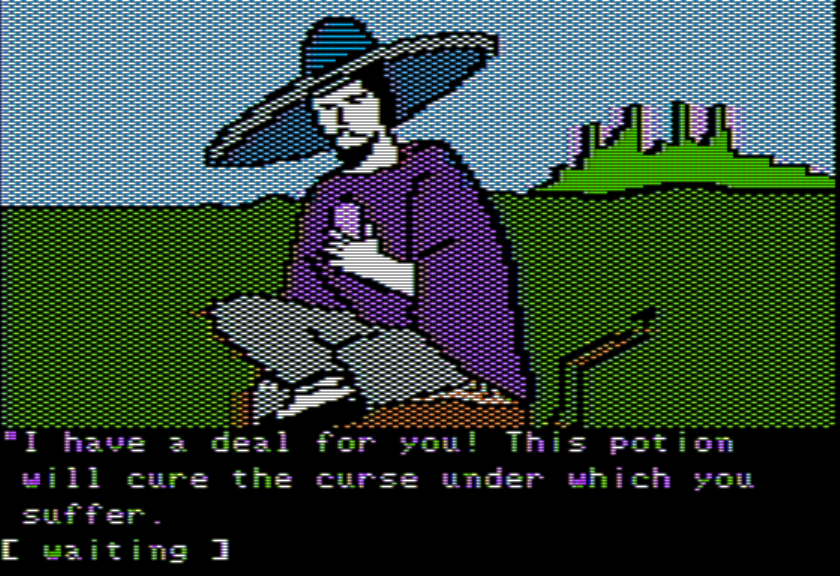
This is set up to feel nominally like a puzzle as you GIVE every item in your inventory; the one the man wants is your REVOLVER.
This sort of encounter is not common in adventure games; it is, again, a set-piece, and it is very easy to back out and ignore the man on a re-try. It suggests, yet again, a different philosophical approach to writing the game (at least for the road parts). It is of course possible the scene of getting ripped off is needed for some later scene, but this game doesn’t give me that sort of vibe.
No puzzle even here: you just drive by faster and don’t even have the encounter (I have the feeling I’ll be meeting them after finishing with the second ruin).
Speaking of the second ruin, when entering you get an encounter with a creature who has been kept immortal and gives you a hint about using three bowls (jade, silver, gold) to get through the upcoming obstacles. I only have two out of the three, but it is nice the structure here is so explicit that Ruin 1 leads to Ruin 2.
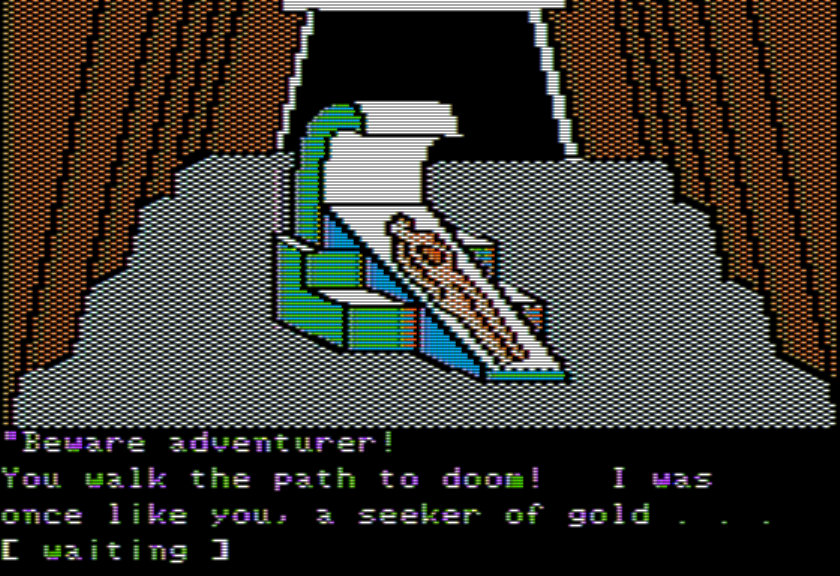
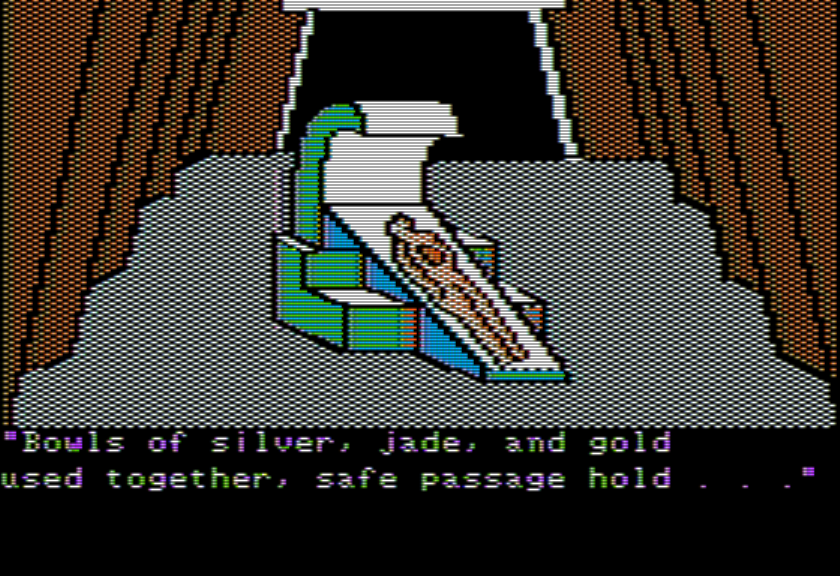
Immediately after this you are blind in a room with toxic gas. I assume the jade bowl helps somehow but I have yet to puzzle out what to do (it might even be the missing silver bowl I have to use first, so I haven’t been trying too hard yet).
The third ruin can also be reached straightaway, and you can walk around a little, but you are stymied in all directions by doors that need keys. It seems nearly certain that Ruin 2 has the keys to get into Ruin 3 and make it to the end of the game.
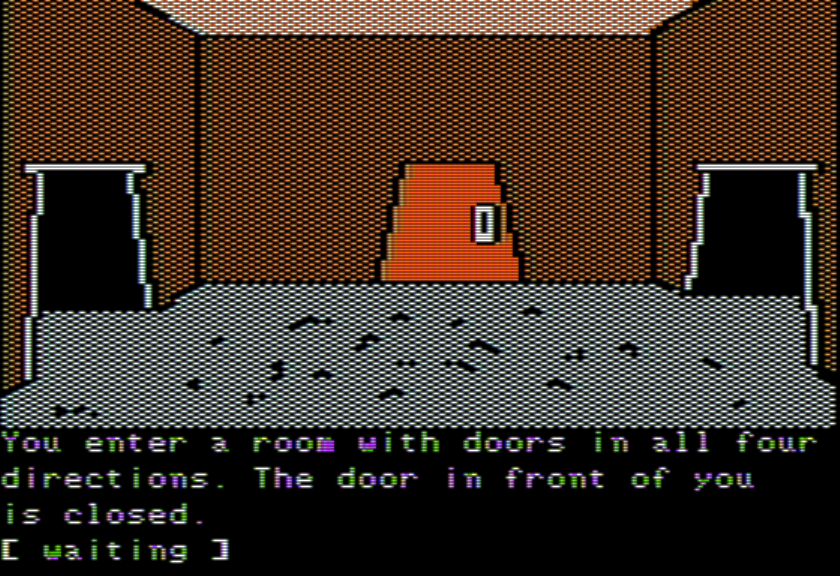
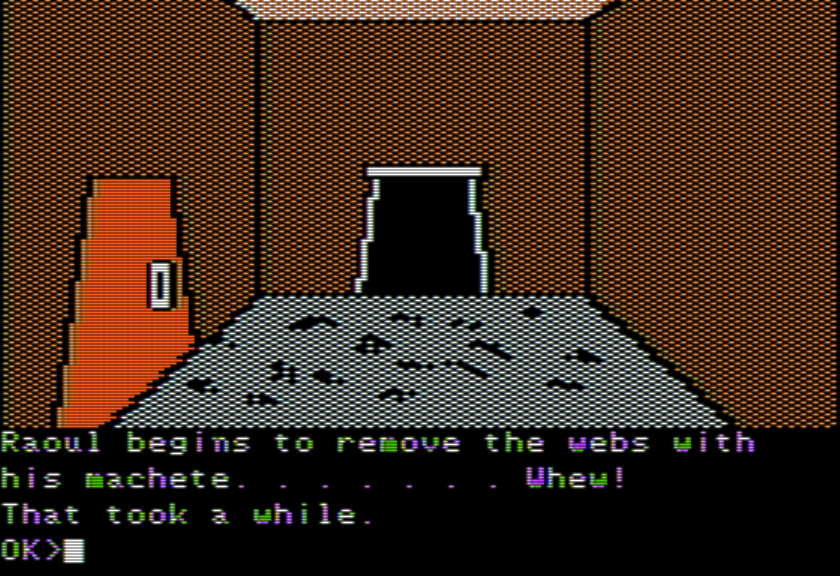
I am perfectly happy to get spoilers on the boulder and/or skeletons in the first ruin, although please use ROT13.
Anson says that the company has defined 115 distinct tasks involved in putting out an adventure, and many of those tasks involve creating and refining a story. Everything is planned; frequent meetings are integral to every step of the production. Ideas for the plot of the game, the characters, the puzzles— all are tossed around at these bull sessions.
(Continued from my previous post.)
The manual for Mask of the Sun from the later Brøderbund printing, via the Internet Archive.
So before getting back into the gameplay, I wanted to discuss the game’s parser, which I hinted last time left something to be desired. The Softline article I quoted last time certainly tries to pump it up:
Ultrasoft’s parser is based on concepts of artificial intelligence. In any given message, it eliminates words that don’t make sense and attempts to make sense out of words that are relevant to the situation. This method frees the player from the verb-noun format of the typical adventure’s input. Consider: If you’re in a room with two men, one old and one young, in an adventure with a two-word parser, you might have to make several tries before finding the correct verb-and-noun combination that expresses your wish {as to what is correct, the arbitrary decision of the programmer is final).
In Serpent’s Star, there is just such a situation. But with the Ultrasoft parser, you can type, “Co sit with the old man at the table,” and the parser extracts the operative words “sit” and “old man” and sits you down next to him. Once you’re familiar with what the operative words are, you can just type “old man” and know the parser will understand. Many of the verbal “puzzles” of the two-word parsers are really only hindrances to realistic game play. After all, you can only put up for so long with messages like “I don’t know how to OLD something.”
I can’t comment on Serpent’s Star (Ultrasoft’s second game which we’ll visit in ’83). I will say this game’s parser has serious issues, and their handling of the issue cited above is terrible.
For example, there is a scene early with a jade bowl. You can GET BOWL and the game will react like you’d expect. However, immediately after, trying to EXAMINE BOWL gets:
I don’t recognize an object in “EXAMINE BOWL”.
??? I was seriously baffled for a while until I realized EXAMINE JADE BOWL was what worked. So not only do most actions require the adjective, the game inconsistently requires it, so one scene you can refer to the bowl as a bowl while the next you can’t.
As another example, let me pull up my verb-testing list for the game.
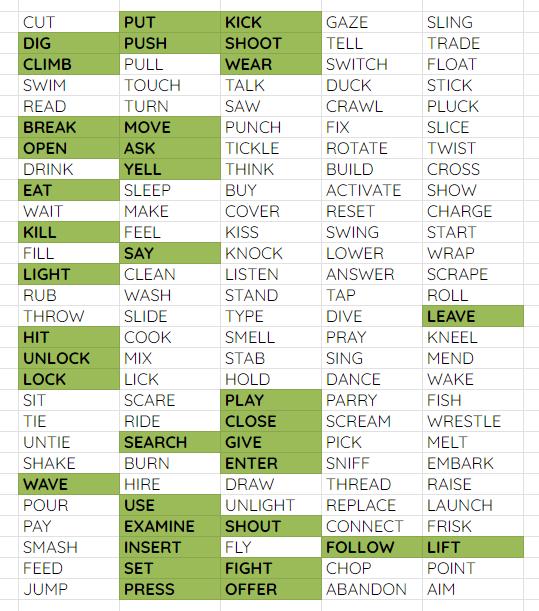
This represents me going through the list and typing each word alone. Sometimes the word genuinely works alone (DIG: “DIG doesn’t work here.”) but usually the response on one of the green-marked words is something like:
I don’t recognize a noun in “CLIMB”.
Fair enough, although I should point out using grammar terms isn’t the greatest way to do this; “you need to say what you want to climb” would be better. It’s better to explain why something went wrong in a game from the perspective of what the player needs to fix rather than from the perspective of what caused the computer to be confused. That isn’t what the main issue is, though. Take USE:
I don’t recognize a noun in “USE”.
This made me think USE OBJECT might be useful in some circumstances, but here’s the response to USE ROPE:
I don’t recognize a verb in “USE ROPE”.
Which straight up comes across as a bug. I’m still not sure what to make of it. Does this mean that USE will work somewhere, but only in a very specific place, just like you can refer to the “jade bowl” as just a “bowl” but only when taking it? This wild inconsistency is far, far, worse than dealing with a two-word parser.
At least two-word parser give you their restrictions up front. Here I’m paranoid about guess-the-phrase showing up, and it isn’t like removing “excess words” like THE is that big a deal (another thing the manual touts).
Enough grumping, let’s move on. Last time I entered a ruin and was cut off in darkness, lacking a match to light my lantern. I missed possibly the most obvious thing to try, which was to check my inventory in case I had something helpful to start.
So we get a box of matches, knife, bottle of pills, ancient amulet, and loaded revolver in our inventory as the adventure begins, added onto immediately by the shovel, lantern, food, rope, and map from the jeep. We’re actually well equipped! (Like you would expect to be true on a real adventure!) I’ve observed before getting a lot of tools to start is pretty rare, even though in a verisimilitude sense it would match better with the situation. I’m wondering if this is a positive effect of the “strategic planning” element of Ultrasoft; that is, they thought about adventures at a “meta level” and wondered themselves why so many of the games start you with nothing.
Of course, because this is the Ultrasoft parser, trying to refer to a the match box is futile, and I mean totally futile.
I don’t recognize a noun in “OPEN BOX”.
I don’t recognize a verb in “OPEN MATCH BOX”.
I don’t recognize a verb in “OPEN MATCHBOX”.
I don’t recognize a noun in “OPEN”.
(Just like USE, yes.) I eventually puzzled out I could just LIGHT MATCH straight up, so even though you don’t see individual matches in your inventory, you can still refer to them. Look, this sort of thing is a nice quality-of-life feature to jump straight to pulling out a match, but that doesn’t mean you get to skip the player being able to refer to the box itself. What if there’s a limit to the number of matches? Maybe there is, I don’t even know.
(Incidentally, back to the inventory, those pills are “your lifegiving pills” and you start with 97 of them. I assume you have moments where your curse-illness strikes, so they’re for lasting a little bit longer. Good atmosphere, that.)
With the lantern lit I was able to enter the first ruin properly, and see what was hissing. What you’re about to see is a series of animation screens, and the animation keeps going as you type. If you wait long enough you’ll die.

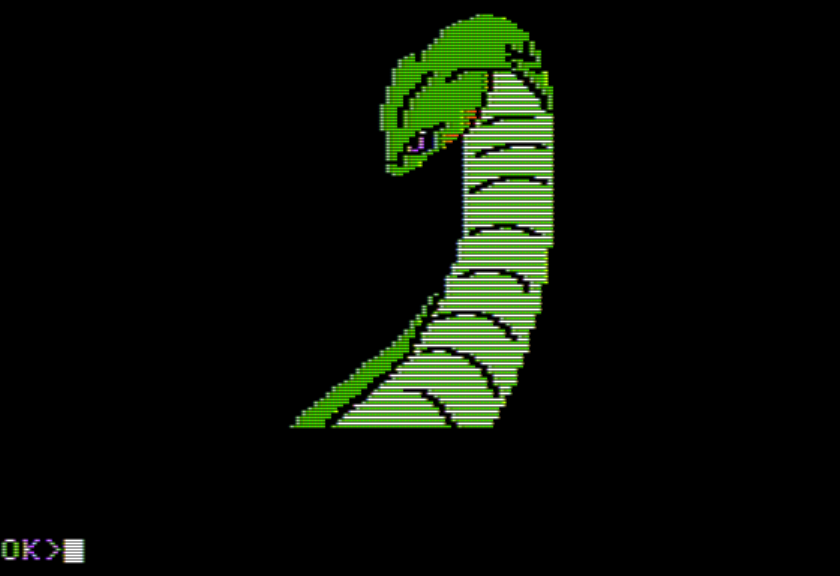
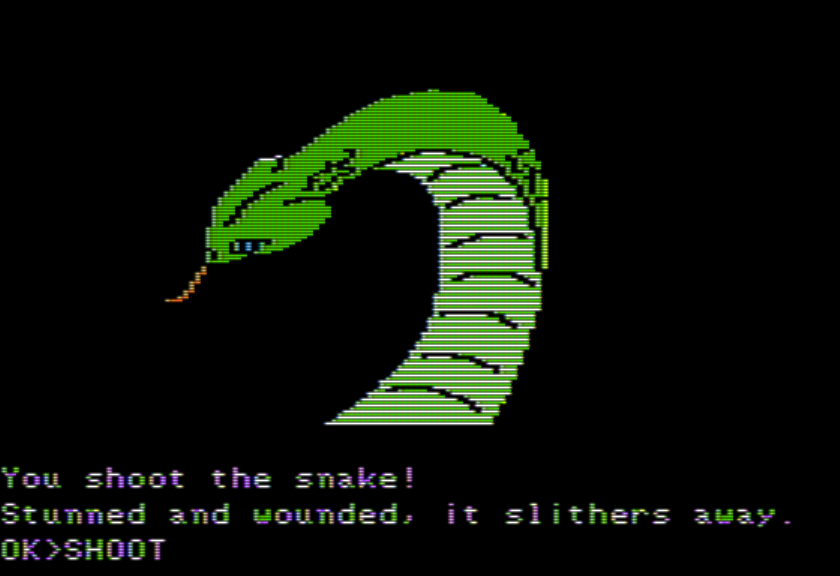
The final screen immediately triggers after typing SHOOT; you don’t even hit enter. (Bespoke! So much for their advanced parser. But this time it worked out in practice.)
This leads to a room with a pedestal and a left and right passage. Compass directions are now out. You have to type LEFT or RIGHT or FORWARD or BACKWARD to move, and sometimes the directions are relative (that is, if you enter from the east, going right will be north) and sometimes they’re not and just based on the image that you see on the screen (so the passage on the RIGHT will always be oriented that way in a particular room, no matter how you arrived at the room).
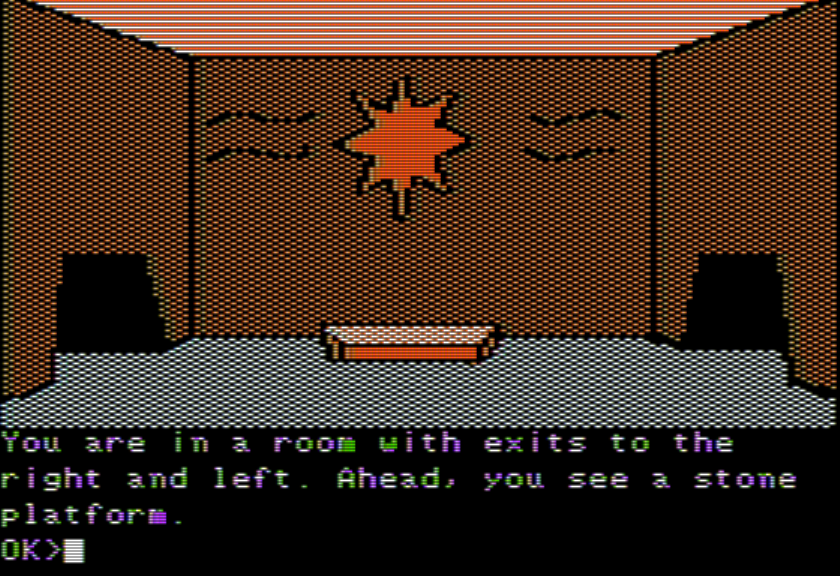
RIGHT and LEFT are both dead ends.
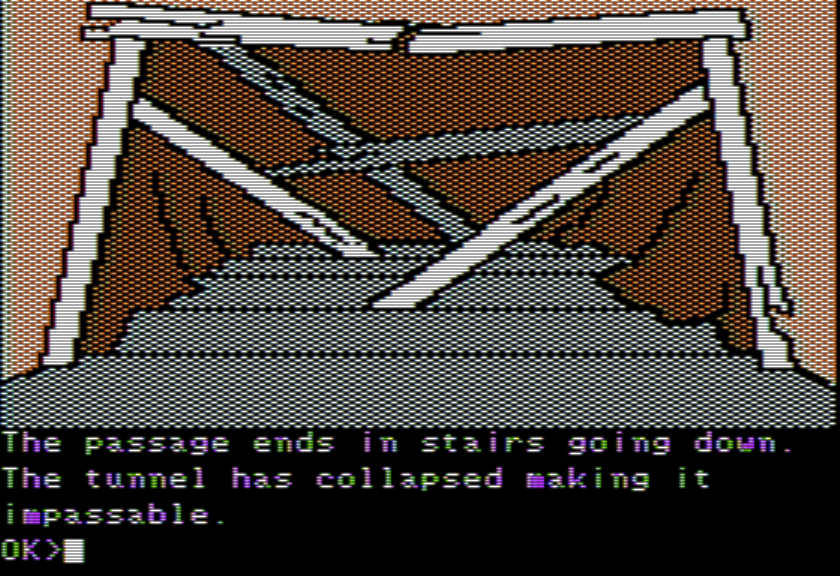
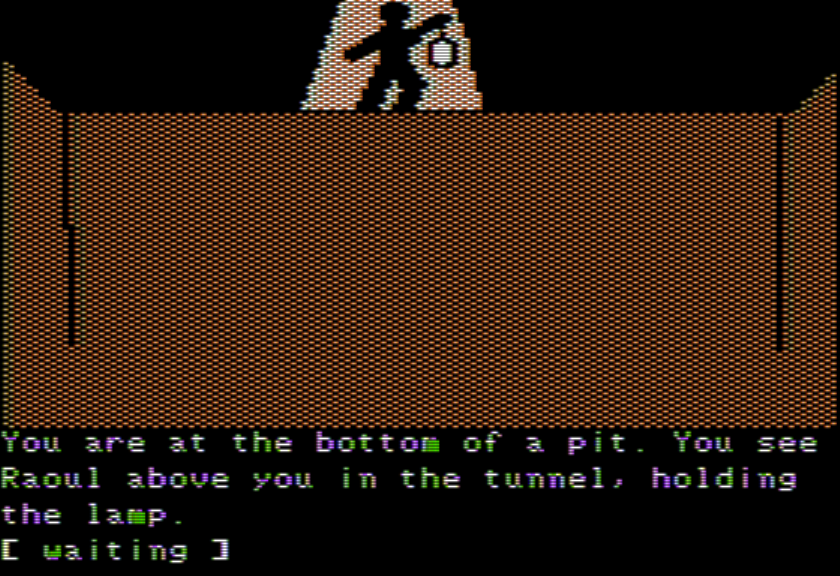
Your companion will lower a rope you can climb, so this is a “cinematic set piece” rather than a puzzle.
If you try to EXAMINE the pedestal the game says you should search further, so SEARCH PEDESTAL instead gets a secret door you can open:

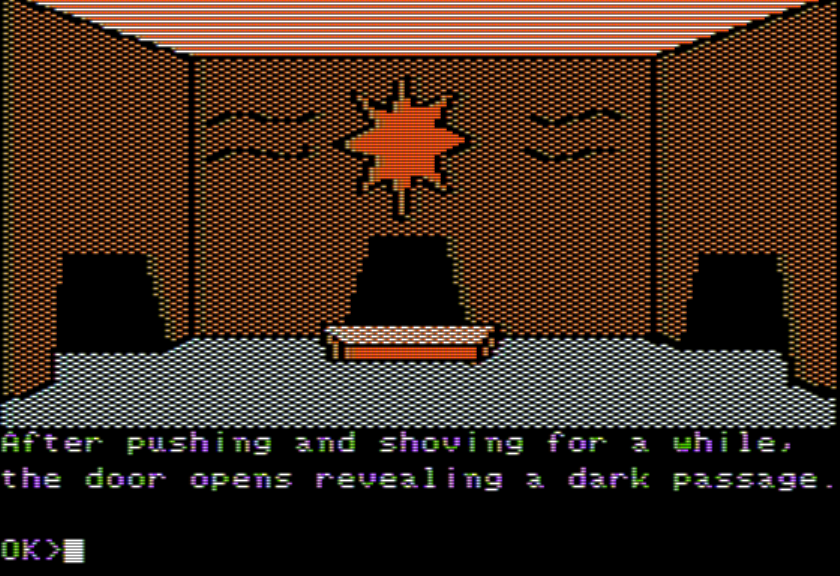
Further in is the jade bowl I was complaining about earlier.
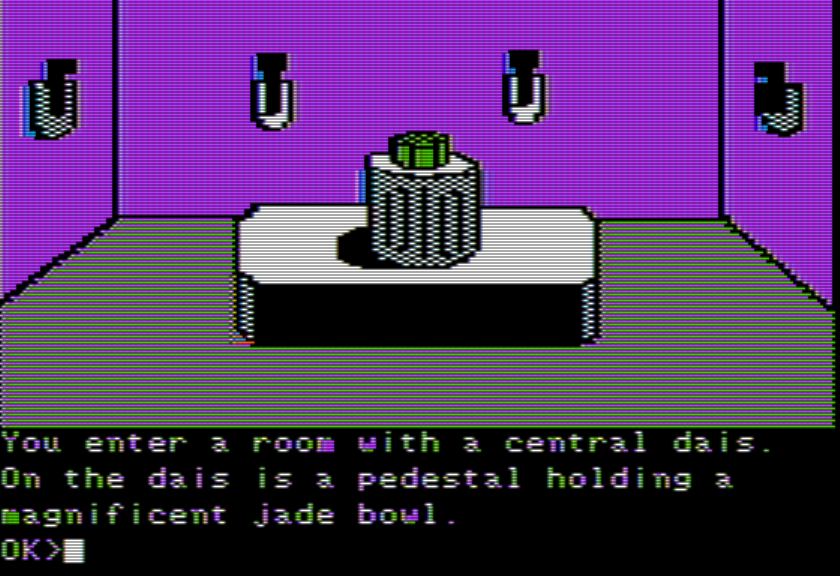
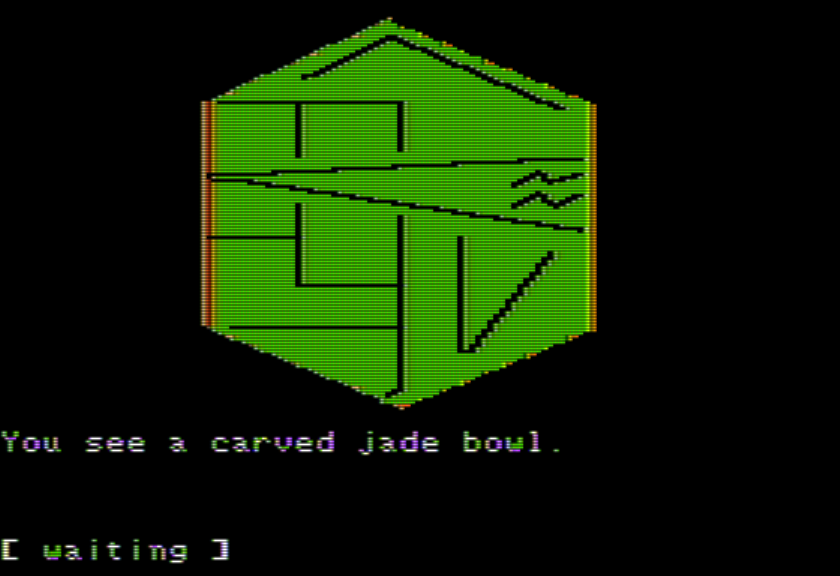
If you pick it a trap triggers and the room brings you down to another level.
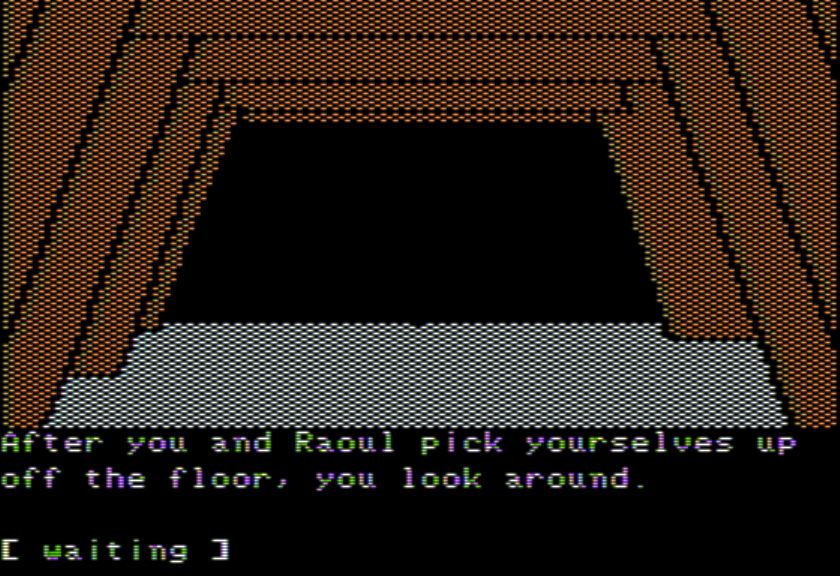
In one direction is a teetering boulder, and it is honestly atmospheric as the boulder is animated teetering in real time. I haven’t managed to get it to trigger even on purpose for an amusing death message.
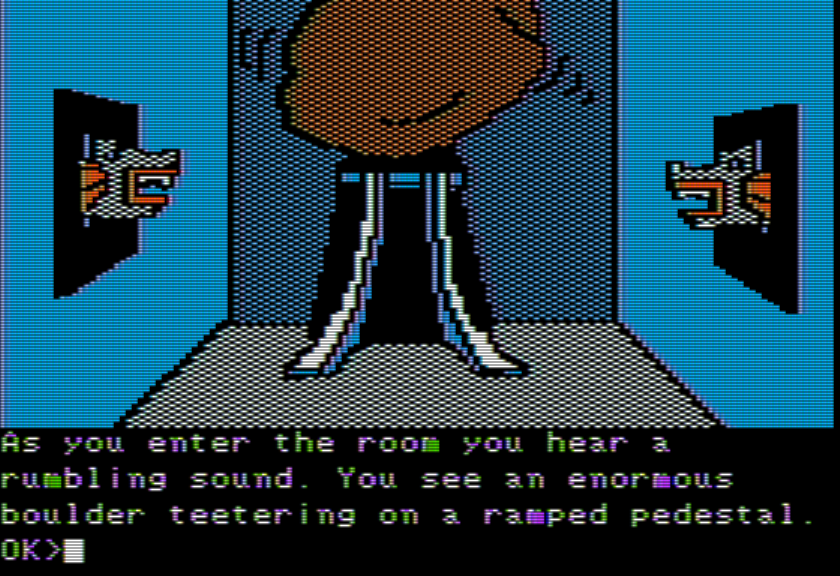
In another direction are some sarcophagi. You can get Raoul to help you open one, revealing a spirit.
Just waiting long enough seems to cause the spirit to go away, leaving a gold bowl.
In a third direction is another branching area. Moving a heavy urn from one pedestal to another opens a passage to the outside, so you can go back to the jeep.
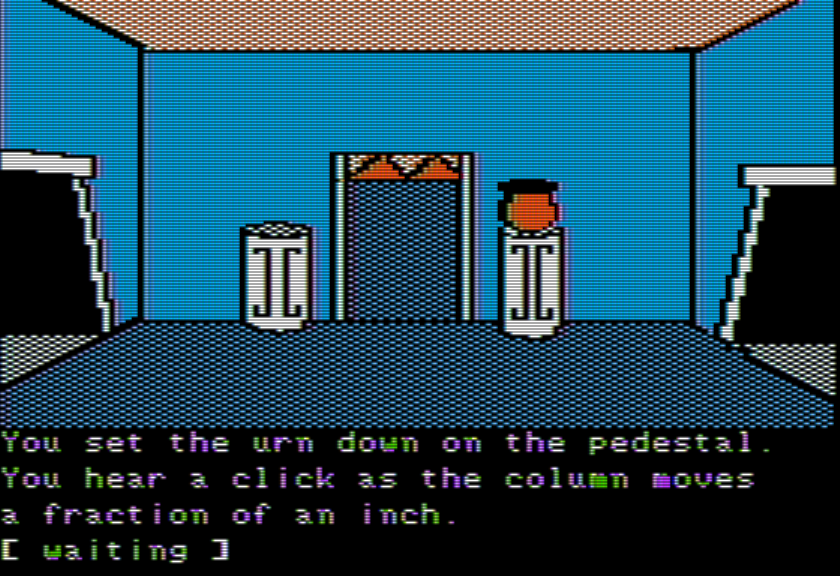
Going to the “right” leads to some skeletons guarding a silver bowl (remember I already have jade and gold). However, the skeletons wake up and defend this one, Harryhausen-style, and even animate kind of like Harryhausen.
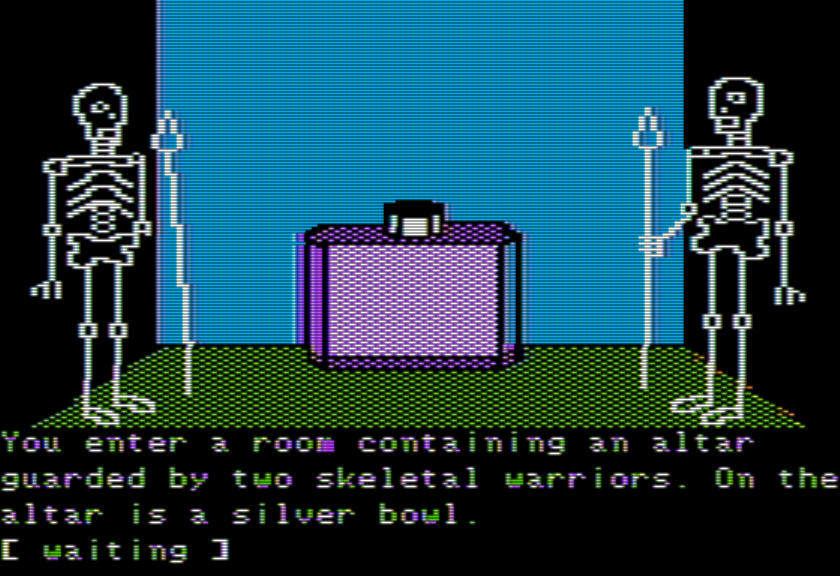
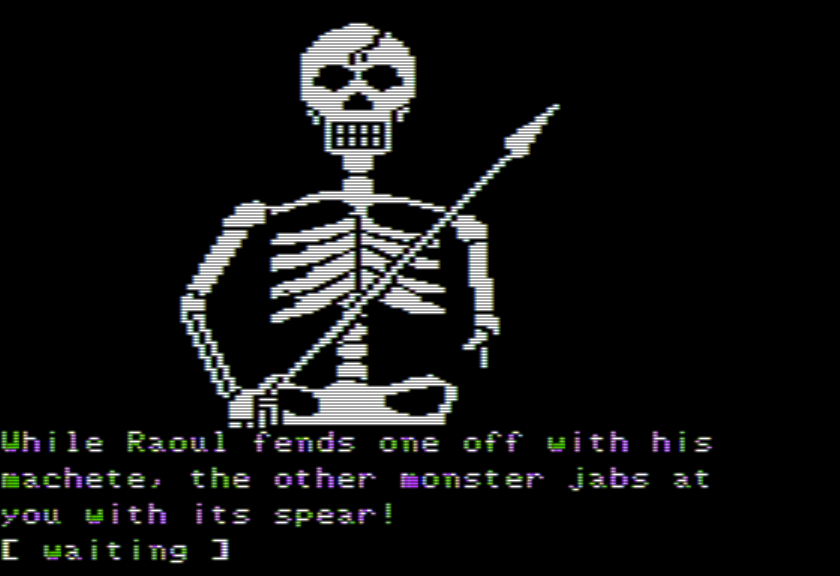

This animates as you are typing, just like the snake.
Again, waiting too long kills you, and this time (admittedly as expected) the gun doesn’t work. I’m still not sure how to deal with the skeletons; I don’t know if I’m supposed to be yet. I kind of want the boulder to kill the skeletons but I can’t get it to trigger and based on the map I don’t think it’s a straight shot. (If you run away, the skeletons just resume guarding position, so you can’t lead them over.)
The reason I feel like I should deal with them now is the game has been structured so far more like a gamebook than a standard text adventure. By which I mean: lots of self-contained set pieces, left or right branches that sometimes lead to nothing, and the general feel of “cinematic scenes” akin to Arabian Adventure more than a big looping puzzle-box. I’m not far enough in to be certain, though.




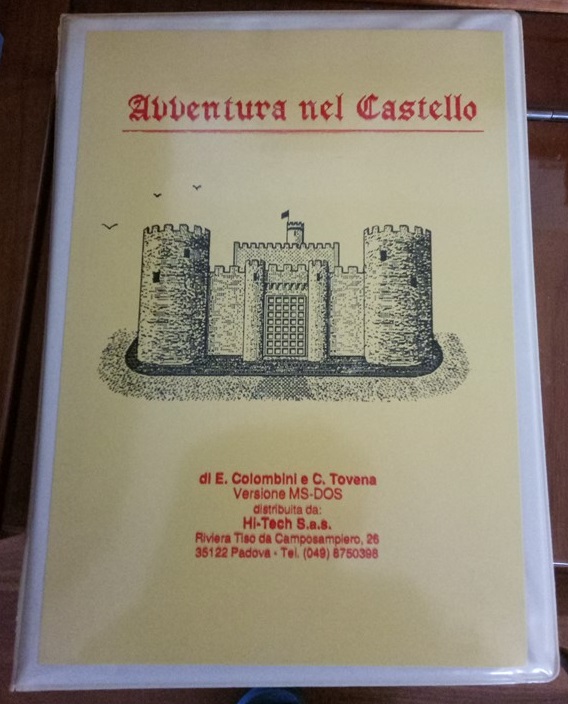
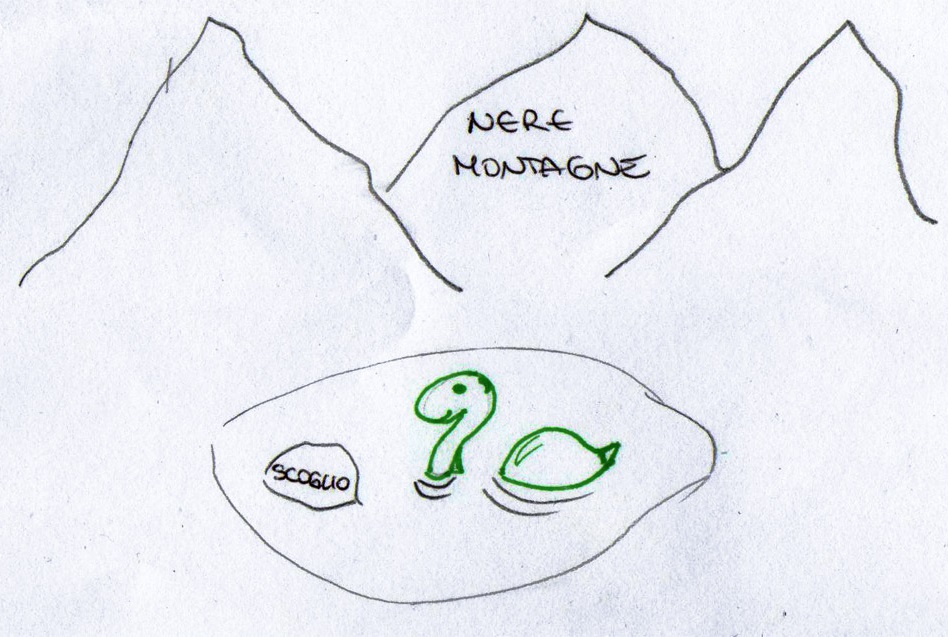
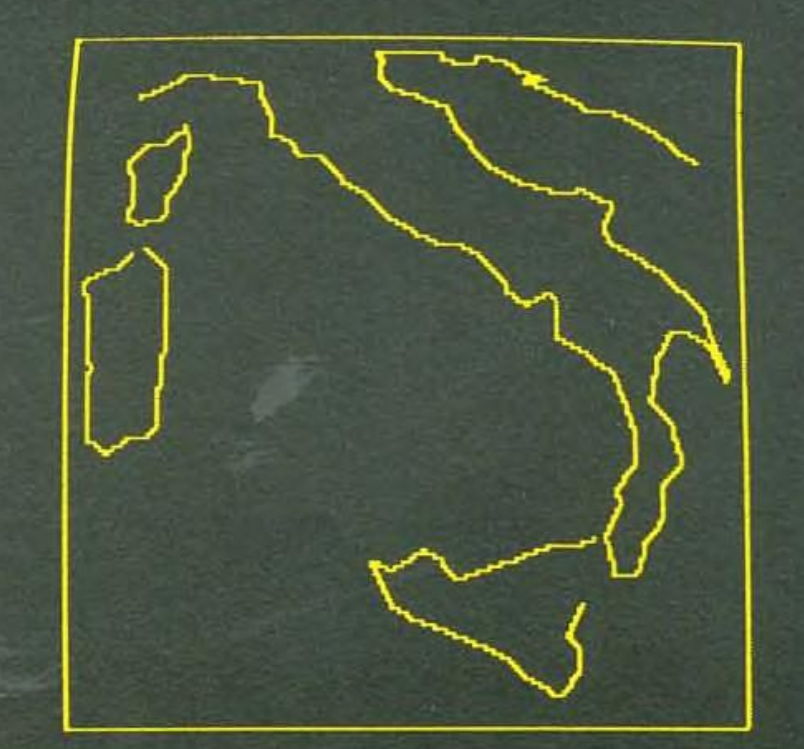





 Renga in Blue