The copyright date on this game is 1981 although it may not have been published until 1982 (when it first shows up in the Dynacomp catalog). This is the year of the first Cannonball Run movie, sort of like the Gumball Rally movie but even sillier.
When I left off, I was enormously stuck on either crossing a collapsing bridge or getting by a locked gate. As I guessed, the bridge was just a trap, and the gate was the way to go. What I did not guess is that the locked gate would open more or less by magic.
This was down where there was a volcano erupting and lots of ash. You could PLAY RADIO (as hinted at by a sign nearby) to hear an update on the volcano:
THANKS FOR TUNING KXXX
AND NOW FOR THE NEWS:
MOUNT SAINT TROY ERUPTED TODAY SPEWING ASH AS FAR EAST AS AMIKAY
ROUTE 14 IS COVERED WITH UP TO FOUR FEET OF ASH IN PLACES
BE SURE TO CARRY A SHOVEL IF TRAVELING THAT WAY
MOTORISTS ARE CAUTIONED NOT TO GET TOO CLOSE TO THE VOLCANO
AS FURTHER ERUPTIONS ARE EXPECTED AT ANY TIME
THE NEAREST ACCESS ROAD IS COUNTY ROAD T8
HAVE A NICE TRIP
I had also found to approach further I needed to not be holding the shovel (“YOU ARE ON ROUTE 14 / A GREAT PILE OF ASH BLOCKS THE ROAD HERE”) and for some reason I was able to get by, which was clearly a bug, since holding the shovel means the player is stopped. Playing around with the bug some more I finally was able to SHOVEL ASH and get a message about clearing the ash away, and progress is possible.
Studying the radio message carefully, while I knew I had already checked every exit from every room in the volcano area, I wondered if I had checked any of them before listening to the radio, with the idea that hearing about “COUNTRY ROAD T8” might be the trigger to find such a road in the first place. I tested every exit and while I was at it tested the locked gate, and…
YOU ARE ON COUNTY FIRE ROAD T8
T8 LEADS INTO THE HILLS TO THE WEST
TO THE NORTHWEST IS MOUNT ST. TROY
SMOKE AND ASH POURS FROM THE MOUTH OF THE VOLCANO
THERE IS A LOUD POP! YOU HAVE A FLAT TIRE!
…what? Somehow the radio (plus the shoveling, I think?) was enough to trigger the door being open, which makes no sense at all. I’ve certainly had games with secret passages not revealed until you have the relevant info (as I had been testing here) but I’ve never had that be what triggers a lock to open.
Ugh. My first time through here, I didn’t have the spare tire replacement and had to re-do my steps so I had one before going through the tire-blowing. It happens both east-bound and west-bound so once through you can’t go back the same way.
Next is just a small maze-area of intersections, including a picnic table with a transit coupon you need to get through a toll gate later.
Also, if you like death scenes, there’s a volcano if you go the wrong way.
YOU ARE AT THE BASE OF THE VOLCANO
PLUMES OF SMOKE AND ASH RISE INTO THE AIR ABOVE YOU SUDDENLY, THE VOLCANO ERUPTS! PYROCLASTIC FLOWS POUR OVER THE RIM OF THE CRATER. GREAT BLACK CLOUDS OF ASH AND SMOKE COVER THE AREA. YOU ARE CHOKING! THE TEMPERATURE RISES TO 800 DEGREES. YOU ARE PAR-BROILED.TOO BAD
BETTER LUCK NEXT TIME!
Heading past the maze north runs you into “T5 WESTBOUND THROUGH A FOREST” where going west results in “A LOG BLOCKS YOUR WAY”. Fortunately, I had a chainsaw at the ready (my very first item picked up in the game) and did SAW LOG.
The road then turns south to an ENDLESS TUNNEL and this is a sort of gag to the player who might be wondering “did the code turns this into an infinite loop so it really is endless?
YOU ARE ON THE COAST ROAD
THERE IS A TUNNEL AHEAD TO THE SOUTH
A SIGN READS: ENDLESS TUNNEL
>S
YOU ARE IN THE ENDLESS TUNNEL
>S
YOU ARE IN THE ENDLESS TUNNEL
>S
YOU ARE IN THE ENDLESS TUNNEL
>S
YOU ARE IN THE ENDLESS TUNNEL
>S
It is not literally endless and you end up in the small town of Endless on the other side. The only things to do in Endless are take a toll road east back to Bordertown (using the coupon from the picnic table) or take a ferry ride over to the next town.
You may be thinking, “didn’t we use our ferry ticket already to get at the gas station card and be able to fuel up the car?” You’d be absolutely right. Fortunately, in the throes of being stuck on other things, I combed back over the original towns and found that if you use the ferry ticket up, it (“another one” I mean) magically re-appears back at the dump where it first appears.
YOU ARE AT THE ENDLESS FERRY
A BOAT IS WAITING TO LOAD
HAVE YOUR TICKET READY
>W
YOU ARE ON THE FERRY TO GOLD ISLAND
THE SEA IS ROUGH AND YOU ARE SEASICK
THE FERRY FINALLY DOCKS ON THE SOUTH SIDE OF THE ISLAND
TO THE NORTH CAN BE SEEN A SMALL TOWN
The town of Yellowbar is large, annoying to map out, and a lot of it consists of recently built homes on “Simba Estates”. To be fair this describes my experience sometimes in navigating such communities. Would it kill them to use a grid?
>NW
YOU ARE ON GOLDEN DRIVE
THERE IS A CAR PARKED HERE
A SIGN TO THE NORTH READS:
SIMBA ESTATES
>N
YOU ARE AT THE INTERSECTION OF GOLDEN DRIVE AND ANDERSON
THERE ARE MANY NEW HOMES HERE
>W
YOU ARE AT THE CORNER OF MARCUS AND ANDERSON
>N
YOU ARE AT THE INTERSECTION OF MARCUS AND BARBER
With the “CAR PARKED HERE” I should put up a reminder we’ve been chasing the directions of a poem.
STAY ON THE ROAD OF THE GOLDEN BAR
‘TILL YOU FIND THE PLACE WITH THE PARKED CAR
FOLLOW THE LION ‘TILL YOU FIND THE SCHOOL
I guess Uncle Marcus is highly confident the parked car is just going to stay there forever. In a planned community? Maybe it’s one of the slacker Home Owner Associations. (To be fair, we’re in Imaginary Country Gamma, not the real United States or Canada or whatever.)
I spent a while searching for a “lion” and the general feel was oddly like a real road rally scavenger hunt as I went through the variety of road names (Jones, Miller, Johnson, Adams, Jackson, Barber, Anderson, Murphy, Thorp, Lomac, Todd, Owens…) searching for a potential pun, but no luck. However, I hadn’t tried messing around with the railroad tracks yet.
There are a couple points where there’s a railroad crossing, and trying to go along the railroad says you can’t go in a car. You have to disembark here and walk. Going in a tunnel collects another death.
OK, YOU’RE OUT OF YOUR CAR
>E
YOU ARE ON A W-E SET OF TRACKS
THERE IS A MOUNTAIN TO THE SOUTH
>E
YOU ARE ON THE TRACKS
THERE IS A TUNNEL ENTRANCE TO THE EAST
>E
YOU ARE IN A RAILROAD TUNNEL
IT IS VERY DARK BUT TO THE NORTH
YOU CAN SEE A LIGHT. IT IS GETTING CLOSER AND CLOSER. IT IS A TRAIN!!
YOU ARE RUN OVER. TOUGH LUCK!
However, one part of the tracks leads you to a “roaring” noise that surely is what was meant by the lion.
YOU ARE ON THE TRACKS EAST OF TOWN
THE TRACKS SWING SE AND WEST HERE
>SE
YOU ARE ON THE TRACKS SOUTH OF A LARGE MOUNTAIN
A SIDING TO THE NORTH PARALLELS THE TRACKS HERE
THERE IS A CABOOSE SETTING ON THE SIDING YOU CAN HERE A ROARING SOUND COMING FROM THE OTHER SIDE OF THE CABOOSE
>N
YOU ARE AT THE EAST END OF THE CABOOSE
THERE IS A DOOR INTO THE CABOOSE HERE
THE ROARING SOUND IS LOUDER HERE
>W
YOU ARE IN THE CABOOSE
THERE IS A DOOR AT THE EAST END
THERE IS A SMALL CROWBAR LAYING HERE
The roaring is not a train about to run us over (as the game intentionally seems to indicate) but a waterfall.
YOU ARE ON THE EDGE OF A CLIFF
IN A CANYON BELOW TO THE NORTH IS A RAGING RIVER FILLED WITH ROCKS A HIGH WATERFALL TO THE NE POURS TONS OF WATER INTO THE RIVER
A BOILING CLOUD OF MIST RISES FROM THE BASE OF THE FALLS
THERE IS A TRAIL LEADING INTO THE CANYON TO THE NW
The trail leads to the penultimate section of the game.
A fork in a trail leads one way to Bradley Academy (abandoned) and the other way to a baseball field (also abandoned).
THE TRAIL HERE RUN N-S
TO THE EAST IS THE ROARING RIVER
TO THE WEST A HIGH CLIFF RISES 200 FEET
>N
YOU ARE AT A FORK IN THE TRAIL
THE NW FORK LEADS UP THE SIDE OF THE CLIFF
THE NE FORK CONTINUES ALONG THE WEST BANK OF THE RIVER
A SIGN TO THE NW READS: BRADLEY ACADEMY
A TRAIL LEADS SOUTH
>NW
YOU ARE AT THE TOP OF THE CLIFF
THERE IS AN OLD SCHOOLYARD HERE
THE SCHOOL BUILDING HAS BEEN TORN DOWN
SOME SCATTERED LUMBER LIES ABOUT HERE
TO THE WEST IS A LARGE BOULDER
TO THE EAST IS THE EDGE OF THE CLIFF
A FENCE BORDERS THE OTHER THREE SIDES OF THE YARD
Just a reminder of the last part of the poem:
FOLLOW THE LION ‘TILL YOU FIND THE SCHOOL
CLIMB ON UP AND SEE THE JEWEL
FROM THE TOP YOU CAN SEE REAL GOOD
THE THING YOU WANT’S BENEATH THE WOOD
TAKE THE THING THAT YOU’LL FIND THERE
THEN GO AND SEARCH; YOU’LL KNOW WHERE
“Climb on up” seems to refer to a fir tree that you can climb.
YOU ARE ON THE SOUTH SIDE OF A LARGE POOL
THE POOL IS A CALM BACKWATER OF THE RIVER
THE RIVER BENDS TO THE EAST HERE
THERE ARE MANY FISH IN THE POOL
A SIGN READS: NO FISHING
THE TRAIL TURNS WEST AROUND THE POOL AND TO THE SOUTH
>W
YOU ARE ON THE NORTH SIDE OF THE POOL
THERE IS A LARGE FIR TREE HERE
THE TRAIL LEADS TO THE EAST
AND WEST FROM HERE
>U
YOU ARE AT THE TOP OF THE TREE
YOU CAN SEE A BASEBALL FIELD TO THE NE
ON TOP OF THE CLIFF
THERE IS A TRAIL TO THE NE LEADING UP THE CLIFF
THE BEGINNING OF THE TRAIL IS HIDDEN IN BUSHES
AT THE BASE OF THE CLIFF
Specifically, at right field in the baseball field, you can find a piece of wood and a boulder. At the SW corner of the Bradley Academy, you can also find a piece of wood (a “board”) and a boulder.
YOU ARE AT THE SW CORNER OF THE SCHOOLYARD
THERE IS A LARGE BOULDER HERE
THERE IS A SMALL BOARD LAYING ON THE GROUND HERE
However, despite the crowbar in hand, neither boulder wants to budge (with PULL or PUSH or MOVE) and there is nothing under either piece of wood.
For a time, I felt quite a nice vibe from the game here, as I started searching around both the baseball diamond and the school looking for some way of thinking of “BENEATH THE WOOD” in a less literal way, kind of like the lion. Since I had it mapped out the game felt briefly like a real scavenger hunt.
Unfortunately, yes, “briefly”, especially when I found out what was required. At least I had the right suspicion: home plate at the baseball field.
YOU ARE IN RIGHT FIELD
THERE IS A LARGE BOULDER HERE
THERE IS A PIECE OF WOOD LAYING ON THE GROUND HERE
>W
YOU ARE ON FIRST BASE
>W
YOU ARE AT THE SW END OF THE FIELD
THERE IS A WOODEN PLATE IN THE GROUND HERE
CHALK LINES LEAD TO FIRST AND THIRD BASE
Home plate is made out of wood! The other two pieces of wood were deceptions. This would be classy if the game did not then
a.) require guess the verb
b.) require guess the noun
c.) hard crash upon resolving both a.) and b.)
PUSH PLATE (“NOTHING HAPPENS!”), MOVE PLATE (“I DON’T UNDERSTAND MOVE PLATE”), and LIFT PLATE (“I DON’T UNDERSTAND LIFT PLATE”) don’t work. You also can’t take the item, either. No, the game is fishing for the exact verb and noun LIFT HOME (and yes, it seems like a moment before LIFT isn’t even an understood verb!)
>LIFT PLATE
I DON’T UNDERSTAND LIFT PLATE
>LIFT HOME
THERE IS AN ENVELOPE UNDER HOME
SYNTAX ERROR IN LINE 1730
READY
This could have been the best moment in the game — I really did puzzle the answer out carefully, and the boulder plus crowbar led to enough side-deception to make this work.
1730!V0$\P1=1\X(12)=L\\GOTO300
The double-slash at the end (before GOTO 300) is wrong. There should be only one. This is not the sort of error that would be done by disk corruption; I’m fairly sure this was an authentic author-typo, meaning nobody bothered to test the game to the end (and nobody complained because who would find LIFT HOME?)
Rather than fixing the code (before starting with the RUN command, type that 1730 line but with only one double-slash before GOTO 300) and going through everything again hoping it wouldn’t break, I changed the code to give me the envelope at the very start. The envelope has a ferry ticket (so you can go back across, you can then take the toll road to freeway-country) a latchkey, and a note.
THE NOTE READS: GO SEARCH MY HOUSE IN EASTPORT-WHERE YOU STARTED!
Weirdly, UNLOCK DOOR never works and always claims you don’t have a key, while you’re holding a key. You can just go WEST while at the locked front door with the key in hand, though.
Now we’re in a relatively normal house-searching game! No more driving.
YOU ARE IN THE MASTER BEDROOM
THERE IS AN LARGE OLD BED AND A
SMALL DRESSER HERE
A DOOR LEADS NORTH
>OPEN DRESSER
THERE IS A PAPER WITH NUMBERS ON IT IN THE DRESSER DRAWER
>GET PAPER
OK
>READ PAPER
THE SLIP OF PAPER READS: 22R-12L-45R-7L
In addition to the safe combo in a dresser, there’s a padlock key in a desk. This lets you tromp downstairs through a padlocked door into a storage room and the final challenge of the game: fiddling with the parser, yet again.
YOU ARE IN A STORAGE ROOM
THERE IS MUCH JUNK SETTING AROUND THE ROOM
THERE IS A FRAMED PICTURE OF UNCLE HARRY ON THE NORTH WALL
ON THE EAST WALL IS A LARGE MOOSE HEAD
THERE IS A DOOR TO THE WEST AND SOUTH
I was out of places to go and this came after the locked door and its picture, it ought to be hiding the safe, right? Still, it was infuriatingly hard to come up with the only verb that would work, SLIDE.
>SLIDE PICTURE
THE PICTURE SLIDES TO THE SIDE REVEALING A SAFE IN THE WALL
Fortunately, you do not then have to master a parser syntax for working out how to spin right 22 times etc.
>OPEN SAFE
AS YOU DIAL THE COMBINATION THE SAFE CLICKS OPEN
THERE IS A RUMBLING SOUND
A SECTION OF THE NORTH WALL SLIDES BACK
REVEALING A ROOM UNDER THE OUTSIDE STAIRS
>N
YOU ARE IN A SMALL ROOM UNDER
THE OUTSIDE STAIRWAY TO THE COAL SHUTE
THERE IS A LARGE CHEST HERE
THERE IS A DOOR TO THE SOUTH
>OPEN CHEST
THERE IS A STACK OF TWENTYS AND A LETTER IN THE CHEST
>GET LETTER
I DON’T UNDERSTAND GET LETTER
Sure, let’s give the parser one last quirk. No, just read:
READ LETTER
THE LETTER READS:
CONGRATULATIONS! YOU HAVE PERSERVERED TO THE END OF THE SEARCH! THE MONEY YOU HAVE FOUND IN MY CHEST WILL PAY YOUR WAY TO ENGLAND THERE, YOU’LL FIND YOUR NEXT ADVENTURE. SOMEWHERE IN WHEMBLY CASTLE LIES HIDDEN A HUGE TREASURE OF JEWELS AND GOLD. HIDDEN THERE BY YOUR GREAT, GREAT, GRANDFATHER ALMOST TWOHUNDRED YEARS AGO. MANY HAVE SEARCHED, BUT NO ONE HAS FOUND IT. WITH YOUR LOGIC AND INTELIGENCE I KNOW YOU WILL BE ABLE TO FIND IT! GOOD LUCK!
UNCLE HARRY
“LOGIC AND INTELIGENCE”, eh?
Thus the sequel (published with this game by Dynacomp) is now set up. However, I’m not sure how obvious it was from the size of the maps (and the moments of parser struggle, and the hard game crash): this took a lot of energy to play, so I’m going to kick the sequel (Whembly Castle) further down my 1982 list.
Some aspects had a unique aura. I’ve never seen an attempt (in computer game form) to capture the gimmick rally and while the riddle was not airtight it did give the experience a stronger feel than Just One Map Section After Another. The sheer amount of mapping went far too extreme but I can at least see conceptually what the author was going for. The noble failures of history can be just as useful to look at as the masterworks.
From the Japanese movie poster for Cannonball Run III (aka Speed Zone), via eBay. Cannonball Run (1981) and Cannonball Run II (1984) were followed by one last sequel to make a trilogy in 1989, where the racers all get arrested right before the event starts and the sponsors need to find new drivers.
I did finally get to grips with the monstrous map, and I even included the whole thing so far as a 4143 by 2839 image file, but first a few words on rallies vs. races, and the tradition of “gimmick rallies”.
There’s a very important difference between rallies and races which is best exemplified by the final leg of The Gumball Rally movie:
It looks like Franco’s team loses by just a few seconds (thanks partially due to a stop for Linda Vaughn). In reality, this is a rally, and the thing that counts is overall time. There was a time difference of 10 seconds at the start, meaning he actually won!
Rallies (needing to travel along real roads) are asynchronous and are scored by all sorts of things. I already alluded to the use of puzzles in “gimmick rallies”; they often track ability to navigate more than speed, which is why rallies tend are done in teams (one driver, one navigator). For a recent real life example, here’s a clip from a gimmick rally cued up to some directions being read:
This is all relevant to Uncle Harry’s Will because I think the poem that serves as instructions really does give the vibe of the slightly-corny directions you’d get in a gimmick rally. They were certainly around in 1981; Jean Calvin’s Rallying to Win (still available in an updated edition) was first published in 1974 and mentions different species like the photograph rally (where all directions are in the form of photographs of locations), the scavenger hunt, or what the book calls the “grand old man” of gimmick rallies, the poker rally:
The instructions call out route-following procedure, but ordinarily there is no tight time schedule. There will be an elapsed time for the entire run, and along the route either five or seven checkpoints. Instead of receiving a time at the control, each team draws a card from a standard deck of playing cards. At the finish, the team with the best poker hand is the winner.
Here’s the map I mentioned; click the image to view its high-resolution glory. Dark blue marks positions that hold items, showing how few objects there have been so far.
The freeway took an enormous amount of time to map but it was the kind of map where I wasn’t discovering new things but just figuring out what looped back to where, and then repositioning multiple times to have the map make a modicum of sense. It’s still incredibly messy.
There are two gas stations (marked in orange). It takes much longer to happen than with Gumball Rally Adventure but your car does eventually run out of gas, essentially the equivalent of the lamp in Adventure. It takes so long it no longer has the incessant simulationist feel of the previous game. However, while the gas station lets you buy GAS, OIL, and a TIRE (letting you get by that one road I mentioned last time) it initially tells you that you have no money.
I was able to find a way to get access to the gas station’s services which I’ll show off shortly. Note on the map the Border Crossing on the west side. Just a bit to the east there’s a Passport Office with a border pass you can use:
YOU’RE OUT OF YOUR CAR
YOU ARE IN THE PASSPORT OFFICE
HEAPS OF OLD PAPERS COVER THE COUNTER
THERE IS A BORDER PASS LAYING ON A COUNTER HERE
However, as you can see from the map, the border doesn’t really go anywhere! All you can find is a “BOTTLE OF COKE”, and if you try to take it with you it turns out to be the other kind of coke.
YOU HAVE BEEN CAUGHT WITH A BOTTLE OF COCAINE. YOU GO TO JAIL!
GEE WHIZ! JUST WHEN YOU WERE GETTING SOMEPLACE!
WELL, BETTER LUCK NEXT TIME. AT LEAST YOU’LL KNOW
BETTER THAN TO DO THAT AGAIN!
Turning over to that poem now, the first part of the poem seems to indicate the final destination:
BEHIND THE WALL, BELOW THE RISE,
IN THE ROOM MY TREASURE LIES
IN ALL DIRECTIONS YOU SHOULD DRIVE
TO FIND IT, YOU MUST STAY ALIVE
ON YOUR WAY ACROSS THE NATION
I think this might be the house right at the start; if you go around to the back there’s some stairs down and a second locked door. (“Below the rise”?)
YOU ARE ON THE WALKWAY AT THE BASE OF THE FRONT PORCH
STEPS LEAD WEST TO THE FRONT PORCH
ANOTHER WALKWAY LEADS NORTH AROUND THE SIDE OF THE HOUSE
>N
YOU ARE ON A WALKWAY AT THE NE CORNER OF THE HOUSE
THE WALKWAY CURVES WEST AND SOUTH HERE
THERE IS A WIRE FENCE ALONG THE BORDERS
>W
YOU ARE ON THE NORTH SIDE OF THE HOUSE
STEPS HERE LEAD DOWN TO THE BASEMENT
THE WALKWAY HERE LEADS EAST AND WEST
>D
YOU ARE AT THE BOTTOM OF THE STEPS
A SMALL DOOR IS SET INTO THE NORTH SIDE OF THE HOUSE HERE
THE DOOR IS LOCKED FROM THE INSIDE
The next part of the poem refers to a “station”, presumably a gas station, and says there is a “smoky hill” that will lead the way.
YOU’LL HAVE NEED TO FIND A STATION
THE SMOKEY HILL WILL LEAD THE WAY
I KNOW YOU’LL FIND IT, COME WHAT MAY
The hill in question is visible one of the western towns, Lakecity.
Specifically, at the ferry:
YOU ARE AT A FERRY DOCK
A FERRY IS HERE WAITING TO LOAD
ACROSS THE LAKE SMOKE CAN BE SEEN
RISING BEHIND SOME HILLS
>N
YOU ARE ON THE FERRY CROSSING A LONG LAKE
THE FERRY PULLS INTO A DOCK ON THE EAST SHORE
YOU CAN SEE SMOKE BEHIND SOME HILLS AHEAD
THE DOCK IS TO THE NORTH
This leads to a route which culminates in a “paper bag” by a road which has a card for free service at a gas station. Once you get the car you can BUY OIL, BUY GAS, and BUY TIRES while at one. I’m still puzzling over if the card is meant to be the goal of following the ferry directions, or if there’s something else entirely going on. (Or maybe even if the map is bugged. There’s one road where one part is inexplicably one-way such that I’m almost sure it was unintentional.)
If it wasn’t for the direction that makes your tires go flat, you could go to the paper bag in a much more direct way. It only affects the car going westbound, so if you go east you can land right back at the starting town.
I’m also still unclear about the next part of the poem:
FOLLOW THE SUN AT THE END OF DAY
TO GET ACROSS, YOU’LL FIND A WAY
STAY ON THE ROAD OF THE GOLDEN BAR
“Follow the sun at the end of day” surely means that we’re driving west, but there are only two places on the map where I have the opportunity to drive west and are unable to; everything else is mapped out. First, most straightforwardly, is a “RICKITY” bridge near the Passport Office that collapses. I suspect this is meant as a trap rather than a puzzle.
YOU ARE ON RICKITY ROAD
THERE IS A BRIDGE TO THE WEST
A SIGN READS: RICKITY BRIDGE
>W
YOU ARE ON A RICKITY BRIDGE
THE BRIDGE BEGINS TO SWAY AND ROCK
IT FALLS WITH A CRASH INTO THE RIVER
YOU ARE KILLED! TSK. TSK.
GEE WHIZ! JUST WHEN YOU WERE GETTING SOMEPLACE!
WELL, BETTER LUCK NEXT TIME. AT LEAST YOU’LL KNOW
BETTER THAN TO DO THAT AGAIN!
This even happens if you’re on foot! (By the way, the way the game treats walking on the street while out of your car is repeatedly saying IF YOU’RE GOING TO WALK, IT’LL TAKE FOREVER. If you walk over the spot on the map that pops your tire, the game will still claim the tire-popping happens, but you can walk back to the car and drive off like normal.)
The other more likely possibility for going west is back at the lake. If you drive southwest there’s a sign about tuning into the station KXXX, which is a hint that you should try to PLAY the RADIO:
THANKS FOR TUNING KXXX
AND NOW FOR THE NEWS:
MOUNT SAINT TROY ERUPTED TODAY SPEWING ASH AS FAR EAST AS AMIKAY
ROUTE 14 IS COVERED WITH UP TO FOUR FEET OF ASH IN PLACES
BE SURE TO CARRY A SHOVEL IF TRAVELING THAT WAY
MOTORISTS ARE CAUTIONED NOT TO GET TOO CLOSE TO THE VOLCANO
AS FURTHER ERUPTIONS ARE EXPECTED AT ANY TIME
THE NEAREST ACCESS ROAD IS COUNTY ROAD T8
HAVE A NICE TRIP
Just a bit further, a “great pile of ash” is blocking the way.
YOU ARE ON ROUTE 14
A GREAT PILE OF ASH BLOCKS THE ROAD HERE
However, weirdly enough, if you have the shovel with you, the way is blocked (“YOU CAN’T DO THAT”). The way to get through is to not have the shovel. This is 100% clearly a bug; the author must have swapped a logic statement somewhere. (Or there was a very slight corruption of the file which did the same thing, that has happened here before.)
YOU ARE ON ROUTE 14 A N-S ROAD
A DIRT SIDE ROAD LEADS EAST
>S
YOU ARE AT THE MAIN INTERSECTION IN THE
TOWN OF AMIKAY. MOST OF THE TOWN IS COVERED
WITH A FINE WHITE ASH
Going west you are blocked by a “locked gate” and … that’s it. I’m stuck from here. The map is big enough I’m sure it might be worthwhile to check over everything again, but the shovel bug in particular has lowered my confidence significantly and I might poke in the source code before too long.
Uncle Harry has died! You are called to his house on the east coast of the country to hear the will. The will leaves everything to you! The only problem is that he failed to tell where “everything” is located. Not even a map! The only thing that might help is a poem which gives clues on where to look.
In 1975, Art Walsh and Fred Ruckdeschel were both working at Xerox in the area of Rochester, New York. Fred was Art’s supervisor. In 1975, Ruckdeschel had just bought an Altair:
… it only came in kit form, cost $495, I think. And you you got a a box full of components in a in a shell which look like a big bread basket. And, he put one together.
He said this is neat. And, so that we could use it in our laboratories and have our machines directly input their output, into a computer and do all sorts of image analysis on it. Which we were able to do. And he, he tried getting me interested in the computers, and I’m used to working on mainframes, but, and it was also cheap.
Both Fred and Art got further into computers, writing articles for Byte magazine.
Ruckdeschel’s articles were fairly technical and eventually he wrote a two-part book of over 1000 pages on mathematical algorithms in BASIC. From November 1978 Byte.
Art had a lull between assignments where he programmed his computer to play bridge, and around the same time Fred had made an oil tanker simulator. Ruckdeschel had the notion that they since the pair had two programs already, and they could produce a few more and a start a new company together.
We formed a company, and it was one of the first software companies [1978], and the name is Dynacomp. And we ran ads in Byte Magazine … we started getting an order here and there for our software.
This was all while they were still at Xerox. The pair eventually had a personality conflict and by 1981 decided to split their company (and catalog) in two, with Art going one way with the company Artworx, and Ruckdeschel keeping under the Dynacomp name. (Some titles were kept in both, which is why both had a version of Cranston Manor Adventure.) For our purposes today, Dynacomp is more our target of interest, because Fred Ruckdeschel had a North Star Horizon at home and it was one of his favored computers, meaning his company kept the North Star part of the catalog.
Dynacomp incidentally lasted a bit longer than many other mail-order kings; they got up at least to the early 90s. Artworx had similar longevity, but at least I can explain theirs: their Bridge game was an evergreen product. With Dynacomp, I’m not entirely sure why they lasted so long. It may have been they didn’t focus entirely on the “hip” computers (like Apple and Commodore) but rather went for unusual niches, most with some variant of the CP/M operating system. In addition to their large collection — really the only large collection — for the North Star Horizon, later catalogues list support for:
Osborne, North Star CP/M, SuperBrain, NEC PC 8000 CP/M, KAYPRO II MORROW DESIGNS, HEATH ZENITH Z-100, HEATH ZENITH H-89 8″, CROMEMCO, ALTOS, XEROX 820, IBM PC/PC Jr., SANYO (with MS DOS), PANASONIC, COMPAQ Z or BA, CANON AS-100, DEC RAINBOW 100 (with MS DOS), and other CP/M IBM 3740 systems.
SuperBrain, now that’s a oddball computer. I found a Usenet thread from ’88 with someone trying to locate a commercial C compiler for CP/M and getting a recommendation for Dynacomp (a company that “no one has heard of”).
The SuperBrain came out in 1979. Check out that 70s design aesthetic! From Wikipedia.
The North Star Horizon has only come up here recently due to the discovery of a new cache of software thanks to f15sim, essentially a gigantic chunk of the Dynacomp catalog (given there are disks supposedly still left to upload, maybe the entire Dynacomp catalog). I wanted to try out three games from I hadn’t heard of before: Gumball Rally Adventure, Uncle Harry’s Will, and Windmere Estate, all (probably) by R.L. Turner. They’d been out there in the Dynacomp catalog already (see the Winter ’82 one here) but uncatalogued on Mobygames and elsewhere; the North Star just never has gotten much attention.
I unfortunately have not dredged up any details on R. L. Turner other than he seems to have been a car enthusiast, as his first game in the Dynacomp catalog (probably) is Gumball Rally Adventure. The (probably) is because it is listed as copyright 1980 from Novel Software, but there’s a Turner Motel, and the theming matches quite strongly with Uncle Harry which we’re about to get to, and they’re right next to each other in the catalogue, so–
YOU ARE IN GOOFY’S GARAGE ON THE EAST SIDE OF BIGTOWN. THERE ARE FIVE CARS PARKED HERE. YOU MAY CHOOSE ANY ONE TO DRIVE. EACH CAR HAS BEEN PREPARED FOR RACING AND IS GASSED UP READY TO GO. ALL FIVE CARS HAVE A SPARE TIRE IN THE TRUNK. THERE IS AN EMPTY 1 GALLON CAN HERE. ALONG ONE WALL IS A GAS PUMP, AIR & WATER HOSES, GREASE GUNS, ETC. THE EXIT IS ON THE WEST SIDE OF THE BUILDING AND LEADS ONTO A NORTH-SOUTH STREET. WHICH CAR WILL YOU DRIVE?
This is essentially a simulation game in the vein of Camel, The Oregon Trail, etc. where you are trying to get from point A to point B. Except if you don’t have the map which presumably came with the game, it’s super easy to get to lost trying to get from one coast to the other.
This is based on the ’76 movie and some of the vehicle choices seem to match what’s on the show.
(The trailer references It’s a Mad, Mad, Mad, Mad World from more than a decade before, which is a comedy where people were racing across the country to find a treasure hidden at the Big W. This movie was also part of the trend invoking the brief fame held by Cannonball Runs, getting from one coast to the other coast of the US as fast as possible, like Will Wright did in 1980.)
I have no doubt there’s an “optimal” vehicle choice (they allegedly have different gas consumption and handling) but I wasn’t interested enough in the proceedings to figure out.
The basic idea is:
1. Type START to start your engine, STOP to stop.
2. Type a number to change your speed.
3. If something is a “sharp” curve the car’s speed needs to be fairly low (25, sometimes lower) or the car will slide.
4. You’ll lose a shocking number of tires to flats, you need to CHANGE TIRE when it happens.
5. At various gas stations you can BUY GAS, BUY OIL, or BUY TIRE. Make sure you buy more than one spare because of the aforementioned flats.
6. There’s the occasional police radar speed trap.
7. There’s the occasional other special encounter, like a school bus and a hitchhiker (who will, according to the source code, steal your car if you try to stop, but I was never able to get her to trigger).
YOU STOP FOR THE BLONDE. SHE GETS IN AND PULLS A GUN. SHE TAKES ALL YOUR MONEY AND YOUR CAR. YOU LOSE!
8. There’s a bit where it “goes dark” and you are supposed to type LIGHTS ON. It’s a car, after all, not the middle of a dungeon.
9. I’m not entirely sure if the map is bug-free; I managed to get to one point where it “overlapped” a road in a way that didn’t make sense, and I checked every route going west and all of them dead-ended.
(Orange is a gas station, red is a tire blow-out spot, blue is police radar.)
Despite the very mild gesture to special encounters this is entirely “simulation” gameplay without anything resembling a puzzle. However, it does get at something I’ve wondered, which is the Route to Adventure Without Adventure; that is, if we didn’t have Crowther/Woods or Wander, and we somehow got to an Adventure archetype, by what route would it come? By adding a map a game like Camel gets close to feeling like an adventure, maybe? However, that’s not what happened here as the author is clearly aware of adventures and adds a response to PLUGH:
MAGIC WORDS DON’T WORK HERE
It was worth spending the time here because of Uncle Harry’s Will, which is clearly playing with the same idea, but dumps the speed/gas simulation aspect.
UNCLE HARRY HAS DIED! UNCLE HARRY HASN’T BEEN HEARD FROM IN A NUMBER OF YEARS. HE WAS PRETTY MUCH A RECLUSE AND DIDN’T HAVE MUCH CONTACT WITH THE FAMILY. IT WAS SAID THAT UNCLE HARRY WAS RICH AND HAD HIDDEN A LARGE TREASURE WORTH MILLIONS.
WHEN THE LAWYER CALLED, HE STATED THAT YOU ARE THE LONE BENIFICIARY. HE ASKED THAT YOU COME TO HARRY’S HOUSE FOR A READING OF THE WILL. THE WILL WAS QUITE SIMPLE. IT STATED THAT THE MONEY WAS YOURS IF YOU COULD FIND IT. THE ONLY CLUES TO THE LOCATION WERE IN THE FORM OF A POEM. NO OTHER CLUES! NOT EVEN A MAP. I GUESS YOU’LL HAVE TO MAKE A MAP AS YOU TRAVEL.
Looking at 1981, the only other “rich person dies with an eccentric will” game is Stoneville Manor; the rich person in that game wasn’t technically our relative! So this is arguably the first “claim your inheritance” adventure plot (eventually followed by games like Hollywood Hijinx and The Mulldoon Legacy and…. IFDB lists 14 games and I’m pretty sure it is missing a few).
BEHIND THE WALL, BELOW THE RISE,
IN THE ROOM MY TREASURE LIES
IN ALL DIRECTIONS YOU SHOULD DRIVE
TO FIND IT, YOU MUST STAY ALIVE
ON YOUR WAY ACROSS THE NATION
YOU’LL HAVE NEED TO FIND A STATION
THE SMOKEY HILL WILL LEAD THE WAY
I KNOW YOU’LL FIND IT, COME WHAT MAY
FOLLOW THE SUN AT THE END OF DAY
TO GET ACROSS, YOU’LL FIND A WAY
STAY ON THE ROAD OF THE GOLDEN BAR
‘TILL YOU FIND THE PLACE WITH THE PARKED CAR
FOLLOW THE LION ‘TILL YOU FIND THE SCHOOL
CLIMB ON UP AND SEE THE JEWEL
FROM THE TOP YOU CAN SEE REAL GOOD
THE THING YOU WANT’S BENEATH THE WOOD
TAKE THE THING THAT YOU’LL FIND THERE
THEN GO AND SEARCH; YOU’LL KNOW WHERE
The big difference here between this wacky uncle and his later variants as that this one is asking you to drive cross-country. It’s possible R. L. Turner (and the fictional uncle) are fans of road rallies with a puzzle element. These are road races where the racers need to follow instructions and there are puzzles embedded within.
Here’s an example of an easy gimmick: a misspelled street name. Let’s say that your current Route Instruction is “Turn right at Smith” when you come to Smyth Street. According to the General Instructions, the word “Smith” must appear on a sign where you do this Route Instruction, but the word “Smith” does not appear on the “Smyth St” sign.
I have no idea if Uncle Harry’s Will is really following this tradition (which includes straight puzzle hunts), because I still have yet to get that far. The map alone is a serious time investment; there are multiple connected towns and a freeway to map out, and finally one-way exits make sense. You spend most of the time in your car, although you can LEAVE CAR to enter locations on foot. The only adventure I’ve played that I can think of that’s remotely comparable is Amnesia (1986), which put in every intersection in Manhattan.
Rather like Amnesia, most locations in Uncle Harry’s Will are bare-bones. Amnesia doesn’t make the player map things out, but we have to. Driving onward!
YOU ARE ON MAIN ST. IN THE TOWN OF EASTPORT
MAIN RUNS NORTH-SOUTH
>N
YOU ARE AT THE INTERSECTION OF MAIN AND FIR
>E
YOU ARE AT THE INTERSECTION OF DOCK AND FIR
>N
YOU ARE AT THE CORNER OF DOCK AND PINE
>W
YOU ARE AT THE INTERSECTION OF MAIN AND PINE
>N
YOU ARE AT THE EASTPORT ZOO. THE ZOO IS CLOSED
Before driving away too far I should mention there’s a by-foot location right where you start in the town of Eastport: you can walk up to a house which is locked and the game asks for a key you don’t have.
>LEAVE CAR
OK, YOU’RE OUT OF YOUR CAR
>W
YOU ARE ON THE STEPS LEADING TO A WALKWAY UP TO THE FRONT PORCH THE WALKWAY HAS A WIRE FENCE ALONG BOTH SIDES HERE
TO THE WEST IS THE FRONT PORCH
>W
YOU ARE ON THE WALKWAY AT THE BASE OF THE FRONT PORCH STEPS LEAD WEST TO THE FRONT PORCH ANOTHER WALKWAY LEADS NORTH AROUND THE SIDE OF THE HOUSE
>W
YOU ARE ON THE FRONT PORCH THE FRONT DOOR IS TO THE WEST TO THE EAST STEPS LEAD DOWN TO A FENCED WALKWAY
>W
YOU HAVE NO KEY
I can give the starting town at least, which has no items to nab.
However, the freeway (which you can see a part of) makes things very confusing, as it is possible to have it merge with an existing freeway without it being clear.
YOU ARE ON A NORTHBOUND FREEWAY
>N
YOU ARE ON A NORTHBOUND FREEWAY
THE FREEWAY PASSES THROUGH MOUNTAINS HERE
>N
YOU ARE ON A NORTHBOUND FREEWAY
>N
YOU ARE ON A NORTHBOUND FREEWAY
THERE IS AN EXIT TO THE NE AHEAD
>NE
YOU ARE AT THE CORNER OF PARK AND OAK
(In the clip above, we landed back in the starting town, but it wasn’t clear that’s what was going to happen until I tried the exit, and sometimes exits just lead to more freeways.)
Here are some highway rooms where I’m fairly sure I did a loop and have some duplication:
Taking Route 60 south from Eastport I was able to find a dirt road with a chainsaw, my first item.
YOU AT THE END OF THE ROAD
THERE ARE CUT TREES EVERYWHERE
THIS IS AN OLD LOGGING CAMP
THERE IS A CHAINSAW LAYING NEAR A LOG HERE
Further down there’s the town of Baycity where I was able to find a shovel in an old hardware store and a ferry ticket in the dump. Everything seems to be totally abandoned.
The abandonment (so far) means no police radars, but I did find a spot that clearly invoked Gumball Rally with a flat tire trying to go west from the starting town.
YOU ARE ON FORD ROAD
THERE IS A BRIDGE TO THE WEST
THERE IS A LOUD POP! YOU HAVE A FLAT TIRE!
>CHANGE TIRE
YOU HAVE NO SPARE TIRE
THERE YOU SIT WITH A FLAT TIRE!
AND NO SPARE! NEXT TIME, GET MORE SPARES!
READY
Well. I would buy one if I could find a store with living people! I’m sure they are somewhere. This seems to now be treated more like a puzzle than a simulationist checkbox.
I’ll try my best to get more of a full map next time and maybe reckon with the poem. Even with the abandoned towns this could end up being a neat idea but the number of rooms (over 300, according to the advertising) is overwhelming.
At least the reward ought to be better than a gumball machine! Although I could see the plot having a twist at the end.
For the old-school type readers, only 20 of them are parser this time, although it does include a explicitly Zork-based game. Also the return of C.E.J. Pacian with a survival horror game.
One thing I didn’t comment on last year but I should note — there is allowed the use of artificial intelligence in cover art. The rules require they be labeled (although it is 100% obvious which ones are using it, they have all the same bizarro glossy sheen). Note well, please — this is the one sort of competition where it is totally OK to scrawl something out in Microsoft Paint. It will have much more soul. I’m sure you mean well and I’m not holding it against anyone, but still please consider if you enter in the future to simply not include a piece of cover art. It’ll be fine!
This lists, straightforwardly, the games I know about that are missing, or have some technical barrier to playing them. Most of these were unearthed by people other than myself. Many are from the folks at CASA Solution Archive.
This is no doubt incomplete so feel free to reply with other possibilities. (Note I am not being super-inclusive; if something seems much more like an RPG but maybe-sorta could be an adventure, I am not including it.)
Wander (1974 original, Peter Langston, Mainframe)
I’ve played the modules for these now. This was a system originally made before Adventure, and the modules have a different feel from the normal mainstream of adventures, but people didn’t pay them much notice at the time.
castle: you explore a rural area and a castle searching for a beautiful damsel.
a3: you are the diplomat Retief (A sf character written by Keith Laumer) assigned to save earthmen on Aldebaran III
library: You explore a library after civilization has been destroyed.
tut: the player receives a tutorial in binary arithmetic.
However, these were made in a later port, and the original written in HP Basic is lost.
As I remember I came up with the idea for Wander and wrote an early version in HP Basic while I was still teaching at the Evergreen State College in Olympia, WA (that system limited names to six letters, so: WANDER, EMPIRE, CONVOY, SDRECK, GALAXY, etc.). Then I rewrote Wander in C on Harvard’s Unix V5 system shortly after our band moved to Boston in 1974. I got around to putting a copyright notice on it in 1978.
Underground (1978, Gary Kleppe, Mainframe)
According to David Cornelson, this was on the Milwaukee Public School’s mainframe in PDP Basic. While the original tape is lost it is possible the game made its way elsewhere.
Gary Kleppe himself later has added some details. The full list is in the comments, but here’s a few relevant parts that might help identify the game:
* At the entrance to the caves is a robot, but you have a laser pistol with which you can shoot it.
* There is a chess set locked down by a computer. If you initially play against the computer you will lose, but if you’ve found and read a certain book then you can beat it and it will give you a trophy (a treasure). After that you can blast the computer to take the set which is also a treasure.
* There’s a room where the description is written backwards, as is any message that gets displayed to you while you’re there. You also need to type commands backwards for the parser to understand them.
I first played Adventure at Colorado State University (almost finished the game then the administrators did away with it :-( ). That version had a jeweled “loaf” in a cottage in the forest (evil witch, Hanzel and Gretel type cottage (made of candy)).
There’s also a “700 point” adventure variant apparently written in PL/I, which would make it the only game other than Ferret I know of to use the language; I also find the version from Norway written in NORD-FORTRAN 77 (for NORD computers) to be unique.
World of Odyssey (1979, Powersoft, Apple II)
A new ADVENTURE game utilizing the full power of DISK II, which enables the player to explore 353 rooms on six different levels full of dragons, orcs, dwarves, goblins, gold and jewels.
The same technique is used in programs such as World of Odyssey, from Powersoft, and Journey, from Softape. Their “maps,” however, are different from the original Adventure caves. Journey features some entertaining twists and traps and is written in a tongue-in-cheek style. Odyssey is another complete, complex, computerized cavern.
Discover the floating island and rescue the beautiful princess. To win you must recover the enchanted crown, but you face the threat of magic spells and demons.
This might be a CRPG. This might be an ambiguous hybrid. This is all the information we have.
New Adventure (1979/1980, Mark Niemiec)
Martian Adventure (1979/1980, Brad Templeton and Kieran Carroll)
These were written at the University of Waterloo and it mentions here that “Archive tapes for this mainframe exist and it might prove possible to get at the source code for these games.”
Adventure 751 (1980, David Long, Mainframe)
Written about in detail here. Has the unusual condition of an attempt at a BASIC port made without any access to the source code, but I’ve never been able to get it to run properly. Was on Compuserve, and there was a poster sold of the map; here is a portion that includes the section unique to Adventure 751:
The BASIC port was by Carl Ruby. The source code is up there if anyone wants to give it a try. It was giving me legions of errors.
In April, 1982, Carl Ruby, a junior at California Lutheran college, discovered this game and attempted to write a version in BASIC for the school’s Apple II computers. However, it wasn’t until 1986 when his father bought an Apple IIc that he was able to get any real work done. Learning machine language, and the data compression trick, he almost squeezed the entire program into memory, but in 1994 he discovered Microsoft QBASIC and the Apple Adventure project was abandoned. He completed a Microsoft version in 11 days, and it was completely debugged in October 1996.
The Pits (1980, Jim Walters and Dave Broadhurst, Mainframe)
(Note that one of the lost Adventure variants from the earlier link was also on Prime systems, described as having over 1000 points. It is faintly possible the correspondent was confusing The Pits with Adventure.)
Sinbad (1980, Highland Computer Services, Apple II)
From the folks that brought you The Tarturian. Compute Sep./Oct. 1980 called it a “hires adventure-like game using over 100 pictures.”
This was in the company’s Oldorf/Tarturian phase so I’d expect a game like that.
From The Tarturian.
Spaceship to Nowhere (1981, Algray?, TRS-80)
Mentioned in a 1981 Algray catalog. Controlled with the arrow keys. Algray distributed games from other companies so it may not be the ones who made the game.
A Remarkable Experience (1981, Hoyle & Hoyle, Heathkit/TRS-80)
A Physical Experience (1981, Hoyle & Hoyle, Heathkit/TRS-80)
Discussed in this thread. This is the first and third of a trilogy. We have the second game (I haven’t played it yet) although here’s the cover of that one:
CPS Games Entire Collection (1982, Atari/ZX81/ZX Spectrum)
The Domed City
The Fourth Kind
The Ghost of Radun
Hasha the Thief
The Lord of the Rings: Part 1
Peter Rabbit and Father Willow
Peter Rabbit and the Magic Carrot
Peter Rabbit and the Naughty Owl
The Seven Cities of Cibola
The Tower of Brasht
Tummy Digs Goes Shopping
Tummy Digs Goes Walking in the Forest
The Wizard of Sham
You can check the ad for descriptions (and some wargames which I think are also lost); The Fourth Kind, intriguingly, is all about trying to communicate with extraterrestrials.
Love (1982, Remsoft, ZX81)
A game written “by women for women”. “A 16K ZX81 women’s adventure game set in the riotously funny Poke Hall. Meet the voluptuous Griselda, the rude Sinclair, Indian mystic Mr. Ram Pac, and more.”
An aeroplane carrying UN ambassadors crashes near to a ski lodge where you are staying. For some unknown reason, unknown parties have captured the ambassadors. Your job is to rescue these ambassadors and return them to the ski lodge.
Also weirdly, appears in a legal guide to software copyright notices and gives a copyright of 1984 (rather than 1982).
Cathedral Adventure (1982, Phillip Joy, ZX81)
Mentioned in Sinclair User Issue 3. 15K of Basic, “describes more parts of a cathedral than I ever knew existed—more than 30 in fact. Shortish descriptions are given, sometimes including a cryptic clue—no pun intended—and more than 70 words are recognised.” The writer was stuck on the Mad Monk and couldn’t get farther.
Gods of Mt. Olympus
Marooned in Time
Lunar Mission
although absolutely everything listed in the catalog is gone. The catalog is the only evidence we have of the games or the company even existing.
Some of PAL Creations Catalog (1982, Tandy Color Computer)
They did Eno, Stalag, and Mansion of Doom, which I’ve written about before. They had other games listed in the ad here which are lost. (Space Escape isn’t, but it lands in 1983.) Eyeballing them, I think the adventures are
Isle of Fortune
Scavange Hunt (with that spelling in the ad)
Dark Castle
Witches Knight
Beacon
Evasion (sequel to Stalag)
Funhouse
Scatterbrain
Mother Lode
although they are mixed together with non-adventures so it’s hard to tell. Beacon is “can you signal the ship before it runs aground?” — I could see that easily being almost a mini-board game. Without the game we can’t tell.
Adventure (1982, Simpson Software, ZX81)
Helpful title, eh? Mentioned here in issue 2 of Sinclair User as being “set in a mythical castle containing evidence of an extraordinary mixture of living beings – hobbits, dwarves and pirates, among others. It is a non-graphics adventure with 25 logically-connected locations written in 11/2 K of Basic.”
Fun House (1982, ASD&D, TI-99)
We have the manual. We even have a picture of the disk. We don’t have access to the game, though. I’ve played games from the series before starting with 007: Aqua Base.
Takeda Building Adventure (1982, Micro Cabin, MZ-700/MZ-1200)
The only Japanese game I’m missing for 1982, published the same time as Diamond Adventure. (Totally different author. Diamond Adventure was by N. Minami. This was by Akimasa Tako when he was a junior high student and the game was sent to Micro Cabin by family/friends without his knowledge; he later did an Alice in Wonderland game.) I’ve seen copies come up for this before but they’ve been expensive. Please note there’s a part 1 (from 1982) and a part 2 (from 1983) but they look very similar and some websites confuse them.
Part 1 (red font) on top, part 2 (black font) on bottom. Source.
Weirdly, I have enough I could technically make an entry for this game because more than a decade ago someone made a website re-creating the game in HTML format. It’s essentially a death maze. Unfortunately the website is long gone and only a very small part has been stored at the Internet Archive, but I was able to play for one move.
Glamis Castle (1982, John Bell, Apple II)
This is the sequel to Haunted Palace, by Crystalware, the funky 3d-game that had a mystery attached which wasn’t solved in the game but through a contest.
There’s also an Atari version, and I know who has a disk, but there’s logistical issues in dumping it (please don’t bother with this at the moment).
However, the Apple II version is totally lost, and based on the predecessor (Haunted Palace) it would be different enough from the Atari version to be worth having, plus it will be easier to get a dump.
ICL Quest (1980-1983, Doug Urquhart, Keith Sheppard and Jerry McCarthy, Mainframe)
I’ve written about the Windows 95 version here. It is somewhat buggy, but there’s a version that’s for C which needs technical help porting it to be playable on modern systems. If this sounds like something you’d be interested in, ping me and I’ll re-direct you for access.
Your score would be 400 (total of 400 points), in 507 moves.
You can read my prior posts on Starcross at this link. For those avoiding the ending, now is the time to veer away.
From bryron9 on Twitter, who points out the sticker on the shrinkwrap means 100% full preservation would technically need sealed packages to get the sticker variants. Also, based on Jimmy Maher’s writeup it looks like not everyone was aware the saucer is the player’s ship, the Starcross itself (“there were no actual flying saucers in the game”)?
I was rather close to done. The globe puzzle I was especially close on. As arcanetrivia pointed out in the comments, I essentially described how to solve while lamenting being unsure how to solve it.
The most obvious behavior to play with is still the fact you can put things under the globe and on top of the globe … I tried having the teleport on the floor so that the thing from above lands on it and teleports, but no dice (additionally, why would that help?)
As far as my understanding of the mechanism goes, I was confused by two things:
1.) I thought the blue rod simply did not exist on the other settings, and the globe was of equal thinness on every setting. The real idea is that the blue rod is always present under the “force wall” even if you can’t see it. This meant my thinking that required the last step be to have the globe at its smallest setting was wrong.
2.) I thought the way the teleporter worked was simply to teleport all items that step on it. Instead, it teleports things that step on it and things that are close enough. I do not know why you would think this before it happens.
I managed to finally get the thing to work by mucking about, and I’m fairly sure I tried this combination before in almost exactly the same way, but I must have had something slightly off: Set the dial to medium (2 or 3) so there’s room on top. Slide one teleport disk under the globe while in small mode. Drop the other teleport disk on the floor as normal. Put an item on the globe. Set the dial to max size (4). The item will fall and trigger the teleport, and the teleport will teleport both the item and the rod to outside the globe.
>SET DIAL TO 3
The globe flickers out for an instant and then reappears, expanded. The silvery globe is the size of a beachball.
>PUT BASKET ON GLOBE
The metal basket is now on the globe.
>SET DIAL TO 4
The globe flickers out for an instant and then reappears, expanded. The silvery globe is the size of four feet and seems embedded in the floor. You hear the hum of the transporter disk activating. There is a loud click, and then the metal basket appears resting comfortably on the red disk. The blue rod must have been in range of the disk, because it appeared as well!
Looking at the image from the Zork User Group hint guide (see above) I may have not visually have placed the globe quite as much into the ground. In addition, I always assumed the rod was on the top, so even with a teleport that gets “close items” the rod doesn’t seem like it’d be close. I think it’s meant to be jammed in the middle somehow, even without the globe to anchor it? You know what, I still don’t understand this puzzle.
With that done, all I had to do was figure out what was going wrong with my ray gun so that I could get extra charges (and as a reminder, flying via shooting the gun is the only puzzle I remembered, so I knew it was running short). I needed Invisiclues for this. I previously went through my verb list and maybe didn’t pay enough attention to the SHAKE verb, especially because of a bug:
>SHAKE GUN
It rattles loudly.
This happens before you’ve shot it at all. Afterwards, SHAKE GUN gives a blank prompt.
Just to prove that it isn’t just a modern interpreter issue, here’s the same bug in the Macintosh version.
The bug implied to me that no useful information was being given and I was just hitting a glitch, but no: the rattle is very important. It implies something is stuck in the gun.
>LOOK IN GUN
In the barrel is a silver rod!
>GET SILVER ROD
Taken.
With the silver rod out, there’s no “backfire shot” and you have 3 shots rather than just 2. This is enough to make the Newton-propelled flight. Before showing that off, I should demonstrate the use of the silver rod:
>JUMP
Gravity is almost non-existent here, so your jump easily carries you to the hatch of the drive bubble.
Drive Bubble Entrance
You are floating (clinging?) outside the drive bubble, a crystalline half-sphere covering the aft end of the artifact’s axis of rotation. Small knobs like handholds lead up the surface of the bubble, away from the end of the cylinder. The drive bubble is transparent and through it you can see the controls for the main engines of the artifact, which must be aft of here. The only way in is a hatch which is closed. Beside the hatch is a silver slot.
>PUT SILVER ROD IN SILVER SLOT
The silver rod slides into the slot and the hatch opens.
>IN
Drive Bubble
The drive bubble is on the axis of rotation at the aft end of the artifact, so there is no “gravity” here. It is transparent and you can see the tips of the tallest trees of the forest beyond. Far off, at the opposite end of the axis, is another bubble much like this one. The room is a featureless gray except for one small white slot. One way out is the hatch, which is open.
Floating near a white slot in the wall is a white rod.
>GET WHITE ROD
Taken.
>PUT WHITE ROD IN WHITE SLOT
As you insert the rod, the walls come alive with a white tracery of controls, dials, and gauges. In addition, a black slot surrounded by an ominous dead-black circle appears.
Putting the black rod in the black slot is an emergency stop and the game ends. The black slot (which you are required to pick up to enter the artifact) is otherwise useless.
You do need to go through the silver rod-white rod process because otherwise there’s a later moment where a button mysteriously fails (without mentioning it is because the drive bubble hasn’t been properly set, and also there’s no way to go back).
Just to be clear on our inventory now, our rods (after using up silver) are clear, violet, brown, blue, pink, black (boo!), gold, and green. Yellow and red got used on repair, and white was found right where it gets used.
The repair hatch in the forest.
Let’s go flying. To be clear on the visual, here, we’re at the aft of the cylinder where there’s a “drive bubble” and we’re flying to the opposite end where there’s a “control bubble” and the end of the game.
>JUMP
You push against the surface of the bubble, and because there is no weight here, you shoot into the air and away along the axis!
Floating in Air
You are floating at the axis of rotation of the cylinder, near the drive bubble. There are enormous trees “below.” There is no gravity here.
>SHOOT GUN AT DRIVE BUBBLE
A blast of orange flame issues from the gun, and the recoil propels you at an impressive speed through the air. Eventually, air resistance slows you down, but you are still in the weightless area near the center of the cylinder.
Floating in Air
You are floating at the axis of rotation of the cylinder. There is grassland “below.” There is no gravity here.
>SHOOT GUN AT DRIVE BUBBLE
A blast of orange flame issues from the gun, and the recoil propels you at an impressive speed through the air. Eventually, air resistance slows you down, but you are still in the weightless area near the center of the cylinder.
Floating in Air
You are floating at the axis of rotation of the cylinder. There is a metal band “below.” There is no gravity here.
>SHOOT GUN AT DRIVE BUBBLE
A blast of orange flame issues from the gun, and the recoil propels you at an impressive speed through the air. Eventually, air resistance slows you down, but you are still in the weightless area near the center of the cylinder.
On Control Bubble
You are floating outside a 100 meter crystal bubble which protrudes from the fore end of the cylinder. Inside, you can make out shadowy mechanisms and odd constructions. There are odd knobs of some sort which you could use to pull yourself down the bubble. At the other end of the cylinder you can see the drive bubble in the midst of enormous trees.
>U
There is only air there.
>D
Control Bubble Entrance
You are floating outside a 100 meter crystal dome which protrudes from the fore end of the cylinder. Inside, you can discern shadowy mechanisms and odd constructions. Near you is an entrance which is closed. A small slot surrounded by gold crystal is next to the hatch. Small knobs which might make good handholds dot the surface of the bubble from the axis to the hatch.
You must specify you are shooting at the drive bubble, otherwise your path goes awry and you plummet (fortunately, I was already doing this by default, I discovered the interesting death later).
To get inside the Control Bubble you need the gold rod:
Control Bubble
This room must be the main control room of the artifact. The control bubble itself is transparent and you can look out upon the interior of the artifact. Far off, hidden among the tallest trees of the forest, is the matching drive bubble. One way out is the hatch, which is open.
The walls are gray except for a single small slot surrounded by clear crystal.
Clear activates the mechanism, and the remaining colors (brown, green, blue, violet and pink) all activate particular controls. I like how we are in a typical Collect the Twelve Orb McGuffins of McGuffinville but they get used for specific technical purposes (rather than the typical fantasy plot where It Just Works when you have the right number).
>PUT PINK ROD IN PINK SLOT
When the pink rod is inserted into the pink slot, a ghostly image appears on the wall alongside it, but the clear slot and its contents fade from view. The pink screen includes a small square, a large square, and a display showing nearby space. This view shows an empty area with a stylized depiction of the artifact itself.
The other colors all give “spots” which are buttons to activate some control.
To make things work, you first use the small and large squares as zoom-in / zoom-out controls; you want the view to be of the solar system. Once you’ve done this, the brown button will swap between planets. (In practice, I was hitting buttons more or less randomly until i had my first reaction, and then it started to be possible to “puzzle out” the rest.)
>PUSH LARGE SQUARE
The view screen now shows the inner solar system, from the sun out to Jupiter.
>PUSH BROWN SPOT
The view screen now shows the Sun brightly highlighted.
>PUSH BROWN SPOT
The view screen now shows Mercury brightly highlighted.
>PUSH BROWN SPOT
The view screen now shows Venus brightly highlighted.
>PUSH BROWN SPOT
The view screen now shows Earth brightly highlighted.
Your goal is to fly to Earth. I was hoping we could get an alternate ending by flying to Jupiter (“ALL THESE WORLDS ARE YOURS EXCEPT EUROPA”) but alas, the game just informs you that the ship knows where you came from, so it shuts down and you’ve failed the trial.
>PUSH VIOLET SPOT
The highlighted image of Earth now is connected to that of the artifact. The line terminates in the center of Earth.
>PUSH VIOLET SPOT
The highlighted image of Earth now is connected to that of the artifact. The line terminates in a parabola looping around Earth.
>PUSH VIOLET SPOT
The highlighted image of Earth now is connected to that of the artifact. The line terminates in an ellipse surrounding Earth.
>PUSH VIOLET SPOT
The highlighted image of Earth now is connected to that of the artifact. The line terminates in a circle around Earth.
>LOOK
Control Bubble
This room must be the main control room of the artifact. The control bubble itself is transparent and you can look out upon the interior of the artifact. Far off, hidden among the tallest trees of the forest, is the matching drive bubble. One way out is the hatch, which is open.
The walls are gray except for five small color-coded slots (pink, brown, violet, green, and blue) arranged in a pentagon.
Of the colored slots, the pink one contains a pink rod and the blue, green, violet and brown rods are in place in the like-colored slots. Alongside each of those are spots of the same color.
The pink screen includes a small square, a large square, and a display showing nearby space. This view shows the inner solar system, from the sun out to Jupiter. The symbol representing Earth is lit. A line on the display connects the position of the artifact with that of Earth, and terminating in a circle around Earth.
Green adds dots (and this is where the step fails if you haven’t prepared the Drive Bubble) and then blue launches. Finis.
All the displays flash once. There is a sensation of movement as the artifact positions itself to follow the course you have set.
The artifact, under your assured control, moves serenely toward Earth, where the knowledge it contains will immeasureably benefit mankind. Within a few years, there could be human ships flying out to the stars, and all because of your daring and cunning…
A holographic projection of a humanoid figure appears before you. The being, tall and thin, swathed in shimmering robes, speaks in your own language. “Congratulations, you who have passed our test. You have succeeded where others failed. Your race shall benefit thereby.” He smiles. “I expect to see you in person, someday.” The projection fades.
Your score would be 400 (total of 400 points), in 507 moves.
This score gives you the rank of Galactic Overlord.
One word (“immeasureably”) might be a typo; no dictionary I’ve found spells it that way (no “e”), although there are some old religious books that do.
There’s questions that have been built up, not only historical, but in terms of understanding the plot. I’ll be referring both to Jimmy Maher’s and Drew Cook’s commentary.
The most immediate question, for me, goes back to the 1982 Lebling quote I started with (which was said when the game was done but not out yet to the public):
Starcross is intended as an entry level game for people who like science fiction but who haven’t played many adventure games before.
Why does Lebling call it “entry-level”?
There is of course aspiration vs. reality; there’s also marketing vs. reality (no doubt why Hitchhiker’s Guide to the Galaxy, surely one of the hardest of Infocom’s games by any metric, got marked “Standard” level). I’m not sure either quite explain the circumstance here. For one thing, his statement is targeted at “people who like science fiction” — that is, this is meant for a hard sci-fi buff who would no doubt realize the life support dot puzzle at glance. I can compare my past self with my modern self here: I remember first coming across the dots and being utterly baffled but I was too young for a chemistry class, and here (even though I didn’t remember anything other than suffering) it took me roughly five seconds to get. It was, at this point in my life — keeping in mind I now work on educational software professionally — quite “easy”.
I have now seen multiple people say they couldn’t get past the opening puzzle, even though (for those who have dealt with polar coordinates) it isn’t really a puzzle.
Still, I think Lebling was overlooking some of the tougher spots, especially the ray gun. The silver rod inside might seem from a designer standpoint almost trivial, but from a player standpoint it is extraordinarily tricky. On top of that, thinking to use the ray gun as a propulsion method is an audacious jump even for a physics buff; there are so many opportunities that feel like the ray gun ought to be used to shoot things that get passed by, for it only to show up at the end — this is a structural trick of the highest order, arguably the climax in my history of nonviolence (the cavalcade of games that give the players weapons that don’t get used as weapons). I can understand now why this was the only puzzle where I remembered the solution.
(The Invisiclues even mention there’s a ray-gun based way to get the blue rod! So someone might get stuck only with two shots and not realize they solved the globe puzzle wrong.)
In the end I’m going to attribute this to a combination of only being partially aware of how hard things will be for the audience (surely they would have tweaked the map puzzle otherwise) but also the truth that this game is a bit easier for a sci-fi buff who really needs everything to work logically. For such a person it is easier than a fantasy world with arbitrary rules (even if those rules are “simpler” in essence: do bell, book, and candle in order). When I made my first post I even had one person on Mastodon mention they found the game a “breeze”:
…what makes Starcross good is that it’s goals unravel in a natural way. Yes, death happens in the game… and is part of that natural way of explaining goals to the player. I totally get that that isn’t everyone’s favored play style, but for me, that clicked very easily. With the adventure genre, everyone experiences them VERY differently.
Both Maher and Cook struggled with a question that can be condensed as:
What’s up with the ending?
There are clear markers we are in some sort of test. (I’ll call the test-makers the Creators.) The original title of the game (as also given in Lebling’s notes from November 1981) was The Gift from the Stars: this is intended to give technology to a race who proved worthy. The spider was first, followed by the weasels, followed by the now-expired lizard.
“I can’t help you there, I’m afraid. I’m quite a stay-at-home, I haven’t left my ship for ages; nothing interesting out there any more. Those furry ones were interesting for a while but they’re stagnant now.”
Lebling’s notes explicitly say “The ship contains secrets which wish to be discovered, but only by a race advanced enough (and clever enough and lucky enough) to penetrate its mysteries.” (I should caution the notes are from the game-in-development and not all of them match the final product. This part seems to be unchanged.)
I still hold what I’ve already established, that this cannot be a full-environmental-control sort of test. Zork III had the Dungeon Master pretend to be needing bread in order to point out a secret door. He set the puzzle up entirely himself, where every piece is controlled. The weasels and spider here, instead, are their own beings. They were previously ones given the test. There was no reason to expect, as a guarantee, that the chief weasel’s brown rod held around his neck would be an object of trade.
Perhaps originally the Creators had more of a controlled method in mind, but things have been going wrong and they’ve worked around the issues. I would suspect, for instance, the ray gun being left behind with the silver rod left inside the Weapons Deck was their doing:
Weapons Deck
This was the armory of the artifact. A massive bulkhead has been burned away, giving free access to the weaponry. Unfortunately, it appears that the vast stock of futuristic armaments has been mostly destroyed. Gigantic projectors are scorched and shattered, strange battle armor is reduced to splinters, and wall racks for small arms are mostly empty.
Mounted in a wall-rack is a genuine-looking ray gun, large and formidable, with a long, ugly barrel. It’s difficult to tell whether or not the gun is fully charged.
Why would anyone but the Creators do that? But the blasted deck itself I don’t think was the doing of the Creators. Here’s Lelbing’s Nov. ’81 take; notice the change in setup, and the idea there would be other weapons:
You find a zap gun here, which has an enormous recoil to it (you can use it to propel you to the control room). It has only a certain number of charges, of course. It also has a key in its barrel which tints the blast its color. None of the other weapons works.
I believe the Creators did not burn the Weapons Deck simply because other aspects of change (the built village, the debris at the yellow deck which requires using the safety line) are from independently-thinking entities, not from the Creators. My guess is the weasels (the “furry ones” as Gurthark-tun-Besnap calls them) were of a much more complicated group than we see: they were advanced enough to be flying around in a ship. I further surmise there were factions in a war, and the chief (“a perfect example of barbarian dignity and splendor”) is the one who won. The group has intentionally taken the lower-tech route, possibly in response to whatever happened with the futuristic armaments; possibly lower-tech won out over higher-tech.
Drew Cook discusses their context in reference to attitudes to colonialism; I think they do fit the stereotypes (as the Earthling is tasked by the Creators to steal an item from their sacred idol) but there are two layers making this complicated: first, that the Creators are the ones making the Earthling do this in the first place, and second, the weasels had to intentionally pick what we think of as a “lower-tech” society. They fit the model of the “savages” that Lebling originally sketched out (he uses the exact word in his ’81 notes) but their decision not to play along with the Creator’s game makes them more advanced in a way.
Drew had another question — “is this a ‘big store’ con?” — which I already explained my answer is no. Now, we could still wonder why we have the exact means of getting by obstacles, but that’s true of any adventure game whatsoever, and we don’t think of all their narratives (in the meta-textual aspect) giant controlled tests. There is always necessary elision and simplification to present the world to the player.
This also means the obstacles would necessarily be different. That is, when Maher comments…
The only problem I have with that is that, absent all those challenges that arose from the general chaos inside the ship, actually figuring out the controls isn’t really that difficult, especially given (presumably) at least a few days to do it. Surely this spider fellow could have pulled it off.
…yes, that is true, but this was likely a matter of the Creators working around things; there likely were other obstacles we didn’t see that others being tested did. Perhaps, even, rather than the weasels being split, they faced some sort of enemy which required massive warfare (landing them at their current state).
The other aspect to this that’s worth considering is the dead lizard. Based on the “rules” of the game, resurrection and time-rewind ought to be possible for each candidate a set number of times. According to the source code, in the section titled DEATH AND TRANSFIGURATION, it is four times.
The expressionless voice seems despairing. “Four failures. They would not be pleased. Such promising candidates, too. If only…”
The voice trails off into background hiss. Nothing more happens, ever.
The lizard has already been through trials, and finally has resolved to escape, burning his last life. Had the pink rod (clearly necessary for the win) gone flying after the last failure, the Creators would have given a replacement, but all they needed was an open possibility for the one being tested to find it.
Regarding life support starting to fail immediately upon the player’s arrival: it brings the artifact test to a full end, and consequently it does it in a way I don’t think the other candidates had to face. Nothing I’ve mentioned is contradicted if the Creators decided to kick off the crisis themselves, but I should add that the docking procedure (and the artifact essentially hitting themselves with a foreign ship) could have caused just enough stress to push everything over the edge. Indeed, the life support is only flashing with low urgency at first, indicating it got pushed to malfunctioning as slightly as it could go. (That would mean, the red rod wouldn’t necessarily be used? Sure, but they also definitely were the ones that placed the black rod, and that one doesn’t get used.) I think one upshot of all this (just like a wonky design gone awry in a real escape room) failure might not have been because of the subjects themselves; again, there was no absolute guarantee the player could have gotten the brown rod from the chief. Perhaps the reason the spider decided not to venture forth is they landed in a “buggy” scenario that was impossible to solve so they knew to give up. Lebling’s notes say the winner needs to be clever and lucky enough. How many deaths and transfigurations did they suffer before they decided it was enough?
I’ve avoided what I suppose really ought to be the main question, which is how does this play?
For the conditions, extraordinarily well. I’ve heard this characterized as a step back from Deadline, but it’s more of a lateral step: leaning into simulating as many conditions of the environment as possible, and hewing closing enough to real physics that puzzle solutions present themselves as the natural result of these conditions. I did end up blowing my perfect-no-hints streak, although I technically never had one in the first place since the ray gun use was in my memory. This still felt the most solvable of all the Infocom games so far to me, and I need to distinguish hard and solvable. Hard allows for hiding things obscurely and requiring death and keeping track of events from the past; solvable means if you’re paying close enough attention you can get through all those things.
Coming up next: based on a suggestion of LanHawk, I’m going to make a megapost explaining which adventure games I know about are currently either lost or behind so-far insurmountable technical barriers. This is good timing as I’m also about to play two games for the North Star Horizon that were previously lost media. I’m also about to hit my “lock” threshold where I solidify my 1982 list. After I pass the 75% mark, any new games I find — even from 1982 — will land on my “loop back” list. (Keep in mind I’ve been putting loop backs in my queue at any time, so that doesn’t mean I’ll stall if there’s a new discovery, but I do want to have a tangible end in sight.)
I’ve made enough incremental progress for a report. I was hoping to have everything on the “main floor” wrapped up, but alas, one puzzle remains elusive.
From the first British paperback cover of Larry Niven’s Ringworld, illustrated by Eddie Jones. Weirdly, it looks like there’s a painting landscape drawn on the inside, instead of the general-above view map the structure should have. The teleportation disks in Starcross come specifically from The Ringworld Engineers, although they aren’t portable in the book.
The most straightforward thing I did was finally get the red rod. The problem with testing every verb on everything is that there are exact conditions that still might not be replicated by the test.
Nesting Cage
The force projectors here aren’t working, but the cage is nonetheless inhabited by many creatures who resemble crosses between a rat and an ant. They are multi-legged with chitinous shells and pincers around their mouths, but they have long ratlike tails and sparse tufts of hair. Some of them are armed with tiny spears and walk precariously on their hind legs. In one corner is a very large mud and stick nest. The nest is constructed of all sorts of odds and ends, including a red rod. The rod is embedded in the mud near one of the entrances of the nest.
>throw black rod at nest
The black rod doesn’t damage the nest very much, and in fact a rat-ant quickly incorporates it into the nest.
Reviewing the text, I realized this implied something heftier might do the job.
>throw gun at nest
The nest smashes into fragments and the rat-ants stop dead in their tracks! They frantically evacuate the nest and immediately begin constructing a new nest at the opposite end of the cage. Rat-ant babies are being carried across the cage, and warriors watch you suspiciously.
Useful for everything but shooting at someone! But I finally got to grab the red rod, and use it to test out what it’s like to set the life support system to methane.
Repair Room
This room is taken up by two large pieces of machinery. The leftmost has a symbol depicting the emission of rays beside a yellow slot. The other machine bears a symbol in three parts: the first two parts, in black, are a solid block and a fluid level. The third, in red, is a series of parallel wavy lines. Beside it are three diagrams; under each one is a red slot. The first diagram shows four single dots equally spaced around a six-dot cluster. The second shows two eight-dot clusters in close proximity. The third has three single dots equally spaced around a seven-dot cluster. The only exit is up some stairs.
There is a metal and ceramic square here.
>put red rod in first red slot
The red rod disappears into the slot. You hear a subdued hum of machinery coming to life.
Just as a reminder, the dot patterns I had theorized were atomic numbers, and indeed that turned out to be right.
Carbon 1, Hydrogen 4 or CH⁴ = methane
Oxygen 2 or O² = dioxygen
Nitrogen 1, Hydrogen 3 or NH³ = ammonia
Enough waiting and you get
The air here has become quite pungent, smelling vaguely of charcoal.
followed by
The air here has become quite hard to breathe, permeated with the smell of coal gas.
The air here has become almost unbreathable, and heavy with the smell of coal gas.
and death with a hard cut off, just like letting the life support run out of time before.
The red rod in the second slot (like you’re supposed to do responsibly, getting oxygen) is sufficient to keep the game going on with no more time limit. I do think the “feel” of the game would be significantly different for someone who solved this puzzle early; for one thing, they wouldn’t get the still-mysterious death messages about how this solar system was going to be marked. There also wouldn’t be as much of a feeling of dread and danger, since most of the other deaths you have to go out of your way to see.
Drive Bubble Entrance
You are floating (clinging?) outside the drive bubble, a crystalline half-sphere covering the aft end of the artifact’s axis of rotation. Small knobs like handholds lead up the surface of the bubble, away from the end of the cylinder. The drive bubble is transparent and through it you can see the controls for the main engines of the artifact, which must be aft of here. The only way in is a hatch which is closed. Beside the hatch is a silver slot.
>jump
Gravity is very light here and you practically zoom into the air. Unfortunately gravity is not entirely non-existent, so eventually you begin to fall, faster and faster, in a lovely curve produced by the rotation of the artifact. You make a gorgeous but fatal swan dive into the surface.
**** You have died ****
The closest I could find with a real chemistry paper containing the same diagram, via ResearchGate.
I made a hard run then at trying to figure out the electronic mouse, since I could take my time following it around (with the literal verb FOLLOW). I tried marking up my map, especially paying attention then the mouse disappeared into the wall, and trying to figure out why it would sometimes go into a room and sometimes avoid it. (In general, it seems to “sense” garbage so, for example, it will avoid the laboratory unless you’ve put something on the ground.)
Yellow Hall
The room is lit by an emergency lighting system.
There is a maintenance mouse here, cheerfully scouring the area for garbage. It has already collected a blue disk, and a safety line.
The mouse disappears into a heretofore unnoticed hole in the wall, which closes and becomes nearly invisible.
I decided to try — just in case I maybe had made a typo before — to try out giving the mouse the blue teleportation disk again (keep in mind I was also thinking they were only usable once and I needed them for the altar; I was trying everything). Just like before, after the mouse disappeared, the blue disk did not work. However, if you wait a long time — and upon subsequent testing this might be a very long time, like 40 turns — it will finally work, and you can teleport to a new area.
>stand on red disk
There is a loud click as you step on the disk, and then a moment of disorientation.
Garage
This is the garage for Maintenance Mice. There are several stalls in which non-functional mice are rusting away. Other stalls are empty. There is a chute into which trash could be dumped, and a large bin nearby. A maintenance-mouse-sized door is in the forward wall.
There is a thin blue disk the size of a manhole cover here.
There is a maintenance mouse here.
There is a trash bin full of junk of all sorts here. Someone appears to have been dumping things for years (decades? centuries?) and never cleaning them out.
Among the trash near the top of the bin you see:
A safety line
The mouse rolls up to the trash bin and dumps some stuff into it.
The mouse leaves as unobtrusively as it arrived.
Oho! I was able to retrieve my disk, dig around the bin and find a green rod, and escape through the north wall (which leads you in that room with the mysterious south wall, so that’s two mysteries in one go).
My structural intuition was that the violet rod still gets stolen via teleport, so I tested out the disks again after the Garage incident and … they worked! But why? It turns out the teleportation happens as many times as you like, as long as you “reset” the disk positions afterwards. This opened the possibility that the disks also get applied to the obnoxious lab-globe puzzle. Alas, that’s the one puzzle I’ve been hacking at with no luck.
Laboratory
This is a glaringly lit room filled with strange devices, most completely incomprehensible. For example, a huge projector of some sort points menacingly at a silvery globe floating in midair in the center of the room. The silvery globe is the size of an orange. Imbedded in the silver globe is a blue crystal rod. Beneath the projector is a dial with four positions.
The silver sphere contains:
A blue rod
Some fun observations:
1. Typing CLIMB GLOBE just says “Bizarre!” but you can try to ENTER GLOBE gets the message:
Climbing it gives you a strange feeling, so you get back down.
2. You can fry the blue rod with the ray gun, or fry the silver sphere. If you fry the latter, everything goes away briefly (and the blue rod is destroyed permanently) but the sphere is re-formed via the matter projector.
The blast washes over the globe, which grows brighter and brighter as it overloads, then with a sinister shiver, it disappears! The blue rod is destroyed by the blast! Moments later, the projector builds up enough energy to restore the globe, and it reappears.
3. BLOCK BEAM is understood as a command, but doing so only gets the response:
Trying to destroy the beam of energy isn’t notably helpful.
4. As noted earlier, the mouse can be coaxed into the room so it might possibly give an assist, but I haven’t been able to trap it in the globe or get it to try to yank out the blue rod. (Yes, longshots, but so was hoping I could just teleport to the disk the mouse had just by waiting 50 turns.)
5. The most obvious behavior to play with is still the fact you can put things under the globe and on top of the globe. It feels like this has to be pertinent, especially because in my (admittedly short) tests I couldn’t find any object other than the globe that let you refer to the space UNDER it and put things. But what is the use? The blue rod only appears on switching the size of the globe to 1, so that has to be the last step, which potentially causes things to fall from above, or from the bottom of the bigger globe to the floor; there might be something on the floor when this happens. I tried having the teleport on the floor so that the thing from above lands on it and teleports, but no dice (additionally, why would that help?)
>turn dial to 1
The globe flickers out for an instant and then reappears, shrunken. The silvery globe is the size of an orange. Imbedded in the silver globe is a blue crystal rod.
When the sphere shrinks, the ray gun falls to the new surface and then slides to the floor.
I’m starting to get the feeling this isn’t totally self-contained and I need an item from elsewhere, but where? The game hid its crystal rod pretty cunningly so I might be missing one or more hidden puzzles which reveal rod and/or helpful items. Even if I play like Green Lantern and try to imagine any helpful item at all, I can’t think of what would extract the blue rod.
It seems like there needs to be some way of manipulating the physical properties of the sphere — with heat or cold, say — and this can then be combined with the size changing to make the small version of the globe go pop. It has resisted all my attempts, and I did do the “try every verb” maneuver on it. It just isn’t normal matter!
>get globe
The globe won’t budge no matter how hard you try.
>touch globe
The globe feels neither hot nor cold. The globe doesn’t move no matter how hard you press.
Weirdly, even while stuck I am finding new things (even if new ways to die) so I don’t feel like I’m reaching a content limit yet. However, I just might try peeking at two (2) of the Invisiclues if I hit, let’s say, one more hour with nothing to show for it. Given the Invisiclues are already cunningly arranged by the original company I don’t need hints in the comments. (However, I would like to hear from either person who said they were playing: are you any farther? Feel free to answer in saying you have X rods.)
Garage
This is the garage for Maintenance Mice. There are several stalls in which non-functional mice are rusting away. Other stalls are empty. There is a chute into which trash could be dumped, and a large bin nearby. A maintenance-mouse-sized door is in the forward wall.
There is a trash bin full of junk of all sorts here. Someone appears to have been dumping things for years (decades? centuries?) and never cleaning them out.
>examine chute
The chute seems bottomless and warm air rises from it.
>enter chute
The chute leads straight to the input hopper of a fusion reactor which gets some of its power from trash. It’s now getting some of its power from you.
I’ve made enough progress to feel like I’m “close” to finishing, yet I simultaneously feel far away.
One thing I stared testing — and this will turn out to have payoff later — is trying to figure out different ways to die. For one thing, Infocom’s prose sometimes waxes its most poetic on killing off the player, but more importantly, death can contain clues.
>shoot me with ray gun
If you say so… The blast destroys you and your possessions so quickly there is no point in even describing the carnage.
(OK, this probably wasn’t going to give a hint, but it was worth trying still.)
>shoot weasels with ray gun
Many aliens are disintegrated, in the best tradition of the 1930s pulps. The remainder of the tribe attacks you, seeking revenge. You fire the ray gun at them. Nothing happens.
Ultimately, you are overwhelmed.
(The game lets you vaporize some things you might not expect and keep playing, like the cleaning mouse and the rat-ant nest.)
Yellow Airlock
This is the main airlock of the yellow docking port. The inner door leading up to the interior is open, and the outer door leading down to the surface is closed.
The room is lit by an emergency lighting system.
Discarded here is a metal basket with a small pocket.
>OPEN OUTER
A bright light over the door flashes menacingly until you remove your hand.
>CLOSE INNER
The yellow inner door closes.
>OPEN OUTER
The door appears to be jammed. There may be debris outside blocking it. Perhaps if you pushed again.
>OPEN OUTER
The outer door opens and air rushes out of the airlock.
Didn’t they teach you anything in the Academy? You can’t breathe vacuum! The process of dying in this way is very painful but at least relativley short.
(Yes, the typo at the end is in the original. Also, that metal basket is useful for carrying rods — if you put one in, a new hole will form for a second rod, and adding a second rod will cause a third hole to form, etc., so clearly it is meant to be a convenient way to carry them all.)
Observatory
This is the interior part of the artifact’s observatory, with an exit to starboard. There are no telescopes or other instruments visible, but in the center of the room is an image of space in the vicinity. Examining the image, you see a tiny model of the solar system. The sun is a bright dot in the center; Jupiter and Saturn are easily discovered. The colors of the dots are not what you would expect, though, and range throughout the spectrum.
A holographic projector is on one wall.
>look in projector
The light being emitted is so bright that your retina is scorched and you are blinded. You blunder about for a while, end up in a dark place, and are set upon by grues.
One death in particular is arguably the most interesting, but let’s save that for the end…
…and instead kick off with the Laboratory, where I hadn’t done that much experimentation yet. Just as a reminder, that has a “silvery globe” with a dial that has 4 settings, and the settings change the size of the globe. At setting 1, a “blue crystal rod” is visible but it is stuck.
>turn dial to 1
The globe flickers out for an instant and then reappears, shrunken. The silvery globe is the size of an orange. Imbedded in the silver globe is a blue crystal rod.
>get blue rod
The blue rod is solidly held by the silvery globe.
>put gold rod on sphere
The blue rod sticks out of the globe, preventing you from placing the gold rod there.
You can put things on the sphere at different size settings. For example, if you switch the dial to 2, put the gold rod on top, and then switch the dial to 1, it will cause the gold rod to slide off (“it falls to the new surface and then slides to the floor.”)
You can have combinations like crank the setting to 2, put something on top, crank the setting to 3, put something else on top, and then crank back to 1 and have both items fall simultaneously. The sphere that is being generated is hollow, though, so when switching between 2 and 3 whatever you had on top is now is sitting on the bottom of sphere.
>set dial to 2
The globe flickers out for an instant and then reappears, shrunken. The silvery globe is the size of a basketball.
>put gold rod on sphere
The gold rod is now on the globe.
>set dial to 3
The globe flickers out for an instant and then reappears, expanded. The silvery globe is the size of a beachball.
You hear something fall inside the sphere.
The ultimate goal, clearly, is to extract the blue rod in the setting 1, but I admit the whole setup has me baffled as to a procedure. All that really seems to be happening is the ability to have an item from above fall onto the top of the “orange” sized globe, but that doesn’t cause the blue rod to budge.
>set dial to 1
The globe flickers out for an instant and then reappears, shrunken. The silvery globe is the size of an orange. Imbedded in the silver globe is a blue crystal rod.
When the sphere shrinks, the safety line falls to the new surface and then slides to the floor.
The closest I’ve had to something “productive” is with the red and blue disks that are in the same room. I at least managed to figure out what they’re for. When you drop one of the disks there is an “inaudible click”. If you drop both of them and step on one…
>drop red disk
The red disk drops to the ground. There is an almost inaudible click as it comes to rest.
>stand on red disk
There is a loud click as you step on the disk, and then a moment of disorientation.
Laboratory
There is a thin blue disk the size of a manhole cover here.
The silver sphere contains:
A blue rod
…you get teleported! This only works once, and it can also work on items.
I was able to slide one the red disk under the sphere (suspicious that the parser even accepts that), crank the sphere to 4 (that’s the huge setting) and teleport. Unfortunately this just kills you:
>stand on blue disk
There is a loud click as you step on the disk, and then a moment of disorientation.
You reappear amidst the sphere. Unfortunately, parts of you are inside it and parts of you are outside it. Very untidy.
I tried going for extra-grisly (collecting deaths, remember) by putting the disk on the sphere in size 2, cranking only up to size 3 (so the disk should be sitting on the bottom of the beachball-sized sphere), and teleporting inside. Unfortunately, teleportation in this scenario does nothing. I think the disk needs to be set specifically on the floor to activate. This also means that the mouse that likes to pick stuff up (and occasionally disappears in a hole in the wall) can’t be teleported to, even if the mouse has picked up one of the disks.
I found a spot later where the teleporter was useful, so this mucking about likely was for nothing, but there is the faint possibility this game has alternate solutions to things that use up resources in a wrong way (like Hadean Lands, but without that game’s ultra-fancy rewind system).
After getting nowhere on the lab gizmo I decided to take another run at the red rod. This time I brought out the big guns:
Infocom has enough verb coverage that this almost doesn’t seem useful to make. (This also hides some details, like how POKE seems to be interpreted the same as SMASH. Some are also likely “vestigial” via porting from Zork — that is, they’re standard enough to be included like DRINK, but they don’t do anything.) I went ahead and tried all of them on the nest, the rat-ants, and on the red rod, and nothing worked. This is where I found I could shoot and vaporize the nest (this vaporizes the red rod too), shoot and vaporize the red rod individually, shoot and vaporize some of the rat-ants…
>shoot rat-ant
Several rat-ant warriors are reduced to ash, but many more rush out to replace them, and these look mad!
…but most interestingly, give items over that are then incorporated into the nest.
>give black rod to rat-ant
A rat-ant takes the black rod and incorporates it into the nest.
Unfortunately, while each item you give over then lands in the room description, nothing of use happens with the procedure.
Nesting Cage
The force projectors here aren’t working, but the cage is nonetheless inhabited by many creatures who resemble crosses between a rat and an ant. They are multi-legged with chitinous shells and pincers around their mouths, but they have long ratlike tails and sparse tufts of hair. Some of them are armed with tiny spears and walk precariously on their hind legs. In one corner is a very large mud and stick nest. The nest is constructed of all sorts of odds and ends, including a black rod, a gold rod, a space suit, a metal basket, a blue disk, a red disk, a safety line, a ray gun, and a red rod. The rod is embedded in the mud near one of the entrances of the nest.
No luck nudging the mouse up to the cage, either. The mouse seems to be restricted to the bottom three rings, and I suspect it has more to do with the wall on Ring Four with the distinctive message (“There is no exit visible on the aft wall.”) since it sometimes goes into a “mouse hole” and disappears.
However, the reason I still have something to report is that verb list. FOLLOW is a very rare verb, and when it does appear it can be anti-intuitive. You’d expect to just be able to use a compass direction to have identical effect to a verb FOLLOW, but sometimes it gets used as a direction system bypass (like how in Demon’s Forge you needed to FOLLOW a man to find a secret room, which was otherwise inaccessible).
I remembered seeing the chief of the weasels in the “warren maze”, and since it wasn’t acting like a real maze, maybe FOLLOW would work instead (even though the chief was staying in place, making the command might spurn him to move?)
Where my map was before solving the Warren puzzle.
Shockingly, it worked! This is decidedly a bit where the game earned its Expert label (remember, there’s no indication he’s trying to “lead you” somewhere, it only happens if you’re applying FOLLOW).
>follow chief
In the Warren
This is an earth and reed burrow within the warren. There are many aliens here, going about their business. The younger ones stare at you and make funny noises. There are passages all over the place, and a constant traffic in and out.
The chief alien, wearing your space suit, is here.
The chief slips through a crowd, which parts deferentially.
>follow chief
In the Warren
This is an earth and reed burrow within the warren. There are many aliens here, going about their business. The younger ones stare at you and make funny noises. There are passages all over the place, and a constant traffic in and out.
The chief alien, wearing your space suit, is here.
>follow chief
You can’t follow him until he leaves…
The chief slips through a crowd, which parts deferentially.
>follow chief
In the Warren
This is an earth and reed burrow within the warren. There are many aliens here, going about their business. The younger ones stare at you and make funny noises. There are passages all over the place, and a constant traffic in and out.
The chief alien, wearing your space suit, is here.
Dodging several youngsters, the chief enters a hovel.
(…etc. for a bit…)
>follow chief
Center of the Warren
This burrow is deep within the warren and the aliens seem to avoid it. An exit to port leads back into the warren. The walls are covered with crude but vibrant paintings depicting a huge spider, a gigantic mouse, man-sized lizards, and in the center, a being in a space suit. You realize that this room is the center of the green hall’s junction with the ring corridor. In fact, a ladder leads down to the green airlock.
The chief alien, wearing your space suit, is here.
The chief grins, exposing his pointy teeth, and points portentiously at the ladder. He curls up on the dirt floor and waits, watching you with interest.
Plot-wise, the paintings are interesting — we know from the spider that the physiology of humans was pre-announced, so to speak, but I’m curious if the paintings were added one by one, or all four species intended to be contacted were known from the start. (I’m thinking the former, especially given the dead lizard who tried to escape.)
Page from the manual. Notice the mention of Leather Goddesses of Phobos.
Going in the green airlock, we find the ship that brought the weasels, and a shrine.
Umbilical
You are in a plastic umbilical about two meters in diameter which connects the green airlock to starboard with a spaceship about ten meters to port. The plastic is cloudy, obscuring your view of the outside.
>w
Cargo Hold
This was once the cargo hold of a spaceship, and is filled with fetishes of wood and clay, totems in the shape of strange beasts, and a great deal of withered fruit and grain. Openings lead fore and aft, and the umbilical tube is to starboard. There is dim illumination from ancient glow bulbs.
A large fragment of black smoked glass from the chief’s helmet visor lies on the floor.
>get
(black visor fragment)
Taken.
>s
Guard Room
Once a guard room or barracks, this room is now dusty and unused. The only exit is back the way you came. A large door that may have led to the engine room is fused shut, as if by enormous heat.
>n
Cargo Hold
>n
Control Room
This was the control room of the ship which originally carried the now-primitive aliens to the artifact. The control panel was obviously destroyed by a fire or explosion long ago, although the lights here still glow dimly.
Outside you can see the surface of the artifact. Gazing longingly at that view are the empty eyesockets of a skeleton; the skeleton of an aliens weasel. It is dressed in the shreds of a space suit and sitting in the control couch. Scattered around the couch are fresh offerings of fruit and vegetables.
>get
(alien skeleton)
When you touch the skeleton, its arm falls off the armrest. Something slides out of the space suit and onto the floor.
That’s a violet rod, so we need it. Unfortunately, disturbing the skeleton is Very Bad, and if we go back after having done so (even if we hide the violet rod by putting it in the basket and closing it) the chief will realize something is wrong and you’ll game over.
As you re-enter the warren an alien approaches, spear in hand. Initially he looks friendly but becomes suspicious and rushes past you into the ship. There is a loud roar as he realizes you have desecrated the altar! Other aliens surround you, spears at the ready.
However, the teleporter works! We can simply warp out after the violet rod heist, with the only problem being we can only do the trick once.
The black visor fragment is useful for an entirely different puzzle, and I knew about it because I was collecting deaths. Go back to the list, and notice one time we simply died because of too much light.
Observatory
This is the interior part of the artifact’s observatory, with an exit to starboard. There are no telescopes or other instruments visible, but in the center of the room is an image of space in the vicinity. Examining the image, you see a tiny model of the solar system. The sun is a bright dot in the center; Jupiter and Saturn are easily discovered. The colors of the dots are not what you would expect, though, and range throughout the spectrum.
A holographic projector is on one wall.
>look at projector with glass
The light is very bright, but the black visor fragment filters it enough so that you are not blinded.
Inside the projector is a clear crystal rod, which has a prismatic effect on the light being emitted.
>get clear crystal rod
Taken. The image displayed is now clear and correctly colored.
So that’s two more rods down (violet and clear) but I still don’t have the one I really want, which is red! Argh!
Part of a letter included in the grey box packaging.
I’m still making progress, so no hints please. I’m hoping that the red and the blue are the last two to go (although surely the mouse is hiding something?) and I’ll be able to make my final push.
Before checking out I should share what I thought was the most interesting death. This happens if you run out of time on the life support (just WAIT a bunch) and happen to be wearing the space suit so you don’t die outright.
Suddenly, everything begins going dark, as though the artifact was shutting down. A thrumming vibration stops; one you didn’t even notice until it ceased.
**** You have died ****
An expressionless voice seems to be trying to express outrage, but not successfully. “The candidate has not made the necessary repairs in time. This is a disaster. All are now dead, and repairs are not possible. They would not approve. This area will be marked, that is certain.” Everything fades to black, and silence reigns.
The game just hard quits here; no revival, no prompt asking if you want restore a saved game.
(You can read my Starcross posts in order with this link.)
As I am sure is obvious to my long-time readers, I am a huge fan of puzzles, and would have been just as happy doing an All the Puzzle Games project instead of an All the Adventures project*. However, there is something exhilarating and unique that adventure games provide when they are done well. Rather than just thinking about one obstacle, I’m thinking about the combination of current plot, past lore, and environment in combination with the obstacles. Thinking about the story can help solve puzzles, and solving puzzles can help reveal the story; this interchange gives me a sort of immersion I can’t get from any other experience.
One thing that distinguishes this game from Zorks in Space (as Lebling termed it) is that the environment is designed in way that there is a logical superstructure (the cylinder) that everything fits into. Zork could go anywhere at any time, but here, the feeling is not so much exploring as uncovering, since all the missing pieces are hidden in one (admittedly large) object. When thinking about what to do next, I’ve been invoking my intuition about the structure and its history, rather than just deciding I need to map out East now.
The ultra-rare Dysan printing for DOS. These were originally intended to sell their new 3 1/4 disk format (they look like regular 5 1/4 floppies, just smaller) but it never took off. The “hard shell” 3 1/2 inch size ended up become the true next generation in disks. From the Museum of Computer Adventure Games.
While making my post last time I theorized two actions mid-stream that might help solve puzzles; I got hits both times! (My rate at such guesses in not normally that great.) First off, I thought (while listing off my objects) if the “tape library” from the Starcross itself would interest the spider.
>play library
The player picks a recently referenced selection: “Fantasia,” complete with holo-projection, begins.
>play library
The player picks a recently referenced selection: A lecture on the history of Brazil in the 2030’s begins.
>play library
The player picks a recently referenced selection: This is Pynchon’s “Gravity’s Rainbow.”
>play library
The player picks a recently referenced selection: The classic computer mystery “Deadline” is displayed.
The spider had already expressed excitement about “A whole new culture to learn” so I handed it over, and my sincere apologies to the spider if they hit bad RNG finding the shards of the teacup in Deadline.
>give library
(to the giant spider)
The spider examines the tape player and discovers the controls. A random song begins playing. Agitated, he fiddles with the controls again, and a lecture begins. He becomes even more agitated. “What a wonderful gift, human! This will alleviate my boredom for a while. Your culture is young, but you have amassed enough of interest to keep me sane for a few more years. I thank you.” He fishes in a pouch and comes up with something. “Perhaps you may find some use for this; I long ago grew bored with such baubles.” He tosses a yellow crystal rod at your feet.
This rod will become very important shortly.
My other guess was that I could interrupt the weasels hunting the unicorn by using the “backfire blast” of the ray gun.
Grassland
A grassy plain circles this band of the cylinder, the vegetation merging into dense forest as you look aft, and stopping abruptly at bare metal as you look forward. The plain arches above you, giving an aerial view of the other side and the entry through which you came. The forest obscures the aft end of the cylinder. A herd of creatures not unlike unicorns crops grass nearby.
There is activity nearby: Weasel-like aliens in a hunting party enter the grassland.
>shoot aliens
You have disturbed the hunters, who are annoyed, and the unicorns, who are now more wary. The hunt is spoiled.
A giant blast of silvery rays issues from the barrel, but it doesn’t go very far. In fact, there is a secondary explosion about a foot from the barrel, scattering dust motes in the air. There is almost no recoil: instead the gun vibrated almost painfully. This felt like a misfire.
The aliens are impressed and terrified.
I have yet to see a positive result from the hunt’s interruption. It does mean you get a different reaction from the weasel village:
They resemble human-sized weasels. Their bodies are thin, flexible, and covered with several colors of hair. There are all sizes and ages, and the stronger ones are armed with spears, knives, and other nasty hardware.
They stare at you with mingled awe and belligerence.
The smaller ones are hustled away, leaving only the better-armed members of the tribe.
Before, the weasels gesture in a way to “indicate friendship”. However, you can still have the scene like normal where you trade your space suit for a brown rod (and the alien leaves behind his own space suit).
>point at brown rod
The chief hesitates, understanding you all too well, then reluctantly removes the rod from its string and hands it to you.
Dodging several youngsters, the chief enters a hovel.
From the cover of the Zork User Group hint guide.
After this, the weasels are back to the “friendship” gesture, so maybe this was all just a small touch of plot? Either way, the unicorns are skittish and don’t let anyone close. Maybe the ramification of this all shows up later.
Having used the ray gun first for the backfire, I wanted to try out the second use where it works. This is the one place in the game where I remember what happened from many years ago. I don’t know why this puzzle in particular stuck, but it requires going back to the top of the tree and the “Bubble Drive”.
You are floating near and clinging to a large crystalline bubble covering the aft end of the axis of rotation of the artifact. There is no weight here. Small knobs resembling handholds cover the bubble; you could use them to climb back down. Far away at the fore end of the axis you can see another bubble very similar to this one.
>jump
You push against the surface of the bubble, and because there is no weight here, you shoot into the air and away along the axis!
Floating in Air
You are floating at the axis of rotation of the cylinder, near the drive bubble. There are enormous trees “below.” There is no gravity here.
>shoot ray
A blast of orange flame issues from the gun, and the recoil propels you at an impressive speed through the air. Eventually, air resistance slows you down, but you are still in the weightless area near the center of the cylinder.
Floating in Air
You are floating at the axis of rotation of the cylinder. There is grassland “below.” There is no gravity here.
>shoot ray
“Click.”
Hmm, I don’t remember that happening. Maybe air resistance will be cut later.
I next wanted to fiddle more with the repair room. That had some “rays” showing next to a yellow slot, and three red slots with different dot diagrams. While I can’t confirm my answer yet, I think the dots are meant to be atomic numbers, meaning the three slots represent specific gases:
Carbon 1, Hydrogen 4 or CH⁴ = methane
Oxygen 2 or O² = dioxygen
Nitrogen 1, Hydrogen 3 or NH³ = ammonia
This corresponds with a solid-liquid-gas symbol on the machine and hence is also connected to the solid-liquid-gas indicator on the computer. That light was (when I saw it) flickering dimly. Later it is flickering more rapidly, and there are messages about it being hard to breathe. Clearly then, the solid-liquid-gas picture is describing the artifact’s life support system. I absolutely would love to test out the options (let’s breath ammonia, everyone!) but I don’t have a red rod to go with the red slots yet — that was stuck at the nest with the rat-ants. I’ll give my theory about how to nab the red rod later.
Speaking of color coding, I do have a yellow rod to go with the yellow slot. Let’s go!
>put yellow rod in yellow slot
The yellow rod disappears into the slot.
I admit I was confused by the lack of noise, but if you head back to the DARK hall, it is now lit by emergency light.
Please note the middle ring: it has a dock in three halls (yellow, blue, red). The fourth green hall (which if the computer is to be believed, still has a working airlock) has its corresponding place covered by the village center. I do wonder if we’re supposed to dig down there later somehow, but it’s interesting to see the weasels building a society right on top of where the entered the artifact.
Not everyone was content with staying, as you’ll see when we go in the yellow airlock. But let’s visit the laboratory first:
Laboratory
This is a glaringly lit room filled with strange devices, most completely incomprehensible. For example, a huge projector of some sort points menacingly at a silvery globe floating in midair in the center of the room. The silvery globe is the size of a basketball. Beneath the projector is a dial with four positions.
A thin red disk the size of a manhole cover hangs on the wall.
A thin blue disk the size of a manhole cover hangs on the wall.
I don’t know what the disks are for. The dial has four settings.
>turn dial to 1
The globe flickers out for an instant and then reappears, shrunken. The silvery globe is the size of an orange. Imbedded in the silver globe is a blue crystal rod.
>turn dial to 2
The globe flickers out for an instant and then reappears, expanded. The silvery globe is the size of a basketball.
>turn dial to 3
The globe flickers out for an instant and then reappears, expanded. The silvery globe is the size of a beachball.
>turn dial to 4
The globe flickers out for an instant and then reappears, expanded. The silvery globe is the size of four feet and seems embedded in the floor.
The rod is “solidly held” by the globe. My assumption is some sort of globe size manipulation is combined with ??? to get the blue crystal globe to pop out and add to our collection.
Now for that airlock:
Yellow Airlock
This is the main airlock of the yellow docking port. The inner door leading up to the interior is open, and the outer door leading down to the surface is closed.
The room is lit by an emergency lighting system.
Discarded here is a metal basket with a small pocket.
The basket is empty. I don’t know what it’s for.
>close inner
The yellow inner door closes.
>open outer
The door appears to be jammed. There may be debris outside blocking it. Perhaps if you pushed again.
Remember, the computer said the yellow airlock was having issues (flickering) but not completely broken (lit).
>open outer
The outer door opens and air rushes out of the airlock.
>out
Yellow Dock
This dock area is severely scorched and damaged where other docks have rope housings. There was apparently a major explosion here, or possibly a chemically fueled rocket attempted to leave without taking proper precautions. There is a hook beside the airlock.
Entangled in debris at the edge of the dock, to port, is what might be a body. It is out of reach from here.
I’d been wondering why the safety line hook has been available, even if it wasn’t useful. Here it is useful. Attach yourself, and you’ll be able to approach the rocket:
>go port
You crawl across dock area, your magnetic boots overcoming the effect of centripetal force. The metal area they can cling to ends before you reach the edge of the dock, but thanks to your safety line you make it successfully to the tangle of debris.
Among Debris
You are among the blackened and twisted metal left by a huge explosion. The tentacle housings have been destroyed. To starboard is the airlock dome.
Entangled in the wreckage is the scorched body of a creature resembling a large reptile, almost a miniature allosaurus, clad in the remains of a space suit.
Clutched in the reptile’s claw is a pink rod.
The pink rod is the only result, but I still found filling in this piece of lore to be satisfying.
I incidentally find it very disconcerting that I’ve “used up” the yellow rod yet I’m collecting other ones. Usually when a game has a collect-a-thon all the items are needed, and they’re all applied in the same place. Just as a reminder, I currently have a black rod (from the airlock at the start) a gold rod (from getting the computer working) a brown rod (from trading), and a pink rod (from visiting the unfortunate lizard at the rocket). The yellow rod was used up, I haven’t found a silver rod, and the red rod still needs to be reclaimed from the rat-ants before it gets used.
Speaking of that red rod:
From the inside front cover of the Zork User Group hint guide. I haven’t been able to look at any more pictures (spoilers and all that) so I don’t know what’s in there other than the two I’ve shown off.
>e
Nesting Cage
The force projectors here aren’t working, but the cage is nonetheless inhabited by many creatures who resemble crosses between a rat and an ant. They are multi-legged with chitinous shells and pincers around their mouths, but they have long ratlike tails and sparse tufts of hair. Some of them are armed with tiny spears and walk precariously on their hind legs. In one corner is a very large mud and stick nest. The nest is constructed of all sorts of odds and ends, including a red rod. The rod is embedded in the mud near one of the entrances of the nest.
>get rod
As you reach for the red rod, a rat-ant pokes its head out of the nest and snaps at you with its needle-sharp mandibles. You draw back just in time.
You notice that the air has become quite thin.
Yes, I get it, it’s urgent, the air is thin. (The spacesuit works, but given how much work has been put into the puzzle I’m guessing it’s only temporarily, plus, something bad probably happens if all the weasels die.) My guess for rod retrieval is the mouse robot. I haven’t been able to pick up the mouse or coax it towards the cage, though.
For an “open dilemma” update:
1.) how do you “capture” or direct the mouse?
2.) how do you get the red rod at the zoo? (does it use the mouse?)
3.) what is the holo-projector for?
4.) what do the things at the laboratory do?
5.) how can we fix the ray gun so we fly farther? or is there some other method of continuing?
6.) how do we get past the damaged wall?
7.) what do we do once we’ve stopped the hunt?
8.) where do we get the silver rod?
*Speaking of puzzle games, the famous Deadly Rooms of Death has a new hold (aka “levelset”) coming out, and it took 10 years to write. Allegedly, it is bigger than every previously released hold combined (!!). The thread is here and The Descent of King Hesper drops on the 14th of September.
I mostly did mapping without puzzle solving. There’s a lot to take in.
Before I start showing maps, I should mention this game describes directions in terms of ship directions (port/starboard/etc.) but you can just use n/s/e/w if you want. I will be sticking with normal compass directions to avoid hurting my brain. One interesting side effect — due the lack of a word for, say, port-aft — is that there are no diagonal compass directions in this game. Nevertheless, the map manages to be complicated due to the physics involved.
Last time I was at a red dock and just made it into an airlock, getting a black rod in the process. This leads to an appropriately color-coded red hall.
>GET ROD
When you take the black rod, the airlock door opens!
>IN
Red Airlock
This is the main airlock of the red docking port. The inner door leading up to the interior is closed, and the outer door leading down to the surface is open.
>CLOSE OUTER
The outer door closes and air rushes into the airlock.
>OPEN INNER
The red inner door opens.
>IN
Red Hall
This is a wide room with corridors leading in four directions and a ladder down to the airlock. The lighting is poor, as though the lights were worn out. Halfway up the walls are planters full of wilted plants.
>S
Red Hall
This is part of a long hall with failing lights. It intersects with another corridor at right angles. The plant boxes here are empty.
The map is a cylinder, with blue, red, green, and “dark” stripes going north/south — the dark being portion of the artifact that doesn’t have light. The map wraps around when going east/west (I’ve marked the exits in orange) so if, for example, you start from the farthest north point and go east five times, you get back to where you started.
Red Hall
The red hall ends here. A smaller corridor curves away on both sides. The light is dim and the plants are stunted.
>E
Green Hall
The green hall ends here at a ring corridor. The planters are well-tended.
>E
Room on Ring One
A passage leads aft from this point on the ring corridor.
>E
It is pitch black. You are likely to be eaten by a grue.
>E
Blue Hall
The fore end of the blue hall meets a ring corridor here.
>E
Red Hall
The red hall ends here. A smaller corridor curves away on both sides. The light is dim and the plants are stunted.
The “eaten by a grue” room is noteworthy for two reasons. First, it’s a whimsical reference in what is otherwise a serious game; I guess Lebling didn’t want to change what was a convenient way to keep the player from stumbling in the dark. Second, the way grue logic (and Crowther/Woods logic) has always worked is that stepping into a dark room is safe, as long as you step into a lit room afterwards. Normally this is intended to force the player back to where they came from, but since this map clearly is forming a wraparound cylinder, I tried doing the “pass through” seen in the transcript above and it worked. This allows reaching one bit of the “Village” that is otherwise inaccessible, although it’s just a dead end:
Blue Hall
A ring corridor joins the blue hall here. There is an entrance (presumably for the blue docking area) below, and also a way up.
>W
It is pitch black. You are likely to be eaten by a grue.
>W
Outskirts of Village
This is the fringe of a populated area lying to port. The corridor is filled with primitive huts, and is being used for the cultivation of grain. It seems that the inhabitants heard you coming and have fled.
>W
The corridor is blocked by a wood and mud palisade.
Let’s zoom in, starting with the aforementioned village.
The village is centered around the “green hall” zone, and has a weasel-like race.
This is the edge of a populated area, growing denser as you move starboard. Primitive huts line the corridor, which is blocked ahead by a palisade built of mud and wood. An open gate, guarded by several spear-bearing aliens, leads into the structure. A small crowd of aliens has gathered to watch you.
They resemble human-sized weasels. Their bodies are thin, flexible, and covered with several colors of hair. There are all sizes and ages, and the stronger ones are armed with spears, knives, and other nasty hardware.
They gesture in a way intended to show friendship (they bare their huge razor-sharp teeth).
The smaller ones are hustled away, but almost immediately begin to sneak back.
In the center of the village I encountered a chief alien (“all-grey”) who wanted me to give him my space suit.
He looks at you in awe, staring at your space suit. He points to it, and then at himself, and brandishes his spear menacingly.
I was then able to point at the brown crystal rod he was wearing to receive it in trade. Given I already had a black rod in addition to the brown rod, and we’ll later see a red rod (which I haven’t been able to get yet), there is clearly a collect-a-thon element to this game, where likely we’ll need to full set of rods to fix something.
To the east there’s what is technically a maze, maybe?
In the Warren
This is an earth and reed burrow within the warren. There are many aliens here, going about their business. The younger ones stare at you and make funny noises. There are passages all over the place, and a constant traffic in and out.
Any direction just loops back to the same room description. If you drop an item it gets stolen by children. I wandered enough times and made it back to the Village Center, but I don’t know if there’s any real geography. You can later find the grey alien in the Warren in order to confirm you’re just looping back to the same room over and over.
In the Warren
This is an earth and reed burrow within the warren. There are many aliens here, going about their business. The younger ones stare at you and make funny noises. There are passages all over the place, and a constant traffic in and out.
The chief alien, wearing your space suit, is here.
>N
In the Warren
This is an earth and reed burrow within the warren. There are many aliens here, going about their business. The younger ones stare at you and make funny noises. There are passages all over the place, and a constant traffic in and out.
The chief alien, wearing your space suit, is here.
One other bit I marked on the map — but which turned out to be not particular to that spot, since I’ve encountered the robot elsewhere — is a “mechanical mouse”.
A small metal contraption about a meter long and half a meter high enters the room. Its guidance system (two dish antennae at the front) circles quizzically. A power antenna juts from the rear. On top is a small tray. It cleans the floor as it goes, humming contentedly. All in all, it looks like nothing so much as a mechanical mouse.
The tray is empty (at least it was when I looked). I don’t know yet what puzzle the mouse would help me solve, but I assume it can go places I can’t (and maybe get stuff from the dark if it turns out the lights never turn on).
Let’s zoom in around the blue corridor next.
The Observatory is self contained. A blindingly bright projector would be great to take to the dark areas of the map, but given the response to TAKE PROJECTOR is “Not bloody likely” I think we’re not talking something at the portable scale.
Observatory
This is the interior part of the artifact’s observatory, with an exit to starboard. There are no telescopes or other instruments visible, but in the center of the room is an image of space in the vicinity. Examining the image, you see a tiny model of the solar system. The sun is a bright dot in the center; Jupiter and Saturn are easily discovered. The colors of the dots are not what you would expect, though, and range throughout the spectrum.
A holographic projector is on one wall.
>EXAMINE PROJECTOR
The projector is a type of laser, producing a continuous holographic view of space outside the artifact. The light issues from the front of the projector, and is blindingly bright.
Nearby this is the Zoo, which I’ve got on the map as a dotted “region area” because it actually is four rooms:
To the west is a broken cage which appears to have once had the grues; that must be whey they’re roaming the ship freely. To the east is a Nesting Cage.
Nesting Cage
The force projectors here aren’t working, but the cage is nonetheless inhabited by many creatures who resemble crosses between a rat and an ant. They are multi-legged with chitinous shells and pincers around their mouths, but they have long ratlike tails and sparse tufts of hair. Some of them are armed with tiny spears and walk precariously on their hind legs. In one corner is a very large mud and stick nest. The nest is constructed of all sorts of odds and ends, including a red rod. The rod is embedded in the mud near one of the entrances of the nest.
Here’s the red rod I already mentioned, but if you try to take it you get snapped at by a rat-ant. I haven’t tried anything as a counter yet.
Returning to the Blue Hall and heading south, the Weapons Deck has one more fun items of the game: a ray gun.
Weapons Deck
This was the armory of the artifact. A massive bulkhead has been burned away, giving free access to the weaponry. Unfortunately, it appears that the vast stock of futuristic armaments has been mostly destroyed. Gigantic projectors are scorched and shattered, strange battle armor is reduced to splinters, and wall racks for small arms are mostly empty.
Mounted in a wall-rack is a genuine-looking ray gun, large and formidable, with a long, ugly barrel. It’s difficult to tell whether or not the gun is fully charged.
I like how the description suggests some sort of past history to the place. I don’t know if deciphering the lore is part of figuring out the game as a whole. The ray gun itself initially backfires if you try to shoot it; on the second shot it issues “searing orange rays” and the recoil knocks you over. The third shot just gives a “click”.
I tried it on a suspicious wall in Ring Four, between the Red and Blue halls:
Room on Ring Four
You are between the red and blue halls on a ring corridor. The corridor looks damaged to port. The illumination dims to starboard.
>SHOOT WALL
A giant blast of silvery rays issues from the barrel, but it doesn’t go very far. In fact, there is a secondary explosion about a foot from the barrel, scattering dust motes in the air. There is almost no recoil: instead the gun vibrated almost painfully. This felt like a misfire.
>SHOOT WALL
An explosion of orange rays sweeps over the wall, but when the smoke clears, it is still there (though perhaps a bit singed).
No luck! This might be the sort of puzzle where the solution just reveals itself on its own later.
Before going on, a quick summary:
1.) upon entering the artifact you get a black rod
2.) there’s a village with a chief that you can trade your space suit for a brown rod
3.) a red rod at the zoo is protected by a rat-ant that snaps at us
4.) an electronic mouse is running around
5.) a projector is running with a super-bright light
6.) a ray gun is lying around but can only be fired twice
7.) there’s a suspicious damaged wall
There’s still more to go! (And in the main cylinder area I’m skimming over the Computer Room that’s back at the Green Hall, because that’s better saved for last.) In the middle of the Blue Hall, at the same ring as the Red Dock, there’s both a Blue Dock (if you go down) and a second, smaller cylinder (if you go up). Heading to the Dock first:
Blue Dock
You are viewing this area, color-coded in blue, through the first of several transparent bubbles connecting the dock with a large spherical object tethered by silvery ropes. The blue airlock dome is behind you, and the spherical spaceship is aft of here. There is a hook by the airlock.
Yes, that hook is suspicious, and you can attach your spacesuit to it using the safety line, but given the line has only five meters of slack you can’t go anywhere. It might come up in a specific moment later.
>S
Bubbles
This is a series of plastic bubbles connecting the blue airlock with a spherical spaceship docked aft of here. The bubbles are made of a thick material which is nonetheless transparent.
>S
Spherical Ship
You are within a huge bubble, transparent from this side. The interior is crisscrossed with wire webbing, so that an agile creature could move around using only the wires. Objects are stuck in the wires in various out-of-reach places. The whole impression is of a rather untidy spiderweb. The connection to the artifact is at the forward end of the sphere.
Crouched in the center of the sphere, where the wires converge, is a creature resembling a giant spider. A closer look reveals that it is not an insect, but rather a multi-legged, endoskeletal mammal. It has huge eyes and impressive grinding teeth. It grips the wires with many tiny fingers, and gazes at you with almost hypnotic intensity.
The spider watches you with multifaceted eyes.
Hang out at the spider enough, and he’ll talk with you:
The spider draws forth an object from a wire clump. He fiddles with it and a voice issues from it: “Greetings, creature from Earth. Are you afraid of me? Come closer, I won’t harm you.”
The spider tells you his name is “Gurthark-tun-Besnap,” (or something more-or-less that). Like yourself, he landed here to explore. He failed to control the artifact before it left his system, and has been stranded here for centuries. He sighs. “It’s getting a little boring. The other inhabitants of this place are not too stimulating. The computer was some company until it malfunctioned. When we began to approach your system, I got excited! A whole new culture to learn! The end of boredom, for a while at least. I fed your language to my translator, from your radio broadcasts, and have eagerly awaited your arrival.” He grins broadly, a fairly horrific sight.
I’m having a lot of trouble here; TALK TO SPIDER gives a blank prompt (!). (I’m not playing one of the early versions, either, this is from the Masterpieces of Infocom collection in the 90s.) ASK SPIDER ABOUT THING isn’t even an understood syntax. We’re not playing Deadline here. Still, I assume given the spider’s behavior I’ll need to figure out an interaction somehow. But let’s save that for later, since we still have yet to go up from the Blue Hall’s 3rd ring, which reveals a whole new area.
You climb a vertical shaft for a considerable distance. The shaft opens into a gigantic space which obviously occupies most of the interior of the artifact. The area is brightly lit and has an interesting geography…
Grassland
You are standing on the floor of an enormous cylinder, kilometers in length and hundreds of meters across. Above you and all around is revealed a micro-geography of trees, grassland, and manufactured structures. The cylinder is divided into various bands, of which this is approximately the central one. Things cling to the floor (or ceiling) above you, as each band continues all the way around the cylinder.
You are in the midst of a grassy plain, a sort of savannah with warm breezes and tall grasses. An exit leads down to the outer deck. Looking forward, a metal floor circles the cylinder, and extends all the way to the forward end of the cylinder, which is a sheer metal wall with a crystal bubble at the axis. Looking aft, the grassland becomes more and more densely forested. The aft end of the cylinder is totally obscured by impossibly tall trees. A herd of creatures not unlike unicorns crops grass in the distance.
This is a whole new cylinder within the cylinder. Just like the other one, it has a “wrap-around” effect if you keep going east or west.
If you wait long enough, some weasels will hunt and kill one of the unicorns. I have yet to try to interfere (the ray gun might be fun). A bit farther south is a “thin forest” with a hatch that goes down to a Repair Room, which I’ll show off in a second. Even farther is a tall tree.
Base of Tree
You are in a primeval forest, near the base of a giant tree. The trunk is thick, perhaps 40 meters in diameter, and the height is incredible. The forest is dense, so you can’t see exactly how tall it is, but extending all the way to the axis isn’t out of the question. The bark is so rough that climbing would be no problem.
>U
Up a Tree
You are climbing a gigantic tree, one that would make the largest sequoia blush with envy. Fortunately the bark is rough and climbing is easy. The gravity lessens as you near the axis of rotation, which also helps.
>U
Top of Tree
You are at the top of a giant tree, just below a huge crystalline bubble full of machinery and controls which lies at the axis of rotation at the aft end of the cylinder. Out of reach above you is a hatch which leads into the bubble. Beside the hatch is a silver slot. Gravity has almost disappeared here as you near the axis.
Keeping in mind the physics of the situation (low-gravity) I tried out JUMP and reached a Drive Bubble.
Drive Bubble Entrance
You are floating (clinging?) outside the drive bubble, a crystalline half-sphere covering the aft end of the artifact’s axis of rotation. Small knobs like handholds lead up the surface of the bubble, away from the end of the cylinder. The drive bubble is transparent and through it you can see the controls for the main engines of the artifact, which must be aft of here. The only way in is a hatch which is closed. Beside the hatch is a silver slot.
>U
On Drive Bubble
You are floating near and clinging to a large crystalline bubble covering the aft end of the axis of rotation of the artifact. There is no weight here. Small knobs resembling handholds cover the bubble; you could use them to climb back down. Far away at the fore end of the axis you can see another bubble very similar to this one.
Note the silver slot; we’re about to see more slots in a moment. If you’re having trouble visualizing the “drive bubble” (I know I did), it might help to go back to that map cover from the Zork User Group. Zooming in:
You can see the half-sphere at the end, the tentacles at the dock prior to dragging the Starcross in, and the spherical spaceship with the spider.
Now, we finally get to the two rooms that I skipped talking about. One of them is the Repair Room below the hatch.
Repair Room
This room is taken up by two large pieces of machinery. The leftmost has a symbol depicting the emission of rays beside a yellow slot. The other machine bears a symbol in three parts: the first two parts, in black, are a solid block and a fluid level. The third, in red, is a series of parallel wavy lines. Beside it are three diagrams; under each one is a red slot. The first diagram shows four single dots equally spaced around a six-dot cluster. The second shows two eight-dot clusters in close proximity. The third has three single dots equally spaced around a seven-dot cluster. The only exit is up some stairs.
There is a metal and ceramic square here.
The metal and ceramic square does not fit in the yellow slot, but it does fit in the red slots; however, it just gets swallowed up. I’m not sure what rays are being emitted by machine #1. Machine #2 I’m going to guess shows chemistry diagrams (I haven’t sat down to figure out which chemicals are being represented).
I never bothered to test the square back at the silver slot (with the engine) because I found somewhere better for it to go. Near the green hall, down at Ring One (the far north), there’s a Computer Room.
Computer Room
This is the main computer room. The builders of this ship were obviously still wedded to large mainframes: this one fills the room and is thirty meters high. There is an overlarge switch at about eye-level and an access panel below it, which is closed. The power seems to be off.
>OPEN PANEL
Opening the access panel reveals rack upon rack of metallic cards. There is one slot that has no card in it.
>TURN SWITCH ON
The lights in the room come on and there is a deafening FOOOOM! noise as the computer starts up.
Lights blink on the main display and the word “Fault” appears.
The “metal and ceramic square” fits here, giving a different reaction.
The lights in the room come on and there is a deafening FOOOOM! noise as the computer starts up.
The main display blinks twice, a bell rings, and a gold rod falls from the output hopper onto the floor! A moment later, a previously unseen enunciator panel comes on.
The panel has three banks of four colored lights: red, yellow, green, and blue. The first is labelled with a symbol of the emission of rays: of the lights underneath, the red one is flashing and the yellow one is brightly lit. The second bank is labelled with a stylized docking port and the third with an airlock. Of these two banks, the first yellow one is brightly lit and the other yellow one is flashing. The panel also contains six other lights, each bearing a stylized picture. The first four, all dark, represent navigation, engine, library, and defenses. A fifth, picturing a cage, is brightly lit. The sixth is flickering dimly. It bears a symbol in three parts: the first two parts, in black, are a solid block and a fluid level. The third, in red, is a series of parallel wavy lines.
I assume the colors are referring to the different Halls. This is very hard to parse and I had to make a picture. (L = lit, F = flickering)
I think the writing could have sorted things out a little more clearly. If I’m reading it correctly, an indicator being lit means “broken”; a indicator flickering means “danger zone”.
So in the Yellow Hall, illumination is broken, the docking port is broken, and the airlock is nominal. Navigation, the engine, the library, and defense are all working; the cage at the zoo (the grue one) is busted, and whatever is represented by the three-part symbol is in “danger”. The block, fluid, and wavy lines suggest solid/liquid/gas to me, so maybe temperature regulation?
To add to that enormous info-dump:
1.) upon entering the artifact you get a black rod
2.) there’s a village with a chief that you can trade your space suit for a brown rod
3.) a red rod at the zoo is protected by a rat-ant that snaps at us
4.) an electronic mouse is running around
5.) a projector is running with a super-bright light
6.) a ray gun is lying around but can only be fired twice
7.) there’s a suspicious damaged wall
8.) there’s a spider at the Blue Dock who wants to talk
9.) there’s a unicorn that gets hunted at the secondary cylinder
10.) there’s four slots at the Repair Room
11.) there’s a “square” found in the Repair Room that starts a Computer Room display showing what’s broken
12.) there’s an extra slot and hatch entrance at an engine found by climbing a tall tree
The items I have are a black rod, brown rod, ray gun, safety line, space suit (before trading), tattered suit (after trading), and a tape library (from the ship, which I haven’t mentioned yet — it plays Earth media, and now that I think about it might interest the spider). Also the square that started the computer if you want to count that.
One last thing! I had discovered this early but mentally brushed over it; however, it seems to be integral to the plot. Just like Adventure/Zork, you can get revived if you die.
You wake to find yourself alive, on board the “Starcross.” It appears you have been given another chance.
This was given neutrally enough I thought maybe this was “meta”, just some sort of automatic multi-undo command. However, if you die after docking you get a much different message:
You hear, if that is the right word, an expressionless voice. It seems to be inside your head. “This is not promising. The candidate does not deserve another chance, but the instructions are explicit. There are not even any more docking ports. They would be disappointed if they knew.” You wake to a brief glimpse of a pallet (on which you are lying) surrounded by metallic threads. The whole apparatus begins to vibrate and you feel very dizzy. As you lose consciousness, you realize that you can’t see the rest of your body. There is a feeling of dislocation, and then…
Curious. This suggests we’re undergoing a “test” just like the Dungeon Master was giving in Zork III, although in that game, the Dungeon Master was essentially controlling everything (even appearing in disguise). Trying to explain why all the items needed to beat an adventure game are somehow always at hand leads naturally to “clearly some external intelligence was controlling the strings!” Given the weasel-creatures and the spider-creature are their own beings, I don’t see how that can quite be the case here. The broken pieces of ship also suggest things have gone awry. Maybe this is like the tests in Portal, which supposedly follow a script, but the cake is a lie?
I’ve had two people tell me they started playing along, but please no spoilers (or speculations) yet. I’ll let y’all know if I hit the threshold.


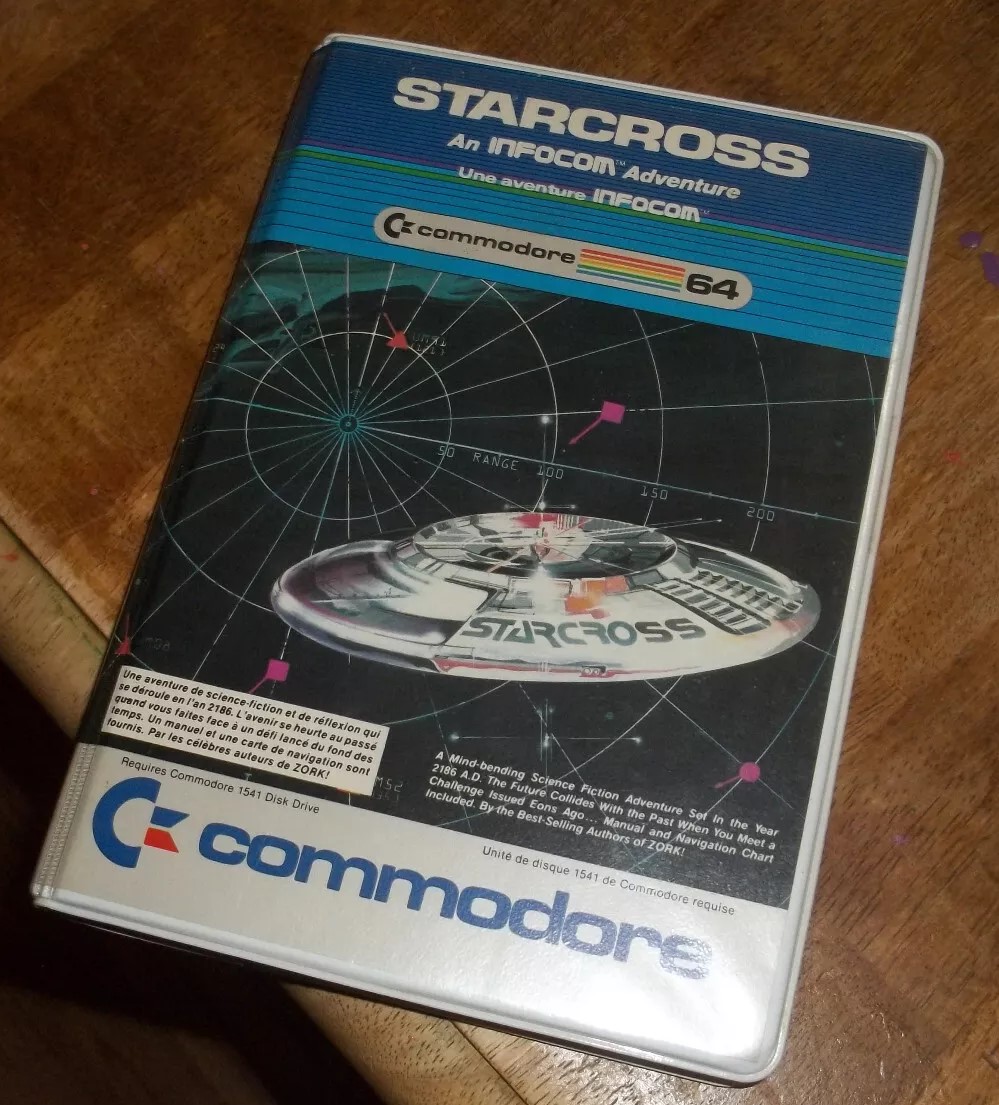


 Renga in Blue

