Author Archive
Last I visited Haunted House I thought I was done playing. Fate decided otherwise.
Before I go on, I want to preface: this game was written with *very* tight requirements. The TRS-80 was originally released with only 4K of memory space, and while the base model was swiftly upgraded to 16K it appears Radio Shack wanted Haunted House be playable on any of their systems, including the lowest end models.
Hence, the entirety of this game fits on two 4K cassette tapes, and not for a total of 8K; each cassette is a self-contained part of the game. For reference, Adventureland (which is legendary for extremely tight space requirements) uses the entire luxurious 16K of the newer model (that is, four times the size).
So in a way Haunted House is an impossibility, a marvel. It is still a deeply bad game.
We left off on holding a bucket of water, with no apparent way to apply it to a fire.

You can “pour bucket” but it just pours water on the ground and refills. Would you suspect a bucket of endless water is a useless red herring? (Well, maybe Joseph Nuccio would.)

I want to stop for a moment and emphasize you can walk through the fire without carrying the bucket of water. The bucket of water is entirely unnecessary and its entire existence seems to be very specifically engineered to force players into an intentionally impossible game of guess the verb. Perhaps this doesn’t sound so frustrating with me just describing it, but I assure you in terms of actual gameplay this is possibly the worst maneuver I’ve ever seen. There is an analogous part in Crowther and Woods Adventure but that at least has the saving grace of no item that seems like a completely logical solution.
In any case, the part with climbing the rope which takes you to the second floor swaps you to “Tape 2.” (The version I was playing has the tapes merged so a tape swap is unnecessary.) The code on Tape 2 is entirely self-contained to the extent that some verbs that work on the first floor don’t work on the second floor, and vice versa.
To continue, I took the magic sword and went wandering:

Given your original inventory is all gone, and the verb set is even more limited than the first floor, the only option is to kill them all (“YOUR MAGIC SWORD ENABLES YOU TO KILL THE GHOST!”).
After slaying the ghosts, there’s another ghost, a … superghost of sorts?
KILL GHOST
THE GHOST IS IMMUNE TO YOUR ATTACK!
It won’t let you just pass by either. With only TAKE, DROP, direction commands, and KILL at your disposal, what to do?
Well, obviously, go off to another room and drop off the sword. (In another context, this might have been kind of neat, but here it is just random.)
This is followed by a “maze” of sorts with a bunch of identical ghost rooms, exploiting the fact that going in a direction just repeats the room description, beating out stiff competition for the award for Least Verisimilitude in Any Maze Ever.

Eventually, going south gets to a room with a sign.

Let’s just summarize:
- There are three exits: east, west, and south. Two of them will kill you. There is no hint as to which one.
- If you ignore the sign, by, say, wandering around the maze too fast, you will die because you have to read the sign in order to live (even if you went through the correct exit)
- If you carry the sign with you after reading it you will also die (even if you went through the correct exit).
- Dying for any of the reasons above requires a reset of the second floor. I am dearly hoping it didn’t require reloading the cassette.
Somehow I don’t feel bad about spoiling the end.

Of course, a game like this deserves a seriously impressive Amiga remake (thanks, Sean Murphy!)
Feel free to share any personal stories you have about this game in the comments. The back cover claims it is fun for the entire family. When is the last time you’ve played something that’s done that?

This game was was published by Radio Shack — the same ones who made the TRS-80 — and for obvious reasons was only available on that platform. The manual and tapes (it was originally published on two) give a copyright date of 1979, so I’m sticking with that.
It gives no author but mentions “Device Oriented Games” as the developer, who goes on to make them Bedlam (1982) and Pyramid 2000 (1982). Bedlam names the author as Robert Arnstein, who I am fairly certain was the author of every game from that company. Robert Arnstein is also credited as the author of Raäka-Tū (1981) and Xenos (1982) so we’ve got a genuine text adventure auteur on our hands. (Trivia: earlier he wrote 8080 Chess, the very first microcomputer program to participate in the ACM North American Computer Chess Championship.)

Clearly the most dramatic text adventure opening of all time.
Old Man Murray once ran a feature called “Time to Crate” which evaluated games based on how long it took for the game to have a crate. (They were everywhere at the end of the 1990s. Often it took 5 seconds or less to find a crate.) Text adventures of this era could be evaluated on the “time to reference of Crowther/Woods Adventure” system, which in this case is two moves.

Saying “plugh” tosses you inside the haunted house, with an objective to escape. There are no room descriptions, just room names (“YOU ARE AT THE DEN.”) and so far the only danger has been in ignoring a floating knife:

(Just taking the knife prevents the death.)
If you go in a direction that is invalid, the game will just print the room description again. I first thought there were mazelike loops everywhere but given this property happens in every single room it just must be a quirk of the game.
Even for the era the verb set I’ve been able to find is really sparse: directions (NSEW only), OPEN, CLOSE, DROP, GET, READ, POUR, CLIMB (which just gives a response of “NO.”) Trying to use an invalid verb on an object gives the response “WHAT SHOULD I DO WITH IT?” which is frustrating in that it almost barely pretends to understand, and the way I found to test if a verb works is to type it without an object upon which the game says “WHAT?” as opposed to “I DON’T UNDERSTAND.”

For a long time I was stuck by a locked door. It turned out to be an absolutely horrible trick. I’ll explain in a second, but take a moment to study the right side of the map and think about it first.
…
Recall the “loop” property where room descriptions just repeat if you can’t move. There’s a servant’s quarters with a cabinet next to another one with a cabinet. There is no way to distinguish the difference between looping and realizing you’ve entered a new room without having dropped something in the first room.

Things did not improve after I found the key. I came across a raging fire. I happened to be holding a bucket of water (one that magically refills if I pour it, even) but I am completely unable to apply it to the fire.
It’s been a while since I’ve skipped finishing a game for this project without completing it, but I just might have to invoke that option.
This is the first “full length” game for Eamon past the Beginner’s Cave, and is written by Donald Brown himself.

“Girlfriend” as a choice was automatic. If your character is female it assumes “boyfriend”.
In order to play I had to take a character through the Cave first to gather enough experience in combat, then port that same character into the Lair. I can’t emphasize enough how pleasing this sort of continuity feels; I’m fairly sure this is part of the reason Eamon took off.
There’s sort of a plot?

This doesn’t play nearly as fun as Beginner’s Cave. That game was tight enough that it felt like a genuine dungeon crawl and all the features had a chance to shine. This game has the same problem as Greg Hassett where more space for rooms leads to more rooms that do nothing.

(Click on the map for a larger version.)
Mind you, the RPG system is still relatively strong, and I had emergent sequences like this one:
- I ran across a “black knight” whose heavy armor was very hard to penetrate in battle; fortunately, the knight fumbled and dropped their sword which I was able to grab. It then proceeded to run away. This led to a weird inversion where I was chasing a black knight trying to hit it (for the weapon experience, of course) like I was the relentless stalker of some horror movie. Eventually I got tired of trying to knock the knight’s hit points down to zero and let it live.
- In the process of knight-stalking I came across a “wandering minstrel eye” who was friendly and started following me around. Not helping in combat, mind you, just following, like a small puppy.
- I met an (evil?) priest in a room full of ancient books which I bested in an extended combat. Unfortunately, in the midst of battle the priest decided the wandering eye was a valid target and slew it in a single blow.
- I found the girlfriend in need of rescue tied to an altar with another evil priest. Unfortunately I was low on health and died before I could free her.
Related to health, I had enough money to come in with a spell this time (HEAL) which predictably healed some damage from prior combats, but as far as I could tell only worked once during the game. It’s almost more like I bought a consumable potion rather than a spell. Maybe it regenerates after enough turns or some such but I wasn’t able to figure out a way to use the spell again.
After the debacle above I made a second character which I first ran through the Beginner’s Cave again trying to get better statistics. That character fumbled and killed himself with his own sword before he could even make it out of that game. Whoops.
I repeated the sequence with a third character and much more successful character before bringing to the Lair. This time I was a bit more selective in my combats and managed to free the girlfriend, who then was able to contribute to combat. I then made my way through the maze (see map above; the “loops” connecting bottom to top were non-obvious) and defeated the minotaur mainly by hanging alive long enough for him to drop his weapon.
The strongest aspect of the game past the regular Eamon system is the amount of optional activity. Since no treasures are “required” and simply result in more gold at the end of the adventure, monsters and puzzles can be ignored to an extent there’s a “branching plot” feel.
For example: There’s a stone with the word “CIGAM” on in and if you SAY the right word (I’ll let you guess which) an emerald will pop out. There’s a portion that appears to be recently dug and if you bring a shovel you will find some gold coins. There’s a room with 5000 silver coins which are tractable to carry if you find a magic bag in another part of the map.
There’s also two “neutral” monsters: a blacksmith with a golden anvil (who is neutral upon you entering his room, but you can kill and rob because D&D) and a gypsy with a wicked looking sword. The charisma stat also comes into play here. I suspect it’s possible to make friends with the black knight with a lucky enough reaction, for instance.

There’s even one “backup item” branch. At the beginning there’s a coffin with a skeleton; if you kill the skeleton you get a “skeleton key” you need to unlock a gate later. If you skip fighting the skeleton (not unusual to occur, there’s a river after which is a one-way trip), the previously-mentioned priest with the ancient books has a skeleton key you can use instead.
While this game and the next couple Eamons are early enough in history I wouldn’t want to miss them, I do suspect enough of them tip far enough into the “RPG” category I may start skipping them in my All the Adventures list. As is, though, Eamon won’t be coming back until I’m out of 1979.
Retro enthusiasts who follow this blog may be wondering why the only home computer featured so far is the TRS-80. I apologize; I did try with Lords of Karma to use a Commodore PET or Apple II version but neither was cooperating. Now, finally, we have our first game designed specifically for Apple II.

I prefer the title screen in monochrome to the color version.
Donald Brown’s achievement with Eamon really is remarkable. He created essentially an “RPG campaign system” which lets you make a character that can then play in multiple adventures. I’ve occasionally heard talk in the interactive fiction community of a “shared universe of objects” that allows porting things between games, but it never really materialized; here it was done in 1979. (Definitely 1979 even though it’s been reported differently elsewhere; Jimmy Maher has a blog post about the issue.)

Failing at character creation can be deadly.
The game starts with you specifying a name (which corresponds to a saved character), choosing male or female, and then being handed a randomly-chosen set of statistics.

Character creation can be deadly even when you do follow directions.
This is followed by a long set of instructions, which I’ll summarize: There are five weapons classes (clubs/mace, spear, axe, sword, bow) which I’ve just listed in order from easiest to use to hardest, although I gather swords cause more damage than maces and so forth. Armor (leather, chain, plate) makes it harder to be hit but also makes it harder to hit others, and shields are usable when not wielding a two-handed weapon.
You can carry weight up to 10 times your hardiness; your hardiness also serves as your “hit points” although the amount of damage felt is conveyed in text (“YOU DON’T FEEL VERY WELL”) as opposed to numbers. Agility affects your ability to hit monsters. Charisma affects the prices in shops and the friendliness of monsters (more on the latter point later).
There are some magic spells, although as far as I can tell stats don’t affect their use (other than them having effects *to* stats).

I mentioned a “shared universe of objects”; as noted in the screenshot above, it isn’t complete (one author can’t create a magical object which then affects other games) the persistence of money, weapons, and armor is non-trivial and makes the general experience of Eamon feel more like a modular set of stories rather than many distinct ones. (I should add many later Eamon games do end up customizing enough to be stand-alone; there was even an Eamon game in IFComp 2010.)
In any case, after choosing to embark an adventure the player is prompted to swap disks; without swapping disks, they are sent to the “Beginner’s Cave”. The game is emphatic about the “beginner” moniker — if your character is too experienced they won’t be allowed in.

The map is fairly straightforward but does have the feel of a room-by-room Dungeons & Dragons crawl.
The “charisma” statistic plays a big part in what happens. There is a “hermit” and a warrior named Heinrich, both which can be peaceful and follow you around. (There’s random chance going on here, so even with a higher charisma stat it is possible one or the other may not be friendly.) They will then fight with you in combats with monsters, which helps enormously with the chance of survival.

There’s a chest which is really a mimic, a bunch of rats, and a pirate with a sword with a magical flame (that will activate for you with the word TROLLSFIRE). The combat system does make the world does seem a bit dynamic; enemies can run away from you multiple times, causing monsters in one room to end up in another. One time I chased the rats into the room with the hermit. I hadn’t befriended the hermit yet but fortunately he turned out to be on my side and started killing the rats.
“Critical hits” and “critical misses” are in; you can fumble and drop a weapon in the middle of a fight, or kill an enemy instantly with a single blow. (The downside is the same can happen to you; once the pirate killed me in a single blow when I had full health.)
There are magic items, but fortune and death are dealt in equal numbers: There’s a bottle, which when drunk, will heal wounds. There’s a book, which when read, will automatically kill you.
The ostensible “goal” is to gather as much gold and items as possible and then leave once satisfied. However, there’s a secret door (which is revealed by hanging out in a room and LOOKing, just like Lords of Karma) which leads to a priest and a stereotype.

Once the battle against the priest is won, Cynthia will follow you around; rather notably for a videogame escort mission, if getting into combat she will run away to safety rather than get herself killed.
Since the game is essentially goalless, you can leave whenever you like:


Even though Eamon games seems to classify more as “RPG” than “Adventure”, it feels like their popularity at the time is not proportional to historical memory. There are at least 255 Eamon games. Donald Brown clearly provoked some sort of affection for his creation which lasted a long time.

This cover is from a dodgy plagiarized version with the author name stripped out. You can read more details at The Eamon Adventurer’s Guild.
Yes, this one is back! It turns out I missed something.
Just as a reminder, the only new place added to the Blackett / Supnik 1977 version of Adventure was a gazebo, which contained a palantir (orb). I mentioned various messages received if you PEER IN the orb:
0205 a grate at the entrance to a large cave……
0206 a small stream feeding into a large cave…..
0207 a grate above you and a crawl west…..
0208 a hall,but the vision is clouded by thick mists…..
0209 yourself…the lights come up and an usher asks you to leave….
… and I assumed that was it. There was a magic word (“PKIHMN”, which sounds like a cross between Pikmin and Pokemon to me) that teleported me to outside the grate but I assumed that was merely to allow escape.
However, S. Healey (who made the Gobberwarts port) pointed out an interesting extra detail; that PKIHMN is linked to the orb, and it can be used as long as the orb is around:
…the palantir teleports you to different places depending on what you’re carrying (you get teleported to the same place as described when you PEER ORB).
The items/places are:
Keys: Outside grate
Axe: Hall of Mists
Lamp: Below Grate
(default): West Chamber of Hall of Mountain King
If you’re carrying more than one of the items, you teleport to the location related to the item top-most in the above list.
There seems to be a teleport location that was never implemented:
xx[ii++] =”0206 a small stream feeding into a large cave…..
This has the extra effect of killing a player who attempts to use the orb without getting the items from the building first, because the “default” teleport is a dark area where the player is bound to fall down a pit.
In my post about early versions of Adventure I mentioned a 1977 port which seemed to be the first past Crowther and Woods which tried to do more than just port the code. Unfortunately, it’s a little hard to know who to credit, exactly. This is from the source code:
c For x86_64, pgf77/ifort/gfortran, S. O. Lidie, 2015.04.01
Tested On Mac OS X Yosemite and CentOS 6.x.
Update for NOS/VE 1.4.x, 89/11/03. SOL, LUCC.
Convert to NOS/VE: use direct access reads instead of word addressable
NOS CRM files. S. O. Lidie, 87/05/01, LUCC. NOS/VE 1.2.2 L678
Program last updated from SCOPE 3.4 to NOS 1.3 by
Bill Hein and Shelley Hobson (ACCA).
Modified by Kent Blackett
Engineering Systems Group
Digital Equipment Corp.
15-JUL-77
Modified by Bob Supnik
Disk Engineering
21-OCT-77
Original version was for DECsystem-10
Next version was for FORTRAN IV-Plus under
the IAS operating system on the PDP-11/70
This version is for FORTRAN IV (V01C or later)
under RT-11 on *any* PDP-11.*
These credits don’t even mention the version I played was a recent port at Gobberwarts; so recent that the author bug-fixed something in it for me today (thanks!).
In any case, this text and another one like it in the game suggest to me that most of the long list of authors were merely porting between systems but Blackett and/or Supnik succumbed to the irresistible urge to add their own touch to the game.
Unlike Adventure II, there was just a small addition. Specifically, there are three new rooms near the starting building (Forest, Dell and Gazebo) and one new item: a palantir (orb).

Map via Steve Lidie. The new rooms are shown.
>s
At your feet all the water of the stream splashes into a 2-inch slit
in the rock. Downstream the streambed is bare rock.
>e
You are in open forest, with a deep valley to one side.
An overgrown path, barely discernible, leads south.
>s
You are in a dell, deep in the woods. Before you is a steep
incline leading up to an old deserted gazebo. As you peer through
the overhanging moss and cobwebs you see a dark form.
A path, heavily overgrown, leads south.
>u
You are in the gazebo. The dust is deep here, indicating
long disuse. Ancient elvish runes here describe this as a
place where one may see many things. Another, more ancient
inscription reads “PKIHMN”.
There is a palantir(orb) here.
If you check the map carefully, you notice there’s no exit out; the magic word is used in the gazebo to teleport to outside the locked grate at the start of the game.
The orb is a treasure and the source of the extra 16 points, but at least in concept the author(s) tried to add an interesting design element: peering into the orb to get hints.
>peer in orb
The lights dim…it now seems to be totally dark — in the orb
many visions pass by… many things are seen…..
now you are looking at …….
a grate at the entrance of a large cave……
Unfortunately, there doesn’t seem to be much actual hints; here all the messages possible for the last line of the palantir’s vision in the source code:
0205 a grate at the entrance to a large cave……
0206 a small stream feeding into a large cave…..
0207 a grate above you and a crawl west…..
0208 a hall,but the vision is clouded by thick mists…..
0209 yourself…the lights come up and an usher asks you to leave….
It’s possible there was intended to be more, or it’s possible this was simply meant as atmosphere.
In any case, there is a long history of modifications to Adventure and it’s interesting to see what (maybe was?) the very first one.
For further watching: GET LAMP interview with Bob Supnik.
Before I get to the winning path, I want to talk about a few other gameplay elements.
First a map, alas incomplete (click to enlarge):

There are forests arranged in mazes and tunnels underneath that are dark. Navigating the tunnels took using my torch, which I found ran out far too quickly; it was hard to explore more than a fraction of the tunnels before it went out. That element plus the secret doors (which I’ll talk about it a moment) plus the general randomness made it too hard to be fully comprehensive about mapping.
A lot of the enemies (vampire bat, goblin, and an evil magician) were lurking down in the tunnels. They apparently have no problem in the dark:

(If I had killed the magician, I might have finished a quest; there’s a “man in grey robes” wandering aboveground that warns “RETURN TO ME THE STAFF OF THE EVIL SHIMMERING MAGICIAN, BUT DO NOT USE IT YOURSELF!”)
What makes the light source issue doubly frustrating is there are secret doors hidden in a very odd way.

In other words, hang around and looking over and over and eventually a secret door may just materialize. I presume the intended mimesis is that by using LOOK you are searching the room, like an old-school D&D adventurer.
On to winning–
If you read my last posts carefully, you might have noted I ran across a king who wanted me to rescue the princess, and I shortly thereafter was killed by a knave near a “young woman in soiled but expensive clothes”.
It’s apparently possible to luck out, because I randomly came across the same knave / woman pair while playing a new game and attacked them even though I didn’t have weapons. I killed the knave with a single karate chop.
At this point the princess was willing to follow me, so I headed back to the king (who I hadn’t even visited yet that game!) and this happened:
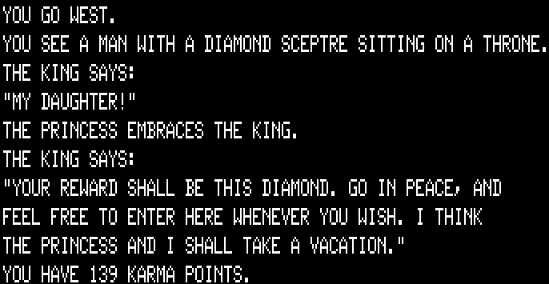
After that bounty of karma points, I took the diamond to the church and gave it for even more karma points (quite a few!) and decided it was time to go inside the church and pray:
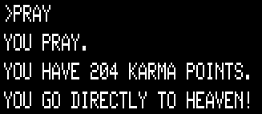
The problem with having a game with so many generative elements and a flexible goal it is quite possible to squeeze through via luck. I reset the game and tried to kill the knave quite a few times without weapons and had no success.
The amount karma awarded is random; I tried going through the princess-rescuing sequence again (with a weapon this time) and even after donating the diamond and several more items to the church, I was only at 176 karma points. Praying at 176 karma did nothing.
Apparently even the maximum required score is random:
The purpose of the game is to accumulate “karma points”, which are necessary for the character to go directly to Heaven. The player is never informed how many karma points are needed, and the chosen number of points is another example of the game’s randomness as it changes from game to game; some games end nearly instantly due to a very low karma point goal being randomly chosen, while others can last for hours.
Other than not defeating the evil magician I never got by one other obstacle: a giant in the forest. I’m not sure if it’s meant as an obstacle to something greater or if it’s just another notch for your karma score.
I also found a very neat item I never was able to use: a bomb with a fuse. I’m curious what would happen if I tried it on the idol of Baal, but I never had a situation where I both was holding the bomb and found the idol.
Normally my sense of completion might be enough to find out for myself what I’m missing but the fact goals don’t even give a consistent score rather takes my motivation away. If anyone else is dying of curiosity, though, I first recommend you grab an emulator as opposed to playing online, because there’s a several-minute startup time for the random generation; you can set the emulator so it accelerates the process and takes only a couple seconds. Download for the game itself is here (there are two versions, they both seem to work fine).
While my description of gameplay may seem underwhelming, Lords of Karma does feel chock full of texture. There’s randomly placed items, characters that can follow you, monsters that can chase you, and a weird religion system which feels suitably mystical. It’s certainly a promising first effort, especially for an author who programmed his own adventure-creation system from scratch in 1978 technology.
Lords of Karma (so far) features a very simple parser and gameplay which consists almost solely of wandering and slaying the occasional monster. This would be a recipe for a grind except the religion system is keeping things very interesting.
I have managed to gain some karma points. The simplest way was by defeating a monster, which I guess is improving the good of the world somehow.

I also found a “man in rags” who I could give treasures to.
>GIVE FARTHING
YOU GIVE A BRASS FARTHING.
THE BEGGAR SAYS:
“THANK YOU.”
YOU HAVE 1 KARMA POINTS.
although I found a bigger bang for my dollar (so to speak) by giving at a church
YOU ARE AT THE ENTRY TO THE CHAPEL OF PRAYER.
>GIVE TOPAZ
YOU GIVE A TOPAZ.
YOUR TAX-DEDUCTABLE CONTRIBUTION IS APPRECIATED.
YOU HAVE 20 KARMA POINTS.
YOU ARE AT THE ENTRY TO THE CHAPEL OF PRAYER.
After entering the church and praying, I had some sort of religious experience:

Exploring the new area yielded a nearby “idol” to Baal. I had a ring I tried to give as an offering, but bad things happened:
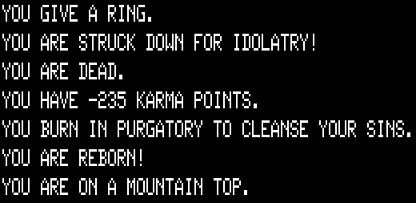
While the church did not specify any kind of denomination, I’m guessing some sort of mutant Christianity? I’m not sure what to think yet what’s going on with religion, really — the name of the game is Lords of Karma, plural — other than I’ve been anxious to know what will happen next with the worldbuildling.
While Scott Adams had the good fortune of writing in a “meta-language” that made it easy to port to other system, his work originally was designed for the TRS-80. Of course, anything in BASIC was relatively portable, so people like Greg Hassett also embraced multiple platforms.
However, there’s another author working around the same time who was possibly the first to be ambitious from the start about portability on home computers: Gary Bedrosian.
So having what for the time was a fairly good system, I wanted to try to write an adventure game. The only trouble with that idea was that most people didn’t have what I had, so I knew if I wanted to reach a wide audience, I had to make it run on Apple, Atari, and TRS-80. The answer to my problem was a shareware program called Tiny Pascal. It was a very compact compiler (it had to be for a computer limited to less than 64 kilobytes of memory) designed for the 8080 or Z80 microprocessor. Best of all, we had the source code for Tiny Pascal in Tiny Pascal itself. So a friend and I modified Tiny Pascal so that we could cross-compile into 6502 microprocessor code for the Apple and Atari. The TRS-80 was a Z80 system so that wasn’t a problem.
Using Tiny Pascal, I wrote a very small adventure core that could handle text messages, parsing user input, and manipulating objects (matches, doors, swords, etc.) based on object tables. Remember, everything had to fit into memory, so we wrote another program that compressed text in a way that was fast to decompress on the fly, so we could store approximately 3 characters in every 2 bytes. In the final adventure game, everything including program, the text messages, and data describing the objects had to fit into less than 64 kilobytes of memory. [Source]
Using his system, he wrote Lords of Karma (1978), Empire of the Over-Mind (1979) and G.F.S Sorceress (1980). All were eventually published by Avalon Hill in 1980. Lords of Karma originally came on a single tape that worked for TRS-80, Commodore Pet, and Apple II (a tape published in 1981 also included Atari 400/800).
Some people think highly even now of Empire of the Over-Mind, so I am looking forward to seeing another early auteur in development.
But first, Lords of Karma. The game’s back cover is intentionally evasive about plot / worldbuilding / lack thereof:
However, this line in the manual is interesting:
The object of the game is to get to heaven with as many “karma points” as possible. You get these points performing deeds of kindness and bravery.
This gave me the impression the goal is not getting points by gathering all the possible treasures and hoarding them in a single room for no apparent reason, but rather to do as many good deeds as possible. After so many greedy sojourns I … think I could use a plot like that.
Before starting I also learned the map “partially randomises” [source] so we’ve got some generative roguelike-ness going on.
I actively tried to get Apple II and Commodore Pet versions to work since I’ve been doing a lot of TRS-80 lately, but unfortunately both of them had early crashes, so I had to stick with the old reliable.

You can see we’re not in for epic room descriptions. (I’m somewhat reminded of playing a old-style MUD, with a large landscape of curtly described rooms.) It turns out you are supposed to LOOK upon entering a new place.
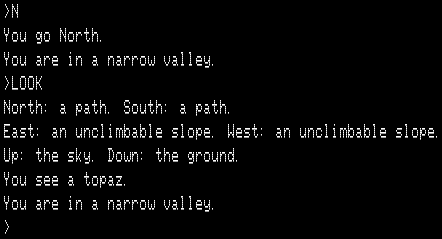
Is the topaz a “treasure”? Do we need it? Will we get something for it? I also enjoy how the game feels compelled to mention “up” is “the sky” and “down” is “the ground”.
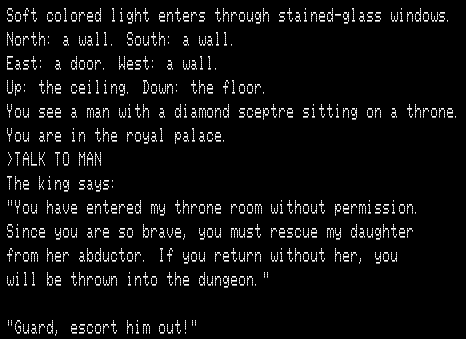
I guess just wandering into the throne room makes me qualified.
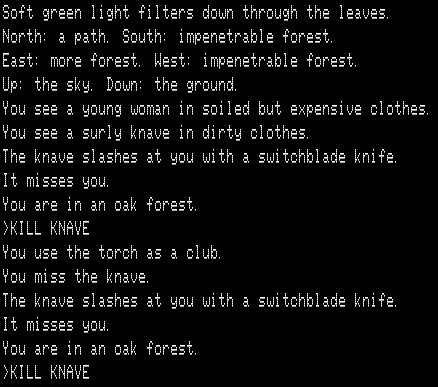
The MUD-like feel holds up: here we have some combat.
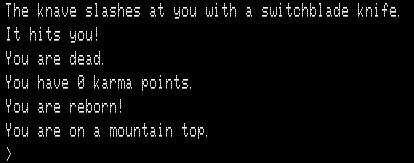
Picking up “treasure” did nothing for my karma, so it is possible the treasures are just means to an end (bribery, buying stuff) and not part of the overall goal at all.
At the very least this game feels very different from others I’ve played. Let’s see where it goes!
I have been trying to detangle the history of Adventure — the Crowther / Woods game — so I know which ports I should be playing in which order for the All the Adventures project. This turns out to have been very complicated as information is spread over a tangle of websites and not all of it is accurate. This is my best attempt to sort everything together.
This document will likely get edited as I tangle more things out. Looking at the full list of modifications gives a small glimpse into the insanity.
Adventure Family Tree, by Nathanael CJE Culver based on work by Russel Dalenberg

I link to sources whenever I can.
1975
In the 1975 academic year Will Crowther starts what we know as Adventure. [Source.]
All Crowther family testimony is consistent with the 1975-76 date range. Responding to a direct request via e-mail, Crowther (2001) dated his original “Adventure” to 1975, “give or take a year.”
— Dennis G. Jerz
1976
Will Crowther stops work on Adventure. The game is noticeably incomplete (there is a sign mentioning maintenance in a lower section of the cave where advancing further causes the game to crash). [Source.]
The most likely timeline places Crowther ceasing work on his original game in early 1976.
— Dennis G. Jerz
Original source code here
Windows compiled version here
1977
Starting March, Don Woods discovers the source code and starts working on it. He produces a 250 point version [source] on his way to finalizing a 350 point version several months later.
I’m relying solely on memory which tends to be fallible (see above: the dwarf ‘vanishes’, not ‘disappears’) but my best recollection is that ADVENT.EXE first appeared on the PDP-10s at ADP (the old First Data in Waltham, Mass.) in 1977. It was an incomplete version which only had about 250 points worth of treasure. I seem to recall that there was nothing past the troll bridge but an ‘under construction’ sign or some such. I believe our copy came from WPI, but word at the time was it was developed at Stanford. Two or three months later we got the full 350 point game.
— John Everett
This version is then ported, in a fairly literal way, by Jim Gillogly into C. [Link to source code.]
The original 350-point version is separately ported July 1977 by Kent Blackett. [Source]
ADVENT.FOR: C REV. 17 ADVENTURES MODIFIED BY KENT BLACKETT ENGINEERING SYSTEMS GROUP DIGITAL EQUIPMENT CORP. 15-JUL-77 ORIGINAL VERSION WAS FOR DECSYSTEM-10 THIS VERSION IS FOR FORTRAN IV-PLUS UNDER THE IAS OPERATING SYSTEM ON THE PDP-11/70″.
This is followed by Bob Supnik, circa October (date given in his own source code). It has 366 maximum points and the cumulative efforts of Blackett and Supnik (probably) represents the first modification of the game past the Woods version.
Stephen Lidle’s version of Bob Supnik’s code modified for modern compilers, based on a SCOPE version by “R. Emerson, W. Wirth, S. Hobson, W. Hein, S. Connard”, et al.
There’s also a version of Bob Supnik’s port on if-archive, although I have been unable to confirm if it is exactly the same as the 1977 code.
Source code of Bob Supnik version
Kevin Black’s compilation of Bob Supnik’s source for DOS
1978
Gordon Letwin made a 350 point version available by August 1978. It was the first version available on a personal computer — the Heath. [Source] It was not a literal port. [Source]
The version I played was written in FORTRAN. One of the treasures was an African gray parrot in a pirate aviary, accessible by a rubber raft. There was also an office of some kind with the words “how do you spell relief?” on the wall, and after you read the message, you could use “Rolaids” to teleport to and from the well house. I think the magazine at Witt’s End might have been a copy of Byte magazine.
–Carolyn VanEseltine
While this version has been lost, there is a downloadable Osborne port which may be derived from the same source although I have been unable to test it as of yet. The actual 1978 version seems to be a this archive.
Don Woods expands upon his own work, producing a 430-point version with 5 new difficult-to-find treasures.
David Long at University of Chicago starts on his own modification of Adventure (a process which goes on until at least 1980), although no versions from this year exist.
Peter Luckett and Jack Pike finish “Adventure II” by the end of 1978. [Source and executables]
1979
George Richmond (“with the support of Mike Preston”) makes a 500-point version of Adventure in Pascal. [Information source] [Source code]
David Platt writes yet a different modification of Adventure into a 550-point version. [DOS version]
Microsoft Adventure is released as a commercial game for TRS-80 computers, with both v1.0 and v1.1 dated as June 1979. Gordon Letwin, who wrote the Heath port from 1978, is the one responsible. [Info from the Game’s Manual] It includes some slight modifications which mirror the 1978 Heath version somewhat. [Downloads for v1.0 and v1.1]
This year has a “501 point” version of David Long’s code (“Version 5.2/2, October-79”) although it rather confusingly this might be a “side release” by an anonymous contributor. Even more confusingly the version might actually be intended as 500 points (?) and the vanilla compile goes to 496 points (??) although the version online is fixed to be at 501. [Source code] [501 point version compiled for online]
The David Long story gets very messy past this point into the 1980s and I’m not going into every variant from his code, but I should mention the last version from David Long himself was at 751 points. While this version was playable on Compuserve for a while, it now appears to be lost except for a remake by Carl Ruby into QBASIC.