Long back when I first wrote about Roberta and Ken Williams and their first game (9 years ago), I mostly deferred the history to other authors like Jimmy Maher. More sources have come up since then, including new interviews and three books:
The Sierra Adventure: The Story of Sierra On-Line (Shawn Mills)
The Apple II Age (Laine Nooney)
Not All Fairy Tales Have Happy Endings: The Rise and Fall of Sierra On-Line (Ken Williams and Josh Horowitz)
Hence, now seems like a good time to begin the story fresh–
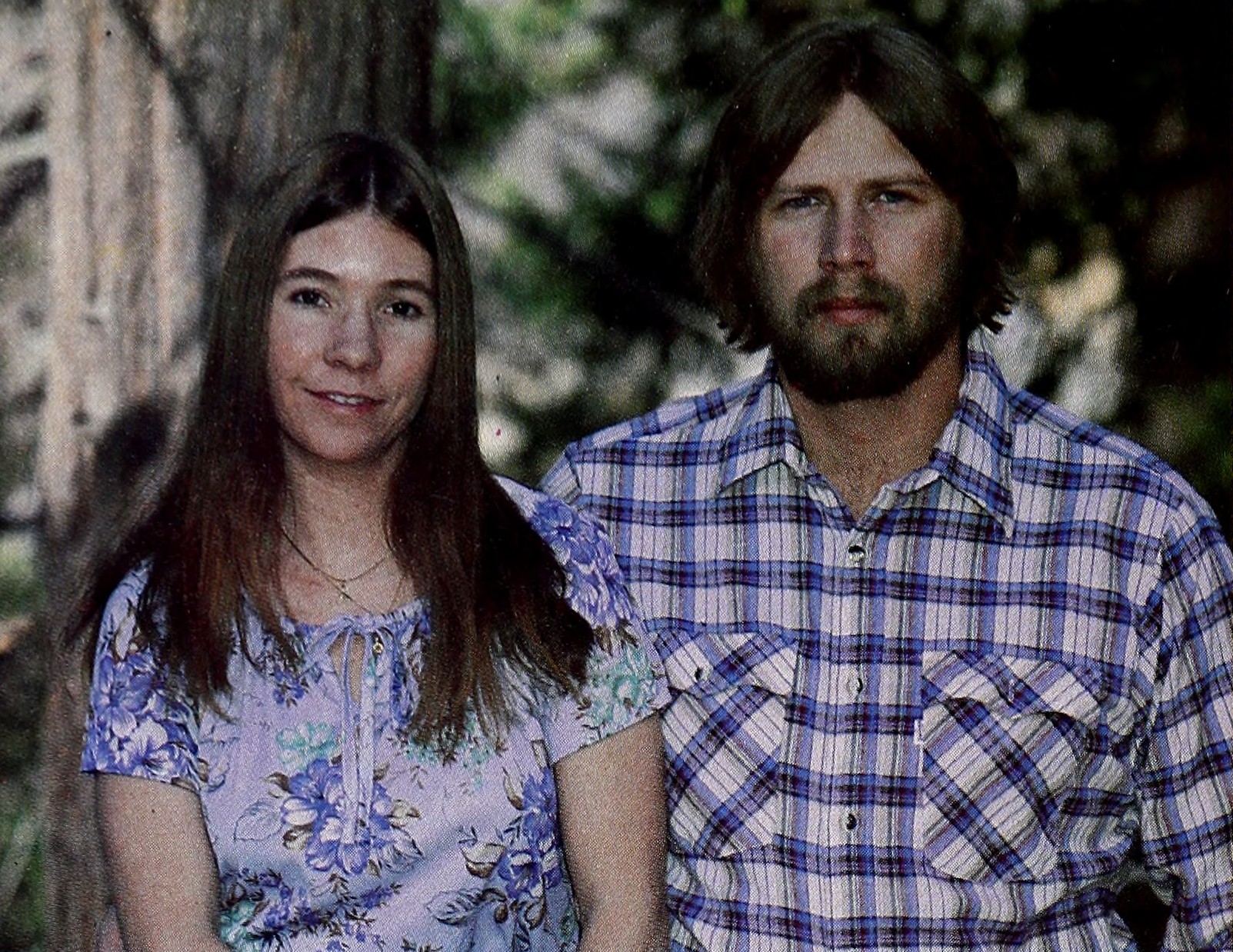
Picture from Softalk February 1981 of Ken and Roberta Williams.
Throughout the 1970s in southern California, Ken Williams was driven by the Quest for More Money; he started as a computer “operator” before graduating to be a “programmer”, and from there hopped from job to job.
I remember needing to fudge how long I had been at each job, and leave out companies I had worked at, in order to minimize the number of companies for which I worked.
He would sometimes claim knowledge of whatever system or programming language was being used (when he had none) then get up to speed quickly enough with a cram session that it didn’t matter. This backfired for one job, involving assembling language for an IBM mainframe where the programming manager realized he couldn’t do the job, but he quickly managed to jump over to another company with a higher salary and the assembly knowledge he picked up in that window of time.
Despite Roberta Williams raising a child, she also started working with computers (with the simple calculus that two incomes makes more money than one); as she notes, while helping Ken during programming she picked up enough skills she didn’t need any training. In 1978 (while the pair was in Illinois) she took an operator job with the government; her boss originally wanted her to make coffee (she declined) and later type a letter (ditto); she had to firmly establish her job was computer operator, not secretary.
Their stint in Illinois was short lived, and they drifted back to California in 1979, where Ken and Roberta both picked up programming jobs (Ken at Informatics, and Roberta with the county as a COBOL programmer). Despite their attachment to California as a state, by now they were dreaming of a place away from Los Angeles.
There were plenty of reasons; but mostly it boiled down to our saying, “Wouldn’t it be nice to live in the woods?” Our second son, Chris, was born in May of 1979 and our eldest, DJ, would soon be six years old. Did we want him growing up in Los Angeles schools, where we worried about drugs and violence? Plus, the drive time was killing me. I was spending multiple hours a day sitting in Los Angeles traffic.
To really make the kind of money Ken needed (and the flexibility of location) he needed to found his own business. He had meetings with a colleague from Informatics (Bob Leff) where he tossed around ideas of what could be done with these new “personal computers” emerging from the market. In particular, he noticed how a company called Microsoft had done well for themselves selling a version of BASIC, and wondered about selling other (more capable) programming languages for home machines.
Roberta got Ken an Apple II computer for Christmas 1979, and in January he (along with Leff and others) started work on a Fortran compiler, with the notion of commercializing it. Around the same time, while Ken was using a home teletype (to connect to remote mainframes), he discovered a program, ADVENT (Crowther/Woods Adventure).
You are standing at the end of a road before a small brick building. Around you is a forest. A small stream flows out of the building and down a gully.
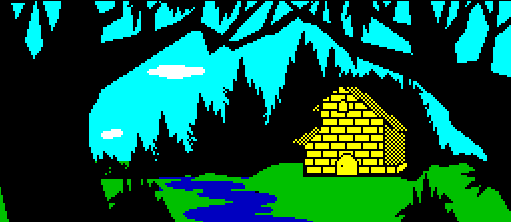
From the 1989 La Aventura Original version.
After some struggle getting it to work, he came across GO BUILDING.
You are inside a building, a well house for a large spring.
There are some keys on the ground here.
There is a shiny brass lamp nearby.
There is food here.
There is a bottle of water here.
He showed it off to Roberta.
This was getting very interesting. Roberta was nearby in the kitchen, so I called her over to the computer. She read over my shoulder and then pushed me aside. She wanted to try. I was not happy! I had just gotten rolling and she took away my toy.
According to Ken, she started “ignoring the world around her”; quoting Roberta:
I began playing it, became obsessed with it, had to play it, had to solve it, did and then decided that I could design my own game after playing it.
Roberta wanted to keep going, using the Apple II; she got a hold of some Scott Adams games as well as the otherwise-obscure Journey by Steve Baker; the latter has the feature of “hang yourself by your own rope” style comedy deaths which strongly resemble the ones that would become a signature of Sierra games.
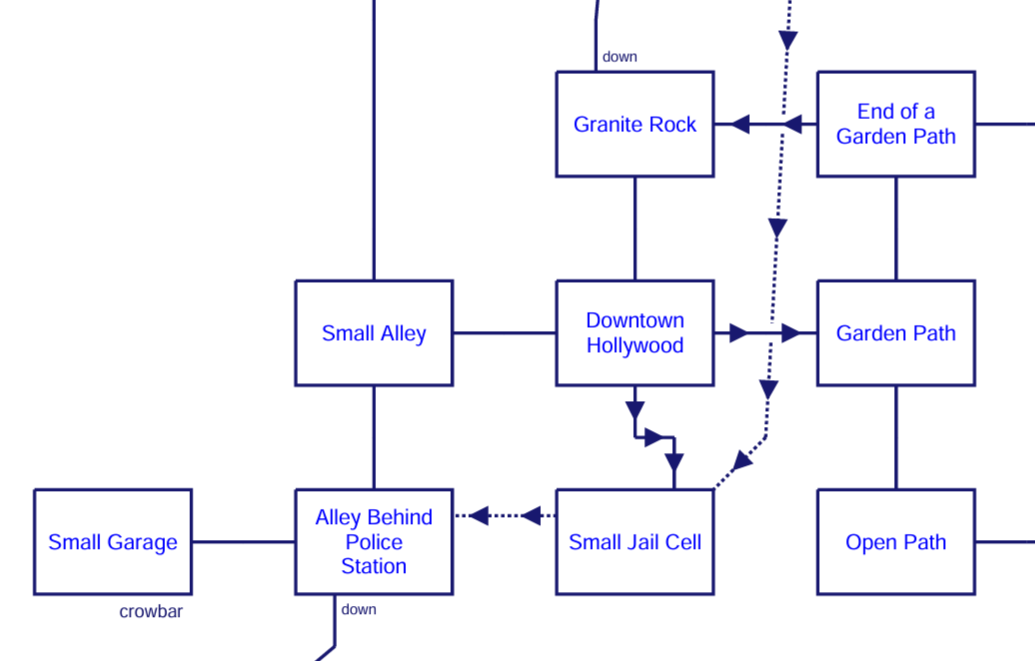
Part of the map of Journey. At the alley behind a police station you need to open a manhole to get into some sewers, but it’s possible to loop back around and land in the police station itself. Escaping through a window, you die by falling in a manhole that some fool adventurer had accidentally left open.
She worked out a game of her own on the kitchen table and set-up a date to reveal her creation; according to Ken:
She tried to show me what she was working on a few times but I was busy and never really focused on it. I was keeping busy working on my compiler in addition to working both a full-time and several part-time jobs.
And then, one Saturday night, our lives took a dramatic turn when Roberta said she wanted to take me to dinner and had a surprise for me. I had no idea what the surprise could be. We made reservations at a fancy steakhouse (The Plank House) and arranged a babysitter.
Whatever it was she wanted, it seemed to be important to Roberta.
At dinner, Roberta laid out her idea for an Adventure Game of her own. Roberta was envisioning a game, to be called Mystery House, which would be loosely derived from a combination of Agatha Christie’s novel, “And Then There Were None” and the board game “Clue.” In Mystery House there would be eight people, locked in a house, and murdered one by one. As Roberta was describing the killings, I was trying to hide under the table. Roberta was using words that are not typical during a romantic dinner, like: “kill,” “murder,” “gun,” “knife,” “blood,” and “strangle.” The couple at the table next to us was overhearing pieces of the conversation and could see Roberta across the table animatedly and loudly saying things like, “Wouldn’t it be great if I could give him an icepick in the eye?”
Continuing the conversation at home, Ken wondered if graphics would be possible. This was non-trivial; while Atlantean Odyssey had full graphics the year before, these were “character graphics” on a TRS-80 (and the game was the kind sold in baggies in a single store so nobody had heard of it yet besides). Roberta thought it would be “fun to try” and Ken decided to take a break from his compiler project for “a few days” to see what he could make.
Roberta started drawing pictures; in the meantime Ken tried to devise a way to store graphics on a single disk. Visiting a computer store, he came across the Versawriter.
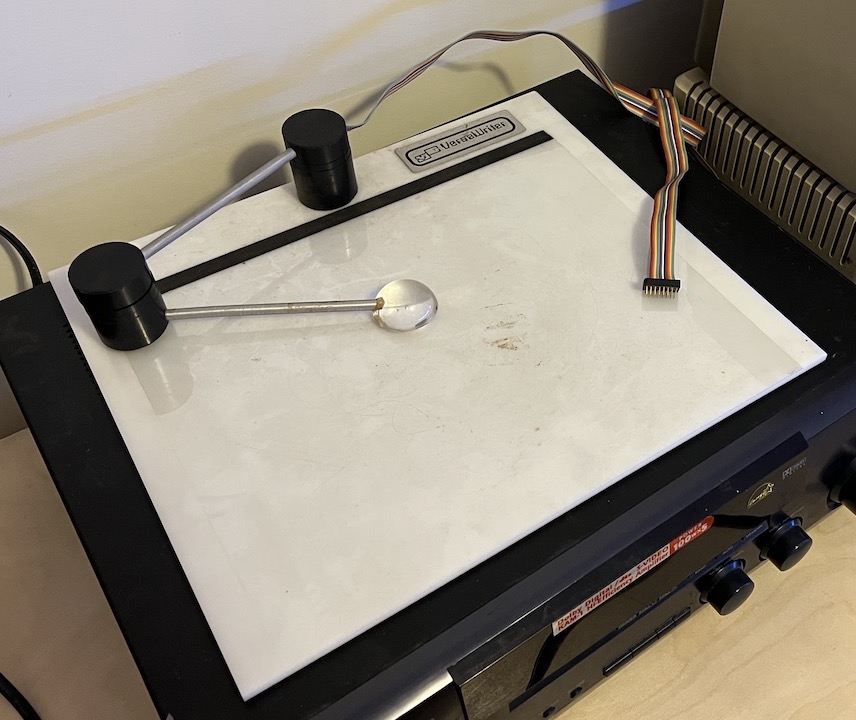
I have a timestamp cued up to a demonstration of the device on video (including unboxing from the original packaging)!
(As pointed out in the video, Apple had their own more-capable art tablet including a pen, but the Versawriter was half the price, and Ken was still unsure how much video games were going to sell.)
The Versawriter, by default, stored “medium” and “high-res” pictures in a pixel-based format; as the manual states, a standard diskette will store 10 high-res pictures. This is on a disk with only pictures, no program! The format was too large for the purposes of an adventure game, so Ken Williams designed a setup to store images in “vector” format instead, specifying points and lines that would essentially re-create the process of drawing a picture every time it showed up on screen.
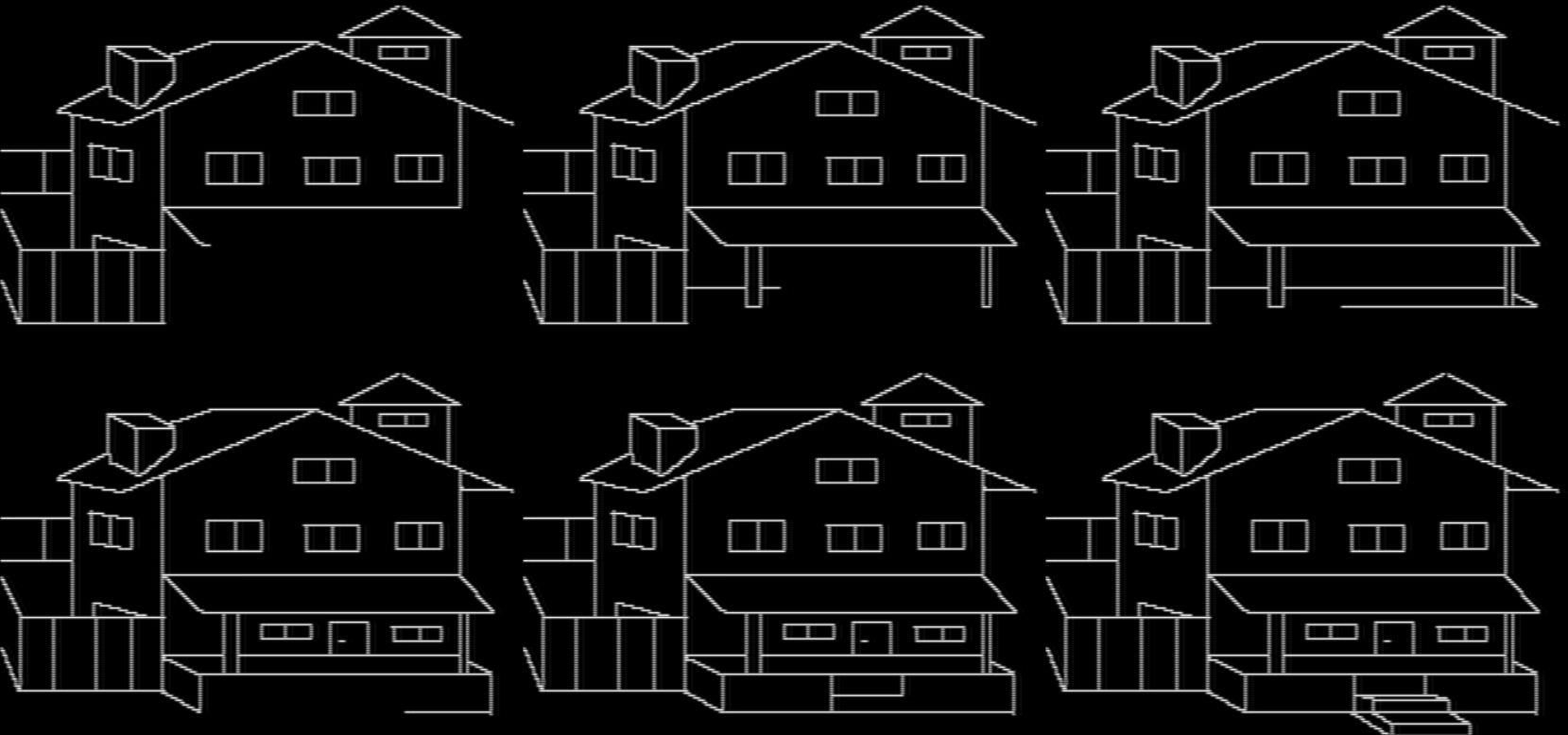
Ken wanted the process to allow “multi-tasking”, that is, he wanted the game code to be a separate entity from the program code so that Roberta could work on the game separate from Ken’s work on the program. The program was initially written on paper and typed in as a combination of a light “database” format (VERB 1, for instance, was GO/ENTER/RUN/EXIT/LEAVE/WALK) and a message file which was simply a list of text strings. This point is important and will come up later.
Ken still thought the Fortran compiler would be the way to fortune. While visiting Rainbow Computing in Northridge and hyping his product, he also showed a demo of Mystery House in progress.
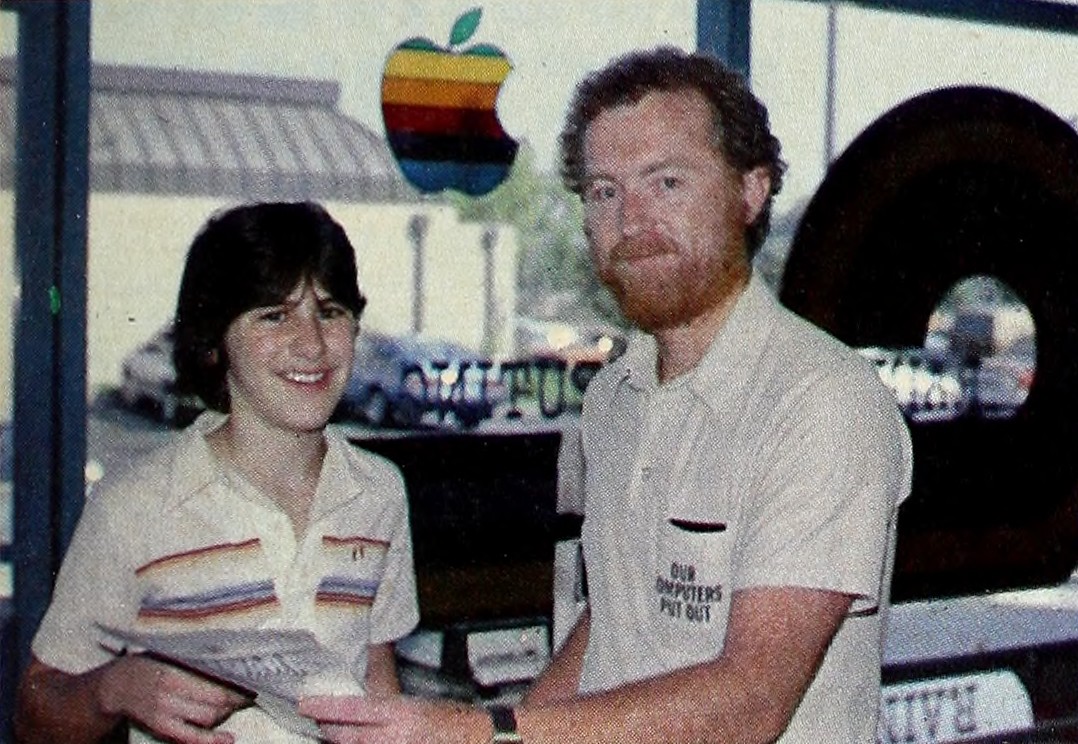
Gene Sprouse in 1980. He was one of the owners of Rainbow Computing and was present at the Mystery House demo. He’s shown here giving a prize here to young Harvey Shapiro who won a Softalk contest (source).
It was a showstopper. Everyone in the store gathered around the computer and watched. They all wanted to type. I didn’t want them anywhere near the computer because I knew how fragile the game was. Type the wrong thing and the game would crash. Unfortunately, I couldn’t hold people back. Everyone wanted to try typing into the game.
Prior to this, he considered the project a “distraction”, but he realized now he had something much bigger. He tried shopping the product around for distribution; Programma (publishers of the original version of Goblins) offered a 25% royalty with an estimate of $9000 over six months, which was more than double the amount the Fortran compiler was projected to earn. He also tried selling the game direct to Apple, but after sending a copy he got no reply after a month (they did eventually respond with interest, but only a year later).
Ken and Roberta decided to first sell the game on their own, and go to Programma if it didn’t work.
This involved both shoe leather hustle, getting the product (baggie, one sheet, disk) hanging in stores, and print advertising. John Williams (Ken’s younger brother) was at school in Illinois and was asked to show the game around (while having essentially no computer background at all). Quoting him writing in 1990:
The product was, as those familiar with the story know, Mystery House. I examined the package as soon as I got it, and it claimed that what I would find inside was a computer game.
To be honest, this surprised me. Ken didn’t have a fun bone in his body back then (he was a chronic workaholic). I’d have expected it to be a database or a compiler (whatever those were). Anyway, I took it to the Computerland in Downers Grove, Illinois the next day.
Continuing the story from a different retelling:
I arrived on a Saturday to find the store full of people, and the retailer was a bit irked because this was a big sales day for his little store, but [he] decided to help me out anyway. He pulled the diskette out of the baggie and helped me boot it up, and what appeared on-screen was a game called Mystery House. I had seen text-based adventures and in fact had spent a summer playing them on a mainframe terminal with Ken and Roberta a few summers before, so I quickly got the hang of how to play the game.
I drew an immediate crowd around the small green screen. Almost as an afterthought, I told the retailer I had some copies, and would he be interested in selling them. Before I left that day, we had sold all ten copies at about $25 a copy, and I had gotten through about 10% of the game. After I discovered that retailers liked what Ken had to offer, I made it a habit to visit computer stores as often as I could. In fact, over the next months I pinballed everywhere I could reach, like Wisconsin and Indiana, and that summer I started south and didn’t stop until I hit ocean, then went west and got as far as Denver. Before the summer was over, I’d hit eleven states.
For print advertising, they dropped an ad in MICRO magazine, their May 1980 issue…
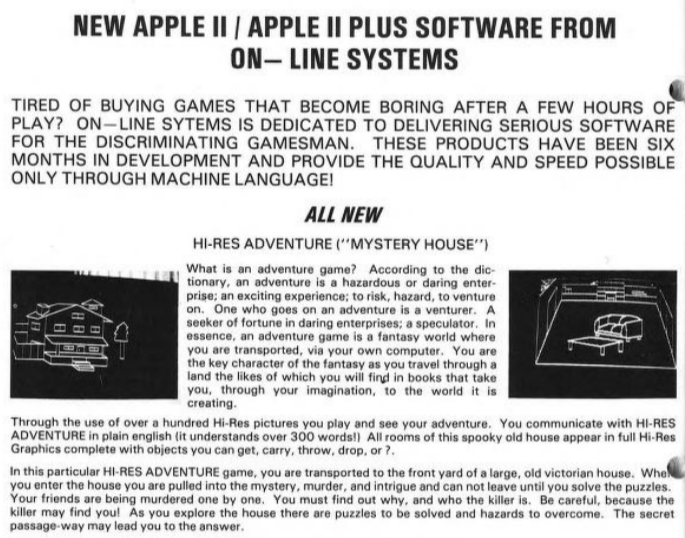
…and included were two games written by a friend, Trapshoot and Skeetshoot (the friend is credited as “Kieth Yilt” on Trapshoot and “Kieth Wild” on Skeetshoot; the games are insanely rare and only one authentic copy of Trapshoot is known to exist).
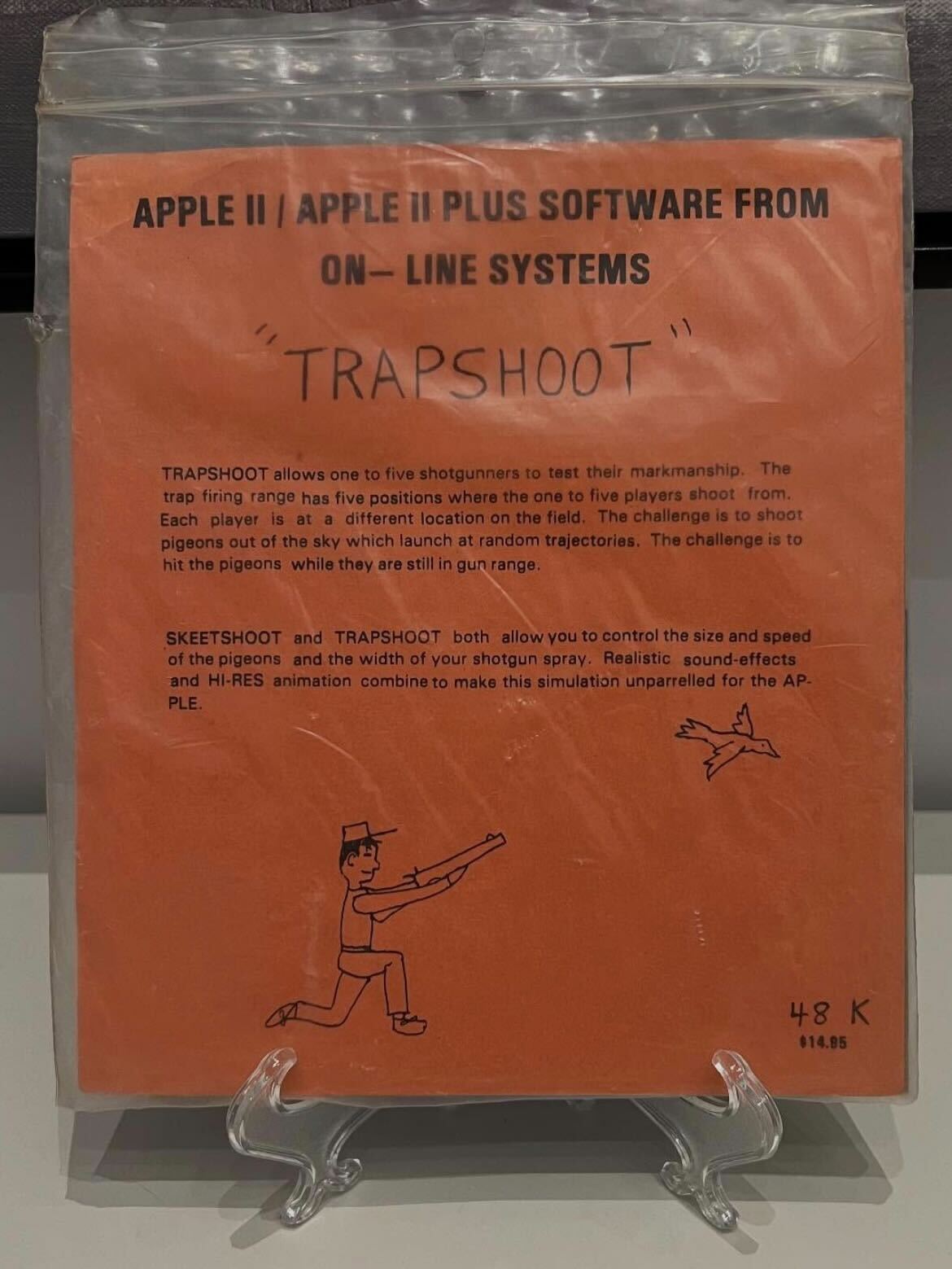
Their phone started ringing constantly; they made $11,000 in May. For the next issue of MICRO, they reprinted the same ad, and made roughly double. For the issue after, they printed a new ad:
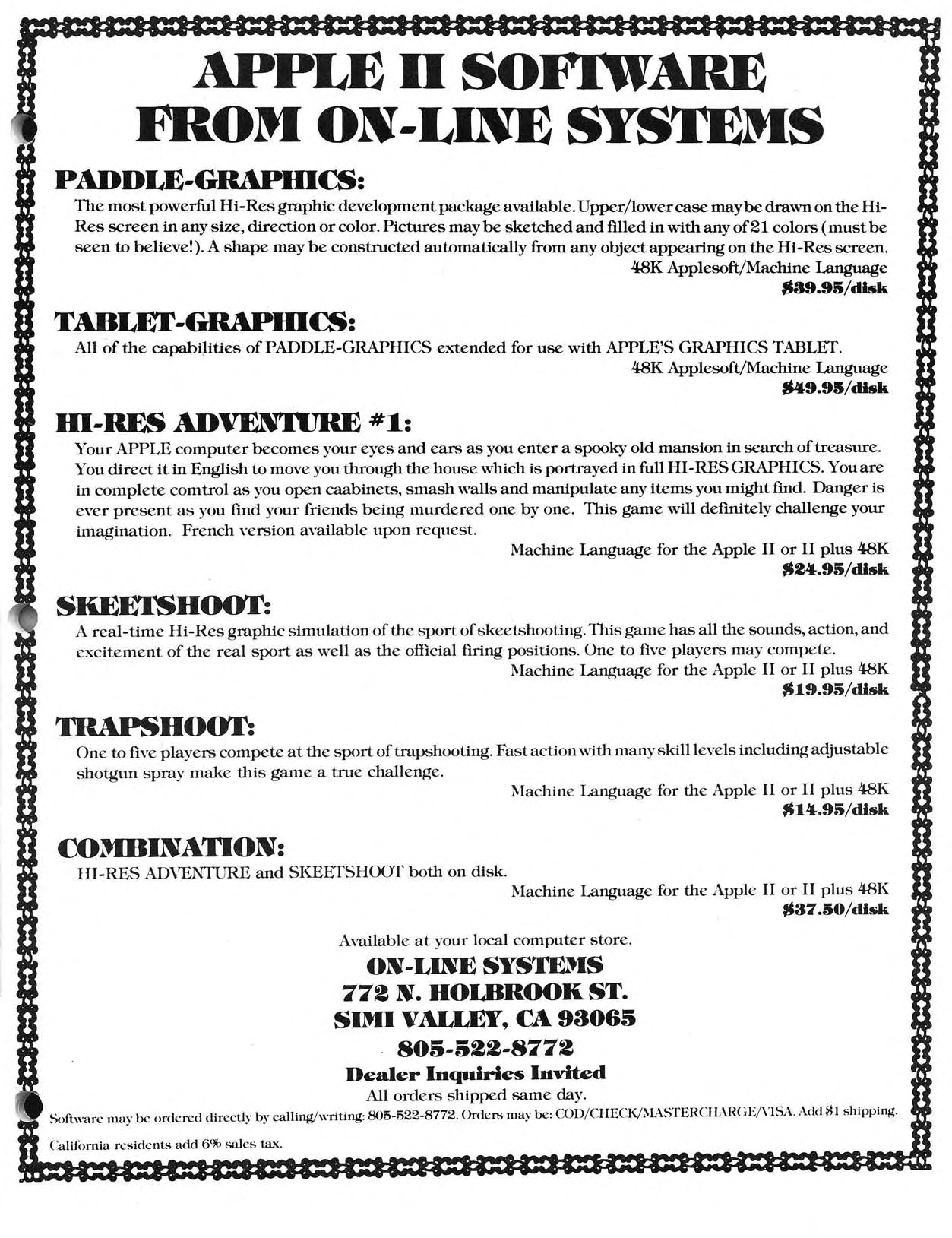
In addition to starting to sell the graphical tools Ken developed to help make Mystery House, the ad has one important addition: French
version available upon request.
And now we finally get to the protagonist of today’s story, Tom Nalevanko.

Tom Nalevanko in 1991. Source.
Nalevanko grew up in the Pittsburgh area and got a Bachelors in Mathematics in 1969, followed by a Masters in mechanical engineering from Penn State. He followed this with moving to Los Angeles to work at Hughes on a fellowship, where simultaneously getting yet another degree (a master’s in engineering) from UCLA. He stayed in Los Angeles until 1974 before going to Paris, where he lived and worked for five years, still working for Hughes. I haven’t been able to find out exactly what project he worked on in Europe, but my guess would be (given his career afterwards) he was working with NATO to coordinate with satellite information. (By this time, NATO’s system was using the Hughes H5118ME computer, each with a luxurious 1 megabyte of memory, and each with a cost of $300k to $400k.)
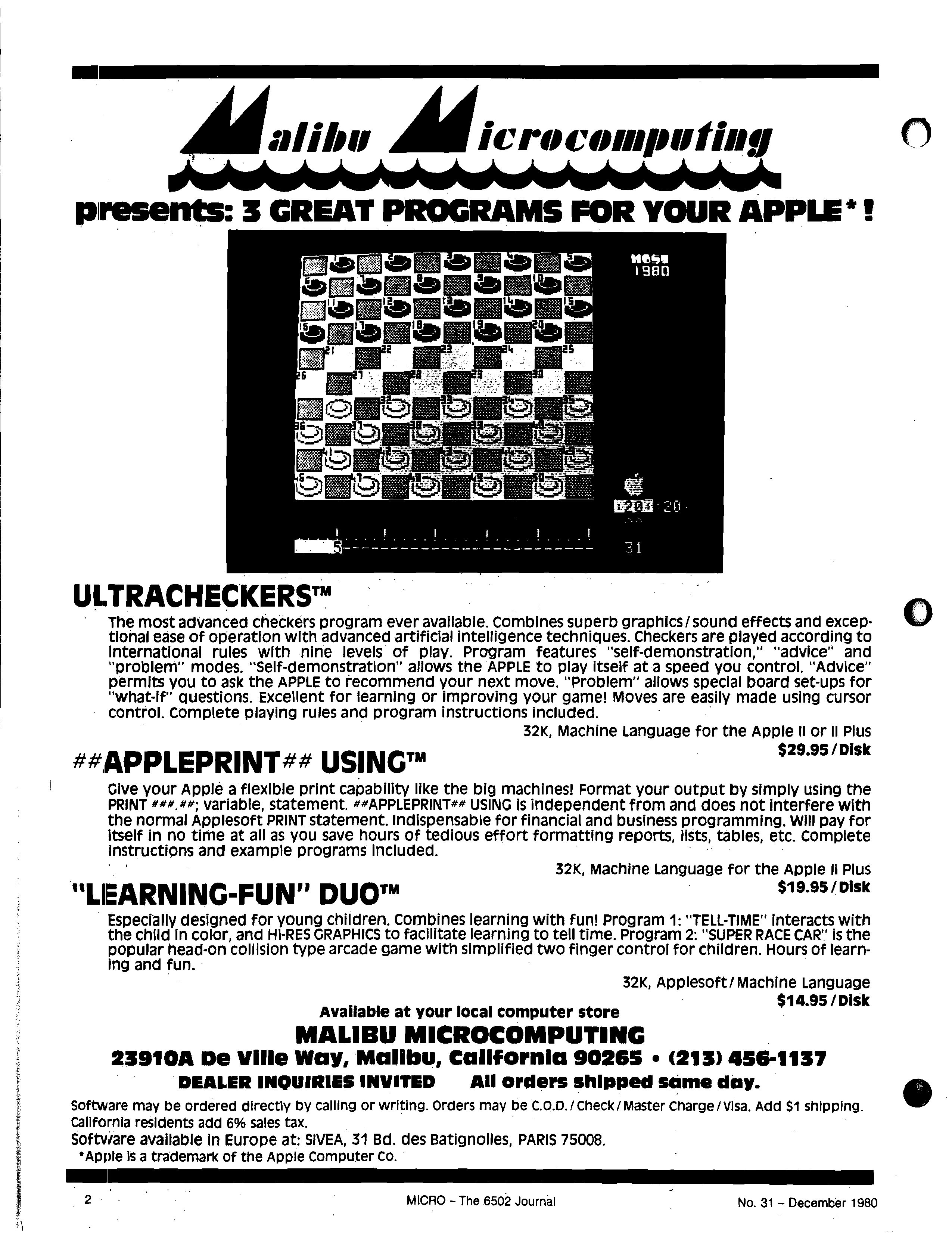
After this, he went back to the Los Angeles area to form a computer store, Malibu Computing. Here’s an ad from Micro December 1980, and there’s an important item on the bottom:
Zooming in a little:
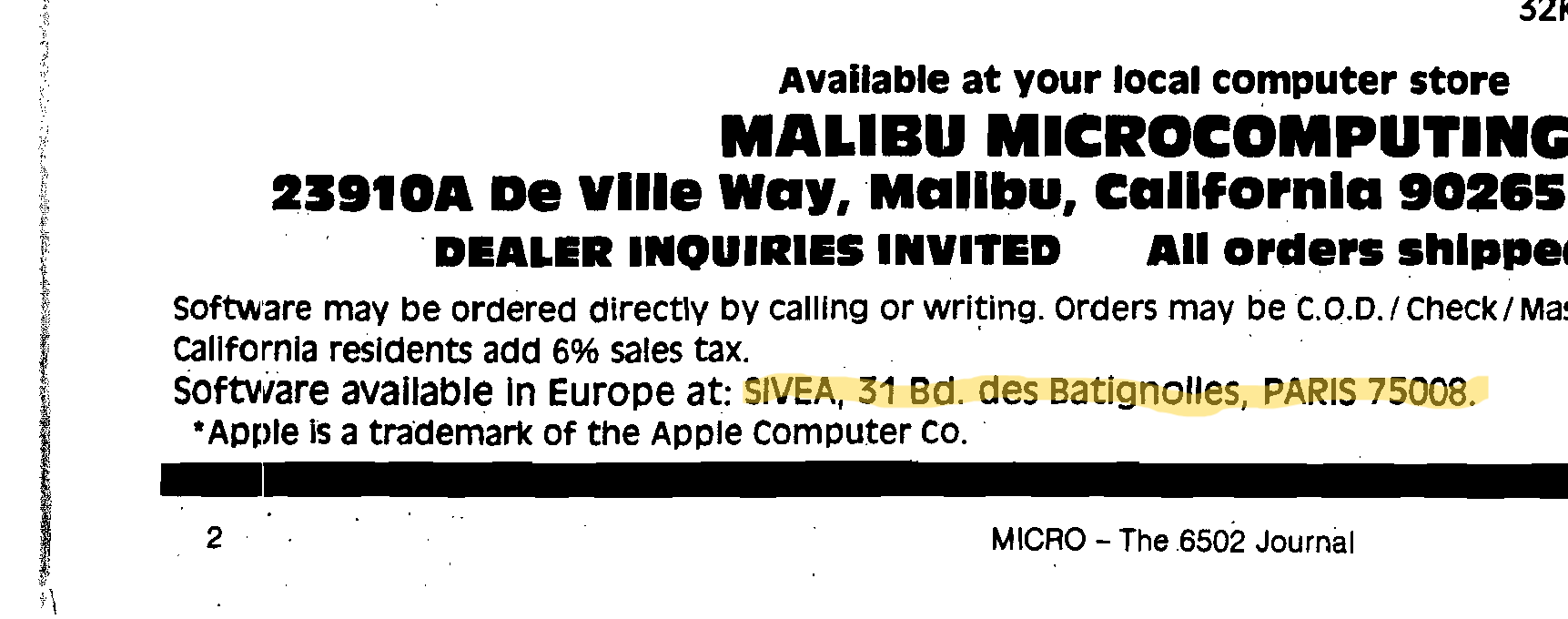
SIVEA was one of the big computer stores in Paris at this time. By 1984, SIVEA had three locations in Paris, as well as stores in Lille, Nantes, Bordeaux, Cannes, Rouen, Lyon, Montpellier, and Nice.
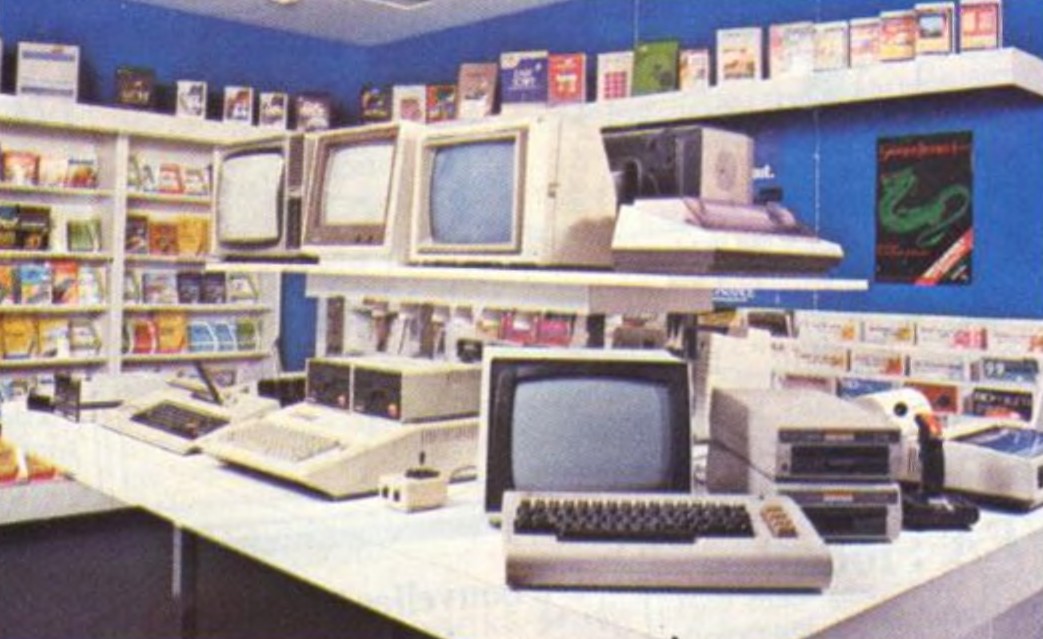
L’Ordinateur individuel, June 1984.
Nalevanko kept his ties with Europe, including in his later companies. He founded Funsoft in 1982 (with arcade-style games like Flak: The Ultimate Flight Experience and Snokie), but got into financial difficulties (“our bank account was down to $100”) but knew one of the Apple people (Alain Rossman) from his time in Paris; he reached out and got development tools for the Macintosh early, switching his company name to Mainstay with more a focus on programming and utility software.
We were interested in doing serious software, and the Mac seemed to be the second serious rebirth of the personal computer. The IBM PC — I didn’t believe in it. At the time we had one full-time programmer, Yves Lempereur from Belgium, and he didn’t want to work on the IBM PC either.
Mainstay kept a development group in Brussels, which kept up by e-mail and “large phone bills”.
We have a product marketing manager there, and we all attend the major Mac trade shows. Also we do cross-localization — U.S. products are localized for Europe in Belgium. In Japan our distributor does the localization.
Returning back to the main product at hand, Mystery House, Nalevanko must have encountered it quite early (very plausible running a computer store in the LA area); on his own initiative he contacted Ken Williams. From my own correspondence with Ken:
He wrote to me. That said, I don’t remember how he would have written to me in the days before email — so, maybe he telephoned me, or found me at a computer show. I don’t remember, but I wouldn’t have contacted him.
Ken did not provide source code, and he thinks the translation was done even before he got contacted. He would have needed the product essentially a month after product release to get it in the advertising in time. Pyramid of Doom had a similar genesis where the lawyer Alvin Files deconstructed the Scott Adams format on his own and sent a finished game; just this was on a much tighter time-table.
The major messages of the game are all in a TXT file and could be edited “straight”.
C’EST TROP HAUT
OK
C’EST SAM, LE MECANICIEN. ON L’A FRAPPE SUR LA TETE AVEC UN OBJET ARRONDI.
C’EST TROP LOURD.
TOUTES LES FENETRES SONT BOUCHEES SAUF CELLE DE GRENIER.
VOUS VOUS TROUVEZ DANS LE JARDIN A L’ARRIERE DE LA MAISON.
IL VA FAIRE NUIT BIENTOT.
VOUS VOUS TROUVEZ DANS LE JARDIN A COTE DE LA MAISON. VOUS POUVEZ SUIVRE LA CLOTURE VERS LE SUD.
The “database” section is a little trickier; while no English terms were removed (so you can still refer to things by the English names) French synonyms were added; for example, according to the paper Inspecting the Mystery House, the NOTE from early in the game can also be called a LETTRE or a PAPIER. That same paper also claims
Different assembly source code fragments were captured on this disk image.
so that “Nalevanko must have had access to Mystery House’s source code to do his work” but … apparently not? He was a programmer used to fairly low-level code (see: Hughes computers) and with enough determination it would still be possible to tweak assembly code; we saw a similar high-wire act recently with Madhouse which was a straightforward “mod” of TRS-80 machine code to create a brand-new game.
However the work was done, it was an official port, and it did make its way over to French-speaking countries. Hugo Labrande located ads in France, Belgium, and Quebec; the earliest is from December 1980 by (who else) SIVEA, back when they only had one location in Paris.
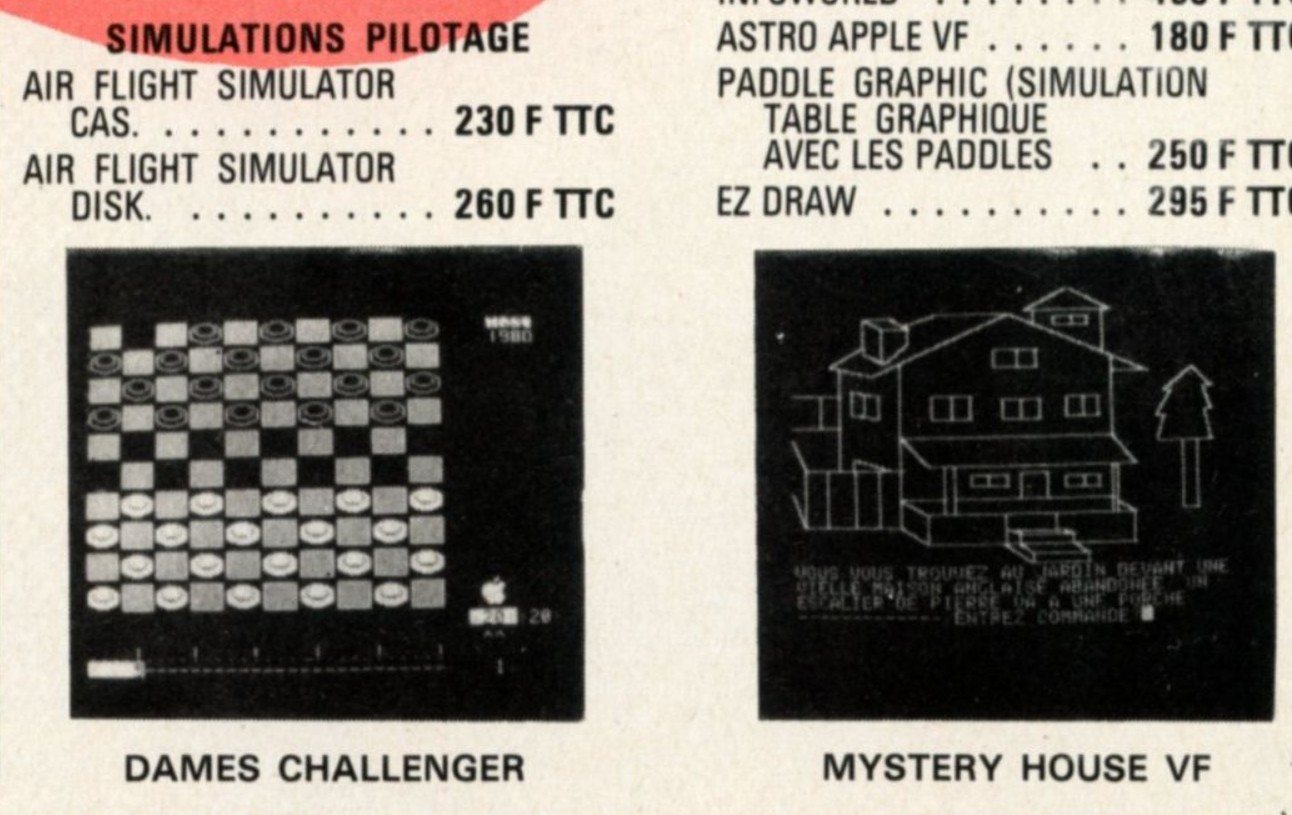
Notice this also has the Malibu Microcomputing checkers program.
There’s an opening splash screen with color…
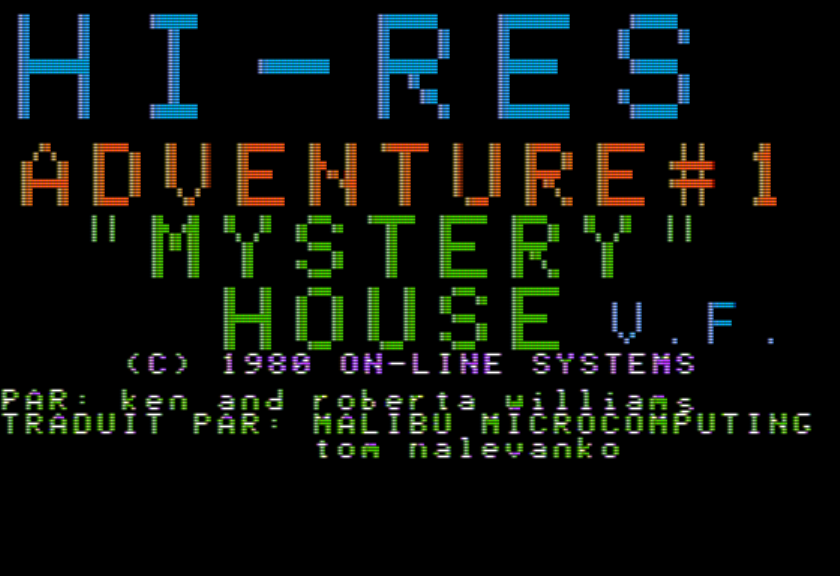
…but otherwise everything is black and white, like the original game.
Unfortunately (?) I remember the game too well to tackle it quite “from scratch” but I did attempt to replay it through. I’m going to switch to screenshot-with-commentary style with focus more on the translation than the original design (you can read my posts from 2017 for my original playthrough). One thing to note off the bat is that translation from English to French tends to increase the length of text; the translation service I just linked estimates 20-25% expansion, and another one also estimates 20% for English-to-French.
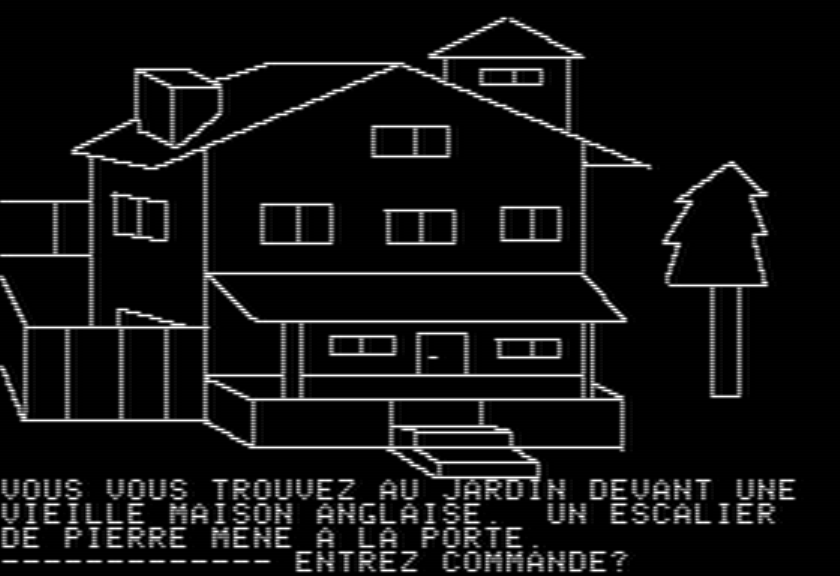
The original: YOU ARE IN THE FRONT YARD OF A LARGE ABANDONED VICTORIAN HOUSE. STONE STEPS LEAD UP TO A WIDE PORCH. The translation just refers to an “old English house” (rather than “large abandoned Victorian house”) and stone steps leading to a door (without mentioning a “wide porch”). I suspect this is already an instance where the translator was running out of text characters (since he was doing one-for-one swaps in the message file).
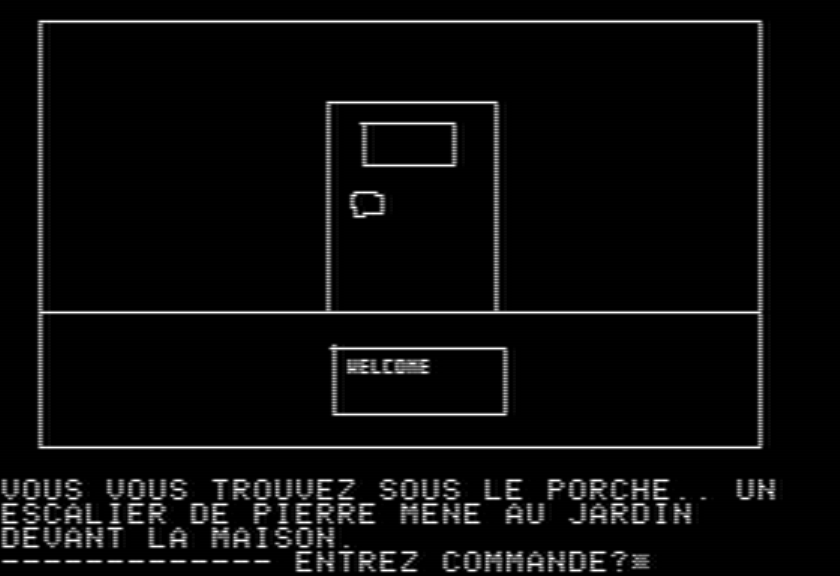
The original here is: YOU ARE ON THE PORCH. STONE STEPS LEAD DOWN TO THE FRONT YARD. The French has the player under (SOUS) the porch. The word “porche” can refer to a covered entrance, which is the reason for the confusion (in English, that’d imply you were under the floorboards). Note that the “WELCOME” is still in English — no graphics are changed in the game — and there’s a double period mark.
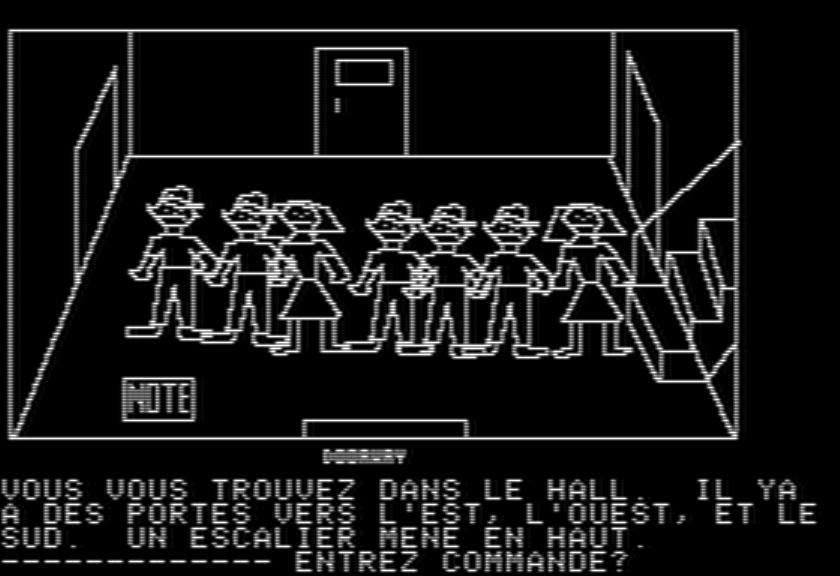
“NOTE” in English. You can refer to most things in the game in English, but the hack job on the parser meant a few things broke down.
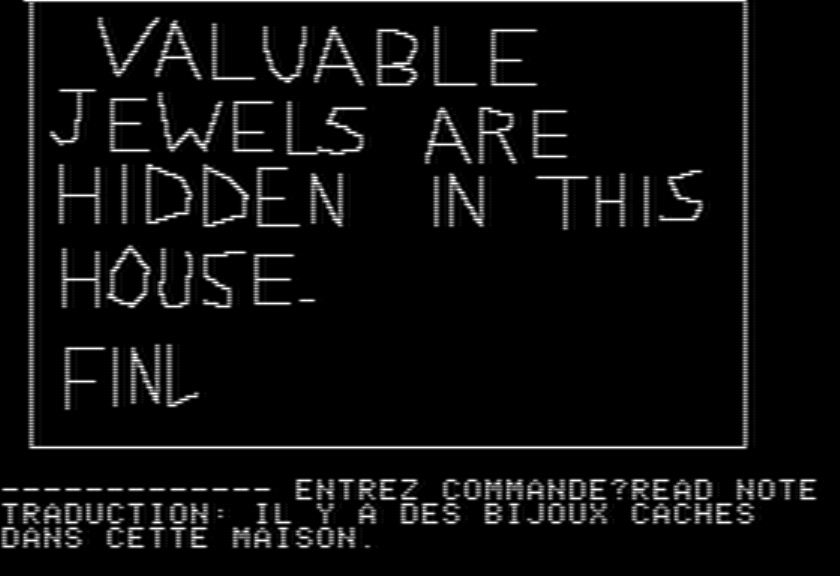
The game displays a translation alongside the picture of the English text. Even if there was the time/ability to redo images, I’m not sure it would have been a good choice; if I was playing a game investigating a French manor with French texts lying around, I’d rather have the translation alongside to maintain the atmosphere. Also, FINDERS-KEEPERS was still being drawn when I took this screenshot.
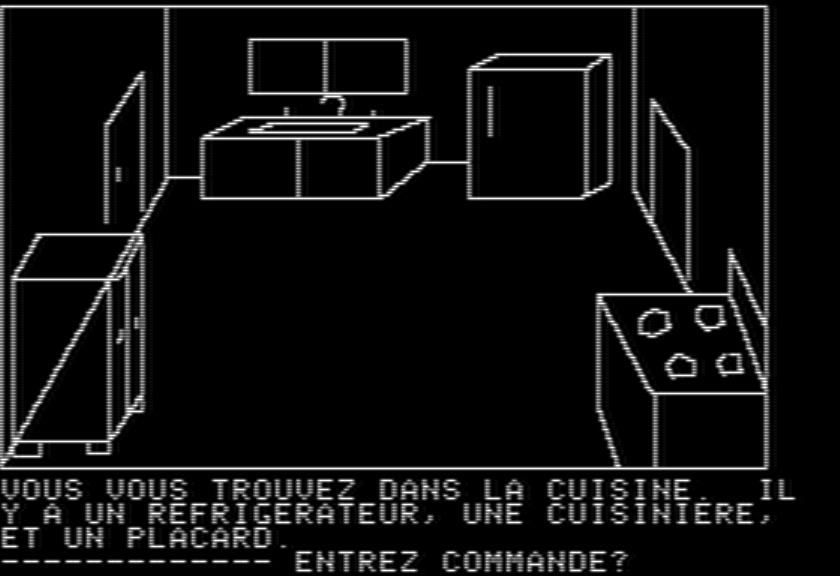
This is where my first major issue of the game happened. This is west of the start. You are supposed to nab some MATCHES, a PITCHER, a BUTTERKNIFE; then you turn the sink on and fill the pitcher with water. The problem is I couldn’t turn the water on, and checking walkthroughs, they used WATER ON which isn’t understood.
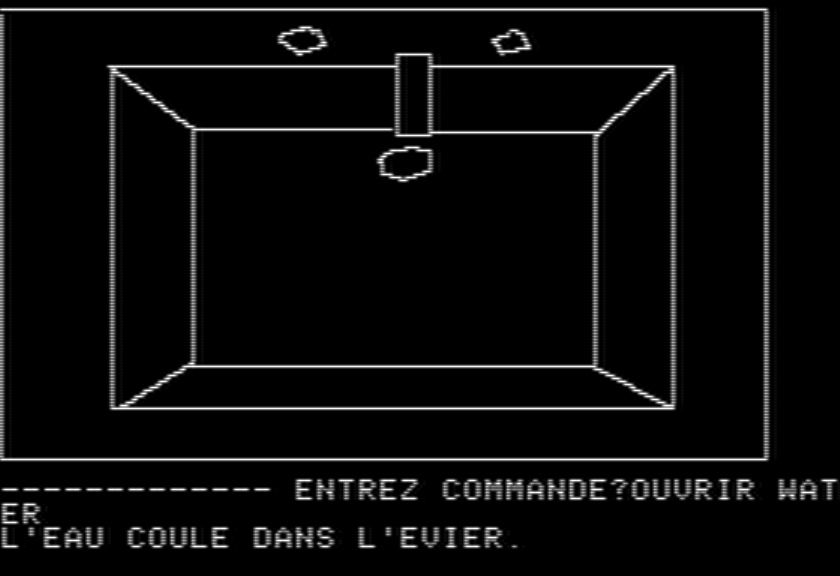
I finally came across OUVRIR working. OPEN WATER does not work in the original. I was worried for a while the crack had broken the game, but I suspect it’s just the verb list being messed up slightly via the hacking needed to get the game to work. “ON” is in the data file but it must have been detached.
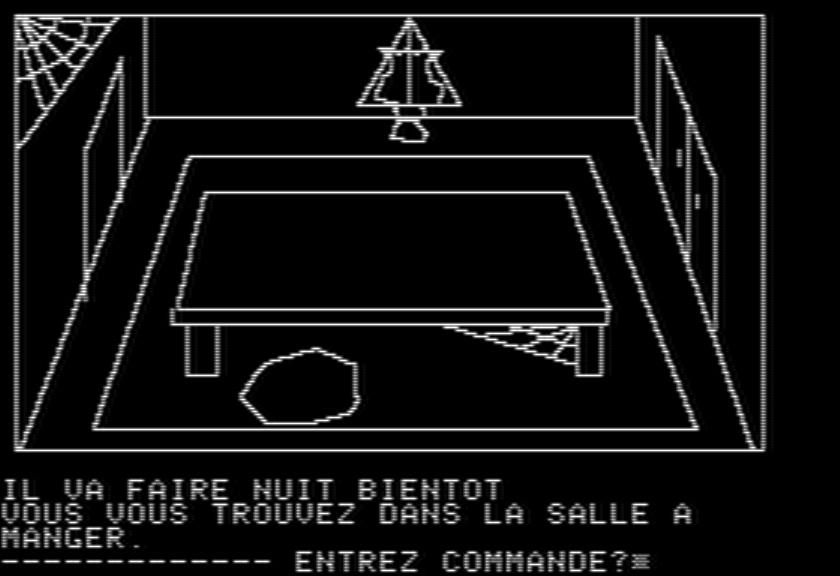
With the water in the pitcher, you can survive lighting a candle, starting a fire, and accidentally making a hole in the exact spot there’s a key. This is still one of the most miraculous coincidences in any text adventure I have played.
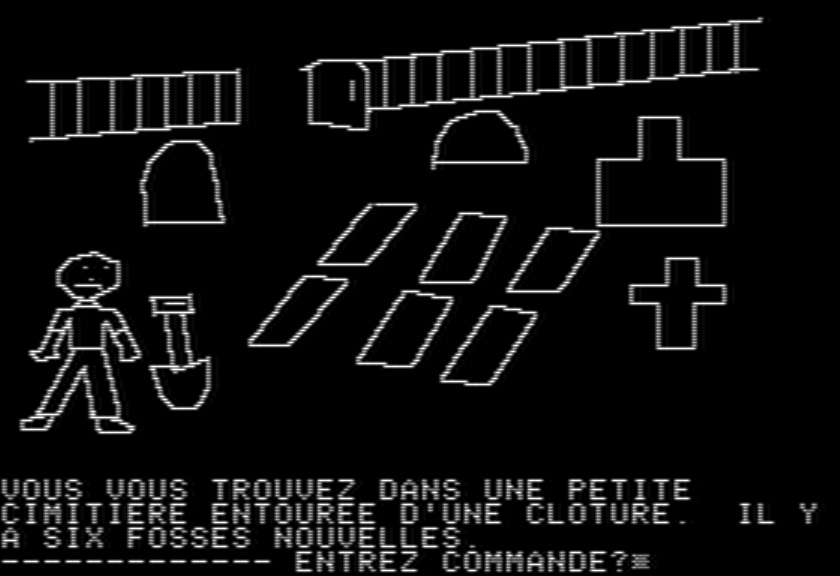
Original: YOU ARE IN A SMALL FENCED CEMETARY. THERE ARE SIX NEWLY DUG GRAVES. Essentially exactly the same in French. Not every text needed modification. The spelling mistake is in the original.
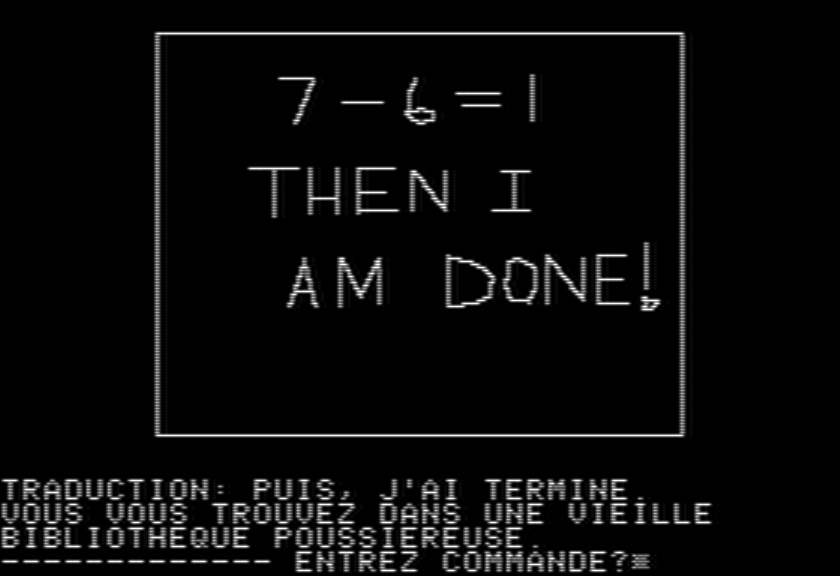
Note in the library, again with the mixed English/French.
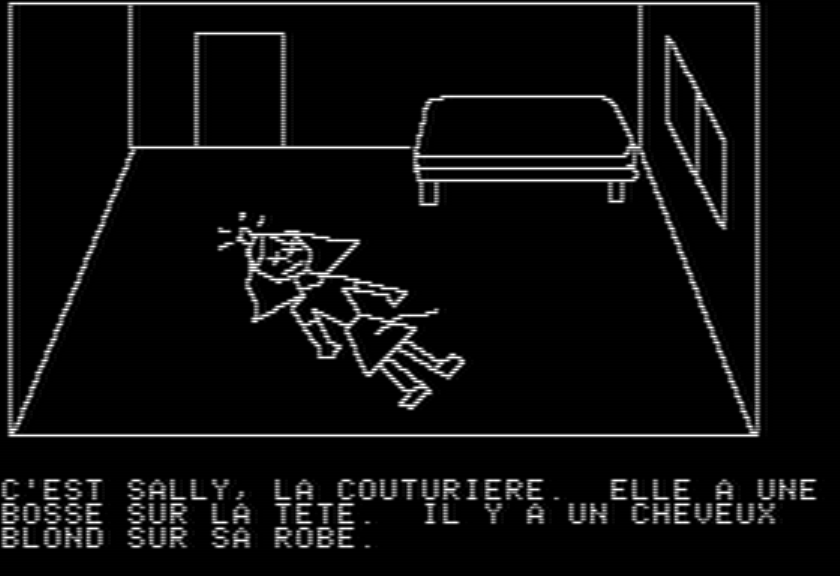
One of the bodies scattered through the house. Roberta Williams clearly had the most fun drawing these. I wish there was a better plot moment where the player is away for long enough for the bodies to all “teleport” in place without it feeling magic.
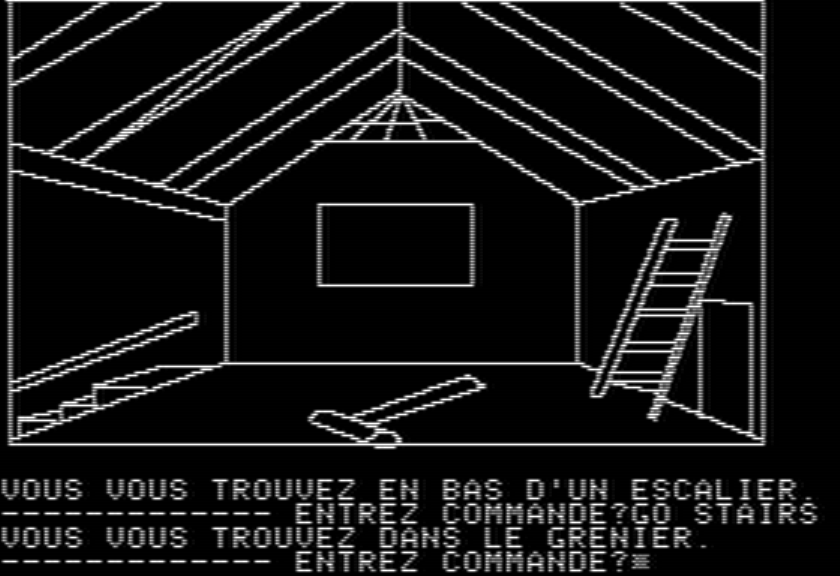
This needs to be referred to as a “SLEDGEHAMMER” if you’re using English, “HAMMER” doesn’t work for some reason even though it does in the original. In the data file, it lists SLEDGEHA MARTEAU MASSE; possibly one of the English words was removed because of space restrictions, possibly it was by accident.
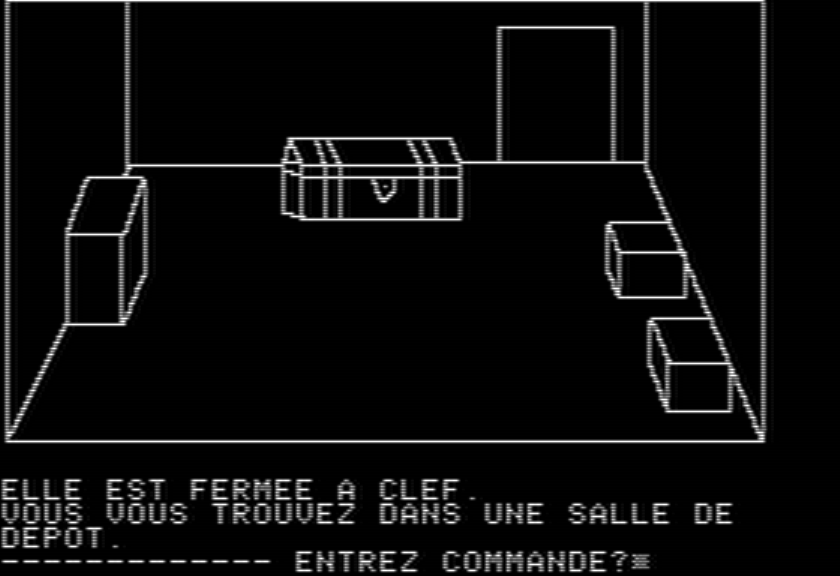
In English, this needs to be a TRUNK rather than a CHEST (which is allowed in the original). In the data file, it is written as TRUNK TRONC MALLE TROMPE. That’s plenty of synonyms in French; I doubt many people ran into an issue. (Except: two of those are the wrong kind of trunk!)
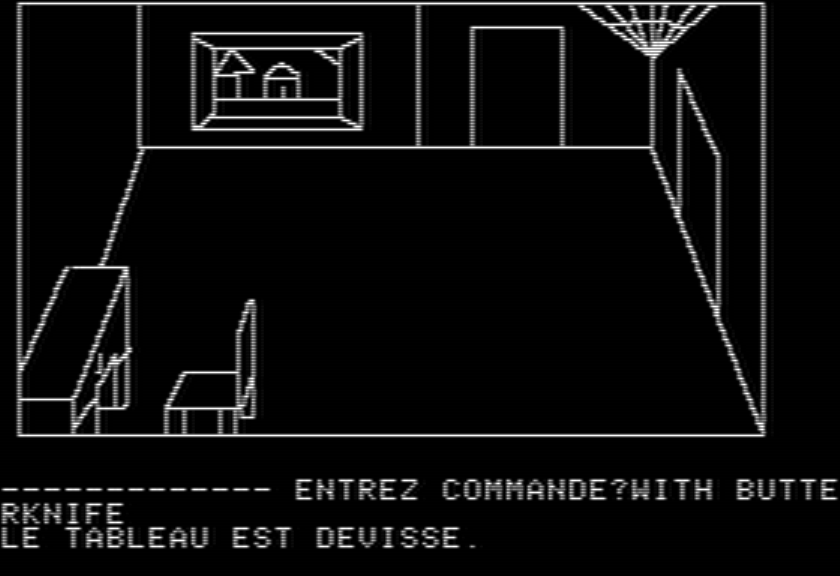
You’re supposed to USE BUTTERKNIFE in English but that got removed, I used WITH BUTTERKNIFE instead. Pushing the button behind the picture reveals a secret exit down to the basement.
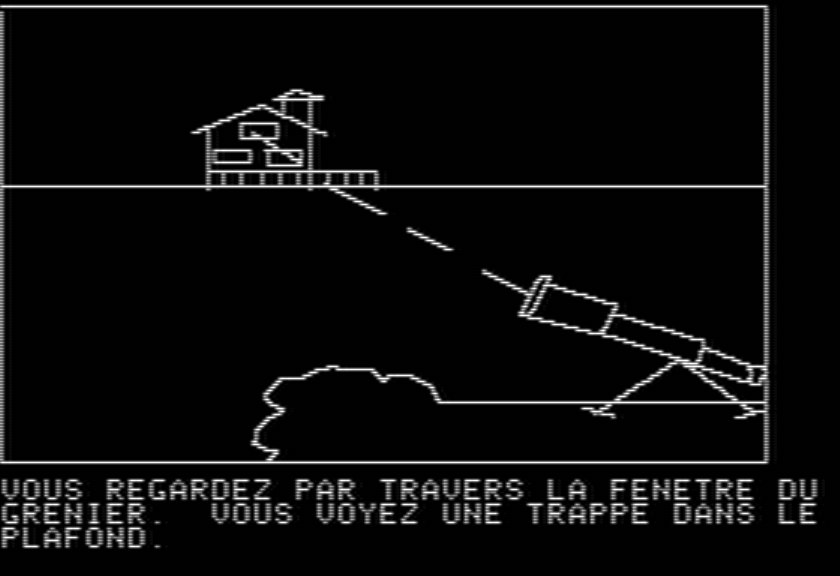
YOU ARE LOOKING THROUGH THE ATTIC WINDOW. YOU SEE A TRAPDOOR IN THE ATTIC CEILING. Again extremely close to the French. Roberta Williams used a lot of straightforward wording which helped make it easier for the translation to match.
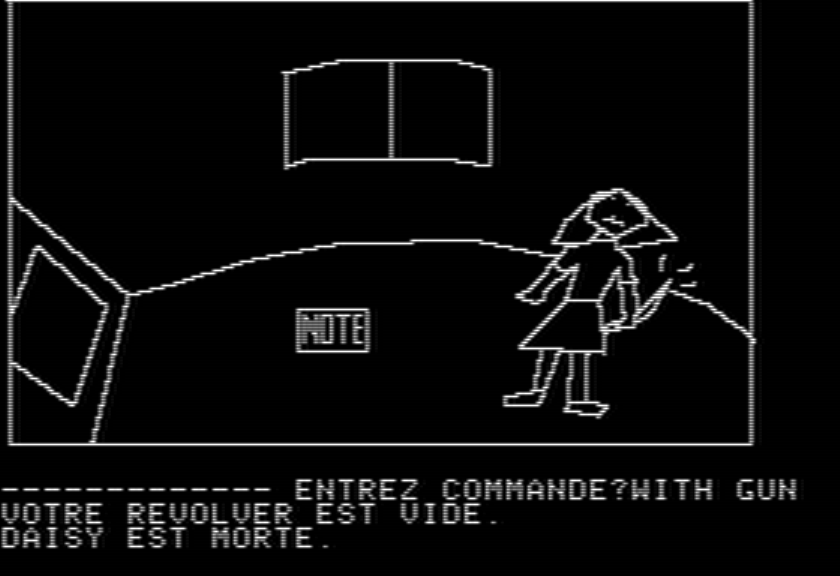
DAISY EST MORTE is somehow more satisfying than DAISY IS NOW DEAD (original) for me.
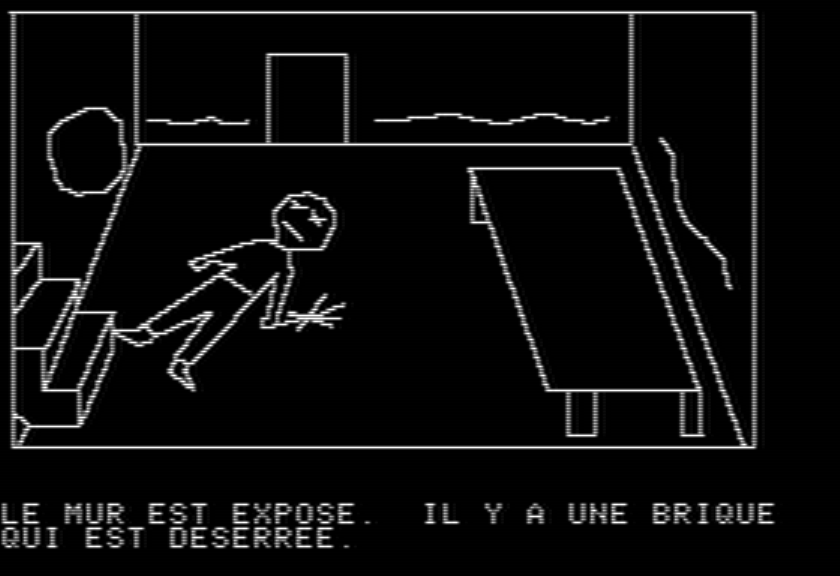
Finding the treasure in the basement. The BRIQUE is exposed by removing the algae. Note that you’re supposed to GET BRICK after but the only English word that works is BRICKS. Again, I doubt many people discovered this at the time (I used BRIQUE, I only found out there was an English possibility at all going over the data table later).
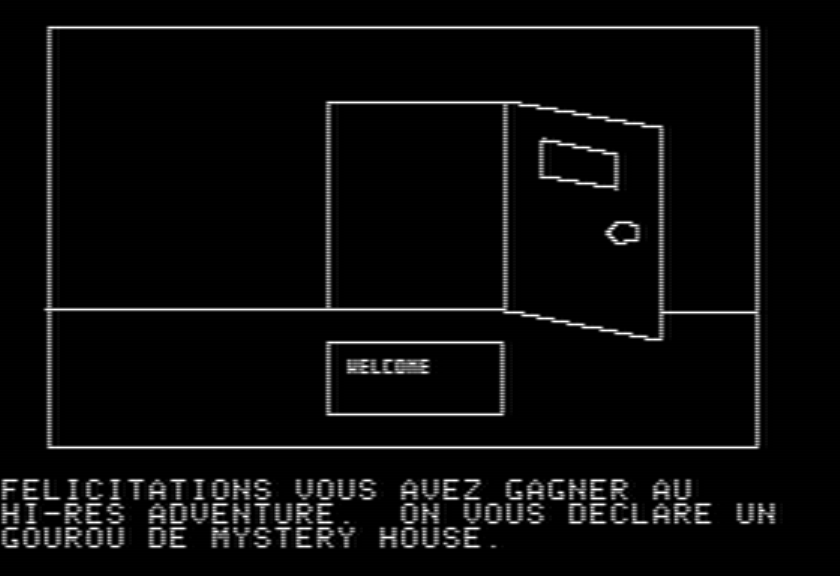
Original: CONGRATULATIONS YOU HAVE BEATEN ADVENTURE AND ARE DECLARED A GURU WIZARD. The French drops the wizard part: “you are hereby declared a Mystery House guru”.
Again, it helped that the wording of the game was mostly straightforward so literal translations were fairly common, despite the character expansion issue. While a couple English words were removed, having them present in the first place was more like an extra feature of the game; I thought the sprinkling of French synonyms was plentiful enough, and only the sink faucet caused me trouble. (It’s trouble in English too, to be fair.) There’s still all the issues the original had (the hammer I originally thought was some boards lying around, for instance) but this ended up being better than I expected a file-hacking job to be.
As far as I can tell, this is the first “official” (sold in stores) translation of an adventure game. Bilingual Adventure was an “unofficial” conversion (no endorsement by Crowther/Woods). I don’t have enough understanding of the landscape to claim it’s the first official translation ever; for example, I’m unclear if the Spanish version of Kingdom (1979) in Creative Computing ever made it to an official package, and there were other genres besides where a translation may have happened and I just don’t know about it.
This game had some notice from French teachers, along with Bilingual Adventure. They had issue with the fact the games gleefully ignore many word endings because of the words being cut off in the parser.
In both games some grammatically incorrect sentences are accepted without hesitation or explanation.
It’s funny to think about a parser that tries to be more picky with the player just because of slight phrasing issues when what was said was still clearly understood! Besides this they did have less objection to the French itself.
It was my impression that the French of Mystery House was considerably better than that of La Grande Adventure, though reviewers found things to quarrel with in both programs.
At the time I wrote about it, I claimed the parser was the worst I had ever seen. Clearly I needed the Bart Simpson meme (“worst day of your life so far“) because I eventually came across parsers much, much worse; the all-time champion might be Deathship.


 Renga in Blue
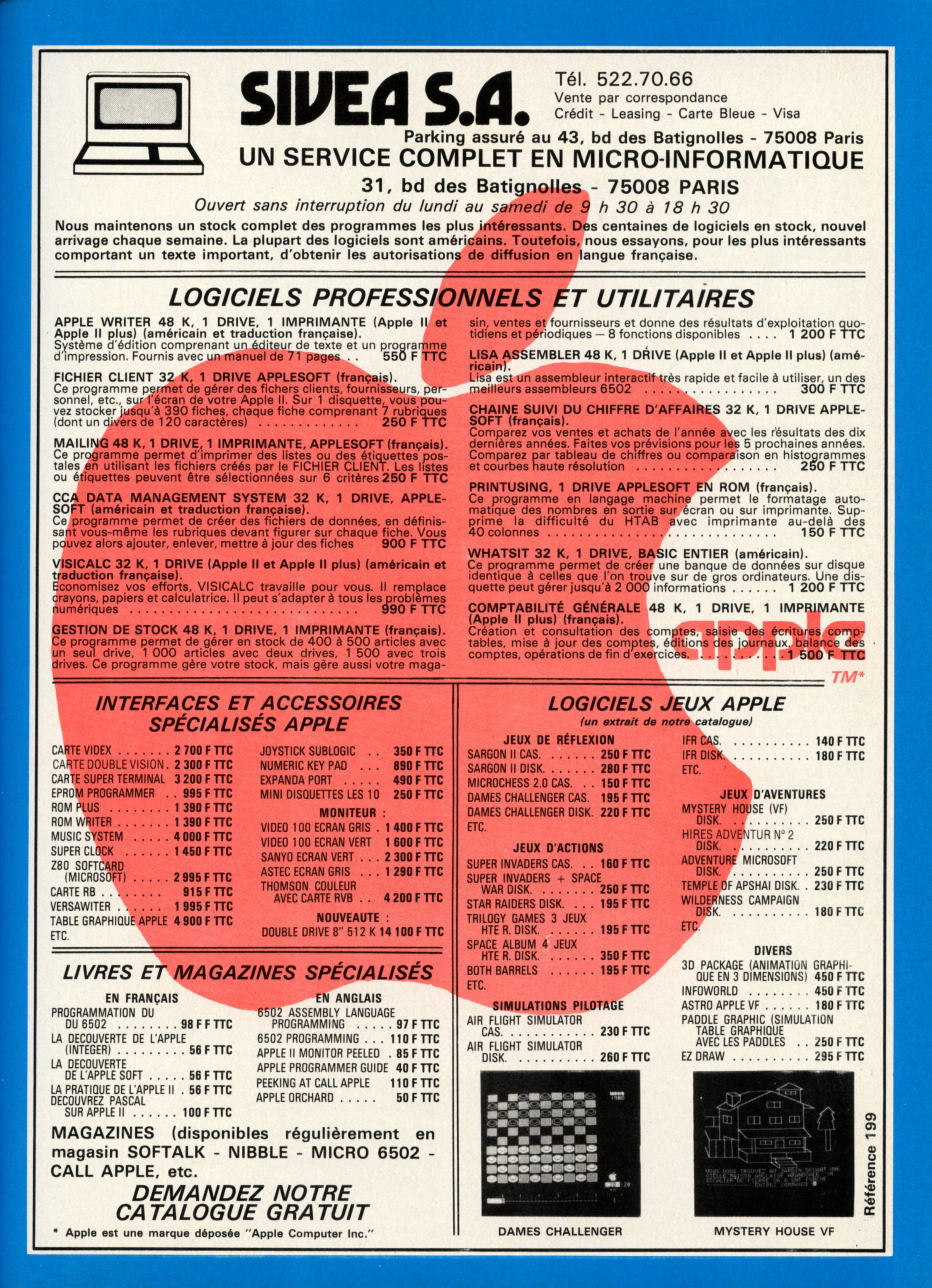
That’s a poor translation. Spelling and conjugation errors, bad grammar, but this one takes the cake: TRUNK TRONC MALLE TROMPE TRONC is tree trunk, TROMPE is elephant trunk. Only MALLE is correct here.
Ha! That’s beautiful. I’ll add that to the comment
What gets me is the kitchen. If he was trying to save space, why not “frigo” instead of “réfrigérateur”? Also, “four” could have been used for “cuisinière” and it wouldn’t have been a big deal. I think his grasp of the language was pretty dodgy.
Two other things:
Years after I first proposed it, I remain more convinced than ever that Mystery House was more influenced by Roberta sitting around and watching the “Night Horrors” episode of Hart to Hart in January, 1980 than by either Agatha Christie or Clue. Wave it off if you like, but certain details are too close for comfort. They’ll never admit it, though…
I WILL DIE ON THIS HILL!!! (ahem)
Regarding Atlantean Odyssey, I’m pretty certain that the graphical version didn’t come out until 1981, as we went into in depth in a previous thread. I think Mystery House really is the first graphic adventure for a home computer.
Busca pointed out to me in email that “felicitations vous avez gagner” is technically conjugated wrong
I found enough instances in the wild I just left that be without comment but it certainly wouldn’t make the French teachers happy
As CrocMiam already said, it’s a poor translation. The “vous avez gagner” instead of “gagné” is just one of the more egregious examples. A couple other ones I saw at first glance (adding the accents knowing they were not reproduced):
– “Il ya a des portes” -> “Il y a des portes”
– “une petite cimitiere” -> “un petit cimetière”
– “un cheveux blond” -> “un cheveu blond”
– “une brique … deserree” -> “une brique … desserrée”
And don’t even get me started on “Ouvrir water”. “Water”, when used in French, is a denomination for a toilet. I understand it resulted here from combining available French and English words, but still… .
it lets you freely use English verbs with French nouns, or vice versa
although that’s an interesting dilemma for games in general where you want it to understand two languages at once when they have different meanings!
one other brief point to note, is that Apple II couldn’t do the é, it was pretty common at this time even in English to ignore weird things that happened with missing characters (see I CANT in a bunch of Britgames, no ‘ in the character set, sometimes they would write I CAN”T with the quote mark instead which is also wrong)
there’s one Apple II game from France eventually upcoming (La Pierre de Vie) that I’m pretty sure has the same issue
Interestingly, Starcraft’s Japanese localization of Mystery House also keeps the notes etc. in English, with the translation provided only in the text, despite the fact that all the graphics were redone from scratch. It at least shows that Starcraft intentionally prioritized authenticity to the setting, rather than convenience for both the programmers and their potential audience.
Parsers that accept both Japanese and English input aren’t too uncommon, starting around late 1984, but I’ve almost never seen this create problems. Though honestly I haven’t really tried mixing-and-matching languages because it just doesn’t make sense to try. The writing systems are completely different, and the word order is backwards! Substituting a Japanese word for its English equivalent or vice versa causes syntax itself to break down. For example, “akeru door” doesn’t mean “open door” but rather “a door that opens”. You have only described the door, not applied any action to it!
My theory is that THIS is the reason many of the games from Japan you’ve played so far have only accepted one word at a time, not technical limitations or lack of programming ability. Breaking the input into two distinct phrases makes it easier for a mind accustomed to thinking in S-O-V syntax to get used to the counter-intuitive notion of entering the verb first.
Funny thing is original Crowther (or Crowther/Woods) doesn’t care about word order – you can type LAMP GET, rather than GET LAMP.
None of the guides on how to write adventures went in that direction, as far as I know.