(Continued from my previous posts.)
I was missing one reasonably simple (but still hard to find) action in order to escape with the Bluestone; I did try the next part of the game but it didn’t go well.
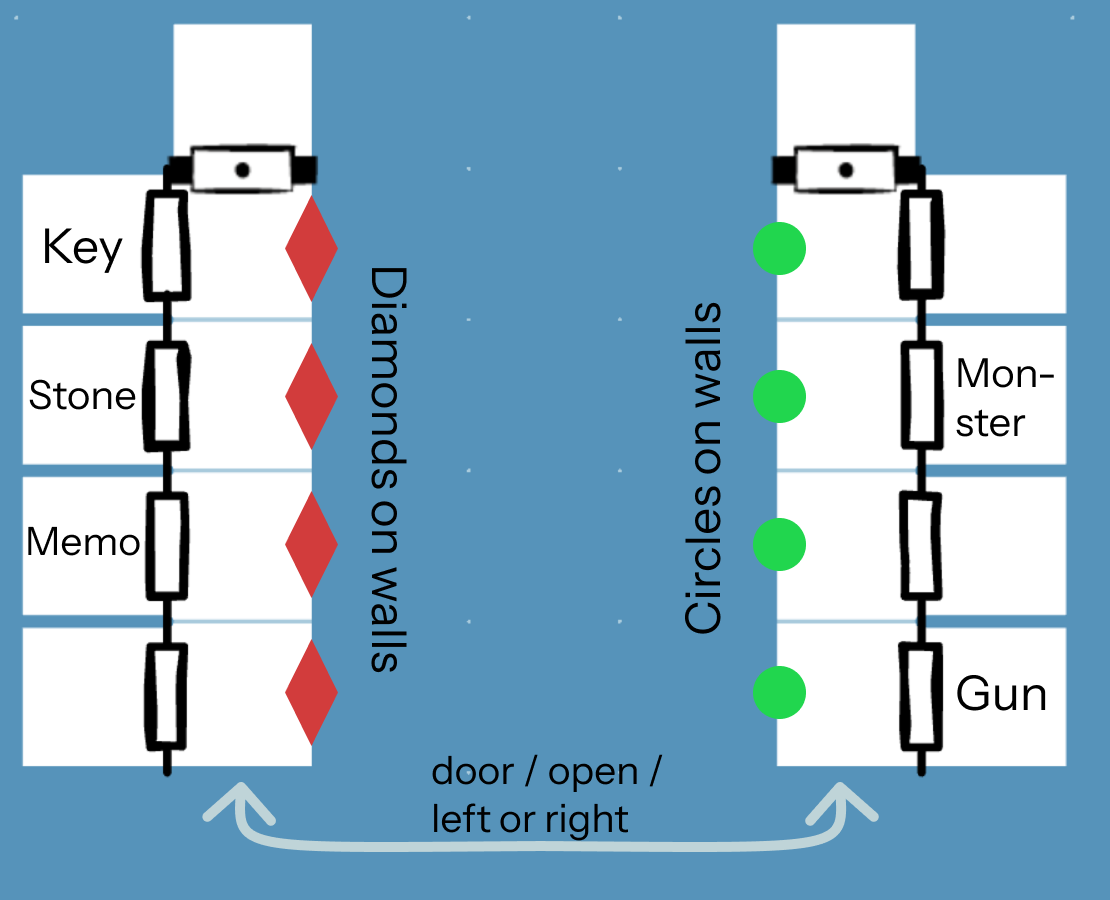
Just as a reminder, I had found a key, the bluestone, a gun, and a memo, and I was now looking for a way out of the base on the planet of Ariosferia. I received the verbs USE, TAKE, SHOOT, and PUSH from pressing the HELP key.
Kazuma Satou informed me in the comments that I had missed a feature; if you are being prompted for a noun, you can hit HELP in order to get them listed by the game. Hence you don’t have the guess that the GUN is a GUN (assuming you’ve understood this aspect from the instructions).
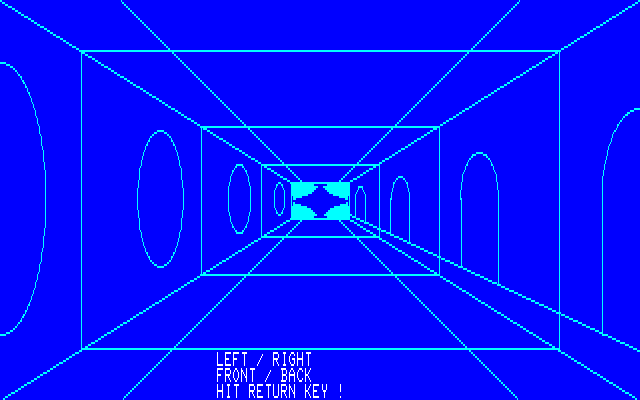
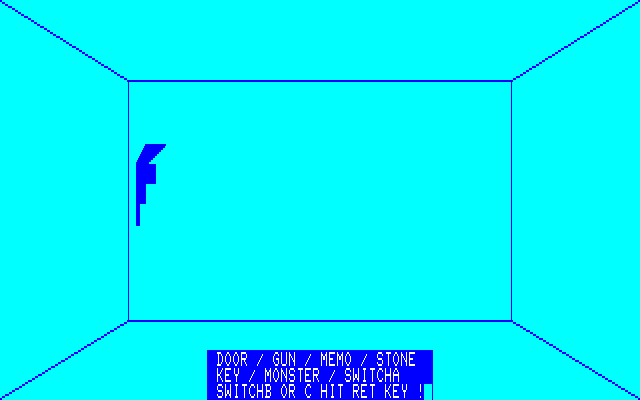
I went around every surface of the game trying to apply USE, SHOOT, and PUSH in order to see if I could get some kind of reaction. It turns out the end-hallway figures are very different.
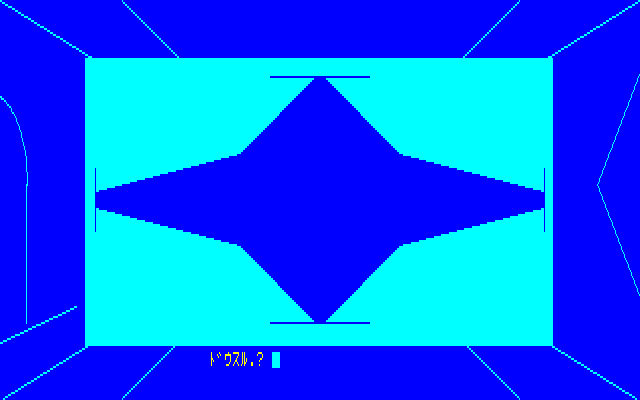
This is the end of the hallway on the left.
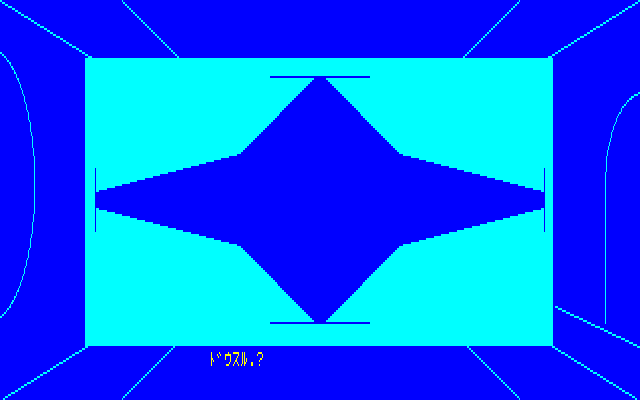
This is the similar-looking end of the hallway to the right.
If I tried USE on the right side (and only the right side) the game was asking me for a noun. I went through my held items and found that using the KEY then went back to asking me for a verb again, and I was very confused since it didn’t seem like anything happened, and in fact the game is prompting you for your next turn a specific action, and if you don’t that it resets the variable (that is, you go back to needing to USE KEY again). If you type OPEN right after using the key you reveal hidden switches.
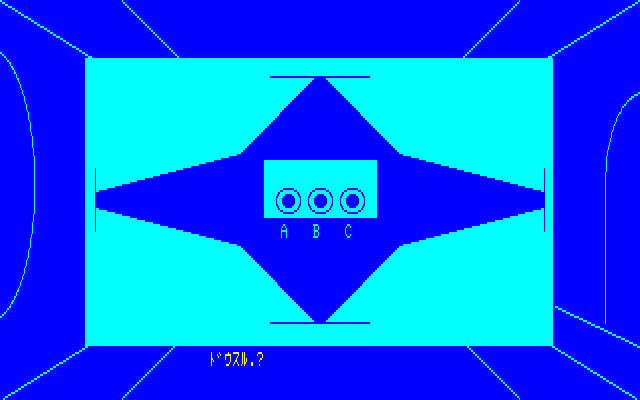
This is an entirely random choice, and there’s no save feature to the game, so after struggling through the combat and going through the sluggish adventure session you now have a one-third chance of just dying. Good luck!

(For me the correct switch was SWITCHA.)
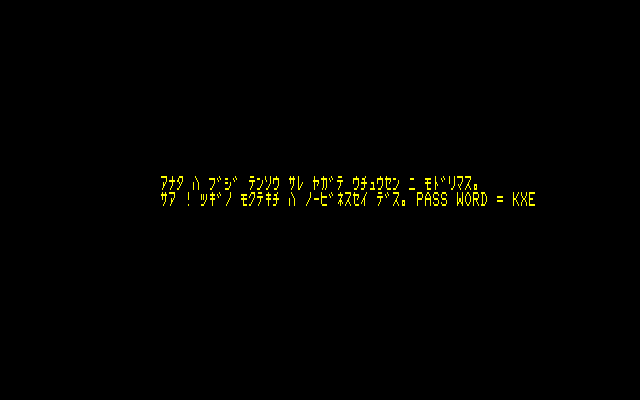
(Immediately after this scene, the game does a LOAD”CAS:” to open the next part of the game. You can theoretically LOAD”CAS:” twice from the start to jump to part 2; only not knowing the password is stopping you.)
We’ve been teleported back to the ship and are ready to go onto the next phase. Unfortunately, the ships are just as irritating and deadly as before. (At least not invisible; the comment in the Oh! MZ guide said something about this but it meant that their movement is invisible; that is, you don’t see sprites smoothly changing places but rather “jumping” between points like an old LCD handheld game.)
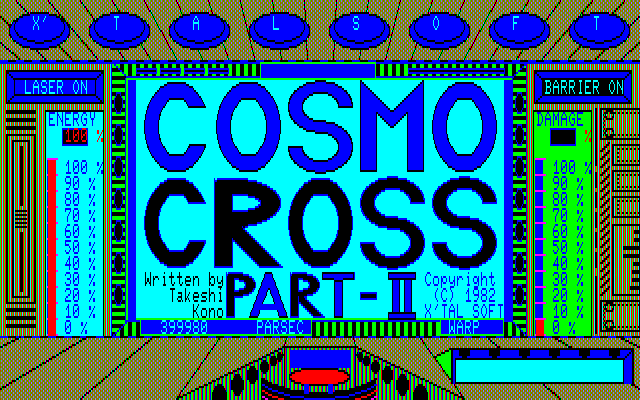
Reader, I tried. I tried for far longer than I really ought to have. I tried using Antimicro to map my gamepad to the right keys; while this made playing a little more comfortable, but it didn’t change the fact that the laser movement is outrageously slow compared to how quickly you get destroyed, and this level has the downside of it not being as obvious which planet you’re aiming at (you’re going for something red … I think).

Mid-warp.
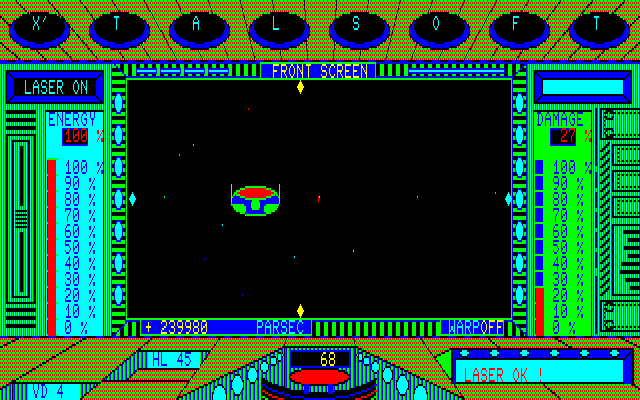
Attacked. This enemy is in a good spot, but that’s no guarantee for the next five enemies.
It was time to resort again to hacking.
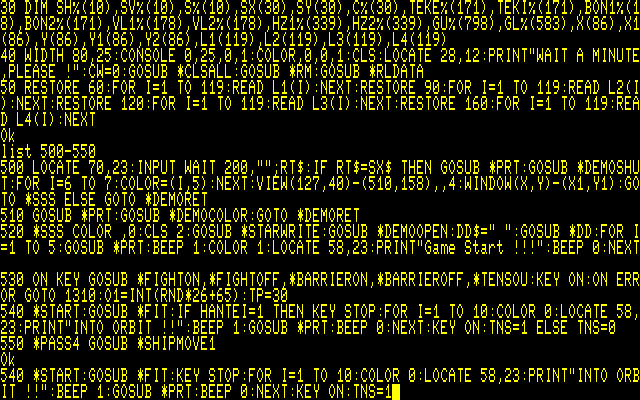
This is me typing in a replacement line. Compare it with the original two lines up.
After the game had a moment of confusion it brought me INTO ORBIT, closed the spaceship window, and opened it again on a red environment with a dot in the background. I could use warp to get closer and aim but without any enemies around.
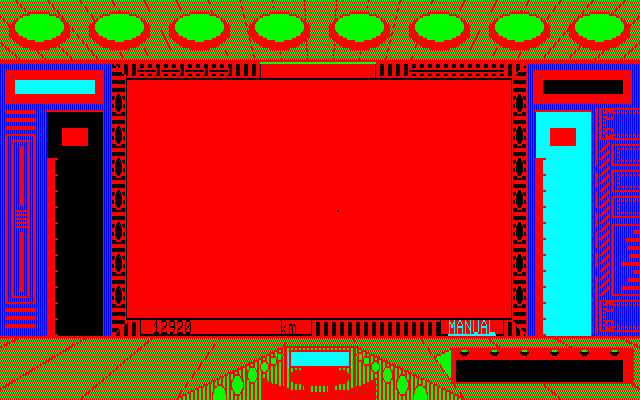
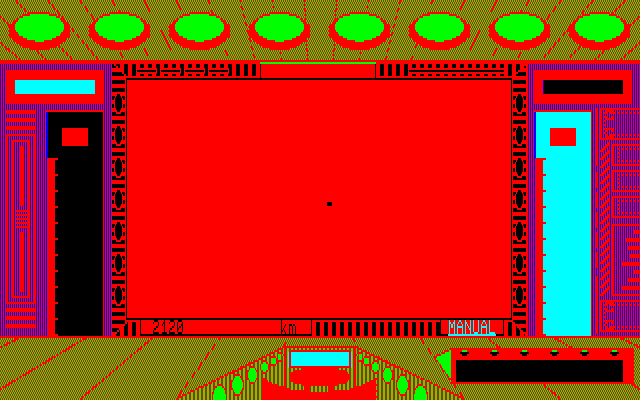
The dot was constantly moving to the right so I kept having to adjust my center aiming every few steps of warp.
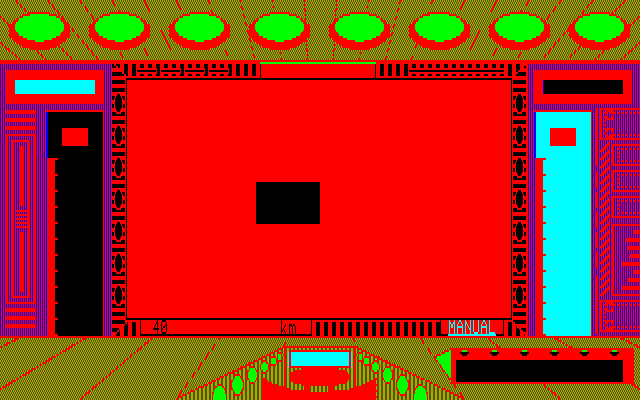
The controller for the planet launcher is supposed to be a black rectangle.
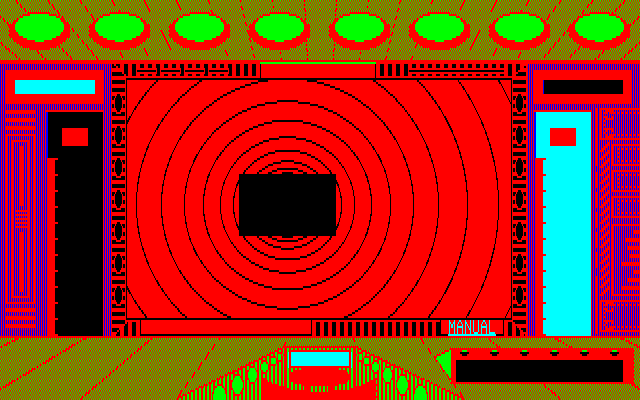
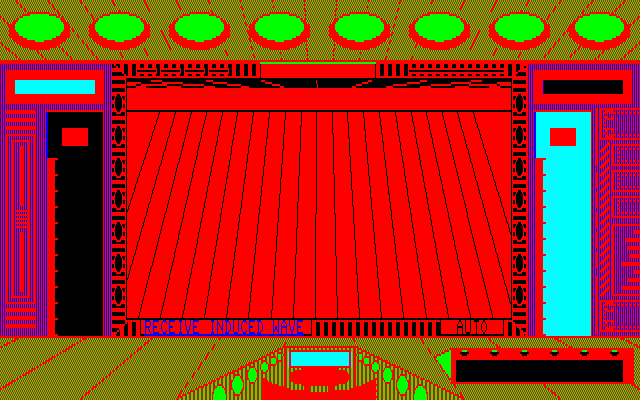
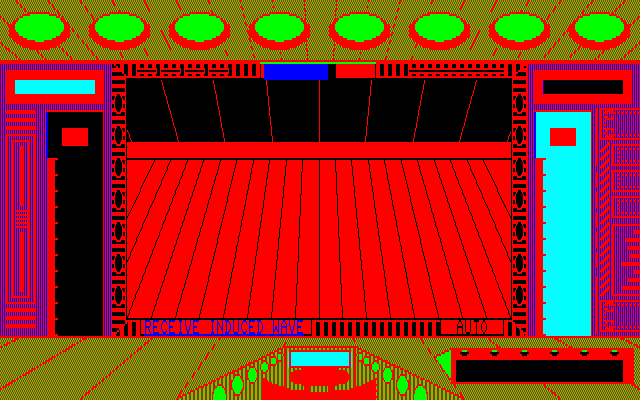
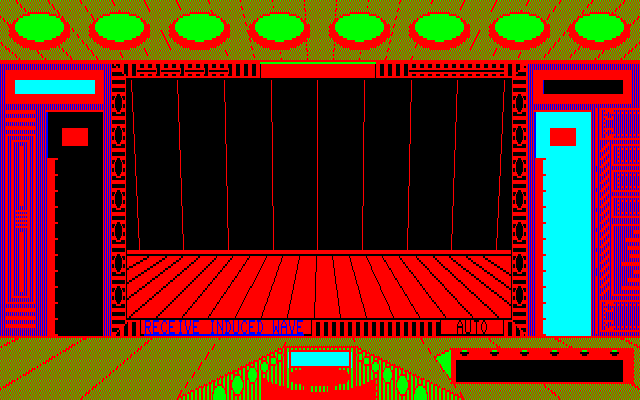
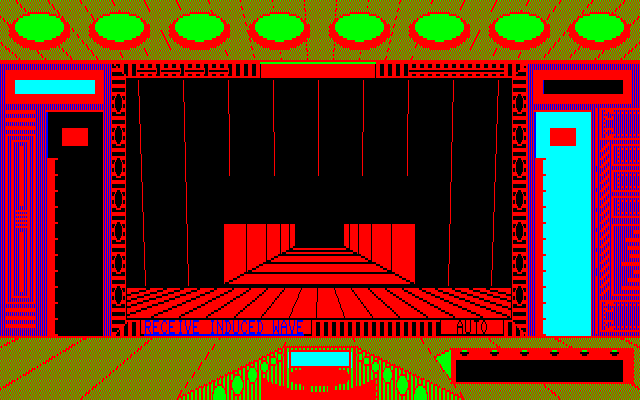
Once I reached the screen above (and pressed F5, although I am unclear if I needed to do that), a very very long cutscene started. It is long in that it is being drawn on a PC-88 and I found in the end weirdly magnificent and impressive. I would probably not find it so impressive if I died in the scene after and had to redo the entire thing.
I’m showing far more screenshots than usual. Keep in mind each frame lasts about two seconds, and I’ve still cut many of the in-between frames.
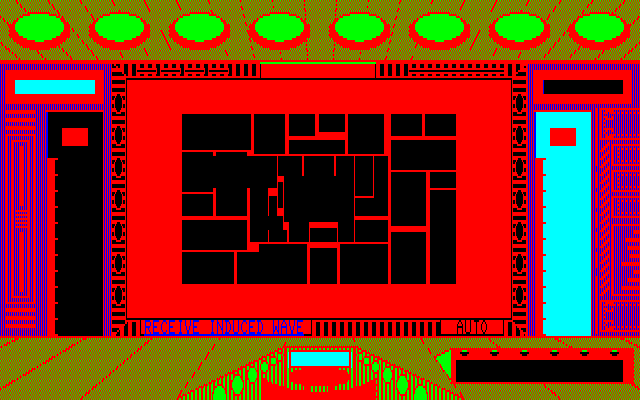
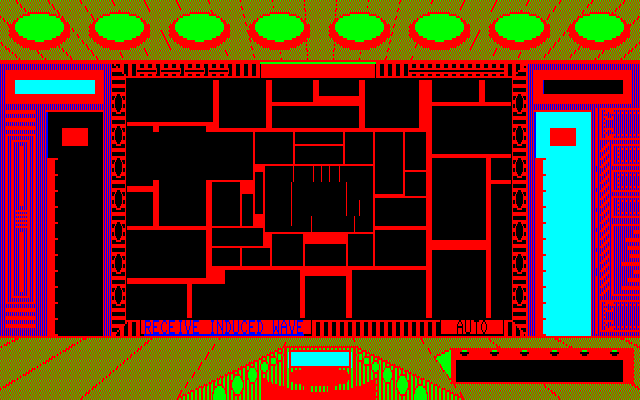
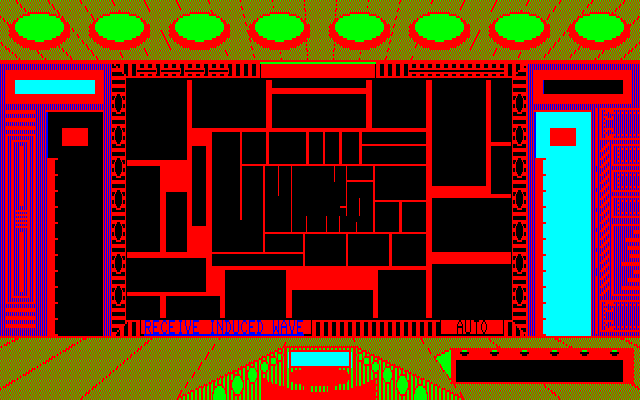
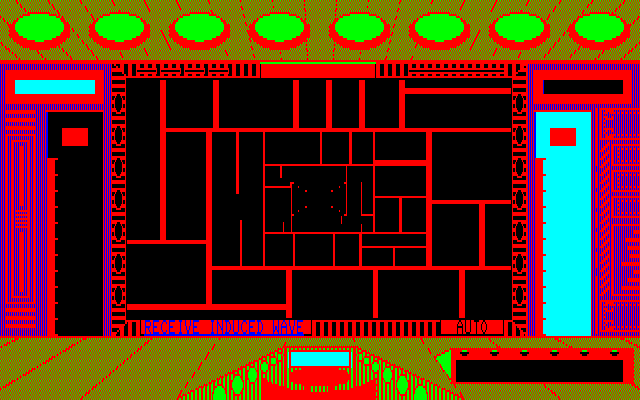
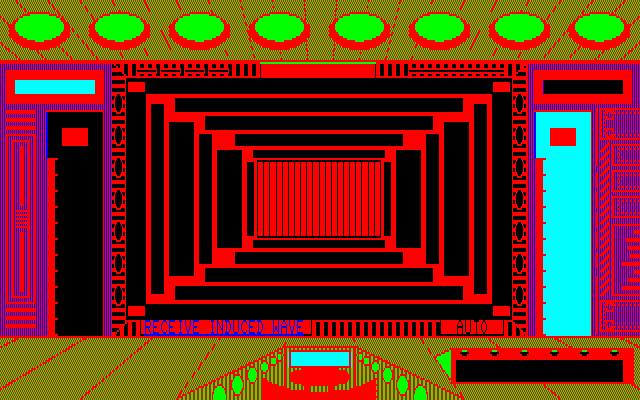
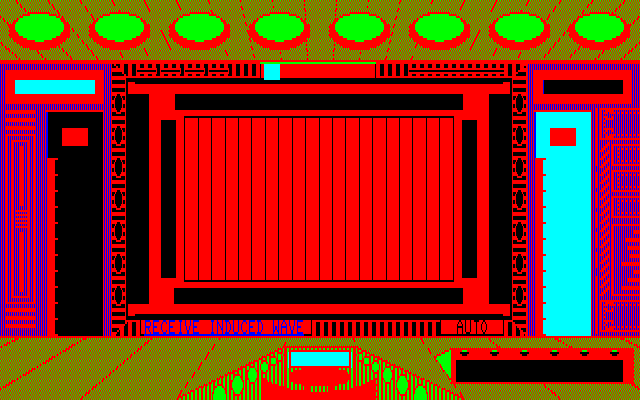
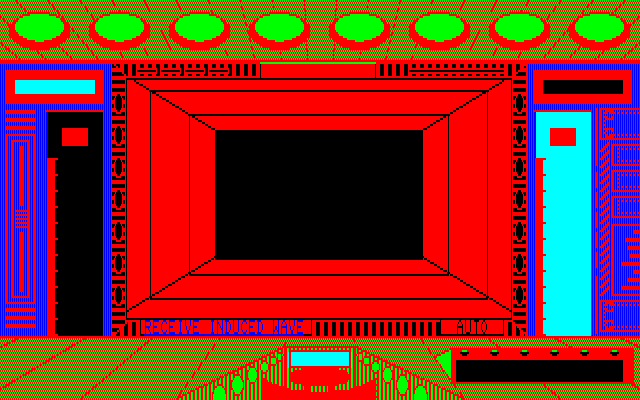
And then…
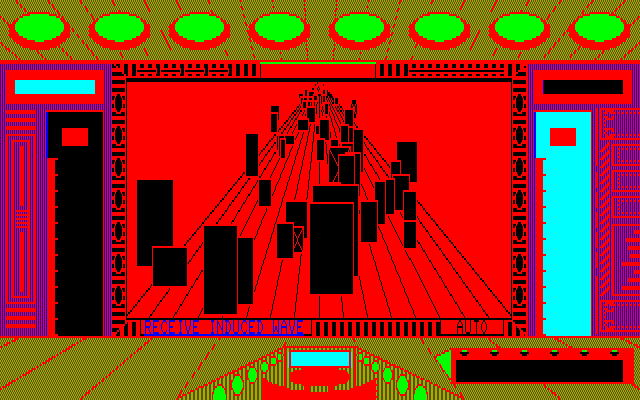
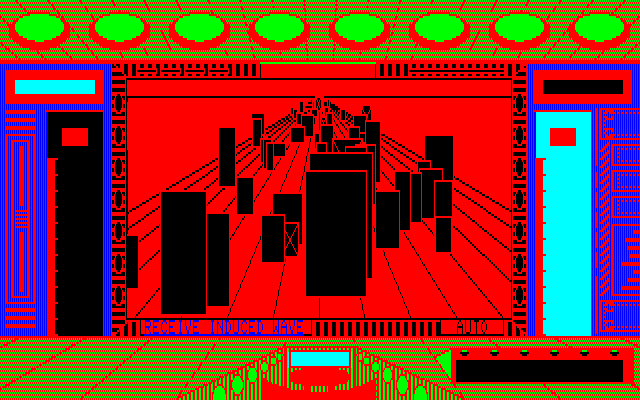
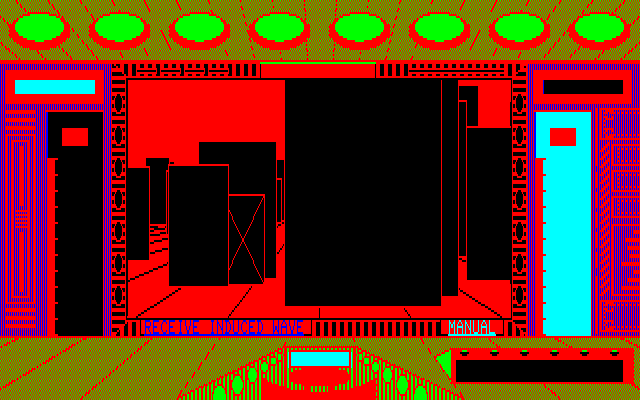
…a sea of monoliths. You now can control movement, using up/down/left/right, with it being agonizingly slow as a bar fills at each step.
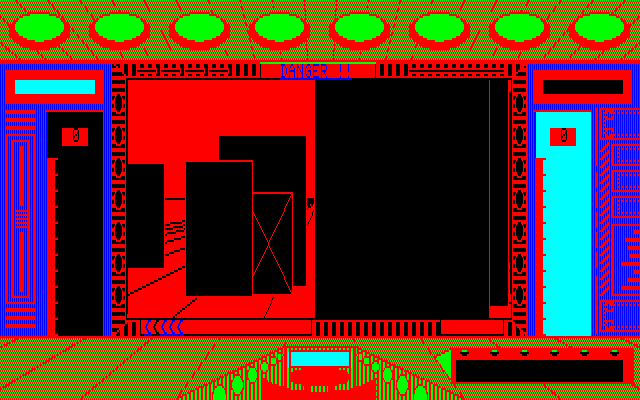
Midway filling a “charge” that will turn us a step to the left.
Pressing F1 will show either an arrow left, arrow right, or double-arrow (which I think indicates “you’re pointed the right way”). The problem is you need to navigate the monoliths without hitting things.
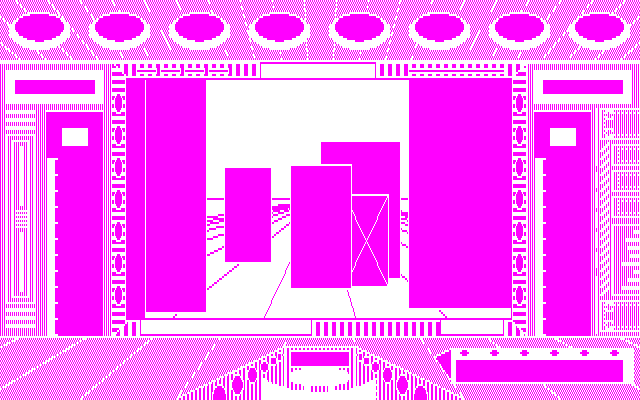
My spaceship being destroyed because it collided with one of the monoliths.
I found this section terribly confusing as it doesn’t appear like the things you hit are the monoliths? Or at least you can sometimes steer towards what appears to be an empty path, move forward, and crash.
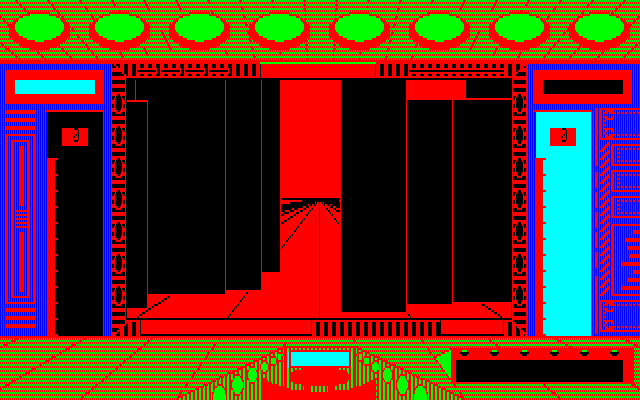
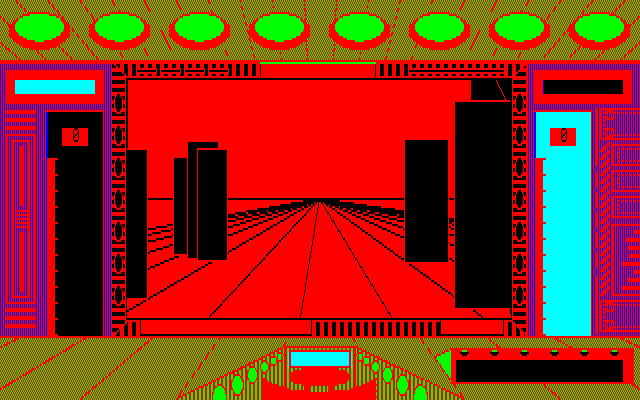
Moving forward here crashes into apparently nothing.
The goal, according to the manual, is to find a series of six rectangles that you shoot with the Revival Ray (powered by the Bluestone) and you’ll be able to escape. Oddly enough, it appears to be impossible to crash moving backwards, so the way to position yourself is to slide far to the right (past whatever hitboxes the game thinks are there, visible and invisible) and slide forward the right amount, then slide back into place. At least I think this is the strategy, as I haven’t found a single one of the rectangles, and this is with occasionally hitting the “speedup” key to keep the sluggish movement from being so sluggish.
I’m far past adventure territory so I can consider this one done. The cinematic ambition is impressive and I found the imagination of both “act 2” sections I experienced to be exciting, just janky and undercooked for BASIC source code on an ancient system. The “ship docking” section with giant monoliths made me think the author was trying to make cinema more than a game. Not only thinking of 2001 here, but the long special effect sections of Star Trek: The Motion Picture.
On my timeline of early Japanese adventure games, this technically lands somewhere in November of 1982, as the earliest ad that Rob found was in December of 1982.
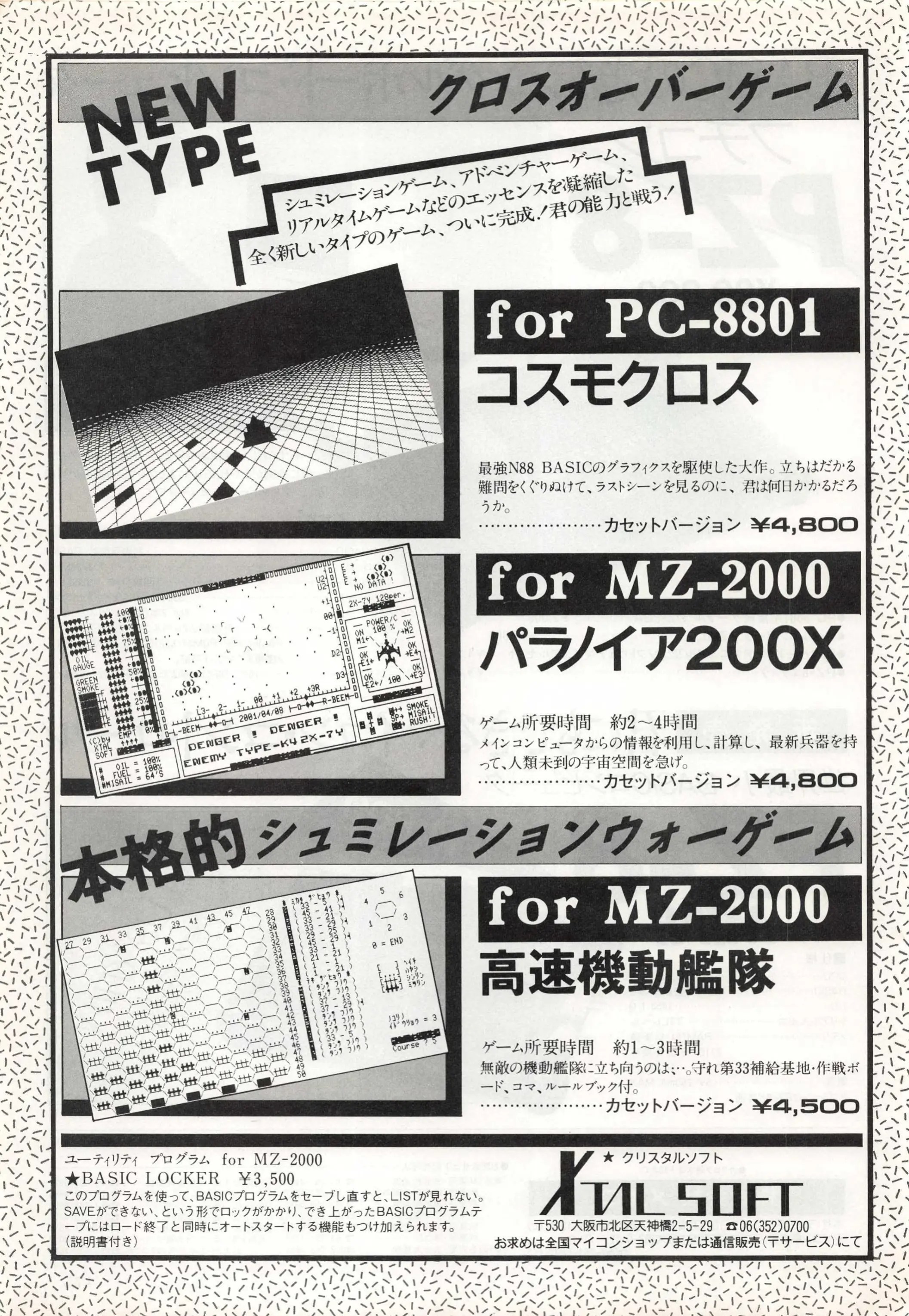
Given the by-hand local distribution early in Osaka, I’m inclined to think that month might bump back a little, after Mystery House II but before Diamond Adventure. However, other games (like Diamond Adventure) may have ended up in displays in local computer stores early as well, so for consistency I’ll place in November against the ones we’ve played:
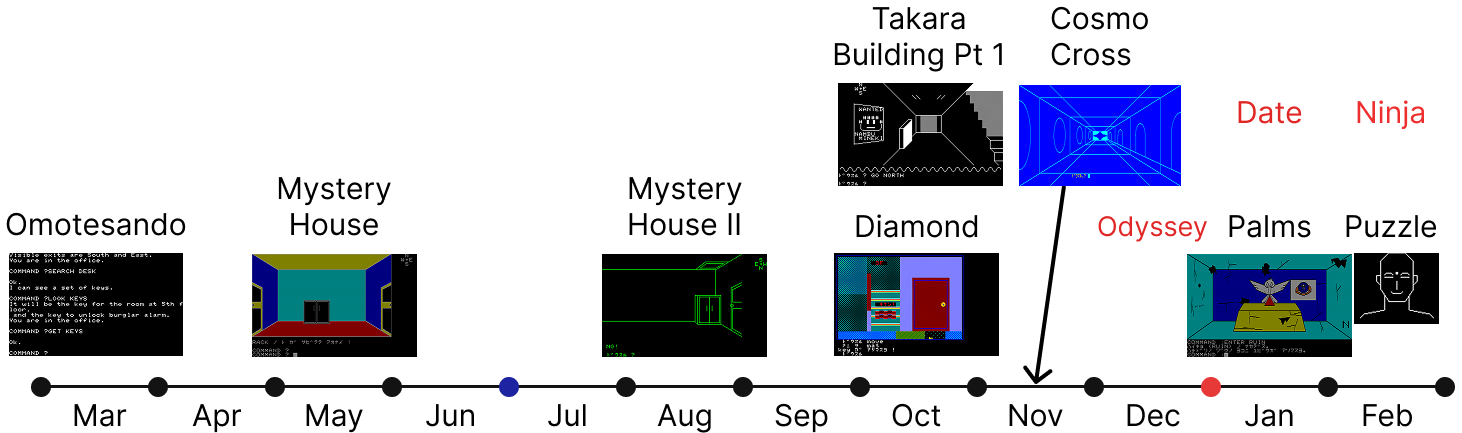
Xtal will return with more adventures, so if nothing else, this gives a preview of what their kind of thinking might lead to. There’s even a sequel to Cosmo Cross by the name of Grand Cross, sorted as “ADV/RPG” although I’ll worry about what sort of genre it really falls into once I get past 1983.


 Renga in Blue
It’s amazing that this super-weird and impenetrable game started a company instead of ending any attempts immediately.
Japan actually likes their games to be weird and impenetrable, at least they did in the early-to-mid 80’s, so it’s not too surprising.
I wonder why the password it gave you is different from the one I got? My password for Part-II was “VCN”.
The monoliths you’re looking for are the ones with a big red X written on the front. Get right up to next them and hit space bar to fire the Revival Ray. The bar that fills up every time you move isn’t a just a loading bar, its a radar. Each character that appears there represents a monolith in the direction you are facing, starting from furthest away and getting closer to your ship as it fills up. The space here is decidedly non-Euclidean, and moving backwards and forwards will cause some monoliths to blink in and out of existence… I’m not sure I ever figured out its principles properly. Finding a safe way forward isn’t too difficult. If moving forward will crash the ship there will be a DANGER warning up top, just move to the left or right until it goes away. Going left, right or back will never crash the ship… at least, it never happened to me. The arrow that appears when you press F1 is sort of a compass, it points towards the center of the mass of monoliths. The arrangement, size and shape of the monoliths are completely randomized each time, and my first attempt was thwarted because I couldn’t line a shot up with the final monolith no matter what angle I approached it from, so I had to restart from outer space again. Doing this section without speeding up the CPU takes about 2 hours… obviously I would NOT recommend doing it that way!
At any rate, you’ve already seen nearly everything the game has to offer, so no harm in leaving it here. The ending is about as brief and underwhelming as you’d expect for a game from this era, and you’d have to go through absolute hell to reach it. It’s not worth it even for historical curiosity. But I’m worried you might have opened Pandora’s box here? If a game containing adventure elements is enough to make the blog, don’t you need to cover The Dragon & The Princess now too for consistency’s sake? The town in Koei’s Dungeon plays like a text adventure, would you have to cover that as well?
Generally speaking, any RPGs stay in RPG-land (I have excluded Eamon, for instance, even though they are wholly “text adventure” format and parser and so forth – it isn’t just the format being similar to adventures, it’s the gameplay type. Even if a “puzzle” gets tossed in Eamon I spend about 95% of my time thinking about what spells to cast and juggling stats and potions and monster health points and so forth.)
I will do some borderline things for fun anyway (PRISM isn’t any of those categories, for instance). I think the main factor with Cosmo Cross’s brief adventure section is that it could be separated out entirely from the sim-parts and be an adventure game on its own.
I do have a some more weird hybrids to look at, including some from England, it wasn’t just in Japanese games.
If I remember correctly, it generates a password at random and POKEs it into memory at a specific place, then PEEKs it back out in the next part and compares it to what you typed.
one extra question:
one game I do consider an adventure is The Old Village Story (Enix, PC-88/98). It’s top down perspective so it feels it ought to be like Ys but there’s no xp or whatnot, it’s conversation and story and finding items
Are there any other games like this?
Hmm, interesting question. Well, a few Japanese menu-driven adventures with some movement/exploration via overhead map started appearing in the mid ’80s, like Karuizawa Yūkai Annai, Yanpara Adventure and Asteka II, and it quickly spread to the Famicom, where numerous adventures included those elements, but I wouldn’t say that’s exactly the same thing as Old Village Story.
The closest analogies (mainly overhead view, heavily dialogue-based, etc.) woukd probably be stuff like Harry Fox: MSX Special, Shalom: Knightmare III and Pro Yakyū? Satsujin Jiken!.
Those are all mid/late ’80s though, so the only thing I can think of that would have any relevance to you right now would be Adventure in Hakata by Union Planning/Riverhill Soft, from 1983. It’s a weird overhead semi-randomized thing, but I’m not sure you’d really call it an adventure. It’s on the Retro AVG Kouryaku site though, so you can check it out and see what you think.
if nothing else, Adventure in Hakata is probably worth a look for being Rika Suzuki’s first game
Dreamweb is a top-down pure adventure, but it’s from 1994 and not Japanese, so I’m not sure if that’s what you meant.