The company for today’s game, confusingly, goes by X’TAL SOFT, XTAL SOFT, or CRYSTAL SOFT depending on what document you are looking at. At least the title of the game is straightforward:
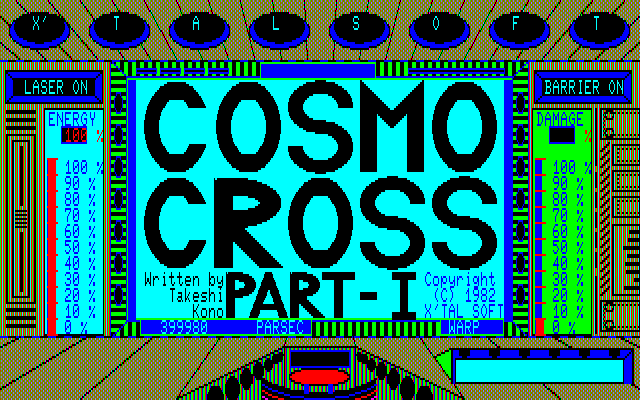
Except for the “Part-I”, thing, but that’s not part of the title; the game was sold as one whole but the three different parts are accessible with different passwords. Part-I is reached with XTAL.
The founding president, Yoshiyuki Morita, was a music fan in high school (along with Takeshi Kono, who he discussed rock and guitars with) and after graduating from university he founded the music studio “SKY SOUND” in Osaka. I found a 1982 recording from the studio, if you want to hear what sort of work they did:
In 1980, he saw a PC-8001 in Nipponbashi (aka “Den Den Town”, the second big electronics haven in Japan after Akihabara), and bought a MZ-80B for his studio “under the guise” of customer management.

Den Den Town in the 1980s. Via @carllin117464 on Twitter.
He found the management software terrible and learned programming by modifying it to be usable. This experience gave him enough of a taste of software development he wanted to work on his own. Because of the tape-based nature of computers at this time, it was not that unusual to switch from music to games; he founded Xtal Soft in April 1982 and the company’s first product (Cosmo Cross) was written by his old acquaintance Takeshi Kono, who left his job to join. Initial copies were made manually for the local Osaka area, one by one.
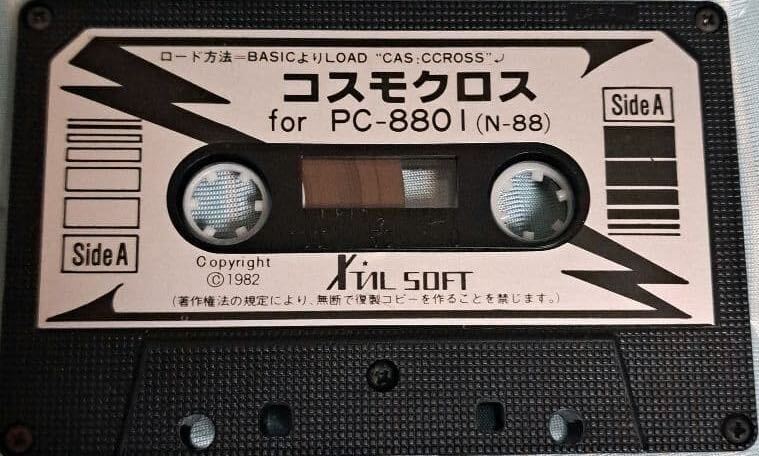
Cosmo Cross eventually sold a solid 10,000 tapes and was enough to kickstart the company to life, although where they really established their credibility was the RPG Mugen no Shinzou (translated either as “Heart of Fantasy” or “Heart of Illusion”). Quoting the composer Chihiro Fujioka (who had joined the company in 1983), the game was “a bit hard to explain” and they were “anxious about whether it would actually sell” but “the game decided the fate of Crystal Soft.”
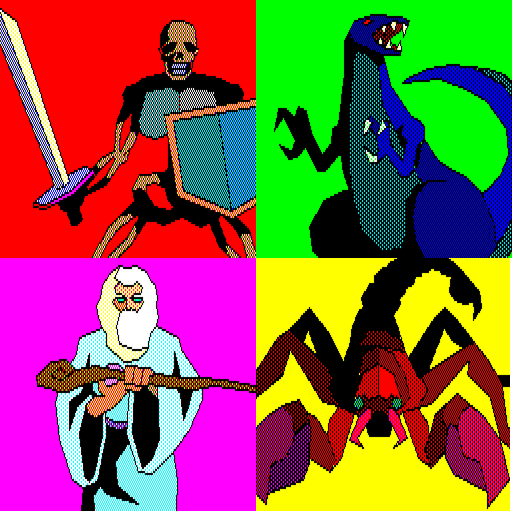
It’s similar to Ultima but with giant character pictures on encounters. Images from Hardcore Gaming 101.
While they have multiple early adventures, they became mostly known for their RPGs; both Lizard and Crimson are available to play on Switch (Japanese language only, they never sold in English). Noteworthy is that the music for Crimson includes Sky Sound in the credits so they were still operating the same time as the software company.
For the purposes of today’s game specifically, I want to jump ahead a bit to 1990: Xtal Soft does a merger with T&E Soft, the latter most famous for the seminal RPG Hydlide. Takeshi Kono is still around as a game director. Mitsuto Nagashima is hired right before the merger as a programmer; his first project is the Japan-only (and technically impressive) vertical shooter Chikyuu Kaihou Gun ZAS…
…which he follows up with a game for Virtual Boy, one of the most famous for the system: Red Alarm. While Mitsuto Nagashima wore quite a few hats, according to an interview…
I was in charge of the game’s content, balance, enemy positions, and even parts of the story.
…the director of the game was Takeshi Kono, the author of Cosmo Cross.
ASIDE: Of the two top videos on Youtube, one calls it one of the very best Virtual Boy games and one calls it the worst. The reactions seem dependent on how people are able to handle the wireframe graphics, and this may be a case where the 3D looks different to different brains. Gunpei Yokoi, designer of the Virtual Boy, is quoted as saying, “when playing, you completely forget it’s all just lines” but that clearly wasn’t true for everyone. Digging into the Youtube comments: “in the actual game, it [the wireframe design] can actually make it difficult to focus your eyes because there is no surface to focus to.”
Cosmo Cross is part space shooter, part adventure game. It was originally for PC-88 (the version I’m playing) and later got a Sharp X1 port. It isn’t quite like Probe One: The Transmitter with both running simultaneously forcing the player to leap between joystick and keyboard rapidly; a better comparison is The Desecration, which switches between “arcade segment” and “adventure segment”. The Desecration’s arrangement is:
adventure – action – adventure – action – adventure – action
while Cosmo Cross instead goes:
action (in space) – adventure – action (in space) – action – action (in space) – action
(I’m basing this off both the manual which describes Act 2 of Part I as “kind of an adventure”, but also the guide from a 1984 issue of Oh! MZ. “Action” is more like “simulation” but I’m being handwavy here.)
There’s hence only a little adventure going on, but it’s unusual and early enough in Japanese adventure history to be worth a play even if I skip by the other parts. The problem is getting to it! I spent a long time deciphering what was going on with Part I Act 1.
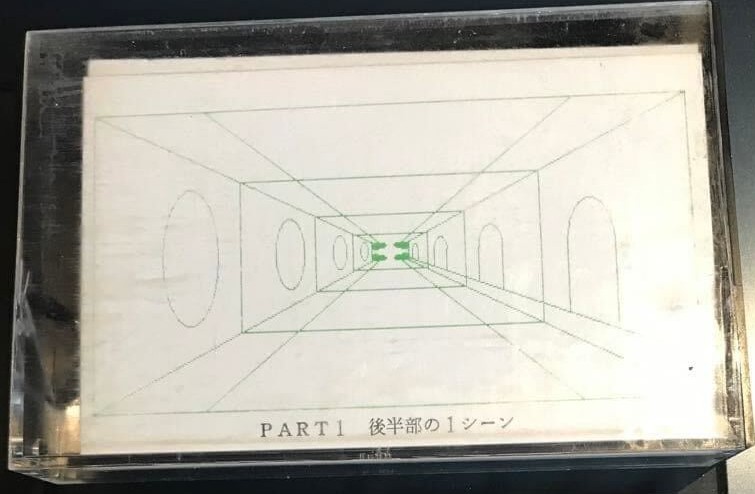
The game came with “instruction cards” showing each of the scenes. This is a scene from the “adventure” part of the game.
Plot: in the year 259 on the Octam calendar, humanity was expanding their space colonies, and started to have constant battles with the Zagros. While most humans had moved from Earth, they still regarded it with fondness, and so the Zagros came up with an evil plan: tamper with a device installed by ancient aliens — intended to keep planets stable — to instead fling a planet into Earth and destroy it.
Humanity pooled their resources to build a single spaceship, the Saint Cosmo, piloted by… you! Your mission is to
a.) fly to the “clear blue” planet of Ariosferia (アリオスフェリア) to retrieve a Bluestone (ブルーストーンを); note that “the Zagros have anticipated this and have set many traps on Ariosferia.”
b.) use that Bluestone to power a “Revival Ray” and fix the sabotaged planetary-stability unit.
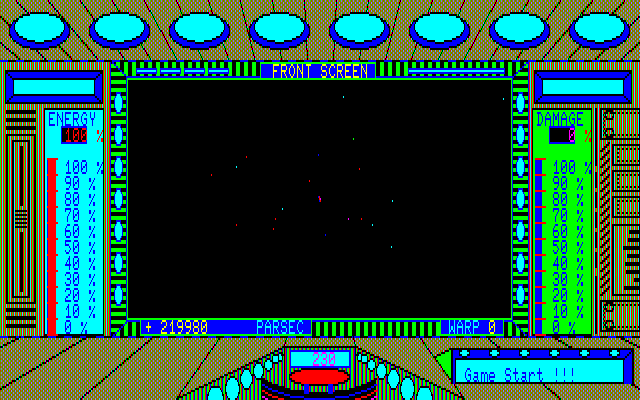
There’s a lot of keys going on; there’s a summary here and the more full manual text here. The big issue is that there are three kinds of steering:
◆ The number pad is used to generally change which direction your ship is pointing at.
◆ While floating in space with no enemies, you can press up plus a number (1 through 4) to activate Warp at different speeds. You can backwards-Warp by pressing down and a number.
◆ You can press F1 to activate a laser (F2 to turn it off); then holding down arrow keys will move a “crosshair” around. You cannot do any other kind of movement with the laser on.
I often was befuddled trying to rapidly switch from one to another, and since any kind of stalling can result in being attacked by ships, the result of pressing F2 a little too slow for the umpteenth time can be deadly.
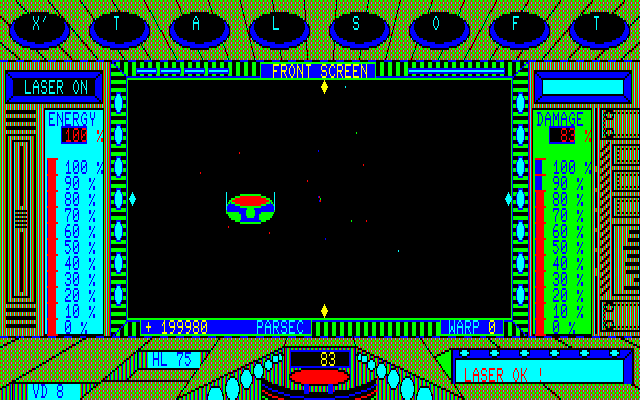
Facing a Zagros ship, with the laser active.
There’s also a “barrier” that the player can activate with F3 (and turn off with F4) which will absorb some enemy shots; there’s a lot of details and rules about what you can do with particular amounts of enemy damage (like reduced warp) but the important points are that killing an enemy gains you 30% energy, and in general if you start to get serious damage (past about 50%) it is almost inevitable that you are going to die.
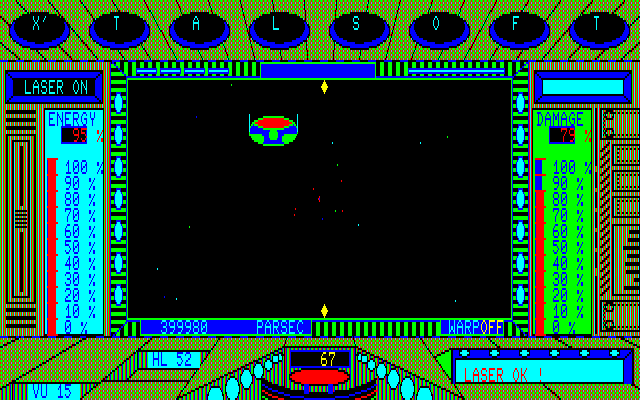
Suffering major damage. Notice that the laser crosshairs no longer show on the right and left side; this is one of the results of the damage.
The numbers in the bottom left corner end up being important.
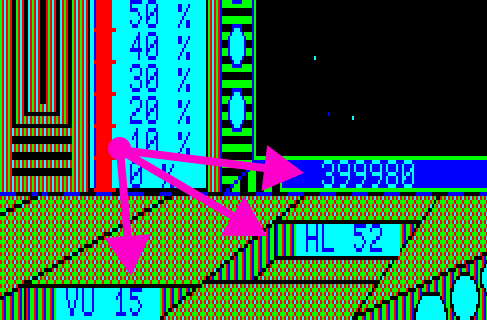
VU and HL refer to how far off you are from an enemy vertically and horizontally. If you get these numbers down to 0 you are dead center and your shot will automatically kill. (You can still cause damage and eventually kill if you aren’t direct on center.) These become super important later (in a section I haven’t reached yet, and will probably decline to play) when there are invisible enemy ships to contend with.
The PARSEC display indicates shows how close you are to the destination planets. There’s a whole set of planets off in the distance you can try to get closer and closer to, and you point to the right one with your number pad movement; if you aren’t pointing at any planet, the display saying 0 PARSEC will be black space. You need to be pointing directly at a planet to see it at 0, and the goal of each of the space sections is to fly to the correct planet.
Ariosferia (the initial goal) is the clear blue one as the instructions say; later sections apparently can have the colors change when up closer.
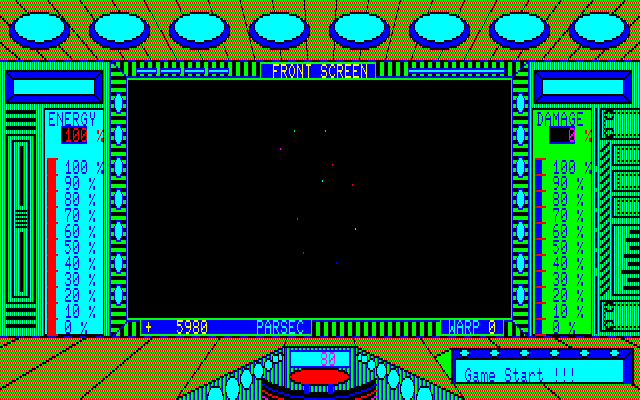
Closer to the planets, close enough that if you try warp speed 4 you’ll overshoot and the game will automatically switch to rear camera and you’ll need to use warp backwards. The blue one is in the lower right. It’s not true 3D space and you’re essentially on a “track” like the one in Red Alarm or Star Fox, just the way you point your ship matters when you get up to the <2000 parsec range.
I found this section extremely frustrating to play. You start almost like a game of Lunar Lander where you’re just watching a number (the PARSEC count) in the corner, first holding up and Warp speed 4 and watching the counter tick down, then switching at the right moment to warp 3, 2, and 1 as you get closer and closer. Somewhere along the line you need to stop and steer, and that’s when an enemy will almost definitely appear (they can catch you at low warp, but it’s less likely).
The big problem is that often ships will appear in a position like this…
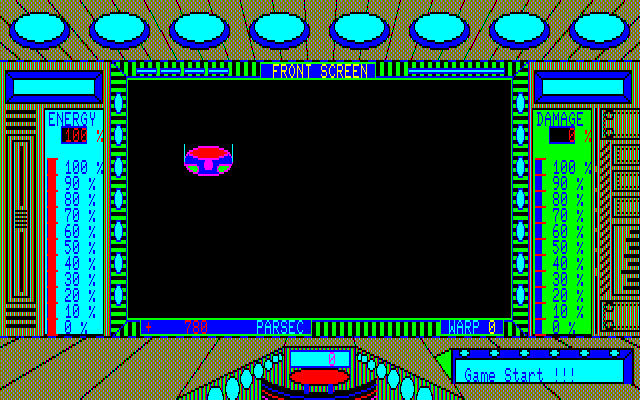
…and the laser is very slow at moving. (You can’t do number-pad steering in combat.) You can take many hits just from moving to shooting position. Here’s a battle (with the barrier shields off) that went relatively lucky; often the ships aren’t as well behaved and you need to adjust multiple times:
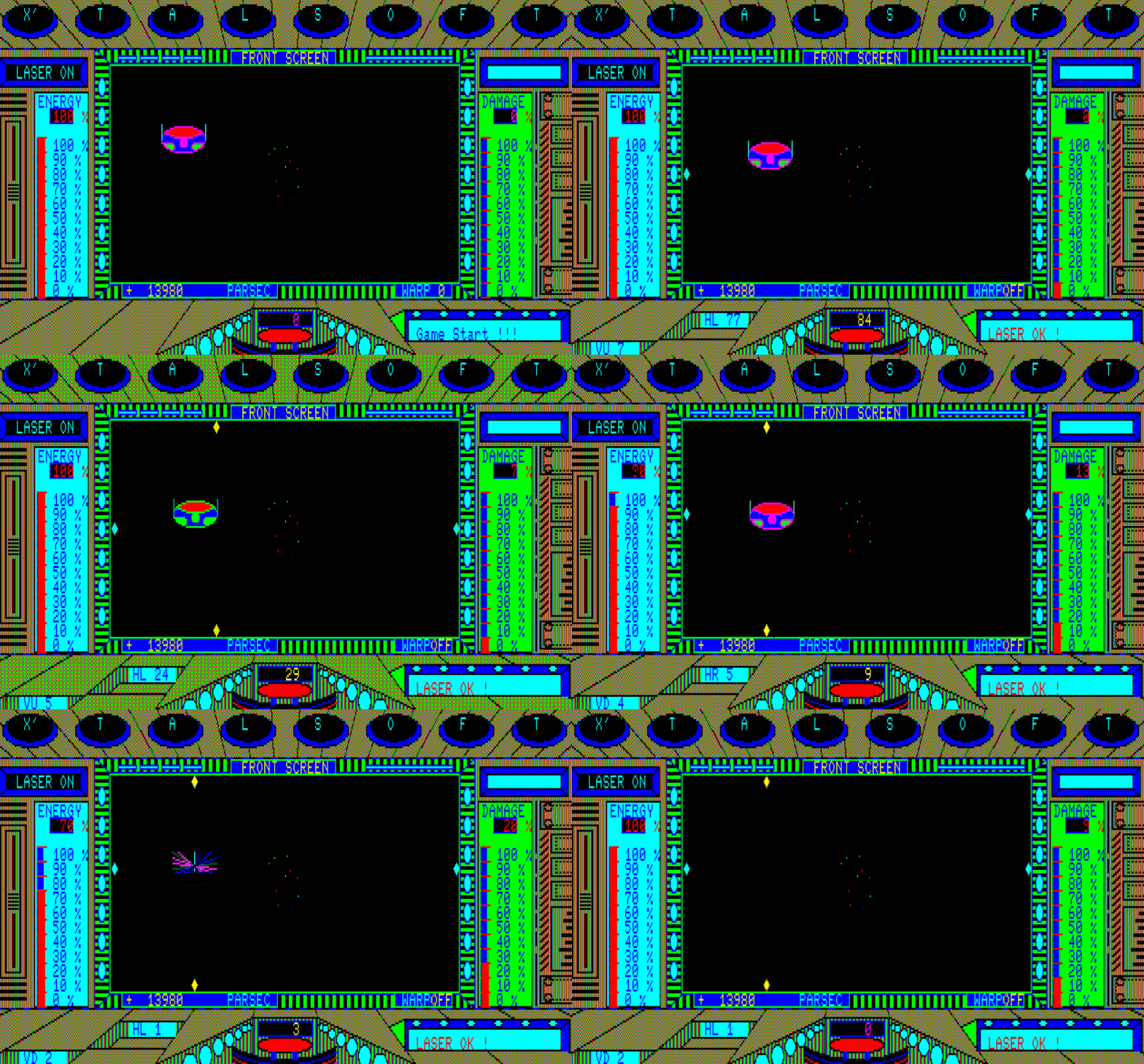
I constantly found myself in a situation where I would sustain rapid-fire from an enemy ship and even with my attempt at moving the laser over as “fast” as possible eventually I just would die.
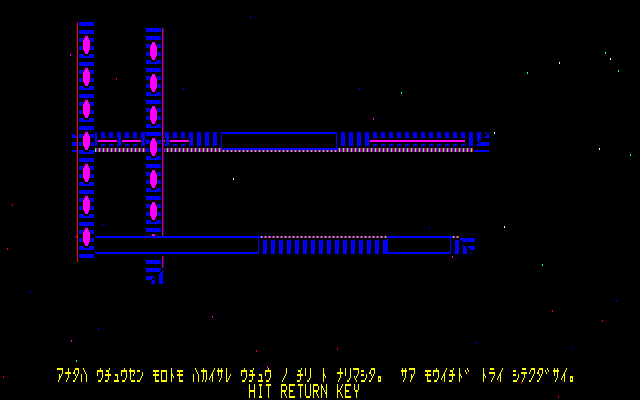
I finally threw in the towel, as this is All the Adventures, not All the Space Simulators. I have here a video of the game played on Sharp X1 cued to start right at “0 PARSECS” with the planet in view. Once pointed the right direction, your ship will enter orbit and you press F5 to activate the next section of the game.
The video above keeps going into the adventure part but does not finish it. Things get a bit complicated so I’m going to wait on delving into there next time. (The game is in BASIC, and I have a setup from gschmidl that will skip straight to the adventure.) I will try a few more jabs at the space combat, but unless I’m missing something I’ll say finding the Bluestone will stay as my ultimate goal, because I really don’t want to deal with shooting down invisible enemies in space.


 Renga in Blue
I’ve completed the game and I never ran into any invisible enemies. I think you snagged some misinformation or more likely a mistranslation there. The difficult part is that you need to travel 800000 parsecs while enemies appear more frequently and fire more aggressively. It basically comes down to RNG on where the enemy first appears on screen; if it shows up in a corner then it will probably tear through your barrier before you can even align the crosshairs on him. The second section of part 3 is just the brief ending sequence, so to modify your diagram a bit it should look like:
action (in space) – adventure – action (in space) – FPS puzzle/exploration – action (in space) – END
I would say that you should try to get through Part 2 if you can. The second half of Part 2, and especially the transition between them, is something that absolutely needs to be seen to the be believed… in both the good and bad senses of the phrase. No one would blame you for skipping the final part, I can even tell you what happens in the ending if you wish.
XTAL SOFT and CRYSTAL SOFT are both pronounced the same way and thus look the same in katakana, in case there was any confusion there. They are really one of the great unsung heroes of Japanese CRPGs if you ask me. Fantasian was one of the first big-sellers in the genre, one that helped spread awareness of RPGs in Japan, along with The Black Onyx, of course. Lizard and its sequel Aspic are the only *original* RPGs ever to be made for the PC-6001. Mugen no Shinzou was created by a guy named Kazunari Tomi, who would later found Studio Alex, the studio that developed the Lunar series of RPGs for Game Arts. When Dragon Quest first came out on the Famicom, many computer gamers at the time actually wrote it off/belittled it as a ripoff of Mugen no Shinzou II! While there are certainly parallels and similarities between the two games, nothing comes anywhere close to actual “ripoff” territory IMO. Crimson II followed the same story structure as Dragon Quest IV, where you follow the story of individual heroes in the beginning chapters, and all these characters come together in the final chapter to form a party, but Crimson II came out a year before DQ4. (Of course, this story structure was likely inspired by the Japanese epic novel Satomi Hakkenden, which itself took inspiration from The Water Margin…)
One annoying thing is that there doesn’t seem to be a dump of the sequel to this game, Grand Cross, anywhere online. It IS available for puchase at Project EGG, since D4 Enterprises was basically Frankensteined together from the corpses of Bothtec and T&E Soft and therefore owns the entirety of Xtalsoft’s catalog, but I don’t really feel like subscribing to a monthly service just to play one game that I’ll probably finish in a few days and never touch again…
I guess the idea is that the X in Xtal is pronounced as in Xmas for Christmas? (Apologies if that didn’t need spelling out.)
“xtal” is how I’ve seen diodes indicated in really old radio wiring diagrams.
As far as I know, neither “Cross” game is available through Project EGG.
There were a number of other original RPGs for the PC-6001, but they’re all type-ins.
Do either of you know what the “deal” is in Grand Cross? (is it alternating ADV/RPG, some more integrated type of hybrid, etc.?)
No promises on the later sections, the first one was painful enough. I will at least try out space combat number 2 though.
From everything I’ve seen, Grand Cross is played through all the same way, rather than in alternating sections like Cosmo. It’s more like a 3D maze game with minor RPG elements (combat, energy level, etc.) and item-based adventure puzzles via command line. One interesting thing is that it actually seems to have a “realistic” inventory system, where you can only hold two items at a time, one in each hand.
Pingback: Cosmo Cross: Don’t Look Behind You | Renga in Blue