(Continued from my previous posts.)
Curses, foiled again!
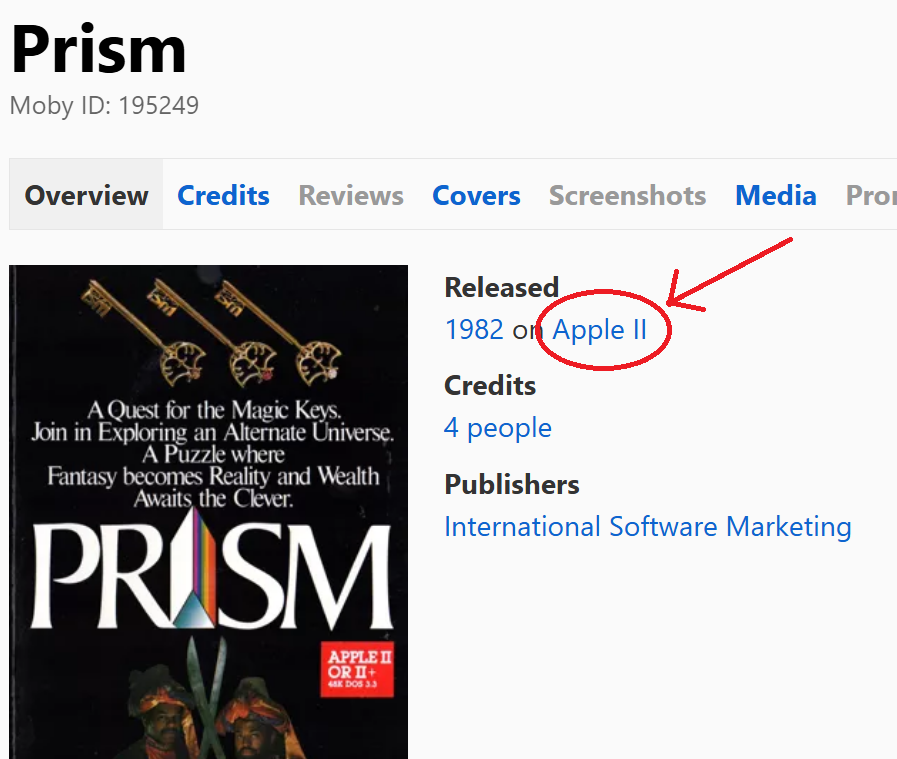
The review that mentions PRISM (Creative Computing, May 1983) only lists the game for Apple II, and PRISM barely got any mentions later, so I didn’t even think about a second port until Atarimania asked in the comments about it. To be fair, that version is rare enough it gets a perfect 10 from its Atarimania listing. Given there are three eBay listings of the Apple II version right now as of this writing (one, two, three) I think it likely the Atari version didn’t sell as well.
After some emulator issues I did get the game to work, and there are enough differences it’s worth downloading the set if you’re trying to work out PRISM in earnest. For now, I’m going to put all the art-screenshots (but not the text-screenshots, which you can find in the file if you want to delve for cryptograms or whatnot).
Just to make clear what I mean by differences, here’s the first screen of the Apple version…
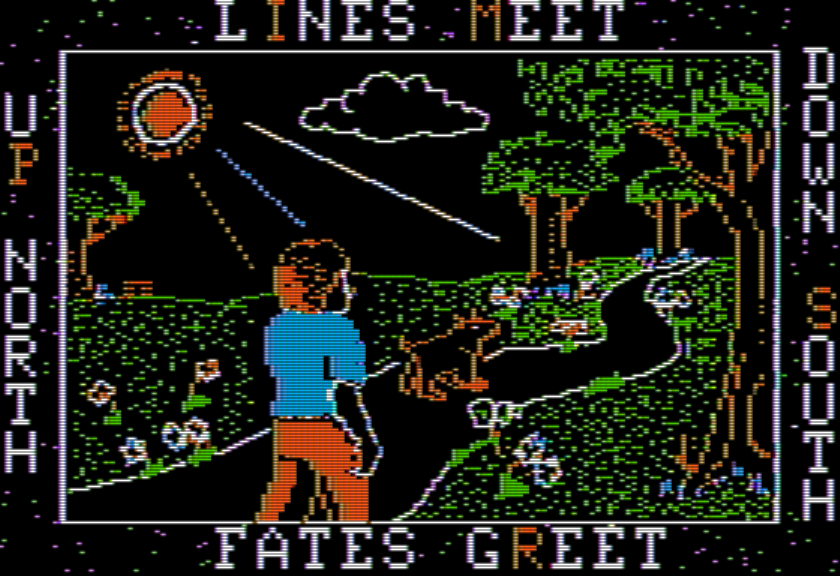
…and the first of the Atari version.
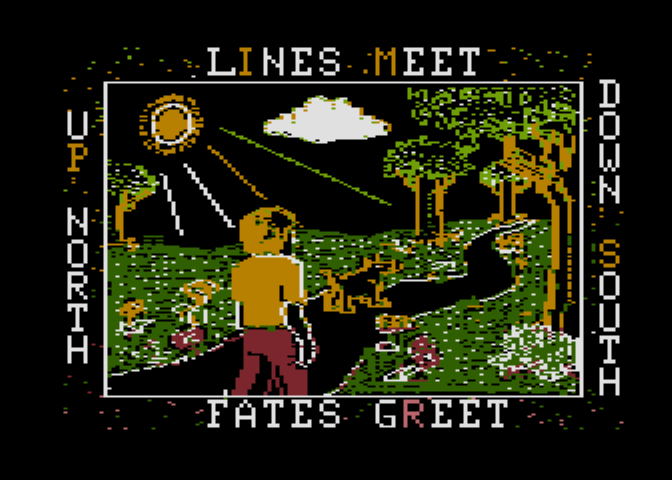
PIMS are a different color than the R, which is not the case for the Apple II version. I had been thinking of the exact colors of the letters as highly significant, but maybe not. (Or the puzzle is broken on one platform but not the other!)
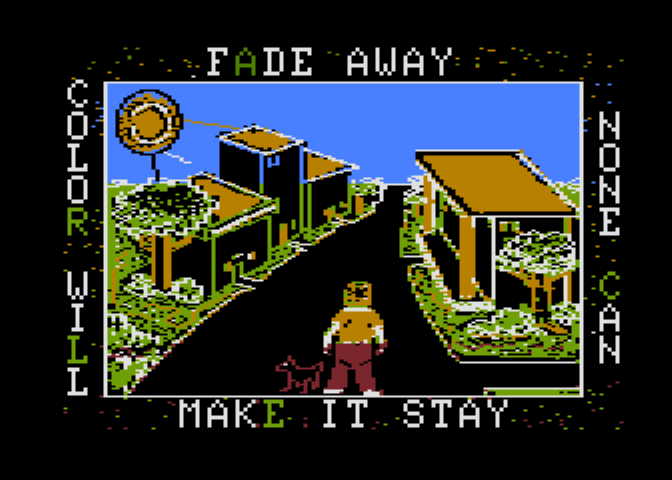
Here’s the remainder of the images, including a brand-new image for Atari (you’ll know it when you see it).
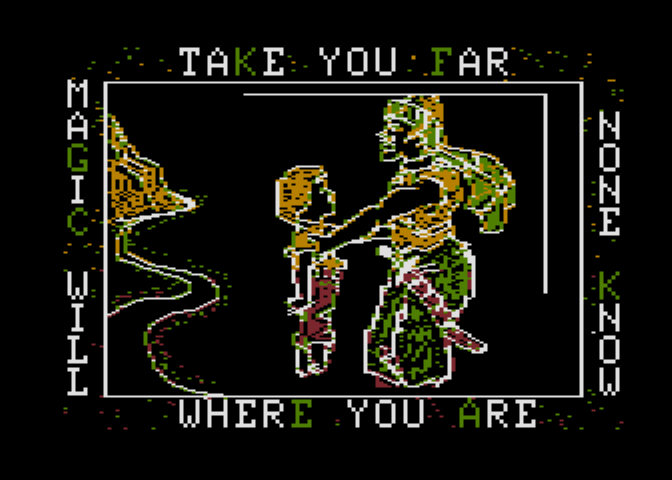
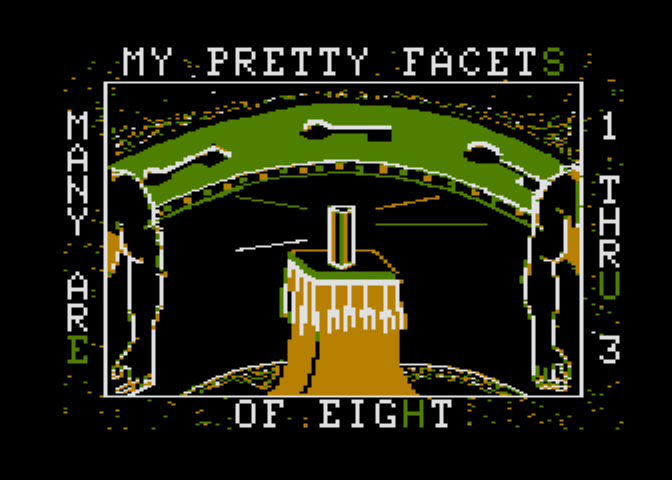
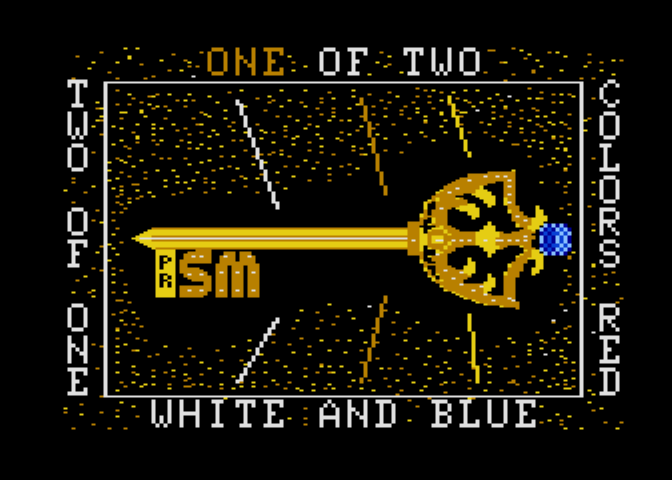
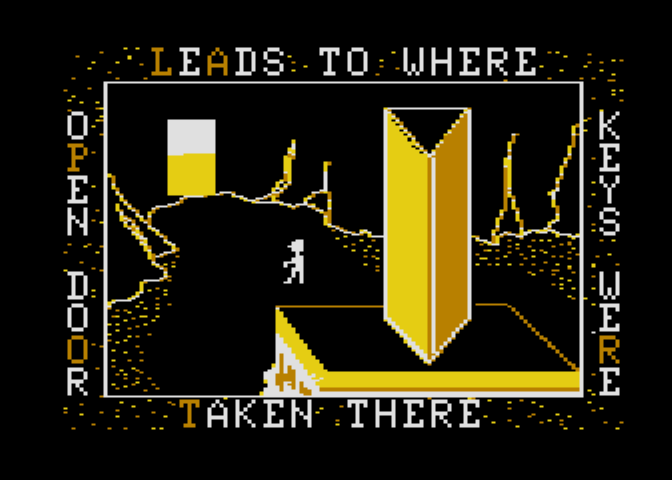
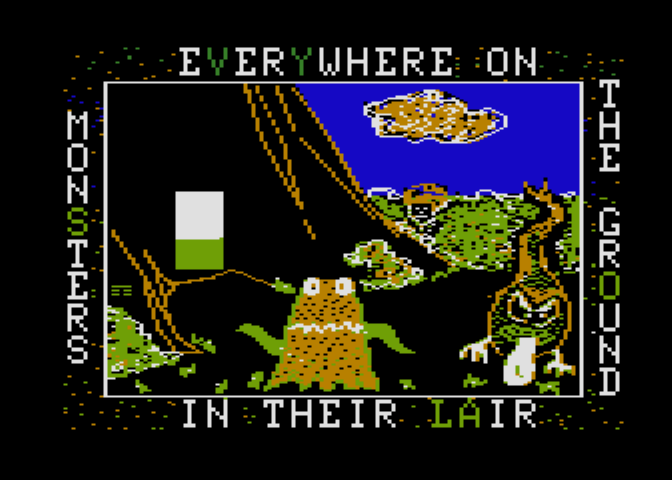

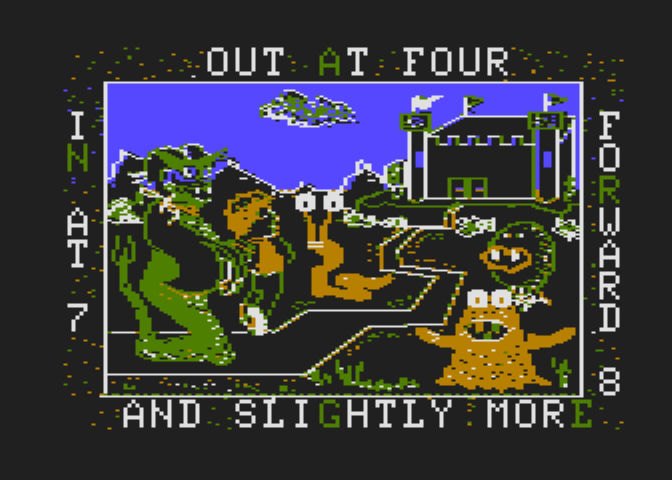
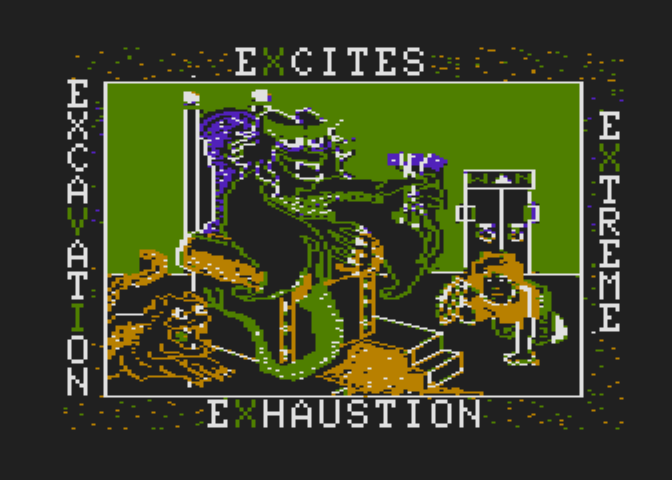

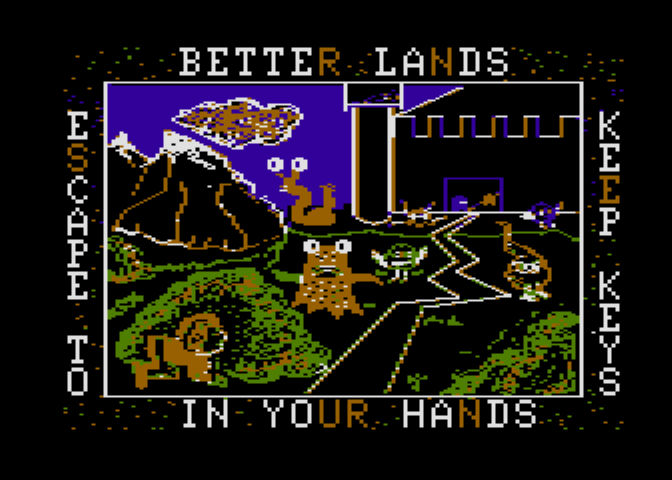
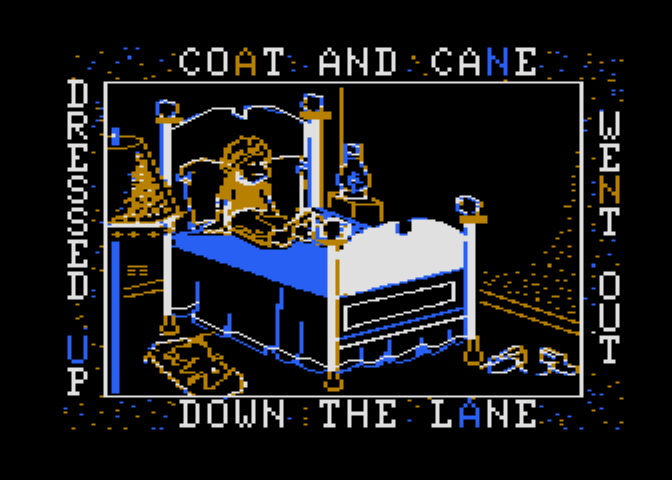
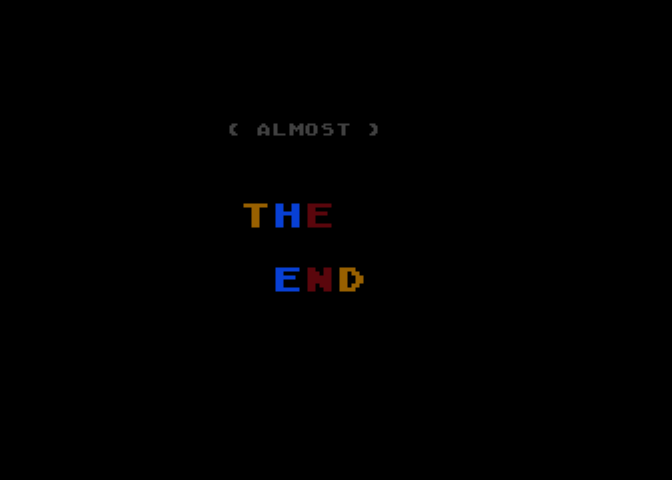
One last observation is the sound is different. The opening of the Atari version has a better melody, and there’s no “random music” going on at the XXXVI picture.
If nothing else, this clears up the squinting I was doing at some of the Apple II screens trying to see if the “noise” meant anything (that doesn’t even appear in the Atari shots). I don’t know what to think about the color changes. Look at the tree: it’s TRE + T now! If you consider just the blue letters, you get T from that page plus UNA from the last page. The only time red appears is the “R” at the start.
Coming up: some TRS-80 Color Computer games which should hopefully be less trouble!


 Renga in Blue
A “game” full of riddles is not, definitely, my definition of fun. Congrats on solving them!
One thing I noticed about the miscolored letter: Notice how, in that picture, there’s no red above the kid’s waist, and no yellow below it. I don’t think that’s meant as a clue; I think it’s a technical shortcoming… It looks like in this video mode, there are only four simultaneous possible colors (i.e. black, white, green, yellow/red), and it’s using a scanline interrupt to swap the fourth one partway through drawing the image. You can see them doing the exact same trick in the next two images once you’re looking for it (in fact, “color will fade away” does it twice, swapping from blue+yellow in the sky to green+yellow above the kid’s pants, and green+red beyond there). So it’s possible that whoever ported it was so busy thinking about how to sneak extra colors into the art, that it didn’t occur to them that it would interfere with the color of the letters in the borders as well?
so because the right T at the tree is at the height of the blue sky, it ended up being blue?
Exactly, yeah.
As I don’t want to become a crazy treasure seeking obsessed maniac, I’ll more more thoughts here and leave it to someone else to run around America hunting for the keys.
Using the XXXVI “clue” to be a Northings reference of 36, almost exactly along this line is a town called “Wagon Mound”. If we follow the I25 south we can see the town of Truth and Consequences which Matt W. mentioned in a previous post. Going North, about the same distance away we come to Denver which has lots of roads meeting (lines meet). Around Wagon Mound are several hills. Making a massive leap at this point – If we overlay the 4 pictures which contain the I-ching trigrams and hexagram, the three trigrams form a line which sort of follows the shape of Wagon Mound and the hexagram appears to be on top of a place called Mound MoJ.
Now I can’t find anything else to fit the above and even Nicholas Cage would probably question this if he saw it in a script but it’s all I got.
Good luck to everyone else.
I wonder if this new knowledge means that everything I decided to focus on is effectively a red herring. The coloring change would be a serious error if it had an effect on things, nobody who has the Atari version would be able to solve it. In which case the “Magic Will” picture requires us to factor in gibberish somehow.
The other part is that if you look at the text and compare it to the Apple II version, this throws out the theory that what’s on an individual page and the downward reading of letters is of importance. Both are significantly changed between versions. Even the spacing. That’s not to say the text still can’t be important.
Incidentally, the Prism on the key in the “one” image no longer has color. None of us were really focused on that, just pointing it out.
I would also guess (based on the fact the Atari had to “de-color” some things) that the Atari version came second, so that means it’s technically the “revised” version and might actually be the “improved” version in a clue sense. I do think the best thing to do is pitch considering any inconsistent elements.
The I Ching elements do look close to the same, at least.
Yes, the Atari version is a port and insanely rare. The graphics are in one of the standard modes limited to four colors with no extra tricks used so anything missing from the Apple original is probably of no importance. Do make sure you are running the game in NTSC mode and not using PAL as colors may be different.
screenshots are NTSC
it appears there was also have been an IBM-PC port. on page 93 (as numbered) of PC Mag 1982 volume 12 is an ad for software “For the IBM-PC Exclusively”, and in addition to ISM’s Graphmagic and Mathemagic, under “Games” it lists: “Prism — A Storydisk (win 3 keys worth $40,000) — $19.00”.
possibly it is the same version that the internet archive has listed as a CP/M version of PRISM — however i have not had any luck getting anything to understand this disk image. this upload has raw track data in kryoflux format, but i dont have kryoflux, so couldnt explore those.