(Continued from a post from a year ago. You should probably read that post before this one.)
While I occasionally reach a videogame in the All the Adventures project which is famous enough to have existing interviews and memoirs to pull from (like The Hobbit and The Dark Crystal) oftentimes I have very little to start with. Even when an author gets some attention from later work they may never talk about their adventure game output (like with Stuart Marks’s biography pretending that Pillage Village didn’t exist).
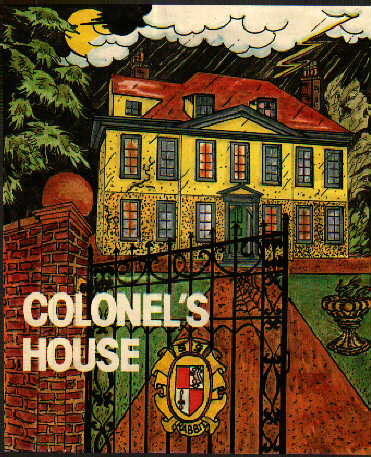
Via Everygamegoing.
Hence I was gratified when the author of The Colonel’s House (Rob Davis, 14 when he wrote the game) contacted me and not only was he willing to do an interview, he remembered this era well.
The first computer I experienced was a ZX-81 that my Maths teacher showed in the school staff room. I was immediately massively inspired by seeing it, and requested one for my birthday. I learnt to program BASIC on the ZX-81, and very quickly outgrew it and bought a VIC-20 where I continued to program BASIC and learnt Assembler.
Rob Davis first had contact with adventure games via a visit to a friend’s house; they had an Apple II and were playing Mission: Asteroid, “a really early graphic adventure that I remember involving a spaceship, and you had to work out which buttons to press on a very simple spaceship control panel, and it was a text adventure, but it was graphics, and I found that really exciting.”
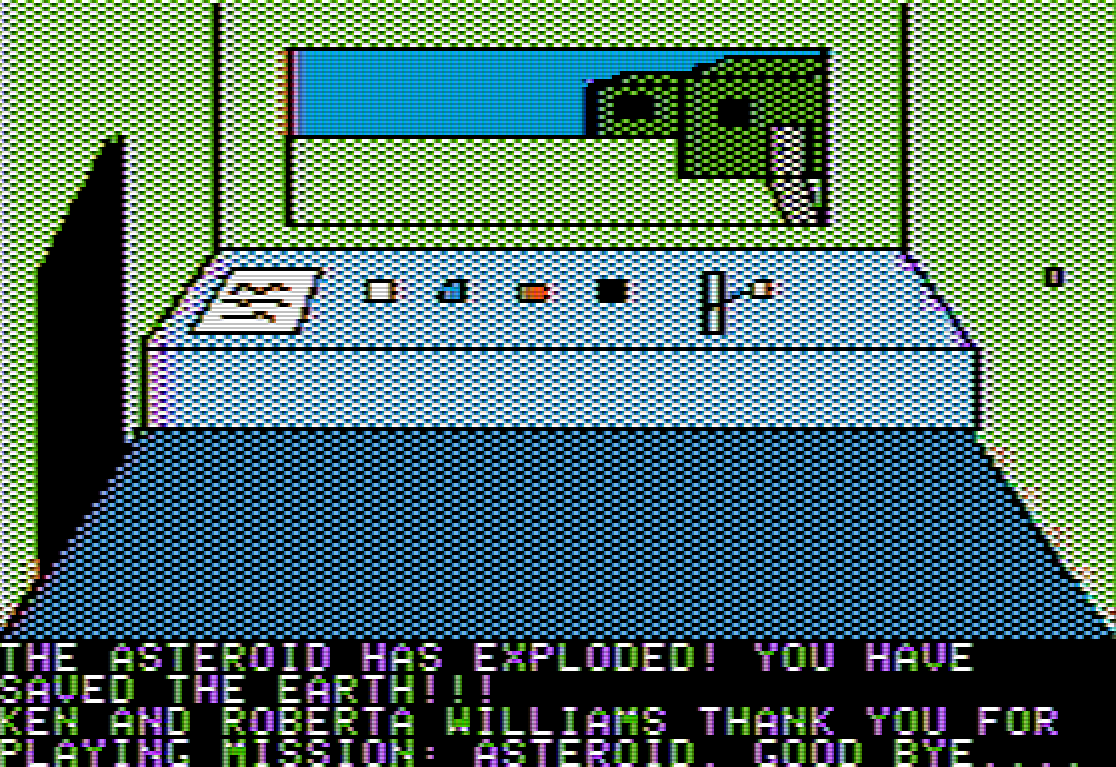
He also had exposure to Mystery House (more on that in a moment) but otherwise this brief visit was his only exposure to adventure games (he played lots of games, “especially Jeff Minter ones”, but not adventures); that was enough to make him want to write his own.
I was just doing it in my own from my own inspiration it was just really that one game and really just one hour with that game that was the starting point for me.
He had no exposure to Crowther/Woods Adventure, or Scott Adams, or any of the VIC-20 adventure games coming out at this time.
I did it from scratch. I had read books about coding, but no, I had no guide to making adventure games or anything. I just started and I worked out how to build the engine for the adventure game, which was an engine that was able to kind of store room state, store player state, parse language, render rooms and react to your movements across the rooms and react to the objects changing state and all those kinds of things. So I wrote the engine for that from scratch from my own understanding of coding.
His VIC-20 had memory expansion; he wrote one game as a proof of concept (“a small map and was set on a desert island”) before writing The Colonel’s House.
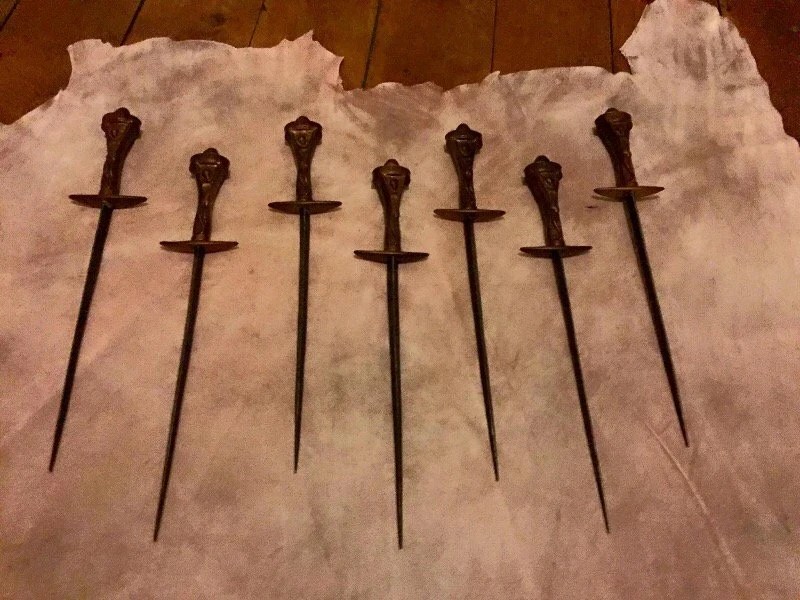
More than games, I was inspired by the Omen movies on TV at that time, which had a set of seven daggers forged to kill the Antichrist.
He’s referring to The Seven Daggers of Megiddo. They are named after the seven churches from Revelation, and each one needs to be placed at a different point of the body to kill the Antichrist.
The Colonel’s House was a “private game” to just share with friends. Sometime after this, he had gone to a computer game show in London, where he found Rabbit Software, and the topic of his game came up:
I got talking to them, and they asked me to send them a tape of my game. I wasn’t going to send it, but a school friend persuaded me that I should, and Rabbit immediately offered to publish it.
They were “chaotic” and actually released the game without telling Davis; a school friend had said they’d seen it at a game store. Rob didn’t believe him but his friend offered to buy a copy.
That was also the first time I saw the cover art, which I didn’t approve at the time, though in hindsight it was OK.
I was able to discuss the content of the game a bit; he had a scene (which I didn’t hit while playing) where you can fall out a window; you’ll be alive, get picked up by an ambulance, but then the ambulance will get in a wreck on the way to the hospital and you’ll die. This comes directly from a death in Mystery House (when you leave the attic). Regarding the amount of the death the game has in general:
I mean, I’m casting myself back now to when I was 14, but I’m not sure that I would know mechanically how I wanted to treat players who had done something unwanted and kind of you know failed in one of the puzzles; like probably death was the only way to handle that. How do you cover the cases of the different failures of the puzzle? That might have been a complexity that I wasn’t sure what to do with … therefore game over seems like quite a kind of neat way to wrap up whatever kind of sequences of actions that haven’t got them (the player) to the right solution.
He did indeed have a grand plan for seven games total:
I had planned to make 7 adventure games, each to recover a different one of the 7 Knives of Eternity. The lore was that the knives were extremely powerful and when joined together, gave the holder ultimate powers. They had been hidden distributed throughout time and space for safety, but their locations had been compromised and others were seeking them. You were an agent who had to recover them and destroy them for good. I did complete the 2nd game, Escape from Detra Five, which had a knife hidden in an alien space station. Unfortunately it was never released because Rabbit went out of business.
He remembers Detra Five being at a computer show once so it is still faintly possible a copy escaped to the wild; he doesn’t have one he can find.
Rob Davis did eventually go on to be a full-time game developer, and there’s even an interview in The Guardian with him back when he was in charge of Solaris Media (“worked with Macromedia Flash for five years to build websites, online games and digital art installations”).
His more recent work includes Star Wars: Hunters, a free-to-play game which was only shut down in October of 2025; his current ongoing project is a game intended to fight climate change with planting trees.
Again, deep thanks to Rob Davis for his time, and of course (if he is the one reading these very words) feel free to drop any additional thoughts in the comments.


 Renga in Blue

That seems to be the wrong link (it doesn’t go to a post on this blog). Maybe it accidentally got swapped with the link in this following paragraph:
oof, yes, thank you