I’ve finished the game; this continues directly from my previous post.

Covers of the last three issues of the magazine (ending in August 1983).
I received warning on the puzzle I was stuck on from gschmidl that: “I have no idea how you’re supposed to figure it out.” The puzzle is so baffling I am coining a new term, supermoon logic.
The term moon logic has not come up as often on this blog as you might think; as I’ve mentioned before, I think the term gets applied far too widely to any kind of puzzle difficulty without any kind of care taken to if a puzzle is illogical or just difficult. Quoting myself on the game Katakombs:
I still think the term is useful, but I tend to narrow down to circumstances were cause and effect seem to be nearly at random; perhaps you understand from the animation why the bubble gum made the goat move, but the connection is one that could almost never have been predicted. There is a disjoint between action and result. Oddly, in text adventures, this shows up less than you might think, just because the requirement of a verb adds specificity to an action; you can’t just USE BUBBLEGUM ON GOAT and have the animation happen, but rather need to specify to (for sake of example) FEED BUBBLEGUM TO GOAT. The puzzle is still perhaps a bad one, but there’s at least a suspicion that something interesting might happen.
This puzzle is worse than that. Not only do cause and effect seem to be random, but even after seeing the result the sequence makes no sense. Put another way, if a game asks me to “guess what the author is thinking”, usually afterwards I can see how the author made the decision they did (even if it went spectacularly awry). Here, even knowing the particulars and combing the source code I can’t even begin to reconstruct what was going on. Perhaps you, the reader, can help demystify this, but for now I’m slotting this as the rare supermoon logic, where moon logic doesn’t even make sense after the fact.
Last time I was stuck with water in a jar (from a pond), a key (extracted from the bottom of the pond), a gold leaf, and a staff. I had dead-ended at a castle with a pit that you could use a staff to fly over and a wizard in a room with a cryptic sign.
The pit turned out to be a complete red herring; I am unclear why the flying scene was in the game. Only the wizard room is important:
? E
YOU ARE IN THE CASTLE ENTRY.
VISIBLE ITEMS:
NOTHING
? E
YOU ARE IN THE WIZARD’S ROOM.
THE WIZARD IS IN THIS ROOM.
A SIGN IS NEARBY.
VISIBLE ITEMS:
WIZARD
SIGN
? READ SIGN
IT SAYS, ‘I AM CLUTON. THROW A PIE AND YOU WILL DIE.’
? TAKE SIGN
THE WIZARD SAYS, ”LEAVE MY SHINGLE ALONE.”’
The hint that I needed to do an action I had already done was enough to get by, but only because I looked at my previous screenshots and saw an action that could be done in any room.
? DRINK WATER
O.K.
EVERYTHING BEGINS TO SPIN AROUND AND…
YOU ARE ON THE HEATH OF ORIONE’S MANOR.
TO THE NORTH IS A HOUSE, TO THE EAST, A DUMP.
VISIBLE ITEMS:
NOTHING
Anyone with an idea? I tried doing anagrams of “I AM CLUTON”; I tried poking the word (and the “throw a pie” phrase) into search engines to see if I had missed some obscure cultural reference. I tried checking the source code to see if I had missed a way of getting a hint. Drinking the water elsewhere gets the message “BOY THAT REALLY HIT THE SPOT!!!” which suggests nothing magical.
The other lesson from this is that magic is very dangerous for a game designer; it can be done to make arbitrary effects, but if a part of the game is based on that effect, it is almost certainly going to be frustrating for the player.
Moving on, as we aren’t too far from the end:
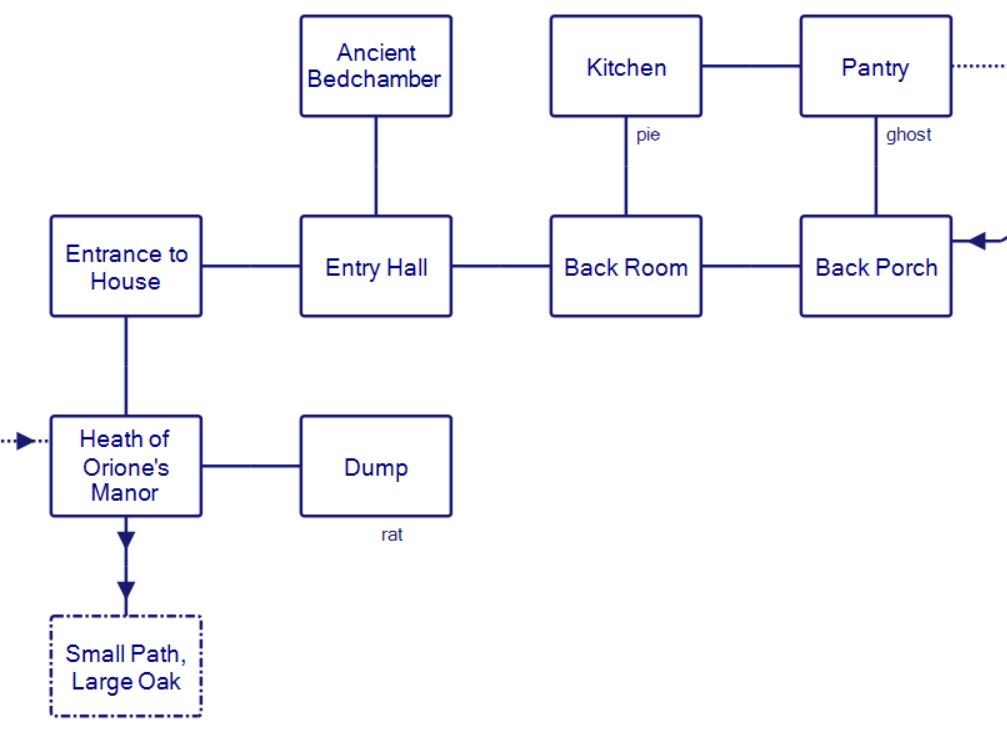
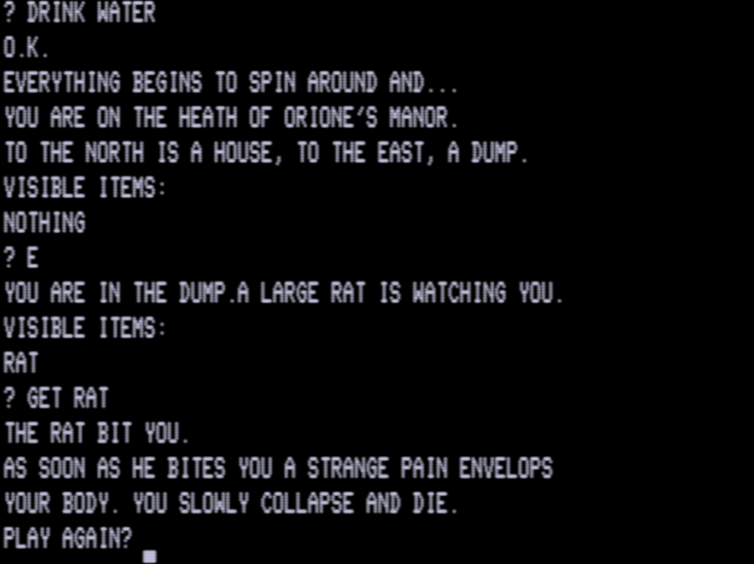
You can go south to loop back to the forest with the oak tree if for some reason you missed something; if you go east you end up at a DUMP with a RAT. This room serves only to kill you if you try to mess about with the rat.
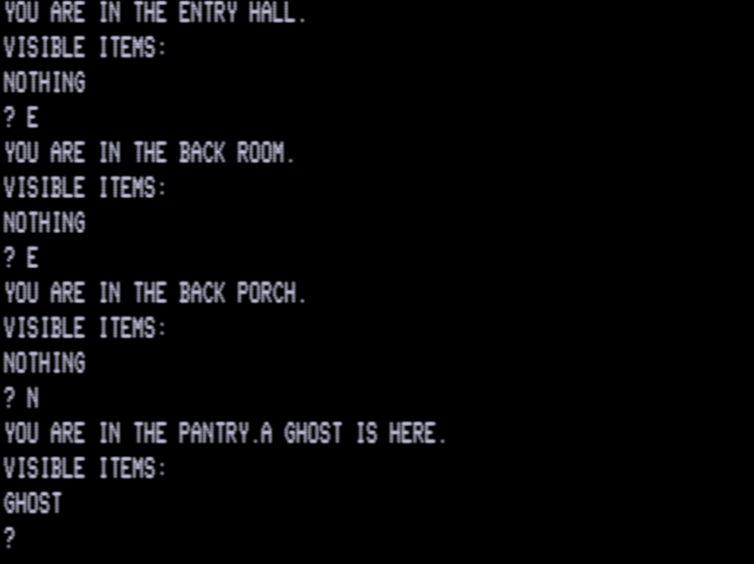
Heading north instead into the house, there’s a series of locations that are room-name-only (YOU ARE IN THE ENTRY HALL, YOU ARE IN THE BACK ROOM, YOU ARE IN THE BACK PORCH). One side room is a kitchen with a pie, and at the end of the sequence is a ghost.
Given the sign earlier, it was impossible not to resist trying to THROW PIE while at the ghost.
YOU HIT THE GHOST WITH A PIE.
HE GETS MAD AND PUNCHES YOU, THE FORCE OF THE BLOW
IS SO GREAT THAT IT KILLS YOU.
I know people are still sore about the pie/yeti combo from one of the King’s Quest games; finally, the ghost gets revenge.
Thinking outside the box, I looped back around to the wizard Cluton and tried throwing the pie at him instead…
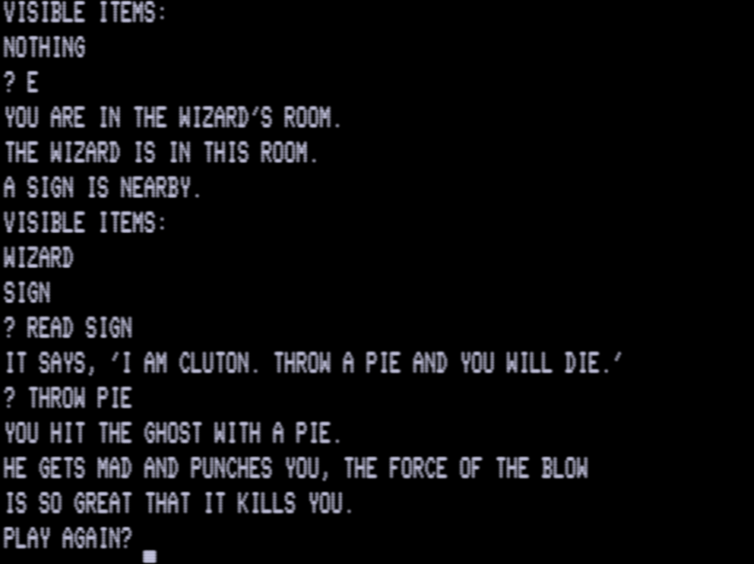
…the end result being that THROW PIE still somehow throws it at the ghost, even when you are nowhere nearby. OK, yes, the source code is a bit fragile. (I checked the late issues — see top of this post — for corrections, but couldn’t find any, but maybe the magazine ended too quickly for that.)
I tried EAT PIE instead and found a diamond. Knowing GIVE was on my verb list, I tried GIVE DIAMOND while at the ghost and it worked.
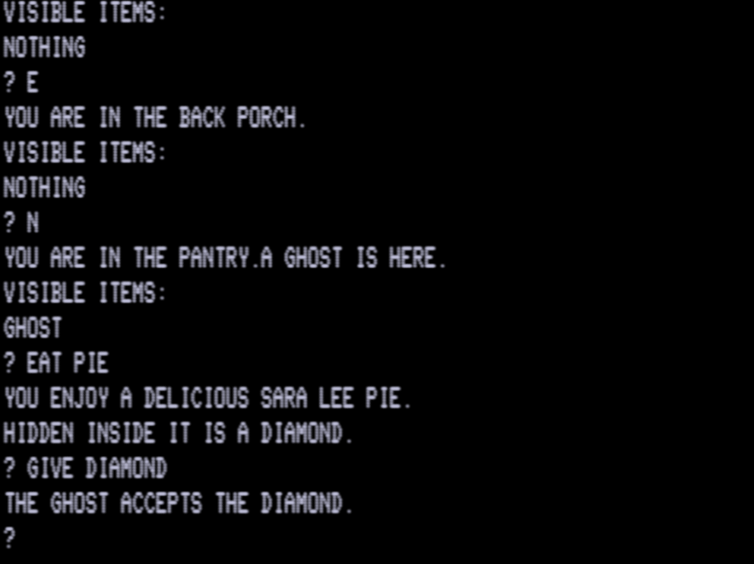
This isn’t supermoon level logic since “enemy accepts something valuable” makes retrospective sense (sort of), but I certainly didn’t use regular logic to solve; it’s just the game limits so heavily what options are available I didn’t have many choices to go through.
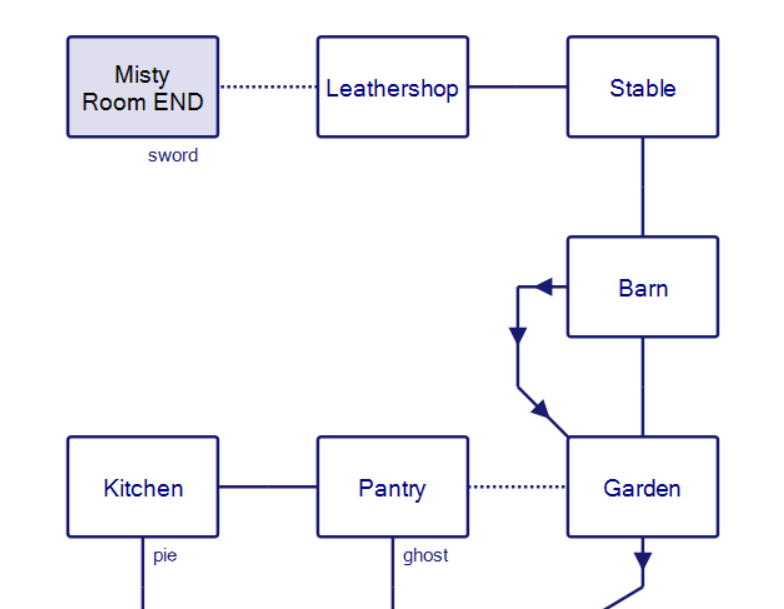
The ending had no puzzle at all because I had already found the key (if you didn’t find it earlier, you can go back and get it; you can even refill your water and do the DRINK WATER trick again).
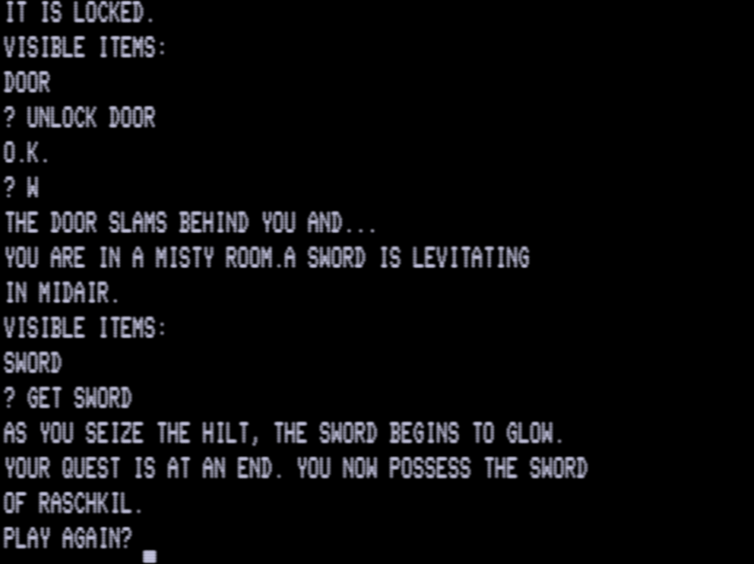
My apologies to the author if he’s here Googling himself. I did indeed hit a puzzle so baffling I had to coin a new word to describe it. I did at least appreciate the “pure” feel of the game even with the bugs and puzzle illogic, and even with minimal description I did get the scent of another world.
It was also useful to see what sort of game H & E Computronics printed (and the fact they likely did not test the game for bugs at all); as I mentioned in my last post, we’ll visit them again sometime at least once more (I have not skimmed the complete catalog to be sure nothing else is missing).
Coming up: an interview with an author giving a snapshot of the chaotic UK game publishing scene, followed by an Apple II “contest game” with buried treasure.


 Renga in Blue
“the end result being that THROW PIE still somehow throws it at the ghost, even when you are nowhere nearby”
Yeah, throwing the pie anywhere gets you killed by the ghost, except in the pit where you get the staff, which is the only place where it’s the wizard’s turn to strike you. Lines 870-890 should check for room 15 instead of 13.
Did you try to finish the game without the leaf in your inventory? I can’t see any reason why that would have the effect is does.
That might well be another OCR oversight, but the game in general is very clumsily programmed, as you probably noticed.
I did not see that with the leaf
IT LEVITATES OUT OF YOUR REACH
at least the leaf _seems_ magical and there isn’t any reason not to be carrying it at that point, but still baffling
Isn’t that how British players reacted to the Zork 2 diamond maze? Clues made no sense, solution made no sense, none of it made sense until someone told you what the authors were thinking.
No, I have no idea what the author was thinking here. I’m not even sure what a “Wizard Cluton” in-joke would look like to make this make sense.
(One of my friends figured out the diamond maze *this morning*, thanks to my Visible Zorker writeup.)
It’s a good comparison
I’m fishing with a hope someone knows a reference in the comments
Very comparable would be the Maltese Falcon in Adventure 751, where the reference didn’t make sense to me – but even without the “fix” it still wasn’t supermoon level because the action at least makes sense after the fact even if you don’t know the reference
Also, as I’ve already written about, if you’re solving the “baseball maze” normally you can do it with no reference to baseball at all, it’s just the hints talk about baseball so that’s how it got perceived. Someone may get it as an arbitrary SE / NE / NW / SW as a “code” but I don’t think anyone expects a maze to “spell out” an answer beyond “there is one path”.
As a Zork-playing Brit, I’m never quite sure where the train of thought regarding this puzzle not being ‘portable’ comes from. Baseball is still ubiquitous enough to be recognised whether through vague knowledge of the sport, watching Charlie Brown or simply playing rounders.
The bigger problem is, it’s just a fairly rubbish puzzle.
I’ve always wondered about that, but enough people got deeply upset I took them at their word.
I still think it’s rubbish but for different reasons than having to do with baseball
How many letters does the parser count, again? Because “Wizard Cluton” can anagram into some of the letters of “Drink Water”, or at least “Drin Wat”, so it is possible that it’s something else and we just can’t see it. Bit of a stretch though.
This game compares entire words, so if you want to drink the water, you have to type “DRINK WATER” exactly like that.
Haven’t we seen this exact game before? I distinctly remember levitating with a staff over a useless pit, throw a pie and you will die, and drink water magically transporting you in a completely unclued way.
Different blogger maybe? I did some searches and no hits and I don’t remember anything like this
Absolutely losing my mind here! I distinctly remember playing along with something like this, where we were going over the business with the leaf and what the staff did, and realizing that though the staff was necessary to get you over the pit, you didn’t need to go by the pit at all. Could I have played it on my own when Gunther put it up? but why would I have done that?
it’s totally plausible this was just ripped off some previous game, but I’ve done every search term I can think of
anything different you can remember?
I’m worried (not really) that I have some kind of tumor that is causing an illusory sense of deja vu, because I don’t remember a single thing being different. Everything from the pie to the ghost to the logic with the staff (especially that the staff let you levitate but there was no reason to cross the pit) to the mysterious effect of the leaf seems familiar to me. My memory is unreliable enough that I could easily be confabulating the new stuff with old stuff that I remember, but it doesn’t seem usual for me to completely seem to remember something I’d never seen before at all.
Maybe there were more rooms around the pit that didn’t do anything? But there I think I probably am conflating some game with multiple wings, or multiple rooms in one of the wings.
And even if there was another place where I read about old text adventures, absolutely nowhere else mentions “Raschkil.” It is a mystery! If only to me, because it seems to be mostly about the contents of my head.
Did you maybe find my type-in in the comments and play it?
I guess that’s the most likely situation, since I do read comments regularly. It just seems very unlike me to stick with a game like this past any frustrations; my general idea is that Jason plays these games so I don’t have to. And I can’t imagine how I could possibly have hit on drinking the water myself. I really thought I remembered talking about it with someone.
I typed (or rather, OCR’d and corrected) this one so unless someone else did and nobody found it, that’s unlikely.
The blog’s shallow thread depth is preventing me from replying in the right place, but whoever wrote the Invisiclues for Zork II apologized in the text for the American-ness of the baseball diamond puzzle, so maybe that’s the source of at least some of the popular thought that that is the primary issue with it.
Yeah, the fact the hints essentially called the puzzle itself a bad puzzle because of cultural reasons embedded it a little more in memory than I think it normally would have.