This is, as far as I can find, the only game or article of any kind by Stewart F. Rush. It comes from a BASIC type-in listing printed in the January 1982 edition of Creative Computing (the same one that had that rollercoaster game that used a laserdisc); it is for computers that use a S-100 bus (like the North Star Horizon) but includes conversion instructions for TRS-80 and Apple II. It was later re-printed in a slightly larger form in David Ahl’s Big Computer Games (1984), which gives the lines:
5 REM MOON SURVIVAL PROGRAM
6 REM WRITTEN BY STUART RUSH 3/12/81
These lines are not present in the original magazine article. We’ve had plenty of instances of people removing comment lines of this sort but never retroactively adding them (people might add themselves in the credits, but David Ahl was the editor, not Rush). I think what this indicates is that the 1984 form of the game is the original and the one printed in the magazine is pruned down for memory-saving purposes.
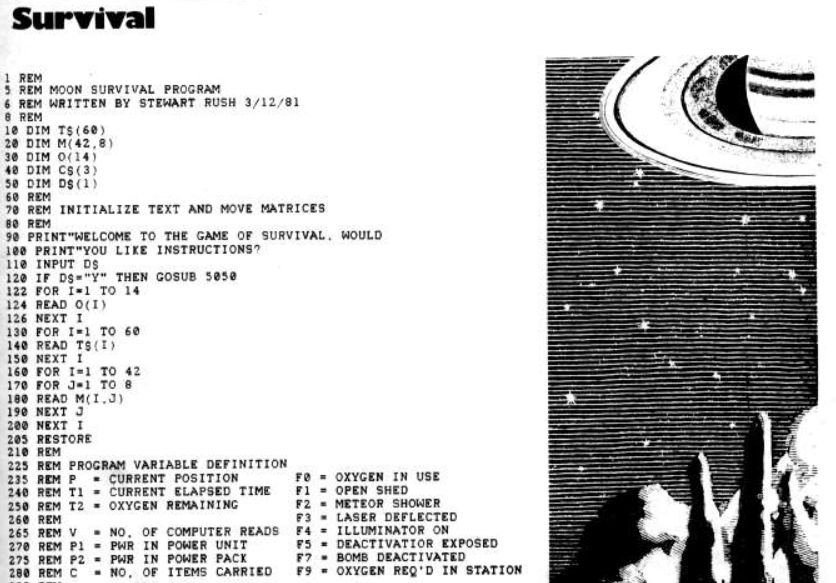
Here’s the intro of the 1984 version:
*****************************************
* CURRENT STATUS & LOCATION INFORMATION *
*****************************************ELAPSED TIME: 0 MINUTES
POWER UNIT: 225 UNITS
OXYGEN REMAINING: 180 MINUTESLOCATION: You are at Mare Serenitatis. Long eerie shadows from distant mountains and craters cast themselves across the barren landscape.
Compare with, simply: “YOU ARE AT MARE SERENITATIS.”
I’m fairly certain the intent was to put both versions in the January 1982 magazine, but something got messed up in the printing! The end data section has two versions, with Listing 2 being an “Option for Shortened Text”. The two are exactly the same.

Being in the vague “implied public domain” (not really public domain but people played fast and loose with BASIC source code in the 80s) there were multiple versions later, some based on the ’82 code, some based on the ’84 code. If you’re an avid follower of this blog I’m betting you already know one of them.
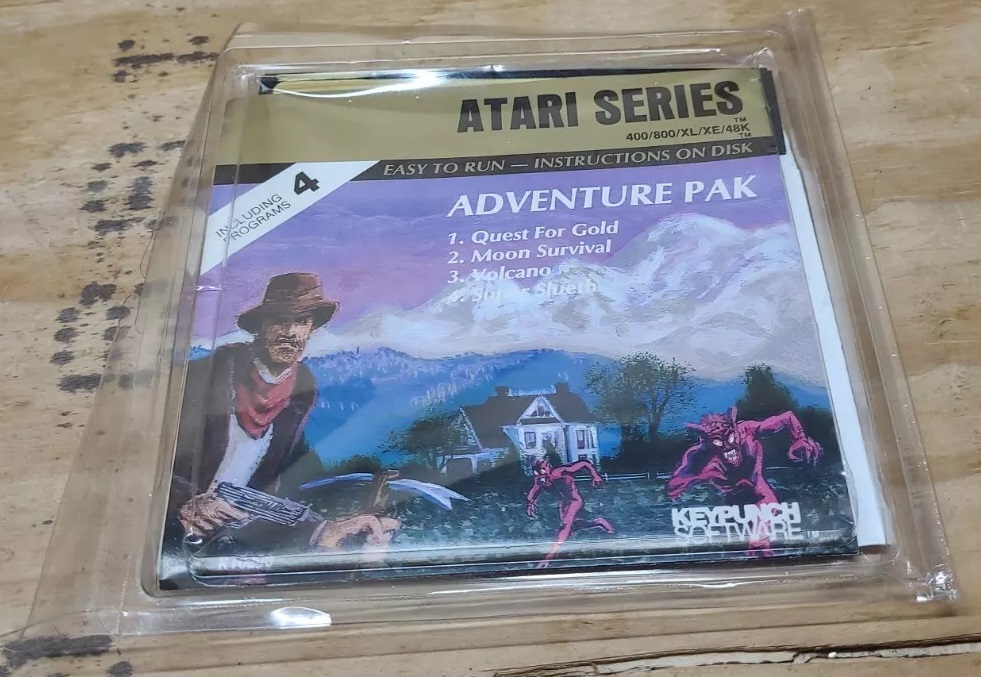
Via eBay. OK, I know the cover is depicting Quest for Gold, not Moon Survival, but is that a prospector posing for a picture with werewolves in the background?
(Incidentally, David Ahl has released all of his work into the public domain. This wasn’t the case in the 80s, though!)
I pored through many versions trying to find one that matched the ’84 code (including checking a port for the wildly obscure Microbee, an Australian computer — it turns out the DROP command is broken) and the best I could come up with was this copy which has “enhancements” by G. M. Bright. I didn’t know what these “enhancements” were (cue ominous foreshadowing) but it’s the closest version I could find that I could get to run.

From the 1982 article.
It is THE FUTURE, the year 1991, and our craft has crash landed on the moon and our goal is to escape. I admit I was originally excited to see how things would go because the author mentions
Each location described corresponds to an actual moon location taken from a National Geographic map of the moon.
making me wonder if this was going to be set in “true” hard science fiction — that is, we’d be dealing with a real spacecraft and scenario as much as possible. This turned out not to be the case, alas. Surely someone in the early 80s was nerdy enough to do an adventure with a realistic spaceship model, and not just randomly guess what it might look like?
*****************************************
* CURRENT STATUS & LOCATION INFORMATION *
*****************************************ELAPSED TIME: 5 MINUTES
POWER UNIT: 220 UNITS
OXYGEN REMAINING: 175 MINUTESLOCATION: You are on a promontary point on the rim of the crater Posidonius, only half visible when seen from below. There is total darkness to the East.
As the screen indicates, there is a constant check over “power” and “oxygen” and the magazine article even mentions
The emphasis is on determining optimum move scenarios, resulting in minimum times and resource use.
That is, the actions you need to do (barring parser annoyance) are easy to figure out, and the hard part is making sure you don’t run out of oxygen whilst escaping. You have an inventory capacity of four, and you start with a power pack and an oxygen tank, both you need while exposed to space.

The “dead” on the right shows the player hitting a dark place, and any step after is death.
The green-marked part is your ship, and has oxygen, so you can simply drop your oxygen to stop using it. (I’m pretty sure that’s not how it works in a real space suit; it took me a while to realize this and was the only “tough puzzle” of the game for me.) Oxygen is tight enough that you do need to optimize both steps while on the moon and make sure you drop your oxygen every time you’re indoors.
LOCATION: You are at Mare Vaporum. The Apennines Mountains rise ominously to the North and West.
##
There is an ILLUMINATOR here.
Quite randomly on the surface of the moon there is an ILLUMINATOR in one place and a SHOVEL in another. Both can wait for later; what we really need to start with are a SEALANT and a KEY from the ship.
LOCATION: You are in the control room, the ships console is before you.
##
There is an ELECTRONIC KEY here.
Starting from the Base of Crater of Plato and heading west has our suit get hit by a meteor shower, and we need to USE SEALANT otherwise we’ll die.
LOCATION: You are at the base of the crater of Plato. A shiney object is seen to the West.
? w
There is a meteor shower. Your space suit has developed a leak!!
? use sealant
Proceeding to seal suit…….LOCATION: You are standing before a small metal shed. A sign reads ventillator shaft number 2.
There’s a peculiarity of the source code worth highlighting here.
3080 PRINT “There is a meteor shower. Your space suit has developed a leak!!”
3100 GOSUB 4890
3110 IF I2 THEN 2980
3120 PRINT “Proceeding to seal suit…….”:FOR CX=1 TO 1500: NEXT CX
Specifically, GOSUB 4890 is asking for a one-shot command. Either “try” or “use” is accepted, otherwise whatever the player does (even if it is something reasonable like APPLY SEALANT) fails.
4890 INPUT B$
4900 C$=LEFT$(B$,3)
4910 IF C$=”try” THEN 4950
4920 IF C$=”use” THEN 4950
4930 I=-1
4940 RETURN
Then, the player goes through a routine to check the player specified the right item (sealant, in this case) and that they have it in their inventory. This is all bypassing the regular command parser; we’re in a “faked” mini-parser level. This isn’t so apparent with the sealant, but it gave me issues at the next step.
?w
The shed is locked
I first encountered this without the key (I had the illuminator and the sealant) so I went back for the key, returned, and tried many different methods of typing UNLOCK DOOR. I finally realized that the game is treating the locked door with the fake parser again. That is, you need to first try to enter the locked door to trigger the section starting at 4890, then type USE KEY (it won’t work outside of the routine) and this will allow the player to move on.

The next part is all in green so is generally safe without oxygen (except a red-marked exit — if you go straight from the corridor to the hanger, there’s no oxygen, you need to go through the side “air lock chamber” first, and no, the game isn’t clear about that at all).
LOCATION: You are in a lighted space station corridor.
##
?nLOCATION: You are in the storage room and supply area.
##
There is a CODED BADGE here.
?
The coded badge is incidentally so that a nearby robot won’t think you’re a security threat and shoot you, but given the robot is in a side room anyway, there’s absolutely no reason to worry about the badge. What you do need to worry about is going to the upper floor and finding the nuclear bomb in the hanger (with the oxygen caveat I already mentioned).
LOCATION: You are in the hangar area. The launch area
is located to the South of here.
##
There is a NUCLEAR BOMB here.
Why is there a nuclear bomb about to go off? Where are the people who set it? One could imagine a convoluted situation like Lost but the author has not filled in the gaps.
You can use a “transporter” to a room that gives information about a defuser to the east of where you started. You can’t find the defuser until you’ve seen the message. Where going east from the start point twice previously led to death, now it leads to a new room with the defuser.
LOCATION: You are in the space station’s control center.
##
There is a TRANSPORTER UNIT here.
There is a COMPUTER MESSAGE here.
? read message
Bomb de-activator located somewhere east of Mare Serenitatis on moon’s surface.
You need to coordinate picking up the de-activator while not burning too much oxygen; additionally, there’s some dilithium crystals you need as fuel (…realistic space ship…) that you can dig up with a shovel.
LOCATION: You are at the top of a rocky arete on Burg crater. To the North the center of the crater is thousands of feet below you. To the West, the huge crater of Eudoxus can be seen between crags on a ridge bordering Lacus Mortis.
##
There is a SHOVEL here.
? get shovel
Okay
? d
LOCATION: You are at the base of the Burg crater in Lacus Mortis. The surface is very soft here.
##
? dig
There is DILITHIUM CRYSTALS here.
Incidentally, there’s a walkthrough over at CASA that optimizes things even more by picking up the bomb and bringing it to the defuser rather than the other way around. Unfortunately, in the version I played, the bomb was too heavy to pick up.
This turns out to be a serious issue. I did very careful step counting: the game gives 180 minutes of oxygen, and each step takes 5 minutes. That turns out to be 36 non-oxygen steps.
8 steps are needed at start to grab the illuminator and head to the crash site. You can technically do this part just a little later but it doesn’t save any steps.
For the crash site you can grab the sealant and key. You need to go to where the meteor shower happens, get hit, drop the sealant, and return for the illuminator. Doing all that and making it to the shed (where you can drop the oxygen) takes 13 steps.
14 steps are needed to leave, pick up the defuser (and just that), and return for the defusal, for 22 steps.
That’s 35 steps out of 36, and doesn’t even account for getting the dilithium crystals for the ship to blast off. (You might wonder why you can’t ignore the bomb, get the fuel, and blast off — it says your ship isn’t fixed yet if you do that. I guess there’s some kind of auto-repair function?) If you’re allowed to take the bomb with you, the step count becomes manageable at 17 to both get to the defusal room and retrieve the fuel.
Since the original source does let you take the bomb, and the step count seems impossible otherwise, I’m pretty sure it was intended by the author, and G. M. Bright in an effort to make the game more “realistic” made the game impossible to win.
I decided to change the appropriate lines to make the behavior match the original, went through all the steps, got to the last room where I could blast off, and…
You have no power left, or you have no power source.
You have frozen to death.
You have failed to survive.
Do you wish to try again?
Agh! There’s not just oxygen going down, but also power. This wouldn’t normally be a problem but the “enhancement” also added the bit with a shovel. The original intent was for the player to just dig with their hands. You can even see this in the sample play in the 1984 book:
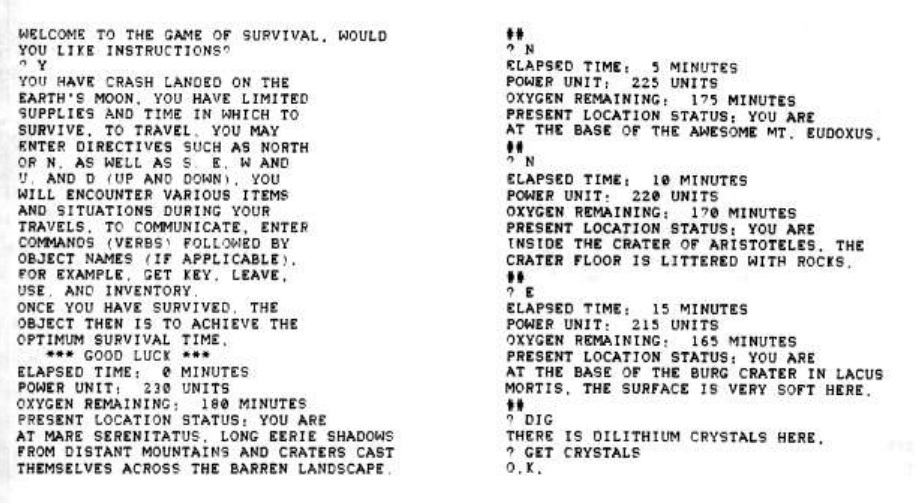
The steps it takes to pick up the shovel are just enough to exceed the player’s power pack. Unlike oxygen, which has no means of restoration, there is a spare power pack in the moon base, but just retrieving it and walking it to the entrance burns up power (even though the power isn’t needed indoors!) However, maybe there’s just enough to make things work?
Well, no. It has 50 power, and uses 5 power per step. It takes 10 steps to get outside, so you use the power pack entirely just retrieving it!

So not only did adding the “realism” of the nuclear bomb that couldn’t be picked up cause the game to be unwinnable, but adding the two extra steps to pick up a shovel did too.
You know what, if the game is going to be that broken, I’m just going to cheat, since I got to the end anyway:
GOTO 4165
Congratulations, you have just blasted off and are on your way to earth. Your escape time was 355 minutes.
I bet if you try hard enough you can win the game in negative moves!
In all seriousness, putting aside my mishap with the bad version — which says something about even when something is preserved with lots of versions, the act of playing can be difficult — the emphasis on super-exact timing is interesting; we haven’t seen it much before (but have a little; for example, with the games of Paul Shave). However, the timing being this tight removes any real sense of verisimilitude — we can’t pretend we’re just a lucky protagonist when we already know so much to ignore any misstep at all. Somehow this didn’t feel awkward with Atom Adventure, which clearly was an exercise in step-counting, but the initial framing here being couched in realism — up to at least including the real map of the moon — made the slow destruction of the facade a touch more grating.
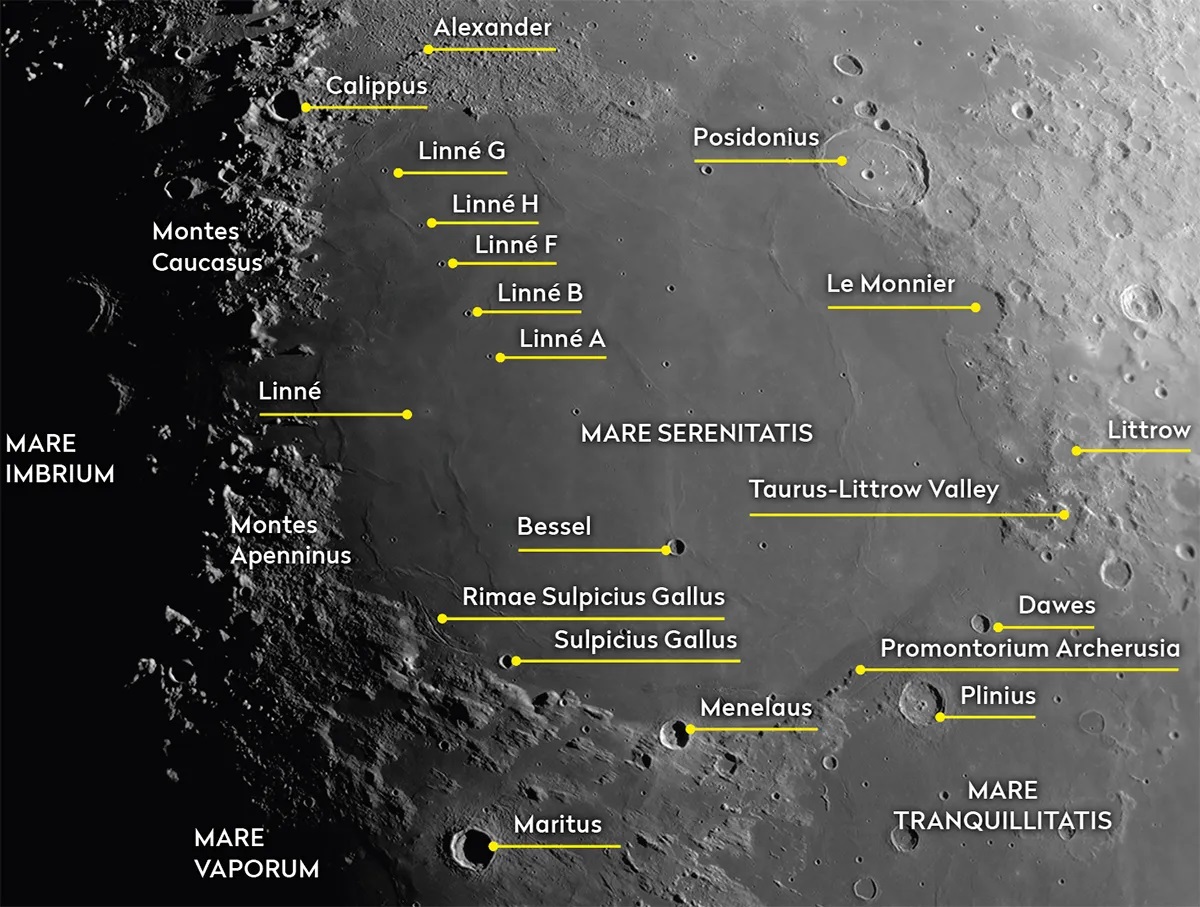
From the BBC and Pete Lawrence.
By the way, if you linger and try to play with the robot or whatnot the moon gets destroyed by an asteroid anyway. Wouldn’t that be more of a problem than the bomb is?
ELAPSED TIME: 405 MINUTES
The moon base has just been destroyed by a large asteroid.
You have failed to survive.
Do you wish to try again?


 Renga in Blue
OMG… I also see that the “parser” (the regular, complete one), is really “comprehensive”… (about 30 if’s in a row)…
I know the answer to that one!
So, “320 P=1: C=2: T1=0: T2=999: P1=999: P2=999: V=0”, should do the trick.
Seriously, I hate games with time limits, even more if they’re tight. Indeed, I don’t see what tight timing and adventures have to do with each other…
I think the main issue with an optimizer is when there are no real choices or puzzles beyond what’s getting optimized (which is essentially the case here). Atom Adventure had the bit where you needed to throw something over a river just to save a little time, and it did feel like an “adventure puzzle” in that moment. The handing of the ring also required a moment of insight. This game maybe aspired for some kind of similar idea (especially given the extra power pack) but never really got there.
(This is all part of the reason I’m not that stuck on the idea I should be worrying about max points in the All the Adventures project in general.)
i suppose the space agency holds the attitude of “not anyone’s fault” when it comes to natural disasters, but considers a nuclear bomb to be moon-vandalism.
Sorry if this is a dup…
Does anyone know of a text version of the original code? It was written in an odd dialect the author wrote, and I’d like to use it to see if I can get it running in my interpreter.
That’d actually be nice to have, but I don’t recall anyone getting transcripts of the third Ahl book
https://archive.org/details/Big_Computer_Games/page/n85/mode/2up
Probably wouldn’t be a terrible amount of work to OCR?
I see four of the games here but not Survival:
https://github.com/robhagemans/hoard-of-gwbasic/blob/master/BackToBASICs/README.md