I have finished the game; my previous posts on Dungeon Adventure are needed to understand this one.
A recent discussion that happened with Starcross is relevant here. In that game, the player is taking a “test” in an alien artifact; parts of the artifact are failing. One idea brought up (by both Jimmy Maher and Drew Cook) is the possibility that every puzzle in the game is a coordinated part of the test. I discarded that idea given that some characters are independently acting; that is, there wasn’t some way the Master Overlord Aliens could have guaranteed particular things happening, like the “chief” weasel alien being willing to trade their brown rod to the player. So there was a “test” where the aliens had to go out of their way to provide ways for the player to succeed because of certain things going wrong, and they just had to hope they had gone far enough to make the test fair.
What if, instead, it was an evil Demon Lord that made a “perfect test”, and generated a completely controlled tower of traps, with all objects and solutions intentionally given at hand? What if they decided, even if their victim “won”, they wouldn’t play fair anyway?

From the cover of the Firebird edition of Jewels of Darkness. Via Gaming Alexandria.
To back up a little: last time I mentioned all I really needed to “win” was to escape, given I had smashed the gem containing the Demon Lord. As orcs were gathered at the exit, I needed to get the horn (showing fleeing enemies) that was guarded by a goat that butts the player off a cliff.
Rather than thinking in terms of the puzzle, I thought in terms of my unused objects. I had magical dragon’s teeth, a magical bed, a cracked pot, and not much else I hadn’t used already. (There was of course, the possibility of object re-use, like the hammer on the gem, but I went with the logic that I didn’t have many obstacles left and the objects I hadn’t used probably had a purpose.)
The cracked pot, despite being cracked, could be considered as a container. But for what? It isn’t helpful for water, but maybe — studying the part of the map it was located in —

— maybe it could go pick up the jelly (which previously ate up a corpse), only two rooms away? Indeed it could.

Part of what took me a while to come up with this is what I call the physicality limit problem. This is a concept that affects nearly every videogame that aspires to a certain level of real-world integration. This is the moment where it seems like a player’s avatar ought to accomplish some task, given the world’s visual and/or textual description of the circumstance, but can’t.
The first two Divinity: Eternal Sin games lack a jump (unlike Baldur’s Gate 3 which uses the same engine), and this is lampooned in the first game with a simple rope that stops our heroes who need to resort to teleportation, telekinesis, or some other arcane trick rather than just stepping over the rope.

This physicality limit happens all the time in text adventures; all sorts of physical stunts and schemes that seem like they ought to bypass puzzle X but don’t, because the parser doesn’t allow unlimited creativity or, for example, self-reference to body parts. (One reason why I was startled by CLOSE EYES working in Dungeon Adventure is the number of times a body part reference might help in a different game — like one with a medusa — but isn’t understood.)
Typing GET JELLY gets a response of
Don’t be silly!
and I might normally think to PUT JELLY IN POT or SCOOP JELLY WITH POT or something of the like (neither “put” nor “scoop” is an understood word), but at this stage in Level 9’s development it still is essentially using a two-word parser. So I was essentially hitting my physicality limit on anything where a well-specified command would require both a noun and an object. Analogously: yes, I know there’s no jump button, but that rope is still there taunting me.
The thing tripping me up was not thinking “oh yes, FILL POT would be non-ambiguous as to what the pot is being filled with”. Fortunately, when I went to the jelly with intent the right command was not hard to summon up, but just in terms of my general mental puzzle-solving, the limited parser was stymieing my approach to a solution by implicitly providing a physicality limit.
(Put more simply: sure, a two-word parser can express a lot, but that doesn’t mean it won’t throw up obstacles that aren’t just in trying to communicate!)
Getting back to the action, with the jelly-filled pot, and my knowledge that nearby slime made things slippery, I decided it was time to return to the goat with new concoction in hand.

And yes, the horn works exactly as expected: the orcs run away, and the way is free to leave.

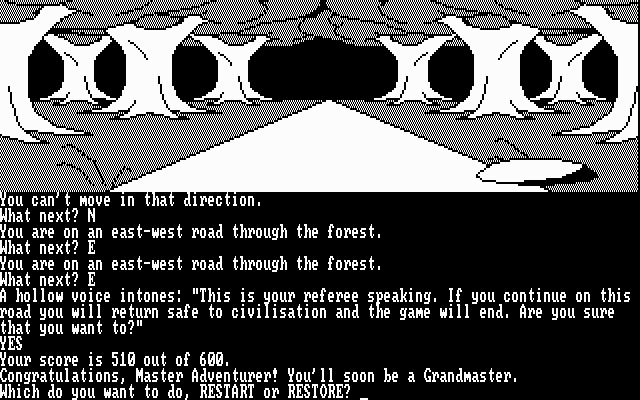
I’m happy to consider this (510/600 points) my “canonical ending”; our protagonist got most of the treasures, killed the Dark Lord, and likely retired in luxury. I had lingering puzzles I wanted to check on, but given I already “won”, I was much less resistant to the hints provided by lmari Jauhiainen.
First off, there is a source of light that can fill the miner’s helmet, found near where the roc’s nest is. In the DOS version the roc grabs you right away (and it might have the most absurd solution in the game) so in practical circumstance the second light source likely won’t be found by a player until the very end of the game. Erf. In the Atari version the source is a little more accessible:

Again there’s some parser weirdness; the wisp floats out of reach if you try to take it normally, but for some reason you can catching it while holding (not wearing) the miner helmet. (PUT WISP IN HELMET of course does not work. This genuinely stalled me for a bit trying to think I needed to attract the wisp somehow.)
I still found the roc would always grab the player after getting the wisp, so the roc nest puzzle needs to be solved anyway to escape.
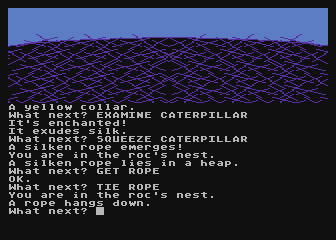
Ilmari rightfully calls this puzzle “ridiculous”. I’m pretty sure I’ve seen SQUEEZE as a verb … somewhere? … but it is wildly uncommon, and it certainly wouldn’t make my top 10 in How to Make a Caterpillar Produce Silk, even with magical rules.
Ugh. In the department of More Reasonable to Solve, but I Swear I Tried It Once, let’s go back to the mystery enemy hurling rocks.

I had tried waving the wand, I thought, everywhere, but apparently not everywhere.

I admit I was imagining something like giants rather than just some person in a chair. I realize the wand’s use before was in an adjacent room so it makes sense here. Oh well.
With that out of the way, we just have the end of the Tower Trap Test. I had 8 out of the 9 needed gems (with 10 available, isn’t it nice how the Demon Lord gives an extra gem to make it super fair on adventurers who get stuck?)
Regarding the snake in the box, Ilmari’s hint was that the snake needed to be dead before opening the box. Hmm. I sort of visualized the box as waterproof, but I realized that wasn’t well-founded, so tried:
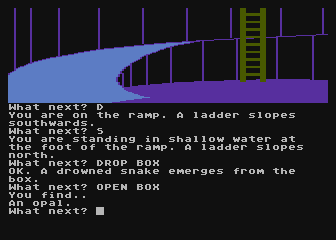
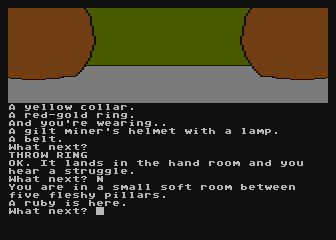
Oho! But what about the ghostly strangling hand? My best bet was — given the trap tower was carefully arranged so everything had a solution inside the tower itself — the red-gold ring. The ring killed me upon picking it up without having a leather gauntlet on. At the ghostly-hand room I had tried waving it, rubbing it, all sorts of other actions. I was unknowingly hitting a physicality limit issue again — normally to communicate “I want to throw the ring inside the opening to the room” I’d need a parser that takes both nouns and objects, but THROW RING turns out to map to exactly that (despite THROW almost everywhere else being synonymous with a DROP command).
Even with the strength belt on filling up 10 inventory slots with gems plus the burning driftwood plus the magical case turns out to be impossible (if you have the miner helmet, you can leave a slot free and get all 10). However, since only 9 are needed to enter the door, I went ahead and tried it.
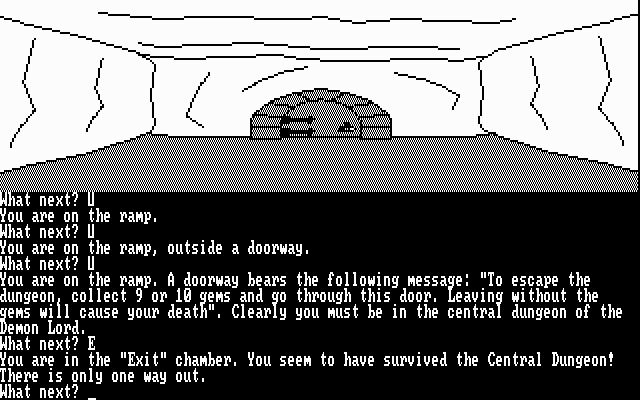
Congrats, you escaped the Demon Lord with wonderous treasure! Now I’m sure it’s safe to leave — oh —
A horde of wights attack!
You have managed to get yourself killed!
This is sort of an anti-Zork. After carefully playing through the carefully-designed puzzles, rather than the adventurer being able to walk out with newfound loot, they (and their full inventory) get killed anyway. The only reason we’re able to get out is our magical case and the fact we can be somewhat meta since the Demon Lord is dead already: swapping inventory around so the crucifix and cross are both being held is sufficient to survive a landing back in the wight house.

Of course there’s no point in going there! There’s no reward for going through the Exit, only death. Rather than a Dungeon Master (or aliens) congratulating us, the whole mini-adventure was revealed as a ruse all along.

Back of the manual for the “wallet” edition, via the Museum of Computer Adventure Games.
Coming up: Back into space, or more specifically, the Moon. Also, part 2 of my Lost Adventures list soon.


 Renga in Blue
SQUEEZE is a default action in Inform 7* but I can’t think of a game that uses it offhand, except I included it as an easter egg in an extremely silly extremely short game I made that involved a bicycle horn. I don’t even remember anyone using it in Cragne Manor. (Well in my rooms I also implemented squeezing as contact–or “weiner contact”–for a bunch of responses to verbs like touching, which also weren’t required, but I don’t remember anyone using it as a required solution, and you’d figure someone might have.)
*Its only default synonym seems to be SQUASH. Imagine that as a solution!
Ah, site search reveals that SQUEEZE DIAL was a solution in Ferret, which is the other “If that verb is used anywhere it’s used here” game.
according to Ilmari HUG also works
but that one’s even worse
In Inform 7 HUG defaults to a synonym for “kiss” (I ran afoul of this in Ad Verbum where I was trying to use “embrace” to pick something up in the E room).
Beyond Zork uses SQUEEZE on a plant called moss of Mareilon that is found in a few rooms to increase your dexterity stat. I think the game feelies somewhere tell you this is possible to do.
oh yes, I remember that one!
it was explicitly in the “copy protection”
HUG comes from Level 9’s own clue sheet, so it should work – the producers even seem to prefer it, giving SQUEEZE only in parenthesis (that poor silkworm). I wonder if anyone has solved this puzzle without hints.
Do you have an opinion which one was a better game, Adventure Quest or Dungeon Quest? I slightly prefer the latter: although it is a more traditional treasure hunt, it feels more playable, Adventure Quest having a somewhat too chaotic feel to my tastes. For what it’s worth, I’d say the next Level 9 game (Snowball) will be a more interesting experience than their first trilogy.
I don’t think I can rank them exactly, there’s enough non-transitive properties
Adventure Quest was more satisfying as a narrative, had more reasonable puzzles in the end, and the teleportation was more fun to play around with (except it was harder to use to coherently solve something)
Dungeon Quest is less motivated, and the puzzles are much more about self-contained riddles, which is a style that works but is simultaneously both more satisfying and less satisfying. (that is, it’s great to knock down a puzzle in a single blow like have the revelation about the box and and the water, but you don’t get nearly the same sense of coherent large-scale coordination; that is, it isn’t so much a “quest” and there’s no “sequence” like the ending of Adventure Quest). There’s less inventory irritation to deal with, though, which is huge.
The trap tower gimmick turned out to be super clever but it struck my enjoyment more on a philosophical level than a visceral level.
Call it a tie, I guess?
Personally, I have a soft spot in my heart to that starting sequence region. It has a lot of fairytale clichés integrated in a short but faithful environment, that I think they work pretty well as a satisfying adventure start.
Then, the surprise that the explorations is a coherent evil wizard dungeon modelled after a huge orc head… was just mind blowing.
But in the end I found the game, and the light source limit, too difficult for me. But reading you solving the game, I found that I have a lot of puzzles and regions more or less solved in my mind. So I think some day I will make the run myself.
Returning to the light sources, ever as you can rekindle the driftwood (something that surprised me a lot, I’ve never find out that), I think the will-o-wisp is too much in the end game to be useful to common players, so I think the game would benefit a lot of more light sources, maybe magical, or temporary.
I think it is a great treasure hunt, even climatic if you find, knowing the nature of the dungeon, and finding the last gem and breaking it, would count as a very climatic ending.
Said that… I think I said this before in this blog, but I think Level 9 excels at making coherent maps, and they showed off here. Definitively my favourite piece is Red Moon, just because of the geography and those “Ahá!” moments when you connect a region to other.
Amazing play!
being able to re-light the driftwood makes things much better. In general my issue with time limits is the nagging feeling of having to re-do everything I’m doing, but since there’s unlimited relighting, just making sure to plan returning to base once in a while isn’t bad and let me noodle around more casually the last part of the game (and it gives reason to use the teleport network, which almost seems superfluous otherwise — I think if you planned it right you can beat the game without using it once)
I think the teleport system is just too tight designed in a eighties way that it is not too much useful. With a more relaxed design, the teleport system would allow to a more flexible play style, and less stress on the time limit.
I can’t believe I’ve missed this. Ok… let’s read from the start…
Was wondering where you had snuck off to!
Enjoy!
The pointless tower of traps is interesting to me from a ludological standpoint. In some sense there is no point in playing the game at all, and even within the game fiction there are many parts of the game that have not much point, since you can just leave without all the treasures. The tower of traps is worth solving in the same way the rest of the game is, in that you solved some puzzles and did some things! But the game also signals that there is some sense in which this was a lot of trouble for nothing, and as you say this makes sense in the fiction of the game.
This reminds me of my favorite game ever, Knytt Underground, which goes to a lot of trouble to make clear that in one sense everything you are doing is pointless and in another sense you are doing it all for the pleasure and the experience of playing the game. For instance the first side quest you get is to look for a child whose mother thinks she may have gone to a hard-to-reach bird’s nest. She’s not at the bird’s nest and when you return she’s back with her mother, who unfairly scolds you for not having looked for her. (The PC is mute and can’t defend herself.) But the point for you, the player, is that you got to play through this sequence that was slightly more challenging than the critical path at the moment, and also practice some techniques you’ll need later.
They did a good job clearly signaling what was going to happen but making it feel like a surprise anyway.
And the meta you get nearly from the start (an exit you’re allowed to walk out of, and the referee checks if you’re fine with that) reinforces this is more like a traditional D&D crawl where you don’t necessarily need all the treasures, and might pass on some just because of the risk.
For whatever reason, I found the puzzle of using the wand straight.
Congratulations!
yeah, I don’t think it’s a “hard” puzzle, but I was visualizing something more like the two giants from earlier where the sleep wand would be ineffective
knowing it’s just Some Guy the connection is a lot clearer
but mainly I just had bad luck as I had tried the wand in a bunch of places just to test it
The Divinity: Eternal Sin reference reminds me of a moment from Final Fantasy X-2 that had me helpless with laughter. The overworld map of that game is identical to the previous game, but there’s a new region which you can access by virtue of the fact that the player can jump over the little knee-high barrier in one area that was an insurmountable obstacle for the god-killing warrior band of the previous game.
fantastic!
the divinity example is a little unusual in that it lampshades the whole thing in the dialogue and then expects you to get past anyway (rather than it being what TV Tropes calls an insurmountable waist high fence where you’re genuinely supposed to leave and come back later, or apparently, come back in a totally different game installment).