Ken Rose’s Adventures in Adventuring column has featured in this blog once before, where I wrote about the first three installments, including Journey to Planet Pincus. The column was printed in the bi-monthly magazine Softline (essentially an extension of the Sierra brand, at least when it started) and was meant to teach people how to program their very own adventures in BASIC.
Today I’m going to take down the remaining issues of 1982.

Just like the previous three installments, there’s a prefatory article explaining the thing being taught; unlike the previous three, the source code has no commentary with REM statements. My guess is as the games started getting longer it became harder to justify the print space. The September article even discusses the increasing length:
You’ll probably notice that as these programs become more sophisticated, they become longer. Most of the length is taken up not by the logic of the program but by the descriptive words needed to flesh out the story. In fact, in most commercial adventure games, the program takes up very little of the disk. The bulk of the disk is filled with the wordy descriptions used to make the game interesting.
The articles still explain what’s going on section by section. I’m hence treating these as “teaching exercises” rather than full-fledged attempts at games; each games tries to emphasize one particular aspects of adventures as opposed to being complete experiences.
I did manage to avoid having to type in any of the type-ins. Werewolf and Minotaur I found on this disk at the Internet Archive. It was uploaded from “crates” via the Rhode Island Apple Group, and this particular disk comes from the Big Red Computer Club (a public domain distributor similar to Brunswick Publications). However, I couldn’t find any Apple disks that had the Diamond game.
What saved me is the Atari. All the programs from the Adventures in Adventuring series were converted to Atari and then sold on disk. You can find the files in a thread here.
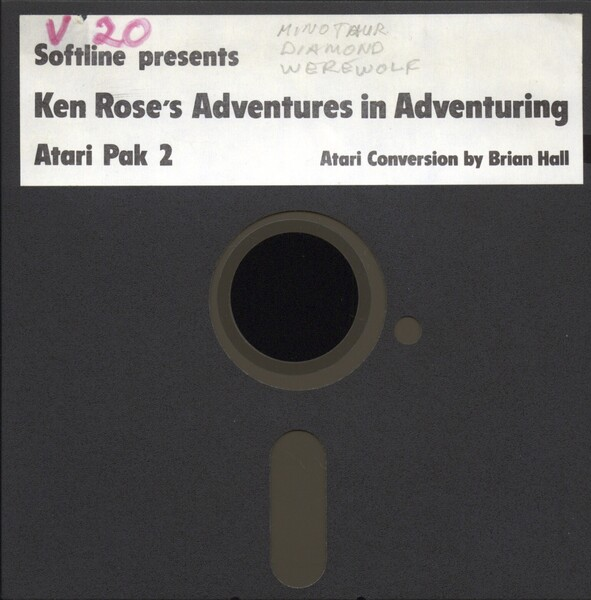
Brian Hall, credited on the disk, chimed in: “Seeing pictures of the floppies really warms my heart! This was one of my first paid projects during high school.” When asked how he got attached the product, he responded: “I think I had approached them with the idea, and they agreed. I *think* that came as a result of having been mailing them high scores (when mailing in a high score was a thing!)”
However, there’s a catch! Disk 2, the one shown above, is corrupted. I used the Atari Explore disk utility and was able to rescue Diamond and Minotaur; Diamond is the file that I didn’t have in Apple form. I have a hacked version of the disk here (with the menu for disk 1 — pick option 2, Please Pass the Zork, which will actually play Diamond).
So the upshot is I’m playing July on Apple II, September on Atari, and November back on Apple II. All three only give credit to Ken Rose (and given Michael Rose — who after some Internet scrounging I am 98% sure is Ken’s younger brother — was pretty explicitly mentioned in Jan. and May, I’m not going to assume he’s not involved here, but it is faintly possible).
The Werewolf Howls at Dawn
The easiest way to control time is to set up a counter that keeps track each time a move is made. These moves can be called hours, or minutes, or stardates, and they can be incremented every time another move is made. This is the technique illustrated in this month’s program.
This is essentially a 5-minute game. The idea is you’ve been bitten by a werewolf and have a limited number of turns to get some wolfsbane which will cure your condition, so the game is showing off how a “timer” works in a game.

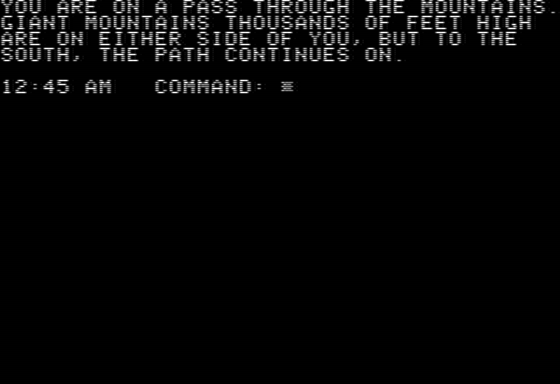
The room descriptions, at least, are colorfully done. There are regular messages indicating your slow transformation into wolf-form.
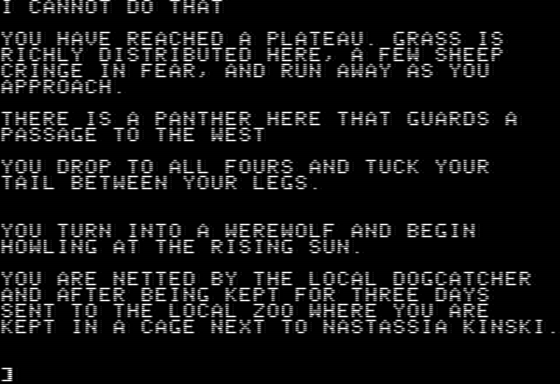
Tight limit, but very short game.
Curiously, the parser has regressed: it’s the type where you type in a verb, and then if it applies, you type in a noun. This game is so simple the author apparently wanted to isolate just the time-changing aspect.

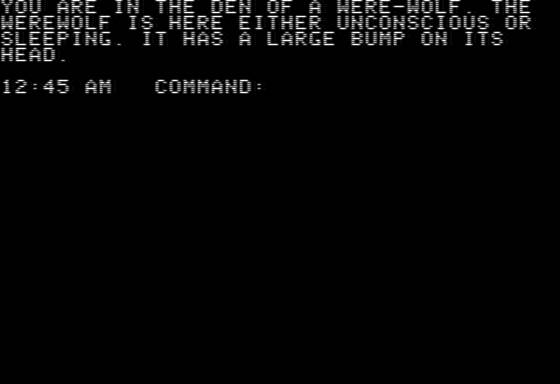
This is just a bit west of the starting location, rather than right where you start, even though the narrative essentially picks up with you bonking the werewolf on the head.
You just need to grab some CATNIP from the cave and some PLANT CLIPPERS from a swamp. Then you need to pass by a panther, with THROW CATNIP.
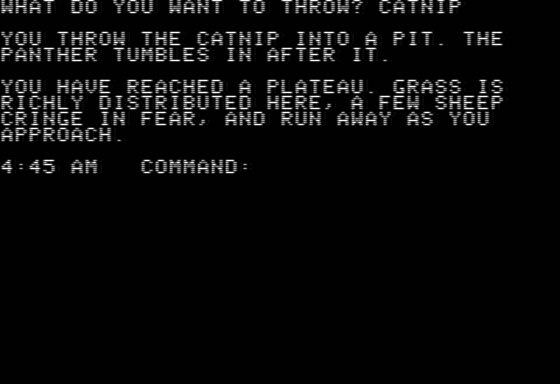
Remember you type THROW and CATNIP separately.
Past the panther is an alcove with the medicine you need. The clippers need to be used to CUT first, then you EAT.

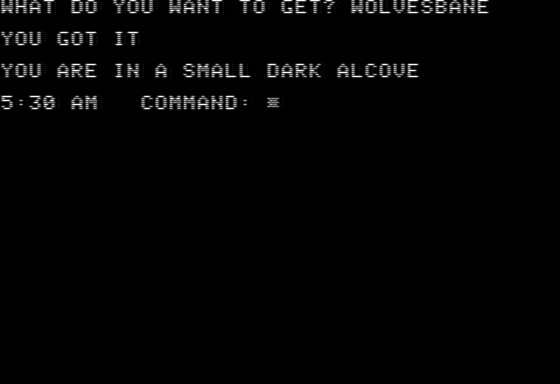
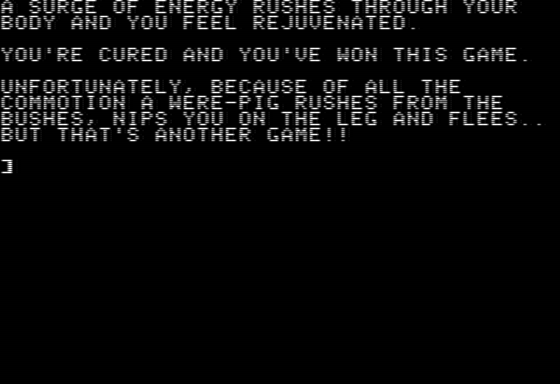
This game isn’t that surprising in context; if all I was doing was demonstrating a global timer, I’d also want the game to be short in order to quickly show off how it works (and how it’s not just a simple “move” increment but actually using a clock). The only part I’d do differently is make sure that typing in something wrong (like a bad direction) would not increment the time, and discuss the idea of how meta-moves and mistakes shouldn’t count, because something as simple as a typo can then kill the player.
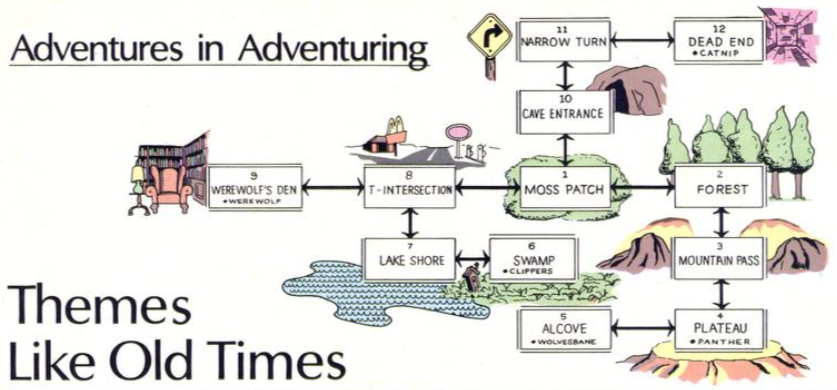
That’s a funny-looking werewolf den.
The main issue is that not everyone would encounter this game in context! It was, as I mentioned, on a public domain disk, and made it to an unofficial DOS port. I imagine some people popped it open expecting something a little more substantial, when something substantial might have actually interfered with the demonstration.
The Case of the Pig-Headed Diamond
The September article is titled The Thing’s the Thing and is “about” objects. Again the game is quite small.
This month we’ll deal with the handling of objects in an adventure program — how to pick things up, use things, and drop them. Our adventure has a mystery theme, in that we will be trying to recover a stolen diamond of little value.
The game has switched back now to a two-word parser. I’ve been wondering if all these games were really written in sequence for the articles or if there was a certain amount of scrounging from the archives, so to speak. Again, the map is quite simple:

The room descriptions have been nuked for functionality. (And less room in the magazine.)


There are no room exits so mapping is slightly slower than the previous game (which was good enough to mention every possible exit in descriptions). The overall effect is for the game to feel even more like a demo than Werewolf.

You first need to grab a shovel, and then use that shovel to dig out a ladder from a garage. Why the garage has a dirt floor is left unclear.

Then take the ladder inside to find a chandelier.
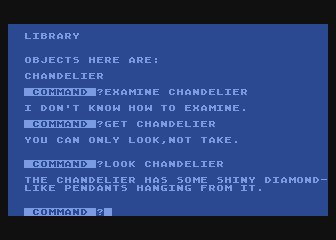
You can use the ladder to help grab the diamonds.
CLIMB LADDER
YOU HAVE OBTAINED SOME DIAMOND—LIKE PENDANTS HANGING ON THE CHANDELIER. YOU CLIMB DOWN THE LADDER.
…and then the Atari BASIC broke down and kept insisting on “TWO WORDS PLEASE” over and over after making the heist. Oh well. I think I’ve seen enough here.

There’s a pig in the bathroom for some reason. Also, you can grab ice cubes rather than diamonds.
ADD: Matt W. in the comments points out the actual goal: bring the ice cubes back (the chandelier is a fake-out) as well as some matches. If you drop the matches first at the bank, then drop the ice, you’ll get a “win”.
4020 IF OB(3) = 1 THEN PRINT : PRINT “THE MATCHES FLARE UP AND MELT THE ICECUBES AND OUT FALLS A CHEAP INDUSTRIAL GRADE DIAMOND. NOT MUCH, BUT ENOUGH TO WIN.”: PRINT : GOTO 4100
I would much prefer to teach good game design at the same time as teaching the programming, but I suppose the author felt it was appropriate here to noodle around with fake-outs, especially given the number that appear in the next game.
The “adventure” part is so barren I can understand why this game was left off the Apple II disk. It really is just a demonstration.
The Labyrinth of the Minotaur
For the November article, Ken Rose feels obliged to teach us about mazes. Could we skip teaching the masses that one, please?
Ever since Adventure, it has been almost a requirement that an adventure game contain a maze. Perhaps the neatest among the current ones is the maze in Zork I, because of its complexity and the necessity of exploring it thoroughly.
I assure you it is not “almost a requirement”, especially given the author’s own Palace in Thunderland did not have a maze! To be fair I think the percentage of adventures with mazes has been roughly 80%, not counting “confusing geography” as a maze, and some of that no-maze percentage comes from multi-title authors like Scott Adams and Peter Kirsch who shook off the need to have a maze in all their games.

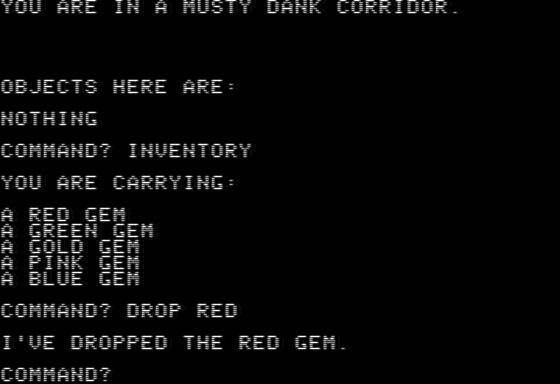
I can say of all the games, it is the only one that felt “substantial”; it took about an hour to map out.

The game gives only five gems to map 20 rooms. You can do the “relay” method to an extent (take the red gem you used in the room 1 and transfer it to room 6) but that only works if some of the exits don’t warp you back a significant way, and you might notice a room two away from the exit room goes nearly back to the start.
In addition to that annoyance, the game includes death rooms next to signs.
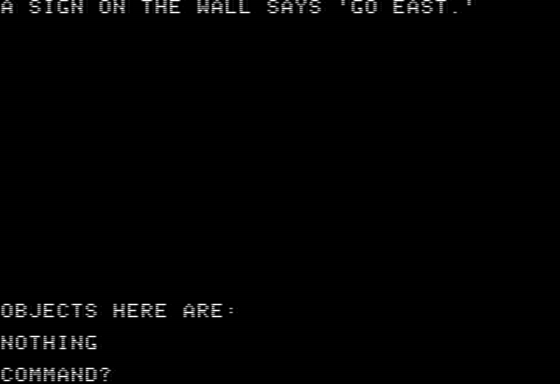

Worse than a death, this is a softlock. You have to test out N/S/E/W to realize they all loop after here and your game is over.
Another sign tells you “Don’t go west” and the exits of east, south, and west all kill you. (That is, both following the sign and following its opposite by going east are both deaths.)

You’ll finally hit a sign that says ABSOLUTELY DON’T GO NORTH and that’s when you finally do want to go north, escape, and reach the twist ending.
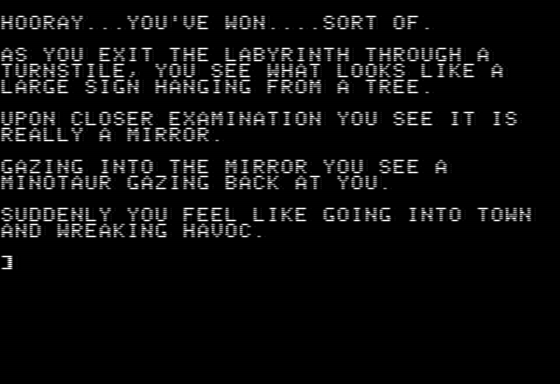
I’m not sure why being cooked by the minotaur earlier made sense, then.
The maze is a “cheap” way to extend game time. It forces the player to slow down and map and requires almost no design thinking on part of the author. And I guess people were still having … fun with it? At least I appreciated the moments of cruelty mixing things up, even if I only muscled through by using save states on my emulator.
Postnote
The author indicates the development so far has been systematic…
Those of you who have been following this series of articles can probably see how we have been using various routines to build up from very primitive programs to some level of sophistication. If you entered the game late and are feeling a bit bemused by all this, pick up earlier issues of Softline and you’ll be able to see why these things work as they do.
…and I’m not quite so sure, given it isn’t using the exact same structure every time. For example, in Minotaur the maze data is all saved together as one data file, and only uses N/S/E/W:
10010 DATA 2,7,1,1,1,7,3,2,3,8,3,3,3,4,5,4,5,5,5,5,21,
16,16,16,1,1,7,7,4,8,8,9,4,9,10,8,5,15,15,15,7,16,11,11,
17,7,12,12,8,13,13,12,9,19,14,14,15,15,14,15,11,16,16,
6,12,17,17,11,13,18,18,18,18,20,20,20,20,20,20,20
while Diamond splits things up, and includes UP/DOWN directions.
10020 DATA 3,1,0,0,0,0, “LONG SHADY ROAD”
10030 DATA 5,2,0,0,0,0, “BOTTOM OF HILL”
10040 DATA 0,0,5,0,0,0, “DUSTY GARAGE”
10050 DATA 8,2,6,4,0,0, “OPEN FRONT DOOR”
10060 DATA 0,0,0,5,0,0, “OVERGROWN GARDEN”
Any of the source code could be helpful for a budding adventure writer, just if I was building the series I would have tried to build up the source code so later months always duplicated prior months precisely. We saw something approaching this systematic approach with Basement and Beasties. At least the line numbers essentially match in terms of section organization. For example, moving around in Minotaur starts at 1410:
1410 IF VIS = “NORTH” THEN R = N(R)
1420 IF VIS = “SOUTH” THEN R = S(R)
1430 IF VIS = “EAST” THEN R = E(R)
1440 IF VIS = “WEST” THEN R = W(R)
and it does as well in Diamond, just the logic has sightly different structure:
1410 R1 = R
1420 IF VIS = “NORTH” AND N(R) > 0 THEN R = N(R)
1430 IF VIS = “SOUTH” AND S(R) > 0 THEN R = S(R)
1440 IF V1$ = “EAST” AND E(R) > 0 THEN R = E(R)
1450 IF V1$ = “WEST” AND W(R) > 0 THEN R = W(R)
1460 IF V1$ = “UP” AND U(R) > 0 THEN R = U(R)
1470 IF VIS = “DOWN” AND D(R) > 0 THEN R = D(R
I can’t claim this is arbitrary as teaching material, then, although I’m most curious where things eventually lead, as there are three more months to go in 1983. Will there be a “culmination” adventure including all the previous learnings, or will the series just fade out?


 Renga in Blue
Wow, both a “Cat People” AND a McRib reference here? Clearly teaching you how to code adventures was merely window dressing for the cutting-edge pop culture commentary…
Regarding the Sierra link, it’s interesting that they published exactly one issue of their “On-Line Letter” in the summer of 81, made a big deal about it being an ongoing thing, and then it immediately disappeared, with the first issue of Softline being released just a couple of months later.
Advice unclear, now making a game with a maze that crashes just as you win. ;p
I’d say that the maze one could actually teach you how to make one-way paths, which is more useful than a maze. And to play with player expectations, though the way it’s done here might not be the best teacher. The item one, on the other hand feels so basic that I wonder how many got anything good out of it.
Maybe the Shropshire Shoat is the previous game’s hero? (Though I see that a shoat is under one year old–perhaps technically true if counting from the time of first becoming a pig.)
Anyway from the source code listing, looks like the pendants are a trap. If you drop them in the diamond bank you lose. You are supposed to melt the ice cubes which have a diamond in them–but since no verb is implemented for the matches, you have to drop the matches in the diamond bank first, then drop the ice cubes, whereupon the matches mysteriously flare and melt the ice.
I see these aren’t tutorials in good game design.
Hiya! It’s funny you’ve been going through these games!!! I just found an old (incomplete) stash of Softline magazines at my parent’s place and have been playing some of these Ken Rose adventure games.
To be specific, I’ve been dusting off my programming skills and converting the Applesoft and Atari Basic games into Python and/or Java.
The first one I translated was “Journey to the Planet Pincus” that you covered in your previous article. The current game I just finished is “The Horrible Rotten Dancing Dragon… Strikes!!!” from the January 1983 issue. It’s the most complex game in this series so far with conditional logic, items to carry and drop, a dragon to survive and a few other things.
If you’re curious, I’d be happy to send you a copy of the “Horrible Rotten Dancing Dragon Strikes” in Java or Python. Originally written in Atari Basic, with Applesoft hints in the article. I only found one bug in the listing, which I fixed in my Java and Python translation.
Anyway – keep up the good work!
Sure, I’ll take the source (would prefer Python though).
Python is definitely doable. Give me a little bit to clean up the code a tad. Link to follow.
Here’s a link to the python code – just one file. You’ll need python 3.10 or above to run it – it uses match/case logic.
https://drive.google.com/drive/folders/1w5cDWWWIenKL5vTSwcpG_oHpL5ubLrjk?usp=sharing
To run – open a terminal window where you downloaded the file and type: python3 adventure.py
Also – it doesn’t clear the screen per each action since it’s running from a terminal.
NOTE: You’ll want to customize one line. Ken presented this as a typing challenge, so he made one room description “up to you” in the comments. So – for that room – I just used his comment as the room description. Feel free to make that anything you like – I did. :)
this is terrific, thank you!
I tried the game through this python version… I thought I’d get bored immediately, but well… it wasn’t so bad, even if you can’t examine anything or redescribe the rooms.
Well done!!
There’s some great humor in it. Also – as you’ve seen – the puzzles are good. It really pays to map this one out.
By the way – if you’re curious about the “write your own room description” section, here’s what I came up with
I’d be curious to see what other folks come up with.
I’m afraid I’m not a huge fun of this kind if humor. I’d prefer to have more “atmospheric” descriptions.
Added a pic of the main page of the article to the link I shared above. It’s a nice illustration, plus it’s also a map.