I have finished the game. You’ll have needed to read my previous entries for this one to make sense.
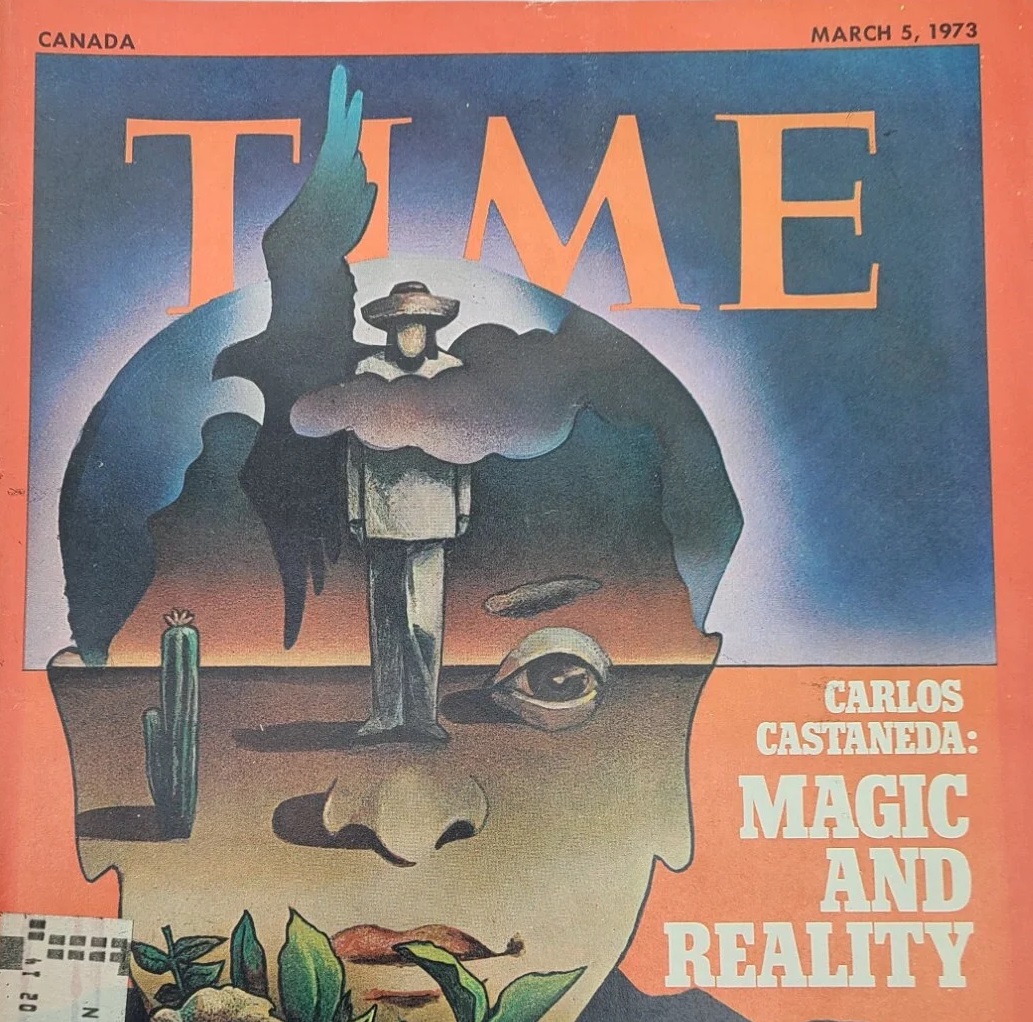
This issue of Time called Castaneda the godfather of New Age. The best article I’ve read on his legacy (and his “cult” of “witches” that cut themselves off from their families) is this one from 2007.
First, let me go over two chunks of contents from before the cave that I had missed. Neither is necessary for the win.
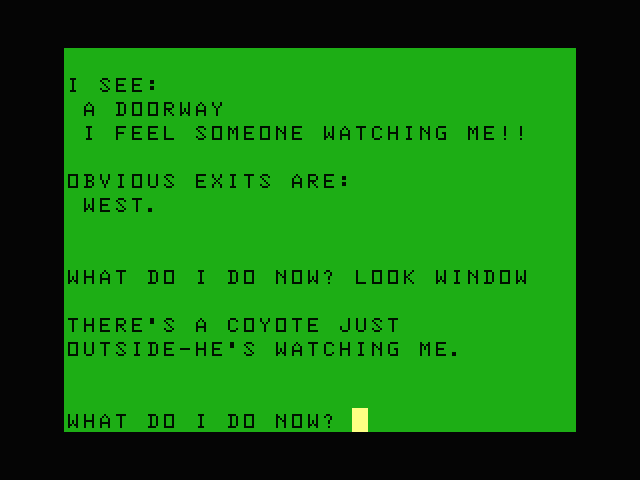
The first moment is right here, at the shack. I had never worked out what being watched meant, and I could swear I tried LOOK WINDOW here. Maybe I misspelled it WIDOW and didn’t notice and moved on.
You can shoot the shotgun (which I also had never used) at the coyote.
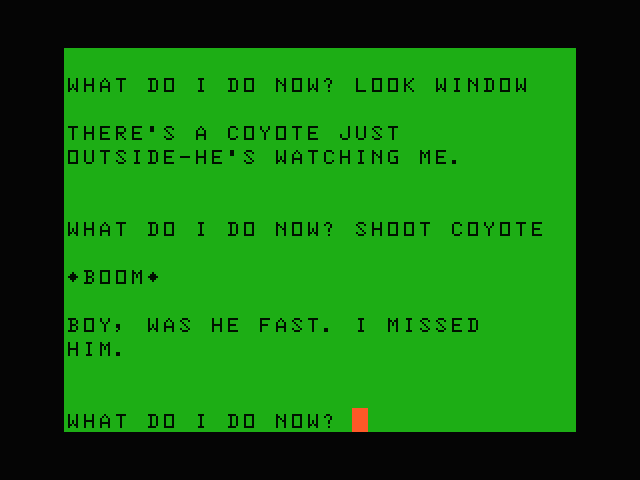
You can then go outside to find footprints, and later, if you go in the canyon, you can see more footprints and LOOK UP to see a cave.
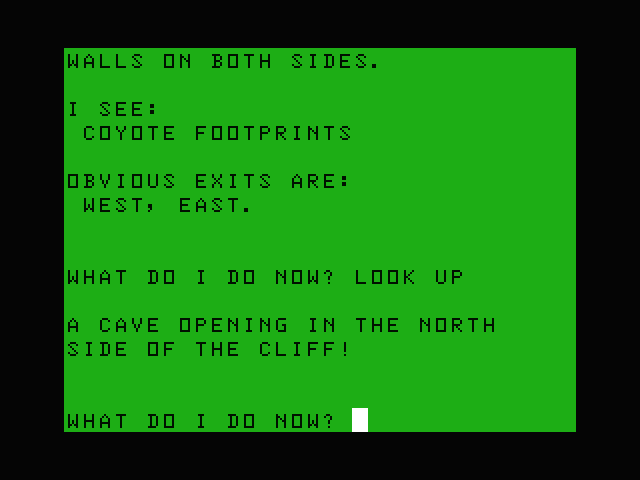
This is how you’re supposed to know about the cave without guessing based on geography.
The other scene I missed involves the place with the machete.

There’s a hole you can climb in and up and it seems to be the bottom of a well (that is, the well seen in the desert) but I had warped out without thinking of it much. If you wrap around on the map there’s a wall you can PUSH, breaking open a passageway, and that allows light to come in so you can see some inscriptions in the southeast corner.

Then if you go down to the bottom of the well and SAY UP you get warped to the top. This is entirely unnecessary, and I had to check a walkthrough because it wasn’t working (it turns out I was trying it while I had already crawled partway up, but you need to use the word at the bottom). However, the inscriptions that explain dreaming aren’t readable until you have the mask, so I understand the author’s sequencing as some players wouldn’t be able to dream-warp yet (and I respect the fact he left open the possibility of an alternate solution).
My winning game did neither of these scenes so I can confirm they are not strictly necessary. One last thing before returning to the action: after entering the cave and before riding the beast, I missed an important room. This is back where I found the bell:

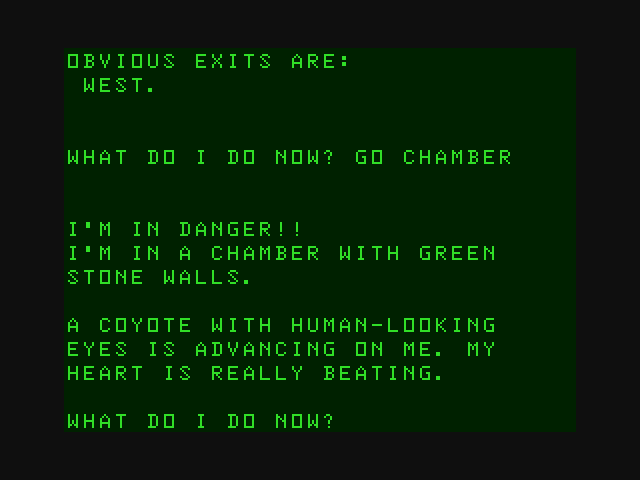
You can GO CHAMBER (somehow, probably because of the sound, I parsed the room as geographically close to the noises but not having a literal door, even given the word “inside”). There you can have a confrontation with the coyote. You’re not ready yet — the twig needs to be dipped in the oil of cactus blossoms, as told us by the lizard. So let’s save that:
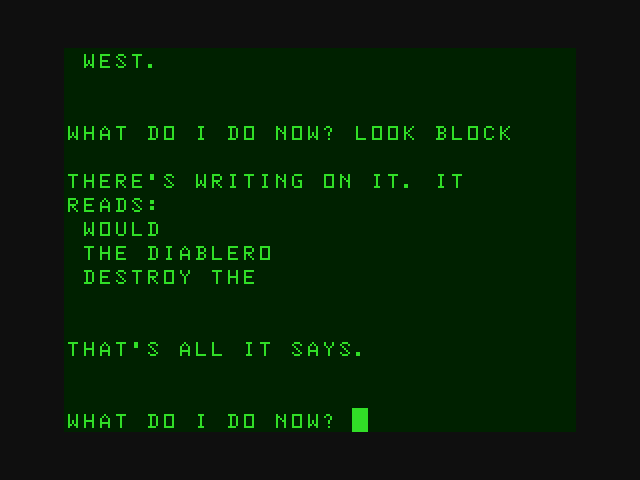
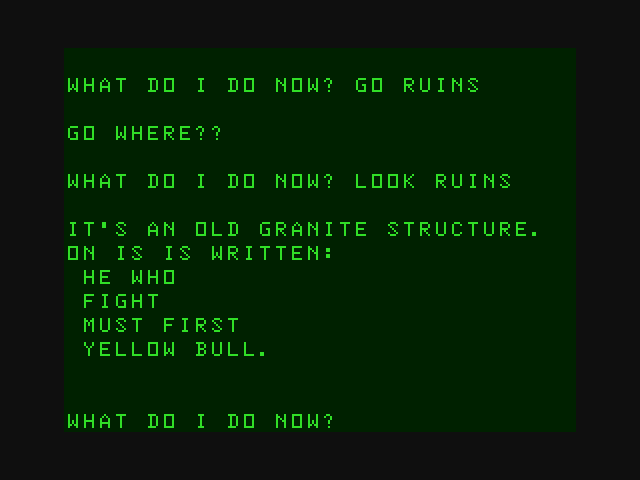
Back to where I left off, I had been swimming in a pond and made it to a “block” which referenced a mysterious yellow bull. I was stuck, but I should have been paying more attention to one of the messages while in the water. For the initial dive, if you try to keep using SWIM DOWN to go farther, you get the message
CAN’T GO.
but if you do this at the third lake with the ruins, going down at the “bottom” instead says
I CAN’T SEEM TO GET ANY DEEPER.
These being different messages should have been a red alert: there is a way to go deeper. You need to be holding something heavy.
You need to be holding the granite block.

This lets you go to a fourth pond, leading to a tall pillar by another chasm. You can PUSH PILLAR to knock over the pillar and walk over it.

The path eventually leads to the north side of the same chasm we started at.

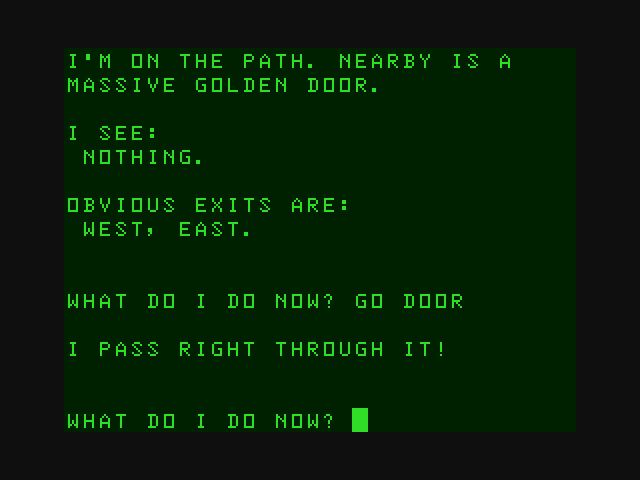
The north side of the chasm, importantly, includes a golden door. Try to open the door, and it proves to be an illusion. You can just walk through.


Lizard buddy! I tried the SAY REVEAL code from before and was told
LISTEN WELL, FOR ONCE YOU BREAK THE YELLOW BULL, THAT WHICH WAS UNREAL BECOMES REAL.
To the west are some clay colored statues of bulls. None of them look yellow normally, but fortunately I had been obsessively trying GAZE on everything in the game, and finally it paid off.

Don’t take and break the figurine right away! As the lizard warns you, unreal things will become real, so the golden door that previously you could just walked through now seals shut.

Yes, this is a softlock, although the player was pretty amply forewarned; I had to set this up on purpose to get the screenshot.
However, this also means the golden bridge and golden statue become real as well! So you can walk across the golden bridge now without falling in, and the golden statue lets you touch it, and more dramatically, push it so it falls into the chasm.

I did something goofy in retrospect here and went through the chasm section again trying to figure out where the golden statue landed, but the smell is coming from the spot the statue was, not where it went. I was just supposed to look, as the room now had a DEPRESSION.

Twig powered up! So now it was time for a confrontation with the coyote, and the game’s final trick. This is yet another moment of participatory plot, where the player themselves needs to figure out what’s going on to get the final revelation.

Pause a moment to breathe, and formulate what you think the answer is.

From World of Dragon.
If the coyote wanted us to lose, why would he tell us what we needed to do to use the magic?
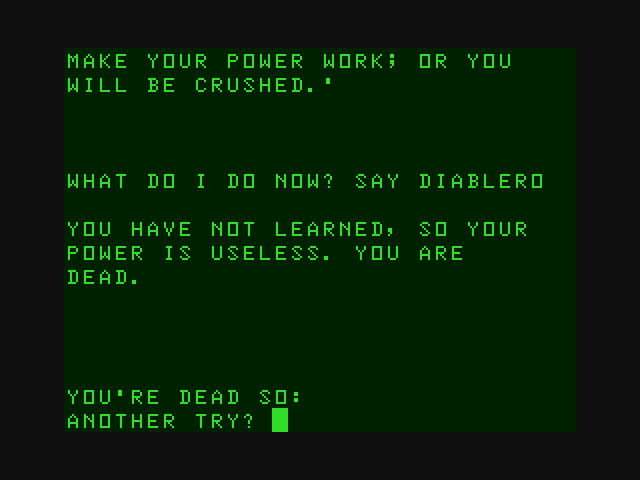

Yes, our teacher was El Diablero the whole time, in some cases putting us in a significant amount of danger. This is not absurd for the Castaneda-verse.
In Castaneda’s fourth book, Tales of Power, he essentially finishes his initial “sorcerer’s journey”. He is ready at the end to take his final test with don Juan and don Genaro, and is taken to the edge of a cliff, where he must jump.
Don Juan and don Genaro stepped back and seemed to merge with the darkness. Pablito held my forearm and we said good-by to each other. Then a strange urge, a force, made me run with him to the northern edge of the mesa. I felt his arm holding me as we jumped and then I was alone.
This works terrifically as literature, but is a bit more sad when it is given as literal, which Castaneda always clung to until the end. I’ll leave the sordid details to the article I linked (but at least one person seems to have died trying to enter the “other world”). I should emphasize none of this was really known to the general public in 1982, when El Diablero came out.
Which is good, since I don’t know how well I’ve conveyed this, but: the game was magnificent.
Not a masterpiece, maybe not even a high scorer if I tried to come up with some acronym (Morpheus Kitami gave it a try). The writing is obviously sparse and one could imagine the brutal reviews if this was turned straight from text to novel form, but in terms of the game’s premise it works: it felt like I was reckoning with nature as intellectual and sparse, and the parts where the words counted they were used effectively.
I AM EVERYWHERE AND NOWHERE AT THE SAME TIME. A STEADY WIND BLOWS AGAINST MY FACE.
Despite the grand cliche at the end, the story was genuine and serious, and it gives the player freedom to do some things out of order while still driving to an ending. There are two moments of participatory plot where the player moves events forward simultaneous with having a revelation about what’s really going on.
Amnesia is definitely old hat by now, but this is the first adventure game we’ve reached that’s had it. Kalish invented the amnesia adventure plot for this game. This is the first time we’ve had “memory unlocking”.
(No, seriously! The other references I’ve made have been sort of a quasi-amnesia. Ferret had amnesia, but it was only tangentially relevant and the game is only sort-of from 1982. Mystery Fun House has come the closest by hiding the player’s objective in their shoe, and that game also did some wonderful moments of participatory plot; the protagonist knew what was going on, just the player had to figure it out.)
The puzzles were rough and could use tweaking, and a couple bugs caused distress (I didn’t even discuss how the inventory count gets messed up by the magic twig, causing your inventory limit to go down permanently by one). But this is the sort of game I was hoping to find through All the Adventures, something known to very few which deserves a more public viewing.
This was Ken Kalish’s only text adventure.
It would have been nice to be able to do more text-only adventures as a way to do story telling, but graphics adventures supplanted the text ones.
Odd comment (since Infocom was just getting started in 1982) but I can understand it being easier in a business-pragmatic sense to do graphical games, especially for a US author that didn’t have a thousand shelves he could toss a ZX Spectrum tape onto.
Next up: Speaking of endless shelves of ZX Spectrum, we’re headed back across the pond to hit one of those games, with a much simpler plot than El Diablero. (Which happens to have graphics! I might instead do one of the other ports, I haven’t decided yet.)


 Renga in Blue
I think you did convey the magnificence. I also played some, but then that’s part of your successful conveying, because I usually don’t dare with these games.
Glad you explained how the well works because I did not figure that out even though I got the inscription. The only way I could figure out to leave the machete area was by dreaming, which was annoying, because it meant my awakening always took me back there. There are a lot of ways that the game seems to try to give you progression while also letting you sequence break if you make intuitive leaps to figure out things like dreaming without the clues. (It also seems like the description of the bowl as “newly made” is meant to be a clue that something was baked into it?)
It also seems thematically appropriate that the coyote was your teacher (I did guess that as I read the post) because, when I discovered that it was the Diablero, I thought “Coyote isn’t a villain! He’s a trickster!” Which is perhaps not true in Yaqui mythology, but that probably didn’t matter to Castañeda so much. Gazing at the coyote through the window reveals a “subtle yellow glow” so maybe the subtlety is a cue that the coyote isn’t exactly the enemy.
Coyote is a big deal in the Castaneda-verse (is at the climax of book 3). I believe he glows yellow in the book too but I’d need to check.
The background of Casteneda’s history makes this a bit creepy. (I knew he’d made everything up but I wasn’t aware of the cult and suicides.)
However, I agree the game is great. The yellow-bull mechanic is inspired. Being able to dream and awaken to places would be better cued in a modern game, but it’s a solid idea.
Yeah, this turned out to be one of the great ones. Between this and stuff like Phantom Slayer, you really have to tip your hat to Kalish as being one of the standout creators of the classic gaming era, despite not getting as much attention as the big names who worked on the more popular platforms of the day.
The creepy Castaneda cult stuff, plus the descriptions of swimming through those dark pools, made me think of the fantastic Mike Stax book “Swim through the Darkness”, about the weird and tragic Craig “Maitreya Kali” Smith saga. Definitely the kind of guy who would have read (and taken seriously) Castaneda’s early books. Those “Apache” and “Inca” LPs were already legendary rarities to a certain type of psych collector (like myself) decades ago, but little did we know how dark and strange the story around them really was…
Aside from the difficulties in understanding the mechanics of the game and getting your intentions across to it, this really was very well done. Lots of atmosphere packed into just a few words and some very inventive ideas going on.
Yes–the words are few but well-chosen. (Shame about the “you’re” at the end.)
I just thought of something though–shouldn’t you be able to dip the twig when the statue is illusory?
It specifically rips the base off. I think the statue is illusionary but the base isn’t, but once the statue is real it is heavy enough to cause the whole thing to get removed.
Now that is the kind of attention to detail that marks this as a great game.