I’ve finished the game, and this continues directly from my last post.

British schoolchildren (Andy Stoneman, Luke Youll, John Shaw, David Graham, Steven Iveson) using a Video Genie, from the Mirror, 1981.
I left off on the edge of a cliff where the game hinted I needed to use a “wishing staff” but I was unable to do so. The game needs, admittedly logically, the verb WISH. I am still unclear what action is really being taken by the player. I can concretely visualize “wave” or “shake” or even — to cause the wishing staff to shrink back to a normal staff — the verb “rub”. Does wish involve saying some magic phrase, or is it reflective of an internal state of mind? This is not purely theoretical: I know from experience I have a harder time summoning up such verbs when they occur.

The game is also finicky about how the item is held. You must be holding the staff to use wish (and then the game will have you drop it); you must have the item dropped to be able to use “rub” and undo the wish.
Crossing over reveals a “dynamite shack”. Despite visible threats to the contrary it will not tip over no matter how hard you try to whack at it.

The dynamite turns out to be what we need to break into the glass dome, but we need to be able to light the fuse on it first with a match (hence needing both a match, and a thing to strike the match on to light it). The switch either causes some pipes to make sounds (if you type OFF) or water to start running (with ON). I tried each and then running all around the map until I could find a result. With the water ON:

Just in case you want to see the result without the jacket on:

“scoulded most heinus” is a terrific one for the collection.
I was stuck a long time here and ended up finally prowling through source code. I didn’t hit much enlightenment other than finding there were multiple “cave” rooms. My prior attempts at poking in the dark cave led me to breaking my neck. Here is when I needed to take a leap of insight/faith.
We have seen many, many different methods now of coping with darkness. Darkness will randomly kill you if you are in it long enough (Crowther/Woods Adventure); darkness will kill you upon one step (Zork); darkness will kill you if you go “down” while it is dark (Ferret); darkness is safe as long as you don’t run into a wall (Scott Adams). Given this was designated as an Adams tribute, I should have figured it would be the last case, but I was originally treating the darkness more like Zork.
The other thing is: “exploring” in the dark in the Scott Adams games was always a sort of hack. In Savage Island, Part 1, you could technically skip solving a puzzle via tediously mapping through the dark, but it was obviously not an “intended” solution, so here, I was treating the darkness in a similar way. This was a mistake.
You have to feel through the darkness in this game.

This means, essentially, you have to map your way through with random fatal falls. There is the unspoken rule in some games that this level of randomness means you have reached “brute force” and need to lean off, but it doesn’t take long here if you start mapping to find some “strange oozy mud” which glows in the dark.

Here’s the map I made, including the “stubs” I added when I fell in the dark:

To the south you can pick up a match (as long as you’ve swapped the geyser from below-ground to above-ground) although you still need a way of lighting it. To get that you need to first get by a “large rock” in the cave. You are explicitly given the hint to try to “prise” it but I was having no luck. I realized the fact I could undo the wishing operation meant the staff was a likely candidate tool, and indeed:

The next step uses an object I only mentioned incidentally: a bone that’s sitting at the scary altar from last time. Past the rock is a valley of bones, so I tried (based on the game’s text) to return the bone back home.

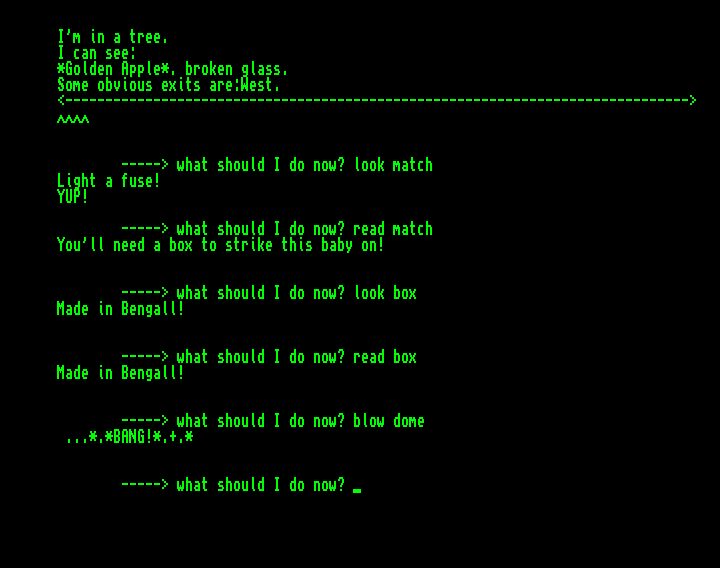
The empty match box has the standard-issue friction surface on the side, which is sufficient to light the match. So we can take match, box, and dynamite back to the glass dome to win the game. (Mind you, this still took me a while, I tried commands like STRIKE MATCH and the like which were not understood; the game wants you to skip all the implicit action and go straight to BLOW DOME.)

Go bowling forever, I guess.
I’ve been wondering, from the author’s note in my last post about trying to publish the game, who he tried to publish with. The TRS-80 was not prolific in the UK; if you saw one, it was often the cheaper clone system Video Genie (seen at the top of this post) instead of the proper Radio Shack system. Even given the clone presence, there wasn’t a giant stack of publishers to choose from like with the ZX-80/81/Spectrum; really the most likely possibility is Molimerx, which published the early Howarth work and also Temple of Bast. I wouldn’t say they were overwhelmed with adventures, though. My guess is if Paul Standen accurately reported that they wanted “arcade games” because of having too many adventures, it was rather that Golden Apple was not quite at the same standard as the other games. Or maybe the swearing and tone weren’t respectable-commercial enough. When in the dark you are told you “can’t see shit”; this is not the sort of message that would appear in any “respectable” adventures until, maybe, the late 90s? (I’m thinking Little Blue Men by Michael Gentry of Anchorhead fame, and Chicks Dig Jerks by Robb Sherwin who went on to make games like Cryptozookeeper.)
This game isn’t interesting as a grand moment in game design (although the philosophical handling of darkness was accidentally of note); it does give another good data point of what a schoolchild’s real game-writing was like, with the attitude of the “Adventure narrator” cranked higher in intensity and lower in maturity.

Just a joke bit.
Coming up next: A sequel, where we must battle against Hitler one last time.


 Renga in Blue
Speaking of the Video Genie and Molimerx, I noticed a while back that they seem to have ported a few of the Howarth games to the Video Genie’s successor, the Colour Genie. That led me to also notice that the Colour Genie platform seems to be entirely missing from CASA, including all of its known adventure games. The bulk of these appear to originate from two main sources: Gumboot Software’s “Quest” series of 6 standard-looking text adventures, most written by Marc J. Leduc and published around 1983, and a handful of text/graphic adventures in German, mostly by the brother (?) team of Stephan and Heiko Scholz, published around 1984/1985 by SBS. All this info can be found on the very comprehensive Colour Genie section of Everygamegoing. I’d guess you might already have these on your master list, but I thought I’d give a heads up here, since they’re not on CASA, Mobygames, etc.
I don’t have these listed. Thanks!
After poking around a little more, I noticed that this same Marc J. Leduc must also be the author of the three “Epic Hero” adventures released by Molimerx for the TRS-80/Video Genie circa ’82-’83, which would actually make him one of the more prolific adventure authors of the era, despite how obscure these all seem to be. When you get around to covering them, it will be interesting to see if any more info can be dug up on him! It does seem that he wrote some other non-adventure (and non-game) software at the time.
I wonder if Marc makes a cameo in those Colour Genie games like he did in his TRS-80 ones, Marc ran a Colour Genie user group in the UK.
I’m not sure why that platform isn’t listed on CASA… the world of the TRS-80 derivatives is quite complex and the Genies must’ve slipped through the net. Unfortunately, despite knowing about issues like thise, I can’t edit pages on CASA at the moment due to a long-standing and ongoing database issue which currently stops the site displaying the authoring systems on entries and also seems to lose information if entries are edited. It’s something that the site owner is aware of but there hasn’t been any news about a fix.
Looking at the CASA platform categories, TRS-80 derivatives such as the Video Genie and Dick King Smith MK 1 are mentioned under the general TRS-80 tag, so I guess that’s where the site would currently place any games for those systems; with an explanation on each game about any compatibility issues (or the original target).
scoulded most heinus
I’m gonna scould this guy’s spelling most heinus. Sounds a bit like Bill & Ted, actually 😆 as does “Absolutely fantastically excellent, dude!”
“Hong Kong blues”? Are we supposed to understand that’s written on the bone, or is it some kind of sass from the narrator? I don’t think I understand it either way.
I noticed you tried to read the apple. Were you hoping it would say “Kallisti”?
Reading had weird effects so I got in the habit
Hong Kong Blues is a 40s song about an opium addict in Hong Kong who wants to go home to San Francisco but keeps spending his money on opium instead.
Need somebody to carry me home to San FranciscoAnd bury my body there
I guess that’s what the player is supposed to be thinking of? I’d heard of Hoagy Carmichael, but not this song. Though it appears there have been several covers since 1939, including one by George Harrison in 1981.
Speaking of spelling, and indeed referring to the Pisuerga bathing Valladolid (sorry, this is a Spanish saying, used when you are going to speak of something totally unrelated).
[Pisuerga is a river, Valladolid a city.]
Do you know that CASA is Spanish for “home”?
Maybe this is old news, after all.
The picture shows the main high-score screen from _Cosmic Fighter_. I remember playing that on a 16K TRS-80 back in 1982 or so. It was the fourth game produced by Big Five Software (the company had nothing to do with Big Five sporting goods stores — it was just two guys, Bill Hogue and Jeff L. Konyu). It was a TRS-80 implementation of the arcade game _Astro Fighter_, with the name changed to avoid copyright infringement.
Game came out 1980.
I was just looking for a Video Genie picture but this one fit what I was writing about wonderfully.