Can you escape the padded cell? Will the old lady hit you with her knitting? How much longer will you have to wait for a 96B bus? These and many other questions will be answered in PYTHONESQUE.
Supersoft we’ve seen twice now before: Brian Cotton’s game Catacombs (for a while lost media, first of a series, we’ll get to the rest sometime) and more relevantly for today, their own version of The Hitch Hiker’s Guide to the Galaxy.
The company received permission from Pan Books to publish Hitch Hiker’s but got in a legal tangle trying to re-publish the game (so re-named it); here, we have a game that started life as Pythonesque — as in the Monty Python comedy troupe — and later again surfaced for the C64 as Streets of London. There was no legal tangle to speak of but perhaps the company was a little nervous.
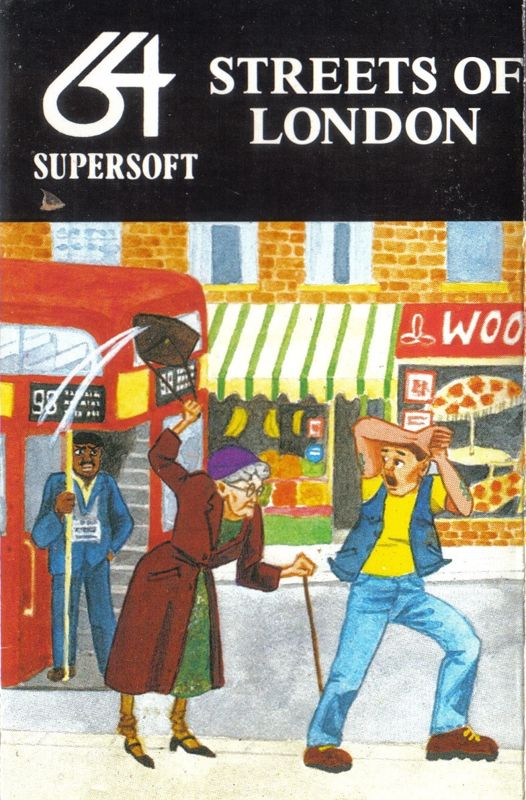
From Mobygames.
The authors (Allen Webb and Grant Privett) also have credits on The Cricklewood Incident and The Kilburn Encounter which allegedly just rework the elements of Pythonesque on different platforms. They look different enough I’ll keep them separate for now (meaning they’ll wait for a later year).
The game starts, oddly enough, with you choosing a difficulty level (1 to 5, I went with easy, usually a wise choice on old adventures where the interest is more in puzzle-solving). You then wake up in a padded cell and decide you need to go locate the Holy Grail.
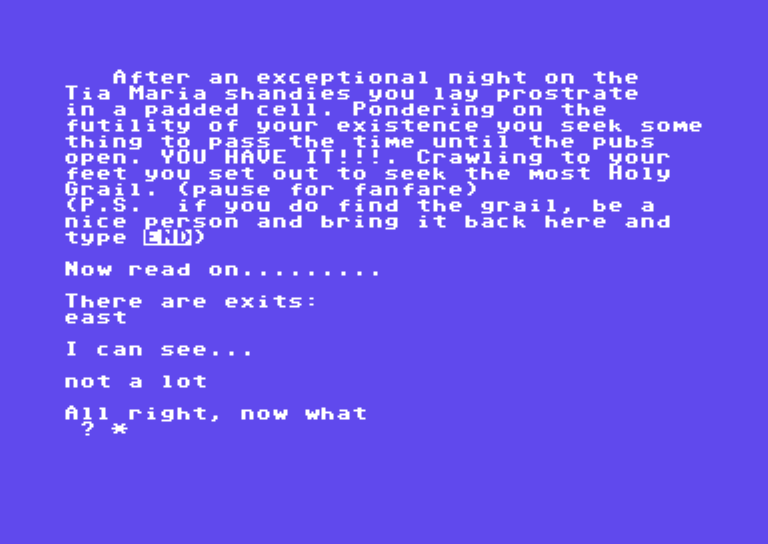
This one absolutely spins the wheel on random, and draws items from famous Monty Python movies and sketches, like the Holy Hand Grenade. The structure is heavily surreal in a way we have yet to see in this blog.

Namely, the game is spread out amongst many small micro-chunks. You teleport (either via random chance, or using a magic word I’ll show off in a moment) and might be in a one-or-two-room area, and one of the directions will drop you right back in front of the padded cell again.
The magic word comes from a piece of toffee paper just outside the entrance: “OH YANGTZE”. It teleports you to completely at random to one of the micro-chunks I’ve been mentioning.

If you don’t recognize the words (I admit I’ve only seen a couple episodes in whole and the “greatest hits”) they’re from the skit asking the deep question “Why is it that so many of Britain’s top goalies feel moved to write about the Yangtze?”
I’m not sure everything is meant to be a reference, although in the same area where you find the toffee paper is one of the most famous ones, one of Hell’s Grannies.
In game form, she isn’t as threatening, or at least I have yet to have her try to hit me as illustrated at the front cover at the top of this post. As implied, there’s also a bus stop there, but the problem is not getting beaten at the bus stop, but rather lacking in money.

I’ve gone through various runs where my character’s finances go up, but I have no idea why or how they do. Money is important not just for the bus but for the fact some places require you to buy things rather than just letting you take them.
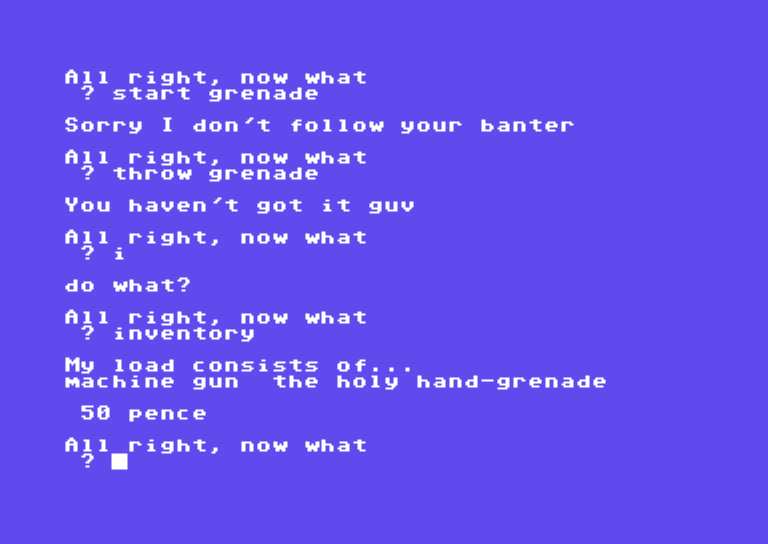
The hand grenade just lands with a thud if you try to throw it and doesn’t explode (you can’t PULL PIN). The machine gun I’ve managed to use on the old lady but that just nets you a dead old lady and no game progress.
If you do have money to ride the bus it works like the magic word — you get on, get off, and find yourself at some new random location. Also, sometimes you randomly just get swiped up for no apparent reason and sent to a new place.

I don’t have anything resembling a complete map yet — the random aspect (and fact some directions will teleport you to the start, and you can’t tell which ones until you try) make my efforts scattershot, and I have some puzzles sticking me in some locations besides. Let me give a far-out view first, just to show general patterns:
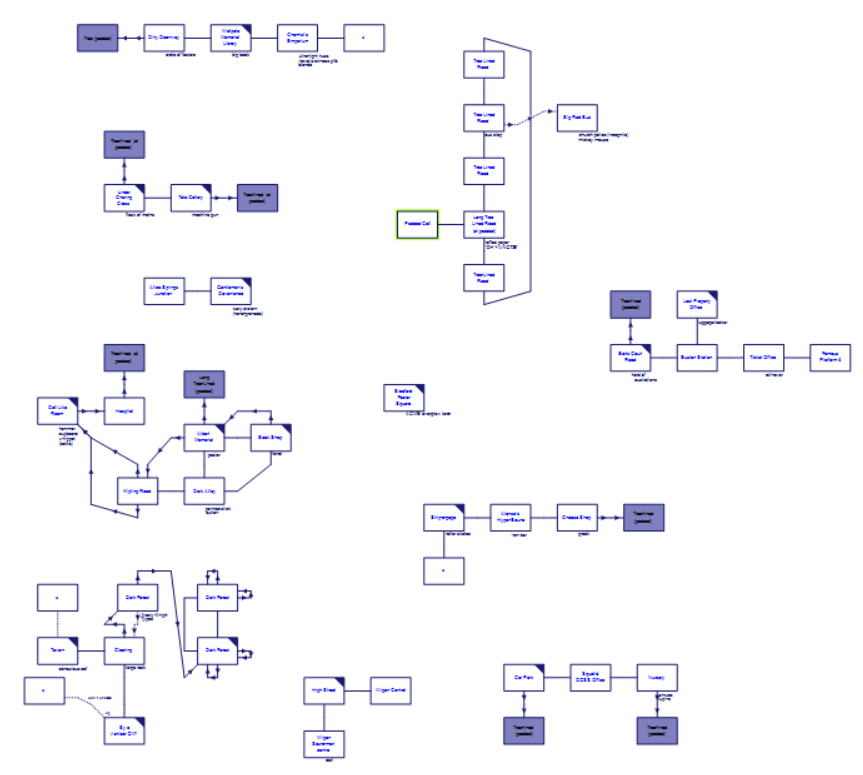
Blue marks “teleport back to the start” rooms. The tag in the corner marks possible landing points (sometimes you get more than one in a section). You’ll also notice some rooms are completely closed in, and I’ve gotten myself stuck before, because the only way out seems to be via magic word, and the magic word only has a limited number of uses.

Above is one of the larger contiguous sections. Going “up” at the vertical cliff requires gear, you get stopped by an “oaf” trying to go north at the tavern, and while you can get past the Nasty Knight Types in order to enter the Dark Forest (they want a shrubbery for heading south, but will let you go north), the Dark Forest consists of two rooms where you get stuck in an endless loop.
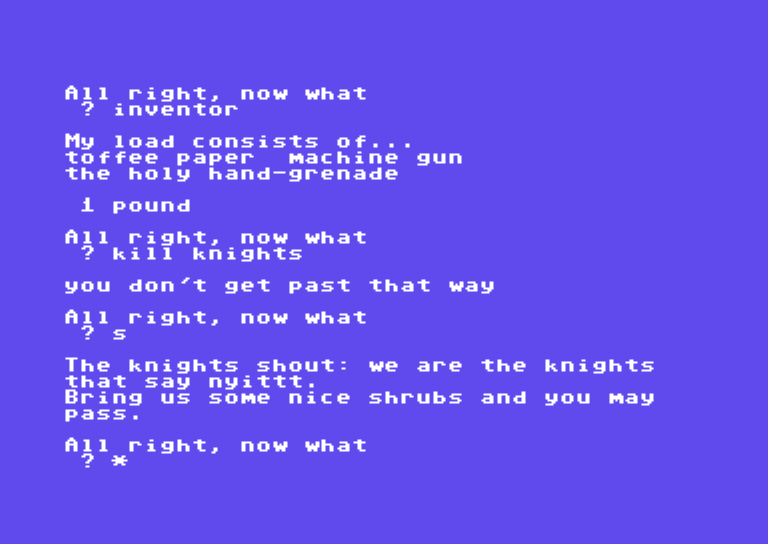
I know where the shrubbery is — it is for sale elsewhere, but on the run where I had this encounter I didn’t have the shrubbery in hand (again, the only movement is random, and you have a limited uses of the magic word).
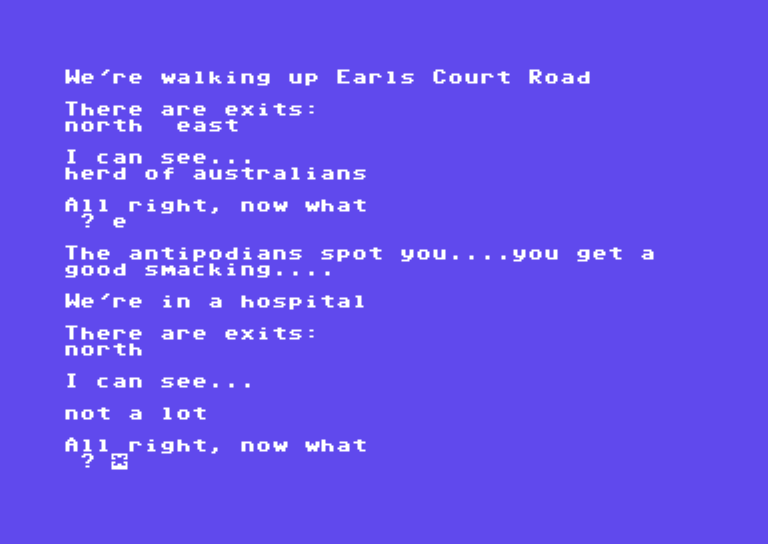
I have a hard time encapsulating all of what’s going on. Some of it is fairly raunchy (that Galahad scene from Holy Grail is in, you end up in the hospital; fortunately the hospital just lets you teleport back to the start). Some of it is plain confusing:
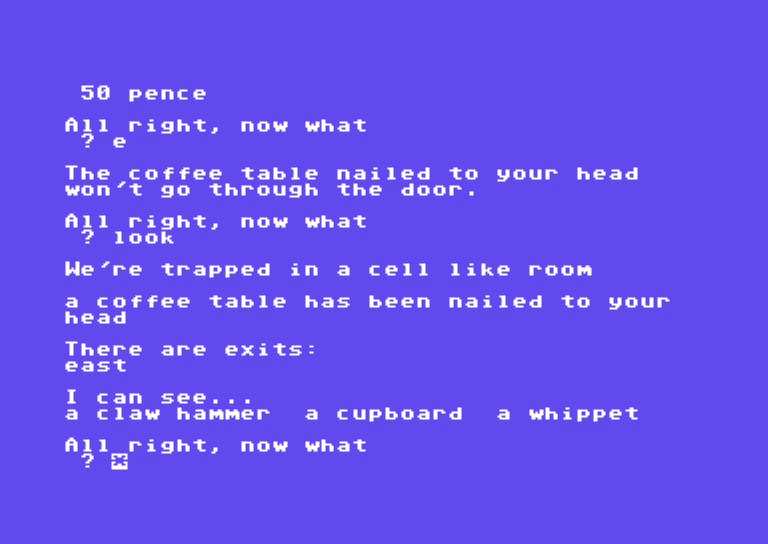
If you take the hammer somehow the table comes off and the whippet runs away. Is this another reference?
I’m not sure yet whether to be positive or negative about the game, although the number of softlocks I’ve hit is starting to tilt to a thumbs-down. Maybe there’s a way to manage the movement I’m not seeing. It’s simply very hard to test objects on things to see if they form solutions when there is very little guarantee I’ll have item X at puzzle Y.
I also don’t think the comedy is hitting, really — it’s so far just been references rather than actually trying to tell jokes — but I’ll reserve judgment on that until I manage to solve some puzzles (or grab for the walkthrough once I get frustrated by the randomness).


 Renga in Blue
I found this game hilarious when I was 15, so much so that a friend and I “ported” a certain version of it, unofficially, to a certain popular micro which did not have it. Details will remain unsaid to preserve the reputation of those involved (my friend is well-known in the retrogaming community). I don’t remember a lot of it, but there were “solutions” to some puzzles that were as far out as the puzzles themselves. As for the comedy, it’s a case of “you had to be there”.
Could you clarify the situation with The Cricklewood Incident and The Kilburn Encounter? Is it a Prisoner / Prisoner 2 type situation? Just glancing at screenshots they don’t seem like the same.
Clarify? Probably not much. The four games (Pythonesque, Streets, Cricklewood and Kilburn) are essentially the same game, with minor details changed, and they definitely share the same common original code logic from the PET. Why the game changed name with almost every different platform release is a bit of a mystery, but the marketing tactics of the time are probably to blame – companies that acquired the rights to the back catalogue or ports of others often tried to disguise the fact that the games were not new. Examples, I’m sure, abound – a particularly unethical one was Keypunch Software taking magazine listings and re-publishing them with credits changed as seemingly new games for the IBM PC, but this was done with legally licensed ports as well all across the industry. Martin Jones was the author of some of the ports for Pythonesque, which is why he’s credited in some versions.
So it’s not exactly a “Prisoner 2” type situation, as that was a reworking with significant changes. I regard these four games as one and only. Then again, it depends what you may call “significant”. It can be somewhat debatable. Some details were just missed – for instance, when you finish The Kilburn Encounter by Tansoft, it greets you with “You have been playing THE CRICKLEWOOD INCIDENT”, to the bafflement of players who didn’t know if that was intentional and part of the joke.
But you should judge for yourself. Do spend some time looking at the other games and checking them – some details are different, but all in all you might agree that there are not too many material differences after all. Disclaimer: I’m talking from memory and maybe remembering things wrong (or forgetting something important), so empirical testing is always warranted.
The scene with your head nailed to a coffee table is a reference to Doug and Dinsdale Piranha. Check YouTube for “Monty Python Piranha Brothers” for the source. One of their more elaborate sketches (about 14 minutes) from, if I recall correctly, the fourth and final season of the Flying Circus.
Thanks! Figured someone would know.
Also feel free to recommend random sketches if you have favorites.
Having one’s head nailed to a coffee table is a reference to Doug and Dinsdale Piranha. Dinsdale generally preferred to nail people’s heads to the *floor*, but wasn’t above diversifying. Doug, meanwhile, used sarcasm. See here, with nailed coffee table at 6:02.
Re: hand grenade — have you tried counting to three before throwing it?
I suppose five is right out.
alas, that’s a brilliant idea, but it doesn’t recognize the verb COUNT
DIG, READ, OPEN, DRINK, EAT, WAIT, KILL, THROW, TIE, PUSH, SAY, TALK, BUY, GIVE, SCREAM, THREAD, SCRAPE, LEAVE
tried doing say one, say two, say three and no dice
Tia Maria shandies? I suppose that’s a reference, but it sounds kind of vile. A shandy being beer and lemonade (which is fine) but then Tia Maria is a coffee liqueur…
Pingback: Pythonesque / Streets of London: Gospel of the Holy Book of Armaments | Renga in Blue