We, have, so far, had three adventure games from Japan, all in 1982:
Omotesando Adventure (ASCII, from April)
Mystery House (Micro Cabin, from June)
Mystery House II (Micro Cabin, from September)
Micro Cabin hadn’t technically yet formally incorporated as a software publishing house for their first adventures (they were still just a store) but in November 1982 they took the plunge, and they also published two more adventure games: Takara B. D. Adventure (written by A. Tako) and today’s game, Diamond Adventure (ダイヤモンドアドベンチャー), as written by N. Minami.

A 1983 Spring/Summer NEC PC catalog from Micro Cabin, via Yahoo! Auctions.
In addition to The Spy (seen above) N. Minami also later worked on Ghost Town (from August 1984), and Worry (aka Mystery House: Worry, from December 1984). All three games are more elaborate than Diamond Adventure, which is short in an Eno / Space Gorn sort of way: it has only a handful of rooms. Mind you, they’re illustrated, and the game still took me a while to get through (for reasons I’ll explain shortly).

The entire map of the game, from Retro AVG Strategy Guide, which calls it the easiest of the adventures played for the blog.
The original version was PC-6001, as shown in the catalog, and there were later versions for X-1 Sharp and MSX. The PC-6001 version is undumped, so I started with the X-1 Sharp version. I was able to load the game using what’s generally “standard” Sharp BASIC (HuBASIC) but I was getting syntax errors.
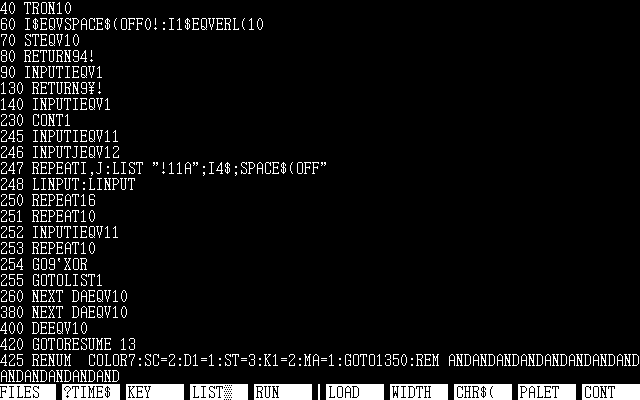
Part of the source code when viewing in HuBASIC.
After this I tried out the MSX version. The NEC and Sharp versions both — like Mystery House — give images with text in Japanese, but require typing commands in English. First enter a verb, hit ENTER, then enter a noun, then hit ENTER again.
The complete list of words is FORWARD, BACK, LEFT, RIGHT, UP, DOWN, ON, OFF, SEARCH, TAKE, LOOK, UNLOCK, USE, OPEN, MOVE, LIGHT, DOOR, MAT, SHELF, TELEVISION, TABLE, VASE, CHAIR, BOOK, PICTURE, SAFE, CANDLE, MATCH. It makes sense, given the players are Japanese, that the complete list of words would need to be given in-game; the game otherwise is expecting you to recognize things from their pictures, but a player might not even know the English word for “safe”.
The MSX version has one other very important difference from the original: the commands are now typed in Katakana, in Japanese.

This was a pain for me not just because of my inadequate Japanese skills, but my inadequate skills at handling MSX emulators. First off, I could only find the file in “TSX” format and the usual emulators don’t like it, so I had to convert it to WAV format (like a raw audio file) then convert again to CAS (which all emulators are fine with). Then since I’m not on an MSX keyboard, I was essentially typing characters “blind” (pressing right ALT activates the character mode). No emulator I found simply let me translate normal modern Unicode into what it’d look like on the MSX. I ended up making “fake” text. For example, early on you can search a postbox. Postbox is ポスト; with the diacritic symbol º separated as the game needs it you get ホºスト. If you are pasting into an emulator the text to paste is ノミソツ. That is, for example, cutting and pasting “ミ” into the emulator creates a “º”. I had to refer back and forth from tables and essentially make a cut-and-paste dictionary to make real progress.
The thing that makes gameplay slightly easier is that it comes with some built-in verbs. The full list is
F1 = Up
F2 = Left
F3 = Forward
F4 = Right
F5 = Open
Shift-F1 = Back
Shift-F2 = Down
Shift-F3 = Get
Shift-F4 = Search
Shift-F5 = Help
but note this leaves out words like USE which has to be typed on its own.
I managed to get a little ways, but the text issue was painful enough I grinded more on the Sharp problem before finally resolving it. What brought realization was finding a different Micro Cabin catalog just for Sharp products.

On the right page, under the line that translates to “Diamond Adventure”, it indicates a very specific BASIC interpreter called dB-BASIC is required.
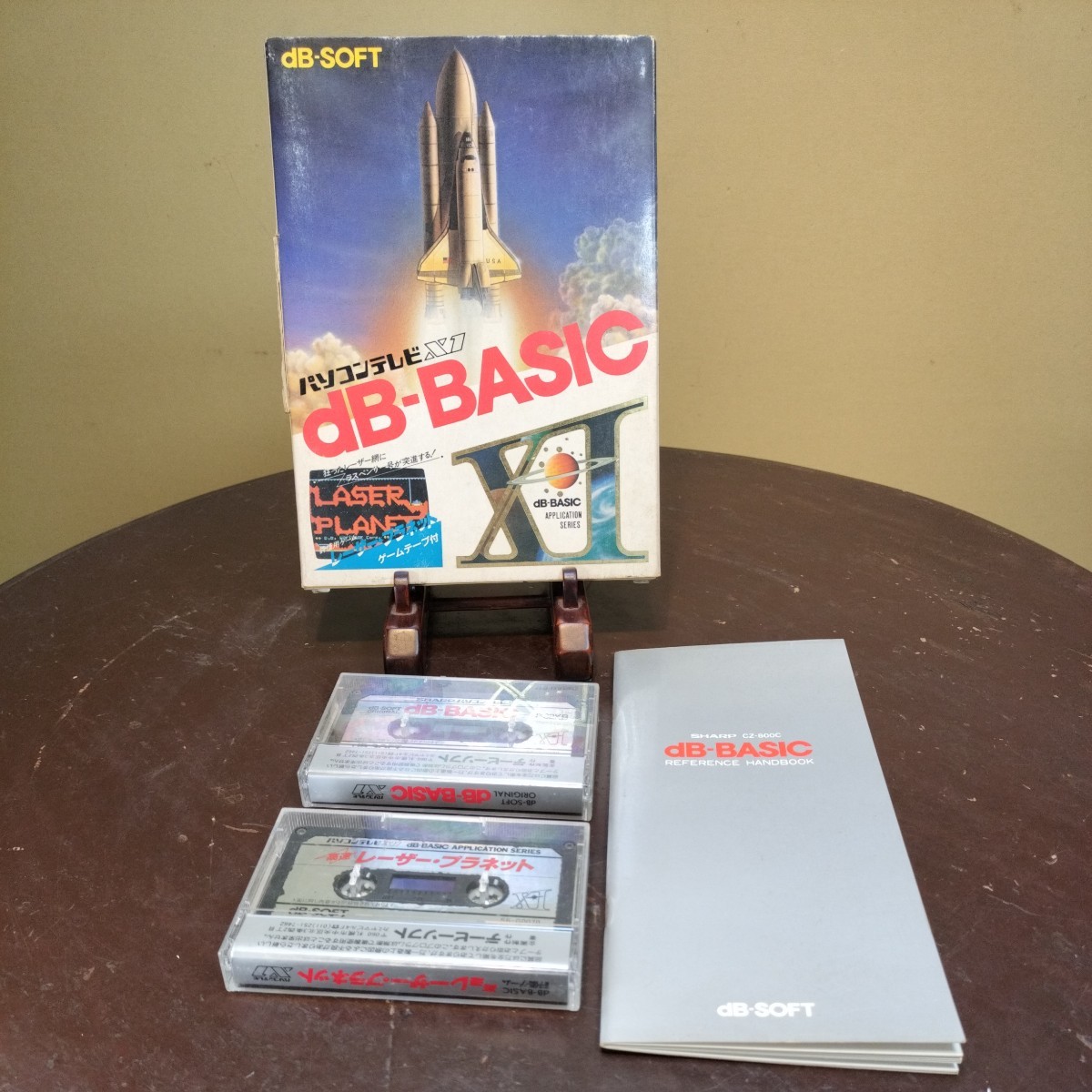
From Yahoo! Japan.
With dB-BASIC loaded the syntax is LOAD”DIA-ADV” with the right tape inserted (despite other BASICs wanting a “CAS:” in front to indicate you’re using a tape, dB-BASIC only can load BASIC games from tape; if you put in the CAS it gets confused and will skip the file you’ve named). To save a lot of suffering to anyone who wants to play I have everything packaged together here, and you can either load save state 0 (right after typing RUN, just hit ENTER) or save state 1 (as the game loads). The reason to use the former is that there’s some random elements to the game which won’t appear with the other save state.
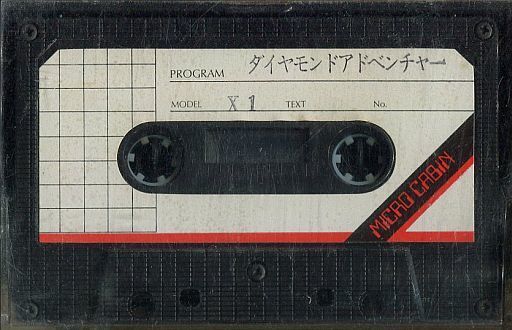
Tape of the Sharp version, via Giant Bomb.
With all that setup, let’s get back to the actual game!
We are quite simply tasked with going to a three-story building — which has a diamond worth 10 million yen — and stealing it. This is essentially a combination of Omotesando Adventure (visit a building with alarms, be sneaky) and Mystery House (nab a diamond). While Crowther/Woods Adventure did make it to Japan it wasn’t the urtext so it makes sense people would be making copies of Omotesando instead. (The other November game from Micro Cabin is even closer to Omotesando, but we’ll save that one for the future.) The practical ramifications for early Japanese adventures are: less treasure hunts with multiple items, less mazes.
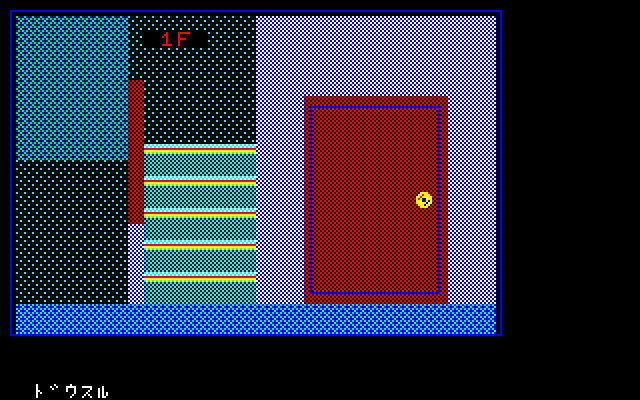
After moving Forward from the starting location towards the building.
You can (in the MSX version), open the first floor door, walk in, and immediately die.


It took about three hours to reach this point.

The first-floor door is impossible to open in the Sharp X-1 version. In either version you’re supposed to go UP when you approach to arrive at the third floor.

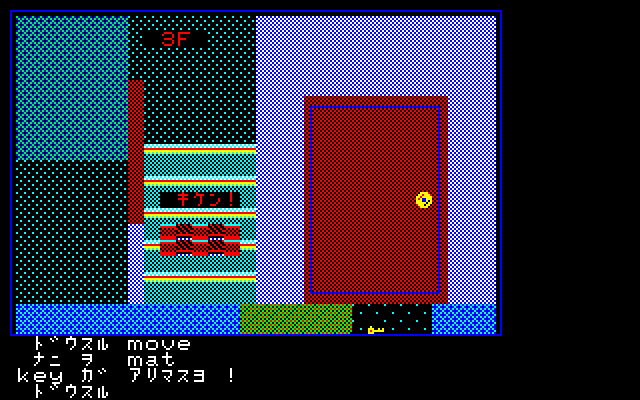
With the key from moving the mat (see above) you can just walk in.

One thing I neglected to mention when writing about Mystery House (I wasn’t aware at the time) is that many of the early objects are randomly placed. So there’s a set number of places you can search, and a fewer number of items, and those items are scattered; this makes it so each playthrough is slightly different. This game does the same trick, except it is such a small game it takes roughly 4 minutes to find all the objects that can be searched. Here, you can just the vase, table, and “shelf” (even the Japanese player on the MSX walkthrough I watched got confused about that and had to check the help).
Just to the “right” you can find a chair to search:
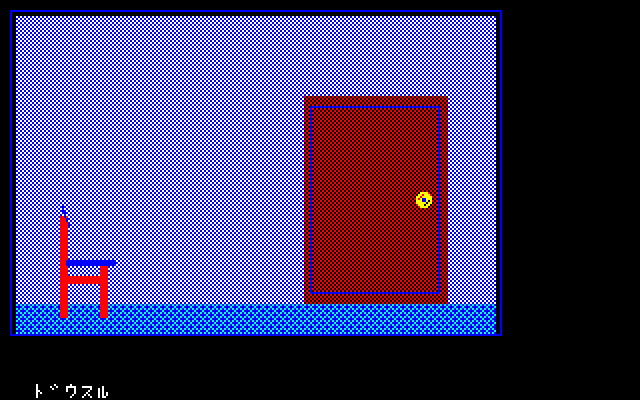
And through the door you can find another table and a television:

The items you get (assuming you’ve been thorough) are a candle, a match, and a key. You can move the “picture” here to find a safe, which unlocks with a key. Within the safe is another key.

Moving on, you can find a bookcase. You can TAKE BOOK, specify a row (either 2 or 3) and then specify a book (1 through 5).

I think you might also be able to find either the candle or match on the chair.
Randomly, two books are useful. One of them will give you the code which will be used shortly.
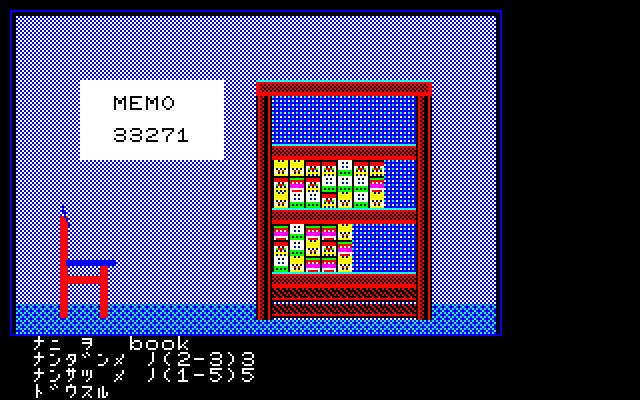
This code is randomly generated.
The other will cause the bookcase to swing open revealing a secret room. You can go in to find another “shelf” which unlocks with the key from the safe.


The shelf reveals a stairway inside (very similar to a moment in Mystery House). You can then find a safe which requires the code from downstairs.


“Good job! You did it!”
This wasn’t notable in a gameplay sense — the double-book secret is honestly the only part of the game that counts as a “puzzle”. The emulator was the real boss. This is notable in a history-of-games sense, as an amalgam of Omotesando and Mystery House in the short window where copying was happening. In 1983 things start to get very different (including with the third game from Tsukasa Moritani after the two Mystery Houses); Crowther/Woods Adventure cast a long enough shadow that it still was affecting Western games 5 years later.
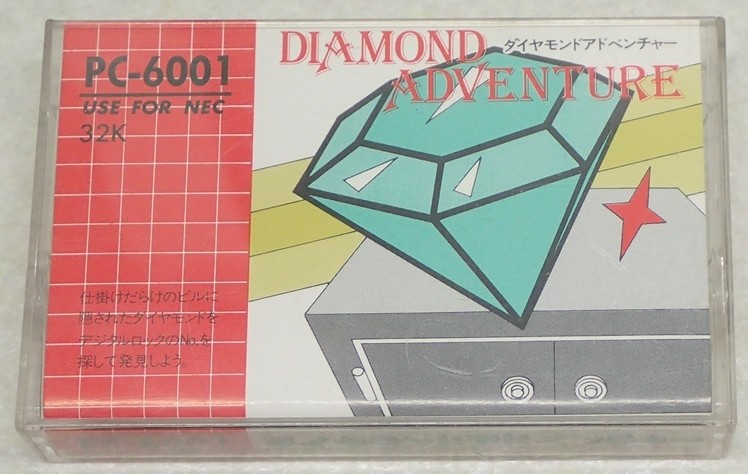
From Yahoo! Auctions.


 Renga in Blue
Poking around a bit, I found an entry for this on the Pc6001 Game Library site, where there are a couple of screenshots indicating that it has been dumped. No idea if it’s available for download anywhere, though.
Curiously, that site lists it as a 1983 release, whereas the Retro AVG site says 1982. Which sources did you use to pin it down to November, ’82?
I’m using the dates from bowl-of-lentils (who has researched this pretty extensively, and has copies of things and JP material that’s not online) who put everything up at Giant Bomb. They also did that Mystery House video I linked from one of my earlier posts.
I’ve seen some screenshots but unfortunately Japanese stuff is weird, you can have something dumped but not generally available. It isn’t in the TOSEC, at least. I’d love to see a copy if it comes around though!
So, after a little more searching, I would guess that he came to this date based on the first Microcabin ad that lists this game and Takara Building, from the November, 1982 issue of I/O magazine, which has always been the best source for these old ads. I used to own physical copies of these years ago, but had to dump them when I moved, since each one weighs more than a phone book! Anyway, the only nit I would pick is that, based on the standard delay between cover dates and actual magazine releases at that time, these games may have come out a bit before November, since these were listed as “new releases” with full details such as price, etc. in this ad, which must have been printed up and submitted even before the magazine was ready to publish, at least 2 months before the actual cover date.
The issue of “hidden” Japanese dumps is if course a long-standing thing. I take it as a cultural issue, more than anything else. I used to contribute to a blog about obscure vintage progressive/psychedelic rock LPs, and kind of specialized in digging up completely unknown stuff from Japan, which was still very abundant back then, as the tiny handful of Japanese collectors who knew about them usually tried to keep them hidden, rather than sharing information and hyping them up to the high heavens, as we tend to do in the West.
I’m really in the weeds here now, I know… Sorry!
No, the weeds are great!
Yeah, I often push by a month based on ads, although I’m not going to fuss too much about it here.
Remember, whenever it comes to Japanese computer games, it’s best to check the Neo Kobe collection. IIRC, they always have more games than everywhere else. This doesn’t help you if the rips are bad though, because usually it’s just one rip everywhere, and nobody bothers to check if you can play it all the way through. I’ve played multiple games that had one platform which is just unwinnable at some point or another.
Off-topic, any recs for those obscure prog/psych LPs? Not specifically Japanese, I just like finding stuff from then and the Prog Archives isn’t great for finding more obscure material.
I don’t actually have a copy of Takara B. D. Adventure, btw. I’ve found screenshots from multiple places and I know the objective and how the game starts, but none of the people who have a copy have put one on the Internet.
goes by 宝ビルアドベンチャー in Japanese
might find for MZ-80K (and variants), MZ-700, MZ-800, or MZ-1200 (which I think is just a MZ-80K variant but still might have content sorted differently)
the author Akimasa Tako went on to do the Alice and Wonderland game which I believe has come up on the Adventure Gamer blog before
(add: one extra comment — there seemed to have been a “part 1” and a “part 2”, and supposedly you get a password from part 1 to be able to start part 2. i may actually have part 2 but I can’t load the tape because of the password thing! and I get the vague sense that part 2 might not even be an adventure game ?! you can see the two different tape covers here)
and…of course I find out some more info immediately after writing that
Part 2 kicks off with an action sequence, the rest is a normal adventure game (I found a walkthrough) but the action sequence is apparently pretty hard. That person I quoted playing Mystery House as a kid also wrote about Takara
http://furuiotoko.la.coocan.jp/room06/mystery1.htm
Unfortunately, I don’t think there’s an easy source of computers from the MZ series, there’s no Neo Kobe for it. I just now tried searching for stuff, but I suspect it’s the same stuff (and site) you found. I’m surprised there’s so much stuff for the MZ-700 and MZ-800 but not that.
yeah, Sharpworks has done a great job preserving everything Euro but doesn’t do Japan
https://mz-archive.co.uk/index.html
he is interested in getting a copy of Mystery House though (the very first version which was for Sharp also hasn’t been preserved online)
Hi, I tried responding to this days ago, but it seems to have disappeared into the void, so here’s another go…
Re obscure old prog/psych stuff: Best online research sources I know of are RYM, Discogs, Gnosis2000, 45cat, Freeman bros (Audion/Ultima Thule), and a few others. The old blog I used to help out with was called the CD Reissue Wishlist. It’s long defunct, and I think he moved a bunch of our reviews over to RYM or his other sites (my old friend Tom, who also founded Gnosis2000), but it’s still online, so you could just scroll down the long list of bands he/we covered back then and see if something catches your eye. If I could make one recommendation from the Japanese stuff we dug up, it might be Tanaka and Super Session “British Rock Live in Japan”, which eventually did end up getting reissued.
I’m not sure if you are aware of this or not, but archive.org has a collection of Japanese games translated into English. I did not see this game, but I did not look that carefully. I did see Mystery House, though.
https://archive.org/download/En-ROMs/En-ROMs/
even given the language barrier I’d recommend the FM-7 version of Mystery House over the translated one, the interface is so much less of a pain
that’s a nice collection though!
You could also try this collection here. You might even find someone willing to translate a game on the forum.
https://www.romhacking.net/?page=games&genre=&platform=&material=transexist&order=&perpage=20&dir=&title=&gamesearch=Go
I thought I knew every Japanese adventure game that was out in 1982, guess I was wrong. This one comes off as very traditional for Japan, since 1982 is marked by a lot of questionable games which may or may not actually be adventures or RPGs. And as you might not be able to notice, they were rather eager to get away from the classic parser design, both because text on these PCs without Kanji looks like ass, and because of various technical issues relating to the parser. BTW, you will have just as much fun getting used to the parser on every single Japanese computer, until suddenly it isn’t an issue. Let’s just say on the other hand that the Japanese believed in making games unwinnable, and not in ways that us mortal men can begin to comprehend.
Pingback: The Sands of Egypt (1982) | Renga in Blue
Pingback: Takara Building Adventure Part 1 (1982) | Renga in Blue