I have finished the game. You can read all my entries in order here.
I should preface a little, for the benefit of those who normally don’t read this blog and are here just for this game: this isn’t really a “review blog”, even though you can interpret what I write that way. I’m trying to understand the full span of adventure games, and extract what knowledge I can and place it in historical context. That means some elements of a game may be bad choices, but serve a purpose, or at the very least be “good enough” in a particular setting.
This game was extremely important for Italy, and it had wide enough commercial spread it was some people’s first adventure, or even first computer game of any kind. In this interview with the author from only two weeks ago, in addition to the live comments, there’s this top comment that attests to lasting influence:
Mi sono appassionato alla programmazione proprio grazie ad Avventura nel Castello che giocavo rigorosamente al buio con i miei cugini su un M19. Oggi è il mio lavoro e la mia passione! GRAZIE
I got into my passion for programming specifically because of Avventura nel Castello, which I used to play only in the dark with my cousins using a M19. Today it is both my job and my passion. Thank you!
(M19 refers to the Olivetti M19; Olivetti was one of the big local computer manufacturers; they had started out in typewriters.)
If the game is treated as a place to visit (where you don’t necessarily care about winning) it manages a strong atmosphere; the vast majority of the castle can be reached without solving puzzles, and any new areas are small. So I could see someone playing the game off and on over years, maybe getting to a new place just by sheer persistence, meaning my playthrough is not representative of how people responded at the time.
So while I’m going to be a little hard on this, I’m doing it out of love, but also with the presumption it should be a game played from start to finish without large pauses in the middle.
Last time I was hopeful that perhaps I could turn things around and not rely on poking at hints every other puzzle.
cough
No, sorry. Things got even worse. There was one nifty trick remaining, but the rest of the puzzles were mean in some aspect. (One of the mean parts was also wonderfully audacious in its cruelty, but let’s just see it in context.)
Let’s get a reasonable part out of the way first — relatively speaking, you have to refer to a thing in the room description again:
You’re in a short room crammed with hunting and war trophies. Fixed to the walls are stuffed animal head of all kinds, weapons, shields, even an entire suit of armour that probably belonged to a rival clan chief killed in battle by the Laird himself.
What are you going to do? EXAMINE ARMOR
It is the armour of Sir Crawford, the valiant warrior wizard who, for many years, held MacCallum IV in check with his prowess and his fearsome arts. The armour still maintains a haughty bearing, and even seems to stare at you, leaning on the sword.
You’re in the trophy room.
What are you going to do? TAKE SWORD
Done!
“Reasonable” is relatively speaking. This is still referring to a “second-order” object — that is, it’s an object that gets referred to in the description of an object, and you have the realize you can try to go ahead and take it. I had this in my head because with some different suits of armor (back in the main hall of the castle) I killed myself trying to grab a pike:
You’re in a large hallway, the floor of which bears the signs of the passage of countless generations. A row of armour is lined up along the wall, each holding a long pike.
Towards the centre of the hallway, there appears to have once been a door, now bricked up.What are you going to do? TAKE PIKE
You take the pike and pull it towards you, but the armour doesn’t seem to want to let it go. Should you pull it a wee bit harder ? YES
With a firm tug, you finally manage to get hold of the pike.The armour, unbalanced, wobbles slightly……
and as you step back with the tip of the pike gripped in your hands, the armour falls with all its weight onto the other end of the weapon, piercing you through and through.
This is how it was used in battle!
So I was at least somewhat prepared to grab the sword. The sword is described as having a “spell” on its blade. You can try to read the spell and the game mysteriously asks if you mean to read it out loud.
What are you going to do? READ SPELL
Should you say it out loud? YES
Nothing is happening.
Back down past the ogre that the cat ate last time there are two things: a dwarf holding a diamond, and a chest. (Both locations are marked on the map below.)
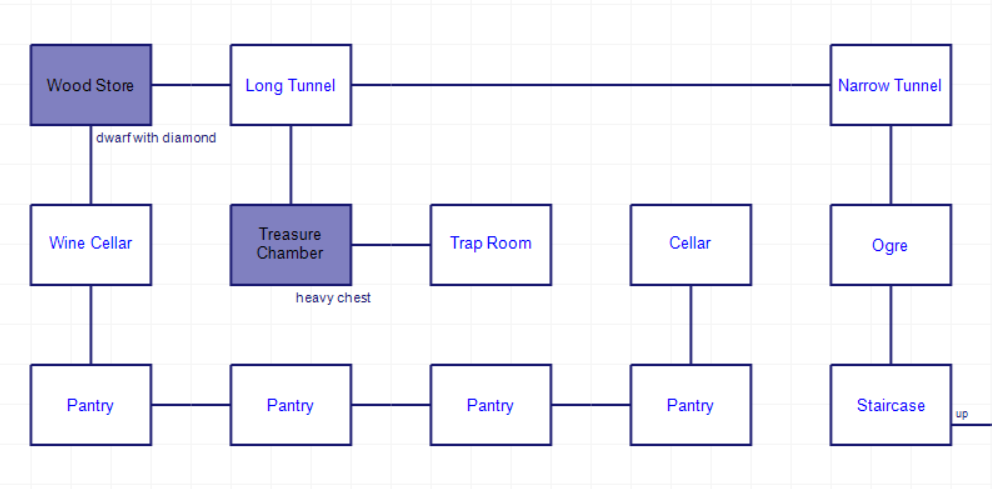
The chest is where the spell goes, and yes, it’s very arbitrary:
What are you going to do? OPEN CHEST
The ghost of Malcolm’s faithful squire, Edgar MacDouglas, rises to defend the treasure of his ancient Laird from the foreign defiler.
You’re in the treasure chamber.
I can see a heavy chest.
I can see a ghost.
Yes, if you go back and look at the sword, and specifically the armor, it seems to be someone who defined the Laird family of the castle, so it makes some sense after the fact that the spell on the sword would help oppose a spirit who identifies with the Lairds. It’s still very after-the-fact reasoning, and made worse by an extra obstacle: when you try to read the spell out loud voice is cracked.
Your throat is dry with fear…
You can’t speak…
The ghost takes advantage of this to attack you.
I very briefly mentioned last time some honey milk I fed to a cat; the cat is takeable without giving over the milk. I had unknowingly soft-locked the game. The milk is supposed to be saved so you can use it on yourself, although you have only one turn, the one immediately before stating the spell.
What are you going to do? DRINK MILK
Lip-lickingly delicious!
What are you going to do? READ SPELL
Should you say it out loud? YES
With a long, desperate wail, the ghost returns to the nothingness from which it came.
The honey is sort of a hint about throat control, but this puzzle was, at the very least, kind of mean. The chest, ghost-free, yields up a hunting horn.
It is decorated with hunting scenes that wrap around in a spiral from its mouth. Galloping riders are seen to chase their prey, while large birds circle overhead.
The one after is as well:
You are in the wood store, where dry branches and logs of various sizes are stacked in perfect order.
I can see a wee dwarf with a big diamond.What are you going to do? EXAMINE DWARF
He’s quite small.
What are you going to do? EXAMINE DIAMOND
The more you observe the wonderful gemstone, the more you become overwhelmed by an unbridled desire to possess it.
You do need the diamond, but can’t steal it away or defeat the dwarf in combat or anything like that. You’re just supposed to GREET (or in Italian, SALUTA) it:
The dwarf is so happy to finally meet such a courteous person that he simply gives you the diamond.
This is one of those puzzles if you run 20 people through, someone is bound to get it just by trying naturally, but it is hard to work out what the natural thought process for a solution might otherwise be.
The game then rather cheekily warns you to be careful with the newly-acquired diamond:
It’s magnificent: the light reflected and refracted by its a thousand perfect facets creates an infinite play of colour. You are fascinated by it, and would observe it for hours and hours. I think it’s of inestimable value, and you should treat it with utmost care.
However, remember: this is not a treasure hunt! We don’t care about treasures. We care about getting out of the castle. Somehow (…magic?…) the bludgeon from down the basement (the one that required using a bone to get) is able to smash the diamond, and we can then get a key.
On the first blow of the bludgeon, the diamond shatters into a thousand pieces.
Conceptually, I see the point here: the narrator has been a little bit off-kilter since the very first puzzle, so the very strong suggestion to treat the diamond with utmost care can be thought of as giving instructions to do the opposite. That doesn’t stop the puzzle from being amazingly cruel.
The key and the horn are the two items needed to escape. We need to head back to the maze, the one I mentioned last time led to nowhere when I mapped it out, but we got an explicit hint I hadn’t applied yet:
‘Only by the good use of sense will you find your way out from the labyrinth’
This is a puzzle we’ve seen before but somehow the phrasing threw me off here. It works both in Italian and in English, and by making that statement, I’ve given the hint that wordplay is involved.
‘Only by the good use of sense will you find your way out from the labyrinth’
We’re not using “our senses” (as I first read it) we are using the word “sense”, giving the sequence south, east, north, south, east. (Without having read the hint first, this just returns the player to the entrance.)
In Italian, the word is SENNO, which might seem like it breaks, but the Italian word for “west” is “ouest”! So S, E, N, N, O is the solution in that version of the game.
What are you going to do? E
You’re in the large secret room, under the castle tower. A current of icy air
hisses through invisible cracks.
I can see a lever.
I can see a stopped old pendulum clock.
I imagine for people who didn’t ping at the walkthrough for items this puzzle was completely stumped; here, I was just mostly stumped. The key is not the kind of key to unlock things, but the kind of key to wind things. You can WIND the clock, causing it to start ticking. It was close to but not right at midnight, and when it reaches midnight:
A stone block shifts, revealing a spiral staircase.
This leads you to the roof, and once again, you have to make arbitrary use of a magic item.
You’re at the top of the tower, where your gaze sweeps above the fog covering the peatland, and towards the distant mountains.
I can see a flag in tatters.What are you going to do? TAKE FLAG
The old flagpole evades your grip… and suddenly gives way, making you lose your balance. You fall down onto the parade ground.
(Or you can try fiddling with the flag, but that’s a red herring, it kills you.)
You have to use the horn. Now, we hit the one part where the English version is much harder than the Italian version. You would think to BLOW HORN, but no, that verb is not understood. I was completely baffled and checked the required verb in Italian, which is SUONA, which I’d still translate (in the context of using the word on a horn in English) to “BLOW”. But they (Adam Bishop, the translator) translated it to SOUND, like SOUND HORN. This is the first time I’ve had that as a required verb in an adventure game, and it may be the only time I ever see it. Yes, it technically is grammatical, but more along the lines of terminology from a prior century.
What are you going to do? SOUND HORN
The ancient horn sounds across the moor, echoing off the distant mountains. A black dot rises from the mountains and grows larger as it approaches. Quickly it reaches the tower: it’s a large golden eagle that lurches towards you with its claws extended.
What are you going to do?
This is a fake-out; you can’t type anything before being interrupted. Oh also, you needed the parachute here, otherwise you die; theoretically an easy puzzle to resolve after dying once, but someone might have dumped their parachute back in the first room where it would be inaccessible and have to restart the whole game.
You have no chance:
The eagle grabs you, quickly lifting you up to a great height.The eagle flies for a long time while the landscape races beneath you… … … … … … … … … … … … . .. … … … … … … … … … … … … … … … … …Loch Ness appears in the distance… … … … … … … … … … … … … . .. … … … … … … … … … … … … … … … … …Suddenly, the eagle lets go of you.
You gently descend in the dying daylight. Below you are the dark waters of Loch Ness. The wind pushes you towards the centre of the lake. By chance, you land on a small outcrop of rock.
While you fold away your parachute, you look around:You’re alone and abandoned on a black rock peaking above the icy waters. Let me correct myself, you are not alone: the Loch Ness Monster (Nessie among friends) is there to keep you company.
The Loch Ness Monster is not trying to be your friend.
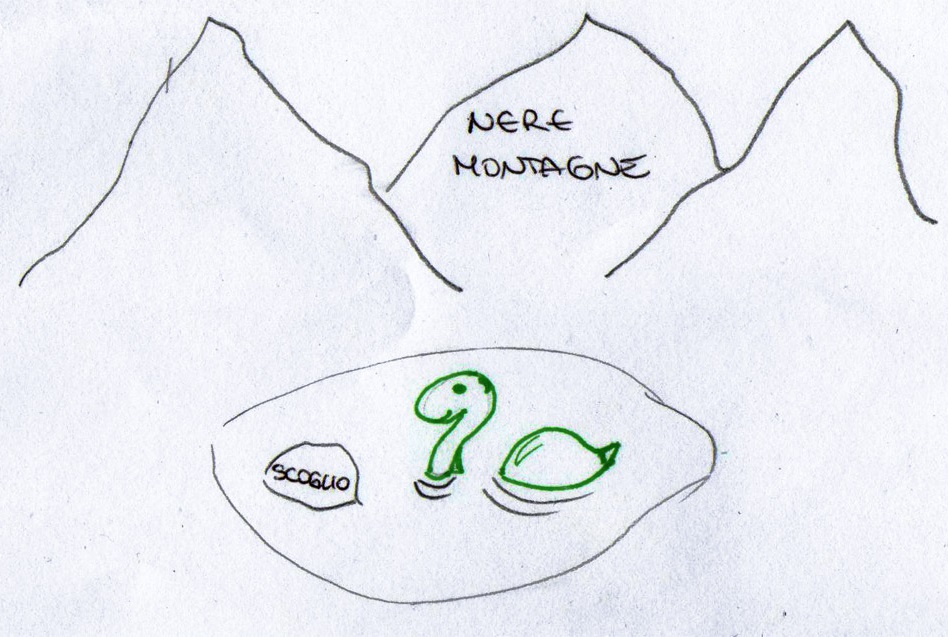
Depiction of the final area via Oldgamesitalia.
Arbitrary magic is your friend again. This is solvable in a “well, there’s nothing else I can do” sense but not in a logical sense.
The ancient horn sounds across the moor, echoing off the distant mountains. A black dot rises from the mountains and grows larger as it approaches. Quickly it reaches the rock: it’s a helicopter from the Royal Archaeological Service, which throws you down a rescue ladder. You climb the ladder as the monster’s jaws snap shut inches below you.
You are informed the horn is Malcolm the Fourth’s thought to be worth “a million pounds or more”, but upon landing we get charged with crimes.
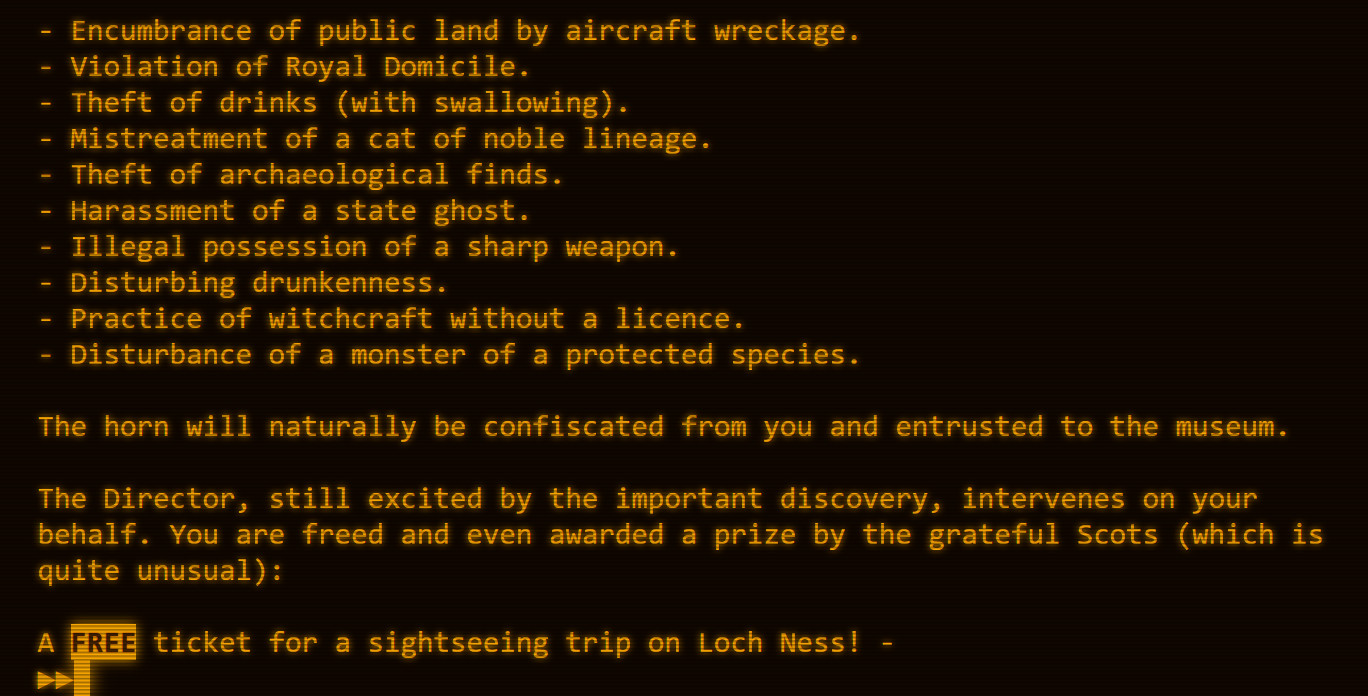
At least the game compensates you with what I think is the best title for winning a game I’ve ever heard.
Anyhow, console yourself: you have finally earned the 1000 points that give you the right to boast the coveted title of:
THE DEVIL’S LIEUTENANT!!!
Look: I loved original Adventure as a child, but I never came close to beating it. I was able to explore most of it — even the part past the plant, which was one of the easier puzzles — and while I didn’t solve the golden eggs puzzle until I was a grown adult (so had to sacrifice treasure at the troll) I still had a grand time and have many core memories exploring the dense caverns. Similarly, while I’m sure someone will chime in they somehow solved this game without help, I’m guessing a lot of the people this game influenced treated Castle Adventure as a destination to explore, with the fact there were unplumbed secrets making something of a bonus.
And certainly: the text has a great sense of attitude, both in the Italian original and the relatively literal translation. The deaths were amusing and while the softlocks were terrible they weren’t overwhelming either; you also don’t have to bother with a light timer like so many Adventure clones felt obligated to include.
So while I only recommend this for the historically curious (English version here) I’m glad that it exists.


 Renga in Blue
As an Italian, I am glad to see this milestone game appear in your blog. A pity you seem not to have had much fun from it, and I wonder how much went “lost in translation”. For context, I played the 1987 DOS version a couple of years ago and found it very enjoyable, and I was able to solve it in about a week, using just one hint. But, to be fair, other Italian retrogaming reviewers were less kind, so I guess it was a case where the setting and tone worked for me and allowed me to forgive the many shortcomings of the implementation.
Is there anything in the Italian that makes greeting the dwarf easier to figure out? That was the one that I was most baffled by.
Oh, for that one I was getting desperate. At the end, trying random verbs, I happened to type “DI” (“say”). To which I was prompted what I wanted to say. An answer of “CIAO” (“hi”) had the dwarf comment I was somewhat too informal, but he appreciated the saluation and gave me the diamond.
So, while GREET is quite hard to guess, I think SAY is a verb that has some chance to be found.
Hi, I read all 3 chapters of your gameplay. I’m Italian too and played this as a kid in ’99 at the place of a blind family friend, this game was perfect in that sense, as in leaving the dos intervace, etc. . There was a crude but functional voice sythesizer which described any new text.
Strangely I didn’t have much hard time figuring out the bone puzzle but others have completely confused me, i.e. I completely missed that I could descend the south east spiral stairs lower. I’ll comment more specific details on your early gameplay entries being more pertinent.
You forgot an added annoyance about the cat and honeymilk, on top of drinking it ahead of time and *willingly* feeding the cat with it making, as you noticed, the game unwinnable potentially unnoticed for long before getting to that point, – the fact that as you enter downstairs from the south east rampart, the cat is gonna eat the honeymilk in their own intiative! Adding to what can unadvertently softlock if you don’t do it in the perfectly right sequence.
I read that in the 90’s Sierra was also infamous for very insidious softlocks, missing something you need, consuming it not at the right time.
Guess being able to do something that may softlock you can give more sense of freedom and agency, less handholding, which I may in part agree many modern game lean too heavily on.
This game is indeed non linear for the time, while not exactly open world, as you noticed about being able to explore most of the castle without solving a single puzzle, except maybe the entire south east rampart being a puzzle in itself, as I didn’t immediately realize unlike the other 3 towers it couldn’t be accessed going east from the main hall or “atrium” ^_^.
Same for the dwarf, I played it recently and I was trying to remember, “oh probably I have to try greeting him or something, so “Saluta il nano””, but mainly after seeing that you couldn’t even “talk with the dwarf” and the game tells you to “be more specific”.
And totally, the least wrong move and you are killed for no reason, taking the flag, taking the pike.
And in the parade courtyard, you can’t even “look” or examine the well slab, as it gives in under your weight and you fall to your death inside it! What? Who told them to walk over it just do examine it? Also you’d have to assume it wasn’t even che classic cylinder shaped well, but just a hole, sure they exist. And one would assume it would be larger than the well and leaned in the ground around it, not just stuck inside, it, alas still why step on it if I didn’t even order to try opening it?
oo, I never had the cat just drink the milk on its own, that’s tricky
it saying “be more specific” on the Dwarf would help, I never got such a message playing in English (although I might have been wording things different from how the game was expecting)
> I completely missed that I could descend the south east spiral stairs lower
you can see in my first map I missed that — missing exits is one of the main thing that gets me stuck on these games, and if I’m stuck I’ll sometimes just ram through trying all the exits and marking down where I’ve tested
enough of these games even establish “we’re going to show you the exits” but then violate that somewhere that I can’t trust anything the game says
Wanted to add, about the cat something which could have been a scrapped feature, the way you can both erroneously feed the cat the honeymik or even have it treacherously feeding on its own initiative if you have both with you just a few rooms from where you have to cast the spell on the cat, mercilessly softlocking you, suggest me, along with the line about the cat being hungry and letting themselves be caught easily, that maybe originally Enrico thought about having the game feature a puzzle where the honeymilk is needed to lure and attract the cat, in order to take it, otherwise they would flee you not letting being caught! And for some reason it ended up being cut off the game as we know we can take the cat without having the cup with us :), curious how the line plays not only as a one time comment the first time the cat is caught, but every time it’s taken even after being dropped. It struck always as a bit nonsensical to me, as hungriness making a cat easier to catch without having something they may like, more like a cat which is sated and a bit sleepy.
So it would have made more sense if you had that prized cup with you.
Yeah “sound horn” is an astounding mistake, just cause playing, a wider english verb, in italian become “suonare” as in making the noun “sound” into a verb, when it comes to musical instruments, though horns are often just “blown” sometimes in english when not played musically, it seems, which even applies to ringing of bells, phones and door, intercom or doorbell. So the emphasis in playing in italian is on them making/emitting a sound when played/executed.
Strange how the translator fell into that as I read it’s a human one, but it’s possible he relied on the partial assistance of an automatic one and then checked and cleaned up, possibly missing that. But I’d have expected even an automatic translator in 2021 to at least default to “play” for it.
Another trivia on the throne room and the “phantom” of a wall now walled, from the map, as well as my mental one, it quite likely leads to the corridor where it’s also hinted a walled door or doorway is present.
Spoiler: About the ending, it sounded cartoonish and comic like and indeed it reminded me of how many of Uncle Scrooge adventure and speditions raiding ancient tombs, temples and castles and their treasures ended up, being comically charged for multiple violations to archeological sides and, in good part rightly, having to return the retrieved goods and artifact to the collectivity. It really sounded like a shoutout to these stories, especially given the rich italian classic disney school and the weekly “Topolino”. Felt more unfair here as the adventurer in question was just trying to survive and escaping unscathed, basically (:. The part about the local spectre harassment and the exaggerated “witchcraft practiced without a license” are quite disneyan indeed, giving that sense of the trope of modernity as killjoy of the spirit of adventure.