An Unearthly Child, the first serial of Dr. Who, aired in 1963; in 1967, the Doctor made his first appearance in comic book form, via TV Comic issue 800.
Dr. Who is on a planet with his grandchildren (John and Gillian) and is facing off against spiders. The comic authors were somewhat unclear about the general mood of Dr. Who (which involves outwitting more than shooting alien species) but here he goes full blaster.
From the blog Die, Hideous Creature, Die! which includes details about the Doctor cheerfully destroying a species.
In Dr. Who Adventure I got to use a Dalek ray gun on a spider and it crashed the game, which somehow seems appropriate. But let’s rewind:
I had left off on planet Peladon. One thing I hadn’t experimented with was the verb SEARCH, which works in any random room for hiding hidden things. I ended up hitting zero going through the entire planet, even when trying SEARCH multiple times, except for back in the Maze:
I originally visualized this as a lockpick or a guitar pick; this is the kind of pick for digging.
The discovery of the item also let me test out just what the map was like, where I discovered that every direction (north, south, east, west, up, down) looped back to where the pick was. This indicates that escape from the maze is more or less random, so I shouldn’t sweat mapping it.
I also discovered, on a later playthrough, that you don’t always find the pick when searching — and it isn’t a matter of searching multiple times, but rather, you have to “loop again” and that resets the chance of the search working. I don’t know if this is true generally for the map, but if so, then trying SEARCH multiple times won’t help at all; you would need to re-enter each room multiple times, and try SEARCH each time, hoping for the random chance of the designated object showing up. I’m not up to that level of suffering yet though.
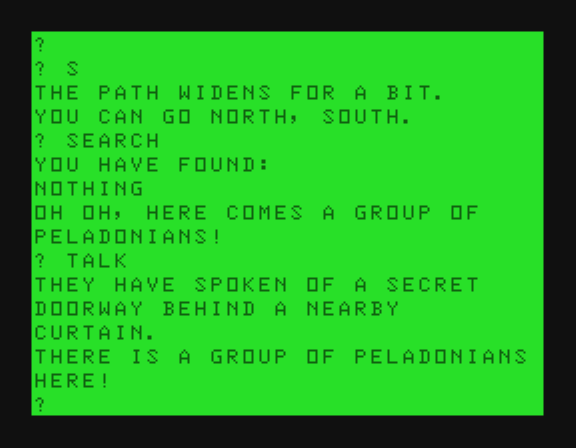
The “peladonians” are the “wandering random enemy” of the planet, but they’re only sometimes an enemy. Here are two separate attempts to TALK with them.
Success or failure seems to be random. HIDE on the always hand always works (when it is a creature you can hide from at all, there’s a nasty spot later where you can’t). You can also simply just move to an adjacent room, it isn’t like the aliens have any physical reality to them; it’s just a dice roll if you see one in a particular room, and if you step out and come back in they’ll be gone unless the dice roll makes them show up again. We’ve seen this kind of behavior most recently in Africa Diamond; somehow it was more irritating in that game, I think because it kept switching through what creature might show up, whereas here — being always the same encounter on the same planet — it has a vague tinge of realism.
Leaving the planet behind I hopped around a little. Note that not all of them have real episode equivalents, or at least, the author was mis-spelling from some half-remembered episode.
GALAFRY (the actual planet of the Time Lords, but spelled wrong) PELADON (as already seen) SKARO (the planet of the Daleks) DIETHYLAMIDE (probably invented for the game) HIDAOUS (probably invented for the game) DARK SIDE OF THE MOON (a Cybermen base from the episode The Invasion) MUTOS (not a planet; the derogatory term for an alien race on Skaro)
I did a lot of hopping around, for our purposes let’s visit the remaining planets as listed in order.
SKARO
Because it isn’t Dr. Who without Daleks. (Upon the Who “reboot” starting in 2005 it seemed like Daleks might have finally been done away with, but alas.)
I admit, I was initially tentative about exploring here, but Skaro turns out to be safer than some other places, as there aren’t instant-death spots like passing TARDISes and the geography, while jumbled up, isn’t mind-rending.
Stepping out of the TARDIS I found some jelly babies. They’re one of The Doctor’s favorite snacks, and one of the common elements I’ve found across a few planets (that is, some sort of “personal object” of The Doctor is lying around). They’d be my first candidate for the “key of time” items just because of the theming but if so, I haven’t found one on any planet yet.
The atmosphere is nice; it turns out you can ignore red screaming sirens, though.
The most important thing I found (via SEARCH in a random room) is a dalek ray-gun.
You might think I would immediately go back and try to use it on the actual daleks, but I was still slightly nervous at this moment and didn’t want to force a confrontation. You’ll get to see the gun in action later though.
DIETHYLAMIDE
There is no planet Diethylamide, a place of fog and mountains. That’s ok, not everything needs to be a reference.
I’m missing some exits in the northwest that almost certainly just go to death. The reason why is that it turns out to be horrible to test death-exits in this game.
There’s no save feature, and if you die, you simply go back to Time Lord Central and have to hop into the Tardis and type RESET a lot to get back to the planet you want. It isn’t even the time spent that was grating as much as the act of intentionally hurling bodies just to check every direction (N/S/E/W) to make sure they’re all accounted for.
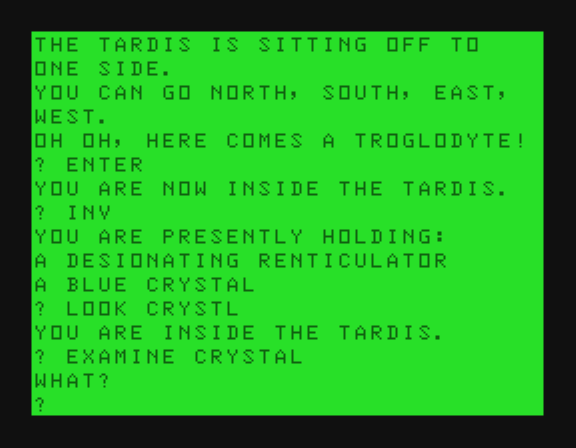
There’s a troglodyte wandering around, and it likely is responsible for the occasion where you get knocked unconscious and sent somewhere random with your items missing. Lying around the planet (or requiring a SEARCH in one case) I found a DESIONATING RENTICULATOR, a BLUE CRYSTAL, and a WHITE CRYSTAL.
No idea what any of this does.
HIDAOUS
A slime world, again made-up for the game. There’s not much I can find (although I haven’t bothered mapping thoroughly yet), just a landing point, a set of “LOST IN THE SLIME” rooms (with a SKULL hidden therein) and a tree with some bananas. I expect I’m missing something, or maybe the author just ran out of disk capacity.
DARK SIDE OF THE MOON
Where Cybermen are hiding, based off a real series.
I know the Cybermen are supposed to be a threat on par with the Daleks, but I’ve never quite felt the same level of concern with them.
In the game version, they are at least a little more deadly than the Daleks since you can wander into death:
Still, in essence the procedure is the same: hide if you see a threat. I’ve snagged a long scarf (Tom Baker ahoy) and a “large rock”.
MUTOS
A planet with a mysterious monolith, and the one I’m definitely not done mapping yet.
There’s a bit where you can find a sonic screwdriver, and also a sign which says to DIG HERE. DIG works to use the PICK to go down into a sewer, although it seems like you can get the same way from another direction. Either way, the moment where my mapping ceases is right here:
There’s a spider where I softlocked the first time through (no items, no way to escape, HIDE doesn’t work) and the second time through, ray-gun in hand, I managed to hard crash the game.
I think maybe there’s supposed to be a PRINT statement there, but when trying to replace the line then playing through again it still seems to be buggy.
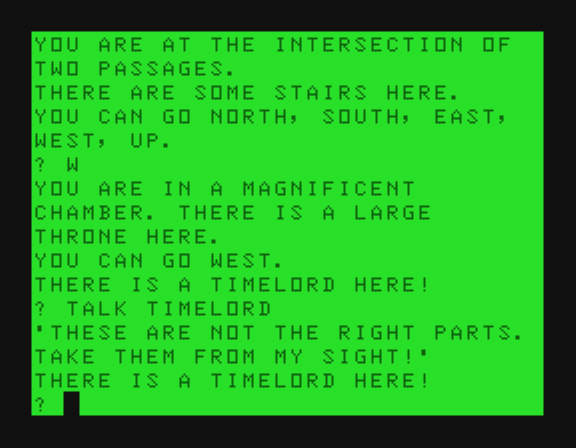
So this is at least a good place to do a write-up. My big problem, other than that stalling point on Mutos, is figuring out what the Key of Time parts are. The magazine article claims there is a way to tell what the parts are, and I have no idea. The game has a score but the only way to check it I’ve found is to quit the game. I’ve tried taking items to the Time Lord who needs the pieces at the starting area but I haven’t got a positive reception yet. Maybe I need all the pieces at once.
Cybermen from The Invasion, one of the “lost” serials of Dr. Who, since the BBC didn’t routinely start archiving their materials until the late 70s.
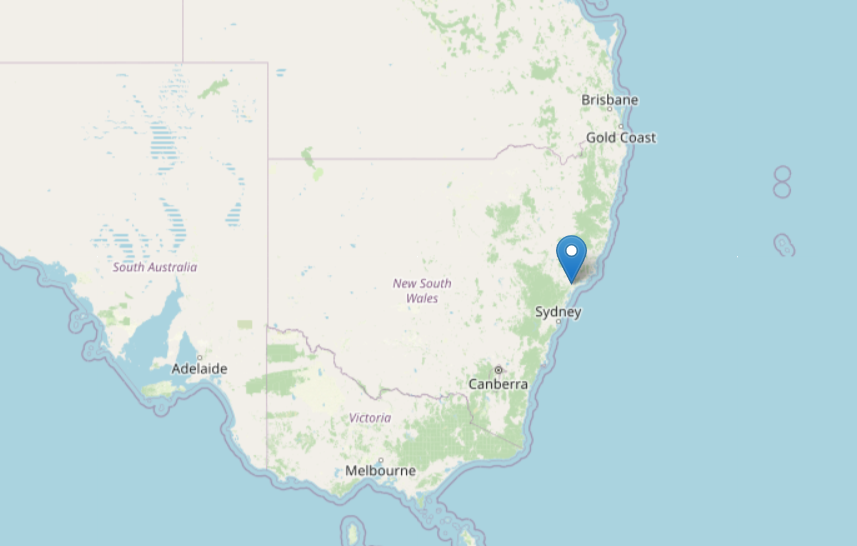
Tarro, where today’s author (James Smith) was located.
Australia started broadcasting Dr. Who back in the 1960s roughly contemporary to when they were being made in the UK, but the broadcast history was not straightforward; episodes needed to be censored for “early evening general viewing” — that is, unedited they were considered suitable only for adults — and some of the early serials just never aired at all.
In 1981, the first licensed Dr. Who animation was created, as part an ad for Streets ice cream in Australia. It used Tom Baker, right before Peter Davison took over the mantle of the Doctor. The Logopolis serial (where the switchover between Baker and Davidson happens) was already broadcast in the UK, but it didn’t air in Australia until March 1982.
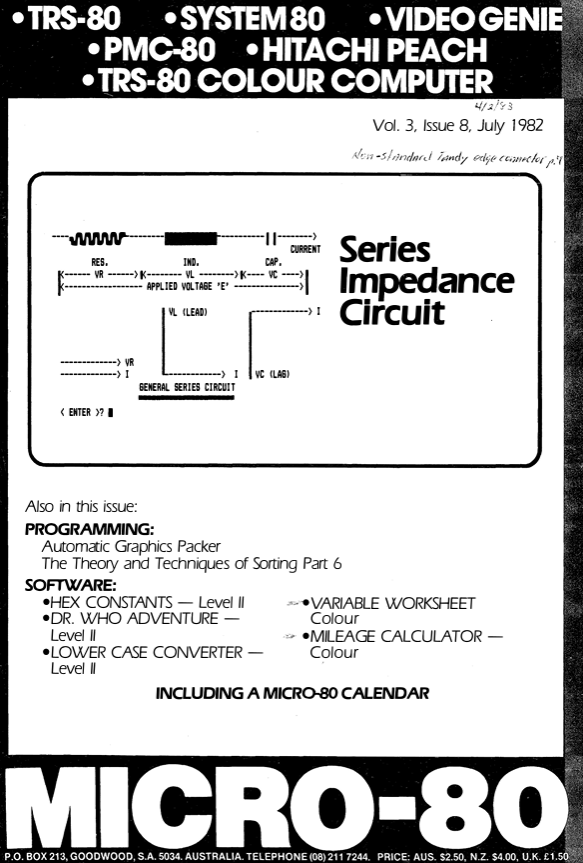
1982 also saw the first Dr. Who text adventure I’ve been able to locate in any country, written in March 1982 and published in the July 1982 issue of the magazine Micro-80. If you check my dates, you’ll see Baker was still “the current Doctor” from the author’s perspective.
The source is for TRS-80 but I am playing Jim Gerrie’s edited version for TRS-80 MC-10. In his blog post about the game he mentions bug fixes, including one where you can get “mugged” for an object but it doesn’t fix your inventory count, meaning you eventually can hit your inventory limit with 0 items. He also made some random values a little nicer and I’m not that gung ho about authenticity when it simply is going to be pain.
You do not seem to be “The Doctor” but just “you” sent along on a TARDIS the Time Lords have managed to scrouge up. I assume you are a Different Time Lord.
After Dr. Who collected the Key to Time and defeated the Black Guardian, he received many praises and went on to greater things. The Key itself was again broken into its component pieces and scattered throughout the universe.
But the dark forces threaten, and in order to save the universe, the Timelords again need the Key. You have been chosen to go forth and locate it for them.
The Key of Time is from Tom Baker’s run, specifically starting with The Ribos Operation in 1978, where the Doctor is asked by the White Guardian to find the six segments of the Key, bringing balance to the universe. The main gimmick to note for our purposes is that the pieces of the key are disguised as other things; in the first serial, a lump of Jethrik crystal is the first part of the key.
X pieces of some item of power makes for an extremely common videogame plot, so it is not shocking James Smith picked up on this as a game device. Your job is to bounce around planets searching for the Key, given that the pieces will be disguised.
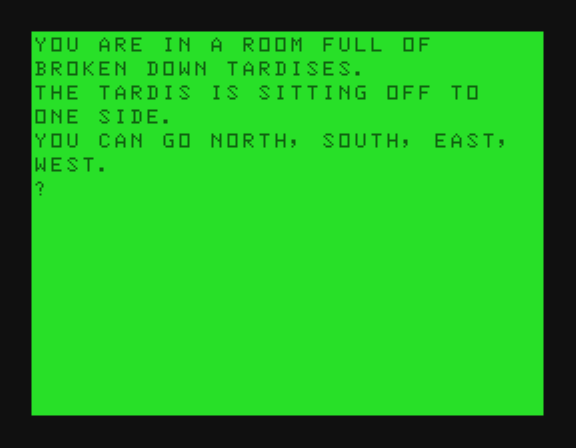
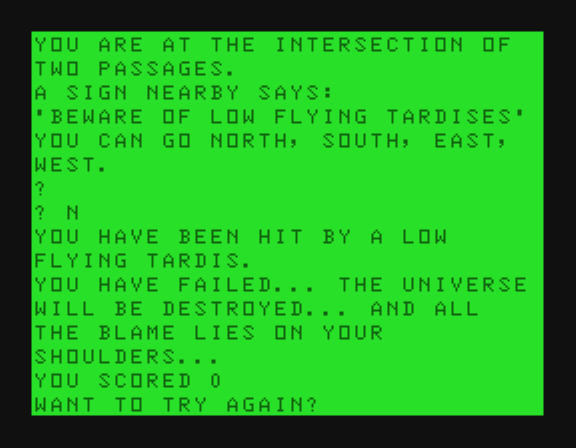
You start on Gallifrey. It is terribly easy to get lost, and at one intersection I got rammed by a passing TARDIS.
I did manage to find a “throne room” where the parts apparently get delivered after finding them.
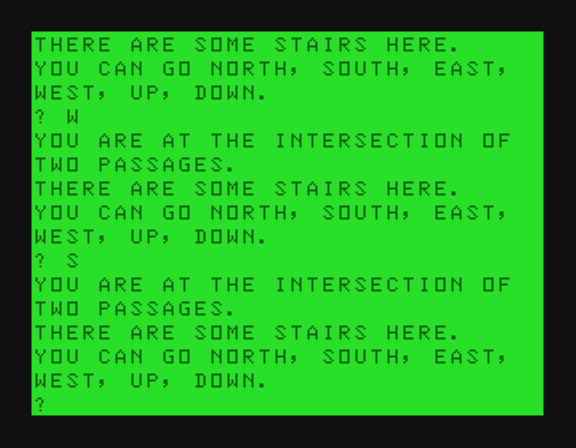
However, upon exiting the throne room I got stuck in a series of junctions which I’m sure are a fairly simple maze, but since I didn’t have any objects yet I had to restart the game.
So I decided it was best to hop into the TARDIS and start time-hopping.
You will be given a TARDIS (rather old and unreliable, but the best available) that has the coordinates of the planets on which the six parts are located pre-programmed into it. By RESETing its controls you can travel between the six planets and Gallifrey. As usual, the six parts are disguised as other things, and you will have to use your intuition to figure out which is which. (There is a way to tell … )
All the planets are inhabited, and most inhabitants tend to be antisocial. Whether you TALK to them, HIDE from them, kill them, OFFER them gifts of appeasement, or simply ignore them is up to you. Most objects are obvious, but some are hidden and have to be SEARCHed for. Only one key part is on any one planet. Beware the maze on Peladon …
Of course, it was terrific that the first place I landed in an effort to avoid mazes was Peladon, the place of three moons and constant storms.
From a recent Big Finish series set on the planet. “Journey to Peladon, member world of the Galactic Federation and home to intrigue and adventure. With each passing generation, industrial exploitation and deadly political games are taking their toll on the planet.”
sigh Well, let’s try it. I stepped out to a trail, only to find some Peladonians coming nearby. As the instructions mentioned HIDE, I tried the verb out, landing me in the maze.
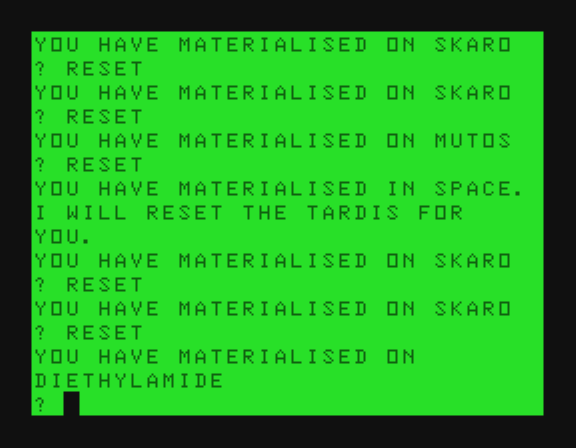
There was really nothing for me to try than wander randomly. I did hit some non-maze paths but quickly landed in the maze again. I eventually had to simply restart my game and go back to the planet from the TARDIS. This isn’t as easy as it sounds, since RESET from the TARDIS lands you on a random planet; you can’t choose.
The destinations are GALAFRY, SKARO, HIDAOUS, PELADON, DARK SIDE OF THE MOON, MUTOS, and DIETHYLAMIDE. You can also just end up in SPACE which in case it is simply another reset.
I wanted to be stubborn and finish what I could on Peladon, so I eventually got there after about twenty resets. The TARDIS incidentally comes with a limited number of resets in this game, and that number is intended to be random! (One of the values made nicer in the MC-10 port is making this random number of resets simply be the maximum from the range.)
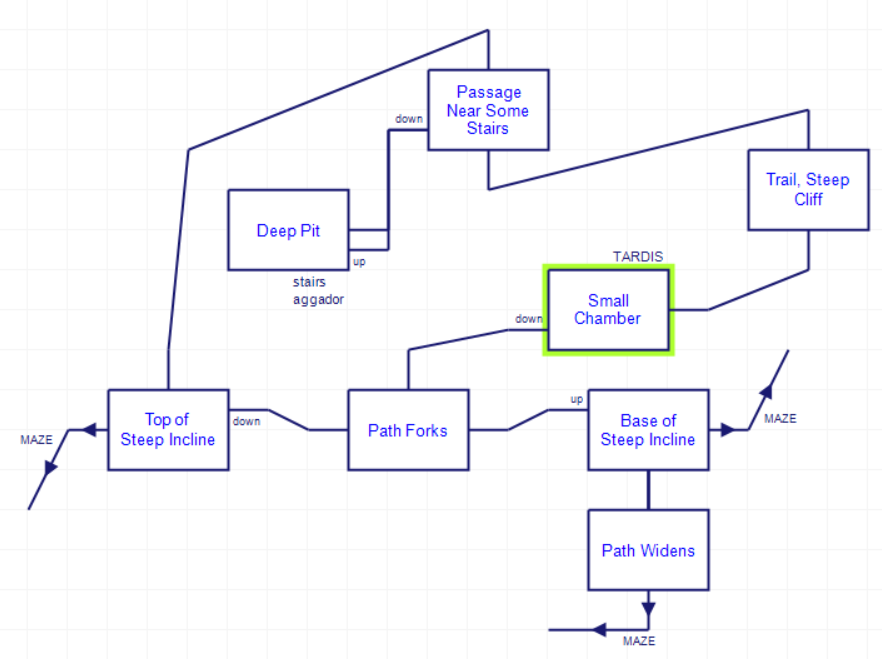
Even when not explicitly in the MAZE (as three of the exits go) the map is fairly maze-like and is the sort of game where if I go EAST from one room, I immediately need to test WEST back the other direction to see if it returns, since I’m likely to get a nasty surprise.
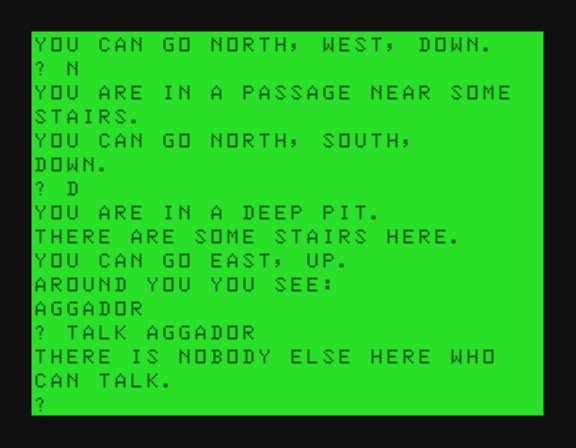
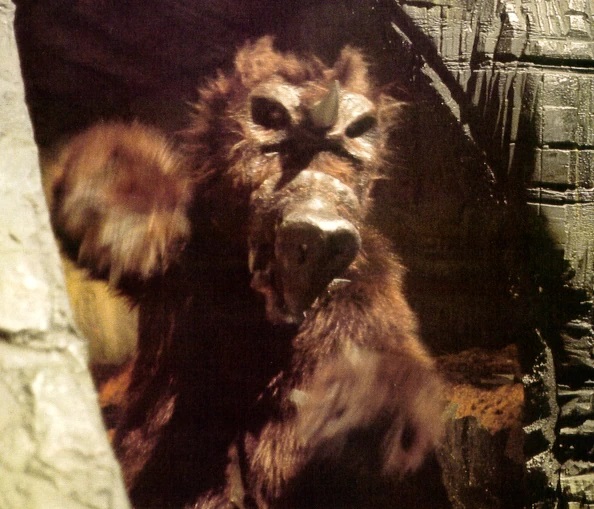
The wandering Peladonites turned out not to be a threat — I could just go somewhere else when they showed up — and the only other thing on the planet I managed to find is an Aggedor.
Perhaps I need to return with some music?
From the Alien Species Wiki: “The Aggedor is a wild beast native to the mountainous regions of planet Peladon … The ancient natives of Peladon viewed the Aggedor as a sacred animal and symbol of great power, to be feared and respected. The creatures can be domesticated and trained, and are susceptible to some kinds of music. The Doctor was once able to hypnotize one such beast with his watch while singing a Venusian lullaby.”
This game has been a hassle to get going, so I wanted to report in for now. Hopefully I’ll have visited all the different planets next time. I don’t think this is be like G.F.S Sorceress with a dense plot — this still is only a type-in with limited space — but at least the random elements (whatever they happen to be) should make for an interesting write-up, even if it turns out to be suffering on my part.
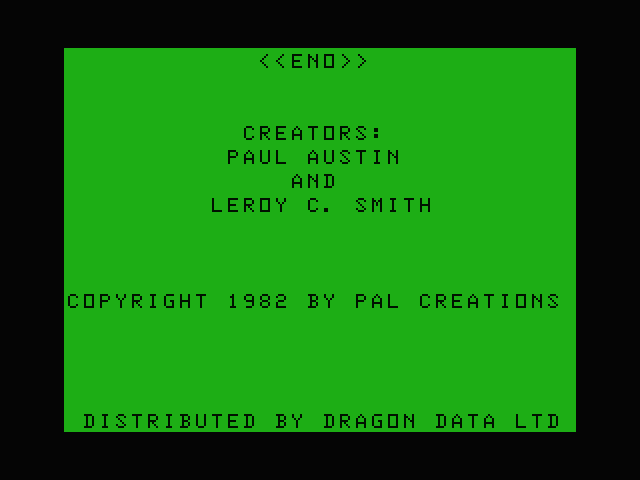
PAL Creations is another one of those early-80s companies I haven’t found much on about other than that they existed. They worked out of San Diego, and advertised in Tandy Color Computer magazines like The Rainbow, with games like SKI LODGE (“Manage a Vermont ski lodge”) and SCAVANGE HUNT (“Find the items on the list and return them lo Hickory Ridge to free your niece Rebecca from the hermit of Medicine Tree County”). To give you an idea of the obscurity-level, the ad above mentions 20 games; as of this writing, Mobygames only is aware of the existence of 5.
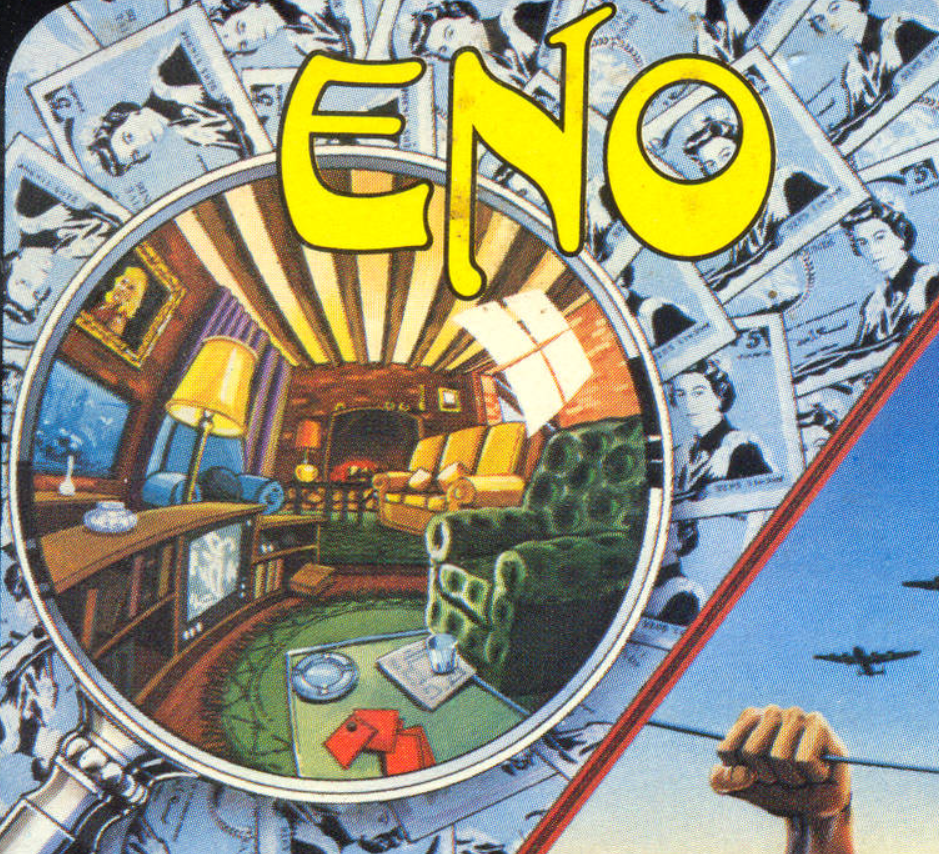
Our game today is ENO (“You inherited a million dollars. Just one catch – first you have to find it!”) which was given away as a “bonus game” option for buying one of their regular games. It also ended up being published by Dragon Data (the Welsh company I’ve written about here) in a two-pack, Eno paired with a prison-escape game called Stalag.
We’ll pass on Stalag for now and stick with Eno, which has the noteworthy attribute of being quite short. So far, if someone has wanted to write a short game for sale, they’ve generally landed in gamedisk or tapedisk format; see Space Gorn for an example. Eno’s publishing demonstrates two other options, being published as part of a “pack” or being given away in conjunction with another game.
It is weirdly both modern and ancient. Let me just narrate what happens straightforwardly and then explain after.
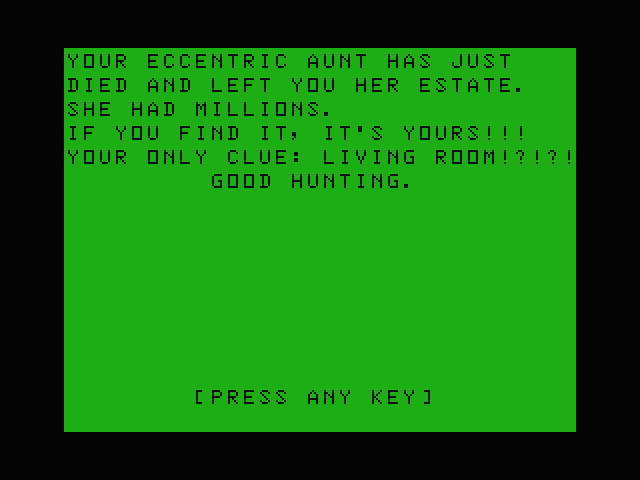
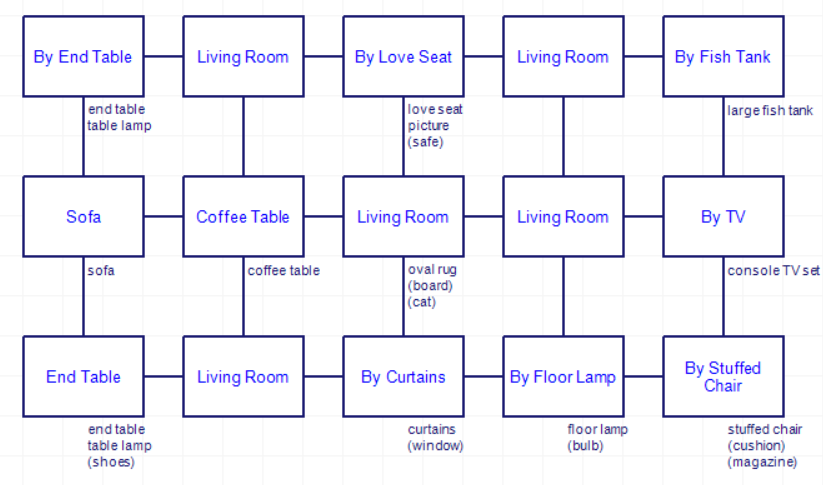
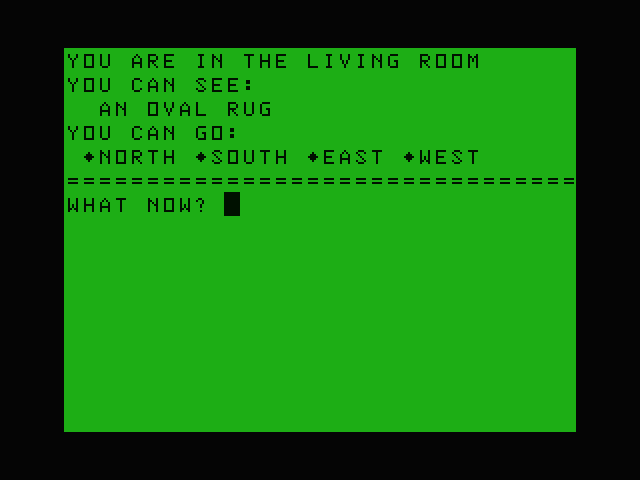
You are simply tasked with finding your wealthy deceased relative’s inheritance, and the “living room” clue is indicative of the full environment of the game. The entire game is in the living room, just it is divided into small sub-areas to make a 15 “room” map.
You start in the center (“Living Room”) and then can move around to each of the pieces of furniture in the room, the TV in the far east, and the fish tank to the northeast.
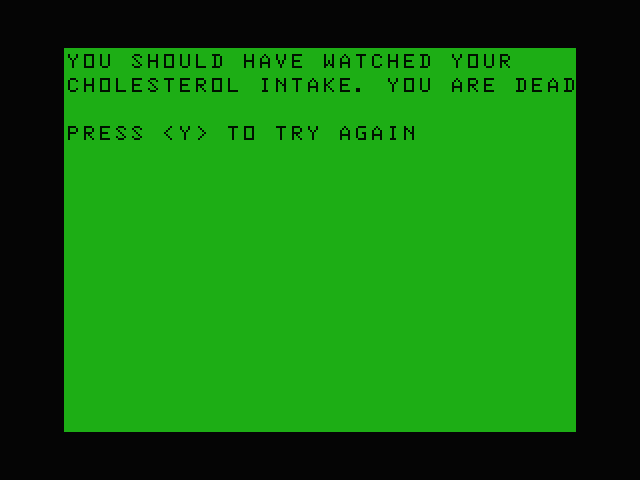
The verb list (past the usual directions and INVENTORY) is severely limited, but at least the game is good enough to list it in the instructions: PUSH, TAKE, LOOK, DROP, TEAR, TURN, READ, OPEN, HELP. You can, if you want, mechanically try all the verbs on everything in the room, although the game discourages this by having some items in the living room be deadly.
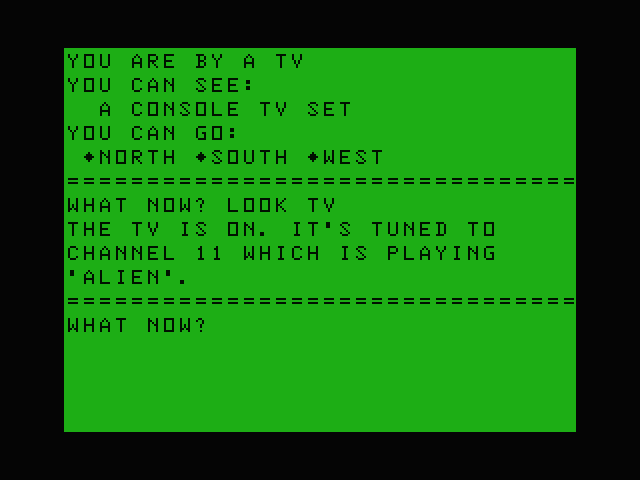
For example, TURN TV (in a valiant attempt to change the channel) results in electrocution.
Both end tables to the west have doors that can be opened. The southwest end table has some smelly nurse shoes; the northwest end table kills you.
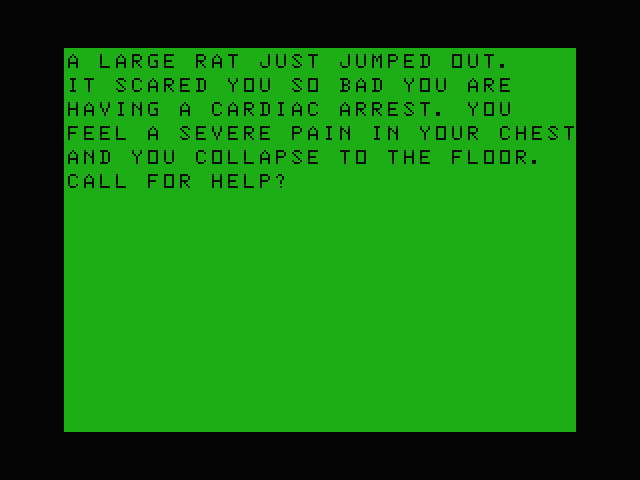
The game wants you to type HELP here before moving on to the next screen.
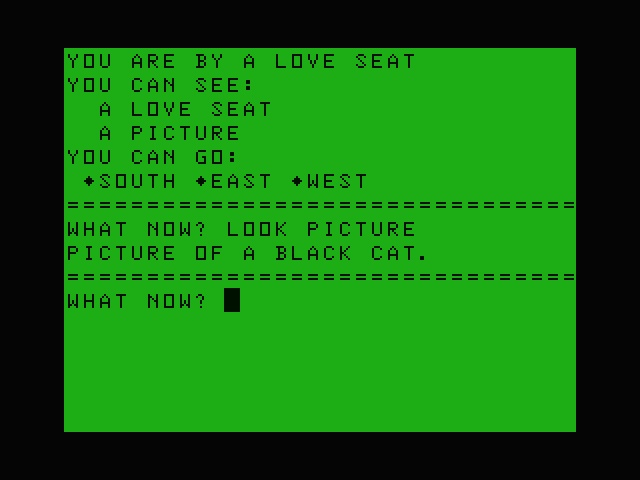
The very important room happens to be to the north, where there is a picture of a black cat. You can move it to find a safe.
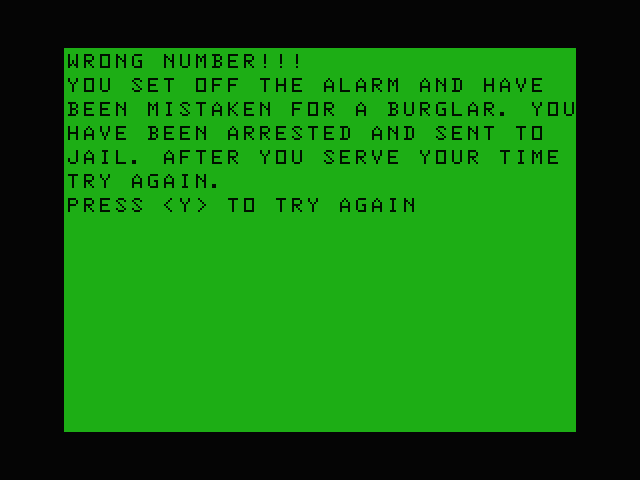
It will then prompt you for three numbers if you try to OPEN SAFE, and if you get one number wrong you get a game over.
Although not technically “death”, and even though the game restarts, the “world fiction” technically begins where you left off.
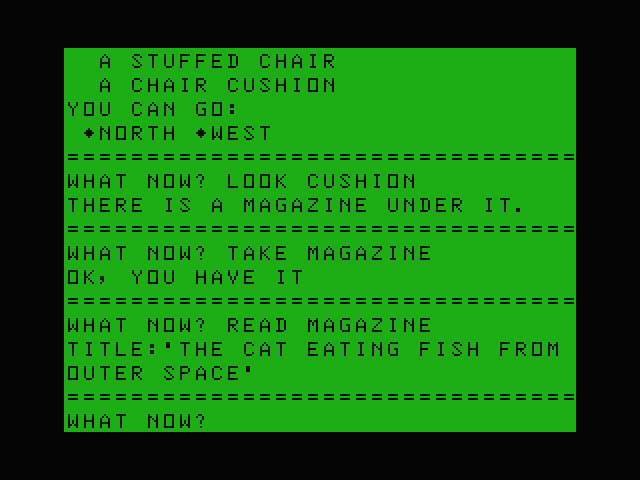
So the rest of the game is a matter of figuring out three numbers, and which order those numbers might go in. This acts a little bit like a Rhem puzzle where there’s a symbol somewhere that only marginally relates to what you’re looking for, but you’re supposed to make the connection anyway. While I only found it in the middle of my searching process, the first item related to the number sequence is hidden under a cushion to the southeast.
This gives you the order you are supposed to enter numbers into the safe, and the source of the numbers: the number of black cats the house is supposed to have, the number of fish the house is supposed to have, and the TV channel showing a space show.
You incidentally cannot find a black cat in the house despite the picture. If you move the rug in the opening room, however, you can find a dead cat under a loose board.
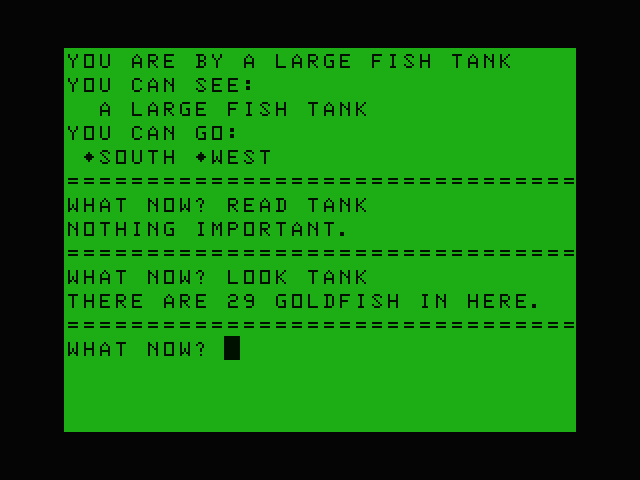
You can count up the fish at the tank to be 29, and as already seen in a previous screenshot, the TV is tuned to channel 11.
Unfortunately, 1-29-11 doesn’t quite work. You’re supposed to examine the cat further and notice it ate one of the fish.
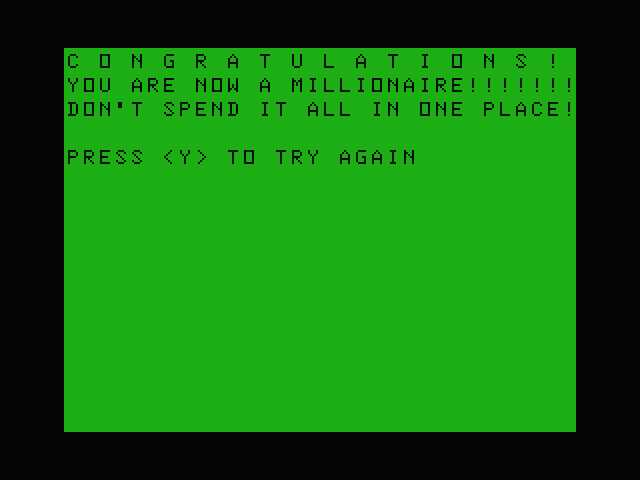
That is, the live-cat count is supposed to be 1, and the live-fish count is supposed to be 30. 1-30-11 opens the safe.
While a modern reaction, I imagine that this brief review by Alastair from Computer Solution Archive captures what people from the 80s likely thought of the game.
No wonder Dragon Data bundled this with another adventure game, this effort is no more than magazine type-in quality.
I don’t actually disagree, but weirdly enough, I liked it? Notice how it
somewhat fits the one-room adventure genre, which really didn’t start kicking until the late 90s
fits the “reduced verbset” genre, which is spread through all adventure gaming but never got “respectable” until probably the 2000s with games like Midnight. Swordfight.
has the clue-finding feel of a modern escape room
tries to make the deaths participatory and comedic
Despite the lack of a save file system, the game being very very short means it doesn’t matter; it’s more polite than a Super Mario “troll” level anyway. In the very specific circumstances here of a reduced-verb short game (where you hand-wave over realism) it works, just in the context of the early 80s market there isn’t much it fits with. The only slightly comparable game I can think of is Mansion Adventure which had its difficulty in clue-interpretation rather than object manipulation.
We will be seeing more from Paul Austin and Leroy Smith (including the other half of this commercial package, Stalag) but next up we’re going to head over to Australia for some Dr. Who.
Previously, we’ve encountered Softside magazine issue 47 (August 1982) with the game Operation: Sabotage. The same issue had a piece by Peter Kirsch entitled Anatomy of an Adventure.
In it he dissects his framework in BASIC that he has used for all his games up to that point:
Early in my adventure writing career, I created an adventure interpreter, or skeleton, as I call it, to serve as the backbone of each of my adventures. It has since been updated many times (now at version 4), but basically remains the same tool.
Magical Journey is clearly version 1, as the same skeleton structure of that game is clearly similar to the general structure Kirsch describes. I’ll go into it in a moment, but a few points from the article:
He gets introduced as “author of most of SoftSide’s Adventure of the Month series.” Alas there is no further biographical information.
He notes “The days of simply finding treasure and returning it to a storage location are gone forever.” which is a curious comment given how many Treasure Hunts there still are in 1982, but Kirsch got it out of his system back in 1980.
He tries different layouts before putting “a final version of my adventure map on a giant piece of heavy paper.”
He ran out of memory in writing Titanic Adventure and had to make cuts.
His games eventually all had ports for TRS-80, Apple II, and Atari; for making the Atari port used a special routine since the Atari BASIC doesn’t support string array, making a single string and treating it as an array by cutting the part he needs.
His parser on TRS-80 and Apple II uses the last three letters. He explains this “alleviates some of the annoying keyboard bounce in the TRS-80”. His Atari parser uses the first three letters because of the Atari string array issue meaning he makes the strings with padding. (I’ve played most of the Kirsch games on Atari, which explains why I didn’t recognize the last-three-letters style parser.)
He found Atari BASIC easier to debug because he could change something and still keep running the program, unlike on Apple on Atari.
Applesoft BASIC has the issue where if you use A has a variable and you write it before a THEN statement it interprets ATHEN as the command “AT”, so parentheses are required.
For the skeleton, he does something relatively distinct from other BASIC authors to start things off:
He has every single room description as a PRINT statement, and manually sets room exits along with these statements. From Magical Journey, where A is the variable which indicates the room the player is in:
10 IFDT=1THEN320ELSEONAGOTO11,12,13,14,15,16,17,18,19,20,21,22,23,24,25,26,27,28,29,30,31,32,33,34,35,36,37,38,39,40,41,42,43,44,45,46,47,48,49,50,51,52,53,54,55,56,57,58,59,60,61,62,63,64,65,66,67,68,69,70,71,72,73,74,75,76,77,78,79,80,81,82,83,84,85,86
11 PRINT”IN A FOREST.”:W=1:N=3:E=1:S=1:GOTO350
12 PRINT”ON TOP OF A TREE.”:D=1:GOTO350
13 PRINT”AT THE BASE OF A MOUNTAIN.”:S=1:E=4:GOTO350
14 PRINT”ON AN OPEN PASTURE.”:W=3:GOTO350
15 PRINT”ON TOP OF THE MOUNTAIN.”:D=3:GOTO350
This is wildly atypical. Consider Hog Jowl mansion (written July 1981, printed January 1982 in 80 Micro), which starts with room descriptions but uses DATA statements instead:
50 DATA “IN A DUMBWAITER.”,0,0,2,0,21,0,”IN A LONG HALLWAY.”,0,6,3,0,0,0,”IN A WORKSHOP.”,0,0,0,2,0,0
60 DATA “AT THE BOTTOM OF A SECRET PASSAGE.”,0,0,0,0,0,0,”IN A LABYRINTH OF TUNNELS.”,0,9,0,0,0,0
70 DATA “IN A TORTURE CHAMBER”,2,0,7,0,0,0,”IN A LABYRINTH OF TUNNELS.”,0,11,8,6,0,0,”IN A LABYRINTH OF TUNNELS.”,0,12,0,7,0,0
80 DATA “IN A LABYRINTH OF TUNNELS.”,5,0,10,0,0,0,”IN A LABYRINTH OF TUNNELS.”,0,0,11,9,0,0,”IN A LABYRINTH OF TUNNELS.”
This is the method given in other tutorials at the time, like the booklet for Deathship. Kirsch used DATA for objects and verbs, so clearly had a notion of just using a “data table” for exits rather than having to specify what the variables equal each and every time. My guess is due to the Atari string handling he didn’t want to deal with changing the method.
The remainder of the skeleton also follows the Magical Journey structure fairly closely. There’s a routine for display exits (“IFN>0PRINT” NORTH”; :B(2)=N”), a player input routine, special routines for movement, taking, and dropping, and then the whole list of other verb routines. This is followed by DATA statements for objects and verbs, and then — quite importantly for me, as you’ll see — the line
3000 PRINTA$” WHAT?”:RESUME390
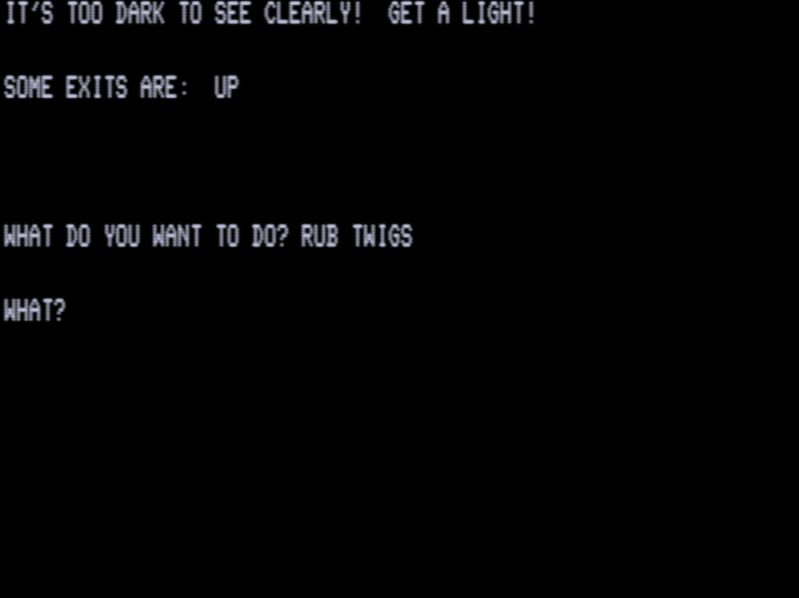
What’s going on here is that the game is set up to automatically send errors to 3000. The intent is for anything that confuses the parser past what it can understand has at least some grace and a sequence reset back to resetting the parser. In practice, it means that if there’s a bug in the main code, it will stop what’s going on and jump straight to WHAT, as opposed to breaking out with a custom error message explaining what’s wrong, making the game much harder to debug.
Unfortunately, I only realized what was going on fairly late in my process of debugging Magical Journey.
For a while, I thought the issue above was potentially some sort of parser misdirection, but no; in the portion of the code that handles removing and adding objects to the player’s inventory, there was a straightforward typo. See if you can spot it:
That should be K2=1 to 5, with an equal sign, not a minus sign.
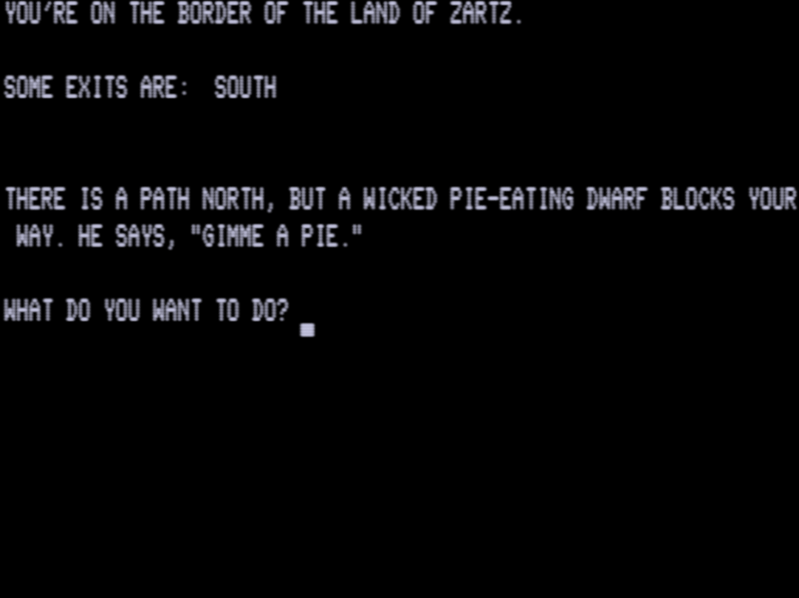
Or consider the hungry dwarf I gave a screenshot of last time:
There’s a farmhouse with an oven, pie filling, and pie crust, and you can BAKE PIE with them all together, but after YOU HAVE JUST BAKED A RHUBARB PIE. the game told me WHAT? and gave me no item. Spot the error:
810 PRINT”YOU HAVE JUST BAKED A RHUBARB PIE.”:PE=1:A$(59)=”RHUBARB PIE”:H$=”59)=A$(59):A(59)=25:K3=21:R$=””:GOSUB1100:K3=25:GOSUB1100:M$=””:K3=21:GOSUB1200:K3=25:GOSUB1200:GOTO5000
A few more along these lines happened, so I was simultaneously exploring the map and then every once in a while searching the source code for a misplaced character. This was as close to the metal as adventuring gets. (I also hit one inexplicable bug at the very end which I’ll get into later.)
Fortunately, the game itself was extremely simple in terms of puzzles. Find SNAKE FOOD, it goes to some RATTLESNAKES.
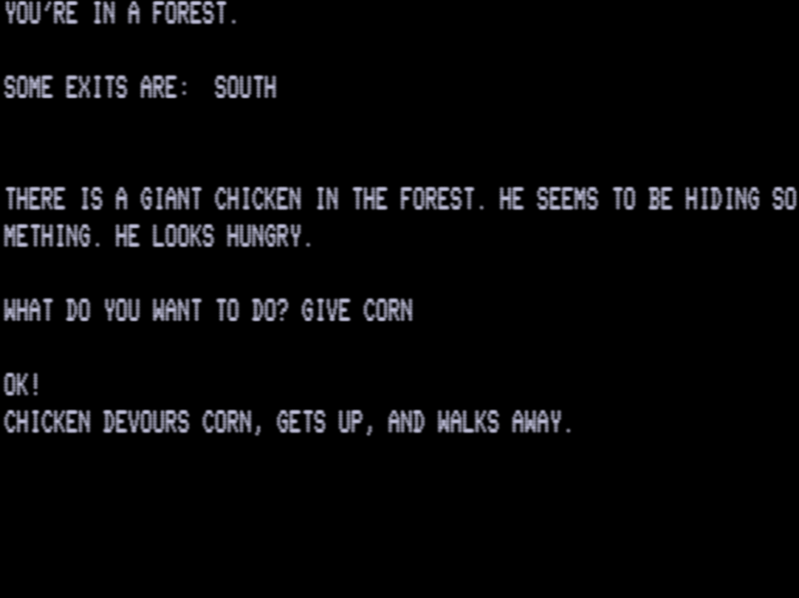
A GIANT CHICKEN wants to eat some CORN.
This leaves a golden egg.
For an only slightly more elaborate example, some FLYPAPER was next to some FLIES was near a GIANT KILLER FROG.
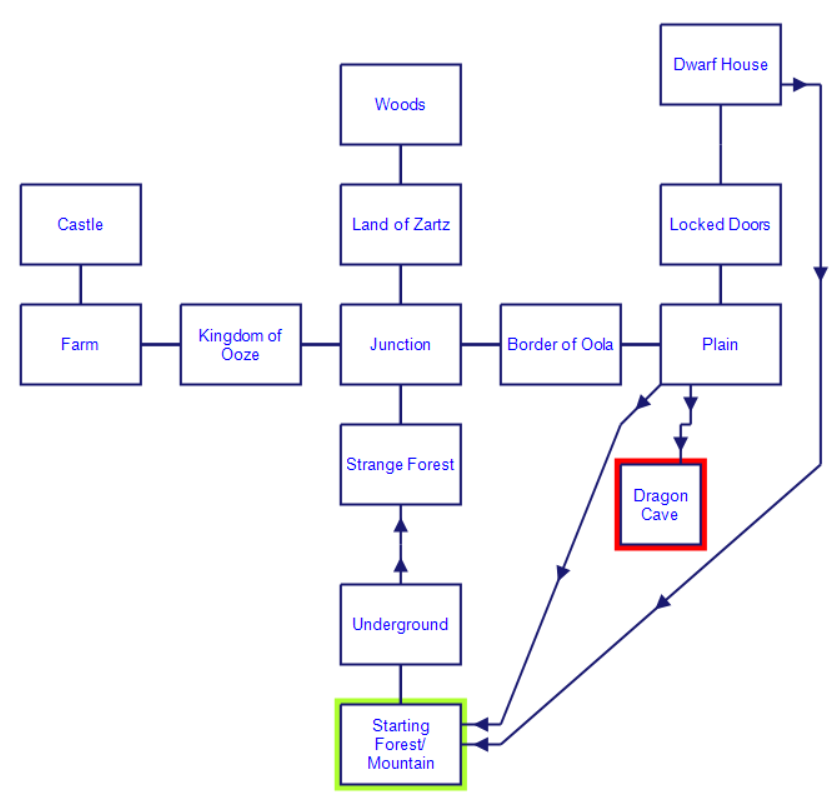
The meta-map of the game seems slightly elaborate…
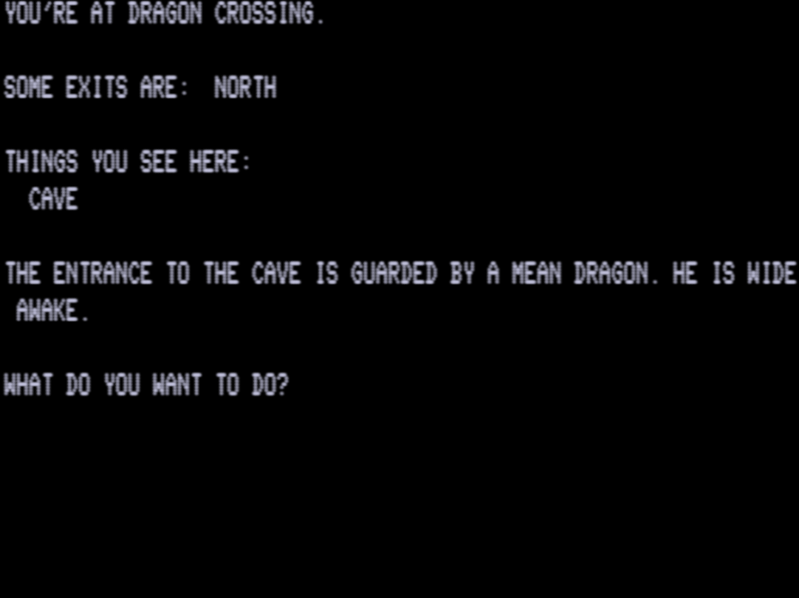
…but for the most part there is only a handful of obstacles that block your way. In addition to the pie mentioned, a troll needs a toll which you can offer with a SILVER DOLLAR (not marked as a treasure) found down a pit. Even a dragon is relatively easy to defeat.
Two rooms away are a GAS MASK and some SLEEPING GAS, and the dragon is described as wide awake.
The only part slightly messy to juggle is that the game can return you to the start in two cases; in one case (passing through a dwarf house) you need to take the warp back, because it puts you at a treasure (a gold watch) before returning to the starting area.
To get back to the starting area to the main junction you need the shovel, so if you’ve left it behind, this means your game is softlocked, which is kind of rude for what is clearly intended as a beginner’s game.
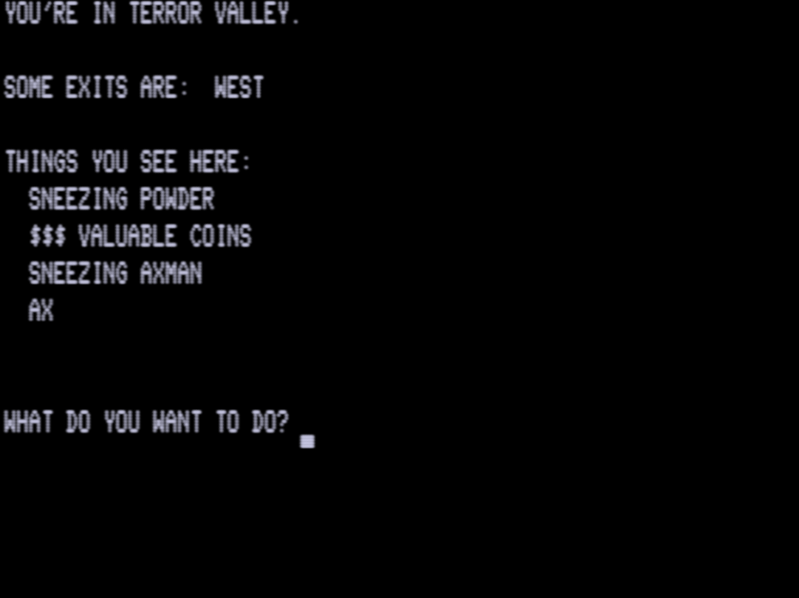
The only slightly less obvious puzzle; you throw sneezing powder to defeat a MADMAN swinging an ax.
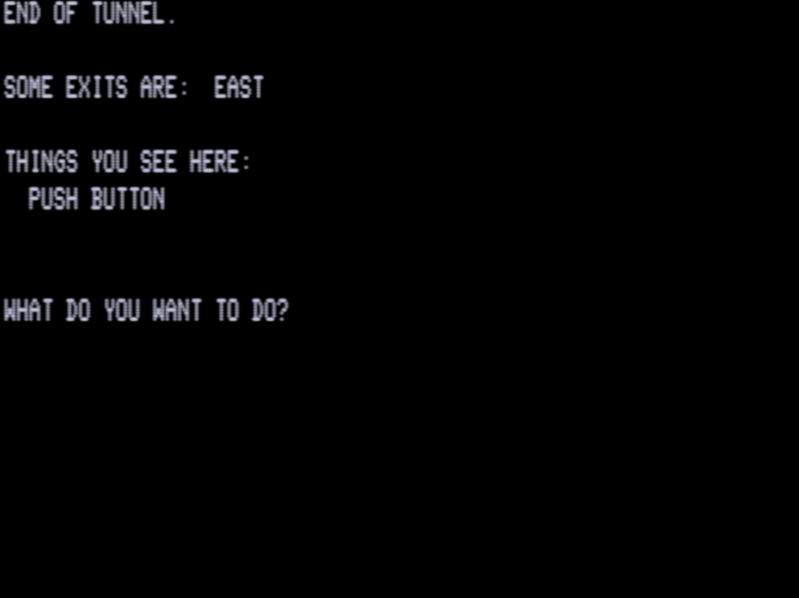
My major hang-up turned out to be at the very end. Quite inexplicably, after getting in the cave past the dragon, and heading west, the game decided to always crash, or at least stop with WHAT? when trying to show the room name, then end up in endless loop. This turned out to be the last room.
The end room is marked in red.
I still have no idea the reason for the crash. I ended up having to add some code to essentially hack my way out of the bug:
300 N=0:W=0:E=0:S=0:U=0:D=0:Y=0:CLS:PRINT”YOU’RE “;:IF(DK=0)*(A>5)DT=1
305 IF A = 72 GOTO 82
310 GOTO10
Line 305 is mine. Rather than going to the select-a-room routine, I just have the game jump directly to the relevant line that displays the room name (82). This bypasses whatever is going on with line 10 to have a bug.
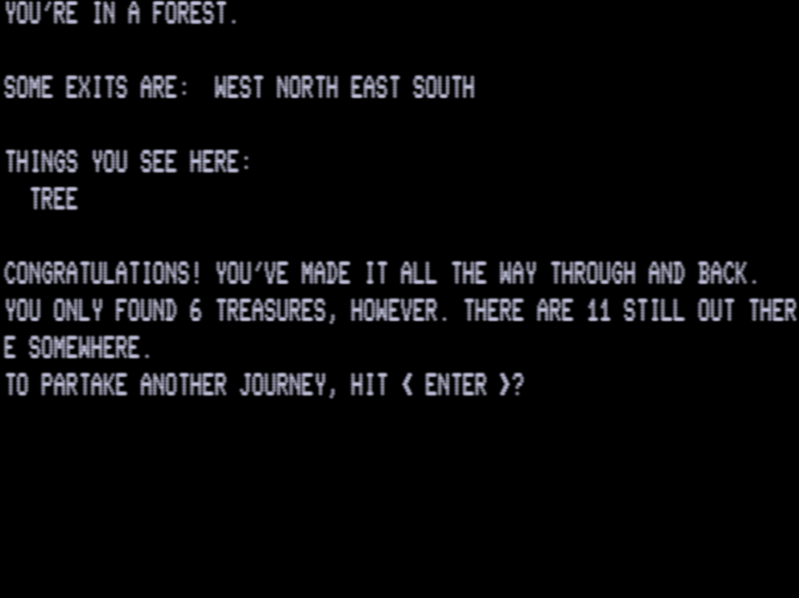
With this fix in place, I could finally see the last room.
Pressing the button congratulates you and then tells you how many of the 17 treasures you found.
6000 PRINT”CONGRATULATIONS! YOU’VE MADE IT ALL THE WAY THROUGH AND BACK.”:IFNT=17PRINT”YOU FOUND ALL 17 TREASURES.”:GOTO6100
6050 PRINT”YOU ONLY FOUND”NT”TREASURES, HOWEVER. THERE ARE”17-NT”STILL OUT THERE SOMEWHERE.”
6100 INPUT”TO PARTAKE ANOTHER JOURNEY, HIT “;A$:RUN
I should possibly be thankful for the bugs. Other than the interest of the “rucksack” holding all treasures while ignoring the inventory limit, there wasn’t much of theoretical interest, but I essentially had to study all of the source code in order to make it to the end. The adventure wasn’t an abstract magical journey as much as one programmer’s journey — badly typed by someone else in the past — as interpreted by some quirky source code.
Unfortunately, some of the rooms remain inaccessible, including one to the west of a room “near the magic garden”. You’ll see on my meta map it currently goes to the opening forest, but it isn’t supposed to do that — it is supposed to go to a tool shed where you can find a ring.
Feel free to check the source yourself to try a diagnosis (including my extra line 305). It seems to have trouble with room numbers 72 or larger (jumping to lines 82 and up). Alternately, you can download a disk here I have prepared that can be run directly with the emulator trs80gp (just drag and drop the file on the emulator). I can’t guarantee there aren’t more bugs. (For example, colors of keys will change when you drop them, but at least that isn’t important for winning the game.)



















 Renga in Blue