(Click here to catch up on my Avon posts before this one.)
So I resolved two puzzles from last time during summer, resolved (probably) one during spring, and made headway on a puzzle that spans all three seasons and might be one of the most cryptic in the game.
The general theming was: what object from one Shakespeare play could be used to help with a dilemma from another?

From PcwWiki.
I was still stuck on the Puck/farmer dilemma, which I’m starting to suspect is resolved via some sort of wordplay.
You are at the remains of a chicken farm. A fox has clearly visited this place and killed half the stock. The only way the farmhands will let you go is back to the west.
“What! all my pretty chickens and their dam, at one fell swoop?” he mutters. “I asked my keeper, Puck, to get the fox’s earth seen to, but he went away saying that he’d put a hurdle round the earth in forty minutes (and that was hours ago.)”
This he repeats, over and over again, trying to understand the tragedy.
(Incidentally, the words “chicken”, “puck”, “dam”, “hurdle”, “fox”, and “girdle” are not understood, so none play a part in resolving the puzzle. Not like it is shocking, really, given how many things have been resolved in a lateral way.)
That was the last “winter area” puzzle (I think) but I decided to wallop a bit more on spring and summer. I started going with the assumption that if a location was unimportant in two other seasons, it had to be important in the third. There was a battlefield with Richard III muttering about the winter of our discontent; it seemed like I needed to return to the battlefield later, and indeed, in summer, I found the “kingly hunchback” crying about his kingdom for a horse.

Hogarth showing his friend David Garrick as Richard III. Via the Met.
If you’ve been paying attention in my previous posts, you may already know the resolution for this dilemma.
You are on Bosworth field. There is battle raging all round you. The only safe way out is to the north.
A kingly hunchback is fighting here. Hopelessly outnumbered he cries “A horse! A horse! My kingdom for a horse!” Your appearance on the scene, complete with ass’s head causes his enemies to flee in terror.
The king thanks you, removes the ass’s head from you and departs. You find that he has left his crown under a nearby bush.
You are on Bosworth field. There is battle raging all round you. The only safe way out is to the north.
The Plantagenet crown is here!
So you get your head turned into an ass in Midsummer Night’s Dream-land, then utilize said ass-head to help Richard III. Makes sense.
Another object I hadn’t messed around with yet was the meat pie. I always am hesitant to test eating things in games (it often makes the food disappear and softlock the game), but here I needed to be hesitant for another reason:
There is a nourishing meat pie here.
> get pie
OK.
> eat pie
Although the cheer be poor, ’twill fill your stomach. You eat of it with pleasure until a man dressed as a cook enters and reveals to you that two of the ingredients in the pie were named Chiron and Demetrius. ‘Tis true; witness his knife’s sharp point… I’m afraid he stabs you.
That’s the pie made out of people! (See: Titus Andronicus.) I didn’t think much of this scene yet, but later, while off the computer, it suddenly struck me that the meat pie would solve an entirely different dilemma: the merchant who wants a pound of flesh. In the play (Merchant of Venice) this results in a dramatic court scene as Shylock tries to get his pound of flesh, but here, we already have the flesh pre-cooked:
As you pass the moneylender’s premises, their owner comes out to greet you. Scenting business, he offers to lend you 3,000 ducats until you next meet, the security to be a pound of flesh.
Three thousand ducats. ‘Tis a good round sum.
Wilt thou borrow it from the moneylender?
yes
The moneylender gives you the money and goes back into his establishment.You are at the docks. Roads lead to the north, southwest and southeast.
To the south is a barge; its poop is beaten gold, purple the sails
and so perfumed that the winds are love sick with them.
> drop ducats
OK.
> inv
You are holding:
A scroll.
A meat pie.
There’s the smell of blood upon your hands.
> n
The moneylender accosts you as you pass, saying “I would have my bond.”
Since you do not have the ducats, the moneylender demands a pound of flesh from you. Fortunately you are able to persuade him to accept that disgusting pie you were carrying: he takes it from you and then he leaves.
For my third puzzle, I was trying to resolve (in Spring) being attacked by knights.
You open the door and enter the house.
The door slams behind you and you hear sounds of a key turning in the lock.
You are in the kitchen of a small house. There are several doors leading from it, all of which appear to be locked.
There is a letter here, addressed to Mistress Golesind and signed
‘Thine own true knight,
By day or night,
Or any kind of light
With all his might,
For thee to fight,
John Falstaff.
> wave trophy
Nothing of great import happens.
Suddenly the door opens and several knights armed with swords rush in. They brand you as an intruder and promptly slay you.
I did a little structural solving first and realized there was no way to really attack the knights directly, so I needed to hide. One laundry basket (from The Merry Wives of Windsor) later:
Do you want to get into the basket?
YES
You are in the basket. It is a very tight fit and you are unable to move your hands.
Do you wish to spend any more time cooped up in the basket?
YES
Suddenly you hear sounds of people entering the room. They pick up the laundry basket, with you inside it, and carry it off. After a while there is a mighty SPLOSH! and you are tossed into the river.
Unfortunately the current is too strong for you and you are swept under and drowned.
Well, that’s not quite it, but I already got one magic power from the witches, maybe swimming? The frog toe seemed promising but holding had no effect.
I baffled for a while, but if you’ve been paying attention to my little playing quirks, you might realize the problem. I hadn’t tested eating the frog toe before getting tossed in the river.
The frog’s toe that you ate gives you tremendous swimming ability: the torrent roars and you do buffet it, with lusty sinews, throwing it aside. You are able to struggle to land, narrowly escaping being swept over a waterfall.
Voila! Unfortunately, going through that whole sequence seemed to yield me nothing. The letter in the building can’t be picked up (you only have one turn that must be used going in the basket). So maybe the information is important?
I realized that the name Mistress Golesind sometimes changed (like Mistress Legosind) and I also compared it with passwords I had been getting from Yorick the Jester way back at the graveyard (like SILEGODA). Maybe it is supposed to be
SI/LE/GO/DA = silver/lead/gold/??
LE/GO/SI/ND = lead/gold/silver/??
That is, these match the materials of the caskets. Back in the mansion, we were offered to open two caskets, remember; it turns out this offer is given in every season. Since we are offered two caskets per season, we can open six caskets.
This suggests opening the caskets in order as given by the password and the name, concatenating the six materials (SI + LE + GO + LE + GO + SI), but my testing this yielded no treasure. (You get a smoothed ice, a perfumed violet, and a painted lily, but this seems to happen if you just guess randomly.) So I’m not sure what to do here. I feel like I’m missing something. Yes, you can mash up DA and ND to get D AND, but from there …?
> OPEN GOLD
The casket is empty. Shielded from your view, the Lady Portia performs a rearrangement of the contents of the caskets and invites you to open a second casket.
Choose again. Which casket will ye open now?
LEAD
You open the second casket, which contains a perfumed violet.
The lady Portia picks up her caskets and leaves, murmuring “Sweet, adieu.”
That’s essentially everything for now, except one bonus thing. I found if you go back in the graveyard in summer (where you meet a live Yorick in winter) you can find a Yorick skull. Then you can go back to the witches, who will happily trade the rest of their items for the skull. This means you can get the last two items (wool of bat, tongue of dog) instead of just one of them! (Or maybe the skull is really what you need, the game is willing to be that evil.)
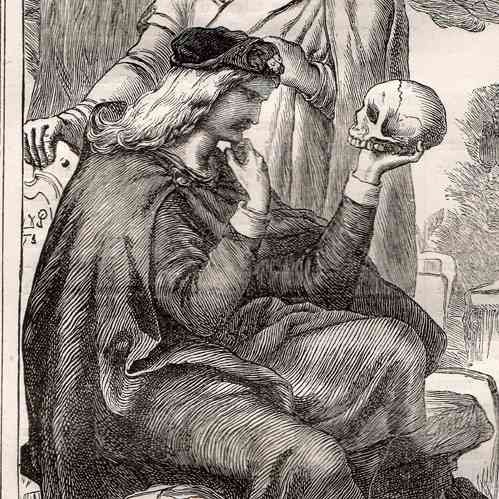
The gravedigger scene in Hamlet, from a Wentworth engraving in 1870.


 Renga in Blue
SI/LE/GO/DA = silver/lead/gold/??
LE/GO/SI/ND = gold/lead/silver/??
I do think you are on the right track. I don’t think I would have picked up on the name being a clue for the caskets. This game is indeed on another level. My hunch is that the last two letters are telling you which two caskets to open each season and probably in what order. But I hope I am completely wrong as I certainly haven’t puzzled it out yet.
Well right as I was falling asleep my mind came up with another theory on this puzzle. But I would need another piece of information to know if my theory is even applicable. (not asking for that right now as I don’t want to guide nor mislead you.) Hopefully you find a solution yourself.
The second one is lead gold, no?
Fixed. Thanks!
“ There was a battlefield with Richard III muttering about the winter of our discontent (Gloucester gives the speech with the line in the play, though)”
Gloucester is Richard III before he becomes King.
Fixed that too. I just glanced at an index and didn’t think about it. (Also the horse thing happens in summer, not spring! Brain must have been tired.)
Since there are three caskets mentioned in each name, and three seasons, but you can only choose two caskets per season, it seems to me that you should choose one casket from each name to make a pair every season, and maybe in the final season, once you choose the sixth casket, you’ll find something interesting.
Question is, which name should get priority in the pairs? If D in “nd” and “da” means “do”, then perhaps N means “not”, and A means “already”? So a casket from Yorick’s password would come first, followed by a casket from Falstaff’s mistress.
The big problem with using a pairing logic is that you can only discover the second password in the spring (the door is bolted in the winter that leads to the kitchen with the letter in it).
Still feels like it might be along these lines, though.
Have you gotten the jester password (winter) and the Mistress letter (spring) in a consecutive playthrough without restoring to a previous save? If so, is the password/name the same or different?
(this isn’t the piece of information I referred to earlier)
Every time you get a new password or name it comes out to be different.
I should also note on one test I’ve gotten “Go” before as the first syllable on both passwords (without saving) meaning that it can’t be “first syllable from first word – first syllable from second word” being a combination, because you can’t pick the same casket twice in a row.
I looked something up and it does suggest that saving locks the solution here.
I also discovered a huge spoiler which I will rot13, but it can be found within your previous entries if you look hard enough:
gurer vf n guveq guvat lbh’ir rapbhagrerq, orfvqrf gur gjb lbh’er nyernql jbexvat ba, gung pbagnvaf gur zntvp flyynoyrf.
I’m wondering if the caskets conundrum is another Hezarin pits situation where the act of saving the game is mucking up the puzzle’s internals. If you start a new game and plow all the way through getting and using the jester password *without saving at all*, what’s the result?
Still the same as far as I could tell.
I maybe could test in the DOS version and save states just to be sure there isn’t some corruption.
I’ve gone and read a walkthrough on how this puzzle works. Without getting into spoilers, I will say that I just did a test using the “Play online” option on Avon’s IFDB page, which leads to an online playable BBC Micro version, and the puzzle appears to be working as intended in that version (as far as I tested it).
I think at least one of the interpreters is broken — I tested using Parchment and got it to work (simply “get password from jester -> apply password -> get treasure in winter”).
Yeah I confirmed recently this works on Parchment too. Messing with the save file this way is just unnecessary, especially since he just disabled saving in a few other places where the trial-and-error solution could work with saves.
Unfortunately the mainframe version of Hezarin is lost to time, or else I would wonder if it has the same save-screwing at that one sequence as the PC version does.
btw, it gets even better — once you have all three items from the caskets (I did find the third clue, it was sneaky), yielding three treasures total, you start to get warm and die from melting for no apparent reason
I’ve got a half-written post but it probably won’t be up until tomorrow
@ItsMe: Yeah this seems like a frustrating interpreter bug or design decision or some combination, it’d be a lot better to disable saves rather than soft lock the game for no good reason.
I was also wondering whether there is a third combination of metals that gives you some combination of “DA” and “ND” as last two letters. Might be instructive, also if you get something completly different.
If I’m understanding the way it works, you can’t survive getting the second password without the toe of frog, you can’t get the toe of frog till spring because you need the eye of newt to get anywhere in the winter, and you need to try the caskets in winter, spring, and summer… so mustn’t the correct choice for winter be determinable from the Yorick password only?
Also, are the last syllables always “DA” and “ND”?
Always the same. As far as I can tell you just ignore everything past the first four letters in both cases.