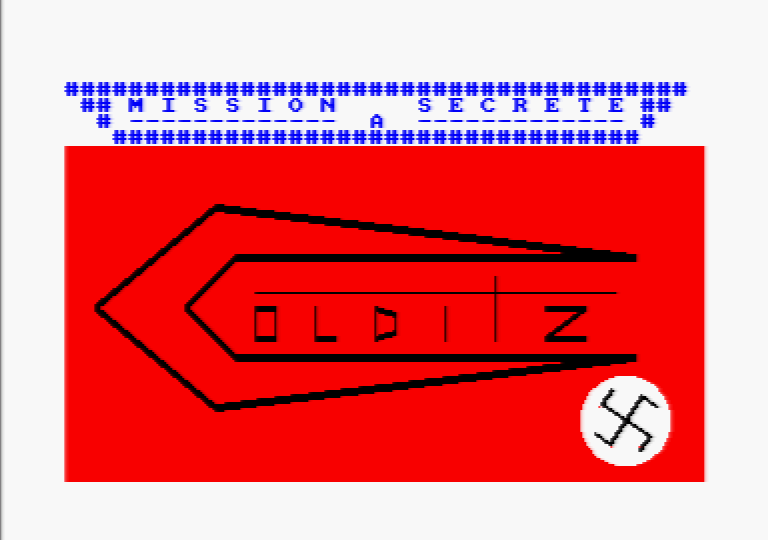
After World War II ended, Germany was split into four “occupation zones”, with Russia in the northeast, the UK in the northwest, France in the southwest, and the US in the southeast. The US, British, and French sections made up West Germany; the Russian section was East Germany.
This arrangement meant French military forces were stationed in Germany, which is important for our story.
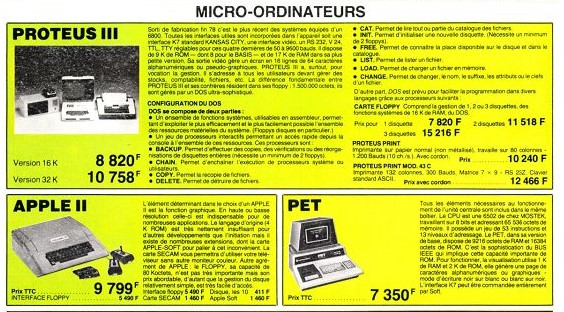
From Micro Systèmes Number 5, May/June 1979. Other than these three computers the TRS-80 was the main personal computer in France circa 1979. The Proteus III is a wildly obscure local system that was text-only and ran on a Motorola 6800.
(Before going on, I’ll preface that most of what follows comes from Hugo Labrande, who has extensive research on early French text adventures as well as interviews here, here and here.)
The author of today’s game, Marcel Le Jeune, got his start with electronics with a Texas Instruments calculator in the early 70s; his first computer was a PDP-8 he encountered while at French military school. He then went on as an electronic warfare specialist, being stationed in Germany from 1977 to 1982.
He had access there to American military bases and their duty-free shops, and thus was able to be a very early owner of a TRS-80 as well as get exposure to US magazines and software. He most particularly remembers the adventure game Pyramid of Doom, although it wasn’t necessarily officially obtained, as he had a Parisian friend who kept him supplied in tape copies sent by mail.
His early exposure to adventure games is likely what led him to be one of the first people from France to create an adventure game; in fact, since Bilingual Adventure was just a modified port of Crowther/Woods, we can say Mission secrète à Colditz is the first original adventure game in French. (That we know of. Making a statement like this invites being outdated in six months when something new comes up.)
While he wrote it in the 1979-1980 period (according to his memory) it wasn’t published, but rather sent to friends and demonstrated to both friends and family. Viewers were amazed at the flexibility of the parser (it’s a bit of a sneak, more on that in a moment) but Marcel was generally frustrated at the reception as people were stumped, and when he tried to help, the response was
Je n’aurais jamais pensé à faire ça!
that is, “I would never have thought of doing that!”
Much later — after returning to France — he became editor of the magazine CPC, dedicated to the Amstrad, and had Stéphane Cloirec port the source code directly from the TRS-80. There was also a version published in the pages of an Oric magazine. The TRS-80 source is lost so I went with the Amstrad version to play.

Now, since my French is terrible, I gave myself a little more advantage than I usually do straight from the beginning: I extracted the verb list. All of the verbs only have the first four letters, so I made my best guess as to what verbs match.
ALLE (aller = go)
PREN (prendre = take)
OUVR (ouvrir = open)
REMP (remplir = fill)
TUER (tuer = kill)
LIRE (lire = read)
ASSO (assommer = knock out)
DONN (donner = give)
DEMA (demander = ask)
COUP (coup = cut)
ALLU (allumer = light up / turn on)
ETEI (eteindre = extinguish / turn off)
POSE (poser = drop)
JETE (jeter = throw)
MANG (manger = eat)
BOIR (boire = drink)
CASS (casser = break)
TOUR (tourner = turn)
(I works for Inventory and there’s also direction abbreviations. Feel free to point out any alternatives or outright mistakes, I’ve already made some edits based on comments.)
I mentioned some subterfuge in the parser. The game only looks at the first four characters for the verb and the end portion for the noun. That means there can be sentences and phrasings in the middle which are entirely ignored. Hugo Labrande also points out a finesse to account for the fact that in French, writing an adjective after the noun is normal: the game hand-checks nouns and possible noun-adjective pairs together in order to parse things correctly.
IF RIGHT$(R$,5)=”PINCE”OR RIGHT$(R$,14)=”PINCE COUPANTE”
Still unsure on the parser, I checked the first line (and only the first line) of a walkthrough, and it said
Ouvrir la porte du camion
that is, open the door of the truck, but OUVR CAMION works just as well. The practical upshot is the parser can ignore articles someone would normally use (parsing “prendre la lampe” ignores “la”). From what I gather (although I would appreciate a native speaker’s perspective) leaving out the “la” in “la lampe” feels much odder than leaving out “THE” when typing GET LAMP. So this keeps the coding simplicity of what is more-or-less a two word parser while accommodating the change in language.
However, notice the sample includes “la porte” (the door) which is totally unnecessary. I’m wondering if part of the issue with sampling the game for friends was that the author was “showing off” too much; having too many ways to communicate can make it difficult to teach how to play a regular text adventure.
The upshot of all this is I can just type VERB NOUN for commands and ignore everything else.
The game’s premise:
In 1943, we have been summoned to London about a secret mission; one of “our best agents”, Captain Jim O’Donnel, had been on a parachute mission to obtain secret codes allowing V2 rockets to be destroyed in-flight. While he was able to get the code he wasn’t able to send it, and has been locked away at the fortress of Colditz.
(For background on Colditz, I have this post about an entirely different Colditz game. Remember this was all written while the author was stationed in Germany!)
We are sent on a secret mission to Colditz to get this code. We’ve snuck into the castle by hiding in a truck, and
Il est un peu plus de 21 heures, la nuit est noir …
B O N N E C H A N C E !
(We arrive just after 21:00, the night is dark, good luck!)

I’ve prodded enough to at least make an initial map:
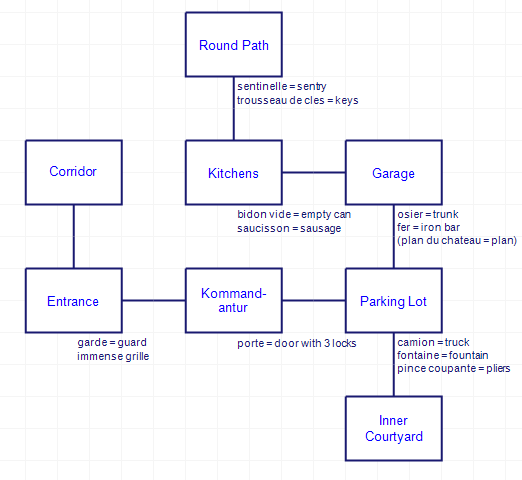
The “plan” that’s in the trunk just to the north of the starting room is unfortunately “old and all moldy” so doesn’t have any useful information. (That’s “building plan” as in map, not “plan” as in list of steps.)

The two spots with guards (Entrance, Round Path) haven’t raised any alerts yet, but I also haven’t tried to antagonize the guards, or try to poison sausage and feed it to them, or something like that.
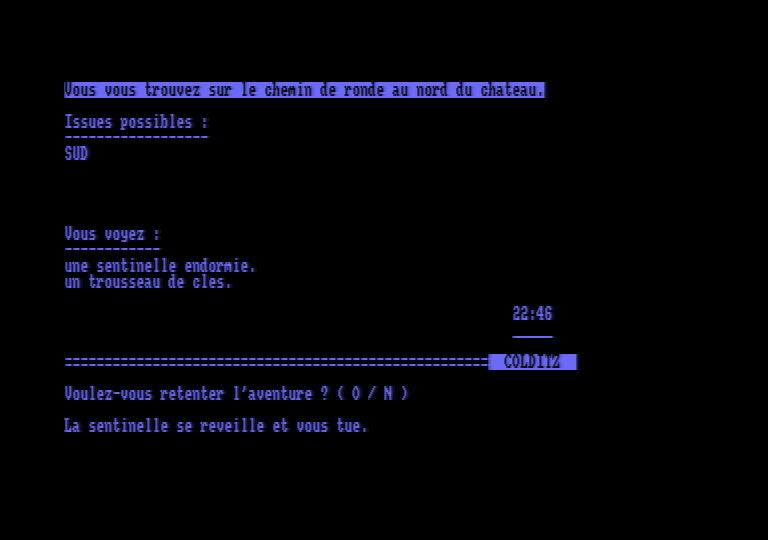
Except for this. I tried to take the keys and the sentry woke up and killed me.
This might be a game I might normally take care of in one chunk in English but I’m willing to split into two or three parts here to give it the time it needs. I’m going to try to solve it as honestly as possible, but if all else fails I do have a full walkthrough so I can at least write about what’s supposed to happen even if my reaction is “Je n’aurais jamais pensé à faire ça!”


 Renga in Blue
transferring some comments I got on a Discord message to here:
-ASSO would be “s’asseoir” in the infinitive form
-COUP could be for a generic “hit something/someone” as in “mettre un coup à quelque chose/quelqu’un” – or it could be abbreviated from “couper” (cut). I don’t know enough about the events of this game to affirm it’s the second option
-“allumer” and “éteindre” also make sense when referring to turning on/off equipment, eg. “allumer/éteindre la lampe”
-“jeter” both refer to dropping something (intentionally) and throwing something but considering that there’s a separate verb for placing down items I’ll go with the second
Given the rest of the verbs seem to be infinitive, anyone have a theory about ASSO?
It seems like “assoit” is a 1990 modernization of the conjugation of “asseoir” anyway (see , corroborated by a 80’s-era French major).
I’m going to guess “associer” for “combine”? My French is nowhere near good enough to know whether that makes sense but it seems like a possible meaning.
ASSO is assommer (knock out)
you use it to hit the sentry
it asks what item you want to use, and you can specify the iron bar
I don’t know why it wouldn’t let you use tuer, the game seems to be confused about it even though it is on the verb list
I would’ve also assumed COUP would work, since it could be hit, but again, parser doesn’t get it
it’s guess the verb in French form! at least I have the list so there aren’t any surprises
Well I completely botched the link for the reformed conjugation of “s’asseoir.” It should go here.
(BTW “jetez” and “jeter” are the same verb, jeter is the infinitive and jetez is the second person plural/formal.)
My French is super rusty and was never good, but I would’ve definitely thought “couper” was “cut”; I’m not that surprised it’s not accepted as “hit.” I think “coup” in the sense of “hit” may be more a noun than a verb?
“Tuer,” in Inform I’m used to games not distinguishing lethal from non-lethal damage, but maybe it’s different here–though trying to kill the guard is natural and probably should be accepted.
Re: coup, just reporting from my native-French-speaking correspondent
I think after enough mucking it is meant for using the cutting pliers though
Made some edits on the list, hopefully closer to correct now
COUP use more likely sorry for the verb COUPER (= to cut) rather than the noun that means (a) kick.
PLAN usually means a map.
I consider my French rather good for a non-native.
Autocorrect made a mess of that, new try.
COUP is more likely for the verb COUPER (= to cut) rather than the noun that means (a) kick.
PLAN usually means a map.
I consider my French rather good for a non-native.
I mean, I was reading plan in English was a map too. A plan of the location is a map?
Like a house plan is a blueprint of the house?
I did already change coup to cut, but given ASSO was non-obvious I’m not going to completely assume anything.
oooof
hit a point where the game crashed and I had to fix source code
the magazine had the text correct but the version I downloaded had a parentheses in wrong
this unfortunately does not give me confidence on other glitchy-feeling behavior
there’s a lamp where you can’t get nor interact with the lamp for no reason I can see
you can break a padlock on a steel plate (this required fixing the code) but the plate you get afterwards can’t be referred to
probably just going to check the walkthrough soon in case it’s not typing bugs but rather than game is being super-finicky
I’ll say one thing, this has to be the nicest looking text adventure window I’ve seen. Technically the now standard design is better, but something about this just feels well designed. Room name, exits and objects all in their nice little areas and then some descriptive text at the bottom. It feels like the best possible execution of a Scott Adams-style window possible.
Great intro. I never knew any of this about early French adventure games and type-in, I was so happy to find an adventure game in 1983 (!) that I thought naively it was the first French one. I should have known better.
Removing the “Le” or the “La” for us feels the same as removing the “The” for you. I played a handful of French adventure games (I only remember “Orphée” [1985]) or translated American/English ones (King Quest & Larry Suit, even as a kid) and yes it was natural to write “Prendre Lampe”.
I used to have this game sorted as ’85 (when it showed up in the magazine) until Hugo discovered about the circumstances of writing by finding the author.
Bilingual Adventure was 1979, but it is mostly a port of Adventure. It does seriously tweak one of the puzzles (the dragon) though.
So I’m saying this is the first “original” adventure.