My previous posts about Pimania are needed for this one to make sense.
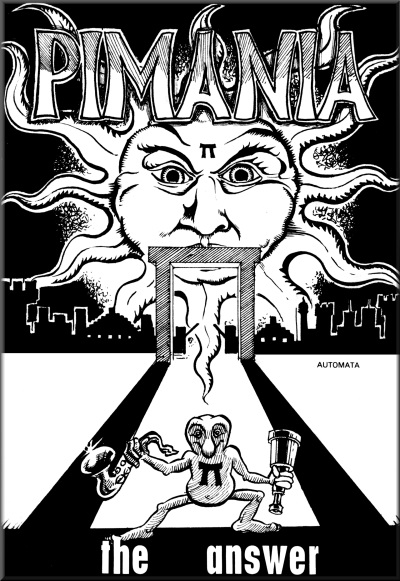
From World of Spectrum.
One thing I’ve been puzzling at is how Pimania got viral. Mel Croucher’s April 1985 interview in Sinclair User rather elliptically mentions sales of 100,000 (same as Elite, which is about as big a seller as the UK market could have produced). I’m skeptical of this number but it was still “a lot”.
It hit the right moment to carry another wave of contest mania, yes; rather than just burying the Golden Sundial it went on a rotating exhibition (the way to win, remember, is to find the right place, day, and time to show up). But still, I think there was a lot more marketing push than the underground-comic feel to the art might indicate.
It was advertised fairly regularly in Your Sinclair, but Automata also ended up with an unusual arrangement with Popular Computing Weekly starting somewhere in mid-1983. I’ll let Mel Croucher take over (in the book Pibolar Disorder by Mel Croucher and Robin Evans, published 2018):
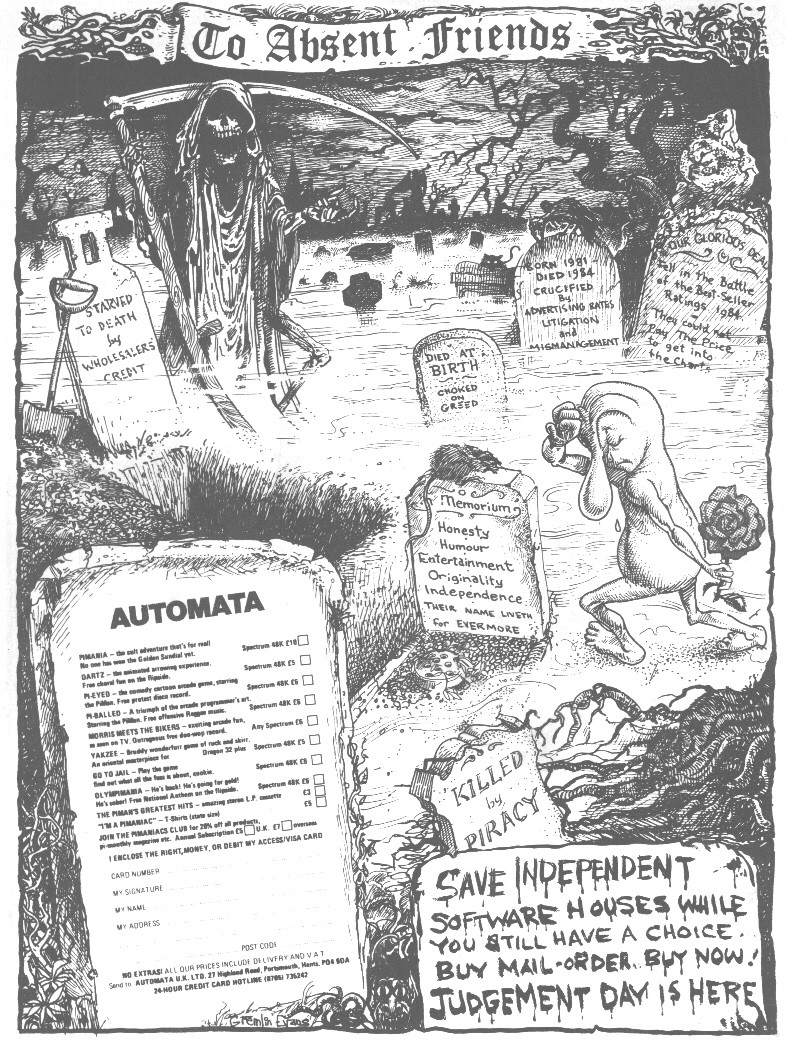
After a while, a magazine called Popular Computing Weekly surrendered to our idiocy, and made a deal with us. They would give us the back page of their magazine to do what we liked with, in exchange for us entertaining the masses and increasing their circulation.
In other words, they got free copy on the back page of a UK-wide publication! So while this led to comic strips and funny drawings, Automata was able to pitch their products, and specifically the Piman character itself, for free.
Quoting Mel Croucher again, this time from Deus Ex Machina: The Best Game You Never Played in Your Life:
Looking back, I don’t know if I invented transmedia in video games or not, but when I conjured up the computerised quest PiMania in 1981, I saw no reason not to break out of the confines of the computer monitor. It was released in 1982 as a video game, a rock album, a comic strip, a t-shirt, a magazine, a social network, and a real-world treasure hunt for a gold and diamond prize, all of which needed the other elements for maximum participation. The central character (usually Christian Penfold dressed as the PiMan) also made live appearances and TV recordings. The game went to Number One in the UK, Germany, Spain and several other territories we didn’t even know about, thanks to a new phenomenon called “software piracy”. At one point we had thousands of self-styled PiManiacs searching for the prize in the real world, and I trickle-fed them clues via the game content, the weekly comic strips and subsequent music albums. The prize was eventually won in 1985, and in 2010 a commemorative PiMania album was released on fashionably retro vinyl, complete with a PiMan mask, so I guess the little bastard is still selling, and I want to bring him back to life when Deus Ex Machina 2 is done and dusted. But that’s another story.
Regarding a T-shirt, there’s also a pitch for merchandise within Pimania itself, but I’ll get to that. I wouldn’t go all the way cynical and say the entire enterprise was unhinged capitalism, but there was at least some level of opportunism.
I say all this because by most metrics the game is pretty dire.
Continuing directly from last time, I had found a Scared Pi-Man and Bored Pi-Man and managed to trade some items. I theorized about at least one other form, and I found it as Hungry Pi-Man.
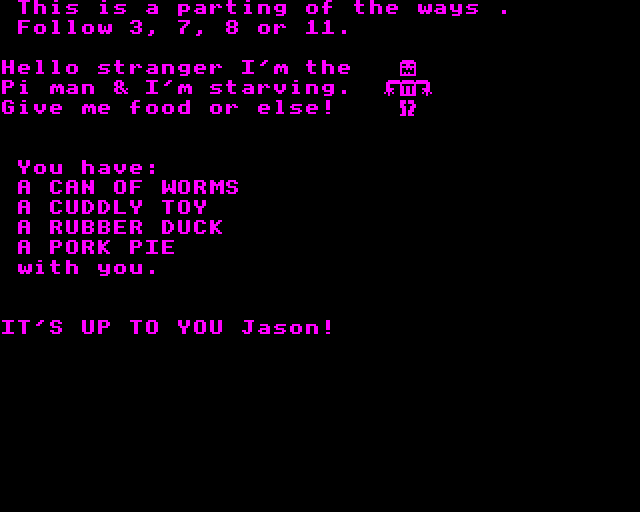
Hungry Pi-Man’s needs are fairly obvious, and he trades just like the other two:
CAN OF WORMS → DEAF AID
BAKED BEANS → HANGLIDER
TV DINNER → TELESCOPE
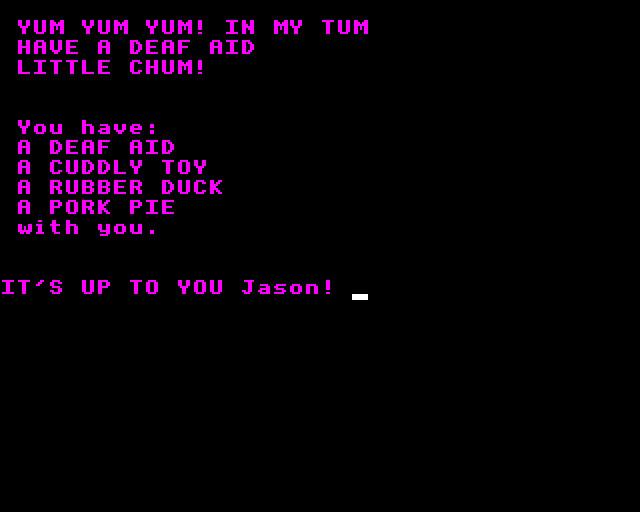
A pork pie is just like the duck with bored Pi-Man; it will cause him to steal something.
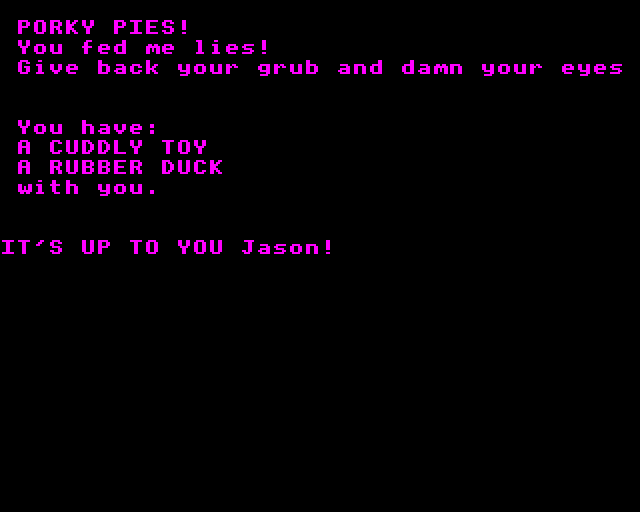
While I didn’t work out the pattern until fairly late, to simplify the narrative I’ll explain now: the rubber duck + bored Pi-Man and pork pie + hungry Pi-Man combinations are still important. Holding them in inventory is what summons the respective Pi-Man. The scared one doesn’t seem to be fussy, but the other two simply won’t show unless you have the right item, which is part of why it took me so long to find the Hungry variant (I just didn’t have the luck of wandering around with pork pie in hand, I dropped it in an object stash fairly quickly).
Because it also ends up being important, let me give a simplified map of the three forms of Pi-Man (there ends up being only three) as well as the “secret exit” to the ULTIMATE GATE OF PI.
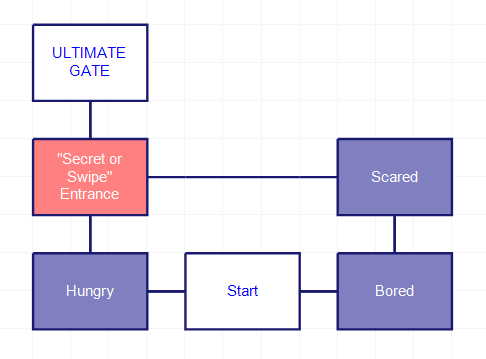
This excludes all “side passages”.
The “secret or swipe” is what I’m calling the room where sometimes a green door appears, and sometimes the Pi-Man appears to steal one of your items (one that’s been traded for, like, the DEAF AID, but it won’t steal the CAN OF WORMS).

The gimmick turns out to be that if you don’t have a stealable item, nothing happens; if you do, then either it gets stolen or the green door gets open. So you have to risk item theft in order to get in the door.
Furthermore, this isn’t a 50-50 chance. In some cases it is more like 75-25 odds tilted in favor of your item getting stolen (if you have more than one traded-for item it will just steal one, but stealing an item still means no open door). In some cases it is, maybe, 100-0.
From this next part I am essentially reliant on the pamphlet “The Answer” that was released after the contest was finished. In order to win the game you need to bring seven specific items into the ULTIMATE GATE and drop them. Remember you normally aren’t allowed to drop them, so it is clear when dropping an item as a “sacrifice” works that it means something special.
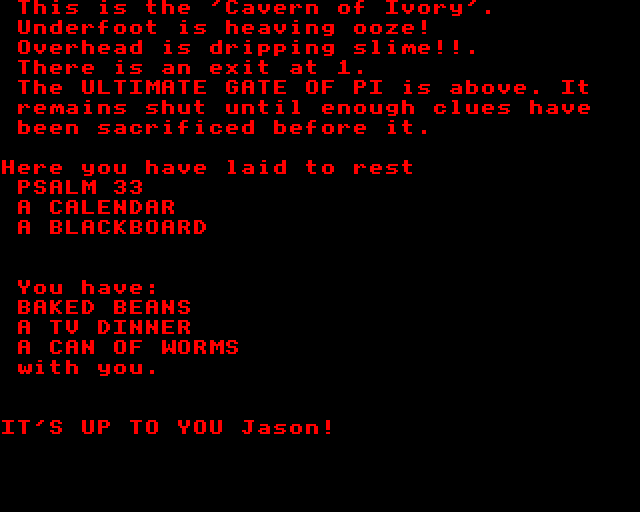
The seven items are THE COMPASS, THE CALENDAR, PSALM 33, THE TELESCOPE, THE DEAF AID, THE BLACKBOARD, THE HANGLIDER. Any other traded-for items (like OXYGEN) the game won’t let you drop at all.
I never managed to get all seven items in.
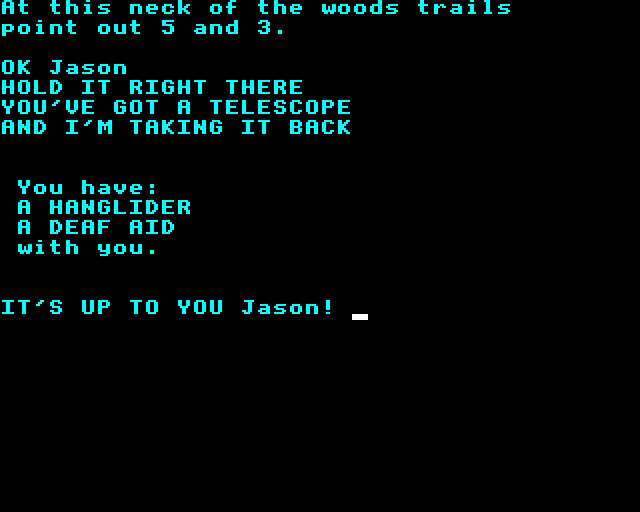
This screen was my nemesis. I kept seeing it over and over again rather than having the gate open. The Answer claims that “The more useful the gift, the less likely it was that the Door would be revealed.”; in other words, a fairly nifty object like The Telescope (which gives you a picture of what the target location for the contest looks like) is allegedly much harder to get past the Swiper.
I say “allegedly” because I never got the telescope through, not after many, many, attempts. The randomness is pure hell. In addition, you need to get all seven items through in a fairly specific order.
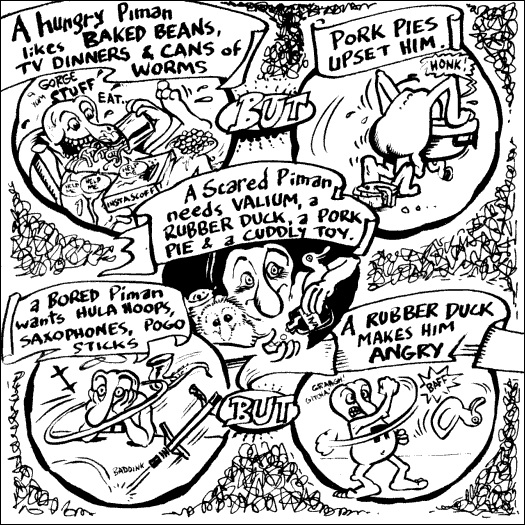
Remember how the pork pie summons Hungry Pi-Man and the duck summons Bored Pi-Man? (Not something mentioned in The Answer, by the way.) The seven items you need are all from Hungry and Scared. You need to trade away the duck as part of the sequence (you get a CALENDAR from Scared); it means, assuming you stash the Calendar safely, you never see Bored again.
This isn’t terrible in that even though one of Bored’s items technically gives a clue (a MEGAPHONE, I’ll talk about it later) the megaphone doesn’t count for the seven items at the gate. So Bored Pi-Man is technically optional.
On the other hand, you need the pork pie to summon Hungry, so you have to wait on giving the pork pie to Scared until you’ve got all of Hungry dealt with.
That all still is just a matter of sequencing carefully, but the ending upshot is having one (or a few) items that need offloading at the Gate and the Swiper Pi-Man just refuses to let you through. I tried many different permutations. I did get close once — I would have made it to the Gate with six items, but I got stymed by an in-game ad.
You see, typing 10 to go into the green door only sometimes works. Sometimes it gives you an ad. The hard-fought after, sometimes-10-minutes-to-appear green door. I wish I was joking.
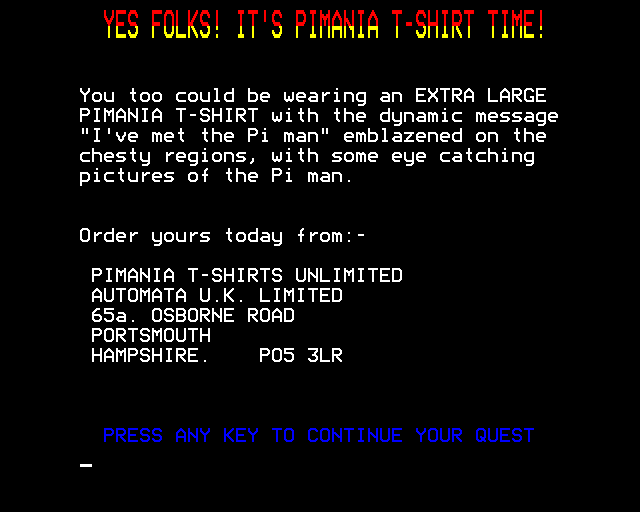
After hitting the ad-door the room’s randomness “resets” and you can have something get stolen rather than have the real door appear. I basically got stuck with my cargo and after many different approaches I concluded there was no way to get through.
People talk about the game being obtuse, but really, in a way, once the initial obstacles (opening key and movement) are resolved it is almost trivial; the trades are all very simple puzzles. The appearance conditions of the Pi-Man are arbitrary to work out, and breaking through the Swiper door is especially arbitrary. It is a game near-impossible (impossible?) to beat not because of obscurity but because of randomness.
So I apologize: no official ending.
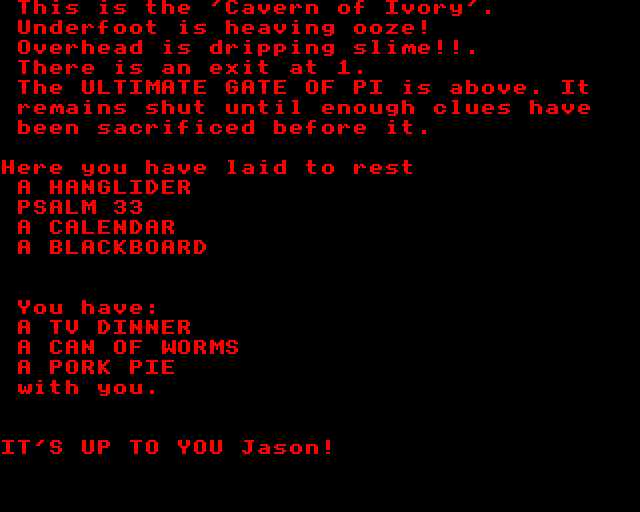
Now the whole thing is in BASIC so we can still read the ending. After depositing the seven artifacts you are asked for one final key, which is 22. (22/7 being an approximation of pi, and 22/7 being the day the contest is asking for.)
AT LAST, BY ACCIDENT OR DESIGN YOU HAVE RETURNED THROUGH THE ULTIMATE GATE OF PI. REMEMBER WHERE YOU HAVE BEEN AND WHAT YOU HAVE SEEN…. REMEMBER TOO THOSE GIFTS THAT UNLOCKED THE GATE. DISTIL THIS KNOWLEDGE AND MEET ME AT NOON ON THE CORRECT DATE AND PLACE REVEALED. I’LL BE WAITING THERE FOR YOU EVERY YEAR, BEARING THE GOLDEN SUNDIAL OF PI
Ugh. The other aspect about all this is that I was able to speed up my emulator. Normally there’s a long wait between commands, but at least I could zip around the map, but it still got irritating trying to get the TELESCOPE through to the gate for the 6th time. I tried save state abuse and that didn’t help either.
Why didn’t any of the reviews point this out? Did nobody really finish the game?
In truth, even the winners, Sue Cooper and Lizi Newman (teachers from Yorkshire), really didn’t. They noticed, if you draw the directions “properly” that they make a horse. The correct place to go was a chalk outline of a horse at Hindover Hill.
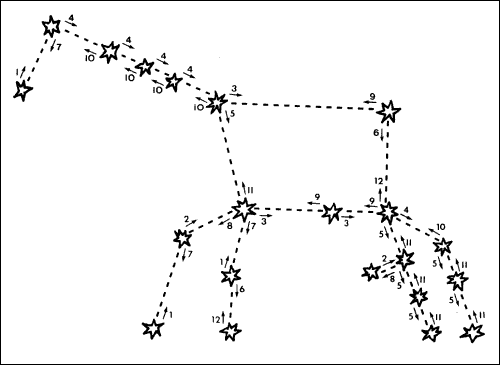
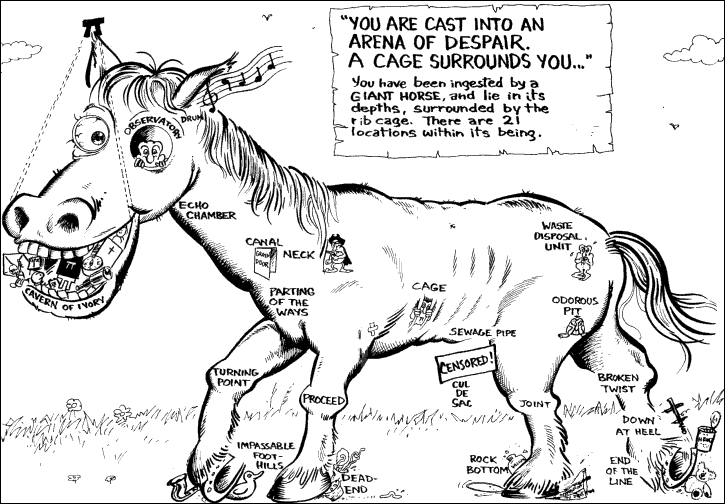
Not normally addicted to computer games, they have been playing Pimania since early 1983 on a Spectrum. When I asked Sue for an estimate of the number of keyboard hours they had put in, she replied: “Very little, we knew it had to be a horse fairly early on, so most of our time was spent in researching where!”
They then looked for prominent horses. The star constellation in particular (see the opening animation reference to “shooting into space”) is a Pegasus. They hit two “wrong” horses on the July 22 dates in 1983 and 1984. In 1985:
The clue that pointed them to the correct geographical location was the fact that Pegasus is near the Seven Sisters of the Plough. Their search, after a misleading pointer to Cambridgeshire in the Field Guide, finally put them on to the Seven Sisters cliffs between Seaford Head and Over.
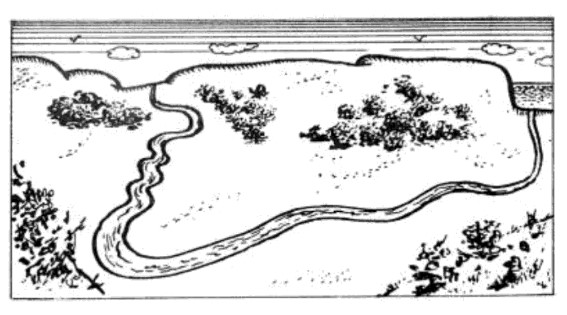
However, they were not convinced that they had the right spot until they made a pre-visit the day before. They saw the large compass mounted on a pillar, close to the car park entrance at this beauty spot. They also noticed the inscription of Psalm 33 on a metal plate set in stone (and adjacent to Psalm 34 in the game) nearby. But it wasn’t until they saw the view down into the Cuckmere Valley, where the river meanders to its outlet at Cuckmere Heaven, that they became convinced that this was indeed the view shown in the Pimania graphic when looking through the telescope.
Here is the river as illustrated in The Answer:
I wish I could give a screenshot, but I was never able to get the Telescope up to the Observatory, where it gets used.
Nor did I get the deaf aid through, which has the Pi-Man listening to the notes CAGG. This is meant to be Ca, or Calcium, referencing the chalk outline of the horse; the GG is supposed to reference “baby talk for a horse”. This latter bit makes no sense to me, is this some kind of British thing?
Also, I never bothered with the megaphone — too exhausted — but if you take it to the Echo Chamber next to the Observatory you can use it to get
I WILL BLESS THE LORD AT ALL TIMES; HIS PRAISE SHALL CONTINUALLY BE IN MY MOUTH!!!
I am honestly sheepishly impressed with the contest part. The GG part is the only thing in the explanation that made me confused; everything seems genuinely workable (not that it stopped legions of Pi-Man fans visiting Stonehenge hoping that was the right place). While we’ve had map spelling things before, the geometrical angle of the clock makes it particularly slick (as well as the rooms corresponding to the parts of a horse). I do have one last piece of history to baffle over, though:
According to various sources, including in Pibolar Disorder, the intent for the final position was for the Finder to be at the horse’s arse. The teachers were instead at the horse’s head but Croucher gave the prize anyway.
…Mel didn’t have the heart to tell them the exact location of the treasure was in the horse’s arse, and he got Robin to change the official answer book accordingly.
But … why? What possible clue is there to the arse rather than the head? The ultimate gate of pi is at the head, the megaphone signals the head. (Even if you consider the megaphone a “negative clue” — as it doesn’t go to the ultimate gate — that doesn’t signal the arse.)
The answer book of course smoothly explains why the head works. There is nothing that contradicts it. Is the whole thing maybe a waggish joke Croucher was playing on future historians? (It makes a terrific conclusion to Jimmy Maher’s chronicle.) I don’t know, but if anyone has a theory as to what was intended there, I’d love to hear it.
July 19, 1984, Practical Computing Weekly.


 Renga in Blue
Yeah, gee-gee is an extremely well known slang for a horse in Britain; at least it was in the 1980s anyway!
I think that a lot of the appeal and the success of the Piman, Pimania and all the other Automata games was down to the work of the artist Robin Grenville Evans who brought Mel’s madcap ideas to life in places such as the Popular Computing Weekly comic strip.
I never like Piman that much but I was rather fond of one of Robin’s other creations, Sam, the mascot of the SAM Coupe computer (now a rare machine, but one I owned back in the day)… it’s User Manual was written by Mel Croucher!
Robin is still around and working… he did the front cover to Shaun McClure’s “A Guide to ZX Spectrum Adventure Games – 1982 – 1985”
I think my favorite random post-Automata Croucher thing is that he did the sound samples for Klik & Play.
https://www.mobygames.com/game/51146/klik-play/
That’s got the similar “anyone can make a game” gonzo aesthetic going for it
GG for a horse shows up fairly often in Guardian cryptic crossword puzzles and always makes me mad when it does.
(You could point out that it is perverse for an American to do a British crossword puzzle and then get annoyed at the Britishisms in it, to which I respond, once the answer was OESOPHAGI! The things they have done to me!)
I didn’t even know that word existed!
I will read GG forevermore as Good Game.
It’s the plural of esophagus, which I guess is spelled oesophagus in the UK?
(The clue part of it was “fare goes down here.” Truly I have suffered! So when I did a table flip about Team Ferret’s explanation of why “ten” was “d,” you know it was strained… fortunately that wasn’t needed for the solution at all. Did we ever find out what the rejected crossword puzzle clues were besides the one we needed?)
Perhaps he might have just been mocking the “competitors” in his own gane/competition for wildly scurrying around looking for stuff? Like a final big “joke’s on you!” type of gag. Seems like the sort of thing Frank Zappa would have done if he had learned to code, and I think Croucher may have been more than a little influenced by him…
The “head/arse” thing you mean? Yeah, it is the sort of thing I might shrug and take at face value anyway in other circumstances except I could see Croucher trying to do a Groucho Marx style joke to a journalist offhand at the time and then sticking with the story after.
Plus, the problem of the evidence from the game itself only supports the head being the source.
Ok, how about this: The “head” is really more the horse’s mouth, and you’re basically “feeding” it these items. Where do things that are eaten by an animal ultimately end up coming out of…? Maybe he’s “digesting” them and they’re, uh, plopping out as a nice, shiny golden sundial? Or again, maybe it was something more like “If I’ve been able to con you into buying my weird game and running around like a blind mouse, then you really must have
have your HEAD up your ARSE! Ha ha ha! Hungry freaks, daddy!”, etc.
That’s all I’ve got…
ha, maybe!
The funny thing is out of the contest games we’ve tried so far, in the actual contest part itself this one has been the most tightly designed. There’s genuinely enough legit confirming elements that I don’t think it has something like Krakit with multiple completely plausible answers.
I don’t like riddles: in general, they show more the intention of their creator to appear as a genius than to become true entertaining.
It’s been fascinating reading this. My brother and I, who were teenagers at the time, spent many, many hours playing Pimania when it was released. Like you, we never managed to fully complete the game, but we had drawn out the map using the clock system and concluded that the location was a chalk horse (having seen the final message in the BASIC code). We also believed the date was 22 July. Unfortunately, we couldn’t find any clear indication of which chalk horse it was, and couldn’t persuade our parents to take us to one on the off-chance that it was right! I’d never seen the answer presented before now, so it’s nice to know we were pretty close.
ZX Spectrum?
The one-day-only condition (and relative fairness compared to Masquerade) did make me wonder if there were any other “winners” who just didn’t try to make the trek all the way across the country. Also not sure how easy it’d be to find out there was a Psalm 33 in proximity to a particular horse without being there.
Yes, we played on a ZX Spectrum.
We thought that there must be more cryptic clues to the exact location hidden in the game, which we’d just failed to work out. Having seen the answer now, I’m not surprised we didn’t get them!
We also spent a lot of time puzzling over Masquerade, but didn’t get as close to the solution. There was another Masquerade-inspired contest later on (run by Cadbury’s Creme Eggs, I believe) where there were multiple prizes hidden in different regions of the UK. We solved the one for the south-west, but couldn’t find the buried prize.
I’ve never played Pimania, but I remember being fascinated by the chronicles of this kind of game, and the Answer. So yeah, I think it made an impact here in Spain, but I doubt it was played too much here.
This is off-topic, but it seemed as good a place as any to report that the 1993 French treasure hunt “On the Trail of the Golden Owl” was solved today. Article in french: Le trésor de la « chouette d’or » déterré après 31 ans de mystère, annonce le dépositaire du jeu (lemonde.fr)
I guess there’s still hope for the Alkemstone! Thanks for sharing.
a reader (Paul Collins) is having trouble posting a comment, so I’m doing it on his behalf:
Just wondering if you're aware that Automata's 'music' compilation "The Piman's Greatest Hits Too" included a very big hint about Pimania. Perhaps by then (1984) they were worrying that nobody would ever solve it... Anyway: the track "Extremely Silly Song", played backwards, tells you something fairly clear about a "calcium horse"!