I gathered all the necessary treasures, but the endgame wouldn’t trigger. Cross-checking with the source code, I’m definitely at maximum, so I must have run into a bug; I can call this one done. (Also, the source code indicates an essentially identical endgame with Adventure 350, so I’m not missing anything.)
Before I made it to the end I was going to call this post “Annoyances” because I ran into legions of them. Case in point: gathering the necessary treasures isn’t just a matter of dropping them in right room. There’s a safe that stores most of the items. However, some of them don’t fit, but *do* fit in the pirate chest (it is unclear how one would know the pirate chest can contain extra loot and is an acceptable holder). Some don’t fit in either so really are just dropped on the floor. One of them (a radium stone) is radioactive and can only be stored in a special container; the score only increases when storing the stone in the container and it doesn’t matter where the container goes in the well-house. The only way to figure all this out (other than spoilers) is to keep an eye on the current score and test every possibility out.
You might remember last time an outdoors location that was reached by going north from a certain location where the destination was chosen via random number generator. The game does it again on an important indoors section, going south from the East End of Long Hall:

(Rant Mode On) Again, I should note the room-exit based version of this doesn’t seem to be a Thing outside of ports of Adventure, but in other adventures I have seen characters and/or objects only appear in certain rooms based on a random chance. Suppose, as a game designer, you want an Event to occur in a certain central location. Since the location is central, you expect the player to pass through 10 times, and you set the Event to happen with 25% probability. Surely the player will see it?
75% to the 10th power is 5.6%, so approximately 1 out of 20 players will never see the event by random chance! Don’t be lazy: engineer things so the event may seem random but the player is guaranteed to see it in a timely manner. (/Rant Mode Off)
The sad thing here is that the annoyance is followed by the best puzzle in the game, and in fact the best instance of re-appropriation of an object I’ve seen any of the Adventure variants.
You’re in the Cloakroom. This is where the dreaded Wumpus repairs to sleep off heavy meals. (Adventurers are his favorite dinner!)
Two very narrow passages exit NW and NE.
A lovely silken cloak lies partially buried under a pile of loose rocks.
In the corner, a Wumpus is sleeping peacefully.
The Wumpus stays asleep until you grab the cloak, at which point it starts chasing you. You have about six moves to somehow escape or defeat the Wumpus. As is tradition, I will not solve the puzzle here, but I did leave enough information in this post (as long as you’re somewhat familiar with original Adventure) to figure things out. Answers in the comments are welcome.

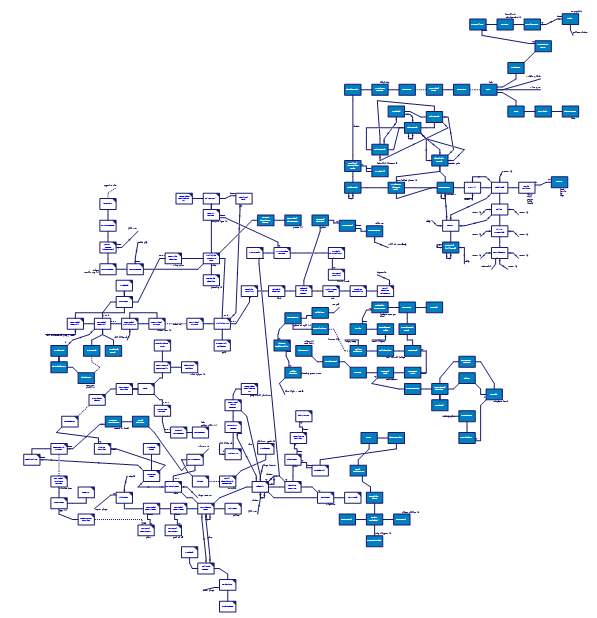
From Dennis Donovan’s map of Adventure 751.
Back to annoyances: I ran into two deadly guess-the-verb issues in a row. I’ve tried to argue before that guess-the-verb is rarer than the reputation of old adventures suggests, and then a game like this comes along and asks me to exit a boat:
>EXIT BOAT
I don’t know in from out here. Use compass points or name something in the general direction you want to go.>LEAVE BOAT
I don’t know in from out here. Use compass points or name something in the general direction you want to go.>OUT
I don’t know in from out here. Use compass points or name something in the general direction you want to go.>U
There is no way to go in that direction.>ESCAPE BOAT
I don’t understand the word escape.>QUIT BOAT
What do you want to do with the boat?
I pretty much rammed through every verb I could think of until I came across this, which is so bizarre it might be a legitimate bug.
>PULL BOAT
Dropped.
Immediately after this there are some bees where I wanted to get to their hive. I had some flowers where I thought >GIVE FLOWERS, >THROW FLOWERS, or some variation thereof would work. It eventually came down to >FEED BEES which I guess sort of makes sense, but I don’t think is the word most people would use.
…
One infamous aspect of 350 point Adventure is “the maze of twisty passages, all different” which contains a vending machine that dispense batteries for the battery-powered lamp. It was a way to extend the time allowed for solving puzzles, but since getting the batteries required using rare coins (and thus destroying a treasure) the vending machine was useless for anyone who wanted a high score.
One consequence of expanding the map in Adventure 501 is that the battery-powered lamp doesn’t have enough charge to get through every puzzle, even in the most optimized route. In this game there are “lead slugs” you can find which work in the vending machine. However, the map is big enough that once the lamp starts going out, there often isn’t enough time to go pick up the lead slugs and trudge all the way to the maze. I lost one of my “final runs” just from getting in an impossible scenario here, and on my subsequent attempt made sure I picked up the batteries early before I even needed them. This isn’t outrageous, but it did surely count as an Annoyance.
(Adventure 550 had a similar conceit of needing a lamp recharge, but there was a magic word that recharged the lamp when it got low and the magic word could work anywhere. Therefore, the annoyance was neatly avoided.)
I suppose if there’s anything positive I can grasp out of this experience, it’s that a coherent map is a pleasing thing. The expansion allowed many gaps to be filled in, and many more routes to be created to get from points X to Y. It led to routing decisions: if I want to reach object Z, do I use a boat, do I walk in from the bridge going the other direction, or do I teleport in with the ruby slippers? (Predictably, they’re just a Wizard of Oz reference; wearing them and typing >CLICK works.) The general feel of Adventure 501 was exploring an real environment, not a node graph.
I’d still recommend Adventure 550 over this one, though; it didn’t suffer nearly as many annoyances.

And that’s it! I can say I have played and written about every adventure game of the 1970s. I’ll likely make a summary post at some point and dive into 1980, but before that, I’m going to do something entirely different.


 Renga in Blue
I wouldn’t bet on it working, but I would absolutely try leading the wumpus over the Hall-of-Mists bridge and waving the rod when it’s halfway across.
As the bridge disappears, the Wumpus scrambles frantically to reach your side of the fissure. He misses by inches, and with a horrible shriek plunges to his death in the depths of the fissure!
This was especially satisfying in that the bridge had always been sort of a meaningless flourish (even though it was in Crowther’s very first version) due to the fact there’s an alternate route (most walkthroughs of Adventure 350 completely skip it).
I’ll leave some comments here and on the other posts on Adventure expansions.
I can say that the 551-point version (or at least the Z-code translation) avoids both “guess the verb” situations you listed above” I have an old transcript from one of my sessions, and “leave boat” does work in that one, as does “throw flowers”. But, I will concede that there really is no way to know you’re supposed to store (most) treasures in the safe without checking your score (and who checks their score after every trip to the building?) Also, although the method of recharging the batteries is neat, it’s just too inconvenient to be of much use. And I too see what you mean about being annoyed with random exits, but at least in the original (and 550) I don’t think there is any random exit you have to use to win the game.
Yeah, I gather 551 is a lot more polished, and I’m guessing the Z-code port is a lot more stable besides. (With the port I used I had to water the plant early, because later in the game >POUR WATER would crash.)
The only other version of Adventure that requires the random-exit trick to win is Adventure 500, which technically is a re-imagining rather than an expansion.
I hit both mazes when I was getting the pirate chest, since you can pick up the batteries without using them yet. Then when I found I was on a trip that included the dreaded “your lamp is flickering” message I reloaded and made sure I took the batteries along.
Wumpus: I’d go south from East End of the Long Hall and pray the Wumpus would end up in another room. The chance is almost one out of five!
Alas, unlike original Hunt the Wumpus, the Wumpus knows where you are after you wake him up.
I recall having to type the same command 99 times or something stupid to win at the end.
I tried 200 or so. That’s not to say there won’t be something that triggers at move 500, but given I know what the endgame is I’m not up for testing it out.
BTW, I occasionally have someone try to click your classic Dungeon map you posted long ago – it doesn’t seem to be at the same address any more. Is it still available somewhere?
Click to access DungeonMap.pdf
Congrats on finishing the ’70s, and thank you for the series. I’ve enjoyed reading your play throughs and commentary, and learning about all of these games I’d never heard of before.
Thanks!
I remember finding out about the bridge from the text file for the 350 Adventure. I never would have thought of putting the diamond by the chasm and waving the wand. Luckily, as you as say, it’s not needed to win.
Found the bug that was stopping the endgame triggering (it was in the safe opening code). Completed a full run and it looks good now.
Nice! Thanks for doing all this – I had known about this specific version of Adventure for a while from Rick Adams’s page (like 15 years maybe?), but it always stated nobody had compiled it before so I was just left wondering.
Pingback: Trizbort, plus qu’un simple outil de cartographes – Fiction-interactive.fr
Pingback: Before Adventure, Part 4: Hunt the Wumpus (1973) | Renga in Blue
I found a reference to Adventure 751 being on Stanford servers in 2009/10… maybe an avenue? https://cs.stanford.edu/people/eroberts/courses/cs106a/announcements.html
Very interesting catch there. I have a “friend who knows a friend” with some old ties to Stanford, and had her send an email about it to Dr. Eric Roberts, who was running that course. We’ll see if anything comes of it.
I jumped at this and emailed Eric S. Roberts myself. It turns out that the game in question is *not* LONG0751; it is a distinct 665-point extension of LONG0501. According to the in-game “History of Adventure” book, this version was extended successively by Mark Edwards, Mark Sylvester, Eric Roberts, and Kristin Powers (possibly et al?). Somehow it was “previously unknown to science” — the science of us Adventure Family Tree taxonomists, that is — but it has existed for a long time, because in 1999 someone was looking for a 535-pointer featuring “a belt with magical powers, and a piece of venetian glass (a treasure) which was leaded into a wall,” i.e. some ancestor of this game.
Amazingly, you can play it in your browser right here: https://cs.stanford.edu/people/eroberts/Adventure/
It comes in two versions: a 240-point “Starter Adventure” which is only minorly different from WOOD0350 (differences around the Plover Room; two early treasures removed, no endgame) and the full 665-point “Wellesley Adventure” which includes the belt, venetian glass, ruby diadem, etc. etc. in addition to everything from LONG0501.
Are there dates attached to either?
Hi Arthur,
I was sitting on this one for the past couple of weeks, as I did email Dr. Roberts through a friend of mine, and he was kind enough to send me both the link to the online versions and the Fortran source code. I’ve been playing through it, comparing it to other related versions and trying to put the entire history together (as far as that’s really possible), while waiting to see if he responds to several follow-up questions I asked that might really help to clear things up, and then I was either going to post about it here or email Jason. Now I’ll just go ahead and talk about it here, as I do have some theories.
Re. Jason about the dates: There are some leftover dated files in the source code, but it’s complicated. I’ll post more here later.
Okay, so before I get into some other info I’ve come up with since, and my own tentative theories about all of this, first I’ll just quote from Dr. Roberts initial response where he sent me the link, source code and some additional comments:
“Thanks for your note. Sadly, I don’t have a copy of David Long’s lost 741-point Adventure, but rather the one that Mark Edwards and I developed at Wellesley College starting from an earlier version of Long’s program”
And here are the follow-up questions that I sent him just under a week ago:
“Do you remember the exact development history/timeline of your version? I ask this because much of the content of the game syncs up very closely with the recollections of ‘Rawson’ in a compilation of old threads about lost mainframe versions of Adventure, particularly regarding his memories of a 535 point version that he recalled playing circa 1981, and the 665 point version he mentions, which seems to track almost exactly with yours. There is game content he describes that is completely unique to your version, so there must be a connection.”
Here’s the link to the thread he referenced:
(I sent him the link to the lost versions thread here)
Furthermore, you might also notice his reference to the 551 point version, that combined with the 535 seems to make up the bulk of the 665. The 551 point variant is largely known as a version based on David Long’s 501 point game, but with a few additions by Doug Mcdonald, started around 1984 but not widely published until 1990. However, McDonald has always claimed that he was mainly cleaning up and porting a version of Long’s 501 point game that had additional content via “anonymous authors”. This, among other things, had led to widespread speculation about an earlier 551 point version (generally known as ANON0551 in Adventure family tree taxonomy), although some think that it’s apocryphal. Looking through your 665 code, I note that a number of elements track very closely to McDonald’s version, sans the ‘Elven castle’, which he admitted was his own later addition. This leads me to believe that the ‘anonymous authors’ previously referred to may actually be you and Mark Edwards. Does any of this (admittedly convoluted) set of circumstances ring a bell for you?
Finally, I was wondering how many elements you took for your version from your original Mirkwood Tales D&D campaigns as compared to Crowther, as I noticed a heavier Tolkien/fantasy influence here, via the Silmaril, the elves, and the mail for instance, which is mentioned several times in the Mirkwood manual itself. I’d also love to know more about your Adventure contests at Wellesley. Do you think any of the games your students created might still survive there somewhere, and when did you integrate some of their puzzles into your own version (I believe you mentioned the diadem specifically)?”
This should give you a good idea of the direction my thoughts/theories are headed in with all this, but I’ll get more into that in my next comment.
So here is the additional information I’ve come up with:
Going back at least as far as 2010, Eric Roberts has been teaching a programming course Standford that uses the creation of adventures in Fortran as one of the main assignments. He created a slideshow covering both some general and more Adventure-specifc history and used this to make handouts for his students. You can find a couple PDF versions of this online via Stanford (and recently Willamette University also seems to have picked this up as a course), but here I’ll quote the most relevant part:
“-Eric Roberts begins the Mirkwood Tales in early 1975.
-Will Crowther creates Adventure later that year.
-Will moves to Xerox/PARC in 1976.
Stanford graduate student Don Woods releases an expanded version of Adventure in early 1977.
-Dave Lebling and others from MIT release the first version of Zork in 1977. That game later becomes the foundation of the computer game company Infocom.
-Adventure is ported to a wide variety of platforms by 1980.
-Eric Roberts creates an expanded version in 1984 and uses it as the basis for his first Adventure Contest at Wellesley. “
As you can see, some of the dates are a bit variable, but I’ll get back to that later. The most important thing here is the bit at the end regarding Wellesley and the Adventure Contest, which apart from the 2010 announcement that Gunther dug up here (which was directly related to what seems to be the earliest version of this course handout), “Rawson’s” old Usenet comments and McDonald’s own (frequently questioned) citing of an “anonymous author” for Adventure 551, is the only fleeting piece of information to surface on these versions until now.
Before I get into my own theories, I’ll also mention that as recently as 2023/24, Roberts (now with the help of Jerry Cain, as I believe he’s semi-retired) has revived the Adventure Contest idea, and there’s a very interesting PDF handout for it also available via Stanford.
This was longer than expected, so I’ll go over my own theories, and what I found in the source code, in a separate, final comment.
So here are the general outline of things, as far as I can tell. Much of this is speculative, and awaits further details from Dr. Roberts himself, provided that he has the free time to get more deeply into this arcana at the moment:
Roberts was the head of the computer science department at Wellesley from 1980-1985. At some point during that time, Mark Edwards and Mark Sylvester were his colleagues there. It would seem that he/they may have had some contact with David Long early on, or even before, this period, who was at the University of Chicago, where he developed his Adventure 501 and 751 variants. It would seem that he/they began developing their own version(s) early on in this time-frame at Wellesley, based on Long’s 1978 501 version, rather than the 751 version, which was still in active development with an eye towards being commercialized at the time (which it was ultimately via Compuserve). Some early-ish version of 551 then must have spread around to some extent from Wellesley, and ended up in the hands of Doug McDonald, who cleaned it up a bit, ported it, and added the Elven Castle section and treasures. Because he was a bit cheeky about crediting “anonymous” sources, and the seemingly complete lack of evidence for its existence otherwise, this version became known by later researchers as “anon0551”, and was generally thought to be apocryphal. But I think now we can see that it was actually the work of Roberts/Edwards/Sylvester. Getting back to them, it appears that the game kept being developed and was eventually used as the basis for Roberts first Adventure Contest, which would seem to have taken place around 1984 (thus Roberts’ use of that date, despite the fact that the game(s) must have been in development significantly earlier than that). A puzzle was created for this contest involving a diadem by one of his students, Kristin Powers, and was then integrated into the game at some later date. McDonald obviously never had access to this revision, as that element (as well as all the “531” content and some other stuff) didn’t make it into his version.
Now, although speculative, this all seems possible to piece together fairly well up to this point. But things really take a turn for the mysterious with the just aforementioned 531 point version. “Rawson”‘s old comments turned out to be uncanny in their accuracy as to the unique content in that version, and in how the 665 combined it with 551. He must have had access to these versions through either Wellesley or Stanford, and his exact recollections are such that I’m inclined to believe his circa 1981 dating for at least 531, although there may be some discrepancies there. The real question then, is who wrote this version, and how did it end up being integrated into the 665? Was it perhaps an earlier version that Mark Edwards and/or Mark Sylvester had developed and spread around, but wasn’t incorporated until they met Roberts at Wellesley, after the release of the earlier version of 551 that McDonald ended up porting? Or is it the other way around and is from an earlier Roberts version that he didn’t mix in until the (presumably later, as encountered by Rawson) release of 665? The key to unraveling this, absent further information from Roberts himself, may lie in this comment found in the source code. Make of it what you will:
“*** THE HISTORY OF ADVENTURE *** –
142 – ——————————– –
142 Once upon a time, a group of adventurers, out to seek their fame
142 and fortune, mounted an expedition against the evil Necromancer of
142 Mirkwood to rescue a captured wizard. One of the stalwart members
142 of that party was a experienced thief named Willie Crowther, who
142 (on those few occasions when the Dungeons and Dragons game gave way
142 to other pursuits) was also employed as a magic user (with a general
142 specialty in computer wizardry) at Bolt Beranek and Newman Inc. in
142 Cambridge, MA. There, restless by the lack of excitement and magic,
142 he descended into the depths of the netherworld of programming
142 and brought forth the first version of Adventure. Willie’s other
142 interests include spelunking, and the geography of Adventure is
142 modelled on a real cavern, called Colossal Cave, which is a part
142 of Kentucky’s Mammoth Caverns.
142 – – –
142 Shortly after completing the original version, Willie Crowther
142 moved to the magical lands of California and little was heard
142 about Adventure for some time. After about a year, Don Woods
142 and other programmers at Stanford discovered Willie’s program,
142 made significant revisions, and greatly expanded the cave.
142 – – –
142 More recent additions were made in 1978 by David Long while
142 at the University of Chicago, Graduate School of Business.
142 In the process, the code was heavily rewritten to permit more
142 generalized handling of objects and to allow a far more complex
142 syntax.
142 – – –
142 From there, additional modifications and extensions have been
142 made at Wellesley College by Mark Edwards, Mark Sylvester and,
142 most recently, Eric Roberts who, in the circular history of these
142 affairs, also designed and refereed the original Dungeons and
142 Dragons adventure in which Willie Crowther first played. The
142 puzzle of the ruby diadem and so forth was designed by Kristin
142 Powers and was the winning entry in the Great Adventure contest.
142 – – – – – – – – – – – – – – – – – – – – – – – – – – – – – – – – -“
Now, here are a few other things I noted while playing the game and sifting through the source code:
-The current online version seems to have last been updated circa 2021. The latest files on the code are dated from then, and that’s mentioned on an in-game billboard along with comments about making the outdoor navigation easier (this applies to the forest and especially the little salt marsh maze, which was entirely eliminated except for the initial location with the pole).
-From the dating of most of the other files, it would appear that the general revival of this game to use for his classes did indeed take place in 2010, with a few files dated from later in the ensuing decade.
-The earliest dated files (and references in the code that I could find) are from around September 1986, including a bug report and this interesting leftover txt file of an in-game billboard:
“+—————————————————————-+
| WELCOME TO ADVENTURE |
| |
| Brought to you by Crowther, Woods, Long, Edwards, and Roberts |
+—————————————————————-+”
Note the lack of Sylvester there, which seems to contradict the account in the “History of Adventure” comment quoted above.
-Roberts left Wellesley for California in 1985, and started teaching at Stanford in 1990. There’s one other file in the source that bears mentioning here, as it’s dated 1991 and I believed is related to some of the games routines. I wonder if this indicates that he picked up the code one last time after getting to Stanford? In any case, after this, he seems to have put it to bed again until the 2010 classroom revival.
So there you go. Certainly one of the more interesting adventure game (and game history in general) discoveries of recent times, although one that still has a lot of loose ends to tie up. Particularly in light of the (as mentioned in the code itself) full-circle nature of Roberts’ original involvement with and inspiration of Crowther himself, as covered not long ago on this very site. That does lead to one last question, though: Why didn’t any of this come up when Kate Willaert was in touch with Roberts, which led to the unearthing of the Mirkwood Tales campaign manual and its ensuing coverage here by Jason? When Roberts emailed me back (through my friend), he also included a copy of Mirkwood, and was quite explicit as to its overarching connection with all this. As you saw in one of my previous comments, I also noted what seem to be direct Mirkwood influences in his (and Edwards/Sylvester’s?) version, so the fact that it seemingly never came up until Gunther, myself and Arthur’s involvement seems curious.
How nice of Dr. Roberts to send you the code for this version and Mirkwood – I hope it’ll be made available/playable offline in some way.
I wonder what he thought about two different people contacting him about this after all this time… let’s see if his recollections can shed a light on the mysteries you’ve uncovered.
Yes, very kind of him to go out of his way to help here. I should also note that the reason Wilammette was also running that Adventure course is because Dr. Roberts currently lives in Oregon, so he must have been teaching it himself. Imagine how awesome it would be having him as your compsci professor!
One other strange “hiding in plain site” aspect to all this is that there actually is a Roberts version of Adventure listed on Nathaniel Culver’s Adventure family tree, a Python adaptation from 2018:
“ROBE0000 – A “recreation of Willie Crowther’s “Colossal Cave Adventure” game in Python”. To play: cd ~/adventure/ ; python3 adventure.py”
The code is up on Github via Simon P. Couch.
Rob – are you able to put up the source code, or a compiled version, up somewhere? I don’t trust online versions, they’re too ephemeral.
Thank you! How foolish of me to think it would simply compile…
Sure, he put it up via his own Stanford page, so it should be okay to share (I already emailed it to Jason):
https://cs.stanford.edu/people/eroberts/Adventure/newadv.zip
To your point about instability, I have noted a few bugs, crashes (try saying “phuce” at the two-inch slit, for example) and weirdness with using save files, although nothing fatal so far.
Hi Rob, if you could email me (arthur.j.odwyer@gmail.com) and/or cc me on your next email to Roberts, I’d really appreciate it — and I bet he would too, since it’d keep things in one thread instead of two (or more) uncoordinated correspondents. :) I’ll do the same for you except I don’t know your surname or email address yet.
Re “ANON0551”: I’m quite confident in my belief that there was no intermediate hop between LONG0501 and MCDO0551: the _only_ pieces of MCDO0551 that aren’t in OSKA0501 are the Castle of the Elves portion, which contributes the new 50 points via two new treasures. In ~1990 McDonald credited that to “an anonymous contributor,” but I’m confident that that was a tongue-in-cheek reference to himself. (See also https://github.com/Quuxplusone/Advent ).
Meanwhile ROBE0665 contains none of the castle-of-the-elves business, which again is the _only_ addition MCDO0551 made to LONG0501. So I’m confident that ROBE0665 is a cousin, not a descendant, of MCDO0551; and that Edwards/Sylvester weren’t involved with MCDO0551. It does seem possible that Edwards/Sylvester made a 535-pointer and then Roberts extended it to 665 points; I haven’t seen any evidence one way or the other for that. (Might depend on whether Roberts claims authorship of the Venetian glass puzzle, because we know that was in the 535-pointer already.)
I’ve already emailed Nathanael Culver (cc: Mike Arnautov and Russel Dalenberg) pointing out that the current “ROBE0000” should be retaxonomized to “COUC0006” and descended from ROBE0665, not CROW0000 (content-wise it’s a subset of ROBE0665, but *not* a subset of LONG0501, and it’s also not a superset of CROW0000).
Dates in the source code’s comments include 1986, 1987, 2010, and 2021. I’m not *deeply* source-diving yet because I’m going to try to beat it unspoiled first. :) My observations above about content have been made from gameplay, not source-diving.
“the _only_ pieces of MCDO0551 that aren’t in OSKA0501 are the Castle of the Elves portion”
Granted that this is just from source code comparison (I’m also trying to play through relatively “clean”), but it does look like 665 ads the Sapphire to the Star Chamber, which is not in Long 501, IIRC. That was one of the main clues (along with the initial 1984 “end” date given by Roberts coinciding with it also being the “start” date for Mcdonald, and him only admitting to adding the Castle stuff himself, which only comes AFTER you get the Sapphire, IIRC) that led me to believe that Mcdonald was porting from an early (pre-535 additions, pre Adventure Contest puzzles) version of Roberts without (either knowingly or unknowingly) crediting the names of the original authors. Note also that neither version includes the anonymously added spider, fly and “Shamut” stuff, which seems to be the only surviving version of 501, and I’m pretty sure Roberts and co. were in direct contact with Long at some early point, and thus had the original “clean” code to work with, which is how it also ended up being the basis for Mcdonald.
Just to put a finer point on things, regarding the anon0551 issue:
From your 2014 email exchanges with Carl Ruby:
“I’ve just been in contact with Doug McDonald — when it rains, it pours! — and he told me that the Castle of the Elves in his [McDonald’s] version was his own invention and therefore doesn’t correspond to anything in David Long’s versions. I’ll find this out from your QBASIC version, I guess, but I’m particularly interested to know what treasure was found in the Star Chamber in the 751-point version. In Doug McDonald’s version, it’s a star sapphire, and it is involved in the discovery of the magic word that takes you to the Castle of the Elves.”
From the “treasures.txt” file in Roberts’ 665 code:
“Sapphire (10 points) @ Star Chamber (183)”
As mentioned previously, no surviving version of Long 501 contains the sapphire, so combined with the other circumstances cited above, this would seem to be something of a smoking gun, absent any directly contradictory information from Roberts himself.
Hi Rob, I’ll wait for your email to discuss further.