Archive for the ‘valley-of-cesis’ Tag
I’ve finished the game, and be sure you’ve read my other posts before this one.
(Also, in my second post, by accident I picked a screenshot of a room that held a secret. Can you find it before I talk about the room?)
A little more on the nonsense-monster name thing to kick things off —
Rather more famous than The Gostak is the Lewis Carroll poem Jabberwocky.
‘Twas brillig, and the slithy toves
Did gyre and gimble in the wabe:
All mimsy were the borogoves,
And the mome raths outgrabe.
“Beware the Jabberwock, my son!
The jaws that bite, the claws that catch!
Beware the Jubjub bird, and shun
The frumious Bandersnatch!”
The poem is an exercise in imaginary words, although curiously enough, if you look up pictures of the Jabberwock they most look the same. That’s because it was illustrated by John Tenniel in Through the Looking-Glass, the novel where the poem appears.

More interesting visually is the Bandersnatch; if you look up depictions, there’s a wider variety of approaches.

A collage made up from random pictures on an image search. I needed to add a date restriction to avoid clashing with the Netflix show.
There’s still some curious consistency having a creature that walks on legs, but the creature is still in a real sense an infinite beast encompassed by every visualization at once.
That’s not how I thought of Qedejiv the weird and Baryon the bad and Zezotim the blue and (most importantly) the Elmralat. I didn’t have (nor do I have) any visualization at all. I am not one someone with aphantasia: I visualize things all the time. But with no reference, I had them stored more conceptually. If you were to insist on a visualization, Rob’s comparison to “weird fantasy” like Dark Crystal seems appropriate, and that may even be what the author was thinking of. But I only had that feeling as a mood, not something concrete I could draw.

Last time I had found a horn which seemed to have three “Brothers”, including the green treasure I had already found, with some link to the Elmralat: “Held afore from him / Who bears the Elm / And in a secret / place was hid it.” I supposed I needed to bring the red book to Remesis the red and the blue book to Zezotim the blue, getting the last two treasures, and then something special would happen with the horn and it would then need to go to the Elmralat. Then I would defeat and/or make friends with the Elmralat, Mortal Kombat style.

I was correct on all accounts.

The one major catch is that I was running into a game-crashing bug.

I tried many different combinations of horn and treasure and I just couldn’t get them to combine; either they would stay separate or I’d get the crashing bug. I finally broke down and went for a walkthrough.

Spellcheck, you don’t know what a Sesajat is? This is from the legendary Dorothy Millard (or Irene), author of many C64 adventure games. These include Yellow Peril, where you are trapped in a world where everything is yellow.
Fortunately, I didn’t spoil much other than one puzzle later which would have been very difficult to get. As far as why my game was bugged, I don’t know, but the intent seems to be you pick up the horn first, then pick up the treasures, and they automatically go in the horn if you do so. (This wasn’t happening in my game, but I think you need to have found the horn before any treasures for things to work correctly.)

Back on track! I took the horn over to the Elmralat and hit one of the nasty parts of the game, which Dorothy observes: the travel agent sends you somewhere random. I got lucky the first time I played and got sent to the correct place (the forest) but on this playthrough I got sent all the way back to the ice river and had to walk back and try the travel agent again, hoping for a more favorable outcome.

The incorrect first destination.

The right way to land.
Toting the horn to over to our infinite beast, the first obvious thing to try is to GIVE it just like you do with the books, and that turns out to be correct:

This gives you a “frosted glass sphere”. Dropping the glass sphere breaks it but reveals an “iron key”.
A key. Hum. No idea.
OK, here is where the secret comes up. I think the only plausible way you could work this out is wondering about the verb “pull” off the list, which hasn’t been useful anywhere at all. It is only useful here:

You can pull the floorboards.


This leads to yet another map section, although a mercifully small one.

On the way there’s a healing balm that’s the only useful potion of the game…
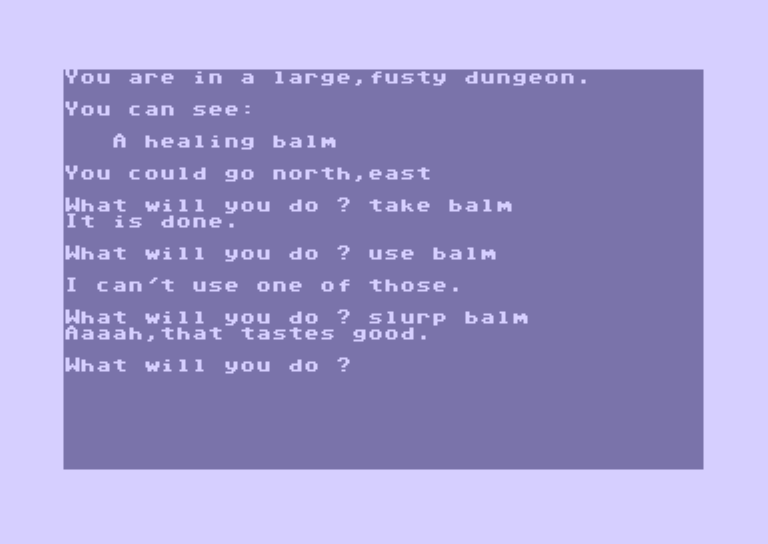
…the kind of room which doesn’t describe the room but rather gives your mental state…

…and some creative writing.

I guess that explains what the letters on the talisman are. This is meant to be a hint that the talisman is about to be relevant.
North of here is a locked cell with a padlock, where you can use the key. Inside is an old man.

Who is he? An old hero? A king? A random chosen one? Admittedly this makes about as much sense as The Dark Crystal did if you don’t read the companion books.

There: that’s our quest. Now we need to take the TREASURE OF CESIS all the way back to the start, and we’ve won.

Sorry for spoiling your secret, C. Steadman.
I more or less ignored all the treasures; as I already theorized, there’s no “storage place” so the point total is based on what you’re holding, so it’s pretty limited anyway. You could scoop up the gold pieces (I didn’t bother) for a few points, but given they’re placed at random and I’m already past the 14,000 point mark, I think I’m fine stopping there.
I can’t say I appreciated the bugs, the dodgy parser, or the floorboards puzzle (where out of the 150+ rooms you have to guess that one room description might hold a secret) but the atmosphere was utterly unique, and probably wouldn’t have worked in any other context than a cryptic C64 game.
Coming up: Dragon’s Keep, for the Apple II.
(Continued from my previous post, please read that one first.)
I got through a major bottleneck — the ice river — and the game more than doubled in size. I also know, sort of, what the overall quest is now, and it isn’t just grab the loot.
Just to give a sense of scale, here’s the full map zoomed out, with the new rooms marked in dark or light blue (except for lairs, which are all marked in red):

At the very least, while it’s still obviously possible, I think this is a little hefty for a lost type-in. I had this concern while researching because the other game I’ve seen a disk “published by Brunswick” (apart from Boothman’s own work) is the game The Dungeon of Danger. We know where The Dungeon of Danger came from: a book in the Mostly BASIC series by Howard Berenbon. It came out originally for Atari computers in 1980, then was ported to Commodore and Apple. The CRPG Addict has written about the game here.
Picking up right where I left off, the first issue I managed to tackle was the mysterious “1 gold piece” objects lying around; I went through all of these commands and nothing worked.
take gold
take 1
take 1 gold
take 1 gold piece
take gold piece
take coin
take money
take cash
take gold coin
take peice
take all
tak gol
ta go
(It’s actually a two-letter parser. I’m guessing this is why potions use SLURP rather than DRINK, since DR is already taken for DROP.)
Thinking perhaps the author was D&D inspired, I tried
take gp
and it worked.

When you’re at one of the Beings (as I’ll call them) and you take an item, if the item is considered “valuable” and the Being is unfriendly they won’t let you take it. Gold pieces aren’t valuable enough to fret over, it seems.
While I might need to care in a winning run, I subsequently have ignored the money. It (along with some of the treasures, and the “minor” monsters like the ogre) gets randomly distributed, and I think it is just a matter of points.
With that resolved, I went back over the object list…
bottle of wine, meat, plank of wood (2), rug, crystal ball, dagger, potion, silver thimble, brick, silver sword, some rope, green moss, silver trinket, green treasure, old manuscript
…as well as the verb list, and tried to test things together.
take, use, open, break, drop, look, close, slurp, give, inspect, pull, score, bash, list, hello
USE will be handy momentarily. BREAK is mean to work on an object being held — I don’t know which yet. SLURP on the unlabeled potion I had access to had no effect, and the game says “you got the wrong one!” INSPECT is the game’s version of EXAMINE, LIST is INVENTORY, and BASH is the combat verb.
Without aid, you can bash nothing.
This was cryptic since it seemed like maybe I was supposed to use a brick to bust open a secret wall? Or just bash a bottle of wine on someone’s head, bar fight style? BASH is instead usable with the silver sword, and I was previously envisioning some kind of epee. Instead, I guess it’s Cloud’s sword from Final Fantasy VII.

This vaporizes the sword and the Being and is usable only once. Trying to use a dagger in the same way gets a similar message, but the dagger just gets dropped on the ground and no slaying occurs. My best guess is that some of the Beings can be befriended but some cannot, so the silver sword needs to be saved for a Being where you can’t make friends and you need them to let you pick up whatever is nearby. Or maybe it’s just optional for points!
What’s not optional is we need to get by the ice river. (Importantly, “ice” river, not “frozen”. I was thinking of slipping on thin ice, but it is a flowing river, just with ice in it.)

The one bit on the map where you don’t have to worry about crossing, because you can access the other side via a different route.
I went through every item I had available trying to USE it or simply be holding it and walking in the relevant direction. While nothing worked I was suspicious of the rope’s message on USE, which was different than the others:
Can’t use it on anything.
USE SWORD, for comparison:
I can’t use one of those.
I tried USE in many of the rooms (with the traditional mark-as-you-go method) but realized about halfway through why the game gave me 2 planks of wood rather than just 1: they want you to make something by combining the three things. I was still thinking “frozen” river, so, maybe, snowshoes? Instead I got a raft.

This let me open up the two blocked exits from last time.

I took what turned out to be the long route first (“Cavern of Rototars”) so let’s follow that way and loop back to the “Long Twisting Tunnel” at the end.

This is a place where a sword is required, as the Being won’t let you take the potion. Too bad the potion is the wrong one (at least on the save file I was playing with, maybe there’s one good “random” potion and the rest are bad).

Moving on, up some stairs to a new area…

…and to the first object of interest, a magic talisman.

Cool symbol, don’t know what it signifies, am happy to take guesses. USE TALISMAN gets the standard “I can’t use one of those” so it isn’t like the rope. HELLO TALISMAN:
Don’t bother, it doesn’t understand English.
Fair. Moving ahead are two more Beings, Xeginem the mysterious and Minitex. Xeginem has one nearby chamber marked “Cavern of Xeginem’s dog” and south of the lair of the Minitex is “the cave of many Minitex”.

Don’t know what a looney is, there’s also a leper in the earlier section but I don’t think it’s a “leper” like from English. The response here might be wry humor.
An item close by of special note is a red book, which asks you to return it to its owner. One supposes this would be Remesis the red, but I haven’t had been able to test this theory yet.
Along a side route there’s a castle.

The rooms are colorfully described, including a kitchen with stale bread, a pantry with a washing board, and a zombie butler, and a blue book.


The blue book almost certainly goes to the blue Being, or rather, Zezotim the blue. However, I also haven’t gotten test it yet. (Sorry! This session had a lot of mapping. To be fair, the player’s “energy” level has started to be an issue. I don’t know if I’m just supposed to optimize my moves fast or there’s a recharge, like a potion I haven’t found yet.)
Turning in an entirely different direction — west of the Minatex — leads to a “dwarf with cold feet”, some “black grapes”, and a travel agent.

This bizarre … encounter? … in-joke? … drops the player in the last section, the area of the dread Elmralat. The game gives more warnings than any of the other Beings, and it just sits there and acts grumpy, just like all the other Beings.


Three last points:
Point 1, nearby the Elmralat is a bag of sapphires. It gets treated differently from other treasures, because if you drop it somewhere random, a “small elf” appears, takes it, and runs away saying
Ha ha,I shall hide it better this time!
(I still don’t have a treasure “storage” area and don’t know if there even is one.)
Point 2, Elmralat seems to be referenced in that manuscript from last time.
In times of yore
Tehre was remembered
a magical cone,which
so say many, did hold
Three Brothers,in
Comp’ny with another
Held afore from him
Who bears the Elm
And in a secret
place was hid it.
The “Elm” is likely “Elmralat”, yes? I’m unclear how this translates into action, but I can move on to point 3, which is I found the magical cone. If you read back in this rambling mess of a travel blog, you’ll notice I said the ice river leads down two paths, and I started by taking the longer one. The shorter one is only two rooms: a passage leading to a dead end.
I’m guessing since I have the green treasure for returning the green book, I’ll get a blue treasure for the blue book and a red treasure for the red book, and they somehow get inserted into the cone and represent the Three Brothers. There are so many other things going on I doubt that’s quite the ending of the game (what’s the talisman for?) but I’m hoping this won’t take too much longer. I went into this game expecting the same kind of public domain one-shot I got from Alien and instead I got an epic that kept sprawling, even if it is mostly exploration and unhelpful creatures.


For this game, written by C. Steadman for Commodore 64, it will help to go over how public domain software got distributed in the 80s and 90s.
The most straightforward way was friends and family passing disks (see: early distribution of Mission secrète à Colditz). There were also clubs with monthly meetings that had “librarians” who kept up catalogs that members could access (see: the Toronto PET Users Group and Fantasyland). Magazines starved for content could do reprints (or toss the software on their disk or tape, if they came with one). Download from an online service like The Source was possible (as I discussed with this post and “Apple City”). A less-scrupulous vendor might mix public domain software with new software in a package sold on store shelves.
Relevant today is another method: companies that had large catalogs of public domain software where people could choose to get copies for nominal fees. This is different from the “commercial package” method, as this was a case of the user clearly getting what they expect. “Package” disks were also common from this sort of company, with numbered disks akin to the user groups, like this disk of demoscene art. Such companies could still mix “new” games in their catalogs or even distribute “new” public domain software — that is, software not easily findable by any other outlet.
(Incidentally, the idea of “freeware” where author retains the copyright and “public domain” was quite fuzzy in the era. The Smurf Adventure declared public domain status in its source code, and sometimes authors would include a message that meant they clearly were intending the same, but it seems like everyone assumed “no copyright notice = public domain” when that really wasn’t the legal case. At the very least, “anonymous source code” tended to also equal “permission to distribute”, but there were plenty of times where an author name was included but stripped off in a later version. A company or author might even add their name to source code that wasn’t really theirs.)

A mysterious public domain collection from early 1983 Australia, via michaelcarey at the Lemon forum. The disks had been re-formatted and he was trying to find out the origin of the collection.
Valley of Cesis survives to us through two public domain distributors.
Starting with the less-common copy, there’s a version of the game via The Guild Adventure Software. The Guild was founded by Anthony “Tony” Collins in the UK in October 1991. It focused on conversions between platforms, and also kept up a library of public domain games.
The company didn’t last long, dying out in fall 1993 with the games sent to other publishers; relevant to today’s story, the C64 merchandise wen over to Binary Zone. (Especially relevant because Binary Zone is still selling the game so you can’t download this version of the disk.)
A listing of software from The Guild includes public domain dating back to the late 1970s with Dog Star Adventure. Valley of Cesis is far back enough that its presence doesn’t indicate anything in particular (that is, the author Steadman likely doesn’t know of Collins and probably didn’t even know that this outlet was republishing their game).
The second distributor was Brunswick Publications out of Australia, run by Peter Boothman. Peter Boothman was a jazz guitarist in Sydney who has records dating back to the 70s, and somewhere in the 80s he picked up “Commodore 64 author” as a side gig, writing games like the three Telnyr CPRGs. The first Telnyr (1990) is listed as being from Brunswick; the obituary I linked says his company was founded in the “late 80s” so that’s as specific as we’re going to get.
The timing (1982 vs. starting in late 1980s) means it likely wasn’t the “initial distributor” of the game, but since the it hasn’t shown via any other vectors, it is possible it stayed in the Commodore club scene of Australia and went no farther until Boothman picked it up. It is even possible C. Steadman knew Boothman personally.
The other evidence we have of C. Steadman’s activities is a pair of articles in Personal Computer World. The first appeared in the UK edition, October 1983, and the second appeared in the Australian edition, November 1983. Both are identical. I’m unclear about the policies of this particular magazine, but in general magazines are one or two months off from their newsstand date anyway; in all likelihood Steadman when sent the article once and it hit both countries “simultaneously”.

So we can’t tell from this evidence if the author is Australian or from the UK; my inclination might still be for the former because of Boothman, although I should point out the article says the software is tested for “PET, BBC, Microtan 65, VIC, and Acorn Atom.” BBC, Acorn Atom, and Microtan 65 would be especially odd for an Australian to have handy.
Now I’d normally plow ahead with the game, but let me give one last bit of background, as I’m going to make a reference only some of the people reading this blog will know offhand. Specifically, The Gostak, which gets categorized on the Interactive Fiction Database as a “wordplay” game. However, unlike Nord and Bert or Counterfeit Monkey, you’re not manipulating words directly, but rather trying to parse what’s going on in the world you’re seeing from contextual clues.
Delcot
This is the delcot of tondam, where gitches frike and duscats glake. Across from a tophthed curple, a gomway deaves to kiloff and kirf, gombing a samilen to its hoff.
Crenned in the loff lutt are five glauds.
Everything, including the verbs the player types, is based on the modified language of the game: clearly English, but with a whole passel of unknown verbs and nouns. The contextual clues end up enough to accomplish the main goal: you, the gostak, must distims the doshes. (Aaron Reed has written about the game if you want to read more.)
Before you get too excited, no, Valley of Cesis doesn’t go this far, back in 1982. But the main characters (who all have lairs) are given names that could come from the Gostak-verse and have no descriptions, and so I obtained the same sense of understanding-without-understanding as I was making progress. What seems to be the primary mechanic of the game involves making friends with these vaguely-defined beings which have no real way to visualize them, unless you want to make something up.

There’s a long pause when the game starts which indicates some kind of randomization going on. The “1 gold piece” items that get scattered across the map do seem to change, but nothing else. I have not puzzled things to the end so I cannot be 100% certain about this.

The “1 gold piece” there is only from the iteration of the game I was making the map.
I’m not even sure what the end is, exactly. We do seem to be gathering treasures and we have a score going up, but our inventory limit is three (or four depending on object size), and I haven’t found any “treasure store” area where the treasures can be dropped and the score retained. This may be another game where you just get as big a score as possible and give up when you like, but maybe there’s even some kind of goal the game isn’t disclosing?

The above text is quite standard when you enter a lair, that is,
BEING_NAME is here.
He doesn’t like you here.
Don’t come back here in a hurry.
I originally thought there was going to be some sort of grisly death or a passage was blocked I needed to puzzle out, but there is no consequence for going into a lair room as many times as you want. (I think. There is a “timer” where you run out of energy but it seems to be based on number of turns you’ve taken, not where you go.) In the process, in addition to Sesajat, you can meet:
Tetsotoh
Qedejiv the weird
Madewob the mad
Baryon the bad
Remesis the red
Zezotim the blue
Duxwetil the green
There are other, more “ordinary” creatures scattered about: an ogre, a rabid dog, a large balrog. They are equally quiet and you can just ignore them and they won’t do anything.

Here I tried to get a reaction by giving meat, but all this did was drop the meat on the ground.
Other than the friendship which I’ll get to in a second, the only obvious obstacle is an ice river running through the map. It blocks some exits so the game says “You cannot cross the ice river without aid.”

There’s two wood planks on the map, some moss, and some rope, but I haven’t gotten any of them to be helpful. The game helpfully gives a word list (take, use, open, break, drop, look, close, slurp, give, inspect, pull, score, bash, list, hello) so I don’t think it’s a communication issue, I really don’t have the right object yet.

Well… maybe there’s a communication issue. I say this because of the 1 gold coin pieces spread throughout the map, which have eluded my efforts at picking them up.

I could probably resolve this easily by peeking at the source code, but hey, the author asked in the title screen not to, I should give just a little more slack before I go there. They might be optional anyway.
Regarding making friends: I found a green book where I could INSPECT it and find that it wants me to “give it to my owner, whoever he may be.” Duxwetil is green is so was worth a try:

My current thinking is most or all of the beings will trade for the right object, I just have to find out what it is. For reference, here’s all the objects I’ve found so far:
bottle of wine, meat, plank of wood (2), rug, crystal ball, dagger, potion, silver thimble, brick, silver sword, some rope, green moss, silver trinket, green treasure, old manuscript
The manuscript gives a cryptic message…

…and that’s all my cards on the table. I’m happy to take speculation for what to try in the comments (don’t even bother with ROT13); if for some wild reason you know this game already, hold for now.


 Renga in Blue