One of the key skills in game design is being able to understand things from the mind of another person. They don’t know what you know; you have to imagine you are seeing information as they are. Beginners to designing puzzles especially will often include leaps that are clearly out of mental bounds of their players. The technical term (well, one technical term) is “cognitive empathy”.
I think the problem with The Scepter is the young author lacked a.) a sense of when puzzles are easy or difficult and relatedly, b.) cognitive empathy.
(Not weird for a first time author! And we’ll come back to Simon, so we’ll get to see if he’s made progress.)
From the Museum of Computer Adventure Games.
Here’s the item stash from last time:
wheel, crystal ball, sword, goblet, lamp, acorn, wire, diamond, axe, bag of dirt, old boot, key
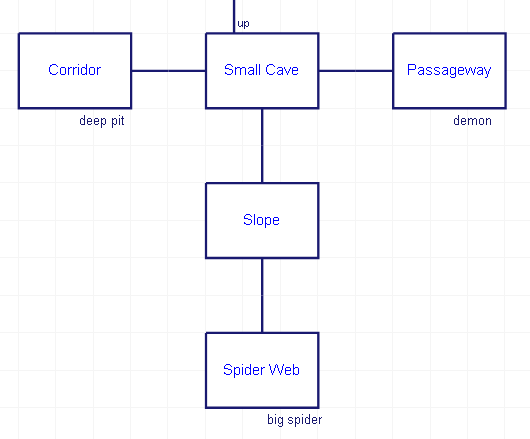
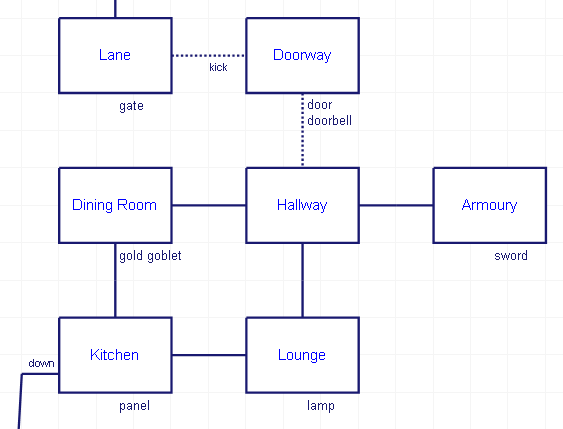
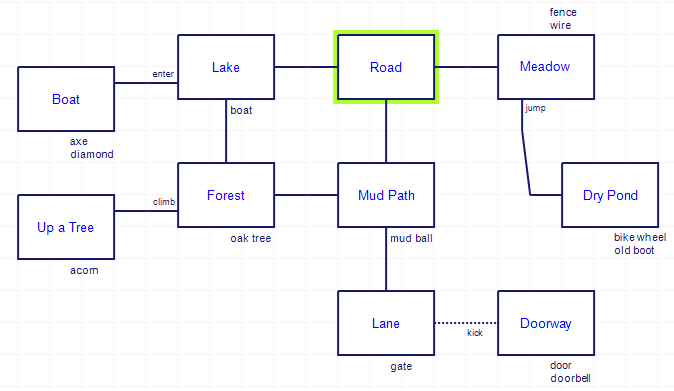
Here’s the map from last time:
One of the puzzles causing issue was a giant web with a spider. Any direct attack on the spider was ignored; the spider equally ignored the player in their efforts to kick, push, tickle, etc. in the hope of something, anything to happen.
I need to check with hints via rmartins; the puzzle is entirely unsolvable from the room itself, but rather you are supposed to look at the room adjacent, the Slope. From there, you can ROLL the WHEEL which will head downhill and smash the web.
This of course assumes the player knows the slope goes down, that the wheel is big and stable enough to roll free-standing on its own, that the web is placed such that it would make sense to get taken down by a wheel, and that the web is small enough for the same. Failure on any of these can lead to a very difficult-to-visualize puzzle; in particular I was thinking the web as being too large for such a thing.
Many of these could be fixed by a more responsive parser, so technical issues are partly to blame. It’s a pity because this is quite a clever puzzle in a way: a very indirect and creative approach to the solution. I’d probably (taking my game-designer red pencil) also allow DROP rather than ROLL as a solution; even though it is possible you might have the wheel roll down by accident that way, it is an unlikely dumping spot for the player. As an extra bonus you could have other items slide down the slope to emphasize the physicality of the space and give a hint as to what’s going on.
Past the web is a locked chest. If you have the WIRE in inventory you can PICK LOCK (note how LOCK is not even a described noun in the game, you just have to infer the command will work).
This gets a *SKULL* which is one of the three parts of the Scepter that we’re seeking.
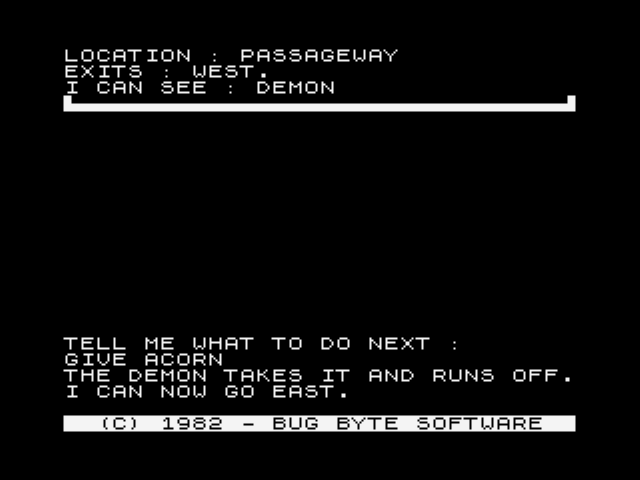
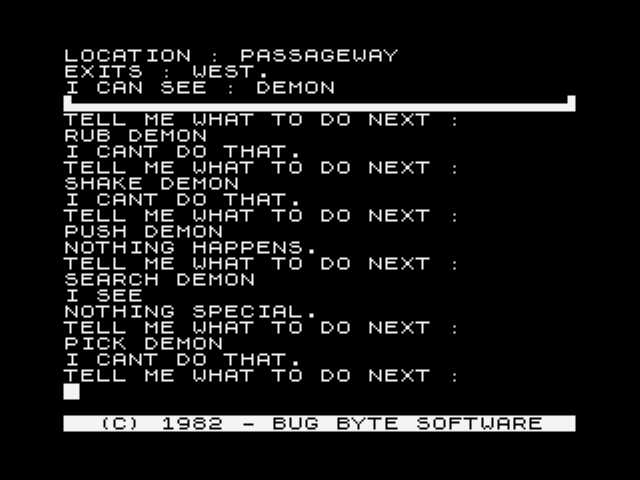
Moving on next is the demon. (Again, I needed an rmartins hint.) You’re supposed to give it …
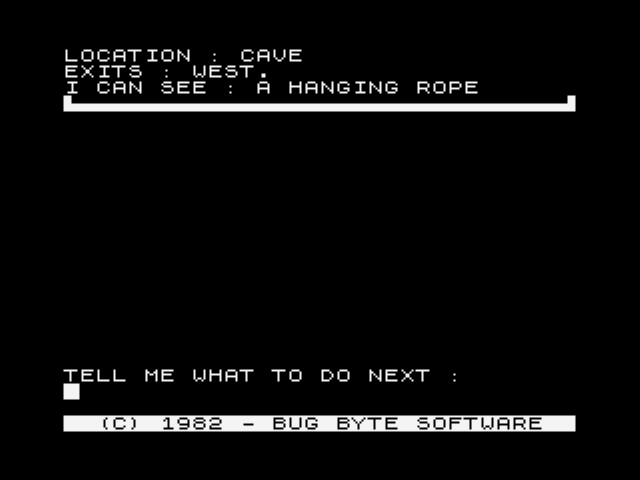
… the acorn. Sure? Maybe it’s a demon-squirrel. LOOK doesn’t give any info so you just have to hit this randomly.
Past that is a *STAFF*, so that’s two parts out of three.
Over to the pit, you need to take the crystal ball — which already worked to gazing and seeing a goblet and a furnace — and rubbing it.
This again seems like a failure of cognitive empathy. Imagine the process from the player’s end: how will they solve it? The only real way seems to be testing RUB at random to see if it is magical, and then testing RUB in every location looking for an effect. I could see in the author’s mind thinking that — oh, the only way across is magic — and thinking there wasn’t a big leap in logic, but it isn’t even obvious that crossing the pit is desired (I tried for a while to survive the jump in, or use a rope from the demon’s direction as a way of climbing down).
The ghost puzzle is terrible but let’s zip by a moment for the easy puzzles. There’s that furnace where you can melt the goblet, getting a coin (not only was there a vision of the two together but the goblet said MELT ME, why so many hints on this and not the acorn-loving demon?)…
…next to a vending machine to use the coin.
The scroll allows teleportation back across the pit.
Then there’s a “fierce dog”, where the only tricky aspect is you’ve been trained by the spider and demon to look for a “weird” solution. No, you’re just supposed to kill it. With your sword.
A sad dragon is made happy again. I mean, I got it first try at least.
And then we reach a puzzle that would truly bit nifty if it weren’t for a verb issue.
Remember the bag of dirt I was making fun of from the start of the game? I realized quite quickly this was meant to be the Indiana Jones weight-swap. You have to SWAP, SWITCH doesn’t work, nor does PUT DIRT or many other variants.
Before leaving you need to deal with the ghost, and boy, you thought the acorn was unprompted:
This isn’t “moon logic” — SAY HELLO isn’t a 100% absurd thing to do, after the fact — but it has zero prompting and is it highly unlikely someone would just hit upon the act naturally. Even if someone gets close (“I want to talk to the ghost”) other words like HI don’t work. It has to be that exact command.
Using this advice, you can go back aboveground, BUILD SCEPTER to put together the staff, ruby, and skull, and then WAVE SCEPTER while at the chopped-down tree in order to teleport home. Why we could not walk back the way we came is undisclosed.
There’s a confusing meta-feeling playing one of these ultra-minimalist games (where all that gets conveyed to indicate a single place is a word, like “LOCATION: SLOPE”). In book form, this would be atrocious. Somehow, the act of gameplay boosts the significance, like receiving a writing prompt and filling in the blanks, but rather than “writing” the spaces are colored in with the mental effort of playing. This is true even when there’s a lot of flailing at nothing. But what gets colored in isn’t plot, exactly (I’m not imagining my avatar try to lick, kiss, poke, and kick every single thing) but just tension. Feelings. Unrealized ideas for puzzle solutions.
To pick up from last time, I had a door with a doorbell that caused electrocution. Poking through my inventory with LOOK doesn’t reveal anything, but I eyeballed the verb list (reproduced above) and occurred to me the OLD BOOT I had might respond well to SHAKE. It did, having a key fall out, so I was able to unlock the door and go in.
This led to another item dump; a golden goblet that says MELT ME (referring to the crystal ball vision, no doubt), a sword, and a lamp.
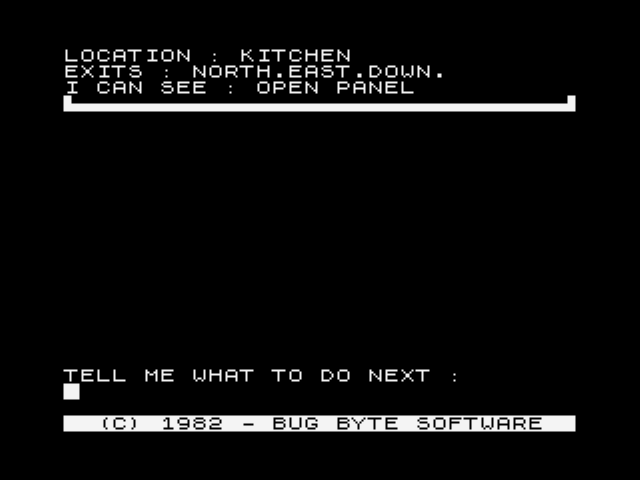
The kitchen had a PANEL and it took me a lot of struggle with verbs like PUSH, OPEN, SLIDE, and so forth before I hit upon LIFT, which I am fairly sure is the only verb that works. It didn’t feel like solving something as much as–
–okay, here’s an analogy. Sometimes the old Fighting Fantasy books, with numbered sections, had a bit that asked a riddle. Since you can’t “type in” a word you are supposed to convert it to a number, so if you get the one correct riddle answer, you can move on, but because you’re staring at a static book it isn’t going to react otherwise.
Solving “puzzles” like “what verb to open a panel with” is like fighting the right section to jump to in a Fighting Fantasy book; no responsiveness until you’ve done the task, and the whole process can feel arbitrary.
Back to the action: going down further led to a SPIDER, a DEMON, and a PIT.
This sounds like it might be exciting! Engage the demon in combat, realize just the sword isn’t cutting, and enhance it by solving another puzzle before engaging again, or something like that. No, this is how the demon scene ran:
The spider was similarly pacifist:
No responsiveness to anything (including the obvious KILL and KICK), nor do they try to kill me back. At least you can jump down the pit and die, but that’s a little like “I hurt myself in order to feel alive”.
In normal circumstances I would have reached for hints already, but I want to re-iterate that this game was a massive pain to get emulated correctly. I have sunk investment.
However, at this point, I am totally happy to get hints from you, the readers, either in:
a.) speculation [again] what to do in normal text form
b.) hints telling me exactly what to do in ROT13 form, and feel free to plunder the BASIC code although there’s a walkthrough up at CASA so you might as well use that
One quick side note: the tree you can climb at the start to get a WALNUT you can also chop down. The chopping seems to serve no purpose.
I tried every single verb on my chart with no response. Maybe it is meant as a red herring.
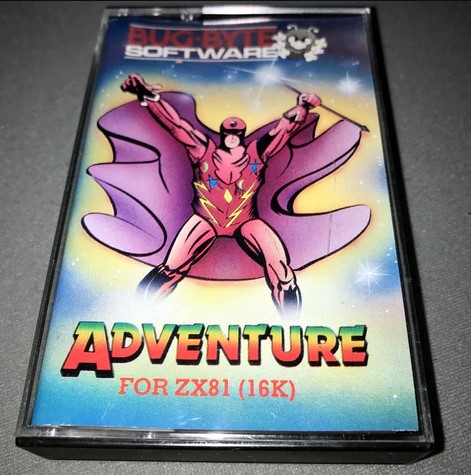
The publisher sold this one as “Adventure”, so I’ll hope you forgive me going with the alternate title on the intro screen, which the author (Simon Wadsworth) has stated was always the real name of the game anyway.
Bug-Byte was founded in 1980 by Tony Baden and Tony Milner while they were students and neighbors at Oxford. Tony had bought a ZX-80 and the duo — after playing around with the machine — realized that software selection was scant.
They formed their own company (using Tony Milner’s address from Coventry as the business mail, since a student residence didn’t seem professional) where “at first we pretended we were bigger than we were”, making a peak of 150 pounds in weekly sales by the end of the year.
They tried spending for a full page ad in March 1981 for ZX-80 software; that same month is when the ZX-81 launched.
We had doubled our advertising and halved our sales.
After graduating Oxford the duo went full time into business, finding an office in Liverpool and cranking out ZX-81 software (“I wrote eight in one day once”) eventually growing to the point of having sold 500,000 cassettes by August 1982.
They later became famous as the publisher of the adventure Twin Kingdom Valley, which we’ll hit in 1983, and the platformer Manic Miner, which we won’t be reaching at all (although Data Driven Gamer gave it a play-through you can read, or you can watch the video below).
For today’s game, we’re firmly still in the summer of 1982. The author, the 16-year old Simon Wadsworth, describes how “my school friends and I spent countless hours battling the creations of Scott Adams, Brian Howarth, Level 9 and Artic Computing” and decided to write his own, using ZX81 BASIC (with some machine code). Note how there’s been enough time for the early British games to be influential, it isn’t just original Adventure and Scott Adams.
I have no idea what made me submit it to Bug-Byte for publication, but I’ve always been glad that I did. This was the first step in my career as a software developer. It was written while studying for my GCSE O-Levels. When the Head of Year got to hear about it she contacted the local newspaper; so I achieved my fifteen minutes of fame.
I wasn’t expecting much. When they accepted it, I could hardly believe it.
Simon sent in a second game to Bug Byte which never got published (for unclear reasons) followed by two for Artic, so we’ll be visiting him again, but for now, let’s check out his first effort.
This was incidentally a giant pain to emulate. EightyOne, the typical recommended emulator for ZX81, has been acting very slow for me (pushing a button for a menu taking 2 minutes+ to respond). JtyOne, the online emulator at zx81stuff, had input problems, I presume because of the ZX80 machine code (at least that site makes the BASIC source code easy to read). I went through some even more obscure emulators like no$zx and ZEsarUX which had the same input error, and finally had luck with reverting to an old version of EightyOne (version 0.52) which you can find here.
The “collect pieces of the magic gizmo scepter and assemble them” plot gives vibes of Howarth and the Arrow of Death (remember he was an inspiration!)
The opening just has a handful of generic-forest-adventure rooms (lake, meadow, forest, mud path, …) but a wildly unusual number of items just lying around. To get to the pond above I needed to JUMP over a fence, and the fence itself had a wire. There’s a boat you can enter that just has an axe and a diamond you can grab, there’s a “mud ball” that turns out to be a crystal ball if you just “clean” it (LOOK CRYSTAL: “I SEE A GOBLET AND A FURNACE”), and there’s an acorn up a tree.
Without doing much other than kick down a gate I had 8 items and I was stuck on a “doorway”.
You don’t pick up the bag of dirt: you start the game with it. I can just imagine some emperor sending you on your journey and reminding you “don’t forget your dirt!”
The “doorbell” is strange in the description since this is a “first three letters only” style parser, so it first seems like the game only lets you refer to the door, not the doorbell. The trick is to use the noun BELL, but alas, that doesn’t translate to progress:
PRESS BELL
BUZZ…
IM ELECTROCUTED
THE GAME IS OVER
So I find myself stuck, yet again, on some teenager’s simple BASIC game stuck on what seems like a very simple obstacle. I did go through my verb list…
…but despite the large item list to play with I’m out of ideas. Suggestions welcome! (Please no plumb-the-BASIC-source spoilers yet, though, at the moment I only want to hear if you haven’t looked anything up.)












 Renga in Blue