To continue directly from last time, I drained a pool (grabbing the scepter I used as a hook along the way) and went down.
Going west there’s a boat, which mentions a place you can tie a rope. Having tied the rope I got from braiding fronds, I wasn’t able to do much with it other than FLOAT BOAT.
(FLOAT is another one of those “magical riddle words” the game’s looking for, but I previously had created my “standard verb list check” and it was on there. PUSH BOAT or any other kind of movement command aren’t understood.)
I was able to GO BOAT…
…but here I was horribly stuck. Pretty animation, though.
If you hang out in the boat, it’ll keep floating to the east, underneath the hole you came in, and the eventually plunge over some falls. If you skip the boat and go west, the ledge collapses.
I kept trying to manipulate the rope and failing. It occurred to me to try to have the boat move to the west but no command I tried seemed to be recognized, including PADDLE.
You can’t do that now.
I should have been more alert here. My brain was interpreting this as being on the wrong track still, but the message in the CoCo version for “I don’t get that verb” is
I don’t understand.
and the different message subtly indicates that PADDLE does make sense to the game, just it doesn’t want to do it. Of course, the game never says something like “you don’t have anything to appropriately paddle with”, because life is suffering. I did happen to grab quite a few of the items just in the random hope one would later be helpful (like the axe) but the one time I tried PADDLE I wasn’t holding the actual helpful item letting you paddle, which is the SHOVEL.
You can then tie the boat to the pole and GO ARCHWAY to leave the boat (LEAVE BOAT or the like of course don’t work).
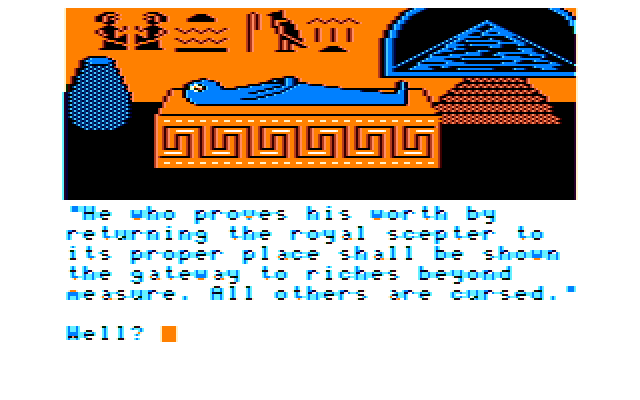
Yet again, the game is fishing for the right word here. Our character is established as an esteemed gentlemen archaeologists, of course he can read hieroglyphics. But for some reason, you need to use the verb TRANSLATE instead to actually read them.
PUT SCEPTER (which normally just drops it in the room) works here special, and you can specify IN MUMMY. The room shakes and opens a crack.
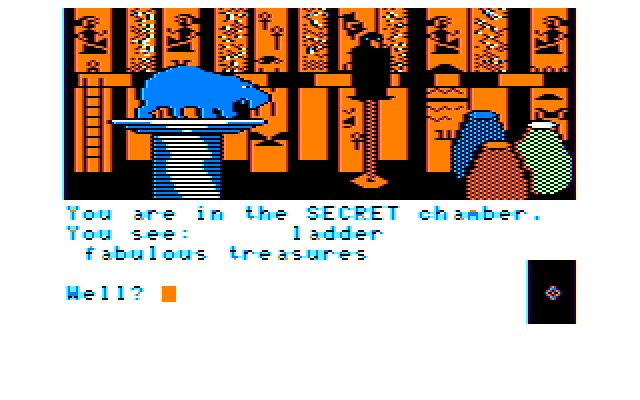
You are told multiple people are needed to take the treasures; the ladder is what you need. You can now backtrack, hopping on the boat, and CLIMB LADDER when the boat passes under the hole in order to get back up top. The physics of this are weird and I was expecting to leave the boat first before somehow getting a ladder inside a hole but I’ve learned to stop asking questions of this game.
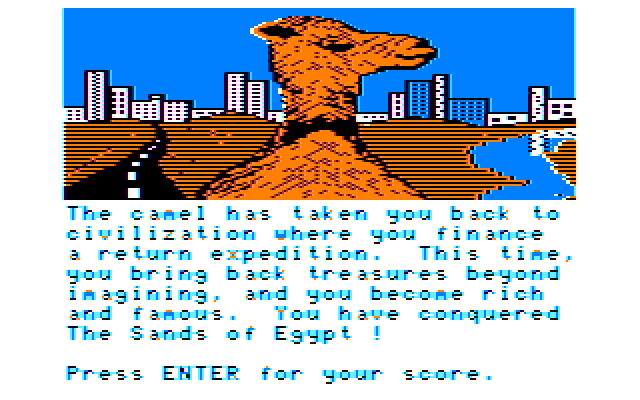
Then it seems like nothing has been accomplished, as you just looped back to the pool, but you can give the camel another ride and this time it goes somewhere different.
Honestly a little galling if you think about it — our selfish main character annoyed his workers but managed to find a treasure hoard and then claim it for the Crown, the British way. I’m a little more appreciative now of how the Infocom ending went instead. (If you don’t know what I’m talking about, you can read Jimmy Maher writing about Infidel, although the ending really is best experienced organically if you plan on playing it.)
I guess both The Sands of Egypt and Infidel have one similarity, in that the authors were unhappy with the result. Berlyn mentioned in an online conference he “hate[s] the game” (that is, Infidel; I enjoyed it but it’ll have to wait until 1983) and in that same interview where Bjork talked about infusing an arcade sensibility into adventures, he said:
My final comment on “The Sands of Egypt” is it could have been a little better.
No expansion. Did he mean the parser, or the plot actions? Both feel a little undercooked — we go underground, we find a treasure, we leave, and the actions are elaborate more because of the opening maze and riddle-verb parser rather than any kind of complex puzzle-solving you might expect in an Egypt-themed game. Compare with Temple of Bast which had an ancient curse that had to be outwitted in two different ways.
I will say the animation is solid. To compare briefly back with the Apple II, I do think it is clear the art was intended for the CoCo and its unique palette. Something about the Apple translation makes it muddier.
The orange along the sides feels “sharper” somehow.
The Apple version isn’t bad, exactly, but it doesn’t seem to be leveraging the strengths of the hardware. The CoCo is being used to make interesting custom “textures” (sometimes animated) which get blurred up a bit even when clearly the same assets are being used.
From Transylvania. Not that different in color scheme, but made more specifically for Apple II.
If you want to compare with Atari, too, Dave Dobson has a playthrough here.
Technically Datasoft has another adventure coming up — one based on the TV show Dallas, from 1984 — but that’s long enough away we can kick the can a bit and think about our immediate lineup. I’ve got a handful of small solo-author games, a C64 game which is a ripoff of an Apple game (as in stolen code that a company pretended was theirs), and then a most curious exploration of what happens when you hybridize an adventure game with a shoot-em-up.
By the title up top, I’m not meaning games with wordplay-based mechanics. Basically this comes down to a suspicion of mine that got confirmed in this game–
In the very early days, 1977-1979, parsers were not as terrible to manipulate as now generally thought. Crowther/Woods Adventure itself had a decent vocabulary and its puzzles did not demand complex combinations of objects that are hard to communicate. The immediate clones went the same route, Scott Adams games had mostly reasonable parsing, the early Greg Hassett games all demanded only simple actions for the player so never diverged into messy-verb territory.
When authors got more ambitious — 1980 — is when the trouble began. Scott Adams starts Savage Island Part II with what may remain the most absurd verb of all time. Authors tried hard to have “difficult” puzzles reliant on things other than magic words and mazes and inventory juggling that required communicating difficult things.
Parser communication started to be such a problem I wondered if there was anyone who thought that guess-the-verb was in fact an essential feature. That the adventure was at least partly a sort of word game, like a real crossword rather than a metaphorical one, and you might intentionally pick a tricky verb over a simple one — never even thinking of synonyms — as part of the game’s challenges, rather than as part of the game’s failures to deliver a transparent UI.
Let’s return to that thought shortly.
So I left off on not being able to drink, having tried DRINK WATER, DRINK CANTEEN, DRINK POOL, and every other combination I could think of. It turns out you just need to DRINK.
Interestingly enough, I still would have been foiled on first finding the pool as the game explains a gentlemen drinks out of a canteen if you try to DRINK. Just cupping your hands is too undignified, I suppose. This is the weird sort of condition that actually works — I love it when the character of the avatar intrudes on the game — and also actually explains why the action doesn’t work, unlike most “wrong actions” in this game.
Having said that, I wasn’t quite done with the canteen puzzle, but I’ll keep to the sequence I discovered things as I was playing. Moving on, I also realized while fiddling I could GO TREE to get closer to one.
The game only lets you climb up with one object in hand.
Keeping in mind the message about the old rope, I tried to get the fronds but was rebuffed. To be fair I didn’t have anything that resembled a tool for that. But I could get the dates and go back down, and try FEED CAMEL with the dates.
The moment where it redirects “GO CAMEL” to another word is unusual but not rare; usually it indicates an author whose code structure makes it hard to have synonyms so they just add a special text message instead. Doing MOUNT CAMEL as requested, I was then able to RIDE CAMEL. However, I couldn’t get off.
I went with HELP, as this does have a contextual help command, and the game asked me
-The opposite of MOUNT is?
The game could have done the same sort of command interception, and then turns the help for finding the right command into a riddle. It appears, as I suspected might be able to happen, the authors considered finding the right word to be an essential part of the gameplay, and not in a word-puzzle game way like Ad Verbum.
This explains how miserable the game is to communicate with otherwise, including the hellish bit in the pool. We’re getting there. Using DISMOUNT on the camel we make it to a pyramid with a carving. Examining the carving reveals a pharoah holding a scepter, that we can refer to separately.
It seems like we ought to be able to take the scepter, and if we try to the game asks HOW? but the game wasn’t understanding what I meant. However, I started to suspect it was “stuck” and what I needed to do was to get the snake oil way back at the north part of the desert over to the pyramid, so I could OIL SCEPTER.
This was trickier to enact than I expected because I realized I had my map wrong: when you get into the pool area, that’s a one way trip. The map doesn’t let you go back. So you have to do everything in the desert before getting to the pool: that’s get the shovel, get the canteen, fill it with the snake oil, nab the torch, nab the magnifier.
You cannot drink the snake oil, so you’re getting thirsty all this time. (When I played before, I took the canteen on a beeline to the pool, figuring I’d go back and dig and get oil as needed later.)
Fortunately, making the entire loop isn’t that tight — I just had to suffer being told I was extra extra extremely thirsty for a few turns — so I was able to move on, and try OIL SCEPTER, then return to the pool to fill my canteen. (Every time you use the canteen, you drop it, so a number of times I rode the camel but forgot to bring back the canteen.)
With the scepter and axe in hand, I took a visit to the top of the palm tree, did CHOP FRONDS to get some, and then tried to make a rope and found … the game was being quite picky again. I had to go check a screenshot to see that the OLD ROPE was specifically made by using BRAIDed fronds. Back to the word-game, this time cued by the game proper rather than the HELP feature. (You could sort of think of it as the correct instructions being encoded in the word, kind of? It feels less gauche than DISMOUNT, at least.)
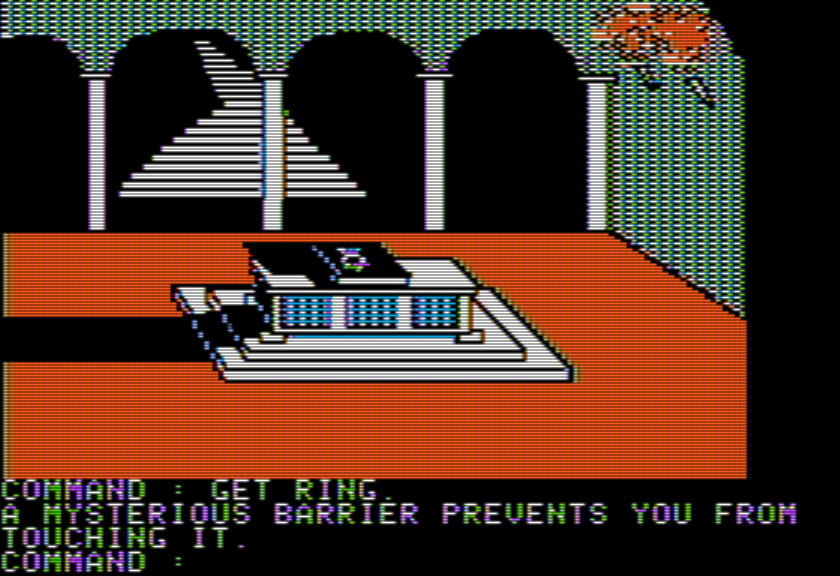
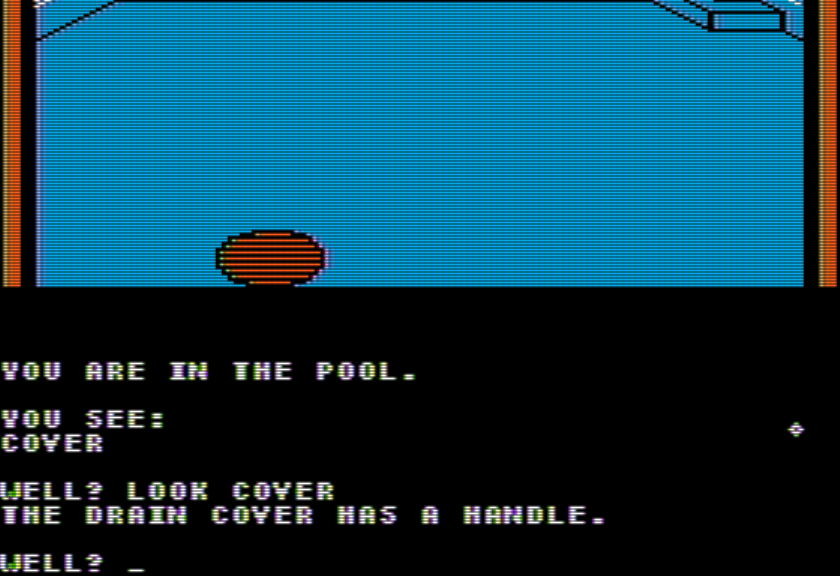
Now, we get to the horrible terrible part. You can GO POOL, and to get out, CLIMB STEPS (as mentioned by 4am). The handle of the cover that we can use to drain the pool is described as a “hook”, and the scepter is also described as a “hook”. Quite obviously the two go together. But how? Switching to Apple just for 4am (and also I switched to Apple now when I got stuck so this is the actual screen I saw):
Wonderful. (Please note the sarcasm you can hear through the screen. OK, you can actually HOOK SCEPTER, but that’s still wild, because you’re really hooking the handle, and that doesn’t work, and yes, I tried HOOK HANDLE first and went wildly in a different direction after for a while.)
You can light the torch with the magnifier, then go in to find a sewer. I’ve made it a smidge farther with yet another outrageous verb but I think I’m close to the end of the game so I’ll save it for next time.
If I went by raw voting (including the people who messaged me outside of the comments) I have had slightly more people ask for Tandy CoCo than Apple II. What ended up happening is
(a.) I went with CoCo, struggled, and got to a point where I was impossibly stuck
(b.) I switched to Apple II to see if anything was different, found only one difference, was still impossibly stuck
Part (b.), other than splitting the baby as Ahab suggested in the comments, is a general strategy I use when stuck on anything (not just solving adventure game puzzles) where I re-attempt the same task with different context to see if anything new pops out. In the case of adventures, there might be different text, but in the absence of that, I might just type commands in a different sequence or happen to find I made a mapping mistake. Potentially, my brain has a new insight just from the slight change in context.
I don’t think my issue is a mapping mistake even though the entire game so far has been a maze. It’s more the parser is putting up a unique struggle, where something in nearly every game so far, even the bad-parser ones, I’d have gotten a response. Just to avoid hiding the lede:
There’s a pool with … water. You don’t think that, given you’ve been repeating emphatically that the player is thirsty, that they might try to drink it? Or if they have a canteen they fill with water from the pool in case there’s some weird quirk there, that they might to drink out of that?
This adventure has an extensive vocabulary. It may take some experimentation to discover the correct command to use in certain situations.
Thanks, manual. Anyway, to rewind:
We start in what looks like an open desert. It is not an open desert. It is a fairly finicky maze. This was non-trivial to get over — I’m used to desert mazes always having some open-grid sense to them even if they get maze-like on the edges (like the trackless desert in Adventure Quest).
You don’t have any items to start — there’s one just north that you can dig up but you don’t start with a shovel — and the map is oriented so that many of the exits return you to the start room. I got through by testing out “let’s try going repeatedly E, reset, go repeatedly S, reset, etc.” and found there was a new room by going north three times.
I tried constructing a map from there, realizing that I was likely in a single column, and answering the question “how many steps north to reach the new room?” would tell me where I was at any moment.
(You might remember in my Apple II animated shot I had a shovel. I got that randomly when trying to get a good GIF file and couldn’t re-create my steps. At least it let me know the solution was purely wander-based. This is another manifestation of the “play in a different context to break something” method.)
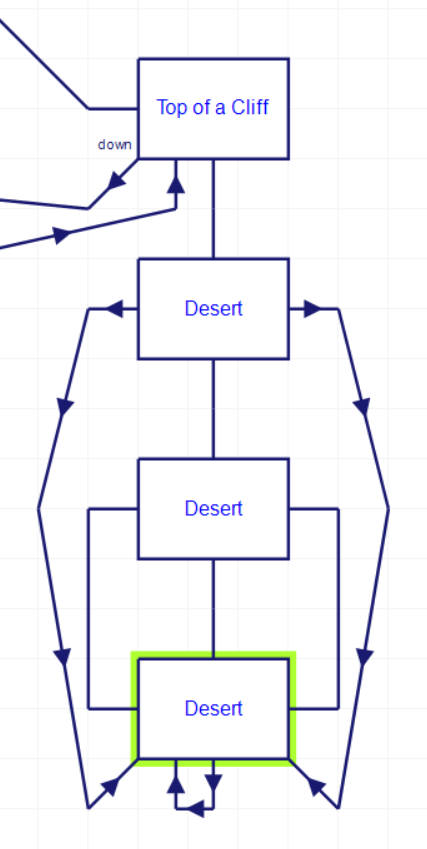
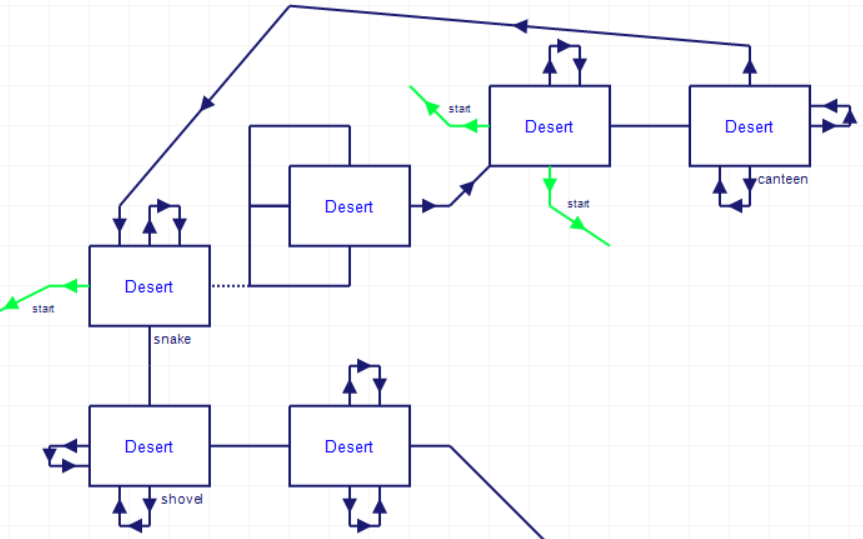
The “down” and “west” exits lead to two different branches of desert. I started with the down branch in my gameplay but the west branch is the more useful one sequentially, so let’s go that way first.
The green exits go back to the starting room.
This specifically leads to the previously seen shovel, which means you can start using to help map out rooms. And of course, digging — digging everywhere. An Egypt-archaeology-desert is the one case I don’t feel weird about that, and even marking every room as I make sure to type DIG in it to find a new item. Ludic gameplay matching the story environment. For example, just north of the starting room there is a torch, but since I’m not in any dark places yet, I can’t use it (although it can help with the mapping).
The one non-visual difference between the Apple and CoCo versions I mentioned is that “you are thirsty” messages start triggering earlier on the CoCo.
North of the shovel is a snake. You can HIT SNAKE / WITH SHOVEL and it turns into snake oil. A bit east you can find a canteen, and fill it with the snake oil, but I haven’t found a use for it.
Taking the other branch in the desert:
At the “base of a cliff” area you can dig up a “magnifier” (50-50 on if it gets used to set fires or used to study tiny hieroglyphs) and find an “old rope”, but taking the rope causes it to fall apart.
Finally you can loop round to the accursed pool, which I’ll show off again, this time in Apple II format.
Leaving aside the impossibility of drinking the water, you can dive in to find a cover, described as having a handle.
Yes, more parser trouble. I’m almost willing to accept the cover needs a tool hence the parser not being helpful and saying “it’s stuck beyond your ability to move with your own strength” but who would code a game with a thirst daemon and not expect the player to drink the first water they see? Argh!
One thing I haven’t done yet is make my verb table, but I was trying to approach this game like a “normal player” first, since it isn’t like most people are going to have a list of words accumulated over 10+ years in order to play. I can’t imagine people in 1982 were too pleased about the situation.
(Oh, did I mention I still don’t know what command to use to get out of the pool? “Some experimentation” to communicate. Right.)
The year is 1893 and you are the aristocratic British explorer, Sir Percy. Life as a great explorer has its excitement of recovering precious gems and gold trinkets, but currently you are hopelessly lost in the middle of nothing but sand. You will need to avoid dangerous snakes and cliffs, and find water before dying of thirst.
Before embarking on today’s game, a more general question: how does historical context help us decide why certain games are designed the way they are?
The most obvious and common thing to look at is influences. Games with authors looking at Crowther/Woods Adventure copied specific elements, especially if that was the only game they had as a model. PLATO Adventure was an amalgam of both Adventure and Zork. The authors of Warp specifically wanted to outdo Zork and came up with a unique macro system. Some of the early home computer authors had exposure to Scott Adams but not Crowther/Woods, and the look of their games was influenced accordingly. Escape From Rungistan was written with Wizard and the Princess and Indiana Jones in mind. Japanese authors had Omotesando and Mystery House to look at, leading to Diamond Adventure being a combination of both.
Another element to consider is the technical conditions: what limitations did platforms, tools, and their own coding skills put on authors? The mainframe platform and modular programming made it easy to expand Crowther/Woods Adventure, or even make a brand new game treating the base code as an “engine”. Some early authors have games solely with or almost solely with exploration because they didn’t have the technical capability to be more complex. Bruce Robinson’s even-more-minimalist-than-minimalism style came from working with the unexpanded VIC-20 memory.
More subtly, we can look at motivations. Roberta Williams talked about the fascination of entering a world, wanting one that went on endlessly, which explains the size of Time Zone. Robert Lafore mentioned an interest in “using computers for literature” so had his free-typing system which encouraged the player to use punctuation like they were adding to a story. Roger Schrag cared about the intellectual challenge of coding so devised an elaborate first-person graphical view.
Alternately, we can look at environmental circumstances, or relatedly, financing. The college games (like Battlestar or Haunt) were designed while the students were around for an entire school year, using school resources, so they could afford to be large and sprawling and also include sexuality in a way commercial games couldn’t. The author to Transylvania had a game already done and was given nearly an entire year to work on art. The Mask of the Sun was made in a business with a professional framework where there wasn’t just an artist, but a team backing the artist.
The first three (influences, technical conditions, motivations) are nearly guaranteed to have some sort of effect; the last one (environment) is a little more up in the air. Imagine a 1982 UK coder who is writing an adventure from their house vs. the same coder in a parallel universe at the back of a computer store producing an adventure they know is for money. Will the game necessarily come out different? In this era it’s not like “beta testing” or checking for typos is guaranteed.
All this brings us to the unusual conditions behind Datasoft, 1980-1989, which mostly cranked out arcade games in the early 1980s, and where there’s a moderate chance their initial funding was via crime. Do either or both of these things affect the adventure game they produced in 1982?
Via the CoCopedia.
Let’s start with the crime, tracing specifically to the late 70s when companies were wanting computer chips with ever-increasing demand, and companies could not produce enough of them. Hence: an underground market.
In one business letter discovered at Space Age Metals, a Republic vice president told a Space Age official that he was amazed at the quantity and price of this product that was being offered, given their scarcity in the marketplace, but that he wanted to close the deal and was not stupid enough to ask any dumb questions.
Specifically, this regards the 32-bit Eprom (“erasable programmable”), the Intel model 2732. Demand was enormous, and Siemens in West Germany, despite being a valuable customer, could only obtain 1000 of the chips a month.
Enter Jack Jackson, previously involved in less high-profile crime like bad checks and burglary, now in Silicon Valley circa 1979 working in “remarketed” devices. Most of the chip theft (90% according to Jackson) was done in the shipping process, but one particular job involved stealing directly from Intel’s manufacturing facility.
Jackson arranged with an inside man to have Intel make 10,000 extra of the chips, and have them erased from the records. The next step was to steal the new chips outright. There was 24-hour security, an alarm system, and closed-circuit television to deal with, so Jackson had a security guard, Albert Williams, nab the chips away using garbage bags and the liner of his leather jacket. These were then sold to Siemens for enormous profit. Jackson admits to getting cardboard boxes with $350,000 or $400,000 or more (but hard to say exactly, as no records were kept).
There couldn’t be a direct route from the theft to Siemens, so there was laundering:
Via Computerworld, 7 Sep 1981.
The chips first went through Jackson’s own distribution company, Dyno Electronics, over to a metal reclaimer named Space Age Metals. From there they went to two separate companies, Mormac Technology and Republic Electronics, before finally going to a distributor in West Germany and finally Siemens.
The way the whole arrangement was got, incidentally, was glorious. Siemens, not paying attention to what was legit and what was from the “grey market”, had complained to Intel about faulty chips; Intel soon realized after what had happened.
One of the people in the chain, of the consulting form Mormac Technology, was Pat Ketchum, founder of Data Soft.
He faced serious indictments himself, but the don’t-ask-questions method was sufficient for cover and prosecutors weren’t able to bring a case. Jackson tried to finger in particular a colleague of Ketchum’s, Terry Koosed, as having Mafia involvement, and having an operation on a 150-foot yacht to put counterfeit marks on the chips, but investigators turned up no evidence of such a ship existing and Jackson’s credibility was not high. Ketchum himself was accused by Jackson of selling some of the chips to middlemen who then traded on to the Soviet Union; again, keep some skepticism as this is based solely on Jackson, who already had racked up a fraud conviction even before going into the stolen chips market.
Actually, I was involved with a very successful distribution company called Unidata Investments. In 1980 Terry Koosed, Bill Morgan, and I tried to buy a software company, but Hayden Publishing ended up with it. We got so excited about what we learned, however, that we knew we wanted to be in this business. We were already into computer hardware with California Computer Systems. We were already into retailing and mail order with H.W. Computers. And we were already into integrated circuits. So at Unidata we had all the ingredients to diversify, and it was my task to organize the new software company DataSoft. We incorporated on June 12, 1980.
Terry Koosed, remember, was the second person indicted at Ketchum’s link in the chain. This feels a little like dirty money funding a more legit spin-off, or maybe ask-no-questions money. Either way, they focused mainly on arcade games, with a mixture of Tandy CoCo, Atari 400/800, and TRS-80 games. Two high sellers were Popcorn! in 1981 for the Tandy CoCo and Zaxxon in 1983 for the same machine, both written by Steve Bjork.
Bjork, one of the authors on Sands of Egypt, claimed that it was “the most costly” project Datasoft had done up to then, and took five months of work, between himself (direction) Ralph Burris (special effects) and James Garon (story). The interview neglects the mention of Frank Cohen, who is credited on the box as “Screen Play” — that is, he did the writing.
Arcade games also sell better because of impulse buying, the graphics, clever sounds and eye-catching title screens. “The Sands of Egypt” is a mixture of the graphics of an arcade game and the challenge of an Adventure.
So, returning to that question of if the environment this game was made in was relevant to the design, I would say at least the “arcade” identification is important: this was described by Bjork himself as infusing the arcade look into an adventure game.
The Tandy CoCo version of the game came first, followed by a Atari port (also in 1982) and finally an Apple version (in 1983). I tried all three of them. Here’s some of the animation from each.
The scrolling (with a background layer moving independently) is a standard arcade effect but not one we’ve seen yet with adventure graphics. The scrolling doesn’t entirely make sense. East and west causing the scroll to go right and left, sure, but north and south also have the same type of scroll, so it appears that south and west are going the same direction even when they aren’t.
The Apple II version does not have animated clouds, but rather puts an animated sandstorm front and center with the sky holding still. The port was by an entirely different person (Brian Mountford) who either decided the sandstorm was more realistic, or that the scrolling was hard to pull off with Apple II graphics.
At the very top of this post I referenced the plot: we’re a “gentlemen archaeologist” from the late 19th century who was trying to lead a dig in Egypt but was abandoned alone. If that sounds to you a bit like Infocom’s later game Infidel, yes it does, and it even keeps having a letter in the packaging which makes clear the main character is a bit of a jerk.
Being the author of nineteen critically acclaimed etiquette books, I was diligent in trying to teach the others proper digging methods and the proper way to keep their khakis starched.
Will it have the same type of Infocom ending? We’ll find out this week, I suppose. But first I need to decide: which version should I play? I won’t open this up to a formal vote, but you’re welcome to try to persuade me in the comments. The game is supposedly short enough I can probably do a replay on a different platform after winning anyway (akin to Rungistan).












 Renga in Blue