(Assuming you can see video embeds, above is the trailer for Play Misty for Me, a 1971 movie with Clint Eastwood that seems to be the rough predecessor of KAXL.)
In my last post Rob sleuthed out another piece of information on The Case at KAXL that seems worth mentioning. This will be a short post but maybe it will help the actual Doug Rogers (out of the 20 or so I have looked at) find this page via a Google search one day.
First, the game states it is Copyright 1982 by Doug Rogers on the title screen of the GW-BASIC version. Since GW-BASIC wasn’t invented yet, we know it has to be a port; the file itself has a preserved timestamp of 1986-04-18, so it was made (or at least the last version was saved) in April of 1986.
I strongly suspected the original source was TRS-80 because of the odd case glitches. Look at this screen:
Notice how “sign” and “keys” are in lower case but the other objects start with an upper case letter. This suggests this was written on a computer which didn’t account for case. With TRS-80 in particular we’ve seen glitches where someone developed on a TRS-80 without case but then an oddity occurs when the same game gets moved to a later model that does have case. (That is, even when the display isn’t showing case, that still gets stored as data.)
The display is also wide, suggesting more than 40 columns, that is, not an Apple II (you could turn the classic Apple II into 80 column mode but the card that enabled that also put in lower-case mode letters).
However, this is still hand-wavy explanation, and the real evidence came from the fact it was later published for TRS-80, Model 4. All the way out in 1993 (!) but still:
TRSTimes was launched in 1986 when Lance Wolstrup had found out that 80 Micro no longer was going to cover the TRS-80, and lasted all the way to 1995.
Therefore, it is with some sadness that I declare this to be the very last issue of TRSTimes. I hope that our readers have benefitted from reading our publication. My appreciation goes out to all the many people who, over the years, shared their knowledge with us, especially my good friend, Roy Beck, without those articles TRSTimes would not have lasted past the first year.
Goodbye … and thanks.
The printing of KAXL ripped out the copyright date, no doubt it seeming awkward to publish a game 11 years after it was written. The presence of the new piece of information led me down the road of more Doug Rogers but unfortunately nothing has panned out.
This long lag time isn’t that odd for the TRS-80 community. Moreso than, say, the Apple II, they had a tradition of amateurism and retaining source code, and even now the major archive maintains a heavy amount of personal source code, and the proprietor (Ira Goldklang) will even rip your old disks and keep them private just for preservation purposes.
In order to keep a TRS-80 publication going all the way to 1995 a little amount of pulling out of the archives seems to be necessary.
Anyway, to compensate for such a short post, let me mention what’s coming ahead: two “short” games, followed by an Apple II game which I consider one of the most important for 1982 and I have been looking forward to reaching for a long time.
There is a real KAXL radio station. It services the Bakersfield, California area with a Christian contemporary format.
This game has nothing to do with the real station, but I just wanted to clear that up; because of how radio station names work we can say the fictional version is somewhere on the western half of the United States (since it starts with “K”, starting with “W” would indicate stations on the eastern half).
This game is otherwise utterly mysterious. There’s an Internet Archive page for it but it isn’t listed (as of this writing) in any of my sources. It is in GW-BASIC format for DOS, copyrighted 1982 by Doug Rogers. Was it written in that format? Probably not. GW-BASIC first appeared in 1983. In 1982 DOS is just rare overall; the only DOS-developed game we’ve seen so far is The Hermit’s Secret. There’s also textual irregularities which suggest to me a port from another platform.
Nevermind. At least the premise is interesting. You get a panicked call from a radio station and need to investigate. No specific goal immediately given. Was it corporate espionage? Murder? Zombies?
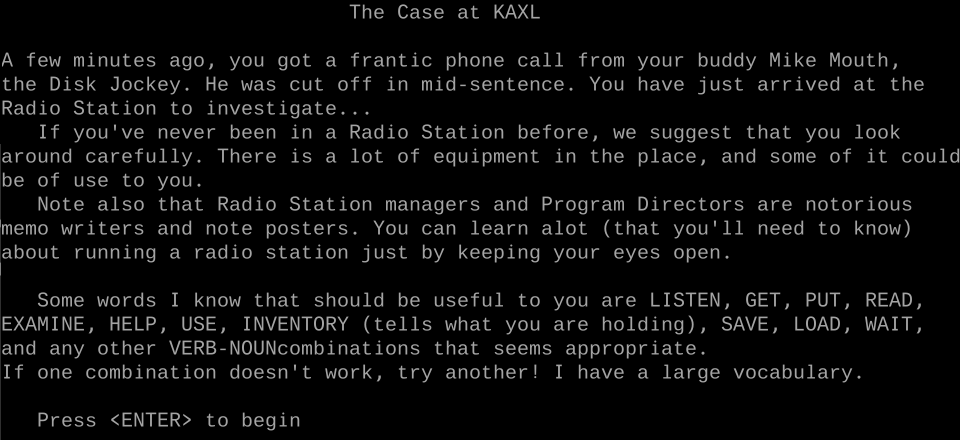
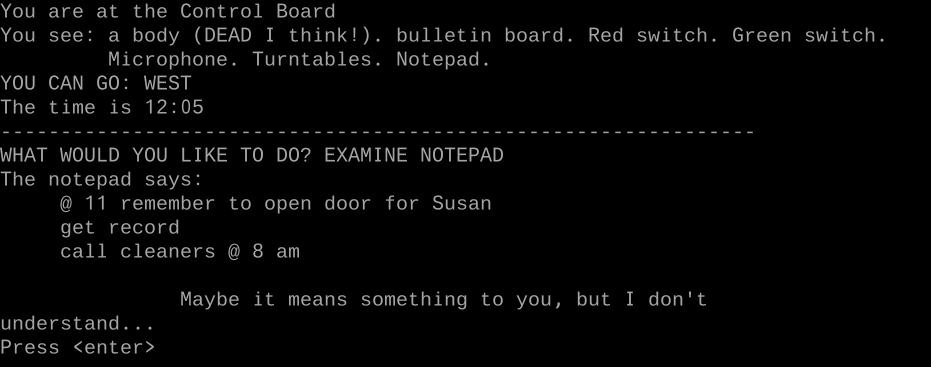
The details about “If you’ve never been in a radio station before” and casually mentioning “Radio Station managers and Program directors are notorious memo writers” strikes me that the author, at least, has/had radio station experience. In fact, this feels like a My Office Game, cousin to the My Home Game, filled with details that aren’t really part of the game proper but are part of a real radio station.
The map structure is fairly simple; there’s a main hallway I have shaded in color above with branches. No rooms are locked off except the one at the very back, and for that room there’s keys just sitting on the desk of the first room, because given the story scenario, there would be keys laying about in the first room. So the design is from the end of verisimilitude, while inserting a story scenario.
You arrive at the station at midnight to find the front door strangely unlocked.
The entire game involves exploring the different rooms of the radio station and looking at things. According to the ratings book in the office, the station is currently number 1 on the charts. The station ID recorder is broken (announcing the name of the station, as is required) so it has to be entered in manually at the hour. There’s a large studio with microphones and an old piano.
The open map means it can take a while to make the main discovery, the dead body of Mike, the one who called us on the phone.
The game isn’t clear from here but the idea is to gather clues as to what happened. You keep in them in inventory akin to getting items in a standard Treasure Hunt.
Items include a broken record (“MISTY”), lipstick, a lovenote (between Mike and a “Susan”, the same one that got let in the studio late), a cigarette (there’s also randomly the faint smell of smoke), and a transmitter log.
Once you collect enough information, you can go to the phone at the front desk and USE it. You’ll be prompted who to call; you can call the POLICE.
If you have enough evidence gathered, the police will ask you to help them locate where the murderer might be happening. When I played, I had already gotten stabbed so I knew where to go.
As a game, this was pretty easy and slight. The only challenge I had was realizing the premise in the first place (gathering evidence then calling police).
Just scenery.
As a conceptual premise it was unusual, though; even our “easy” games have generally had arbitrarily map layout meant as service to the game’s puzzles. Here, there’s a radio tower out back for no reason other than that’s what should be there, and the door there is locked only because, logically speaking in the real world, that door would normally be locked. Not because there was a puzzle that demanded a key.








 Renga in Blue